Showing posts with label Vinod Khanna. Show all posts
Showing posts with label Vinod Khanna. Show all posts
Anil Kapoor is responsible for convincing me to become a part of films-Dia Mirza
8:46 AM

Akash Bhatnagar (HINDUSTAN TIMES; July 18, 2026)
For Dia Mirza Rekhi, 2026 is a special year. She marks 25 years as an actor, and was seen in Ikka with Sunny Deol and Akshaye Khanna and opposite Anil Kapoor in Alpha. She also has web series Operation Safed Sagar in the offing.
And it all started thanks to her co-star. “AK (Anil) is responsible for convincing me to become a part of films,” the 44-year-old reveals, adding, “He met me right after my Asia Pacific pageant (in 2000). He and Anupam Kher were very keen that I do the film that they were working on, and they were the ones who helped me get my first film.”
For Dia, starring opposite Anil “felt like a beautiful full circle moment”: “The first time I met him in the lobby of a hotel in Hyderabad, he had told me, “You have so much grace, you would be so beautiful on screen, you must become an actor’.”
Dia is also all praise for Sunny and Akshaye. “I’ve done some films with Akshaye’s father (late veteran Vinod Khanna) and we shared a very special bond, and I’ve known Rahul (Khanna, Akshaye’s brother). I’d actually approached Akshaye to act in a film that I was producing, but that didn’t work out. So, it was cool to finally work with him,” she shares.
Their film also featured a scene of her slapping Akshaye. “I was terrified, and then Sunny sir was quick to jump in and say, ‘Listen, you’re playing my wife, so you shouldn’t be scared’. And I was like, ‘Have you seen Khanna sa’ab’s fan following?’” she laughs, adding, “It’s only in the last eight years that I have been appreciated and my films have done ridiculously well at the box office. The last 25 years have been preparation for what is to come.”
Singer-actor Sulakshana Pandit passes away at 71
9:36 AM

Avijit Ghosh (THE TIMES OF INDIA; November 7, 2025)
Sulakshana Pandit, who sparked to prominence as a singer-actor in the 1970s and whose promising career was cut short by a string of unfortunate events, passed away following a heart attack at Mumbai's Nanavati Hospital on Thursday. She was 71.
Sulakshana Pandit was only 13 when first noticed in 'Saat samundar paar se' (film: Taqdeer, 1967), a duet she sang with the peerless Lata Mangeshkar. Another memorable track, 'Beqarar dil tu gaaye ja (film: Door Ka Rahi)' with Kishore Kumar further underlined her precocious talent.
But in the mid-seventies, producers also noticed her leading lady looks. Over the next decade or so, Sulakshna became a prominent singing star in Hindi cinema. During this period, she was paired opposite top heroes of the time - Sanjeev Kumar (Uljhan, Waqt Ki Deewar), Rishi Kapoor (Raaja), Jeetendra (Sankoch, Apnapan, Dharam Kanta), Rajesh Khanna (Bundalbaaz), Vinod Khanna (Hera Pheri) and Shashi Kapoor (Phansi), among others.
Singing was her core competence though. In some films she acted in, Sulakshana rendered a song or two. But in a field dominated by established singers, it wasn't easy to make major headway. However, Sulakshana showcased her capabilities with her soaring rendition, 'Tu hi sagar hai tu hi kinara' (film: Sankalp, music director: Khayyam). The composition maximized the inherent sweetness of her voice and displayed her mastery over the high notes. It also earned her the Filmfare award for the best female singer. 'Bandhi re kahe preet' (film: Sankoch), which was also filmed on her, and 'Khali pyaala ujla darpan' (film: Sparsh), a masterclass melody by the minimalist composer Kanu Roy, are some of her other classics. Sulakshna came from a family of musicians. Jatin-Lalit, the composer duo, are her brothers. Her actor-singer sister, Vijeta, played the female lead in the superhit, Love Story.
Muzaffar Ali’s unreleased film Zooni to be restored
10:23 AM

Niharika Lal (BOMBAY TIMES; January 11, 2024)
Muzaffar Ali’s unreleased film Zooni (1988), starring Dimple Kapadia and Vinod Khanna, which revolves around the 16th-century Kashmiri poet Habba Khatoon, is set to be restored by the Film Heritage Foundation. Due to financial constraints and various other reasons, the film was halted midway in 1988.
'Muzaffar Ali has entrusted the script, reels of the film to the FHF'
Shivendra Singh Dungarpur, director FHF says, "I received a call from Muzaffar Ali last year, and he mentioned that he has two reel cans of Zooni, which could assist us in saving and digitizing the film. These films are in a severely deteriorated condition. We also received photos and the script of the film."
Whenever Muzaffar Ali shoots, he always has a photographer who captures the people and environment so that he can integrate those shots in the film. These stills will help in restoration of the film. Due to financial constraints and various reasons the film was halted midway in 1988.
I hope the essence of the film will emerge from restoration: Muzaffar Ali
Muzaffar Ali says, "I have great hope and expectations for Zooni. It was lying in the lab, and the lab didn't know what to do with it. As they were closing the celluloid section, we took the negatives and gave them to Shivendra, who has been meticulously working on film restoration. I think it's a wonderful job that FHF is doing, and that alone gives us hope. I can only say - ummeed ki tooti hui deewar se lag kar sau baar jo socha tha wohi soch raha hoon."
He adds,"I am quite impressed and amazed at what they are doing. I hope something beautiful will emerge, maybe not the real film but the essence and passion behind the film."

With Akshaye Khanna, you’re assured of good conversations-Tabu
8:17 AM
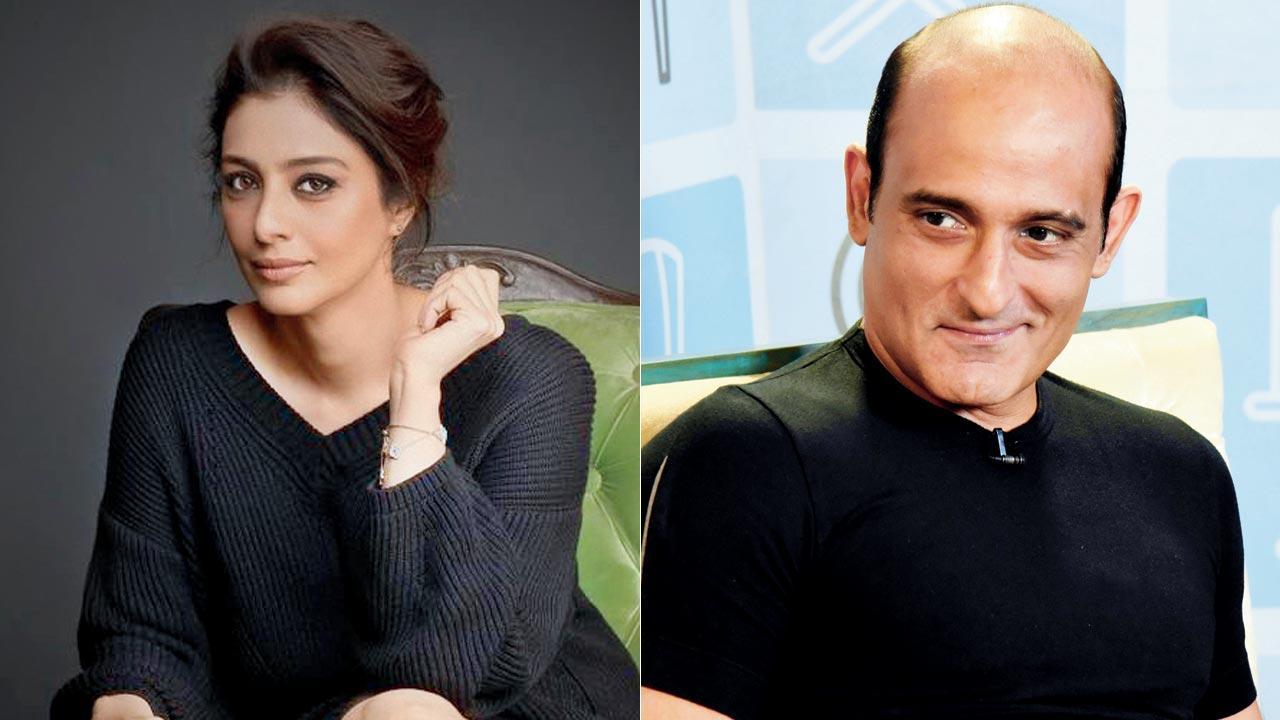
Tabu elated to share screen space with Akshaye as he joins the cast of Drishyam 2
Uma Ramasubramanian (MID-DAY; June 10, 2022)
For Tabu, it’s back-to-back sequels with Bhool Bhulaiyaa 2 and Drishyam 2. While she was a new entrant in the second instalment of the Bhool Bhulaiyaa franchise, Drishyam (2015) is a project she has been associated with right from the inception. The actor, who shot the latest schedule of the crime thriller in Mumbai, says returning to a sequel is comforting.
“It’s fantastic to go back to a sequel because you are inhabiting the world again. You know the story so well that it feels like an extension of your [world]. We shot in my college, St Xavier’s,” she smiles.
The first edition saw Tabu’s cop character Meera in a face-off with Ajay Devgn’s Vijay Salgaonkar as she suspects him of killing her son. Drishyam 2, an adaptation of Mohanlal’s 2021 Malayalam film of the same name, will see Devgn and Tabu in a cat-and-mouse game again as she tries to poke holes in his alibi. What makes Abhishek Pathak’s directorial venture more exciting is that Akshaye Khanna has joined the cast.
“I am so happy we have him on board,” she says, elated to share screen space with him. “Akshaye is a brilliant actor, and spontaneous as a person. With him, you can be assured of good company and good conversations. My sister [Farah] has worked with him and his father [Vinod Khanna]. Now, I am working with him. Ajay and he have the most important roles in Drishyam 2.”
Tiger Shroff had to get out of his dad’s shadow. Thankfully, he has carved his own image-Jackie Shroff
8:10 AM

Renuka Vyavahare (BOMBAY TIMES; March 3, 2022)
Jackie Shroff is known to speak straight from the heart. He isn’t diplomatic and has no qualms about sharing his opinion. In a previous interview with Bombay Times, when asked about his son Tiger, he said, “I was unkempt, but so is Tiger. You will always find him in sweatshirts and track pants. He is essentially an out and out sports person — football, basketball, hockey, skating, cycling — he’s into that. That’s him. He’s an actor after that.”
Speaking of the young actor being compared to his father, he added, “It’s tough for him. His father is an actor, so there will be constant comparisons. My father was an astrologer, so people had no expectations from me. Of course, it wasn’t easy for me either. In the 80s, we had Amitabh Bachchan sahab, Vinod Khanna and Dharmendra, so I was lucky that I was even accepted and I hit the jackpot right in my first film, Hero (1983). Mere 220 films ka vazan hai uske sar pe. Tiger had to get out of his dad’s shadow. Thankfully, he has carved his own image and path in the industry, which is nothing like mine. His dance, action, style is totally different.”
Talking about his son, he further adds, “Like me, Tiger has been lucky, too. More cinema halls have opened now. There are web series, so there are more opportunities for actors.”
For the character of a billionaire in Heropanti 2, I tried to ape Vinod Khanna’s walk-Nawazuddin Siddiqui
7:56 AM
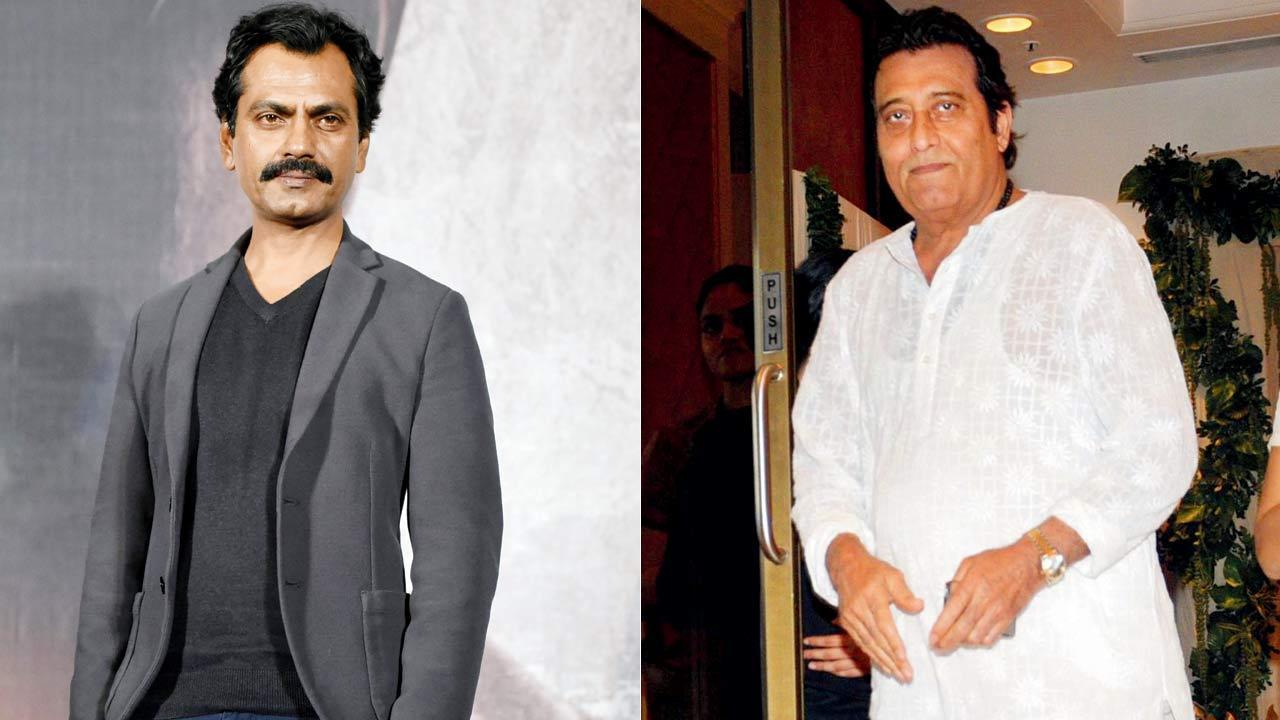
From changing his gait for billionaire act in Heropanti 2 to picking up salsa, Nawaz on enjoying being part of mainstream movies
Uma Ramasubramanian (MID-DAY; December 22, 2021)
Salsa isn’t the first thing you associate with Nawazuddin Siddiqui. But trying his hand at new things is a classic trait of the actor. So, while he is giving romantic stories a go with Tiku Weds Sheru, he has also picked up a move or two for a dance number in Kangana Ranaut’s production. “The choreographer made me do salsa and some more dance [styles]. The [team] gauged that I [understand] rhythm, so they made me practice before I faced the camera. They were more confident about my skills than I was,” laughs Siddiqui, who was recently nominated at the International Emmy Awards.
After lying low in 2021, the actor will be seen in several films in the coming year, including Heropanti 2, Jogira Sara Ra Ra and Bole Chudiyan. It is interesting to note how he is consciously choosing movies that are completely at odds with the dark films he is known for. Siddiqui says he is enjoying mainstream offerings like Heropanti 2, where he will be seen playing a billionaire.
“In mainstream films, I don’t know why people always look at me through a different lens. In art films, people look at me as a common man, while commercial filmmakers make me look rich. It’s all a matter of perception.”
Not surprisingly, the actor is bringing his own quirk to the role in the Tiger Shroff-starrer. “For the character of a billionaire, I tried to ape Vinod Khanna’s walk. I personally adored his walking style. I had worked with him on a TV serial years ago, but unfortunately, it was never released. I tried to capture his [gait], while exaggerating it a little.”
He views mainstream projects — from romantic dramas to actioners — as his attempt to step out of his comfort zone. “For me, even romantic films are an experiment because I have never done them before. In the midst of hardcore cinema, if I get to do a romantic film, I feel good as an actor.”
I was the only one who turned up at my interview with Vinod Khanna with my father-Anjala Zaveri
8:11 AM

For Anjala Zaveri, acting was never part of the plan, as her parents weren’t keen on her having a career in films
Rishabh Suri (HINDUSTAN TIMES; October 12, 2021)
She had to compete for her first role, literally! Anjala Zaveri being cast opposite actor Akshaye Khanna in Himalay Putra (1997), their debut film, was the result of a talent hunt across countries, in search of a fresh face.
Born and raised in England, the actor, who belongs to a conservative Gujarati family, has always been mesmerised by the glitz and glam of showbiz. “We’ve watched a lot of films on video cassettes bought from a small Pakistani shop. The world of cinema was always intriguing,” says the 49-year-old, who was spotted by Vinod Khanna when she was 16. The late actor was in search of a female artiste in England to cast opposite his son, Akshaye.
At that point, Zaveri was an aspiring model, and hence, had got a photoshoot done. But, she didn’t have the height required to be a runway model, and instead, sent her pictures to Khanna. “I landed my first interview with him. Some 16-17 models had turned up, I was the only one with my father! I was so nervous during the interview that I kept my mouth shut! It was a 10-day competition... I handed over some more pictures, and later, got a callback from Vinod Khanna, saying ‘Please get Anjala’s passport ready, we are taking her to India’. Within a month or two, I left. My mum came with me,” she recalls.
However, her family wasn’t too keen on her joining films. “Even if I was going to be chaperoned by a parent, they had preconceived notions in their head,” she reveals.
Soon after Himalay Putra released, she got busy with Tamil and Telugu films, as a result of which Hindi projects took a backseat. “After Himalay Putra, I went home for a two-month break. When I returned to India, I got signed on for Tamil and Telugu films. Majority of my time was in Hyderabad and Chennai, and Hindi films happened in the middle of that,” says the actor, who has also starred in Betaabi (1997) as well as Pyaar Kiya To Darna Kya (1998).
Zaveri is married to actor Tarun Raj Arora, best known for playing Anshuman in Jab We Met (2007). And, offers have again started coming her way, given that her husband is in the limelight. “He did a few Hindi films, took a step back and got into hospitality. I don’t know if it is luck, but he is also doing South films now! Offers have started coming to me too, but not very exciting,” she says.

Anjala Zaveri with Kajol in a still from Pyaar Kiya To Darna Kya (1998)
My debut was a mistake. I looked completely ungroomed-Shadaab Khan
8:19 AM

Since entering showbiz as a star kid, Shadaab Khan has had quite a journey of hits and misses over the years
Sugandha Rawal (HINDUSTAN TIMES; October 8, 2021)
When you’re the son or daughter of Amjad Khan, the actor who played the iconic villain Gabbar in Sholay (1975), then trying to follow his footsteps might seem like a no-brainer. And, that’s exactly what his son Shadaab Khan had in mind when he made his Bollywood debut in 1997 with Raja Ki Aayegi Baraat. However, after a string of failures, he vanished from the industry for a while, only to make a comeback in 2019 with Romeo Akbar Walter.
Looking back, he admits that his debut film was his “biggest mistake”, which had a ripple effect on his career. “I shouldn’t have made my debut with Raja Ki... I was too young. Before my debut, I weighed about 145 kg, and lost all that weight for that film. But that reflected on my face, too. I looked too pinched, scrawny, raw and completely ungroomed. My debut was a mistake from my side. It was nobody’s fault,” Khan tells us.
It was the death of his father, which led to his foray in the film industry, as he wanted to take forward his legacy. “It was only after my father passed away that I understood the true meaning of the song, Don’t Let The Sun Go Down On Me by Elton John and George Michael, which he kept humming,” shares Khan, adding, “At that time, I didn’t want to study. I just wanted to come into this business somehow. After losing my weight, I got featured in a magazine, which caught the attention of (late actor) Vinod Khanna and he wanted to launch me with Himalay Putra (1997), which didn’t work out. But after that I got my debut film.”
His career is marked by films such as Hey Ram (2000), Refugee (2000), Bharat Bhagya Vidhata (2002) and Highway 203 (2007), all of which failed to garner good response. “Somewhere along the line, I started thinking that this isn’t the right profession for me. I felt I was too young, and that’s why I stepped away from showbiz. For about 17 years, I had completely left acting. I had again gained weight, and went back to almost 135 kgs. I started writing novels,” the 48-year-old reveals.
It was in 2017 when Khan shed those extra kilos, and decided to give his acting career a second chance. And then Romeo Akbar Walter happened in 2019. “Just before the shoot, I got third-degree burns on my stomach and chest due to some incident, and doctors told me to rest. But I couldn’t afford to lose that film as I wanted to come back so badly. I took painkillers and shot the film,” recalls the actor, who also made a brief appearance as Ajay Kedia in Scam 1992: The Harshad Mehta Story.
The actor, who has multiple auditions and projects lined up, shuns the conception that star kids have it easy. Khan shares, “When your parents are around in the business, then you have all the right people in your corner. [But] when they aren’t there, you’re worse off than the outsiders. I’m on my own completely.”

I have tried to replicate Vinod Khanna’s walk in Heropanti 2, unka ek alag hi swag tha-Nawazuddin Siddiqui
8:21 AM

Renuka Vyavahare (BOMBAY TIMES; September 29, 2021)
“No one walked the way Vinod Khanna did,” said Amitabh Bachchan in an emotional blog after the actor passed away in 2017. Khanna had an aura that was unmatched and he was particularly known for his ‘panther walk’. A version of his iconic walk has been borrowed by actor Nawazuddin Siddiqui for his character in Heropanti 2. Nawaz often infuses quirks and traits of people around him in the characters he plays on screen. This time around, he has sought inspiration from the dashing Vinod Khanna.
Nawaz spoke to us from London, where he is shooting for Heropanti 2 with Tiger Shroff, which is being directed by Ahmed Khan. While the actor stayed tight-lipped about his character in the film, he shared an interesting detail. “I observe interesting people a lot aur woh dimaag mein reh jaata hai,” he said, adding, “For instance, the energy is slightly different, but I have tried to replicate Vinod Khanna’s walk in Heropanti 2. I loved him as an actor and also his persona and style. Unka ek alag hi swag tha. His walk had a slight feminine grace. Usi movement ko maine exaggerate kiya hai. Ahmed bhai and I discussed it and decided to go ahead with it.”
On the work front, Nawaz is also excited about his film No Land’s Man getting global recognition. The film, helmed by Bangladeshi director Mostofa Sarwar Farooki, deals with hate crime and discrimination. It has been shortlisted to compete for the prestigious Kim Jiseok Award at the upcoming 26th Busan International Film Festival.
Talking about the film, the actor says, “Main kaun hoon and where do I belong is a relevant question today. We are territorial. Nature ne aapko ek planet diya. Insaan ne apni apni jagah bana di. Har koi dusre ke ilaake ko hadapne ke koshish mein hai. This desire for more is never-ending. The film deals with this issue.”
Stardust, the magazine that taught us paparazzi rules, turns 50. Shobhaa De goes down memory lane
8:08 AM
Jane Borges (MID-DAY; March 14, 2021)
Shobhaa De was all of 23, when she took up the reins of Stardust, the monthly film and gossip magazine, which launched in February 1971, literally with a bang. Its inaugural issue cheekily asked, “Is Rajesh Khanna secretly married?” sending the Hindi film industry in a tizzy. Turns out, this was the beginning of the magazine’s tryst with scoops and scandals. “Stardust was a toofan, a hurricane... it was like nothing else in the market. The idea was to shake up the film industry and make readers sit up!” says De, the founding editor of the magazine, which just turned 50. During her 11-year stint with the publication, De went on to become one of the most intrepid editors, daring to push the envelope of film journalism, issue after issue.
Until before Stardust, De says, “there were only tame, goody-goody players on news-stands”. “Film magazines ran sugar coated, PR stories about a star’s pet Pomeranian or a dull photo shoot featuring star couples posing decorously next to plastic flowers,” she remembers. Stardust, she says, smashed all the stereotypes, emerging as a powerful game changer—not just in the realm of movie fanzine journalism, but across the board. “It was witty, bold, irreverent and deliciously wicked. It went where no others wanted to go—scandals, affairs, exposes. What is showbiz without masala? Stardust presented a far more thrilling picture, without glossing over the gory bits. It was catering unashamedly to the voyeuristic interest that fans have in the private lives of their favourite screen idols. Nobody wants a recipe for chutney from a sizzling star. Give us the dirt! Spill the beans—that’s human psychology,” shares De of the reason for the “aggressive approach” adopted by the magazine.
De recalls the time when Raj Kapoor initiated a lawsuit against them. “We had filed a review of Satyam Shivam Sundaram [1978]—his magnum opus—and titled it Satyam Shivam Boredom.” Court cases, of which they had their fair share, didn’t pull the plug on their writing. They confronted them with a “bring it on” attitude. “Stardust did not depend on movie ads for revenue. We could afford to cock a snook at all the players—and thereby retain our independence.” There were also the big shockers, like the cover story in August 1975, which screamed, “Will the Bachchan Marriage Survive Inspite of Zeenat?” “Every scoop had some amount of salaciousness built into it.”
Most readers of Stardust will, however, remember the magazine for its easy-breezy writing style and catchy Hinglish. The colloquial lingo was born organically. “Essentially, it was street speak—what we call Bambaiya or tapori talk. It was a new, unbridled way of expression. At the time, readers said we used Hinglish because our English was weak. But, to play with language and manipulate it to create a fresh vocabulary requires risk, confidence and a certain mastery over words. Mighty dailies started to use Hinglish—political headlines sounded like Stardust cover stories! Our column, Neeta’s Natter was constantly quoted.”
At one point, the magazine was so popular that even film stars, who loved and hated it in equal measure, didn’t miss the opportunity of a feature. “Our approach was not just imaginative, but also innovative. We got top stars to pose for daring shots that had the potential to shatter their carefully constructed ‘wholesome’ image. But, they gamely went along with our out-of-the-box ideas because they realised the publicity value of those pioneering shoots. Even our gossip pages carried exclusive shots of stars partying—these pictures were the forerunners of the paparazzi culture that followed,” says De, who after Stardust, went on to launch Society and subsequently, Celebrity.
Having the “gutsy” Nari Hira as publisher to back their product, says De, helped take Stardust to new heights. “His tabloid style formula totally transformed film journalism. Nothing was sacred. Nobody was spared. We derived our spunk and daring from the boss. He backed all our stories robustly, even when it came to nasty and expensive court cases. He went where rivals feared to enter, and taught his team to swim with the sharks.”
De’s top 5 picks

December 1980
This was the quote we ran on the cover after interviewing Smita Patil’s wonderful, outspoken mother. Patil was a personal favourite of mine—I knew her quite well, and admired her talent, beauty and transparent nature.

November 1972
Here was an unconventional superhero like Vinod Khanna, unafraid to say it like it is. He was a good friend of Stardust, and got featured several times. We gave him the ‘Sexy Sanyasi’ tag when he joined the Rajneesh Ashram in Oregon and walked away from Bollywood.

February 1971
The cover image was notably ghastly! But the issue sold out! We doubled our print run from the next issue. The “scoop” was personally given to Nari Hira by Rajesh Khanna’s then girlfriend Anju Mahendru’s mother. It was Stardust that had dubbed him, “The Phenomenon”. Khanna still retains that title according to me. The madness around him has not been matched by any other star, the Khans included.

January 1972
Stardust had given Dharmendra the ‘Garam Dharam’ tag which he lived up to. The story detailed his many liaisons, and he didn’t have a problem with the reportage.

August 1974
This was declared by Katy Mirza, the lovely Parsi girl from Mumbai who went to London and became a Playboy Bunny. It was a candid story and she spoke freely about body-image at a time when nobody discussed such terms.
Yash Chopra came to me thrice with Dil To Pagal Hai, but I was young and success had gone to my head-Juhi Chawla
8:02 AM

Roshmila Bhattacharya (MUMBAI MIRROR; October 9, 2020)
Their first collaboration was Chandni, a guest appearance, and Juhi Chawla, who was riding high on the success of Qayamat Se Qayamat Tak, was both excited and nervous to be working with her idol Sridevi, senior actor Vinod Khanna, cinematographer Manmohan Singh and of course, the legendary producer-director Yash Chopra. They started out with a photo session in the white outfit she was to wear in the song “Lagi Aaj Saawan Ki Phir Woh Jhadi Hai”, subsequently shot at Chandivali Studio. “It was choreographed by Saroj Khan and I was tense, but fortunately, the shoot went off smoothly. I met Yash ji at a suite in Holiday Inn, which had been converted into a hospital room. One look at me and Yash ji told Pandhari Dada to reduce my makeup. When Dada reasoned that since I was dying in the film, the pronounced dark circles below my eyes were justified, Yash ji told him something, I’ll remember all my life, ‘A heroine should look lovely, no matter what,’” the actress recounts 31 years later.
For the rest of the shoot, an awed Juhi remained practically tongue-tied in the presence of her seniors. “It would be years before I could have a conversation with Vinod ji. It was at the premiere of a film, maybe Dabangg, when I raved to him about what a brilliant actor his son Akshaye was. When he complained that he was too selective, I assured Vinod ji that though his films were few, Akshaye was riveting on screen,” she laughs.
Bring up the subject of Yash ji and she says that what set him apart was that while other makers sketched out the story to her in three lines, she got a full narration of Aaina, produced by him, from scriptwriter Honey Irani. And when he approached her with Darr, he himself narrated the story of obsessive love.
“Since we were flying off to Switzerland for a 25-day schedule, he had Neeta Lulla design my entire wardrobe and got his still photographer to click pictures of me in every outfit in the garden. He’d look at them closely and tell Neeta what worked and what needed to be tweaked. This was when, on other sets, I’d get my costumes on the day of the shoot and they’d be switching and tucking, minutes before I faced the camera,” Juhi shares.
Chandni was followed by Aaina, a story of two sisters, directed by Yash ji’s first assistant, Deepak Sareen. The producer himself never came on the set and only supervised the song “Goriya Re” which had remained incomplete because of unseasonal rains in Lonavla, in the end. “Aaina’s Reema, shy, bespectacled, introverted, was a lot like me. But I guess Yash ji saw something to cast me as the more glamorous Kiran in Darr,” says Juhi. “Darr followed Sri ji’s Chandni and Lamhe, so I had pretty big shoes to fill. I’d look at Adi (Yash ji’s son Aditya Chopra), who was assisting him, after every shot, to gauge how it had gone off from his reaction.”
The schedule in Switzerland was gruelling. She’d be up by 6 am and into the bus an hour later. At the location, there were no vanity vans, so while Shah Rukh Khan changed behind a tree, the curtains were drawn and she was given the bus to dress up, and do her hair and makeup. The shoot was constantly interrupted by showers and everyone would dash into the bus. Work was held up for an hour or two. “We were never bored because we had two great raconteurs in Yash ji and Shah Rukh, who regaled us with stories. Yash ji was always full of laughter, jokes and anecdotes,” Juhi reminisces.
They’d shoot till around 10 pm, drive back to their chalets, tuck into a hearty Punjabi meal, and listen to Pam Chopra sing, before calling it a night. “The next day we were back on the bus for a full day’s shoot, but it was so much fun that it never felt like work,” she marvels.
They stayed in touch even after the film, meeting at Holi bashes and Diwali parties at his home, where Gauri, Shah Rukh and Yash ji’s sons, Adi and Uday, would play cards, squabble and laugh. “Whenever we met, Yash ji would greet me, saying, ‘India’s Most Beautiful, how are you?’ Sri ji was far more beautiful, but I revelled in the warmth of his teasing words,” Juhi smiles.
They did not do another film together. “He came to me thrice with Dil To Pagal Hai, but I was young and success had gone to my head. I didn’t want to play second fiddle to Madhuri (Dixit), though Yash ji assured me that Nisha, too, was a great role. It’s something I’ll regret all my life because he went away too soon,” she rues.
On October 21, 2012, a couple of weeks after their last meeting at Amitabh Bachchan’s birthday bash, when Juhi thought Yash ji wasn’t his usual self, he passed away after contracting dengue. Eight years later, as his production company steps into its golden jubilee year, the ex-Miss India raises a toast to the memory of the King of Romance, who immortalised her as one of his ethereal heroines.
Some of my good films also didn’t get right kind of release-Govinda
8:25 AM

Shreya Mukherjee (HINDUSTAN TIMES; July 20, 2020)
While struggles shape us better, it’s how we deal with them that defines us, feels Govinda. Amid the raging outsider vs insider debate, the actor points that despite his parents — Nirmala Devi and Arun Kumar Ahuja — being actors, he went through his own share of struggle.
“There was a gap of 33 years between them leaving the film industry and me becoming an actor at 21. So, by the time I entered the industry, many new producers had started working, who didn’t know much about my lineage. I had to wait for hours to meet them,” he recounts.
Though Govinda tasted success quite early on in his career, he confesses that many thought he wouldn’t be able to make it at all. “I’ve been told this on my face. But I knew even the likes of Raj Kapoor ji, Jeetendra ji, Amitabh Bachchan ji, Vinod Khanna ji and Rajesh Khanna ji went through a lot too,” he says.
Bollywood is known for having cut-throat competition, and Govinda says that one can’t let success get to their head. He explains, “Success at times, makes you harsh and doesn’t let you progress. Cinema is a form of art, and we’ve turned it into a business. Artistes are human beings, not products. Accept those who have merit.”
Govinda shares that the film industry is now being dictated by a handful of people. “Earlier whoever was talented, got work. Every film would get equal opportunity in theatres. But now, there are four or five people who dictate the whole business. Some of my good films also didn’t get the right kind of release,” he says.
Govinda’s daughter Tina Ahuja is also part of the film industry but he says he never went out of his way to help her. “She’s charting her own path and will rise whenever her time comes,” concludes the actor.
I watched Amitabh Bachchan give 14 perfect takes of that famous drunken scene-Shabana Azmi
7:58 AM

Roshmila Bhattacharya (MUMBAI MIRROR; May 30, 2020)
 He was one of the wizards of Wonderland who made me believe in miracles. I grew up convinced that Sai Baba could restore eyesight, that blood transfusions from three different donors simultaneously could save a life and that Anthony Gonsalves lived in Roop Nagar, Prem Galli, Kholi No 420. If you haven’t yet guessed that I’m speaking about Manmohan Desai’s now-iconic 1977 action-comedy, Amar Akbar Anthony, then, excuse me please, you are not a Bollywood buff.
Forty-three years later, when I asked Shabana Azmi, who’d played one-time crook Lakshmi who wins the heart of cop Amar, about the film, she revealed that she had almost completed Parvarish and they had a blast. One day, Manmohan Desai came to Ranjit Studio, where she was shooting. He told her in his usual candid manner, “Shabbo, I’m producing a film, usmein there is no khaas role for you, magar woh Vinod Khanna meri jaan kha jayega ki ‘why is there no heroine opposite me when both Amitabh and Rishi have’. Toh you please do the film for me!” The National Award-winning actress almost fell down laughing and said “yes” immediately.
Shabana goes on to inform that Neetu Singh, Vinod, Amitabh Bachchan and she were simultaneously shooting Parvarish and Amar Akbar Anthony on two different floors of the R K Studio. “MD and AB would flit from one floor to the other! In fact, I watched AB give 14 perfect takes of that famous drunken scene where he puts bandage on his reflection in the mirror. He got it right each time, but it was difficult for the camera because it was complicated. AB didn’t express his frustration even once. Then, both of them hopped over to the next floor to the Parvarish set, where the climax was being filmed. If you narrate this to a Hollywood star, he would faint!” she points out.
Kiran Kumar, whose father Jeevan played the role of the crime don Robert/Albert, saw the film, “a total masala entertainer with fantastic performances”, recently during the lockdown and loved it again. “Manmohan Desai’s power of conviction could make anhoni ko honi and honi ko anhoni. Daddy loved to shoot with him because Pran uncle and he were his friends. Whenever they shot in Mumbai, khana hamare ghar se jaata tha,” he reveals. His mother excelled in Kashmiri cuisine, and a huge tiffin carrier with a meal for not just Jeevan saab and Manji, but all the actors who relished her koftas and paaya, was dispatched to the studio at lunchtime.
Kiran ji’s sister, Nikki, the youngest of the kids and a self-confessed brat, remembers going to Pune for the film’s climax shoot. She was around eight and when she learnt that her daddy would be gone for 20-22 days, afraid ki ab bahut maar padegi for her pranks without him around, she went sobbing to him, asking to be taken along since Man ji was the only person from the film industry, the girls were allowed to interact with.
Nikki ji was studying at St Joseph’s Convent and initially, her principal was aghast when Jeevan saab asked for permission, but when he pointed out that he hadn’t produced a fake medical certificate, the nun, who was fond of him, granted her leave. And she landed up at Hotel Blue Diamond, where Man ji’s son, Ketan, was also around. He instructed everyone that the bachchi should get everything she wanted and Nikki ji had a blast ordering room service. Also, once the chivalrous Mr Bachchan learnt that they shared the same birth date, October 11, she got chocolates and wafers from him.
Vinod Khanna was associated with Osho Rajneesh back then, and looking at the glow on his face, Nikki ji would wonder whether to approach him and he would flash her a lovely smile. She remembers Rishi Kapoor as a livewire and the leading ladies as “so beautiful”. She got friendly with Parveen Babi “who wouldn’t eat as she had to get into a tight yellow maxi and run through the sugarcane fields”. The shoot was a picnic, and on her return, Nikki ji was a star in school when she boasted to the kids, their parents and the teachers, that she’d met ‘the’ Amitabh Bachchan. The only irritant was that after the film’s release, due to scenes like the one where Jeevan saab spills whisky on his shoes and asks Pran saab to wipe it with his sleeve, the kids would wonder if her daddy was as bad even in real life. “When I went crying to him, he told me, ‘Bachcha, ask your friends, if anybody knows their daddies like they know me.’ That was all the answer I needed,” chortles Nikki ji, who went on to become a teacher while Kiran ji followed in their father’s footsteps.
Four decades on, “Humko Tumse Ho Gaya Hai Pyaar Kya Karen” still resonates. The song created cinematic history, bringing together four legends, Lata Mangeshkar, Mukesh, Kishore Kumar and Mohd Rafi. Pyarelal (Sharma), who scored the music with Laxmikant, persuaded Man ji to change the name of Mr Bachchan’s character from Anthony Fernandes to Anthony Gonsalves so the film’s other chartbuster, “My Name Is Anthony Gonsalves”, could be a tribute to his guru, Anthony Prabhu Gonsalves, a music arranger, composer and teacher from Goa who taught him to play the violin.
While this is well-known, literary critic, writer, editor and historian Saquib Salim shared another little-known trivia in a tweet on May 27: The film’s opening line, “sophisticated rhetorician intoxicated by the exuberance of your own verbosity”, spoken by Anthony when he emerges from the Easter egg, is from a speech in the British Parliament by Prime Minister Benjamin Disraeli in 1878. And to think that there are some who describe this lost-and-found tale of three brothers, propagating communal harmony, as a nonsensical comedy.
Sanjay Mishra should win a National Award for Kaamyaab-Lilliput
8:05 AM

Lilliput raves about his co-star in Hardik Mehta’s film but feels his own turn wasn’t great; admits his inability to learn the industry’s ways led to missed opportunities
Nishi Tiwari (MUMBAI MIRROR; May 18, 2020)
 “In India, a dwarf is a lesser human being,” Lilliput had rued while talking to Mirror in November 2017. According to the veteran actor-writer, the Hindi film industry had failed to look beyond his stature, leading to a dearth of work and subsequent financial distress.
Three years on, he has a new story to tell, a story stemming from self-analysis. “On the sets, I would only be concerned with giving the required shot to the best of my ability and making sure to not create glitches. I thought that was enough. But people seek company and acceptance; they want others to laugh at their bad jokes (chuckles). It never occurred to me to do that,” Lilliput explains.
He goes on to admit that he did receive immense love from the industry. “Dharam ji (Dharmendra) and Amit ji (Amitabh Bachchan) were two such people. But I had so much respect for them, I could never talk to them on their level. My respect transcended the normal, which led to misunderstandings. You think of them as Gods, and they think of you as arrogant. It was up to me to clear the air and I didn’t do it,” he rues.
Another incident involves his Saagar co-star, who passed away recently. “I met Rishi Kapoor and he was a lovely and bindaas man—at Mehboob Studio during the prayer meet for Dev saab (Dev Anand). He started abusing me, saying, ‘You’re such a good actor, why aren’t you working? You must!’ Before I could respond, Vinod Khanna arrived and the two proceeded to go inside. I wanted to tell him that I couldn’t grasp the grammar of the industry, that’s why I am unable to find work.”
He was recently seen in Hardik Mehta’s Sanjay Mishra-starrer Kaamyaab in an extended cameo and is all praise for the character actor-turned-leading man—“Sanjay has outdone himself and should win National Award, Filmfare Award, all the awards for this one,” Lilliput says. But he isn’t too happy with his own turn: “I didn’t perform well. There wasn’t any scene that required performing. Some people told me it was nice and I keep wondering what was so great about it.”
Financially, he is “not comfortable, but not too uncomfortable either”. “I didn’t earn a lot. I never reached the Rs 30,000-Rs 50,000 per day bracket like some and teetered between 18-20 k. Even that would come after 90 days. Sustenance wasn’t difficult as I never had expensive habits, like drinking, smoking or courting girls. And I know I won’t start to look like Hrithik Roshan if I wear expensive clothes,” he notes.
Meanwhile, he revisited Dekh Bhai Dekh on TV recently. “I only watched the bits I liked, for instance, the first episode, and the ones with Suzy, Mithaiwala and Jhopda. I was required to be on set all the time. As an actor and writer, I’d tell the cast which dialogue had to be said with what intonation. Shekhar (Suman, co-star) and I would joke around the sets,” he reminisces.
I don't think I would have done a better job than Aamir Khan in Taare Zameen Par-Akshaye Khanna
9:20 AM

Actually sits down for one, and opens up on his professional and personal lives for the first time. Akshaye Khanna unplugged in the latest edition of Sit With Hitlist
Mayank Shekhar (MID-DAY; January 2, 2020)
There are two ways to look at a chat with actor Akshaye Khanna. One, that he is so painfully shy, no matter how hard you try, he's unlikely to dig deep and open up (about his life; or otherwise). That said, for the same reason, anything you pointedly ask is likely to elicit a response you haven't heard before. Because we know so little about him anyway — right down to something as rudimentary as his name, which is what we start this edition of Sit With Hitlist with.
Excerpts from the interview
If you Google 'Akshaye', ending with the letter E, the only person likely to show up is you! Is there a story to your name (is it different from 'Akshay')?
You know, I had asked my father this many times, as to why my name's spelt the way it is. There was a specific reason that he had given me, on two or three occasions. And I can't remember. My mum's gone, and my dad's gone as well, so I don't know who to ask.
Even the mystery around your name persists?
So, it was very logical. It has got nothing to do with astrology, or numerology — so there's no juggling or changing of spellings, or anything later. It is my name on the birth certificate. It does mean something that 'Akshay' does not. And there was a specific reason.
The other mystery: Where do you live?
I've lived at Malabar Hill (in South Bombay) all my life.
You're perhaps the only one in Bollywood who continues to work from South Bombay, which can often be a two-hour commute to where the movie industry is (Bandra northwards)!
No, a lot of people, even from my father's generation, lived in South Bombay — Shashi Kapoor, Shammi Kapoor… Suniel Shetty still lives there. Now with the Sea Link, I can [travel] in 50 minutes. In a couple of years, once the coastal roads come up, there won't be any real distinction between different parts of town. It will be an even easier commute.
Another thing I can't find: Which school did you go to?
I went to Bombay International, which is in Babulnath. Then I went to HR College for a year (for junior college), where I flunked. Then my parents sent me to a boarding school in Ooty, after which I started working. I am not very well educated, and I wasn't very focused on academics.
I'm told you always wanted to be a movie-star ever since you were a teenager. Where did that come from (doing stage in school, perhaps)?
Oh, from much before [my teens], I always knew this is what I wanted to do. But more than that, I never saw myself being able to do anything other than be an actor. I think it was more from seeing my father (Vinod Khanna). I spent a lot of time going to work with him as a kid, which influenced me a lot. I did amateur theatre in school, but I am not a fan. I have huge stage fright. Still do.
Somehow I always felt this [film] was the right fit for me. The first hurdle to cross was telling parents. Once I did that, then it was, kind of, out of my hands! Because dad said he wanted to make a film for me. I have always been naive in life — unable to plan things. Still am. I just go with the flow.
But you were sure of a movie-star career, 'launched' with Himalay Putra (1997), whereas your brother [Rahul Khanna], as anchor, became the face of American MTV in India. Couldn't have been more dissimilar, no?
You'd have to ask him [about that]. But entertainment is a funny industry, in terms of what you can start off with, and end up doing. There're so many who wanted to be directors, ended up being actors; or wanted to be actors, but maybe found love for cinematography, editing or sound design. It is that kind of place. You might know you want to be in this environment. But you don't always know exactly what you want to do [within it].
But you were clear about being the Bollywood star, as it were.
I have been, although it's unusual for me to be clear about anything. And I didn't say I wanted to be a movie star. I wanted to be an actor. But if you are a successful actor, then you're a star!
You're also asking me about what I thought about, a long time ago. It's impossible for me to remember. It's really scary how I can't remember things — events, faces, names, it's very blurry. So anything about the past... If you ask me two years from now what I spoke to you about [here], I wouldn't remember. It's always been that way, ever since I was a child. It's very embarrassing.
Okay, let me ask you stuff from (user-generated trivia on) the Internet, and check if you remember any of it being true. One, that Feroz Khan was supposed to launch you first with the film Prem Aggan, which he eventually did with his son Fardeen. And then, Janasheen, which again, he did with Fardeen. True?
No, he had signed me up for a film called Janasheen, I think. It wasn't Prem Aggan. And at that time Fardeen hadn't told his dad that he wanted to be an actor. He did, maybe about six to seven months after he (Feroze) had already signed me up. So obviously [Feroze] came to my dad and said that he will have to make a film with [his son] instead. So, yeah, that's true.
You were supposed to debut with [top director] Mukul Anand in 1994?
In 1994? I can't remember that. No, it can't be 1994, because I started [Himalay Putra] in 1994; it took about two and half years [to make]. But [Mukul Anand] died shortly after that. What year did Mukul Anand die? (1997).
According to Karan Johar, you wouldn't step out of your Alibaug weekend home, even if invited to pick up the Academy Award. True?
Yeah. I like my weekends in Alibaug.
You apparently have a laundry list of films that didn't roll after you signed up. One that caught our eye is Farhan Akhtar's Voice From the Sky, that he shelved, to make Don 2. True?
True. I've no idea [why]. You'll have to ask Farhan. I remember, it was a really good script. I would do anything with Farhan. He was really excited and keen to make it. He still hasn't.
[Coming to Farhan], you were originally cast in Aamir Khan's role in Dil Chahta Hai (DCH), Aakash, as against Siddharth, that you played eventually; true?
No, out of all three [lead] actors, I was the first person to hear the script [of Dil Chahta Hai]. When I first read it, the role that I wanted to instinctively play was Aamir's. And that's not the role that Farhan wanted me to play. When [Farhan] heard me out, I think he was a little disappointed.
He went and got the cast that he wanted [in place first], and then he came back to me and said, "I know this is what you wanted to do, but this [Sid] is the role I have written for you, and so will you please consider it again?" I heard [the script] again, and again, and again, until I was convinced that what Farhan was saying was right, and I was wrong. So I did that [role].

Aamir Khan returns to your life with Taare Zameen Par. Director Amole Gupte had actually approached you for the lead role?
[Amole Gupte] was a friend of Aamir's and he had approached him to get in touch with me. He asked Aamir if he could help [introduce him to me, and to make me hear a narration], since he didn't know me, and Aamir and I had worked together in Dil Chahta Hai. Aamir being Aamir said, "You know I can't recommend a script, unless I hear it first. If I like it, I will tell Akshaye."
He liked it [Taare Zameen Par] so much that he ended up doing it! I was once shooting at one of the studios — if I remember right, Mehboob. Aamir was also shooting on one of the floors. I went to his van to say hi. He was like, oh you know what —this happened. I said, okay, no problem.
Was that a miss?
I don't think I would have done a better job than Aamir. He was superb. So it was good that destiny took him, instead of me.
The other thing about your career are the big gap years —at least two or three blocks of them in your filmography.
Having worked continuously from a very young age, not working is the hardest part. It's depression time — not something that I seek, or look forward to. But somehow, destiny has played its cards in such a way that I've taken certain forced breaks in my career. They never have been by choice, and never will be in future. This is rare, especially in the Hindi film industry, because there are such few actors, and there is so much work.
How do you overcome that phase? Other passions you pursue, playing squash at Willingdon Club, maybe?
You don't. You just go through that phase. Can't play [squash] for three years, no? I am not going to tell you what my day looks like, when I'm not working. Why would you even want to know?
You mentioned somewhere that you had a personal reason for the last break that you took.
I wasn't getting the material that I liked. I didn't want to do anything that was offered to me. So I decided to not do anything, as opposed to something that I just didn't find my heart in, simple — nothing really complicated.
You lost your mom last year, only a year after you lost your dad. Did that have a huge impact on you, personally?
Of course, it would impact anyone. It was a deeply sad time. But everybody has to lose their parents at some point. It is tough. And it is always good that it happens that way; and not the other way round —where parents lose their kid. That would be even worse.
We know nothing about your mother (Kavita Khanna).
That's how she wanted it.
When your father (Vinod Khanna) passed on, the obituaries in the press revealed an incredibly committed yet uniquely free-spirited man. Are there any stories you can recall?
I think once a person who's been in public life for decades is gone, if there is a side of them that they wanted people to know about, they would have managed [to convey] that in their own life, right? So I don't know if there is any aspect of him that I'd like to throw light on, which maybe he didn't [want].
What's in public domain: a man who left everything at the peak of his career to join Osho. You were probably four or five then. Did you want to know, who's this guy [Osho]?
One doesn't look at it like that at five. Osho had nothing to do with my thoughts about why my dad wasn't there. That came much later. As one grows, maybe 15 or 16, you start learning, listening or reading about the person who…
Influenced your father so much...
To not only leave his family, but to take 'sanyaas' (renunciation). Sanyaas means giving up your life in totality — family is [only] a part of it. It's a life-changing decision, which he felt that he needed to take at the time. As a five-year-old, it was impossible [for me] to understand it. I can understand it now.
You can, in what sense?
In the sense that something must have moved him so deeply inside, that he felt that that kind of decision was worth it for him. Especially, when you have everything in life. And when life doesn't look as though there's much more that you can have.
A very basic fault-line/earthquake has to occur within oneself to make that decision. But also stick by it. One can make the decision and say this doesn't suit me — let's go back. But that didn't happen. And circumstances in America with Osho and the colony, friction with the US government — that was the reason he came back.
Oh, I was given to believe that a lot of people like him got disillusioned with Osho eventually, which led to their return.
From whatever memories I have about my father talking about that time in his life, I don't think that was a reason at all. It was just the fact that the commune was disbanded, destroyed, and everybody had to find their own way. That's when he came back. Otherwise I don't think he would've ever come back.
And you read up on Osho when you became older?
I've read a lot of Osho's discourses and seen hundreds of thousands of videos, I love him.
You could join an Osho commune? They still exist.
I don't know if sanyaas is something that I could do. But that doesn't mean I can't enjoy his discourses, respect his intellect, oratory skills, and his way of thinking. I have deep respect for him.

[Back to movies] and trivia list, your favourite director is Priyadarshan. True?
One of them. I've done five films with him. And if you take Malayalam, Tamil, Hindi, I'd say Priyan would've done 100-plus films, which is a rare achievement for any director. Some directors like to move on. But he's also tended to repeat actors he's enjoyed working with — Akshay Kumar, Paresh [Rawal], there're many. He has done 30 films with Mohanlal. I always know when Priyan likes an actor. He makes it obvious. When I was doing Aakrosh (2010) with him and Ajay [Devgn], I told Ajay, he'll definitely offer you a couple of films in the future. They did a film together right after.
You tend to protectively advise co-actors about directors, it seems. Saif (Ali Khan on Sit With Hitlist) told us about how you advised him about becoming warm and breaking ice with Abbas-Mustan during Race (2008), and that he was behaving too much like a star!
Did I? If he [Saif] says so, maybe I did. Abbas-Mustan are very gentle people. I've done four films with them. When they direct you, and even in their personal life, they are very soft. You have to be very soft with them, otherwise they clam up. You cannot be loud and aggressive. And Saif, sometimes, can be a little, you know how Saif is... I must have told him something to that [effect], I don't know. But I think they got along fine.
(Audience) Loved your film Section 375. What did you think of the timing of the film's release — coming a year after the #MeToo movement? How do you think it changed the narrative around the movement itself?
The timing was never the intention. Neither was it the purpose of making the film. It was just a great story. It [delved on a] topic of the time. Which it always will be, because there are always people from both sexes, who don't know how to behave appropriately. Having said that, Section 375 is a film that I am very proud to have in my filmography.
Sometimes, box-office numbers of a film are not always commensurate with the quality of a product. This film I will continue to be proud of. It will age well. Take Andaz Apna Apna (1994), it flopped, when it released. It is considered one of the comedy classics of Hindi cinema. Another example: Shawshank Redemption, it was a disaster at the box-office, but it tops all lists of greatest films ever. I'm not comparing Section with Shawshank, but it is an example.
Having been an actor for over 20 years — with Section 375, one sensed that you were totally stepping out of the usual tropes and mannerisms that we've of course admired you onscreen for. Would you agree?
On the contrary — to be able to engage an audience purely through dialogue, without other things, itself is not easy. And it's a combination of how you are directed, and how you perform. But the direction side is more important. That's why I felt very satisfied, creatively, with the way Ajay [Bahl] directed Section 375. It's very easy for a director to impose direction on an actor, when it's really not required. And I think Ajay has a very good sense of when to direct an actor, and when to not direct. That's very important. I don't know if I am making any sense.
Yes, you are.
Acting has been primarily one thing — being in the moment. Like, in the last few years, I've been noticing that we always do photo-shoots for a film's poster and publicity material. I just don't like the quality of photo-shoots — no matter how good the photographer or subject is. Since everything is digital now, a great alternative is you remove a frame from a scene of the film. It is always more honest. Eyes are more honest. The actor is acting. That 'being in the moment' doesn't come across in the photo-shoot. You understand what I'm saying?
Would you say that about dubbing as well, as against sync sound?
I wouldn't compare it with dubbing, no. But I know what you're saying. Sync sound is way more honest than dubbing. It has to be, right? It is like real life is more honest than fiction.
Saying this because Dil Chahta Hai also got credited with reviving sync sound in mainstream Hindi films in a way.
Yeah, the realism of sync sound was lost to Hindi cinema for many decades. I think millions of performances that have been dubbed for so many decades would have lost a certain edge [as a result]. I've worked the majority of my career dubbing in my films. Only in the last 10-12 years, we've been spoilt with sync sound. I really feel bad for actors who never had sync sound. Not that they knew the difference, because they never experienced it, but I still feel bad for them.
Do you closely follow latest releases/films?
Yeah. I primarily watch at home. I might wait three months for it to come on one of the platforms, but I will watch it.
Two back-to-back releases in 2019 were Bala, and Ujda Chaman (by the same producers as Section 375). Did you get to watch them?
Haven't watched yet. But will, when it comes (on web platforms).
They were both on premature balding, and how it affects confidence levels. You've had that situation in your life. Is it such a big deal?
Well, because it started happening to me at such a young age, it was like a pianist losing his fingers. It almost felt like that to me, in those days. Till you really come to terms with it, and then it starts bothering you less. It's like, I suppose, waking up one morning and saying, "Oh shit, I can't read!" So it would affect you, right? Or you get up in the morning and your knees are paining, and the pain just won't go away. You take a Combiflam for pain relief, and you might realise you need a knee surgery at a very young age. And you might be a sportsperson, so it is heartbreaking. You might lose a year or two of your career. So, as I said, it is like a pianist losing his fingers. Because the way you look as an actor is very important.
And especially this part (pointing to the face upwards). [Balding] at 19 or 20 is devastating. It can mentally like kill you. But, as I said, it is like anything else — someone needs glasses, someone needs something else... It's up to you, and what you are comfortable with doing [about it].
Did it affect your confidence levels as an actor at some point?
I think it did affect my self-confidence as a young actor — more than I'd like to admit, actually. Definitely.
(Audience) Lot of actors these days interact with their fans through social media. Do you ever intend on doing so?
Can't say for the future, but right now, whatever I hear from my colleagues, especially my friends on social media, I've never got a sense that it is something constructive. It just doesn't serve any purpose. I am not comfortable with it.
(Audience) Do you think you resonate more with the scripts being offered/churned out today than, say, 2001/2002?
People's memories are short. So they kind of think that what I'm doing now, is what I have always wanted to do, but never got those opportunities before. That's never the case. Your current choices in films, at least for me, are very instinctive. They are not well planned, or thought out. And some of those films might not appear to be hardcore commercial cinema.
But when I view myself as an actor, I see myself as a very hardcore commercial actor, given the choices of my films, right from the beginning of my career. I do understand, especially since I have started working more regularly in the last two to three years, that my choices have been a little cerebral — if that's a word you could use for, say, even Mom, Ittefaq, The Accidental [Prime Minister], or Section [375]. But that is just some choices of films. I don't intellectualise it. And neither should you.
Are there films you've seen lately that you wished were offered to you?
When I watch most films I always feel that the person who has done those parts has done them better than I could.
Any script you can remember saying no to, which turned out to be a pretty good film?
Yeah. Saif's role in Parineeta (2005). I didn't do it for some reason. I don't know why. After the film released, I called up [producer Vidhu] Vinod [Chopra] and said I really enjoyed the film, and wish I had done it. You know how Vinod is. He said, "Yeah, I told you, you should have; you're such a b******, d***, and this, and that!" I was, like, fine.
There are times you could be in a bad mood, when you hear a script. There could be so many things that influence your decision. So, yeah, sometimes things slip out of your hands. And sometimes things fall into your lap, which you never expected.
For example, I did an out-and-out negative role in [Abbas-Mustan's] Humraaz (2002), which I believe five or six major leading actors were approached for, and they'd said no to. But when I heard it, I loved it. That was one of the first negative roles I did. So it happens all the time.
Last question: You might be the only person in Indian showbiz to take a stand on an institution, and say that you'll never get married! And that you want to live alone "forever".
I have always known instinctively that I would very much prefer to live my life without someone by my side all the time. I find that suffocating. That's the only reason.
Do you go on dates?
All the time. But to commit to a lifetime of togetherness is virtually impossible for me.
Serially monogamous — is that what it would mean?
No, it means knowing oneself reasonably well enough to not ruin somebody else's life!
Okay, final question: Are you (mentally) exhausted (after this interview)?
No I loved it, really enjoyed it.

At the end of the day, The Accidental Prime Minister is just a film, not an earthquake or a Tsunami-Akshaye Khanna
4:11 AM

Akshaye Khanna on his upcoming political-drama, which he describes as a ‘mature entertainer’, the lack of desire to share his space with someone and being on a big high at the moment
Roshmila Bhattacharya (MUMBAI MIRROR; January 3, 2019)
He’s agreed to the interview being pushed by half-an-hour. He will be there on the dot, we’re warned. He arrives 15 minutes earlier and is raring to go when you are shown into the hotel room. Here’s Akshaye Khanna, uncensored…
Your upcoming film, The Accidental Prime Minister, based on Sanjaya Baru’s 2014 memoirs of Manmohan Singh, has already stirred up much controversy. With the first spate of interviews, it has made it clear that it is a political film consciously coming in the election year. What’s your take?
I don’t have one. Yes, from what I’ve seen and read, I see a definite interest among the audience to see the film which from the outside and the way promo has been cut, may look like one that is out to court controversy, but when people see it, they will realise that it’s not true. Yes, we have made a political film, but it has not deviated from the book or from facts that are already in the public domain. We’re not showing anything new in terms of what people already know, have seen or heard. What we have made is a mature entertainer and I know people will come out of the theatre with a smile.
Vijay Gutte has said he approached you for the role of Baru because your family has a background in politics…
No, what he said is that Akshaye’s father (the late Vinod Khanna) was in politics so when I gave him the script, he understood it from the point of view of a film and maybe also a little bit from the political perspective. But that’s his opinion. I personally don’t agree with him. I read the newspapers, watch the news, but I don’t actively follow politics nor do I understand how it works. And I was not the first person he approached. He took the role to many actors. They all said “no” before he came to me.
What made you say “yes”?
Actually, when I read the first draft even I said “no” because my role wasn’t fleshed out. But I told Vijay that this was an important film and he should go ahead and make it, he had my support. He asked me some questions, then asked for some time to write something for me. Mayank (co-writer Mayank Tewari) and he wrote for quite some time before they called me for another narration. This time I loved what they had done with the role and instantly said “yes”. I didn’t want to miss out on this kind of writing.
From the initial promotions and the fact that it’s coming on the same Friday as the film on Uri attacks, it seems that perhaps The Accidental Prime Minister was made consciously to run down Manmohan Singh and the Congress Party.
If you make an authentic political film, which talks of real people and real events, in a politically conscious country like India, it is but natural that people will react to it in different ways and there will be a collage of opinions. That’s to be expected and if it didn’t happen, I would have been disappointed. But at the end of the day, it’s just a film, not an earthquake or a Tsunami, so let us not get too carried away.
Are you saying this political film will not shake public opinion given its timing? If it had come in another year it may well have been treated as just another film but not when it’s coming five months before the elections…
This question is a valid one and bound to be asked, but unfortunately, no matter what I say, opinions have already been formed and my statement will not make even an iota of a difference. Let people think what they wish. This is too in-your-face to defend. As much as I may want to defend it, it’s better to move on.
Given how choosy you are, what was it about the film that caught your attention?
The director... the way he spoke, his thoughts and interpretation of things, intrigued me. Vijay never sounded like a first-time director and proved that on the set. I read the book twice, then, read the screenplay again and was amazed with the way Mayank and Vijay had cracked the book. That’s exactly what I told Rajkumar Hirani when I first heard the narration of Sanju. He had the whole of Sanjay Dutt’s life to write about and he chose exactly what was needed to make for an engaging script. Ditto with this one! There’s a maturity in the writing, no chichorapanti or nautanki, and my character is incredible. There’s a fifth reason too…
And that is?
We’ve seen films on the Buckingham Palace, the White House and 10, Downing Street, but never about the office of the Prime Minister of India. And I was convinced that people would be interested in an inside peek into this world and given that we are the largest democracy in the world, the time had come to open a door that had many, many locks on it. I was impressed that a producer had the vision, confidence, integrity and guts to spend money on a film like this one. After The Accidental Prime Minister, with the correct paperwork and permissions, you can make a film on anything.
Can we make a film on Godhra riots and would it be allowed to peacefully release it at such a time?
Have we not watched hundreds of films on the Holocoust, the darkest period in human history? And it’s the Jews who made them.
But they were not made when the Nazis were in power...
Who cares when they were made? The fact is that films have been made on the Holocaust and on the two World Wars. Richard Attenborough’s Gandhi showed Hindus and Muslims killing each other during the Partition. I myself have made a film on Gandhi on how he treated or rather mistreated his elder son, Hiralal. Nobody asked me such questions during Gandhi, My Father, even though there was no bigger and more respected political figure than Mahatma Gandhi. He was the Father of the Nation and nobody raised objections.
Today, as an author I can write what I want. Sanjaya Baru told the Prime Minister he was writing this book and was asked, “Tu mere baare mein likhega? Kadwa sachh bhi likega?” And when he said “Yes,” he was allowed to write the book and publish it. Manmohan Singh himself has read it, and though the PMO issued a statement against the book, no one sent Baru a legal notice. Had they taken him to court, no one would have bought the film rights to the book.
Getting back to your question, if one can write articles on Godhra, discuss it and analyse it, why can’t one make a film on it if it was to be made honestly and authentically? It’s a human story that happened. People come on TV every night and give gaalis to someone or the other, no one has a problem with that. But when it comes to films, it’s a big problem. That’s unfair, that’s hypocrisy!
Your father was in politics, during the time did you get an insight into politics?
No, politics doesn’t interest me.
If you were asked to campaign for a political party during the elections or given a ticket? Would you be open to it?
I campaigned once for my dad and I was miserable. After that I told him not to call me because I don’t like it, it’s uncomfortable, and I don’t want to be there. And he never did. I hope that answers your question.
Will we see you doing more films this year?
If I had my way, I’d do two-three films every year. But God has not given me my way for a long time now. If the universe gives me three films a year or one film every three years, it’s not in my hands, I have to be patient, wait for the right scripts and be excited about what I am doing. Right now, I’m on a high because the best film of my career is up for release. It’s an incredible time for me. And to answer your question, I will have three films this year.
One of them is Section 375: Marzi Ya Jabardasti which I’m told is finally on course...
I’m starting the film this month. It’s my first courtroom drama, a tough role so I’m nervous, but it’s a good script.
Both you and your brother, Rahul, have always looked to do something different and with so many avenues opening up, this seems like a good time to come back?
I don’t like being clubbed with anyone, be it my father or brother. I am my own person. As far as opportunities go, it’s a fantastic time for creative people. Today producers have to book shooting floors months in advance because so much work is happening, be it films or TV, web series, advertising, theatre or stand-up comedy. The whole world is one with great crossovers happening. As long as I can speak the language, I would love to explore too.
What keeps you busy between projects?
I’ve been working since I was 19, that’s all I know how to do, so I don’t like it when I’m not working. But I’ve had several such bouts and have come to realise that it’s also an important part of an actor’s life as it helps one grow. I need my time-off when I enjoy doing nothing. I would hate a life in which I’m constantly busy. I salute those who when they are not working, are partying. I would collapse in 24 hours flat, I need my aaraam.
A few weeks ago, you lost your mother. Do you feel the vacuum that you spoke about when your dad passed away?
My dad was a public figure but also a very private person. My mother was a very, very private person. I never spoke about her when she was alive, she would not want me to speak about her after she is gone. It’s a terrible loss and the only way to console myself is with the thought that it’s 10 times worse for parents who lose a child in their lifetime.
Is there anyone you would like to share your life with?
No, I don’t want to share my life with anyone, I would like to keep it mine. Neither do I have the desire to share anyone’s else life. Many of my friends can’t be alone for even a few hours. It’s normal to want to have people around but it doesn’t bother me. People ask me how I can you spend so much time by myself. I tell them, “I can spend much more time alone, now go.”

Akshaye Khanna and Rahul Khanna's mother Geetanjali passes away
8:12 AM

Akshaye with his mother at father Vinod Khanna’s funeral in 2017
MUMBAI MIRROR (December 17, 2018)
 Late Bollywood actor Vinod Khanna’s first wife Geetanjali died at the family’s farmhouse in Maharashtra’s Raigad district, police said on Sunday. She was 70.
Geetanjali and her actor son Akshaye Khanna (pictured above) were visiting the farmhouse located at Mandva over the weekend. She complained of uneasiness at the farmhouse on Saturday evening following which she was taken to a hospital in Chondi village, Mandva police station in-charge, assistant police inspector Meghna Burande said.
After treatment at the hospital, Geetanjali and Akshaye returned to the farmhouse where the actor took her to the bedroom and asked her to take rest, she said.
Akshaye later went out of the farmhouse for some time. When he returned, he enquired with a care-taker about his mother and then went to her bedroom where he found her unconscious, the official said. He then called the doctors again at the local hospital and also his actor-brother Rahul Khanna (right) in Mumbai. On doctor’s advice, he took his mother to the Alibaug-based civil hospital where she was declared dead, Burande said.
After the postmortem at the civil hospital on Sunday morning, the body was handed over to the family, she said. “It appeared to be a natural death, but doctors have preserved the viscera to ascertain the exact cause of demise,” the official said.
“We recorded Rahul Khanna’s statement and have not found anything suspicious,” she said, adding that the last rites of the deceased were performed by the family members at Alibaug on Sunday afternoon.
Tributes to Shashi Kapoor, Vinod Khanna & Sridevi at IFFI 2018
8:33 AM

Lasyapriya Sundaram (BOMBAY TIMES; November 6, 2018)
 The 49th International Film Festival of India (IFFI) will honour three stalwarts from the Hindi film industry. Tributes will be paid to Dadasaheb Phalke Award winners, Shashi Kapoor and Vinod Khanna and National Award-winning actress Sridevi.
A retrospective of Vinod Khanna’s films will be part of the festival this year. The line-up of movies include his critically-acclaimed film Achanak (1973), in which he played the role of a military officer who turns fugitive, the mystery drama Lekin (1991), where he played a government employee who travels to Rajasthan to make a list of items of an abandoned haveli, and the blockbuster Amar Akbar Anthony (1977) in which he essayed the role of a policeman. Khanna’s wife Kavita and sons Rahul and Akshaye are expected to be present at the festival to kick-off the retrospective of films.
Meanwhile, homage will be paid to the late superstar of Hindi cinema, Sridevi. The actress breathed her last in late February this year and also received her first National Award posthumously in May for her role in Mom. Her husband Boney Kapoor will be present on November 21 at IFFI when the actress will be honoured. Boney says, “She deserved this honour and I am grateful to the Government of India and the International Film Festival of India for recognising her contribution to Indian cinema.” The presence of her daughters Janhvi and Khushi is yet to be confirmed.
Tribute will also be paid to late actor Shashi Kapoor, who passed away in December last year, for his contribution to cinema. His son Kunal Kapoor is expected to be there for the same.

It’s frustrating that most of us are not proud of our country-J P Dutta
8:05 AM

The storyteller in J P Dutta is frustrated that people are not interested in knowing what goes on at the border; as he revisits his favourite subject with Paltan, the filmmaker talks about the stories that touch him, the tussle with Abhishek Bachchan, and why he was off the radar for long
Shaheen Parkar (MID-DAY; September 2, 2018)
Over a decade after his last Bollywood outing, the Abhishek Bachchan- Aishwarya Rai starter Umrao Jaan (2006), J P Dutta is back on the scene with Paltan. The veteran filmmaker is synonymous with war sagas, which include LOC Kargil (2003), Refugee (2000) and Border (1997). At his office at Four Bungalows, Andheri, there are tomes about the world’s biggest battles fought over the ages.
He studied history, so he considers himself a historian, who considers cinema as a medium to tell the real story. “It’s frustrating that most of us are not proud of our country. That national pride is lacking. We should be aware that we have been plundered for generations. We were never the aggressor. We have become a passive nation.”
Dutta's obsession with war-based films is because “these stories touch me the most. People need to know about what goes on at the country’s borders and the valour and sacrifices of the army folk.”
Paltan is based on the Indo-China skirmish in 1967, in which India emerged triumphant. The clashes at Nathu La and Chog La along the Sikkim border was for the control of Sikkim. He says, “This was a proper war as the two countries knew what they were fighting for, unlike the 1962 war, which was an act of terror. Those were the days of Hindi Chini Bhai Bhai, but they took us unawares. The Chinese army burnt bonfires to distract us and slipped into our land to wreak havoc.”
Dutta has been in constant touch with the army and concerned authorities for the research and permissions required. He says, “It took me two and a half years to get the nod. I wanted it to he factually correct.” About his long absence from the scene, he says, “I had begun work on a film, which I shot in Switzerland, Italy and Rajasthan. It was in 2008 when there was an economic crises worldwide. The film studio cut my budget to 45 per cent. They pulled the carpet from below my feet. I am a passionate filmmaker and did not want to compromise. I told them our creator is also our destroyer. I had conceived the project and was also ending it.” There was also a personal loss, when his dad (O P Dutta) passed away. “He used to write the dialogues for my films.”
Dutta is also known to shoot most of his films in Rajasthan, which include Ghulami, Batwara and Border. “I am known as Jaipur Dutta. I like to shoot in stark landscapes. Someone referred to me as the filmmaker who shoots in naked landscapes like in deserts and mountains. It is in the nothingness that you feel close to God.” Paltan, which stars Arjun Rampal, Sonu Sood, Luv Sinha, among others has Dutta’s daughter Nidhi looking after the production. “Luckily, there were no hiccups even though we shot at high altitudes.”
About present day Bollywood, the veteran filmmaker says, “I belong to the generation when actors were men, there was Raj Kapoor, Shammi Kapoor, Vinod Khanna and the heroines were women like Meena Kumari and Nutan. Today’s actors, Shah Rukh Khan and Salman Khan, are boys. The heroines are girls. But then, things change.”
Dutta is already planning his next. “It could be a war film, something that touches me and everyone should know about,” he concludes.
Revolt at National Film Awards embarrasses I & B Ministry, leaves President’s office fuming
8:39 AM

Over 60 winners, who alleged “discrimination”, refused to accept their awards from Smriti Irani, after last-minute change in schedule that saw the Prez hand out only 11 awards
Roshmila Bhattacharya (MUMBAI MIRROR; May 4, 2018)
 The National Film Awards ceremony, which took place on Thursday at the
Vigyan Bhavan in Delhi was a forlorn affair, with about half of the
120-odd awardees choosing to skip the event. Over 60 seats were empty,
and the nameplates of those who boycotted the event were kept face down.
Their boycott – on the discontent among the awardees – was a reaction to the breach of a 65-year-old tradition of the awards being handed over by the President.
On Thursday, however, President Ram Nath Kovind presented only 11 awards, while Information & Broadcasting Minister Smriti Irani, and her minister of state Rajyavardhan Rathore gave away the rest.
Filmmaker Praveen Morchhale, who was among those who skipped the ceremony, told Mirror that several awardees, were hurt because of “the discrimination that was without any basis”.
“We did not ‘boycott’ the ceremony nor did we disrespect anyone — we simply skipped it. We would have been happy if the I & B minister would have presented all the awards instead of a select few being chosen to receive them from the President,” said Morchhale, whose Walking With The Wind bagged the award for Best Film (Ladakhi), Best Sound Design and Best Re-recording. Late actors Sridevi, and Vinod Khanna, who was also a BJP MP, were among those felicitated posthumously by the President. Boney Kapoor, Sridevi’s husband, and Kavita Khanna and Akshaye Khanna, wife and son of Vinod Khanna, received the awards.
“We are left with no choice but to express our disappointment and convey to you that at the end of the day we feel dejected rather than honoured for our work. It feels like a breach of trust when an institution/ceremony that abides by extreme protocol fails to inform us of such a vital aspect of the ceremony with prior notice. It seems unfortunate that 65 years of tradition is being overturned in a jiffy,” stated a letter signed by the protesting recipients, which was issued by them at an impromptu press conference ahead of the ceremony and which was addressed to Chaitanya Prasad, additional director general, Directorate of Film Festivals, and marked to both the President and the I & B Ministry.
Pointing out that the National Awards are different from other awards and urging the government “to maintain the dignity and eminence of the event” without a “display of hierarchy”, the letter also said, “in the circumstance of not receiving a response to our grievance we are left with no option but to be absent from the ceremony. We do not intend to boycott the award but are not attending the ceremony to convey our discontent and are awaiting a more just solution”.
The petition calling for skipping the ceremony was signed by over 60 winners, including Nagraj Manjule (Best Direction, Pavasacha Nibandha, Marathi); K J Yesudas (Best Male Payback Singer for the song “Poi Maranja Kalam” from the Malayalam film Vaswasapoorvam Mansoor); and Jayaraj (Best Director for the Malayalam film Bhayanakam). However, all three accepted their awards on Thursday evening from the President who was flanked by Irani and Rathore.
The awardees learnt of the change in the schedule and felicitators on Wednesday afternoon during rehearsals for the event, and conveyed their grievance to Irani who, said a source, assured them that she would convey them to Rashtrapati Bhavan and would get back once she heard from the President’s office. Later in the evening, the source said that all the awardees were verbally asked to be present at Vigyan Bhavan by 3:15 pm on Thursday. The source added that the final decision to skip the ceremony was taken after there was no official word from the I & B minister.
The President’s press secretary Ashok Malik said in a statement: “The President attends all award functions and convocations for a maximum of one hour. This has been the protocol since he took office (August 2017). It was conveyed to Information and Broadcasting Ministry several weeks ago and the ministry knew this all along. Rashtrapati Bhavan is surprised by the 11th hour questions that have been raised.”
Meanwhile, several of the winners, who refused to accept their awards from Irani, watched the telecast of the ceremony in the lobby of Hotel Ashok where they were put up. “What should have been one of the happiest days of our lives is a sad one for many of us,” one of them told Mirror.
—Inputs from Lakshmi Iyer

Subscribe to:
Posts (Atom)