Showing posts with label Vidhaata. Show all posts
Showing posts with label Vidhaata. Show all posts
I don’t want to remake my own film-Subhash Ghai
2:29 PM

As Sanjay Dutt revives Khalnayak after three decades, Subhash Ghai reveals why he won’t direct the sequel, but will lend his vision to the project
Renuka Vyavahare (BOMBAY TIMES; April 28, 2026)
Last week, Sanjay Dutt announced that Subhash Ghai’s 1993 cult classic Khalnayak is getting a sequel, Khalnayak Returns, adding that he will produce the film and reprise his role from the original. While it has not yet been confirmed who will helm the project, Ghai, the director of the original, will serve as a mentor.
Speaking to us, the filmmaker said, “Sanju was passionate about making this sequel for years. Even during his time in jail, he had written to me saying, ‘Uncle, I want to make this film’. So, I sent him the concept and story. If you ask me, no one can make this film the way I did. However, I don’t want to remake my own film; besides, I am 80 now. I told Sanju, ‘If you are so keen, why don’t you produce it yourself, and I can be your creative producer’. I am sure he will find the right director for the film and announce it soon.”
Khalnayak was headlined by Sanjay Dutt, Madhuri Dixit and Jackie Shroff. The sequel will pick up directly from the events of the first film, beginning after Ballu Balram (Dutt) completes his sentence and is released from prison. Apart from Dutt, who will reprise his role, the rest of the cast is yet to be finalised. There has also been speculation about Tamannaah Bhatia recreating Choli Ke Peeche, but Ghai has dismissed these reports. A source close to Dutt also clarified that the claims were untrue.
‘Sanju is like my son, I’ll do a cameo for him’
Ghai confirmed that the sequel will feature his trademark cameo. “Sanju is like my son, so I will do it for him. I also did one for Shah Rukh Khan in Om Shanti Om. I cherish the relationships I have built in the industry over the years. There are distributors who stood by me even when some of my films didn’t work. Other than Rishi Kapoor and Dilip Kumar, who were established names when I worked with them in Karz (1980) and Vidhaata (1982), I never worked with stars. I looked for newer talent who fit the parts, and they went on to become huge stars,” he added.
‘Dutt sahab always told me that Sanju mein ek bachpana hai, which I believe abhi bhi hai’
Sharing how Dutt and he go back a long way, Ghai added on an emotional note, “When I first met Sanju, he was barely 20. He was flamboyant and not particularly interested in becoming a star. He had the face, body and aura of a star, so I knew he would be a hero, but I never thought he could put in the hard work required to be an actor. When I cast him opposite Dilip Kumar in Vidhaata, which was his second film after Rocky (1981), I even told his father, Dutt sahab (Sunil Dutt), that Sanju has it in him, but usko acting mein thoda interest lena hoga. Dutt sahab always told me that Sanju mein ek bachpana hai, which I believe abhi bhi hai. But he is one of the most genuine people you will meet. There is no façade. Years later, when I saw him in films like Saajan and Sadak (both in 1991), I realized he had changed. I saw him taking acting seriously, and that’s when I cast him in Khalnayak. What he brought to the negative character was remarkable – the body language, the gaze. He worked extra hours to get things right. He doesn’t talk about his craft, but he is a solid actor.”
Ghai also attributed the making of the sequel to Dutt’s wife, Maanayata. He said, “She is the anchor in Sanju’s life and was keen that he make a sequel.”
Dilip Kumar will remain the greatest actor ever of Hindi cinema
8:49 AM

Box Office India Trade Network
One of the greatest legends of Indian cinema, Dilip Kumar, passed away at the age of 98 due to a prolonged illness. Dilip Kumar started his career in just before Independence in 1944 with JWAR BHATA and had a defining career of around 55 years and a film count of only 56 films.
His first film JWAR BHATA released in 1944 and success was not too far away as films like JUGNU (1947) and SHAHEED (1948) scored at the box office after which there was no looking back. Although these things are always arguable, the fact is that Dilip Kumar is the greatest actor that the Indian screen has ever seen. The biggest actors who have come after have imbibed from him and even the actors today who may not even be aware that they are being inspired by Dilip Kumar but who they think they looking up to was in all probability inspired by Dilip Kumar. Basically acting in India all started from this man.
There was a phase in the late 40's and early 50's that his films were working only because the audience was coming to see his acting. These slow films which we can call towards the dark side were working just because of the histrionics of Dilip Kumar as no one before had seen such acting. The masses were lining up in cinemas across India to see films which may not be offering huge entertainment but they did not care as all they wanted to see was the histrionics of Dilip Kumar. This was the period where Dilip Kumar got the tragedy king tag. This has never happened with any other actor as they had to be backed by a genre or more commercial elements to pull through and this holds till today.
These films were becoming HITS due to the histrionics and then there were the BLOCKBUSTER films like AAN, AZAAD, INSANIYAT, NAYA DAUR, MADHUMATI, PAIGHAM and KOHINOOR which were more in the commercial element of those times and smashed box office records. These films created Dilip Kumar the Superstar The likes of AAN, AZAAD and INSANIYAT also set the precedent for that big budget Hindi commercial potboiler which was to dominate Hindi cinema for years and still does.
The peak of the career came in the early 60's with films like MUGHAL-E-AZAM (1960) and GUNGA JUMNA (1961) which created history and remain today among the biggest BLOCKBUSTERS of Hindi cinema. The performance in GUNGA JUMNA is also probably the greatest ever by an actor in India. The workload slowed after that though the big HITS still came with RAM AUR SHYAM (1967) and GOPI (1970) but it was difficult now to fit into that traditional hero format due to age.
Dilip Kumar took a break for a few years and then did something that no actor ever managed to do before or after as he returned as more of a character actor. But this character actor was the main lead of these films and drove those films to huge success. Films like KRANTI (1981), VIDHAATA (1982), KARMA (1986) and SAUDAGAR (1990) all were were BLOCKBUSTER films and all driven by Dilip Kumar despite playing older characters. There were others like DHARAM ADHIKARI and KANOON APNA APNA which also saw average success. This was the part of his illustrious career which sets him apart from all other actors as no one else has managed to get such success as a character artist. It has to be said that you have to be a Dilip Kumar to get such roles without being the hero and there has only been one Dilip Kumar.
Simply put Dilip Kumar will remain the greatest actor ever of Hindi cinema unless we see some miracle over the next 100 years.
Dilip Kumar asked me to work on Raaj Kumar’s role in Saudagar-Subhash Ghai
8:27 AM
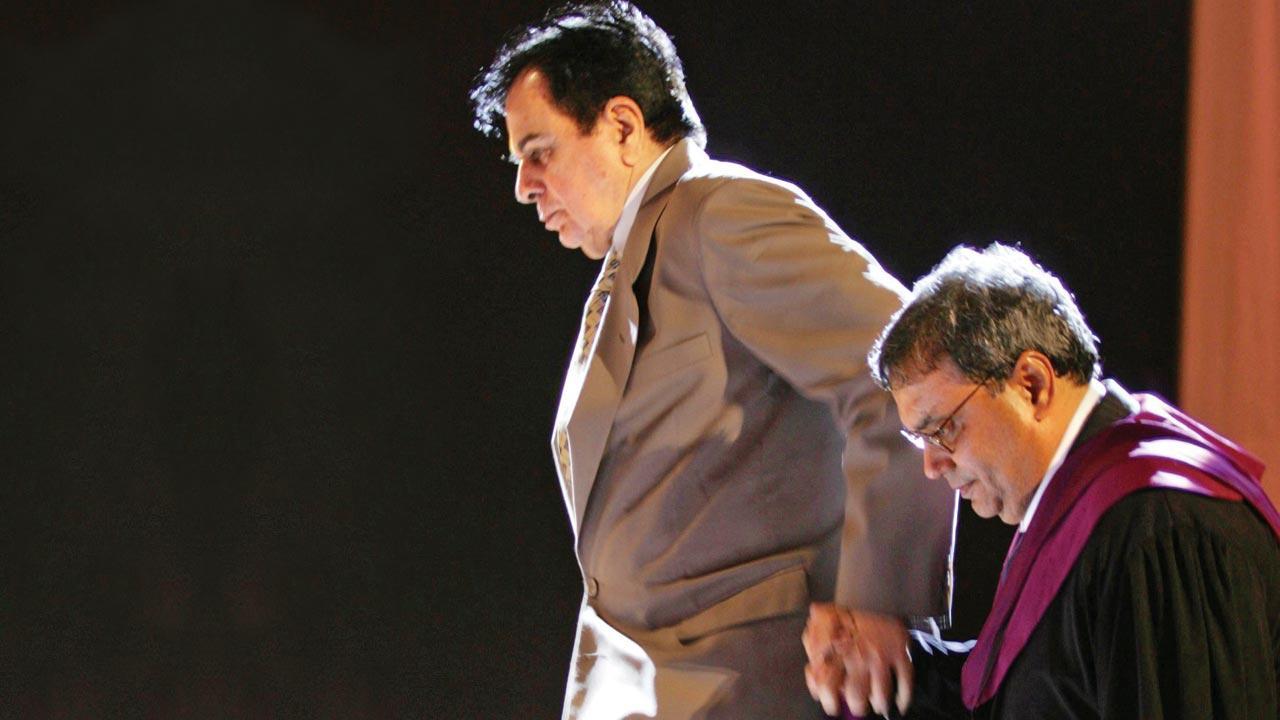
Subhash Ghai on his 40-year association with Dilip Kumar
As told to Upala KBR (MID-DAY; July 8, 2021)
My association with Dilip saab goes back 40 years. My first narration to him was for the film Vidhaata [1982], but he didn’t hear the story, instead he started talking to me as a friend and asked about my previous film Krodhi [1981]. I kept wondering why he was asking me. He loved the story [of Krodhi] and immediately said, ‘Yes, you think well and understand cinema, so we will do the film’. I rewrote the script because I had a responsibility towards him and wanted to live up to his expectations. He reheard the script of Vidhaata after six months.
One of my favourite memories of Dilip saab was during the filming of Vidhaata in Goa. The car designated to pick him up from the airport and drop him off at the shoot location, didn’t reach on time. He boarded a taxi, found the location and came alone. I was so embarrassed, so was the unit. I immediately went to him and began apologizing. He smiled and said, ‘Don’t worry. These are production hassles. If technicians suffer, artistes suffer too. You focus on getting a better shot for the movie’.
As an actor, he had a unique style and manner, which made him a great artiste. Dilip saab delivered dialogues from his heart. In every take, his words would [slightly] differ, but he would convey the required emotions [accurately] in every scene. Whenever we met socially or for dinner, he would ask me to narrate a story more than five times. Without commenting on [the characters], he would tell me, ‘You are working. Good. Just carry on working’. And I’d understand that I had to work more on his characterization. During the shoot, he would always know more about the story and character than me.
Among all my films with him, my favourites include — Vidhaata, Karma [1986] and Saudagar [1991]. He was always concerned about giving equal importance to the other characters. He’d say that it is always the story and characters that work in movies and not Dilip Kumar. [In fact], during Vidhaata, he would often ask me if I had done something to groom Shammi Kapoor’s character. He [even] asked me to work more on Raaj Kumar’s role in Saudagar. I realised [much later] what he meant — the story and characters matter, not the star.
Saroj Khan would extract the best from each actor-Subhash Ghai
8:44 AM

As told to Upala KBR (MID-DAY; July 4, 2020)
[Saroj Khan's death] is a personal loss. Last Saturday, when I learnt that she was hospitalised, her daughter Guddi messaged me saying she was [getting] better. Saroj was slipping in and out of consciousness and could communicate. When Guddi told her that I had called to ask for her, Saroj smiled for the first time. It was an emotional moment for me.
Aruna Irani had first recommended Saroj for a song in my film Vidhaata. I told Saroj I was making a movie with Dilip Kumar and Sanjay Dutt, and had one song left to complete. It was the climax song, Pyar Ka Imtihan, with Sarika. I was impressed with Saroj's grace. I promised her that I would give her my next movie, if she could give me a good climax song. She worked very hard, and when she gave me the song, I gave her Hero, starring Jackie Shroff and Meenakshi Seshadri. For the first time, at my insistence, a special category for Best Choreography was created by a publishing house, and Saroj won it that year, for Hero.
The year that it released, Choli ke peeche became the most controversial song. When I gave her the song, she loved it and told me to [let her handle it]. We were buddies who would fight over creative calls. I told her it would feature Madhuri Dixit, and explained the situation [in the film where the song would be placed]. I told her it is a sensitive number, and that she would have to make it look aesthetically appropriate. She rehearsed for 15 days in a hall, and created each step. Each day, I would go to see what she was doing, and would fight with her over [the choreography]. We would discuss what would or wouldn't work. We could get on the same page quickly.
Saroj was the best dance teacher for every newcomer. She understood their body language and [expressions] and could choreograph steps accordingly. Hence, it would be easier for the actor — even if s/he couldn't dance — to grasp the steps. She knew the art of extracting the best from every artiste. Madhuri, Manisha [Koirala], Mahima [Chaudhry] were all newcomers when they learnt to dance for cinema, from Saroj. She was an integral part of my cinematic journey. Our bond was unbreakable.
Pandhari Juker put his soul into it, that’s why he is a legend-Subhash Ghai
8:00 AM

Subhash Ghai and his Pardes heroine remember Pandhari Juker
Hiren Kotwani (MUMBAI MIRROR; February 19, 2020)

Dilip Kumar introduced Subhash Ghai to Pandhari Dada during Vidhatha and the showman got him to do the make-up for all his leading ladies, from Meenakshi Seshadri (Hero) and Madhuri (Ram-Lakhan) to Mahima Chaudhry (Pardes). “After Vidhaata, I told him I was making a film with newcomers and wanted him to work on their looks. When I saw Meenakshi she was a perfect Radha,” recalls Ghai, adding for Dada make-up for him wasn’t only a technical craft. “He put his soul into it, that’s why he is a legend.”
His Pardes heroine, Mahima informed that every make-up artist she worked with since her first ad, had trained with and assisted Dada. “I did a few campaigns with him too. He did my make-up for my first screen-test. I was unsure if Mr Ghai had liked me and told him we might need another change. He smiled and said, ‘No beta, you’ve been selected. We’re doing the test to see which looks to shortlist for the film,’” she flashbacked. One tip? “He would tell me, ‘Beta, jitna kum, utna zyada achha,’” Mahima signs off.
Dilip Kumar taught me how to understand philosophy of my film’s story & psychology of my characters-Subhash Ghai
7:06 AM

Dilip Kumar and Shammi Kapoor in Vidhaata
Roshmila Bhattacharya (MUMBAI MIRROR; December 13, 2019)
Dilip Kumar is 97 and I’m reminded of a time when, as a cub reporter, I had watched him from afar, as he lounged in the lawn of his bungalow, recounting his journey to my editor. Then, suave in a suit and a tie, he posed with Filmfare’s Black Lady that he’d bagged for lifetime achievement. My biggest regret is that I didn’t get to interview him. Perhaps that’s why, I keep talking to those who knew the man who made me laugh in my growing up years as he strutted around on my black-and-white TV screen crooning, “Sala Main To Sahab Ban Gaya” in Sagina and weatched my mother swoon as he went careening in a tonga to the tune of “Maang Ke Saath Tumhara”. By the time I met him, he was no longer a dashing Casanova with an errant lock kissing his forehead. But he was still just as charming and made me wonder even more about the man behind the matinee idol.
So, I quizzed a filmmaker who decided to become an actor after watching Dilip saab’s Shaheed and Jugnu, then, went on to co-star with him in Aadmi. While it was being filmed, Manoj Kumar would often borrow from his friend’s wardrobe. In the course of a conversation, he recalled how, whenever Dilip Kumar spotted him in one of his costumes, he would smile and say graciously, “Achche lag rahe ho.”
 Thirteen years after the 1968 film about obsessive love, Manoj saab convinced Dilip saab to end a five-year sabbatical to spearhead his Kranti (right). The historical drama was his most ambitious production, with Manoj saab as its writer, director and actor too. For the first four days at RK Studio, he just sat patiently and watched Dilip saab get into character. Then, he was living Sanga, reeling off one perfect take after another. Having known him closely, Manoj saab understood that his role model was a perfectionist who could not be hurried. But once Dilip saab was ready, the assistants never had to remind the thespian to report for work. He’d be on the sets by 11.15 am at the latest, and leave only after taking permission from his producer-director.
Subhash Ghai who directed Dilip saab in three films—Vidhaata, Karma and Saudagar—informs that the two most influential persons in his life till date were both born on same day, December 11. “One is Osho who taught me how to understand the philosophy of life and the psychology of people and stay happy. The other is the emperor of acting, Dilip Kumar, who taught me how to understand the philosophy of my film’s story and the psychology of my characters,” Subhash ji points out.
The filmmaker goes on to add that during Vidhaata he had no idea that Dilip saab and Shammi Kapoor had a spat decades ago and set up his first scene with the two actors in Agra. “Shammi ji was not happy with the scene shot because he had got intimidated by Dilip saab and expressed his resentment to me in his room. He was shocked when I told him that after the shoot, Dilip saab had told me, ‘Subhash, Shammi’s character seems to be a very interesting part of the film and he is a good actor as well. Please see that you increase his role even at my cost. You will be happy,” reminisces Subhash ji, saying that Shammi ji went on to bag the Filmfare Award for Best Supporting Actor for his performance in the film.
Subscribe to:
Posts (Atom)