Showing posts with label Venkatesh. Show all posts
Showing posts with label Venkatesh. Show all posts
Even when I had my Mercedes back home in Kolkata, I used to travel in autos in Mumbai-Jisshu U Sengupta
9:30 AM

Chandrima Pal (BOMBAY TIMES; October 5, 2026)
On a day Kolkata nearly drowned, Jisshu U Sengupta glided in at an upscale lounge, dapper in his boots and trench coat. Evidently, his interpretation of festive dressing has its own rule book. Just like his career choices. In between prepping for a US tour with his band, juggling work in Bengali, Hindi, and Telugu theatricals and OTT, and prepping for a massive two-part film project this winter, he was at his leisurely best as he sat down with Calcutta Times for an adda over a double-shot espresso.
You haven’t had long-form conversations with the media in a long time. Why is that?
I’ve always believed my work should speak for itself – not just in the last three or four years, but always. I’ve avoided giving in to the media too much. I’m not a great speaker, and I believe that about myself. Saying “I’m a good actor” doesn’t make me a good actor. Saying “I’m a good drummer” doesn’t make me a good drummer. Some colleagues are very vocal, and that’s needed too. But I’m happy in my own cocoon. I talk to myself, and that gives me peace. I’ve never planned anything in my life.
The work you do for the South film industry, and the work you’ve done for OTT and Hindi projects, are very different – one is larger than life, the other hyper-real and tightly scripted. How do you make that switch?
I’m not a trained actor. My father was a theatre actor, and my mother used to say one actor in the family was enough (laughs). I was rather into cricket and music. By default, I’m here today talking to you primarily as an actor.
Unlike a lot of actors who design their script and character before going to set, I’ve never done that. I read the script. Ritu da (Rituparno Ghosh), who was my mentor, once asked if I put any thought behind what I do. I said no. Wherever I’m shooting, everything from the people around me to the cup of tea in the frame helps me do what I do. He heard me out and then told me, that while my approach wasn’t wrong, it would help if I got into the character’s headspace – understand his backstory, take him back to his childhood, parents, and heartbreaks, and work my way to who he is today.
From that day, that’s exactly what I’ve done. I build the character’s story in my head. I realized if you don’t believe in the character, you can’t act. The best way to act a character is not to act, but to behave. I try to behave.
Your trajectory in Bangla cinema is something people have watched evolve. But by the time you moved to Mumbai and later started doing South films, you were almost a complete package by then. Would you agree?
People think it’s easy to go to Mumbai and get work – that if you meet the right people, it’ll just happen. It doesn’t work that way. Even when I had my Mercedes back home in Kolkata, I used to travel in autos in Mumbai. I did that for years, and it helped.
People assume because you’ve done well in one film industry, people elsewhere will automatically know you. They don’t. When you go and ask for a role, you’re just an actor asking for a role. If you fit the bill, you get it. If you don’t, you don’t.
You are also reuniting with Nandita-Shiboprosad for Bohurupi: The Golden Daku?
Posto was my first film with them – a great father-son story built around a true story. Then I did Baba Baby O which was unusual as well. The first Bohurupi was a huge hit, and I had big shoes to fill – Abir’s shoes. He did a brilliant job, I was quite unsure about stepping into this role, but Shibu convinced me. And I also genuinely believe Shiboprosad is a great actor. I’ve told him this to his face and behind his back too. I don’t know why he does not pursue acting more.
Shiboprosad is a brilliant actor. Had he taken it up seriously, most of us would be totally out of work. He is that good.
What was the turning point in this journey?
Honestly, I have no idea (smiles). There was no calculation behind it. I wanted to be at it – if I wanted to achieve something, I had to keep showing up. That’s how I ended up doing Telugu films. I did Manikarnika with Krish, who’s now a great friend. He asked if I wanted to do a Telugu film, and I said I didn’t know the language. He said that didn’t matter. From that day to this, I’ve done around 18-19 Telugu films with Chiranjeevi sir, Ravi Teja, Venkatesh sir, Nani, and Nithiin. Funnily enough, a lot of people think my name is Jishu Sen Gupta and that I’m a Telugu actor. When people around me speak in Telugu, I simply smile and nod my way through it.
That’s the beauty of this industry. Every day is a new day. If I carry the baggage of what I’ve already done, I’m weighing myself down. Honestly, I believe I’ve done nothing in life, and I mean it.
I’d love to win a National Award someday. There have been awards I haven’t even gone to collect, and ones I have picked up. It feels brilliant being recognized as best actor, but that glory is only for that moment. The next day is a new day. That award isn’t going to fetch me three more awards – I still have to work hard for that.
This has been an interesting year for you — a lot of exciting projects, back-to-back Bangla releases after a long time. What do you look for now when you say yes to a Bangla project?
This applies to everything, and it’s something Ritu da taught me. He once asked me whether I wanted to be an actor or a hero. I said I wanted to be an actor. He explained that if you choose to be a hero, your time span is limited, but an actor can act until he dies.
He told me: “When offered a character, imagine taking him out of the story. Does the story still move without him, or does it get stuck? If it can move without him, don’t do it. But if the story doesn’t work without that character, take it – because that one scene will give you another frame.” That’s exactly how I’ve chosen scripts ever since. I never wanted to be a hero. I wanted to be an actor.
Do you think the response to Abhhiman, your first Bangla production under your Why So Serious banner could have been different? It didn’t quite land the way it should have, isn’t it?
It did average business, and it could have been better. I’ve learnt a lot, and so has Saurav (Das). We could have marketed the film differently – it was a father-son story, and we marketed it as a rockstar’s film. The film could also have been a little shorter. We’re going to fix these mistakes the next time we produce a film.
Bangla cinema is going through a fair bit of churn right now. Do you see yourself playing a role in shaping its future?
If I get the opportunity, of course I will. This is where I grew up, where I earned my first bread, butter, and chicken tandoori. I’d give my life for it. Think about it – name me one state in India that has mountains, snow, forests, a river, an ocean, red soil, and the world’s biggest mangrove forest, all in one place. We have all of it. The rest of the Indian film industry should come here and explore it.
Yes, there will be competition. Bangla cinemar pashe daran – I think that’s rather silly. Amra jani amra kothay dariye acchi. But we don’t do enough about it. We need to fix that.
On a more introspective note — where are you in your head these days, in terms of your personal space and journey?
I’ve grown up a lot in the last few years. I never really knew who I was, but I’ve at least understood that there are certain things I need to work on, let go of, and face. These last couple of years have given me that time and space to understand myself – to let go of habits and arrive at the person I wish to be.
Would you say you are a work in progress?
Absolutely. Every person has shades of grey. At least once a day, you look in the mirror and know where you’ve gone wrong. I have my own justifications, but I know exactly where I’ve been wrong, and where I’ve been right. People are quick to judge, but no one has stepped into my shoes and walked the paths I’ve walked. So first do that, and then judge.
I wanted to play cricket for India; I couldn’t. I wanted to play the drums at Wembley Stadium; I’ll probably never get to. That would be an achievement.
It’s rare for men in showbiz to talk about their emotional journeys. There’s a certain image to protect, and vulnerability to hide.
Because that’s how our world has conditioned us – “boys don’t cry.” Amra etai shune eshechi. I don’t subscribe to that, though. I’ve gone to a psychiatrist. I’ve taken therapy. It’s helped me a lot. We only really talk about what women go through with mental health, which is ok. But men go through instability too, and we just don’t talk about male mental health.
I lost my father when I was 21. I started working at 16, earning at 17, and by 19 I was taking on responsibility for my family – no one really talks about that. It’s still difficult, taking care of so many people. Carrying those responsibilities, a man goes through a lot – EMIs, due dates, and people who judge you without paying your bills. And I have my desires too.
I’ve failed so many times, and I’ve learnt from every failure. Men cry. I cry. On my bad days, I miss my daughters and I cry. That’s okay. Why should I hide that just because I’m a man? I don’t buy that anymore. This is who I am.
We see you on screen, the glamorous side of you, but your inner journey isn’t something we usually pause to think about.
Honestly, I don’t want anyone thinking too much about it, and I don’t want suggestions from anyone either. Respect is the only thing I actually work for. In fact, the only thing all men want is just a bit of respect, and we’ll do anything.
------------------------------------------
JISSHU’S HISTORY & CHEMISTRY WITH SRIJIT
Srijit Mukherji, says Jisshu, is a director “who’s experimented with me the most, and I’m grateful to him for that. I am a director’s actor. But Srijit has pushed me further than most.” Here’s what he had to say about his projects with the director:
Rajkahini: One of my biggest turning points. I actually said no initially, but he insisted. It was a small role, but I won pretty much every award for those ten minutes.
Zulfiqar: Got me some of the best reviews of my career. Koushik Sen and I got the most critical acclaim among all the actors in that film.
Dawshom Awbotaar: Not a great film for me. I remember getting a late at night call from Srijit, and I told him to stop overworking himself, that he’s capable of doing much more. He said I didn’t understand the economics of filmmaking. We argued. But yes he has given me some of my best roles.
Goenda Kanai Charan: The premise comes together with so many of Srijit’s own passions — food, travel, everything. Honestly, that character is largely Srijit himself. When he grows old, he’s going to become Kanai. It’s really his own future coming onto the screen.
Srijit will go to any extent to convince you about what he wants, and he’ll make you believe he’s right. He will not leave the table until he has won the argument.
------------------------------------------
Music has helped me find my calm. when everything is moving so fast, it makes me take a step back, sit somewhere, and just be in the moment. my love is divided into three parts – cricket, music, and acting – and each gives me happiness and peace
The second coming: From Sunny Deol to Akshaye Khanna, mature actors score big at the box office
10:14 AM

Actors aged 50-70 are delivering the goods across Hindi, southern cinema as acting skills trump media gimmicks
Rajesh N Naidu (THE ECONOMIC TIMES; February 5, 2026)
Mumbai: Men with dad bodies, crow feet and grey hair around balding pates are barrelling the cinema box office with gravitas, character and depth. They are also charging hefty premiums while crashing the youngsters' rave in cinema halls and OTT platforms. Films starring mature actors aged 50-70 have recorded impressive box-office collections across Hindi and southern cinema reflecting audiences' growing preference for acting skills and character depth over stardom hype and social media gimmicks, leading producers and distributors told ET. The "second innings" of these actors have turned the match.
In recent years, mature actors such as Sunny Deol (68), Chiranjeevi (70), Nandamuri Balakrishna (65), Venkatesh (65) and Akshaye Khanna (50) have either delivered solo hits or contribute meaningfully to noteworthy hits, giving a run for the money to younger peers.
Notably, these mature actors today are charging fees in the Rs. 15-50 crore range, considerably higher than Rs. 2-10 crore they charged at the prime of their careers, trade analysts said.
Films such as Border 2 (India collection: Rs. 335.7 crore), Dhurandhar (India collection: Rs. 1,004 crore), Mana Shankara Vara Prasad Garu (India collection: Rs. 245 crore), Daaku Maharaaj (India collection: Rs. 108 crore) and Sankranthiki Vasthunam (India collection: Rs. 225 crore) are prominent successes of these mature actors.
"It is impressive that films of mature actors are recording above Rs. 100 crore at the box office almost consistently. After Gadar 2 and Jaat, Sunny Deol delivered another winner in Border 2 at the age of 68 in today's highly unpredictable times," explained Shaaminder Malik, film distributor and trade analyst.
Producers attribute the captivating charisma of these long-established stars as a fundamental reason for their success.
"Across languages, actors in their 50s and above are delivering extraordinary performances. Films today demand larger-than-life, deeply rooted Indian characters. These mature actors who have distinct personalities are showcasing these elements with conviction and gravitas. Audiences are returning to theatres because these actors bring in certain authenticity," said Sunil Bohra, co-founder, Bohra Bros.
These actors have long-established connections with multiple generations of audiences, which works for them.
"These stars attract a wide and multi-generational audience. In a time when younger actors are over-exposed across platforms, the familiarity, trust and legacy of these mature stars work in their favour," shared Suniel Wadhwa, co-founder and director, Karmic Films.
He said that today's audiences are less focused on actors' age. They value depth of talent, presence, nuances, and suitability for roles.
Producers said that the emergence of credible larger-than-life stories such as Dhurandhar have worked in favour of these stars.
"The wave seems to have shifted from south to Hindi film industry. Directors in Hindi film industry are making credible larger-than-life films. These films are working as audiences are responding to them. These mature actors are talented. Today, the difference is they are getting the right roles which exploit their talent," explained producer Rajesh R Nair.
These stars' flexibility in accepting roles which are beyond their 'set image', opportunities from streaming platforms, and almost constant social media buzz around them have worked for these stars, producers said.
Salman Khan conceptualizes 2 grand entry scenes for Venkatesh and Jagapathi Babu in Kisi Ka Bhai Kisi Ki Jaan
8:24 AM

Sources say Khan, with stunt choreographers, conceptualized two elaborate introductory action scenes for Telugu stars Venkatesh and Jagapathi Babu in Kisi Ka Bhai Kisi Ki Jaan
Upala KBR (MID-DAY; April 3, 2023)
It’s easy to tell from the Kisi Ka Bhai Kisi Ki Jaan (KKBKKJ) teaser that Salman Khan’s offering will be an action extravaganza. However, it’s not only the superstar who will flex his muscles and take on the baddies. We hear Khan, who is producing Farhad Samji’s directorial venture, has conceptualized two heavy-duty action sequences that will mark Venkatesh and Jagapathi Babu’s entry in the movie. The actor sat down with stunt directors Anbumani-Arivumani (Anbariv), and Anal Arasu to design scenes that would do justice to the senior Telugu actors.
The actor-producer has been deeply involved in every aspect of the film, from the music to choreography. A source tells us, “Salman wants Venkatesh and Jagapathi’s entry sequences to elicit claps and whistles from the audience. For Venkatesh’s introduction scene, an elaborate set of a hilltop was built at the Golden Tobacco factory in Mumbai. Production designer Rajat Poddarr created a set-up of a south Indian village, with a rocky hill overlooking it. A separate set was built for Jagapathi’s fight sequence, with each set taking more than two months to be constructed.”
The Eid release — that also stars Pooja Hegde, Bhumika Chawla, Jassie Gill and Raghav Juyal — revolves around four brothers, with Khan playing the eldest. While Babu portrays a don, Venkatesh essays the role of Hegde’s father, a respected man in a village who is compelled to resort to violence. The source adds that Khan has mounted Venkatesh’s introduction scene on a grand scale.
“Salman sat for hours with Anbariv, cracking the set-piece. He wanted Venkatesh’s opening scene to be perfect, as the film sees him returning to Hindi cinema after 28 years.”
It is heard that Khan, in his pursuit to give his fans a complete entertainer, is overseeing every aspect of the film, down to the last detail. “Salman was involved in the recently released song, Bathukamma, which is choreographed by Jani Master and composed by Ravi Basrur. He was a part of the music sittings. It was the superstar who told costume designer Ashley Rebello to dress him in a white-and-gold lungi and kurta.”

Jagapathi Babu and Venkatesh play key roles in the movie
First look: Salman Khan brings Bathukamma, Telangana’s flower festival, to screen in Kisi Ka Bhai Kisi Ki Jaan's song
8:01 AM

Khan brings Bathukamma, Telangana’s flower festival, to screen in Kisi Ka Bhai Kisi Ki Jaan song
Hiren Kotwani (MID-DAY; March 31, 2023)
Salman Khan, who is readying his production Kisi Ka Bhai Kisi Ki Jaan for an Eid release, is set to unveil the film’s fourth song, Bathukamma, today. The peppy number celebrates the annual flower festival that is held across Telangana and some parts of Andhra Pradesh for nine days in the months of September-October. Interestingly, the idea to include a song marking Bathukamma came from south superstar Venkatesh, who returns to Hindi films after 28 years with Farhad Samji’s directorial venture.
A source reveals, “When Venkatesh mentioned the festival that is celebrated with pomp in the south, Salman loved the idea. He asked music director Ravi Basrur to compose a song dedicated to it, which would be picturized on the entire cast of the action drama.”
The foot-tapping number sees Khan and Venkatesh shake a leg with co-actors Pooja Hegde, Raghav Juyal, Jassie Gill and others, all dressed in traditional attire. The source adds, “The team shot the number, with 200 background dancers, during the Bathukamma festival last year, in real locations across Hyderabad. It is Salman’s tribute to the rich Telugu culture.”
Kisi Ka Bhai Kisi Ki Jaan is said to be an adaptation of the Tamil film, Veeram (2014), which revolves around a man whose four younger brothers want him to get married so that they can settle down too.
I had multiple conversations on how to play a father as I didn’t know the tone that was required-Rana Daggubati
8:44 AM
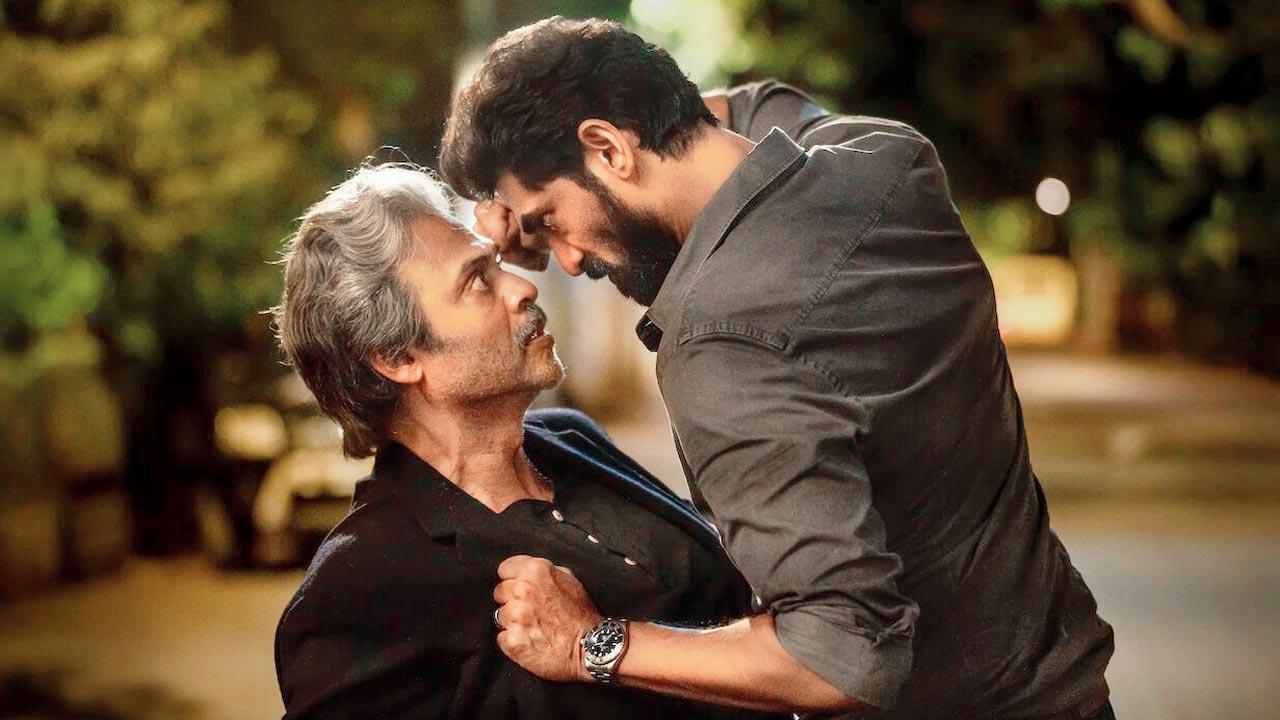
Rana shares the challenges and joy of headlining his maiden OTT series Rana Naidu, which pits him against Telugu star-uncle Venkatesh
Priyanka Sharma (MID-DAY; March 3, 2023)
Barring the name, Rana Daggubati has nothing in common with his character in Rana Naidu. The actor makes his digital debut with the Netflix series, which sees him as the fixer of celebrities’ problems. “His job is secretive. He [seems to] be detached, but deep down, he is a family guy,” he begins.
The Indian adaptation of American series Ray Donovan, Rana Naidu revolves around the protagonist’s complex relationship with his father, who also doubles up as his nemesis. Daggubati says two aspects drew him to the project — the dark side of the parent-child dynamics depicted in the show, and the opportunity to share screen space with actor-uncle Venkatesh, who plays his on-screen father.
“Shooting with him and learning how he does what he does was a wonderful experience. We have always been close, but on a set, you have a completely different equation. Our characters were so nuanced, and we had directors who would answer as many questions as we asked them, making sure that we were being true to our parts. Except the fact that I was called Rana [which blurred the lines between my on-screen and off-screen persona], I didn’t have any other problem,” he laughs.
The actor, who enjoys pan-India popularity since the release of the Baahubali franchise, was waiting for something tempting to make his foray into the digital medium. When creator Karan Anshuman of The Inside Edge and Mirzapur fame, and The Family Man 2 director Suparn Varma united to make an action drama, it was an easy yes for Daggubati. In them, he found reliable guides as he navigated the complex titular character.
“I had multiple conversations with Karan on how to play a father because I didn’t know the tone that was required. This was the first time I was playing a father on screen, that too to grown-up kids. But Rana Naidu is a dark guy; it was hard to let go of the character. There was a certain gloom [it brought] into my life, and I only realized it when I went back to dub for it.”
Da-Bangg The Tour deferred; Salman Khan lines up a non-stop schedule of Kabhi Eid Kabhi Diwali
8:30 AM

With the Da-Bangg The Tour deferred, Salman Khan lines up a non-stop schedule of Kabhi Eid Kabhi Diwali in Mumbai and the southern state
Upala KBR (MID-DAY; May 28, 2022)
From mid-May, Salman Khan has been giving his undivided attention to Kabhi Eid Kabhi Diwali. The superstar was to take three days’ break from the shoot to front Da-Bangg The Tour Reloaded in Nepal. However, with the show getting postponed due to the local elections and poor weather, he will devote the time to Farhad Samji’s directorial venture. It is heard that Khan has lined up a non-stop month-long schedule in Mumbai and Telangana.
A source from the creative team says, “Salman was to fly to Kathmandu yesterday to perform at Da-Bangg The Tour. But, after the show got postponed, Salman sat down with Farhad and reworked the dates. He will film his portions over the week at Mehboob Studios in Bandra, before leaving for an awards gala in Abu Dhabi on June 3. While he does his hosting duties in the UAE, Farhad will continue filming with the rest of the cast in Mumbai, only to be joined by Salman by June 5. After a week-long stint in the city, the team will go south in mid-June. A massive set of a village has been built in Kokapet, where the director will can two crucial tracks — one focusing on Salman’s character and his on-screen brothers, and the other dedicated to leading lady Pooja Hegde. The entire cast, including south star Venkatesh, will be present during the month-long spell.”
Khan is supervising every aspect of the film that is slated to hit the marquee on December 30. “The action sequences have been designed by Anbu-Arivu, while Prabhudheva is handling the choreography,” adds the source.
Now, more than the language, the audience connects with the emotions of the characters-Rana Daggubati
8:09 AM

Suhas Yellapantula (BOMBAY TIMES; January 5, 2022)
Rana Daggubati enters the new year brimming with positivity and exudes confidence about the way film content is going to be consumed in 2022. While there is uncertainty around upcoming theatrical releases due to a spike in Coronavirus cases across the country, Rana, who has featured in films such as The Ghazi Attack, Housefull 4, Haathi Mere Saathi and Baby, believes OTT has bridged the gap between regional cinema and Bollywood, and has opened up new avenues for artistes.
He says, “The whole process of OTT and video-on-demand has broken all barriers. Now, more than the language, as an audience, you connect with the emotions of the core characters. That’s what’s bridged the gap between regional cinema and Hindi cinema a lot more. Having said that, as much as you’d love to see an adaptation, you would also love to see content in the comfort of your own language. Now, this opens a lot more doors. ”
It’s going to be a big year for the pan India actor, who will be seen in big ticket films like Bheemla Nayak (Telugu) with Pawan Kalyan and Virata Parvam (Telugu) with Sai Pallavi. However, Rana is most excited about teaming up with his uncle, Tollywood star Venkatesh, for the first time ever. The duo will feature in an upcoming web series, which is the adaptation of the popular American Crime Drama, Ray Donovan.
“Right from the time that I became an actor, I knew that at some point Venky and I would work together. I always knew that when we act together, it will not be in a conventional film — I wanted it to be different and cool. When I got the opportunity to do this web show, I knew this was it. It’s going to be special,” he says, excitedly
The Baahubali actor feels that the Indian audience has gotten used to long form of storytelling thanks to OTT platforms. “Commercial cinema is made for the box-office, because it costs a lot of money to release the film in theatres, to market that to audiences. Unless it’s extremely engaging, with so much content available, it’s very hard to bring people to the cinema hall. But when it’s genre-specific, niche content, people don’t mind watching it from the comfort of their homes. This definitely leads to more localised and much deeper storytelling. It won’t be wrong to say that OTT has gotten us hooked to long form storytelling where you’re not just connected with a character for three hours, but you’re with them for seasons after seasons,” he adds.
Now, a Hindi remake for Venkatesh and Tamannaah's Telugu comedy F2 - Fun And Frustration
8:39 AM
Anees Bazmee will direct the Boney Kapoor production, which will have three leading men and two heroines
Natasha Coutinho (MUMBAI MIRROR; March 29, 2019)
 The Telugu comedy, F2 - Fun And Frustration, featuring Venkatesh, Varun Tej, Tamannaah Bhatia and Mehreen Pirzada in the lead roles opened in January to raves. Now, the film is gearing up for a Hindi remake. Mirror has learnt that Anees Bazmee, who is currently shooting his John Abraham, Ileana D’cruz, Anil Kapoor, Arshad Warsi, Kriti Kharbanda, Pulkit Samrat and Urvashi Rautela-starrer Pagalpanti in the UK, will direct the film. The project is jointly produced by Dil Raju who had backed the original and Boney Kapoor.
Boney confirmed the news, saying, “It’s a fun film and a family entertainer. I thoroughly enjoyed watching it and I believe it’s a subject that will resonate with the Hindi audience as well. Dil Raju suggested that we make the Hindi version together. He is one of the most established producers down South and also a distributor and exhibitor. It’s the coming together of two passionate filmmakers.”
Boney added that the film will have three leading men and two heroines for which casting will begin soon. On his choice of director, he said, “Anees has always excelled at such fun subjects as a writer and director and we have a good rapport, so he was the obvious choice. From No Entry, to Ready, Welcome and Mubarakaan, all his films have been entertainers.”
F2-Fun and Frustration was the story of Venky (played by Venkatesh) and Varun (Varun Tej) getting caught by police and their subsequent interrogation.
Natasha Coutinho (MUMBAI MIRROR; March 29, 2019)
The Telugu comedy, F2 - Fun And Frustration, featuring Venkatesh, Varun Tej, Tamannaah Bhatia and Mehreen Pirzada in the lead roles opened in January to raves. Now, the film is gearing up for a Hindi remake. Mirror has learnt that Anees Bazmee, who is currently shooting his John Abraham, Ileana D’cruz, Anil Kapoor, Arshad Warsi, Kriti Kharbanda, Pulkit Samrat and Urvashi Rautela-starrer Pagalpanti in the UK, will direct the film. The project is jointly produced by Dil Raju who had backed the original and Boney Kapoor.Boney confirmed the news, saying, “It’s a fun film and a family entertainer. I thoroughly enjoyed watching it and I believe it’s a subject that will resonate with the Hindi audience as well. Dil Raju suggested that we make the Hindi version together. He is one of the most established producers down South and also a distributor and exhibitor. It’s the coming together of two passionate filmmakers.”
Boney added that the film will have three leading men and two heroines for which casting will begin soon. On his choice of director, he said, “Anees has always excelled at such fun subjects as a writer and director and we have a good rapport, so he was the obvious choice. From No Entry, to Ready, Welcome and Mubarakaan, all his films have been entertainers.”
F2-Fun and Frustration was the story of Venky (played by Venkatesh) and Varun (Varun Tej) getting caught by police and their subsequent interrogation.
No other producer in the world made as many films as Rama Naidu did-Venkaiah Naidu
7:37 AM

From
top: Karisma Kapoor in her debut Prem Qaidi, produced by Naidu; Kajol
and Anil in the Naidu production Hum Aapke Dil Mein Rehte Hain; The
producer with grandsons Rana Daggubati and Naga Chaitanya
Daggubati Rama Naidu
June 3, 1936-18 February, 2015
Daggubati Rama Naidu, the Dada Saheb Phalke awardee who produced more than 135 films in 15 languages, passed away in Hyderabad on February 18, at the age of 78. The end came after a long battle with prostate cancer. Over the last year, he had retreated from the public eye as his condition worsened.
The doyen of Telugu film industry, who received the Padma Bhushan in 2013, was also the patriarch of a large filmy family, which includes sons, actor Venkatesh, producer Suresh Babu and grandsons, actors Rana Daggubati and Naga Chaitanya.
"Dad breathed his last at 2.30pm on Wednesday. His body will be kept at the studio for his fans to pay their last respects till Thursday noon. The funeral will be in the evening," Venkatesh announced.
The actor, who debuted with Kaliyug Pandavulu, in 1986 was among the many artistes introduced by Naidu. Karisma Kapoor is among the 12 actresses Naidu launched and he worked with three generations of Tollywood's leading men, including Akkineni Nageswara Rao, NT Rama Rao, Sobhan Babu, Chiranjeevi and Krishnam Raju.
Chiranjeevi, a frequent collaborator and family friend, recalled how the veteran continued working through his illness, wanting to be a part of cinema till the end. "He used to affectionately call me Raja. His son, Suresh, requested me to intervene when he refused to stop working despite his illness. When I spoke to him on the subject, his reply was, 'Raja, to stop making films is equal to death for me.' Movies were his world," the superstar recalled.
Manchu Manoj, the Tollywood star who like his father actor Mohan Babu, worked with Naidu, added that Naidu was like his grandfather. "Thatha Garu created magic in Indian cinema," he asserted.
The magician was born in Karamchedu in the Prakasam district of Andhra Pradesh on June 6, 1936. He started his life as an agriculturist. But the desire to act took him to Chennai where he met and befriended legendary actor Akkineni Nageswara Rao who advised him to try his hand at production. His first film under the banner of Suresh Productions was Raamudu Bheemudu. The hit kicked off a career which continued to flourish over the next five decades. Naidu flagged off many trends including the practice of multi-starrers. A disciplinarian, he never over-shot a schedule and was a trusted name in a volatile market, famously setting the precedent of issuing cheques before the film released.
Explaining his famous work ethic, he had once said in an interview: "The producer should know each and everything about the film. He should involve himself in all departments and must have full control over the film. The actors and technicians must have a good understanding of each other's needs. As producer, I know the shooting schedules of all my films... When a trolley boy didn't come on time, I did his work. I never waited. That's how I reached this position."
He forayed into politics in 1999. He was elected and joined the Lok Sabha as a member of the Telugu Desam Party.
As news of his demise spread, condolences poured in. Union Minister of Parliamentary Affairs Venkaiah Naidu said, "No other producer in the world made as many films as Rama Naidu did. His work is eternal." His opinion was echoed by political bigwigs like Andhra Pradesh Chief Minister N Chandrababu Naidu, Telangana CM K Chandrasekhar Rao, YSR Congress Party president YS Jaganmohan Reddy.
The Telugu film industry will observe a day of condolence on Thursday. According to reports, Salman Khan, a family friend of the Naidus, will attend the funeral in Hyderabad.
Subscribe to:
Posts (Atom)