Showing posts with label Veer Savarkar. Show all posts
Showing posts with label Veer Savarkar. Show all posts
There should be one or two films made on Gandhi every year for the next 100 years-Anubhav Sinha
9:44 AM

Anshul Chaturvedi (BOMBAY TIMES; October 2, 2026)
Hindi cinema doesn’t have a great track record, at least of commercial success, when it comes to projects around the generation of freedom fighters. Not many movies have been made, fewer still have connected to the larger audience. Is there any point in making more movies on characters such as Mahatma Gandhi? Anubhav Sinha says yes, that filmmakers have a responsibility to keep making these films, in the hope that maybe the next one will work, or the one after that, or the one after that...
Why should another film be made on Gandhi today?
I feel there should be one or two films made on Gandhi every year, for the next hundred years. His contribution to the modern history of our country is just amazing. The weaknesses he shows, the strength that he shows, the tough decisions that he takes…
I was telling my son ki Gandhi woh aadmi tha jo kehta tha ki tum log jhagda band nahi karoge toh main khana nahi khaunga. Toh mera beta hasne lag gaya. Bola toh? Toh maine kaha log jhagda band kar dete thay. Ek baar nahi hua, kai baar hua. Ye uss aadmi ka power tha. Ambedkar ke, Gandhi ke views sabko maloom hain. Par jab Constituent Assembly banti hai toh woh Nehru se jaakar kehta hai ki Constitution inse likhwao. Because yeh desh ko behtar samajhte hain. Desh ke vanchiton ko behtar samajhte hain. Aur woh aadmi jo criticize karta tha, woh aisa karne ko agree kar deta hai. Woh Congress party join karta hai. Yeh bade unique log thay. Ambedkar ho, Gandhi ho, Patel ho. Yeh baat toh sach hai na ki Patel ko vote zyada mile thay aur Gandhi ne kaha ki nahi Nehru. Toh woh step back kar jaate hain, aur aapko kahin bhi Gandhi aur Patel aur Nehru ke beech mein koi animosity ya koi sarcastic remark kahin dekhne ko nahi milta. Ye bade unique log hain! Patel, Nehru, Gandhi, even V P Menon. Inn logon par toh itna zyada kaam hone ki zaroorat hai. Bhagat Singh. Bose. Matlab aapas ke itne contradictions...
A counter thought: We had a large number of Bhagat Singh movies in 2002. Five came out together. And maybe some of them did not even recover their cost. Is the audience willing to consume all those movies if you make them?
We have to understand that we are not making glucose biscuits. These are films, and these films live. A glucose biscuit is consumed with a cup of tea and it’s over. Then you buy a new packet. This is a different ball game. This is an art form. And every film, every such film will leave an impact on X number of people.
And slowly for all we know that X number of people will swell into a much larger number, which it should and it will. So just because two films on Bhagat Singh did not work, it doesn’t mean that the audience is not interested in him.
And also, those films were made with people who were in their thirties. When Bhagat Singh started, he was 17. He was born in 1907. He died in 1931. 24 saal mein toh phaansi ho gayi thi. Toh 17 saal ke ladke ke saath Bhagat Singh kab bani? Jab tak aap 17 saal ka Bhagat Singh nahi dekhenge, aap Bhagat Singh ko samajh hi nahi sakte.
A second counter thought: India is fascinated, captivated with the persona of Subhas Bose. And I remember vividly when Benegal’s The Forgotten Hero was released. I went to Kanpur to meet Captain Lakshmi Sehgal (who was then 90 years old), to ask her what she thought of the portrayal of her character. She said, “Beta abhi I have not watched the movie, because it is not running in a single hall in Kanpur.” And I was taken aback. Sahara was the distributor, I had gone from Lucknow, it was on Bose – and the INA veteran hadn’t been able to find a show in her city. As an audience, do we care about these movies – at least proportionate to how we apparently idolize those leaders?
Those are the predicaments of the cinema being run by corporations, right? See, any art form is very intimate, very personal. But cinema is so capital intensive that it becomes a corporate-run art form. So it will have these hiccups and roadblocks. But that still doesn’t mean that the next Bose should not be made or the one after that should not be made – or the one after that should not be made. It is our responsibility as filmmakers to keep on doing it because these people have played the most significant part in the making of India that we live in and that we chant about. We will never be able to contribute to India like they did.
That’s a legit POV too. Hollywood never tires of making movie after movie on the men who fought for them in WWII, and it just keeps coming. And they never say, we are now tired of seeing what our soldiers did. From the Battle Of The Bulge (1965) to A Bridge Too Far (1977) to Pearl Harbor (2001), Saving Private Ryan (1998), to Dunkirk (2017)… there are dozens, literally.
True. And we do not; we do not have this argument about the other side of the spectrum. So are you telling me that if a film about Air Force warfare doesn’t work, we should stop making films about Air Force warfare? No! It didn’t work. The next time it will work. Maybe the time after that.
Maybe a Safed Sagar comes in 2026 and it will sort of restore the perception.
Yeah, yeah. Maybe in 2047, a Netaji Subhas Chandra Bose film will work. We have to keep making it. And it’s not easy to make these films. It’s very difficult to make these films. But that’s the game. That’s the business of films.
So you say films on Gandhi should keep being made. There are films on Godse also now. What is your take on that?
But why shouldn’t they? I am not opposed to it. There are people who believe in Godse. They should make films about Godse. There are people who believe in Savarkar. They should make films about Savarkar. There are people who believe in Nehru. They should make films about Nehru. These people, whether it’s Godse or Savarkar – they have a place in history, right? They have a definite place in history, and their stories should be brought to the table.
We should not live on WhatsApp myths. There should be a biopic on Godse. There should be a biopic on every such person who played a part in the making of this nation. Because we can have these n number of dining table conversations about them, but we have a responsibility to acknowledge them, to recognize them, to talk about them, to know them. I’ve just ordered a book by Savarkar. I want to read Savarkar. I want to know Savarkar. And why shouldn’t I?
You’re saying, essentially, that people of every single spectrum/affiliation should understand every other spectrum as well to know what the actual debates were, rather than taking this condensed version 70 years later and arguing over it?
I think they were all human beings. I’m reasonably certain that they all made mistakes. But there was something going on between 1915 and 1950. There was something going on, and there were significant things going on. People losing lives, people changing history’s course. According to me, there are 200 films between 1915 and 1950. 200. 200 films minimum.
The Komagata Maru ship tragedy is not explored yet. A whole lot of things, like even Bose. Bose’s days in Germany when he goes to meet Hitler, there’s a film there. You can agree, disagree with anybody. That’s besides the point. But there are at least two movies there. There’s maybe more. What happened in Singapore?
What was Bose doing in Singapore? There’s a story there. There’s a film there. I would love to make a love story between Nehru, Gandhi and Patel. I think it’s a love story. It’s a beautiful love story.
Did you read up on Gandhi earlier as well?
Yeah, There’s... In my office, in my room, there’s only one picture on a wall, which is Gandhi. And for a reason. I try to visit every place that Gandhi visited. I go and sit there alone. I went to Bhitiharwa where he started his first Indigo Revolution. I sat there for two hours. I was sitting in the cottage that he made with his own hands. I sat under the tree that he planted. I… sort of spent time with him. One thing I miss terribly is that I never met him.
Any movie you think that got Gandhi’s persona right? We all began by seeing, of course, Attenborough’s Gandhi as a first starting point.
That’s a very hagiographical film.
Irrespective, but that’s the first time most Indians saw Gandhi on screen, so that remains your initial definer of what... it’s like seeing Arun Govil as Ram.
Yeah. No, there’s no other film on Gandhi, actually, and there’s none that treats Gandhi as a human being, which this film is doing. Just as a human being. I mean, we forget that the first time Gandhi ever got political, it was a rather racist cause. In South Africa, he was saying, ‘Don’t treat Brown people like Black people. Treat them like White people.’
But then he corrects himself. By the time he comes back in 1915, he’s a different man, and between 1915 and 1948, he’s a different man. And he’s changed over time. He’s constantly improving himself and at the same time not rejecting his mistakes. You read his autobiography, he talks about his stint with non-vegetarianism. He talks about that night when his father passed away.
By the time he wrote this book, he was a Mahatma already. He didn’t need to write all that. He didn’t need to write all that. His non-vegetarianism was between him and his friend and could easily have been buried. You and I wouldn’t talk about it today. But he wrote it in his autobiography. And that’s when I... And it comes on the fourth page or the sixth page, and I was like, “Whoa. What a man.”
We haven’t seen a film of that kind about Gandhi, the kind of truthfulness and faithfulness he has in his narrative about his own life without being worried of, uh, its interpretations.
He wrote what he lived. That’s a lot of courage. I was recently reading something that Marcus Aurelius said – that nobody knows you fully well. There are 17 sides that are inside of you. Nobody knows you. Even if you don’t know yourself very well. Then why should you worry about what people think of you? Because they don’t know you. And Gandhi explores himself in that book, and, he says everything that he knows about himself.
Some of the pictures are dark, some of the pictures are bright, but he puts them out, and he allows you to interpret him in the manner you choose to.
What was your buy-in into the project when Sudhir discussed it with you?
The first thing was that I... The first thought that came to mind was, how can I steal this story? (laughs). Can I... Should I ask him? Can I? Because he had come over. He comes over home quite frequently in the night, sometimes for dinner, sometimes for post-dinner coffee or ice cream, and we sit and we talk about films and life and the world. And one of these days, he told me that story, and I actually considered asking him, ‘Do you want... Do you mind giving this story to me?’ But then I didn’t, because he was so passionate about it. So, I thought I’ll get associated with it as a producer.
No, but what stayed in the story? I don’t know that part.
The fact that he was looking at Gandhi in such a personal humanist vision. A man who could make mistakes.
Narayanrao was lynched after Gandhiji’s murder; 8,000 Brahmins were lynched in Maharashtra-Randeep Hooda
10:25 AM
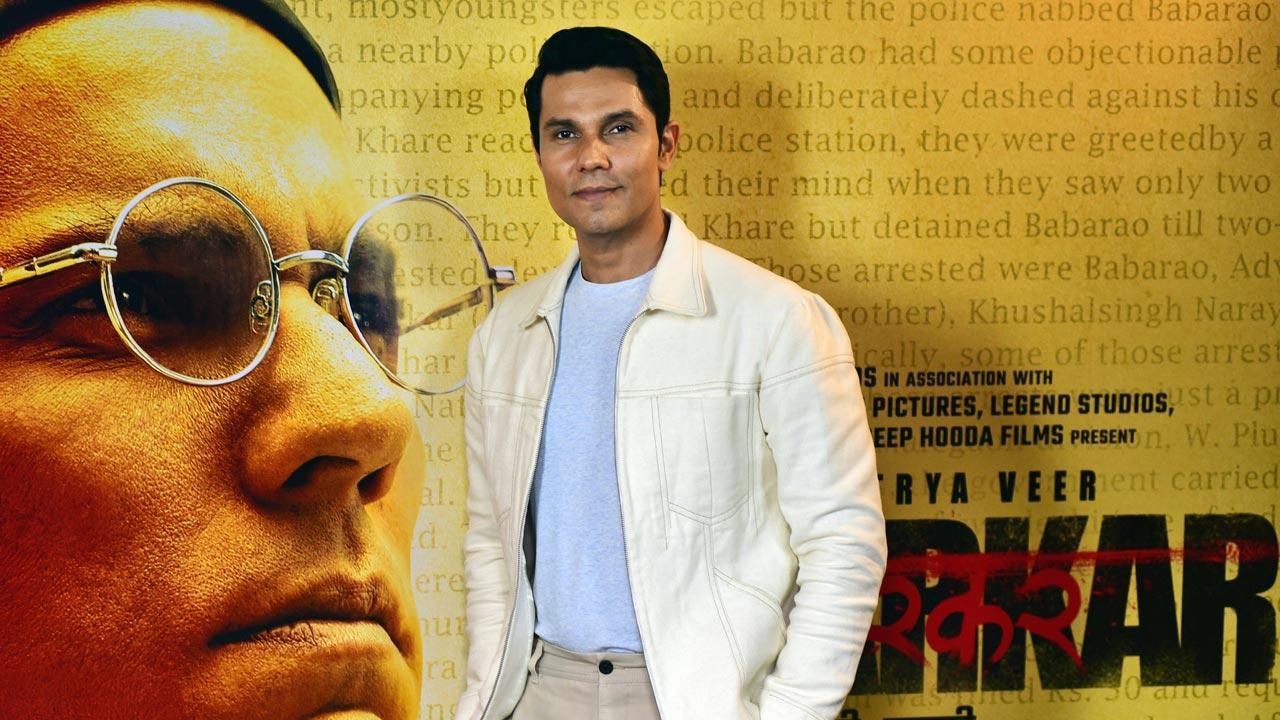
Randeep Hooda plays Vinayak Damodar Savarkar in his directorial debut, and hopes the thriller will shed new light on the much-maligned nationalist
Aastha Atray Banan (MID-DAY; March 10, 2024)
If you thought Vinayak Damodar Savarkar and Mohandas Karamchand Gandhi were antagonists, given that the former was accused of playing a part in the latter’s assassination plot, actor Randeep Hooda will tell you differently. “They had completely different ways of going about it, but their end goal was the same: Akhand Bharat,” he says.
“In fact, when Savarkar was in Kala Pani [Cellular Jail], it was Gandhiji who advised his brother, Narayanrao, about how to draft the bail plea.” It has been claimed that Savarkar swore allegiance to the British if he was released.
Hooda plays the controversial man in his directorial debut, Swatantra Veer Savarkar (due to release on March 22), and is now a veritable expert on his life, likes, dislikes, and ideologies. “But this movie is not a history lesson,” he laughs, “It’s supposed to be entertaining as well.”
The “anti-propaganda film”, as he calls it, is a retelling of Savarkar’s life. The intellectual-writer developed the nationalist political ideology Hindutva in Ratnagiri in 1922, and was a leading figure in the Hindu Mahasabha. He was also sentenced to two life-terms at Kala Pani (after he was found guilty of supplying the pistol used to assassinate the then collector of Nasik, AMT Jackson, in 1909) and composed 6,000 poems when incarcerated. His book, The Indian War of Independence, about the first war for freedom in 1857, was banned before it came out.
However, members of the Hindu Mahasabha turned against him when he distanced himself from Nathuram Godse and others accused of playing a part in Gandhi’s assassination plot during their trial. Though Godse had claimed full responsibility for the assassination, court approver Digambar Badge had said that Godse had a meeting with Savarkar before the assassination, where Savarkar told them all, “Yashasvi houn ya (be successful and return)”.
He was branded a traitor and coward, and though the Bharatiya Janata Party has tried to rebrand him as “Veer”, the nasty names continue to follow him around. We meet Hooda in Juhu, and he is in good spirits, wanting to delve deep into Savarkar’s psyche. Excerpts from an interview
What was your first introduction to Savarkar?
I think Kala Pani and Savarkar were synonymous for me when I was a child. When I started digging deep, I found there was so much missing from the public domain. I wondered why it has been swept under the carpet. My well-wishers told me, “Why are you getting into this? Why become political? You are an artiste”. I replied, “His story needs to be told, whatever it takes.” The kind of name-calling that happens in his name is unjustified. I just pursued the goal to correct that wrong with all sincerity. I ended up co-writing the film and directed it as well. It’s taken me two years of only thinking about Savarkar. I have put everything on the line—emotionally, monetarily, physically. And I’m so grateful people will know his special story.
What was the research involved?
I read books in English, Hindi; spoke to Maharashtrian filmmakers and historians who have written about him. I read about him and I read what he wrote. He is such a profound writer... People have just heard things through “WhatsApp university”, and keep calling him maafiveer (apologist). He was not that. He was just 26, and sentenced to serve two life terms. He went to Kala Pani in 1911 and the date of his release was 1960—he would have been 76! He used to keep writing bail pleas, but they were too flowery. Then Gandhiji asked him to keep it short, and that’s how he got out. Narayanrao was lynched after Gandhiji’s murder—8,000 Brahmins were lynched in Maharashtra. So much for non-violence. People don’t know about most of this.
He had a complicated relationship with Gandhi...
They had opposing ideologies, and both were very stubborn. They met three times—in 1907 at London’s India House; and once at a restaurant on Vijay Dashmi, and gave speeches together. Then in 1927, Gandhi visited him in Ratnagiri when he was placed under house arrest. They started at opposite ends, but met in the centre united by one purpose: A united India. But both of them were not part of the government, much like revolutionaries all over the world. Revolutionaries fight; politicians take control.
Was Savarkar less about religion, and more about nation?
Yes. Till 1920, everyone was one. In 1920, a caliphate movement started in Rae Bareli. Many Muslim leaders thought that India was a sultanate when the British came, and that it should go back to being a sultanate when they left. They didn’t want to be a part of the Congress’ democratic process, where they were a minority. To get them involved, Gandhiji became president of the Khilafat Movement, and there on began the process of appeasement. They were given more seats, and electorates.
This irked Savarkar. He came up with the Hindutva philosophy in response: he held that everyone who lived in the region between the Indus river to the sea, were Hindus. Whatever caste, religion, or community, as long as you love Hind, you are a Hindu. This angers people, but that’s a geographical definition. He said anybody who calls the land between the river and the sea the home of their ancestors, are Hindus.
Are the movie, and you, defending Savarkar?
I hope it does, but that’s not its purpose. I have made it as a thriller; it will enthrall you. It’s for young people. I have laid out the facts; I don’t call him veer, you will have to decide if he was one.
What did you learn the most by playing Savarkar?
Saam, Daam, Dand, Bhed (by any and all means)—that’s what he believed in. It’s what I have used to make this movie and get it released. One should do whatever it takes once one has decided the purpose of his life. And also, “Dushman ko kiye hue vaade nibhaaye nahin jaate”.
What do you want people to take away when they leave the halls?
That there is a bias in the telling of our history; documentation has been very one-sided. Also, you will get entertained and learn more about the freedom struggle than what’s available at first look.
Mockery of history, say Subhas Chandra Bose and Khudiram Bose's kin after Randeep Hooda’s tweet on Savarkar biopic
8:28 AM

THE TIMES OF INDIA (June 1, 2023)
Family members of Netaji Subhas Chandra Bose and Khudiram Bose have dismissed as “mockery of history” and “cheap publicity stunt” any suggestion that Hindutva ideologue Vinayak Damodar Savarkar had a role in inspiring the freedom fighters.
Their reaction follows a tweet by actor Randeep Hooda, who plays Savarkar in the biopic “Swatantrata Veer Savarkar”. “The most wanted Indian by the British. The inspiration behind revolutionaries like Netaji Subhas Chandra Bose, Bhagat Singh and Khudiram Bose,” Hooda had tweeted.
Netaji’s daughter Anita Bose Pfaff said perhaps the only thing common between her father and Savarkar was their religion. “Netaji was a devout, religious man. One can also say that he was a devout Hindu. At the same time, he had great respect for all other religions,” she told TOI.
“Like Mahatma Gandhi, Netaji was opposed to the divisiveness based on religious differences. Let Sarvarkar’s followers join Netaji in his vision for India and not hijack him for views that certainly were not his,” Pfaff said.
Subrata Roy, grandnephew of Khudiram Bose who went to the gallows when he was just 18, said he had never seen any reference in books that the freedom fighter found inspiration in Savarkar.
“Khudiram Bose was part of Anushilan Samiti, an underground society for revolutionaries. He was inspired by Hemchandra Kanungo, Satyen Bose and Aurobinda Ghosh,” said Roy.
Savarkar’s ideology, Netaji’s grandnephew Chandra Bose said, was totally different from that of Netaji and Saheed Bhagat Singh, who had fought for a secular united India. Savarkar wanted a Hindu Rashtra, much like Jinnah’s demand for a Muslim state, he said.
“There is ample evidence, both in Netaji’s writings and speeches, that he opposed Savarkar. In his unfinished autobiography, Bose states that in India’s freedom movement, one can expect nothing from the Hindu Mahasabha or the Muslim League. And there are multiple speeches in which he has said that nothing can be expected of Savarkar and Mohammad Ali Jinnah,” he said.
Netaji’s daughter Anita Bose Pfaff (above) said perhaps the only thing common between her father and Savarkar was their religion
For SwatantryaVeer Savarkar, we’ll be recreating Andaman prison in a studio in Mumbai-Anand Pandit
7:40 AM

Sharing details of the making of Randeep Hooda’s next, SwatantryaVeer Savarkar producer Anand Pandit on why they will have to create a set of the Andaman and Nicobar prison
Hiren Kotwani (MID-DAY; October 16, 2022)
Earlier this month, Randeep Hooda began filming SwatantryaVeer Savarkar, near Wai, Maharashtra. While he plays the freedom fighter Vinayak Damodar Savarkar in front of the camera, he’s also making his debut behind the camera, as director of the biopic.
While Mahesh Manjrekar was to initially direct the film, he had to opt out due to his other work commitments. Producer Anand Pandit confirms that the scheduling issues cropped up due to the weight-loss process that Hooda had to undergo. “Randeep had lost 18 kilos, but he wanted to shed a few more to look the part. We discussed the idea of making him look leaner in the post-production, but eventually decided to go with his decision.”
They decided against roping in another director because they wanted to meet their date with the audience on May 26, which aligns with Veer Savarkar’s 140th birth anniversary. “Also, it would take another director a while to align with our vision, and execute the making accordingly. Randeep has researched extensively on the revolutionary, and has also written the biopic along with Utkarsh Naithani.”
After wrapping up the shoot near Wai, the team will film a schedule in Mumbai, and another in London. Asked if they will film in prison in Andaman and Nicobar Islands, where Savarkar was lodged, Pandit is non-committal. He says, “Over the decades, that jail has been refurbished. So, it doesn’t look like what it used to be when Savarkar was serving his sentence there. We’ll be recreating that prison in a studio in Mumbai.”
SwatantryaVeer Savarkar was to begin in June, but got delayed, and I had to opt out-Mahesh Manjrekar
8:28 AM

Manjrekar claims no bad blood, as he hands over directorial baton to lead actor Hooda for Savarkar biopic
Upala KBR (MID-DAY; October 5, 2022)
Even though Randeep Hooda is evidently excited to begin work on his directorial debut, SwatantryaVeer Savarkar — based on the life of freedom fighter, activist, and writer Vinayak Damodar Savarkar — few would know that his appointment as director, was a chance occurrence.
The film on Savarkar, who developed the Hindu nationalist political ideology of Hindutva while imprisoned in Ratnagiri in 1922, was to be helmed by Mahesh Manjrekar, who had to eventually bail out due to scheduling issues.
Manjrekar tells mid-day, “SwatantryaVeer Savarkar was to begin in June, but got delayed, and I had to opt out. It was a mutual decision taken by the producers [Anand Pandit, Sandip Ssingh, and Sam Khan], Randeep and me, as I had other commitments. They wanted to begin shooting at the same time as Bigg Boss 4 Marathi rolled. Since I am the host of the show, I wouldn’t be able to do justice to the film.”
Ssingh confirms the development, adding that seeing as invested as Hooda was in the project, they handed the directorial baton to him. “Mahesh was our choice. But, Randeep had to lose 15 kilos for one leg, and another eight kilos for the next leg. So, the process was time consuming, and the dates were not aligning with those of Mahesh. Randeep has written the film with Utkarsh Naithani, and had already started losing weight for it. He is an evolved and involved actor, and he knew each and every thing about Savarkar. We sat down and discussed the issue, and he agreed to come aboard as director. He told us that it was his dream to become a director one day, so this film served as the ideal offer.”
The team plans to release the film on May 26, 2023, on the occasion of Veer Savarkar’s 140th birth anniversary.
Check out Randeep Hooda's first look from SwatantraVeer Savarkar
8:43 AM

Sharing Hooda’s look from the Savarkar biopic on his 139th birth anniversary, director Manjrekar on how actor lost 10 kilos to match freedom fighter’s lean avatar
Uma Ramasubramanian (MID-DAY; May 28, 2022)
In March, mid-day was the first to report that Randeep Hooda had been signed on to play Vinayak Damodar Savarkar in SwatantraVeer Savarkar (Savarkar is the most misunderstood hero, Mar 23). Two months on, remembering the freedom fighter on his 139th birth anniversary, the makers have shared Hooda’s first look from the biopic. Sporting a bushy moustache, round glasses and the signature cap, the actor bears a striking resemblance to the national hero.
Looking the part, however, is only the first step. Hooda knows it will be a tough road ahead as he teams up with director Mahesh Manjrekar to shine a spotlight on the hero’s contribution towards India’s fight for freedom. “This is a salute to one of the tallest unsung heroes of India’s freedom struggle. I hope I can live up to the challenge of filling such big shoes, and tell his real story that had been brushed under the carpet for so long,” says the actor.
Slated to go on floors in August, the Anand Pandit-backed film will revisit Savarkar’s early association with the revolutionary group India House in the UK, his imprisonment at the Cellular Jail and the later years when he advocated social unity. Manjrekar says that in Hooda, he has found a leading man who is deeply committed to doing justice to the role.
“Randeep was 20 kilos heavier than how we had visualised him. I was skeptical [about the casting] since he was well-built, and Savarkar was lean. But Randeep surprised us by losing 10 kilos within a month. He intends to drop another 10 kilos,” says the director.
He is equally impressed by the actor’s deep-dive into the revolutionary’s life. While Manjrekar has spent over a year with the research team to ensure historical accuracy in the film, he admits that his leading man’s knowledge on the subject is vast. “It’s rare that an actor is more well-read than the writing team. It’s nice to be working with an actor who is on the same page. We have read extensively and found necessary references, but he has read far more than us.”
Producer Sandeep Singh adds, “Savarkar is the most misunderstood hero, and it is high time we understood him.”
Randeep Hooda to play Veer Savarkar in the freedom fighter's biopic
8:31 AM

Randeep Hooda steps into Veer Savarkar’s shoes for biopic that traces his role in India’s freedom; director Manjrekar to take film on floors in June
Hiren Kotwani (MID-DAY; March 23, 2022)
After playing 19th century painter Raja Ravi Varma in Rang Rasiya (2014) and an innocent Indian farmer hanged for allegedly spying in Pakistan in Sarbjit (2016), Randeep Hooda is ready for his third biopic. The actor will bring alive the story of freedom fighter Vinayak Damodar Savarkar in his next, Swatantra Veer Savarkar. We hear Hooda signed on the dotted line on Monday evening.
Sources say the film will revisit Savarkar’s early association with a revolutionary group in the UK, his imprisonment at the Cellular Jail and the later years where he advocated social unity, thus highlighting his contribution in India’s fight for freedom.
Hooda is eager to bring his interpretation to the revolutionary. “There are many heroes who have played their part in getting us our independence. However, not everyone has got their due. Vinayak Damodar Savarkar is the most misunderstood, debated and influential among these unsung heroes,” he states. The actor is delighted to reunite with Sarbjit producer Sandeep Singh for the venture.
The period drama, to be helmed by Mahesh Manjrekar and co-produced by Anand Pandit, will roll in June. The story will take the cast and crew to London, Maharashtra and the Andaman & Nicobar Islands. Keen to see India’s freedom movement from a different prism, Manjrekar feels this is the “right time to tell stories which we had ignored.” “It will be an edgy narrative that will force us to revisit our history,” he says.
Subscribe to:
Posts (Atom)