Showing posts with label Varun Gupta. Show all posts
Showing posts with label Varun Gupta. Show all posts
Re-releases walking a fine line between nostalgia and overkill in cinemas
9:12 AM

Re-releases are walking a fine line between nostalgia and overkill in cinemas today, with some experts questioning their long-term impact
Akash Bhatnagar (HINDUSTAN TIMES; September 22, 2024)
What started as a novel idea to evoke nostalgia in theatres, the trend of re-releasing films is quickly turning into an overload. Almost every other day, there’s news of a new re-release. While a film like Laila Majnu (2018) was brought back to theatres to offer the theatrical experience they missed during their original release, others like Taal (1999), Tum Bin and Rehnaa Hai Terre Dil Mein (both 2001) seem to be simply jumping on the bandwagon. But is this re-release overload becoming a buzzkill, or is it fuelling a growing trend?
THE OVERKILL OF RE-RELEASES
Trade analyst Komal Nahta believes it’s too much, too soon: “Definitely, it’s an overkill. It’s difficult to predict how long this will go on, but it won’t last forever. People will soon get tired of watching old films. Right now, they’re rushing to the theatres because it’s a novelty, but that won’t last.”
Varun Gupta, founder director at Max Marketing, agrees: “It’s a fad, not a trend. The reason some films are working is that very few people saw them in theatres during their original release. There’s no real nostalgia there. It’s more about people catching up on what they missed. But this doesn’t apply to all films... Hum Aapke Hain Koun...! (1994) re-released but didn’t pull in the numbers. The re-release culture isn’t a cash cow.”
A SYMBIOTIC RELATIONSHIP BETWEEN OTT AND THEATRES
Offering a fresh perspective, Kamal Gianchandani, CEO of PVR INOX Pictures, sees re-releases as part of a bigger trend. “These films gained more popularity on streaming platforms, and cinemas are giving audiences a differentiated experience,” he explains.
When asked if this trend will fade, he says, “Maybe. But people said the same about pan-India releases, and those are here to stay. Some films will do well, others won’t.”
THE BUSINESS SIDE
Devang Sampat, managing director at Cinepolis India, sheds light on the financial angle. “Re-releases have contributed positively to business, but new releases generally offer higher margins for theatres. The share percentage for new films is higher, but the affordability of re-releases attracts more footfall. Theatre business thrives on balancing the two.”
To avoid re-release fatigue, Sampat suggests focusing on “high-demand films and pairing them with strong promotional strategies”. “This way, theatres can keep the concept fresh and prevent it from losing its charm,” he ends.
How postponing a film's release date can affect finances and a lot more
8:43 AM

Along with finances and dealing with disappointment from fans, pushing a film’s release date at the last minute can create issues for all involved
Rishabh Suri (HINDUSTAN TIMES; July 9, 2024)
Just three days before its release, actor Ajay Devgn’s Auron Mein Kahan Dum Tha was pushed to a later date. As rumours go, the makers decided to move it due to the release of Kalki 2898 AD. This isn’t the first time that such a decision was taken and experts weigh in on the repercussions.
Marketing a film can make or break a film and Varun Gupta, head of Max Marketing, who also handled Kalki 2898 AD, which had a date change, says, “I remember with Jersey (2022), the makers realized they will clash with KGF - Chapter 2 (2022), which had a lot of advance booking. I think the same happened with Auron Mein... They didn’t think Kalki 2898 AD would have such a craze in the North. For Adipurush (2023), there was overestimation and no films were released two weeks hence.”
Further, Gupta adds, “With Pushpa 2 - The Rule, two songs are out, but they are lyrical, and the teaser doesn’t tell the story, either. The problem occurs when the makers’ don’t have new assets to create a buzz during the new date.”
Best to AVOID a CLASH
Trade analyst Taran Adarsh is all praise for Auron Mein... makers for opting out of the clash and says, “Postponing a film impacts the finance as interest mounts. It would’ve been immature to be stuck on, ‘Hum toh issi date pe aayenge’, knowing Kalki 2898 AD was a storm.”
When a big-budget film is postponed, it messes with the entire year’s release calendar. Amit Sharma, Managing Director of Miraj Cinemas, tells us, “Pushpa 2 - The Rule was slated for August 15, but the date change turned the entire calendar upside down. Release of small and mid-budget films are majorly affected as they look for the right time to come out to grab more eyeballs.”
Factors are A-plenty
There are several factors that play a part in creating buzz around a film — media interviews, social media collaborations and on-ground promotions, where actors visit colleges, shopping malls, restaurants, etc, around the country — that are slated in advance. Danny Singh handles film promotions in North India and calls this a “big issue”.
“If a film gets pushed by 15 days to two months, it’s tough to reorganize interviews. It’s not producers, but people like me who are affected when events are cancelled. They don’t spend on actors’ trips to different cities; Hotels, colleges, malls, etc, pump in money in return for the actors’ visit.”
In the past, Singh has faced legal entanglements when actors have postponed or cancelled an event. He rues, “Colleges and event sponsors have sued us for the same. Stars also cancel at the last minute and the production house simply says, ‘Artist ka mood nahi hai’.”
-----------------------------------------
In India, as a programmer, there are atleast 40 movie titles that we handle a week. It made sense to push Auron Mein Kahan Dum Tha, with Kalki 2898AD already doing well. It is a logistical issue.
- Devang Sampat, Managing Director, Cinepolis India
Pan-India films usher the era of cross-regional collaborations
8:23 AM
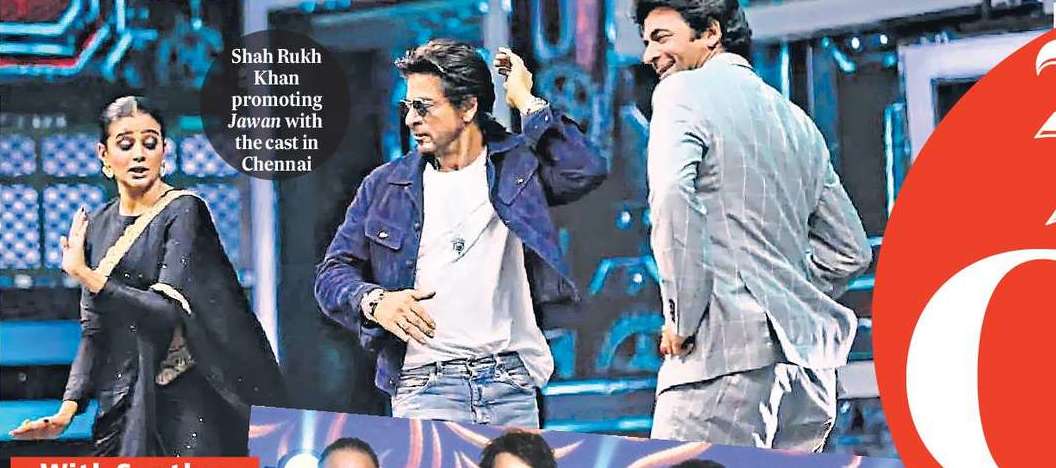
With Southern horizons embraced and stars shining beyond borders, it’s the new era of pan-India appeal and cross-regional collaborations
Rishabh Suri (HINDUSTAN TIMES; December 26, 2023)
Yes, 2023 has turned out to be a great year for Hindi films, with multiple hits coming in. But a crucial aspect related to films also underwent a sea change — we saw biggies turning to the south states for mega events, some deciding not to promote their film at all (we are looking at you, Shah Rukh, for Pathaan), and some (again, SRK) heavily promoting the film abroad. But the most significant evolution observed was the industry’s pivot towards engaging with the lucrative Southern markets.
IT SHOULD ALL GO SOUTH
Considering the tough competition regional language films give to Hindi films, it was only a natural step for us to explore the South markets. Makers of Shah Rukh’s Jawan realized that for a film to be called pan-Indian, it definitely needs to be accepted in those states. And hence, they organized a live show at Sai Ram Engineering College in Chennai, with the entire cast in attendance.
Varun Gupta, the founder of Max Marketing and the brain behind the promotions of almost all big films in the northern belt, including Animal and Adipurush, explains, “Actors like SRK and Ranbir (Kapoor) need no introduction, but they need to grow an audience base in the South. The idea with Animal was that the Hindi-speaking audience loves Ranbir; they would love to watch him in a never-before-seen avatar. But audiences in different languages might not have seen all their films.”
THE SUPPORT
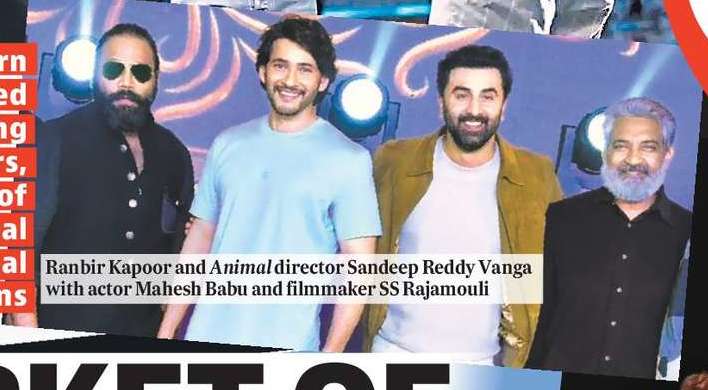
A monumental shift was witnessed with the film Animal introducing an unprecedented pre-teaser marketing strategy previously unseen in Hindi cinema. The film gained support from renowned personalities like (filmmaker) S S Rajamouli and (actor) Mahesh Babu, indicating a collective industry effort towards extending its influence beyond conventional boundaries.
But Gupta feels not every film needs to practice this: “For me, as a marketing person, my job is limited till the opening weekend; I need to market the film in a way that people come in the first three days; after that, the content has to work. I am very proud that despite Adipurush not doing well ultimately, it still opened at around Rs. 37 crore.”
G Srinivas Rao, Managing Director of Shreyas Media (which is responsible for almost all promotions done in the Southern states), echoes Gupta’s sentiments, emphasizing the immense untapped potential of the Southern markets for Hindi filmmakers. He highlights the impact of localized promotions, citing instances like Brahmāstra: Part One – Shiva (2022), which ventured into Vizag, Andhra Pradesh with large-scale events, targeting diverse audience segments.
MORE IN THE PIPELINE
Producer Ramesh Taurani, whose film Merry Christmas is set for release, also has plans for an event in Chennai. “We have made two films: one in Hindi, and the same in Tamil. In the both versions, only (actors) Katrina Kaif and Vijay Sethupathi are the same; the rest of the cast is from the respective film industries. We have a big event planned for the first week of January,” he tells us.
Makers opt for revisited versions of newer non-film songs
8:10 AM
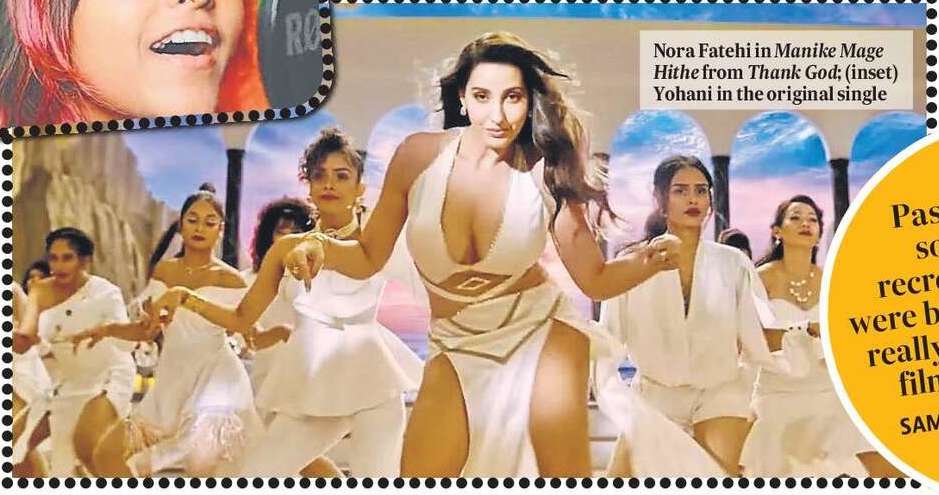
Recreation of old classics for films is passé. Of late, makers are opting for revisited versions of newer non-film songs
Rishabh Suri (HINDUSTAN TIMES; July 28, 2023)
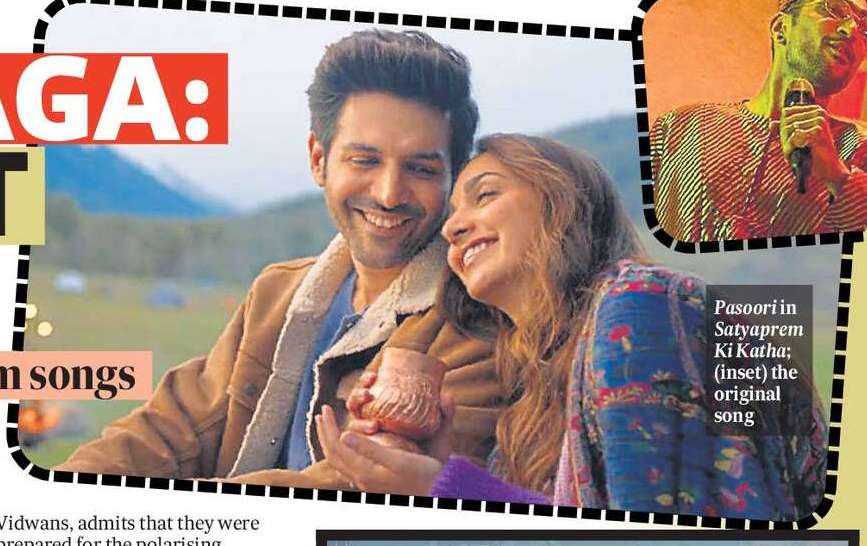
While recreations of old hit songs for Hindi films isn’t a new trend, of late, filmmakers are opting for recreations of relatively newer songs. In the recent times, a number of movies saw hit singles that released barely a couple of years ago get recreated. Singer Ali Sethi’s cult song Pasoori was revisited for Satyaprem Ki Katha recently. Earlier, Manike Mage Hithe, a hit single by Sri Lankan singer Yohani, was used in the Sidharth Malhotra-starrer Thank God (2022). Jehda Nasha, a viral song composed by the indie band Faridkot, was used in the 2022 film An Action Hero.
While the singles are still fresh in listeners’ minds, we wonder what makes filmmakers opt for their recreations. Varun Gupta, the man behind the marketing of big films, including Adipurush and Saaho (2019), says, “Recreations, if done with a bit of thought, make sense. The call lies with the producer, director and actors. For films that don’t have much music, such recreations help in promotions. But when a movie has original music, it’s not required.”
Earlier, the 2018 song Coca Cola Tu by singer Tony Kakkar was recreated for actor Kartik Aaryan’s Luka Chuppi (2019). Musician Harrdy Sandhu’s 2018 chartbuster Naah Goriye was used in 2020 for the Ayushmann Khurrana-starrer Bala.
Gupta feels that promotional songs that don’t feature in the film are a good marketing tool. “Coming up with a recreation just before a film’s release to get attention works at times. But is it a foolproof way of marketing a film? Not at all,” shares Gupta.
Pasoori’s recreation for Satyaprem Ki Katha was discussed widely. The announcement came barely a few days before the release and the film’s director, Sameer Vidwans, admits that they were prepared for the polarizing feedback. “Pasoori is a cult song. So if we recreated it, people were bound to react. We really wanted the song in our film’s soundtrack. Yes, it could have led to a negative impact on the movie, but we were sure that the song’s intensity will only add [value] to our film. I am glad it worked,” he says.
Focus on original music
Trade analyst Taran Adarsh doesn’t feel remakes help a film. “There’s so much original stuff we can do. Recreation has become a norm today. The makers feel if a song is already out, why not encash on its popularity? A really popular recent song, if recreated, will always draw comparisons with the original that’s still fresh in people’s minds,” he says.
Echoing the same sentiment, filmmaker Aanand L Rai, who produced An Action Hero, adds, “As a maker, I have accepted this and feel sorry. Recreations show our bankruptcy on the music front. It shows that we are unable to create something that is soulful or what people enjoy listening to. These things show that it is time for us to gear up and work a little more on our films’ music. It is a very important ingredient and we cannot borrow it every time. It is important to come up with originals.”
Decoding can't-live-with-or-without-you equation of cinema stars and paparazzi
9:11 AM
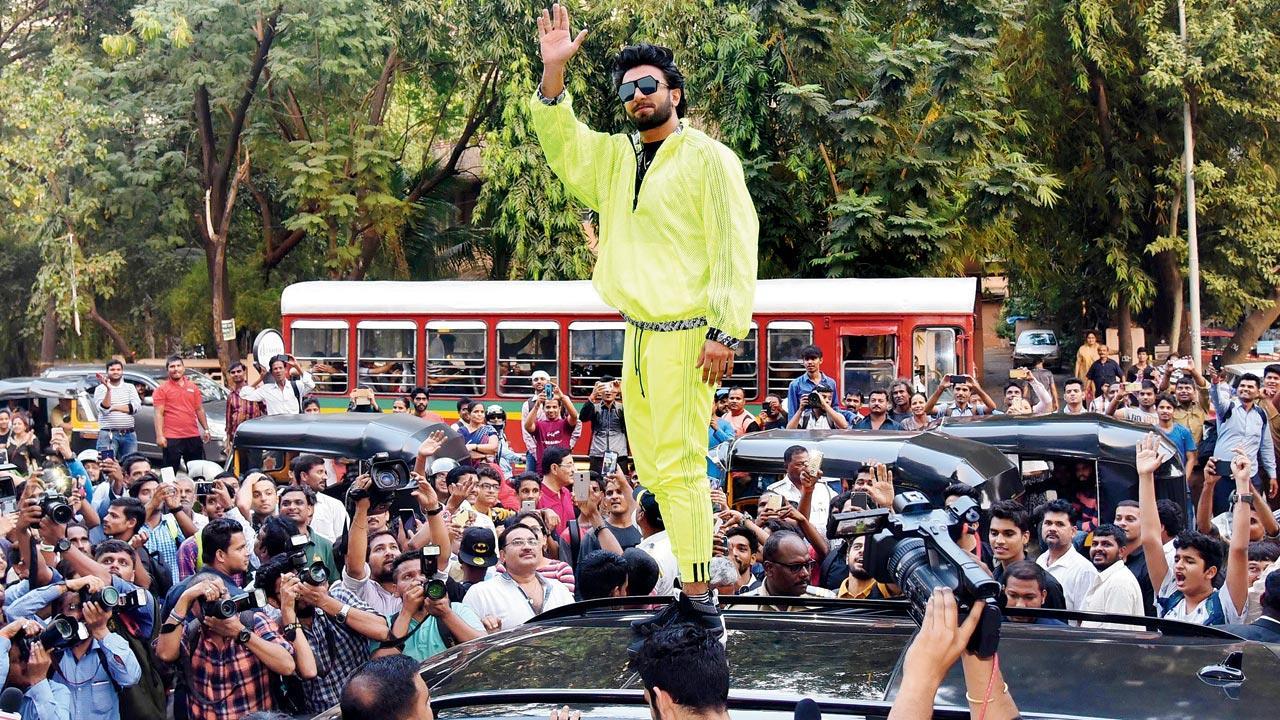
Are star photographers biting the hand that feeds them? Showbiz’s frenemies slug it out in a bid to draw boundaries and gain respect in a dog-eats-dog entertainment world
Mohar Basu (MID-DAY; July 23, 2023)
In February this year, Alia Bhatt slammed photographers who had from a structure opposite her apartment taken photographs of her inside, scrolling through her phone and spending private time with family. The A-lister took to Instagram to call out the “invasion of privacy” and tagged the Mumbai police.
“Are you kidding me? I was at my house, having a perfectly normal afternoon, sitting in my living room when I felt something watching over me. I looked up and saw two men on the terrace of the neighbouring building with a camera right at me. In what world is this okay and is this allowed? This is a gross invasion of someone’s privacy. There’s a line that you must not cross, and it is safe to say that all lines were crossed today (sic),” the 30-year-old said in the post.
Soon, several other celebrities shared similar experiences. The situation alluded to the cant-live-with-or-without-you equation that cinema stars share with photographers. While the big names may not like to admit the publicity that paparazzi or photographers’ social media accounts generate for them, for the smaller faces, being clicked could prove make or break. It is a symbiotic relationship.
Without the stars, the photographers would not only be jobless, they’d be robbed of the following they enjoy and the reactions that pictures of the famous garner for them. And in this mix is the star’s publicist or manager, often the key to a celebrity presence tip off.
If you thought that the surprised expression that heroine sported when she walked out of a Bandra cafe right into an assembly of photographers, was spontaneous, you’ve been living under a rock. It’s often the manager’s job to alert the paparazzi about the star’s whereabouts, whether it’s a Saturday afternoon blow dry at the salon, a dinner with friends in the neigbourhood or a flight to the next shoot. It changes the headline of the “spotted” picture to “arranged-to-be-spotted”, but that’s hardly of concern to the fans and public, as long as they get to see their favourite star in ‘candid’ mode.
Mumbai’s top freelance celebrity photographers have a following that rivals the actors’. Viral Bhayani leads with 7.5 million followers; Manav Manglani has 2.8 million, and Yogen Shah has two million. It has made them powerful enough to decide who will be in conversation today, circulation tomorrow. And it’s a power that the stars and their agents have played a critical role in handing to them.
Three days ago, leading film publicist Alpa Turakhia who is co-founder of Communique PR, shared a screenshot on her Insta account of a conversation between a well-known pap and her colleague. The pap wrote, “Even prostitutes want a post for airport spotting. So all these celeb managers are pimps indirectly.”
Fed up, she says, of enduring this behaviour, Turakhia called him out. When this writer, in a moment of solidarity for women professionals, reposted, we received a flurry of messages from celebrity publicists and artiste managers, each with their own version of what they called a pap horror story.
One of them, on condition of anonymity, told mid-day, “Once he [pap] put up a picture of Dharmendra and Waheeda Rahman on his page; it was not a tasteful picture. We requested him to take it down. He ranted, threatened, vomited venomous words. Most of them [paparazzi] are arrogant and have no understanding of how disgraceful their tone can be.”
Another female publicist, who runs a boutique agency, told us, “They give us maa-behen gaalis; blackmail is common. We have sometimes had to keep proof of text message exchanges so that when our clients [stars] ask us why we aren’t dealing with certain senior paps, we can show them why. In our firm, if an artiste wants a post put up by a pap who has behaved badly with us in the past, we ask the agency to reach out to the photographer directly.”
Turakhia didn’t name the photographer, but she may have been referring to Bhayani, who identifies himself as a digital creator. The independent photographer who has gone from working solo to hiring a team of 12, reached out to mid-day after our post, saying he is often misunderstood. He admitted to being under overwhelming pressure.
“I start my work day at 7 am. It’s non-stop until 1 am. I have a team, yes, but the work becomes too much. I take 200 to 300 calls a day. I admit that I might have spoken rudely or misbehaved with some; I think I should now hire a manager to streamline the communication,” he said.
Bhayani, like most other top paps, gets paid for each post. If he won’t deliver, the publicists and stars are sure to come after him. “Say, I schedule a photographer for celebrity spotting at the airport at 8 am. The publicist to a star will call me at 7.50 am, saying s/he is exiting in 10 minutes. I call my guy, he may not answer. He calls me back after 15 minutes. By then, I have had an argument with the publicist. When the pressure mounts and tempers flare, we become negative and end up saying what we shouldn’t. I am fighting for respect, too. No matter how far I go in life, I will always be seen as the man who chases celebrities. I have once had a call from an actor, threatening, ‘Photo nahin dalega tu? Chal, utha leta hoon tujhe’. I am frequently at the police station handling defamation threats. Having said this, I do want to work on my misbehaviour. I have no vices, no hobbies. I work. I don’t want to hurt with my words,” he says philosophically, mirroring his mood from an Instagram story that quotes Buddha: Only I can change my life. No one can do it for me.
Bhatt is not the only one to have taken a stand. Taapsee Pannu’s altercation with the paps during the promotions of her film Dobaaraa is now infamous. When Pannu didn’t like the way they spoke to her, she had a heated exchange. mid-day reached out to Pannu this time to understand where her relationship with the paps stands.
“Honestly, at that point, it was a reflex action. At times, I have felt that they have crossed the line. They have shouted at me. We are extra-courteous to them because we acknowledge that they spend their days filming us and building us up. That said, sometimes when our personal space is violated, it elicits a reaction. I can’t generalize because like every industry, there are good ones too. Someone sitting at a desk across the country doesn’t realize that paps don’t capture the moments when they misbehave because the camera is on us, not on them. The videos of us reacting are used as clickbait later, because negativity sells on social media. After the Dobaaraa incident, I thought a lot about this—is this a healthy part of my profession? Of course not. I am okay if I don’t get clicked often. People notice me because of my work, not how often they see me in fancy clothes. I don’t want to fear what the paps might do if I don’t go out of my way to entertain them. The power we gave them is biting us back. We have overindulged. The boundaries must be drawn. I am happy to meet them at work and entertain them, but not at the cost of my respect.”
Parag Desai, CEO of Universal Communications, a leading entertainment PR firm that represents Ajay Devgan and Amitabh Bachchan, explains how the paparazzi in India became all important. “Social media platforms have become an easy access point for fans to get their news and content on-the-go. Many freelance photographers caught on to this trend and began offering the audience insights into the daily routine of their favourite stars. Their pages soon gained popularity, and the public began interacting with their content. We have come to a point where a top pap’s social media is the essential medium for us to reach audiences directly. For young actors, this is crucial to gain recognition, reach a wider audience, and maintain regular visibility. We work on mutual trust and respect. We can’t do without the other. But, dignity and decorum has space,” he says.
Fan clubs in the city and those who run them understand the angst of agents. They say, they too have been at the receiving end of arrogance. Sumit Kumar, who runs a popular Sidharth Malhotra fan club with 110k followers on Instagram, spoke of paps expecting revenue sharing. “Fan clubs share content taken from the paparazzi, and credit it to them. What is on social media is out there for everyone to pick up. I was threatened by a pap to not pick up his content. He said I had to become a ‘50 per cent partner’, if I wanted to use his content. He wanted a stake in my revenues and followers. I had to delete his posts from my page and stopped using his content.”
Independent photographers charge for every post they put up. Some of them enjoy a remuneration in the range of three to five lakh. An industry insider says, “The top paps charge in the range of Rs 10,000 to Rs 15,000 per post. If they are given a non-industry person to post about, they hike their fee by another Rs. 10,000. For instance, a businessman who wants to be featured will end up paying more than a celebrity.”
Not everyone, though, is making a killing. A senior photographer with a leading newspaper offers an insight into the freelance photographers’ game. “Most paps make twice the salary of someone like me, a full-timer with a publication, in just a day. Despite this income flow, they choose to hire stringers for as little as Rs 10,000 a month. They don’t ask for hikes, holidays, benefits, food. Most paps you now see hanging outside say, a Bandra cafe waiting for a celebrity, are fans themselves, who want to be close to their stars. They are handed a camera by a top pap and do a bit of his work for him. There is a well-known stringer called Sneh Zala. He was a huge Deepika Padukone fan and would track her every move. He was soon hired by a senior pap. That’s how fans who hang around with their camera phones become ‘content creators’. So many paps have a previous life as delivery boys or drivers. They are not trained or professional. You’ll see them crack cheap comments or catcall the actors.”
He speaks of success having brought along hubris. “Some of them have made fake press cards,” he says. “It gives them access to places where they ordinarily couldn’t go,” he says. But he adds that it’s a juggernaut with multiple players, and all have contributed to this mess: production houses, publicists, and even the stars.
“There are stars who have multiple paps on their retainer payroll. You won’t find them posting a bad picture of these actors. Every snap and video that goes up has their approval. So, the world is seeing exactly what they want to show—how relatable, s/he is when s/he eats pani puri on the road just like an average Joe.”
When celebrities are involved in major celebrations, like a marriage, iftar party or a house get together, leading paps are paid anywhere between Rs 10 lakh and Rs 30 lakh to cover it. Interestingly, not much of this reaches the foot soldiers, who are often jabra fans, too star-struck to ask for more or better. “They are also unaware of the problem they are becoming.”
Discussing what an important cog in the wheel the paparazzi have become in India, Varun Gupta of Max Marketing, tells mid-day, “Before pap culture, only keen fans would know about a certain star’s arrival in say, Delhi to promote a film. Now, everybody knows. If Kartik [Aaryan] and Kiara [Advani] are at a launch in Jaipur, we can reach out to the entire country simultaneously through paps. They are instrumental in allowing us to reach the right target group across the country. Paps started spotting where celebrities frequented— gyms, salons, cafes, etc. It was organic and gradually, the masses followed. Now, of course, authenticity is out of the window. Anyone can pay and earn a post. They have the power to make a nobody a sensation. Take Uorfi Javed,” he says of the television actor with an outrageous fashion sense.
“We all know her, but we have no idea what she does. Ranveer Singh mentions her on Koffee with Karan!”
Gupta cites a marketing campaign they did for Oscar-winning film, RRR. They called it RRR march. “We were in different cities on the same day and did interviews against the most famous landmark of the said city... Varanasi Ghat, Howrah Bridge, Statue of Unity. We took four posts a day with the pap pages in a bid to showcase that we were everywhere promoting the film. RRR was a pan-India movie and we had to reflect this in the campaign. It is a marketer’s job to use the paps right. What you put out there and how you use them is in your control.”
Shrenik Gandhi, social media strategist and founder of White Rivers Media explains that enigma is no longer in fashion. The stars want to be accessible, and relatable. Aura doesn’t sell.
It wasn’t like this 20 years ago, says veteran photographer and curator, Piramal Gallery, NCPA, Mukesh Parpiani. He remembers a time when they landed a photograph through what they heard and dug out. “When I was photo editor at mid-day, senior photographer Pradeep Dhivar got a tip off about Amitabh Bachchan walking to Siddhivinayak mandir at night. It wasn’t routine for stars to do this back then. We got the shot in 2007 in the wee hours of the morning. When we learnt that Mandira Bedi would run on the beach early morning, we clicked her exclusively. Even when we did a shoot in conjunction with someone famous, it was more about executing an editorial call, it wasn’t staging a picture. I remember that when Rakhi Sawant was becoming famous, we realised that a middle-class girl was making it big. We shot her on a local from Andheri to Vile Parle. It was part of telling her story.”
Marcellus Baptista, who has been covering Mumbai’s party circuit for decades, recalls a time when celebrity invites were sent in hard copy. “There was no PR agency to speak of,” says Baptista who started his career with Free Press Bulletin in 1981. “It was friendly. I once went to an art event and met Amitabh Bachchan there. I didn’t even know he was going to come. It was wonderful. Perhaps publicists should stop encouraging the paparazzi. They are creating a vicious cycle.”
With inputs from Aastha Atray Banan
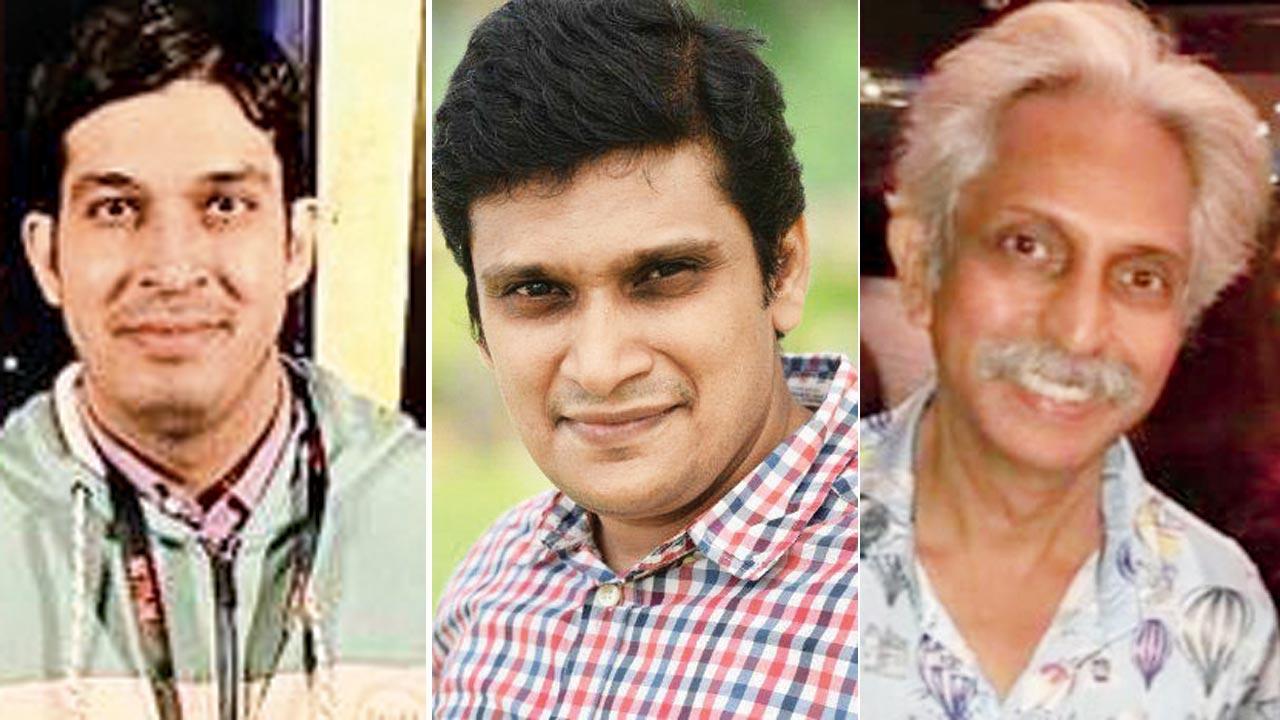
Sumit Kumar, Viral Bhayani and Marcellus Baptista
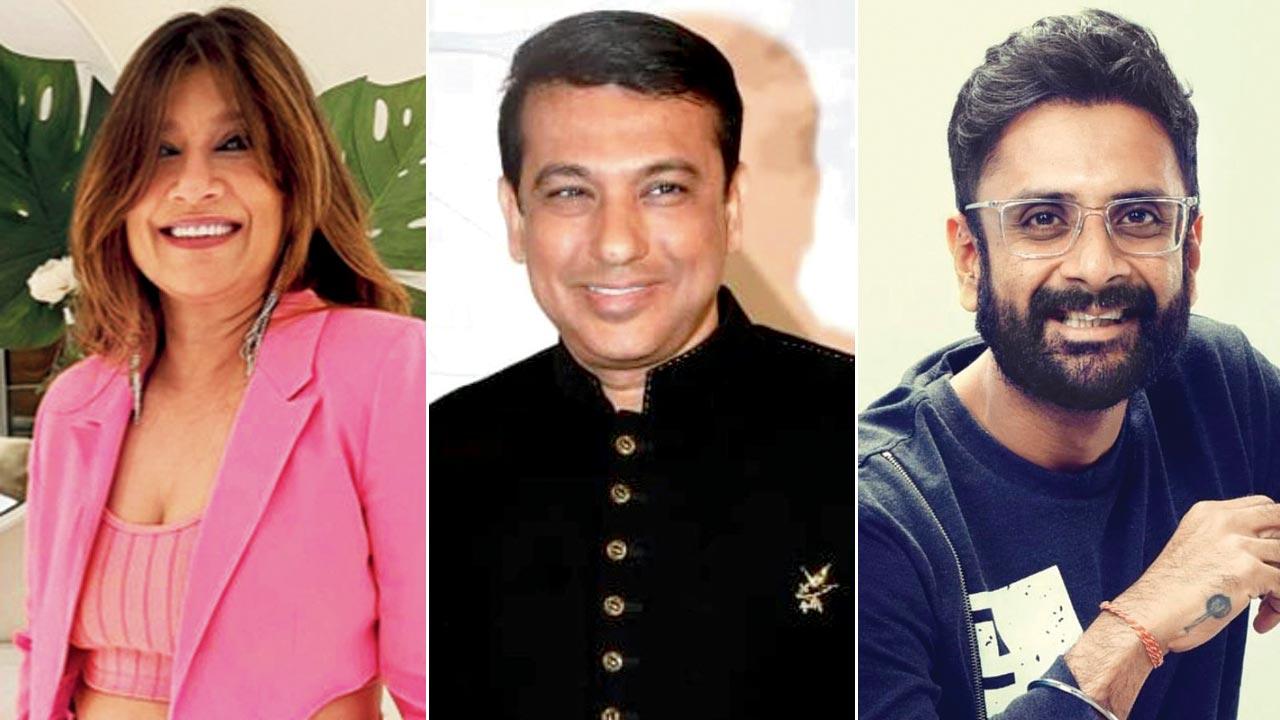
Alpa Turakhia, Parag Desai and Varun Gupta
To promote or not to promote is the question for Bollywood after Pathaan’s box-office success
8:38 AM

Rishabh Suri (HINDUSTAN TIMES; February 10, 2023)
With a Rs. 250-crore budget, three big stars, and foot-tapping music, everyone expected the makers of Pathaan to go all out marketing it. But barring some old-school repartee on #AskSRK, the film’s lead Shah Rukh Khan’s Twitter, the film remarkably opted for no promotions.
The action-thriller’s mammoth numbers (Rs. 850 crores worldwide), however, haven’t deterred makers of upcoming biggies Selfiee and Shehzada from taking the all-out route with promotions. While actor Kartik Aaryan is on a multi-city tour for the latter, Selfiee makers have been holding trailer and song launches with much fanfare.
This has inevitably plunged makers and experts in the debate — promotions or no promotions? Varun Gupta, the man behind the marketing for Selfiee, Drishyam 2, and Ram Charan and Jr NTR’s next, says it is “stupid” to blindly follow Pathaan’s example. “An actor just asked me a few days back that if Pathaan is not doing anything, why should we? I just feel helpless trying to explain that it is not a film that you can measure with any other lens. It’s the return of brand SRK on the big screen after four years, nobody else can match that. Marketing tactics will keep evolving, but they will never go out of fashion,” says Gupta.
Trade analyst Taran Adarsh, however, feels that no promotions is the way forward, because eventually, it’s content that does the talking. “Drishyam 2 didn’t do any city tours, no mall visits. Promotions and tours only add to the cost of the film. Devote time to social media and do your promotions there. Avoid lavish expenses and controversial comments before release,” he opines.
Uunchai, Ram Setu and Good Luck Jerry (all 2022) co-producer Mahaveer Jain weighs in: “If the trailer of a film hits the ball out of the park, it’s the biggest resource for any film. The same applies to songs. Now, if the makers feel that multi-city tours and promotions are required to reach the audience and create awareness, they must go ahead with it.”
And who says promotions can only be done before release? Makers of Pathaan recently also slashed ticket prices by 25%, which, Jain feels, “will help add a whole new section of an audience for the film”. Gupta agrees, calling it an excellent promotional tactic on their part.

As cinemas reopen, OTT platforms amp up promotional plans
8:26 AM

With a string of theatrical releases lined up, OTT platforms amp up promotional plans to ensure direct-to-web films Sardar Udham, Rashmi Rocket aren’t lost in the noise
Mohar Basu, Uma Ramasubramanian (MID-DAY; September 29, 2021)
As soon as the Maharashtra government announced the reopening of theatres from October 22, countless Hindi films lined up for their turn on the big screen. Simultaneously, Amazon Prime Video and ZEE5 are gearing up for the digital premiere of two promising films — Sardar Udham featuring Vicky Kaushal and Rashmi Rocket with Taapsee Pannu in the lead, respectively. At a time when all eyes are on the big-ticket theatrical outings, the two web platforms may have to launch an aggressive promotional campaign to ensure that their offerings are not lost in the noise.
Manish Kalra, chief business officer, ZEE5, says the streamer has a strong audience base, thanks to its diverse library. “For our latest title Helmet, we planned the #HelmetOn [campaign], [a series of] above- and below-the-line promotional activities covering social media, television, and out-of-home space,” he says.
It is not lost on the team at Amazon Prime India that the theatre-versus-OTT competition will, in the true sense, play out in the coming months. An insider says, “To generate buzz around Sardar Udham, the team is planning a massive event in the city, where they will recreate London. Going ahead, more films will resort to on-ground activities, besides chasing digital tie-ups and creating social media trends to ensure that their movies are a talking point.”
Shailesh Kapoor, CEO of media research firm Ormax, predicts that the small direct-to-web films will probably lose out in this race for eyeballs. “Shershaah broke out [online] in a big way in its second and third week. The upcoming theatrical releases won’t enjoy this luxury since there will be a new release every week. [Despite the disadvantage], films like Sooryavanshi and '83 will fare well because of their all-star cast. The pressure will be more on smaller films, lacking in star power, that are taking the OTT route.”
However, Varun Gupta of Max Marketing — that recently handled the promotions for Bhoot Police — states that theatrical outings have a tougher road ahead. “Every Friday has a big offering, right up till mid-2022. A cinema-going family can afford one major film [per month], so each movie has to fight for attention. [In contrast], an OTT outing targets more subscriptions. [With each film], they are luring people to the platform, not to the product.”

Releases galore but makers avoid grand promotions
8:24 AM

Film releases sans exuberant promotions have made the marketing pundits realise that they need to chalk out newer ways to engage with the audience
Juhi Chakraborty (HINDUSTAN TIMES; March 3, 2021)
After quite an underwhelming 2020, it’s finally raining theatrical releases in Bollywood with many small, medium and big films making a beeline at the box office. And what has been an integral part of film releases are the elaborate promotions including city tours, press conferences and more. But given the pandemic and rise in number of cases, is that feasible?
“I’m working on RRR, Radhe Shyam, Bhoot Police and Antim. Our strategy is to give the feel of the magic of cinemas, only then will they come and watch the film,” says Varun Gupta, founder director of MAX Marketing.
He further goes on to add that they’re not involving actors a lot in the promotions, something that they used to do pre-pandemic.
“It’ll be limited but not compromising on how we’re pitching the film as a big screen experience. We’re not looking at city tours for promotional,” he adds.
Cutting back on grand promotions is also the social responsibility on the actor’s head as even the audience would not want to venture into some place where there is a lot of crowd. Filmmaker Vipul Shah feels it’s still going to take at least six to seven months before such promotional gigs resume. “The fact that digital platforms have a wide reach, touring cities has become redundant. You’ve to work with newer ways, the world has changed. I don’t see the need of physical promotions. But yes, we’ll all have to be innovative and we’ll be fighting for people’s attention,” he explains.
Having said that, digital promotions have their own set of challenges. Jay Gotecha, who looks after marketing at Emmay Entertainment, says they released Indoo Ki Jawani in December last year, and it was challenging for them to market the film fully, using digital as a medium.
“But it was also a great learning experience as there were no physical promotions. While we’d want the actors to go all out and promote our films, for us, health and safety would be priority, not just for the actors but for the fans and cine goers as well,” says Gotecha.
Therefore, he adds, “We’ll focus on more innovative mediums to engage with our audiences. We would want them to watch our films like Satyameva Jayate 2 and Bellbottom in theatres with all safety precautions.”
Yusuf Ibrahim, the security consultant for many top Bollywood stars, says he still has no information about on-ground promotions in different cities. “There’s no protocol in place. Things will be clearer when films start this month onwards,” he says.
Even if physical promotional activities are out of question, innovation is going to be key and marketeers will have to come up with novel ways of promoting the film.
“Now that films are releasing in theatres, we can’t only be relying on digital promotions. If you expect an audience to shell out 250 bucks to watch a single film in a theatre, we need to go beyond the basic marketing of where we are just informing that a film is releasing,” concludes Gupta.

Is OTT era the end of the star reviews?
8:29 AM

With no box office numbers to lean on, the focus may shift from a film’s stars to its story
Juhi Chakraborty (HINDUSTAN TIMES; August 30, 2020)
 The Coronavirus pandemic, which brought the entertainment industry to a standstill, also made producers realise that releasing new films digitally is the best option for now. And films have been making a beeline to get a release on OTT platforms. But in the absence of box office numbers or any indicators to determine a film’s success or failure, there is no clarity on which actor’s film is faring better than the other’s, thus leaving the ‘star’ system redundant .
Ad filmmaker-turned-Hindi film director Vinil Mathew says since we don’t have any way to measure the popularity of a film or an actor, “it does kind of dilute and affect the brand value of an actor. I think till one devises parameters, there is no way to assess an actor’s value any more on the basis of his films. A star is a product of theatrical releases and, without it, obviously it would affect their stardom”.
 The lack of box office figures makes OTT releases an entire game of perception management since there is little authentic data to back it up. “Anybody can say ‘these many people have watched my film on the first three days’, there is no way to authenticate it. Stardom is out of the question now. One important component of stardom was pulling people to the theatres, there is nothing like that on OTT platforms. The push, pull and aura of stardom have completely vanished on OTT,” says film marketeer Varun Gupta, founder-director of MAX Marketing.
 Not all are complaining, though. Actor Amyra Dastur, who has starred in a web-only released film Rajma Chawal (2018), says things are better now than ever before because everything is based on word-of-mouth, not just box office collections. “Now you have to do everything based on talent. Yes a big star’s name is going to garner more interest but, at the end of the day, it is all about how good the content is. All you care about is whether it was good or not, just like in old times,” shares the actor.
The democratic nature of OTT platforms is what might make the star system and the concept of star value obsolete, feels actor Nimrat Kaur.
Agrees ad filmmaker Prahlad Kakar, who says that the OTT platforms have made the star system “very open”. “People will respect you if they relate to you, if not then they will diss you. Now with the OTT (releases) there is a breath of fresh air. It is all about content and a star does not matter,” he explains.
“Value is dependent on how you measure it. For both, the actors and us, ” expresses Aparna Acharekar, programming head, ZEE5 India, while adding, “We have had plenty of stars whose debut films premiered on the platform and the response has been phenomenal! For instance, Shalini Pandey and Aditya Rawal received immense appreciation for their roles in Bamfaad and we left no stone unturned when it came to talking about their hard work. The reach that we, as a video streaming platform are able to provide not just in India, but globally, is immense and talent – newcomers or established – are seeing this as a huge opportunity.”
Blockbuster Friday on July 31: How will a four-way film clash pan out in the digital world?
8:28 AM

With four films up for release on July 31, for first time in Bollywood, mid-day examines if there's such a thing as a box office clash in OTT world
Mohar Basu, Uma Ramasubramanian (MID-DAY; July 20, 2020)
 After Bollywood began exploring digital premiere of films since June, it was only a matter of time before we would witness a clash of movies. Come July 31, four films will compete for viewers' attention — while Vidya Balan's Shakuntala Devi drops on Amazon Prime Video, Nawazuddin Siddiqui and Radhika Apte-starrer Raat Akeli Hai and Kunal Kemmu's Lootcase will stream on Netflix and Disney+ Hotstar respectively. They will have a rival in Vidyut Jammwal's Yaara that will have dropped 24 hours earlier on ZEE5. With factors such as screen count and opening weekend collections no longer coming into play, how will a four-way clash pan out in the digital world?
 Honey Trehan, who has helmed the Netflix outing, believes the beauty of the OTT world lies in the freedom it offers from box-office numbers. "There is no concept of a clash on OTT platforms. A viewer no longer needs to buy four tickets for four films; he has the subscription to the platforms."
Aparna Acharekar, programming head, ZEE5 India, notes movies no longer have the pressure of making money within a week before the next release hits the screens. "Also, each service has its loyal audience, which is the digital [equivalent of the] first day, first show viewer. Now, people can watch two to three movies [over one weekend]."
Considering streaming giants do not reveal the viewership figures of their projects, it is difficult to determine if a film bested its rivals. However, Varun Gupta, founder-director, Max Marketing, which handles digital promotion, says there is a method to the madness. "It's a clash of the platforms, with each aiming to widen its subscription base. So, it will boil down to which film got you new subscriptions."
He predicts that the OTT world will have its own version of a clash once the honeymoon period is over. "Eventually, direct-to-web releases will move to a pay-per-view model."

Film promotions in covid times: innovation is key
2:47 PM

When movies finally do release, in theatres or on the web, creating a buzz will now be a challenge
Juhi Chakraborty (HINDUSTAN TIMES; July 16, 2020)
 The entertainment industry is slowly trying to recover from the repercussions of the Coronavirus crisis and two films, Sooryavanshi and '83, have already announced their theatrical release dates. But with social distancing and restrictions still in place, what happens to the grand promotional activities that involve huge crowds at malls and colleges, which form a very crucial aspect of a film’s release?
“Marketing will change majorly and we’ll no longer see those big events and press meets. The last few films that I worked on — Street Dancer 3D (2020), Shubh Mangal Zyada Saavdhan and Pati Patni Aur Woh (2019) — we had a lot of on-ground activities. Now nothing of that sort will be possible,” says Varun Gupta, founder director of MAX Marketing, adding strategies for theatrical films and OTT films will also differ.
Siddharth Kadam, head of marketing at Dharma Productions, feels it is now a game of waiting and watching how things pan out in the next few months. “A couple of projects have been announced for Diwali and Christmas, we don’t know what happens next as the number of cases are going up. But yes, large-scale promotional activities are no longer possible. Health and safety are priorities,” he says.
 While physical multi-city promotional tours seem a distant dream as of now, digital seems to be the way forward. “I won’t be surprised if we have a virtual meet-and-greet, that will be interesting. We will have to be very particular and won’t be able to go all out. The studio partners and marketers will have to sit down and figure out smart and innovative means of promotion,” says Jay Gotecha, who looks after marketing at Emmay Entertainment.
Another important aspect that film promotions will have to focus on is messaging, which will involve making the announcement that the film industry is back with a bang, to get audiences back to the theatres.

Another key aspect would be activities linked to the film, feels Gupta. While he admits that the movement of actors will get severely restricted, there will definitely be activities around a film which will help to promote it in different cities. “We will do a lot of things for Coolie No 1. While I might not take Varun Dhawan to Nagpur, for example, but I will still do something in the city which will move each and every person enough to go and watch the film in theatres,” he says, adding that it will be challenging yet exciting.
With 51 artistes, one voice, Amitabh Bachchan's Guzar Jayega to enter record books
8:12 AM

Voiced by Big B and 50 singers, Guzar Jayega set to enter record books
Mohar Basu (MID-DAY; May 26, 2020)
 Almost a fortnight after it dropped online, the track Guzar Jayega — that has Amitabh Bachchan voicing the prologue and features Raveena Tandon, Kapil Sharma, Juhi Chawla and Sunny Leone, among others — is set to be enlisted in the Guinness Book of World Records. Varun Gupta (right), creator and producer of the track, says that it marks the collaboration of 51 singers across the country — a feat unmatched so far.
"When we filed the nomination for the Guinness World Records, they asked us about the process we followed to develop and compile the track. We had 115 artistes joining forces for the song, including 65 celebrities who featured in the video, 50 singers and Amit ji as the narrator. It's the first time in the history of music that a single language song has witnessed collaboration of 51 singers. We have also applied to the Limca Book of World Records," enthuses Gupta, adding that the record was previously held by Michael Jackson for amassing 40 artistes for We are the world, that went on to garner $60 million for humanitarian aid in Africa.
With several singers, including Sonu Nigam, Shaan, Babul Supriyo, Shilpa Rao and Shreya Ghoshal, onboard, developing the number amid the Coronavirus lockdown was a challenge. Charting out the 25-day process, Gupta adds, "Most of them did not have the facility of an at-home studio. So, they recorded the entire track on their phones and sent it to us. We then removed the ambient noise from their portions and tweaked it. Aftab Khan [sound engineer] handled the mixing and mastering of the song."
Subscribe to:
Posts (Atom)