Showing posts with label Vaibhav Patil. Show all posts
Showing posts with label Vaibhav Patil. Show all posts
For Ranveer Singh’s natraj shot in '83, a lot of thoracic and rotational mobility was needed-Vaibhav Patil
8:17 AM
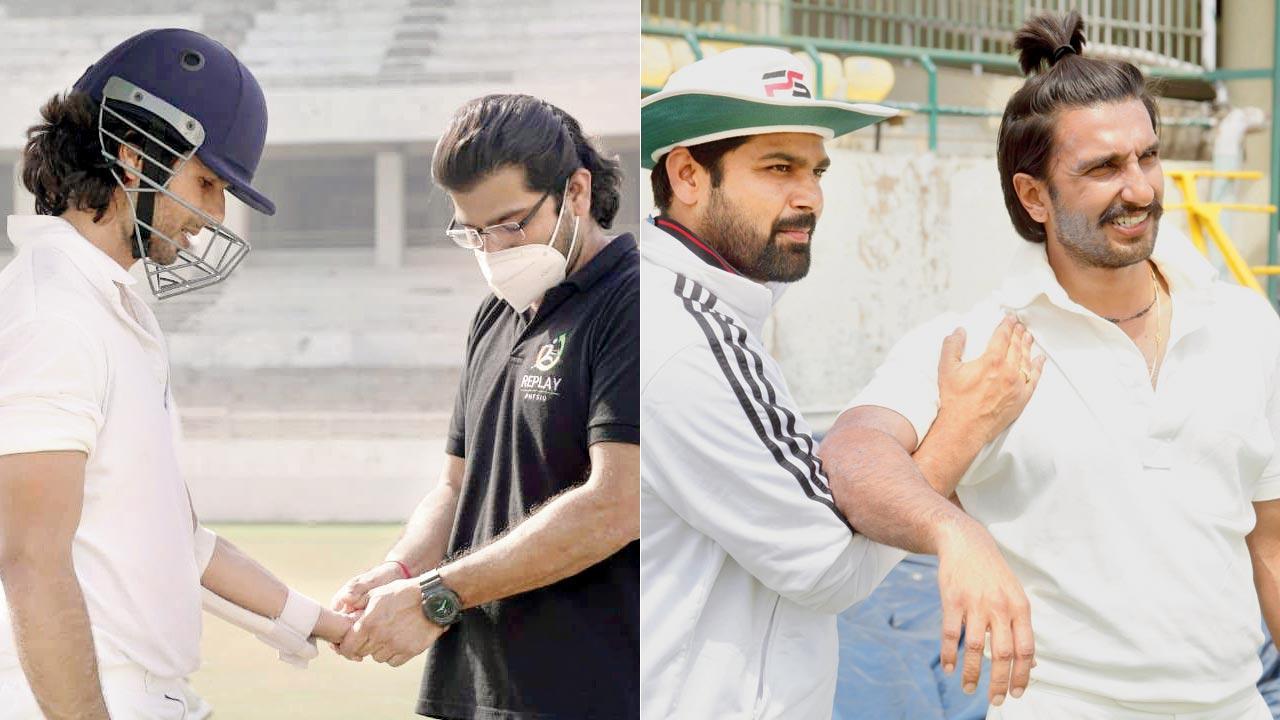
Patil Jersey actor Shahid Kapoor, and (right) with Ranveer Singh
Physiotherapist Vaibhav Patil, keeper of good health on films like Jersey, '83, Gold and Shahid Kapoor’s upcoming actioner on how therapy is employed not to heal actors, but to prevent injuries in the first place
Sonia Lulla (MID-DAY; January 26, 2022)
The task that Vaibhav Patil was dealing with at the moment was simple — to train Shahid Kapoor to run between the crease, as fast as he could. Patil knew that Kapoor’s acting prowess would enable him to perfectly resemble a cricketer in the first few takes. But unless his athletic levels matched that of a sportsperson, his body would give way over successive takes. “Functional training, like the word suggests, trains you to get better at a desired function. In this case, it was about getting the batsman to run between the wickets, faster,” he says of Kapoor’s character in the forthcoming film, Jersey.
“He needed to run with a bat, and in full gear. At the time, Shahid was tending an ankle injury. In a rehabilitative method, we trained him to first run without gear, then with dumbbells, then a [heavier] medicine ball, and eventually, with a bat, and in full gear. Such a progression could take a month, but when it translates on the big screen, it looks efficient,” says the physiotherapist, who also catered to the Indian team at the 2012 London Olympics.
A physiotherapist, one would assume, would be appointed on a sports-film set long into the shooting process, if and when injuries among actors become evident. “We are appointed very early on, often when [casting is underway],” Patil corrects us. “Especially in films like '83, where [we] need actors to look like cricketing legends, the casting process is crucial. As a physio, I analyse if a person will be able to replicate a desired body language, and pay attention to how many injuries and imbalances could become a hindrance. If the director likes an actor for a role, we tell him that we would need more time with that actor to address imbalances. For instance, Dhairya Karwa, who played Ravi Shastri, and Chirag Patil who played [his father Sandeep Patil], were definitely less athletic, and had to start training much earlier. But Saqib Saleem and Harrdy Sandhu, who were cricketers, could come in and pick up things faster.”
Same, but different
Apart from a three-step process comprising assessment, performance and recovery, Patil equips actors to excel at unfamiliar movements. “In '83, the actors had to wear the stud shoes of the olden times. None of them were accustomed to wearing them, so we had to foresee the kind of ankle issues they could face, and start strengthening the ankle accordingly, on day one.”
When dealing with the aspiring actors undergoing prep work for the hockey film Gold, Patil found himself addressing back issues on the first day of his appointment. “In the era that we were replicating in Gold, the hockey sticks were longer, and the mechanics of the game was different. None of today’s hockey players or the coaches knew how to deal with that length, and they took a few days to analyse the patterns. In hockey, you are constantly bending and running long distances. That puts a lot of load on your back. When I met the 50 actors who were shortlisted and undergoing prep, they all had lower back pain. I told the makers that we needed to change the pattern. I need to evaluate them, build their endurance, and develop a certain baseline strength before [they could even begin to train].”
Given that the actors were also unfamiliar with the sport, “hit injuries” he says, were also common. “Either they’d hit someone with the hockey stick, or they’d incorrectly fling the ball, which would hit another player.”
Serving different needs
For Patil, work on most films follows a standard protocol. A “head to toe” screening process familiarises him with each actor’s strengths and weaknesses, past injuries, and the kind of training that will suit him. He also notes the movements an actor must avoid while training and filming to keep injuries at bay, and the shooting schedule on track. With an understanding of all the actors’ strengths, a training programme suited for each is subsequently drafted. “For the part of the wicket-keeper [Syed Kirmani], we needed to increase the amount of squats and lateral movements needed for the actor. For Ranveer’s [Singh] natraj shot, a lot of thoracic and rotational mobility was needed. There was also a different training for his lateral run during the iconic catch at the boundary.”
Directors, he says, are happy to pay heed to his request when he opines that an actor needs to be pulled out from a shoot to recover. “When we feel fatigue is setting in, we pull the actor out. Actors don’t realise when they’ve hit that phase, and ignoring it can cause injuries. Also, when you are portraying enthusiasm in a sports film, a weary-looking player is not what you want to portray. So we decide how much time an actor should spend in training, and in recovery.”
While in 83, he was tasked with getting actors ready to replicate cricketers, working with Kapoor in Jersey was simpler because they didn’t have a cricketer to mimic. “So, we could shoot movements that Shahid was good at. The perfectionist that Shahid is, he wanted to be the best in each shot. Since he is a dancer, and knows how to pick up steps quickly, he could learn movements faster and then spend time perfecting them.”
From sport to sport
Kapoor was suffering from cervical spondylosis when he was cast. “That was a disadvantage, but he also had an advantage — his great footwork. We could hence balance the two during [choreography]. I spent a month in Beas at his second home. We would practice daily, and take to ice baths for recovery in the evenings.”
Working on Kapoor’s next action film poses a different set of challenges. While he trained him for power-movements in Jersey, given that as a cricketer, he had to “generate the impact”, for his training in the actioner, Patil had to teach him to “handle an impact”. “That implied focusing on core stability and strength so that he could learn how to fall without suffering a hit.”
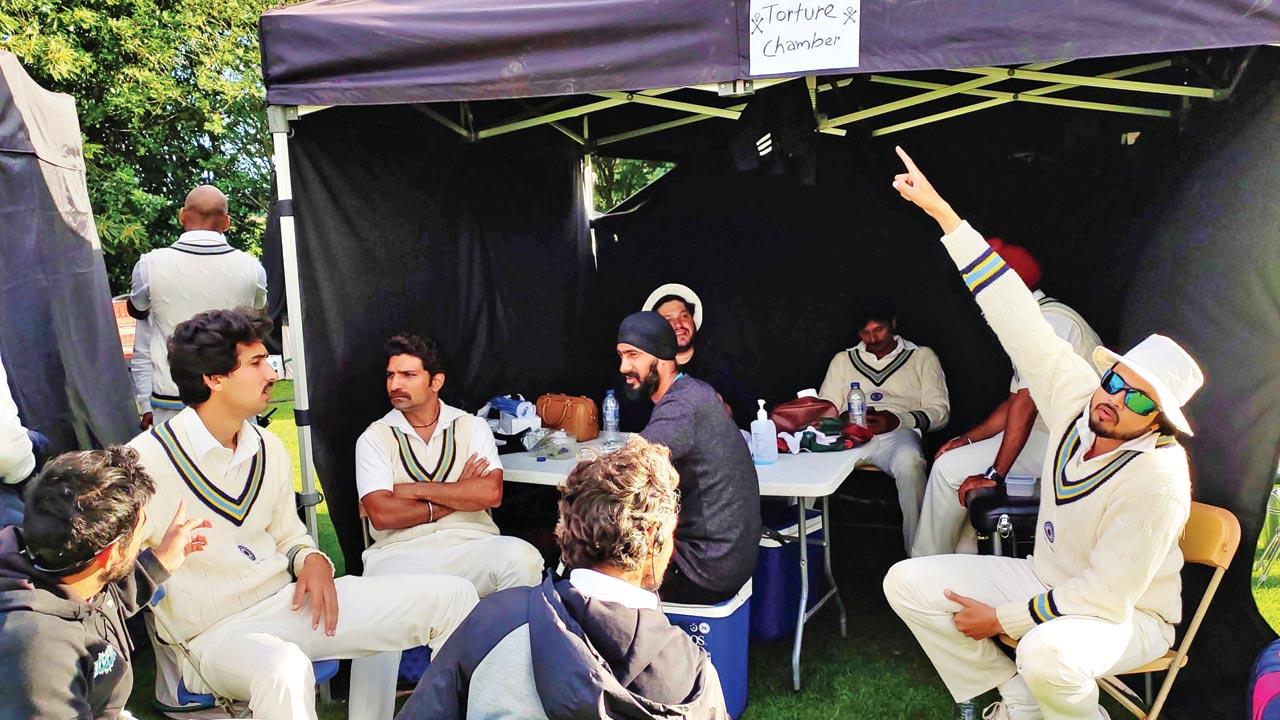
The cast of 83 referred to Patil’s work station, where they underwent rehabilitation, as ‘torture chamber’
The more Ranveer Singh bowled, the more his muscle memory developed-Balvinder Singh Sandhu
8:24 AM

Cricket coach Balvinder Singh Sandhu and team on the physical prep that the cast of Ranveer Singh's sports film is undergoing
Sonia Lulla (MID-DAY; May 1, 2019)
In the midst of a merciful break that had punctuated their practice session, cast members of Kabir Khan's '83 were summoned by coach Balvinder Singh Sandhu to witness what a ball, hurled at 90 miles per hour, looked like. "I set the bowling machine at the speed and got them to see what that pace looked like. Watching the balls being shot like bullets, they were taken aback. Those were the balls that we [1983 cricket team] faced. They realised the [importance] of portraying people who played to that pace, and were then further determined to up their [act]," says the former cricketer, who has been mentoring the cast for eight months.

Whipping Singh into shape
Then fresh off the shoot of his cop drama, Simmba, leading man Ranveer Singh was way too muscular and heavy to play the quick-footed Kapil Dev. At about 12 kilos more than desired, he had to shed the extra weight, up his lean muscle mass and stamina, and simultaneously participate in sports-specific training that cricket demanded. "When a bowler jumps and lands, there's a back-foot and front-foot impact. To bowl like Kapil, he needed strong legs. We started working on his glute muscles, along with isolated leg-strengthening exercises," says Sandhu (top; left), as fitness trainer Rajiv Mehra (top; right) adds that glute strength plays a vital role in preventing injuries. "When the glutes fire during bowling, the muscles around the hips and knees don't take the load. This helps us keep them injury-free," he says.
Coupling their goal of achieving weight loss and enhancing his bowling skills, the duo says a major chunk of his cardiovascular activity was achieved when training on the field. "The groundwork includes a lot of running. We'd begin with a structured warm-up, focusing on technique, and hip, ankle and shoulder mobility exercises. There would be different drills incorporated to suit a cricketer. These included 20 to 30 metre striding, lateral shuffles, step overruns, and also replicating catches. Executing them while paying attention to technique was also challenging. The more Ranveer bowled, the more his muscle-memory developed. On a bad day, he'd bowl 70 to 80 balls. On a good day, it was 150." Given Singh's affection for swimming, a sport least likely to cause injuries, the actor was also put on a regimen accordingly.

Addressing troubled spots
Strength endurance training that includes executing lesser reps of lighter weights helped the team achieve a two-fold effect - It helped Singh reduce the bulk he had acquired for Simmba, and also become agile and faster. "His upper body had to be strengthened to protect the load being put on it. He had tight lat muscles, which needed to be addressed. We began working on his rotator cuff muscles to improve the strength he'd require to bowl. He has been training regularly over the past four weeks. As his fitness level is improving, it is reflecting in his ability to execute the required bowling action," Sandhu says.
Making him Kapil Dev
With years of experience in training professional athletes, Sandhu and Mehra knew that the task at hand with the cast of '83 was different. Here, their performance on the field didn't matter as much as their ability to ape the players. "Ranveer has a 45-minute bowling component incorporated into his routine and must copy Kapil. We'd take his video from two angles and show him how his hands were moving. We had to then draw parallels with Kapil's movements, and make adjustments accordingly. When he first came, he struggled to bowl. He's not a fast bowler, and we had to make him one of the greatest fast-bowlers we've had. When I saw him bowl for the first time, I said it would be tough." But Singh's drive for perfection has almost become synonymous with the man himself. "When he comes in, others up their [game]. He's full of energy and makes us work harder. If I would have rated him three on 10 at the start, I'd say he's up to an eight now. I knew batting wouldn't be a concern when he played his first pull shot. But, like with all players, we worked on making him mimic the original cricketer."
 Building a team
A recently concluded 10-day Dharamshala session was conducted to enable the assorted actors to work together as a team. "Cricketers including Kapil, Madan Lal, Mohinder Amarnath, and Yashpal Sharma came and shared their experiences. That trip made the 14 players a team. They were keen to practice in the world's most beautiful stadium. During the bus rides, Ranveer would start singing, while others would join in. We had many beautiful singers. Then there would be some stand-up comedy [acts]. We achieved more than expected," Sandhu says.
Keeping niggles at bay
Physiotherapist Vaibhav Patil's (right) job began way before the actors complained of injuries. "Our aim was to prevent injuries. These actors had to mimic legends whose actions were unique. There's a lot of change that their bodies had to undergo. Apart from matching the cricketer's size, they had to ace movements that may be at odds with their own natural movement." To keep injuries at bay, Patil began with a screening session that enabled his team to identify each actor's physical follies. "If you know someone has a weak hamstring before the prep, it means that they would be prone to hamstring injuries later. So, from the onset, we'd train that muscle. Ranveer has a shoulder injury from Padmaavat. In the past, he has had surgery, and a labral tear. So we had to address his needs accordingly with the use of thera-bands and form rolling. Whether or not any actor encountered pain, he had to follow a therapy plan that was catered to his individual needs."
Therapy sessions also facilitated specific action. "For instance, Ballu sir would highlight a particular action that he needed of Ranveer that was not emerging. So, I'd design workouts to make that easier for him."

Subscribe to:
Posts (Atom)