Showing posts with label Upkar. Show all posts
Showing posts with label Upkar. Show all posts
Decoding Manoj Kumar's phenomenal box office track record as an actor
8:59 AM

Box Office India Trade Network
Legandary actor director Manoj Kumar passed away on April 4, 2025 due to a prolonged illness and LEGEND is a word used very easily but here was a man who has a legitimate claim. There is not much to say about him as a director of blockbusters as that will be pretty well documented but as actor he also had a record which would put the people with tags like superstar, megastar, emperor, king, queen etc. to shame.
Manoj Kumar was an actor who started his career in the late 50's and that time there was hardly anything called PR as this started in the late 60's. Then the tags mentioned above came into play as the media also sprang its wings with many more publications. So, various journalists probably got the nudge to write certain things and it continues till date. The super and mega tags were missing even for all the legends who came before the late 60's as they did not indulge in PR. There will be exceptions but the real talents did not at that time. Actually its easier to write about people whose success is less documented as the ones with the tags who are no doubt huge also but the level of success tends to get overrated due the actors pushing a lot themselves.
The track record of Manoj Kumar as an actor may well be second to none or at least up there with Dilip Kumar in terms of HIT ratio and success ratio if we count post stardom only. There was selective work as the filmography is only 50 films plus but this is the method of almost all the major stars today as well. However, they are unable to have this sort of track record even though it is actually easier today as an initial and seven days does the job.
In the times of Manoj Kumar, it had to be done over weeks and many of his films hit 25 weeks in ten centres or more. Obviously he was a better filmmaker than anyone today in the industry so that understanding helped pile up the HITS (many were ghost directed by him though credits had other names) and even other wise, there were generally better filmmakers around then who knew how to tell a story the Indian way.
It was on April 9, 1965 that HIMALAY KI GOD MEIN first released in Delhi/UP which made Manoj Kumar a box office star and there was no looking back after that. In the next 15-16 years, which was his peak before health took its toll, he had 25 releases and out of them only three films flopped and another four were successful while all the others were HITS or better. Out of the three films which flopped, there was the long delayed PICNIC which should have come a few years earlier and in 1976 there was another long delayed film AMAANAT which should have come in the early 70's. But such was the goodwill of Manoj Kumar that even AMAANAT somehow succeeded to the shock of its distributors.
Despite just twenty five films in these fifteen odd years there was a clash also as PEHCHAN and YAADGAAR released on the same day in 1970 and both did well. At that time, clashes were not important as a film would release in Mumbai and another film would have its premiere in Delhi/UP or East Punjab or West Bengal but here it was a genuine clash. Both these films started their journey in the same circuit as PEHCHAN released in Delhi /UP and CP Berar while YAADGAAR released in Delhi/UP and East Punjab. Business of both films was similar but PEHCHAN had less costs involved.
Below is the phenomenal box office record of Manoj Kumar between 1965 and 1981. The HIT or better films are in BOLD and the verdicts of these will be put up later this year as the site is updated. The way its going today, it may all be about nostalgia and the great records of years gone by. Nevertheless, you live in hope for things to get better and a director or two like Manoj Kumar would give confidence. This list does not include two films, MERA NAAM JOKER and SHIRDI KE SAI BABA, as they are seen as guest roles. The former failed while the latter did well.
The list is in release order.
Himalay Ki God Mein (1965)
Poonam Ki Raat (1965) - FLOP
Bedaag (1965) - AVERAGE
Gumnaam (1965)
Shaheed (1965)
Do Badan (1966)
Sawan Ki Ghata (1966)
Anita (1967) - FLOP
Picnic (1967) - FLOP (Delayed Release)
Upkar (1967)
Pathar Ke Sanam (1968)
Aadmi (1968)
Neel Kamal (1968)
Sajan (1969)
Pehchan (1970)
Yaadgaar (1970) - SEMI HIT
Purab Aur Paschim (1971)
Balidaan (1971) - SEMI HIT
Beimaan (1972)
Shor (1972)
Roti Kapada Aur Makaan (1974)
Sanyasi (1975)
Dus Numbri (1976)
Amaanat (1976) - SEMI HIT (Delayed Release)
Kranti (1981)
Manoj Kumar's flops can be counted on one hand; was successful actor and even more successful director
4:10 PM

Box Office India Trade Network
Legendary actor director producer Manoj Kumar passed away on 4th April due to age related issues which had been going on for some time. Manoj Kumar was one of the greatest directors ever seen in India and also had a pretty impeccable record as an actor. He was known for his patriotic films due to the huge success of them but was also very successful in other genres.
Manoj Kumar (born Harikishan Goswami in 1937) started his journey in the late 50's and was on the payroll of producer/director Lekhraj Bhatia appearing in practically all his films. But the turnaround came in HARIYALI AUR RASTA in 1962 which put Manoj Kumar on the road to stardom and this was consolidated with the blockbuster HIMALAY KI GOD MEIN which made Manoj Kumar a bonafide star.
He only worked in 53 films (not counting guest roles) which is very less for a career spanning 20 years as hero for that era. From HIMALAY KI GOD MEIN till 1981, the track record was such as hero that his flops can be counted on one hand. The stardom was not like say the blind following of a Dharmendra but the audience knew a film which had Manoj Kumar's name attached to it meant its a worth a watch and flocked to see them.
Manoj Kumar was super successful as an actor but even more successful as a director and only comparable to the great Raj Kapoor as an actor director. But as Manoj Kumar made patriotic films, they were probably not seen in the same way in the English media in India as they saw patriotism as jingoism but that cant take away the insane success.
As a director, it was blockbuster after blockbuster which culminated in KRANTI in 1981 which is among the top ten blockbusters ever seen in India. The directing career started with SHAHEED in 1965. It was ghost directed by him and was not credited to him. Nevertheless, it was a huge hit. It was followed by UPKAR, PURAB AUR PASCHIM, SHOR, ROTI KAPADA AUR MAKAAN followed by KRANTI and all of them were huge hits. Health problems took over post KRANTI and it was never the same as a hugely delayed CLERK released in 1989 and could not do well.
The directed films listed above featured Manoj Kumar in the lead roles and were huge hits and the other big films were HIMALAY KI GOD MEIN, NEEL KAMAL, BEIMAAN, SANYASI and DUS NUMBRI. His films also always had blockbuster music be it as director or actor and he also had a part in this with the lyrics. The legacy left behind will always reverberate on Republic Day and Independence Day for years and decades to come.
Manoj Kumar generated employment for so many people-Prem Chopra
3:20 PM

(From left) Prem Chopra and Manoj Kumar in Upkar and Shaheed
Close friend and veteran actor Prem Chopra remembers Manoj Kumar’s contribution to cinema and his career
As told to Upala KBR (MID-DAY; April 5, 2025)
I came from Shimla to become an actor. But I took up a job in a newspaper to gain a foothold in the film industry. Manoj [Kumar] was always there to help me; he has contributed a lot to my career. I was there in almost all his films. We were the best of friends, and we did many films together, including Dr Vidya [1962], Shaheed [1965], Upkar [1967], Yaadgaar [1970], Purab Aur Paschim [1970], Kranti [1981], Sanyasi [1975] and Be-Imaan [1972]. The films he made, glorifying India, are remembered even today. [That is why] he is also known as Bharat Kumar. He was a filmmaker, writer, and producer. Some of the current generation of filmmakers are even copying his patriotic style of making movies. In every film, he conveyed a message to his country. Manoj also generated employment for so many people through his films. He was instrumental in changing the images of many actors who have sustained in the film industry because of him.
My first film with Manoj was Woh Kaun Thi? [1964]. After that, he offered me the role of Sukhdev [Thapar] in Shaheed, based on Bhagat Singh, Sukhdev, and [Shivaram] Rajguru. That was my big break.
Set against the backdrop of the Indo-Pakistani war of 1965, Upkar [1967] celebrated the contributions of farmers and soldiers to India. The film also marked Manoj’s directorial debut. Initially, Rajesh Khanna was set to do the role, as Manoj wanted a young actor, but he had to opt out due to other commitments. So, he immediately cast me, as the set was ready, and we had to start shooting.
People have often compared him to some of the best directors of India, including K Asif and Raj Kapoor, among others. Manoj was ahead of his time; he would sketch out his characters and give them to his actors. It was so easy to work with him because he was clear about what he wanted. Manoj would tell you everything you were going to do [in the scene] and then back off so as not to disturb the actors in front of the camera. When he was directing, his mind was completely focused on the film 24/7. Manoj had directed himself in so many movies; he also wrote his own dialogues, which were challenging. He knew everything about cinema, including cinematography and music.
I will miss him; he was a dear friend. I feel sad that he has left us. Manoj’s name will be written in gold in film history.
Manoj Kumar said he would shelve Purab Aur Paschim if I didn’t feature in it-Saira Banu
3:18 PM

Saira Banu recounts how the veteran actor convinced thespian Dilip Kumar to have her star in Purab Aur Paschim after their marriage
As told to Upala KBR (MID-DAY; April 5, 2025)
A wonderful man has left us today. Manoj Kumar ji and I worked together in Shaadi [1962], Purab Aur Paschim [1970], and Balidaan [1971]. As soon as my first film Junglee [1961] became a big hit, I received many offers, among which was Shaadi. I used to be awkward while doing romantic songs. I had requested my dance director Satya Narayan ji to have one of his dancers as a stand-in for me, for the first song, Aaj ki raat naya chand. Manoj ji was very understanding. When my solo shots were being filmed, he’d quietly move away from the set.
A few years later, my family and I were attending a première at Metro cinema. After the film ended, I noticed Manoj ji at a distance, signalling something to my brother Sultan, but we could not reach him due to the crowd. The next day, he called my brother and suggested casting me in Upkar [1967]. I was also considered for Neel Kamal [1968]. Unfortunately, my dates were committed to other ventures. So, there went my chance of doing two films with Manoj ji!
His idol was Dilip [Kumar] Saab and when I married him, I could see that they both were close—always venturing together to make different types of omelettes, and indulging in sher-o-shayari. While shooting a scene in Aadmi [1969], Manoj ji started emulating Saab so much that Saab joked, “Yaar tu meri tarah shots kar le, main koi aur tarika nikalta hoon!”
After our shaadi, Saab and I had decided that I would not continue with my film career. But as luck would have it, one of the films I had signed just before the wedding was Purab Aur Paschim. After Saab and my wedding, Manoj ji came home and declared that he would shelve his project if Saab did not allow me to feature in it. Later, when I took ill during the shoot, Saab told Manoj ji that he could have me replaced. But Manoj ji said that he would rather shelve the film than replace me. I will always respect him for this magnanimous gesture.
In Balidaan [1971], Manoj ji played a dacoit. His wife Shashi was very close to us, and used to tell me, “How will he play a daaku? He won’t sit on the horse as he is very scared.” She joked that even if a bee came into the bedroom, Manoj ji would hide and tell her to drive it out.
When Dilip Saab starred in Kranti [1981], Manoj ji kept a special screening for me and my friends. After the show, when he asked me my thoughts about the movie, I said, “I missed seeing more of Saab in the movie.” To this, Manoj ji said that he wished that Saab would be in every frame.
Manoj Kumar and his wife's hospitality reflected their roots and show business of that time-Bhawana Somaaya
3:15 PM

Renowned film journalist and author Bhawana Somaaya bids farewell to the actor and filmmaker, whose love for movies and the country brought forth a new cinematic language
Bhawana Somaaya (MID-DAY; April 5, 2025)
It was a sunny afternoon, sometime in the 1980s, when I was visiting Manoj Kumar for an interview at his Juhu residence. The filmmaker and actor was narrating stories related to his movies, when it suddenly started raining. Kumar got up to shut the windows and said, “Aise mausam mein pakode khaane ko jee karta hai”.
A while later, the house-help entered with a tray of fragrant tea and hot pakodas. Kumar smiled and said, “My wife always knows what I’m thinking”. The attendant skilfully served us tea and snacks, and added, “Bhabhi ji ne kaha hai ke pakode ghar par bane hai, zaroor khaiyega”. It was the sweetest line any homemaker had addressed to a guest, and I was touched. Their hospitality reflected their roots and show business of that time.
Kumar loved cinema, was passionate about homoeopathy and was an engaging speaker, which explains why journalists frequently sought him. He had a traumatic childhood and the wounds reflected in his characters. During the 1947 riots, he saw his baby brother collapse in his mother’s arms on a hospital bed when the hospital staff deserted all the patients and ran away. Kumar was only 10 years old and unable to help his mother!
His family migrated from Pakistan to Delhi, India, and for a long time lived in the refugee camp. Kumar was always interested in movies, and rushed to the cinema halls whenever he had a few coins in his pocket. His friends encouraged him to travel to Bombay and try his luck in movies, so he strolled inside a suburban studio seeking work. Initially, he did odd jobs like moving camera trolleys, and sometimes sweeping the set floor, till one day, he was asked to stand in for a missing actor. That’s when the cameraman declared that the 20-year-old had something in him!
Kumar’s debut film Fashion [1957] led to eight more movies, but none of them succeeded till Hariyali Aur Rasta [1962] launched him as a star. The magic truly started with Woh Kaun Thi? [1964], followed by two more murder mysteries Gumnaam [1965] and Anita [1966].
Playing a patriot in Shaheed [1965] impacted him deeply. It is said that our then Prime Minister, Lal Bahadur Shastri, invited him to Delhi and asked him to make a film promoting the slogan, Jai Jawan Jai Kisaan. “Do it fast before the climate changes,” Shastri ji is supposed to have told him. Kumar had never written or directed a film earlier. He didn’t wish to work in isolation, and came up with a unique plan of writing the script. He booked himself on a Rajdhani train to Delhi and finished writing the film’s first half from Bombay to Delhi. The second half, he completed from Delhi to Bombay.
Upkar [1967] won two National Awards, but the person for whom Kumar made the film was no more. Shastri ji died on January 11, 1966, in Tashkent. The film was a turning point in his career, and made him a multi-hyphenate as he wrote, directed and acted in all his films—Purab Aur Paschim [1970], Shor [1972], Roti Kapda Aur Makaan [1974], and more.
His acting assignments continued simultaneously, and he was overjoyed when Raj Kapoor cast him in Mera Naam Joker [1970]. When the film bombed, a heartbroken Kumar watched it again and again to understand what went wrong. When he arrived at the answer, he phoned Kapoor to share that had he switched the second and the third story, the audience may have been more receptive. Kapoor agreed, but by then it was too late.
In 1980, he fulfilled his dream of working with his idol Dilip Kumar in Kranti. The film was a grosser, but by the end of the decade, he was losing interest in movies. A personal tragedy where his father died under unusual circumstances put him in depression. Slowly, he stopped meeting people. The only one he stayed connected to was his heartbeat, Sai Baba. Wherever he went, he carried a picture of the deity with him.
Rest in peace, Pandit ji [as his friends called him], and walk into the clouds with your deity.
Like Raj Kapoor, Manoj Kumar had an ear for popular music
3:11 PM

Avijit Ghosh (THE TIMES OF INDIA; April 4, 2025)
New Delhi: Some actors, who later became filmmakers, displayed a keen ear for good music and it reflected in the movies they acted in and made. Irrespective of the film’s box-office fate, the music was invariably chartbusting. Raj Kapoor was one such filmmaker. Manoj Kumar belonged to the same select bunch.
Most of the films Kumar made in the 1960s and 1970s were not only box-office biggies but embellished with platinum music albums. Songs weren’t an appendage in his films, rather integral to the narrative. Kumar, like Kapoor, made special efforts to film his songs in an off-beat manner as evident in Ek pyaar ka nagma hai (film: Shor) and Main na bhoolonga (film: Roti Kapada Aur Makaan). Both have a dream-like quality.
Kumar’s Roti Kapada Aur Makaan was a rare film which ended up capturing the top two spots in the annual show of Binaca Geetmala, the hit radio countdown parade. The songs being: Mehangai maar gayee (No 1) and Hai hai yeh majboori (No 2). Even the Nitin Mukesh-Lata duet, Zindagi ki na toote ladi (film: Kranti) was a chart-topper and finished second in the annual rankings. Laxmikant-Pyarelal were the music directors of these films.
Composer duo Kalyanji-Anandji provided the score for some of his early hits such as Himalay Ki God Mein, and the initial films produced and directed by him such as Upkar and Poorab Aur Paschim. Upkar’s Mere desh ki dharti remains mandatory in schools for special days. Suspense flicks such as Woh Kaun Thi (music: Madan Mohan) and Gumnam (music: Shankar-Jaikishan) and the romantic tragedy Do Badan (music: Ravi) also had unforgettable music.
Santosh Anand, a popular lyricist of the 1970s and 1980s, debuted in ‘Purab Aur Pacchim’ (1970). The film’s opening credit said, ‘Introducing Santosh Anand’, an honour generally reserved for heroes and heroines.
Anand, a librarian then, had become a popular poet in Delhi. The actor-director met him at the city’s Oberoi Hotel and listened to his poems. The long soiree, said Anand, was the actor’s way of establishing a poetic bond. A few days later, Kumar sent him an air ticket for Bombay. “I wrote about 50 stanzas for my first song, 'Purva suhani aayee re'. He chose the parts he needed,” Anand told TOI in 2018.
Later Anand also penned the chartbusting number, ‘Ek pyaar ka nagma hai' (film: Shor), for Kumar. The number scorched the web after an impoverished platform singer was videographed singing it.
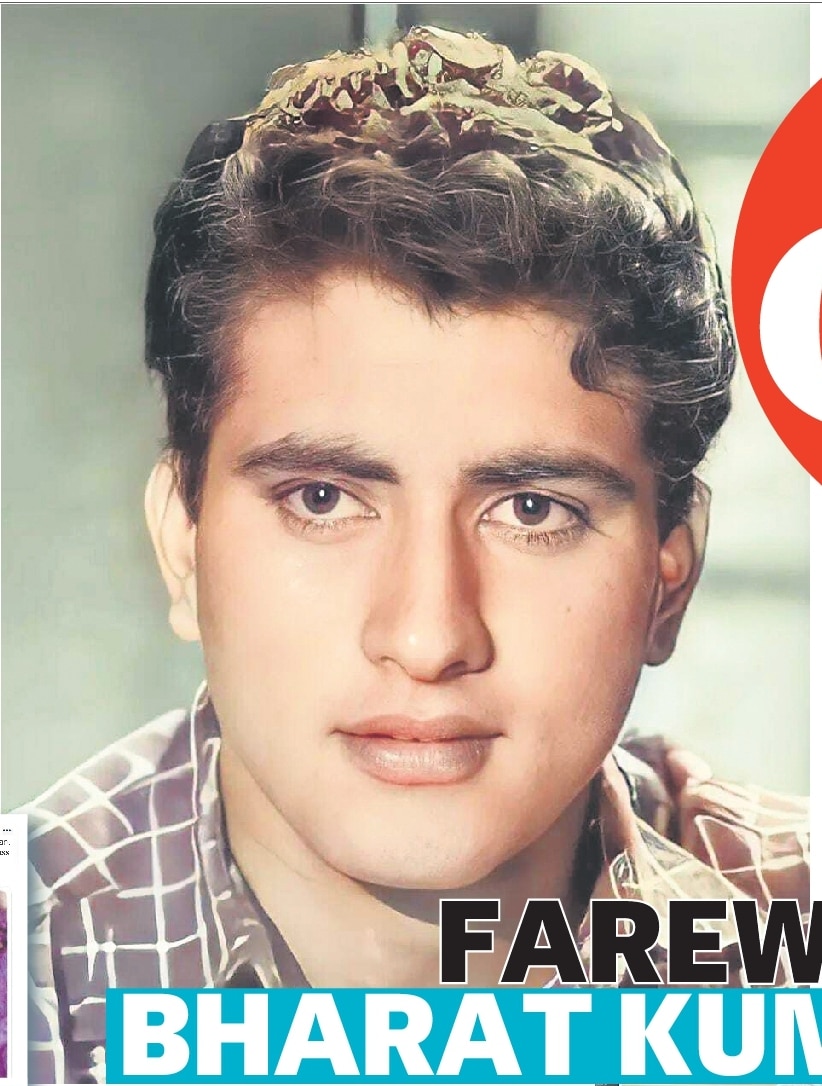
Manoj Kumar passed away at the age of 87 in Mumbai
3:10 PM
Avijit Ghosh (THE TIMES OF INDIA; April 5, 2025)
Manoj Kumar, who constructed and embodied Hindi cinema's ultimate nation-loving hero, Bharat, in blockbusters such as ‘Upkar' (1967), ‘Roti Kapada Aur Makaan' (1974) and ‘Kranti' (1981), passed away early Friday. He was 87. The actor was bedridden for the last few years battling health issues, his son Kunal Goswami told PTI. He was admitted to hospital for pneumonia some weeks ago.
A recipient of the Dadasaheb Phalke award in 2016, Kumar also starred in a bunch of stylish whodunits, notably ‘Woh Kaun Thi' (1964) and ‘Gumnam' (1965) and successful crime dramas such as ‘Sanyasi' (1975) and ‘Dus Numbri (1976)'. But it was Bharat — the screen name he often took in the films he produced and directed — that defined his image.
Bharat's idea of patriotism evolved over time. He was a nation builder in ‘Upkar' ploughing the fields, battling the enemy outside and personifying Prime Minister Lal Bahadur Shastri's slogan, ‘Jai Jawan, Jai Kisan'. In ‘Purab Aur Paschim' (1970), he was a cultural nationalist defending ‘Bharatiya sanskriti' from the ‘polluting' West while insisting that sari is better than skirt. Bharat rarely touched his heroine even though the movies weren't exactly shy in displaying the female anatomy.
Manoj Kumar constructed Hindi cinema's ultimate nation-loving hero, Bharat— the screen name he often took in the films he produced and directed.
In the 1970s when corruption and joblessness took centre-stage, the unemployed Bharat took on the enemy within, the black marketeers, in ‘Roti Kapada Aur Makaan' (1974), a film that started the multi-starrer trend in Hindi cinema. And in ‘Kranti', he time-travelled to the 19th century to fight brutish colonial masters.
Over the decades, the name, Bharat, blended Kumar's celluloid and private identities, looming large in public consciousness. "Is naam ka bahut bojh hai mujhpe. Zaroorat se zyada zimmedariyan dalta hai (The name burdens me. It puts added pressure and responsibility)," he once said in an interview.
Kumar's personal life was remarkably free from the controversies that gossip mags hungrily fed on in the 1970s and 1980s. Born in 1937 in Abbottabad, a town in north Pakistan, Kumar lost his uncle to Partition violence. At 10, he arrived in the capital, growing up in the refugee colonies of Kingsway Camp and Hudson Line in Delhi. His infant brother, Kuku, too died in the same period. "Bahut rota hua bachpan tha (I had a very sad childhood)," he said in Guftagoo, a Rajya Sabha TV show.
Recalling a moment in Delhi's Tis Hazari hospital during the Partition riots, he said, "When the sirens blared, the doctors and nurses would take shelter in the basement. My mother screamed. Kuku had died. I was angry. I took a lathi, beat up doctors and nurses. Later we immersed him in the Yamuna. As the body sank, I felt I was sinking. My father made me promise that night I will never fight again." The boy kept his word. His father was a poet who was given the pen name "khizr" (the knowledgeable) by eminent poet Allama Iqbal, he said.
Kumar got interested in movies after watching Dilip Kumar in ‘Jugnu' (1947). He even took his celluloid name, Manoj Kumar, after the character played by Dilip Kumar in ‘Shabnam' (1949), an actor who was to influence his style. His real name was Harikrishan Goswami.
A graduate from Delhi's Hindu College, Kumar arrived in Bombay in 1956. In TV shows, he recounted facing abuse, sleeping on railway platforms and getting beaten by cops before making his debut in a small role in director and relative Lekhraj Bhakri's ‘Fashion' (1957). He made his leading man debut in H S Rawail's ‘Kaanch Ki Gudiya' (1961) and survived a series of flops before striking gold in Vijay Bhatt's social drama, ‘Hariyali Aur Raasta' (1962).
Tall, fair and handsome, Kumar became a reliable box-office brand, delivering hits such as ‘Himalaya Ki God Mein' (1965), ‘Sawan Ki Ghata' (1966) and ‘Neel Kamal' (1968), a reincarnation yarn. The engagement with nationalism started with ‘Shaheed' (1965), where he played revolutionary Bhagat Singh. The film received National Award for Best Feature film in Hindi. Made at the request of then PM Shastri, his directorial debut ‘Upkar' (1967), partly shot in a village on the outskirts of Delhi, became a super hit. No song encapsulates rural India's idealized image better than lyricist Gulshan Bawra's ‘Mere desh ki dharti...'
As Kumar's career progressed, he developed a drawl for dialogue delivery; a signature hand movement across the face became more pronounced. Critics scoffed at the mannerisms but fans didn't mind. He also graduated to writing, editing, producing and directing his movies. In the 1980s, he even wrote songs, making him an accomplished all-round talent.
Manoj Kumar's multi-starrer historical ‘Kranti' (1981) was his biggest box-office hit. But thereafter the winners dried up. His final appearance as a leading man was in the vastly outdated ‘Clerk' (1989) which showcased Pakistani stars, the Rampur-born Mohammad Ali and Zeba Ali.
Kumar was married to Shashi, whose mother Savita Behen was a Congress politician of Delhi, who was nominated to Rajya Sabha, recalls Vivek Shukla, a chronicler of the capital. Initially a Congress supporter, Kumar joined the BJP in 2004.
His death on Friday was mourned widely. "He was an icon of Indian cinema, who was particularly remembered for his patriotic zeal, which was also reflected in his films. Manoj-ji's works ignited a spirit of national pride and will continue to inspire generations," posted Prime Minister Narendra Modi on X.
-----------------------------------------
HINDUSTAN TIMES (April 5, 2025)
Legendary actor-filmmaker Manoj Kumar breathed his last on Friday at Kokilaben Dhirubhai Ambani Hospital in Mumbai. He was 87. Manoj was affectionately known as Bharat Kumar for his portrayal of patriotic characters in films such as Shaheed (1965), Upkar (1967) and Purab Aur Paschim (1970). He is survived by his wife Shashi Goswami, and sons Kunal Goswami and Vishal Goswami.
Manoj died due to cardiogenic shock following acute myocardial infarction (heart attack). He was also struggling with decompensated liver cirrhosis for several months, according to PTI.
Born Harikrishan Goswami on July 24, 1937, in Abbottabad (now in Pakistan), Manoj began his career in the late 1950s. He emerged as one of Bollywood’s biggest stars in the 1960s and ’70s .
Apart from his patriotic films, he also has hits such as Hariyali Aur Rasta (1962), Gumnaam (1965), and Do Badan (1966) to his credit.
Manoj was known for his bold stance as an artiste. He sued and won a case against some of the laws imposed by then Prime Minister Indira Gandhi during the Emergency in 1975.
Over the course of his illustrious career, Manoj has received several awards and honours, including the Padma Shri, Dadasaheb Phalke Award, and National Film Award.
Actor Saira Banu, who acted with Manoj in films such as Purab Aur Paschim (1970), says, “He was unwell for a very long time. He was such a dedicated man... In later years, Manoj ji remained very close to us. We were both people of very few words, but we worked comfortably together.”
‘Was at peace with his loved ones’
Manoj’s son Kunal Goswami told ANI, “He was unwell for a long time, but he overcame everything with great intensity. It is God’s grace that he passed away peacefully. He was very happy, though a little unwell due to his age.”
Kunal also confirmed that Manoj’s last rites will be performed at 11 am today at the Pawan Hans crematorium in Vile Parle (Mumbai).
-----------------------------------------
“Veteran actor Shri Manoj Kumarji passed away peacefully early this morning around 3.30, due to age-related health issues. He had been hospitalized for the past few weeks.”
- Dr Santosh Shetty, CEO and Executive Director, Kokilaben Dhirubhai Ambani Hospital
Manoj Kumar's films have become textbooks for aspiring actors and filmmakers for his innovations-Prem Chopra
8:40 AM

Roshmila Bhattacharya (MUMBAI MIRROR; July 23, 2020)
August 15, 1947, is a red-letter day for us as it marks the birth of independent India. Almost a decade earlier, on July 24, 1937, another Bharat was born, in Abbottabad, a small town in the North-Western Frontier Province, then, a part of this country, now in neighbouring Pakistan. The boy who entered the world with a lusty cry was christened Harikrishna Goswami by his aunt, the name chosen because it carried a little of both parents, Harbans Lal and Krishna Kumari. Today, however, it’s Manoj Kumar rather than Harikrishna Goswami that rings a bell. In fact, thanks to his blockbuster patriotic dramas, the actor-writer-filmmaker has come to be known as Mr Bharat.
Prem Chopra, who worked with him in 13 films, including Shaheed, Upkar, Purab Aur Pachhim and Kranti, remembers Manoj Kumar saab as an all-rounder, who not only played the hero to perfection but also wrote, produced and directed his own films. “He could even operate the camera and edit, with the result that his films have become textbooks for aspiring actors and filmmakers for the innovations he introduced, like one-scene-one-shot at a time when there were no visual effects, and technical gimmickry was limited to trolley and zoom shots. Over the years, he’s become an institution in himself,” he asserts.
While Manoj Kumar saab officially made his debut as a director with Upkar, Prem Chopra saab reveals that even though S Ram Sharma is credited as the director of Shaheed, it was their Bhagat Singh who was taking all the calls, including insisting that none of the ‘prisoners’ could shave. “So, all through the making of the film, 75 per cent of which was filmed at the Ludhiana Central Jail, I sported a beard,” narrates the actor, who played Sukhdev in the desh bhakti film and admits he actually felt like one of the nationalists when marching towards the gallows.
The film premiered in 1965 and Prem Chopra saab remembers that the then Prime Minister Lal Bahadur Shastri, who was the special guest, had warned that he wouldn’t stay longer than 10 minutes. “But he was so mesmerised and moved, he sat right through the film, without even an interval break. Upkar was made on his slogan ‘Jai Jawan, Jai Kisan,’” recounts the actor who played Manoj Kumar saab’s younger brother, Puran, a role with grey shades, which, after the success of the film, brought along a flood of offers. As a result, he could finally give up his job in the circulation department of The Times Of India and become a full-time actor. More than half a century later, he’s still going strong.
Shatrughan Sinha, who played a fiery freedom fighter, Kareem Khan, in another of Manoj Kumar saab’s patriotic drama, Kranti, agrees with Prem Chopra saab that he is a “genius” and not just as an actor, producer, writer and director, he also has a terrific ear for music. “He is a complete artiste, and as a person, always serene. I have never heard him raise his voice at anyone on the set, not even on me even though I was notorious for coming late,” Shatru ji reminisces with a laugh.
Irrespective of when he arrived, Manoj saab would smile amicably at his Bihari Babu and tell him to let him know when he was ready to shoot before going back to his corner to work on his lines and those of others too. Instantly, you are reminded of Shatru ji’s evergreen dialogue from the film, “Apni laashon se hum tarikh ko aabad rakhen, woh ladaai ho ki angrez jise yaad rakhe” that still resonates.
So does Prem Chopra saab’s equally popular line, “Shambhu ka dimaag do dhaari talwar hai.” The actor remembers that back then filmmaking was a group activity and the whole team would sit together to discuss and design. “A character like Shambhu Singh was conceived by Manoj saab, but he gave me complete creative liberty to flesh him out,” he recounts.
Shatru ji remembers the actor-filmmaker, who turns 83 on Friday, approaching him for the role of Kareem Khan and telling him that it wasn’t much in terms of footage, but promising that it would make an impact. And sure enough, he reveals, when late producer-director Manmohan Desai saw Kranti, he called Shatru ji to tell him that he was the best. “It taught me a lesson I will remember all my life, that it’s not the length of the role, but the strength of the role that matters,” he signs off with his signature flourish.

Shaheed team with the then PM; Prem Chopra & Manoj Kumar in Upkar; Shatrughan Sinha in Kranti
In Urdu, ‘awara’ means ‘khushboo’ and even today, the ‘fragrance’ of Raj Kapoor fills our senses-Manoj Kumar
8:22 AM

Manoj Kumar with wife Shashi and Raj Kapoor at a suburban hotel, celebrating his National Award win for Shaheed; with Rishi Kapoor in Mera Naam Joker (below; right)
Roshmila Bhattacharya (MUMBAI MIRROR; June 3, 2020)
 I knew about the Joker long before Joaquin Phoenix brought him home to me. And unlike his trigger-happy Arthur Fleck or Pennywise the Dancing Clown of It, my funnyman with the painted smile and cherry nose did not give me the shakes; he made me smile, sigh and sing, “Jeena Yahaan, Marna Yahaan, Iske Siva Jaana Kahaan.” On Raj Kapoor’s 32nd death anniversary on June 2, I decided to rewind to the film closest to his heart, Mera Naam Joker, with the man, who, though on screen for a short time as David who woos Mary away from an adolescent Raju, had a major role to play in this 224-minute story.
Let’s start with Raj Kapoor’s Shree 420, which released in the Capital’s Regal cinema. Among those who queued up for tickets, first day, first show, was a young boy fondly called Ghulu. He entered the auditorium, took a corner seat and, as the lights dimmed, gave himself up to the story of Raj, Vidya, Maya and a life gone astray. Suddenly, when the song, “Shaam Gayi, Raat Aayi Ki Balam Aaja” came on, a group of men stood up, started to whistle and create a commotion.
“In a flash, a man dressed in white raced past me towards the stage. As he went up on the dais, the lights came on and I saw an enraged Raj saab calling the men, hired by rival distributors to run down the film, ‘bhaade ke tattu’. He told them that he’d made the film with heart and honesty and God would reward him. Pointing to the door, he told them to get out and shame-faced, the men complied,” Ghulu, who grew up to become Manoj Kumar, reminisces, adding that at night, when his naani wondered why he couldn’t sleep, he told her all that had transpired and asked her who was this man who could talk so fearlessly. “‘He’s a karmayogi—one who connects with God through actions’—she told me, and the words stayed with me.”
A decade later, Manoj saab was shooting for Raj Khosla’s Anita at Mehboob Studio when he got a call from Raj saab, who wanted to come over and meet him. He offered to drop by himself and a couple of days later, was at RK Cottage at 2 pm, where Raj saab requested that he oblige him by doing a cameo in Mera Naam Joker. “I immediately agreed. We decided to shoot after I’d released my Upkar,” he narrates.
Soon after, while he was away in Delhi or maybe Kolkata, Raj saab tried calling him and was brusquely told he had got the wrong number. On his return, Manoj saab was surprised when singer Mukesh relayed this to him, saying Raj saab was upset, thinking that he was being avoided as Manoj saab didn’t want to do Mera Naam Joker. Almost immediately, Manoj saab called Raj saab and asked to see him.
“We met at 4 pm at (composer) Jaikishan’s residence, where I assured Raj saab that neither I nor my wife Shashi would dare discomfit him. I told him I was looking forward to working with not the showman but a karmayogi and went on to tell him about the earlier incident at Regal. Raj saab quietly heard me out, then, put his head in my lap and started crying,” he recounts.
Soon after, Manoj saab flew down for the shoot in Ooty where, while narrating a scene that they were to shoot the following day, Raj saab stopped abruptly, alerted by the expression on his face that he didn’t agree with something. When prodded, Manoj saab pointed to a certain dialogue which made a reference to Gandhi ji’s assassination. He pointed out that since Raju was an adolescent then, the Father of the Nation would have been alive. Taken aback, Raj saab retreated to his room on the first floor, but after half an hour, came down, telling Shashi ji to persuade Manoj saab to re-write the scene for him. “When I demurred, pointing out that (K A) Abbas saab (who had penned the story and screenplay) was a senior writer, he made me speak to him on the phone and he gave me his permission,” the writer-actor-filmmaker reveals.
Raj saab was so impressed with his dialogue, particularly one where, in response to young Raju’s query about who’s the biggest joker till date, David points his thumb towards the sky and reacting to Raju’s “Bhagwan” reasons that God, like the joker, does everything for others, apne liye kuchh nahin. “Appreciating that dialogue, Raj saab called (DoP) Radhu Karmakar and a few others to listen to me as I narrated what I’d written, pointing out that I had encapsulated the philosophy of the joker in these lines,” Manoj saab recalls, adding, “The first story in this three-story film was reworked by me, but I didn’t do it for name, fame or money. I paid for my travel expenses and hotel stay and refused to take credit as writer. Mera Naam Joker was my tribute to karmayogi Raj Kapoor. In Urdu, ‘awara’ means ‘khushboo’ and even today, the ‘fragrance’ of Raj Kapoor fills our senses.”
Revealed: Shashi Kapoor, Manoj Kumar and a story of friendship
8:18 AM

Manoj Kumar and Shashi Kapoor at Purab Aur Pashchim premiere
Roshmila Bhattacharya (MUMBAI MIRROR; March 20, 2020)
Their friendship dated back to their struggling days. Even though Shashi Kapoor was the son of Prithviraj Kapoor and the younger brother of Raj and Shammi, he was determined to make it on his own. He found kindred souls in Manoj Kumar and Dharmendra, who were also chasing the celluloid dream. The trio would often land up at auditions together, hoping one of them would go home smiling. Such was the camaraderie that once, when Manoj saab ran into Shashi saab at cousin Lekhraj Bhakri’s office in Ranjit Studio, where he had dropped by on the invitation of top filmmakers Kuldeep Sehgal and Lekhraj ji, Shashi saab assured him that he wasn’t there to take away his work.
Such generosity of spirit might seem implausible today, but those were simpler times and the actor-filmmaker has fond memories of them sitting on a road roller outside Tardeo’s Central Studio where they were both shooting, weaving rainbows. “I told Shashi that if I ever made a film, I’d take him as the actor and he promised me the same,” reminisces Manoj saab.
He kept his word and approached his friend for his 1967 directorial, Upkar. “I met Shashi at Kalyanji’s (one-half of music director-duo Kalyanji-Anandji) to offer him the role of my younger brother Puran in the film. He accepted without even asking about the story or his character. He never did, such was his trust in me,” Manoj saab recounts.
However, in retrospect, Manoj saab realised that he might be betraying his friend’s trust, as Puran goes against his war-veteran brother Bharat and even his own country and the actor-filmmaker feared these shades of grey might tarnish his friend’s image of a romantic hero. “So, we met at Kalyanji’s place again where I told Shashi this role was not for him as it could cause damage. Again, without questions, he nodded, ‘As you say.’ I took it to Prem Chopra with whom I’d done Shaheed earlier and it was a turning point in his career. Shashi attended the film’s premiere. He and Jennifer (Kendal) were also there for the premiere of Purab Aur Paschim,” he narrates.
A few years later, Manoj saab went back to his friend with the 1974 social, Roti Kapda Aur Makaan. Once again, Shashi saab unquestioningly accepted the role of Mohan Babu, a rich businessman whose act of sacrifice in the end makes him a bigger hero than any quintessential lover boy. “When I tried to discuss money with him, knowing I was on a tight budget, Shashi told me, 'Jo mujhe chahiye woh tum nahin de sakte, so why don’t you just keep paying me in instalments. When you stop paying me, I’ll know that’s it'. That was Shashi Kapoor!” exults Mr Bharat, remembering fondly how during a two-month schedule in Titwala, every morning, he would leave his bungalow in Juhu, pick up Amitabh Bachchan on the way, and head for the location. Around the same time, Shashi saab would drive from his home in SoBo. “Every day, his car would overtake mine on Thane bridge, and he’d reach the set before us. Shashi was a stickler for punctuality and this quickly became a friendly race between us.”
He goes on to relate that his friend even cut short his Christmas and New Year vacation in Goa with Jennifer and his kids, to shoot for the film’s climax. “That was an annual ritual with him. It was the one time in the year when he was strictly off duty. But that one year, Shashi returned from Goa and brought in the new year working with me,” Manoj saab shares.
After he completed the film, as was a ritual with him, he wanted to take the cans of film to Haji Malang’s shrine for Baba’s blessings. But having injured his back, he knew it would be impossible to trek three miles up the hill. “When I told Shashi this, he offered to take the cans to the shrine for me. What’s more, he even hauled up the cans of Kranti. Both films were superhits, Shashi was a true friend,” says the gratified actor-producer.
During Roti Kapda Aur Makaan, Manoj saab had gone to meet his friend at Filmalaya Studio, and as he drove through the gates, he was surprised to find the usually gentlemanly Shashi Kapoor speaking in a loud, irritable voice. On enquiring, he learnt that the actor who was filming N N Sippy’s 1974 caper, Chor Machaye Shor, there was not happy with the song they were to shoot. “Bogus hai yeh gaana,” he groused, and insisted Manoj saab listen to it. Reluctant and embarrassed, Manoj saab had them rewind the Ravindra Jain’s composition for him. “As soon as the last notes died away, I told Shashi, ‘Yaar, gaana superhit hai!’ Immediately, he turned to the director (Ashok Roy) and said, ‘Since my friend likes it, let’s shoot.’”
“Le Jayenge, Le Jayenge Dilwale Dulhaniya Le Jayenge’ was one of Shashi Kapoor’s biggest chartbusters and the film was the second biggest grosser of the year. The title of Shah Rukh and Kajol’s evergreen love story, Dilwale Dulhania Le Jayenge, also has its genesis in this song.
In later years, the two dosts would meet at the hospital, when Shashi saab came for dialysis and Manoj saab for physiotherapy for his ailing back. “Then, one late evening, around 10.30 pm, I got a call. ‘O Bhagat Singh, tune maar dala.’ It was Shashi and he was watching Shaheed,” he flashbacks. “That was our last conversation. He is gone today… But his talent and his memories live on,” he says. Shashi saab would have turned 82 on March 18.
Noor Jehan had called me at least 10 times before boarding the plane-Pran
7:50 AM

Roshmila Bhattacharya (MUMBAI MIRROR; February 15, 2018)
I met him a couple of months after he had brought in his 78th birthday on February 12, 1998. I went expecting the bad man of my celluloid nightmares but found instead a frail fatalist reeling from his first visit to a hospital and the trauma of learning that one of the valves of his heart had shut down. Despite the youthful green of his kurta, Pran looked like a tired old man, often running out of breath, but unwilling to cut short our conversation.
As we meandered down memory lanes, he spoke about being discovered outside a ‘paan’ shop in Lahore by Wali Mohammed Wali, a leading script, dialogue and song writer of the time. Wali saab offered him the role of the villain in his upcoming Punjabi film, Yamla Jat, along with the address of Pancholi Studio where he promised to set up a meeting for him with his boss and the film’s producer, Mr Pancholi. But to the writer’s horror, the teenager did not turn up for the appointment the next day, convinced that the movie offer had been made in an inebriated state and not worth following up on. So instead of the studio, Pran Sikand headed to his photography shop and it was business as usual.
But the following weekend, he bumped into Wali saab again, at the Plaza theatre, and after cursing him roundly for the embarrassment he’d caused, the industry bigwig collared him to the studio the next morning, where Pran was signed for a monthly salary of Rs 50. The pre-Partition drama also featured M Ismail, Durga Khote and Noor Jehan as the heroine’s younger sister.
Yamla Jat which was unveiled in 1940 was a jubilee hit and two years later, Pran was signed as the leading man of Khandan opposite Noor Jehan. Their romance was limited only to the screen, a painfully shy Pran taking to his heels every time he was instructed to run after his heroine, but a real-life love story was playing out away from the camera. The film’s director, Shaukat Hussain Rizvi, was captivated by 17-year-old Noor Jehan and they tied the knot the same year and shifted to then Bombay. But after the Partition, Noor Jehan chose to move to Pakistan where she was born, settling down in Karachi. She mothered three children, before Rizvi and she separated in 1953. Later, she married Ejaz Durrani, a Pakistani actor-filmmaker popular for his portrayals of Ranjha and Mirza in Heer Ranjha and Mirza Sahiban, nine years younger than her, and took the curtain call after Ghalib in 1961 but never stopped singing. That marriage too ended in a divorce after three more children.
Meanwhile, Pran had married Shukla in 1945 and two years later was happily settled in Lahore, the proud father of a son, when communal fires that were sparking off across the city led to him sending his wife and young son to family in Indore. He promised to join them in time for the lil’ one’s first birthday and reached Indore on August 11 with a small suitcase. He never returned home and after the Partition, moved to Maximum City.
He was without a job for a few months, then in a span of three days signed four films—Ziddi, Apradhi, Grihasti and Wali Mohammed Wali’s own production Putli— going on to become one of Bollywood’s most hated khalnayaks. This was reiterated by the findings of a survey in the’60s across three states—Maharashtra, UP and Punjab—that threw up the startling fact that not a single school or college-going child had been named Pran during the time.
Over the years, the badmash metamorphosed into the widely respected Malang Chacha after Manoj Kumar’s Upkar and a much-loved Sher Khan after Prakash Mehra’s Zanjeer. When he was honoured with a Lifetime Achievement Award years later, he brought the audience to his feet and their standing ovation brought tears to his eyes. “Destiny, that’s the deciding factor. What has to happen will happen, even God cannot change your taqdeer…” These lines came not from any dialogue sheet but from his conviction that what’s written in the stars cannot be kept away from you.
Interestingly, while Pran was making box-office history this side of the border, his first leading lady was making history as Pakistan’s Malika-e-Tarannum (Queen of Melody) for lending her voice to the maximum number of film songs and becoming the country’s first female director. He never went back to Lahore but Noor Jehan did fly down to Mumbai to attend a musical gala in 1982, ‘Mortal Men, Immortal Memories,’ as the chief guest. “She was really nervous about that trip and had called me at least 10 times before boarding the plane. I reassured her that I’d be waiting for her at the airport here with a special bus,” Pran had reminisced. As her “Awaaz De Kahan Hai” resonated through Mumbai’s Shanmukhananda Hall memories came flooding back, of a time when borders hadn’t been drawn and countries hadn’t been divided.

Upkar: Manoj Kumar reveals how Asha Parekh refused to meet Marlon Brando
7:39 AM

Roshmila Bhattacharya (MUMBAI MIRROR; October 5, 2017)
On October 2, Asha Parekh turned 75, and Manoj Kumar, who worked with her in four films — Apna Bana Ke Dekho (1962), Do Badan (1966), Upkar 1967) and Saajan (1969) — informs that back in ’57–’58, they were part of a group called ‘Stars of Tomorrow’, being promoted by the then Filmfare editor L P Rao, J C Jain, general manager of the Times of India, and Gulshan Ewing, editor of Femina. They would meet at functions and photo sessions.
Asha got the hit she was looking for with Nasir Hussain’s ’59 romcom, Dil Deke Dekho. She consolidated her position with Ghunghat, Jab Pyaar Kisi Se Hota Hai, Gharana and Chaya, while Manoj Kumar continued to struggle for his big break till producer Jagdish Nirula, who considered Asha his sister, came to him with Apna Bana Ke Dekho. “I got the film on her recommendation and remain obliged to her,” admits Manoj, who five years later, went to her with the role of Dr Kavita in Upkar, his first official directorial, which was inspired by Prime Minister Lal Bahadur Shastri’s, ‘Jai Jawan, Jai Kisan’.
“I went to her residence with my wife, Shashi. She was packing for Kashmir, for the shoot of Jawan Mohabbat, and immediately gave her consent even though it wasn’t her usual singing– dancing kind of role. I’m not sure if she enjoyed doing the film. She certainly didn’t understand my need to drive 25–30 km to catch a sunrise. I never saw the shadow of a frown between her brows but I’ve never heard her speak about Upkar. She didn’t attend the premiere despite repeated requests. Maybe, as she said, she was busy. Once she made a commitment, Asha never went back on it,” he muses.
He recalls, when they were filming in Delhi, Marlon Brando had come to India and was staying at a five-star hotel close by. He called Brandon and they had a long chat during which Manoj Kumar invited the legendary Hollywood actor to his shoot. Brando had a meeting with Prime Minister Indira Gandhi the next day and did not know when he’d be called for it. But he promised Manoj that he’d drop by the day after.
“I requested Asha that instead of shooting the following day as planned we continue the day after, in the presence of our special guest. She refused, saying she had already committed to a dance performance on that day and flew off to Mumbai. We missed Brando but I appreciate that she doesn’t go back on a commitment, for anyone,” he says.
There are no hard feelings, only warmth, the Dadasaheb Phalke awardee insists, as working with a professional like Asha was always a pleasure. “She was the only one who called to wish me on the night of my wedding in Delhi and invited Shashi and me for lunch back in Mumbai. My wife and she continue to be friends and she’s like family,” the actor– filmmaker says, recalling their vigil at Nanavati Hospital years ago. “My father was unwell and her mother was ailing. She’d walk the corridors anxiously through the night. Her parents were always very warm and we met for lunch three to four times. During Upkar, I remember she was raising money for the Asha Parekh Hospital,” Manoj says.
The Asha Parekh Hospital bid ‘Sayonara’ on September 30. But buzz is, Asha has plans to start it again. Till then, it’s cheers from Mr Bharat on a platinum jubilee to a woman who heralded spring with him in the song “Aayi Jhoom Ke Basant” in his iconic patriotic drama, Upkar.
Bollywood publicist Gopal Pandey passes away on Jan 10 in Mumbai
7:47 AM
MUMBAI MIRROR (January 14, 2015)
Gopal Pandey, the PR powerhouse who handled the publicity of some of the biggest Bollywood films, from the late `60s to the early 2000s, died on January 10, in a Mumbai hospital. He was in his late 70s and passed away after prolonged illness.
Pandey was one of the first organised PROs in the film industry at a time when film publicity was still at a nascent stage and the extravagant promotions that are currently a norm were unheard of.
He started his career with the Manoj Kumar-directed Upkar (1967) and went on to handle the publicity for some of most successful films in the coming decades, including Purab Aur Pacchim (1970), Roti Kapda aur Makaan (1974), Don (1978), Khal Nayak (1993), Dil To Paagal Hai (1997), Kuch Kuch Hota Hai (1998) and more recently 36 China Town and Pyaare Mohan. He also handled the personal publicity for stars and filmmakers like Amitabh Bachchan and Yash Chopra.
The Subhash Ghai-directed Salman Khan-Katrina Kaif starrer Yuvvraaj was one of the last films he worked on as a publicist. He enjoyed a long association with Ghai, having worked with him on projects like Yaadein and Om Jai Jagdish.
Remembering his old buddy, Ghai told Mirror, “Gopalji was very much a part of my growth as a producer and helped me connect with the media since the Karz days.His loyalty to Mukta Arts lasted till the end. We will miss him.“
Producer Boney Kapoor, another frequent collaborator, said: “Gopal and I worked together for 25 years and we had a memorable time working on the publicity of Milenge Milenge. He was always smiling and equally efficient. The only time I remember him being sad was when his wife, Tamanna, was diagnosed with cancer. He was like a family member.“
'Sorry, yaar' was a popular catchphrase of his and he would often start his conversations with those two words. A friend of Pandey's recalled, “When his son was born, he broke the news saying, 'Sorry yaar, ladka paida hua hai.' Right from the Bachchans to Jeetendra and the Chopras, he was like family to all the top filmmakers. He had a presence in the South as well and managed the work of Sridevi, Jaya Prada and Bhanupriya.“
Gopal Pandey, the PR powerhouse who handled the publicity of some of the biggest Bollywood films, from the late `60s to the early 2000s, died on January 10, in a Mumbai hospital. He was in his late 70s and passed away after prolonged illness.
Pandey was one of the first organised PROs in the film industry at a time when film publicity was still at a nascent stage and the extravagant promotions that are currently a norm were unheard of.
He started his career with the Manoj Kumar-directed Upkar (1967) and went on to handle the publicity for some of most successful films in the coming decades, including Purab Aur Pacchim (1970), Roti Kapda aur Makaan (1974), Don (1978), Khal Nayak (1993), Dil To Paagal Hai (1997), Kuch Kuch Hota Hai (1998) and more recently 36 China Town and Pyaare Mohan. He also handled the personal publicity for stars and filmmakers like Amitabh Bachchan and Yash Chopra.
The Subhash Ghai-directed Salman Khan-Katrina Kaif starrer Yuvvraaj was one of the last films he worked on as a publicist. He enjoyed a long association with Ghai, having worked with him on projects like Yaadein and Om Jai Jagdish.
Remembering his old buddy, Ghai told Mirror, “Gopalji was very much a part of my growth as a producer and helped me connect with the media since the Karz days.His loyalty to Mukta Arts lasted till the end. We will miss him.“
Producer Boney Kapoor, another frequent collaborator, said: “Gopal and I worked together for 25 years and we had a memorable time working on the publicity of Milenge Milenge. He was always smiling and equally efficient. The only time I remember him being sad was when his wife, Tamanna, was diagnosed with cancer. He was like a family member.“
'Sorry, yaar' was a popular catchphrase of his and he would often start his conversations with those two words. A friend of Pandey's recalled, “When his son was born, he broke the news saying, 'Sorry yaar, ladka paida hua hai.' Right from the Bachchans to Jeetendra and the Chopras, he was like family to all the top filmmakers. He had a presence in the South as well and managed the work of Sridevi, Jaya Prada and Bhanupriya.“
Subscribe to:
Posts (Atom)