Showing posts with label Udta Punjab. Show all posts
Showing posts with label Udta Punjab. Show all posts
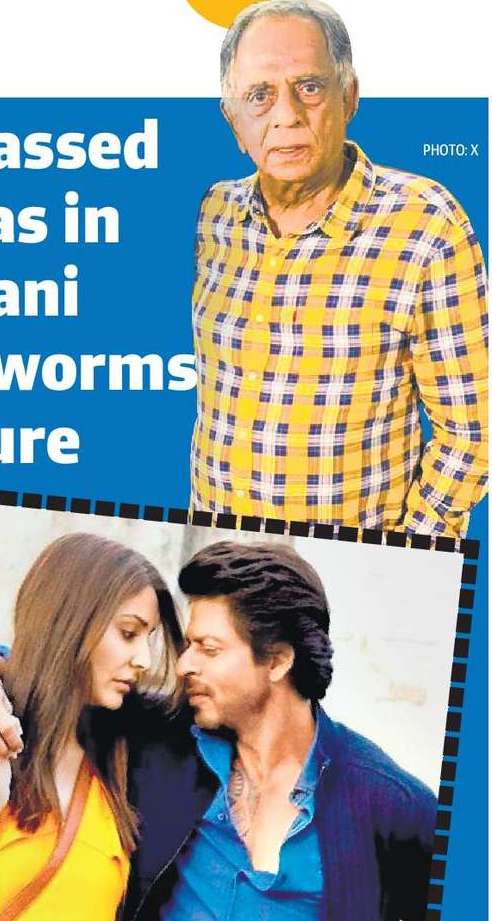
Ex-censor chief, producer Pahlaj Nihalani dies at 76
10:54 PM

Bella Jaisinghani (THE TIMES OF INDIA; June 5, 2026)
Mumbai: Producer Pahlaj Nihalani died at age 76 Thursday, reportedly of a liver ailment. He had produced successful films like ‘Ilzaam’ and ‘Aag Hi Aag’ which introduced actors Govinda and Chunky Panday respectively.
Nihalani’s first venture was ‘Haathkadi’ (1982) featuring Reena Roy’s song ‘Disco Station’, followed by ‘Aandhi Toofan’, ‘Paap Ki Duniya’, ‘Aankhen’, ‘Gunaahon Ka Faisla’, ‘Mitti Aur Sona’ and ‘Shola Aur Shabnam’.
He was also president of the (former) Association of Pictures and TV Programme Producers for 29 years.
Nihalani courted controversies during his tenure as chairman of the Censor Board of Film Certification (CBFC) from 2015 until his eventual sacking in 2017. His criticism of certain artistes raised concern, and his 98 edits of ‘Udta Punjab’ were defeated after the makers approached court. Critics said Nihalani’s moralistic stand over the depiction of Indian culture in cinema contrasted with bold portrayals and songs in his own films like ‘Andaz’ and ‘Julie 2’.
He is survived by his wife and three sons. The last rites were performed at Santacruz crematorium where Govinda arrived to pay respects.
He said, “Nihalani ji was like a foundation stone for many of us. Several artists, including me, who rose from impoverished backgrounds, received his support and encouragement. He shaped the careers of at least one dozen artistes. He had a rare ability to identify talent and help people rise to the skies of fame.”
CM Devendra Fadnavis said, “The news of the demise of renowned film producer and former CBFC Pahlaj Nihalani is heartbreaking. His contribution to the film industry will be remembered forever. With his passing, the film world has lost an experienced personality.”
Alia Bhatt to produce a line-up of films with Bambai Meri Jaan director Shujaat Saudagar, to start off with an adult campus story
9:49 AM

Mohar Basu (MID-DAY; September 22, 2025)
Even as Love & War’s shoot is keeping her busy, Alia Bhatt is developing a new chapter for her banner, Eternal Sunshine Productions. mid-day has learnt that the actor and producer is joining hands with Shujaat Saudagar for a line-up of projects that will be rolled out over the next few years. Their first offering is said to be a young adult campus story.
From her maiden production Darlings (2022), Bhatt has made it clear that she wants to back fresh stories. A source says that Rock On 2 (2016) and Bambai Meri Jaan (2023) director Saudagar, with his mix of scale and grit, fit the kind of collaborators she was looking for.
The source adds, “They’re aiming for big-screen spectacles and OTT stories. Shujaat’s company will be involved in production while Alia’s stable will work on the creative aspect. The YA story will go on floors soon.”
Did you know?
Alia Bhatt was to reportedly star in Shujaat Saudagar’s ‘Rock On 2’, but dropped out when the film’s dates clashed with that of ‘Udta Punjab’
Filmmakers are seeking insurance against piracy losses, but insurers remain reluctant
8:01 AM

Filmmakers are seeking insurance against piracy losses, but insurers remain reluctant to underwrite risk: Industry experts
Rajesh N Naidu & Shilpy Sinha (THE ECONOMIC TIMES; July 2, 2025)
Hindi film producers are increasingly seeking insurance protection against piracy-related losses, particularly for big-budget films, amid reports of significant piracy losses. However, insurers are hesitant to underwrite the risk, industry insiders said.
The issue of piracy has come into focus following reports that producer Sajid Nadiadwala suffered estimated losses of Rs 91 crore due to a leak of Salman Khan-starrer Sikandar, which was released in March.
The film is insured for standard production and liability risks with New India Assurance, people aware of the matter said. However, losses due to unauthorised copying and distribution are not standard inclusions, they noted.
“Studios working on high-budget releases have approached us for piracy cover, particularly during the final edit and digital transfer stages,” said Sumant Salian, business head of media and entertainment at Alliance Insurance Brokers. “The fear of content leaks before release is growing.”
According to a recent Media Partners Asia report, if piracy remains unchecked, revenue losses of the digital video industry in India are likely to double to $2.4 billion, or about Rs 20,565.5 crore, by 2029 from $1.2 billion in 2024.
“Piracy continues to impact revenues. It is crucial that producers put in an explicit clause covering anti-piracy losses and enforcement costs while opting for film distribution insurance,” said Suniel Wadhwa, a veteran film distributor.
“There are discussions going on between producers and insurance companies to obtain cover for film piracy,” he said.
However, while the demand for piracy cover is both legitimate and increasingly urgent, insurers face significant hurdles in addressing it. For one, it is difficult to quantify losses due to piracy, they said.
“There is demand for piracy cover, especially after the piracy of Hindi films such as Udta Punjab (2016). But insurers are reluctant to underwrite first-party piracy risk, as it is difficult to quantify and prove losses,” a senior executive at an insurance broker said, requesting anonymity. “Unless a policy is explicitly structured to protect a producer from film piracy and associated losses, an insurance company would not respond,” the executive added.
Some producers believe that they should combat piracy through systemic changes rather than relying on piracy insurance coverage.
“I think we need to fight piracy by bringing in stringent laws instead of recovering losses from piracy cover. Piracy is deeply entrenched... I think a piracy cover will make producers complacent,” producer Rajesh R Nair said. “Also, a piracy cover is an additional cost to producers at a time when there are funding challenges. Granting the industry ‘industry’ status can eradicate these problems,” he added.
Globally, too, most film producers primarily rely on anti-piracy enforcement rather than specialized insurance products to address piracy risks. “Pirates typically target big films,” Nair said.
While there is no dedicated standalone anti-piracy insurance, in the US, insurers offer optional anti-piracy riders with their customizable error & omission and cyber Insurance policies for films, a film distributor said, requesting anonymity.
In India, the film industry typically relies on two main types of insurance – for production and distribution.
Film production insurance typically covers delays, cast or crew illness, equipment damage, and liability under errors and omissions (E&O) policies. Film distribution insurance, on the other hand, protects against damage or loss of film prints or digital masters, delays in theatrical releases, business interruptions, and losses arising from leaks or piracy before release or during the early stages of digital roll-out.
Producers estimate that 10-15% of Hindi films opt for film insurance each year.
TechSci Research, a consulting and market research firm, estimates that the total Indian entertainment insurance market will grow to $373.8 billion, or about Rs 32.03 lakh crore, by 2030, from $181.6 billion, or about Rs 15.14 lakh crore, in 2024.
Omkara was passed because Sharmila Tagore’s son Saif Ali Khan was in it-Pahlaj Nihalani
9:28 AM
HINDUSTAN TIMES (May 27, 2024)
Filmmaker and former chairperson of the Central Board of Film Certification, Pahlaj Nihalani has opened up on his controversial tenure at the helm of the censor board.
In an interview with TV-radio host Siddharth Kannan, the 74-year-old, whose tenure with the board was riddled with issues, made the shocking claim that actor Sharmila Tagore, who had earlier been the chief, passed Omkara (2006) because it starred her son, actor Saif Ali Khan.
“During Sharmila Tagore’s tenure, Omkara was passed because her son Saif Ali Khan was in it. People in the board accepted bribes to pass certain films without cuts. They went against the guidelines, I just made sure the rules were followed,” said Nihalani, who was the CBFC chief from 2015 to 2017.
He also alleged that it was actor Shah Rukh Khan who agreed to removing the word ‘intercourse’ from the trailer of his 2017 film Jab Harry Met Sejal. “I spoke to Shah Rukh about this, he said, ‘Cut it’. There was only one cut. I told him to send another version or accept the cut, and he said, ‘Okay, cut it’. The media targeted me because I was controversial,” Nihalani said.
On the long-drawn controversy around the 2016 film Udta Punjab (over profanities and depiction of drug use), Nihalani added, “I never allowed myself to be pressured by the government. I passed films on merit alone. They didn’t want the title ‘Udta Punjab’ to be passed, and I threatened to resign. I don’t have any regrets. I’ve done my work with honesty.”
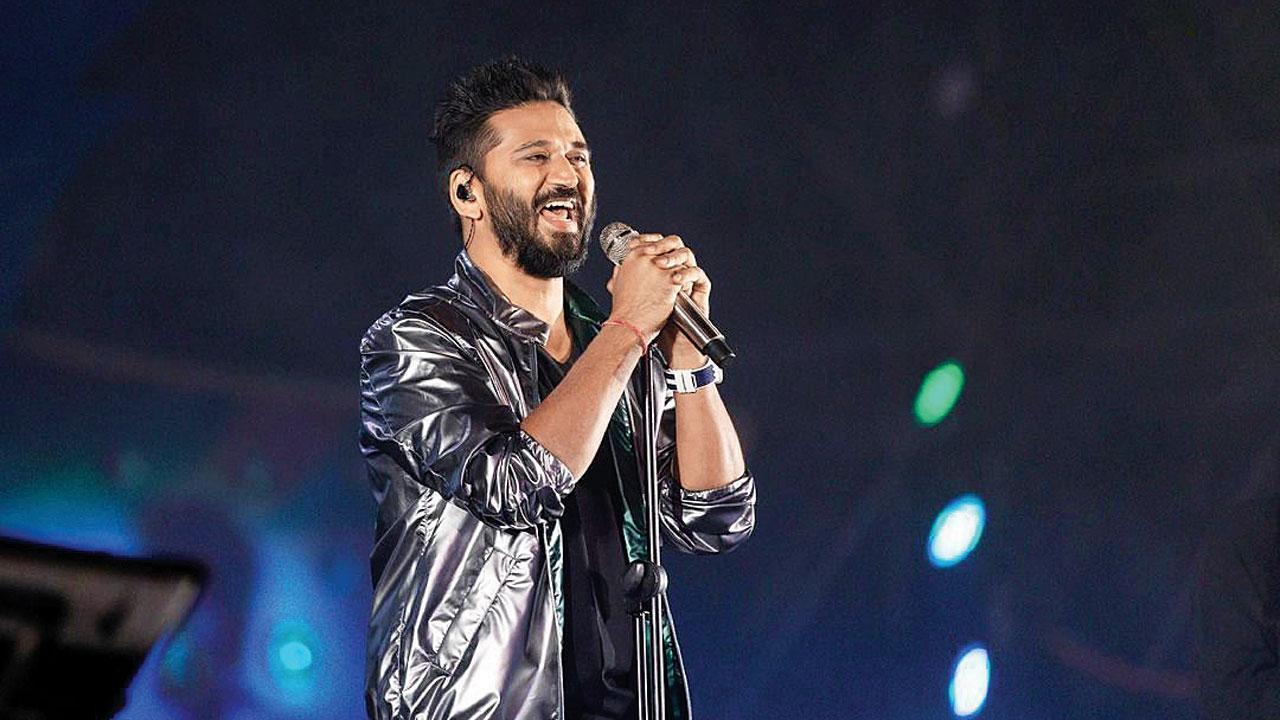
I won’t do film albums that have more than one composer; public will not know ki kiska gaana kya hai-Amit Trivedi
8:54 AM
Debarati S Sen (BOMBAY TIMES; October 14, 2023)
In 2009, Amit Trivedi’s soundtrack of Dev D changed the way Hindi film music sounded. Over the years, his willingness to experiment with diverse musical landscapes, blending of traditional elements with contemporary sounds, resonated with music lovers and his songs like Iktara (Wake Up Sid), London Thumakda and Kinare (Queen) to the electrifying beats of tracks from Udta Punjab gave Indian cinema a refreshing musical identity.
In a candid conversation with the musician at his Andheri studio, we discussed his love for freedom as a music composer, how he works multiple mediums whether it's films, OTT or the independent space, and more. Excerpts from our interview…
Mostly, all your film work has been complete albums. But there are many that have three to four composers working on one single film. Did you consciously take a stand against such albums?
Yes, I have said a no to such work. I won’t do film albums that have more than one composer. I feel bad for composers who do that because the public will not know ki kiska gaana kya hai and so your identity will be lost. In the long run, no one will remember. But if it is an individual composer then people would know and recall far more easily. For example, if it's Pathaan, we all know it is Vishal-Shekhar.
Did you ever have to give up your creative freedom for others? For the director or producer of the film?
That keeps happening. I won’t take names but when my fans feel ‘this song isn’t an Amit Trivedi one’, those are the times when I have faced this interference! In those songs mujhe creative freedom nahi diya gaya tha. Curb kartein rahein. Yeh mat karo, woah karo etc. And that is when the result is like that. Whenever I have not had any interference, those tracks and albums have worked extremely well like a Dev D, Udaan, Lootera, Kai Po Che, Queen. In Udta Punjab thoda bahut interference tha, but not much. I did the music for Qala in just three days. I didn’t let anyone interfere at all, kisi ko mauka hi nahi diya! That’s my learning after all these years in this industry!
You’d completed the first six songs of the Dev D album in six months, and it was released without any changes. Has that ever happened in recent years?
It happened with Qala and Jubilee. It is such a pleasure to work with filmmakers like these. They just let you be. They give you that freedom to create. Their ideas and visions are really great. What they want to say in their films is also unique and working on such projects is an experience. To be a part of that vision and getting to create the way you want to and the freedom to bring in what you can in that space, is magic. But if you are chasing a certain parameter of success, whether it is commercial or there is a certain mindset, it is a different ballgame, and I don’t operate from that level.
It’s been 15 years as a composer in the Hindi film music industry. Would you say your journey has been more about ups than downs?
Life is like that – ups and downs toh rehta hi hai. Mostly ups and very little downs so far, and it has been a beautiful journey and I am immensely grateful for that. Jo bhi bura hona hai woh toh hota hi hai. But then, I have a habit of rubbing things off and moving forward constantly. I never look back. Never have. Always aage chalo. Keep working. I never look at the lows in life.
I didn’t even know how to speak in Punjabi. Suvinder Vicky paji helped me-Harleen Sethi
3:07 PM
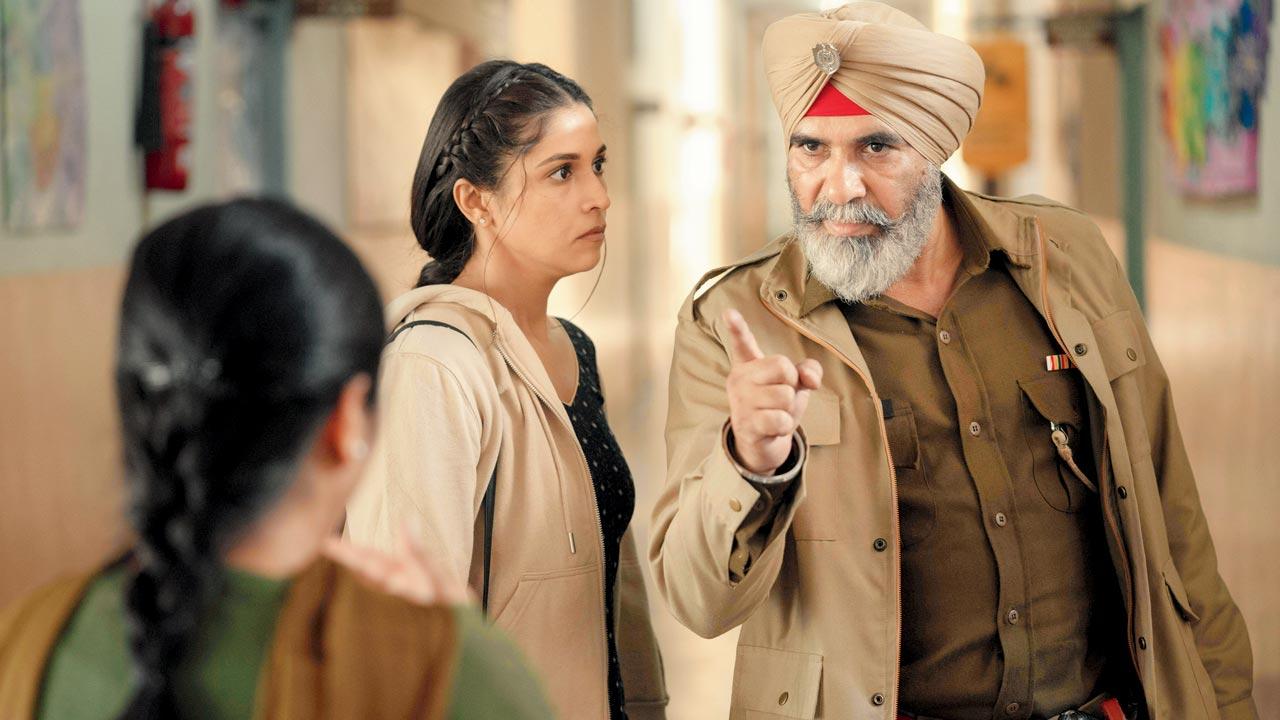
After Kohrra, actor Harleen Sethi hopes she doesn’t get stereotyped as a Punjabi girl, but Suvinder Vicky says he doesn’t mind being a Sikh cop all over again
Aastha Atray Banan (MID-DAY; July 30, 2023)
At the core of Kohrra is the dysfunctional relationship between a father and a daughter. Balbir Singh, played by Suvinder Vicky, and Nimrat Kaur, played by Harleen Sethi, are angry at each other. Where the father thinks their daughter is going wayward, the daughter resents the manner in which she was raised. The relationship needs work, but the performances are pitch perfect. We are speaking to the two on Zoom on a particularly rainy Mumbai day—Sethi is at her home in Andheri, and Vicky is joining in from Punjab.
And that’s the main difference: While Sethi is a Sikhni born and brought up in Mumbai (her ancestors are from Pakistan), Vicky is a Punjabi munda born in Sirsa.
“I didn’t even know how to speak in Punjabi,” says Sethi, “and at one point in the show, I have a long monologue in the language. But Suvinder paji helped me.”
She now seems at ease with the language, asking Vicky when he will be back so that they can meet up. “Tussi toh star ban gaye ho!” she says. Vicky, shy, laughs: “Tu bhi toh! I will be back soon. And of course, we have to meet. But Harleen impressed me. She got a Punjabi tattoo that says ‘Nirbhau Nirvair (without fear, without hate)’, and I knew she had committed herself to the process. She would come up to us after every line, ‘I said it right?’”
Sethi grew up in Andheri West, Mumbai, dancing as part of choreographer Ashley Lobo’s troupe; Vicky grew up doing theatre at Punjab University. Sethi made good with leads in shows such as Broken but Beautiful, and Vicky has done multiple movies (2016’s Udta Punjab) and shows like CAT, in which too he played a Sikh cop. He has been quoted by many reports as saying that “it’s better that success came to him late rather than never”.
But for both, the opportunity to be in Kohrra gave rise to different kinds of emotions. “I was too excited when this role came by,” says Sethi. “I had to go to Punjab and speak Punjabi. It was a challenge and a different kind of role. Also, it was a character role, not lead. There were some apprehensions, but I knew it was going to be great. The industry does stereotype you—so I really wish that doesn’t happen with us.”
For Vicky, who calls the success of Kohrra “a balle balle feeling—Punjabi style”, the role was just another one he needed to take up. “If people want to keep casting me as a Sikh cop again and again, well, that’s the way it is,” he shrugs.
“I can only say no if I have another choice in front of me. But that’s not the case. This is it. So I take what I get. At least now, people are saying ‘Paaji, you look great in pagdi’, ‘Paaji, we saw your other show, CAT, also!’”
Ask whether having Punjab as the background has contributed to the show’s success, and Vicky says it’s the story that’s the true star. “It could have been set in Haryana also,” he says. “Then the language would have changed. The rest would have remained the same—down to the fields. It’s the story that’s got the good stuff and that’s what made this show a hit. But, yes, people have appreciated the language—they like the sound of Punjabi. It’s so sweet.”
I went to last page of Kohrra's script to see if my character is killed-Suvinder Vicky
8:21 AM

Nurturing Bollywood dream since 20 years, Kohrra’s breakout star Suvinder says he was in disbelief when he was offered the lead role
Priyanka Sharma (MID-DAY; July 27, 2023)
Until a few weeks ago, Suvinder Vicky would feel anxious about his career, worried that it wasn’t moving in the right direction. But that has changed dramatically since Kohrra dropped online over 10 days ago. “Maybe this is what fame feels like. My phone hasn’t stopped ringing,” laughs the actor, talking to us over a call from his Chandigarh house.
With Netflix’s gripping investigative crime thriller emerging as a sleeper hit, the Hindi film industry and the audience have found a new breakout talent in Vicky, who plays a Punjab cop investigating a murder case. The actor, 50, points out that his success is not overnight; instead, it’s the culmination of a 20-year journey. To him, Bollywood was always the destination, but he was too scared to pack his bags and move to Mumbai.
“I come from a humble background. My parents weren’t keen on sending me to Mumbai because it felt unsafe. You keep hearing stories of outsiders, struggling to find work and pay bills. I could never muster the courage to follow my Bollywood dreams. So, I kept honing my craft, working in Punjabi films,” he says.
But Bollywood often knocked at his door, even if with smaller opportunities. The actor featured in Hansal Mehta’s Shahid (2013), and Abhishek Chaubey’s Udta Punjab (2016). Unknown to Vicky, it was during the making of Udta Punjab that Kohrra creator Sudip Sharma spotted him. Sharma, who wrote the Shahid Kapoor-Alia Bhatt crime drama, was so impressed by Vicky that he decided he would cast him in a bigger role whenever the opportunity arose.
“Sudip sir then cast me in Paatal Lok [2020], where I just had a few days’ shoot. So, I found it unbelievable when he rang me up and asked if I would do Kohhra,” the actor shares.
Even though he played a significant role in CAT (2022), headlining a Hindi show was beyond Vicky’s imagination. He candidly shares, “I read the first few pages of the script, and then went directly to the last page to see if they have killed my character.”
There was no denying that the story—exploring the dark side of love, father-son bond and familial violence—was powerful. But more than that, it was Sharma’s unflinching faith in him that made Vicky come on board. “The script was complex. I was so scared if I would be able to do it. But when the show’s creator says, ‘I won’t make the show if you don’t do it,’ then that becomes your guiding light.”
Now, Vicky feels emotionally prepared to visit Mumbai and explore more opportunities. “I have done many credible films, where I’d be mentioned as a scene-stealer, but it’s the first time, every praise mentions me as the leading man. It’s such a different feeling, especially when directors like Karan Johar, Hansal Mehta and Deepa Mehta specifically mention your name,” the actor smiles.
No one wants to make a film like NH10 or Udta Punjab for theatres today-Sudip Sharma
8:36 AM
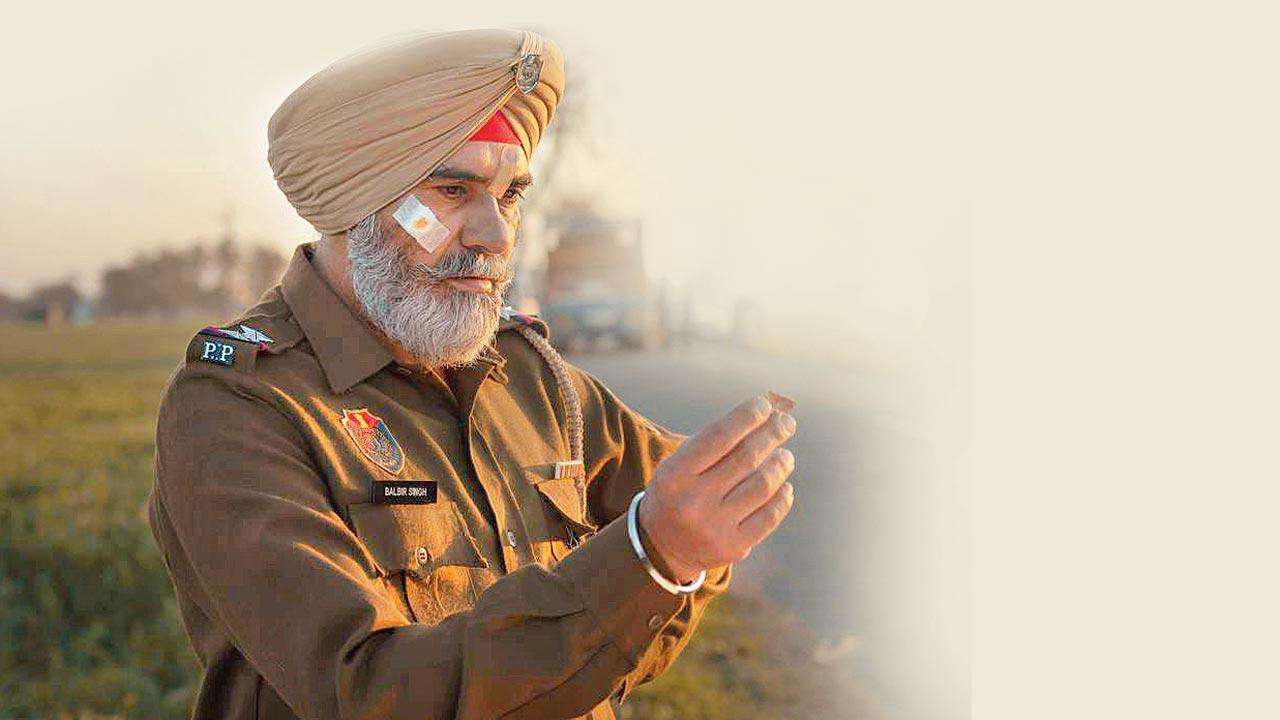
Kohrra creator Sudip on how theatrical movies have been ‘dumbed down’ in the name of entertainment, leading filmmakers to explore brave subjects on OTT
Priyanka Sharma (MID-DAY; July 20, 2023)
“I’m a non-violent person. I have never even got into a heated argument with anyone,” laughs Sudip Sharma, aware that his screen offerings might suggest otherwise. But then, it takes a calm mind to understand the complex subject of violence, its roots, and different manifestations.
After Paatal Lok (2020), Kohrra is creator-writer Sharma’s latest attempt to examine the dark side of humans. “We all carry that darkness inside us as individuals, families and societies. That’s fascinating to explore,” he begins.
The Netflix series sees Suvinder Vicky and Barun Sobti as cops investigating the murder of an NRI groom in Punjab. Under the disguise of a thriller, Kohrra tells a story about love and generational violence. Sharma, who has created the show with Gunjit Chopra and Diggi Sisodia, reveals that love was indeed its genesis.
“The starting point was the title of one of Charles Bukowski’s poems, Love is a dog from hell. We wanted to do a show about relationships. I was coming off Paatal Lok, which was a procedural. So, I didn’t want to do another. But when Gunjit and Diggi pitched the idea, I felt there was an opportunity to explore relationships and how love can be either uplifting or soul-crushing.”
When it came to casting, Sharma knew it was time to work with that actor who had left a lasting impression on him with his bit roles in Udta Punjab (2016) and Paatal Lok. Enter Vicky. “He had one scene in Paatal Lok. But he was so good in that scene that I knew I wanted to work with him again. When we started writing Kohrra, I knew he was the right choice for Balbir Singh. None of his breakthrough work like CAT [2022] and Meel Patthar [2020] had come out then.”
While Kohrra has opened to unanimous praise, Sharma has moved on to the second season of Paatal Lok, which is due next year. So, has he given up on theatrical offerings in favour of long-format stories? Something like that, says Sharma, whose last theatrical venture was Laal Kaptaan (2019), in which he served as a dialogue writer. Reason—“We stopped making films that interested people like me,” he says.
“No one wants to make a film like NH10 or Udta Punjab for theatres today. The thought—if it’s theatrical, it has to be entertaining and understood by all—basically means it has to be dumbed down. They want you to write the kind of films that are getting made. I don’t even watch those films. How can I make them?”
As The Kerala Story faces trouble in West Bengal and Tamil Nadu, industry rues the lack of creative liberty
10:27 AM
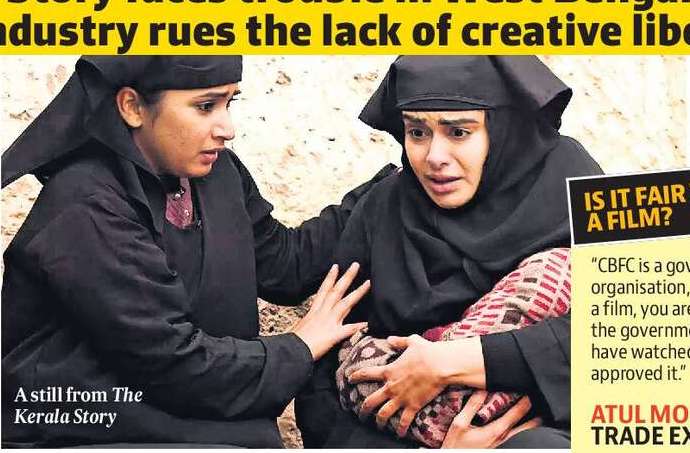
Rishabh Suri (HINDUSTAN TIMES; May 12, 2023)
Sitting at the centre of a nationwide debate storm is The Kerala Story. While Uttar Pradesh and Madhya Pradesh have made the film tax-free, it has been banned in West Bengal and it’s screening has been stopped in theatres of Tamil Nadu.
Filmmaker Anurag Kashyap tweeted, “You agree with the film or not, be it propaganda, counter propaganda, offensive or not, to ban it is just wrong (sic).” Producers Guild of India, too, issued a statement that read: “We are distressed by, and would like to record its strong objection to, the state-enforced bans on The Kerala Story.”
Filmmaker Madhur Bhandarkar says, “I supported Udta Punjab and Ae Dil Hai Mushkil (both 2016). But when Indu Sarkar (2017) was targeted by political parties, no one supported me. I feel once a film is passed by the Central Board of Film Certification (CBFC), it should be released, whether you agree with it or not.”
The film has been doing well at the box office. Trade analyst Joginder Tuteja says, “I am not saying what’s happening in West Bengal is right or wrong. But if the CBFC has allowed something, why should any state go against it? There should be creative liberty.”
Is it fair to ban a film?
Atul Mohan, trade expert: “CBFC is a government organisation, so by banning a film, you are challenging the government. People have watched it and approved it.”
Pritish Nandy, producer: “Once passed by the CBFC, a film is officially cleared for exhibition. But, if certain states feel it could create a law and order situation, it’s their right to decide whether it should be screened or not. They understand the local circumstances.”
FICCI Frames: We are upset, deformed madmen who hang around here despite not being paid for many years-Sudhir Mishra
10:13 AM

Niharika Lal (BOMBAY TIMES; May 6, 2023)
Does Bollywood exist? Is filmmaking an industry? Are filmmakers part of a system or are they freelancers doing their own projects? Is showbiz actually a business? When these questions were asked to four filmmakers – Sudhir Mishra, Hansal Mehta, Sriram Raghavan, and Abhishek Chaubey – at a session titled ‘Creating the magic of cinema’ at FICCI Frames, they shared how the magic of movies works on them.
The filmmakers, who have spent over 20-25 years making movies, spoke about how the industry is more than just the term Bollywood, it’s a place where people support each other, and that it’s an industry based on emotions.

‘BOLLYWOOD DOESN’T EXIST; WHAT EXISTS IS A RESPECT FOR EACH OTHER AND A DESIRE TO SHARE OUR WORK’
Talking about the film industry, Hansal said, “Bollywood doesn’t exist. There is no Bollywood. What exists is a lot of respect for each other and each other’s work. There is a desire to share what you have done with each other. Say, the preview of Udta Punjab – every director who was assaulted was there to support and watch the film. That for me is an industry – where you are supporting each other’s’ work.”
Agreeing with Hansal, Abhishek, who has directed films like Udta Punjab and Sonchiriya, recalled, “When Udta Punjab got into all sorts of problems, a press conference was organized. Literally, the entire industry turned up...They are talking in one voice for the film of a guy they don’t even know really well. In that sense, it was brotherhood or fraternity, or whatever you may call it. We are not an industry in the traditional sense, but we pretty much are. I love the medium of movies and I thrive on it. It is the only sensible thing I do in my life.”
Hansal said that for him, an industry is where filmmakers appreciate each other’s work and learn from it. He recalled, “When I saw Vishal’s (Bhardwaj) film Maqbool… I called him, and said, ‘Vishal, I wish I had made my first film after I saw this. I would have learnt from this and made a better film.’ That’s what happens when you see the work of a colleague and you see the work around you. When I saw Jubilee, I messaged Vikram (Motwane), ‘How do I even try to become like you?’ I think that, for me, is the beauty of the industry.”
Recalling when his first film (Jayate, 1999) made it to the Indian Panorama section (of International Film Festival of India), Hansal was told that Sudhir Mishra was on the jury. “I knew that Sudhir Mishra made Dharavi (1992). When I met him, he hugged me and said, ‘Bahut achhi film banayi hai yaar tu ne,’ and that was it! It’s now been 26 years since that day and I think that pat on the back, that hug was the industry. Everything comes out of passion and emotions. It is an industry based on emotions.”

‘WE ARE SLIGHTLY UPSET, DEFORMED MADMEN WHO HANG AROUND HERE DESPITE NOT BEING PAID FOR MANY YEARS’
Sudhir, known for films like Chameli and Hazaaron Khwaishein Aisi, said he “never liked the word Bollywood” and would rather call it “the Indian film industry”. He added, “That’s why I’m very comfortable with Vetrimaaran or somebody in the Kerala industry or Bengal, because we always grew up in the independent cinema movement. (It’s not) that people are understanding internationally our cinema (now)… they understood it with (Satyajit) Ray, no? Now, you have to set up stalls. When Ray was making films, you just had to walk around Cannes and say ‘Hey, Satyajit Ray film’ and everybody went to you. There has never been a person like him.”
Sudhir added that the money aspect of filmmaking is necessary, but that’s not what cinema is about. “I think we are all fanatics and we love this muse called cinema. We are slightly upset, deformed madmen who hang around here, and like he (Hansal) said, we have hung around here despite not being paid for many years. I often put in my director’s salary to complete the post-production. Why? It’s kind of lunacy... People who are in cinema can’t do anything else. I think that’s why they stick around. The medium loves us. It cured me. I’m sane because of it. There is so much that it does for me. Can I screw it for money? No.”

I have never had a plan. In fact, I used to think I will get married very late-Alia Bhatt
8:47 AM

Alia Bhatt with mid-day’s entertainment editor Mayank Shekhar at the latest edition of Sit with Hitlist. Pics/Ashish Rane, Satej Shinde
Bollywood’s youngest superstar on checking every life box before she turns 30, including the box office, of course
Mayank Shekhar (MID-DAY; August 20, 2022)
Shortly before he became the OTT sensation/star of sorts, actor Pankaj Tripathi used to be Alia Bhatt’s tutor — for a month. This is when Bhatt was preparing to play Kumari Pinky, a brutally abused, drugged-out migrant girl from the under-classes in Udta Punjab (2016).
“There is a ‘Pankaj Tripathi wave’ that came, na, but it came after that,” Bhatt recalls her trainer, whom she’d meet every day, mastering body language, Jharkhandi dialect, down to how her character sits on haunches for hours.
It’s the only time in her career that Bhatt confesses she went “method” on herself. Meaning, abandoned cell-phone, never stepped out of hotel room, consumed no entertainment, spent time interacting/empathising with local youth, never switched on the TV, and simply marinated in the character, until the shoot ended. Why? Because she wanted to prove she was “a chameleon as an actor.” To whom? To herself, she says.
But looks like even before the audience, first to her director, Abhishek Chaubey — who hadn’t imagined Bhatt at all in the role while scripting it. She had in fact read the said script, through Shahid Kapoor, her co-actor in the romantic fantasy, 'Shaandaar' (2015), that they were shooting at the time. She actively went up to Chaubey, asking him to consider her for the battered female lead. The initial look-test didn’t wholly convince him either.
She even learnt to play hockey for a month, which is only part of the character’s back-story, not even in the film. The effort totally matches the outcome. Although she says, “There is a part [of me] that says I won’t do it again; of course, never say never. I only played that part for 20 days, which was great. I don’t know how I would have survived it for, say, 60 days.”
And it’s not that she hasn’t attempted sufficient variety since her debut in Karan Johar’s 'Student Of The Year' (SOTY, 2012), a high-school musical, playing the high-heeled, dolled-up Shanaya Singhania, who’s also admittedly nothing like Bhatt, contrary to popular belief: “If you saw me in the clothes that I wore for my first audition, you would know how I was really not that character.”
Apparently around 400 young girls tested for that debuting role. Bhatt was in 11th standard then.
Set for a starry career, she followed up SOTY with occupying a polar-opposite space as Veera Tripathi, with a traumatic past, in 'Highway' (2014). How did she land up there? In the same way that she grabbed 'Udta Punjab' for herself — through persuasive skills.
She recalls, “Imtiaz was thinking of going with an older woman. He bumped into me at a screening, and I was very actively pursuing him. I gave him a vibe that was genuine and heartfelt. And Imtiaz Ali offering me a film, after 'Rockstar' and 'Jab We Met', of course, was a big moment for me. I read the script, and was like, okay, tough, tough, tough… I don’t pay anyone to take me in their movies, in case anybody was trying to sell that narrative. I think dedication sells on the top of the pyramid, and then come the rest. Talent is secondary, hard work is number one.”
More importantly, in showbiz, nothing sells like commercial success. And Bhatt has to her credit quite possibly the best box-office report card in Bombay. Over the past decade, all films starring her, have performed at the cinemas, barring merely two. She’s quick to point them out — Shaandaar (2015) and Kalank (2019).
As I write this, 'Darlings' (2022), Bhatt’s latest release, is trending at number two, across the world, on Netflix. She made a longish appearance in one of India’s greatest hits ever, S S Rajamouli’s 'RRR' (2022). Sanjay Leela Bhansali’s 'Gangubai Kathiawadi' (2022), with Bhatt in the title role, in fact, turned out to be a face-saviour of sorts for Bollywood in the theatres, post the pandemic, while pretty much all the top-starrers have bombed since.
Ever since she can remember, Bhatt had always wanted to be an actor. As an audience, as she described it, she was a “runty thing”, watching all of Govinda’s No 1 films in the front row of Juhu’s Chandan cinema: “I was like, mujhe Govinda banna hai!”
She entered the big screen as Preity Zinta’s child version in her father Mahesh Bhatt’s production, 'Sangharsh' (1999), when she was six. Enough offers came her way thereafter for similar parts, but her mother Soni Razdan (also an actor) was clear she didn’t want Bhatt to become a “child actor”; instead she should “study, lead a normal life; acting can happen later.”
The mother made an exception once, though. This is when she took little Bhatt out for an audition, suggesting it’d be a good experience. It’s only when she reached the building, and her mom asked the watchman about Bhansali’s floor, that she figured she was going to audition before a director she had been fan-girling over, forever: “How ironic, na, that even the building he stays in is called Magnum Opus!”
The role was for Bhansali’s 'Black'. Taking an instant shine to the kid, Bhansali told the mother right then that while he wasn’t considering her for Black, he did have a film in mind, wholly centred on her. This was going to be Balika Vadhu, that Bhatt would’ve debuted as a heroine with, when she was nine!
“We did costume rehearsals, look-tests. I went ahead and danced on Dola re dola and all of that. Ghoom phirke, I don’t know what happened. I went back to school. Sir decided not to make the film. But the keeda of working with him remained stuck in my head. When I joined the movies, I was told Sir only works with actors at their prime. I knew once that happens, I’ll get the chance.”
She still feels he should’ve gone ahead with Balika Vadhu, which became a hugely popular network TV show few years later. At the press conference before Gangubai’s premiere at the Berlin International Film Festival, Bhansali described how Bhatt had stormed out of the director’s office, having first heard the film’s concept/script. She laughs, “Sir exaggerates a little bit. He said she ran out of the office. He was not wrong. I did get a little thrown off with the subject, because we were supposed to do another film [Inshallah, a romance, with Salman Khan, that got shelved]. So I was like, you know Sir, it is a very different subject. Totally different from what I had imagined. I need to digest it for a second, but it was a no-brainer [to accept the offer].”
Box-office successes apart, what has struck audiences is Bhatt’s capacity to convincingly inhabit worlds so separate from hers — whether as a mature, Kashmiri spy, undercover in Pakistan in 'Raazi' (2018), or for that matter, the cutesy girl from Ambala in 'Humpty Sharma Ki Dulhania' (2014) — given a protected upbringing, with life experiences that barely stretch beyond Juhu, the tony, filmy neighbourhood where she’s lived all through. In terms of the world/setting, the only film, she says, that comes close to her own, is 'Dear Zindagi' (2016).
The 'Udta Punjab' acting process was of course an anomaly. Otherwise, she says, besides unconditionally submitting to her directors, and approaching the part/script “from an academic sense” beforehand — on the set, she likes to be in the moment, trusting her instinct and spontaneity.
“For instance, in Darlings, I depended a lot [on the debutant director] Jasmeet [K Reen]. It helps to work with a writer-director. You know that they’ve lived with the script for that long. Jasmeet spent three months in Byculla [where Darlings is set]. She would come and tell me things. You are then really responding, living, breathing that moment [on set]. That is why I had so much fun working with Shefali [Shah], because she is exactly like that. You don’t know what she is going to do. Also, I am a bit of a sponge. You can tell who I’ve hung out with on a given day — because I start speaking like that person!”
Which was the case with Gangubai, Bhatt reveals about Bhansali being the performative inspiration: “I took so much of Sir’s personality and put that into Gangubai’s character — the way he speaks, thinks, has a certain attitude, tashan… Because it is in his head. Film is the director’s medium. And then it’s the written word. The actor has to collect all those things and place it in front of the camera.”
Which kind of explains the unique range Bhatt manages, with three disparate directors — channelling lower-deck Bombay, in what can be seen as a trilogy in her career — playing Safeena from Kurla in Zoya Akhtar’s 'Gully Boy' (2019), down to 'Gangubai' (from Kamathipura), 'Darlings' (in Byculla).
Within Mumbai itself, it’s not that there’s been anything regular about Bhatt’s own life, or so one guesses. The first time I saw her, from a distance, was at the premiere of SOTY — she would’ve been 19, decidedly seeming a brat. Everyone is allowed their 20s, and all the senseless swag that comes with it. Only that a life entirely spent under a spotlight doesn’t allow for such leeway. That’s been the 20s for her. She’s 29. Did it require a certain mental adjustment?
She admits, “Well, you got to keep it together at most times, yes. I am very open to people’s opinions. That is the only way a person learns. But there is [this] humbling part [in my personality] that also comes with my upbringing, and the people around me. I am not the first member of my own fan club. I do not believe the sun shines out of my backside. I genuinely believe I am here to do a job, and must continue to do it well, which is a by-product of a lot of people doing their job well. It is not just me. I value that.”
The question was actually meant more in terms of whether she has led the normal 20s, pulling all-nighters at nightclubs, playing the fool, with friends, etc? “Actually, I recently realised that I have literally not been a ‘present’ friend for 10 years. And they let me be ‘unpresent’, because they knew I was chasing something. And you have to make sacrifices to try and get what you want. I have the same [set of] nine friends I went to [Jamnabai] school with. At the end of the day, I feel most comfortable with them. There is a certain version of myself that I have to be in a public space, which I don’t, in their company. What matters to them is me, being me. That’s very grounding. The reason I have not lost them, is because of them. Because they have been so understanding, supportive.”
The other aspect that separates a regular person in their 20s from those killing it in showbiz, or sports as well, is your income levels — which go in the opposite direction of almost all other jobs, where you make so much less at an early age, and financially peak only nearing retirement, when there is hardly the same energy/inclination left to splurge!
At what age did Bhatt buy her first car? “At 19-20; Audi Q5.” First home? “At 21. But listen, I feel very touched and grateful for the privileges. That’s why I believe in giving back, I have set aside a certain amount of money that goes into CSR on a yearly basis, for animals [rights, protection], that I feel very passionately about.”
What did she get paid for her big Bollywood debut, SOTY? “Rs. 15 lakh. I deposited the cheque straight to my mother and very nicely said, ‘Mamma, you handle the money. Till date, my mother handles my money.”
Where does she invest her money — I’m just curious, having never met someone as rich through their 20s, with an income/earning that is totally theirs? “In fact my CA, who’s also a family friend gets stressed out — that I don’t spend any money, don’t invest, that I need to enjoy a little bit. But I am not much of a spender.”
That said, Bhatt concedes she does have some sort of “business brain”: “Itna toh mujhe pata hai. I created my own children’s [clothing] brand, and I put my own money into it. I didn’t go to an investor. And the brand has grown a lot.” It’s called Edamamma; meaning?
“My [five-year-old] cat’s name is Edward, who is my inspiration for everything. So Ed-A-Mamma, like Ed’s mama. He is there in my production house logo as well [there is a cat’s whiskers], and in the beginning of my film.”
Bhatt launched her movie company with Darlings, and named it Eternal Sunshine, which is an obvious reference to Michael Gondry’s 2004 romantic sci-fi, surely? “It is one of my favourite films. But it’s also the feeling [that] movies [evoke]. I believe movies are [an] eternal [sunshine].”
Her character Badru in 'Darlings', presumably the same age as her, actually has a checklist hanging in her wall at home, with life-goals for boxes that she must tick, before she attains a certain age. Why does that sound familiar?
Here’s Bhatt, the actor, with a house, car, checked, before 21; Bollywood debut before 20; started a film company, and then married, and is even expecting a child, before she turns 30! Is she following some timeline — yes/no/maybe?
Bhatt says, “Contrary to the character in Darlings, I don’t have a list. I have never had a plan. In fact, I used to think I will get married very late. I was one of those girls, who didn’t really talk about marriage much. But it is totally different, when you fall deeply in love, and you also feel like, okay, no, you want to get into that next point of your life.”
“That happened very naturally with Ranbir [Kapoor]. I don’t know why. It just happened. And I am not feeling like my work will stop, pause, or change. I will continue to work till the very end. But that [raising a family] section of your life is something that you have to give your time and energy to. It is not going to happen by itself.”
As for manifesting life events, here’s something that can’t be denied about her relationship with her now-husband, Ranbir Kapoor. Over the past decade, pick up any interview, especially the rapid-fire round type stuff that’s common on YouTube chats.
Every time she’s been asked about a crush, someone she’d like to date on-screen, etc — inevitably, her answer has been Ranbir Kapoor. Which is mildly strange, since both of them had been dating other people, all through. It’s almost like she set her eyes on this guy, and simply announced to the world that that’s the one she’s gonna end up with.
Bhatt laughs, “You know, it is really weird. I was saying it as a regular ‘cute girl’. I was not actually chasing Ranbir on the side, or plotting to get Ranbir; none of that was happening. The fact that I was saying it obviously means I was not thinking about it. Sometimes when you think about it, you never say it.”
“It is beautiful how it naturally worked out, when we started working together on Brahmastra. For the longest time, we were socially meeting each other. But we had our own lives. There was no interaction, nothing. There was not even a friendship. I could not even call Ranbir a friend. But it naturally happened on that one flight to Tel Aviv, when we both were not seeing anybody. Both of us were single. Both of us were like, ‘Oh my God, what were we doing all these years?’ ‘Why aren’t we together?’ It was a question he kinda asked me. I was like, ‘I don’t know!’ So that’s what I was talking about. You cannot plan something like this.”
By the way, Bhatt will soon get christened Bhatt-Kapoor, or Kapoor-Bhatt, however she plans to put it, for her last name. While Ranbir has “fondly” changed the marital status on his passport, she hasn’t had the time to make the submissions since her wedding.
But she intends to go in for an official name-change in her travel documents: “We are going to have a child now. I don’t want to be the Bhatt, whilst the Kapoors are traveling together; you know what I mean? I don’t want to feel left out.” Her screen name, she says, will remain the same.
That’s a lotta information to share, given her marriage ceremony itself in Mumbai on April 14, 2022, seemed no less than a state secret, with her fans, and therefore the national press, going on all fours to scoop out any details they could, while none were forthcoming.
Even the wedding date was open to speculation — what with one uncle in the family declaring a date, and another cousin contradicting it. It’s unclear if either was invited! Why not just reveal the date, and end the unnecessary attention.
Bhatt says, “Par mere ko announce nahin karna hai. Kyunki yeh public event nahin hai [Why? It’s not a public event!]. Speculation was also that there are 25 vegan counters [at the wedding]. I said I didn’t even have 25 guests. What am I going to get 25 vegan counters for? And I have got a lovely but a basic house. You speculate what the hell you want, it is fine, entertaining. I don’t care. I didn’t want to confirm it. Because you have to understand, I live in a residential building. It was anyway a nightmare [for the neighbours] — poor things, we sent them all hampers…”
A celebrity destination-wedding, away from prying paps, could have also saved everyone from the traffic snarl on Pali Hill, with TV crews clogging the two-lane road for days, assuming she could tie the proverbial knot, any afternoon/evening/night!
“Yes, haath jodke unse maafi maangti hoon [I apologize with folded hands], but we made enough preparation. I wanted to get married at my house, where Ranbir and I have lived together for the past many years since our relationship began. It was perfect, comfortable — I got to interact with everybody, because there were only 40 people. We aren’t the big, celebratory kinda people.”
Speaking of unnecessary media attention, while India, like the world, was reeling under COVID-19 in 2020, the national TV news media, particularly certain aggro anchors, known for manufacturing enemies within, chose Bollywood as a fresh egg in their basket. Accusing it of being the hotbed of a nepotistic culture — the insider-outsider, elite-subaltern as binaries, being part of a wider politics.
The city’s film industry was under siege in nightly debates, that instantly expand to trolling online; both feeding off each other. Bhatt belongs to the third generation in the film industry. Her grandfather Nanabhai Bhatt used to make swashbuckling stunt flicks in the black-&-white era. And she was introduced to Bollywood (along with Sidharth Malhotra, Varun Dhawan) by Karan Johar, who was himself under attack for heading a “gang”/”mafia” of sorts. She, in turn, uniquely became the face of Bollywood’s nepotism. Surely the insane vitriol can take a toll — what did she make of it?
“I believed the only way I could shut the conversation down is through my movies. So, don’t respond, don’t feel bad. Of course, I felt bad. But feeling bad is a small price to pay for the work that you are respected and loved for. I delivered a film like Gangubai. So, who’s having the last laugh? At least until I deliver my next flop? For now, I am laughing!”
Bhatt is combative enough as she makes her case further: “I can’t keep defending myself verbally. And if you don’t like me, don’t watch me. I can’t help it. That’s something I can’t do [anything about]. People have something to say. Hopefully, I will prove to them with my movies that I am actually worth the space I occupy. That’s the controlled person in me. The other person in me is like, ‘What the hell is this nonsense? Why is this happening for no reason?’”
“Nepotism, in my opinion, exists in every industry. It’s leveraging your connections to help somebody get a position. You can similarly put somebody forward for a job in tech, marketing, or finance. But if he messes up that job, the company goes into a loss. [Likewise in films] the audience is the biggest barometer for success. If they believe you’re worth that success, they will give it to you. Another thing — how can I control where I am born, bhai? Tomorrow, if my child wants to get into acting or movies, they will have to work hard to prove. So you have to have a super thick skin [about it].”
Which she does, evidently, over a deceptively petite frame — even a sense of humour, actually. Recall the video she once made with AIB, lampooning herself, responding to memes in 2014, because she couldn’t answer who the President of India was, on the chat show Koffee With Karan.
Oh wait, that reminds me, does she know who the President is now? To be fair, it’s a trick question. At the point we were recording this episode of Sit with Hitlist, Droupadi Murmu was the President-elect. She remembers [Ram Nath] Kovind. “Madam President,” she says. Asking me in return if I know who the production designer of Darlings is. Fair point, I should know, but I don’t [it’s Garima Mathur]. My bad. But it’s not the same thing!
While Bhatt sweetly retaliates, “I don’t want to give the wrong answer. And tum mujhe dumb samjho, mujhe koi interest nahin hai, jaake meri film dekho, bas [Think of me as dumb if you like, never mind, just go watch my movies].” Oh not dumb at all — someone with an uncannily high emotional intelligence, for sure.

When Mira Rajput saw Jersey, she hugged me and cried for 15 minutes-Shahid Kapoor
4:22 PM

Shahid on how wife Mira deeply connected with Jersey that sees him play a devoted father
Uma Ramasubramanian (MID-DAY; April 13, 2022)
With Jersey, Shahid Kapoor will be back on the big screen over two years after his last release, Kabir Singh (2019). While the actor is looking forward to the audience’s reaction to the drama, he has got wife Mira’s nod of approval. He has often stated that his wife is his harshest critic. “Sometimes, she just comes back home [after a screening] and says, ‘Don’t waste too much time on this film. Move on quickly,’” laughs Kapoor.
Director Gowtam Tinnanuri’s film, which sees the actor as a defeated man who revives his love for cricket, however, has left a lasting impression on Mira. Kapoor says, “When she saw Jersey, she hugged me and cried for 15 minutes. I think she was overwhelmed because I was playing a father in the film. To me, Jersey is the story of every married [person] in this country — all of us have dreams in our 20s. When you go on to have responsibilities and children, you sometimes give up on your passion and do the practical thing. After watching the film, Mira understood a lot about me as a person; she could understand my struggles. She connected with the film deeply.”
To Kapoor, Mira is his sounding board as well as an honest critic. He points out that he values her opinion as she responds emotionally to stories. “I remember seeing Udta Punjab [2016] with her. It had barely been a year since we were married. By the time it was interval, there was a six-foot distance between us. She said, ‘I am scared of you right now. Are you like Tommy?’ She has an [honest] reaction to every film.”

Diljit Dosanjh: The sardar with swag who has won India’s heart
8:26 AM

Dosanjh’s epic takedown of Kangana made stans swoon and inspired memes. Sunday Times charts his rise from humble kirtan singer to a star who wears his ‘pendu’ identity with pride
Himanshi Dhawan (THE TIMES OF INDIA; December 6, 2020)
With a Billboard chart-topping album titled G.O.A.T, a new Bollywood release and his face on billboards at New York’s Times Square, Punjabi singer and actor Diljit Dosanjh could claim to have arrived in 2020. But this week he truly hit the popularity charts when his name became a verb. To be Diljit Dosanjh-ed is “when you get into a Twitter beef with an exceptionally badass stud but are blindsided by his comebacks.” Shedding his low-key amiable guy image, 36-year-old Dosanjh took to Twitter to support the farmers’ protests raging on Delhi borders after Bollywood actor Kangana Ranaut alleged that protestors were on hire for Rs 100. She also misidentified a senior citizen as Bilkis Bano, popularly called the dadi from Shaheen Bagh.
Dosanjh’s ripostes impressed even those who didn’t get the theth Punjabi. With 4.3 million followers on Twitter and 10.7 million on Instagram — significantly more than Ranaut’s — and support from several Punjabi celebrities like singer Mika Singh, actor Angad Bedi and cricketer Harbhajan Singh, it was an uneven match. On Saturday, he even joined farmers at the protest site.
But the move was in character for the self-confessed urban pendu (an affectionate term given by his fans to describe a village simpleton surviving in the city). Dosanjh livened up grim days during the lockdown with videos that showed his struggled with Angrezi Alexa (eventually teaching her to address him as jaan) and his earthy humour in amateur cooking videos.
Film critic Anupama Chopra describes him as charming and authentic. “He never says anything that he does not mean. At a time when all of us have many versions of ourselves, it is very reassuring that there is only one version of Diljit,” she says. His success is even more impressive considering that turban-wearing actors are not a norm in the film industry. “Forget being a leading man in Bollywood, even Punjabi films do not have turbaned heroes,” she says.
Dosanjh comes from a humble background and spent his childhood in the village of Dosanjh Kalan in Punjab’s Jalandhar district. In an interview, Dosanjh talks of his desire to hit the big time in the early days. He recalls going to gurudwaras with the same prayer always, “Hai paramatma main kissko na jaanu, mujhe sab jaane.” (Let me become famous).
At the age of 11, his mother sent him to the city hoping that learning under his uncle, a ragi (musician who sings the Gurbani) would improve his prospects. The move was deeply upsetting for Dosanjh who felt rejected by his family. “After I left home, I was very angry with my mother. I used to love Diwali but after I left home I was never able to celebrate the festival again,” he said in an interview.
But staying with his uncle helped. Not only did Dosanjh learn tabla and harmonium but also honed his voice to start singing kirtans (devotional songs). Soon this paved the way for singing on public platforms and by 18, he had cut an album Ishq Da Uda Adaa.
To make the new artist stand out, a producer asked him to change his name from Daljit to Diljit. Years later when the people of Dosanjh Kalan village, settled in large numbers in Canada’s British Columbia, feted him, he added the village name as a surname. So Diljit Dosanjh was born.
Punjabi music producer Sukhpal Sukh, who is credited with grooming several young pop stars, says he remembers Dosanjh as a very young, raw talent. Sukh wanted to bring in a Canadian-Bombay finesse to his rustic music, and Dosanjh was a willing pupil. “We helped groom him, from how to wear a more stylish patka (turban) to fine-tuning his performance in front of the camera. We did bhangra rehearsals for a month before we cut the music video,” he recalls. Sukh produced two albums with Dosanjh, Dil (2004) and Smile in 2005 which catapulted the singer to fame and fortune.
Offers for performing at wedding ceremonies, “DJ nights” and live performances in UK, US and Canada started pouring in. In 2011, he starred in his first film Lion Of Punjab but it was his third film Jatt & Juliet, a record-breaking romcom, that led people to discover Dosanjh. The singer-actor later collaborated in a sequel with director Anurag Singh.
Singh describes Dosanjh as a very spiritual person who took his time to open up to people. “He embodies the spirit of chardi kalan (eternal optimism and joy). When things were not going to plan on set, he would reassure me. He could always see the positive side to things,” he says.
Udta Punjab director Abhishek Chaubey, who was the first to cast him in a Hindi film, says he knew Dosanjh was perfect for the role as soon as he met him. “In an industry obsessed with appearances, he seemed very real and has a genuine humility about him,” he says.
He also has a great sense of style, carrying off big labels like Gucci and Balenciaga in traffic-stopping hues. But despite the luxury brands and cars, Dosanjh seems to have kept an enthusiasm for work . He dropped a new Punjabi album written and shot entirely during the lockdown which got 115 million views on YouTube, and is currently shooting for a Netflix film. Director Anurag Singh says, “He constantly finds new mountains to scale.” Or in Dosanjh’s own words, “Paise poose bare billo soche duniya, jat paida hoya bas choun vaste” (People worry about money darling, Jats are born to shine.)”
My first shot in a Hindi film was with Kareena Kapoor-Diljit Dosanjh
8:53 AM

As told to Hiren Kotwani (MUMBAI MIRROR; January 3, 2020)
 I had already worked in quite a few Punjabi films when, sometime in 2015, I got a call from (casting director) Honey Trehan. He said the makers of Udta Punjab had a role if I’d like to do it. I met Vikramaditya Motwane sir (one of the film’s producers) and Abhishek Chaubey sir (director) and said if the role was good, I’d do it. Stating that it was my kind of character, Abhishek sir narrated not just my role, but the entire screenplay. He didn’t say which role he had in mind for me, but while listening to the narration, I felt Sartaj was a good part to take up. Before that, I had met directors who would only narrate my role, badha-chadha ke, saying how the character was driving the story. I believe that is a wrong approach because the audience comes to see a film in its entirety, not just a role or a character.
My first day’s first shot was a hospital scene, which we shot in Tarn Taran in Amritsar. I had to walk in, slap a guy hard—which even the people outside could hear—and go in to see my brother, who was admitted. Kareena ji (Kapoor) was playing the doctor who comes in for his check-up. I was to say, “Mera bhai toh theek hai. Logon ne bigaad diya usko.” So, my first shot in a Hindi film was with her.
I was quite confident and did my scenes well. Abhishek sir was cool and said even he was getting into the flow and we’d be fine the second day onwards. Prior to beginning the shoot, I had just done a reading with Kareena ji.
A year later, I was called to watch the film. It was in the room where I had heard the first narration. The film was exactly what was narrated to me, not a frame here or there. Usually, when you listen to the script, people narrate it very grandly. But it doesn’t turn out the way it was first presented to you.
Shahid Kapoor has maintained a healthy mix of classics, casuals and quirky ensembles-Kunal Rawal
8:31 AM

As told to Ankita Chaurasia (MUMBAI MIRROR; December 2, 2019)
 Sonam Kapoor introduced me to Shahid Kapoor while they were working together in Mausam. The film was our first collaboration. I remember giving him a white tuxedo for a song, he looked really handsome in it. Shahid likes classic cuts and timeless silhouettes which complement his good looks. You don’t have to overdo things with him, including several elements in the attire to play up his looks. Instead we would have fun playing with combinations. I’ve learnt that though dressy, tuxedos don’t have to be serious all the time, nor a shirt-pant or a tee-shirt-chino combo. With Shahid, it was about including one interesting element and keeping the rest of the look clean and uncomplicated.
Shahid has a quirky sense of humour which was reflected in our slogan tees. He also loves sneakers and we stocked up on a lot of them, to pair with different outfits. As a stylist, I keep a few things in mind while putting together a look. First, the body type and what works on it. Second, the personality of the actor, as most A-listers have a distinct identity they have worked hard to create. So, it’s important that their clothes should reflect that rather than my aesthetics.
Shahid is comfort-driven and likes to dress for the occasion. His style has not changed much, even after marriage. He has maintained a healthy mix of classics, casuals and quirky ensembles, and today, has a distinct voice.
Working on his wedding wardrobe was a lot of fun. We were so much in sync, that whenever we went shopping, we’d end up picking the same clothes. It was uncanny! He’s a sucker for tone-on-tone threadwork and I love it too so there was a lot of that. It was also the first time that we played with French knots and they became a huge hit. It was a non-traditional wedding look but worked so well, they set trends. I will cherish the experience all my life, more so because it was the first time I was designing for a wedding.

1. CHUTNEY COMBO: Shahid’s act, with Farhan Akhtar, for this event, was hilarious so we wanted the look to be playful. We did this chutney number in a well-tailored silhouette, and paired it with sneakers for a casual vibe.
2. ‘GROOM’ED: Shahid’s only brief was not to make the look ornamental, maximalist and Air India Maharaja-esque. Not many knew about the wedding, so, only a small team was working on his look. The jacket, with geometric detailing, was more panelled than a regular sherwani. We paired it with classic breach pants instead of a churidar.
3. MAN WITH A BUN: This look was created just when Shahid had started working on Udta Punjab. It immediately drew attention thanks to his man bun and eye make-up. At the time, I wanted to change the way Indian menswear looks, so the open kurta with texture-detailing and dhoop-chhaon thread-work on Patiala pants in a highly-reflective fabric.

4. GO GRUNGE: This was for a dream sequence song in R... Rajkumar. We incorporated layers of manly grunge for this kadi jacket with real kadis on the pockets. We used darker colours to complement the starkness of the Rann of Kutch.
5. MIX N’ MATCH: Shahid wore high-waisted pants and a kurtashirt with a cropped jacket for a show. He was sporting a stubble then and white looks good on him when he has the rugged look. We gave Mira an androgynous red co-ord set.
6. PIN-UP BOY: For Padmaavat promotions, we chose this black pinstriped kurta-shirt in handwoven handloom fabric. We teamed it with a churidar. An Indian look, with a global silhouette. We would work with a lot of blacks, whites and grays. Colours were in muted, washed out tones.
Wary movies play safe with ever-expanding disclaimers
8:19 AM

Niharika Lal (BOMBAY TIMES; August 19, 2019)
Take a look at this — ‘Use of certain expressions in this film are purely for dramatising the performances’, or ‘This film does not support the use of expletives’, or even ‘Under the Hindu Marriage Act polygamy is illegal in India’. These detailed and explanatory sentences are disclaimers that have been carried with films recently. From the standard disclaimer, ‘All the characters and events depicted are fictitious…’ to those like the ones mentioned above, disclaimers in films seem to have entered a new territory.
In the beginning of Batla House, a disclaimer states that the film is “based on events and information only available in the public domain”. And that the film is “not a documentary and is not intended to accurately reflect events”.
Be it Kalank, which had three to four frames just of disclaimers, to last year’s Padmaavat, which had a disclaimer for every aspect of the film, disclaimers seem to have become long-form writing, with detailed ones for every topic — social, political, religious — that might spark an outrage. They are no longer a few lines, disclaimers have now become lengthy paragraphs — there can be even five-six disclaimers — covering every possible aspect, that can “hurt sentiments”, thereby leading to protests and landing filmmakers in trouble.

‘DISCLAIMER’S A MUST FOR FILMS THAT ARE BASED ON HISTORICAL INCIDENTS’
Currently, each film carries around three to four disclaimers. A Central Board of Film Certification (CBFC) official tells us, “The CBFC panels do not ask the producers to add any disclaimers without watching the film. We suggest disclaimers only when a film has a historical/research-based/non-fiction premise, because sometimes ,filmmakers simply write ‘inspired by true events...’ which is vague. However, it differs from case to case.”
Last year, when Padmaavat was banned in multiple states as protests ensued regarding the depiction of Rani Padmavati and the Rajput history in general, the filmmakers issued seven declarations and clarifications through full-page newspaper ads even before the film released. Also, the film had one of the longest disclaimers ever, including explanation of the dance forms and clothes in the film not claiming historical authenticity. Another film that was banned in several states was Ashutosh Gowariker’s Jodhaa Akbar (2008), again for allegedly depicting wrong history of the Rajputs. Ashutosh was reportedly quoted as saying, “There’s a disclaimer about the Rajput queen’s name at the beginning of the film. But to see that, the protesters have to see the film.” The said disclaimer clarifies that historians do not agree with Jodhaa’s name.

‘DEPENDING ON THE SUBJECT, FILMS CAN HAVE FIVE-SIX DISCLAIMERS’
Some CBFC officials complain that filmmakers put lengthy disclaimers to get away with anything and everything. A CBFC member says, “These days, lengthy disclaimers are used frequently in films so that filmmakers don’t get into unnecessary trouble. They don’t want any ‘hurting sentiment’ arguments to halt the release of the film, which is why they add them.” Last year, before the Akshay Kumar, Rajinikanth-starrer 2.0 released, Cellular Operators Association of India (COAI) sent a legal notice to the film’s producers, alleging that the film has “obscurantist and anti-scientific attitudes towards mobile phone, towers and mobile services”.
But a disclaimer in the film was added even before the objection, stating, “The theme of this film is based on an article that appeared in various newspapers and social media platforms. The characters and events depicted in this film are purely a work of fiction.”
Depending on the subject of the film, the number of disclaimers can go up. An Information and Broadcast Ministry (I&B) official tells us, “The number of disclaimers can go up to even five-six — it depends upon the subject of the film. There is a disclaimer for the subject being fictional, against consumption of nicotine products, for animals not being hurt etc. As per I&B’s 2016 circular to filmmakers, if a movie has rash driving scenes, filmmakers also have to add a disclaimer stating that ‘Performing such scenes by the audience may violate traffic laws/rules hence should not be emulated’.”

‘COURTS ASK FILMMAKERS TO ADD DISCLAIMER TO PROTECT THEIR ARTISTIC FREEDOM’
“There have been instances where the courts have asked films to include a disclaimer, so as to protect the filmmaker’s artistic liberty,” says an I&B official. In one such instance, in 2012, during the release of Chakravyuh, Bata India Ltd moved the Calcutta High Court, objecting to the lyrics of the song Mehangai. The lyrics were, “Birla Ho Ya Tata, Ambani Ho Ya Bata, Sabne Apne Chakkar Mein Des Ko Hai Kaata.” The Calcutta HC refused removal of the song, but asked the filmmakers to add a disclaimer to the song. The disclaimer, which appears in the beginning of Chakravyuh, states, “Use of the names in the song are merely as example. No injury or disrespect is intended to any particular person or brand.”
One movie in which a disclaimer was inserted after its release was Once Upon A Time In Mumbaai (2010). The Lucknow Bench of Allahabad HC directed the makers of the film to add a disclaimer before the start of the film, stating that the character of Rehana, played by Kangna Ranaut, has no resemblance with the ’50s actress Rehana. Anurag Kashyap’s 2016 release Udta Punjab was again in trouble with the censor board as the CBFC had asked the makers to remove Punjab references. The Bombay HC ruled in favour of the film, but asked to change the disclaimer. The modified disclaimer reads, “...Punjab has been a highway of drugs and not the end consumer”. In fact, the film had four frames of disclaimers, all revolving around the use of expletives and drugs.
SOME DISCLAIMERS THAT ARE SEEN IN FILMS CURRENTLY
Padmaavat: The film Padmaavat is inspired from the epic poem Padmavat, written by Malik Muhammad Jayasi,which is considered a work of fiction. This Film does not infer or claim historical authenticity or accuracy in terms of the names of the places, characters, sequence of events, locations, spoken languages, dance forms, costumes and/or such other details. We do not intend to disrespect, impair or disparage the beliefs, feelings, sentiments od any person(s), community(ies) and their culture(s), custom(s), practice(s) and tradition(s)
Chakravyuh: Use of the names in the song are merely as example. No injury or disrespect is intended to any particular person or brand
OMG: OMG Oh My God! is the journey of the protagonist who discovers his faith through the happenings and occurrences in his life and goes from being a non-believer to a believer. The film is meant for entertainment purposes only and we do not intend to hurt the sentiments of any individual, community, sect or religion
Gangs Of Wasseypur: Wasseypur is an actual place located in Dhanbad, a district of Jharkhand (esrtwhile Bihar). Though the film is based on real incidents, reported widely in media, it is a fictionalised account of the same. Names and timelines have been changed and the related incidents have been fictionalised for dramatic purposes. The film has NOT been shot in the real locations of Wasseypur
HOLLYWOOD RELEASES IN INDIA
In 2009, when Avatar was to be released in India, a religious group asked James Cameron to attach a disclaimer at the beginning and end of the film, explaining that it has no relationship with Hinduism or its concepts
In 2006, Sony Pictures had rejected a CBFC notification, which stated that a disclaimer had to be put at the beginning and end of the film The Da Vinci Code to clarify that it is a work of fiction, which eventually delayed its release

Funnily, I don’t like flying. I do it as a part of my job-Shahid Kapoor
8:44 AM

As told to Avinash Lohana (MUMBAI MIRROR; July 9, 2019)
How do I prep for a film? Well, the first thing I do as an actor is to get into the head of the filmmaker I am working with as it is eventually his vision that needs to be interpreted and his world that I must inhabit and represent. This process also gives me the opportunity to learn, observe and create new material which comes from the script and in most cases, is written by the director himself.
Once I have understood that, the second step for me is to work on the physicality of the character, including his hair, body, body language, attitude and the overall personality. As an actor, I try to change my silhouette as often as I can, and that, in fact, is one of the reasons for my choice of films. I don’t feel comfortable if I am too comfortable about how I am going to play a certain character as this means it’s in my comfort zone and so obstructing me from finding and attempting something new.
For my just-released film Kabir Singh, I had to create three different silhouettes, one of which needed me to be out of shape. My normal weight is around 71-72 kg, I had to add on over five kg, going up to 76-77 kg, a lot of it fat, and look destroyed in those scenes. It was challenging but also, I admit, very exciting at the same time.
The part I was apprehensive about was the one in which I had to portray a younger avatar. At 38, I was expected to play a boy of 25. Today’s audience is much evolved and won’t overlook any discrepancies in appearance, knowing that I worked hard to get my look right.
I play a surgeon in the film, and here I must mention that my director Sandeep Vanga who is a qualified physiotherapist himself was of great help. I did my basic R&D too, but beyond that, I wanted to find the character and not just focus on his profession.
 Another challenging film was the 2009 caper thriller, Kaminey (right), directed by Vishal Bhardwaj, and my first double role, which had me playing twin brothers Charlie and Guddu with speech defects. While one lisps, the other has a stutter. As a part of my homework, I met people with speech disorders. I was very sure I was not going to mock them, rather I wanted the viewers to feel for the character and spent some time getting it right.
Strangely, I have not needed a coach for any of my films, except for the one that I have for my work-outs, to oversee my physical prep. Only for Abhishek Chaubey’s Udta Punjab, in which I played Tommy Singh, we had a dialect coach on the set. Now that I think of it, I had one for a scene in Kabir Singh too where I speak Punjabi. It was to make sure that I am not mispronouncing anything and that my lines would flow naturally and organically on screen. Being a Punjabi myself, I know and understand the language well, but since I have grown up speaking in English and Hindi, I am not too fluent in it. So, I spent a few hours working on my dialogue delivery before facing the camera.
 A film I had to train a lot for was my father’s (Pankaj Kapur) directorial debut, Mausam (left). I played an Air Force pilot in the film and had to go through three-four months of flight simulator training. The flight simulator is a device which artificially re-creates an aircraft flight and the environment in which it flies, for pilot training, design and other purposes.
I also had to be in great shape as one has to be in prime fitness to get into an Air Force aircraft. Back in Mumbai, I used to train three times a week. Funnily, I don’t like flying. I do it as a part of my job, but for me, the sky is not my favourite place in the world. However, once I started training, I had a lot of fun.
Imtiaz Ali’s Jab We Met is still remembered 12 years after its release. I had to play the guitar in one of the scenes and I specifically learnt how to do that so that when I played, it would look believable on screen. It took me around a week to 10 days to get it right. I want to learn how to play a musical instrument for real, also, martial arts. I also want to play more sports, but I don’t get the time to do these things and more. Having said that, I really enjoy my job and I am happy with it. As part of my prep, I learn so many new and different things.

If we start judging the characters we play, we can’t make movies that are real-Shahid Kapoor
8:13 AM

Renuka Vyavahare (BOMBAY TIMES; June 20, 2019)
Shahid Kapoor stars as the brooding Kabir Singh in director Sandeep Reddy Vanga’s upcoming Hindi remake of his Telugu hit, Arjun Reddy. While the original was widely appreciated, the central character drew varied opinions, owing to the unapologetic portrayal of his anger and self-destructive passion. In an elaborate chat with BT, Shahid explains his interpretation of the character, why he refused to judge him and why our flaws make us more real. Excerpts:
You started off as a hero with chocolate-boy looks and great dancing abilities, who could pass off as a guy-next-door. Have you consciously tried to break away from that image by opting for complex, edgy characters?
It was a big struggle for me to fight the things that people thought I should be doing. They can only analyse you based on what you have already done. You need to look for directors who will offer you something different. I am always searching for people who will bring something new to me, and something that I have never done before. I am an actor at heart. Yes, stardom is important to me. It’s important to be a star as it gives you the platform to be able to do different types of work. You need to reach out to a wider audience, but if that starts limiting you, then you feel caged. Such a scenario, makes me feel claustrophobic, and I don’t like it. Some years ago, I had a few reservations that as an actor yeh hona chahiye, woh nahi hona chahiye.
But today, I have zero reservations. I can go for anything. I believe I can do different things. I am not afraid. I have also been fortunate to work with some fantastic filmmakers like Vishal Bhardwaj. They helped me discover myself as an actor. I wouldn’t be who I am today, and my career wouldn’t be what it is today if it wasn’t for Vishal sir. He is special. I appreciate every filmmaker who offered me a role that I hadn’t done before.
When we see you and Vishal Bhardwaj collaborate, it often makes us wonder why other filmmakers couldn’t tap into your talent like he did…
He is number one on that list, but I have done Udta Punjab. Today, I am doing Kabir Singh. There will always be somebody who will discover you for the first time and see something in you that even you didn’t see. That’s Vishal sir’s biggest quality. He always goes against the tide. His vision helps him to shock the audience as you get to see an actor in a new avatar, and that adds value to the subject. He did that with me repeatedly, and because of that, other filmmakers come to me today and give me opportunities. Vishal sir helped me prove to the world that I can break away from the trappings of the boy-next-door, gooddancer image.
Alia (Bhatt) once jokingly told us that though she’s 25, she still looks 12. In your case, too, you look younger than your age. For an actor, that’s a great compliment, but at times is it a hindrance, too?
I don’t look 12 (laughs!). The key word for me is transformation. If you can transform on screen, you are an actor. If you can’t, you are just a star. I am a medical student and a debauched self-destructive surgeon in the same film (Kabir Singh). If I hadn’t pushed the envelope to try and achieve something beyond my visual appeal, I wouldn’t have gone beyond that. You have to break your own barriers and limitations and take risks.
Arjun Reddy evoked polarising views and is perhaps one of the most debatable screen characters in recent times. He’s a man of extremes. On the one hand, you empathize with him for being extremely passionate to the point of being self-destructive, and on the other, he bullies people and manipulates his girlfriend into doing what he wants. How did you perceive this troubled character, who follows the ‘my way or highway’ principle?
I loved him for the good and the bad in him. I felt it was cinematic and original. He has a lot of heart. The character is extremely powerful, effective and vulnerable at the same time. It’s that dichotomy that makes him so intriguing and exciting to portray. I never judged him. If we start judging characters, we can’t make movies that are real. Everyone is flawed. We all have some good and bad within us. Also, every human being goes through different phases in life, where we feel we are falling apart and we don’t know what to do with ourselves. I think that’s what’s most appealing about this character. Even though he is so flawed, he is vulnerable, attractive and there’s something about him. No matter what he does, he has a good heart. He is self-destructive, aggressive, angsty, but he loves purely. He wears his emotions on his sleeve. He is real. I could relate and connect to those things. We all have been through those phases. We all become self-destructive at some point in our life. Our weaknesses come to the fore when we go through that phase. It’s about learning to deal with that.
Do you think that the lead actor slapping his girlfriend because he loves her, subconsciously justifies a certain kind of violence that stems from anger?
Didn’t Vijay Raaz slap his wife in Gully Boy? But nobody asked him this question. Why does this only happen when a mainstream Hindi film actor plays a character with grey shades? Don’t people do things that aren’t justified? One man’s meat is another man’s poison. That’s how life is. Films have to be a reflection of life, and life is complex. There are no straight lines. Nothing is perfect. It’s like asking Al Pacino, why did he do Scarface or asking my father why did he do Maqbool or why did Kamal Haasan do Nayakan? These are some of the finest performances of their careers. Also, the audiences are adults who have the power of discretion. They have the intelligence to tell the difference between right and wrong. When I watched Arjun Reddy, there was a part of me that could relate to the misgivings and imperfections of the character, and I could see moments of my life when I have been there. It was cathartic for me to see that shown on screen. It helped me deal with my own issues, which might have been present at some level. That’s what films are all about. It helps you deal with things even when it happens to someone else. You have to represent everyone as long as you are not giving a wrong message in a film. Arjun is actually a nice guy. He doesn’t have control over his emotions, but he has a good heart.
Alia Bhatt’s character breaks a bottle on Kalki Koechlin’s head in Gully Boy because she loves Murad (Ranveer Singh). Her violent streak came as a surprise. So, It’s not really about the gender, but the justification of the behaviour or anger that could evoke a discussion...
So, should we now start making films that don’t showcase violence? When heroes are hitting 20 people in these masala films and they are bleeding through their noses, how come that isn’t questioned? Why does this question only come up for certain movies? I think we shouldn’t interpret a character unidimensionally. We can’t say that because so and so is a feminist, she should or shouldn’t do certain things. There could be a violent person, who happens to be a feminist, or a calm person, who happens to be very confident from within. There are all kinds of people in life. Our job is to go out there and play complex characters. It was the year of Game Of Thrones; I think we need to get over this.
Do you think your reclusiveness is often misconstrued as arrogance? One often hears things like… Shahid has an attitude problem...
I have worked on that. I think I have become a lot better. I have realised that being reclusive as an actor might not necessarily be the right thing. When you are a star, as it is, you are a bit inaccessible. On top of that, if you are reclusive, it becomes difficult for people to reach out to you or connect with you. It’s important to drop the barriers so that people know who you really are. I am making far more effort today to achieve that than I did earlier.
You are known to be someone who gets obsessive about getting every shot in front of the camera perfect. So, after the director says cut, do you leave your character behind and go home without any baggage whatsoever?
I am not obsessive. I am extremely passionate. I am all in or all out, and I don’t know any other way. I can’t be practical about anything. I don’t have a method. I have never been to any film schools like the NSD (National School of Drama) or the FTII (Film and Television Institute of India). I don’t have any formal training or education in the field of acting, so I am instinctive. The parts that I have played are complex, so people think there must be a method behind it. Let me confess, there is no method for me. It’s all experimentation. About taking my work home, I need to hold on to myself or else it wouldn’t be possible for me to be a father, husband and a crazy guy like Kabir Singh at the same time. When I go home, I need to be who I am with my wife and children. I can’t be affected by the work I do. It is challenging. For instance, when I did Udta Punjab, I was single, living alone, didn’t have any kids. So, it was relatively easier to surrender myself to a role, but when I did Kabir Singh, it was difficult. I had so much to come back to, so I had to be more responsible.
Has marriage and fatherhood changed your perspective on life and people?
I feel once you are married and have children, it changes you from within. That does reflect on your work as well. You become a new person. Your wild side gets domesticated. It’s good. I love having family around.
Arjun, aka Kabir, feels he is highly misunderstood as a person. Did you relate to that aspect of his character?
There are some who are a people’s person, and they know how to maintain that image. But I always liked people who could be rough around the edges but are real. You can take them at face value. I don’t look for perfect people. I look for real people. I am not like Kabir Singh at all in real life, but only in this sense, I guess I am like him.
Fake modesty or self-assured personality? What do you think is more admired or accepted in the film industry?
Being self-assured is never appreciated because it’s perceived as intimidation. I think people get intimidated with those who are not afraid of being different. It’s easier and better to be less strong. If you are fluid, then people find that more comforting. I am learning to be a good balance of everything, but I don’t want to be someone I am not. Deep down, I am a simple person. I think there are some who find simple people to be complex, as they feel it can’t be real. Those who are close to me understand that and those who aren’t, probably don’t get it.

Subscribe to:
Posts (Atom)