Showing posts with label Tulsi Ramsay. Show all posts
Showing posts with label Tulsi Ramsay. Show all posts
It was clear that being scared was a thrill for the audience, says third generation member of India’s first horror family, the Ramsays
2:52 PM
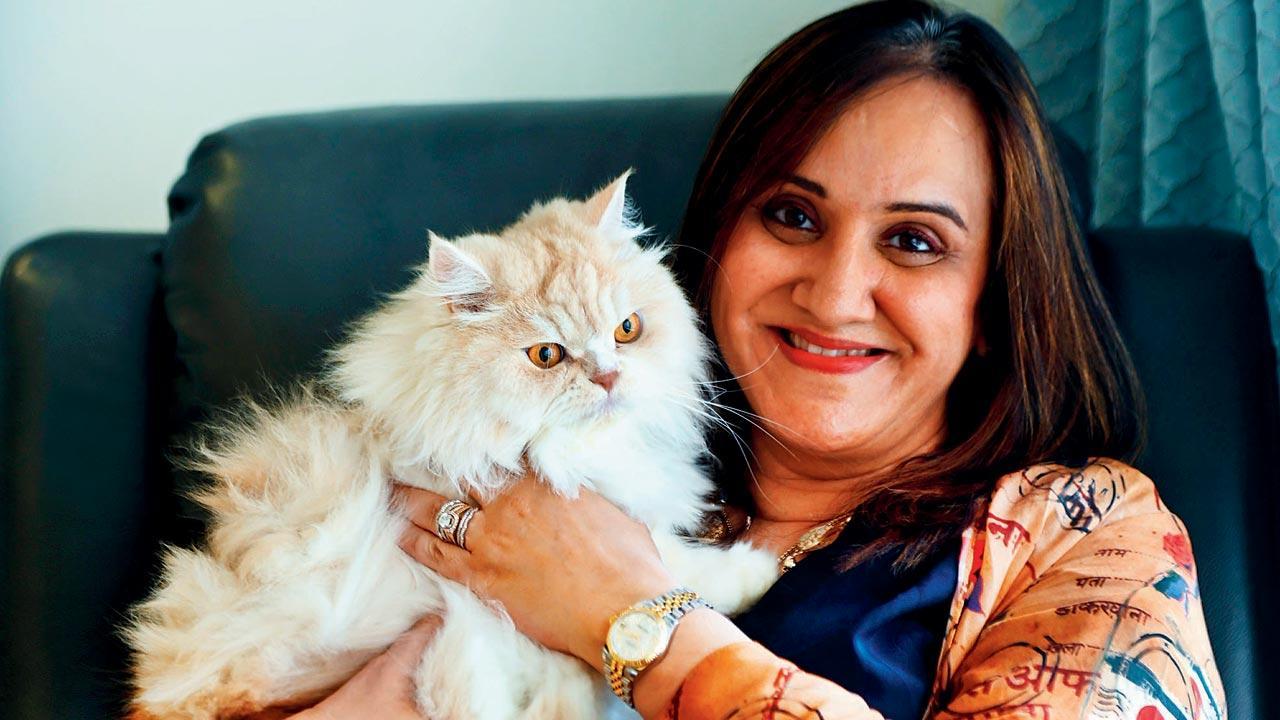
Alisha Priti Kirpalani says she was a sceptic, like most members of the Ramsay family, until she captured a ghost on her video camera, during a visit to Sagrada Familia, Barcelona’s most famous church. Pic/Bipin Kokate
A new book by a third generation member of India’s first horror family reveals how plot lines of their cult films blurred with the paranormal reality they were living with
Jane Borges (MID-DAY; April 11, 2021)
“Why did the Ramsay Brothers choose horror as their speciality?” It’s a question that pops up right in the middle of author Alisha Priti Kirpalani’s new book, Ghosts In Our Backyard (HarperCollins India), after she has narrated several eerie, ghostly encounters experienced by the Ramsays. For Kirpalani, who was born into the family that introduced Hindi cinema to the horror universe, the question seems to be rhetorical.
Having chosen to write an unusual family memoir, which she describes as a bridge between the spirit world and spirituality, the book offers a possible explanation to the inspiration behind the “purani haveli” variety of horror that Indians lapped up through the ’70s and ’80s. The supernatural, she claims, was not just a figment of imagination for celluloid, but also a shadow that followed some members of the Ramsay family, her mother Asha Thawani — daughter of Fatechand Uttamchand (FU) Ramsay — in particular.
Kirpalani’s take is in stark contradiction to what another family member, Saasha, granddaughter of FU and daughter of late filmmaker Shyam Ramsay, recently shared in an interview: “The Ramsay family doesn’t believe in ghosts.” And yet, Shyam’s own account of a ghoulish hitchhiker he encountered on a highway, and which is documented in the book, puts the spotlight on many such bizarre events that Kirpalani says the family deliberately chose to keep secret. Why? “Because, I think they didn’t believe in it themselves. They all thought they were imagining it. When you face the supernatural, you tend to rationalise it. That’s probably what happened in their case,” she tells mid-day. “I don’t think anyone else would have been able to get them to speak about it.” These are very personal memories, she says, and it needed someone from the family to help dredge them up.
The Ramsinghanis—“the family surname had been shortened to the easier-to-pronounce ‘Ramsay’ for the benefit of their British clientele”—originally hailed from Karachi. They moved to Bombay, right after the Partition. FU, who started his career as radio engineer, had to switch to selling fabric to meet the expenses of his large and growing household—he had seven sons and two daughters.
Like most small-time businessmen, FU was drawn towards films. While two of his films, Shaheed-E-Azam Bhagat Singh (1954) and Rustom Sohrab (1963) that starred Prithviraj Kapoor and Suraiya, did well at the box-office, it was Ek Nanhi Munni Ladki Thi (1970), which changed the business of filmmaking for the family. “Both Shyam and Tulsi noticed the audience’s positive reaction to the scene [in that film] where Prithviraj Kapoor wore a scary mask. It was clear that being scared was a thrill for the audience,” Kirpalani writes in the book. That’s when the Ramsays’ tryst with horror began.
FU, a self-taught filmmaker himself, had a unique vision for the movies and saw merit in this new path his sons were seeking.
The brothers’ first was a Sindhi horror film, Naqli Shaan, in 1971. A year later, they made Do Gaz Zameen Ke Neeche, which not known to many, was loosely-based on a story narrated by their sister Asha to her father FU, says Kirpalani. Asha, now 75, we learn in the book, was among the first of the siblings to have witnessed something paranormal as a child, inside a building in Ajmer, where her maternal aunt lived. “When [journalist] Shamya Dasgupta was writing a biography [Don’t Disturb The Dead: The Story Of The Ramsay Brothers, 2017] on the Ramsays, my mother had checked with one of her siblings if he had mentioned to the writer that she was the one who had given the story for that film, and he said, ‘Oh! I forgot.’ I remember noticing my mum’s disappointment, then. While the Ramsay brothers have contributed immensely, there was a Ramsay sister as well, who was an equally gifted storyteller,” says Kirpalani.
Her biggest contribution was to this book, her daughter feels. It was Asha who reached out to her siblings around three-and-a-half years ago, and convinced them to share the strange experiences that some of them had encountered. Kirpalani, a former journalist, went on to do full-length recorded interviews with her uncles, aunts, and cousins. “None of these stories have been made up. One cannot expect Ramsay monsters, of course. But, they are all authentic,” she tells us.
For sceptics, like this writer, a book of this nature might seem perplexing at first. Yet, one cannot discount the cult following the Ramsay brand of horror continues to have. Even though relegated to ‘B-grade’ category, their movies, made with low budgets and small-time stars, managed to hit gold at the box office. Films like Veerana, Purani Haveli and Bandh Darwaaza among others, despite the ghostly makeup that bordered on the farcical, spooked the daylights out of their audience—some credit must go to that iconic, spine-chilling background score, now synonymous with the Ramsays.
Kirpalani too, claims to have never really believed in ghosts. Though she binge watched horror films along with her mother, and even accompanied the family on shoots, she saw all of it as pure entertainment, and nothing else.
“I remember, when my mum would tell me about her experiences, I would do what most members of the Ramsay family did—listen from one ear, and let go out of the other, as they say,” she laughs. Her daughter Tiana too, had had strange paranormal experiences by then, including hearing her dead kittens mewing in their bathroom, hours after they had passed on. But none of it had made her overly anxious.
It was only in 2012, during a family holiday to Spain, when she visited Sagrada Familia, Barcelona’s most famous church that Kirpalani turned into a believer. Documenting “a white translucent hand, its fingers diaphanous” on her video camera, which she says could otherwise not be seen by the naked eye, made her realise she had crossed paths with something unusual. While she had not panicked then, a series of unfortunate events followed, which pushed her into exploring the family’s history, and why, when it came to horror, the Ramsays, had been the chosen one. The book is replete with supernatural incidents that Kirpalani accessed from the family.
She had started researching for the book, when her uncles Tulsi and Shyam, were still alive. The brothers, known as the Kings of Horror, passed away a year apart, in 2018 and 2019. While Tulsi mama, she recalls, had teased her about her attempt, “because he had not seen any ghosts in his lifetime”, her uncle Shyam had been more forthcoming. He shared his highway encounter with a woman “bathed in moonlight” whom he had given a lift to, while returning to Mumbai from a shoot in Mahabaleshwar in 1983. It was only once she was in the car that he noticed her “twisted toenails” and “gravelly voice”. “Inspired by this occurrence, five years later, in 1988, Shyam Ramsay made the film Veerana,” Kirpalani writes in the book.
Even her late uncle Arjun Ramsay had an eerie encounter while shooting in a graveyard.
Rescuing a man, who had fallen into a casket while carrying a very heavy spotlight, “he thought the corpse within had caught hold of his foot”. He later facetiously described it as a “clumsy entanglement with the rattling bones of a skeleton,” but his daughter Tanuja feels there was more to it.
There is also the bhootiya “palace” that Kirpalani writes about, which became a popular destination for the Ramsay shoots, where many a crew member and family, could hear the shuffling of feet from one of the rooms, which had been out of bounds. The caretaker had said that his mentally unstable sister lived here, but nobody had ever seen her. Gopal Ramsay, son of the eldest Ramsay brother, Kumar, had a more sinister account to share. Daredevil that he was, Kirpalani shares how one night, he “snuck into the passage and peeked through the keyhole”. He could hear the same shuffling sound, but didn’t see anyone. “At that very moment, the thick glass of the window in the passageway cracked and then shattered. Scared witless, Gopal raced away and never ventured near that room or the passageway ever again,” she writes. Other members of the family had heard demonic cries in the palace; they were later told that it was of a woman, who had gone insane after being abandoned by her lover. Kirpalani’s sister Jaya and mother too, claim to have witnessed a creature inside a decrepit well—not too far away from the premises—that wasn’t far removed from the bhoot envisioned by the make-up artiste for the film. “The palace was really a ground for mass hauntings. Everyone has had some or the other experience here,” says Kirpalani.
Stranger are the accounts from the Juhu bungalow that Kirpalani’s father Devidas Thawani, son of the late Jotumal Thawani—both of whom were well-known film financiers—had briefly acquired following an unpaid loan by a producer. Her mother had once seen a shadow swirl in the television room in the basement of the building. Another time, the television set in her bedroom switched on, on its own, the sound of the “ear-splitting static” jarring her nerves.
“But, I found Gangu mama’s [second son of FU] story very scary,” says Kirpalani. Her uncle, a cinematographer, and his wife Veena, recounted being chased down by a male apparition while they were walking to their hotel in Mahabaleshwar. “In the dark, it [the head] glowed yellow. It was round, abnormally round, emitting a pasty, jaundiced pallor. The face was bloated like a full moon, and there were no distinguishable features—no nose or a mouth. Though the features were smudged, it had definitely been human once,” Kirpalani writes of the ghost that the couple had encountered. “When I was imagining their situation, my blood turned cold. He is in fact one of the only brothers, who still continues to have strange encounters,” she says.
Kirpalani says that the Ramsay family was quite supportive through her endeavour. “What is strange is that all their experiences have been very alike—the cold air and the pressure in the chest. How is it that everyone is reporting something similar?” she wonders.
Kirpalani is aware that in writing this book, she has probably put her own credibility at stake. “If I have to be authentic, I will have to take risks. Nothing ventured, nothing gained. What’s the worst case scenario? People will think I am cuckoo; I am fine with that,” she says. “But, my purpose [in writing this book] was to create hope, and not fear. The book is more an exploration of life, death and beyond, and how the Ramsays were very much part of this journey.”

Kirpalani with her mother Asha Thawani—daughter of Fatechand Uttamchand (FU) Ramsay—and daughter Tiana, both of whom have claimed to have experienced several supernatural occurrences

For the longest time, the Ramsays lived together at their Lamington Road residence. While the ground floor housed the production office, Ramsay Films, the family inhabited the two floors above. Pic/Bipin Kokate

Posters of Ek Nanhi Munni Ladki Thi and Do Gaz Zameen Ke Neeche, the films which set the wheels in motion for the Ramsay horror genre. Pic courtesy/Dhruv Somani

A young Kirpalani (centre) at her late uncle Shyam Ramsay’s wedding. In the book, Shyam shared his 1983 encounter with a ghostly lady, on a highway. The filmmaker, who helmed many horror movies in his career, passed away in 2019

The late FU Ramsay with Kirpalani’s paternal grandfather, film financier Jotumal Thawani
Shyam Ramsay of Ramsay Brothers, who pioneered the genre in ’70s Bollywood, passes away
7:54 AM

MUMBAI MIRROR (September 19, 2019)
Shyam Ramsay who, along with his brothers Tulsi, Kumar, Kiran, Gangu, Arjun and Keshu (collectively known as the Ramsay Brothers), pioneered the horror genre in Hindi cinema, succumbed to pneumonia on Wednesday morning. A few days ago, the 67-year-old filmmaker had been admitted to a suburban hospital.
The filmmakers made their debut with the 1971 film Nakuli Shaan, which tanked at the box-office. According to industry lore, the Ramsays were surprised to see the audience flocked to the theatres to watch a film for a scene in which Prithviraj Kapoor’s character enters a museum in a mask and a scary outfit, and left immediately afterwards. Realising that the average movie-goer was enjoying being spooked, the Brothers followed up their debut with Do Gaz Zameen Ke Neeche in 1972.
Shyam and Tulsi led the family banner, jointly directing horror films, while the other departments were delegated to the rest of the siblings. Kumar wrote the scripts, Kiran handled sound, Gangu manned the camera, Keshu assisted on cinematography and assumed production responsibilities, while Arjun oversaw postproduction and editing.
Banking on a potent mix of horror and erotica, the Ramsay Brothers became synonymous with the genre with films comprising corpses, zombies, among other tropes, delivering films like Darwaza, Guest House, Dahshat, Purana Mandir, Tahkhana and among several others, including Saamri in 3D. With the advent of private satellite channels, they also ventured into horror TV shows.
Tulsi, Shyam’s elder brother and codirector, had passed away on December 14, 2018
-------------------------------------
MID-DAY (September 19, 2019)
Shyam Ramsay (1952- 2019)
Shyam Ramsay, one of the seven Ramsay Brothers known for cult horror films such as Purani Haveli (1989) and Tahkhana (1986), succumbed to pneumonia at a hospital yesterday, his family said. “He was hospitalised two to three days ago as he was not feeling well. He passed away at around 5 am today,” a relative said.
Veteran actors Raza Murad, Puneet Issar and Pankaj Dheer were among those who paid tribute to the filmmaker, remembering him as a “humble” and “polite” man. Murad, who worked with the Ramsay Brothers in the 2006 film, Family: Ties Of Blood, said that despite infusing horror in the hearts of the audience, the entire kin was soft- spoken. “Shyam was respectful, the entire family was. The kind of films they made were amazing. The brothers were sweet; we would joke that we’d get diabetes if we talked to them for five minutes. They were the joint family filmmakers in every department of filmmaking, and were extremely committed,” the actor said.
Murad recounted how Shyam convinced him for Family after he had initially rejected the role. “It sounded like I was just among the men from the underworld. I thought I would be one of the actors who may not get importance, so I turned down the role. Shyam called and narrated the role in detail. He said, I’m sorry I couldn’t narrate it to you. You have an important role and we would never waste you’,” he added.
Issar, who starred in their cult classic Purana Mandir (1984), remembered Ramsay as a “capable technician”. “Shyam ji knew the craft very well. He was a man of few words. He and Tulsi [brother] used to direct together. They had great clarity. It’s such a big loss,” he said.
Director Vikram Bhatt said, “Shyam Ramsay carried the torch of horror films right through the ’70s and ’80s. Even amongst the Ramsay Brothers, he was considered the leader. He was innovative and regaled his audiences with fabulous spooky cinema from time to time. His passing is indeed sad, and his contribution to the dark films will always be held in high esteem,” said Bhatt.
The Ramsay brothers also consisted of Tulsi, Kumar, Keshu, Arjun, Gangu and Karan. Shyam is survived by daughters Sasha and Namrata.
Tulsi Ramsay was ahead of his time-Puneet Issar
8:39 AM

Puneet Issar talks about filmmaker Tulsi Ramsay, who passed away on Friday
Ismat Tahseen (BOMBAY TIMES; December 16, 2018)
 Tulsi Ramsay, King of Bollywood’s horror genre with films like Purana Mandir and Veerana, passed away on Friday. Talking about their equation, actor Puneet Issar, says, “Tulsi Ramsay has been my mentor. In 1982, he and his brother Shyam Ramsay, came to me for Purana Mandir. I was doing Coolie then for Manmohan Desai, and after that Coolie accident, the brothers came to me saying, 'Mr Puneet, we would like to work with you. We want to make this film Purana Mandir. The film had Mohnish Bahl and Aarti Gupta, too'. It became a super duper hit and ran for almost 100 weeks non-stop. Today, it’s considered a cult film. I also did a 3-D film called Saamri for them. Tulsi was a very fine human being and the Ramsays are a very good family — seven brothers into cinema. He and his brothers were ahead of their times; they had started doing horror in 1978-80, which is a big thing. They are the pioneers as far as horror films are concerned. Tulsi’s passing away is sad news, but that I guess is life. I pray that God rests his soul in peace and gives his family the strength to cope up with the situation.”
Subscribe to:
Posts (Atom)