Showing posts with label The Shameless. Show all posts
Showing posts with label The Shameless. Show all posts
India didn’t have any moment at Cannes-Anurag Kashyap
8:11 AM

BOMBAY TIMES (June 12, 2024)
“India didn’t have any moment at Cannes,” says filmmaker Anurag Kashyap, stressing that the victory of independent filmmakers at the European gala is theirs alone and the country doesn’t support that kind of award winning cinema.
India won three awards at the 77th edition of the Cannes Film Festival last month – Payal Kapadia became the first-ever director from India to win the Grand Prix for her movie All We Imagine As Light, Anasuya Sengupta was awarded best actress in the Un Certain Regard strand for The Shameless, and FTII student Chidananda S Naik earned the best short film award at the La Cinef section for Sunflowers Were the First Ones to Know.
“I get very upset when it’s said ‘India@Cannes’. This is a boost... a shot in the arm for a lot of independent filmmakers but their victory is their own,” Anurag Kashyap told PTI in an interview.
‘No funding support’
He said Kapadia’s All We Imagine As Light, which was also the first film from India in 30 years to feature in the main competition at Cannes, received funding from a French company. The Malayalam-Hindi feature, which earned the second highest award at Cannes after Palme d’Or, is an Indo-French co-production between Petit Chaos from France and Chalk and Cheese Films from India.
There were several films at Cannes with either India-set stories or Indian talent, but most were co-productions with banners from other countries. Indian-British filmmaker Sandhya Suri’s Santosh and Karan Kandhari’s Sister Midnight were funded by the UK, while Konstantin Bojanov’s The Shameless was almost self-funded. However, Chidanand’s Sunflowers... is a production of the TV Wing one-year programme under the FTII. “India just likes to take credit for a lot of things, they do not support these films, and they don’t even support these films to have a release in cinema,” he said.
‘STOP TAKING CREDIT FOR CANNES SUCCESSES’
In 2021, Kapadia had won an award at Cannes for the documentary A Night of Knowing Nothing but is yet to be released in India. “Stop taking credit for it. Even if the film is released, no one will go to watch it in the theatre,” the 51-year-old said.
Kashyap, whose films such as Gangs Of Wasseypur, Ugly, and Kennedy have screened at Cannes, said he was surprised when former FTII chairperson Gajendra Chauhan took credit for Kapadia’s win. In 2015, Kapadia was one of the students who protested against the appointment of Mahabharat actor-politician Chauhan as the FTII chief. Kapadia was among the 35 students charged under Indian Penal Code sections for offences related to unlawful assembly and rioting. The chargesheet was filed in 2016, and the next hearing is scheduled for June 26.
“The worst part is the man who put the case against her, and sent some students to jail, is the first man who took the credit and said, ‘I’m proud I was the FTII (chairperson)’. What is his name? Yudhishthir ji (his ‘Mahabharat’ role), Gajendra Chauhan said, ‘I’m so proud that she was the student when I was the head’. You are the one who put the case against her,” Kashyap added.
----------------------------------
Payal Kapadia’s film (All We Imagine As Light) happened because of the French fund, India did not even give the rebate promised to that film. Sandhya Suri’s film (Santosh) was funded by the UK film lottery fund. Karan Kandhari’s film (Sister Midnight) was funded from the UK. Konstantin’s film (The Shameless) was almost self funded and the company that funded it got no support from India.
I used to tell myself that if acting has to happen, it will. Didn’t know it will take 15 years-Anasuya Sengupta
9:13 AM

Niharika Lal (BOMBAY TIMES; June 1, 2024)
Around 15 years ago, when Anasuya Sengupta moved from Kolkata to Mumbai to become an actress, she had never imagined it would take her so long to make her mark in cinema. “I used to tell myself that if it has to happen, it will happen one day. I didn’t know it would take 15 years,” she tells us. Anasuya plays the protagonist Renuka in The Shameless, for which she won the Best Actress award at Cannes in the Un Certain Regard section – a first for an Indian actor
About working in the film, she says, “When you see everyone bring in their A-game, you give it your best. You can’t give the best actress award to a crew, but just one person can’t do it alone.” The actress, who is currently in Delhi where her husband, Lt Cdr Yashdeep Sharma is posted, speaks to us about her journey from Kolkata to Cannes.
‘The environment I created for myself has been very artistic’
For Anasuya, acting took a back seat when she became an assistant director. Thereafter, she worked in the art department, eventually becoming a production designer and then HOD of the production design department at 26. As a production designer, Anasuya has worked on projects such as Ray and Chippa, and she believes that it was her love for storytelling that led her down this path.
She said, “So, cinema, writing, storytelling, and repeatedly working with some wonderful people have been constants in my life. I think the environment I created for myself has always been very artistic. I worked on developing a strong instinct, so when Konstantin (Bojanov, The Shameless director) offered me the film, I knew I had to take it.”
‘I used to tell myself that if it has to happen, it will’
In conversation with us, Bojanov said that it was not an immediate decision for Anasuya to accept the role; she took a while before making a decision. What was she hesitant about? “I wanted to act, and I used to tell myself that if it has to happen, it will happen one day. I didn’t know it would happen 15 years later, and I wasn’t actively thinking about it. When Konstantin approached me, it caught me off guard. I may be a first-time actor in a way, but I’ve been in the industry for so long. I kept wondering, ‘Are you sure? I don’t have a whole body of work. Will you be able to mount this with me? Will the producers agree? I was almost worried about the film,’ and he kept saying, ‘Just read the script’.”
‘My character is almost like a feminist icon in her own unsung way’
Anasuya says that The Shameless’s story touched her so much that she wanted to give it her very best. She said, “If people are connecting with her (the character), I felt the exact same thing when I read the script. I mean, she’s almost like a feminist icon in her own unsung way. Those are not the heroes we sing about, and why don’t we? It bore right into my heart. I wanted to stand up for her more than anything else, and that’s what steered me to just do a deep dive.”
‘There is no Renuka without Devika’
“There is no Renuka without Devika,” says Anasuya as she talks about her co-star Omara Shetty, who played Devika in the film.
“Renuka’s character was a bit of a lone wolf, a nightcrawler type. A lot of my mental work for the character involved spending a lot of time by myself, walking the streets alone, and listening to music. Much of my preparation was focused on that. Except for this light in Renuka’s life, which is Devika, portrayed by Omara. We kept having discussions about how in this dark world, the love between these two unlikely odd characters is the light. It’s that love, this is the light for both characters,” she adds.
William Dalrymple is thrilled that his book Nine Lives inspired The Shameless
9:08 AM

Published in 2009, Dalrymple’s Nine Lives (left) explores India’s diverse religious traditions through the lives of nine Indians: a Buddhist monk, a Jain nun, a lady from a middleclass family, a prison warden from Kerala, an illiterate goatherd from Rajasthan, and a devadasi among others. It seeded the idea for The Shameless
Chandrima Pal (BOMBAY TIMES; May 28, 2024)
Bulgarian filmmaker Konstantin Bojanov, director of The Shameless starring Cannes winner Anasuya Sengupta, (in an interview to TOI) credited William Dalrymple’s Nine Lives: In Search Of The Sacred In Modern India, for seeding the idea of making a documentary set in modern India. Speaking to us, Dalrymple shared his joy at having inspired the talked-about film.
“I haven’t seen The Shameless. But I’m thrilled Nine Lives inspired this wonderful movie,” said the historian, broadcaster, curator and critic.
Bojanov has spoken about how in spite of working on the documentary he eventually moved on to make the feature. Dalrymple said, “Reading the book gave Konstantin the idea of this subject. I am delighted that Nine Lives has been the inspiration for this project.”
Dalrymple also praised the lead actor who won the Best Performance award at Cannes. “I am thrilled about Anasuya receiving such incredible acclaim for what is her first (full-fledged) film role. From the clips that I have seen, she is astonishing, even though she is not actually an actor,” he said, adding, “So all credit to her, all credit to Konstantin. I think my role in it is very small, but it definitely provided the start. I would urge everybody to go watch the film and read the book.”
Without Nine Lives, the movie would never have existed, says Bojanov
“I was in Brooklyn and I picked up William Dalrymple’s Nine Lives in a local bookstore. I became fascinated by the themes it tackled – from art, tradition, modernity to sexuality and friendship in the complex and dynamic India of today. Without Nine Lives, the movie would never have existed,” Konstantin Bojanov said in an interview with TOI.

I’m a male director dealing with a female subject. I’m prepared to get attacked, left, right, center-Konstantin Bojanov
11:04 PM

Konstantin Bojanov, director of The Shameless, talks about the Cannes effect and more
Niharika Lal and Raima Ganguly (BOMBAY TIMES; May 30, 2024)
Bulgarian filmmaker Konstantin Bojanov’s The Shameless, for which Anasuya Sengupta won the Best Actress award in the Un Certain Regard segment at Cannes – a first for any Indian actor – took a dozen years and many challenges to come to fruition. “It’s like 12 years of bordering on insanity. In the meantime, I made one more film, wrote scripts for three more, produced one, and pulled my name out of it. So, a lot has been happening in these 12 years,” he said. Excerpts from an interview with us:
‘Do you have the right to tell this story?’
When the film was selected for Un Certain Regard, Bojanov said in an interview, “I’m a male director dealing with a female subject. I’m prepared to get attacked, left, right, and center.” But, he was surprised. “Almost no one asked me the dumb question: ‘Do you have the right to tell this story?’ We all have the right to tell stories. It’s freedom of speech. But some people on the extreme right and left lay down boundaries of what we can say and what is acceptable,” he tells us.
‘Loved Anasuya’s art’
“I met hundreds of talented actresses, and all so very well-known. I had a shortlist of very strong performers as well. But I kept looking at pictures of Anasuya (Sengupta) on social media, especially her drawings (left). That’s actually how I got curious and reached out to her. There was something in her attitude that went with my gut reaction, and I always trust the latter.”
‘India’s watershed year at Cannes’
“This was a watershed year for India at Cannes,” says Bojanov, citing the official selections and Payal Kapadia’s historic Grand Prix win. “I also watched Santosh which has an extremely powerful story and performances,” he says. Hopeful about a resurgence in India’s independent films, he adds: “It just might be a new page in Indian cinema. There are some very talented actors also working in Bollywood, but they tend to play vastly idealized roles and themselves fit the stereotype. Anasuya herself doesn’t fit into the mould at all. Most of the films shown at Cannes this year had a female cast and none of them are stereotypical characters.”
‘Was not possible to shoot the film in India’
The Shameless is set in Delhi, but the film was shot entirely in Nepal. The decision to shoot the film in Nepal was not what he would have preferred, but the film’s team had its reasons, says Bojanov. “We could have shot the film on our shoestring budget in India before the pandemic, but after the pandemic, the price of everything had gone up. Also, for foreign productions, any script needs to be cleared by the Ministry of External Affairs. The majority of the line producers were very sceptical about being able to obtain the necessary permits, so we didn’t even see the point of applying for permission,” he tells us.
‘It will be disappointing if my film faces cuts in India’
Bojanov hopes that the audience in India will get to watch the film sooner rather than later, but he has concerns. “As much as I’m informed about the censor board (in India) and what passes through and what doesn’t pass through, the film will have great difficulties at the moment.”
However, he hopes they will find a distributor. “I was exchanging text messages with Anasuya just after Cannes and she said how everything about this project has been unusual. So maybe the rest of the journey will be unusual as well. I would very much like the film to be seen in India, I see people really interested in seeing the film here. If chunks of the film need to be cut out (for certification), it’ll destroy the film. I will not be okay with that,” he says.
Quotes:
- "It’s ironic, given Indian cinema’s history, not just in Hindi but in other languages, the first time an Indian actor has received an award at Cannes, is for a Bulgarian director’s Hindi film"
- "The parallel filmmaking scene in India was marginalized after the 70s, except in a few regions. It has seen a huge revival in past 20 years"
I shakily walked to the stage, says Anasuya Sengupta on being first Indian actor to win a Best Actress Award at Cannes
9:27 AM
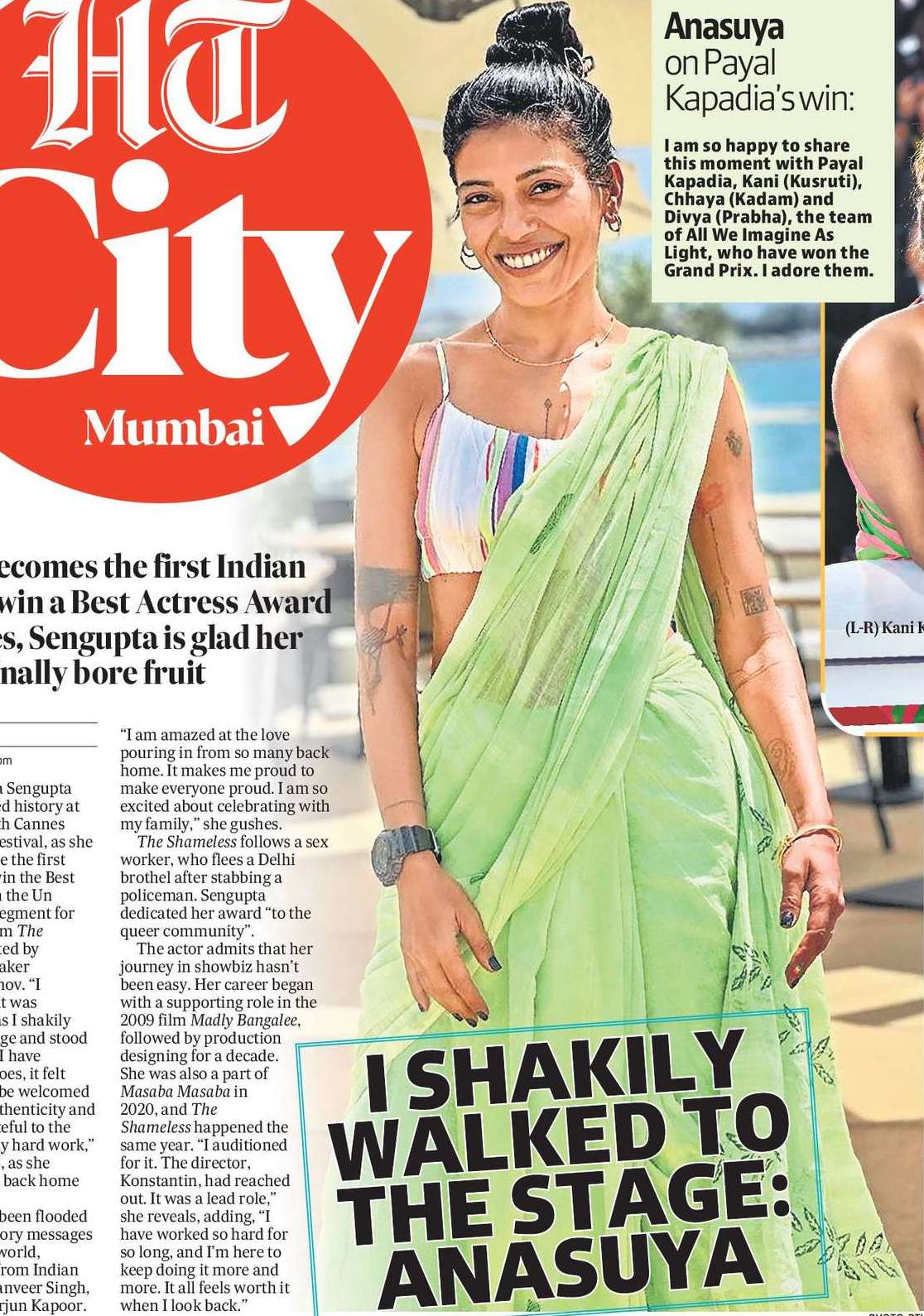
As she becomes the first Indian actor to win a Best Actress Award at Cannes, Sengupta is glad her efforts finally bore fruit
Rishabh Suri (HINDUSTAN TIMES; May 27, 2024)
Anasuya Sengupta scripted history at the 77th Cannes Film Festival, as she became the first Indian actor to win the Best Actress Award in the Un Certain Regard segment for her role in the film The Shameless, directed by Bulgarian filmmaker Konstantin Bojanov.
“I couldn’t believe it was happening! But as I shakily walked to the stage and stood with the artistes I have admired, my heroes, it felt oddly natural to be welcomed with so much authenticity and love. I am so grateful to the jury for seeing my hard work,” Sengupta tells us, as she boards her flight back home to India.
The actor has been flooded with congratulatory messages from across the world, including those from Indian actors such as Ranveer Singh, Alia Bhatt and Arjun Kapoor. “I am amazed at the love pouring in from so many back home. It makes me proud to make everyone proud. I am so excited about celebrating with my family,” she gushes.
The Shameless follows a sex worker, who flees a Delhi brothel after stabbing a policeman. Sengupta dedicated her award “to the queer community”.
The actor admits that her journey in showbiz hasn’t been easy. Her career began with a supporting role in the 2009 film Madly Bangalee, followed by production designing for a decade. She was also a part of Masaba Masaba in 2020, and The Shameless happened the same year. “I auditioned for it. The director, Konstantin, had reached out. It was a lead role,” she reveals, adding, “I have worked so hard for so long, and I’m here to keep doing it more and more. It all feels worth it when I look back.”
Anasuya on Payal Kapadia’s win:
I am so happy to share this moment with Payal Kapadia, Kani (Kusruti), Chhaya (Kadam) and Divya (Prabha), the team of All We Imagine As Light, who have won the Grand Prix. I adore them.
Anasuya Sengupta becomes the first Indian to win Un Certain Regard prize for Best Actress for The Shameless
7:45 AM

BOMBAY TIMES (May 26, 2024)
Anasuya Sengupta made history on Saturday as the first Indian to win the Best Performance award in the Festival de Cannes un Regard category. She received it for Bulgarian director Konstantin Bojanov’s The Shameless.
Upon receiving the award, a visibly emotional Anasuya said, “This is for the queer community everywhere, and all other marginalized communities all over the world... You don’t have to be queer to fight for equality, you don’t have to be colonized to know that colonizing is pathetic — we just need to be very, very decent human beings. More female gaze is the way forward.”
The Shameless was initially being made as a documentary exploring the themes of “love, sexuality, free will and artistic expression, within the confines of the castes and religious beliefs of present-day India,” the director said in an interview for the Cannes official platform, adding how eventually it evolved into a feature inspired by the true story of a girl born in the devadasi system.
About casting Anasuya in the pivotal role of Renuka, Bojanov said, “I looked at her pictures on Facebook and said, ‘She fits my vision of Renuka perfectly.’ It was more than just her appearance; it was her attitude too. I knew that she was primarily a production designer. Nonetheless, I took a chance...”
---------------------------------------
Who’s Anasuya Sengupta
Born and brought up in the Lake Gardens locality of south Kolkata, Anasuya is an alumnus of La Martiniere for Girls, Kolkata, and completed her graduation from the Department of English, Jadavpur University. She debuted with Anjan Dutt’s 2009 rock musical film Madly Bangalee and has worked as a production designer in Sanjeev Sharma’s Saat Uchakkey (2016) and Srijit Mukherji’s Forget Me Not in the anthology Ray (2021). She is now based in Goa, where she works as an illustrator and production designer.
What’s the Festival de Cannes un Regard category
The Festival de Cannes un Regard category celebrates cinema of discoveries, and its mission is to bring out new trends, new paths and new countries of cinema. This year, 18 feature films were screened in this category. Guan Hu’s Black Dog took home the Un Certain du Regard prize while Abou Sangare won the best actor award for the film L’Histoire de Souleymane.
I found my Cannes ‘Best Actress’ on Facebook-Konstantin Bojanov
7:43 AM

Behind Kolkata-born Anasuya Sengupta’s historic feat of becoming the first Indian to win Best Actress at Cannes is a Bulgarian filmmaker. In an interview with Sneha Bhura, Konstantin Bojanov talks about how he came to make the Hindi film ‘The Shameless’, and why he prefers Indian independent cinema to mainstream Bollywood
Sneha Bhura (THE TIMES OF INDIA; May 26, 2024)
Can you talk about your connection with India, and how you decided to make a Hindi film?
My connection to India goes way back to over 20 years. But to be precise, after my first feature film ‘Avé’ premiered in Cannes in 2011, I was looking to develop a new script. I was in Brooklyn and by chance picked up William Dalrymple’s book ‘Nine Lives’ in a local bookstore. I became fascinated by the themes it tackled— from art, tradition, modernity to sexuality and friendship in the complex and dynamic India of today. I optioned the book in 2012 with the idea of creating a documentary but gave up the project to develop ‘The Shameless’. Though it is a completely fictional story, I have to acknowledge that without ‘Nine Lives’, this movie would never have existed. And for that reason, I’m grateful to William Dalrymple. But the story in the book and the film are completely different.
What made you think of the story of a sex worker who escapes from a Delhi brothel after killing a cop?
While shooting the documentary in the Belgaum region of Karnataka, I observed the interactions of the central character, a 33-year-old real-life Devadasi called Reshma, with her best friend, Renuka, a sex worker in her thirties. It was incredibly touching and tender. The kind of emotional support that these two women were able to give each other in a very harsh world is what made me think of the story of ‘The Shameless’. Several women who come to these communities work under the relative protection of a quasi-religious system. So, I imagined what if a woman on the run, who has committed a crime, enters this community that operates by its own sort of rules, and rebels against it? That’s how the central character of Renuka (played by Sengupta) was born.
The movie has quite a cast but how did you find your ‘best actress’?
I take a long time to cast the leads for my films. I worked with Parag Mehta, the casting director who was recommended to me by Anurag Kashyap. Although I had shortlisted some extremely talented and well-known actresses for the part, I wasn’t convinced. I was so discouraged that I was contemplating making it as an animated film for adults. Then an Indian producer and a director I know said we have a friend who makes these very interesting drawings and maybe we could work together to develop the animated characters. And this is how I befriended Anusaya on Facebook. I would keep looking at her photo and knew there was something about her; a certain charisma that was suited to Renuka. The idea of the animated film was struck down by the sales agent and the producer, but that initial connection with Anasuya remained. The making of this film took so long — almost 12 years — that it almost drove me to insanity but the character of Renuka was the biggest hook for me, and it kept me going.
It’s not easy to be an independent filmmaker working in a foreign language. What were some of the challenges you faced?
I don’t speak Hindi and wrote the script in English. Translating the dialogue into Hindi proved to be a major challenge. I tried to work with several different translators and writers, and they were taking it in a different direction or adding Bollywood clichés. Ultimately, it was my production designer, Parul Sondh, who stepped in to translate and knew exactly what I wanted. We shot it on a very, very low budget in Nepal. The financing took years, with small chunks of money from different countries like Switzerland, France, Bulgaria and Taiwan. And finally, an Indian production company came on board just six weeks ago!
What are the Indian films you’ve enjoyed watching?
Growing up in 1970s Bulgaria, because of the links between India and eastern bloc countries, we watched a lot of Bollywood films. I remember as a kid, just bawling as I fondly watched ‘Haathi Mere Saathi’ maybe 10 times. Back then, as a kid, it was either Russian war films or East German Westerns, which is funnily enough a contradiction in terms, or Bollywood. But I don’t watch mainstream Bollywood movies now. However, there’s been a wave of refreshing, new voices in Indian independent cinema in the last 15-20 years. Some that have stayed with me include ‘Killa’, ‘Liar’s Dice’, ‘Newton’, Anurag’s ‘Black Friday’, and ‘Court’.
How did you deal with the fact that you’re an outsider in the Indian film scene?
I could only make the film from my own perspective. It would have been foolish and ignorant of me to try to make an Indian film from the perspective of an Indian director. I tend to focus on the universal aspects of the story, no matter where the story takes place. Ultimately, stories are what connect us. Also, it worked because of my sincere connection to the subject matter and all my Indian collaborators. You don’t make a film alone.
Cannes Film Festival is not a place where you can boast about your project’s box office collections-Mita Vashisht
8:00 AM

A still from The Shameless; Vashisht at the festival along with director Konstantin Bojanov
Asserting that creativity is the only virtue at the film festival, The Shameless actor Mita Vashisht celebrates desi offerings being showcased abroad
Priyanka Sharma (MID-DAY; May 21, 2024)
Seated in a packed auditorium where cine-watchers turn up to watch her film, Mita Vashisht is evidently celebrating a milestone in her career—her offering, The Shameless, is competing at the coveted 77th Cannes Film Festival. This opportunity, however, may have well evaded the actor, who was a “last-minute addition” to the cast of the film based on two young women hoping to free themselves from the shackles of sex work.
“Whatever is meant for you, will find you,” says Vashisht, who plays the matriarch in the poignant drama, directed by Bulgarian filmmaker Konstantin Bojanov.
“I came on board two days before the shoot began because the director wasn’t satisfied with the casting for the character that I eventually played. When my name was recommended, we connected over a Zoom call, and he said I had a strong identity and would hence be apt for the role. I was told that while not a lengthy one, the role was critical.”
Ironically, Vashisht was initially unimpressed with Bojanov’s script. Addressing questions about her decision to initially turn down the role, she says, “I told him that whatever he said about the role was in his vision alone, and was not reflected in the script. He was taken aback. I said, sir, first of all, you haven’t named the character. You have only addressed her as ‘the grandmother’. Until you give her a name, how do I know what kind of woman she is? He said, ‘This is exactly the kind of input I was looking for. We will rewrite the portions and connect them to the rest of the characters.’” Vashisht was finally on board.
The offering, also starring Anasuya Sengupta and Omara Shetty, received a standing ovation at its Cannes premiere. It is one of the many reasons for celebration, as several Indian offerings, including Payal Kapadia’s All We Imagine As Light, and Shyam Benegal’s 1969 drama Manthan, are being featured at the festival.
Vashisht says she is hopeful that impactful narratives will finally receive their due. “The Cannes Film Festival is not a place where you can [boast] about your project’s box-office collections. Here, the value is only in the craft and vision. It’s reassuring to know that we have so many Indian films here, because it implies that Indians are making films that do not only cater to box-office demands.”
Subscribe to:
Posts (Atom)