Showing posts with label The Father. Show all posts
Showing posts with label The Father. Show all posts
Although, I have an action-hero image, I have barely done action scenes in our movies here-Randeep Hooda
7:58 AM

Rachana Dubey (BOMBAY TIMES; July 5, 2021)
A year ago, had everything worked as planned, Randeep Hooda’s international film, Extraction, which was released on a digital platform, would have had a mega premiere in the US. The actor is now in talks for more international projects and an announcement might be made soon. When asked if he has achieved what he intended to with the film, Randeep says, “Yes, I have — I have widened my audience base and opportunities for the future, built great relationships, and finally, done action and combat scenes in my movie. Although, I have an action-hero image, I have barely done action scenes in our movies here. So, that was a new genre to explore, and it came to me at a time when I had spent three years prepping for a movie that was shelved. I was in a dark space.”
Around the time of the film’s digital premiere, Randeep had said, “Maybe they didn’t like my acting,” when he was asked about Bollywood’s cold reaction to his Hollywood project. Bring this up, and he shares, “I was asked that Bollywood which lauds a poster launch, a teaser launch or a blink-and-miss appearance of an actor in a Hollywood film had not said much about my work. I responded to that saying that maybe they didn’t like my acting man…”
Randeep, who was recently seen in Radhe: Your Most Wanted Bhai, admits that he does find himself in a better place on the international film circuit. “Their industry has just opened up and conversations have begun. Talks are on and I hope one of them materializes soon. They don’t want people to travel there right now looking at the situation that exists here and everywhere else in the world.”
After a two-decade career, one wonders if Randeep, who has barely had 50 releases, has figured where he’d like to head from here. Randeep says, “I want to do more action films now. I enjoy that genre and want to expand myself as an actor where I need to prepare and change myself in every way and experience another life. I feel fortunate that 20 years down the line, filmmakers find me exciting and unexplored. I am offered challenging work, and I hope it continues. I hope that I can keep doing challenging things till the day I die. I saw Anthony Hopkins in The Father. To win an Oscar for the best actor at his age is so amazing. It tells actors what they can do even when they get older. He’s brilliant. There is no end to roles and craft. It keeps getting better as long as you stay interesting and interested.”
The actor further adds, “Staying relevant is about a whole juggernaut of things that you need to do, which are not entirely in your hands. Keeping yourself interested in your work, trying to be better at it and translating thoughts into your work while connecting with yourself is in your control. I am going to keep doing that.”
There is a serious lack of constructive criticism towards theatre in India-Ratna Pathak Shah
7:38 AM

Prominent film and theatre personality Ratna Pathak Shah is joined by actor Heeba Shah, in a candid conversation about performing arts in the country and more
Reema Gowalla (BOMBAY TIMES; May 16, 2019)
Naseeruddin Shah’s play, The Father had an exhaustive twoweek run outside the city recently. Centred around the subject of dementia, this production also features actors Ratna Pathak Shah and Heeba Shah, who essay the same roles in the play, but in different shows. We caught up with the two a little before their last performance. Excerpts:
Most interactions nowadays are limited to taking a selfie ...
Ratna: We don’t always get to interact a great deal with the audience, partly because of the length of the piece. And at the end of two hours, it’s difficult, especially for Naseer, to find more energy to interact with people. But what’s more unfortunate is that all are interactions have become limited to taking a selfie. We often say that no to photographs. But almost 50% of people, largely consisting of the middle-aged crowd, turn back and walk away. It’s the younger one who usually behind to talk to us; ask questions.
Do you think theatre, in a way, can be considered a source of living in India?
Heeba: Maybe in a way, you could. But it’ll require you to go out and ensure that you have a lot of grants coming in for your play. Right now, the kind of sponsorship that is available for films, is not there for theatre, unless the play is a replica of the film that one is doing. Having said that, I think it is good in a way. Because, the advantage of theatre as an art form is that it is not done entirely for money. It’ll be ideal, if you could survive on theatre and make a lot of money out of it, as in, we put in as much hard work on stage as our counterparts do in films. But again, there are certain aspects that are exclusive to theatre alone. There is always the factor of excitement on stage; you get the energy to live and be happy with it. On stage, you get to rekindle your flame that is about to go off. The creative freedom is always more in theatre.
Ratna: However small your production is, it costs money to bring about a play. And it’s not easy to raise that kind of money. India nurtures various kinds of theatre. There is commercial theatre in different languages, in which actors do manage to survive with the money they earn. I think film versus theatre is a bad comparison to make. Both are two completely different mediums that are made with different intentions and likewise incur different costs. The lack of money is a big issue in theatre. So, if you ask whether or not an actor or a playwright can survive by doing theatre alone? The simple answer is no! Partly because, we don’t believe in giving royalties. There are a number of people in this country who do theatre without giving any royalty to the writer. It also goes under the heading of ‘poor theatre’. This problem needs to be addressed too. Again, there is the lack of quality theatre also. One needs to constantly push boundaries to bring in good plays. The issues in theatre are complicated, and there are no easy answers to them. Nonetheless, despite having so little money in it, there are so many people who still want to do theatre. This art form gives you something that no other work can give.
How can the government help?
Ratna: We need more theatre hubs all over the country. And that is where I feel real government intervention can help — give us a place for rehearsals and spaces where we can perform. The government has completely abdicated its responsibility, and so have the corporates. They would rather organise an awards night, as part of their CSR activities, which would actually be of no benefit for the theatre community. Instead, that money should be directed towards building new spaces and make them available for theatre practitioners at a cheaper rate.
What’s your take on the lack of criticism towards theatre?
Ratna: We are past our prime. But for the younger lot in this country, this atmosphere is no good for creativity. Having said that, there is also a serious lack of constructive criticism towards theatre in India. But when I say criticism, I mean it in its technical sense — critical analysis. It does not necessarily mean finding negative things in somebody else’s work. This kind of an approach cannot lead to good work. There should be feedback — some mechanism, by which I am judged for what I am doing. There is a tremendous lack of criticism within the theatre community itself. Again, there is no professional criticism. Nobody is being made to stand up for their opinions. If you didn’t like my play, tell me why you didn’t like it. Don’t give me a half-baked patronising statement. I feel, this is very dangerous.
Yours is a family of theatre people. What happens when there is a disagreement among each at home regarding a play?
Ratna: When we have disagreements, we sulk for some time, and then we make up. Of course, discussions are often centred around theatre. But I don’t think we have identical opinions. There are things that I like, but the others don’t. And sometimes, it’s the other way round. We enjoy talking about theatre and performances a lot. In The Father, for instance, Heeba and I play same role. Of course, the age difference is obvious. But initially, there was a major problem in thinking of Naseer as my father. I thought I was doing it well until somebody pointed out saying, “Hey, he is your father in the play, not your husband. So, stop treating him so seriously.” That’s when I realised that she was right. We don’t take our parents half as seriously as we do our partners. You tend to speak with your parents with a familiarity that you don’t often manage with your partner. That incident changed my entire perspective of the play.
I’m allergic to selfie hunters after my show-Naseeruddin Shah
8:01 AM
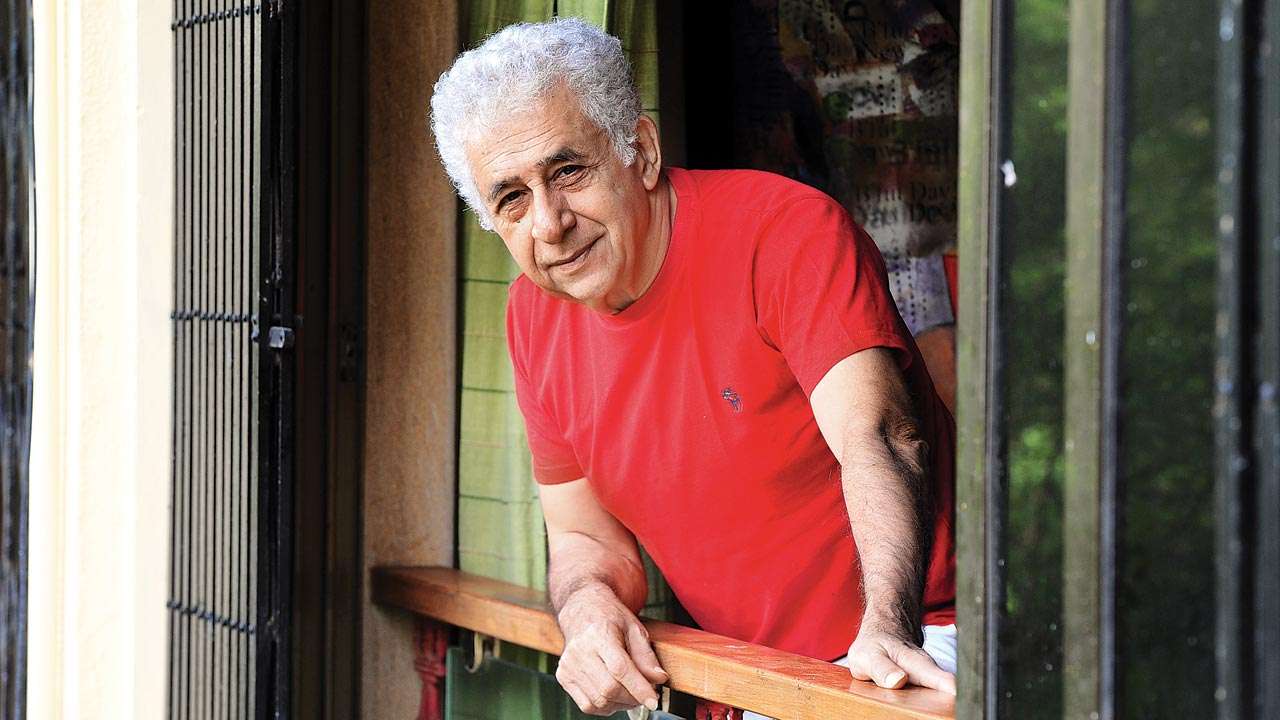
Deepali Singh (DNA; September 8, 2018)
Naseeruddin Shah has been busy of late. Between his play The Father that’s having a month-long run at the NCPA Experimental Theatre, conducting acting classes, swimming and playing tennis, he’s got it all sorted. But the one thing he isn’t doing is acting in movies. “I’m out of work,” Naseer states simply, when we meet him for a chat at his Bandra residence, adding that he’s glad he doesn’t have films at the moment, as it’s giving him time to do what he wants. Over to the veteran actor...
You may not be acting in films but are you watching a lot of movies?
I’m happy with some of the movies I have seen in recent times like Shubh Mangal Saavdhan, Nude, Dum Laga Ke Haisha and Kaun Kitne Paani Mein — the latter was a totally unknown film which I saw on TV one day. Several other films like Anarkali Of Arrah, Ankhon Dekhi, A Death In The Gunj and Newton were also good. But all these filmmakers get snapped up so fast by the Bollywood machine. It chews them up and spits them out. They made these movies out of conviction, but the moment one of these movies succeeds, they get snapped up by the movie-making factories and then they have to conform.
The boundaries between commercial and art cinema have been blurring now...
It’s a good thing. Films don’t get stamped as art films and the audience doesn’t need any help in deciding. They smell it out, as Dubey ji (Satyadev Dubey) used to say. ‘Audience soongh leti hai kaunsi film kaisi hai’. It’s true. Even among the ones being made now, I know which ones I want to see and that has been the case since school. ‘Six months from now, Shammi Kapoor ki jo film aa rahi hai woh dekhni hai!’’
Have you been offered any projects on the digital platforms?
I’ve been offered a few things but I didn’t find them interesting. I’ve been doing some short films with young people and that’s been great fun.
After month-long runs at Prithvi Theatre and NCPA last year, you’re back on the stage with your play, The Father...
Yes, and by the time this month ends, we would have completed 80 shows. Then we’ll need to do a few more to make a 100. We’re planning to take it to Bengaluru and also to Pune, so we will achieve that figure. It’s quite an achievement because we have managed to do this in a-year-and-a-half. It took us about 20 years to do 100 shows of Waiting For Godot! (laughs)
Do you think the success of the play will encourage other theatre companies to follow suit with the format?
I always felt that it’s possible to do it, but the problem is most theatre companies don’t have the resources. One has to book a theatre for a month which means a fat amount of money. And now these theatres cost a lot. Then the actors have to be available for a month. So, I don’t expect that everybody will start doing it. I did it because I could afford to do it. The actors I chose have all given their commitments and it’s been great fun.
When you were doing the play for the first time, you had said that it’s a complex one, but you never underestimate the intelligence of the audience.
Absolutely, and the response has been very encouraging. At the same time, there are always walkouts in every show. I don’t mind. Maybe those people found the play confusing, which is actually the playwright’s purpose, to put you into the mind of the character. So if you’re confused at the end, it’s intended, provided the experience has given you something of seeing this man. But the majority of audience stay on and that has been really good to see.
What’s the kind of feedback you have received from audience members?
So many of them come and tell me about some member of their family, or some relative. And everybody knows what it’s like, because at some some point or the other, one feels that their parents have grown old, and that they don’t understand them. So, it’s easy to empathise with the situation where this man has receded to this point that nothing he does is making sense to anybody. They come and say ‘it must be so hard for you’, but it’s not hard for me. I’m just telling them a story. It’s hard on the audience.
You have always maintained that you don’t like audience members coming backstage to talk to you post a show, but seems like it was different this time...
I’m allergic to selfie-hunters after the show! But this time, I actually had meaningful conversations with people. A number of youngsters have come to me, some of them went away when I told them ‘no selfies’. But some stayed and spoke to me. That has been really wonderful. One of them actually said ‘thank you for doing this because today, I understood my grandmother. She was just like this’. I don’t feel that I have achieved perfection or anything close to it. But I have at least managed to convey the essence of this play and that’s what I feel happy about.
What next?
I’m planning a month-long run of a play called Old World for November next year. It’s a lovely play which I had seen, enacted by my heroes Mr and Mrs Kendall of Shakespearana Theatre Company.
People are in tears when they meet me backstage; they ask if they can hug me-Naseeruddin Shah
8:06 AM

Mumbai’s theatregoers are coming to grips with Naseeruddin Shah’s disturbingly real portrayal of an Alzheimer’s stricken man. The veteran tells us what it’s like to live with Andre 58 nights in a row
Fiona Fernandez (MID-DAY; December 17, 2017)
Towards the end of our chat with Naseeruddin Shah at his Bandra apartment, we share hesitantly the story of a family member with a neurological condition, much like Andre, the ageing protagonist he portrays in Motley’s ongoing play, The Father. “Does he display similar traits? Is he as unpredictable as Andre?” the veteran asks. Much of it is concern, but the keenness to sharpen his craft is an ongoing attempt, we can see.
Less than 12 hours before, we are part of the audience that watches him portray a Frenchman as he struggles with a memory-debilitating disease. They are uncomfortable with multiple actors playing the same character, and the jerky time travel in script, all to reflect the confusion in Andre’s mind. The story reaches a bittersweet crescendo, followed by a standing ovation at curtain call.
Later today, The Father wraps up its run in Mumbai after 58 back-to-back performances. It’s time to reflect on its unprecedented success. “It’s heartwarming, because typically, Indians are not enlightened towards the mentally ill. We are a superstitious lot who imagine such conditions to be the result of bad wishes. ‘Devi chadh gayi,’ we say. It’s the reason why we didn’t adapt the original script to India,” he says about the English translation by Christopher Hampton of Florian Zeller’s French story. “People are in tears when they meet me backstage; they ask if they can hug me, that I remind them of their fathers. It was touching when a 30-year-old man told me he was glad he had taken good care of his father when he was alive. It has been gratifying,” Shah says.
Watching Andre’s alternate universe unravel and deteriorate before him is a numbing experience for most in the audience. How did Shah prepare? “The husband of a close friend from my days back at the National School of Drama suffered full-blown dementia. When I met him 15 years ago, I thought he was her father-in-law because he was unrecognizable. It frightened the hell out of me.”
And, there was also an uncle, a police officer, from whom he picked up nuances. “In the original play, Andre is an engineer. I made him a police officer because of my uncle. We looked up to him, and then, Alzheimer’s hit him. I borrowed from them both, and psychiatrist Dr [Harish] Shetty’s case studies.”
But this was before he had heard of this script. He says when he first read it, it was “as if lightning had struck”. He has colleague Paresh Rawal to thank for introducing him to the story. “He was selfless to give it to me although he could have played the character himself,” Shah says about the veteran actor, who was incidentally in the audience with us the previous evening.
Shah says, prep aside, Andre’s character has developed on stage, too. “I never hurry with a part because I have very high regard for writers. I must respect what they have written for me. It takes a long time, usually up to six months to read a script. I insist on reading it repeatedly, and understanding what is being said. I may say yes to a script but the process of understanding it occurs after I engage with it. I don’t get into who will play what character or think about set design. The set for The Father, for instance, instance, was the last thing I locked.”
The cast, which includes wife Ratna, who plays Anne, discover a new dimension to their character and script each night they perform. “It’s such a joy,” he smiles. Which is why he decided on a long run. “Not only is it very intense and needs the continuous involvement [of the cast], we also make progress each night. We have done over 50 shows in three months, which we would have typically done over five years!”
For Shah, the writer comes in for special praise. He thinks this is one of the greatest pieces of playwriting and ranks with Waiting For Godot. “The writer must have seen it from very close and felt it deeply. The disconnected form of this script puzzled me initially; I realized much later that this is the true craft of playwriting; this writer has followed the Shakespearean formulae.”
The doorbell rings. A group of actors have dropped in for rehearsal. Our time is up. Is Andre’s time up as well, we ask him. Shah thinks a bit and says, “He might want to die but it’s not up to him.”

Even after my National Award winning film, the kind of roles I was offered were terrible-Neeraj Kabi
7:49 AM

Neeraj Kabi, who returns to stage in a Naseeruddin Shah play, on why he is still an aspiring artist
Anuka Roy (MUMBAI MIRROR; August 27, 2017)
On a rainy Sunday afternoon, the first thing you notice as you enter Neeraj Kabi’s quaint Mira Road apartment is a poster of Ship of Theseus. The film directed by Anand Gandhi, not only won Kabi huge critical acclaim — the actor shed close to 18 kilos for the role of the monk — but also marked start of his entry into Hindi films.
The 49-year-old made his debut in the 1997 National Award winning Odia movie by A K Bir, Shesha Drushti (The Last Vision). Kabi will be shortly seen in a new play The Father, directed by thespian Naseeruddin Shah, which opens next month. “My last play was Marguerite Duras’s Gates to India Song, directed by Eric Vigner, in 2013. Films took up most of my time and theatre requires time. I wouldn’t have come back to theatre so soon, but I have, only because Naseerudin Shah is directing this play,” says Kabi with a smile.
His desire to work with Shah made Kabi say “yes” for his comeback play, almost instantly. “To watch Naseeruddin Shah at the rehearsal is such a joy. He is a man who will inspire anyone. The way he would come on stage and work tirelessly and continuously at the age he is at right now, is truly an inspiration to any actor,” he says. “The words actor and artiste are important to me. Charlie Chaplin was an artiste; Naseeruddin Shah is an artiste, which is beyond the actor. It takes the hell out of you to become an actor and then an artist.”
Hailing from Jamshedpur, Kabi had no plans of becoming an actor, or an artist for that matter. His initial plans entailed receiving a commerce degree from Symbiosis College of Arts and Commerce, Pune and then pursue an MBA. “I was very close to my teachers but I was not happy with the subjects. That’s when the sudden passion of acting came into my life,” says the actor.
It was a play — Ek Refugee Camp Mein — which he performed with his college team at IIT Bombay’s Mood Indigo fest in 1989, which marked his foray into acting. “We were adjudged the second best production and I won the best actor prize in that fest,” Kabi recalls. “It was this competition and the movies he watched while gate-crashing Film and Television Institute of India (FTII), which made him respect and think seriously about the craft. In fact, when I used to visit FTII, people used to encourage me. They used to say ‘You are a good actor, why are you pursuing commerce’. I was young and I think I got influenced.”
Incidentally, Kabi, though known for intensive acting workshops, has never undergone formal training in the art of performance. “I was determined that this is what I want to do. So, I started training myself. I used to go for acting and dance workshops. But mostly it was about inventing. I would come back and invent. Then I began teaching privately. I taught kids elocution, speech and drama. I was teaching myself as I was teaching others,” he says.
Kabi was clear that he didn’t want to follow anyone’s style of acting. “I know there’s something called method acting, but in my subconscious mind I wanted to create or invent. Like in a play, Hamlet, which I directed, I used Yakshagana and Dhrupad. One is a traditional dance form; the other is classical music, and then blending it with Shakespeare and interpreting that. That’s my style of work,” he elucidates.
Like many other actors of his ilk, Kabi’s acting journey was not a smooth one. Even after his National Award winning film, the kind of roles he was offered were “terrible”. However, the actor was determined that he was not going to compromise by taking up roles just for the sake of acting. Even though he was actively pursuing theatre and conducting workshops, “being adamant and arrogant about the kind of characters I want to essay in movies helped me focus and kept me going,” he says. “When you are saying no to work, you have to be ready to face the consequences. Until the Ship Of Theseus, those 22 years of struggle really shaped me as a person.”
Kabi shrugs when asked about his struggling days. “It’s too personal,” he says. “The only person who encouraged me and stood by me to follow this love and passion for acting was my then girlfriend and now wife (Deepali Kosta Kabi).”
My abilities as a comic actor haven’t been used fully-Naseeruddin Shah
7:45 AM

Deepali Singh (DNA; August 21, 2017)
Meeting Naseeruddin Shah is bound to be an awe-inspiring affair. No matter how many times you meet him, your heart beats a little faster and the mouth feels a little dry, before you can shoot off the first question. But all it takes is a comfortable pat on the back from him and half a smile to ease the tension. He’s just woken up from a nap, in between rehearsing for his latest play, The Father, based on French playwright Florian Zeller — the most ambitious one till date for Motley, his theatre production company. The tragic farce, a family drama on one level, and a searing picture of mental dysfunction on another, will have a month-long run at the NCPA Experimental, a first for the country where theatre is concerned. In between bouts of laughter — and he does that quite a lot — Naseer discusses the project, the dearth of good comedy scripts in the country and his upcoming projects.
You have always taken risks but this form of the play, along with being ambitious and risky, is a different ballgame altogether?
I wanted the whole company to get a taste of what it’s like to work in a theatre professionally. Even though one can’t pay them as much as they deserve as professionals, but I think it will prove to be a very valuable experience for all the actors and the team. I’ve been though this a few times abroad, performing for six months continuously every night, except for Sundays and it can be very tiring. Especially if the play turns out bad, it can be sheer hell! But it also has immense benefits, in terms of staying focused on one job for a period like a month. Of course, in England, normally actors have to do it for a period of six months, then the cast changes. So these plays that run for 20-25 years, the cast is recycled.
I know it’s a risk. We may end up losing a lot of money, but that’s alright. I’m not doing theatre for money anyway. The money comes from the movies. Luckily, over the last few years, our theatre has also brought us a bit of revenue, where we’re able to pay actors decent money. If it works, it works. If the audience doesn’t take to it, it’s part of the risk of the job. But I feel that they will. Even though the play is a bit complex, I think every family has had a person like this. Or they have seen someone very close, so they will be able to connect with the state of mind of this man. Because the whole play is seen from his perspective, which is a muddled reality. The play doesn’t follow a linear progression and that is yet another risk. Since the kind of movies I do are not always of my taste, theatre is a place where I can have fun with my beliefs.
One of my beliefs when it comes to theatre, a very strong one in fact, is that the magic of theatre is in the stimulation you can provide the audience’s imagination. Theatre is trying to mimic movies too much and that, to my mind, is a wrong tree to be barking under. You can never create the same illusion, no matter how many crores you spend on it. The audience never forgets they are in a theatre. This is a play, you’re an audience and we’re actors.
Go on...
I always like to begin my plays with the ritual where we like to chat with the audience. And I don’t mind the actors being seen backstage. What’s the need of creating a bloody mystery about it? It creates a barrier which I would like to destroy. And I think with this play, I might be able to do it because it will be demanding for the audience, the content itself and the form, because we’re not using any props at all. They are all imaginary, but you hear the sounds of the objects. So hopefully, it will take the audience into the space of this man. He hallucinates, sees things which are not there, hears voices. Hopefully, it won’t blow the audience’s mind so much, that they say, ‘What is this?’ (guffaws) But even if they do, it’s fine, because I think that’s the playwright’s intention. To help them share the mind-space of a person who is suffering this, to create an awareness that this is an illness and not under anyone’s control. The person who’s doing it is not doing it to bug the hell out of you. He’s not doing it. It’s his illness. So, I’m hoping for some association with the Alzheimer’s society. At some point, I will invite them to see the play. If it works — the form I’m trying, and I’m confident it will — then hopefully the useful purpose it can serve is to create awareness about this dreaded disease.
Do you think it would be feasible for other theatre companies to do the same? And if yes, do you think it will bring about a change in the way theatre is done in India?
They would be sticking their necks out to do this. And it wouldn’t have an effect in the sense you’re suggesting, that it will create a professional theatre in India. That won’t happen. There was a professional theatre in Marathi that has also practically died away. There was one in Gujarati, which unfortunately degenerated into bedroom comedies and plays stolen from the west. But I would recommend others to try it. It’s not a question of resources really, there are so many alternate spaces available these days, where you don’t have to pay through your nose. The point is to show to young theatre workers also that you don’t need a massive organisation to produce a play. All you need is a team of actors and a good script and some imagination. But I’m not so foolishly optimistic that it will change the theatre scene in Bombay or anything like that.
Mental dysfunction is not a topic we Indians are very comfortable confronting...
Sure, but I don’t underestimate the intelligence of the audience. I know that this will not be the audience which goes to see comedy plays or Hindi movies. It will be the audience that comes to see our work and which encourages us and which appreciates our work. For them, it will be a moment of recognition, possibly disturbing, but one which they will be able to face. It won’t be the audience that whistles and throws coins. That’s not the audience that comes to see our plays anyway and I’m glad they don’t! (laughs)
Your wife Ratna Pathak Shah has been doing a fine act of balancing commercial cinema like Mubarakan, with meaningful movies like Lipstick Under My Burkha. Why don’t we see you doing more commercial films?
So, I did Welcome Back and Waiting.
Yes, but not recently..
Now I’m not getting any work in movies! Now Ratna’s getting work. She’s bringing in the money and I’m very glad to do theatre. (laughs)
You did a short film last year, Interior Cafe Night, which got more than two million views. Any others?
That was a beautiful script. That’s one of the best films I’ve done. I have been offered others but I didn’t feel excited by them.
What are the films we can look forward to?
I have done a small role in a Gujarati film directed by Manish Tiwari. It’s a wonderful story about a group of children who watch a magic show and ask the magician how can we pass in our exams? I’m playing the magician. Then I did one scene in Neeraj Pandey’s new film Aiyaary. Its’ a wonderful scene and I really wanted to work with him again. I have done a film called The Hungry, which is in English and should be out soon. It’s going to Toronto Film Festival. It is an adaptation of Shakespeare’s play called Titus Andronicus, which was his first play apparently. It’s very brutal, bloodbath kind of play. It’s set in Uttar Pradesh in the film, in this zamindar family where they think nothing of chopping off people’s heads.
You were offered a cameo in J D Majethia’s digital series Sarabhai VS Sarabhai...
Yes, I wish I had done it. I think he did it himself. He got the next best actor. (laughs)
We miss seeing the fun Naseer of Jaane Bhi Do Yaaron. Don’t you wish to explore your comic side?
If I have a regret, it is only that. My abilities as a comic actor haven’t been used fully, but there’s still time. I have been offered roles the film industry considers comedy. My sense of humour is somewhat different from the film industry’s. We have made very few good comedies. Chalti Ka Naam Gaadi, Pyar Kiye Ja, Saadhu Aur Shaitan, Jaane Bhi Do Yaaron. So in 100 years, four comedies we have made? We don’t have a sense of humour.
What about movies like Welcome and Welcome Back?
Yes, I enjoyed doing those movies. Anees Bazmee is a fun guy, very organised, very sorted. He knows his formula well. I would love to work with him again. For me, enjoyment is the key word. I did Welcome Back because I thought I would enjoy it and I did.
Subscribe to:
Posts (Atom)