Showing posts with label The Accidental Prime Minister. Show all posts
Showing posts with label The Accidental Prime Minister. Show all posts
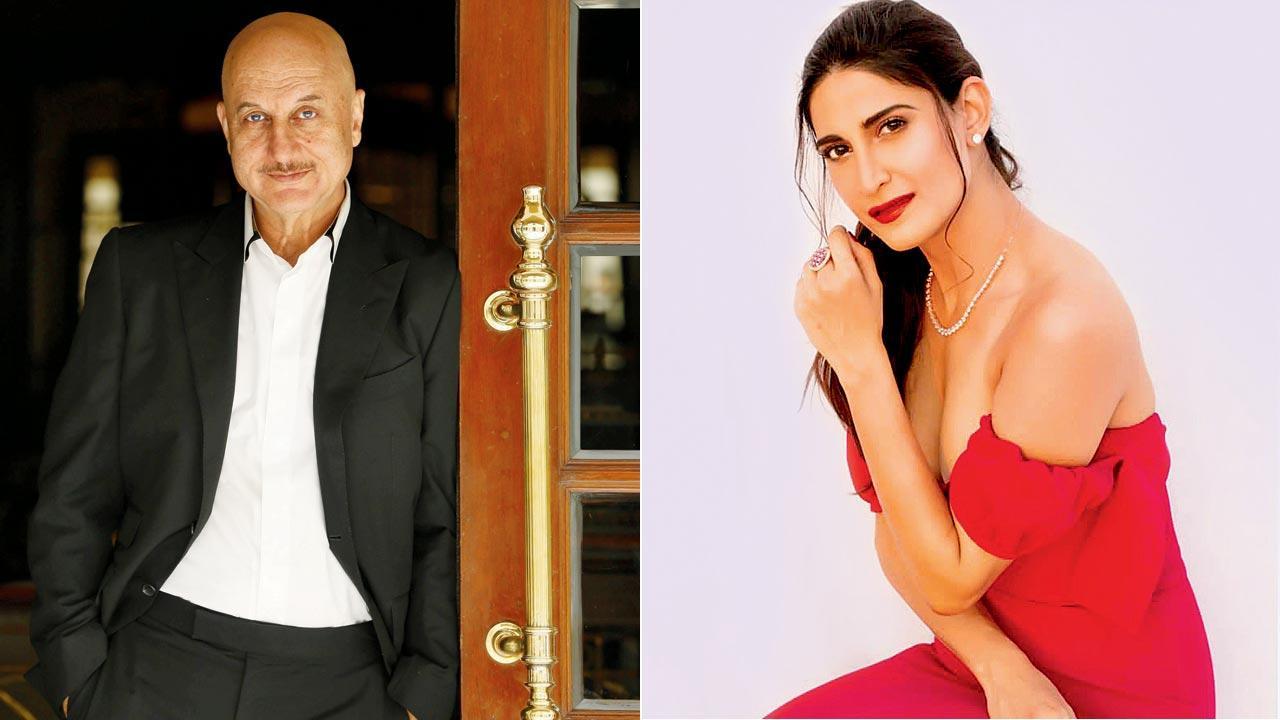
2 years after The Accidental Prime Minister, Anupam Kher and Aahana Kumra reunite for Happy Birthday
8:03 AM
Mohar Basu (MID-DAY; February 23, 2021)
Though The Accidental Prime Minister (2019) was a forgettable film, Anupam Kher and Aahana Kumra had won praise for their fine performances. Two years since, the actors have reunited on the thriller, Happy Birthday. The project, helmed by Prasad Kadam, went on floors in the city yesterday.
Kumra says she is looking forward to tackling a new genre with Kher after the political drama. “I was blown away when I read the script. I am glad to get the opportunity to work with Mr Kher again; we shared great chemistry in our last outing,” she says.
For Kher, the primary reason to give his nod to the project was the opportunity to work with a fresh voice. “I love working with new directors,” he says. The director adds that the thriller, which deals with “the concepts of life and death”, will be shot over a start-to-finish schedule in Mumbai.
I was chatting with Rajkummar & Patralekhaa on my birthday when he broke the news about Irrfan-Hansal Mehta
8:44 AM

Hansal Mehta reveals that a project with the late actor didn’t materialise, says he’s been very productive during the lockdown
Akash Bhatnagat (MUMBAI MIRROR; June 2, 2020)

Also produced by Bhushan Kumar, the film was supposed to release in March, then pushed to June and even now its opening date is uncertain. But Hansal is not worried, “It would have been a disaster had it opened in March; it’s a film which will be liked by all even if it comes after five years as it is an inspiring, heart-warming story laced with gentle and genuine humour. So, I am not bothered.” There have been rumours of a digital release, but the National Award-winning director shrugs it off as just speculations. “We are going through a pandemic and have lost two stalwarts (Rishi Kapoor and Irrfan Khan) in the midst of it. It has been a tough couple of weeks for the industry during which we didn’t even discuss the film. But my producers are working on it and we will have something concrete to announce really soon,” he promises.
Irrfan passed away on Hansal’s birthday (April 29). “I was on a video call with Raj and Patralekhaa who had called to wish me. We were chatting and laughing when Raj broke the news to me. I was stunned,” he recalls. That day, Hansal had tweeted about a secret which even now he refuses to divulge, saying it’s private. All he will say is that Irrfan and he almost ended up working together fairly recently. “It did not happen eventually for a variety of reasons that I don’t want to discuss as it will hurt a lot of other people,” says the filmmaker, who regrets not getting the opportunity, but is glad he got to spend some time with his friend. “We had known each other since 1994, and now our life and death are inter-connected. My date of birth will now mean a new life for Irrfan in a better place,” Hansal says emotionally.
Recently, his film Omerta, based on the life of terrorist Ahmed Omar Saeed Sheikh, completed two years. Going down memory lane, Hansal admits the film was a difficult but satisfying journey because it was Raj and his most intimate collaboration after Shahid. “It will remain special to me because we collaborated on creating an aspect of human nature which we don’t normally explore even as a human characteristic. Evil is not seen as evil,” he points out.
The filmmaker has been a part of movies not only behind the camera, but also in front of it. He was last seen in The Accidental Prime Minister last year. “I keep stepping in for friends when they call me in emergency,” he laughs, revealing he has also done a small role in Vikrant Massey’s sci-fi film Cargo, which was screened at the MAMI film festival in 2019, for producer Shlok Sharma. “I told him I am not an actor but he was persistent,” he shares, adding that he often gets called for acting gigs. “I guess it’s because of my grey hair and that I work for free and for the love of being on a film set. I was even shortlisted for the doctor’s role in Good Newwz, but I was busy with Chhalaang at the time and the film was saved,” he concludes with a chuckle.
I’m one of the luckiest few who enjoys going to work every day-Akshaye Khanna
8:37 AM

Akshaye Khanna talks about the choices that he has made and why he opted for risks over security and commercial viability
Roshmila Bhattacharya (MUMBAI MIRROR; December 21, 2019)
Even before you arrive at producer Nitin Manmohan’s office for the interview, you learn, to your surprise, Akshaye Khanna likes chocolates, but only one particular brand, and would order it even when they were shooting for the upcoming romcom, Sab Kushal Mangal, in Jharkhand. He is also always punctual, even when he has to drive to the ‘burbs all the way from town. Noon strictly means 12 pm. By the time we’re done, you know a lot more about the reclusive actor. Excerpts:
You have had two releases this year with one coming up on January 3. For someone who has always been super selective how does it feel?
It’s been a satisfying year as both The Accidental Prime Minister and Section 375 are films I believed in and I’m proud to be a part of them. That’s a great place to be.
So, we can hope to see you around for another five years?
Five years is just a number, a small one. I hope to be around till I drop dead. There’s a perception over the last few years that I tend to not do too much work, but it’s the opposite. Ayushmann (Khurrana) is doing three-four films a year, that’s the space I want to be in. I’ve always preferred a certain pace, but life has not always allowed it. If it happens, I’m the happiest. Sometimes a film requires 150-200 days of shooting, so you end up doing just one film a year. There are so many permutations and combinations in our business, it’s not like a factory assembly line where you can just churn out stuff.
Yet you seem optimistic about the future of Hindi cinema...
That’s because all kinds of films, be it Housefull 4, Bala and Pati Patni Aur Woh, are getting good releases. Ten years ago, if it wasn’t in the commercial bracket, a film wouldn’t get screens. Today, even Section 375 and Saand Ki Aankh get an audience and a voice. It’s like the social media, anyone can offer an opinion. The numbers may be small or large, but at least they get heard. The Accidental Prime Minister was the first authentic political film and that made it controversial in that it evoked different opinions. Ditto Section 375, as the topic itself was sensitive and so people reacted strongly and emotionally.
Yeah, one review described it as “a myopic ignorant train wreck” and another as a “gripping courtroom drama”.
That people would comment on both sides of the spectrum was to be expected. I might not agree with the one who calls it a “train wreck” but I can’t stop the critic from writing what he wants. I, too, have views about other people’s films. I might say I didn’t like it or that it could have been better...
In retrospect, would you have changed anything in the film?
Sometimes I feel—though it’s not my job or specific to one film that we can market and position our films better. You can never control a narrative, but you can balance it out. But that sometimes gets lost in too much information.
From the trailer of Section 375, one perceived a kind of a #MeToo trial so the twist in the tale was disappointing.
I’ve also got such preconceived notions and reactions. But that would be the obvious expectation and end, which is a choice my director didn’t make. Had it been a typical film, it might have fared better commercially. But the choice was to go in another direction. And that’s what made it interesting for me as an actor. If you believe in a certain premise, you have to live with the consequences. I really respected the thought process and the writing, and if I had to choose again, I’d go for the same. Unfortunately, in our country, while we have always celebrated democracy, freedom of speech and expression, and pluralism, when it comes to art—be it a book, an article or a film—if it offers a different perspective, we are not as accepting.
The upcoming romcom, Sab Kushal Mangal, seems less contentious even though it’s about a reality shows, goon politics and abductions.
It’s the sweetest script I’ve heard in a long time, a film I’d watch before I go to sleep as it leaves you with a nice feeling and no tension. I’d not done a comedy in a long time and my co-stars, Priyaank Sharma and Riva Kishan, are cute kids. Though they’re just starting out, I’m sure once people see the film, they’ll be pleasantly impressed by their performance. They have a certain maturity and focus which I didn’t in my first few films. This applies to all debutants across departments, which is fab and brave.
Brave? How so?
When you come into the public eye and put yourself out there as an actor, director or writer, you could be loved, hated, even ridiculed. So, that takes courage. You read about millennials in large numbers going into depression in their own private space, some even committing suicides over social media posts. Then, you see these kids who, irrespective of success or failure, are ready to give it a try. You can only win the game if you are playing it, not sitting outside. Life is about being on the court.
According to IMDB, you have signed up for two sequels, Phir Hulchul and Kick 2?
The information is incorrect.
Do you watch reality shows?
I rarely watch TV, I prefer movies. I’m getting less and less interested in information because anything you read or hear, unless coming directly from the source, arrives with layers of interpretation and so is never completely accurate. Even an article in the op-ed page of the newspaper, reflects someone’s opinions. Take the Talwar case. Despite years of articles, TV reports, films and a court case that cumulatively ran into thousands of hours, do we know the truth of what really happened the night Aarushi was killed? We don’t, which is why I’d rather read fiction, it’s always dependable.
Why aren’t our digital shows meeting expectations?
Our storytellers are used to the three-hour format. We have a history of television where shows go on for years. That’s why we are still struggling. But it won’t take our writers and directors too much time to get there. We are an extremely talented nation, look at the leap we’ve made technologically. We may not be there with the best of the best, but we can still produce a Baahubali which is a milestone in Indian cinema. It’s a beginning, we will build and improve on it. It’s happening already and the audience is rewarding the effort which is good.
 That wall behind you has posters of several Nitin Manmohan productions, including your dad Vinod Khanna’s Insaaf and your Deewangee.
(Turning to look) Insaaf was one of dad’s fave posters. What an amazing shot! There are so many actors up on this wall, but I don’t know anyone who had his kind of body language... So fluid! It’s nice to be on a wall which has so much talent. You want to hear a great story?
Sure...
Nitin had gone to Mumbai airport to pick up a relative. Two-three decades ago, the entire family would go to pick up or drop off someone. I’ve many pictures of my dad leaving for an overseas shoot, in a suit, with all of us waving. But that day, there was no one to receive dad when he landed in India because hadn’t told anyone in the family that he was coming home from the US. He’d planned on taking a cab, but Nitin recognised him, even with the long white beard when he walked out. Nitin’s dad, Manmohan, and mine used to be very friendly and he insisted on dropping dad home in his car. They must have chatted on the way and that’s how Nitin produced his first film, Insaaf, with my dad making a comeback.
And what’s the story behind Deewangee?
There’s none, it was just a good film and very different from Anees Bazmee’s other movies. After that, he only concentrated on comedies and larger-than-life magnum opuses. He was a delight to work with as he has a good sense of drama. We also did a comedy, No Problem, which didn’t do well.
Looking back, are you happy with your choice of career? At 40, do you wake up eager or are you unhappy about it like so many?
I’m one of the luckiest few who looks forward to going to work every day because our job and days are not filled with monotony. One day, I could be doing a dramatic scene in Ooty, the next, a song in London, and on the third, an action sequence in a city studio. We’re meeting different people. Of course, you never know when the party will pack up, but at least till then, you can do what you love and that’s a gift life gives very few.
You know, I skipped my exams in the first year of junior college on purpose as by then, I was not interested in continuing with academics. I was so underprepared, I knew I’d fail and didn’t go. I had decided this was what I wanted to do. It was a question of when I was going to tell my parents because I was just 17 then. You fear resistance about your career choice from parents, and that delays communication. As a kid you don’t have the power to say “Bugger off!”
How did your parents react?
They were disappointed. Any parent would be hurt. They felt it was not my place to do what I did at that age. Parents of that generation were conservative, taking such risks was frowned upon. Even today, society is chasing security, and for the masses a government job is priority. It’s amazing that millions put their heads down, complete 60 years in service, do their duty with honesty and integrity and retire. It’s an achievement.
You opted for jittery Fridays. How long did it take your parents to accept?
They were fine after a while. Parents always come around.

The curious case of casting for biopics
7:53 AM

Shreya Mukherjee (HINDUSTAN TIMES; November 24, 2019)
 Gone are the days when people would throng to theatres to watch heroes bashing the baddies black and blue. Those make-believe heroes have now been replaced by real heroes on screen, which has resulted in so many biopics being churned out. But inarguably, the most important bit about making a good biopic is casting the right actors.
“When making a biopic there are certain things to be kept in mind. There has to be similarities between the reel and real characters. Also, it’s important to note how much of the character’s demeanour can the chosen actor imbibe. For a film like India’s Most Wanted, one could take some liberty as not many would not know the faces of the terrorists, but that isn’t possible for a film like The Accidental Prime Minister because all the politicians in the story are well-known,” says actor and casting director Abhishek Banerjee.
 Be it Anupam Kher as the former Prime Minister Manmohan Singh (in The Accidental Prime Minister), Nawazuddin Siddiqui as Shiv Sena founder Bal Thackeray (in Thackeray) and author-playwright Saadat Hasan Manto (in Manto; 2018), Ranveer Singh as Kapil Dev (in ’83), R Madhavan as former scientist Nambi Narayanan (in the upcoming Rocketry), Vidya Balan as mathematician (in her next, Shakuntala Devi biopic), or Deepika Padukone as the acid attack survivor Laxmi Agarwal (in the much-awaited Chhapaak) — the makeover in each of these cases inevitably surprised the audience.
Explaining why makeup and prosthetics aren’t enough to look a certain part, casting director Mukesh Chhabra says, “We need to see if the face reminds us of the real life person. Casting for supporting roles is equally important.”
 According to Nawazuddin, an actor needs to go that extra mile to look convincing. “You can’t take the chance by playing around with the audiences’ memory. It’s satisfying when people say, ‘you looked the part’,” he adds.
 Director Omung Kumar feels while similarities do matter, a good actor can hold any character. However, having helmed biopics such as Mary Kom (2014), Sarbjit (2016) and PM Narendra Modi, he feels prosthetic makeup is a boon. “People said so much about Priyanka [Chopra Jonas] playing Mary Kom but she proved everyone wrong. For Sarbjit I took a liberty as his story was more popular than his face.”
For Ranveer’s look as Kapil, director Kabir Khan says he didn’t go for facial similarities while casting him. “How the actor matches the character’s persona is important. Ranveer’s energy matches Kapil Dev’s. In fact, all the characters were chosen accordingly, and went through extensive training and workshops to match the parts.”
Kabir adds, “When I watch Invictus (2009) I don’t question whether Morgan Freeman is looking like Nelson Mandela or not. He played the persona so well that a few minutes into the film, I forget I am looking at Freeman’s face,” he concludes.
I was lucky to not be typecast even by the audience-Akshaye Khanna
7:53 AM

Akshaye Khanna on bending showbiz rules for over a decade, playing a criminal lawyer in his next and why he was forced to go on a sabbatical
Roshmila Bhattacharya (MUMBAI MIRROR; August 27, 2019)
 Even though he has reached a suburban studio after a two-hour drive from SoBo, Akshaye Khanna is far from exasperated. Gearing up to field questions about his second release of the year, the actor is in his element as he sits down for a chat. Excerpts from an interview:
What are the first reactions to your upcoming film, Section 375? Under this section of the Indian Penal Code, a man is said to have committed rape if he has sexual intercourse with a woman without her consent or if she is a minor.
Well, just from within the family and friends circle, the strongest reactions, in a positive way, have come from women. And I find this interesting.
One of the reasons could be the #MeToo movement which exploded in the country last year and has alerted women on what amounts to sexual harassment. In the promo you see the girl being asked in court why she went back after being violated by the man once. That’s an argument one has heard in many real-life cases too.
I’ve read the headlines but I haven’t followed the details of every case so I can’t comment on this. But yes, it’s something a defense lawyer would bring up, arguing that a subsequent pattern of behaviour does not substantiate the accusations. For me per se, it was an interesting case from the point of view of an actor. As a person, I’d say variations in behaviour have been known to happen.
The main players in this courtroom drama are a director and a costume designer who has accused him of rape. The film industry is infamous for the casting couch. Have you heard or seen anything that, in context of what you know today, presents a different picture?
Since I am a part of the film business, my perception would not be accurate. But I’d like to point out that even though it’s working 24x7, only a small section of the film industry is visible to the public eye and only a small number of faces recognised. Within its purview is also TV, advertising, digital, even pornography, so sexual harassment is a definite possibility. At the same time, it’s unfair to target this as a place of bad behaviour vis-à-vis. sex. Every profession has its rotten apples, and going by statistics, this industry normally provides a beautiful and safe environment for both sexes to collaborate in, which I’m proud of. The term ‘casting couch’ may have been derived from showbiz, but simply put, it means sleeping with someone for a job. That can happen in any profession.
But one has heard of chorus dancers in films having to sleep their way from the last row to the first…
True, but there’s much less chance of that happening today when the focus is on talent. If you’re good, you will get the opportunity without having to trade favours.
Was the Shiney Ahuja rape case one of the muses for this film?
You’ll have to ask the writer. It could be one of many cases that triggered someone to write a story, I wouldn't know.
How much law have you learnt in the process of making this film?
Not much, but the film was an eye-opener. In our country, as common citizens, no matter your profession, we know very little about the laws which apply to everybody, including the government. They’re complex, I don’t know why, with the result that justice can be delayed, which is justice denied.
Films like Article 15 and Section 375 are an encouraging trend given that they function within the parameters of mainstream Bollywood and feature recognizable actors...
There’s always an audience for a good story, specially one about law enforcement agencies, as Article 15 proved. But as one grows older, one realises that in the world we live in, it’s so easy to pass judgements because of all the information constantly being thrown at us. But out of a lakh maybe only 1 per cent knows the facts while others are judging prematurely, on fragments of information, rather than the whole picture and that’s not healthy for any society. Section 375 holds a mirror up to the audience to underline this.
Your character, criminal lawyer Tarun Saluja, is defending someone even his family believes is guilty. Did the morality conflict spark your interest in the project?
Morality plays a significant role not just in this film but even in fields like journalism, medicine, government, law and politics. My character is comfortable rather than conflicted in what he believes to be right even if it’s contrary to that of a large section of the society. It’s a job for him. We are not a Banana Republic, even the worst criminals like Ajmal Kasab responsible for the terror attacks on Mumbai got proper legal representation, from the sessions to the Supreme Court. India did not succumb to public outcry and hang him the next day. He was sentenced after going through the due process of law.
What was your first reaction to the narration?
I wanted to do this film and believed I would enjoy playing this character. One reason for it was that the writing was of a calibre I’d not come across in a long time. It takes a subject like rape and engages instead of titillating or repelling the audience. That’s quite a feat, given that for our audience, cinema is an escape from everyday problems, into a world of song-and-dance. Bit it’s good for them to experience a mature, unbiased take on a subject which traditionally has been treated in a shallow, immature manner. Of course, it took many drafts for the script to evolve into what you finally see on screen.
And did your character evolve with these drafts too?
Oh yes. Even one dialogue can change a character and an entire draft can change a whole lot more. But the basics remained unchanged, we just polished and refined the script.
It must be satisfying to be at a stage in your career when you can attempt such characters…
This is not new for me; 10, maybe even 20 years ago, my producers, directors and writers never restricted me but gave me the opportunities to experiment with different roles and genres. This has not been the case with many other actors, with filmmakers playing safe and not letting them deviate too much from their image. That’s changed with new actors today thankfully. I was lucky to not be typecast even by the audience. They have accepted me in romantic, serious, comic and also negative roles. It has been a good mix.
Among the diverse characters you’ve played, does any performance stand out in your mind?
Not really but recently, when I was browsing online, I came across a song from Border featuring Pooja Bhatt and me. “Hamein Jab Se Mohabbat Ho Gayi Hai” is a love song filmed simply. I’d not seen it since the film’s release and it brought back memories of Pooja, a wonderful actress to watch and work with, with whom I’d chat till three at night during the shoot in Himachal. I should surf the net more often.
There are many young boys like Border’s Dharamveer Singh Bhan who are still dying in border skirmishes every day…
(Sighs) Yeah, young soldiers whose lives haven’t even begun. Playing a character in uniform is a humbling experience, more so when you are shooting with real soldiers for around 60 days. It gives you a window into their minds. It’s a different world, a remarkable departure from civilian life. For them, serving the country is a privilege and I believe the army should organise weekend camps to give civilians a chance to interact with soldiers. It’d inspire youngsters. I was enriched by the experience.
Were you happy with your first release of the year, The Accidental Prime Minister?
I’m proud of it because it was the first authentic political film coming out of Bollywood. The ones made earlier didn’t talk of real people and incidents. I’m sure this will open doors for more such films. I wish it hadn’t released just before the elections but after all the rhetoric was done. Then, perhaps, the audience might have been more amenable to our film which was an honest portrayal of politics.
It must be a welcome change for you to have two releases this year.
Three, a sweet romcom, Sab Kushal Mangal, should release by the year-end. I’ve liked some scripts and zeroed in on a film which should roll by the year-end.
So, you’re not planning to go away from the screen anytime soon?
I never did, it’s against every fiber in my being to not working. Taking a sabbatical was never out of choice, it was thrust on me because there have been periods in my career when inexplicably I did not get the kind of work I wanted to do. Since I didn’t come across material I wanted to be a part of, I chose not to work.
It must have been frustrating and stressful for you...
More than you can imagine, because I have this need to express myself like any creative person. Imagine how you’d feel if someone snatched away your pad, pen and laptop from you. For me, acting is akin to eating. I need to do it to stay alive.
Mirror Newsroom: Hansal Mehta, Anubhav Sinha, Gaurav Solanki, Mayank Tewari speaks up on trolls, CBFC
8:20 AM

Anubhav Sinha, Hansal Mehta, Mayank Tewari, Gaurav Solanki
In the latest edition of Mirror Newsroom, filmmakers and writers speak on adapting from real-life stories, negotiating trolls, the CBFC, and the repercussions of having a political opinion
Kunal Guha (MUMBAI MIRROR; July 31, 2019)
Depicting stories inspired by real events on celluloid has become an accepted model in Hindi cinema. Tales of those who have been marginalised to horrific accounts of violence that have either been ignored by newsrooms or relegated to the inside pages of dailies has surely delivered as compelling ‘material’. In the latest Mirror Newsroom session, filmmakers and writers who have championed socially-relevant films, spoke about what drives their cinematic decisions. The esteemed speakers at the roundtable included filmmakers Hansal Mehta (Aligarh, Omerta) and Anubhav Sinha (Mulk, Article 15) and writers Gaurav Solanki (Article 15, Taandav) and Mayank Tewari (Newton, Delhi Crime 2). Here’s what they had to say:
 What has sustained Bollywood’s obsession with real stories?
Hansal Mehta: We don’t have too many stories. So in real life, you’re finding all these stories. But Aligarh (right), for instance, wasn’t just a true story, it reflected ageing, loneliness and being marginalised on account of your sexuality. So it’s important that the real-life character resonates with you. It is finally your voice that is giving life to that real-life character. But it’s good that we are finding new stories in our world, of our times.
Mayank Tewari: As a society, we have become very affluent and self-obsessed and seek stories which are rooted in our realities.
Can filmmakers voice political views?
Hansal: I’ve not seen PM Narendra Modi or The Tashkent Files. But I knew it was going to be difficult for them because even before the film releases, they know that they will be ridiculed. And sometimes, the filmmaker’s reputation precedes him. In terms of a piece of cinema, The Accidental Prime Minister may be inadequate and it was the filmmaker’s first. But the things that you’re showing about the Congress Party during that period are coming to the fore now. They’ve reduced India’s oldest party to a joke. I should also be able to criticize the people I idolise.
Mayank: I watched Modi because I wanted to watch what a propaganda film is like and felt it was atrocious. When it came to The Accidental..., I was heart-broken because I feel a lot of people rubbished the film because of the subject.
 Has the CBFC become more rigid?
Hansal: Sometimes, I’ve had ridiculous episodes with the CBFC. Once, they gave an A certificate to my film’s trailer just because of a certain word that conveyed that the film’s theme is adult. Then, there’s no way to promote the film because my trailer cannot be played with any other film. But then, they also gave a U/A certificate to Article 15 (left) which is wonderful. They are the industry’s favourite punching bag. My last film Omerta had travelled to festivals around the world before releasing in India. The CBFC objected to the scene where you see a guy peeing while the “Jana Gana Mana” was being played. I told them that it was the character who was disrespecting the National Anthem, not me. But they were worried about the backlash and that is something they have to account for. For Aligarh, the CBFC is still fighting a case, while I have made three films after that.
Anubhav Sinha: If you read the Cinematograph Act, 1952, five per cent of the films won’t release. It was written at a time when the Constitution was four years old and it’s based on interpretation. Those who judged Article 15, suggested just five modifications and I just shook hands and ran. Sometimes, you get lucky.
Mayank: Aside from the CBFC, the larger threat is that, as a society, we’re getting addicted to being outraged. And that is more worrying.
Has modern literature tweaked itself to be more conducive for adaptations?
Hansal: In recent years, a lot of books are written with the intention of becoming a film adaptation. Publishers pitch the ideas before the books hit the shelves. As a filmmaker, one has to be discerning and look for subjects that resonate with you. It may be a very mediocre book but you can make it into something wonderful. For instance, you can make a 3 Idiots from a Five Point Someone.
Mayank: I would like to adapt Shubhangi Swarup’s Latitudes Of Longing. Then, Jhumpa Lahiri’s first book Interpreter Of Maladies has some very interesting stories, particularly the one titled ‘Mrs. Sen’s’.
Is this the best time to tell stories?
Hansal: The thing about making movies is you make them when you feel strongly about something. If I would have made Shahid today, it wouldn’t be the same film. The fact that it is still relevant and resonates with so many, I feel it did its job. We knew that we were at a disadvantage then since no one knew who Rajkummar Rao was. I was returning to films after three years, having made a film I shouldn’t have made, perhaps. And despite all that, we made the film in Rs 75 lakh. Today, with the resources at my disposal, I may not make the same film. Shahid partly came out of that hunger and anger that was brewing inside me.
Anubhav: Long back, I had the privilege of spending some time with Shekhar Kapur and he had told me that filmmakers need to quit their obsession with the theatre. Some films are not meant for the theatre but they will have a much longer life. A distributor friend told me recently that the audience of Kabir Singh and Article 15 doesn’t overlap and yet, both did well. So there’s enough market for all kinds of movies. Now, the audience wants a big star, a big dhamaka that follows the big Bollywood recipe. For everything else, they have access to so many other platforms. The only other segment that remains, is our own stories…Malihabad ki kahani, Jharkhand ki kahani. There was no space to tell these stories and TV has always told the Karan Johar version of village stories. But the market that seeks realistic stories wasn’t catered to till recently.
Gaurav: There are also stories that the media refuses to follow. Some time ago, magazines and newspapers would do long pieces on them. But now, since no one covers them, people are deprived of that information. So feature films cater to that need gap by telling stories that news channels don’t want to tell.
How do filmmakers deal with trolls?
Hansal: When I won the National Award (2014, for Shahid), I was invited to a news channel. It was pre-election time, and they asked me why I had signed a document that stated I would vote for the secular candidate from my constituency and I had said, “Because I don’t want Narendra Modi as my Prime Minister”, and the trolls haven’t stopped ever since. Every time I say something, they say, ‘he’s a left-wing guy’. Interestingly, when I did The Accidental Prime Minister, I had left wing trolls after me who are equally rabid.
Anubhav: If I write ‘Hello’ on Twitter, there will be people who will have contrarian views. I find trolls to be like children stuck in a well. You don’t need to respond to them. After one film, I’ve had both, Brahmins and Dalits abusing me.
The year 2019 so far: One blockbuster and five hits
8:47 AM

Box Office India Trade Network
The box office has been pretty good for the first three months of the year in terms of NETT collections which have been aided by a higher share of the theatrical gross due to a lower GST rate. The year so far has seen one BLOCKBUSTER in URI and a five HITS with TOTAL DHAMAAL, KESARI, GULLY BOY, LUKA CHUPPI and BADLA.
URI had an all India share of 101 crore while the likes of TOTAL DHAMAAL and KESARI will be 75 crore at best. The problem today is that films are not opening too well and its about the pick up over the weekend and with that scenario there is always going to be a limit to business as you are not even getting remotely close to utilizing the capacity as best as possible.
The bigger films are coming in the last three quarters and the bigger films have to challenging for records especially with in terms of NETT with this GST reduction. AVENGERS: ENDGAME releases with set a target for those 4-5 big Hindi releases to come this year and if by the end of the year its AVENGERS: ENDGAME still at the top then that will be very disappointing for the Hindi film industry.
The top NETT grossers of the year till date are as follows.
1. Uri - The Surgical Strike - 2,43,99,00,000 (89 days)
2. Total - Dhamaal - 1,49,86,00,000 (48 days)
3. Kesari - 1,43,00,00,000 apprx (21 days)
4. Gully Boy - 1,34,17,00,000 (56 days)
5. Manikarnika - The Queen Of Jhansi - 90,81,00,000
6. Luka Chuppi - 87,37,00,000 (41 days)
7. Badla - 84,81,00,000 (34 days)
8. Romeo Akbar Walter - 27,75,00,000 apprx (6 Days)
9. The Accidental Prime Minister - 23,24,75,000
10. Junglee - 22,50,00,000 (13 days)
I will never make a political film again-Vijay Gutte
8:23 AM

The filmmaker reacts to an FIR lodged against him and the team of his film, The Accidental Prime Minister, in Muzzafarpur
Rachana Dubey (BOMBAY TIMES; February 15, 2019)
 The Muzaffarpur Police has lodged an FIR against filmmaker Vijay Ratnakar Gutte’s The Accidental Prime Minister and its actors Anupam Kher, Akshaye Khanna and 12 others associated with the project. Following a directive from the district court, a complaint was lodged at Kanti Police Station earlier this week, after the court objected to noncompliance of its January 8 order in this regard.
The Accidental Prime Minister released on January 11 and was based on a book of the same name written by Sanjaya Baru. He was employed with the PMO and his book presented an account of the tenure of former Prime Minister Manmohan Singh. On January 8, the court had ordered the police to lodge an FIR against the film’s actors and 12 others based on a complaint filed by advocate Sudhir Kumar Ojha with a plea that the film presents Dr Singh and a host of other public figures in poor light. The complaint has named Anupam Kher, who played Dr Manmohan Singh, Akshaye Khanna, who played Singh’s media adviser Sanjaya Baru, and even those actors who played Sonia Gandhi, Rahul Gandhi, Atal Bihari Vajpayee, Lal Krishna Advani and Lalu Prasad Yadav along with the film’s makers.
The advocate moved the court of Sub-Divisional Judicial Magistrate Saba Alam on February 4 to mention that the police had not complied with its order. A showcause notice was issued to Kanti Police Station through the Muzaffarpur senior superintendent of police and following this, an FIR was lodged under IPC sections 295, 153, 153A, 293, 504, 506, 120B and 34, which relate to promoting enmity among different groups, sale of obscene objects, insult with intent to provoke breach of peace and criminal conspiracy among other things. The complainant had alleged that Ojha felt hurt upon watching the promos of the movie, which was not released at that time, in which, he felt that public figures were portrayed in a manner that projected a poor image of India.
When we reached out to debutant director Vijay Ratnakar Gutte, who helmed the political drama, he told us, “Yes, I am aware that a complaint regarding our film has been filed, but none of us, who have been named, know the exact details of the complaint. The first time they raised a flag was before the release and only on the basis of what people saw in the trailer. I am shocked with these developments. The book on which the film is based has been in public domain since 2014. News channels have used its content for years and everyone knew about my film for about two years before it released. So, I don’t know what people are objecting to now and why. We tried something new with this film and we thought it will open gates for a different kind of cinema to be made in the country. I was under the impression that it had all worked out fine and after people saw the film, things have calmed down. But, this FIR has been lodged out of the blue and funnily enough, no one has officially communicated about it to us. At least, I have only heard about it from the media. After Padmaavat released, the issues around it subsided, but the story refuses to end in our case, even though the CBFC had passed the film with minor changes. I have had to face a lot of opposition with my very first film. It was a challenge to make it all look real, but I will never make a political film again in my career as a filmmaker.”
Sonia Gandhi has a distinct way of saying ‘Can-gress’, ‘party’, ‘Rahool’-Suzanne Bernert
8:25 AM

It took three sari-drapers and innovative makeup strategies for Suzanne Bernert to turn into the UPA chairperson in The Accidental Prime Minister
Anjana Vaswani (MUMBAI MIRROR; February 10, 2019)
 The courier delivery man at the door stares at Suzanne Bernert. It appears as if he is trying to place her, locate her in some sort of context. Has he unwittingly stumbled upon some secret Mira Road hideaway of the United Progressive Alliance, a chamber that somehow also doubles as a time machine? And, is the woman before him, a younger — if, inexplicably, blonde — Sonia Gandhi? Stuttering, he summons the courage to ask the tall foreigner if she’s an actor, and then, of course, comes the selfie request. Bernert complies with a smile. The actor, who happened to find her way into the Indian entertainment industry somewhat serendipitously, has been in Mumbai for 14 years, and has acted in some 24 TV shows, including some Balaji Telefilms productions, and two Bengali films. But it’s her recent role as Sonia Gandhi in The Accidental Prime Minister that has brought her real recognition.
“The reaction is interesting, because I have played Sonia Gandhi before, too,” says Bernert. Bernert, who is in her 40s, plays both a younger Sonia as well as the mature politico who is shown giving PM Manmohan Singh much to fret about through the two consecutive terms that the Congress-led UPA was in power. But, indeed, Bernert first essayed the role of the UPA chairperson in the 2014 miniseries 7 RCR. The German national’s journey — she hails from Detmold, near Hanover — to Bollywood started with her being approached by a line producer for a Hindi movie when she was holidaying in Dubai in 2005. While that movie was never released, Bernert moved to India, met her husband, actor Akhil Mishra, and stayed back, acting in plays and television series.
“I had a few lines of dialogue in 7 RCR, but they may have been edited out of the version that aired,” says Bernert who learnt Hindi on the fly, through her interactions with Mumbaikars. When she speaks, she switches automatically between English and Hindi, which now comes as naturally to her as German, French and Italian.
But being Sonia meant speaking a different brand of Hindi altogether. “I had played Queen Helena in Chakravartin Ashoka Samrat (2015 TV drama), so I was familiar with that very formal sort of Hindi,” says Bernert. Mishra, who she married shortly after she moved here, was a great sounding board for her dialogue practice, and it didn’t take her too long to master Gandhi’s pitch and intonation. “She has a distinct way of saying ‘Can-gress’, ‘party’, ‘Rahool’. I knew that if I could just hit these, the effect would be complete.” Bernert says that she is not a political animal, and does not follow it thoroughly. “Indian politics is overwhelming, and I’m just a German chick,” she says, throwing her hands up.
Bernert also scoured the internet to find a clip of Gandhi speaking Italian, “but I couldn’t find a single one,” she says, with a laugh.
While the accent and language came easily to her, the role did pose other challenges. “I’ve learnt Hindi, Marathi, and even Lavani, but I don’t know how to tie a sari,” says Bernert, whose audition tape on YouTube shows her draped in her mother’s shawl. Three stylists were entrusted with the task of getting Sonia’s sari drape just right. “And there was one dedicated hairstylist who had to ensure that my wig flicked out at the ends, just so.”
Then, her jaw also needed some widening, and her skin needed to reflect decades of experience. “They tried to use a gummy substance, and then tried stuffing cotton into my mouth, and I tell you, I don’t know how Marlon Brando did it — but it was impossible to speak,” says Bernert. “Then, exercising typical Indian jugaad, a young makeup artist cut pieces of makeup sponge and stuck those on — that had the broadening effect and made the jawline sag.”
The toughest part for her, however, was that each scene had to be shot first in Hindi, then in English. “It causes a hop and a jump in the brain,” says Bernert, who’s also still trying to wrap her head around how people recognise her as the woman who played Sonia Gandhi. “I don’t think I look like her,” she says.
Check out images from Rahul Gandhi biopic, titled My Name Is Ra Ga
8:32 AM

Danielle Petite and Aswini Kumar as Sonia and Rahul Gandhi
Himesh Mankad (MUMBAI MIRROR; February 9, 2019)
 With the elections just a couple of months away, it’s raining politicians on screen. After The Accidental Prime Minister, based on Sanjaya Baru’s memoir on Manmohan Singh, and a series of films featuring Narendra Modi, including a biopic on the PM, Mirror has learnt that a film on Rahul Gandhi titled My Name Is Ra Ga is now being made. The film, which is nearing completion, starts with former PM, Indira Gandhi’s assassination in 1984 and ends before the upcoming election.
“My film starts with Rahul Gandhi’s childhood and continues to the present when he is mired in political controversies. It’s about his life as a student in the US to becoming the president of the Indian National Congress,” informs journalist-turned-director Rupesh Paul who has also scripted it based on encounters with those close to Rahul.
 Rupesh says he has not got in touch with any political leader, including those from the Gandhi family, for permission because “all the information is in the public domain”. Reiterating that his film is based on facts, he says that “there is no need to get any clearance”. “If we keep the names aside, it’s a story of every man who has gone through multiple and repeated failures before tasting success. I was deeply inspired by his fight which I saw closely as a journalist,” shares the filmmaker.
Aswini Kumar plays Rahul while Himant Kapadiya will portray Modi in the film. “I wanted to get bigger names on board but in the current political scenario, everyone is wary. I am still trying to get a significant actor on board for the remaining portions,” Rupesh informs. Quiz him on censor trouble and he retorts, “I don’t think there will be an issue because the intention isn’t to malign anyone.”
While Anupam Kher was recently seen as Manmohan Singh in The Accidental Prime Minister, the actor's brother, Raju Kher steps in to play the former Indian PM in this film. “After rejections from many actors (whom he doesn’t wish to name), I was surprised Raju sir agreed to play Manmohan Singh. He has given a different arc to it,” he says. What did he think of The Accidental Prime Minister? “I accepted the film but not its tone. The director should have done justice to the film by staying true to real-life incidents. But it has opened a new genre in Bollywood, giving us the courage to make political films.”
Tickets costlier at PVR chains despite GST relief
8:24 AM

Movie-goers also miffed with other multiplex chains across the country; exhibitor insists that prices have reduced but are dependent on ‘movie categories’
Himesh Mankad (MUMBAI MIRROR; January 12, 2019)
The reduction in Goods and Services Tax (GST) - 18 per cent from the original 28 per cent for movie tickets costing more than Rs 100, and from 18 per cent to 12 per cent for those up to Rs 100 - was expected to bring a smile on the face of movie-goers. However, Mumbaikars are miffed because the national multiplex chain, PVR, have yet to pass down the tax relief to the audience.
“Till last year, the morning shows at PVR Juhu were priced at Rs 150- Rs 170. On Friday morning, I was shocked that tickets for both Uri: The Surgical Strike and The Accidental Prime Minister were priced as high as Rs 185 and as a mark of protest, I decided not to watch either of the two films,” says trade analyst Amod Mehra, adding that the industry should look into the matter so viewers are not cheated.
He was justified in feeling shortcharged because the Anushka Sharma-Varun Dhawan-starrer, Sui Dhaaga, which had opened on September 29, 2018, had been priced Rs 15 lower than Uri. When this was pointed out to Kamal Gianchandani, CEO, PVR, he explained the reason for the discrepancy in the pricing, saying, “We follow variable ticket pricing in Mumbai. Depending on the curiosity and excitement around a film, we categorise them as ‘blockbuster’, ‘popular’ and ‘ordinary’. Uri is carrying fantastic reports due to its topical subject, so we have placed it in the popular category whereas Sui Dhaaga was in the ordinary category. One shouldn’t compare the rates of the two films.” He argued that it is not “fair to compare two films that released in different periods”. “The best way to see the GST benefit is by comparing the ticket prices of Simmba on December 31 and January 1, as that would show a clearer picture. The benefit has been passed on to the patrons across the country and there is absolutely no ambiguity on this,” he maintained and also shared the reduced ticket price chart of Simmba.
The chart above shows that there is reason for viewers like Mehra to be upset given that tickets for the same film at various multiplexes differ. “Though the tax benefit is huge, there doesn’t seem to be a decline in ticket prices across the spectrum. The distributor association should sit down with the multiplexes and fix the rates for big and small films and this should be done at the earliest,” he states.
Despite the tax slabs coming down from 45 percent in 2014 to 18 per cent in 2019, there has been a surge in the average ticket rates across national multiplex chains. Ticket prices have gone up from Rs 280 to Rs 400 for evening shows at key city multiplexes which, according to industry experts, is one of the reasons for the audience to stay away from theatres.
Bobby Singh, a cine goer in Delhi groused on Twitter, that Cinepolis (West Delhi) is yet to pass on the benefit of GST reduction. “Cinepolis (West Delhi) charged Rs 190 for morning shows before Jan 1, and they are still charging the same for morning shows of Uri,” he complained.


(Crisp) Movie Review: THE ACCIDENTAL PRIME MINISTER by FENIL SETA
1:48 PM

My rating - ** out of 5!
It’s fine to criticise the government, but criticising your army... woh bahut hi dukhad baat hai-Paresh Rawal
7:21 AM

Renuka Vyavahare (BOMBAY TIMES; January 11, 2019)
While negative roles seemed to be his forte, it didn’t take long for filmmakers to tap into his versatility. Hailing from a theatre background, Paresh Rawal continues to be one of our finest actors to date. In a chat with Bombay Times, he speaks about his upcoming film URI: The Surgical Strike, his dual role as an actorpolitician and his film being touted as a propaganda movie. Excerpts...
There was speculation that URI might turn out to be a pro-government propaganda film. You are also a BJP MP. What’s your take on that?
The government hasn’t backed the film. Jo hai woh dikhaya hai. What’s the propaganda in that? Whatever has been shown, army ne woh kar dikhaya hai. Agar ussme kisiki waah waah hoti hai toh kya burai hai? Agar unhone achcha kaam kiya hai toh waah waah bhi nahi kar sakte? What kind of logic is that? If this would have happened during Congress’ rule and a film was made then, would people still say this? Some people even say that the surgical strike never happened. These talks only demean, malign and tarnish the image of the Indian Army.
Consciously or subconsciously, do your political views influence the roles you choose today?
Not at all. I look at a character strictly as a character. My offscreen views and roles don’t clash with my onscreen performances. Of course, I won’t play a character jissey meri country ko nuksaan ho and one which could hurt the sentiments of the citizens of India. Lot of people feel that politics is the reason why acting has taken a back seat in my life, but that’s not true. I am waiting for the right scripts. I would love to work with young actors and filmmakers. There’s still so much to learn.
What according to you is the essence of Uri, the film?
Yeh naya Hindustan hai, yeh Hindustan chup nahi bethega. After 26/11, the army had given a proposal that we should go across the border and shoot down the bases (terrorist camps), but that proposal was shot down by our then government. Itna sab kuch ho gaya. Woh Mumbai tak aa gaye, uskey baad bhi we didn’t do much. So, a strong political will is important. Coming back to Uri, the way the army handled this operation with such precision and sharp planning, is commendable. I feel for the soldiers, for them it’s like ‘border pe dushmanon ki goli khao, aur desh mein deshwasiyon ki gaali khao’. Unka bhi toh hausla badhna chahiye.
Aditya Dhar, the director of the film has said that URI is not anti-Pakistan, but anti-terrorism. Do you agree?
I hate jingoistic cinema, which unnecessarily indulges in Pakistan bashing. In URI, hum army ke jazbey ki baat kar rahe hain. That mission was the victory of the skill and bravery of the army and of strong political will, too. I feel army bashing has become fashionable today. Log anaap shanaap kehte hai. It’s fine to criticise the government, you are welcome to do that, but criticising your army and country, woh bahut hi dukhad baat hai. You are playing with fire. We are fortunate that our army believes in democratic values. Jis haalat mein woh kaam kartey hain, usko toh samajhiye aap. For instance, just think about what happened with Major Gogoi.
 You are talking about the debatable 2017 incident where Indian Army reportedly used a human shield (Kashmiri man Farooq Ahmed Dar was tied to a jeep as a ‘human shield’ against protesters by Major Nitin Leetul Gogoi) to stop stone pelters in Kashmir?
Agar bandey ne goli chala di hoti toh kitna carnage ho jata. Usney dimaag lagaya, ek bande ko bandh diya aur gaadi chala di. That was a trick to leave the place tactfully. Agar aapki war alag kisam ki ho, toh aapko bhi improvise karna padta hai. You have to think of innovative ways to defend yourself.
In Sanju, you played Sunil Dutt, in URI, your character is based on Ajit Doval (the current National Security Advisor to the Prime Minister of India). Is it more challenging to play real-life characters on screen?
I have met Ajit Doval a few times at the PMO. He is a superhero. He has such a discreet, unassuming kind of personality and yet, he’s doing such heroic work. Uske liye jigra chahiye. While playing real-life characters, pressure hota hai, but you shouldn’t fall into the trap of mimicking the people you portray. When we were doing Sardar (the 1993 biopic on Sardar Vallabhbhai Patel), prosthetics was an issue as the technique wasn’t fully developed back then. I am talking about the early 90s. So, Ketan Mehta (the director) and I decided to let it be. If you are playing Sardar Patel, you have to behave like him. Even if you don’t ‘look’ exactly like Patel, it’s fine, as long as there is some resemblance. I feel mimicking someone makes your performance caricaturish. You have to capture the spirit of the character. That’s more important. The same thing happened with Sanju, as well. I told the makers, ‘Kitna bhi prosthetics karlo, main ulta bhi latak jaoon, toh bhi main Sunil Dutt nahi dikhunga’. So, I aimed at focusing on the psyche of a father. It will be expected that you look like the character you play, but you shouldn’t get sucked into that trap.
Many believed that Sanju whitewashed the story of Sanjay Dutt.
Koi whitewash nahi kiya tha. If it had been made before Sanjay’s court verdict, one would have said it’s to impress the judiciary. He served his sentence and everything that was shown was in the public domain. Beta bigda hua tha — we showed that. Rajkumar Hirani and Abhijat Joshi are honest. They won’t resort to such things.
Speaking of biopics, you were supposed to play PM Narendra Modi. Is that film still going to happen? Vivekanand Oberoi (Vivek Oberoi) is also slated to play Narendra Modi in a biopic. There was speculation that you backed out, since the film will speak of the Gujarat riots and you wouldn’t want to be a part of that.
Let anyone do what they want to do or say what they want to say. We are making that film and I am playing that role. It is not shelved. There can be multiple films on Modi. He’s that kind of a personality.
Do you think the roles that were offered to you at the beginning of your career did justice to your talent?
Agar main yehi sochta rehta toh mujhe koi roles nahi miltey. The negative characters that were offered to me initially were all third-grade villains. Very rarely was I offered a wellwritten negative role. How to then make those roles palatable or relatable was my prime concern. That’s why I started giving an amusing twist to whatever characters were offered to me. Yehi meri koshish rehti thi. Also, kisne socha tha ke villain ke roles karte karte, mujhe Sardar Patel ka role mil jayega. People warned Ketan Mehta against casting me as I was stereotyped. But, directors like him put their faith in me and believed that I was a good actor, irrespective of the roles that I was known for playing. I was fortunate that Bhatt saab (Mahesh Bhatt) offered me a film like Sir (1993). That was the turning point in my career. I did Tamanna (1998) after that. These films proved that I could act well.
Of all the characters you played, the comic roles you essayed in movies like Andaz Apna Apna(1994) and Hera Pheri (2000) have stayed with people the most.
When you are doing something, you don’t realise that it might turn out to be a cult character. You just attempt it with all your honesty. In fact, during Hera Pheri, I distinctly remember that no one laughed during its trial show and that had us worried. The producer was petrified. Priyadarshan was clear that if my character (Babu Bhaiyya) doesn’t click, the film will flop and nothing would be able to salvage it. I improvised a lot and since I come from theatre, it was easy. When we were shooting for Andaz Apna Apna, Rajkumar Santoshi would enact and show us what he expected and he was hilarious. He is a fantastic actor. Itni innocence thi unkey narration mein, it was fun to bring out his imagination to the screen. I feel that if you over-plan as an actor, it doesn’t work.
Your film clashes with The Accidental Prime Minister at the box office, which is another political drama.
These films will open doors in the country for good political thrillers. Why can’t we create content like JFK, Zero Dark Thirty or Frost/Nixon? We can also make these kind of films. Content is the king today. Look at Rajkummar Rao, Ayushmann Khurrana, Vicky Kaushal... they are all doing content-driven cinema. I wish such films were made when I was younger. I think Dil Chahta Hai (2001) and Lagaan (2001) changed the game in Bollywood. They paved the way for contentdriven films.
No filmmaker will go about his labour of love with the agenda of making a propaganda film-Vijay Gutte
7:06 AM

Lasyapriya Sundaram (BOMBAY TIMES; January 11, 2019)
 As his directorial debut, The Accidental Prime Minister, hits theatres today, BT catches up with Vijay Gutte for a quick chat about the film and why he chose a political movie to begin his filmmaking career with. Excerpts…
The Accidental Prime Minister marks your debut as a director. Why did you choose to open your innings with a film that revolves around politics? You could have played it safe and made a romance, comedy or action film...
The producer gave me the book, The Accidental Prime Minister, and asked me to reject it if I didn’t like it. After reading the book, I didn’t reveal my excitement and told the producer that I wanted to meet the writer, Sanjaya Baru (former Prime Minister Manmohan Singh’s media advisor). I met him for seven days and spent close to five hours with him every day. I wanted to tell the story after reading the book and interacting with him. We know everything about the White House, but we don’t know anything about our Prime Minister’s Office (PMO). I believe that others will now follow suit and make films that involve politics. In fact, so many biopics have been announced, including that of Indira Gandhi, Jayalalithaa and NTR. I picked out chapters from the book that talk about 10 years of Manmohan Singh’s tenure. The film chronicles his achievements and the problems he had faced. I have followed the book to the T.
Political films, especially in our country, are often slotted as propaganda tools. What are your views on that?
I am learning to deal with it. This book has been in the public domain since 2014. What many people found controversial has already been discussed on news channels. We have been making the film for the past two years. Its first look was revealed one-and-a-half years ago, but nobody objected to it at that time.
Have you told the story the way it was written, or have you taken a political stand in the film?
You have to tell the story the way it is. Otherwise, it will be wrong on my part. I have ensured that the spirit of the book is maintained. No filmmaker will go about his labour of love with the agenda that he wants to make a propaganda film.
Did you anticipate any opposition to your film considering it has strong political content?
I had a brief discussion with the producer before starting the film. He had consulted lawyers and found out if we could make a film based on the book. Since those things were taken care of, I didn’t have to worry about it.
Rudra Productions (UK) Bohra Bros in association with Dr. Jayantilal Gada (pen), present The Accidental Prime Minister. Produced by Sunil Bohra, Dhaval Jayantilal Gada & Bloom Arts Pte Ltd, the film releases today.

Fenil's Bollywood Talk # 551
3:16 PM

2 POLITICAL FILMS TO START THE ACCOUNT FOR BOLLYWOOD IN 2019!
The second January Friday is here and this is when the flow of films begin. Last week had two inconsequential releases and hence aren’t counted. Tomorrow will see the release of two significant films and coincidentally, both are political flicks. My analysis:
URI: It is a film based on the 2016 surgical strikes undertaken by India on Pakistan after the ghastly Uri attack on the army. It is considered as one of the most successful achievements of the Indian forces. The film is directed by debutant Aditya Dhar and stars Vicky Kaushal, Yami Gautam and Kirti Kulhari. Paresh Rawal incidentally plays National Security Advisor Ajit Doval while Rajit Kapur essays the role of Prime Minister Narendra Modi. The film also marks the impending debut of dashing TV actor Mohit Raina. Vicky Kaushal was not that known when he signed the film. But 2017 changed the tide for him as Sanju and Raazi turned out to be huge successes and he got noticed and praised for both. Also, his web film Love Per Square Foot opened to great response and his track in Lust Stories got the maximum coverage. As a result, Uri is much awaited not just because of the subject but also due to Vicky Kaushal’s presence. The trailer looks great and the film can have a good opening of around Rs. 6-7 crore. If response is positive, it can have a weekend of Rs. 30 crore and lifetime of around Rs. 75-80 crore or maybe even more. It faces a challenge next week with almost 5 major releases and they’ll take away some screen space even if Uri is doing well. Still, it can sustain and earn handsomely, provided of course the audience accepts the flick.
THE ACCIDENTAL PRIME MINISTER: It is based on the book by the same name, written by Sanjaya Baru. He was the media advisor of Manmohan Singh during his tenure as Prime Minister from 2004 to 2008. Anupam Kher plays the titular role while Akshaye Khanna steps into the shoes of Sanjaya Baru. The film’s trailer was launched just 15 days before release and it became the talk of the town. After all, the film attempts to show how Manmohan was selected for the PM’s post and was to be retained till Rahul Gandhi was fit enough to usurp the throne! The film even has characters playing the roles of Rahul, Sonia Gandhi, Priyanka Gandhi, Atal Bihari Vajpayee etc. It’s interesting to see that all real names are used which is rare and probably a first for such kind of a film. The premise of the film also made many question the motive and whether it was funded by BJP, rivals of Congress and Gandhis. That BJP’s official Twitter handle shared the trailer of the film led to a lot of controversy. All these factors helped the film stay in news. It is not a usual massy film but the curiosity of the film is there and it can help the film fetch an opening of around Rs. 2-3 crore. Uri however will be a major competitor since it looks far more exciting and has action. The Accidental Prime Minister will really have to be engaging and only then will the film be able to sustain well in cinemas.
WHICH FILM WOULD YOU LIKE TO SEE AND WHY? DO LET ME KNOW!
Don't care about reactions, I did my job-Akshaye Khanna
11:11 PM

Akshaye Khanna on how he is undeterred by controversies around the film 'The Accidental Prime Minister', Anupam Kher's performance as Dr Manmohan Singh and his next Article 375: Marzi Ya Jabardasti
Sonil Dedhia (MID-DAY; January 6, 2019)
Did you anticipate a backlash at the unveiling of The Accidental Prime Minister's trailer?
I don't think anyone can predict what is going to happen in the future. Considering it was a powerful trailer, a strong reaction was expected, but I am sure all controversies will be laid to rest once the film releases. While it is a political film, we have made it an entertaining one. We haven't deviated from what has already been documented in the book. The Accidental Prime Minister is not a biopic. It tracks a decade of Prime Minister Dr Manmohan Singh's reign in office. I am sure people will enjoy it once they see it.
There is chatter that the film is deliberately being released before the elections to run down Congress. Comment?
Like I mentioned earlier, if you make an authentic political film, reactions are expected. Frankly, I am not focussed on people's reactions; they can think whatever they want to. I have done my job as an actor and now I am going to promote my film with a proud heart. I genuinely love the film and I am sure people will appreciate it.
Did you meet Sanjaya Baru to prepare for your role?
No, I didn't need to. I read the book twice and watched his interviews to gauge the kind of person he is. I learnt that he is a colourful character and spoke with conviction; moreover, I was never trying to imitate him. Vijay Gutte [the director] had done all the research for me, all he requested me to do was follow his direction and I did just that.
How would you judge Anupam Kher's portrayal of Dr Manmohan Singh and how was it to work with him?
Manmohan Singh is a man of big stature and to interpret him is a great feather in Anupam's cap. It is an actor's interpretation of a person, who has been in public life, for more than five decades. I believe he has given an interesting performance and I am proud to be associated with it. As for working with Anupam, I enjoy his company and had a blast working with him. He kept me entertained with his stories. We even share a good chemistry in the film.
It's common occurrence in the West to make films or shows on political leaders or government institutions. Why do you think Indian directors shy away from replicating the same here?
The fact that filmmakers haven't already made films on the prominent historical figures, especially politicians, is testament to the fact that they don't want to rock the boat or cause a stir in the society. But I feel it must change. Being the largest democracy in the world, I have no inhibitions on being part of authentic political films. I am sure in the future we will see films on Narendra Modi or Amit Shah also. A film on Bal Thackeray is already in the works. The Accidental Prime Minister is based on a book [with the same name], which is written by a political commentator; and if one can write a book, why can't a film be made? Every other form of media has the liberty to criticise governments, politicians, but you cannot make a film? People have a right to opinions and they can be different. My only concern is why should anything be banned even before viewing it? In the end, the political class will have to give in and not snub this kind of creativity.
The Thackeray biopic is being produced by a member of Shiv Sena. What happens when a film like Padmaavat faces issues? Do you feel that filmmakers have no freedom of expression?
I am not a political commentator so, I do not want to talk about other people's films. I think there should be discussion or an open forum on why when it comes to films, the freedom of expression is curbed. The public need to decide and somewhere I feel the decision is made. The interest that this film has generated, shows that people want to watch films in this genre.
Upcoming film
Akshaye Khanna, who has been quite choosy about his projects off late, has a courtroom drama in the pipeline. He said, "I am working on a film titled Section 375: Marzi Ya Jabardasti. It is interesting as I am playing a lawyer for the first time."
No matter how good an actor you think you are, without a good script and director, you are nothing-Akshaye Khanna
10:45 PM

Lasyapriya Sundaram (BOMBAY TIMES; January 8, 2019)
Akshaye Khanna has always made a mark with his performances. He started out as the quintessential leading man, but over the years, he not only impressed in supporting roles but also in characters that required him to play the anti-hero. Not one to follow the norm, when Akshaye’s films didn’t work, he took a break and took time off to find his way back,which he eventually did, but only with roles that challenged him as an actor. With The Accidental Prime Minister, the actor is all set to play a real-life character. In a candid chat with BT, Akshaye talks about why a political film needs to be made and released in India, why he never intellectualises acting and also elaborates on how acting is an insecure profession. Excerpts...
In The Accidental Prime Minister, you play Sanjaya Baru, media advisor to the then Prime Minister, Dr. Manmohan Singh. The trailer of the film shows you saying, “I don’t work for the party, I work for the Prime Minister.” Also, your character comes across as a cunning man. Looks like you had a lot of fun playing this role...
Yes, I did. Through the years, I have realised that when you have had fun playing a role, it comes across on screen. Even today, if you watch Dil Chahta Hai (2001), you will sense that we had a blast making it. Talking about The Accidental Prime Minister, my character is like that ingredient — salt. Politics has friendship, enmity, intrigue and even humour.
This film also has a lot of humour, which mostly comes through my character. The time I spent making this film with my director Vijay (Gutte) was enriching, and I think that it has made me a better actor. It is a role that he wrote for me. Sanjaya Baru was not as well known as Sonia Gandhi or Manmohan Singh. So, this was the only character which the director could create. All the other characters are real people. Vijay is a visual director. He had a clear image of what he wanted me to look like and people have seen that in the promo. If people like my performance in the film, I would give a lot of credit to my director.
You have been part of romances, dramas, action films as well as comedies. As an actor, when you are offered a film that belongs to the genre of political dramas, do you feel challenged, excited and even scared? Do you worry about the repercussions it might have?
When I first read the script, I sensed that it’s an important film in terms of how and why we haven’t made authentic political films in our country for all these years, despite being the largest democracy in the world. Had we not been the largest democracy, this question would have been slightly less significant. We need to be able to make all kinds of cinema. We have made films on Gandhi in the past, even I have made a film on Gandhi (Gandhi, My Father, 2007). Our constitution gives us freedom of speech and expression, and it is about time films like these are made. People should have the freedom to watch or not watch it. However, I was very unhappy with that draft because of the way my role had been fleshed out. I had a meeting with Vijay and I told him that it’s a fabulous script... it is an important film and he must make it. But I also told him that I didn’t like my role and I won’t do it. He then asked me about my thoughts on the role, and then I explained to him that the way I see it, the role has far more scope and potential. I told him to take as much time as he wanted because I wanted to be part of such a film. Vijay and Mayank (Tewari, writer) reworked the script, and what they came back with was something that I loved. Having said that, its good to be on the same page with your director, but it doesn’t mean that he has to take my permission for everything, because he is operating on a much larger vision. One must respect that; it is that vision that allows him to make the film. If a director has not already seen the film in his mind, chances are less that he will make a good film.
Over the years, even when films have been panned, you have always been praised for your performance. Can you give us an insight into your craft?
I don’t think about acting. When someone starts a conversation about acting, I move back because I have never intellectualised it. Acting comes naturally to me. I read the script as many times as I need to read it. That’s about it, and then I am on the set. Till the clap is given, even I don’t know what I am going to do. I give myself a basic outline of how I will do it, but I don’t know what I am going to do. Whether it is magic or utter crap, it is for the director to decide.
You have acted in a war film like Border (1997), a romance like Aa Ab Laut Chalen (1999), a film that explored friendship like Dil Chahta Hai (2001), thrillers like Humraaz (2002) and Race (2008),a comedy like Hulchul (2004) and biographical drama like Gandhi, My Father.Was there a method to the way you chose your films?
There has never been, but I can understand why that question is asked. There are some actors who have a method in the way they choose their films. If you see my filmography, the choices are random and there is no pattern to it. I don’t have a great body of work, but I have decent body of work. You can’t join the dots. My selection of scripts depends on instinct. Sometimes, my instincts are right and sometimes they are not. That’s all we have as professional artistes. We can consult others, but it’s only our gut that can tell us. After working for many years, that instinct gets honed.
Post Race (the first installment of the franchise), your films didn’t work. It was clearly a lull period for you as an actor…
Many of my films didn’t work. It was a lull period and there is no doubt about that. Why on earth would I even attempt to deny that? It’s a period that I wish not to dwell upon because it was a very unhappy one, but that is behind me now. When life throws tough challenges at you, then you need to sit back and absorb them. If you are unable to handle the situation, it’s unfortunate. Until a few days back, I was in a happy space. Life hits you hard again, but one has to go through it. Time is a great healer.
Do you think that today, because of the kind of films that are being made, you are getting the opportunity to play better roles as opposed to the 1990s, or even the early 2000s?
It’s a difficult question to answer. With time, everything evolves. As an individual too, one must evolve, especially being an artiste. Getting stagnant as an artiste can be dangerous. The tragedy of being an actor is that no matter how good or talented you may think you are, without a good script and director, you are nothing. That’s why it’s a unique art form in that sense. Filmmaking is a collaborative art form; individually you are zero, until everything around you is perfect. Acting is an insecure profession because you can’t do anything on your own. How a director uses an actor is the biggest gift that a director can give to an actor. See how Brian De Palma has used Al Pacino in Scarface (1983). Over the years, people have continued to allow me to be part of cinema. Every artiste has a lifespan. The artiste never knows when that day will come when the audience says, ‘We don’t want to watch him anymore’. I have gratitude in my heart because people still want to watch me.
You lost your mother last year. That must have a difficult period...
Losing both parents in a short period of time has been very tough. My mother was a very private person. If I speak about her on any public platform, she will not approve of it. So, I would like to respect that.

The Accidental Prime Minister is a historic step in filmmaking because we are not using pseudo names-Anupam Kher
10:34 PM

Rachana Dubey (BOMBAY TIMES; January 5, 2019)
 He has seen 34 autumns as an actor and has been to several shores, acting in films belonging to different industries. Clearly, he’s not an accidental artiste. Anupam Kher, known for his sharp performances and unmistakable screen presence even in cameos, is gearing up for what he calls his best and the most difficult role by far. The Accidental Prime Minister features him as Dr Manmohan Singh, the former Prime Minister of India. The film, based on a book of the same name by Dr Singh’s media advisor Sanjaya Baru, reflects on an important and recent decade in Indian politics. Over to Anupam, who talks about biopics, Indian politics, censorship, freedom of expression and creativity, which he believes is selectively granted. Excerpts...
Your film, The Accidental Prime Minister, is fielding political controversies. But you don’t seem perturbed by the fact that it’s being perceived as a work of propaganda.
I think that controversy is bound to happen in an era where everyone has an opinion and an avenue to be heard. I’m celebrating the fact that the film is ready for release. I am predominantly euphoric. How many actors in their lifetime can boast of a career graph that begins with a film like Saaransh and achieves something like The Accidental Prime Minister? It’s a dream journey for a small-town boy with no godfather. Of course, God has been kind, the industry has been appreciative, and I have toiled with a lot of sincerity and honesty to get this far. So, today, a controversy doesn’t make me tense. If there is any, the producers will sort it out.
You’ve been quoted as saying that you didn’t instantly agree to act in the film, but you came around. What convinced you to accept the part after brushing it aside initially?
I felt the role could really challenge the actor in me. Yes, initially, when my friend Ashoke Pandit brought the film to me, I didn’t see the scope the role had to offer. When I merely tried imitating Dr Manmohan Singh’s style of walking and I couldn’t, I decided to take this up. At first, I didn’t think of this film as a challenge, but it became one. My ultimate achievement with The Accidental Prime Minister is that my mother couldn’t recognise me. With my experience and knowledge of this profession, I think I’m home with this part.
It is one thing to play a character dug out of history and another to play someone who is relevant to contemporary Indian politics. Comparisons and scathing commentary on how you’ve played the part are inevitable. Are you ready for that?
I am an educated and trained actor, I know my job and I am not afraid of failures. There is a saying that a brave man is also scared, but he is braver for five more seconds. Without mincing words, I’d say that no other actor could have done this role as brilliantly as I have done it. The film’s team has contributed to this immensely.
Biopics in India are often found guilty of white-washing their subjects; even Rajkumar Hirani faced flak for Sanju (based on actor Sanjay Dutt’s life) on similar grounds. However, in the case of this film, the allegation is the exact opposite. What are your thoughts?
I haven’t seen Sanju, but a biopic is a filmmaker’s interpretation of someone’s life. Rashomon by Akira Kurosawa offers three different perspectives on the same story. The Accidental Prime Minister is based on a book, written by Dr Singh’s media advisor, who had closely seen everything that happened at the PMO. Once people see the film, they will have an informed opinion. It’s very easy to watch a trailer and jump to conclusions, threaten people and make splashy, controversial remarks. This film is a historic step in filmmaking, because we’re not going under pseudo names for any character. Dr Singh is Dr Singh in the film; he doesn’t go by another name. Before this, we have not made a political biopic with the real names of people, but going forward, hopefully, other filmmakers will do it. The director of my film wants to change the grammar of cinema and perhaps, he’s made the first move. If we no longer show flowers kissing on screen, why should we hesitate to call people by their names in real-life dramas? Why shouldn’t the political arena be explored as a subject for a film, especially when it impacts our life deeply? And I’m sorry, but there is no good or bad timing to bring out a political biopic. It can very well release in the pre-election phase. People have to stop targeting films and start seeing them as instruments of change and records of our times.
Having said that, the outcome of the 2019 elections will have an impact on Narendra Modi’s biopic also, which is underway. It will probably go through similar scrutiny, right?
The beauty of art and cinema is that woh kisi party ya kisi ke objectives ke mohtaj nahi hain, chahe woh power mein ho… ya na ho. Yes, we are living in these times when films have to often face a lot of scrutiny and heat, but we are to blame for that. We tend to put the spotlight on a handful of people who raise objections; we don’t care if the rest of the country appreciates a piece of work. If a fringe group in UP or Rajasthan threatens to stall the release of a film, why do we give them so much importance? My grandfather often said, ‘Beta, behte darya ko kaun rok sakta hai?’ Films are like that; they will find their space to be seen and heard. Yes, their fate lies in the hands of the audience, but nothing can ever stop art from reaching out to its eventual patrons.
Do you feel freedom of expression is curbed in our country?
It’s selectively granted. There is a section of people who will, on the basis of what the subject matter is, decide whether they are for the freedom of expression or against it. We have no option right now, but to live through these times and do our work, which will hopefully bear results in the future.
Recently, your friend Naseeruddin Shah and you engaged in a duel of words over an opinion he put forth, for which he was also attacked by people on social media. Have you resolved your differences with him now?
What’s there to resolve with him? I have great respect for him as a senior and as a friend. Yes, Naseer gets irritated easily, not just with me but with others like Virat Kohli also. He has the right to say things he feels, but I don’t have to take it so seriously. I don’t take myself too seriously either. A person who does that is the most comical. Deep down, we know we love each other and that is what matters.
Naseer often says that we have this undying lust for the Oscars or at least, some form of approval from the West for our work. You have done some notable work in Hollywood. What’s your opinion on this?
It’s a brilliant feeling to be accepted in the West and in other parts of the world. It’s a good thing to widen your horizon. Of course, I was very happy to meet David O’ Russell, Woody Allen, Ang Lee and Robert De Niro, but I had the same feeling when I met Satyajit Ray and Dilip Kumar saab. You admire art and artistes, no matter where they come from. The Oscars have reached a stage where they’ve become a world phenomenon. Even I want to win an Oscar for The Accidental Prime Minister (smiles). With this film, I think I’ve done my best and I’m ambitiously hoping to win an Oscar. It’s potentially one of India’s best representatives in the Foreign Language Film category. A film that sells India’s picture of poverty is not necessarily the best work that comes out of this country. We don’t always have to put that picture out before the world. Our country has a dynamic face, too, and it’s time we present that through our cinema.

Subscribe to:
Posts (Atom)