Showing posts with label Tanu Weds Manu Returns. Show all posts
Showing posts with label Tanu Weds Manu Returns. Show all posts
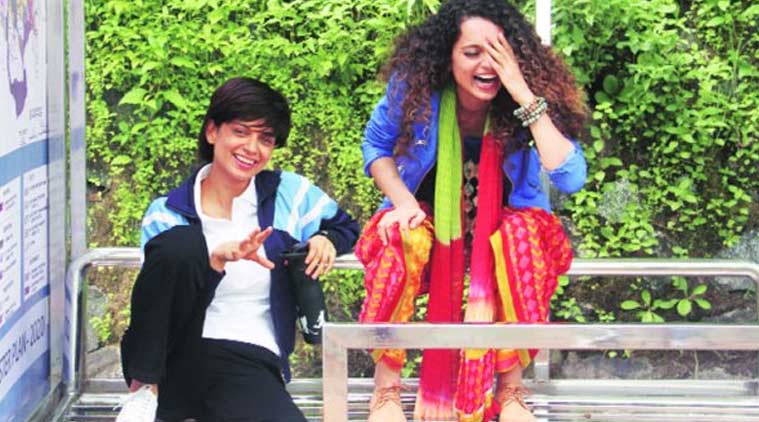
Top 10 romcoms; Tanu Weds Manu Returns the only film with 1 cr plus footfalls
10:08 AM
Box Office India Trade Network
COCKTAIL 2 released this week and has done so so business till date though it will not feature among the top ten Rom Com films of all time. However, in terms of cost, its probably the second biggest rom com ever after TU JHOOTHI MAIN MAKKAAR. The genre is one which came to the fore in the last thirty years as before that there were hardly any rom com films made.
Basically comedy films and rom coms gained traction at roughly the same time because in the 50's 60's 70's and 80's, there were not many comedy or rom com films as North, East and Central India was very unkind to these genres most of the time. It is actually hard to divide which is Rom Com and which is a love story for a film but if a film has drama which is stronger than the comedy and forms much of the film then that goes towards a love story. Drama on the lighter side means Rom Com.
The biggest Rom Com till date is TANU WEDS MANU RETURNS and it is so far ahead of the rest that it makes you doubt that is this film actually a Rom com but a Love Story. It is not for sure as comedy dominates through the film. This film got 1.5 crore footfalls while no other Rom com has even picked up 1 crore. The footfalls of COCKTAIL (2012) are under 90 lakhs.
There is sure to be something different with TANU WEDS MANU RETURNS compared to the other Rom Com films and it could be characterization, relatability or authenticity whereas most Rom coms tend to go the filmy/urban route which limits the business. If big films are still to be made in the genre, then this film is the one at as it stands above all by a margin. Otherwise the genre probably has to be made at a lower cost with possibly smaller casts.
The top ten Rom Com films of all time by footfalls are as follows. There could be some missings from the earlier years but that will not matter much in the context of business today.
1. Tanu Weds Manu Returns (2015)
2. Cocktail (2012)
3. Chhoti Si Baat (1975)
4. Tere Mere Sapne (1996)
5. Dostana (2008)
6. Kabhi Haan Kabhi Naa (1994)
7. Mere Brother Ki Dulhan (2011)
8. Tu Jhoothi Main Makkaar (2023)
9. De De Pyaar De (2019)
10. Luka Chuppi (2019)
We are working on the story for Tanu Weds Manu 3-Aanand L Rai
10:31 AM
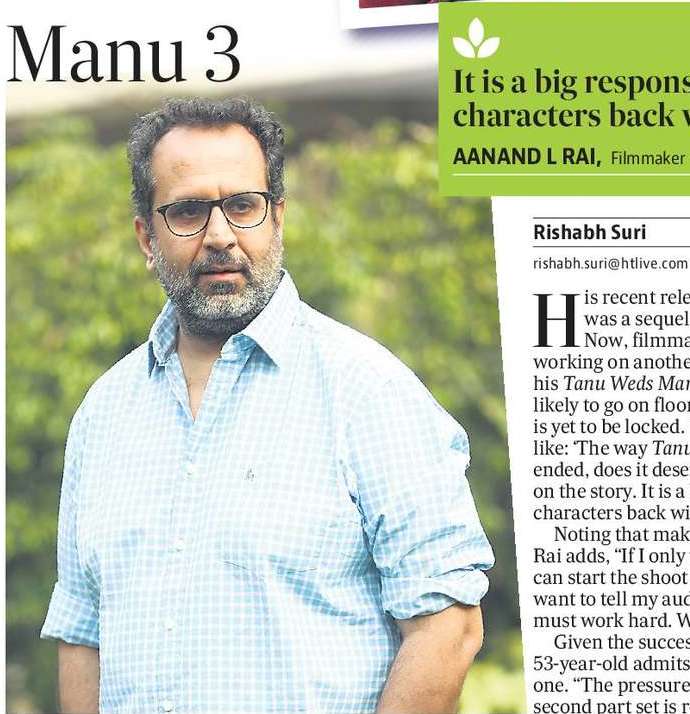
Rishabh Suri (HINDUSTAN TIMES; August 28, 2024)
His recent release, Phir Aayi Hasseen Dillruba, was a sequel to his 2021 film Haseen Dillruba. Now, filmmaker Aanand L Rai has started working on another sequel, the third instalment to his Tanu Weds Manu franchise. While the film is likely to go on floors by mid-2025, Rai says the story is yet to be locked.
“I know there have been questions like: ‘The way Tanu Weds Manu Returns (2015) ended, does it deserve a sequel?’ But we are working on the story. It is a big responsibility to get the characters back with a bigger story and I am on it.”
Noting that making a film is “all about intentions”, Rai adds, “If I only want to make money out of it, I can start the shoot in the next three months. But, if I want to tell my audience a story for satisfaction, I must work hard. Work is on in full swing.”
Given the success of the first two films, the 53-year-old admits that he is nervous about the third one. “The pressure to live up to the benchmark the second part set is real,” Rai ends.
Kareena Kapoor and Alia Bhatt dominate the list of day 1 collections of top 10 female centric films
8:55 AM

Box Office India Trade Network
CREW is the third highest opening ever as far as female lead driven films go only behind VEERE DI WEDDING and GANGUBAI KATHIAWADI though final numbers can even take it above the latter. It is a holiday which has pushed the film to the levels of GANGUBAI KATHIAWADI but even without that, it would have been in the top ten
The top ten list is dominated by films of Kareena Kapoor and Alia Bhatt who are probably the biggest female stars of the past two decades or so. There is also HEROINE (Kareena Kapoor) sitting on 11th place. CREW is an ensemble cast featuring other female stars like Tabu and Kriti Sanon. Hence, its a package but Kareena Kapoor is the main driving force as far as box office goes. There is only one double digit film and that is also a Kareena Kapoor starrer, VEERE DI WEDDING
There have been five heroines in the Hindi film industry who would be in the all time great list and were undisputed in their times and they are Vyjayanthimala, Mumtaz, Hema Malini, Sridevi and Madhuri Dixit and post this opening of CREW, Kareena Kapoor joins the list. Maybe the level of success is not as high as the other names above but the longevity makes up for that. If the success ratio of Alia Bhatt keeps up over the next few years, her name will also be up there with the all time greats, making it seven heroines.
The opening of the film is also boost to the films featuring the heroines as central leads as today most of the top female stars want such roles which makes it tough to get a top male star and a top female star in the same film catering to the mass audience as it will be male dominated.
The problem occurs that today films post pandemic have to cater to a wider audience to get an initial. As a result, it has to be more commercial and cinematic which is tougher with females. It leads the heroines towards action and they play avenging angels or spy agents and basically become the heroes. But the fact remains that heroines become stars due to their songs and glamour but this all goes out of the window in an action/thriller film.
Obviously its action which is going to take these opening numbers higher but how do you do it retaining the essence of the Hindi film heroine with songs and glamour as presenting the heroine like a male will not cut it with the wider audience.
The top ten opening days for heroine led films are as follows.
1. Veere Di Wedding - 10,42,00,000 (Kareena Kapoor)
2. Gangubai Kathiawadi - 9,62,00,000 (Alia Bhatt)
3. Crew - 9,50,00,000 apprx (Kareena Kapoor) (Holiday)
4. Dear Zindagi - 8,62,00,000 (Alia Bhatt)
5. Tanu Weds Manu Returns - 8,61,00,000 (Kangana Ranuat)
6. Mary Kom - 8,32,00,000 (Priyanka Chopra)
7. Ragini MMS 2 - 7,93,00,000 (Sunny Leone)
8. Manikarnika - The Queen Of Jhansi - 7,66,00,000 (Kangana Ranaut)
9. Jism 2 - 7,46,00,000 (Sunny Leone)
10. Raazi - 7,33,00,000 (Alia Bhatt)
I know my intentions were right, whether it was Zero or Raksha Bandhan-Aanand L Rai
8:12 AM
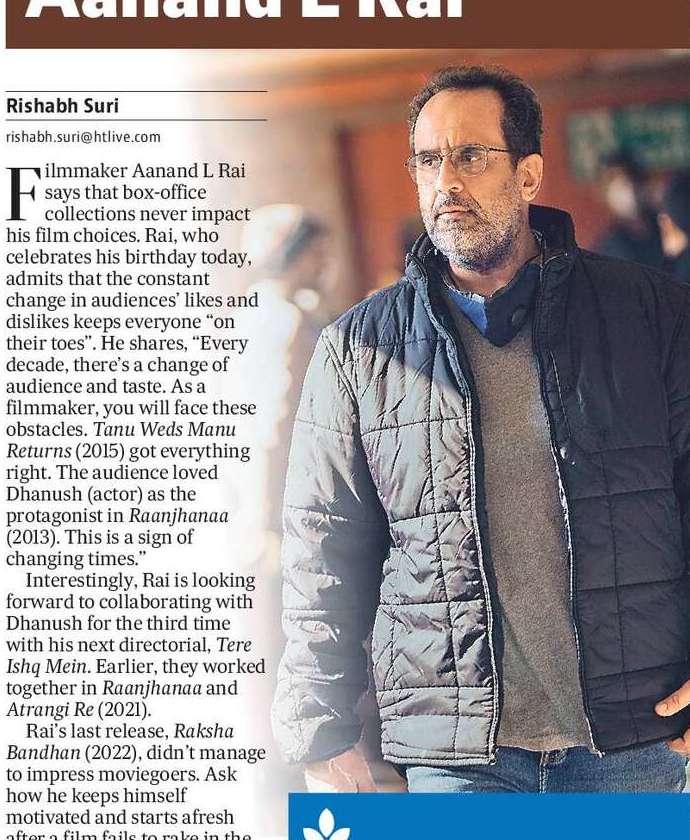
Rishabh Suri (HINDUSTAN TIMES; June 28, 2023)
Filmmaker Aanand L Rai says that box-office collections never impact his film choices. Rai, who celebrates his birthday today, admits that the constant change in audiences’ likes and dislikes keeps everyone “on their toes”.
He shares, “Every decade, there’s a change of audience and taste. As a filmmaker, you will face these obstacles. Tanu Weds Manu Returns (2015) got everything right. The audience loved Dhanush (actor) as the protagonist in Raanjhanaa (2013). This is a sign of changing times.”
Interestingly, Rai is looking forward to collaborating with Dhanush for the third time with his next directorial, Tere Ishk Mein. Earlier, they worked together in Raanjhanaa and Atrangi Re (2021).
Rai’s last release, Raksha Bandhan (2022), didn’t manage to impress moviegoers. Ask how he keeps himself motivated and starts afresh after a film fails to rake in the moolah, and the 52-year-old says, “I am a student. There will be times when my thesis will not get everything right. The only time my confidence can be broken is if I falter in my intention. I know my intentions were right, whether it was Zero (2018; the Shah Rukh Khan-starrer) or Raksha Bandhan. I scored brilliantly with Tanu Weds Manu Returns. My intentions were the same for all the projects.”
Gangubai Kathiawadi is the second biggest female-centric opener
9:02 AM
Box Office India Trade Network
GANGUBAI KATHIAWADI has become the second biggest opener as far as female lead driven films go. If this film had released in normal conditions, then it would have been the biggest opener ever as the collections would have gone around 20% higher.
The top ten list sees mainly four female actresses dominating though the Sunny Leonne films are a lot to do with genre which was working well at a certain time. The others are Kareena Kapoor, Kangana Ranaut and Alia Bhatt who is now having three films in the list with the release of GANGUBAI KATHIAWADI. That first day is an issue with female driven films as many circuits just don't have a interest on that first day and its more about the content of the film post the first day.
A double digit first day is a huge achievement for a female lead and its not been done many times and going forward it will not be done many times. It can be said that GANGUBAI KATHIAWADI has Ajay Devgn in a guest role but looking at the numbers from various centres its pretty much certain that his fan base had a limited interest in this film.
The top ten opening days for heroine led films are as follows.
1. Veere Di Wedding - 10,42,00,000 (Kareena Kapoor)
2. Gangubai Kathiawadi - 9,75,00,000 apprx (Alia Bhatt)
3. Dear Zindagi - 8,62,00,000 (Alia Bhatt)
4. Tanu Weds Manu Returns - 8,61,00,000 (Kangana Ranuat)
5. Mary Kom - 8,32,00,000 (Priyanka Chopra)
6. Ragini MMS 2 - 7,93,00,000 (Sunny Leone)
7. Manikarnika - The Queen Of Jhansi - 7,66,00,000 (Kangana Ranaut)
8. Jism 2 - 7,46,00,000 (Sunny Leone)
9. Raazi - 7,33,00,000 (Alia Bhatt)
10. Heroine - 6,82,00,000 (Kareena Kapoor)
Hindi Medium gave Irrfan Khan & chance to catch up on lost time and conversations-Deepak Dobriyal
8:20 AM

Rachana Dubey (BOMBAY TIMES; March 9, 2020)
 In 2003’s Maqbool, he played Irrfan’s henchman. In 2017, he played his neighbour in Hindi Medium, and in 2020, he will be seen as his brother in Angrezi Medium. In between these, with films like Omkara (2006), 1971 (2007) and the Tanu Weds Manu series (2011 and 2015), he gained credibility as an artiste who can pull off any character with ease. Over to Deepak Dobriyal who talks about his journey so far, why he has never asked for a role and why he loves working with Irrfan. Excerpts:
Angrezi Medium brings you back with Irrfan, and this time, you both play brothers. Post Hindi Medium, you were seen in films which were relatively smaller and niche. This film must be really important for you?
It is very important for me because yes, the films that I did after Hindi Medium had a relatively niche and smaller audience, which would draw footfalls only on the basis of word of mouth. I had not done a commercial mainstream film since then. Being a part of commercial set-ups is just as important for any actor. My role in Angrezi Medium is not just long in terms of screen time, but also crucial to the story. I was getting a chance to work with Irrfan bhai all over again. In the last decade, we could have worked on so many films together, but things didn’t work out. Hindi Medium ke baad, dobara unke saath kaam karne ka chance meri sabse badi lalach thi. Our tuning had worked out so well in Hindi Medium; I was getting a chance to enhance it further. We had a great time off camera, which is evident in the way we have enacted our scenes together. Our chemistry as brothers seems natural. Also, films like Angrezi Medium are important because while you work to enhance your career graph and impress your existing audience, you also have to find inroads into the hearts of the younger generation. I’ve done so many characters, but youngsters don’t remember what I did before Tanu Weds Manu Returns. You have to make yourself accessible to the young generation of audience with the kind of work that they can appreciate. If you think that unko cute ke chakkar mein kuch bhi thama denge toh chalega, you’re wrong. They’re intelligent and discerning.
How do you think your equation with Irrfan has evolved over the years?
I was his henchman in Maqbool (2004), which was a small role. Irrfan bhai cared for me even back then. I remember, there was a patch when I fell ill. I reported to work despite having a fever and he figured that. He got me a three-day break and kept a tab on my health. A gesture like that can never be forgotten. I had promised myself that I will always be there for him, come what may. After that, we stayed in touch and met a few times as well. He loved my work and I loved all his films. I wanted to work with him again and when Hindi Medium came by, I grabbed it. It gave Irrfan bhai and me the chance to catch up on lost time and conversations. At that time, we used to shoot all day, go swimming at night and have meals together. On the shoot, he stopped people from interfering with the way I was trying to improvise my scenes. He supported me like a brother and he subtly showed that he trusts me. That helps enhance a scene so much more. Bhai khiladi aadmi hain. He can handle anything in a scene and make it look great. Iss baar, Angrezi Medium shoot karte waqt hum Thames ke kinaare baithte the London mein. We used to watch cricket together. All of us on the set made sure that we keep the atmosphere light and fun. When he would come on the set, we would first make him laugh and feel at ease, and then start work. Irrfan bhai’s enthusiasm kept the spirit of the team really high.
It’s taken the Hindi film industry a lot of time to start valuing actors who support a film. Was it difficult to hold your own and find your space in the industry in all these years?
I can’t believe it’s been that long! In these years, I never went around asking for work. I continue to audition for roles. The reason I never asked for work is that I always thought, ‘What if there is someone who can do the part better?’ By asking for that role, I am being unfair to that actor. And after asking for it, if I don’t do it well, it would be grave injustice to the role and to the person jiska mauka meri wajah se kho gaya. That’s the reason I don’t even approach my writer friends because I don’t want them to work with a bias. I’ve always worked with the mindset that if I deserve something, it will come to me on merit. That has earned me respect. Mohtaaji ka to angle hi nahi rakha maine. That’s why it took me a long time to get this far. I’ve always worked with the intention of being able to do something different and doing it really well. I don’t just want to be seen in a film. When you work with that in mind, it shows. In my downtime, I introspect and go back to Omkara. I always try to remind myself what it was about that role that worked for me. Also, I’ve learnt that to be able to play different roles and break out of your comfort zone, you have to keep learning new things. A footballer and a chess player have their energies in different places. You have to know kiski energy ko kahan channelise karna hai. Acting is like yog sadhana, you have to surrender to it, for it to work for you.
Recently, BT did a story in which actors, directors and writers underlined the importance of supporting actors in films today. Do you think it’s taken very long for the industry to value this talent pool?
Everyone is an actor in front of the camera, koi category nahi hoti hai. Accha idea, aur acchi performance koi bhi kar sakta hai. Character actors are called so because their dedication to a role is way higher. The first condition for anyone to be an actor is that they have to become a character. I find the term supporting actor or character actor derogatory. Sapne har actor ke bade hi hote hain, par haqeeqat har kisiki alag hoti hai.
You could be a great actor, but you probably don’t fit into every mould. No one invests money in an actor who will not be able to draw an audience to the theatre on his own, right? I didn’t have that guarantee in those early days, but I had the promise of a good performance. Even when I had a small role, I did it like it was the central character. It takes years to find your ground in this business. Once you find it, you will fly.

Rangoli does consult me when she writes about my colleagues and the industry-Kangana Ranaut
8:31 AM

Kangana Ranaut - controversy's favourite child - on tussles with the media, social media wars courted by sister, calling out wrongdoers and mixing nationalism in arguments
Sonil Dedhia (MID-DAY; July 28, 2019)
Not one to suffer silently, Kangana Ranaut believes in facing things head-on. After an ugly public spat with a scribe, she sits down with mid-day to explain explain why a personal squabble became a public brawl. The actor, who just released Judgementall Hai Kya, talks about the controversies she courts, mixing personal issues with nationalism and trying to not succumb to public pressure.
Edited excerpts from the interview.
You have, in the past, brazenly called out your colleagues from the industry. Why did you feel the need to pick on a journalist?
People believe money is equivalent to power but I don't think so. If you can influence hundreds, that gives you power. Media is not interested in reporting real issues about environment, water harvesting or social issues. Media refuses to cover events when it is about planting trees or social work because according to them, 'Isme masala nahi hai. Yeh nahi bikta hai. [There is no meat in the news and it won't sell]'. That hurts.
You could have called the journalist and had a private discussion, like you've done in the past. How did this tussle escalate so much?
I am thick-skinned enough to take a joke on myself. I never felt bad when I was being trolled for my English or criticised for a bad performance. Recently, Shobhaa De wrote something about my film, I messaged and asked her when she was going to watch it. I don't voluntarily get into fights, that's not who I am. After the success of Manikarnika - The Queen Of Jhansi, we invited the media home for an interaction and the journalist in question [reporter from PTI] was also present. He created a scene because according to him I was late. I asked my manager if I was tardy and was informed that the journalist had just arrived. He refused to talk when I reached out to him. There has been a furore over this one event, which was designed to be candid. Journalists asked me questions like 'Tum mental ho kya? [Are you mental?]' and 'Ye mental wala role would come naturally to you. [Does the role in the film come naturally to you?]' When you remove one clip from an hour long discussion, it would seem like I am at fault. I told the journalist, 'Tum toh dushman ban gaye humare and so on'. I haven't crossed any line and my intention was never to shame him or make him a national villain. I am aware of the consequences my actions can have and hence, I am responsible. At the same time, I don't want him to pin me down on a stage.
You referred to his comments on social media. Isn't an individual entitled to his or her opinion?
It is not a criminal offence to have an opinion, to make fun or mock someone on social media, but then, do not expect respect. If I was a lousy actor, do you think anyone would have given heed to my issues?
It is often observed that you mix personal issues with nationalism.
I don't think so. It didn't bother me when he trolled me on a personal level, but when you mock a martyr [Rani Lakshmibai] it becomes a matter of national concern. Everyone has the right to criticise, but there is decorum to do it. You cannot make a joke about national heroes. How am I living up to my reputation, if despite being a public figure I don't call out people when they do something wrong? Actors have guidelines and are crucified for saying the wrong thing, then why are journalists exempt from it.
Saying 'no comments' is always an option, don't you think you could have avoided this controversy/person if you had not engaged in it?
I could have said, 'I won't answer your question', but that would involve explaining to everyone, 'why'. And when I tried to explain, he started an argument. You have to shake people, up who've lost perspective, especially when you've had a personal rapport with them. I won't feel the need to call out a person, who is incapable of their work. It only comes for a person who I feel has the potential. The media has always been supportive and I know they don't dislike me. However, you cannot deny that there are journalists working under the diktat of other celebrities and public relations agency to tarnish my image. I don't think I have done anything wrong by calling them out. In fact, I am standing up for things that could be a detriment to my career, but I will always do so when I know I am right. Personally, I wear my individuality with a lot of ease but I know several actors have a manufactured image.
There is a perception that you dictate your sister Rangoli Chandel on what to tweet. Is there any truth to it?
No, she does it on her own. She is into social media and keeps track of news and what other celebrities have said. She does consult me when she writes about my colleagues and the industry, and at times I censor them (laughs).
During every film release, the topic of discussion revolves more around the controversy rather than your work. Do you feel people no longer wish to talk about your work?
It is a deliberate strategy, which also happened during Tanu Weds Manu Returns (2015). I had planned preview shows for my friends and colleagues in the industry but no one showed up. Isn't that insulting? Back then I had said, 'these young actors feel threatened to come and watch my film'. People said my performance was the best double role but no one from the industry appreciated it. We all know who won the Best Actress award that year [Deepika Padukone for Piku]. These things don't happen organically and that is precisely what I am fighting for. Is it uncommon for a filmmaker to leave a film mid-way for other commitments? Manikarnika is the third highest grossing women-centric film that has garnered over Rs 150 crore worldwide, but it was beautifully concealed by a section of the media.
After Effects Of The Media Fight
When asked if the tussle with media out her in an odd spot with producer Ekta Kapoor and co-star Rajkummar Rao, she said, she doesn't talk on their behalf. "I am sure it's a little unsettling for everyone as they don't know my history with the journalist. They have been co-operative and noticed that it was a deliberate attempt to create a stir."
Meet Hrithik Roshan, Taapsee Pannu, Kangana Ranaut, Vicky Kaushal's dialect coaches
8:28 AM

From Vicky Kaushal’s NRI Gujju accent in Sanju to Taapsee Pannu’s Haryanvi twang in Saand Ki Aankh, dialect coaches are truly transforming Bollywood into the Tower of Babel
Kunal Guha (MUMBAI MIRROR; July 8, 2019)
“Tiger hai tu, tiger. Come on, ror.” Dimple Shah remembers running the memorable line from Sanju with actor Vicky Kaushal. The first time Kaushal heard the Gujarati pronunciation of the word ‘roar’, “he was in splits”. “He was rolling on the floor (laughing) before the word could roll off his tongue,” says the 39-year-old theatre actor hired to sharpen Kaushal’s Gujarati accent. With films aspiring to achieve realistic portrayals, accounting for regional dialects has become a prime concern. With this specificity relegated to actors, dialogue coaches like Shah are becoming a necessary hire to help them wrap their mouths around the words and phrases that effectively convey their character’s regional leanings.
For decades, accents in Indian film and TV were exaggerated for comic effect. Most memorably, the Hindi adaptation of British sitcom Mind Your Language—Zabaan Sambhal Ke—highlighted the linguistic idiosyncrasies of various Indian dialects. But films have come a long way from Mehmood’s turn in Padosan. In fact, in recent years, flaunting a subtly accurate regional dialect is reflective of an actor’s immersion in his character.
 Shah was referred to Kaushal by his Sanju co-star Anushka Sharma whose Gujarati twang in Jab Harry Met Sejal had received mixed reviews. “I had some apprehensions about that accent [Sharma’s] since the character hails from Mumbai, so it couldn’t be that Gujarati,” says the Mumbai-born Shah who credits her tone and linguistic peculiarities to her years in Gujarati theatre. “With Sanju, we were careful that we don’t do a Taarak Mehta or an ‘Arra-ra-ra’ kind of accent. Going by the typical Gujarati accent popularised in TV, it would be ‘Kya karta heyyy’. But a more natural way would be to clip the ‘ey’ a bit,” she explains.
Her efforts paid off as Kaushal’s Kamli slipped into his avatar of a Surat-bred immigrant like a glove. That the film follows the character’s life over a period of time, required Shah to engineer accents for each stage. Luckily, her NRI friends sent her voice notes to narrow down on the precise accent. “When he is fresh off the boat—the accent is overpowering and pronounced. Later, when he has spent a few years in the US—the accent starts fading. And finally, when he has lived abroad for most of his lifethe accent is barely there—only a word or two may slip up.”
Apart from swapping recordings of crucial dialogue, she insisted that Kaushal visit Surat and even mingle with locals to pick up nuances of speech. “There’s a sing-song rhythm in Gujarati which seeps through when a native Gujarati speaker would attempt another language. So sometimes, Vicky would ask me to translate the entire line in Gujarati—just to get the rhythm right,” says Shah, who would be briefed on the mood required in the scene to help establish the tone.
 The surge in films set in the hinterland in recent years has further fuelled this urge to realise hyper-localised dialogue. The comedy hit Bareilly Ki Barfi (right; above) springs to mind for retaining colloquial flavour. NSD grad Rohit Chaudhary (left), who played the part of Munna (Ayushmann Khurrana’s onscreen friend), is credited for this. Following the first script reading, Chaudhary impressed the cast with his authentic Bareilly-speak and was asked to double-up as the film’s dialogue trainer. Born in Etawah, the 33-year-old credits his grasp of linguistic singularities to his theatre days when he toured across the country. “I am closely tuned in to the subtle nuances in the manner of speaking in each city. For example, Mathura mein ‘mohetohe’ ho jaata hai, in Bareilly, ‘matlab’ becomes ‘mull-lub’. When you move across to MP, matraaein badal jaati hain and they say, ‘Tumhara kaam haww jayega’,” he says, parting his jaw dramatically.
During filming, Chaudhary recalls spending every minute he wasn’t in frame, behind the monitor, cupping his headphones close to his ears, scrutinising every word for authenticity. “The director (Ashwiny Iyer Tiwari) asked me to point out if there was a single slipup,” says the actor who will be seen next in Jabariya Jodi, Kanpuriya and Kabir Khan’s The Forgotten Army.
 Apart from linguistic pointers, Chaudhary even came up with the line—“Abe jyaada panchayati na bano bey!” on the spur, to complement the scene where Rajkummar Rao’s character is seen trying out a dapper look by slipping on shades. “It’s a common phrase in UP and is used jab koi jyada Chaudhary banta hai,” he says. But not all pop expressions make the cut. While the idea is to transmit the region’s unique voice, it must also be accessible. For instance, FTII grad Ganesh Kumar (right), who helped Hrithik Roshan acquire a Bihari accent in Super 30, was asked to keep it simple for universal appeal. “‘Jhamlal’ is a common Bihari word for someone who is lazy, dimwitted and jobless. But most won’t get it, so ‘gadha’ becomes a close alternative,” says the 34-year-old on the linguistic concessions he took in the Anand Kumar biopic.
Apart from managing regional peculiarities, a biopic may also warrant internalising personality traits. But in essaying Anand Kumar, Roshan was advised to pick up the mathematician’s body language and retain his own interpretation. “I told him if you just copy him, it would seem fake. But if you manage the language and say it in your own style, it would be more convincing.” Kumar also armed Roshan with commonly used words and phrases in Angika, Bajjika, Maithli, Bhojpuri and Magahi—languages spoken in the state—and also got him to memorise names of sweets, festivals and seasons. “If you just learn the dialogue, you’re restricting your performance. When you’re conversant with a language, it allows you to improvise ‘carry away’ scenes which can be special,” says Kumar, who previously helped with Aadar Jain’s Lucknowi accent for Qaidi Band, and prepped Diana Penty to field press interactions in Hindi during the promotions of Lucknow Central. Roshan’s comprehensive workshop began with “getting the feel of his character”—by wrapping himself in a dhoti and singing and dancing to popular Bhojpuri numbers such as “Lagavelu Jab Lipistik” and “Raja Raja Raja, Kareja Mein Samaja”. “I also taught him a few expletives, even though it won’t be used in the film—bas mann mein budbudane ke liye.”
 In recent years, Kangana Ranaut’s Haryanvi athlete Datto from Tanu Weds Manu Returns is remembered for her distinctly rustic manner. Sunita Sharma, who trained her deep-throated, dehaati speak in the film, remembers her daughter’s first reaction on watching the film—‘Mummy, she sounds just like you’. While the accent, she admits, was more ‘gaaddha’ than seen in Hindi films, it helped convey the character’s personality. “Although she was studying in university, Datto was completely dehaati and muhfat in her ways and her rural roots had to come through,” she describes the character, crediting Ranaut’s perseverance for immaculately picking up the Haryanvi drawl. The performance also turned Sharma, who began as a radio host with AIR, Kurukshetra, into somewhat of an authority in all things Haryanvi. Unsurprisingly, she was hired to train the cast of Dangal, and more recently, Saand Ki Aankh (right), where she trained Prakash Jha, apart from Taapsee Pannu and Bhumi Pednekar. In both films, the accent, she shares, was toned down to be understood by all. “Dadiyan thet bolti hain, so in Hindi we take some liberties because the message has to come through,” she says of the octogenarian sharpshooters Chandro and Prakashi Tomar on whom the film is based.
A dialect coach, Sharma shares, is also often called upon for cultural insights. “While shooting Dangal, Nitesh Sir (Tiwari) would quiz me on the hair and costume of locals. From advice on dupatta odhne ka dhang to conversations one has with one’s neighbour—I was always happy to help.” A mistake that most actors make while attempting a Haryanvi accent? “It’s ‘mayy’ and not ‘main’, so badi ‘ay’ ki maatra aayegi. Until you rehearse it 8-10 times aloud, it won’t arrive on your tongue.”
Sharma’s favourite dialogue happens to be the one delivered by Sakshi Tanwar’s character in Dangal: ‘Doodh, ghee ke paise pure na padh-re, ab chicken ke paise kahaan se ayenge’. “I would break into a chuckle every time we rehearsed it,” she says with a smile.

Uri is the fourth ever top small film in history
11:11 PM
Box Office India Trade Network
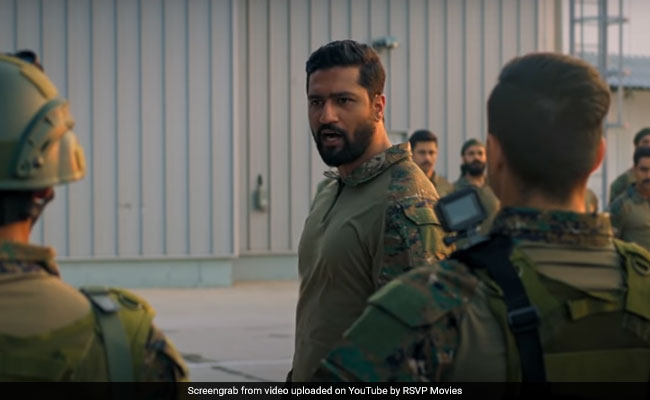
URI is finishing its run on around 244 crore nett. It is probably the fourth biggest small - medium Hindi film of all time. The budget of the film may not be as small as some of the other films comparatively as they were very low budget films but today there has to be some sort of spend while earlier the content could take the film anywhere even without a spend.
A JAI SANTOSHI MAA was made with a production budget of less than 3 lakh and was released on around 15 prints for a total of 5-6 lakhs cost at time of release. Eventually in time nearly 300 prints had to be taken out and the cost of the film went to 50 lakhs apprx. The print and promotions cost of this film was eventually more than 15 times of the production budget.
The business of this film is 400 crore nett plus today in terms of adjusted NETT GROSS which is probably an unbeatable record for a small film. That film went on some sort of wave when released and a similar thing has happened with URI though not at the same level as JAI SANTOSHI MAA across the country.
The other films which make into the top ten from recent films are TANU WEDS MANU RETURNS in sixth place and BADHAAI HO in tenth spot.
The top ten small medium films in the industry of Hindi cinema are as follows.
1. Jai Santoshi Maa (1975) - 400 crore plus
2. Nikaah (1982) - 275 crore plus
3. Dosti (1964) - 250 crore plus
4. Uri - The Surgical Strike - 244 crore apprx
5. Qayamat Se Qayamat Tak - 185 crore apprx
6. Tanu Weds Manu Returns - 165 crore apprx
7. Dharma (1973) - 160 crore apprx
8. Pratighaat (1987) - 150 crore apprx
9. Aaj Ki Awaaz (1984) - 145 crore apprx
10. Badhaai Ho (2018) - 140 crore apprx
Shah Rukh Khan saab understands when he’s touching excellence-Aanand L Rai
8:18 AM
Meena Iyer (DNA; November 21, 2018)
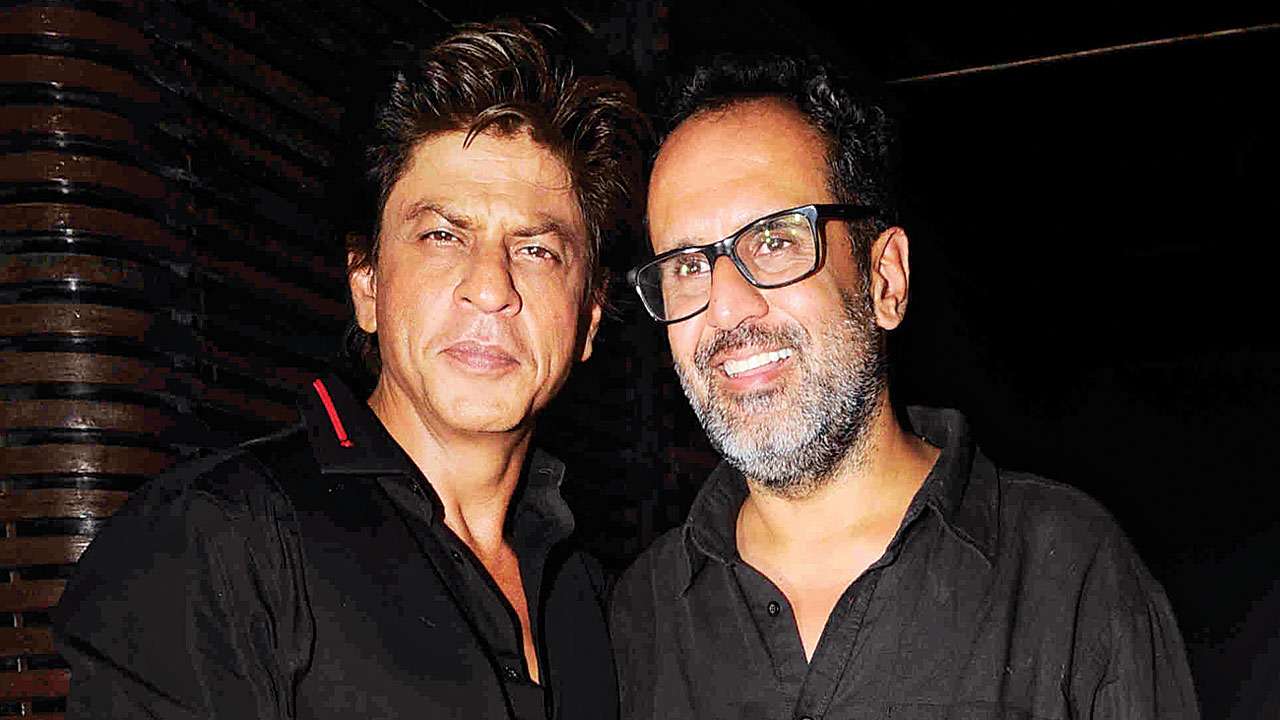
Filmmaker Aanand L Rai has two major strengths. He is a compulsive storyteller. Check out Raanjhanaa, Tanu Weds Manu as well as Tanu Weds Manu: Returns and you will recall coming back hooked by his narratives. His second strength is the way he conducts himself with the media. Perfectly open to listening to what the fourth estate has to say, he lets you believe that what you say really matters. Oddly enough, there are such few people out there who listen, that when you meet a successful man who does you kind of take to him.
When I meet him at his Andheri office, Aanand settles in front of me comfortably, striking the crossed-legged yoga pose and insists we both sip on ginger chai before I switch on my dictaphone. His current obsessions are his December 21 release Zero, which is the talk of B-Town and its hero, Shah Rukh Khan, whom he fondly calls Khan saab. The award-winning filmmaker gets candid about finding new friends in Anushka Sharma as well as Katrina Kaif and why he feels each film is his last. Excerpts…
Technology is gaining so much importance in our movies. VFX has a huge role to play in Zero as well. How important is it to marry content with technology?
We’re now an aware lot of filmmakers in Indian cinema. We are using technology to tell stories and to enhance them. However, we are not compromising on the actual storytelling bit. Whether it is 2.0, Zero, Brahmastra, or any of the other films that are being mounted on huge scales, one thing is for sure, we haven’t forgotten to narrate a good tale. Whether you like it or not, it all boils down to ‘What story are you telling?’ And since the last five years, we’re using technology to do so. Before that, we wanted to experience it, woh ek phase tha, jo hamare yahaan bhi aaya. Now we’re writing plots where technical know-how is necessary.
How do you react to observations that say, ‘Today, Aanand L Rai has become a brand.’ Is it flattering?
It’s flattering only for a little while. After that, you start to feel immense pressure. It never gives you the ease that ‘Chalo yaar, aap ek brand ho’. When I was a nobody, tab aisa nahin lagta tha. However, I can sense that there is a certain kind of responsibility. I’ve a feeling that right now, I can enjoy this phase; when people are talking about my films like someone else is making a small-town progressive film or an Aanand L Rai-kind of a film. But trust me, I’m seeing it as a red alert that, maybe, I’ll become predictable in the next couple of years.
It’s actually calling for a change, it’s telling me to expand my storytelling. Jitni khushi se yeh baat aaj boli jaa rahi hai, tab nahin boli jaayegi with that kind of excitement. So, when you say this, it alerts me.
Going by Zero’s trailer, one feels that you’ve started moving away from your earlier movies. It’s a combination of many factors — casting a superstar, using technology without forgetting your own brand of storytelling...
After Tanu Weds Manu Returns (TWMR), people started saying that ‘Yeh toh Aanand achha kar leta hai... take him to a small-town and the lanes of Benaras, Haryana or Kanpur, etc, and he comes out with these tales beautifully.’ One way was to see that I could do this. The other way was, ‘Is this all about me? Can I expand in my storytelling?’ I’m not saying just for the sake that I know I can do this. Zero is an extension of where I belong. For me, Raj Kapoor, Guru Dutt and Bimal Roy are filmmakers. Main badi mushkil se apne aap ko director maanta hoon. These are small steps in the journey from a director to a filmmaker, from TWM to Raanjhanaa, TWMR and now Zero. In my forthcoming film, maine kuchh halka sa orbit chhodte hue kiya hai. I’m taking a small flight, ek confidence dikhake. A filmmaker has to do that, otherwise you will say that you know what I’m going to write in my next scene. It’s a scary situation, when people can read your storytelling, ki humein pata hain yeh yahi karega. I’m not doing this to prove that I can do this also, yeh woh overconfidence nahin hai. I’m learning from my films and moving ahead. It’s from the same book, but a new chapter.
While you change chapters, you have one constant, your writer, Himanshu Sharma. How do you challenge each other?
We started together, he was assisting me and he discovered the writer in himself. Humne struggle ek saath kiya, we know our weaknesses so well that we complement each other. We don’t function as two individuals, he has his identity, I have mine, but together, we become one different identity. We’re mentally secure, there’s no problem that I think like this and he thinks like that. Somewhere that bond is reflected in our films.
Also, a superstar is on board. There are so many dimensions to Shah Rukh Khan, but having seen the trailer, one notices a new spark in him, too. And it seems he has enjoyed doing this film.
I’ve known him through his movies. Over the last 25 years, we’ve seen him as a big star. But strangely, after meeting him I’ve realised there’s a certain simplicity hidden in him. I can read that man. He allows himself in front of you ki yahi hoon main. When we went on floors, I was yet to meet the superstar who we’re so used to seeing. I got a great friend, guide, philosopher and a fantastic student who is ever ready to learn, despite being so experienced and knowledgeable. One doesn’t expect that from a star, but yahi hua. That also helped make the film. As a person, I can only direct a movie if I know someone very well. You can see it as my strong point or a weakness. If I’m not in love, I won’t be able to work. Technique, craft hoga, I’m not aware about that. What I’m aware of is that human connect. If that happens, then I can understand SRK and everything else. If that doesn’t happen, then I’m very mediocre. I’m fortunate that I’m able to find the connect and that’s why I have survived. Main issi ko apni filmmaking maanta hoon. My films are all about my connect with people.
Even though you’ve discussed so many aspects of SRK, you always feel he’s the kind of person who has something more to him…
You’ve known him for quite some time. I met him about three-four years ago. We talk for hours. I enjoy talking to him, he’s very witty. Mujhe aisa lagta hai ki he’s misunderstood at times because of his sharp humour. In recent times, it seems his wit is not taken the way it was taken earlier. For me, these two-three years with him have been a great learning experience. Knowing such a legendary man is a great feeling. He is such an intelligent guy, you can talk to him about anything. He knows what he is doing. The best part is (I’m not talking about the actor but about the person) that he understands when he’s touching excellence. He knows exactly that this is mediocre, this is average. He is aware of everything. The conversations with him are great, sometimes you feel that itni baat samajh rahe ho, but he hasn’t applied them for some reason or the other. There are so many things you want to know and understand about him.
Going by the expectations, we will get to see something novel — technology and SRK in a new avatar in an Aanand L Rai kind of a film..
You have seen a lot of directors, actors, films.. toh koi bhi technique dekhke nahin jaata. You go for the story.
One feels afraid of a film when there’s nothing to market it. At that time they talk about budget and technology, etc.
How does it matter if Zero is made on a budget of Rs 20 cr or Rs 200 cr, if the audience, to whom I’m telling the story, can’t feel it! If we can talk about the character, the world where he belongs, how does it matter whether the movie is made in X or Y budget? It is irrelevant. Someone might say this is a Rs 1,000-cr film, but if I’m not feeling it, why will I watch it? Audience ko farak nahin padta. The main question is are you entertaining them or not? It’s as simple as that.
I remember Brian Lara (former captain of the West Indies cricket team) giving his retirement speech, just after his last match. In his concluding line, he asked, ‘Did I entertain you?’ It didn’t matter how many centuries or runs he scored, that’s on record. But what matters is entertaining your audience.
Do you ever ask yourself that at the end of every film?
Yes, I do, always. I may not get to see my audiences, but I can sense that they are there. I make my films only for them.
At some places in the trailer, SRK’s dialogue seems as if it’s Aanand L Rai talking...
To be honest, in fact, it is more of Himanshu than me. Besides, Himanshu and I are so much together, it reflects on our actors. We’ve had a great journey and enjoyed working together. It’s a difficult story, more than the technique. If anyone says ‘Kyun difficult hoga’, unke dimaag mein technical hota hai, mere dimaag mein emotional hota hai. This film’s story is in a commercial space, it’s about incompleteness. The male protagonist is vertically challenged, the female leads are incomplete one way or the other. For me, it’s a tough film, but I’m so excited and I’m really trusting my audience.
Tell us about your experience of working with Katrina Kaif and Anushka Sharma.
Brilliant. Maybe I’m working with them at my right time, maybe I had my own journey to reach to these big stars. Mujhe unmein dost hi milein. Whether it’s Katrina or Anushka, I don’t have to think twice before talking to them. I’m very comfortable with both of them and vice versa. I must be able to express myself from the core of my heart and I can do that with them. As a director that is required, and I feel, they gave their best for me. Both of them have delivered brilliant performances.
It’s too soon to ask, but you may be having a pitara of stories to make into movies.
Not at all. Every time, I feel that I don’t have more than two stories within myself. In fact, just the other day I was telling Khan saab (SRK) that each time I make a film, I feel as if it’s my last. When I’ve finished it, I’m so empty that it’s a good state to be in. It seems I’ve given it my everything and that’s a great feeling. I felt that during Raanjhanaa and TWMR. I didn’t know what I had in me next. It’s the same with Zero. After this, I can relax. But there is a story, which was there in me earlier. It will resurface again after Zero releases.
Must read: Tracing Aanand L Rai's journey through cinematic adventures
8:48 AM

Don't Worry. Be Happy. That’s Aanand L Rai’s mantra and the reason why the producer director, in his decade-long trek through wonderland, has fearlessly broken with convention, experimented with taboo subjects and made the kind of films he believes in rather than what he believes will work. Tracing his journey through his adventures…
Roshmila Bhattacharya (MUMBAI MIRROR; August 13, 2018)

HAPPY PHIRR BHAG JAYEGI (2018)
Mudassar spent a lot of time on Happy Bhag Jayegi but somewhere along the way, I felt that he had not relished the film as much as he should have. So, I urged him to enter the ‘Happy’ space again and flush it out of his system completely since he already had a plot to take forward. I’d like to believe that this time it was a truly happy experience for him. Last time, since he was returning from a seven-year sabbatical, Mudassar had perhaps been on the back foot, this time he played on the front foot.

HAPPY BHAG JAYEGI (2016)
Mudassar Aziz came to me with this ‘Happy’ fi lm when I had just started prepping up for Tanu Weds Manu Returns. I’m a director first and told him that while I would have loved to involve myself with his baby, for the moment, my first love was myself and my film. I offered to speak to studios and line up a good producer for him. But Mudassar was adamant he wanted to make the film with me and insisted on waiting. It was his trust in me that led to my producing Happy Bhag Jayegi for him. The film brought about the realisation that I can become a good support for my directors.
SHUBH MANGAL SAAVDHAN (2017)
Coming from the middle-class world myself, I knew we had grown and it was time to shed the tag of ‘conservative’. The idea behind taking an ‘adult’ subject and turning it into a family entertainer was to bring what had, for all these years, only been spoken in whispers behind the close doors of the bedroom, into the living room. Being the father of a teenage daughter, I also wanted to bridge this generation gap. Shubh Mangal Saavdhan (see featured image) brought together two generations in a way that they could talk to each other as friends.

MANMARZIYAAN (2018)
During Mukkabaaz I met a director who was raw and yet so neat. The Anurag Kashyap you will meet in Manmarziyaan is more polished, milder but bolder. This two-film journey was all about getting associated with one of the most brilliant directors of the country. Mujhe apne andar kuch change lana tha, maybe he felt the same way. Working with him has made me a more gutsy filmmaker, while I think he’s more controlled today, perhaps a little happier too.
ZERO (2018)
We have finished shooting the film but I have yet to meet Shah Rukh Khan, the biggest actor in the country. Khan saab has met me like a friend and a brother, a philosopher and a guide, a senior colleague and a student, but ab tak unhone uss superstar se milne ka mauka nahin diya. I look forward to meeting him some day.

NIL BATTEY SANNATA (2016)
 I was 40, high on the success of Tanu Weds Manu and its sequel and
didn’t want to play safe. I wanted to do something out-of-the-box,
something daringly different, and through its overwhelming acceptance
make the Hindi film industry believe that our audience is far more
evolved than we give it credit. The film was about a maid who wants her
daughter to become an IAS officer. Her argument was that if a doctor’s
son becomes a doctor and an engineer’s son an engineer, toh bai ki beti
kya karegi? I’m grateful that a teacher’s son got this opportunity to
make films and told myself if that can happen to me, then why can’t a
maid’s dream come true? Nil Battey Sannata remains one of our most
important films and if it inspires even one maid to educate her child, I
would say it was the most successful film of the decade. More
recently, my associate Rahul Shanklya came to me with an idea and I told
him to just go ahead and make it on a minimal budget. Meri Nimmo (right)
was the purest cinema, a small film with a big heart.
I was 40, high on the success of Tanu Weds Manu and its sequel and
didn’t want to play safe. I wanted to do something out-of-the-box,
something daringly different, and through its overwhelming acceptance
make the Hindi film industry believe that our audience is far more
evolved than we give it credit. The film was about a maid who wants her
daughter to become an IAS officer. Her argument was that if a doctor’s
son becomes a doctor and an engineer’s son an engineer, toh bai ki beti
kya karegi? I’m grateful that a teacher’s son got this opportunity to
make films and told myself if that can happen to me, then why can’t a
maid’s dream come true? Nil Battey Sannata remains one of our most
important films and if it inspires even one maid to educate her child, I
would say it was the most successful film of the decade. More
recently, my associate Rahul Shanklya came to me with an idea and I told
him to just go ahead and make it on a minimal budget. Meri Nimmo (right)
was the purest cinema, a small film with a big heart.

NEWTON (2017)
For me, it was an important step to be associated with a film like Newton because while being an issue-based story, it was, to my mind, also a commercial film. As an audience, I believe the divide between the two cinemas is decreasing and viewers are looking for an intelligent film that’s also engaging. Newton, for me, was that film.

RAANJHANAA (2013)
After the box-office success of Tanu Weds Manu, everyone expected me to quickly come up with a sequel, but I didn’t wish to get typecast as a maker of romcoms. I wanted to challenge myself as a director with a tragedy and Raanjhanaa happened. It was a gamble making a film set in Varanasi with a South superstar, but I was confident that Dhanush was the right casting choice and that this was the best way to play my innings. Just before Tanu Weds Manu, I had lost my Dad and that transformed me as a person. I wanted my films to reflect this change that was happening within me. Raanjhanaa helped me grow not only as a director but as a person too. The fearlessness I carried forward from Tanu Weds Manu was now tempered with a new-found maturity.

TANU WEDS MANU (2011)
I had made two films before this, Strangers (2007) and Thodi Life Thoda Magic (2008), and they had not worked because I had been trying hard to prove that I was a director who knew his job. I realised later that you don’t have to impress people, you just have to tell a story. And that’s what I set out to do with Tanu Weds Manu. It was the best time for me because I was scraping the bottom of the barrel and had nothing to lose. I could behave like the biggest director because no one was looking at me. It took me three years to finish the film but I was sure from here I could only go up. It paid off.
TANU WEDS MANU RETURNS (2015)
In the four years that it took me to return to the franchise, I had grown as a director. But the best part was that I was not focussed on only my own growth but that of my actors as well. Queen had happened to Kangana (Ranaut) in the interim while Maddy (R Madhavan), after some wrong choices in Bollywood, had found the right path in Tamil cinema. Even my writer, Himanshu Sharma, had had his share of ups and downs and grown, as had my audience who were ready for a new cinema. They understood that Datto was not a gimmick but was for real and accepted her as warmly as they had embraced Tanu. Even the story took off exactly four years after the first film had ended with Tanu wedding Manu.

I wanted to cut the all-important two feet from a star as big as Shah Rukh Khan-Aanand L Rai
8:27 AM

Aanand L Rai opens up about his dwarf film with Shah Rukh Khan, his equation with his 'Tanu' Kangana Ranaut, and why he is ready to take risks as a filmmaker
Roshmila Bhattacharya (MUMBAI MIRROR; August 7, 2017)
On August 1, when Aanand L
Rai shared the trailer of his upcoming romcom, Shubh Mangal Saavdhan,
the leading man of his yet-untitled dwarf film, Shah Rukh Khan, who was
busy promoting his road romance, tweeted, “Sir miss kar raha hoon
aapko.“ The filmmaker admits he misses his Khan saab too and can't wait
to shoot with him again.
“Our relationship goes beyond the actor-director equation. Now that I've
found him, he'll be with me till I'm around. It's the same with Dhanush
who's like a younger brother, and Sonam (Kapoor) who I'll just call up
to know what she is doing. I've not trained at any film institute, idhar
udhar ki baton mein mujhe mazaa aata hai aur issi beech film ban jaati
hai. It's important to enjoy the journey because that's what defines a
film which is the last chapter,“ philosophises the producer-director
who's happy with his share of love and wants to spread it around.
Perhaps that's what makes SRK describe his dwarf as a “happy person“ and is okay with being cut down to four feet. For Rai, the idea germinated five years ago when borrowing from Hollywood's Spider-Man, Batman and Superman, Bollywood started making its own superheroes. “I loved seeing Hrithik (Roshan) fly off a 250-feet building, it was brilliantly done, but deep down I felt this wasn't us. Apart from our mythological demigods, Indians aren't ready for superheroes, kadd mein hum abhi bahut chhote hain. That's what made me want to live life from the perspective of a dwarf,“ he explains.
Over two years, he realised a four-footer saying “I love you“ sounds different from one who's six-feet tall, hence the decision to opt for SRK. “I wanted to cut the all-important two feet from a star as big and confident as Khan saab, then tell a love story. Being an intelligent man, he knew what I was talking about,“ Rai recalls.
The film also has another star, Salman Khan, playing himself, and watching the two stars together was pure magic. “It was my fanboy moment, I stopped being a director and was clapping as an audience,“ laughs Rai who despite unprecedented success with his brand of unpretentious cinema rooted in small-town realities, remains a middle-class boy-next-door from Delhi. He's quick to point out that he's a storyteller rather than a filmmaker who through his stories shares a part of himself with an audience he discovered in 2011 with Tanu Weds Manu.
The R Madhavan-Kangana Ranaut marry-go-round which took three years to roll for lack of financiers was familiar territory because, as he points out, there's a Manu in every middle-class boy and a Tanu in every middle-class girl, only the percentage differs. “I'm 70 per cent Manu, while my wife Yogita is more than 50 per cent Tanu,“ he says, admitting that despite the connect, he wasn't sure if even Kanpur would accept his Tanu who smoked, ditched a good NRI match and planned her own elopement. But everyone fell in love with his unconventional, feisty heroine and he believes it wasn't so much the story but the fearlessness and honesty with which he told it that worked for him. “Now, the fearlessness is tempered with a sense of responsibility, but 'keep it simple' and 'don't show off' are still the unsaid rules. The day I act smart, I know it'll backfire,“ he avers.
Another filmmaker would have happily encashed on a sequel, but Rai waited four years to bring back the odd couple, choosing a Raanjhanaa instead to understand how someone like him, who'd never faced death till he lost his father in 2009, would react to a tragedy and emotional vacuum. The industry rejected the film on Thursday night but his audience welcomed it on Friday morning and today Rai is planning another love story with Dhanush late next year. “It's a story and a character meant for him, if for some reason he doesn't do it, I won't make the film,“ he asserts.
Rai's known to be possessive about his stories. Manmarziyan, started with Sameer Sharma as director, but was shelved shortly after when he realized they weren't on the same page. He revived it with Ashwiny Iyer Tiwari before surprising everyone by taking it to Anurag Kashyap. “Just because he's made a Gangs Of Wasseypur doesn't mean Anurag doesn't understand love. I gave him a narration, he loved the script but was busy with Mukkebaaz. I told him we'd do both together, he could make my film after finishing his. This way I'd get satisfaction and he, lots of affection,“ he smiles, also gung-ho about Navdeep Singh whom he signed when the latter was making NH10 and is prepared to wait for him to complete his previous commitments.
Rai was headed in a different career path, when in engineering college he figured he wasn't cut out for a 9-5 job and ended up in wonderland. “The older of two brothers, I had been painfully shy growing up, only to realise later that I'd deprived myself of the joys of human companionship. In Mumbai I opened up, started talking to people and understanding them. As a filmmaker I had to grow to a point where I was allowed to communicate what I wanted and it was time to expand,“ he reflects. Expansion wasn't business but the opportunity to support other filmmakers with finance and experience to tell stories he can't himself but wants to be associated with.
Nil Battey Sannata and Newton are experiments not many producers would dare to be a part of. But Rai, who is not one to underestimate his audience, believes it's important to keep feeding them this kind of work as a trust-building exercise without expecting big box-office returns. “They're smarter than we think and to cheat them with big names and no story, is a great disservice,“ he reiterates.
He's now fully behind R S Prasanna's Shubh Mangal Saavdhan, a small-town love story which touches on taboos like pre-marital sex and erectile dysfunction, without making you squirm. “Prasanna wanted to make a Hindi film and reached out to me. I rented a flat for him in my building, got him to live with me in Mumbai, then sent him off with the writer for a six-month tour of Delhi, Haridwar and Rishikesh, where the film was set. We worked on the script for a year-and-a-half before we embarked on this journey,“ he smiles.
In between these partnerships, he found a way to bring his Tanu and Manu back by putting another small town girl, Datto, in the forefront of their love story. “My stories grow from the world around me and while I can't change it, I can voice my opinion. In Tanu Weds Manu Returns, Datto was that voice. I love that scene between her and Tanu where she argues that it's her problem if she wants to make chapattis for her husband while winning medals for the country. 'Tu apna dekh, yaar,' she shrugs off the progressive other woman,“ he recalls, adding that four years down the line, if he feels the need again, there will be a Tanu Weds Manu 3 but for now, it's not on his radar.
Is another collaboration with the National Award-winning actress on the cards? “Kangana and I are still good friends who care for and call on each other. But we'll wait till we find a happy, meaningful space to work together,“ he informs. “During Tanu Weds Manu Returns, she was a better actor and I guess I was a different director too. I don't know if it was she or me who got more complicated, but the synergy was different. I won't say there were conflicts but she understood life differently from me. We made a good film and have never said we won't work together again, but there needs to be a little gap before we feel we have something to say together,“ he says quietly.
Meanwhile he's found a happy space with Happy Bhag Jayegi that reunited him with Raanjhanaa's Abhay Deol, who did the film only for him. Rai's working on a Happy sequel now for his director. “Mudassar (Aziz) returned from a sabbatical with Happy and there's still a lot of 'happy' left in him. So, I told him to go out there again, laugh and make people laugh. I like to see people happy,“ Rai signs off.
Perhaps that's what makes SRK describe his dwarf as a “happy person“ and is okay with being cut down to four feet. For Rai, the idea germinated five years ago when borrowing from Hollywood's Spider-Man, Batman and Superman, Bollywood started making its own superheroes. “I loved seeing Hrithik (Roshan) fly off a 250-feet building, it was brilliantly done, but deep down I felt this wasn't us. Apart from our mythological demigods, Indians aren't ready for superheroes, kadd mein hum abhi bahut chhote hain. That's what made me want to live life from the perspective of a dwarf,“ he explains.
Over two years, he realised a four-footer saying “I love you“ sounds different from one who's six-feet tall, hence the decision to opt for SRK. “I wanted to cut the all-important two feet from a star as big and confident as Khan saab, then tell a love story. Being an intelligent man, he knew what I was talking about,“ Rai recalls.
The film also has another star, Salman Khan, playing himself, and watching the two stars together was pure magic. “It was my fanboy moment, I stopped being a director and was clapping as an audience,“ laughs Rai who despite unprecedented success with his brand of unpretentious cinema rooted in small-town realities, remains a middle-class boy-next-door from Delhi. He's quick to point out that he's a storyteller rather than a filmmaker who through his stories shares a part of himself with an audience he discovered in 2011 with Tanu Weds Manu.
The R Madhavan-Kangana Ranaut marry-go-round which took three years to roll for lack of financiers was familiar territory because, as he points out, there's a Manu in every middle-class boy and a Tanu in every middle-class girl, only the percentage differs. “I'm 70 per cent Manu, while my wife Yogita is more than 50 per cent Tanu,“ he says, admitting that despite the connect, he wasn't sure if even Kanpur would accept his Tanu who smoked, ditched a good NRI match and planned her own elopement. But everyone fell in love with his unconventional, feisty heroine and he believes it wasn't so much the story but the fearlessness and honesty with which he told it that worked for him. “Now, the fearlessness is tempered with a sense of responsibility, but 'keep it simple' and 'don't show off' are still the unsaid rules. The day I act smart, I know it'll backfire,“ he avers.
Another filmmaker would have happily encashed on a sequel, but Rai waited four years to bring back the odd couple, choosing a Raanjhanaa instead to understand how someone like him, who'd never faced death till he lost his father in 2009, would react to a tragedy and emotional vacuum. The industry rejected the film on Thursday night but his audience welcomed it on Friday morning and today Rai is planning another love story with Dhanush late next year. “It's a story and a character meant for him, if for some reason he doesn't do it, I won't make the film,“ he asserts.
Rai's known to be possessive about his stories. Manmarziyan, started with Sameer Sharma as director, but was shelved shortly after when he realized they weren't on the same page. He revived it with Ashwiny Iyer Tiwari before surprising everyone by taking it to Anurag Kashyap. “Just because he's made a Gangs Of Wasseypur doesn't mean Anurag doesn't understand love. I gave him a narration, he loved the script but was busy with Mukkebaaz. I told him we'd do both together, he could make my film after finishing his. This way I'd get satisfaction and he, lots of affection,“ he smiles, also gung-ho about Navdeep Singh whom he signed when the latter was making NH10 and is prepared to wait for him to complete his previous commitments.
Rai was headed in a different career path, when in engineering college he figured he wasn't cut out for a 9-5 job and ended up in wonderland. “The older of two brothers, I had been painfully shy growing up, only to realise later that I'd deprived myself of the joys of human companionship. In Mumbai I opened up, started talking to people and understanding them. As a filmmaker I had to grow to a point where I was allowed to communicate what I wanted and it was time to expand,“ he reflects. Expansion wasn't business but the opportunity to support other filmmakers with finance and experience to tell stories he can't himself but wants to be associated with.
Nil Battey Sannata and Newton are experiments not many producers would dare to be a part of. But Rai, who is not one to underestimate his audience, believes it's important to keep feeding them this kind of work as a trust-building exercise without expecting big box-office returns. “They're smarter than we think and to cheat them with big names and no story, is a great disservice,“ he reiterates.
He's now fully behind R S Prasanna's Shubh Mangal Saavdhan, a small-town love story which touches on taboos like pre-marital sex and erectile dysfunction, without making you squirm. “Prasanna wanted to make a Hindi film and reached out to me. I rented a flat for him in my building, got him to live with me in Mumbai, then sent him off with the writer for a six-month tour of Delhi, Haridwar and Rishikesh, where the film was set. We worked on the script for a year-and-a-half before we embarked on this journey,“ he smiles.
In between these partnerships, he found a way to bring his Tanu and Manu back by putting another small town girl, Datto, in the forefront of their love story. “My stories grow from the world around me and while I can't change it, I can voice my opinion. In Tanu Weds Manu Returns, Datto was that voice. I love that scene between her and Tanu where she argues that it's her problem if she wants to make chapattis for her husband while winning medals for the country. 'Tu apna dekh, yaar,' she shrugs off the progressive other woman,“ he recalls, adding that four years down the line, if he feels the need again, there will be a Tanu Weds Manu 3 but for now, it's not on his radar.
Is another collaboration with the National Award-winning actress on the cards? “Kangana and I are still good friends who care for and call on each other. But we'll wait till we find a happy, meaningful space to work together,“ he informs. “During Tanu Weds Manu Returns, she was a better actor and I guess I was a different director too. I don't know if it was she or me who got more complicated, but the synergy was different. I won't say there were conflicts but she understood life differently from me. We made a good film and have never said we won't work together again, but there needs to be a little gap before we feel we have something to say together,“ he says quietly.
Meanwhile he's found a happy space with Happy Bhag Jayegi that reunited him with Raanjhanaa's Abhay Deol, who did the film only for him. Rai's working on a Happy sequel now for his director. “Mudassar (Aziz) returned from a sabbatical with Happy and there's still a lot of 'happy' left in him. So, I told him to go out there again, laugh and make people laugh. I like to see people happy,“ Rai signs off.

Suresh Oberoi breaks his hiatus from films; to play Peshwa Baji Rao II in Manikarnika - The Queen Of Jhansi
7:44 AM

Avinash Lohana (MUMBAI MIRROR; July 17, 2017)
After TV actress Ankita
Lokhande, who is on board Krish's Kangana Ranaut-starrer Manikarnika - The Queen Of Jhansi as Jhalkaribai, Mirror has learnt that Suresh Oberoi
recently joined the cast to portray Peshwa Baji Rao II. Manikarnika's
father Moropant Tambe worked in the Peshwa's Bithoor court. Suresh,
whose last Hindi film outing was Imtiaz Ali's 2005 romcom Socha Na Tha
with Abhay Deol and Ayesha Takia, is happy to return to the screen with
the film produced by Kamal Jain and presented by Zee Studios.
“I was initially fascinated by another character but Krish said that given the way I sit, speak and behave, I am best suited to play the Peshwa. It's a fantastic script. I was so excited that I even agreed to shave my head for the part. I had last done that 40 years ago, on a trip to Tirupati,“ the 70-year-old actor said.
Prod him on his extended hiatus from films and he says, “Initially I was busy looking after Vivek's (actor son) career. After working in more than 250 films, I wanted to slow down. I was also involved with social work and enjoying golf and grandchildren,“ Suresh laughs, admitting that he had even turned down a project Vivek had brought to him as he was preoccupied with other things at the time. “But fathers are always there for their sons so Vivek can come to me any time and if it's good cinema, I'll do it. For now, let me get used to working with youngsters of today.“
He is all praise for his son's newest project, Inside Edge, a show that revolves around cricket. “It's become popular. I loved every frame. Everyone, right from Rati Agnihotri's son (Tanuj Virwani), Bishan Singh Bedi's son (Angad) and Suresh's son (Vivek), are good in the show,“ the Oberoi patriarch chuckles.
He is equally impressed with his soon-to-be co-star Kangana's screen turns, especially in Aanand L Rai's Tanu Weds Manu Returns. “I have seen her double role in that film and I was convinced she belonged to the states where the story is set. I am a fan. That role must have required a lot of homework,“ Suresh signs off by doffing his hat to the queen.
“I was initially fascinated by another character but Krish said that given the way I sit, speak and behave, I am best suited to play the Peshwa. It's a fantastic script. I was so excited that I even agreed to shave my head for the part. I had last done that 40 years ago, on a trip to Tirupati,“ the 70-year-old actor said.
Prod him on his extended hiatus from films and he says, “Initially I was busy looking after Vivek's (actor son) career. After working in more than 250 films, I wanted to slow down. I was also involved with social work and enjoying golf and grandchildren,“ Suresh laughs, admitting that he had even turned down a project Vivek had brought to him as he was preoccupied with other things at the time. “But fathers are always there for their sons so Vivek can come to me any time and if it's good cinema, I'll do it. For now, let me get used to working with youngsters of today.“
He is all praise for his son's newest project, Inside Edge, a show that revolves around cricket. “It's become popular. I loved every frame. Everyone, right from Rati Agnihotri's son (Tanuj Virwani), Bishan Singh Bedi's son (Angad) and Suresh's son (Vivek), are good in the show,“ the Oberoi patriarch chuckles.
He is equally impressed with his soon-to-be co-star Kangana's screen turns, especially in Aanand L Rai's Tanu Weds Manu Returns. “I have seen her double role in that film and I was convinced she belonged to the states where the story is set. I am a fan. That role must have required a lot of homework,“ Suresh signs off by doffing his hat to the queen.

Meet Tanishk Bagchi, the reluctant remix guru
7:43 AM

Avinash Lohana (MUMBAI MIRROR; June 6, 2017)
While fans and detractors split hairs over the sudden onslaught of remixes of ’90s chartbusters in films, Tanishk Baagchi, who has recreated “Tamma Tamma” for Badrinath Ki Dulhania, “Humma Humma” for OK Jaanu, and “Tu Cheez Badi Hai Mast Mast” for Machine, has been quietly cementing his position as the go-to guy for remixes. Most recently, he has been commissioned to recreate Sridevi’s iconic “Hawa Hawaii” ditty from Mr India for the Vidya Balan-starrer Tumhari Sulu, as well as a yet-to-be-revealed ditty for Milan Luthria’s Ajay Devgn-starrer Baadshaho. The 30-year-old composer tells Mirror, “There is a retro sequence in the film that required an old, romantic number. We have zeroed down on a few options and will finalise a song soon. I am also making an original track for the film.”
While he attributes all his Bollywood offers to destiny, Tanishk informs that he started out by working under the music composer and sound designer Jatin Sharma, who has remixed many songs. “My training under him really helped me understand the art of recreating,” he says, deflecting attention from his rather unusual repertoire of songs by pointing out that the trend of recreating old classics has been around for a long time and cites the Shefali Jariwala-starrer music video “Kaanta Lagaa”. “The trend comes and goes. I believe as long as you don’t spoil the original essence of a song, there is no harm in recreating it. Even with 'Humma Humma' or 'Mast Mast' the intention was never to do a remix. For the latter, I replaced the old tunes with a new melody,” he asserts.
Tanishk was first spotted by Anurag Kashyap who had heard his and lyricist Vayu Srivastava’s creation, “Oopar Oopar Renn De”, on YouTube. “Vayu and I had decided to do something on YouTube till we got a Bollywood break. The song became really popular and caught Anurag’s attention. He called us to his office and said that he wanted to collaborate with us. Later, our friend Ravi Adhikari introduced us to Aanand sir (filmmaker Aanand L Rai), who gave us an opportunity to make 'Banno' for Tanu Weds Manu Returns. The song became a hit, after which I started pitching my songs to other producers,” he recalls.
Incidentally, Tanishk, the son of a music producer, had never intended to become a part of the music industry. “I come from a very humble background and always believed that there isn’t much money in the music industry so I had wanted to become a pilot but because of a foot injury, I couldn’t pursue it. Meanwhile, while performing at college festivals, I would get encouraging feedback and that drew me to it. I also started earning through stage shows which was a big motivation as well,” Tanishk reveals.
Next up, the Viju Shah super fan would like to recreate his compositions. “My favourite track is 'Mushkil Bada Yeh Pyaar Hai' from Gupt. It was extremely popular in clubs back when it released and I want to bring it back to the mainstream. I am also a big fan of Madan Mohan ji and would love to recreate some of his evergreen songs,” he beams. For now, he has collaborated with Vayu again for Ashwiny Iyer Tiwari’s Bareilly Ki Barfi and can’t wait to graduate to scoring an entire film’s album. “I am doing the album of R S Prasanna’s Shubh Mangal Saavdhan, featuring Ayushmann Khurrana and Bhumi Pednekar,” the reluctant remix guru signs off.
Hollywood sequels score over Bollywood sequels in 2016
8:13 AM

Rachana Dubey (BOMBAY TIMES; December 12, 2016)
For both Bollywood and
Hollywood, 2016 has been a year of sequels and franchises. While
Hollywood had over a dozen franchise sequels releasing in India this
year, Bollywood, too, had its share of notable ones. Jason Bourne, The
Conjuring 2, Kung Fu Panda 3, London Has Fallen, Finding Dory, Inferno,
X-Men: Apocalypse, Captain America: Civil War and Underworld: Blood Wars
are just some of the titles from the West.
Kyaa Kool Hain Hum 3, Ghayal Once Again, Tere Bin Laden: Dead or Alive, 1920 London, Jai GangaaJal, Housefull 3, Great Grand Masti, Raaz: Reboot, Rock On 2, Tum Bin 2, Force 2 and Kahaani 2 represented the desi stable. The trade report card suggests that Hollywood sequels franchise movies have outdone the fare from Bollywood. While only Housefull 3 became a hit like the previous outings in the series, Jai GangaaJal and Kyaa Kool Hain Hum 3 recovered the production cost, but didn't set the cash registers ringing exactly. GangaaJal, spearheaded by Ajay Devgn in the lead role, back in the day was critically and commercially acclaimed. Also, the previous films in the Kyaa Kool Hain Hum series were notches higher in terms of comic value and audience footfall.

Raaz: Reboot and Rock On 2 remained on the other extreme, failing to draw the audiences. Though trade circuit indicates there wasn't enough pre-release buzz about Rock On 2, demonetization seemed to only add to their woes. Force 2, which came a week later, managed to register decent numbers during the cash crunch phase. Of this year's Bollywood sequels, Great Grand Masti suffered the biggest jolt, with the censor copy leaking few days before its theatrical release. As for their off-shore competitors, films like The Conjuring 2, X-Men Apocalypse and Captain America: Civil War had an impressive run at the box office here.
Independent distributor Amod Mehra insists that the reason Indian sequels and franchise movies haven't really kicked a storm is the lack of a great story to take the baton ahead. “We're only learning half the lesson from the West. They make a sequel or continue a franchise only when they have something worth telling. But we seem to be making them irrespective of whether we have a great story or a solid reason to do what we're doing. The reason why films like Rock On 2 and Tum Bin 2 didn't impress is that they lacked a strong story. The audience also feels cheated because our producers here often confuse a sequel with a franchise,“ he rues.
The trend of sequels-franchises in Bollywood, in recent memory, began with Sridevi's Naagin and Nigahein. The latter tanked. Cut to the beginning of the new millennium; Raaz and Raaz 2 opened the floodgate for Bollywood producers all over again. The films, in their genre, brought in a lot of promise. The first three films in the franchise hit the bullseye at the box office too.
 From the way it appears,
Bollywood can't quite give up its fascination with sequels and
franchises. In 2017, the industry has an impressive list like Baaghi 2,
Judwaa 2, Jolly LLB 2, Commando 2, Sarkar 3, Baahubali 2, Hate Story 4,
Aankhen 2, 2.0 (sequel to Robot) and Golmaal Again lined up. Hollywood
will throw in titles like XXX: The Return Of Xander Cage, Resident Evil:
Final Chapter, Fast And Furious 8, Pirates Of The Caribbean: Dead Men
Tell No Tales, Spider-Man: Homecoming and Smurfs: The Lost Village.
The competition will only get stiffer.
From the way it appears,
Bollywood can't quite give up its fascination with sequels and
franchises. In 2017, the industry has an impressive list like Baaghi 2,
Judwaa 2, Jolly LLB 2, Commando 2, Sarkar 3, Baahubali 2, Hate Story 4,
Aankhen 2, 2.0 (sequel to Robot) and Golmaal Again lined up. Hollywood
will throw in titles like XXX: The Return Of Xander Cage, Resident Evil:
Final Chapter, Fast And Furious 8, Pirates Of The Caribbean: Dead Men
Tell No Tales, Spider-Man: Homecoming and Smurfs: The Lost Village.
The competition will only get stiffer.
Distributor Anil Thadani believes that a good film, timed well, will work wonders at the box office. For instance, Rock On 2, he says, did take a beating also because of the demonetization drive. “Most sequels have worked. At least, they have recovered costs. Whether a sequel or a franchise works or not depends on the film itself. For the last month alone, I'd give the Hindi releases a benefit of doubt. But Hollywood content in general has been great on quality. And the results are visible in their box office numbers. The films, when dubbed in regional languages, have an even bigger audience base. Its budget, production quality, scale and the overall output are much better than our films,“ he says.
 Vivek Krishnani, who heads
the Hollywood studio in India that helmed The Angry Birds Movie,
believes that a sequel or a franchise works when it offers a fresh story
or a point of view with familiar characters, a technique that Hollywood
has more or less mastered. “Some Hollywood sequels work in India
because they are visually appealing. Indian actors dub parts of these
films, which makes them even more attractive. In the past, Indian films
like Tanu Weds Manu Returns and the Dhoom franchise worked because they
had familiar characters in a different, challenging environment. A
sequel's success depends on how the story is being taken forward and
whether it is more entertaining than the prequel. This logic applies to
films all over the world.“
Vivek Krishnani, who heads
the Hollywood studio in India that helmed The Angry Birds Movie,
believes that a sequel or a franchise works when it offers a fresh story
or a point of view with familiar characters, a technique that Hollywood
has more or less mastered. “Some Hollywood sequels work in India
because they are visually appealing. Indian actors dub parts of these
films, which makes them even more attractive. In the past, Indian films
like Tanu Weds Manu Returns and the Dhoom franchise worked because they
had familiar characters in a different, challenging environment. A
sequel's success depends on how the story is being taken forward and
whether it is more entertaining than the prequel. This logic applies to
films all over the world.“
Having said that, what cannot be missed is that like Bollywood, even Hollywood sequels haven't had a 100 per cent track record. Independence Day: Resurgence and Jack Reacher: Never Go Back, for instance, were box office downers. Producer Vipul Amrutlal Shah believes that though the trend of making sequels and franchises is catching on in India, it is going through its initial teething issues. “We scaled up Force 2 and it worked despite the demonetization drive. Maybe we need to get our sequels on floors sooner and also up the quality of the content with each film in the franchise,“ he avers.
Sunil Bansal, a distributor from Rajasthan, points out that Hollywood franchises or sequels largely work because they find takers among young Indians, who are huge in number. Year after year, the anticipation for Hollywood sequels and franchises has only swollen in India. Franchises like Paranormal Activity, Hangover and Austin Powers among others have a huge fan following and people earmark their release dates. Irrespective of how they fare abroad, these films have a loyal fan following in the country. “I've generally seen youngsters thronging cinemas when a big Hollywood franchise releases. The overall quality of our films has also dipped. We need to first work on that and then work on sequels and franchises. In the current year, Hollywood has only done 20 per cent better than us. The number could have been higher had the demonetisation drive not affected cinema-goers. We must also not forget that they have some exceptionally big franchises and sequels lined up for next year.We need to pull up our socks,“ he sums up.
Kyaa Kool Hain Hum 3, Ghayal Once Again, Tere Bin Laden: Dead or Alive, 1920 London, Jai GangaaJal, Housefull 3, Great Grand Masti, Raaz: Reboot, Rock On 2, Tum Bin 2, Force 2 and Kahaani 2 represented the desi stable. The trade report card suggests that Hollywood sequels franchise movies have outdone the fare from Bollywood. While only Housefull 3 became a hit like the previous outings in the series, Jai GangaaJal and Kyaa Kool Hain Hum 3 recovered the production cost, but didn't set the cash registers ringing exactly. GangaaJal, spearheaded by Ajay Devgn in the lead role, back in the day was critically and commercially acclaimed. Also, the previous films in the Kyaa Kool Hain Hum series were notches higher in terms of comic value and audience footfall.
Raaz: Reboot and Rock On 2 remained on the other extreme, failing to draw the audiences. Though trade circuit indicates there wasn't enough pre-release buzz about Rock On 2, demonetization seemed to only add to their woes. Force 2, which came a week later, managed to register decent numbers during the cash crunch phase. Of this year's Bollywood sequels, Great Grand Masti suffered the biggest jolt, with the censor copy leaking few days before its theatrical release. As for their off-shore competitors, films like The Conjuring 2, X-Men Apocalypse and Captain America: Civil War had an impressive run at the box office here.
Independent distributor Amod Mehra insists that the reason Indian sequels and franchise movies haven't really kicked a storm is the lack of a great story to take the baton ahead. “We're only learning half the lesson from the West. They make a sequel or continue a franchise only when they have something worth telling. But we seem to be making them irrespective of whether we have a great story or a solid reason to do what we're doing. The reason why films like Rock On 2 and Tum Bin 2 didn't impress is that they lacked a strong story. The audience also feels cheated because our producers here often confuse a sequel with a franchise,“ he rues.
The trend of sequels-franchises in Bollywood, in recent memory, began with Sridevi's Naagin and Nigahein. The latter tanked. Cut to the beginning of the new millennium; Raaz and Raaz 2 opened the floodgate for Bollywood producers all over again. The films, in their genre, brought in a lot of promise. The first three films in the franchise hit the bullseye at the box office too.
From the way it appears,
Bollywood can't quite give up its fascination with sequels and
franchises. In 2017, the industry has an impressive list like Baaghi 2,
Judwaa 2, Jolly LLB 2, Commando 2, Sarkar 3, Baahubali 2, Hate Story 4,
Aankhen 2, 2.0 (sequel to Robot) and Golmaal Again lined up. Hollywood
will throw in titles like XXX: The Return Of Xander Cage, Resident Evil:
Final Chapter, Fast And Furious 8, Pirates Of The Caribbean: Dead Men
Tell No Tales, Spider-Man: Homecoming and Smurfs: The Lost Village.
The competition will only get stiffer.Distributor Anil Thadani believes that a good film, timed well, will work wonders at the box office. For instance, Rock On 2, he says, did take a beating also because of the demonetization drive. “Most sequels have worked. At least, they have recovered costs. Whether a sequel or a franchise works or not depends on the film itself. For the last month alone, I'd give the Hindi releases a benefit of doubt. But Hollywood content in general has been great on quality. And the results are visible in their box office numbers. The films, when dubbed in regional languages, have an even bigger audience base. Its budget, production quality, scale and the overall output are much better than our films,“ he says.
Vivek Krishnani, who heads
the Hollywood studio in India that helmed The Angry Birds Movie,
believes that a sequel or a franchise works when it offers a fresh story
or a point of view with familiar characters, a technique that Hollywood
has more or less mastered. “Some Hollywood sequels work in India
because they are visually appealing. Indian actors dub parts of these
films, which makes them even more attractive. In the past, Indian films
like Tanu Weds Manu Returns and the Dhoom franchise worked because they
had familiar characters in a different, challenging environment. A
sequel's success depends on how the story is being taken forward and
whether it is more entertaining than the prequel. This logic applies to
films all over the world.“Having said that, what cannot be missed is that like Bollywood, even Hollywood sequels haven't had a 100 per cent track record. Independence Day: Resurgence and Jack Reacher: Never Go Back, for instance, were box office downers. Producer Vipul Amrutlal Shah believes that though the trend of making sequels and franchises is catching on in India, it is going through its initial teething issues. “We scaled up Force 2 and it worked despite the demonetization drive. Maybe we need to get our sequels on floors sooner and also up the quality of the content with each film in the franchise,“ he avers.
Sunil Bansal, a distributor from Rajasthan, points out that Hollywood franchises or sequels largely work because they find takers among young Indians, who are huge in number. Year after year, the anticipation for Hollywood sequels and franchises has only swollen in India. Franchises like Paranormal Activity, Hangover and Austin Powers among others have a huge fan following and people earmark their release dates. Irrespective of how they fare abroad, these films have a loyal fan following in the country. “I've generally seen youngsters thronging cinemas when a big Hollywood franchise releases. The overall quality of our films has also dipped. We need to first work on that and then work on sequels and franchises. In the current year, Hollywood has only done 20 per cent better than us. The number could have been higher had the demonetisation drive not affected cinema-goers. We must also not forget that they have some exceptionally big franchises and sequels lined up for next year.We need to pull up our socks,“ he sums up.

Kissing is just about putting your mouth on someone else’s mouth when...-Swara Bhaskar
10:01 AM

Swara Bhaskar talks love, relationships, living-in, marriage and more...
Nayandeep Rakshit (DNA; December 3, 2016)
Whether it’s Ranjhanaa or Nil Battey Sannata, Swara Bhaskar’s performances have always been applauded. Now, she has attempted something absolutely different — It’s Not That Simple — a web series with an unusual, but urban take on marriages, relationships and extra-marital affairs! Swara is herself in a happy and settled space with boyfriend Himanshu Sharma. In this interview, the actress gets candid about her relationship with her boyfriend, her marriage plans and why there will always be a fun debate between her and Himanshu. Excerpts:
What made you jump on board a web series?
I think the audience is shifting to digital content, if one goes by the kind of stuff that’s working on the Internet. As actors, we don’t think that we will act differently for films or TV or a web series. My acting will remain the same. It’s Not That Simple is young, fresh and again something I haven’t done ever before. It’s a relationship drama in a space I have never attempted. It’s heavy on the anglicised side of it. When they pitched it to me, it was an instinctive yes right away.
But it’s a completely different medium...
Yes, it’s more intimate — something you’d watch with your headphones on. It’s not like you are walking into a cinema hall with 200 other people to watch the film. It was interesting to explore it. Other than that, the show is a great take on relationships, marriage and on modern, urban life. It was great fun and I also had my first on screen kiss...
Was the first screen kiss awkward?
I didn’t know whether I was excited or nervous about it. I felt very hassled about it! (Smiles). When you are not in love with someone, it’s just about putting your mouth on someone else’s mouth. But we have do it because a good actor can do anything between action and cut. But then again, we also have to be careful that there’s a life before action and after cut. So, we need to be careful about everything because it’s going to have an effect on your personal life for sure.
Most actresses who are in a relationship refuse to liplock on screen...
I’m lucky because Himanshu is from the industry and he’s a writer himself. Though he’s never written a make-out scene! But he is someone who theoretically understands how scripts are written. You can’t create a show about extra marital affairs and not show the affair! Temperamentally, he’s a very understanding, patient and rational person. Had Himanshu not been a writer, he would still have had the same reaction that he did. The only thing he actually told me was to be careful what I do it for. The act of intimate scenes or taking your clothes off can mean one thing in a Martin Scorcese film and it will turn out to be a legendary scene. But the same scene, in the hands of a different director can seem B-grade. That is the biggest challenge for sure. But I looked at Danish and the team, I trusted them and I think I was completely right in my judgment.
Do you believe in the institution of marriage vs a live-in relationship?
I have been in a live-in relationship, but I haven’t been married. The thing with a live-in is that you are basically married, except for the paperwork. The routine is exactly like that of a married couple. I mean what is marriage than two people sharing a home or life? When I was living-in, both our families knew and we were close to each other’s family. It was not any different from a marriage. Also, urban living in modern India is slowly changing the institutions, the values. But I believe in marriage because I believe in family. My strongest support and the reason why I am still rational and not flipping insane is because of my family. I want to be married and have a family.
When is that likely to happen?
I haven’t thought about it. Himanshu and I have discussed marriage, but we both still don’t know when. I just know that I want my marriage to be a huge party, like a massive affair. I want to have lots of days, lots of functions and lots of gaana-bajaana. I want to be drunk for the entirety of it. When I told my mother, she was shocked. She said, ‘Chhi beta, who talks like this? How shameful.’ But I don’t care, I will be drunk from the first day to the last day. (Bursts out laughing) I have a lot of friends abroad and I want them to come for my shaadi. I have all these plans, but there’s no timeline so sometimes, I worry the person should be the same. We joke about this too and we’re very different temperamentally..
Like what?
He wants to get married in court without any taam jhaam. And I’m like, I’m getting married. Swara Bhaskar is retiring from the playing field and there won’t be any taam jhaam? (Laughs) It has to be a party and how! I need to go out with a bang.
How did you meet Himanshu?
On the sets of Tanu Weds Manu. Then there was Raanjhanaa and Tanu Weds Manu Returns too. I was in a state of love with the character during Raanjhanaa. I had always admired him but I felt he was special during that film. We became friends during Raanjhanaa and we got together at the end of Tanu Weds Manu Returns.
But who popped the question?
He feels that I did and I feel he did. This is a huge debate between him and me. (Laughs) He started flirting with me and I was responding. But he claimed that I made the first move. I have also pictured that that we will end up together and this debate will go till we have our grandchildren. Then we would be telling them, ‘Beta, nana or dada had proposed me first. And he will just say the opposite.’ (Laughs) But it’s him, he started it!
Why Rock On 2 has a Tanu Weds Manu Returns connect
7:58 AM

Joginder Tuteja (DNA; November 3, 2016)
Believe it or not, but in a way, Rock On!! 2 has managed to find a common connect with Tanu Weds Manu Returns. How, one may ask, considering that they aren’t similar in anything — the genre, cast, storyline, treatment or ambience. Yet there is one connect, and that is around the characters who find themselves in the sane scheme of things all over again in the sequels.
“That’s right,” comments an industry observer, “Rock On!! 2 is one of few films, apart from TWMR, where all the principal characters — R Madhavan, Kangana Ranaut, Deepak Dobriyal, Jimmy Sheirgill, Swara Bhaskar and Eijaz Khan — from the first part, return for the sequel. When director Aanand L Rai decided to make the sequel, he was sure of bringing them all together once more.”
Producer Farhan Akhtar, too, has ensured that everybody from the film’s band Magik and their wives returned for part 2. “Farhan, Arjun Rampal and Purab Kohli were in Rock On!! and each of them is back as the band members. The only member who is not there is Luke Kenny and that’s because he died in Part 1. Who knows, he may return in the flashback sequence?” our source wonders.
Prachi Desai and Shahana Goswami (who played the wives of Farhan and Arjun respectively), are back, too. Also, newer characters played by Shraddha Kapoor and Shashank Arora have been introduced.
Now compare this to other major sequels, especially with the ones that feature four or more major characters, and the common trend is to have at least one of them being bumped off.
Pyaar Ka Punchnama 2 is the only film in the history of Bollywood sequels where each of the three leading ladies (Nushrat Bharucha, Sonnalli Seygall and Ishita Raj Sharma) were repeated, while only one leading man, Kartik Aryan remained in both films. In Ram Gopal Varma’s Sarkar 3, only Amitabh Bachchan has survived.
Let’s wait and watch to see which character returns in Rock On!! 3, if and when it happens!
Music is beyond competition and politics-Tanishk Bagchi
7:38 AM

Tanishk Bagchi, who is kicked about his latest release Fake Ishq in Housefull 3, gets nostalgic abouot his big break in Bollywood and why he thinks many composers working on a project is a good trend...
Lakshmi V (BOMBAY TIMES; May 27, 2016)
His debut song, Banno (from
Tanu Weds Manu Returns) catapulted him into the big league and Tanishk
Bagchi followed it up with equally successful numbers like Bolna (Kapoor
& Sons), Allah Hu Allah and Rabba (Sarbjit) and now Fake Ishq
(Housefull 3). In a conversation with Bombay Times, the composer tells
us why he believes everyone should have 'song banks' and how he is
hoping to create music out of nothing...
Within two years, you've managed to become a household name in Bollywood..
(Laughs) My journey started with Tanu Weds Manu Returns. Before this, I used to produce and arrange music for TV shows, including Dance India Dance and Thapki Pyar Ki. I had a bank of songs, but I was scared to play it to others. But after Banno became popular, people started giving me importance and I gained the confidence to pitch my tunes to others. My friend Vayu, also a lyricist, and I collaborated on many tracks and director Aanand L Rai happened to hear one of them. That's how we landed our first break. The makers of Kapoor & Sons had our songs in their bank and when they needed a romantic track, we modified one of our works to create Bolna. Similarly, I'd met one of the producers of Sarbjit a few months ago. They were looking for a qawwali and I played them Allah Hu Allah, which I was planning to release as a single.
Is that how Housefull 3 also happened?
Actually, this is an interesting story. I'd heard from a friend that directors Sajid-Farhad were looking for a track that would complement the fun element in their film. So, I approached them like a newcomer without mentioning about my previous works and made them listen to three of my compositions. They were so humble and encouraging and locked Fake Ishq. It's a fun number.
Are you following Hollywood's way of pitching songs to producers from a bank? Do you think B-Town is adapting that format as well?
I would think so. Composing tracks and saving it for the bank, I think, is healthy and I believe everyone should have a bank. This way, if a film's theme matches with tracks that you have, you can easily adapt it to suit the director's requirement. It's easier to pitch your work to producers. That said, it's also important to view the movie through the director's perspective and composers should be willing to adapt.
But isn't there a different charm in composing songs exclusively for a film, like how it happened till the 90s?
My father worked with RD Burmanji and I remember how much of fun people had when they sat together and composed songs. My dad used to tell me that composers would visit the set and see what's being shot to come up with tunes. They composed on spot and it's such a refreshing experience to listen to people doing it. I follow Rahman sir and I've heard he doesn't like to whip out songs from his bank just for the sake of it. That's why I maintain that composers must modify their songs today to suit the director's need.
Have you always been into music?
I actually wanted to be a pilot. But I started learning music when I was very young. I learnt piano when my fingers were too small to even reach the keys. But somewhere down the line, I came to believe that musicians don't get their due and got very little money and because of this, we were losing many talented people. So, I didn't take music seriously because I thought I would also end up like that. But as I grew older, I saw my parents dedicating their lives to music and it inspired me and revived my passion.
You've managed to deliver different kinds of songs till now - from peppy folk and romantic melodies to heart-wrenching numbers...
My dad is into western classical and mother is an Indian classical singer. So, I've grown up listening to almost all genres of music. When I hear the situation, I can subconsciously decide what kind of song would suit the space. Right now, I'm trying an experimental project - creating symphony from natural sounds. For instance, even if there are no instruments in a room, I want to be able to produce music from whatever is there in front of me.
With so many young composers out there, does that make you insecure?
I've no intention to compete with other composers. Music is beyond competition and politics. That's why even if I win an award, I'm not overwhelmed because I believe that other nominees who put in as much effort into composing a song equally deserve the award.
So, you have no problem in being one of the many composers in an album...
Absolutely not. I think having multiple composers lends a varied flavour to the project. And it will help the directors visualise and shoot the songs better. Similarly, I'm always on the lookout for fresh voices. Every singer brings his own input to the table. I have a fibre, a certain texture in mind when I record a song. That's why I keep asking for demos online.
Within two years, you've managed to become a household name in Bollywood..
(Laughs) My journey started with Tanu Weds Manu Returns. Before this, I used to produce and arrange music for TV shows, including Dance India Dance and Thapki Pyar Ki. I had a bank of songs, but I was scared to play it to others. But after Banno became popular, people started giving me importance and I gained the confidence to pitch my tunes to others. My friend Vayu, also a lyricist, and I collaborated on many tracks and director Aanand L Rai happened to hear one of them. That's how we landed our first break. The makers of Kapoor & Sons had our songs in their bank and when they needed a romantic track, we modified one of our works to create Bolna. Similarly, I'd met one of the producers of Sarbjit a few months ago. They were looking for a qawwali and I played them Allah Hu Allah, which I was planning to release as a single.
Is that how Housefull 3 also happened?
Actually, this is an interesting story. I'd heard from a friend that directors Sajid-Farhad were looking for a track that would complement the fun element in their film. So, I approached them like a newcomer without mentioning about my previous works and made them listen to three of my compositions. They were so humble and encouraging and locked Fake Ishq. It's a fun number.
Are you following Hollywood's way of pitching songs to producers from a bank? Do you think B-Town is adapting that format as well?
I would think so. Composing tracks and saving it for the bank, I think, is healthy and I believe everyone should have a bank. This way, if a film's theme matches with tracks that you have, you can easily adapt it to suit the director's requirement. It's easier to pitch your work to producers. That said, it's also important to view the movie through the director's perspective and composers should be willing to adapt.
But isn't there a different charm in composing songs exclusively for a film, like how it happened till the 90s?
My father worked with RD Burmanji and I remember how much of fun people had when they sat together and composed songs. My dad used to tell me that composers would visit the set and see what's being shot to come up with tunes. They composed on spot and it's such a refreshing experience to listen to people doing it. I follow Rahman sir and I've heard he doesn't like to whip out songs from his bank just for the sake of it. That's why I maintain that composers must modify their songs today to suit the director's need.
Have you always been into music?
I actually wanted to be a pilot. But I started learning music when I was very young. I learnt piano when my fingers were too small to even reach the keys. But somewhere down the line, I came to believe that musicians don't get their due and got very little money and because of this, we were losing many talented people. So, I didn't take music seriously because I thought I would also end up like that. But as I grew older, I saw my parents dedicating their lives to music and it inspired me and revived my passion.
You've managed to deliver different kinds of songs till now - from peppy folk and romantic melodies to heart-wrenching numbers...
My dad is into western classical and mother is an Indian classical singer. So, I've grown up listening to almost all genres of music. When I hear the situation, I can subconsciously decide what kind of song would suit the space. Right now, I'm trying an experimental project - creating symphony from natural sounds. For instance, even if there are no instruments in a room, I want to be able to produce music from whatever is there in front of me.
With so many young composers out there, does that make you insecure?
I've no intention to compete with other composers. Music is beyond competition and politics. That's why even if I win an award, I'm not overwhelmed because I believe that other nominees who put in as much effort into composing a song equally deserve the award.
So, you have no problem in being one of the many composers in an album...
Absolutely not. I think having multiple composers lends a varied flavour to the project. And it will help the directors visualise and shoot the songs better. Similarly, I'm always on the lookout for fresh voices. Every singer brings his own input to the table. I have a fibre, a certain texture in mind when I record a song. That's why I keep asking for demos online.
Subscribe to:
Posts (Atom)