Showing posts with label Tajdar Amrohi. Show all posts
Showing posts with label Tajdar Amrohi. Show all posts
Chalte Chalte...Pakeezah finds her way back to the big screen
11:02 AM

Niharika Lal (BOMBAY TIMES; September 3, 2026)
The film survived a studio fire, a separation and two deaths along the way. Pakeezah, a film that Kamal Amrohi began shooting in 1956 as a tribute to the beauty of his wife, Meena Kumari — then a rising star, saw its fair share of hurdles in its journey till release. When the film finally arrived in 1972, Meena, who had become a huge star by then, passed away within weeks of its release.
This week, Pakeezah begins another chapter in its long journey. The Film Heritage Foundation’s new 4K restoration of Pakeezah will premiere at Festival Lumière in Lyon, France, before heading to the 70th BFI London Film Festival, scheduled from October 7 to 18. The London festival announced its lineup on Wednesday. The fest describes it as “one of the last great classical musicals of Indian cinema, the visually opulent and emotionally tragic Pakeezah is a Byzantine story of star-crossed lovers.”
FHF director Shivendra Singh Dungarpur, who restored the film, tells us, “The restoration of Pakeezah took two years. It has been one of the most exciting yet one of the most challenging restorations I have worked on." Even cinema experts consider it one of the most moving and most extravagant productions in Indian film history. We take a look at the iconic film's arduous journey to restoration.
I have lived with ‘Pakeezah’ almost as long as I have lived with its creator: Meena Kumari
In an interview to Star and Style just a few days after the release of the film, Meena Kumari said, "Pakeezah is the beloved, which has been born of this filmmaker’s imagination nearly two decades ago. ‘Pakeezah’ is the vision which has haunted his soul for as long as I can remember. . . I have lived with ‘Pakeezah’ almost as long as I have lived with its creator . . . For Kamal Saheb, the filmmaker, it was to be his life’s work, his raison d’etre... But both of us went back eventually, and we finished this film together – he as its creator and I as its physical, spiritual and visual embodiment.”
Meena Kumari will remain the greatest artiste the Indian screen has ever known: Ashok Kumar
In an interview to the same magazine, Ashok Kumar, who played the role of Nawab Shahabuddin, said, "Pakeezah kept me in touch with two of the biggest talents which the Indian screen will ever know – the poet-director Kamal Amrohi, and Meena Kumari, my co-star in Pakeezah and so many earlier films. She is, and will remain, probably the greatest artiste the Indian screen has ever known."
'Fire, heartbreak, separation and deaths - the 15-year making of a classic'
Pakeezah took fifteen agonizing years to make, from 1956 to its release on February 4, 1972 - plagued by a switch to colour, a studio fire, casting delays, and went over budget due to Kamal Amrohi's determination for perfectionism in each frame
The star Meena Kumari and Kamal Amrohi separated in 1964, leaving it abandoned as she struggled with alcoholism and cirrhosis. When her friends Sunil Dutt and Nargis saw the rushes, they convinced her to finish it in 1969. Along the way, German cinematographer Josef Wirsching and composer Ghulam Mohammed both died before seeing it completed.
It was released to critical acclaim; the film became a box office hit, but Meena Kumari died just weeks later. Cinema experts say that the film was released at a moment when cinema was moving away from the refined, Urdu-inflected literary style and studio aesthetic of the 1950s and 1960s toward more modern, urban, and action-oriented storytelling.
Late British film critic and historian Derek Malcolm described Pakeezah as one of the most extraordinary musical melodramas ever made.
Restoration process:
The restoration team found that Pakeezah’s original negative was almost melted and unusable, but recovered an interpositive, a CinemaScope print and a colour reversal internegative (CRI) from archival sources. With no surviving original camera negative or principal crew to consult, the team used original shooting stills and memories of Kamal Amrohi’s children, Tajdar and Rukhsaar Amrohi, to help recreate the film’s colours.
The surviving elements had scratches, mould, fading, grain, halos, vinegar syndrome and colour inconsistencies, requiring extensive digital restoration and colour correction.
The sound was restored in 5.1 using the film’s sound negative and a release print, while the restoration sought to maintain consistency across the different surviving picture elements.
Pakeezah was restored in 4K by Film Heritage Foundation at L’Immagine Ritrovata laboratory, in association with Bilal Amrohi of Lionheart Cinema.
We couldn’t have asked for a better showcase for the restored Pakeezah than the Festival Lumiere in Lyon, the birthplace of cinema: Shivendra Singh Dungarpur, Director, FHF
Ever since I forayed into the world of film restoration, it has been my dream to restore Pakeezah. I first watched the film as a child, with my grandmother, in a cinema in Dumraon, Bihar, and it has stayed with me since.
The restoration took two years and was among the hardest I've worked on. When I went to inspect the original camera negative and saw that it had almost melted, my heart sank. In my mind, I could see each frame like a painting saturated with colours, the opulent sets and the luminous beauty of Meena Kumari and the songs of Ghulam Mohammed were ringing in my ears as if it was yesterday, but not a single cast or crew member survived from the film and I wondered how I would be able to restore Kamal Amrohi’s original vision with what I had to work with.
We couldn’t have asked for a better showcase for the restored Pakeezah than the Festival Lumiere in Lyon, the birthplace of cinema, which is helmed by Thierry Frémaux, Director of the Festival Lumière and the Cannes Film Festival.
The screening in France will be followed by the UK premiere at the London Film Festival at a gala screening at the BFI IMAX.
I wish my father were alive to see his creation restored and reborn for the world to see fifty four years after it released: Rukhsar Amrohi
"Pakeezah was my father’s obsession, his dream, his oxygen that gave meaning to his life. He nurtured the film for over fifteen years like a child till it was fully matured and ready to be presented to the world. As a thirteen year-old, I witnessed the countless sacrifices my father made and the relentless dedication and perfectionism in the face of almost insurmountable challenges to make his vision a reality. I have preserved every bit of his legacy that remains in Amroha, but for years, I felt that my father’s legacy as a great master of cinema had been forgotten.
I only wish my father were alive to see his creation restored and reborn for the world to see fifty four years after it released. I cannot wait to see the restored film back on the big screen and I will be travelling to London to present the film.
New generations will see the unforgettable Meena Kumari and enjoy the beauty of the film: Tajdar Amrohi
I was at the grand premiere of Pakeezah in 1972 with my father and Choti Ammi (Meena Kumari) and the film cans arrived at Maratha Mandir in a palanquin. I never imagined that I would be presenting the restored film with my family at the gala premiere in London fifty fouryears later.
I would like to thank Shivendra Singh Dungarpur and Film Heritage Foundation for restoring the film with so much passion and meticulous care and for bringing my father and his greatest work back to life so that new generations will see the unforgettable Meena Kumari and enjoy the beauty of the film.
I remember when I was a child, my father was deep into the making of Pakeezah. Everything in our lives revolved around Pakeezah. My father had put in everything he had in the film and whenever we asked him for anything as children, his response would always be, “After Pakeezah” Pakeezah was his life’s mission. I have so many memories of the film as I would regularly visit the sets on Floor No. 3 at Filmistan where much of the film was shot. The film has influenced generations of filmmakers and even today I am sometimes asked how did he achieve some of the shots.
Court tells Pali Hill society to vacate land leased from Kamal Amrohi, Meena Kumari in 1959
8:36 AM

Nauzer Bharucha (THE TIMES OF INDIA; May 26, 2025)
Mumbai: The legacy of a yesteryear Bollywood power couple, long deceased, has come back to haunt 162 families of a posh Pali Hill housing society, who were recently directed to vacate their premises within six months by a local court.
In 1959, legendary actor Meena Kumari and her husband, film director Kamal Amrohi, jointly purchased a 2.5-acre Pali Hill plot for a reported Rs 5 lakh and leased it to a developer, who constructed five buildings named Cozihom Cooperative Housing Society.
The dispute arose in the early 1970s when the late Kamal Amrohi accused the society of not paying full rent for the leased land (Rs 8,835 per month). The society then said it decided to pay less because part of the land did not belong to the landowner.
In 1991, Kamal Amrohi filed a suit for eviction and possession of the land because of arrears of rent amounting to Rs 66,060. He died two years later, and his children continued the legal battle. Last month, the small causes court, Bandra, on April 23, 2025, ruled in favour of Tajdar Amrohi, son of Kamal Amrohi, and a builder, Arham Land Developers. "We won the case. The society has been asked to vacate within six months," he told TOI.
Cozihom residents said the society will move the Bombay High Court next month to challenge the eviction order, which will displace 162 families, mostly senior citizens, who bought apartments here more than 50 years ago. "The society has already cleared all the pending rent dues with interest and has been depositing the amount in an escrow account for the past two decades," they said. "The entire case only pertained to the land, not the buildings built on it. We will be pointing this out in our appeal before the high court,'' they added.
"The defendant did not pay the rent as per the agreed rate of Rs 8,835 for 1 April 1971 to February 1972. It is admitted that thereafter, the defendant paid rent at Rs 7,000. It is admitted that the plaintiff served notice dated 30 November 1990, but the defendant did not comply with the notice and failed to avail the benefit available under Section 12(2) of the Bombay Rent Act," said the court.
The court also referred to the covenant of indenture of lease clause 14(a): "If at any time during the said term hereby created the lessees dispute or challenge the lessor's right to recover the agreed rent of Rs 8,355 under any law or on any ground, the lessors shall be entitled by notice in writing to forthwith terminate this lease. In which case, the lessors shall be entitled to re-enter and take possession of the demised land together with the building and structures standing thereon, and this demise shall stand forfeited and this lease shall stand surrendered and dissolved, and the lessees shall not be entitled to any compensation whatsoever."
"It is unambiguous that upon the determination of the lease, the lessor is entitled to possession of the land together with the building and structure. The suit land was given with specific covenants for the construction of buildings. The duties and objections of lessor and lessee were agreed upon by the parties. The defendant failed to pay the contractual rent regularly," said the court, which refused the society's plea to stay the order.
"We are of the considered opinion that there is no need to grant a stay. At present, there are no immediate dire consequences from the judgment and decree. The reasonable and sufficient period of six months has already been granted to the defendant. Meanwhile, the parties can approach the competent court by way of a proper proceeding. Hence, we do not think it proper and justified to grant a stay to the judgment and decree passed today. Hence, the request is rejected," said the appellate bench of the small causes court, Bandra.
Meanwhile, the builder, Arham Land Developers, contended that it purchased the land from Tajdar Amrohi for Rs 5 crore and acquired rights and benefits in the 9,849 sq m land together with three buildings by a registered Deed of Conveyance dated 19 May 2010. Property consultant Ashok Narang said the value of the Pali Hill plot is in excess of Rs 1,000 crore.
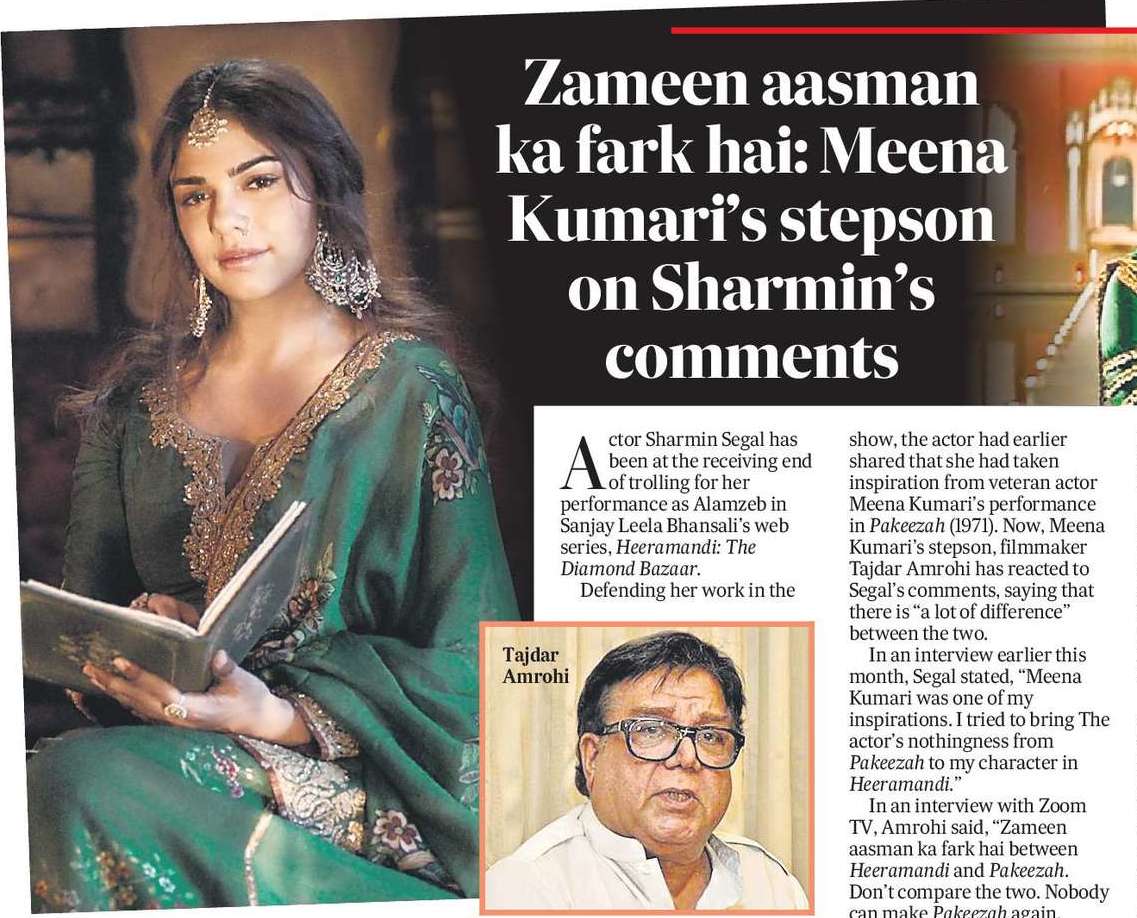
"Zameen aasman ka fark hai": Meena Kumari’s stepson Tajdar Amrohi on Sharmin Segal’s comments
8:27 AM
HINDUSTAN TIMES (June 12, 2024)
Actor Sharmin Segal has been at the receiving end of trolling for her performance as Alamzeb in Sanjay Leela Bhansali’s web series, Heeramandi: The Diamond Bazaar.
Defending her work in the show, the actor had earlier shared that she had taken inspiration from veteran actor Meena Kumari’s performance in Pakeezah (1971). Now, Meena Kumari’s stepson, filmmaker Tajdar Amrohi has reacted to Segal’s comments, saying that there is “a lot of difference” between the two.
In an interview earlier this month, Segal stated, “Meena Kumari was one of my inspirations. I tried to bring The actor’s nothingness from Pakeezah to my character in Heeramandi.”
In an interview with Zoom TV, Amrohi said, “Zameen aasman ka fark hai between Heeramandi and Pakeezah. Don’t compare the two. Nobody can make Pakeezah again. Neither Meena Kumari nor Kamal Amrohi (filmmaker, his father) can ever be born again.”
He continued, “I don’t know Sharmin. But no, I can’t relate to her statement on nothingness. I must say here, that each one of us has individual tastes. There might be people who have liked Heeramandi more than Pakeezah.”
Amrohi then went on to elaborate on Bhansali’s admiration for his father. The filmmaker added, “Once, Bhansali had come to Kamalistan Studio and asked where my dad used to sit, where he walked. Out of great respect, he touched the ground. That was 15 years ago and I never met him again.”
Pakeezah was the Taj Mahal that my father built for Meena Kumari aka his Mumtaz-Tajdar Amrohi
8:24 AM

Roshmila Bhattacharya (MUMBAI MIRROR; April 2, 2020)
“Chalo Dildaar Chalo, Chand Ke Paar Chalo…” Tajdar Amrohi’s caller tune takes me back to my childhood, when I had listened to this song from Pakeezah on a LP record in our living room. “It’s been 48 years since the film’s release, but even today, this romantic duet, in fact, every song from this timeless album, is instantly associated with Pakeezah and Meena ji (leading lady Meena Kumari),” points out the son of the film’s writer-producer-director Kamal Amrohi.
Tajdar saab goes on to inform that while shots of the boat sailing were taken in Goa, those featuring Meena ji and Raaj Kumar saab were canned indoors because the actress was battling cirrhosis of the liver by then and too unwell to go on location. “While many berated him for making an ailing chhoti ammi shoot unnecessary songs, daddy promised he’d take good care of her and had a maid, doctor and nurse stationed on the set. Then, without the aid of blue and green screen technology (chroma keying), he brought the stars into the studio for her even as the moon played hide-and-seek with the clouds. My father was a master craftsman who arranged the lights and camera himself, planned long shots with his stars in a way that their romance would look ethereal on screen even as they disappeared behind the boat’s sail,” he reminisces.
Pakeezah started on July 16, 1956, as a black-and-white film, and was re-shot in colour and then, in cinemascope. They were still shooting when, in 1964, Kamal saab and Meena ji separated following mutual differences. When shooting resumed in 1969, “Mausam Hai Aashiqana” was the first song to be shot, with an ailing Meena ji as the mujrewali Sahibjaan being whisked away from the kotha by one of her patrons. However, the night of his dreams is ruined when they are attacked by elephants and Sahibjaan sails away down the river in the splintered boat. She emerges from the water, enters the tent of forest ranger Salim, set up by the riverside, changes out of her wet clothes into his lungi and shirt and flipping through his diary, comes face to face with the man who’d teased her imagination with his lines rhapsodising over her “pure” feet.
“No actress had worn a lungi, which back then, was seen as a male attire, before this on screen. But, daddy reasoned that, in the context of the setting and situation, it would not look out of place on her and being loose and flowing, like the gharara in 'Chalo Dildar Chalo', would camouflage the bloating her illness had brought on.
“After the film’s release, the lungi became a fashion trend, like Pakeezah bangles, dupattas and sandals. Chhoti ammi herself was wowed by how beautifully my father had picturised these songs, which she’d insisted he retain despite her failing health, like everything else in the script,” says Tajdar saab, pointing out that Meena ji herself was a poetess who often scribbled down her meandering thoughts and read them aloud to his father, who’d react with an appreciative nod, sometimes changing a word or two, even telling her how best to recite them to enhance the beauty of the verses. Does he remember any, you wonder, and without a moment’s hesitation, he rattles off a couplet of his chhoti ammi’s poetry... “Raha Yunhi Na Mukammal, Gham-e-Ishq Ka Fasana, Kabhi Mujhko Neend Aayi, Kabhi So Gaya Zamana”.
The simplicity of the words and their sensitivity leave me awed, in the same way that the film had overwhelmed Meena ji when she saw it at the premiere in Maratha Mandir, on February 3, 1972, seated beside Chandan (that’s what she called Kamal Amrohi) and her darling Tajdar. “As the story of Salim and Sahibjaan unfolded, her nails dug deep into my father’s wrist and she clutched his hand tightly, leaving imprints on the tender skin. But not for a minute did a flicker of pain or irritation cross his features. Instead a tender smile played on his lips, which widened when, resting her head on his shoulder, she asked him to promise he’d not make another film after Pakeezah, making me a witness,” Tajdar saab recounts.
He reasons that since his father survived Meena ji, who passed away on March 31, 1972, by 21 years, it was difficult for him to keep this promise. “But Pakeezah was the Taj Mahal that he built for his Mumtaz and will forever be chhoti ammi’s most memorable film,” asserts Tajdar saab, adding that today his father and chhoti ammi lie side by side in the kabrastan, reunited in death. “And I can imagine him holding out his hand to her, inviting, ‘Chalo dildar chalo chand ke paar chalo…’ and her fingers entwining with his as she replies, ‘Hum hain taiyaar chalo…’, the two of them walking away into a technicolour sunset towards a beautiful world.”

Baba insisted that Pakeezah was a slow poison-Kamal Amrohi's son Tajdar
7:12 AM

Roshmila Bhattacharya (MUMBAI MIRROR; February 8, 2019)
 On February 4, 1972, all roads led to Mumbai’s Maratha Mandir theatre where Kamal Amrohi’s Pakeezah was being unveiled. A chariot driven by six horses came with the print and a navy band played as industry big-wigs strode in to a shower of flowers, the foyer redolent with the scent of kewda and mogra. In the crowd was a boy of 18 who was waiting expectantly for his ‘chhoti ammi’. As soon as her car drove up, he ran down to take her hand as she stepped out. His father who’d been standing quietly in a corner, also moved forward towards his Manju more sedately. As she walked up, ethereal in a white gharara, strands of mogra in her hair, their eyes met. Smiling up at her Chandan, she took his arm and entered the auditorium. At around 9.30 pm, the lights dimmed and the film which had been conceptualised in 1958 in black-and-white, exploded on screen in a profusion of colours.
Everyone sighed as Nargis, a heart-broken tawaif, pines away in a cemetery after being turned away by her lover’s family... They smiled as her lookalike daughter, Sahibjaan, who grows up in a kotha, finds love in a train... The lady in white seemed like she was in a trance, her nails digging into the hand of the man beside her. Her grip must have hurt but he didn’t flinch, only smiled as he gazed down at her.
During the interval, the guests crowded around the couple for autographs and photographs before returning to the movie. As it neared the end, Manju rested her head on the man’s shoulder and said quietly, “Chandan, ek vaada karoge? After this you will not make another film.” He laughed, “Then what will I eat?”
The film ended. The reactions were mixed. Majnu aka Meena Kumari, who for weeks had worried about how she would look in her first role as a nautch girl, was reassured that despite the passage of time and ill health, she had never appeared more beautiful. And while everyone agreed that this was not the same Meena Kumari of Gomti Ke Kinare and Mere Apne, there were many whose compliments sounded insincere to the film’s writer-producer-director Kamal Amrohi’s ears. Like his distributors, they weren’t sure if the late Ghulam Mohammed’s songs would work in the era of Laxmikant-Pyarelal and Johny Mera Naam.
As they drove back home, some wondered if a dancing girl who is covered from head-to-toe even when she croons, “Inhi Logon Ne Le Liya Dupatta Mera” and whose vocabulary reflected an old-world tehzeeb would appeal to the modern-day audience? Wouldn’t the ‘thehraav’ of the film seem “too slow” for viewers speeding down life’s fast lanes? “Baba only smiled at his detractors, insisting that his Pakeezah was a slow poison. It didn’t kill instantly, but would live on with the audience till D-Day and in decades to come, would be listed among the top 10 Hindi films ever,” informs Tajdar, the son of Kamal Amrohi, who’d doted on his ‘chhoti ammi’ since he was five and continues to celebrate the fact that his father’s film immortalised Meena Kumari.
Rumours abound that Pakeezah only picked up after it’s leading lady’s untimely death on March 31. Tajdar dismisses them, arguing that a flop film wouldn’t have remained in the theatres for nine weeks. “The craze began when an all-women audience took over Prakash Theatre in Ahmedabad, and spread across India. Even when the news of chhoti ammi’s death was announced in the theatres, it was a full house. After she left us, her fans returned, again and again, to watch her last film and collections escalated. The investors and distributors got their money but Baba didn’t end up a millionaire. But he’s still revered as the Last Moghul,” avers Tajdar.
On February 3, a Pakeezah boat sailed from Chowpatty to the Gateway of India and back for a week, with half-a-dozen girls on board, some playing the sitar, some swaying to the songs. “No one else was allowed to get on and a boat would go out to the sea to fetch the girls,” recalls Tajdar, adding that no one had seen promotion like this before or since.
On February 11, 1993, Chandan passed away and was buried next to his Manju. Tajdar believes, in another world, his chhoti ammi is singing to his baba, “Chalo dildaar chalo, Chand ke paar chalo, Hum hai tayaar chalo… Aao kho jaaye sitaaron mein kahin, Chhod de aaj yeh duniya, yeh zameen…”
Firm which bought filmmaker Kamal Amrohi's Mahal Pictures moves HC claiming rights of Pakeezah
7:45 AM

His children say the movie was not part of the deal
Nazia Sayed (MUMBAI MIRROR; October 19, 2017)
A movie, which survived 16 years of filming and relationship trials to become one of Indian cinema’s most iconic pictures, is now the subject of a high-profile and complex legal tussle.
DB Realty has filed a suit in the Bombay High Court claiming the rights of the 1972 classic Pakeezah, which was directed by Kamal Amrohi and starred Meena Kumari. The company has moved the suit through Mahal Pictures, which it acquired along with the landmark Kamalistan studio from Amrohi’s children seven years ago.
The children — Tajdar, Shandar and Rukshar —have contested the company’s assertion, saying Pakeezah was their father’s most personal work and it was not part of the Mahal Pictures deal.
DB Realty’s suit is primarily against Shemaroo Entertainment Ltd, which bought the film’s rights from the Amrohis in 2015. The Amrohis have joined Shemaroo to oppose the claim because they believe Shemaroo would do justice to their late father’s legacy.
Kamal Amrohi announced Pakeezah in 1956, four years after he married Meena Kumari. But the movie suffered huge delays as their relationship broke down, Amrohi switched from black and white to colour format and Kumari became seriously ill. The movie was finally released in 1972 and it is described by many as Kumari’s best performance.
In 2010, the legendary filmmaker’s children sold his Mahal Pictures to Pune-based builder Avinash Bhosale, DB Realty and the Luthrias.
Tajdar told Mirror on Wednesday that it was mentioned in the contract that after the property sale, Pakeezah’s rights would be pledged back to him as it was his father’s legacy. He said Pakeezah was never a Mahal Pictures production so DB Realty cannot claim its rights.
“Even in the film credits, it is mentioned that the film was written, directed and produced by Kamal Amrohi. Nowhere is it said that it’s a Mahal Pictures production. So when it is my father’s private property, they cannot claim it to be a part of Mahal Pictures. We have sold Mahal Pictures, not Pakeezah,” he said.
But Avinash Bhosle insisted the movie rights were part of the deal. “When we bought Mahal Pictures, the copyright of the film was also handed over to us. Yet, the Amrohis illegally sold the rights to Shemaroo. We are fighting for something which legally belongs to us,” he said.
Tajdar said in 2008, the board of directors of Mahal Pictures unanimously passed a resolution that Pakeezah’s rights would be transferred to him in the event of a company sale. He has submitted the minutes of the meeting in the court.
Vinod Karani, vice-president of Shemaroo Entertainment, has said in a reply to the suit that DB Realty-run Mahal Pictures deliberately hid the facts about the 2008 meeting from the court. He has added that DB Realty filed a “false case” after it learned that Shemaroo had started exploiting the film rights.
Advocate Mahesh Mahadgut, who is representing Shemaroo, said the Amrohis and Shemaroo had a valid agreement for the movie rights.
Jatin Rajguru, an authorised signatory for Mahal Pictures, said the company was the rightful owner of Pakeezah. “The censor board issued a certificate in 1971 where Kamal Amrohi was mentioned as the producer of the movie. At the time, he was the owner of Mahal Pictures,” he said.
He added: “Shemaroo and the Amrohis never mentioned the 2008 board meeting at the time of execution of the share purchase agreement.”
Raaj Kumar accepted Pakeezah without even enquiring about his role in a heroine-oriented film-Tajdar Amrohi
7:41 AM

Roshmila Bhattacharya (MUMBAI MIRROR; October 12, 2017)
'Jaani' Raaj Kumar would have turned 91 on October 8 and perhaps we might have seen him running after a train on a stormy night, like Salim in Pakeezah, who changes the life of a nautch girl, Sahibjaan, with a few scribbled lines of poetry…
“Aapke paon dekhe, bahut haseen hai, inhe zameen par mat utariyega, maile ho jayenge.”
Forty-five years later, these words spoken in that unforgettable baritone still resonate as writer-producer-director Kamal Amrohi’s son, Tajdar, admits that one of the reasons his father cast Raaj saab was because of his voice and impeccable Urdu diction, and because his face and genteel manners stamped him as an aristocrat from a cultured, orthodox family.
“Also, Dil Apna Aur Preet Parai, with the same jodi, had been a huge hit and Raaj saab accepted the film without even enquiring about his role in a heroine-oriented film, confident that Kamaal saab would not be unfair to him,” informs Tajdar.
He goes on to reveal, almost half a century later, that the man you see in the first scene, running after the train, was not actually the actor but someone Kamal saab had picked out from the crowd. The man wore Raaj Kumar’s clothes and hat. “Raaj saab was arriving late and there was no time to waste as the platform had been booked for a specified time and the station master was urging him to wrap up his shoot quickly. Later, when Raaj saab saw the scene, he wondered when he’d shot it. My father assured him that they had taken the shot long ago and he’d forgotten,” Tajdar smiles fondly, marveling at the bond between his father and the actor.
Raaj Kumar had a reputation for being an eccentric. While Tajdar doesn’t endorse this, he recalls, how for a particular sequence, shot over three-four days, the actor would report every day in a different outfit despite being told there was no need for costume changes. Kamal saab didn’t argue with him after a point but on the last day of shooting, he had a quiet word with the dressman, telling him to give Raaj saab the clothes he’s worn on the first day and quickly taking his shots to ensure that continuity was maintained.
He goes on to recount another sequence, which had a thakur who, having recognised Sahibjaan from the kotha, chases after the tonga carrying her and Salim on his horse. Incensed, Salim gets off and gets into an altercation with the man, holding the reins off his prancing horse till the thakur cracks his whip down on his hand, surprising him into letting go.
“Raaj Kumar ke haath se lagan chhut jaye, yeh ho hi nahin sakta, with one twist of my hand I can bring the horse down,” the actor argued. Kamal saab pointed out that he was not Raaj Kumar but Salim in the scene but he was obdurate. “Finally my father took the junior artiste playing the thakur aside and told him to hit him a couple of times till Raaj saab let go. Perhaps he learnt about this but when it was time to face the camera, he told my father that while Raaj Kumar would never let go of the reins, maybe Salim ke haath se lagaam chut sakti hai. And so the shot was filmed with him finally disciplining the thakur,” smiles Tajdar admitting that such incidents brought the two closer, enhancing the love and respect they had for each other.
And we are left with a memory of that baritone intoning another famous dialogue from the film.
“Beshak mujhse ghalati hui. Main bhool hi gaya tha iss ghar ke insaanon ko har saans ke baad doosre saans lene ki ijaazat aapse leni padhti hai. Aur aapki aulaad khuda ki banaai hui zameen par nahin chalti, aapki hatheli par rehti han..”
Ahh, for the days of the Raaj again!
Shashilal K Nair was in a pub playing with white mice-Tajdar Amrohi
7:34 AM

Kamal Amrohi's son Tajdar brought Shashilal Nair back to direct 'ek aur' love story and revive his banner
Sanyukta Iyer (MUMBAI MIRROR; January 8, 2016)

Shashilal K Nair, who bagged the National Award for Best Special Effects for his 1993-drama, Angaar, featuring Jackie Shroff, Nana Patekar and Dimple Kapadia, dropped off the face of the earth after his leading lady, Manisha Koirala disowned the controversial 2002 film, Ek Chhotisi Love Story.
Prod him on where he was for the last 13 years and he says that the only person who could answer that question is Tajdar Amrohi, son of late filmmaker Kamal Amrohi, who kidnapped him and brought him back from UK to revive his family banner.
"I have only two friends, J P Dutta and Shashilal Nair. Since JP was busy I went hunting for Shashi in December 2013," says Tajdar.
His filmmaker friend, K Asif, told him that Shashi was last heard to be in Manchester and Tajdar immediately booked himself on the next flight to London from where he took a bus to Manchester, and began inquiring about his long-lost friend. "I was told that it was impossible to search for someone in this huge city so I thought that I should head to Scotland Yard and file a missing person's report. After a week on the road, I learnt that he was in Huddersfield," he reminisces.
The British town was a colony of retired locals. An old lady told Tajdar that there was only one Asian there and he always frequented a particular dingy pub every evening. Tajdar headed there at 8:30 pm, and in walked Shashi. "When I hugged him from behind I was surprised to notice that he was playing with white mice," recalls Tajdar.
He booked them a one-way flight to Mumbai and convinced Shashi to direct a film for the revival of the Kamal Amrohi banner.
"The film will introduce Mashoor and Esther, who play a couple in love, travel by the local train and romance at the railway station. It's a common man's story. We've filmed from Dombivali to Haji Ali and are currently dubbing for it. It will release in April," he says.
Shashilal's past projects include One 2 Ka 4 with Shah Rukh Khan and Juhi Chawla, followed by Ek Chhotisi Love Story. "Ek Chhotisi Love Story left me a broken man. It was the most unpleasant experience of my life. Everyone stabbed me in the back, my heroine, politicians gundas and friends. I didn't want to talk about it so I took a sabbatical. But now, I'm back with fresh faces and ek great love story," promises Shashi.
Tigmanshu Dhulia debunks rumours surrounding Meena Kumari biopic
10:03 AM

Apoorva Rao (DNA; April 18, 2015)
The biopic on yesteryear actress Meena Kumari starring
Kangana Ranaut is definitely happening, confirmed Tigmanshu Dhulia. He
has told us that he’s not suspending the work on the biopic yet.
Controversy over the movie erupted recently after Tajdar Amrohi, Meena
Kumari’s stepson, objected to Dhulia’s plans, claiming they have not
taken the permission from the actress’ family.
The director clarifies that there is no room for any objection. “We have the rights to the book by Vinod Mehta. The book has been in the public domain for over 20-25 years. If we are basing our entire film on the book, nobody should have an objection to that,” the National Award-winning director said.
The director also plans to discuss the film with the yesteryear actress’ family before going on floors. “We will approach Amrohi as he is her family and for our research and to get some details. We will not make the film without his blessings,” said Dhulia.
But the rights to the film was not the only contentious point as Amrohi also objected to casting Kangana Ranaut as his stepmom. He had said that the Queen actress is “anything but Meena Kumari and does not suit the role”. To add to the conflict, Amrohi himself is making a film on Meena Kumari’s life and has said that the shooting for the film, titled Meenabakamaal has already begun.
Kumar Gaurav's daughter Saachi marries Kamal Amrohi's grandson Bilal
7:49 AM

Vickey Lalwani (MUMBAI MIRROR; November 24, 2014)
 In March, Kamal Amrohi's
grandson Bilal confessed his love for Kumar Gaurav and Namrata Dutt's
daughter Saachi and announced that he would marry her one day. Well, the couple who have been dating for the last
four-and-a-half years, have tied the knot.
In March, Kamal Amrohi's
grandson Bilal confessed his love for Kumar Gaurav and Namrata Dutt's
daughter Saachi and announced that he would marry her one day. Well, the couple who have been dating for the last
four-and-a-half years, have tied the knot.Namrata confirmed the news saying, “Yes, Saachi has married Bilal. We wanted to keep it quiet, but now that you ask.... We had the option of calling everybody or just the immediate family. We chose the latter.“
The reason the wedding, which happened in Mumbai few days ago, was a hush-hush affair because Namrata's brother and Bunty's best buddy, Sanjay Dutt is in jail. Bilal's father Tajdar, who not so long ago was raving about Saachi saying she is “prettier than most heroines and could have become a top star if she wished,“ was more reticent this time saying, “I'm happy with whatever has happened but I don't wish to elaborate. It's a personal matter.“
Saachi got a diploma in fashion designing from SNDT University in 2006. After a six-month internship with designer Anna Singh, she started her own business and is doing well today. Bilal, who made his debut in Atul Agnihotri's O Teri, has bought a flat in Bandra in the same building as Kangana Ranaut. And buzz is, that's where the couple have started their new life together. “Namrata is very happy that they will be living in Mumbai, close to her,“ says a source close to the family.
Ek Chhotisi Love Story director to work with Manisha Koirala in Meena Kumari biopic?
7:50 AM

Subhash K Jha (DNA; August 14, 2014)
Manisha Koirala might play Meena Kumari in a bio-pic produced by the latter’s step-son Tajdar Amrohi.
The
only hitch seems the tumultuous history of conflict she shares with
director Shashilal Nair. They were close friends. She did one of her
best films, Grahan, with him. But In 2002, the two had a massive
fall-out over the content of Ek Chhotisi Love Story. The controversial
film Manisha starred in, and Nair directed, was about an adolescent’s
wet-dreams about a sexy woman. Manisha accused Nair of doctoring the
content and using a body-double to do the intimate shots. The matter got
ugly and ruined their friendship. Nair gave up films and this city and moved to England. Now Tajdar has brought him back to direct the Meena Kumari bio-pic.
Says Tajdar, “I could think of only two directors who could be on the same page as me on this. One is JP Dutta, who is busy with his own film, the other is Shashilal Nair. I tracked down Nair in Manchester. I wouldn’t take no for an answer or let him come later. He came back with me and we started work on the project immediately.”
He adds, “I’ve zeroed in on a particular actress and she has agreed. Nair had problems in the past, but I am telling him to forget what happened earlier and start afresh.”
Director & producer of Meena Kumari biopic squabble over creative differences
7:38 AM

Vickey Lalwani (MUMBAI MIRROR; August 11, 2014)
 The biopic of Tragedy Queen Meena Kumari has taken a sad turn. Shashilal
Nair (director of the infamous Ek Choti Si Love Story) returns to the
arclights with the film. But all is not well between Nair and the
producer of the film, Tajdar Amrohi, the son of the late filmmaker Kamal
Amrohi and Meena Kumari's stepson.
The biopic of Tragedy Queen Meena Kumari has taken a sad turn. Shashilal
Nair (director of the infamous Ek Choti Si Love Story) returns to the
arclights with the film. But all is not well between Nair and the
producer of the film, Tajdar Amrohi, the son of the late filmmaker Kamal
Amrohi and Meena Kumari's stepson.Tajdar, who has re-booted his father's banner, Mahal Pictures, under a new name, Kamal Amrohi Pictures, clashed with the director over the portrayal of the actress' life.
When contacted, Tajdar confirmed that Nair and he are not on the same page as yet. “He wants to take certain cinematic liberties but I am not playing to the gallery. I know we are not making a documentary but we have to stick to the truth," he asserted.
To begin with, Tajdar and Nair have not agreed on the choice of actress to play the film icon onscreen. Also, the two men are on the opposite sides of the fence when it comes to zeroing in on the film's title. “Nair also wants a few song situations which I am not comfortable with," says Tajdar, adding, “Actually, besides the heroine and the title, there are several other things that need to be shown in correct perspective. Creativity doesn't mean that you tell a warped story."
Mirror has it that the last argument between the filmmaker and the director happened while they were discussing a scene where Kamal Amrohi, while returning from an award ceremony with Meena Kumari, dismisses her award as a small achievement. Says Tajdar, “Chhoti ammi and abba did argue, not while they were returning from an awards nite but after seeing Sahib Bibi Aur Ghulam. Chhoti ammi asked my dad if he had liked her in the film and he said 'Great'. She reacted saying that his 'Great' didn't sound genuine."
He adds that it was also said that his father robbed Meena Kumari of the chance of becoming a mother.
“But the truth is that she had conceived twice. But she terminated the pregnancy herself, both times," he insists. “And they did not divorce each other. For God's sake, she was a Sunni, yet she was laid to rest besides my dad in a Shia cemetry at Mazgaon."
He added that contrary to popular opinion, his father was not the villain in his chhoti ammi's life. “I am going to put the truth across in this film. These misconceptions need to be erased," he avers.
When contacted, Nair confirmed his differences saying, “Duniya hai. Objections to hote rahenge."
Tajdar added that they plan to iron out their conflicts.“Nair is the right man for the job, we will make it work,“ he concluded.
Kamal Amrohi's son Tajdar plans Meena Kumar biopic
7:48 AM

Rachana Dubey (MUMBAI MIRROR; May 23, 2014)
Tajdar Amrohi has re-booted his father's banner Mahal Pictures under a new name, Kamal Amrohi Pictures, and has bought two properties in Bandra-one for a new office and one for a rehearsal studio. A biopic on his father's second wife Meena Kumari is in the pipeline.
Pointing out why he was refused permission for a biopic so far, Tajdar explains, "My baba was not the villain in chhoti ammi's life. It's said that he deprived her of motherhood but the truth is that she had conceived twice and both times had aborted the baby. This is just one of the many things I will have to weave into the screenplay to bring out their real love story."
However, his first production which rolls this monsoon will have a cast of fresh faces. "Rain plays a major role in the narrative. We need to shoot on the streets and in the busy pockets of Mumbai and with newcomers we won't invite unnecessary attention," he reasons. A couple of songs have already been recorded with lyrics penned by Tajdar.
Subscribe to:
Posts (Atom)