Showing posts with label TVF. Show all posts
Showing posts with label TVF. Show all posts
No FIR against makers, actors of College Romance, says Supreme Court
8:52 AM

BOMBAY TIMES (March 23, 2024)
The Supreme Court has quashed a criminal case filed against the makers and actors of the web series, College Romance, for obscene content. Setting aside an order of the Delhi High Court to file an FIR against The Viral Fever (TVF), the SC said that no violation of Sections 67 (publishing or transmitting, in the electronic form, any material which is lascivious) and 67A (punishment for publishing material containing sexually explicit act in electronic form) of the Information Technology Act (IT) has been made.
The SC said that it is settled that a court must exercise its jurisdiction to quash an FIR or criminal complaint when the allegations made therein, taken prima facie, do not disclose the commission of any offence.
Senior lawyers Harish Salve, Mukul Rohatgi along with Ameet Naik appeared for the creators and actors of the show. Speaking to us, Ameet Naik said, "This is a landmark judgment of the Supreme Court overruling a judgement of the Delhi High Court, holding that vulgarity and profanity cannot be equated with obscenity and dismissing the FIR filed against the makers of the show College Romance, its actors and writers under Section 67 / 67A of the IT Act, 2000. This decision is a breath of fresh air for content creators as it upholds fundamental right to freedom of speech and expression and holds that the applicability of obscenity under section 67 and 67A of the IT act for vulgarity and profanity has to be viewed in the context and not in isolation."
What did the SC say?
The Supreme Court said that the Delhi High Court has taken the meaning of the language in its literal sense, outside the context in which such expletives have been spoken. The SC bench said, "While the literal meaning of the terms used may be sexual in nature and they refer to sexual acts, their usage does not arouse sexual feelings or lust in any viewer of ordinary prudence and common sense. Rather, the common usage of these words is reflective of emotions of anger, rage, frustration, grief, or perhaps excitement. Similarly, the metric to assess obscenity and legality of any content cannot be that it must be appropriate to play in the courtroom while maintaining the court's decorum and integrity. Such an approach unduly curtails the freedom of expression that can be exercised and compels the maker of the content to meet the requirements of judicial propriety, formality, and official language. Here again, the High Court committed a serious error in decision-making."
The SC observed, "When we notice the use of such language in the context of the plot and theme of the web series, which is a light-hearted show on the college lives of young students, it is clear that the use of these terms is not related to sex and does not have any sexual connotation. Neither did the creator of the web series intend for the language to be taken in its literal sense nor is that the impact on a reasonable viewer who will watch the material. Therefore, there is a clear error in the legal approach adopted by the High Court in analyzing and examining the material to determine obscenity."
Check out Amruta Subhash's first look in Saas Bahu Achaar Pvt Ltd
8:18 AM

Amruta gives new spin to saas-bahu dynamics with Saas Bahu Achaar Pvt Ltd, which celebrates women’s entrepreneurial spirit
Uma Ramasubramanian (MID-DAY; March 8, 2022)
For the better part of the aughts, Indian television churned out saas-bahu dramas where the domineering mother-in-law was the arch villain of the holier-than-thou bahu. But as the years have passed, the role of women has changed. It isn’t surprising then that Amruta Subhash is offering a new take on the saas-bahu dynamics with the series, Saas Bahu Achaar Pvt Ltd. She plays the middle-aged Suman who, compelled by circumstances, has to become the breadwinner of the family, and discovers her innate entrepreneurial spirit when she begins her pickle business. Cheering her on is her mother-in-law, essayed by Yamini Das.
The ZEE5 offering comes from a deeply personal space for creator Arunabh Kumar. He says the show — which celebrates women’s resilient and independent spirit — is influenced by the hardships faced by his mother. “I have closely seen the struggles of my mother, who ran a high school in a village in Bihar, and worked with self-employed women from Tier-II and III towns. This became my personal motivation to tell this story,” he says.
The TVF (The Viral Fever) team began developing the material a year ago, before taking the Annup Sonii and Anjana Sukhani-starrer on floors in Delhi late last year. Director Apoorv Singh Karki, who struck gold with Aspirants (2021), has taken the responsibility of showcasing an unlikely hero. “It’s a story of how everyday women like Suman are rising professionally, and holding their own in the world of business,” he says.
Nimisha Pandey, chief content officer, Hindi originals, ZEE5, adds that she greenlit the series as it offered a refreshing take on age-old relationships and “embraced flawed women characters.”
The OTT business is really the IPL of content-Sameer Nair
8:25 AM
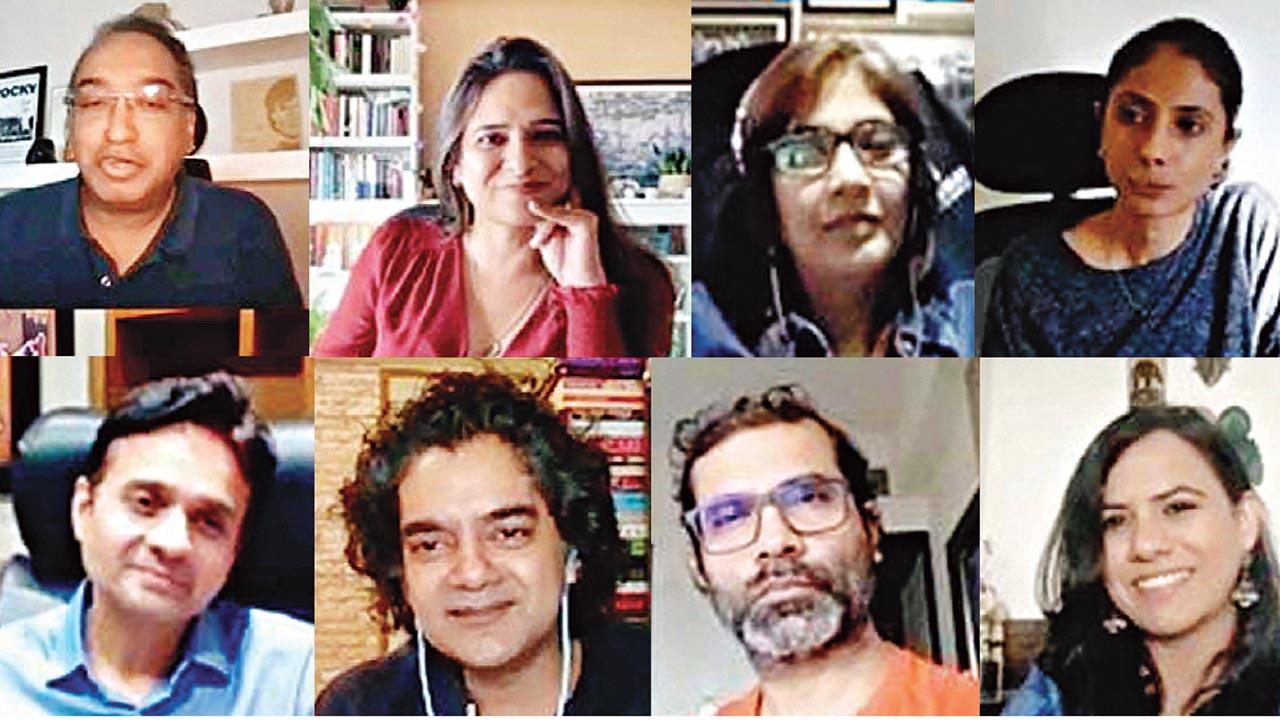
(Clockwise from top) Sameer Nair, CEO, Applause Entertainment; Nimisha Pandey, Chief Content Officer, Hindi Originals — Zee5; Madhu Bhojwani, partner, Emmay Entertainment; Pratiksha Rao, Director — films and licensing, India, Netflix; Aparna Purohit, Head, India originals, Amazon Prime Video; Arunabh Kumar, Founder TVF; Mayank Shekhar, Entertainment Editor, mid-day; Apoorva Mehta, CEO, Dharma Productions and Dharmatic
In the OTT head honchos’ huddle, ahead of Hitlist Awards, India’s top content bosses delve on the changing scene
Mayank Shekhar (MID-DAY; February 25, 2022)
Not that you can time this—a day before the Hitlist Awards’ OTT head honchos’ huddle took place over a zoom call, with India’s top content bosses, Netflix founder Reed Hastings dropped a truth bomb elsewhere.
Of all major markets, Reeds reckoned, Netflix was yet to convincingly crack India. Social media handles took off thereafter, throwing up suggestions on what Netflix must do, where it had gone wrong — a swarm of SWOT analyses, if you may.
Sameer Nair (Applause Entertainment) feels this is like offering boxing lessons to Mike Tyson, going through a purple patch: “Netflix are the leaders of how streaming business is done. And India has always been a complicated, hungry, but value-conscious market, that’s also tasted blood during the pandemic. Even cable TV is pathetically cheap at $3 a month here. Everywhere else, it’s $20-30. Satellite TV has 200 million viewers, OTT platforms are at 30-40 million. We talk of ‘cutting the (cable) cord’ — why bother; it’s just there!”
Pratiksha Rao (Netflix India), on the other hand, takes this barrage of unsolicited, social-media advice rather sportingly, terming it a “huge privilege that people think of brand Netflix as passionately. We see ourselves as creative enablers, partners for as diverse stories as we can, to also make them travel globally,” besides offering global (original) content on the platform itself.
To be fair, as per estimates, Netflix holds about 5 per cent of the Indian OTT market; its revenue-share stands close to 30 per cent. There are, currently, about 75 OTT platforms in India. And of the 225 fresh shows streamed in 2021, 170 of them were in Hindi alone. A certain level of segmentation has obviously taken place in an industry that’s at best about five years old.
Nimisha Pandey (Zee5) reveals her platform delivered 40 pieces of original content (series/films) in 2021: “We plan to focus more on quality.”
Aparna Purohit (Amazon Prime Video) agrees her mandate isn’t quantity either. Given that the streaming service is part of an overall shopping mall. “The pressure is to put out something that constantly raises the bar—becomes part of cultural zeitgeist, water-cooler conversations; whether that’s Paatal Lok or Mirzapur. That’s not easy pressure; even as we placed 18 shows and 50 films across languages (in 2021).”
With its own captive subscriber/audience base, the OTT can be deemed as the new star-system for Indian entertainment. They unilaterally green-light scripts—for films, and shows that are shot like cinema. And, in return, receive both immense love and instant criticism for the choices they make.
Speaking of the star-system, which is directly related to theatrical entertainment—whatever happened to Bollywood, as it were, that took a beating from both Hollywood (Spider-Man), and down South (Pushpa, which collected Rs 80 crore among Hindi audiences alone)?
A contention behind this threat to Bollywood being that most of Mumbai’s top, traditional producers have turned into vendors for OTT platforms in the process.
Apoorva Mehta (Dharma Productions, which pretty much equals Bollywood) reasons, “Theatrical is the cornerstone, that’s where the heart lies. The South is filling a gap. Very few Hindi filmmakers, like Rohit Shetty, are great with delivering scale plus entertainment.”
The other unsung aspect of the nascent, theatrical dominance of the South in Hindi markets, as Arunabh Kumar (TVF) points out, is serious upgrade in the quality of Hindi dubbing, subtitling and translation—something that wasn’t adequately appreciated for Allu Arjun’s Pushpa.
Of course television, more so OTT platforms, and Internet access in general, have had a role to play with audiences sampling cinema/content/stardom from all over, other Indian languages included.
As for his own Hindi films, Mehta says he had to make do with the war-tentpole Shershaah (2021) on Amazon Prime Video (APV), because they had held on to it for over a year since the pandemic: “We couldn’t miss out on August 15.” Also, one’s not sure anymore what the response to a mid-range production like Gehraiyaan (also on APV) would be in a theatre: “There’s a skew towards larger than life, experiential entertainment.”
What’s the unlearning, when film studios enter the streaming fray? How are the OTT and film industries different? Bollywood producer Madhu Bhojwani (Emmay Entertainment), who delivered 10 OTT titles in 2021 (including Empire and Mumbai Diaries 26/11) likens the two financial worlds to farming and hunting. Wherein the OTT industry promises a predictable return on an input cost: “There is a cap on how much you can make.”
“The up-side, even once you dilute stakes on the intellectual property of a film,” depends on performance in theatres: “Films are like the races.”
The other changing dynamic between the two industries is again, of course, the star-system itself. Lead actors in Bollywood are notorious for cornering as paycheck a bulk of the film’s budget. Do they matter on OTTs anymore?
TVF’s Kumar says streaming platforms are democratic, in the sense that they don’t grade content on your device, based on who’s in it. The library is near infinite (for a lifetime anyway). Unlike network television, where you can only watch a show at a time; and theatres, that can only play a certain number of films.
Can’t deny the initial buzz, though, that a show/film on an OTT is likely to generate, given a legacy star in it. Rao from Netflix is clear, “The script and the creator’s vision are most important in assessing a project, yes. There is still a commercial value attached to the power of big talents, who have built a filmography and fan base, over years. While they have to deliver that value, they also have to be used the right way, as we’ve done in the US. [Conversely], you can have a [Malayalam super-hero film] Minnal Murali that generates its own fandom. The film didn’t have a big star. But [Tavino Thomas] became a national heartthrob after.”
The equivalent of the box-office, the barometer for cinema stardom, isn’t clicks on OTT platforms, as Pandey from Zee5 points out: “The click is just a vanity metric. Sampling does no good. Once you have clicked—how long you have stuck with the content matters more in the long run.”
And this is why, according to APV’s Purohit, “There is no rush. You don’t have to prove a success of a film or series over a weekend [unlike box-office]. The audience surprises us eventually.”
The reason OTT platforms are seen as parallel to the film industry, rather than television—despite the disproportionate size of screen—is clearly for the budgets involved. And indeed the cross-pollination of talents that have taken place over the past half a decade.
Unlike the US, that moved towards limited edition, quality series back in the late 1990s, Indian network TV continued to appeal to mass markets, chiefly with long-running soap operas, with little incentive to do much else. “This is India’s HBO moment,” Nair from Applause, reckons.
Having been part of all three worlds, how does Nair perceive these industries separately? He says, “There are various ways to describe it. One that I find useful is to take the movie business as playing for the national cricket team—11 players from a billion plus. Fiction on TV is domestic cricket. Those in it hope to make it from thereon. The OTT business is really the IPL of content—involves both domestic and international players, with quality on display; everybody gets their moment under the sun.”
In the food-chain on the Internet, there is in fact another competitive level, below the IPL of content. Which is where TVF’s Kumar progressed from, on a free-for-all YouTube, making spoofs and branded content—starting out with a sketch called Rowdies in 2012, peaking with Kota Factory, the second season of which made it to Netflix.
In 2022, Kumar asserts, “The lot on YouTube from a decade ago are presently subscribers of OTT platforms. That’s the cascading effect. Likewise, there’s a whole new world of 18-year-olds consuming short videos on YouTube now, that we also make content for—being the only collective from the old lot that continues to.”
This content economy is also a creator economy. Everyone is an aspirant, with an idea for a feature, short, or series; displaying talents all-day, online. Many of whom, we figure, might be interested in a conversation with these OTT bosses.
All of whom suggest their inboxes are open for new ideas. Kumar however warns the idea alone is hardly as important as the rigour and effort behind detailing a plan that ought to be 5,000 pages, minimum: “An idea means nothing. I’d value discipline over talent, any day.”
There’s also the ‘bible’, which Zee5’s Pandey defines as an elaborate presentation of sorts that captures the treatment of an idea/story, sometimes visuals included.
Whether it’s a bible or story synopsis, what’s essential, says Rao for Netflix, is “if you’re able get out, what’s in your head. Focus on explaining the story, and its emotions. Instead of saying, this is the ‘best’, or it’s India’s version of xyz!” In case you were searching for a favoured genre to sell, APV’s Purohit makes it public: she is actively on the lookout for young adult fiction.
A safe area, no doubt. Given OTT is no more quite the brave new world it used to be, only until a year back—what with the government putting in place an indisputably draconian censorship law, skewed towards accepting complaints from any viewer of an OTT platform, to be acted upon by a three-tier crime and punishment system.
Bhojwani is part of the government’s second-tier committee, that comprises industry folk and members of civil society—the first is the OTT platform itself; the third tier involves multiple Union ministries.
Bhojwani says, “Since this grievance-redress council was put in place, a lot of complaints have come in. But it’s been okay, working, so far.” So far, being the essential rider. Mehta at Dharma is taking no chances, getting scripts vetted by legal teams, desisting from anything that spells potential trouble.
Although Nair—who recently got away with Danish Sait’s smart political satire, Humble Politician Nograj—reasons, you gotta do, what you gotta do: “Creators both reflect and hold mirror to society—telling stories you’re not meant to; finding ways to. All great art progresses on these fundamentals. A danger bigger than censorship, is self censorship.”
There is a moment of silence at this point from the OTT platform bosses in this huddle. Well. Understandably so.
One pick of 2021
Sameer Nair: Jerry Seinfeld’s stand-up special, 23 Hours To Kill (Netflix)
Madhu Bhojwani: Mini-series, Dopesick (Disney+ Hotstar)
Apoorva Mehta: German multi-part series, Dark (Netflix)
Nimisha Pandey: TVF series Aspirants (YouTube)
Arunabh Kumar: English-Japanese thriller film, Kate (Netflix)
Aparna Purohit: Cop investigative series, Mare of Easttown (Disney+ Hotstar)
Pratiksha Rao: The Morning Show, Season 2 (Apple TV)
Cast your vote for the Hitlist OTT Awards
Log on to www.radiocity.in/hitlistawards to cast your vote.
You can also vote via SMS. Send HITLIST <space> category name <space> your choice (a/b/c as on the website) to 57575.
Voting lines close on March 18.
Subscribe to:
Posts (Atom)