Showing posts with label Sushil Chaudhary. Show all posts
Showing posts with label Sushil Chaudhary. Show all posts
Farhan Akhtar's 120 Bahadur to be screened through mobile theatres in remote regions for Indian Armed Forces and their families
9:48 AM

With ‘120 Bahadur’ screening planned for Indian Armed Forces in under-served regions, PictureTime founder Sushil Chaudhary breaks down the one-and-a-half year process to set up mobile theatres in Ladakh and Sikkim
Mohar Basu (MID-DAY; November 18, 2025)
A film about courage is on its way to those who live it every day. On November 17, the makers of 120 Bahadur announced that the Farhan Akhtar-starrer will be screened for the Indian Armed Forces, paramilitary forces, war veterans, and their families across under-served regions in the country upon its November 21 release. The initiative will be executed by PictureTime, which will take its mobile theatres to remote terrains to screen the Razneesh Ghai-directed war drama.
Sushil Chaudhary, founder and CEO, PictureTime, says the team has been working on this plan over the past one-and-a-half years. Ladakh, Sikkim, and Andaman and Nicobar Islands are among the regions they are focusing on. Chaudhary notes that it was a tough feat to pull off as some regions sit at the intersection of limited infrastructure and strict military protocols.
“In Andaman, we are using an Indian Army auditorium in Port Blair. Accessing the other islands may happen later, around December. We were attempting Lakshadweep too, but we couldn’t do it,” he shares.
Securing permissions from the Army, Air Force, and Navy required months of coordination. “We reached out to each of them separately,” he informs.
For the team, the most symbolic venue would have been Chushul village in Ladakh. It is where the Battle of Rezang La — on which 120 Bahadur is based — took place.
“We were planning to have the première in Chushul. But this year, winter has arrived almost a month earlier than usual. So logistically, [setting up a cinema] there is a huge challenge. We may be able [to set up] there by November 30,” explains Chaudhary.
Maoist-affected Gadchiroli gets its first inflatable theatre
8:17 AM
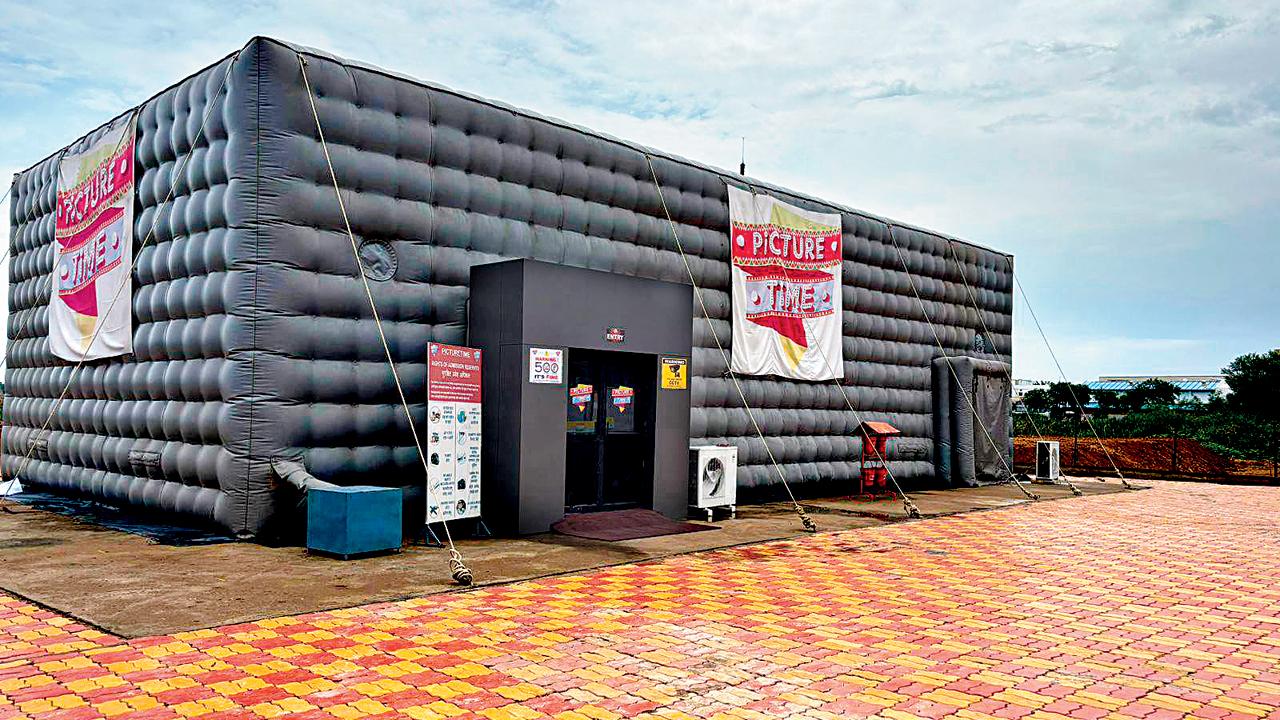
As PictureTime brings the big screen to Maoist-affected Gadchiroli, founder Sushil Chaudhary discusses teaming up with the Maharashtra government to showcase movies in the conflict-ridden area
Mohar Basu (MID-DAY; May 24, 2025)
Cinema should reach every part of the country. From this singular idea was born PictureTime, a cinema chain that has set up inflatable theatres in remote parts of India, from Ladakh to Asifabad in Telangana. On May 22, it launched Maharashtra’s first state-of-the-art inflatable theatre in Gadchiroli, one of the state’s most underserved regions. With tickets priced at just Rs 100, the cinema offers all the benefits of a premium theatre — air-conditioned auditorium, Dolby 5.1 surround sound, and push-back seating.
Sushil Chaudhary, Founder and CEO, PictureTime, says the need for a movie hall in Gadchiroli struck him after Jawan’s (2023) release. “Around that time, I met a well-known Marathi producer who told me there is a demand for screens in interior Maharashtra. We’ve been working with the Government of Maharashtra, and the Ministry of Information and Broadcasting over the past seven-eight years. It has allowed us to provide affordable cinema halls, where the land comes from the government, and we handle the set-up,” he explains.
The 120-seater opened yesterday with Vicky Kaushal’s Chhaava. Chaudhary is confident that the theatre, a permanent fixture in Gadchiroli for the next 15 years, will register strong footfall.
This belief drove him over the past one-and-a-half years as he put the plan into action, undeterred by the region’s strong Maoist presence. “The discussions took about a year, and the paperwork, another six months. The permissions took a while,” he admits.
Understandably, caution has been the keyword. Chaudhary adds, “The Ministry of Home Affairs in Maharashtra wanted to ensure all security checks were in place [since] it’s a Maoist-impacted district. The government helped with infrastructure, and we are bringing affordable entertainment. It promotes normalcy and peace in such conflict-ridden areas.”
How local mobile theatre company is creating movie magic with tickets at just Rs 100
10:48 AM
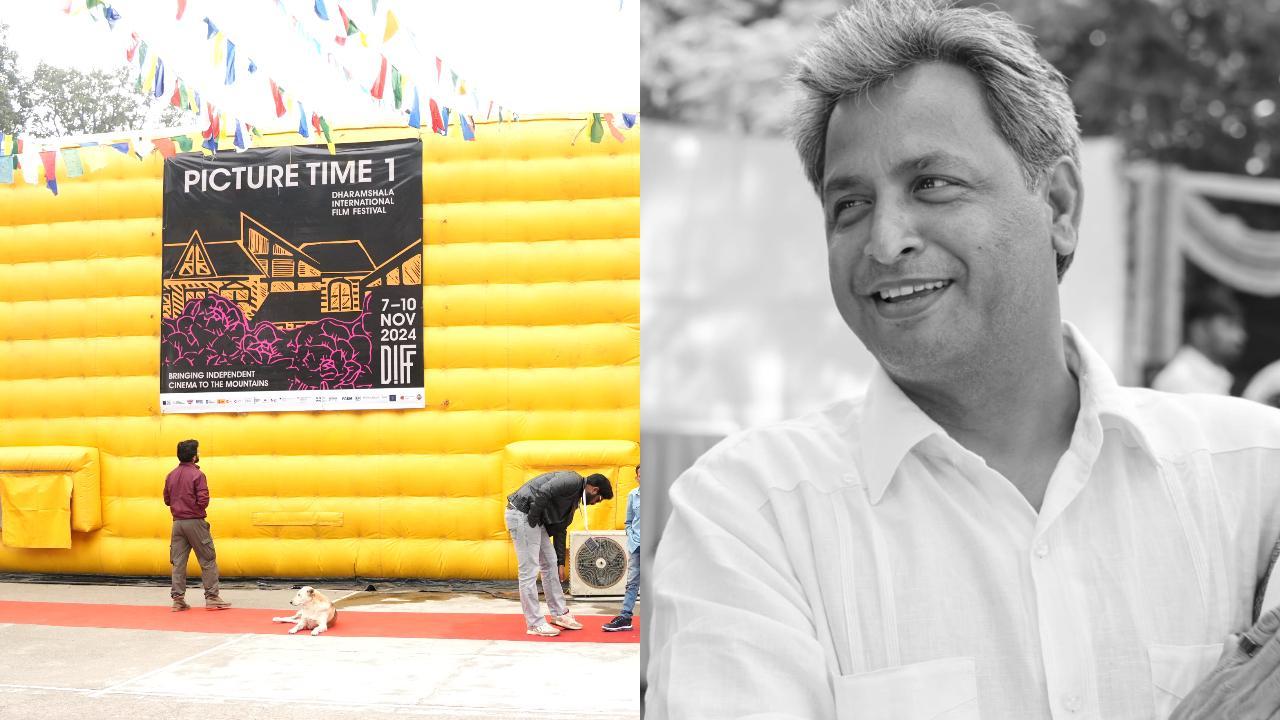
Priyanka Sharma (MID-DAY; November 28, 2024)
What comes after roti, kapda aur makaan? It should be entertainment if one asks Sushil Chaudhary, the man who aims to take cinemas to every nook and corner of the country. Chaudhary is the founder and CEO of the mobile theatre company PictureTime that screens films at inflatable theatres across the country.
“Everybody was talking about it but we took the cinema literally to people,” says Chaudhary, who is currently in Panjim, Goa as PictureTime is the screening partner of the 55th edition of International Film Festival of India (IFFI).
It’s a sweet home coming for PictureTime. Eight years ago, the company began their association with IFFI with the screening of S S Rajamouli’s Baahubali: The Beginning. It continued for the next three years until pandemic played a spoilsport. In the last two years, Chaudhary says, the company was regrouping and missed coming to IFFI.
“So, when NFDC and Ministry of Information and Broadcasting approached us, we immediately said yes. The number one problem for IFFI was the number of screens. It only has INOX. This year, we have put two inflatable theatres.”
If one happened to be in or around Panjim over the last week, it’s impossible to miss the IFF hype— the posters, standees and signboards won’t let it happen anyway. And once entered the primary IFFI venue of Kala Academy, one could spot the red coloured PictureTime inflatable theatre anyone could walk in to catch a film. The playlist at this theatre ranges from Pa Ranjit’s latest work, Thangalaan, Rajamouli’s blockbuster RRR (2022), Ranbir Kapoor’s much-loved 2011 romance Rockstar to Hindi film classics like Guide (1965), Bobby (1973) and Jane Bhi Do Yaaro (1983).
Unlike the rest of the festival, which needs a prior approved accreditation, PictureTime theatre makes no distinction. So, at a given time, the theatre is filled with festival attendees and non-delegates. Another such inflatable theatre is operating in Sanquelim. Not just that, PictureTime has also set up a mobile open-air screen that has been travelling across North and South Goa. Chaudhary is confident that PictureTime will grow bigger by the next edition of IFFI. We wanted to put five theatres time but couldn’t due to budget constraints. But next year we will do it in a bigger manner,” he says.
Chaudhary’s self-belief is not without a reason. From the inception of his company till now, he and his team have put inflatable theatres in more than 600 locations across the country. “These many locations in 18 states. In a state like Orissa, which has very less screen density, I have screened films in all its 29 districts. More than 70 percent of the districts in Orissa have no cinema penetration,” he shares.
It’s rather unfortunate that for a cinema-obsessed country, the magic of movies continues to elude a large population. “India not only has poor theatre density but also doesn’t have a clean entertainment option. For filmmakers to make movies and for movies to make money, the only answer are the cinemas, not OTT,” Chaudhary asserts. Trade experts say that India has around 9,000 screens. For context, let’s look at China, Chaudhary points out. “In 2007, it had more than 3000 screens and in 2015, it had around 55000 screens. Aamir Khan’s Dangal, which released in 2016, made Rs 400 crores in India but Rs 1800 crores in China,” he says.
Chaudhary is singularly focused on making films available to the country's remotest areas. “The government recognises 117 districts as having below-poverty line issues. And in all those districts, we are setting up theatres.” The purpose is to ensure a safe, enjoyable recreational experiences for the youth and families in small towns.
"You hear the stories of couples in small towns being harassed for going out and spending time together. People in the interiors want to go out in quiet, peace and safety but they do not have any place because if you go to the single screens, you are labelled. We managed to convince state governments and the centre government that entertainment zones are very important," Chaudhary mentions.
A 150-seater inflatable theatre takes a couple of days to set up. Five to six people can set up the full screen, and another such team can run full operation, we are told. "The idea is to make the theatre at a very efficient cost and keep the monthly operational cost below Rs 2 lakhs but do not compromise on the quality," he shares. So people get an air-conditioned theatre with Dolby 5.1 big screen and stories that are both Indian and foreign.
And because at the heart of PictureTime is to make cinema available to low-income areas, the ticket pricing is accordingly.
"Rs. 100 is our standard ticket price. Add Rs 50 for popcorn. The pricing depends on the expenditure power of a place as well on the film's producer and distributor. Like in Chhattisgarh, we have kept the ticket price to Rs 70, in Rajasthan it’s Rs 150-200. Normally, when a family of four goes out to watch a movie, it ends up spending Rs five-six thousand. We want it to all fall under Rs 1000," Chaudhary says.
Providing a wholesome experience to families has been another big pursuit of Chaudhary and his team at PictureTime. "We are creating family plexes. The first one will be in Bharatpur, Rajasthan. December 24 is the inauguration. The family plex will have nine retail stores, including food court, and live performances. Cinema theatre should anchor this arrangement and it’s a lifestyle we are taking to these places. Post the ’90s revolution, when the multiplex culture entered India, theatres went inside the malls. What we are trying to do is take malls to the theatres. So, imagine a theatre and a Dilli Haat type set up around it. So, I am creating a rural mall. We have tried this arrangement in Goa and other places and it has worked."
Chaudhary has found patrons in Indian filmmakers. "During our first IFFI association, we could show the theatre to filmmaker Kabir Khan and other senior people in the industry. Kabir Khan called the experience brilliant. Every filmmaker I met, from S S Rajamouli to Siddharth Roy Kapur, loved the idea and they all asked me to keep adding as many screens as possible."
Pankaj Tripathi launches first moving theatre in Ladakh with the screening of short film Sekool
8:14 AM
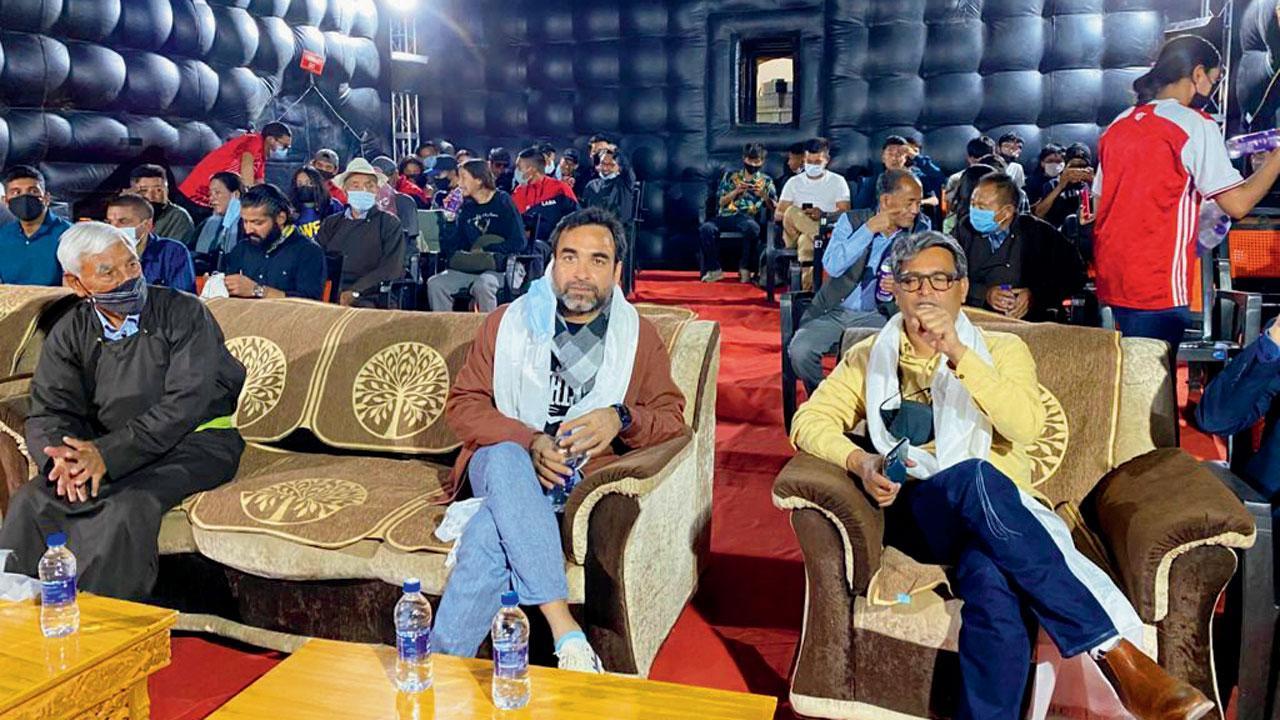
Mohar Basu (MID-DAY; August 23, 2021)
What would the movie viewing experience be like at 11,562 feet? Comfortable and enjoyable, hoped Sushil Chaudhary of PictureTime Digiplex as he launched the first moving theatre in Ladakh. On Sunday, actor Pankaj Tripathi unveiled the inflatable theatre that was installed at the NSD Grounds in Leh. The critically acclaimed short film, Sekool, was screened to the 70-member audience present on the occasion.
Tripathi, who was joined by Thupstan Chhewang, president, Ladakh Buddhist Association, says the locals were jubilant to have a community-viewing experience. “So many regions of our country don’t have the joy of watching films. It’s incredible and heart-warming to see something like this come up in Ladakh. The people looked ecstatic. I am sure after [the pandemic subsides], this concept will flourish further,” says the actor.
While the inflatable theatre is designed to seat 150, the imminent screenings will allow only 75 people per show to maintain social distancing and safety protocols. A special screening of Akshay Kumar’s latest release, Bellbottom, is slated for the Indian Army and the CISF.
Chaudhary, founder and CEO, PictureTime Digiplex, says the move was prompted by his desire to bring a multiplex cinema-watching experience to the locals. “The idea has been to reach out to the entertainment dark spots of the country. Ladakh had been missing out on a big screen for some time. We aim to install two fixed cinema screens, and one moving cinema over the next month.”

As green zones open up, multiplex chains are in talks with a portable theatre company to screen films?
8:45 AM

As green zones open up across the country, multiplex chains are in talks with a portable theatre company to screen films in small towns
Mohar Basu (MID-DAY; May 8, 2020)
 As the country entered its third round of Coronavirus lockdown extension earlier this week, the government relaxed certain restrictions in the areas identified as green zones. This has sparked a conversation in the exhibition sector that the theatrical screening of films, with adequate precautionary measures in place, may be resumed in the near future in these areas. But, of the 300 districts designated as green zones, 240 do not have theatres. In such a scenario, leading multiplex chains appear to have turned to PictureTime Digiplex, a portable theatre company, to revive the cinema-going practice.
"Even a leading chain like PVR has theatres in only 68 towns. In such a scenario, they would want to reach out to the green zones as soon as possible. So, our portable theatres will be required more than ever, and we can set up about 25 new ones in a month. We are in talks with two of the three leading multiplex chains," says Sushil Chaudhary, MD and CEO, PictureTime Digiplex, presumably referring to PVR, Inox and Cinemax.
If given the green-light to function, the portable theatres will have to adopt several safety measures. "No rules have been laid out yet in order to start cinema in green zones, but we have started preparing for the same. We are planning a sanitisation tunnel, where the audience will be sanitised, and their temperatures checked. The seats will also be spaced out with dividers in between, in keeping with the practice of social distancing."
Travelling cinema chain organises simultaneous release of Dabangg 3 in remote villages of Maharashtra
7:07 AM

Mohar Basu (MID-DAY; December 20, 2019)
As Dabangg 3 opens across cinemas today, Salman Khan’s fans in the villages of Vaduth and Tasgaon in Maharashtra have a reason to cheer. Picture Time, the digital mobile theatre, in collaboration with Cinemawale, has arranged the simultaneous release of the cop caper in the two villages. The two-year-old digiplex is a travelling cinema chain that screens films in tents in remote parts of the country and offers the benefits of a multiplex — read air conditioning and digital projection.
While Sushil Chaudhary, CEO, Picture Time, has earlier taken movies to different pockets that do not boast of cinema halls, Dabangg 3 marks the company’s first simultaneous release. He informs that the team has scheduled four shows in a day, with the price of tickets ranging from Rs 25 to Rs 80. “Our aim is to take newly released films to the interiors of India, where cinema isn’t accessible. With Dabangg 3 being screened in districts like Sangli and Satara, it is a matter of pride for us that the endeavour is living up to its purpose.”
Hello LED: How movie-watching is changing yet again
8:14 AM

Goodbye parda, projection booth, and even PDA in the dark. With a Delhi multiplex switching to an LED screen, it may be the end of another era
Sonam Joshi (THE TIMES OF INDIA; September 2, 2018)
Tikeshwar Nath still remembers the day he started working as a projectionist at Delhi’s Delite Cinema. It was 1994, and celluloid ruled the roost. Hum Aapke Hain Koun was playing in theatres, and was to continue its hit run for another 52-odd weeks. For every show, he would head up to his little booth, power up the “carbon stick projector” and pour out the stuff of dreams — a svelte Madhuri Dixit in flamboyant purple and a charming young Salman Khan.
“When film reels arrived, we had to assemble them from different cans, splice them together with tape, then reverse them after every show. It was hard work,” says Nath, 48, the senior-most projectionist at the 64-year-old theatre, who’s seen the transition from analogue to digital. The screening of a film now means transfer of data from a hard disk to a server, activating it with a code, and letting the projector roll. Those bulky reel canisters have been consigned to the mechanical past, along with the whir of the projectors, the sound of the sprockets locking into their holes, and the beam of golden light overhead.
If the transition from celluloid to digital marked a big shift in how films were screened, winds of change are blowing again. This week, multiplex chain PVR introduced the country’s first LED cinema screen in partnership with Samsung in Delhi. It replaces projectors, which have been central to the movie-watching experience since the birth of cinema over 120 years ago. This LED screen is essentially a giant television screen, which Samsung says has “unmatched visual quality, technical performance and reliability over traditional projectors”. “Content becomes far more enriched and enhanced, which we think will excite the audience,” says Puneet Sethi, vice-president, enterprise business at Samsung India.
Launched in Korea in 2017, this is the 12th Onyx screen in the world. Samsung plans to roll out five more LED screens in India by the end of the year. The LED screen is unaffected by ambient lighting, which means you can now eat your buttered popcorn and nachos in non-darkened theatres.
It’s also curtains for the parda. “A lot has happened as far as sound and projection are concerned, but the humble parda or vinyl screen stayed till this LED came along,” says Sanjeev Kumar Bijli, joint managing director of PVR. He says the new screen has another advantage: Saving prime real estate occupied by the projection booth. But this new tech doesn’t come cheap — PVR said upgrading to an LED screen costs nearly Rs 7 crore.
As online streaming threatens to overtake traditional theatres, can newer technology woo audiences? “Over the decades, the industry has faced competition from cassettes, piracy, and now streaming services, but there is a social need to go out and watch movies,” Bijli says.
While filmmakers have experimented with formats since the Lumière brothers first showed their films in the 1890s, the evolution of projection technology has been comparatively slower. Movies were shot on 35mm film and projectors cast them on white screens in darkened theatres. The shift to digital took place towards the end of the 20th century.
Film theorist and historian Amrit Gangar says that in the last 20 years, projection technology has changed faster than in the century before. “Around 1999, digital projectors began to be installed, first in cities,” he says. A decade ago, 4K digital projectors were launched which had a higher resolution than existing 2K projectors and showed brighter, sharper images. Not everyone is a fan though. For Gangar, the analogue 35mm projector was “more immersive” than digital projection that may be “faultless, but it looks synthetic and, to an extent, false”.
“To sell a new technology, they’ll always claim it’s better and brighter but brightness is not the determining factor,” says Bollywood cinematographer K U Mohanan. “The scientific way to see a film is through a projector. Since the projected image is a reflected image with mixed light, it’s more soothing for the eyes. LED backlit screens will exhaust the eyes,” he adds.
Gangar feels the new viewing technology will also be far less sensual.
If the multiplexes do decide to keep the lights on, it will be far less sensual in other ways as well. After all, a movie theatre has been the favourite place for couples to make out or at least hold hands.
With inputs from Mohua Das

----------------------------------
Pop-up plexes bring theatres back to the small town
Sonam Joshi (THE TIMES OF INDIA; September 2, 2018)
The movie-watching experience is changing beyond the big cities. A few years ago, Sushil Chaudhary realised that most villages had no halls as most single screens had wound up. Chaudhary, an engineer, designed his own travelling, inflatable multiplex, the digiplex. “I was inspired by touring tent or tambu talkies in old Indian trucks in Maharashtra that would do open-air screenings,” Chaudhary says.
 Unlike the tambu talkie, a digiplex is fully air-conditioned, equipped with a 18ftx7ft screen and surround sound, and seats 120 people on chairs. Prices are kept low: tickets cost between Rs 30 and Rs 70, with a bag of popcorn for Rs 8 to Rs 15. These inflatable air-conditioned digiplexes can be packed into trucks and assembled in just 2.5 hours. Chaudhary’s company, PictureTime, runs 37 such trucks with plans to expand to over 100 by next March. His focus is on entertainment dark spots — villages and Tier-3 towns with populations of 50,000 to a lakh. “I want families to come back to theatres.”
Caravan Talkies, started by distribution company UFO Moviez in 2015, works on a similar concept, but in even smaller villages. Its fleet of 114 vans travels to villages with a population of less than 10,000, and it is experimenting with LED screens. “We take content to the audience without investing in brick and mortar cinema screens,” says Siddharth Bharwaj, national sales head, enterprise business, UFO Moviez. “Just like the bioscopewala took cinema to the villages earlier, we thought why can’t we take cinema on wheels to an audience that has never seen a movie on a big screen?”
Subscribe to:
Posts (Atom)