Showing posts with label Sunil Dutt. Show all posts
Showing posts with label Sunil Dutt. Show all posts
I don’t want to remake my own film-Subhash Ghai
2:29 PM

As Sanjay Dutt revives Khalnayak after three decades, Subhash Ghai reveals why he won’t direct the sequel, but will lend his vision to the project
Renuka Vyavahare (BOMBAY TIMES; April 28, 2026)
Last week, Sanjay Dutt announced that Subhash Ghai’s 1993 cult classic Khalnayak is getting a sequel, Khalnayak Returns, adding that he will produce the film and reprise his role from the original. While it has not yet been confirmed who will helm the project, Ghai, the director of the original, will serve as a mentor.
Speaking to us, the filmmaker said, “Sanju was passionate about making this sequel for years. Even during his time in jail, he had written to me saying, ‘Uncle, I want to make this film’. So, I sent him the concept and story. If you ask me, no one can make this film the way I did. However, I don’t want to remake my own film; besides, I am 80 now. I told Sanju, ‘If you are so keen, why don’t you produce it yourself, and I can be your creative producer’. I am sure he will find the right director for the film and announce it soon.”
Khalnayak was headlined by Sanjay Dutt, Madhuri Dixit and Jackie Shroff. The sequel will pick up directly from the events of the first film, beginning after Ballu Balram (Dutt) completes his sentence and is released from prison. Apart from Dutt, who will reprise his role, the rest of the cast is yet to be finalised. There has also been speculation about Tamannaah Bhatia recreating Choli Ke Peeche, but Ghai has dismissed these reports. A source close to Dutt also clarified that the claims were untrue.
‘Sanju is like my son, I’ll do a cameo for him’
Ghai confirmed that the sequel will feature his trademark cameo. “Sanju is like my son, so I will do it for him. I also did one for Shah Rukh Khan in Om Shanti Om. I cherish the relationships I have built in the industry over the years. There are distributors who stood by me even when some of my films didn’t work. Other than Rishi Kapoor and Dilip Kumar, who were established names when I worked with them in Karz (1980) and Vidhaata (1982), I never worked with stars. I looked for newer talent who fit the parts, and they went on to become huge stars,” he added.
‘Dutt sahab always told me that Sanju mein ek bachpana hai, which I believe abhi bhi hai’
Sharing how Dutt and he go back a long way, Ghai added on an emotional note, “When I first met Sanju, he was barely 20. He was flamboyant and not particularly interested in becoming a star. He had the face, body and aura of a star, so I knew he would be a hero, but I never thought he could put in the hard work required to be an actor. When I cast him opposite Dilip Kumar in Vidhaata, which was his second film after Rocky (1981), I even told his father, Dutt sahab (Sunil Dutt), that Sanju has it in him, but usko acting mein thoda interest lena hoga. Dutt sahab always told me that Sanju mein ek bachpana hai, which I believe abhi bhi hai. But he is one of the most genuine people you will meet. There is no façade. Years later, when I saw him in films like Saajan and Sadak (both in 1991), I realized he had changed. I saw him taking acting seriously, and that’s when I cast him in Khalnayak. What he brought to the negative character was remarkable – the body language, the gaze. He worked extra hours to get things right. He doesn’t talk about his craft, but he is a solid actor.”
Ghai also attributed the making of the sequel to Dutt’s wife, Maanayata. He said, “She is the anchor in Sanju’s life and was keen that he make a sequel.”
When Asha Bhosle calmed Sanjay Dutt and Urmila Matondkar in the studio
10:50 AM
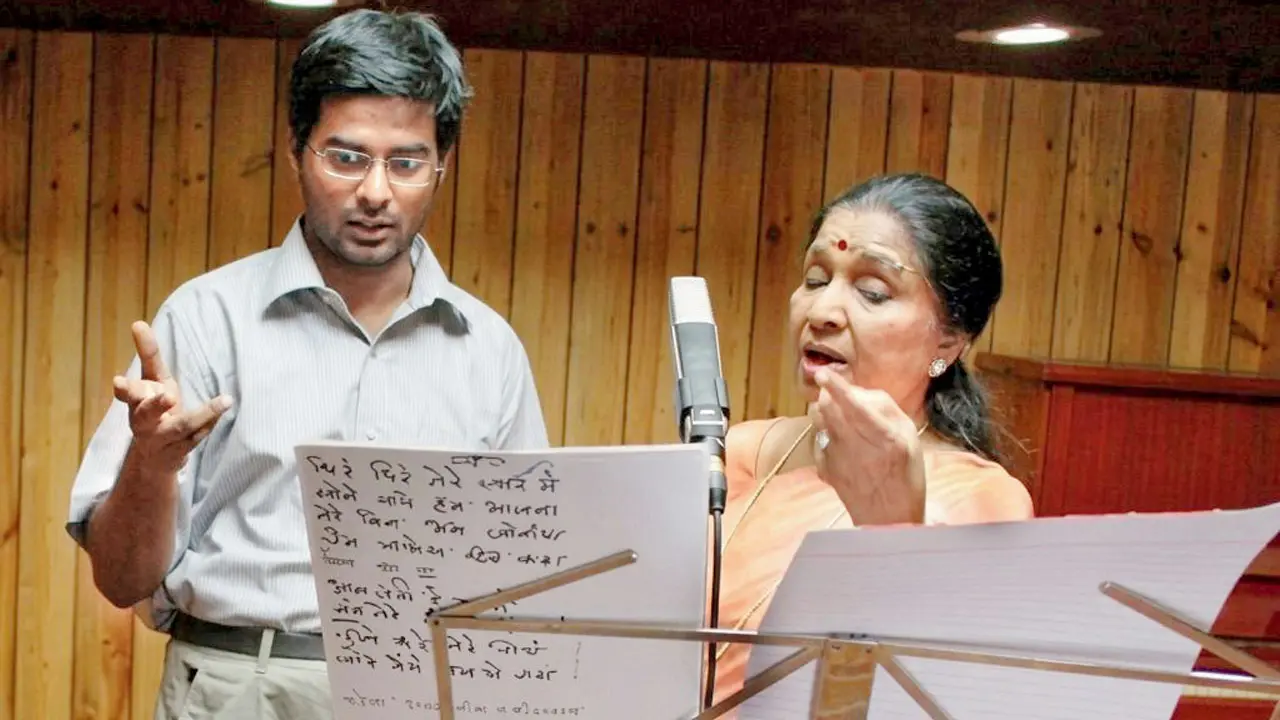
The writer with Asha Bhosle in 2006. Pics/By Special Arrangement
As the world mourns the loss of a legend, journalist and filmmaker S Ramachandran reminisces about the beloved artiste’s lesser-known facets
S Ramachandran (MID-DAY; April 13, 2026)
My first encounter was with Asha tai over three-and-a -half decades ago as a rookie journalist, when she was recording for a Marathi song at a suburban recording studio. When the film’s director realized that I was a journalist, he was perturbed because he thought that I would leak the music of the film, and Tai promptly put her arm around me and said, “To lahan mula aahe. Tu tyachyaavar sanshay kasa gheu shakto?”
And her arm continued to be around me when I directed several music videos with her. Starting with the Aap Ke Dil Mein song with Sanjay Dutt as part of the Asha & Friends album. She would often make fun of me and mimic me pulling up my trousers during the shoot, as I had lost weight by then. She was a terrific mimic, and she even imitated the legendary Sunil Dutt, who was like a brother to her, when she met Sanjay Dutt.
Sanju’s surprise
In fact, how we got Sanjay Dutt to sing for her is a funny story. When we called Sanju and told him that Asha ji would like to speak to him, Sanju thought it was actress Asha Parekh calling him to attend a Cine Artists Association meeting. When he realized it was Asha Bhosle wanting to sing with him, he almost fell off his chair. Later at the recording, she narrated how she had even sung with Sunil Dutt once and put Sanju at ease. She did the same with Urmila Matondkar as well, telling her to calm down and just sing.
A field of her own
That’s the reason why she took on breezy numbers with O P Nayyar, the rocking ones with R D Burman and went on to collaborate a lot with international artistes from Boy George for Bow Down Mister in 1991, Kronos Quartet for You’ve Stolen My Heart, Michael Stipe for The Way You Dream, Code Red for We Can Make It, and finally with Gorillaz for The Shadowy Light in 2026.
Damon Albarn of Gorillaz was a fan of her psychedelic work with Panchamda in the 1970s, and was amazed at her ability to reproduce the same magic at the age of 92.
Culinary prowess
Once we had a 6 am call time for a music video shoot of hers with Urmila Matondkar at Mukesh Mills, Colaba, and she was there at 5.30 am, all cheery and perked up, gobbling up the breakfast she carried from home, also bringing extra for all those working on the shoot. No wonder she had everyone, from Tom Cruise to Amitabh Bachchan, to British boxer Amir Khan, eating out of her hands, be it in the music domain or at her global restaurants. She cooked so well, like her sister, the late Lata Mangeshkar. I have had the fortune of being fed by them and listening to her fun comments on not being able to taste their best dishes, as I am a vegetarian.
Iconic duet
Interestingly, when we were set to sing and shoot a collaborative song with Brett Lee, the Aussie pacer was a bit apprehensive. “My wife is delivering a baby, and I don’t want to be linked to a lady.” Then we showed him Asha tai’s picture and body of work and explained that she was 72 and 43 years older than Brett, who was 29 then. So Brett came in and recorded, and later, when he came to the shoot, she told him, “If you get a son, call him Sachin!” not after Sachin Dev Burman, but her favourite cricketer and Brett’s bête noire, Sachin Tendulkar.
What sibling rivalry?
The legend once spoke to me about the so-called rivalry that the entire industry and fans felt existed between her and her legendary sister. “We sang 80 songs together. How can she be a competitor? She was already a star when I started. How can one have two Taj Mahals? So, I had to pick a niche for myself. In fact, Geeta Dutt was a competitor. I was just her younger sister,” she said.
A perfect symmetry
Incidentally, both sisters passed away at the age of 92 and died four years apart, as their age difference was four years. And both died on a Sunday at the Breach Candy hospital. It is as if fate itself aligned to a perfect symmetry, leaving fans in silence and to play their swansongs — that only their melodies can fill.

Asha Bhosle offers her blessings to then up and coming cricketer Mali Richards, the son of West Indies cricketing great Sir Viv Richards, at the CCI in 2005. PIC/Santosh Harhare, mid-day archives
Auditorium in Gaya to be named after Sanjay Dutt’s grandmother
10:22 AM

Abdul Qadir (THE TIMES OF INDIA; February 13, 2026)
Gaya: In a move that reconnects Gaya with a chapter of Indian cinema and classical music history, the auditorium-cum-academic building coming up at Daulat Bagh in Gaya — the address once associated with Jaddan Bai, grandmother of film actor Sanjay Dutt — is set to be named after her.
The old-style, sprawling house at the site originally belonged to Mir Abu Barkat Ali alias Zafar Nawab of the Kada estate, the then zamindar and a patron of art and music. The palace-like, two-storeyed airy structure had been earmarked by the Nawab for Jaddan Bai, who lived there for several years before settling in Calcutta (now Kolkata) and later moving to the then Bombay (now Mumbai) to pursue a career in films. Even after leaving Gaya, she is said to have frequently visited the residence.
Originally from Allahabad (now Prayagraj), Jaddan Bai was an acclaimed exponent of thumri and other forms of Indian classical music. She is also regarded as one of the pioneers of Indian cinema. In her early years, she found patronage under the Nawab. Her daughter, Nargis — the iconic actor of ‘Mother India’ fame — and her (Nargis’) husband, actor and former Union minister Sunil Dutt, maintained their Gaya connection during the lifetime of Zafar Nawab’s son, Muzaffar Nawab.
Sanjay Dutt, during a political visit to Gaya a few years ago in connection with a Samajwadi Party meeting, had turned nostalgic and described Gaya as his ‘nanihal’ (maternal home).
According to Nawab Iqbal Sayeed Quadri alias Humayun and Nawab Fareed Quadri, surviving members of Zafar Nawab’s extended family, the Daulat Bagh premises were acquired by the govt in the 1950s.
Several years after the acquisition, the state govt constructed the District Institute of Education and Training (DIET) with an annual intake of 200 within the Daulat Bagh complex, leaving aside the building associated with the thumri exponent.
A resident of the Daulat Bagh neighbourhood expressed regret that the structure was not preserved as a heritage building, considering its architectural and historical significance.
Justifying the demolition, principal of the District Institute of Education and Training, Ajay Kumar, said the building had become thoroughly dilapidated and could have collapsed at any moment, posing danger to life and limb in the vicinity. “Reports of past casualties due to collapse of some part of the building are also there,” he said.
The DIET principal said an auditorium and academic building would be constructed at the site. There is a proposal to name the new structure after Jaddan Bai, the iconic exponent of Indian classical music.
Mogambo’s tailor, netas’ favourite: Meet the dressmaker of icons
3:13 PM

Madhav Agasti has stitched clothes for Amrish Puri, Bal Thackeray, Pranab Mukherjee, Narasimha Rao, L K Advani…. He’s been a friend of Sanjeev Kumar, Dev Anand, Mehmood. Farooq Abdullah discovered his tailoring skills in 1984 and never left him. After 50 years, Agasti is still going strong and is full of stories of the people he met and dressed
Sharmila Ganesan (THE TIMES OF INDIA; August 31, 2025)
Madhav Agasti’s mobile rings as we step into his tailoring shop in Bandra. “Farooq Abdullah,” Agasti tells his son, Shantanu, before answering. The first time he had met Abdullah, then the chief minister of Jammu & Kashmir, was in 1984. Agasti was at the Delhi airport, and so were Abdullah and Congress’s NKP Salve. Salve was in a bandhgala and Abdullah had admired the cut. And that is how the serendipitous meeting took place. Spotting Agasti, Salve introduced him to Abdullah. Then things moved fast. Agasti requested Abdullah to accompany him to the VIP lounge. Out came Agasti’s measuring tape — he always carries one — and the measurements were done. What followed a few days later was an impeccable sherwani. Abdullah was impressed. He ordered a suit next, then a pathani, followed by a safari suit. “He remains my client to this day,” says Agasti.
Agasti’s 76 now. And had invited Abdullah to his Andheri home for Ganeshotsav. But Abdullah called because he thought he would not be able to make it. But he’s promised to be back soon for new measurements.
Nagpur To Bombay, Via Calcutta
Agasti’s father was a bhikshuk in Nagpur, a wandering monk who stitched coats for a lawyer named Shewde. Agasti’s ambitions were likely sparked by his father’s skills. He left Nagpur for Calcutta, a young man in his early 20s. He found himself a job as a “cutter” in the city. Then he travelled to Moradabad to learn how to stitch sherwanis and then to Mhow, a cantonment town in MP, to study how to make military uniforms. He travelled back to Calcutta, and, this time, landed a job at a tailoring counter because he could speak English.
In 1973, he moved to Bombay. “I was smoking outside Citylight Cinema in Mahim when I noticed a man with scissor marks on his hand, the hallmark of an assistant tailor. He worked at Super Tailors, dressmakers to Hindi film actors,” recalls Agasti. Soon enough, Agasti landed himself a job there.
A door had opened for him. But what worked wonders was his learning from Mhow; 14 years later, that would catapult him to even higher tailoring fame. He stitched the military uniforms for the 1973 film, ‘Dhund’. And Danny Dengzongpa, who played the role of a cruel, wheelchair bound husband of Zeenat Aman in the film, loved the tailoring.
Agasti had been noticed. His star was on the rise. Plus, his Nagpur-honed Hindi was good, and so was his Marathi. He quickly began to acquire admirers.
Actor Sunil Dutt was the first to suggest that he strike out on his own. “There were no Maharashtrians in tailoring then,” Agasti says. He set up a small shop in Dadar in 1975. Word spread fast. Soon, ministers Vilasrao Deshmukh (“he loved safari suits”), Gopinath Munde, Pramod Mahajan (“he wore kurtas without pockets”), Sharad Pawar and Lal Krishna Advani (“three-button jackets”) were clients.
Through lawyer Shirish Gupte and theatre veteran Mohan Wagh, he met Bal Thackeray in 1981. “Balasaheb asked me to design clothes in such a manner that his legs wouldn’t show in photographs,” says Agasti. He crafted a white kurta-pyjama that became the late Shiv Sena chief’s signature look. “I got him a shawl from Kashmir. He mostly preferred white and off-white,” adds Agasti, himself in off-white shirt and pants today “because this way, I don’t have to worry about combinations”. Thackeray nicknamed him “Rajshimpi” (politicians’ tailor).
Mogambo… Khush Hua
But you could also call Agasti a film stars’ tailor. Last month, he received the Bharat Gaurav Award at the UK Parliament in London for designing Amrish ‘Mogambo’ Puri’s unforgettable costume in the 1987 blockbuster, Mr India, and also Bal Thackeray’s signature kurta-shawl look.
He is now preparing for the release of his memoir, ‘Stitching Stardom’. The book traces his journey of image-making across comedians and chief ministers, prime ministers and presidents. Much has changed in tailoring — technology, speed, the churn of fast fashion — and much hasn’t. “Earlier it was about who you knew,” says Agasti. “Now it’s word of mouth.”
As tea is served for unannounced guests — BJP’s Raghunath Kulkarni and former national secretary Sunil Deodhar have arrived in the shop — the septuagenarian darzee holds forth on his craft, his clients, and his takeaways from 50 years of dressing up the who’s who.
“Contrary to perception,” he says, “politicians are the easiest clients and the best paymasters.” Many believed his “lucky hand” made their measurements special. As he reminisces about designing costumes for five villains in Anil Kapoor’s ‘Ram Lakhan’, his eyes settle on the crisp shirt Kulkarni is wearing. “The linen suits you,” Agasti says. “It’s linen?” asks Kulkarni. “Yes, and the American cut sits well,” replies Agasti, seated in the shop he opened in Bandra in Nov 1985, its launch postponed by 15 days to mourn the death of his friend Sanjeev Kumar.
Dev Anand would sneak in through the back door, head bobbing, calling out: “ Ey Madhav, kya banaya hai mere liye?” while Sunil Dutt preferred the front, greeting him warmly as “Madhav Seth”. He even kept a special stool for Mehmood, who would arrive most evenings, leaving the tailors in stitches with his antics.
But the costume that cemented his name in Bollywood lore was Mogambo’s in Mr India. The now-iconic piece with its high-collared military cut and gold trimmings was meant to project both colonial grandeur and zamindar-like menace. Puri, who exclaimed “Mogambo… khush hua” on seeing it (here, in the Bandra shop), wore it with relish. “I worked with him from his first film till his last. After he passed away in 2005, I slowly stepped away from films,” says Agasti, who found the era of menacing villains fading from the silver screen. Soon, it was in politics, rather than films, that his reputation as a tailor of image flourished.
A Politicians’ Tailor
From the dhoti-kurta and Jodhpurs era to the rise of the suit-boot and back, Agasti has seen political sartorialism in India come full circle. Various chief ministers, prime ministers and presidents — including Pranab Mukherjee — have taken oath in his creations. The busy Narasimha Rao would often be exercising on his stationary bike at 6 am when Agasti would get an appointment with the silk-jacket-favouring polymath.
Someday soon, he hopes to tailor PM Narendra Modi’s clothes. “I’m a big fan of Narendra Modi ji,” he says. “He dresses sharply, always to suit the occasion.”
Today, as he marks half a century in the trade, the shop is lined with mementoes. Pride of place goes to a cap gifted by former Army Chief Manoj Mukund Naravane upon retirement. “Clothes make the person,” says Kulkarni. “By that measure, he (Agasti) is a personality builder.”
Deodhar sizes him up as a “self-made man with networking skills and a sharp memory,” adding one enduring quality: “He calls himself a tailor with pride at a time when many look down on the profession. And… he always has a measuring tape handy.”
55 Years of Padosan: I used to laugh uncontrollably so much that the unit would turn off all the lights-Saira Banu
2:25 PM

Saira Banu took to social media to share some fond memories of the shoot of her film Padosan (1968), which clocked in 55 years on November 29. The film featured her with Sunil Dutt, Mehmood and Kishore Kumar. She wrote, “We are talking about one of the most favourite films of my career, mine, and the public in general. It is Padosan, a film for all occasions and ages. I am glad that I did this because I had refused any work soon after my marriage. It was understood that I would not be carrying on with a professional career.”
She continued, “It was then that Mehmood Bhai as he had earlier approached me for this film came running to Sahib, hugged him close, and kept saying in a rhetorical tone, ‘Yousuf Bhai you have to let Saira do this film for me. I will not let go of you until you say yes please, please.’ Sahab was tickled to the bone and kept repeating laughingly, ‘Mehmood, it is entirely up to Saira, You have to convince her. You have my absolute permission’.”
The veteran actress added, “The cast was so perfectly chosen that even I was initially surprised to see Dutt Saab as a simpleton ‘Gaonwalla’, I mean who could have imagined it? Dutt Saab would humorously say, ‘Saira ji, yeh kyaa hain, yeh hum kyaa kar rahein hain? Hamein toh Anthony and Cleopatra mein kaam karna chahiye, something romantic and glamorous’ (sic).”
‘IT WAS DIFFICULT FOR ME TO STOP LAUGHING ON THE SETS OF PADOSAN’
Directed by Jyoti Swaroop, the musical comedy was a remake of the Bengali film Pasher Bari. Saira Banu concluded her note by saying, “Until Padosan, I hadn’t worked with Dutt Saab, who turned out to be lively and funny. On the contrary, Kishore ji was a very subdued gentlemanly star who would get up from his seat respectfully as soon as any lady walked in. The shooting was a killer. I used to laugh uncontrollably so much that the unit would turn off all the lights and say ‘Ruk jao, abhi madam hass rahin hain’. It was that difficult for me to stop (sic).”
------------------------------------------
ETIMES (November 30, 2023)
Saira Banu reminisces the magic behind 'Padosan' - where Mehmood Bhai's dedication, Sunil Dutt's rib-tickling humor, and Kishore ji's spontaneous creativity turned every scene into a timeless laughter symphony. From the quirky head-shaving ceremony to the stroll in 'Brindavan Gardens,' the film's behind-the-scenes tales are as delightful as its iconic melodies.
In her continued post she wrote, "Continuing with the PADOSAN series, I want to talk about Mehmood Bhai's dedication to his roles. At the "Vrindavan Gardens" Palace, Mehmood Bhai joined our unit to start shooting scenes with me. Soon after his arrival, he sat in the palace verandah with his barber and then we witnessed the funny ceremony of him shaving off his head, giving off his beautiful hair to portray the bald dance teacher Master Pillai with romantic intentions towards 'Bindu'. As the barber shaved, "Tup Tup", tears rolled down his cheeks. We were both sad and amazed, momentarily forgetting our laughter.
The funniest scenes were where Master Pillai alias Mehmood was constantly trying to win over the affection of Bindu. In one scene I am trying to make Bhola jealous when he is standing in the window opposite. In this, I had to hold hands with Mehmood Bhai and rest my head on his big shoulders! It was a scream for both of us because all our lives he had been like a lofty big brother and now doing this scene to enrage Bhola, Sunil Dutt was rib-ticklingly funny. Another favourite scene is where I am strolling in “Brindavan Gardens” with Master Pillai amidst the beautiful greenery and fountains all around, Dutt Saab, Kishore ji and other comedians are walking right behind us eavesdropping trying to hear what we two are talking about (hidden with mobile branches of leaves and trees).
We had an able director Jyoti Swaroop who tried to control us in our fun and frolics while shooting but the major contribution to the making of scenes was inspired on the spot by Kishoreji, Mehmood, and Dutt Saab. For instance, the song “Meri Pyaari Bindu” was choreographed from start to finish by Kishore ji.
"PADOSAN" gifted the world of cinema with timeless melodies and the music of the film was directed by none other than R.D Burman Saab, among them was "Bhai Battur," a melody delivered by the Nightingale of the Indian Music Industry, Lata ji. In one of her interviews, Lata ji expressed that singing "Bhai Bhattur" was a remarkable experience for her, given the song's unique and distinct nature compared to other tunes of the 60s. Similarly, I found shooting for this particular song to be an extraordinary experience".
Spotlight dims on Dadar’s iconic India Photo Studio
8:35 AM

Mohammed Wajihuddin (THE TIMES OF INDIA; August 28, 2022)
Once when Sunil Dutt heard of his wife Nargis’ photos on the show windows of India Photo Studio, he came looking for them. “He was so impressed, he ordered many copies,” recalls owner Vimal Thakker, seated on a sofa where once stars like Raj Kapoor, Dilip Kumar, Nargis, Nutan, Waheeda Rahman, sat for hours chatting with Vimal’s father Jethalal Thakker over cups of chai.
The iconic studio is turning 75, but the spotlight is dimming for this landmark in Dadar as it is buffeted not only by the winds of change, but is also caught in a redevelopment wrangle.
-----------------------------------------
Mohammed Wajihuddin (THE TIMES OF INDIA; August 28, 2022)
Sepia-toned photographs peeping out from glass cases or fading frames on the walls testify that showbiz legends were once regulars at ground floor India Photo Studio at a decaying building near Chitra Cinema in Dadar (East). The cinema downed its shutters a couple of years ago. The studio too may not postpone its death for too long.
As this piece of the city’s cinematic and cultural history struggles to stay afloat, let us first see how it was born.
When Jethalal Thakker, a school dropout and partition refugee, reached Mumbai (then Bombay) in 1948 from Karachi, he did many odd jobs to survive before photography became his passion and profession too. “He would go to film sets to shoot the pictures. Then he thought of setting up his own studio and this place suited him because there were several film studios in the vicinity,” says his son Vimal, 69.
With studios like Roop Tara, Ranjit, Shree Sound, Kardar and Rajkamal not very far from this photo studio, it meant the actors kept visiting it regularly. “There were mainly two purposes of the stars getting photographed here. First, the stills had to be prepared for publicity and then, to remember the continuity between film frames, they needed to shoot photographs,” explains Vimal.
Senior photographer Pradeep Chandra credits this studio and its founder Jethalal for capturing some of the most memorable photographs of leading stars of the golden era. “He (Jethalal) was the only photographer of his generation who photographed even Madhuri Dixit at his studio,” says Chandra.
It so happened, recalls Vimal, that in 1995 a film magazine wanted to shoot Dixit, then at the peak of her career, and her secretary initially wanted it to be done on one of the film sets. “Film journalist Ali Peter John had approached us. My father and I said we would shoot at the studio. Madhuri had no problem and she came. We didn’t close the door so as not to give the impression that any celebrity was inside. At the reception, our man kept telling the customers that ‘andar kaam chalu hai’ till the time she was inside,” says Vimal.
In 2003, Jethalal died and Vimal inherited the rented studio. “While other smaller and newer studios charge Rs 60 or 70 for a few PPs, Vimal charges Rs 200 as he doesn’t compromise on quality,” says Vimal’s friend Prakash Nair.
A decade ago, a builder took consent of some tenants for the building’s redevelopment. “He is not agreeing to compensation at market rate and offering me space on the ground and first floors which doesn’t suit me,” complains Vimal.
“This property is certified under 33 (7) of MHADA and 80% of the tenants have consented. We are offering compensation as per redevelopment rules,” responds builder Ashok Doshi.
While the battle rages in MHADA, photographs at the iconic studio tell of its acche din.
It is sad that only negative aspects of the film industry get highlighted-Shakti Kapoor
8:21 AM

Juhi Chakraborty (HINDUSTAN TIMES; October 7, 2021)
As someone who has spent almost five decades in Bollywood, actor Shakti Kapoor admits the negative narrative about the Hindi film industry hurts him. He, in fact, states that he has only seen people here stand by and help one another.
“I have seen this industry for many years and I can say this is the finest film industry. There are people always standing up for you. Yeh cheez bahar nahin aati, bas negative cheezein bahar aati hain. It is sad that only negative aspects of the film industry get highlighted,” he laments.
Citing the example of his own journey, the 70-year-old adds that despite being a nobody from Delhi, he could make a mark only because people were open to new actors. “I didn’t have any dada, chacha, mama in Bollywood to help me. Early in my career, I found Feroz Khan (actor) and became his favourite. Then, Sunil Dutt (actor) gave me work, trusting my capabilities. He also gave me the name Shakti; my birth name is Sunil,” Kapoor reveals.
Now, he is happy to see his children — actors Shraddha Kapoor and Siddhanth Kapoor — earning accolades on their own merit. “Shraddha is a big star, Siddhanth is on his way to making it big. I’m proud of my children. People praise my daughter and I feel so happy. She has been working in these Covid-19 times. Even Siddhanth is so busy. I feel blessed,” he concludes.
Amitabh Bachchan ji, Dharmendra ji have paid tribute to dad, says Kanhaiyalal’s daughter Hemaa Singh
7:58 AM

Kanhaiyalal played a shrewd money-lender in Nargis’s Mother India
Kanhaiyalal’s daughter makes a documentary on the iconic baddie, best known for his Mother India role; hopes to highlight his contribution to Hindi cinema
Upala KBR (MID-DAY; April 7, 2021)

“The reason behind making the documentary is to highlight the [role] of veteran actors during that era, be it Motilal ji, Ishwarlal ji or my father. The [feature] will showcase all that is not known to the public — right from his childhood days in Varanasi, his migration to Mumbai, his struggles, personal life and work,” says Singh, who is hoping to release the yet-untitled project in the coming months.
In his three-decade career, Kanhaiyalal served as the perfect antithesis to the well-meaning heroes, sharing screen space with Dilip Kumar in Gunga Jumna (1961), Rajesh Khanna in Apna Desh (1972) and Dharmendra in Dost (1974). Singh is touched that many celebrities have supported her endeavour. “Amitabh Bachchan ji, Dharmendra ji, Asha Parekh ji, Jackie Shroff ji and Govinda ji have paid their shraddhanjali [tribute] to my father in the documentary. When I approached them, they enthusiastically agreed to do it. Johny Lever went out of his way and reached out to other [stars] on my behalf. Sunil Dutt ji and Dilip Kumar ji were close to my bauji; unfortunately, Dutt ji is no longer with us.”
While he paved the way for Bollywood villains, Singh says her father was a real-life hero. “He offered financial aid to so many people, never turning anyone away,” she recounts, lamenting that he didn’t get his due. “He never got the Dadasaheb Phalke award for his remarkable contribution. He was an effortless actor who never rehearsed his dialogues.”
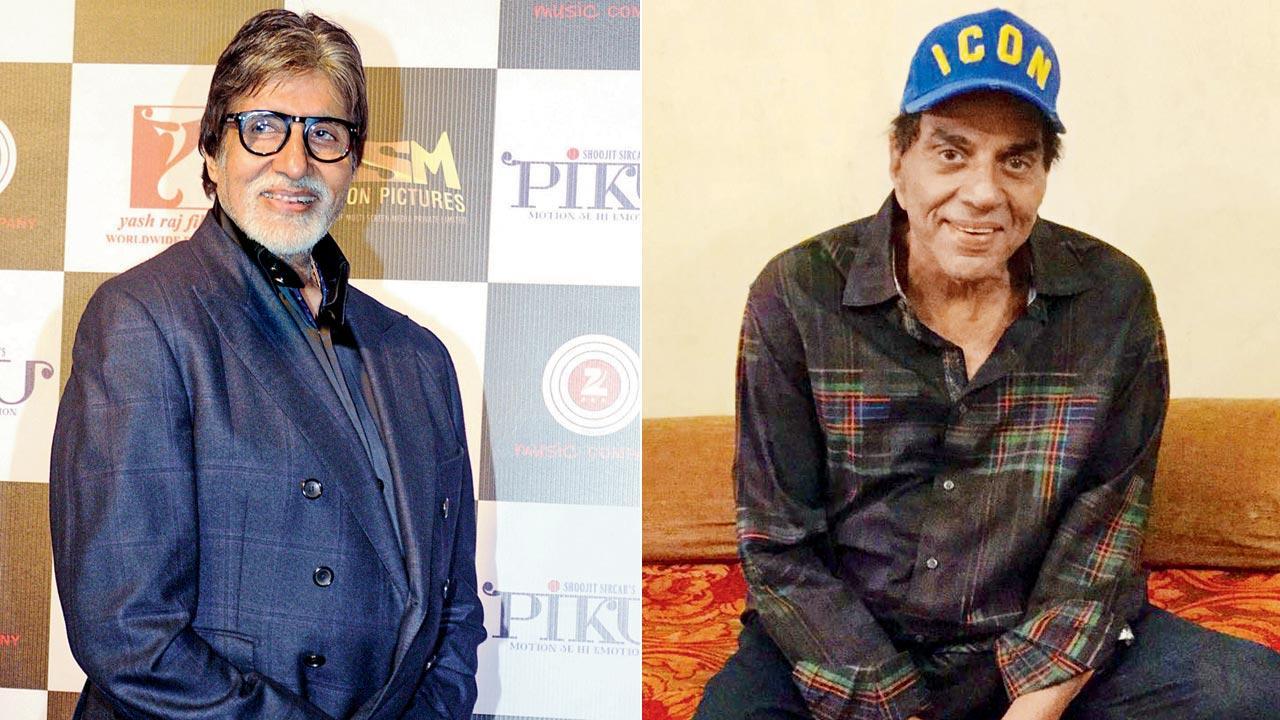
Raaj Kumar, Shammi Kapoor, Saira Banu’s personal letters to fan go viral; NFAI shows interest to acquire them
8:24 AM

Rishabh Deb (CHENNAI TIMES; March 3, 2021)
A Twitter thread by user SamSays on February 25 got everyone nostalgic about older days of Bollywood.
The precious thread gave a glimpse of how Sam’s aunt, an avid film buff — Mehrunnisa Najma, who passed away in 2006, received responses to her letters from some of the popular Bollywood stars including Shammi Kapoor, Dharmendra, Sunil Dutt, Saira Banu, Tabassum and many more.
These letters that were locked in the basement for more than 15 years, wearing dust, will now breathe a new lease of life as the National Film Archive of India (NFAI) will acquire and preserve this collection for Bollywood buffs.

PRESERVATION OF A PERSONAL HISTORY
Soon after the tweets went viral, NFAI reached out to Sam seeking approval to acquire and preserve this unique collection.
Prakash Magdum, director, National Film Archive of India, told us, “We are always looking for filmy materials that are of archival value. What we saw on Twitter is a fantastic collection because this also constitutes part of cinema history. It is so interesting that a lady was writing to these stars and they were replying to her. It that the stars in those years, had a personal connect with their fans. And these were times when there was no social media. Our aim is to acquire rights, preserving them and making them accessible to cinema lovers and history buffs.”

‘I THINK WE NEED TO PAY MORE ATTENTION TO MEMORABILIA LEFT BEHIND’
Speaking with us, Sam Javed, who shared her aunt’s tweets says, “Everyone knew of my aunt’s collection, but somehow no one ever gave it much attention or importance. She used to show it to us when we were kids, and over the years, it was forgotten. It was rediscovered recently during a clean-up and I decided to share it on Twitter. I had absolutely no idea that it will get such an overwhelming response. I think we need to pay more attention to memorabilia left behind to us and do our best to treasure it in the same way, that the person who left it behind did in his/her lifetime.”

‘HAPPY TO SEE THE LETTERS BEING RESTORED AND PRESERVED’
Happy to have received such an overwhelming response to the tweets, Sam is now looking forward to have these letters restored and preserved by NFAI.
“NFAI was one of the first to do so, and it gives me immense happiness to see the collection get such recognition. My priority is to restore and preserve the images so that they can be enjoyed by generations to come. My Twitter thread has got me responses from cinema lovers around the world. I feel blessed that I’m able to share my aunt’s legacy with the world. These pictures and letters take us back to a completely different era. They give us a glimpse of a gentler world. The kindness of superstars for sparing the time to write a handwritten note to a young woman is something very hard to imagine today. The message to today’s generation is to slow down, value the simple pleasures in life and spread love and happiness.”
WHO WAS MEHRUNNISA NAJMA?
Najma was born in the 1930s. Her father was from Punjab and her mother was from Burma (Myanmar). She had two sisters and a brother. The father died in infancy. She and her entire family lived with their uncle. Her aunt was the wife of the then Nawab of Tonk Saadat Ali Khan. Najma was brought up by her Burmese mother in the palace of the Nawab of Tonk.
My aunt passed away many years ago. Among her belongings was an old album that she was very fond of. The album remained lost for many years, buried somewhere in a storeroom in the basement. It was found again recently during a clean-up. 1/n
— SamSays (@samjawed65) February 24, 2021
When boundaries between actors and politicians hadn’t blurred
8:46 AM

Ambarish Mishra (THE TIMES OF INDIA; September 20, 2020)
Mumbai: The Sushant Singh Rajput case has triggered a high-decibel debate on, among other issues, the tumultuous ties between politics and cinema.
In contrast, old-timers recall the days in the soft afterglow of the freedom struggle when actors and politicians coexisted harmoniously while maintaining a dignified distance from one another Politicians didn’t go beyond the ceremonious presence at special screenings of films once in a while. Back in 1936, Pandit Jawaharlal Nehru attended a special screening of ‘Achhut Kanya’, a Bombay Talkies classic starring Devika Rani and Ashok Kumar, at Roxy, the iconic cinema hall.
For Nehru, though, Hindi cinema remained a distant land. During one of his visits to Mumbai, he agreed to meet a delegation of film producers and actors. Everyone present on the Raj Bhavan lawns were in for a shock when he declared with a wave of hand, “Come on, introduce yourselves.” The select gathering included several top-heavy stars of the time. Thespian Motilal, it is said, was too embarassed to utter his name, which he shared with the Prime Minister’s father, Motilal Nehru.
In 1962, the film industry leaders tried again for a brief meeting with Nehru in New Delhi, this time with an agenda: Concession on the raw stock tax. He refused to meet the delegates, even after Satyajit Ray put in a word. Instead, Nehru told them to hold talks with Morarji Desai, who then held the finance portfolio in the Union cabinet.
Vallabhbhai Patel would often send a word, through his emissary filmmaker Chandulal Shah, to cinema czars to help the Congress party raise funds for a national cause. “And money began to pour in like the Mumbai rains,” said cinema scholar Virchand Dharamsey. “But politicians, of whichever hue, never relied on glamour to win an election,” he added.
Lal Bahadur Shastri, it is said, was moved to tears when he saw ‘Shaheed’, actor-producer Manoj Kumar’s bio-pic on Bhagat Singh. Kumar once told an interviewer, “He asked me if I could translate on celluloid his famous ‘Jai Jawan, Jai Kisan’ slogan, which had then taken the nation by storm amidst the 1965 India-Pakistan war.”
Atal Behari Vajpayee was a film connoisseur too. A Mumbai BJP MLA recalled how Vajpayee expressed his wish to see ‘Suraj Kaa Saatwaan Ghoda’, a 1992 Shyam Benegal film based on Dharmavir Bharati’s epic novel of the same name. “But he kept away from film people.”
Congress politicians from Maharashtra, said observers, generally shunned cinema, choosing rustic forms of entertainment: Tamasha, wrestling and elections to sugar cooperative mills. Balasaheb Thackeray, though, had a soft spot for filmdom and many stars would turn up at Shanmukhananda auditorium for Shiv Sena’s anniversary function every year. Sharad Pawar has “excellent equations” with Lata Mangeshkar and Dilip Kumar, though the Baramati strongman prefers the company of litterateurs.
The neta-abhineta (politician-actor) demarcation was by and large intact till the 1970s, said trade veterans. The first breach came when Rajiv Gandhi roped in Amitabh Bachchan, Sunil Dutt and Vyjayantimala for the 1984 Lok Sabha elections.
Experts said the post-globalisation era saw the advent of a new middle-class that disliked politics mired in casteism and corruption. Alarmed over their dipping popularity, politicians turned to film folk to consolidate their vote bank. Cinema researcher Rafique Baghdadi said, “Filmstars and football players are hugely adored.”
Many more made a beeline to politics and the list reads like credit titles of a multi-starrer: Dharmendra, Vinod Khanna, Rajesh Khanna, Govinda, Hema Malini, Jaya Bachchan, Jayaprada, Rekha and Urmila Matondkar, to name a few.
Writer Rachana Shah, a niece of Lata Mangeshkar, has a word of advice: “Both politicians and film people should develop a brand of their own. No point in living off each other.”
Said Hindi cinema aficionado Deepali Mainkar, “Hema Malini and Jaya Bachchan often make a good point while speaking in the Parliament.” Without the luxury of retakes.
Sunil Dutt saab confided that he was a nervous wreck-Boman Irani
7:50 AM

As told to Ankita Chaurasia (MUMBAI MIRROR; February 25, 2020)
It was during the editing of the short film, Let’s Talk, shot on a handycam, that Vidhu Vinod Chopra, who was cutting his Mission Kashmir at the same studio, noticed me. He called me for a meeting and said that he wanted to work with me in his next. I asked him which film it would be for and he said he didn’t have any at the moment, but whenever he made one, I’d be in it. Eight months later, I got a call. He wanted me to play the antagonist, J C Asthana, the dean of a medical college, in a film titled Munnanhai MBBS, to be directed by his editor Raju (Rajkumar Hirani). The name was weird, but after a narration, I was convinced.
My first day on the set was the first day of the film’s shoot as well, which meant it was Raju’s first day as a director. My first shot was with Dutt saab (Sunil Dutt), who was facing the camera after 16 years. So, in a way, it was his first day too. You can imagine the nervous energy on the set.
As soon as I walked into the set, Dutt saab ushered me into his vanity van for rehearsals and started calling for tea. I offered to get it for him, but he insisted on doing it himself, confiding that he was a nervous wreck. Here I was sweating because my first shot was opposite the legend I’d grown up idolising. And he tells me he is nervous!
Going by my get-up, he thought I was older than him and started addressing me as ‘Doctor saab’. When Sanju (Sanjay Dutt) dropped by, he saw me hanging out with his father and I became his ‘uncle’. I wanted to tell him that, at 44, I was four months younger to him but I was just so happy being around such established actors in my first film.
In my first shot, I bump into Dutt saab’s character, Hari Prasad Sharma, while buying nariyal pani after attending a laughter club at the park. Happy at this chance meeting with an old friend, Dr Asthana is dumbfounded on learning that Sharma’s son, who he had dismissed as a good-for-nothing boy was now a doctor and ran a hospital. Simultaneously, he is irritated because the nariyal pani wala (Rohitashv Gour), planted there by Munna, keeps interrupting them. He shouts at him, then, laughs out loud. I fumbled and forgot my lines the first time. Even Dutt saab wanted another take because he thought he could do better than the first.
The script had the words ‘laughs’ pencilled next to my dialogue. Dutt saab assumed it would be a short laugh. The surprise on his face when I broke into a full-throated guffaw was real. Raju told me we’d shoot one take with the laugh and one without it. After a while, we figured the laugh added to Dr Asthana’s quirks and finally stopped shooting a scene twice.
At the film’s premiere, when I walked up to Dutt saab, he greeted me with a cursory smile and hurt, I wondered where had all the warmth disappeared. When I told him I was ‘Doctor saab’, he looked lost, asking me which hospital I worked for. It was then that I realised he didn’t recognise me because I was sporting a full head of hair and he had only seen me with my bald pate. We had a good laugh over it.
My inheritance is not a burden, it’s a gift-Sanjay Dutt
8:01 AM

After 38 years in Bollywood and five films in the pipeline, actor Sanjay Dutt is only getting hungry for more meaty roles
Shreya Mukherjee (HINDUSTAN TIMES; November 19, 2019)
Every performer adopts a certain methodology while choosing a project. For an actor, it is sometimes the role, sometimes the script, or sometimes the team, which draws him towards the film. For Sanjay Dutt, it’s the balance of all these elements.
“Character and story go hand-in-hand. If the character is amazing but the story isn’t, then it’s a futile endeavour and vice versa. For me, both of them are equally important. However, if I strongly feel for a character, I might do it, irrespective of the length of the role in that film. As actors, our hunger for playing challenging role increases with every character that we portray on screen,” says Sanjay.
Having spent 38 years in the industry, Dutt is still going strong with five upcoming releases — KGF 2, Panipat, Sadak 2, Shamshera and Torbaaz. And the actor says that the length of a role has never really bothered him. “It really doesn’t matter, but the gravity of the role does. I’ve done double-hero films at the peak of my career, so I don’t have any insecurity. I get attracted to strong characters backed by powerful stories,” adds Dutt.
Well, that explains why the 60-year-old actor is still offered meaty roles and filmmakers are keen on collaborating with him. Dutt’s talent and amiable nature, many contemporaries feel, is a legacy that he carries forward well from his parents — two legendary actors, late Sunil Dutt and late Nargis Dutt. So, does he still feel the burden of expectations every time his film hits the theatres? “Though expectations have ridden high on me because of my family, I’m grateful for it. I don’t see my inheritance as a burden, but as a gift. I cherish this gift by giving my best in all the films I do,” says Dutt, humbly.
The actor has had a chequered life and feels grateful for the constant support received from his fans. Expressing gratitude, he says, “I feel blessed when audiences start expecting so much more from their favourite actors. It makes us push our envelope and raise the bar. It throws you out of your comfort zone and helps you deliver something new, every time.”
Did Mahatma Gandhi have anything to do with music?
8:02 AM

On his 150th birth anniversary, authors of two new books on the Mahatma discuss how cinema and music of the time, drew inspiration from him
Jane Borges (MID-DAY; September 29, 2019)
 As historian, Lakshmi Subramanian has always been curious about the peculiar—researching odd-ball stories, where previously unrelated facts come together to create a whole. Her new book, Singing Gandhi's India: Music and Sonic Nationalism (Roli Books), is an exercise in that direction. Yet, when she was first approached to write a book on Mahatma Gandhi and music, Subramanian recalls her response as being a "resounding no". "My initial reluctance was partly informed by a sense that Gandhi would have had very little and substantive to say about music per se; and about the complex public history that music threw up in the 20th century. Equally, I was convinced that Gandhi would have unproblematically endorsed the bhajan as it had emerged as a form of marking an exclusive Hindu identity," she shares, in an email interview.
 London-based journalist Sanjay Suri (right)'s tryst with the Mahatma in his new book, A Gandhian Affair: India's Curious Portrayal of Love in Cinema (HarperCollins India), was more organic. "I did not set out to research Gandhi," he admits. The book, he says, grew out of watching hundreds of Hindi films over many years. "Gandhi just kept popping out of them."
Where biographies and academic texts have been forever been engaged with examining Gandhi, the leader, and his role in pre-independent India, close on the heels of his 150th birth anniversary, Subramanian and Suri have explored how he culturally influenced the nation.
A Song For The Community
It was only after Sumbramanian, a professor at the Humanities and Social Sciences faculty of BITS Pilani in Goa, decided to engage with Gandhi's relationship with music that she realised "that not only had he a lot to say about sound and its use in politics, he was curious and inquisitive and inconsistent making his writings a treasure trove for a student of history".
In the book, she writes of how Gandhi was moved, when he first heard 'Vande Mataram' [written by Bankim Chandra Chatterjee] in 1915 in Madras. "You have sung that beautiful national song, on hearing which all of us sprang to our feet. The poet has lavished all the adjectives we could possibly do to describe Mother India," he told the assembly.
Gandhi, she says, saw music as one of the many tools to infuse a feeling of community. "I think Christian singing made a deep impact on Gandhi and the idea of a congregation had definite appeal. This was evident in his experiences in England, and while in South Africa, congregational singing became a form of political communication. The idea was to feel a oneness that went beyond narrow self-interest and work around a moral basis for political action. Prayer, music and spinning were all tools of individual self-regeneration and community building," says Subramanian, who read his collected works in great detail to contextualise her research. Her work also helped quell any misgivings about Gandhi propagating religious music. "At no point did he equate the Hindu religion with music of a particular kind; nor did he espouse the cause of devotional singing in public as an essential feature of the Hindu religion."
Subramanian, however, admits that Gandhi, unlike his contemporary Rabindranath Tagore whose contribution to music nationalism was immense, was not a "rasika". "He did not appreciate the technicalities or even profoundness of the classical traditions in India, but as an inquisitive person responding to debates and public discussions was not unaware of the emerging discourse on music reform and revival. He responded to the emotional dimensions of music and certainly insisted on a trained teacher for his ashram experiments," she says, adding, "He listened to music with great attention and was convinced that it had the power to move millions and to still them into contemplation."

The hero (Dev Anand) of Kala Pani (1958) finally declares satyagraha as his way of securing justice
A Moral Code For Cinema
Suri, on the other hand, discusses how Gandhi's values and virtues were so deeply enmeshed in the Indian psyche that the heroes of Hindi cinema—at least till late into the 1970s—sub-consciously replicated his virtuosity. They did it in two ways, he says. "One, and always, at pivotal points through the scripted story path of the hero. These are the decisive moments when choices have to be made. Those turn out always to be moral choices of a kind—rejection of wealth and a turning away from sex. It's these moral values that turn the plot, and which then give this phase of cinema that feeling of sameness. The hero is always confronted with those temptations, and it is the rejection of both that establishes him as heroic. Those are the very two temptations that Gandhi, the man most sought to overcome," says Suri, who has previously authored, 1984: The Anti-Sikh Violence and After.
He adds, "Secondly, countless invocations to Gandhi himself surface—images of Gandhi show up in one scene or another particularly when the moment of truth comes. These images didn't just happen, in this carefully crafted business of set by set, scene by scene."
According to Suri, Gandhi was far too complex a figure and his experiments in life were both controversial and fascinating. But cinema didn't grapple with any of that. "The Gandhi brought into this cinema is a man identified by a few broad strokes: the one who turned away in his personal life from wealth and sex, the vegetarian who believed in non-violence and who found strength enough through that bare simplicity to take on the greatest power on earth and to dislodge it."
The Hindi film, he feels, that first broke out from this Gandhian narrative was B R Chopra's Ek Hi Raasta (1956). "The hero [Sunil Dutt] is a junior manager killed by a corrupt employee. So she [his wife, played by Meena Kumari] marries his rich boss [Ashok Kumar], and repeats the love song she had sung with the first hero on his bicycle with the second hero in his long American convertible, the kind that ran only in studios. Through a look at the top 10 films of every year from 1948 to 1959, this was the only striking exception to the dominant pattern," says Suri, adding, "We would have to wait for Manmohan Singh to come along for the hero to come into wealth without guilt." While the fascination with Gandhi seemed to have petered out by the late 1980s, Gandhi is once again resurrected in Lage Raho Munna Bhai (2006), where he literally becomes the alter ego of the protagonist, Sanjay Dutt, getting him to propagate the now famous, Gandhigiri.
Did Gandhi ever reciprocate this adulation bestowed to him by cinema? "From what is known, Gandhi seemed to have thought very little of it. But in the invocations to him that followed, in the resurfacing portraits and dialogues, in the binding spell his ideals would have on the hero, Gandhi found a career in Bollywood far from his own world."

Shammi Kapoor, the hero of China Town (1962) is led away from romancing to the path of seeking justice under the watchful eyes of Gandhi. Pic courtesy/A Gandhian Affair by Sanjay Suri, HarperCollins India

The innocent man, played by Raj Kapoor, on the run in Jaagte Raho (1956), finds refuge at last under the blessings of Gandhi
I know I’ve lost many years of my youth, but I’ve have taken every learning positively-Sanjay Dutt
8:06 AM

‘Sanju’s swag & style is inbuilt; I don’t think that will change with age’
Madhureeta Mukherjee (BOMBAY TIMES; September 19, 2019)
At 60, Sanjay Dutt still has the swag, style and subtle sexiness that comes with the streaks of salt and pepper, which he wears with pride. The lines on his face tell a long and deep story — one that has seen trials, trauma, surreal highs and devastating lows. But now, he’s calm and at peace. His boat is steady, and he’s set sail all over again. And his firm anchor, wife Maanayata, has also stepped into showbiz as producer, and together, they are rolling out their first Bollywood film, Prassthanam. In a chat with Bombay Times, the couple talks about their partnership (in the movies and at home), family bonds, lessons learnt and unspoken love. Read on...
Sanjay and Maanayata, now, both of you are a team in the movie business. Sitting here and giving interviews as an actor-producer duo... how does it feel stepping into this new zone?
Sanjay: It is a great feeling. She has turned producer and handled Prassthanam entirely on her own, without any help from me. I am happy about the focus with which she has handled it.
Maanayata: Cuts in… Without Sanju, I would not be able to move an inch into this zone. That is the reason I put this project on hold while he was away. As a company, we are working on interesting projects and I needed him by my side to guide me through this journey. Prassthanam was the first project that we started working on. The Marathi film Baba (which released earlier this year) just came our way; we loved the script and wanted to back it as producers. It was a small-budget film, with a smaller cast, so we could pull it off with more ease.
Sanjay, did you have a huge role to play in Maanayata turning producer? Were you more invested in this project creatively as compared to your other films?
S: I have always encouraged her to do her own thing and create her own identity. It makes me proud. This space is new to her, and I wanted her to be on her own and learn the ropes. I didn’t want to get too much into the production area, I was there mostly as an actor.
M: On set, he was always the actor. But at home, as a wife, I would take his inputs and turn to him for advice.
Maanayata, did you have to go through the process of getting Sanju on board as an actor, or was Prassthanam his idea?
M: A different producer had approached him with this film quite some time ago, and Sanju had agreed to do it. But then, we lost three-and-a-half years during his jail term. Post that, I took over the film as producer.
S: When I heard the story, I liked the way the characters were weaved in, and how the relationships played out. My character does something which he regrets all his life and then tries to mend it. The film also has romance. Well, I don’t romance in it, but Ali (Fazal) does. Even the dialogues are loaded and clap-worthy.
Now, are there more conversations at home around movies and the business of movies?
M: Not really, even earlier, he would never bring work home.
S: Home has always been about family time and hanging out with our children. That takes up all our time.
Prassthanam is adapted from the Telugu film directed by Deva Katta, who is helming the Hindi version, too. It is believed that the sensibilities of filmmakers and the audience down South, are different compared to Bollywood movies and the audience that mostly consumes Hindi cinema. Were there doubts or fears about being able to adapt the film well?
M: We have a very good writer on board — Farhad Samji — who has a good body of work. He took the core idea from the original and adapted it into a Hindi film. He understands the audience here and has written it in a way that it will appeal to them.
Sanju, your character in this film has grey shades. Earlier, you have said that you enjoy playing roles that are dark and layered. Has the all-out good boy on screen become a tad boring for you?
I don’t know about that, but for the longest time characters with grey shades have attracted me. In fact, most of my successful films are the ones in which I have played dark characters. It has worked with the audience, too. I believe that no one is black or white, we all have some grey in us. So yes, I get drawn to such roles.
You turned 60 this year. In a typical corporate job, at this stage one often goes into retirement mode. For you, it’s like a new innings in your career. A lot to look forward to?
I am truly happy in my professional space. And in my personal space, too, I am at peace seeing my children grow up. I want to see our production house grow, too, and I hope that in the next few years, this company will be known for good cinema and people will want to work with our team. There is a lot to look forward to.
Maanayata, in all these years, what do you think has changed the most about him?
He is much calmer and more at peace now. The sword that was hanging over his head for years, has gone. Also, I think that age and the fact that he is fathering two young kids, have contributed to his current state of mind. From the Sanju, who I knew a decade ago, he is a far more composed person now.
 Even after all these years, Sanju’s trademark style, swag and persona... none of that has changed. Does it ever feel like you are living with a 60-year-old, Maanayata?
M: Most actors are young at heart and vulnerable, Sanju is, too. As an actor, I guess you have to be young at heart to play multiple roles. Off screen, I still don’t feel that he is a 60-year-old. Sanju’s style and swag is inbuilt; I don’t think that will change with age. I remember that my sister-in-law, Priya, once told me that their father (Sunil Dutt) would often say, ‘Sanju ne itna drugs kiya hai ki uska dimaag grow hona bandh ho gaya hai’. Sanju always says that his dad loved Priya more, but I feel that his father had that unspoken love for him. Priya would tell me how dad would defend him and say these lines. So, I still feel that he is young, and I am dealing with three kids at home. Shahraan, Iqra (their twins) and Sanju gang up together. At home, the kids are supposed to have pizza and burgers only over the weekend, but he breaks that rule and allows it on weekdays, too. You see what I mean!
Are your kids aware of your stardom, Sanju? Have they watched any of your films?
M: They are aware, because it is spoken about in their school. They are nine years old now, and they know when he goes to shoot. We haven’t taken them out that much in public, so they don’t know about the kind of adulation he enjoys or his fan following. They know that he is an actor, and there is a certain kind of attention they get because of it.
S: We haven’t seen any of my films together. I watch kiddie films with them.
M: We all saw Sanju (2018) together. I am not an avid movie watcher in that sense. Lately, I have started watching more films, because as a producer, I need to do that. In fact, I haven’t seen Bhoomi (2017) or Saheb, Biwi Aur Gangster 3 (2018).
Sanju, talking about what Maanayata just shared with us, do you think there was unspoken love between your father and you?
Yes, absolutely. It is much later in life that he started expressing himself more. The hug that he gave me at the end in Munna Bhai M.B.B.S (2003), was so real that both of us were crying. Towards the last phase of his life, my dad started expressing his love for me, and he was proud of the way I handled myself. For any father, it is a good feeling to see things turn around — from people saying that ‘Sanju Sunil Duttji ka beta hain’, to they saying ‘Sunil Duttji Sanjay Dutt ke pitaji hain’.
Maanayata, what is your first memory of seeing Sanjay Dutt on screen? In what kind of films do you like to see him the most?
My first memory of him is from Aatish: Feel The Fire (1994). There was this scene where he burns down a godown, I still remember it. Sanju is a fantastic actor, you give him any role and he does it with ease. His filmography is so diverse — from dark roles in films like Khalnayak (1993) and Agneepath (2012), to the lovable goon in Munna Bhai, and funny roles in films with David Dhawan and Govinda. He has this larger-than-life presence on screen. I remember once I was on the same flight with Mr (Amitabh) Bachchan, from London to Mumbai, and we were talking about how he has worked with both, my father-in-law and my husband. Mr Bachchan told me, ‘Sunil saab toh bahut acche actor the, aur Sanju ke saath kaam karne mein bahut mazaa aata hai, kyunki agar aapke saamne bahut takkar ka actor ho, toh aapki performance badhti hai’. And he also said that Sanju looks ‘itna chauda’ on screen. It feels great that someone who is an institution in himself, speaks so highly of Sanju.
Back in the day, a hero had to be a certain type. But you were not like that and we saw you playing the good boy and the baddie on screen with as much conviction…
Every actor comes with this baggage of an image, which the audience has formed based on the roles he has played. For instance, Salman Khan can’t attempt something too different. Even if he tries, it is really tough. His fans want to see him in a certain way. They want to see action and songs in a Salman Khan film. I am in a similar situation. I have tried to do different kinds of roles, but it didn’t work. Like in Saheb, Biwi Aur Gangster 3, the reaction of my fans was, ‘Gangster bola kyun, gun kidhar hai?’ In Bhoomi, so many people told me, ‘Aapko courtroom ko tod dena chahiye tha’. I told them, ‘Courtroom kaun todta hai?’ They don’t want to see me standing haath jod ke in front of people. They want to see me in the avatar that they like me best in.
But you have done some prominent films as a lover boy…
Yes, I have. But during our time, a romantic hero did more than just romance on screen. They were romantic-action heroes, you know what I mean. The only full-on romantic film that I have done (without any action), which was accepted by the audience was Saajan (the 1991-film, also starring Madhuri Dixit Nene and Salman Khan). I play a physically-challenged character, who is all heart. It was a lovely love story with great music.
What has been your biggest regret and biggest learning?
I have no regrets in life. The court case went on for about 25 years and the jail term happened, but now, I look back at all of it positively. I know that I lost many years of my youth, but I have taken every learning from it positively. That experience taught me a lot, but very late in life. I wish that it had happened when I was a bit younger. It really mellowed me down.

The dark clouds are gone, I am finally at peace-Sanjay Dutt
8:17 AM

Sanjay, with wife Maanayata, discusses life after his incarceration, making films together and bringing up kids Iqra and Shahraan
Roshmila Bhattacharya (MUMBAI MIRROR; September 10, 2019)
It’s another rainy day in Mumbai and the traffic is nightmarish. At one point, one wonders if the journey to Sanjay Dutt’s Santacruz office will ever end. It does, two hours after one had left from home. Maanayata Dutt is already there, the actor strolls in a few minutes later and is ready for a chat. When suggested that his wife join him, he asks Maanayata to come along. The couple complements each other in black-andwhite and is in-sync as the words flow. Excerpts from an interview:
 Your first Hindi production, Prassthanam, has the tagline, ‘earn the legacy’. Sanjay, is this film your way of taking the legacy of your parents, Sunil and Nargis Dutt, forward?
Maanayata: It’s just the tagline of the film and has nothing to do with his family. Yes, dad (Sunil Dutt) had a production company, but he didn’t keep making films to set Sanju up as a star. He was a self-made man, so is my husband. But Sanju is among the few actors who will always wear his boots. Since acting is age-bound, we had to figure how to take his career a step up. Producing films is another way of entertaining.
Sanjay: I know that both my parents will be very happy that my production company is taking off.
Maanayata, even when Sanjay was away, you had kept his production dreams going. There was talk of a Satte Pe Satta remake…
Maanayata: We were planning to make Satte Pe Satta jointly with Ashtavinayak. When that company wound up operations, the project was put on the backburner. But during Sanju’s incarceration, I developed a lot of scripts. But since I didn’t have his expertise and practical knowledge on how a film is made, I waited till he was there to guide me before rolling with my first film.
But you have been dabbling in other things, including interiors and corporate trading. You could bring that experience into this company; besides you’ve been an actress too.
Maanayata: Every business is about building a product, branding and marketing it. You could build yourself or another entity, but the crux of any business is profit and loss. That’s what any business school teaches you. Then, it’s how you implement it. I’ve done just one film and even after I married Sanju, I didn’t hang around the sets like a star wife. Even today, I can only answer questions related to our productions. If you were to ask me what films Sanju is doing, I’d turn to him and ask, “Aap kya kar rahen hain?” That’s why I held back from producing a film till he returned.
What made you zero in on a remake of a Telugu film as your first Hindi production?
Maanayata: The size of cinema, technology and the faces of actors and directors have changed. What remains unchanged is emotions. Our film is high on the E-quotient.
Sanjay: Yes, it’s a content-driven film which is about life, values, morals and entertainment. My character, Baldev, has many shades in his relationship with his wife and sons; the role offers me scope to perform. Even though it’s set against a political background, it’s an earthy, massy film.
Talking of politics, the ruling coalition partner Rashtriya Samaj Paksha (RSP) chief and state minister Mahadev Jankar recently announced that you will be joining his party on September 25.
Sanjay: He’s family… like my brother… but I no longer have any political aspirations. I’m happy being an actor and our dream today is for this company to make good cinema.
Is this company something you’d want to pass on to your twins, Iqra and Shahraan?
Maanayata: I don’t believe materialistic things should be passed on, they should be earned. I could build an empire for my children, but if they can’t keep it together or expand it, they might lose it. What we can give them is education and values.
Do the children show interest in any aspect of filmmaking?
Maanayata: My daughter, who will turn nine soon, is an artist. From her grade—two divisions of 24 kids combined—her paintings get selected every year for the school magazine. I’m planning an exhibition of her canvases soon. My son is more interested in sports—cricket, football and taekwondo.
The family has always been the centre of your existence. Do you see your life changing now that you are a film producer?
Maanayata: You have to evolve with time, growth lies in change. The kids are busy with school and an activity class every day, be it skating or swimming. They don’t have much time for us and as they grow older, they will get busier. So, it is better that I, too, get busy with something else. This company is like my baby too.
What’s the next film after Prassthanam?
Maanayata: There’s a Punjabi comedy which rolls in mid-November. It will be shot in Punjab in three schedules over 55 days. Habib Faisal is directing a slice-of-life film for us, it starts in January. We have also signed (director) Mudassar Aziz.
Sanjay, do you feature in these films too?
Sanjay: No, but there’s another film with Sanjay Puran Singh Chauhan, titled Pandit Galli Ka Ali, which I will be doing with Chintu sir (Rishi Kapoor), with whom I’ve worked in many films. God bless him, we’re waiting for him to return to start that one.
Maanayata: There’s also a horror-comedy, Virgin Tree, being directed by ad filmmaker Siddhant. It has Sanju playing a virgin baba.
That’s an interesting one.
Sanjay (smiling): Yeah, I have some interesting films lined up, from Shamshera, Panipat and Prithviraj Chauhan to Bhuj: The Pride of India, a film with Vikas Bahl, and two sequels, KGF 2 and Sadak 2. The latter reunites me with (Mahesh) Bhatt saab after two decades. He has the same energy and madness, and after a long time, I felt he was really happy, to be back in the director’s chair. KGF 2, which rolls soon, is an action-packed drama with me as Adheera, the villain’s brother, who returns to take revenge. Maanayata was insistent I do it.
Maanayata: I loved the promos, very intriguing, with a silhouette of the lead actor Yash, and publicised with just a one-line dialogue, “Iss duniya mein sabse bada yoddha maa hoti hai.” For me, it worked big time; I watched the film twice. Sanju couldn’t do the original because of date issues. When the sequel came along, he was contemplating. I told him he had to do it.
Sanjay, talking about mothers, Nargis ji was the centre of your existence and vice versa. I guess it’s the same for Maanayata and your children?
Sanjay: Yeah, they are alike in the way they conduct themselves. Mom was louder than Maanayata but she’s the same with our kids.
You’ve often said that Maanayata made a home out of your house…
Sanjay: I’m proud and fortunate to have a wife like her. Her focus has always been home, husband, kids and her work. I’ve never interfered in her trading, knowing she has a business acumen. After my father passed away, Maanayata has been my support system. She never let me fall, she was always there to pick me up.
Maanayata: For all those who say I am his anchor, I say, he is the sail I set up to protect myself from storms. He’s always stood strong for the kids and me. Even when he was inside, he was worried for us.
Any changes you’ve noticed in him in the last few years?
Maanayata: Earlier, he used to be disturbed, his father didn’t live to hear the court say that he was not a terrorist and acquit him from TADA charges. That had tarnished the family name and bothered him for years.
Sanjay: The dark clouds are gone, I am finally at peace. Like Chintu sir, I am happiest on a film set and now, I can do the work I want to do. Films like Bhuj, which is about the 1971 Indo-Pak war during which my tribal character and some ladies help Ajay’s (Devgn) Air Force officer by building an air-strip overnight in Bhuj. It’s a lovely story of heroism.
Kalank, came with a lot of expectations but left one disappointed over the amount of footage you got.
Sanjay: I know people were disappointed, but I only did this small role for my relationship with Yash (Johar) uncle and his production house, which goes back by several years. Even in the credits it was mentioned as a special appearance.
Another grouse was that Kalank seemed disconnected with today’s world. Did you feel that way too?
Sanjay: It was too small a role for me to feel anything. Everyone tried their best, there was a lot of hard work involved.
Is Torbaaz, about young suicide bombers, shelved?
Sanjay: No, it’s definitely happening. It has a lot of special effects and it takes time to get them right, so scenes with tanks and helicopters look authentic.
A film and two books on your life have come out. Are you still going ahead with your plans of an autobiography?
Sanjay: The two books are what’s in public domain and while Sanju is a brilliant film, how much can you show in two hours? I want to write the book because there are things that only I know. But it will require time, and right now, with so many good movies, I don’t want to get distracted. I also want to direct entertainers, but that, too, has to wait.
While in jail, you were working on a script with two inmates…
Sanjay: Four inmates and many scripts. Two are hilarious, and we are thinking of making them too.
Do your kids watch films?
Maanayata: My son likes the ones with superheroes, my daughter is into animated features. They haven’t seen Bhoomi or Saheb Biwi Aur Gangster 3, which Sanju made after he came out, because both films are in the 13-plus bracket.
Have they seen the Munna Bhai films?
Maanayata: Yes, they have watched both and liked Munna Bhai MBBS more.
When is Munna Bhai 3 rolling?
Sanjay: I keep telling Raju (Rajkumar Hirani) to do it. He’s still writing, I hope it happens next year.
Maanayata, is there any film of Sanjay’s that you’d like to remake or take forward?
Maanayata: Khal Nayak. It’s a great film and Sanjay’s character has so many layers. Negative characters have always worked for him, be it Khal Nayak, Vaastav or Munna Bhai, which was about a lovable rogue.
Any possibility of seeing Sanjay and you together in a home production?
Maanayata: No, my hands are full, and I am in a happy space. I just did one film and at times, I feel I was made to do it so I could meet Sanju. Things happen for a reason. Had acting been a passion, I would have pursued it. If I want something, I go for it but I don’t see myself acting again.
When you look back, what will you recall Prassthanam by?
Maanayata: It will always be special as it’s my first film with my husband. Its title means journey and not just on screen. It encapsulates Sanju’s real-life struggle and the adulation that kept him going, Manisha’s (Koirala) battle with cancer and the highs and lows in Jackie Dada’s graph. It’s my journey with them and I can only hope that our destination is success.

When the director announced a break, I took Waheeda Rehman’s juttis and ran towards her-Amitabh Bachchan
7:54 AM

Stills from Phagun, Trishul
MUMBAI MIRROR (September 6, 2019)
For a recent guest turn on a TV show, Amitabh Bachchan came armed with lesser-known anecdotes from his early days in films. And most of them featured former co-star Waheeda Rehman. The Big B started off by revealing that the senior actress and Dilip Kumar are his two idols.
“The first time I got an opportunity to work with her (was) in Reshma Aur Shera. During the shoot, there was a sequence where Sunil Dutt and Waheeda ji had to sit bare-feet in the desert. I was worried about how she was managing to shoot in high temperature without footwear. So, as soon as the director announced a break, I took Waheeda ji’s juttis and ran towards her,” the 76-yearold actor reminisced, going on to add that she is still the most beautiful woman to him and is the perfect example of an Indian woman.
 During the show, Bachchan also shared an interesting trivia about his family. “Waheeda ji has worked with three members of our family and has played the role of mother with all three of us. In Phagun (1973), she played a mother to my wife (Jaya Bachchan), she was Abhishek’s mother in Om Jai Jagadish (2002; right), and worked with me in Trishul (1978),” he said.
Waheeda Rehman, who was on the show through videoconferencing, laughed her heart out. “It feels happy and ajeeb (weird) at the same time. If it continues this way, perhaps I will play mother or grandmother to Abhishek’s kids someday!” she exclaimed.
It's always interesting to try something new-Sanjay Dutt
7:46 AM

As he forays into regional cinema with his production Baba, Sanjay Dutt says he is open to the idea of acting in Marathi films
Sonil Dedhia (MID-DAY; July 18, 2019)
 Months after announcing his foray into production with Prasthanam, Sanjay Dutt has ventured into regional cinema with the Marathi offering, Baba. The actor says that it was an emotional decision to back the project as the Deepak Dobriyal starrer revolves around the deep bond between a father and son. "When I sat for the narration, I was sure that I wanted to produce this film, as I want to be associated with good subjects. It isn't a deliberate attempt to dedicate the film to my father [Sunil Dutt], but he was my rock. I believe that the first person a child looks up to is his father."
The actor is fondly known as 'Baba' in Bollywood. Point this out to him, and he calls it a happy coincidence. "The credit goes to the director [Raj Gupta]. When they came to me, I was pleasantly surprised to hear the title." As he throws his weight behind regional fares, the star is also open to the idea of acting in them. "If something interesting comes my way, I wouldn't mind trying my hand. It's always interesting to try something new."
There is no denying that, at 59, Dutt finds himself busier than ever. While his recently opened production house needs his attention, the actor also has been dividing his time between his four films, Panipat, Shamshera, Prasthanam and Bhuj: The Pride Of India. But he shows no signs of slowing down — his banner is gearing up to bankroll a Punjabi film titled Bank Loan. "We want to create a balance between content-driven and commercial entertainers. A film like Sairat (2016) was a huge success, but at the same time, Lai Bhaari (2014) also did fantastic business. So the idea is not to compromise on content."
I made sure Sanjay got off drugs and his career started picking up-Sunil Dutt
8:28 AM

Sunil Dutt with Sanjay, Rhea, Priya and Namrata; A still from Munna Bhai MBBS
Roshmila Bhattacharya (MUMBAI MIRROR; May 25, 2019)
He was always Dutt saab for me. A real-life hero who had jumped into an inferno, raced towards his on-screen mother, then, as everyone watched with bated breath, had swept her up in his arms and made a dash back for safety. His spontaneous knight-in-shining-armour action had ensured that though bruised and slightly burnt, both Nargis ji and he lived to see another dawn. That incident which took place on the afternoon of March 1, 1957, in the village of Umra in Gujarat, on the sets of Mehboob Khan’s epic drama Mother India, is Bollywood history today.
Sunil Dutt saab and Nargis ji went on to quietly get married in an Arya Samaj ceremony the following year on March 11. The romantic in me loved the fact that in an era when cell-phones didn’t exist and traffic jams roadblocked you for hours, Dutt saab did not stir from his position outside the Arya Samaj Hall for three hours as he waited for the bride. Sitting in her car, Nargis ji was convinced her groom had left while he worried that if she turned up to find him gone even for a second, she might drive off. The marriage that happened close to midnight, was not expected to last even six months. It lasted 23 years till Nargis ji’s demise on May 3, 1981.
I met Dutt saab under trying conditions. Sanjay had been arrested under the Terrorist and Disruptive Activities (Prevention) Act (TADA), after being whisked off for questioning, minutes after he got off the plane on April 19, 1993. Dutt saab moved heaven and earth to get his son out of jail. On May 5, after Sanjay’s lawyers moved the High Court, he was granted bail. TADA was lifted, he was put under the Arms Act. There was a sigh of relief as Baba drove home to his Pali Hill bungalow past 9 pm the following day.
Sanjay however was still in Arthur Road Jail when I took a seat opposite Dutt saab at the same bungalow. He looked drained and admitted that he was in Germany, on his way to the US for a medical check-up, having undergone a bypass surgery just six months ago, when he heard that his son was in trouble over illegal possession of arms. By the time he reached London, the reports had got stronger. When his elder daughter Namrata got a call from Sanjay telling her to inform him that he wanted to return home from Mauritius where he was filming Aatish, Dutt saab didn’t think twice about booking himself on a flight back to Mumbai. “I knew he needed me,” he told me simply.
When Nargis ji was around, Sanjay had always been closer to his mother. By the time he lost her to cancer, he was heavily into drugs. Dutt saab didn’t work for three years as he tried to wean him away from drugs. “At that point of time he needed me. I stood by him. I made sure he got off drugs and his career started picking up. And I am still doing what I can… For my boy,” he told me that day, his elder daughter beside him, eyes tired from lack of sleep but spirit still strong.
After Sanjay returned home, I got a personal letter from him thanking me for all the support. A letter with a lot of heart that I still treasure.
Five years later, I spotted him at an award show. I was backstage when he strode past, fit and smiling. At the time of his death, on May 25, 2005, Dutt saab was a sprightly 75, Union Minister for Youth Affairs and Sports. He gave my locality in his Mumbai North-West constituency, a joggers’ track that still draws residents.
Last year, I saw Paresh Rawal play him in the Dutt biopic, Sanju. Dutt saab had himself returned to acting two years before he passed away in his sleep, as Sanjay’s reel-life father in Rajkumar Hirani’s 2003 film Munnabhai MBBS.
While discussing Sanju, Raju recalled that when they were shooting the last scene of his debut directorial, Dutt saab had a frozen shoulder and could not lift his arms to give Sanjay a proper hug. “Sanju whispered to me not to pressurise him,” Raju recounted. “Dutt saab heard him and told me not to worry, he would do the scene the way I wanted. And after a few painful tries, he finally gave Sanju a jadoo ki jhappi.”
Subscribe to:
Posts (Atom)