Showing posts with label Squid Game. Show all posts
Showing posts with label Squid Game. Show all posts
Our house help watches Korean TV shows dubbed in Marathi-Siddharth Roy Kapur
9:53 AM

As filmmakers across Asia, Africa and the Arab world rethink their place in global cinema, one question looms large: how do you build the kind of cultural wave South Korea sent sweeping across the world?
Anand Holla (MUMBAI MIRROR; November 30, 2025)
As filmmakers across Asia, Africa and the Arab world rethink their place in global cinema, one question looms large: how do you build the kind of cultural wave South Korea sent sweeping across the world?
It’s the longest-running, cross-cultural magnum opus in the world of cinema, and its story has only just begun. For nearly three decades, films from the Global South have continued to reshape the future of cinema. Today, more than ever before, stories, talent and financing from the Global South are overhauling the global film ecosystem. And the most potent force driving this shift is not technology, budgets, or marketing — it’s authentic, culturally rooted storytelling.
Earlier this week, in Qatar, during the Doha Film Festival, this idea dominated a fascinating industry panel discussion featuring creators and producers from across the Global South. Invited to speak at the event, seasoned producer Siddharth Roy Kapur told Mumbai Mirror, “What Hollywood has managed to achieve over the last 100 years, and South Korea over the last 25, is to reach out to the world with their soft power. Both the government policy and the creative forces worked together to push out Hallyu,” he said.
Hallyu: a real superhit formula
Also known as the Korean Wave, Hallyu refers to the global spread of South Korea’s popular culture — films, K-pop, K-dramas, beauty and food. Korean cultural exports has evolved into a multi-billion-dollar global industry, supported by a mix of state-led strategy and a creative sector willing to take daring, stylistic leaps.
Yet the panelists agreed that numbers alone don’t explain Hallyu’s force. It’s the connection. “Our house help watches Korean TV shows dubbed in Marathi. Now that could be time spent watching a Marathi show,” Kapur said. “So, clearly something somewhere has resonated with the audience on a very deep level. We need to understand what that is and be able to do that with our own entertainment as well.”
The takeaway wasn’t that countries should copy Korea’s model, but that audiences worldwide are ready, even hungry, for stories that feel specific rather than generic. Kapur’s own film Dangal, for instance, became a phenomenon in China, earning over $200 million because Chinese families saw their own struggles in that story about Indian wrestlers.
The film RRR spawned fan clubs from Tokyo to Los Angeles without changing a frame for foreign viewers. K-dramas like Extraordinary Attorney Woo topped charts across Asia, Latin America and the Middle East despite being rooted in Korean legal and social structures. Nigerian film The Black Book entered Netflix’s global Top 5 in 42 countries. Japanese anime films like Suzume and Demon Slayer set records in India and Brazil even though their logic, pacing and spirituality come straight from Shinto folklore. The pattern is undeniable: people want texture. Meaning. A point of view. Besides, when stories travel, they rewrite boundaries.
“Chinese girls were taking their parents to watch Dangal,” Kapur said. “Sometimes we are blind to the commonalities between cultures which some stories are able to bring out.”
The real bottleneck, thus, isn’t talent or audience demand. It’s money. Around the world, the stories with the most cultural potential are often the least funded, which keeps entire regions from playing on the global stage. South Korea’s government, for instance, has long supported storytelling through film. In fact, just this year, the Korean Film Council (KOFIC) launched an initiative to revive mid-budget Korean films. The scheme allocates around KRW 10 billion (Rs 61 Cr) to back films with budgets between KRW 2–8 billion ((Rs12 Cr to Rs 49 Cr). Selected projects can receive grants of up to 30% of their production costs. All of this is aimed at restoring the industry’s “backbone.”
Financing: the largest hurdle
Saleem Albeik, a Palestinian film critic, novelist and cultural editor based in Paris, spoke plainly about structural obstacles. “Arab cinema mostly relies on European funding, often from France and Germany. This means limitations on the scope of the narrative. In the long run, say, over a decade, this controlled framework plays a big part in shaping what constitutes Arab cinema,” he said.
Kapur, on the other hand, spoke of the challenges faced by films that have an “Currently, the ambition in the cinema from South India is very high. Their commercial yet inventive storytelling approach is commendable. They are also taking big, bold risks because of individual financiers who are willing to take a punt on those ideas unlike in the Hindi film industry, where the financing has become very structured,” he said.
Albeik believes the way forward lies in South–South partnerships. “It’s easier to retain an authentic voice and nuance for an Egyptian film when the funding or a co-production is sourced from the Global South, like from India, Brazil, or South Africa, which share similarities on issues like socio-political tensions or poverty. There is a mutual understanding untouched by any colonial past between them, and therefore no power dynamic,” he said.
Qatar’s launch of its Film Committee signals a wider regional push. In recent years, countries from Saudi Arabia to Kenya and Indonesia have expanded film commissions, rebates and co-production programmes to build local industries with global reach.
Africa’s rising wave
If any region embodies this transition, it is Africa. Nigerian media mogul Mo Abudu, who launched the $50 million Afro Film Fund last year, spoke passionately about the stakes. “The global gatekeepers and studios don’t seem to fully realize the potential of great storytelling that they can possibly tap into from our continent,” she said. “They should think of Africa not as a charity case, but as a business case, because Africa has the youngest population globally (70 percent are under the age of 30), which means an audience and a workforce that can spend.”
Africa’s demographic weight is impossible to ignore. With a population nearing 1.5 billion in 2025 and booming streaming markets in Nigeria, Kenya, Ghana and South Africa, production and investment have surged. Abudu believes the world has barely begun to tap the continent’s narrative wealth. “We have 3,000 ethnic groups. We have 250 tribes in Nigeria alone. Be it a movie about a wedding, a funeral, a heist, or any universal theme, the specificity of our society and culture that shines through is what makes the audience experience our stories like they have never before,” she said.
India’s inflection point
In India, the diversity of filmmaking voices could inspire far richer storytelling — provided it isn’t flattened into a Bollywood-versus-regional binary. “We must take a few chances on films that haven’t been made before and help the films that have the ability to travel to do so,” Kapur said. RRR, after all, proved how quickly a local film can become a global phenomenon.
“When RRR dropped on Netflix around the world, the film had exhausted its South Asian diaspora audience overseas but generated a renewed interest from a crossover audience that started to trip out on this incredible, larger-than-life, Indian film,” said Kapur. “The next Squid Game or Parasite is going to come from somewhere. It should come from India.”
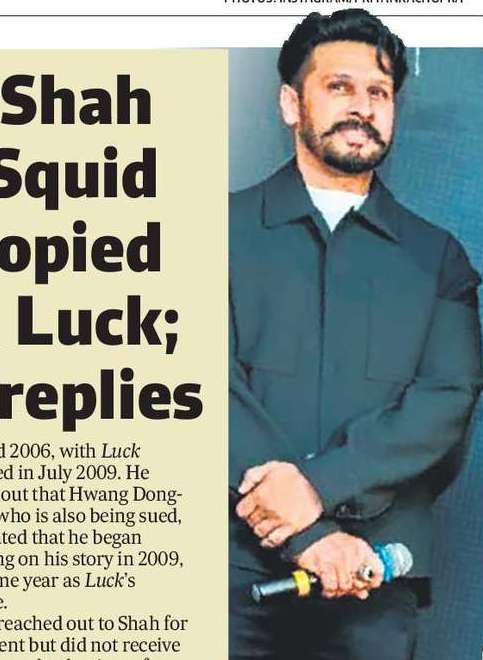
Soham Shah claims Squid Game copied his film Luck; Netflix replies
8:31 AM
Rishabh Suri (HINDUSTAN TIMES; September 15, 2024)
In a surprising twist, filmmaker Soham Shah is suing Netflix, alleging that the streaming giant’s hit series Squid Game is a copy of his 2009 film Luck. Netflix has firmly denied the accusation. “This claim has no merit. Squid Game was created and written by Hwang Dong-hyuk, and we intend to defend this matter vigorously,” a Netflix spokesperson stated.
According to documents obtained by TMZ, Shah argues that his film, which features Sanjay Dutt, Imran Khan and Shruti Haasan, involves players participating in deadly games to win a jackpot, with the prize increasing as players die. Squid Game similarly involves contestants playing life-threatening games for a large sum of money. Shah claims he developed his story around 2006, with Luck released in July 2009. He points out that Hwang Dong-hyuk, who is also being sued, has stated that he began working on his story in 2009, the same year as Luck’s release.
We reached out to Shah for comment but did not receive a response by the time of publication.
We made Brahmastra for half the cost of a Hollywood movie-Namit Malhotra
8:25 AM

Dedicating almost seven years to Brahmastra, VFX head Namit discusses how he has tried to bring Indian superhero films on par with Western counterparts
Mohar Basu (MID-DAY; September 13, 2022)
Until Brahmastra: Part One — Shiva hit the marquee, few Indian movies had showcased that seamless blend of cinematic vision and technology. The stellar special effects are arguably the biggest highlight of the Ranbir Kapoor and Alia Bhatt-starrer. When Namit Malhotra of DNEG came on board as the VFX head and co-producer on Ayan Mukerji’s ambitious directorial venture, all he wanted to do was bring India on par with the West.
“India was lacking in access to technology and tools that filmmakers in the West have. I had the desire to bust that notion that India can’t do [superhero films],” he begins.
But that’s where the comparison with the West stopped. Mukerji’s story about a man discovering his superpower of harnessing fire was so rooted in Indian mythology that the team didn’t need to reference from Hollywood movies. “For creative design, we went into our own history, aesthetics, astras, and mythological references. But the technology is borrowed to translate that [vision on screen]. It’s not like Iron Man where there are high-tech gadgets. That could’ve alienated the audiences, but at the same time, it had to look cool enough for kids who are accustomed to Marvel/DC movies,” says Malhotra, adding that it took them “close to seven years” to perfect the film’s VFX.
It has taken Brahmastra almost a decade to go from paper to the big screen. The film’s budget, reportedly around Rs. 410 crore, has always been under scrutiny. But Malhotra brings forth a different point of view. “I had a running joke with Ayan that after James Cameron, he is the only guy who has taken this long [for a film]. But time has allowed the film to be finer. From a VFX standpoint, we were working till weeks before release. The budget is high for an Indian film, but it’s not a patch on the Hollywood budgets sanctioned for such movies. We made it for half the cost of a Hollywood movie. Brahmastra can stand next to any Hollywood [superhero] flick. Ayan and I [reasoned that] if the ticket prices are the same for Marvel movies, why should we drop the standard for Bollywood movies? We want this film to travel the globe, [like] Squid Game did.”
The franchise, envisioned as a trilogy, focuses on the elements derived from gods Brahma, Vishnu and Mahesh. This philosophy will be at the core of the Astraverse. “In the first part, we explored fire, which is the most exciting energy visually. The future [instalments] will also have similar constructs.”
We don’t try to water the content down. We want the world to know their stories-Bela Bajaria
8:34 AM

Bela Bajaria, Netflix’s Head of Global TV, gets candid about content, competition and creative storytelling
Sonal Kalra (HINDUSTAN TIMES; May 1, 2022)
Among the world’s most powerful media executives, Netflix’s global content head, Bela Bajaria, was recently in India, and much in the news for meeting talent in and outside the company’s content slate. In a frank chat, she fields questions — on the streaming platform’s recent performance and the constant advice she gets from everyone around her.
You’ve been in India meeting a lot of entertainment industry folks. On a scale of 10, how much advice are you getting on how to run Netflix content?
(Laughs) I’d say it varies between 8-10. I also have a large extended Indian family in Los Angeles, and I get a lot of opinions all the time. But I can see that it comes from being excited when they see a new show or a film on Netflix, and that starts to come up a lot in conversations. When The Fame Game released, a lot of people in my personal life started talking about how much they loved it.
Netflix’s recent quarterly results showed a loss of 2 million subscribers. It made big news everywhere, including India. From a content lens, has this led to a rethink in strategy to come out of the tricky patch?
Many people inside the media business, and even those outside of it, have come up with theories about what strategy we should adopt. What I love about it is how personally and passionately connected they feel towards the brand. People usually have more input on a business that they feel a sense of personal ownership with. There are several factors that determine subscribers, engagement or revenue, but for us, it’s always much more about the content that we show.
What is your India visit in connection with? Is it a fallout of the recent quarterly results?
Not at all. My visit is to connect with India because India is a very important market for us. It is to understand the content needs of the Indian audience. We have a large base of very talented content creators and on-screen talent in India who I wanted to have a personal connection with. The last time I met with people here was two years ago, before Covid-19 struck. So the visit was overdue. As for the success of the business, as I said, it is determined by several factors. But remember that this company is not in any other business. This is all we do. Making great shows and great films… That’ll always be the core.
In post-pandemic times, the audience suddenly has a lot more to choose from, with several streaming players in the market, in addition to theatrical releases. Would Netflix look at a strategy of fewer shows or lesser episodes, etc. to focus on the quality of content?
No. For me, the number of episodes per season of any show — globally — is determined solely by the creative diktat. At Netflix, we have flexibility when it comes to the number of episodes as well as the duration of each. One episode could be 42 minutes, the other could be 55. We go by what is the natural way to tell a story. The idea is to serve the audience whatever they are in the mood to watch. If you want comedy, there’s Kapil Sharma’s show. If the mood is to watch an intense emotional drama, there’s Mai. So at any point, our aim is to super-serve the audience.
There is a perception that if a producer gets signed by Netflix, they will face no limits to the cost of making a show or a film. Have you ever received feedback that your shows could be over budgeted as compared to platforms that stay tighter on costs? Reports suggest that the per episode cost of the new season of Stranger Things is $30 million.
While deciding on budgets, the idea is to have the best production quality, and to be able to realise the creator’s vision correctly on screen, for the craft to come out at its best. But that being said, everything is the right size for what it should be. The ultimate objective is local storytelling on a global platform. As an Indian-American growing up in the USA, I never saw myself on-screen. No one on TV ever looked like me. Therefore, I am very conscious of representation. We need to give an opportunity to local storytellers and local actors to get a platform. We want to tell authentic local stories, not international stories. If they are good, they become international on their own. As for Stranger Things, my work is not even remotely connected to the budget, so I won’t know the cost, but do remember that it involved production in several countries during Coronavirus. So the scope and scale would obviously be enormous as compared to smaller dramas. In India, we just launched Thar with Anil Kapoor. That has a scale of its own. There’s no set rule for costs.
Different countries have different content regulations and a varied socio-political atmosphere. Is that a concern while green-lighting content? Do you have an international rulebook for selecting original content?
No, there is no rulebook at all. We have local offices in 26 countries, and the programming teams in each are people who are from that country, speak the language, understand the culture and the sensitivities. They are the ones who make the decisions to green-light their respective projects. We have an organisational culture of giving them the autonomy to do that. We don’t make the content go through any prisms or try to water it down. We want the world to know their stories. It’s Hollywood that has been exporting stories to the world all these years. Now we want the local creative communities to export their stories. It’s also because now there’s great access to world content. You can switch from Squid Game to Gangubai Kathiawadi to Bridgerton with just a click. That’s like getting the world in one place. I recently met a producer from the South of India who told me that his daughter is learning Korean only to watch K-shows! Also, the fact that we shoot our shows at locations in various countries gives a window into promoting tourism for that place. The number of people who travelled to Madrid after watching Money Heist or to Paris after Emily In Paris or Lupin was extraordinary. It’s amazing.
With competing platforms showing niche content, right from reality shows to popular sports events, how do you plan to focus your content strategy?
We did Formula 1: Drive To Survive and Last Chance U, and they did exceptionally well. The shows made a lot of people get interested in the respective sports. But we did those also, with storytelling weaved into the script because that’s our way. As for competition, sometimes just looking over your shoulder can distract you from moving forward. Competition is great for consumers to have choice, but our focus is clearly on being the best place for talent to work with.
Is there likely to be a change from binge-format to appointment viewing, in terms of all episodes of a show not dropping at the same time?
So far, our proposition has been to present all episodes of a season at once. I feel it gives choice to the consumer to decide when and how much to watch at a time. By and large, our audiences have loved it. But it again depends on the individual shows and how the creators design them. Money Heist had two drops of five episodes, and it worked. There is no hard and fast rule about it.
Being the first woman of colour to lead the global content of a studio, how has it shaped your views on gender representation?
I realised while growing up that it’s important to have the power of seeing yourself on screen. I never had that power. When I have it now, I realise it’s not just about you, it’s about the multi-dimensional aspect of gender that you think should get this visibility. It’s not to see women on screen in different roles, it is also about giving that power to women behind the camera. I feel the area of storytelling has the potential to do both. It can show women that their existence is not just in relation to the man in their life. Or that they don’t have to necessarily be likeable all the time. There’s more to them. That’s the real power we want to show. If they can see it, they can be it.
I love and admire Shah Rukh Khan. He is someone who inspires millions of people every moment-Anupam Tripathi
8:01 AM

Mihir Bhanage (BOMBAY TIMES; December 5, 2021)
From pursuing music and acting in plays in India, to doing small roles in South Korean television shows and films, actor Anupam Tripathi’s career graph has been interesting. However, 2021 changed everything for him. The world went crazy over Squid Game, and Anupam’s character of the Pakistani migrant worker Abdul Ali received a thumbsup from viewers. Still coming to terms with the popularity, Anupam says that the response was totally unexpected. “We knew we had created a good show. But the reception was phenomenal; totally overwhelming,” says the Delhi-lad, who is now looking forward to more roles that let him show his potential.
In his journey from Delhi to Seoul, Anupam went from harbouring dreams of joining the National School of Drama (NSD), to pursuing performing arts at the Korea National University of Arts. What has kept him going is his passion for acting. “I was originally interested in music and was learning classical music from Dr Sarita Pathak Yajurvedi. Later, I joined the Behroop theatre group and was mentored by the late Shahid Anwar before coming to Korea,” he says.
Anupam is among the actors who’ve made a mark in the audience’s minds due to shows or films on OTT platforms, and he agrees that these platforms have a big hand in taking projects to a global audience. He shares, “There’s no limit for creativity, thanks to OTT platforms. There are more opportunities for actors and creators, and projects have become multicultural. And this will only grow further. At the same time, the reach and opportunities also put an onus on artistes to constantly hone their craft and experiment with roles.”
Experimentation is something he, too, wishes to do now. So, is Bollywood on the cards anytime soon, we ask, and he replies, “If an interesting role comes my way, I will definitely take it up. That said, I speak three languages — Hindi, English and Korean — and I want to explore opportunities in each of these.”
The topic of Bollywood invariably brings us to the people he looks up to. On his list are — “Irrfan, Nawazuddin Siddiqui, Pankaj Tripathi, Raj Kapoor, Guru Dutt, Dilip Kumar. I also loved Ayushmann Khurrana’s work in Andhadhun. Internationally, I admire Marlon Brando and Charlie Chaplin’s work.”
There’s another person he admires, someone he also shares his birthday with — Shah Rukh Khan. “Not just as an actor, but as a person who has built such a big name for himself through his work and dedication, I love and admire Shah Rukh Khan. He is someone who inspires millions of people every moment,” says Anupam.
While his near ones celebrate his success and popularity, Anupam has his eyes set on the things to come. In his words, “This is just the beginning of my story.”
--------------------
ON THE GLOBAL POPULARITY OF K-DRAMAS AND K-POP...
I am not an authority on this, but I think Korean shows, movies or music are so popular because they tell universal stories and motivate people to do better. Also, what you see in these projects is a melting pot of cultures.

Subscribe to:
Posts (Atom)