Showing posts with label Silsila. Show all posts
Showing posts with label Silsila. Show all posts
Restored & reborn: The 4K revolution reviving Indian cinema
10:00 AM

With recent film releases providing more misses than hits, the industry has turned to restoring old classics in 4K. Rajesh N Naidu writes about what this trend portends for our movie-going experience
Rajesh N Naidu (THE ECONOMIC TIMES; November 12, 2025)
Films from a bygone era are getting a new lease of life, in restored, 4K resolution. It’s introducing a new generation of audiences to cinematic legends, but it’s also having another, more unexpected benefit: It’s bringing families closer.
Imagine a situation in which a grandfather and his grandson are leaving a theatre after watching the 4K restored version of the 1957 Hindi classic Pyaasa. The grandson, a product of today’s highly visual world, says, “The dream song in Pyaasa was shot so well for its time.”
After almost a minute, the grandfather asks the grandson, “Didn’t you like the ‘lift’ metaphor in the scene after the dream song in which Mala Sinha’s character unconsciously conveys to Guru Dutt’s character that she wanted to rise in life and wouldn’t settle for a relatively poor and impractical life with him?’ The grandson says, “Yes, that scene was also shot so well” The grandfather smiles and understands that he relived what he had cherished from the classic and his grandson experienced what he chose to experience—an exquisite marriage of ‘substance’ and ‘visual fidelity’. And just like that, the two, generations apart, have something to bond over as they leave the theatre.
This is a common experience for many Indians in recent months, as several old classics in many regional languages are being re-released in theatres following a 4K restoration. Films such as Awara (1951), Pyaasa (1957), Silsila (1981), Umrao Jaan (1981), Chandni (1989), Samrajyam (1990), Ravanaprabhu (2001) and Varsham (2004) all got theatrical re-releases, and industry observers have said there is a line-up of at least six more films which are undergoing restoration. These include Pakeezah (1972), The Godfather II (1974) and Shiva (1989).
“Film restoration has two benefits: One is preservation, where you restore a valuable piece of film, but which may not make money even after a theatrical release. And second, you restore a classic like Sholay, which is likely to be a commercial success as well. This differentiation of films is key,” said Shivendra Singh Dungarpur, founder and director, Film Heritage Foundation, a non-profit that’s into restoration.
The Film Heritage Foundation, in association with director Martin Scorsese’s film restoration company, Film Foundation, restored Uday Shankar’s 1948 film Kalpana in 2012, the first Indian film to be restored in 4K.
Need of the hour
At a time when more mainstream cinema is being rejected for being too crass, violent or over-the-top, audiences are craving the simplicity of stories and depth of the performances from another era. Meanwhile, a different set of viewers appreciate the grand expanse of a visually clear classic on 70mm film. The re-released masterpieces thus offer something to everyone, creating a celebratory environment where the two sections of viewers appreciate old classics in their own unique ways.
This wave of restorations can also be attributed to more and better access to mobile streaming. “In the past few years, people have become used to a certain quality of content which they consume on smart TVs, smartphones, tablets, etc,” explained Hiren Gada, CEO, Shemaroo Entertainment.
If anything, streamers and platforms don’t even prefer to accept films that aren’t in 4K anymore. “Rights holders of old films in 4K version have an advantage over rights holders of the same old film in a non-4K version, because avenues of monetizing films are limited for the latter,” said Sushil Kumar Agrawal, CEO, Ultra Media and Entertainment Group.
Pandemic boom
The trend properly took off during the pandemic. With millions of people locked down at home and the pipeline of new films firmly turned off, restored films became a lifeline. “During Covid, there was no new content. It was a steady supply of old films in 4K which [entertained] audiences,” said Kavita Prasad, managing director, Prasad Corporation, one of the oldest film laboratories in India.
Even post-lockdown, in the early phase, it was film festivals honouring legendary actors such as Amitabh Bachchan, Dilip Kumar, Dev Anand and A Nageshwar Rao, organized by the Film Heritage Foundation in collaboration with rights holders of these films, that revived footfalls in theatres. “The Amitabh Bachchan Film Festival in October 2022, which showed 11 of his films, was a phenomenal success. It did two things: It brought people back into cinema halls, which wasn’t happening since Covid. And it showed the success of old classics,” Dungarpur said.
“It then culminated with the release of 4K versions of Telugu film icon A Nageshwar Rao’s movies on his birth centenary in September last year.”
Poor box-office performance of new Hindi films in the past few years has also hastened the trend. “Today, most new films don’t run beyond a week or 15 days. Multiplexes with multiple screens need [more] content. This need is being fulfilled by the old classics in 4K. In the South, this trend has caught on quite a bit thanks to the loyal fan bases of actors,” Prasad added.
And then, there are the producers who look at it as a form of reviving cultural memories and reliving nostalgia. “Nostalgia has value and it always sells. The 4K restoration movement marks a turning point for Indian cinema. It is about reviving our cultural memory for a new generation of audiences. It also provides today’s audiences opportunities to experience the same grandeur and emotion that once defined the golden age of Hindi cinema,” explained Suniel Wadhwa, co-founder and director, Karmic Films.
Talking business
But this has also triggered a natural question among industry observers: Will it be a fleeting trend, or does it make long-term business sense? One key advantage of restoring old films is the cost.
According to leading film laboratories, restoring an old film in 4K costs about Rs 20 to 60 lakh, depending on the condition of the original source material. “The cost of restoring old films is lesser than making a new film. One would have to invest at least Rs 10 to 50 crore to make a new film. But restoring an old film not only costs less, but also saves on marketing costs. Moreover, these films have already been made and were proven to have an appeal among audiences,” Prasad added.
But not all old classic films (especially Hindi) restored in 4K have met with success. “We restored a bunch of Guru Dutt films. But not all of them worked out commercially. There were no takers for Baaz (1953), but Pyaasa (1957) worked,” shared Sushil Kumar Agrawal, CEO, Ultra Media and Entertainment Group, which restored Guru Dutt’s films.
So, rights holders of these old films have been forming portfolios of 10-15 restored movies and then gauging their long-term performance, instead of assessing those of individual restored works. “A portfolio of old films restored in 4K can easily provide an internal rate of return (annual return) of at least 20% in the next three to five years post its restoration,” Gada added.
Companies which are into the business of film restoration also pointed out that 4K films provide premium advertising rates on CTVs and YouTube. According to a recent study by media and entertainment research firm Ormax Media, the CTV audience in India has grown by 85% to 129.2 million in 2025 from 69.7 million in 2024, reflecting the swift adoption of CTVs.
“Restoration is a one-time exercise. It increases a film’s reach significantly. A film’s rights holder can monetize it on more, bigger or better screens, targeting more premium audiences,” Gada said. “A 4K film on CTVs can easily fetch premium advertising rates, as it is targeted specifically to premium viewers who prefer superior visual quality,” added Gada.
At present, on average, at least 10% of libraries of aggregators have been restored in 4K, including other stages of upgradation in the visual format. Overall, these aggregators have restored 80-90% of their libraries in HD formats. And in the coming years, the restoration of films in 4K is likely to increase even further, given the available avenues for monetization. Industry observers believe that a lack of clarity regarding the lineup of new Hindi films for the next year may also work in the restored films’ favour.
They also believe that a genuine classic made 20 years later will have takers rather than merely re-releasing an old film in 4K. “A classic film which has a popular appeal can provide a huge 300-400% profit when monetized through theatrical and non-theatrical ways. Genuine classics have better stories which are highly engaging. People relate to these and want to see them in a better proposition, like in 4K,” explained Koushik Bhattacharya, founder, Quality Matters, a company which is into film restoration.
Understanding: What is a 4K film?
4K is essentially a display resolution of a screen. A 4K film typically shows the size of a screen horizontally and vertically in terms of pixels. Typically, a 4K film would have the following format: 4096 (size of the horizontal screen) x 2160 (size of the vertical screen) pixels.
| NFDC-NFAI Charges for 4K Film Restoration | ||
| Key Components | Per minute charge* | **Charge for 2-hour film |
| Reel Assessment & Storage | Free | Free |
| Digitisation and Grading in 4K | Rs2216 | Rs2.66 lakh |
| Restoration & Digitisation in 4K | Rs22836 | Rs27.40 lakh |
| Includes GST* | ||
| Estimated charges** | ||
One of my biggest regrets is missing out on working with Amitabh Bachchan-Padmini Kolhapure
10:02 AM

Neha Maheshwri (BOMBAY TIMES; May 6, 2025)
Padmini Kolhapure is making her return to the small screen with the historical drama Chakravarti Samrat Prithviraj Chauhan, nearly 12 years after her last major television role in Ekk Nayi Pehchaan (2013). “It doesn’t feel like a long time has passed because people still tag me about Ekk Nayi Pehchaan. Social media has given longevity to all our work,” says Padmini. In an interview with us, the actress gets candid about the kind of roles that excite her now, shooting bold scenes back in the day and her niece, Shraddha Kapoor. Excerpts:
‘I’M QUITE IMPULSIVE ABOUT THE FILMS I DO’
Padmini has appeared in only a few Hindi films in the last two decades. She was last seen in Panipat (2019). “I did Panipat because I thought it would be a great experience to work with Ashutosh Gowariker, given the kind of films he makes. Similarly, I did Phata Poster Nikhla Hero (2013), because it was centred around a mother and son. I loved working with Rajkumar Santoshi. He’s such an actor’s director,” she says.
Ask her about being choosy, and she says, “Honestly, I’m not excited about a lot of projects that come my way. I’m quite impulsive. The story has to resonate with me, and even if it turns out to be the worst decision of my life, it just has to touch me. I did a Marathi film called Prawaas (2020). I really liked the narrative and also enjoyed working with Ashok Saraf.”
‘I HAD MY FAMILY AROUND ME WHEN I SHOT BOLD SCENES’
The conversation touches on Padmini having filmed a few bold scenes as a teenager in movies like Gehrayee (1980), Insaf Ka Tarazu (1980) and Prem Rog (1981), long before intimacy coordinators became the norm. When asked if an intimacy coordinator would have helped back then, she replies, “Maine iss baat par dhyaan bhi nahi diya. I had my family around me then. Besides, the entire unit felt like a family.” She also points out that earlier, even small gestures could spark an uproar.
Recounting one such incident, she says, “People made a hue and cry over the peck I gave King Charles on his cheeks. Aur abhi toh sab kuch chal raha hai . Back then, it was considered taboo,” she says.
‘SHRADDHA LOOKS AND CARRIES HERSELF JUST LIKE HER MOTHER’
Padmini also often finds herself addressing frequent comparisons to her niece, new-gen actress Shraddha Kapoor. Clarifying the resemblance, she says, “She looks like her mom, who is my sister. Shivangi and I resemble each other. In fact, at one point, we were often mistaken for twins. Now, just because I am in the public eye and Shivangi is not, people tend to think her daughter resembles me. Shraddha looks and carries herself just like her mother. Despite clarifying this so many times, people still refer to her as my daughter and say, ‘ Aapki beti bilkul aapke jaisi dikhti hai ’, so I’ve started saying thank you.”
‘I AM ENJOYING THE EXPERIENCE OF PLAYING RAJ MATA’
Padmini, who is gearing up for her TV show Chakravarti Samrat Prithviraj Chauhan, says, “I play Raj Mata and I am enjoying the experience. The last historical character I played was in Panipat, which I enjoyed. When you wear the costumes, your demeanour changes automatically, right down to the walk.”
‘Missed working with Mr Bachchan’
Padmini was reportedly part of the original cast of Silsila (1981) alongside Amitabh Bachchan and Parveen Babi. She was replaced by Smita Patil, but the role eventually went to Jaya Bachchan.
Looking back, the actress says, “One thing is for sure, I really missed out on working with Amit ji . It was probably one of my biggest regrets, as I have worked with everyone else, and he is the only actor I haven’t worked with.”
Pandit Shiv Kumar Sharma's music didn’t make masses feel disconnected-Shankar Mahadevan
8:18 AM

Noted composer hails Sharma for bridging the gap between classical and film music
As told to Sonia Lulla (MID-DAY; May 11, 2022)
When you are handling a mainstream subject like a Bollywood movie, there is always a discussion around classy music and massy music. Creating a piece that satisfies both, the maestro and the masses, is not easy because the latter may not understand Indian classical music. But Pandit Shiv Kumar Sharma had the ability to do that. If you see his work in Silsila [1981] and Chandni [1989], you can see that the classical music that he used had depth, but wasn’t so difficult that the masses felt disconnected.
In a mainstream song like Dekha Ek Khwab from Silsila, there is a beautiful santoor section. He raised the bar of Indian music, and was an example for a musician like me who wanted to imbibe [those qualities] and use Indian classical music in mainstream compositions. Not many people know that he also played the tabla in so many legendary songs that were sung by Lata ji [Mangeshkar].
His contribution to film music is only a fraction of all that he has achieved. The santoor was not traditionally known as an Indian classical instrument. The Kashmiri folk instrument was [alien] to the Indian classical music world, and he popularised it all over the world. Indian classical music became popular via the santoor, because of him. He made people take the fact that the instrument was associated with Indian classical music, for granted. With the word santoor, no other name except Pandit Shiv Kumar Sharma can be associated. He will be remembered forever.
Shiv Kumar Sharma passes away; to be accorded a funeral with full state honours
8:14 AM

THE TIMES OF INDIA (May 11, 2022)
Shiv Kumar Sharma, who reshaped the identity of santoor, elevating the instrument’s stature across the globe, and who composed a bunch of dulcet melodies with renowned flautist Hariprasad Chaurasia in Yash Chopra movies, passed away following a heart attack in Mumbai on Tuesday morning. He was 84.
Although the maestro was on regular dialysis, he remained active till the end and was to perform in Bhopal next week, family sources said.
“My story is different from other classical musicians. While they had to prove their mettle, talent and calibre, I had to prove the worth of my instrument. I had to fight for it,” Sharma had told TOI in 2002.
He will be accorded a funeral with full state honours, said CM Uddhav Thackeray. The last rites will be performed at the Vile Parle crematorium at around 3:00 pm on Wednesday.
-----------------------------------------
Shiv Kumar Sharma, who reshaped the personality and identity of santoor elevating the instrument’s profile and stature across the globe, and who composed a bunch of dulcet melodies in tandem with renowned flautist Hariprasad Chaurasia in Yash Chopra romances and thrillers, passed away following a heart attack in Mumbai on Tuesday morning. He was 84.
“He was on regular dialysis but was still active. He was to perform in Bhopal next week,” a family source told PTI.
With his arresting features — the shock of hair being his signature — the santoor maestro regaled music lovers in thousands of concerts over decades; his jugalbandis with Chaurasia and tabla virtuoso Zakir Hussain a treat to the ear and the soul. But the accolade and the glory came after a long struggle to gain respect for the instrument he played.
“My story is different from other classical musicians. While they had to prove their mettle, their talent, their calibre, I had to prove the worth of my instrument. I had to fight for it,” Sharma told The Times of India in 2002.
“Shiv Kumar-ji was an epochal musician. Braving almost universal cynicism, he made an obscure staccato instrument capable of a convincing presence in classical music. His ascension to the Hindustani Music Hall of Fame is even more significant because it coincided with the era ruled by formidable instrumentalists like Ustad Vilayat Khan, Pt Ravi Shankar, and Ustad Ali Akbar Khan,” musicologist Deepak Raja said.
Jammu-born Sharma was ushered into music when just five by his vocalist father Uma Dutt Sharma of Benaras gharana and showed promise in both vocals and tabla. But the notes changed when he was 13 after his father brought a gift from Srinagar. “I tore at the wrapping paper eagerly, expecting a game or something else as exciting. But the box held a strange-looking musical instrument which I hadn’t seen before! And that’s how I was introduced to the santoor,” he told TOI in 2001.
The Dogri musician’s father-guru wanted him to play this instrument. “At that time, the santoor was used only in Sufiana music in a small pocket in Kashmir. No other part of India had ever seen it. But dad wanted it to be developed for national use in Indian classical music — and he entrusted the job to me,” he said.
In 1955, Sharma came to Bombay for a concert packed with the galacticos of Indian classical music: Bade Ghulam Ali Khan, Ali Akbar Khan, Ravi Shankar, among others. He was just 17. But he made an impact. The same year Sharma also composed a background piece in V Shantaram’s film, ‘Jhanak Jhanak Payal Baaje’ (1955) for music director Vasant Desai.
But many critics were far from convinced about santoor’s range. “… connoisseurs rejected it as a complete instrument since I couldn’t play alaap. Santoor is essentially a percussion instrument played by strikers. It can’t sustain the vibrations and so, there was no scope for meend (glide from one note to another)…I modified the instrument and created a distinct character,” he once told TOI.
Much against his father’s wishes, Sharma came to Bombay in 1960, hoping to build a career as a freelance musician. Over the years, his services were utilised by top Hindi film composers, including Hemant Kumar (‘Bees Saal Baad’), Jaidev (‘Hum Dono’), SD Burman (‘Guide’) and RD Burman.
‘Call of the Valley’ was released in 1967. The long-playing record, put together by the trio of Sharma, flautist Hariprasad Chaurasia and guitarist Brij Bhushan Kabra, musically expanded on a day in the life of a shepherd through a bouquet of ragas. The album steadily entered the music shelves of the culturally-inclined and became a milestone in their careers.
When director Yash Chopra introduced Sharma and Chaurasia as a composer duo in ‘Silsila’ (1981), the film industry was surprised. Silsila was a multi-starrer and roping in two classical musicians, Shiv-Hari as they were christened, was deemed a commercial risk. In the end, the music turned out to be one of Silisila’s few highlights. Shiv-Hari became regulars for Chopra (‘Faasle’, ‘Vijay’).
In the Eighties, when melody had largely taken a backseat in mainstream commercial ventures, they provided ear-pleasing yet chartbusting scores, most notably in ‘Chandni’ (1989). That the two had internalised the idiom of Hindi film music was most evident in ‘Darr’ (1993), where they delivered a score that fused seamlessly with the demands of a thriller.
-----------------------------------------
A MUSICAL JOURNEY
- 1938: Shiv Kumar Sharma is born into music – the only son of Jammu-based musician Pt Uma Dutt Sharma of Benaras Gharana
- His music journey begins at 5 as a tabla player. At 13, gets gift of santoor from his father
1955 Sharma gives his first public performance at 17, playing the santoor in the presence of Bade Ghulam Ali Khan, Ravi Shankar, Allah Rakha Khan and other maestros
- Gets his first film as a santoor player in V Shantaram’s ‘Jhanak Jhanak Payal Baaje’. It is also the first time santoor is used in Hindi cinema 1967
- Teams up with flautist Hariprasad Chaurasia and guitarist Brij Bhushan Kabra for the concept album ‘Call of the Valley’, which becomes a huge hit 1981
- Collaborates with Hari Prasad Chaurasia for a film for the first time, composes music for Yash Chopra’s ‘Silsila’ 1986
- Sharma receives the Sangeet Natak Akademi Award 1991
- Is awarded the Padma Shri 2001
- Is honoured with the Padma Vibhushan May 10, 2022
- Dies of heart attack at 84
A classical maestro once said, ‘Baareek se baareek sur ke bhi beech ka sur lagati hain Lata’-Shabana Azmi
8:15 AM

Titas Chowdhury (HINDUSTAN TIMES; February 8, 2022)
Singer Lata Mangeshkar had recorded songs for many films featuring actor Shabana Azmi, such as Swami (1977), Libaas (1988) and Masoom (1983), among others. Mourning her death, the veteran wrote on social media, “Lataji.. our national treasure no more ..her voice lit up our lives , gave us solace when we were sad, gave strength when we were low (sic).”
Talking about what set Mangeshkar apart, she tells us, “It was not only her sur [that was] perfect. A classical maestro once said, ‘Baareek se baareek sur ke bhi beech ka sur lagati hain Lata’.”
She goes on to add that the emotions that she put into her songs made them iconic: “Her pronunciation was perfect, but the feeling and emotions she imbued in her songs were unparalleled.”
Azmi gives an example of the popular love ballad Yeh Kahaan Aa Gaye Hum (Silsila; 1981), and says, “Rekha (actor) said that even if she is reborn a hundred times, she will not be able to recreate the emotion [with which] Lata ji sings [the line], ‘Hui aur bhi mulayam meri raat dhalte dhalte’!”
Azmi’s late father, poet Kaifi Azmi wrote songs like Zara Si Aahat (Haqeeqat; 1964) and Tum Jo Mil Gaye Ho (Hanste Zakhm; 1973), which Mangeshkar rendered. Recalling her favourite collaboration between the two, Azmi shares, “Kuchh Dil Ne Kaha, written by my father for the film Anupama (1966), takes my breath away each time I hear it.”
Perfection is a mirage that you keep following, but you never reach it. Lata Mangeshkar was a rare example who achieved it-Javed Akhtar
8:48 AM
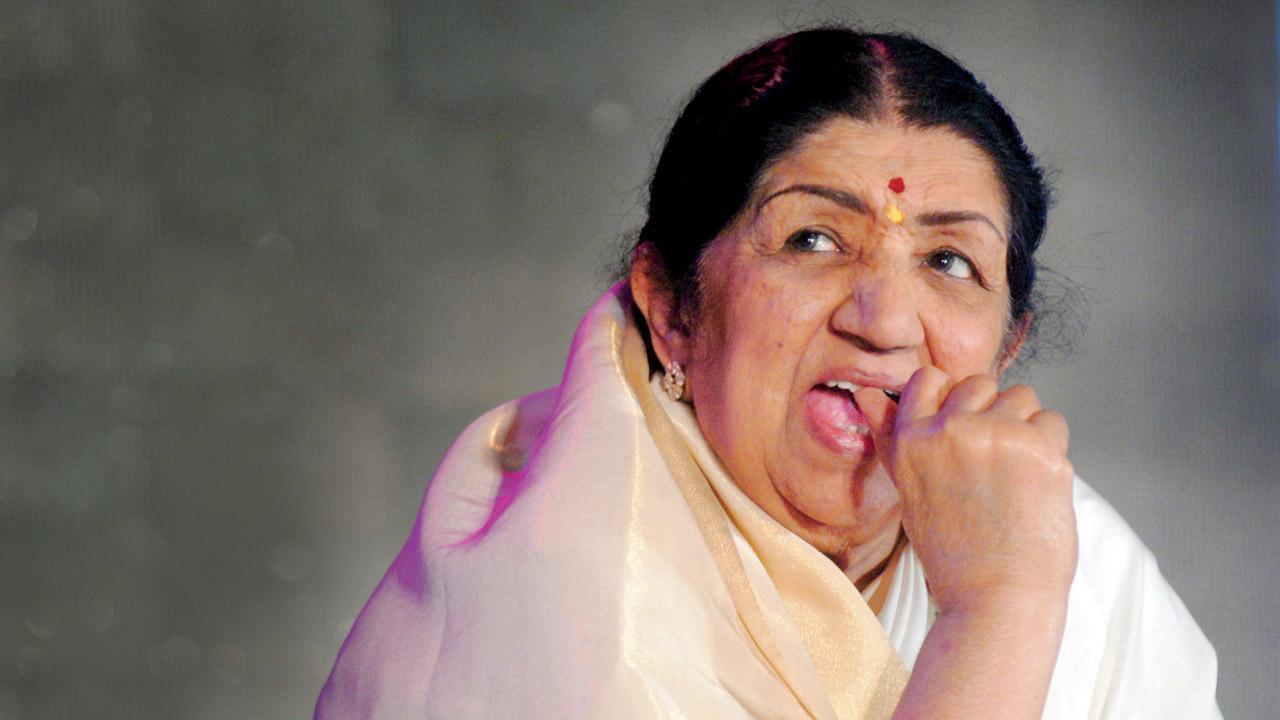
Legendary singer who has given joy and solace to millions of Indians across many generations, passes into the ages, aged 92
As told to Upala KBR (MID-DAY; February 7, 2022)
My professional association with Lata Mangeshkar began when we worked together in the first song that I had written for Silsila [1981], Dekha ek khwab toh yeh silsile huye. It was an honour that my two favourite singers, Lata ji and Kishore da [Kumar] brought my words alive. After that, we kept meeting.
Lata ji was a larger-than-life person who was immensely talented and focused on her work. Every singer treats their first song with extreme focus; Lata ji would do that for each and every song. To me, Lata ji was as great an artiste as Michelangelo, Beethoven and Shakespeare. In the history of mankind, we should leave such immensely talented people out of the chain of human civilization. Such people are of a different league and are emblems of perfection. They remind us that perfection can prevail among mediocrity. Lata Mangeshkar ji ke jaise na koi tha, na koi hoga…
While people know about her legendary singing, few know that she had a great sense of humour and sharp observation skills. Although she appeared reserved, she would talk openly and honestly whenever we met. She would always have a witty remark up her sleeve. We would often share jokes if we had observed something funny. Another [remarkable trait] was her unbelievable memory. She would remember incidents that happened more than 50 years ago, down to every minute detail.
Zabaan — that was another thing. Being a Maharashtrian, she could speak Marathi fluently. But because she had to sing Hindi film songs, Lata ji learned Urdu in the initial stages of her career. Her Urdu pronunciation was perfect. She sang innumerable songs in her over 70-year-career, but you cannot point out one song where she has mispronounced a word. Perfection is a mirage that you keep following, but you never reach it. Lata ji was a rare example who achieved it.
While people know about her legendary singing, few know that she had a great sense of humour and sharp observation skills. Although she appeared reserved, she would talk openly and honestly whenever we met. She would always have a witty remark up her sleeve. We would often share jokes if we had observed something funny. Another [remarkable trait] was her unbelievable memory. She would remember incidents that happened more than 50 years ago, down to every minute detail.
Her pursuit for perfection led to an important factor in singing — lafz [words]. She would always take the song, and write it by hand. Then, she would mark lines across certain words, put commas and hyphens. It was her process, and only Lata ji knew what they meant. After that, she would go behind the mic and we would witness her magic. Pata nahin gaane mein kya daal deti thi — she would create magic though she never changed a word or tune.
Lata ji never sang only through her voice, but it was the blend of awaaz, intellect [dimaag] and heart [dil]. She understood the emotions and subtext of the song. In Yeh kahan aa gaye hum, there was a line that went, ‘Hui aur bhi mulayam, meri shaam dhalte dhalte.’ Mulayalam means soft, and she made it feel soft through her pronunciation. Similarly, in the song Maati re [Godmother], the line goes, ‘Ladte ladte zindagi se thak gayi hoon main’. When she sang thak gayi hoon, you could feel the exhaustion.
[She showed that trait again] when she sang Tere liye for Veer-Zaara (2004). It is about two young lovers who finally reunite in their old age, after 22 years of separation. The song is about defeat and desolation. In her voice, you can feel the acceptance of total defeat. Jis insaan ka sab kuch loot gaya hai, woh mayoosi aur pyaar ka izhaar, unki awaaz mein tha, lavs mein nahin. You could feel every emotion in her songs. It is rare and tough to do that because she had to sing a song within five minutes. There was no alaap or rehearsal. But her rendition would be expressive because she would pour her heart, soul, emotions and experience into it. Her ability to do it for each and every song was what made her great.
While Lata ji was revered in India and abroad, there was a time when she was the most popular Indian in Pakistan too. Many respected poets and shayars from the country have written poems on her, including the popular poetess, Parveen Shakir.
Meeting Lata ji felt like a special occasion in itself. ‘I am meeting Lata Mangeshkar’ — that thought itself was a source of honour and joy. For all of us who knew her, she will always remain ‘Lata Mangeshkar’ — in inverted commas.

Shoojit Sircar and Juhi Chaturvedi make Begum triumph in Gulabo Sitabo-Farrukh Jafar
8:33 AM

Following this principle on screen and off it, Farrukh Jafar, aka Gulabo Sitabo's Begum, gears up for new innings in Bollywood at 86
Mohar Basu (MID-DAY; June 21, 2020)
 At the centre of Shoojit Sircar's Gulabo Sitabo is Fatima Begum, the owner of the dilapidated haveli that becomes the bone of contention between Amitabh Bachchan and Ayushmann Khurrana's characters. Though marketed as a film about a landlord and his tenant at loggerheads, the script cleverly puts the spotlight on its 86-year-old leading lady Farrukh Jafar. You should take the hint when her name appears before Bachchan's in the credits.
Locked in her Lucknow home since March, Jafar isn't oblivious to the praise coming her way. Tell her she is hailed as the new rockstar, and she admits, "I had not expected so much love. I have been working actively for decades. But it's only recently that strong roles are being written for actors of diverse cultures and age groups. It's up to the director and writer to utilise the actors effectively. Shoojit Sircar and Juhi Chaturvedi make Begum triumph."
Chaturvedi's sharp understanding of the character made it easier for Jafar to sink her teeth into the role. "Begum's character was old but sassy, and that attracted me to her. I was particularly lured by the last scene," says the actor, who made her debut in Umrao Jaan (1981).
Quiz her about the much-discussed climax—one that filmmaker Neeraj Ghaywan described as "a gentle slap on the male ego"—and she decodes it, "Begum must be loathing herself for choosing a petty and miserly man like Mirza. It's evident to her that he married her for the haveli, and did not value her. The realisation came late, but it's never too late to start living. Even in marriages, women should have their own identity. They are free-thinking and independent individuals." Jafar believes in walking the talk—ready for her new innings in Bollywood, she is in talks for two projects.
The idea of being Bachchan's heroine, and a unique one at that, made her chuckle. "I remember becoming Mr Bachchan's fan post Silsila and Kabhi Kabhie. His romantic pairing with Rekha [in Silsila] is etched in our minds. Until I saw Silsila, I was a fan of Dilip Kumar."
Subscribe to:
Posts (Atom)