Showing posts with label Shyam Benegal interview. Show all posts
Showing posts with label Shyam Benegal interview. Show all posts
Manthan did brilliantly in Gujarat because its largest audience was also the film’s producers-Shyam Benegal
10:43 PM

Shyam Benegal shares how Manthan was brought to life and how Dr Verghese Kurian made it happen
Shyam Benegal (THE ECONOMIC TIMES; September 10, 2012 | Republished in BOMBAY TIMES; April 26, 2024)
I used to work for an ad agency that advertised Amul products. And Amul launched its first product, milk food for babies. Dr Kurien had this idea to launch this baby food with buffalo milk, which nobody believed could be done. Of course, it worked wonderfully.
Then came the iconic butter which we used to advertise and I used to write for that. But the milk revolution was yet to take place in its entirety.
Now came NDDB, post the then Prime Minister Lal Bahadur Shastri’s visit to Anand. Shastri asked Dr Kurien to replicate his model but he refused to move to Delhi saying, Delhi didn’t have farmers, only bureaucrats!
Around 1972-73, I got to make two of the three documentaries on Operation Flood, called Operation Flood I and II, which led to the White Revolution – all because of Dr Kurien and his rural marketing initiative IRMA, which was a pioneering institute. While doing these documentaries, I used to travel around the whole country and I came across many beautiful places. And I said to Dr Kurien that these documentaries will be seen largely by those who have already been converted to the cause. What about the larger public? He agreed with me but said that there was no money (for a large project). Dr Kurien never allowed anyone to spend any money that he didn’t get value from.
So he asked me, how much do you need? I said Rs. 10 lakh. He did a headcount and said, if I collect Rs. 2 from each member, we can make the film.
He did not take any money from the farmers. He told the collection centres that when they come for their daily morning and evening collection, ask them not to take Rs. 2 and instead they can all be producers of a film!
Then came Vijay Tendulkar who was blown away by the cooperative and wrote several scripts. I chose one and that’s how Manthan was made.
Dr Kurien released the film first in Gujarat before its all India release. The film did brilliantly because its largest audience was also the film’s producers! Everyday, we had this incredible sight of truckloads of people coming in from all over to see the film.
The film’s success gave Dr Kurien another idea. To use the film to woo other parts of the country into the movement. So prints of 16 mm would be used by spearhead teams to persuade farmers to create cooperatives of their own. Like in Manthan, a vet, a milk technician and a fodder specialist who can explain the value of cross breeding would go and help set up cooperatives. That is how this man made India the largest milk producing nation in the world. Quite an extraordinary man.
There are very few stories like him and the only other person I can think of like him is MS Swaminathan.
When Dr Kurien said: “I am a milkman, I am a servant of the farmers,” it was not just rhetoric. He meant it. He never suffered fools. He would never stand for any obtuse ways, if he could help it he never went to Delhi.
He was a delightful, marvellous man with a great sense of humour. I enjoyed his company and we had lots to talk about.
I am lucky to have met him because of Sylvester D’Cunha and Usha Kartak who were hands on. When I left for filmmaking, I made several other documentaries for him. Films for farmers.
A Movie Pure as Milk
Dr Kurien never complimented anyone! But I took the film to the UN that helped the UNDP to use the film for other countries, like a few in Latin America, to set up similar cooperatives.
Rajiv Gandhi asked Dr Kurien for a print of Manthan, which he gifted to the Soviet Union. Dr Kurien was both a leader and the backbone of the movement. I have never known someone with so much integrity like he said at an award function last year, "If I am proud of anything it’s my integrity."
He was a man who took people with him. He made money for the farmers. He took just Re 1 as salary from NDDB and took his salary from Amul right till the end. He should be the person every Indian wants to be like, especially in the material world we live in.
(As told to Nandini Raghavendra)

As long as I have the strength and my mind is working, I’d like to make movies-Shyam Benegal
3:11 PM

Onkar Kulkarni (BOMBAY TIMES; March 15, 2024)
Shyam Benegal, 89, the filmmaker who’s the director behind several National Award-winning feature films, numerous documentaries and short films, released his twenty-third feature, Mujib: The Making Of A Nation in 2023.
Talking to us about how he is still passionate about making films, Benegal says, “As long as I have strength in my limbs and my mind is working, I would like to make movies. I have a lot of subjects, but you see when you make a film, you are making it with somebody else’s (producer) money. So, naturally, if people still trust me at my age to make a film, I would love to do it.”
In his repertoire that spans 60 years, Benegal’s work has been conferred with several National Awards and the veteran filmmaker was also honoured with titles like Padma Shri and Padma Bhushan.
Ask him if he’s satisfied with all the accolades he won in his career, and he says, “All these acclaims have only thrilled me. But the fact is that there are different times in your career. Ultimately, as you grow older you want to make films that satisfy you. It might not necessarily satisfy everyone else, but when it does satisfy everyone including you, then you feel blessed.”
The filmmaker, known for films like Ankur, Manthan, Zubeidaa, Netaji Subhas Chandra Bose: The Forgotten Hero among others, feels that some of his socially relevant films, couldn’t garner the kind of attention that he expected them to.
He explains, “I haven’t made any films that I did not enjoy making. Those films may have collapsed and disappeared, but that didn’t make any difference to me. When I was filming them, I just loved the whole experience. I feel that most of the films I made didn’t work, but then that is how it is.”
For Benegal, films have always been beyond a source of entertainment. “I cannot separate the individual stories from the sociological circumstances. If I take it out, then I would not be true to the subject. A film is not a mere poster. It is not just unidirectional, but a part of the whole historical circumstance and as a story has connections to the past, the future and the present. It’s only then that it comes to life,” he explains.
There's no country where they haven't heard of Satyajit Ray-Shyam Benegal
8:12 AM

Niharika Lal (BOMBAY TIMES; May 6, 2022)
Veteran filmmaker Shyam Benegal, who recently inaugurated the Satyajit Ray’s Gallery at the National Museum of Indian Cinema (NMIC) in Mumbai, as part of the filmmaker’s 101st birth anniversary celebrations – talks about what makes Ray iconic, an original and a marker for Indian cinema (“Everything is either before or after Ray”).
‘SATYAJIT RAY PUT INDIAN CINEMA ON THE WORLD MAP’
Ray’s Pather Panchali had its world premiere at the Museum of Modern Art (MOMA) in New York as far back as 1955. And according to Benegal, it was Ray who put Indian cinema on the world map. He explains, “Ray is that one Indian filmmaker whom everybody knows. In fact, there is no country in the world where they don’t know who Satyajit Ray was. If you go to a West African country – Niger in Nigeria, for example – and utter the words ‘Satyajit Ray’, they will know him. Everybody recognized Indian cinema because of Ray.”
‘IF IT WASN’T FOR RAY, WE WOULD NOT HAVE HAD AN FTII,IT STARTED BECAUSE OF HIM’
Talking about Ray’s reputation as one of the most original filmmakers, Benegal says, “Indian cinema was developing in a particular way when Satyajit Ray came on to the scene, and then there was a great amount of transformation. And therefore, he is a marker — there’s before Satyajit Ray and after Satyajit Ray.”
He adds, “If it wasn’t for Ray, we would not have had an Film and Television Institute of India (FTII). It started because of him. The whole idea was that filmmaking is not just about moving pictures — people singing and dancing and speaking dialogues. It’s an art form of its own. He not only made the audience and filmmakers conscious of the fact that cinema is an art, but also the government.”
‘RAY WAS A MULTI-FACETED GENIUS’
The NMIC — in association with the National Council of Science Museums (NCSM), Kolkata — has created a gallery on Ray, with a life-size statue of Ray set up at the NMIC. Here, visitors can interactively explore Ray’s filmography and get a glimpse of many of his films’ scenes. Says Benegal, “I find the gallery wonderful because it is very well-curated. The design gives an idea of what kind of filmmaker Ray was. He was not just a filmmaker, but a multi-faceted genius. He used to design his film’s posters, titles, and even storyboards. I don’t think we’ve had anybody quite like Satyajit Ray since his time – before or after.”
‘THERE WERE DEBATES LIKE – WOH TOH SIRF BANGLA MEIN FILM BANATA HAI, HOW CAN HE BE CONSIDERED AN INDIAN FILMMAKER?’
Despite the global accolades garnered by Ray, Benegal says that the Mumbai film industry continued to consider Ray as a regional filmmaker. He said, “Unke uss zamane mein bahut grudge hoti thi. Mumbai film industry used to feel – ‘Woh toh regional filmmaker hai. Hindi mein film nahi banata hai’. That’s why he made Shatranj Ke Khiladi. They used to say – ‘Woh toh sirf Bangla mein film banata hai, how can he be considered an Indian filmmaker?’ Iss kism ke debates hote thay.”
REVISTING RAY’S CLASSICS
This month, a three-day Satyajit Ray Film Festival was organized in Mumbai, Delhi, Chennai, Kolkata, Bengaluru, and Pune, in honour of the filmmaker, from May 2-4. In Mumbai, the opening film was Aparajito, about which Shyam Benegal says, “This is a film which is, again, underrated in its style. After Pather Panchali, when Aparajito came out in 1956,everybody felt that it didn’t match up to the original. But the funny part of this is that Aparajito is a very fine film. The Banaras sequence in it is just outstanding, and the way he used the city in Aparajito is very unique.”
You have to watch Salim Ghouse in Bharat Ek Khoj. From Lord Krishna to Ram, he was marvellous in every role-Shyam Benegal
7:42 AM

Legendary director and screenwriter pays tribute to film and TV actor Salim Ghouse
Natasha Coutinho D'souza (MID-DAY; April 29, 2022)
Film and TV actor Salim Ghouse passed away on Thursday in Mumbai after suffering a cardiac arrest. He was 70. He is remembered for his performances in Shyam Benegal’s ‘Bharat Ek Khoj (1988), 'Chakra' (1981), 'Saaransh' (1984) and 'Mohan Joshi Hazir Ho!' (1984). He featured as the antagonist in the Kamal Haasan-starrer 'Vettri Vizhaa' (1989) besides Vijay's film 'Vettaikaaran' (2009).
Legendary director and screenwriter Shyam Benegal paid tribute to the late actor in a conversation with mid-day.com. Benegal said, “It’s such a shock to hear that Salim Ghouse is no more. He was such a physically fit person. Apart from being a brilliant actor, he had quite an energetic presence on the sets. He was a dear friend, but I had lost touch with him for some time. We worked together a lot. He was in ‘Bharat Ek Khoj' in many different roles, one of the characters he played was that of Lord Krishna in the show, by far the most astounding performance. The dialogues were in Sanskritised Hindi, and Salim was from the South, yet he delivered them so well. It was one of those series where you had to have excellent actors because they had to speak continuously for 8-10 minutes. His was an outstanding performance.”
Adding that he is saddened by the news, Benegal said, “His last film 'Well Done Abba' was also with me. In recent years, we didn’t work together much, but you have to watch him in 'Bharat Ek Khoj!' From Lord Krishna to Ram, he was marvellous in every role. He got busy with films in the South, where he was quite popular. I lost touch with the family in recent years, but he was too young to pass away.”
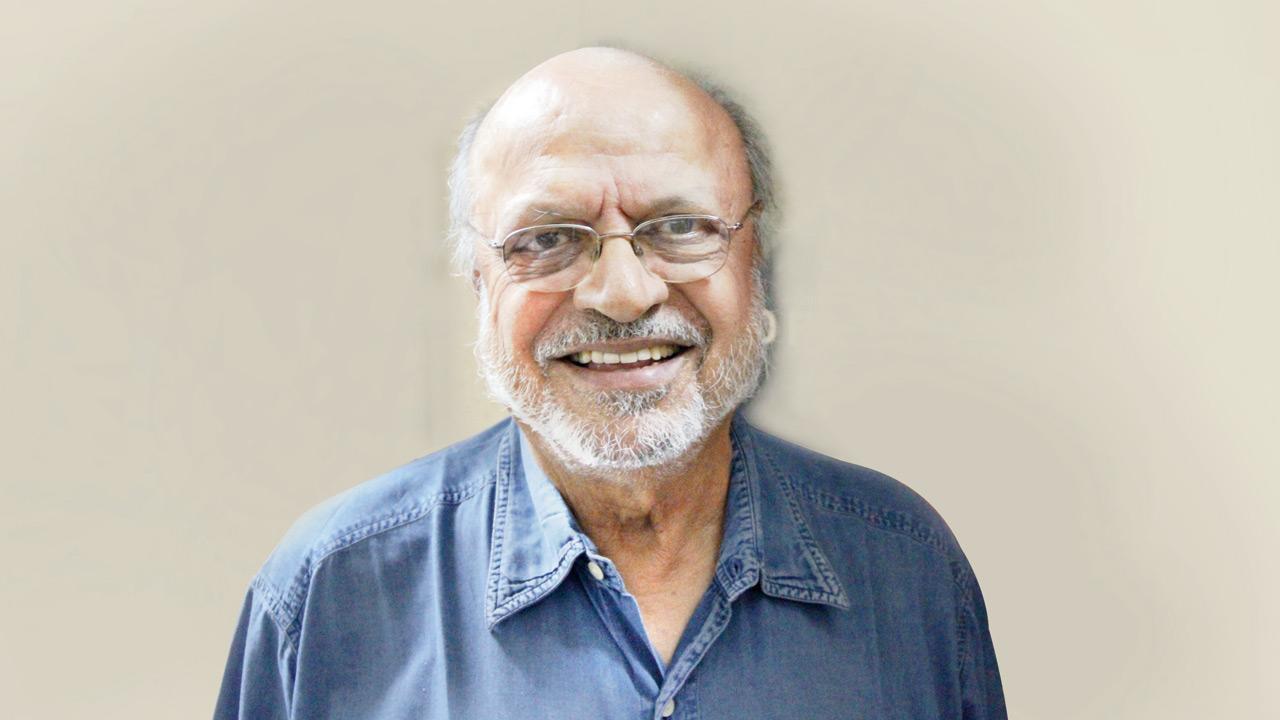
There was no censoring of any kind from Sheikh Mujibur Rahman's family-Shyam Benegal
8:04 AM
Returning to the filmmaker’s chair with a movie on the founding father of Bangladesh, Shyam Benegal on roping in actors from the neighbouring nation
Mohar Basu (MID-DAY; March 21, 2022)
We seek to decipher when a Shyam Benegal-movie last arrived in cinema halls. Wikipedia says it has been 12 years, while the man himself says it was “sometime in the last decade”. Given his long break from filmmaking, there’s reason to celebrate his return to direction with the Sheikh Mujibur Rahman biopic, Mujib: The Making Of A Nation.
In a chat with mid-day, Benegal describes his film on the founding father of Bangladesh as a story of resilience. “It is the story of a man’s vision for a country, and how the nation was thus birthed. A man who created a nation [must have had] a fiery spirit, with insurmountable determination. He steadfastly stayed by his ideals, which is why there is something for everybody to learn, even in this day and age,” says the filmmaker.
Having got the support of Sheikh Hasina, the Prime Minister of Bangladesh, and Rahman’s daughter, Benegal says she also provided fodder for the making of the film. Given the filmmaker’s credibility, it could be assumed that there would be no place for white-washing. “There was no censoring of any kind from the family,” assures Benegal of the film that sees Bangladeshi actor Arifin Shuvoo in the role of the protagonist. He will be supported by other actors from the neighbouring nation.
At a time when filmmakers have faced the wrath of certain sections of society for showcasing content that can be contradicted, is a director of his calibre afraid to present a story on such a volatile subject? “No, absolutely not. We are dealing with recent history. A lot of the resultant issues from the ’70s continue to affect our collective consciousness. A filmmaker needs to distance himself to depict things objectively. One cannot claim complete objectivity, but an attempt has to be made. Quite early on, I decided to bring on board the Bangladeshi cast. We went through many auditions before finally locking the key cast. I marvelled at the talent of these brilliant young people.”
At 87, Benegal, in the midst of promotions, is in his element. What fuels his cinematic drive to continue telling stories, even as he battles health hazards and censorship? “I wonder if my drive is any different than that of a carpenter who wishes to create a piece of furniture? Creative blocks, and exhaustion are part of the work. You recover from it eventually, and carry on, because telling stories is a way of life. I wouldn’t do it any differently.”
Everyone had to take a pause, as we weren’t able to make the kind of films we wanted to-Shyam Benegal
8:13 AM

Titas Chowdhury (HINDUSTAN TIMES; March 21, 2022)
Twelve years after his critically acclaimed film, Well Done Abba (2010), filmmaker Shyam Benegal is back with another project, Mujib: The Making Of A Nation. Ask what kept him away from directing a film for so long and the National Award-winning director says, “For an independent filmmaker [like me], two things are important — to have a subject that excites you enough to be inspired and make a film and when you find a subject, you need to have people who put their money into it, which isn’t always easy.”
Benegal feels the boom in the TV space impacted Indian cinema, which made him take it slow, professionally. “With the growth of television, the cinema audience shrank. And then came a time when TV spread far and wide, and things went all over the place. Everyone had to take a pause, as we weren’t able to make the kind of films we wanted to,” says the 87-year-old director.
Benegal laments the dearth of theatrical releases today and says the surge of OTT has a role to play in that. “There was a time when India would make the maximum number of films [globally] and even I would make three movies in two years. In fact, I had also made two films in a year. But today, movies are being made for the web space, too. So the number of theatrical releases have gone down,” ends the Mandi (1983) director.
Surekha Sikri was a non-fussy, quiet professional who did her work and left-Shyam Benegal
8:17 AM
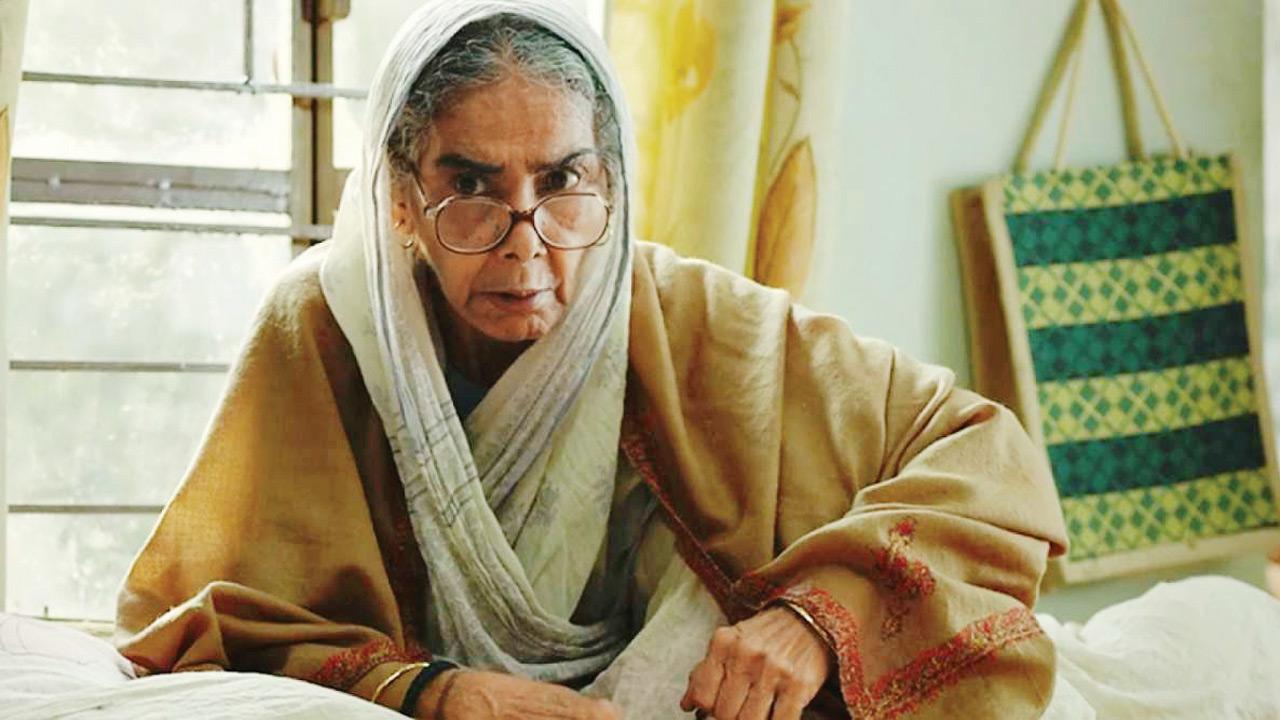
Surekha Sikri’s act as the sharp-tongued grandmother in Badhaai Ho won her, her third National Award
Shyam Benegal, whose Mammo earned Surekha Sikri one of her three National Awards, says the veteran actor was in a league of her own, thanks to her craft and dedication
Shyam Benegal (MID-DAY; July 17, 2021)
There is no greater delight for a filmmaker than finding an actor who can be moulded like clay at his hands. That’s how I remember Surekha Sikri, a fine blend of preparation and instinct. Being a National School of Drama graduate, she not only had a great sense of craft, but also an ability to bring more to the table than the written word. Trained under Ebrahim Alkazi, Surekha was one of the finest from the Delhi theatre circuit. When I first met her, she had delivered a brilliant play; I couldn’t get her performance out of my mind.
I got in touch with her when I was casting for Mammo [1994]. Ours was a strictly professional equation, but as a filmmaker, it was heartening to have an actor whom you didn’t need to brief at all. Thanks to her theatre background, she was among the most prepared artistes I have ever worked with. She knew what costumes she’d wear, and her make-up would be [perfect]. She would know her dialogues by heart, and everyone else’s too. Having her in the same frame helped other actors better their performances because she brought an incredible zest that elevated every scene. Surekha was never complacent — not when she worked with me in Mammo, and evidently not when she did Badhaai Ho [2018]. The fact that she won a National Award for Badhaai Ho speaks volumes about her commitment towards each performance.
I did three films with her, each of which have a special place in my heart. From Fayyazi in Mammo to Ittan bai in Sardari Begum [1996] and then revisiting Fayyazi in Zubeidaa [2001], she internalized every character. While she was always dependable, she would not depend on anyone. I wouldn’t call her reticent, but she was a non-fussy, quiet professional who did her work and left. I slowed down my work, and our paths didn’t cross in the last seven years. Today is a sad day for me. We lost an actor whom people failed to understand or value, for a large part of her life.
As told to Mohar Basu
Vanraj Bhatia hated being termed parallel cinema composer-Shyam Benegal
8:08 AM

As he bids farewell to the man behind gems of Bhumika, Manthan, filmmaker Shyam Benegal says musician friend Vanraj Bhatia craved commercial success
As told to Shaheen Parkar (MID-DAY; May 8, 2021)
I could not think of anyone other than Vanraj Bhatia as a composer on my films. All my projects, except those made in the last few years, had him on board. Having trained in Indian and Western classical music, his knowledge in both genres was deep-rooted. Even though we were long-time collaborators, we would squabble often. My Tardeo office would be rocked by our creative differences and arguments. He was critical of the kind of films I made, what was termed the parallel cinema or the New India Cinema. He used to complain that I [didn’t] use his music [to maximum effect]. My films did not have the hero running around trees and singing — something that he would have probably loved. [Despite our] different tastes in cinema, he would create the best score for me.
He was inclined towards music from his student days, and in the ’50s, spent several years in Paris, studying with the legendary composer-conductor, Nadia Boulanger. After returning to India, theatre doyen Ebrahim Alkazi asked him to teach music at the National School of Drama in New Delhi. It was a short stint in the early ’60s because he soon realised that he wanted to compose music.
He shifted back to Mumbai, and began scoring music for ads and jingles. At the time, I was working with Lintas. We worked on several projects together, and in due course, struck up a friendship.
When I moved to feature film direction with Ankur [1975], he was the obvious choice. He was more inclined towards Western classical music, whereas my films — be it Nishant [1975], Manthan [1976] or Bhumika [1977] — were earthy and had inherent Indianness to them. But his knowledge of music was so profound that he could showcase his brilliance, regardless of the film’s subject.
He was at ease composing the folk song, Mero Gaam Katha Parey, which became Manthan’s iconic track. It was later used by Amul as the theme song for their campaign to showcase the model of cooperative farming. Baaju Re Mondar [Bhumika] showcased his classical excellence.
Even though he bagged the Sangeet Natak Akademi Award and the National Award, he never got his due. He did not achieve popular success, like say Shankar-Jaikishan did; he craved it. He hated that he was termed a composer for parallel cinema. He would have liked to do more commercial films, but his sensibilities did not match. He was an evolved and sophisticated musician; there was no crudeness to his music.
Bollywood is not an ashram in the Himalayas-Shyam Benegal
8:29 AM

Juhi Chakraborty (HINDUSTAN TIMES; October 2, 2020)
For someone who has been part of the film industry for over five decades, Shyam Benegal has seen it all. However, the recent controversies, especially the Bollywood drug nexus debate has astounded him.
“There is as much good or bad in the film industry as there is in India. Why is everybody pinpointing the film industry as though it is some kind of den of vice. It does not make any sense to me. Everyone is making so much of something that does not deserve to have so much news print and TV time,” shares Benegal.
The 85-year-old filmmaker says he does not get the vilification narrative that is being shared by many in the current scenario. “I can’t see the vice and virtue part really. Don’t expect the film industry to become some kind of paragons of virtue. That would be rather silly. It is not an ashram in the Himalayas. It is part of life and part of our everyday existence where you have good, bad and all sorts of things. It is how life is. Film industry is a representation of that,” he explains.
However, Benegal is positive that the film industry will come out of this, and the audience will decide whether to watch a film or not purely on the basis of talent. “An actor is known for the quality of work that they bring. I don’t go to see a film because the actor in it has created a scandal. I go because I want to see quality performance,” he concludes.
How are we maligning the Prime Minister by writing a letter to him?-Shyam Benegal
8:13 AM

Shyam Benegal defends his stance as FIR lodged against 50 personalities, including Anurag, Konkona, Aparna Sen, for their open letter to Modi over mob lynching
Sonil Dedhia (MID-DAY; October 5, 2019)
 "How are we maligning the Prime Minister by writing a letter to him," questions Shyam Benegal, shocked at the recent turn of events. On Thursday, an FIR was lodged in Muzaffarpur, Bihar, against 50 celebrities — including Anurag Kashyap, Aparna Sen, Konkona Sen Sharma, Mani Ratnam and Benegal — for having written an open letter to Prime Minister Narendra Modi in June, expressing their concern over the rampant incidents of mob lynching. The case was lodged after an order was passed by Chief Judicial Magistrate Surya Kant Tiwari on a petition filed by Bihar advocate Sudhir Kumar Ojha. In his petition, Ojha stated that the letter "tarnished the image of the country and undermined the performance of the prime minister" besides "supporting secessionist tendencies".
 Benegal is appalled that their attempt at a dialogue with the prime minister has been coloured by negativity. "The PM is the foremost public figure of our country, and we never made any personal comment. We live in a democracy, and freedom of speech is a constitutional right. We voiced out [a problem] that we thought needed the prime minister's attention."
When mid-day reached out to Sen, she termed the FIR — that was lodged under sections of the Indian Penal Code, including those relating to sedition, hurting religious feelings and insulting with an intent to provoke breach of peace — as "blatantly ridiculous". "Our letter had nothing that can be misconstrued as anti-national, seditious or one that maligns anyone. It was a politely written letter, appealing to the prime minister to stop lynchings because we thought that minorities, including Hindu Dalits, need to be protected. We are within our rights to say this to our elected prime minister."
The letter appealed that the lynching of "Muslims, Dalits and other minorities must be stopped immediately." It emphasised the need for strong action from Modi. "You have criticised lynchings in parliament, but that is not enough. We feel that such offences should be declared non-bailable," it read.

Waheeda Rehman was not confident I could pull Ankur off, having never made a film before-Shyam Benegal
8:14 AM

Roshmila Bhattacharya (MUMBAI MIRROR; September 21, 2019)
 In early 1973, Shyam Benegal, an ad filmmaker, decided it was time to make a movie. He already had a story in mind, and also an actress—Waheeda Rehman, who had worked with his cousin Guru Dutt and whose work he admired to play the central character.
Laxmi, a maid from a lower caste, is married to a deaf-mute drunk. She’s seduced by circumstances and false promises into having an affair with the young landlord, Surya, only to be left high and dry after she discovers she’s pregnant with his child. What made Guide’s Rosie the ideal choice for Ankur’s Laxmi was that being from Telangana where the story was set, Waheeda ji could speak the local dialect Dakhini fluently. “But she was a big star at the time while I was a debutant director. She was not confident I could pull it off, having never made a film before,” Shyam babu reminisces with a laugh.
After Waheeda ji turned him down, he thought of approaching National Award winning actress Sharada who had worked in Telugu films. But he changed his mind when he learnt that not being from Telangana, she couldn’t speak the lingo, a mix of Hindi-Urdu, which was essential to fleshing out the character.
That’s when one of his assistants told him about this girl who, while studying at St. Xavier’s college, had impressed in a couple of stage productions. “Does she have a background in performing arts?” he wondered, and was told that her father, Kaifi Azmi, was a famous poet, while her mother, Shaukat Kaifi, had done a lot of theatre. She, too, was a graduate from the Film and Television Institute of India (FTII). Instantly interested, he asked for her to come and meet him.
“One look at Shabana (Azmi) and I knew she was perfect for Laxmi. Yes, she was young and looked young too, but I was willing to tweak the role for her. Going with my instincts, I immediately signed her on, after learning that since her mother was from Telangana, she spoke Dakhini. I didn’t even audition her like I had Anant (Nag) who played Surya, surprising even her,” he flashbacks.
Anant Nag had accompanied an actor whose name Shyam babu has since forgotten, for an audition. “He came to offer moral support to his friend and caught my eye. I auditioned Anant as well and finding him perfect, introduced him in Hindi films. He became a big star in Kannada cinema but always made time for a role in my films,” Shyam babu smiles.
And so, Ankur rolled, with a team of newcomers, with the exception of cinematographer, Govind Nihalani, who had some cinematic experience having assisted V K Murthy. Straightaway, Shyam babu, with his two first-time actors, along with Sadhu Meher (he played the deaf-mute husband), dived into a dramatic scene wherein Laxmi rushes to rescue Kishtaya who, accused of stealing toddy, is being mercilessly whipped by Surya.
Shabana Azmi turned out to be a real find. Her performance bagged her many awards, including the National Award for Best Actress. “She’s an incredible actress with a huge range. Give her a role and Shabana owns the part,” raves her mentor, pointing out that the actress who brought in her 69th birthday on Wednesday, has also earned a reputation internationally, on screen and on stage.
Ankur also bagged the Best Actor award for Sadhu Meher and was adjudged Second Best Feature Film at the National Awards. “It made me a filmmaker and I never went back to advertising,” points out Shyam babu, who’s seen as the pioneer of parallel cinema in India.
After Ankur, he signed Shabana ji for Nishant, Junoon, followed by Mandi in which she played the madam of a brothel. “She was a really slim girl then, I pushed her to put on weight because I wanted Rukmini Bai to be a well-endowed woman, who chewed paan, cracked betel nuts and kept the girls in place,” Shyam babu recalls.
The duo went on to do more films but haven’t worked together of late. Has his protégée changed as an actress or a person in the decades since, you wonder, and he quips, “No, except for the weight she’s put on, which, as I have told her innumerable times, I don’t like. I guess Mandi is partly to blame for it and I will always feel guilty for that.”
If there was no TV, people wouldn't have seen Shyam Benegal's films-Anurag Kashyap
8:59 AM

Genteel doyen Shyam Benegal and Bollywood's enfant terrible Anurag Kashyap on how India's movie capital shaped them, and they shaped it too
Mayank Shekhar (MID-DAY; June 28, 2019)
It's pre-noon. We are at Shyam Benegal's office in South Mumbai. Anurag Kashyap has travelled all the way from Oshiwara in North Mumbai, where Bollywood currently resides. Between two of India's most iconoclast filmmakers rest stories that equally span the journey of Mumbai as a movie capital, since they also personify the change that they wished to see.
What we didn't know is Kashyap's own struggles in this city, when he moved from Delhi in 1993, began from the same Everest building, Tardeo office we are at. It was the first door he'd knocked, looking for a job. This is his first visit since. Understandably, we start the conversation with:
Mid-Day: What Happened When You First Came To Mr Benegal's Office [In 1993]?
Anurag: It was my second day in Bombay, rainy June 4. I found his address, and came right here. Shyam ji wasn't in. I met a sweet man, Mr Ravi Khemu [actor Kunal Kemmu's father; Benegal's associate]. He realised I'd only watched movies at film festivals, and recommended that I go to FTII. The exams of which were over. Then he gave me other addresses — of Govind ji [Nihalani], and Prahlad Kakkar, who was also in the same building. Eventually, I realised, I needed to do something [for a résumé], before looking for a job.
Mid-Day: Mr Benegal, You've Been In This Office For Years. Even Up Until The '90s, South Bombay Was Actually The Hub Of The City's Film Industry, Wasn't It?
Benegal: I've been here since the '70s. Before this, I used to be at Jyoti Studios [in Nana Chowk]. It was the first sound studio in the country — Alam Ara [1931] was shot there. I used to love that place. Just about anybody/everybody in the history of Indian/Hindi cinema had worked at Jyoti Studios. For years, before things became expensive in this part of the world, and offices moved to Dadar and thereafter, Andheri, this street in Tardeo was the capital of the entire film industry.
Anurag: When I came to Bombay, Lokhandwala was a small hub, with Four Bungalows, and a road between them. Nothing else. Zee and STAR had started setting up offices, and we used to come to Worli all the time. The student-lot, like Imtiaz Ali, stayed at Lalbaug.
Benegal: The film industry had been gradually moving northwards given land value. B R Chopra used to be in Parel, and then his brother [Yash Chopra] moved further up [to Juhu]. Now, many have moved beyond Andheri because it's not affordable.
Mid-Day: Has The Demographic Of People Looking For Jobs In Films In Bombay Changed Over The Decades?
Benegal: Not at all. Most of them come from smaller towns with stars in their eyes, given the larger-than-life image of cinema itself.
Anurag: Most of them come here to be actors. But now with so many job opportunities in various media, what's come down is passion for making a movie — and living and dying for it.
Mid-Day: When You Hang In Versova/Andheri, The Sense You Get Is That Actually Everyone Is From Delhi. Did That Begin In The '90s?
Anurag: A lot of people moved from Delhi, after Shah Rukh Khan. Delhi had a strong theatre scene, where Shah Rukh used to do smaller roles. But when he broke out [in the mainstream] in such a big way, everybody came to Bombay thinking, if Shah Rukh can, so can we. The exodus that was otherwise taking place anyway didn't comprise people who wanted to be part of mainstream. We liked a certain kind of cinema and theatre, and wished to be part of it. The entire cast of Bandit Queen moved to Bombay from Delhi after the film. Piyush Mishra even wrote a play about it called Jinhe Jaldi Thi Woh Chale Gaye!

Mid-Day: By The '80s, Mr Benegal, While You Were An Established Filmmaker, Your Cinema Must've Been Still Hard For The City's Showbiz To Define Within Its Constructs. True?
Anurag: They used to call it "parallel" cinema [laughs].
Benegal: I hated those terms! Somebody once called me a middle-of-the-road filmmaker. I said if I stand in the middle of the road, I'd get run over! Calling something alternate/parallel denoted a caste system. The terminology automatically indicated that nobody can see your films. Even with press reviews, while they wrote good things, there would always be a line, "This is not for general public!" That's it. Killed your film! [laughs].
Anurag: And we were categorised the "Shyam Benegal" type! Which means I need another job to sustain myself.
Mid-Day: Say A Karan Johar Collaborates With Anurag. Curious To Know How Mainstream Showbiz Comprising Manmohan Desais Of The World With Amitabh Bachchan At The Centre Interacted With You Personally, Mr Benegal.
Benegal: I had a similar kind of [joint] conversation [for the press] as we're doing now, with Manmohan Desai, and it went off quite well actually! And there was no feeling [of discord with people from "commercial cinema"] of any kind, seriously. Because you were not seen as a threat. They could be very patronising.
Anurag: There must also have been resentment that if people like Shyam ji didn't exist, then all other awards could've also been ours — outside of box-office! [laughs].
Mid-Day: Anurag, You On The Other Hand, Were The Wild-Child Seeking Validation From The [Mainstream] Film Industry. Threat In That Sense?
Anurag: I made myself into one! My career started precisely because I wasn't a threat — available to do any job for free, because I was learning, and figuring out if I can do it, or not. That's how I broke in. In the early 2000s, I started fighting aggressively for sustenance of a certain kind of cinema. Because I realised the '70s/'80s were not going to come back. Back then, to watch a film that I wanted to, I'd have to travel all the way to Town, that too to one cinema, which was playing one show, over 20 weeks! And even that began to be taken away from us. It was a massive fight.
Benegal: Multiplexes [that came in after] made a huge difference. It gave an incredible boost to filmmakers who were not part of the mainstream, as it were. Because, you had to fill a theatre of 60 or 100 seats, which was not so difficult.
Anurag: Single screens were very different for us. How do you fill up that many seats? And they wouldn't give us more than a morning or a late-night slot.
Benegal: And if you couldn't get 80 per cent audience on the first weekend, you were out on Monday. Even if you filled up 75 per cent of a 1,000-seat cinema, you'd still be out.
Mid-Day: When Television Entered The Scene In The '80s, Did That Change Things For You As A Filmmaker, Mr Benegal?
Benegal: Of course. For one, people who had never seen my films started watching them, because they were coming to your home. That's really where I developed an audience.
Anurag: That's when our fathers said, his film is coming, watch it on TV. Our introduction to his works was the TV series, Bharat Ek Khoj.
Mid-Day: While We Categorise Films As Mainstream/Parallel, The Fact Is Both Of You Have Been Commercial Filmmakers, Backed By Private Funding With Expectation Of Returns, Isn't It?
Benegal: Except for Suraj Ka Satvan Ghoda [1992] and Mammo [1994], which were NFDC [state-funded] films, all my features were made through regular, private finance. Naturally, they had to cover their cost. There's no way I could've remained a filmmaker, if they didn't. Any filmmaker would feel commercial pressure. But you really have to work on strategies, and be clever to get your way.
Anurag: You have to say things that people believe in, to protect your vision.

Mid-Day: Both Of You Worked With New Actors, Who Could Build A Fresh Audience-Base. Say Nawaz, Vicky, Etc. In One Case; And Naseer, Shabana, Smita And Others In The Other. This Created A Parallel Star-System Of Its Own, Didn't It?
Benegal: It did, to the extent that some of them [actors] started to resent it! [laughs]. They weren't getting an 'in' into the mainstream. Because they were considered to be a certain 'type' of actors. Well, you can't beat the system in matters like these. I wanted to make films that I wanted to make, and in my own way. I don't think there was any intention beyond that.
Anurag: All my actors at least get strong-character, or even lead, roles in the mainstream. That transition has happened. Because the old star-system doesn't work anymore. There's greater democracy over how the medium has changed, especially with the advent of the Internet. A person who pulls in the biggest crowds these days is Bhuvan Bam, who's a YouTube sensation.
Mid-Day: The Way Mr Benegal Did With Actors Fresh From FTII In The '70s, You Also Created A Similar Ecosystem, Decades Later, In Mumbai, Though.
Anurag: I didn't do it thinking I was creating a new ecosystem. I didn't have money, so I developed a new way of making movies. It started with Black Friday [2007] — shooting on the street, in full public view. I had no option but to hide cameras, and shoot everywhere. I had no money to create Zaveri Bazaar, so I'd shoot there.
Mid-Day: Black Friday Was Produced By Mid-Day.
Anurag: Which helped, because mid-day gave us these badges, that we flaunted around saying we're shooting a documentary. In the process, I learnt how to shoot on streets without people ever finding out. Primary requirement of that language is to work with people who won't be recognised. I went looking for good actors, with screen presence, and who aren't known. So I created casting systems, with [people like] Gautam [Kishanchandani], Mukesh Chhabra..
Mid-Day: For The Longest, Since Local Distribution Was A Bottleneck, Did You Both Consciously Look At International Markets To Expand Audience-Base?
Benegal: I never did. But because my first film Ankur [1974] went to a few international film festivals, garnering excellent audiences, I found a distributor with presence in all of western Europe. And another distributor in Britain, with a string of art-house cinemas in London. Automatically, my films after that got distribution.
Anurag: I was only trying to survive, having grown tired of people telling me that nobody would want to see my films. I spent considerable time trying to understand that market. I had to make a film that I owned — That Girl In Yellow Boots — so I could experiment in that direction.
Benegal: Now you have OTT platforms. You find your films in their bank. They're available to people all over the world.
Mid-Day: Given Where We Are Now, With The Internet, Where Practically Everyone Is A Filmmaker, Do We Even See Mumbai As A Centre Of Filmmaking In The Future?
Anurag: The world's completely changed. I just saw a whole shoot, where the producer is Bengali, the film is in Hindi, the filmmaker is from the South, the cinematographer is from Poland, sound-designer is from elsewhere. Everybody had only met on the Internet. And they're now making a film together.
Mid-Day: Looking Back At 40 Years Of Films, If You Were To Place A Turning Point, Where Would That Be?
Benegal: It was television, which went national. That made the huge difference.
Anurag: I think it was television, when it came in the '80s. And then Internet, which went global. If there was no TV, people wouldn't have seen Shyam ji's films. Likewise, if there weren't pirated downloads on the Internet, they wouldn't have seen my films either.
Mid-Day: Disappointed That Two Filmmakers Are Calling TV And Internet As Turning Points. There's Still Cinema, Right; Or Is That Charm Over?
Anurag: It's my personal choice to watch films in cinemas. But I can't deny that I found my audience online.
Benegal: The classic distance that you must keep from any screen is two and half times its diagonal length. That gives you the kind of image that you'd get in a cinema hall. I can get that in my home — on a large screen, with surround sound, the works. What I miss is the audience!

I want to see what all the fuss is about-Shyam Benegal on watching Padmaavat
7:12 AM

Shyam Benegal says he will see Sanjay Leela Bhansali’s film which is based on the same poem which had inspired his Padmavati episode in the Bharat Ek Khoj television series
Roshmila Bhattacharya (MUMBAI MIRROR; January 25, 2018)
 Sanjay Leela Bhansali’s period
drama Padmaavat opens in the theatres today and even as Ranveer Singh
takes on the menacing avatar of Alauddin Khilji, one is reminded of
another actor, the late Om Puri, who had played the same role with equal
elan but in a more understated way as a ruthless statesman in Shyam
Benegal’s ambitious 53-part TV series in the late ’80s, Bharat Ek Khoj.
Seema Kelkar was the legendary Queen, a role Deepika Padukone takes on
in the film, with Rajendra Gupta as her husband, Raja Ratansen (Shahid
Kapoor is Raja Ratan Singh today). Sanjay Leela Bhansali was a part of
the TV series too.
Sanjay Leela Bhansali’s period
drama Padmaavat opens in the theatres today and even as Ranveer Singh
takes on the menacing avatar of Alauddin Khilji, one is reminded of
another actor, the late Om Puri, who had played the same role with equal
elan but in a more understated way as a ruthless statesman in Shyam
Benegal’s ambitious 53-part TV series in the late ’80s, Bharat Ek Khoj.
Seema Kelkar was the legendary Queen, a role Deepika Padukone takes on
in the film, with Rajendra Gupta as her husband, Raja Ratansen (Shahid
Kapoor is Raja Ratan Singh today). Sanjay Leela Bhansali was a part of
the TV series too.
 “His sister, Bela Sehgal, was the chief
editor on the series and Sanjay was assisting her. The brother-sister
duo was working together and his name even featured in the credits as
part of the team that edited this particular episode (along with Dilip
Panda, Chakradhar Sahu and Ashok Swami),” reminisces Benegal.
“His sister, Bela Sehgal, was the chief
editor on the series and Sanjay was assisting her. The brother-sister
duo was working together and his name even featured in the credits as
part of the team that edited this particular episode (along with Dilip
Panda, Chakradhar Sahu and Ashok Swami),” reminisces Benegal.
Ask him why Padmavati featured in the series and he states that it is a “part of India’s history”. “We know that Khilji laid siege on the Chittorgarh Fort and the popular belief is that he had wanted to possess Queen Padmini, known for her legendary beauty, even though he never met her. He only saw her reflection in a moat and a mirror, according to the poem,” informs the Padma Shri and Padma Bhushan recepient.
Khilji appears in episodes 25 and 26 of the series which were aired in 1988-’89 on the national broadcaster Doordarshan. In the first episode, he is seen trying to find the reason behind the revolts and conspiracies in his kingdom and quells them with executions while episode 26 is completely based on Malik Muhammad Jayasi’s 16th century epic poem Padmavat which has also inspired Bhansali’s film.
Benegal refuses to be drawn into a debate on whether Rani Padmini really existed since he is not a scholar of history of that period. But he does argue that this particular poem has been accepted as a literary classic and has retained its bearing as it were for all these centuries. “Padmaavat is like Kalidasa’s Meghdoot, a great classic that people know. In that part of the country, it is sung as a ballad,” says the veteran filmmaker who even used the “Ghoomar” song in his series without any objections being raised. “I got Ila Arun and a popular folk singer from Rajasthan to sing for me.”
However, Benegal did not show the queen committing jauhar as is seen in the film. “It was difficult to depict it on screen but we did mention it. There is a reference to jauhar in the poem as well,” the filmmaker says.
Quiz Benegal on whether he faced any kind of disruption during the shoot like Bhansali and he is quick to retort, “None, there were no issues. The shooting happened without incident.”
So how does one explain the controversies that have dogged Padmaavat since the film rolled, right up to its release? “There must be some political reason for it. Some political consolidation is happening somewhere. I don’t want to speculate on it as I don’t understand the inner politics of Rajasthan where the problem appears to be,” Benegal shrugs.
Will he see the film? “Most definitely I will. I would like to know what the fuss is about,” he signs off on an enthusiastic note.
 Sanjay Leela Bhansali’s period
drama Padmaavat opens in the theatres today and even as Ranveer Singh
takes on the menacing avatar of Alauddin Khilji, one is reminded of
another actor, the late Om Puri, who had played the same role with equal
elan but in a more understated way as a ruthless statesman in Shyam
Benegal’s ambitious 53-part TV series in the late ’80s, Bharat Ek Khoj.
Seema Kelkar was the legendary Queen, a role Deepika Padukone takes on
in the film, with Rajendra Gupta as her husband, Raja Ratansen (Shahid
Kapoor is Raja Ratan Singh today). Sanjay Leela Bhansali was a part of
the TV series too.
Sanjay Leela Bhansali’s period
drama Padmaavat opens in the theatres today and even as Ranveer Singh
takes on the menacing avatar of Alauddin Khilji, one is reminded of
another actor, the late Om Puri, who had played the same role with equal
elan but in a more understated way as a ruthless statesman in Shyam
Benegal’s ambitious 53-part TV series in the late ’80s, Bharat Ek Khoj.
Seema Kelkar was the legendary Queen, a role Deepika Padukone takes on
in the film, with Rajendra Gupta as her husband, Raja Ratansen (Shahid
Kapoor is Raja Ratan Singh today). Sanjay Leela Bhansali was a part of
the TV series too. “His sister, Bela Sehgal, was the chief
editor on the series and Sanjay was assisting her. The brother-sister
duo was working together and his name even featured in the credits as
part of the team that edited this particular episode (along with Dilip
Panda, Chakradhar Sahu and Ashok Swami),” reminisces Benegal.
“His sister, Bela Sehgal, was the chief
editor on the series and Sanjay was assisting her. The brother-sister
duo was working together and his name even featured in the credits as
part of the team that edited this particular episode (along with Dilip
Panda, Chakradhar Sahu and Ashok Swami),” reminisces Benegal.Ask him why Padmavati featured in the series and he states that it is a “part of India’s history”. “We know that Khilji laid siege on the Chittorgarh Fort and the popular belief is that he had wanted to possess Queen Padmini, known for her legendary beauty, even though he never met her. He only saw her reflection in a moat and a mirror, according to the poem,” informs the Padma Shri and Padma Bhushan recepient.
Khilji appears in episodes 25 and 26 of the series which were aired in 1988-’89 on the national broadcaster Doordarshan. In the first episode, he is seen trying to find the reason behind the revolts and conspiracies in his kingdom and quells them with executions while episode 26 is completely based on Malik Muhammad Jayasi’s 16th century epic poem Padmavat which has also inspired Bhansali’s film.
Benegal refuses to be drawn into a debate on whether Rani Padmini really existed since he is not a scholar of history of that period. But he does argue that this particular poem has been accepted as a literary classic and has retained its bearing as it were for all these centuries. “Padmaavat is like Kalidasa’s Meghdoot, a great classic that people know. In that part of the country, it is sung as a ballad,” says the veteran filmmaker who even used the “Ghoomar” song in his series without any objections being raised. “I got Ila Arun and a popular folk singer from Rajasthan to sing for me.”
However, Benegal did not show the queen committing jauhar as is seen in the film. “It was difficult to depict it on screen but we did mention it. There is a reference to jauhar in the poem as well,” the filmmaker says.
Quiz Benegal on whether he faced any kind of disruption during the shoot like Bhansali and he is quick to retort, “None, there were no issues. The shooting happened without incident.”
So how does one explain the controversies that have dogged Padmaavat since the film rolled, right up to its release? “There must be some political reason for it. Some political consolidation is happening somewhere. I don’t want to speculate on it as I don’t understand the inner politics of Rajasthan where the problem appears to be,” Benegal shrugs.
Will he see the film? “Most definitely I will. I would like to know what the fuss is about,” he signs off on an enthusiastic note.
We had no money for publicity; I told Shabana Azmi & Smita Patil to roam in Cannes in sarees-Shyam Benegal
7:40 AM

Roshmila Bhattacharya (MUMBAI MIRROR; October 19, 2017)
The first thing Shyam Benegal remembers about his protégé, Smita Patil, was her natural talent and reluctance as an actress. She was studying at St. Xavier’s College when he approached her to play the queen in a children’s film, Charandas Chor. “She was very hesitant. Her mother told her not to be silly and let the opportunity slip away,” he narrates.
Soon after, the filmmaker whisked her away to Chattisgarh for the shoot, where she was thrown in the company of Habib Tanvir’s village actors, some farmers, some local traders, who were reprising their roles from the original play. “Smita quickly became a part of the team, having no starry airs or pretensions, a quality that made her special even after she became Bollywood’s leading lady. She would haul the lights and the cables, serve meals. No one realised that she was homesick. Those days there were no cell phones, and in locations as remote as ours, you could at best book a lightning call from the local post office, which was not always possible. So Smita, who was away from her family for the first time, wrote a letter to her mother every day, but otherwise never let slip just how lonely she was,” he says.
The same year, she also played Naseeruddin Shah’s wife, Rukmini, in his Nishant, which went on to bag the National Award for Best Feature Film in Hindi and was only the second Indian film in competition for the Palme d’ Or at the 1976 Cannes Film Festival. “It was a huge honour, but being a poor ‘art’ filmmaker as compared to the other competitors who came from larger industries we had no money even to print posters. So I asked my heroines, Smita and Shabana Azmi, to drape themselves in gorgeous temple saris and walk up and down the Cannes Crussell. They immediately caught everyone’s eye and their photograph appeared on the front page of the local newspaper along with news of the Nishant screening and we had a packed house,” says Benegal, chuckling at the memory.
They did other films together, including Manthan and Bhumika. The latter was broadly based on the memoirs of Marathi actress Hansa Wadkar, Sangyte Aika, with Smita playing Usha, a role that spanned from 16 to 46. “It was a challenge as she was just around 22-23 at the time and had to literally grow up from an adolescent to a mature woman and to familiarise herself with the industry and its trappings. I had taken her to Cannes for Nishant, which was perhaps her first foreign trip. Bhumika fetched her the National Award and the Filmfare Award for Best Actress and she grew up to become one of our finest performers recognized the world over with a unique ability to blend into her surroundings,” he says, recalling the time when they were filming Manthan in Saurashtra, about 35-40 kms from Rajkot. “Smita who played a village woman, looked so much like one, that the college boys who had cycled all the way down from Rajkot after reading that a film unit was shooting in their part of the world, almost didn’t recognise her as she squatted on the floor of her home, leaning against the mud wall. They were whispering amongst themselves wondering about the heroine when one of them suddenly pointed to Smita.”
On October 17, Smita would have turned 62. Ask Benegal how he imagines she might have been today and he sighs, “I can’t, she never thought she would grow into an old lady. She would always say I’ll die young and though I would reprimand her for getting morbid, it happened that way.”
Nobody has done anything unpatriotic-Shyam Benegal takes up for Karan Johar
9:32 AM

Shyam Benegal takes up for Karan Johar, says government must protect vulnerable film frat
MUMBAI MIRROR (October 20, 2016)
 Saddened to see Karan Johar
being unnecessarily harassed for casting Pakistani actor Fawad Khan in
his upcoming Diwali release, Ae Dil Hai Mushkil, the 81-year-old
filmmaker Shyam Benegal wants the government to step in to protect the
film industry which is particularly vulnerable.
Saddened to see Karan Johar
being unnecessarily harassed for casting Pakistani actor Fawad Khan in
his upcoming Diwali release, Ae Dil Hai Mushkil, the 81-year-old
filmmaker Shyam Benegal wants the government to step in to protect the
film industry which is particularly vulnerable.“I am very saddened by what he had to say because the poor chap (Karan) is being unnecessarily harassed in a way, after all over Rs 50 crore is at stake. What do you expect him to say?“ Benegal sighed, saying the film fraternity which is particularly vulnerable needs to be protected from people who threaten or attack them. “We cannot avoid these things. The government has to protect us against these kind of attacks.“
Benegal who heads the government-appointed revamp panel of the Central Board of Film Certification (CBFC),was referring to threats from political outfits to multiplexes screening the Ranbir Kapoor-Aishwarya Rai Bachchan-Anushka Sharma-Fawad Khan-starrer. On Tuesday, in a two-minute long video, Karan said that he is hurt at being labelled an “anti-national“ ahead of his next directorial and asserted he would not engage with talent from Pakistan going forward given the circumstances but pointed out that 300 Indian crew had worked on Ae Dil Hai Mushkil and it is not fair to face any kind of turbulence on account of the fellow Indians.
The protests came in the wake of the September 18 Uri attacks that killed 19 Indian soldiers, followed by India's surgical strikes on terror camps across the LoC. The Indian Motion Picture Producers Association (IMPPA) passed a resolution asking producers to avoid working with talent from Pakistan.
Last week, the Cinema Owners and Exhibitors Association of India announced single screen theatres in Maharashtra, Goa and Gujarat won't screen ADHM. The Maharashtra Navnirman Sena (MNS) issued an ultimatum to Pakistani artistes to quit India and has threatened to disrupt screenings of Karan's film.
“Nobody has done anything unpatriotic. If you were born here, got your education here, are working here, making your livelihood and voting in every election, then why should you be constantly told to prove your credentials. What more credentials do you want? Every morning I don't have to say from my terrace that I am an Indian, and I am proud to be one,“ Benegal argued, pointing out that when the relationship between the neighbours was cordial, we were taking people from Pakistan and our actors and directors were also going to the other side. “It was stopped because of the skirmishes on the border. This is a temporary thing.“
Tampering with movies is not the job of the CBFC-Shyam Benegal
7:49 AM

Shyam Benegal talks about the new grading system for films which has been proposed by the revising panel led by him
Mohar Basu (BOMBAY TIMES; April 28, 2016)
There was a sense of relief
when the Information and Broadcasting (I & B) Ministry set up a
panel on January 1 this year to suggest necessary changes to the
existent set of guidelines. Many filmmakers have been vocal about their
grouse against the current CBFC (Central Board of Film Certification)
Chief Pahlaj Nihalani, in whose tenure several instances of harsh
censorship came to light. When BT spoke to Mr Benegal in January, a week
after his appointment, he had made his vision clear - “Censorship is the
complete antithesis of democracy.“ Four months later, on April 26, the
Benegal-led panel submitted their first set of propositions to the
I&B Minister Arun Jaitley.
The panel, staying true to their promise, reinstated that the 'CBFC
should not be using scissors on any film'. They have recommended a new
system of grading films depending on their suitability for various
audience groups. The grades include: U, U/A12 (Children above the age of
12) and U/A15 (Children above the age of 15). Additionally, the A (Adult)
category has been branched further into Adult and Adult with Caution.
Benegal told us, “The sub-categories are necessary inclusions. A film about child trafficking cannot be restricted to adults. It is essential that teenagers watch and understand these issues. Parental guidance at that age is crucial. Also, the category Adult (With caution) is imperative. In India, it is mostly seen that films with detailed depiction of sex or nudity find it hard to make it to the theaters. In case a certain movie needs restricted viewership, it will be shown only in selected theatres after 11 pm. With the current classification, clear categories have been marked out for films. This category exists in many countries but for India, it is the need of the hour.“
When a film doesn't fit into any of the above categories, filmmakers could request for re-certification after self-censorship. Benegal and his team are clear that editing is the job of creative people alone. He elaborates, “In order to ensure better transparency in the system, if things need to be changed in the film, they must be done by filmmakers themselves. Once denied certification, they can always re-apply. Tampering with movies is not the job of the CBFC. So far, people would get stuck in between the Examining Committee and the Revising Committee, where they were asked to delete scenes and tone down violence or steamy content. But people making those remarks aren't creative people. Only a film's production team should be allowed to make edits.“
Ask him if this will render the Censor Chief powerless, Benegal is quick to add that the role of the CBFC head is to function as a mentor and guide for the Board and not be involved in the day-today affair of the certification of films. However, the panel has bought more time from the Ministry to look into the other challenges that filmmakers face. “We had to present the first set of recommendations by the end of this month, which we have done. But we have been granted extension till mid-June to look into other areas like procuring permission for cruelty towards animals and smoking disclaimers in each scene. We continue to get suggestions from people on the official website of NFDC (National Film Development Corporation of India). Our recommendations were based on the responses we received from filmmakers and the general public and we have done our best to ease things out for the administration as well as the industry,“ he adds.
Benegal told us, “The sub-categories are necessary inclusions. A film about child trafficking cannot be restricted to adults. It is essential that teenagers watch and understand these issues. Parental guidance at that age is crucial. Also, the category Adult (With caution) is imperative. In India, it is mostly seen that films with detailed depiction of sex or nudity find it hard to make it to the theaters. In case a certain movie needs restricted viewership, it will be shown only in selected theatres after 11 pm. With the current classification, clear categories have been marked out for films. This category exists in many countries but for India, it is the need of the hour.“
When a film doesn't fit into any of the above categories, filmmakers could request for re-certification after self-censorship. Benegal and his team are clear that editing is the job of creative people alone. He elaborates, “In order to ensure better transparency in the system, if things need to be changed in the film, they must be done by filmmakers themselves. Once denied certification, they can always re-apply. Tampering with movies is not the job of the CBFC. So far, people would get stuck in between the Examining Committee and the Revising Committee, where they were asked to delete scenes and tone down violence or steamy content. But people making those remarks aren't creative people. Only a film's production team should be allowed to make edits.“
Ask him if this will render the Censor Chief powerless, Benegal is quick to add that the role of the CBFC head is to function as a mentor and guide for the Board and not be involved in the day-today affair of the certification of films. However, the panel has bought more time from the Ministry to look into the other challenges that filmmakers face. “We had to present the first set of recommendations by the end of this month, which we have done. But we have been granted extension till mid-June to look into other areas like procuring permission for cruelty towards animals and smoking disclaimers in each scene. We continue to get suggestions from people on the official website of NFDC (National Film Development Corporation of India). Our recommendations were based on the responses we received from filmmakers and the general public and we have done our best to ease things out for the administration as well as the industry,“ he adds.

Students are not criminals, don’t treat them like enemies-Shyam Benegal on FTII arrests
2:46 PM

Aaron Pereira (THE INDIAN EXPRESS; August 19, 2015)
On Tuesday night, the Pune Police cracked down on protesting students of the Film and Television Institute of India (FTII) and arrested dozens of students for gheraoing the institute’s director Prashant Pathrabe over the ‘assessment’ process of projects pending since 2008. Speaking to The IndianExpress.com, veteran filmmaker Shyam Benegal condemned the police action saying students were not criminals, and that both, the administration and the protesting students, need to sit down and resolve the crisis. Benegal also said that if given the opportunity, he would consider heading the institute for a third time. Excerpts of the interview:
What’s your reaction to the Pune Police swooping down on protesting students in the middle of the night?
This is the worst thing that could have happened. The worst thing. This is something we have been preventing for a long time, even when I was chairman. Twice I was chairman, there were strikes but we never ever even once invited the police into the campus. And I believe that whatever problems the institution might have between the powers that be and the students, I don’t believe a third-party is necessary there at all.
According to me, that vitiates the atmosphere forever. In an educational institution, there’s a Laxman Rekha there. You don’t allow a third-party (police) to come in. You should be able to solve the problems between the institute and those who are fighting against it. This is ridiculous. It has never happened before and I am absolutely shocked at the fact that the police were invited into the institution to take students into custody.
Is it now taking a political turn? Rahul Gandhi has met with the students, Arvind Kejriwal has offered students a temporary location in Delhi…
Whatever that might be, the fact is that first of all, I think it was a mistake in the first place for students to go inviting people from various political parties. I think that was a mistake in the first place. It’s a very ordinary problem. The problem is that they have disagreed with the person (Gajendra Chauhan) who has been chosen as chairman as they feel the person does not have credentials for the job. This is fine. Now the fact is credentials ultimately mean you’ve got a doctorate or you don’t have a doctorate. Ultimately, that is not of real consequence. Capability is something that is of consequence.
Now, if you’re not sure of a person’s credentials, at least be sure about his capability. And in order to do that, the students simply have to invite him, grill him, satisfy yourself whether the man is capable or not. Then go on a strike if you want to and believe he’s not. But all this has not been done. They went on strike straight on. That is the last option. In any student’s armory your final card is a strike. You shouldn’t use the word strike like it’s an ordinary thing. Only after you’ve exhausted all your other options (you should go on a strike). Because, it will end in a way that it has now ended, which is unfortunate… for the institution. Because a third party has walked into it and it has become a law and order problem. There was no need for any of this. Student’s are not criminals. I still can’t understand why it had to go this extent.
What do you see is the way out for the students and administration to end the logjam?
Well the option before them is that the administration and the students should sit and talk to each other. Invite the chairman-designate. That is the best way to deal with it. You have to worry about capability, not credentials. There are people who are very capable but who may not necessarily have the kind of credentials on paper. Also, he’s not somebody who’s going to be teaching you. He’s a chairman who’s there on the level of policy. As a chairman of the society, he has to see that it works well because the society is autonomous and although it depends on the government for money, the government does not interfere with its working.
But what about his close links with the BJP?
I can have close links with anybody. Why should that be a negative factor against me? I have every right to have a political view point as long as it’s not a view point that goes against the Constitution of the country. That’s the final boundary. You don’t cross that. People stand for elections, I can adhere to any political party. Nobody can stop me from doing that. Why should that come in the way? If you’re going to say ‘he’s going to push that ideology down my throat’, you are there, no? Why are you there? He has not done that yet. He hasn’t even taken up charge yet. There’s enough time for you to check out if he will move in that direction. In any case, as I said, as students, you have an interface with the director. You are there everyday.
But the faculty has backed the students in their protest
The fact is the faculty will support the students because they have to deal with them everyday of their lives. So the faculty will have a sympathy with the students. I can understand that. But the faculty also has a place in the governing council, where they can put forward these views. They just pushed themselves into opposite corners to which now there is no middle ground left. And if there’s no middle ground left, then this is what will happen. The police will walk in. I personally feel this is very unfortunate as I don’t think the acting-director should have invited the police.
But the students gheraoed the director…
I was gheraoed too. When I was the chairman for the first time, I was gheraoed not just for two-three hours. I was gheraoed for the entire night. I called for a meeting the next day and said I want to meet the entire student body and not just the union. And when that happened, we solved the problem. It just meant that I lost my night’s sleep! Ultimately, it’s an educational institution… student’s have come there to study. They are not enemies. The administration should not take them to be enemies. The students too should not take the administration as enemies. They are supposed to be working together.
What about students who are yet to complete their projects, pending since 2008? The administration has sent them notices asking that they vacate the premises.
To vacate the premises will happen only when they go on strike like this for two months. But this is something that I have never understood. Why should projects that students took up in 2008 are not yet completed? Somebody has got to examine that. I wouldn’t know why. I blame both, the students for not completing their projects and the institution for not seeing to it that they do. I don’t know if there were shortcomings on the part of the institution. I haven’t been part of it for a long time. But that is one of the most unfortunate things that can happen. It’s 2015 and we’re talking about students who have incomplete work since 2008. Nothing can be more shocking than that.
You were among those that the government was considering to head the institution. Were you informed about it?
I haven’t been informed about it. But let me put it to you in another way. I have headed the institution twice already. And now it’s been about 25 years since I finished my second stint. Now, the fact is I’m 80 years old. It’s not normal for someone who is 80 to be made chairman of an institution that’s funded by the government. Nobody has approached me, but it’s possible that I may accept it. The only thing people can do at my age is to join politics!
Are you open to joining politics?
(Laughs) I am only joking. I’m just saying that there’s no age limit for one to turn into a politician.
But if asked to head the institution, perhaps in a larger role as an advisory role, would you accept?
Yes of course, why not? I am a professional film maker. All my working life I have been a working filmmaker. Now obviously If I don’t take interest in film education, who else would? It’s a commitment I’ve made for life. Of course If anyone wants an opinion from me or views they consider worthwhile, then certainly I am available. I’ve never said no to anyone. But my only concern is that the institution, both the administration and the students have both been extremely pig headed and they’ve pushed themselves into a situation where they’ve left no middle ground. Where they can come and talk to one another as they should. If exercises that should have been done in 2008 have remained incomplete then there’s something seriously wrong. Don’t you agree? This is absurd.
Would you be open to being a mediator and help resolve this crisis?
What I would like to do is find out more about the problem and see if there’s any solution that is acceptable to both sides. I have a feeling the ministry itself is sitting in Delhi. They’re not sitting in Poona. The kind of information they may get is also probably not absolutely accurate. We don’t know, sitting in Bombay, what’s happening in Poona.
What in your opinion can the students and administration do to end the crisis?
The police coming in was very bad. I think it shouldn’t be allowed at all. I don’t think students should be put in lock-ups. They should be sent back promptly. They are not criminals, they are students. That is not the way to handle the issue. Unless, of course, the students threatened someone or have beaten up someone belonging to the administration. I would like the administration to extend a hand to the students. You can’t sit on a high horse. Unless if you want to close down the institution which they have every power to do. Which would be a great loss although we have many film institutions in the country today. I think FTII has a special place because it is a tried and tested system in cinema and television.
MAMI is not my inheritance-Shyam Benegal
7:38 AM

Shyam Benegal, who has made way for Kiran Rao as the new Chairperson of MAMI, talks about the change in leadership and the future of Indian cinema
Vickey Lalwani (MUMBAI MIRROR; November 28, 2014)
He has spent the past six days watching film after film at the International Film Festival of India (IFFI) in Goa but Shyam Benegal says that he will never tire of the experience. Mirror caught up with the 80-year-old at his Tardeo office on Tuesday.
Excerpts from the interview:
How was IFFI this year?
By and large, nice. Like always, it had six to eight good films. It could have been much better.
What was the problem?
IFFI is a well-funded festival. But a festival is as good as its organisers. Now, IFFI is run by the government. They have a lot of unutilised resources.
Please elaborate...
A government-run festival has people from varied backgrounds in executive positions. And just when they start understanding cinema, their term runs out. Therefore at MAMI (Mumbai Academy of Moving images) we give officials an extended term.
Were you happy with this year's Mumbai Film Festival?
Paisa bahut kam tha. We had difficulty in finding sponsors after Reliance opted out. Perhaps, the brand did not get the mileage they expected. We had only one centre screening the films, in Andheri. It was well attended by members of the film fraternity. But where was the general public?
Why did you step down from the position of MAMI Chairperson?
Anupama Chopra (the new festival director) and Kiran Rao (the new Chairperson) showed immense enthusiasm in raising funds. They have more energy and better ideas. It was time that I got younger people on board. Stepping down was on my mind for six years. MAMI is not my inheritance; it belongs to all who love cinema.
Have you distanced yourself from MAMI?
No, I shall always remain involved with MAMI, but now I won't be attending to the day-to-day decisions. My support for MAMI is irrevocable.
Did you recommend Kiran Rao and Anupama Chopra?
'Recommend' would be a wrong word. But yes, I did mention their names to the trustees. And they deserve it.
It's been five years since you made a film (2009's Well Done Abba was his last). What's gone wrong?
Nothing has gone wrong. I will soon make a film. I decided to put my time and energy in to a TV show, Samvidhaan. It needed a lot of research and time. A show on the Indian Constitution was required.
Are you satisfied with the response it got?
Yes.
What's your take on the films of today?
I think we are making some good cinema. Some of the recent content is amazing.
And do you see any equivalents of your frequent collaborators like (late) Smita Patil and Shabana Azmi?
Zaroor honge, bas unka bahar aana baki hai. I think Rajkummar Rao is an ocean of talent. I haven't seen Alia Bhatt's work but she seems impressive. I am also keen to catch up on Varun Dhawan's work. I think Anushka has a sunshine-like smile. And I am impressed by the work of Rajkumar Hirani, Imtiaz Ali, Anurag Kashyap and Dibakar Banerjee.
How Nehruvian view of social change shaped Indian Cinema-Shyam Benegal
10:09 AM

As told to Mithila Phadke (THE TIMES OF INDIA; November 9, 2014)
I remember the first time I saw Nehru. It was soon after the police action that liberated Hyderabad from
Nizam's rule. I must have been about 12 at the time. A friend of
mine and I were walking towards a disused golf course close to my home
where we often played cricket. It was early in the morning. Two horsemen
came cantering along on their horses. One was General J N Chaudhuri who
was the Military Governor of Hyderabad at the time and the second was
Jawaharlal Nehru. He looked like a bronze god. The second time I saw him
was several years later at an Inter University Youth Festival in New
Delhi. He gave an extraordinarily inspirational speech which in fact
changed the course of my life.
 The early years of Independent
India were times of great optimism. Nehru was the great hero, with his
film star good looks and his charming manner. Also, he was an extremely
inspiring leader, particularly for young people. Nehru in his youth was
greatly inspired by the Russian Revolution. He travelled to the Soviet
Union with his father in the late 1920s and was most impressed with the
idea of the social engineering that he saw being attempted there. He was
all for creating a new society but
not necessarily by altogether dismantling the earlier economic and
social structures. He substituted the ideal of socialist society with the
term socialist pattern of the society which was described as a mixed
economy with space for both private and public sector. He wanted a
self-reliant India rather than attempting to make it self
sufficient.
The early years of Independent
India were times of great optimism. Nehru was the great hero, with his
film star good looks and his charming manner. Also, he was an extremely
inspiring leader, particularly for young people. Nehru in his youth was
greatly inspired by the Russian Revolution. He travelled to the Soviet
Union with his father in the late 1920s and was most impressed with the
idea of the social engineering that he saw being attempted there. He was
all for creating a new society but
not necessarily by altogether dismantling the earlier economic and
social structures. He substituted the ideal of socialist society with the
term socialist pattern of the society which was described as a mixed
economy with space for both private and public sector. He wanted a
self-reliant India rather than attempting to make it self
sufficient.
Many mainstream filmmakers were impacted by the optimism of the early Nehruvian years. The films of Khwaja Ahmed Abbas ('Jagte Raho', 'Awara') and others such as B R Chopra ('Naya Daur') were critical of the present but were extremely optimistic of the future. Their films were essentially Nehruvian in concept.
Another important development in the Nehruvian era were the creation of the three cultural academies - Sangeet Natak Akademi, Lalit Kala Akademi and the Sahitya Akademi. The Film and Television Institute was founded during Nehru's tenure. The FTII was designed to train filmmakers who would create films that would reflect changes taking place in Indian society rather than turn out escapist fantasies which were the staple of mainstream cinema.
The impact of Nehruvian thinking was felt most significantly in Bengali, Malayalam, Kannada and Oriya cinema before it was felt in Hindi films. These films were clubbed together by the press and described as parallel cinema.
Most of the early graduates of the FTII, began to make films that were far more original and reflected social and aesthetic attitudes and views very much their own rather than being influenced by popular mainstream cinema of the time. Among the notable filmmakers, who made their mark were Adoor Gopalakrishnan and Aravindan in Kerala, Girish Karnad in Karanataka, Nirad Mahapatra in Orissa among others. As far as Hindi Cinema was concerned, there were filmmakers like M S Sathyu and myself.
Hindsight criticism of Nehru has become fairly fashionable today. Nehru's contribution according to me was a foundational one and contributed hugely in making India an independent minded democratic country. What Nehru did was help open up minds to different kinds of thinking and to possibilities whose significance can never be underestimated.
My film 'Ankur' was essentially about social change. So was 'Manthan' while 'Bhumika' was about the liberation of women from the oppression they suffered in the traditional patriarchal society of our country. 'Kondura' was about breaking free of traditional superstitions that held society in thrall.
These were all influenced either directly or obliquely by Nehruvian views on social change - the idea that one cannot develop society and move forward without actively helping to make far reaching social changes.
These views are as relevant today as they were yesterday.
The early years of Independent
India were times of great optimism. Nehru was the great hero, with his
film star good looks and his charming manner. Also, he was an extremely
inspiring leader, particularly for young people. Nehru in his youth was
greatly inspired by the Russian Revolution. He travelled to the Soviet
Union with his father in the late 1920s and was most impressed with the
idea of the social engineering that he saw being attempted there. He was
all for creating a new society but
not necessarily by altogether dismantling the earlier economic and
social structures. He substituted the ideal of socialist society with the
term socialist pattern of the society which was described as a mixed
economy with space for both private and public sector. He wanted a
self-reliant India rather than attempting to make it self
sufficient.Many mainstream filmmakers were impacted by the optimism of the early Nehruvian years. The films of Khwaja Ahmed Abbas ('Jagte Raho', 'Awara') and others such as B R Chopra ('Naya Daur') were critical of the present but were extremely optimistic of the future. Their films were essentially Nehruvian in concept.
Another important development in the Nehruvian era were the creation of the three cultural academies - Sangeet Natak Akademi, Lalit Kala Akademi and the Sahitya Akademi. The Film and Television Institute was founded during Nehru's tenure. The FTII was designed to train filmmakers who would create films that would reflect changes taking place in Indian society rather than turn out escapist fantasies which were the staple of mainstream cinema.
The impact of Nehruvian thinking was felt most significantly in Bengali, Malayalam, Kannada and Oriya cinema before it was felt in Hindi films. These films were clubbed together by the press and described as parallel cinema.
Most of the early graduates of the FTII, began to make films that were far more original and reflected social and aesthetic attitudes and views very much their own rather than being influenced by popular mainstream cinema of the time. Among the notable filmmakers, who made their mark were Adoor Gopalakrishnan and Aravindan in Kerala, Girish Karnad in Karanataka, Nirad Mahapatra in Orissa among others. As far as Hindi Cinema was concerned, there were filmmakers like M S Sathyu and myself.
Hindsight criticism of Nehru has become fairly fashionable today. Nehru's contribution according to me was a foundational one and contributed hugely in making India an independent minded democratic country. What Nehru did was help open up minds to different kinds of thinking and to possibilities whose significance can never be underestimated.
My film 'Ankur' was essentially about social change. So was 'Manthan' while 'Bhumika' was about the liberation of women from the oppression they suffered in the traditional patriarchal society of our country. 'Kondura' was about breaking free of traditional superstitions that held society in thrall.
These were all influenced either directly or obliquely by Nehruvian views on social change - the idea that one cannot develop society and move forward without actively helping to make far reaching social changes.
These views are as relevant today as they were yesterday.
Subscribe to:
Posts (Atom)