Showing posts with label Shruti Mahajan. Show all posts
Showing posts with label Shruti Mahajan. Show all posts
I didn’t feel Sanjay Leela Bhansali was a taskmaster. He was cracking jokes and making fun of me-Taha Shah
9:55 AM

Taha recounts how he was satisfied with a minor part in Heeramandi until Bhansali chose him to play the lead; says the series changed his career overnight
Priyanka Sharma (MID-DAY; May 11, 2024)
“Nothing in 14 years, and then in a week, I got everything,” says Taha Shah Badussha, baffled at how his life has taken a turn since Heeramandi: The Diamond Bazaar dropped online on May 1. The actor plays the male lead Tajdar Baloch in Sanjay Leela Bhansali’s period drama starring Manisha Koirala, Sonakshi Sinha, Aditi Rao Hydari, Richa Chadha, Sanjeeda Shaikh and Sharmin Segal. But the journey to becoming a Bhansali hero was dramatic.
The actor remembers chasing casting director Shruti Mahajan for an audition. “After chasing her for 15 months, I got an audition for a three-day role,” he recalls. That it was a small role didn’t matter to him. “As long as I got even one day to show my work to Mr Bhansali, that was [enough]. I signed the contract.”
Then came the twist in the story. Bhansali called him for a meeting a few weeks later and told him that he would play the more significant character of Balraj. He happily agreed, unknowing that there was more drama in store. Two weeks on, he was told the filmmaker had changed his mind.
“I was very sad. I told Mr Bhansali ‘Sir, forgive me if I have done something wrong, but please don’t take this away from me.’ He sweetly sat me down and said, ‘There is [a spark] in your eyes. I want you to be the lead, Tajdar.’ When I was speechless, he said, ‘Tujhe nahin chahiye?’”
Just like that, Badussha—who debuted with Luv Ka The End (2011) and then featured in forgettable films—found himself living the dream. However, a three-month wait followed during which he was offered three projects that had “a lot of money”. “The voice in my heart asked me to have faith. So, I turned down all three projects. Three days later, I got a call from Mr Bhansali, saying, ‘Come to the set,’” he smiles.
It was worth the wait as the actor struck a solid partnership with the creator. While several actors have spoken about how Bhansali tends to be a taskmaster, Badussha says the director simply strives for perfection.
“I didn’t feel he was a taskmaster. He was cracking jokes and making fun of me. You are only a nervous actor when you are unprepared. If you put in the hours, you go on set prepared, and not as somebody who expects Bhansali to do everything for you. He’d push me, but he isn’t strict. He wants things to turn out exactly how they are in his mind, and if people aren’t giving their all, he gets frustrated. When someone wants that kind of perfection from himself, people around him have to be at that level.”
My father said there is light at the end of the tunnel; for me, Sanjay Leela Bhansali became the light-Adhyayan Suman
8:26 AM
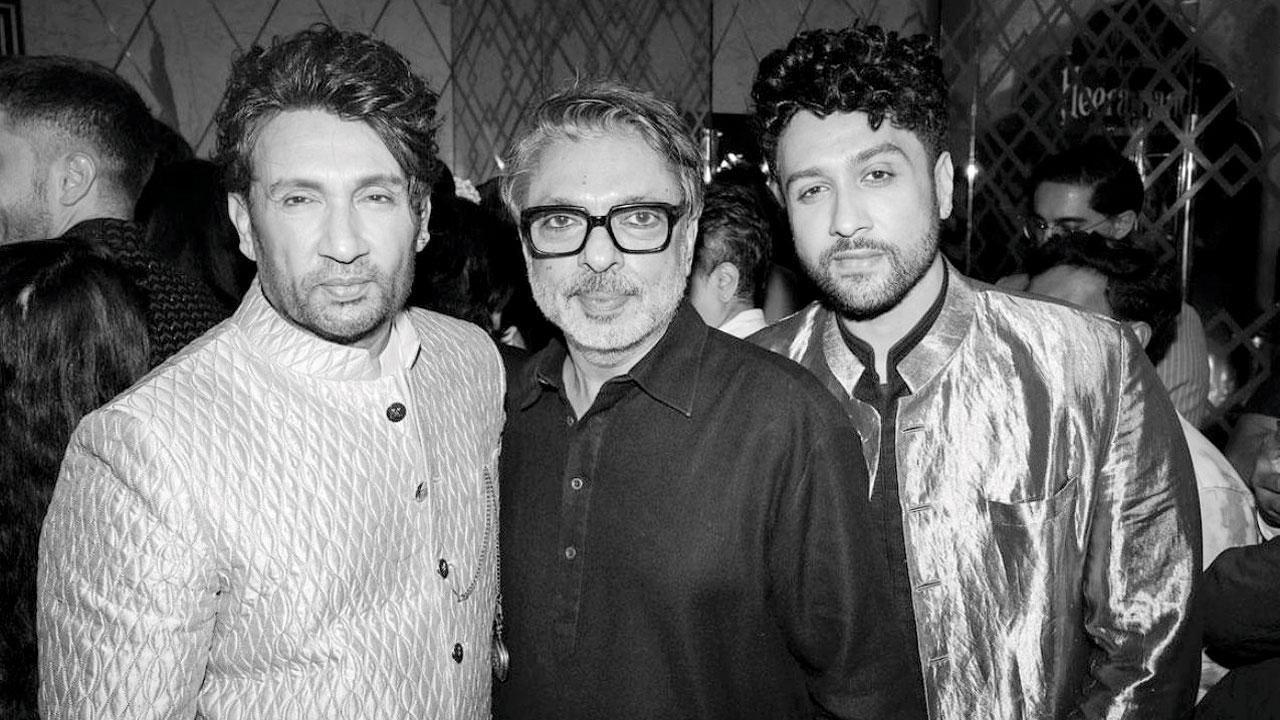
After going without work for seven years, Adhyayan hopes to revive his career as he joins dad Shekhar for SLB’s Heeramandi
Mohar Basu (MID-DAY; April 30, 2024)
The Diamond Bazaar is a delectable package of many surprises. In his maiden web series, Sanjay Leela Bhansali has brought together an eclectic bunch of actors. While Farida Jalal returns to screen after a decade, it also features Fardeen Khan, who was last seen in Dulha Mil Gaya (2010). Among other things, it also stars father-son duo Shekhar and Adhyayan Suman together on screen. Shekhar plays the flamboyant Nawab Zulfiqar, who is in love with Manisha Koirala’s character Mallikajaan, and his son steps into the shoes of Zorawar, a mean, brutal nawab.
Netflix’s ambitious series is centred on six female actors—Koirala, Sonakshi Sinha, Aditi Rao Hydari, Richa Chadha, Sanjeeda Shaikh and Sharmin Segal—but Shekhar asserts that the male characters aren’t ornamental.
“The dynamics between the tawaifs and the nawabs were intimate. It is quintessentially the story of the courtesans and how they wielded power, but these women derived their power from the men. Nawabs were skilled mercenaries, who allied with the British to get power and titles. My character has a hint of arrogance. He adds to the politics of Heeramandi. He is in love with Mallikajaan, but doesn’t shy away from [threatening] her when she doesn’t bow to him,” says the actor.
If fate had worked out differently, Shekhar would have collaborated with Bhansali over two decades ago on Devdas (2002). He recalls, “I came close to working with Mr Bhansali in Devdas when he called me for the role of Chunnilal. I couldn’t do it then because of my workload. But since then, whenever we met, I told him that I would love to work with him when the opportunity presented itself.” And it did in Heeramandi, a period drama about the courtesans of Lahore. It was doubly joyful to work on the project as Shekhar has always had an affinity for history.
“I love historical movies made in India. When I met Mr Bhansali, he was looking for a good actor who had knowledge of the era. Also, he wanted to go for an unusual casting. I knew of Heeramandi for years because it’s written by my friend Moin Beg. He [SLB] is an intense filmmaker who puts passion, pomp, grandeur and everything into the story.”
The light at the end of the tunnel
For the senior Suman, Heeramandi may be the realisation of his wish to work with Bhansali. But for Adhyayan, it is more than a show; to him, it is a ray of hope that pulled him out of darkness and despair. The actor hit headlines early on in his career when he featured in Raaz: The Mystery Continues (2009), but soon had to make do with forgettable films. It hasn’t been an easy run, he admits.
“There have been days I have been broken, I wanted to give up. It sounds dark, but I didn’t want to live anymore. Acting was something I was very passionate about. Unfortunately, [work] dwindled in 15 years. I became a star with a successful film and then 12 films didn’t work. I have not worked for seven years. I went through rejection after rejection. I would wonder, ‘Kal kya hoga?’ The day I stopped chasing, things began to work out.”
After watching Gangubai Kathiawadi (2022), he nursed the desire to work with the filmmaker. “In a few weeks, Shruti Mahajan [casting director] called to say that sir is casting for Heeramandi. My father would always say that there is light at the end of the tunnel; for me, Bhansali sir became the light. When Shruti called, I was in the Himalayas. I stopped on the road in the hills, and recorded my audition.”
When he initially wasn’t chosen for the part, Adhyayan was admittedly “heartbroken for two months.” “However, on a Saturday afternoon, I was called to meet sir. His words were, ‘Bachcha, I will see you on set tomorrow.’”
Different actors, different approaches
On set, the two actors and their characters were as different as chalk and cheese. Through Zulfiqar, Shekhar had to bring alive a character whose love for Mallikajaan was more about power and less about romance.
He breaks it down, “There was a lot of uneasy love on paper and a lot that Mr Bhansali added on set. He is a director who changes the interpretation when the shot flows. I have known Manisha for years, so there was chemistry. Manisha is accomplished, she knew how to be Mallikajaan and that made the energy between her and the nawab easy [to create].”
Adhyayan, however, decided to play his part more emotionally and less technically. His process was personal. Guiding him through the role was his father who sat and read lines with him all night. “Zorawar is debauched, grey, looks down upon the women in Heeramandi; he makes a woman believe he is in love with her and marries another person. A scene in the second episode changed my life. Bhansali sir got up after my performance and cried. I have been waiting for 15 years for an opportunity, and now that I had the opportunity, I couldn’t not be sincere. The character’s language came from my father. Bhansali sir is so sharp, he caught that my father has been working with me off set. One day, I was giving my cues to Manisha ji and sir said, ‘Iske baap ne sikhaya hai isko.’ I was rehearsing with dad from 1 am to 6 am, and at 8 am I was on set.”
Let your work speak
Over the years, the industry has heard more than its share of rumours about Adhyayan. Much of the dialogue about him has been about his off-screen life than on-screen work. The actor hopes that with the web series, the audience will see the artiste in him. He has already noticed a change in his co-actors.
“One night, Richa came home with me to prep for a major sequence that was to be shot the next day. When she went home, she sent me a long text saying, ‘I had these preconceived notions about you being a spoilt star kid, someone who is not serious about his art and got it easy. So much has changed in you. Hats off to you!’ Her validation made me emotional. The lack of opportunities has not let people take me seriously. People have said to my face, ‘We thought you do drugs.’ I wasted a lot of time looking for answers to where the rumours started. Now it is all behind me.”
Choosing art over comedy
We also hope to see more of Shekhar, whom we used to see every day on the tube in our growing-up years as he hosted the popular Movers & Shakers. Considering we are in the midst of the election season, why wouldn’t he give his audience just another season of the crackling show filled with political humour?
The actor-host says, “Movers & Shakers was a cult show. But it has probably resulted in the undoing of an actor. That imagery is so strong that it has been tough to imagine me as an actor. Unfortunately, I am good at comedy. I would love to do that now, especially in the election season. I want to do it sporadically, not continuously. It would hamper my growth as an actor.”
I still have a set of fangs with me as a souvenir from the sets of Tooth Pari-Tanya Maniktala
8:53 AM

Tanya Maniktala, who plays a vampire in Tooth Pari, says the series is a unique blend of romance, thriller and satire
Letty Mariam Abraham (MID-DAY; April 25, 2023)
What’s your first instinct when you read a quirky script about a vampire falling in love with a dentist? If you’re Tanya Maniktala, you queue up for the screen test, determined to be a part of this imaginative world. After Flames, Mira Nair’s A Suitable Boy, and Chutzpah, Netflix’s Tooth Pari: When Love Bites promised to be a whimsical ride. Collaborating with director Pratim Dasgupta and veteran actors was the cherry on top. In a chat with mid-day, Maniktala talks about being blown away by the script, and adding her own quirks to the role.
Edited excerpts from the interview.
What was your reaction to the concept?
I got a call from Shruti Mahajan [casting director], who told me there is a cool and quirky character, and that I would be perfect for it. She asked me to test for it. When I read the script, [I wondered], who are these characters? I called up Shruti to ask what was going on in the script, and she just kept laughing. I wanted to get on board immediately, and was over the moon when I was short-listed. When I got on a call with Pratim sir to understand the world of Rumi [her character], it set the ball rolling. The plot of a vampire falling in love with a dentist seemed so funny that I was rooting for the couple.
At what point did you feel the concept was bizarre?
That was a constant thought. I was drinking blood, which was a lot of beetroot juice in reality. When I got a denture made for the prosthetics, I was intrigued. I still have a set of fangs with me as a souvenir.
Which genre would you bracket this series into?
Boxing Tooth Pari into any one genre would be unfair because there are so many themes going on simultaneously. It is a fantasy, romance, thriller and satire.
How was it working with Shantanu Maheshwari?
We both were playing characters that were opposite to us, and that was fun. He is one of the funniest people I have met. Shantanu is always open to trying new things out; he’d always give me suggestions when I asked for them. He would also be respectful of my space.
What did you learn from working with veterans like Revathy and Adil Hussain?
It was an ensemble cast that I never dreamt [I would work with]. Often, it was difficult to stay in character because Rumi is straight-faced and composed, while the other characters are hilarious. The energy on set was always great because we knew we were creating something wonderful. I was in awe of Revathy most of the time when the camera wasn’t switched on. I wanted to learn about their experiences. They are talented actors, but they are also such fantastic human beings. It was a great opportunity to see their human side, without any façade.
How was your interaction with the director?
After I was signed on for the project, I went back, watched some of his earlier works and realised that he has a lot to say. On set, he gives you free rein to do whatever you want. He is collaborative and interested in listening to what you think the character should do. I was like an eager kid who kept asking him if we could [add] this or that [nuance].
What was the one quirk you added to your character?
Some traits are written on paper, but when you are living the character, you bring in your own [flavour]. While processing the character, I found that she has a tender [heart]. When we started talking about Rumi, we came to the conclusion that she was hurt. She was still nursing a wound, which is why she puts on a hard exterior.
Women's Day Special: Celebrating women behind the scenes in Bollywood
8:26 AM

Today, on International Women’s Day, let’s celebrate women who may not appear on the big screen, but are the most significant part of a film. These women are the true heroes behind the magic we see on screen
Juhi Chakraborty, Rishabh Suri, Titas Chowdhury, Vinay MR Mishra (HINDUSTAN TIMES; March 8, 2022)
Juhi Chaturvedi, Writer
It is a welcome change to have more women around me. But it is not about the number. If I have talent, then I should get the opportunity and not be discarded on the basis of my gender. That change is slowly happening. It’s good to see women getting their due.

Priyanka Borkar, Hair stylist
For far too long, the film industry and hairstyling department have been largely male-dominated. I’ve been here for 14 years and can say that there has been a significant rise in the number of women. I like seeing more women getting into the industry, doing great work. I believe there is equality now.

Deepa Bhatia, Film editor
Women are becoming increasingly visible in the industry, notably in post-production departments. When I first started working, the only woman editor was Renu Saluja. I looked up to her and she was an inspiration to me since we didn’t see many women in that position at the time. More women are participating now than ever before.

Dolly Ahluwalia, Costume designer
Whatever the profession, there has to be equality and respect, for both men and women. Even families didn’t support women entering the industry earlier, but now there is so much awareness. And even in the field of costume design, there were very few women in the past. Bhanu Athaiya ji was the first, followed by Neeta (Lulla) and others. Now, it’s incredible to watch young ladies become great designers.

Sanober Pardiwalla, Stunt woman
When it comes to the industry, there are many women today working in all divisions, and I’m not only talking about stunts. Earlier on set, 80% of the crew were men, and women were only spotted in the costume department. That, however, has changed. Women are involved in every phase of the filming process, from lighting to art direction. The mentality has also become more open, with equal respect given to all. It is no longer a question of whether you work for a guy or a woman.

Savleen Manchanda, Makeup artist
There was a time when hair used to be a woman’s thing and makeup was a man’s job. With time, we have all become comfortable with both sexes and have now become a team. Bollywood has been really accepting.

Ridhi Anand, Assistant director
I began working in the film industry in 2014, and I now see more women on set than I did previously. Filmmaking is no longer solely a man’s domain. Fortunately, I’ve never experienced any type of gender bias in the profession. However, when I first started, I would see a man and a woman doing the same job as the second AD, but the man would get paid more. That, I believe, is beginning to change. To some extent, the battle for better pay has receded.

Meenal Agarwal, Production designer
When I started in 2001 with production designer Suzanne Caplan Merwanji, there weren’t many girls working on the set of a mainstream film. I’ve witnessed a set transition from having no women to having so many of them. Despite this, mansplaining continues to exist. To this day, several studios lack clean women’s restrooms. I intend to continue working for these basic rights. However, the industry now has more educated, civilised people that respect me and my profession, which is a blessing.

Shruti Mahajan, Casting director
People were hesitant to work with female technicians at first, but now they realise that women can handle all sectors. They are strong not just physically, but emotionally as well. I think the casting department belongs to women. Compassion, intuition and instinct come naturally to us. Most actors come and say, “You hear us out,” and that makes a lot of difference.
Shelly Sharma, Cinematographer
I consider myself more privileged than women before me. I’ve been on teams with no women, and now I’m on a team with a lot of women. So, times are changing. I’d also like to thank the Indian Women Cinematographer Collective (IWCC) for raising awareness about female cinematographers. Many young women write to me, asking for advice on how to pursue a career as a cinematographer. That is a great thing.

Coronavirus Scare: After partial lockdown, aspiring actors self-taped auditions shared on phone
8:38 AM

Mohar Basu (MID-DAY; March 21, 2020)
 In contrast to the serpentine queues of aspiring actors lined up outside studios, the casting studios at Aram Nagar wear a deserted look these days. With the city receding into a partial lockdown, Abhishek Banerjee of Casting Bay, one of the leading casting studios, says that they are encouraging self-taped auditions.
"Auditions are a risky prospect as aspiring actors travel from far-flung areas. Usually, we don't prefer self-taped auditions, but now we are relying on them for a few cases. When we get calls from aspiring actors [these days], we tell them to send their videos on WhatsApp. If they show promise, we will call them back once works resume," explains Banerjee. He adds that they are making the most of the slow pace of work by looking into their repository. "Since everything is shut, there's no sense of urgency. We are utilising the time to look into our database, connect with local talents and figure if they fit into a role."
Shruti Mahajan, who has done casting for films like Sanjay Leela Bhansali's Gangubai Kathiawadi, and The Big Bull, tells us, "My entire team is working from home. We are working dedicatedly on improving our database and researching on new talents, including influencers and Tik Tok stars. Some auditions are being taken on videos."
I enjoy the process of being auditioned-Anjana Sukhani
7:59 AM

Titas Chowdhury (HINDUSTAN TIMES; December 24, 2019)
Anjana Sukhani is excited about the second inning of her life after battling depression for two years. The actor’s happy to be part of a big film like Good Newwz. Talking about landing the film, she says, “I’m a blessed child. I was almost coming out of depression and was thinking of meeting people. It was then that I got a call from Shruti Mahajan (casting director). She told me that she wants me to audition for this really interesting character in a film.”
Anjana says that she knew her part in the film was tailor-made for her. “The day I auditioned, I realised that this character belongs to me. My instincts told me that I’m going to be a part of the film for sure. When they narrated the film to me, I was excited. I would say that Good Newwz fell onto my lap. I didn’t go looking for it but it beautifully happened to me,” she shares.
Anjana says that she has no qualms about auditioning for a project. “I enjoy the process of being auditioned. When you audition, the director, in one moment, knows if it’s working or not. It’s because of the audition that I knew that I’m that character in Good Newwz. She’s intelligent, bubbly and gives a lot of advice and it instantly resonated with me,” she says excitedly.
For the actor, being called for an audition makes her feel validated. She elaborates, “I love to audition. When I was a model, I used to audition for five to six advertisements in a day. In India, we raise eyebrows when a star goes for an audition. But in the West, everyone does it. You should feel grateful that they’re calling you for an audition because they think that you fit the bill. And that’s a big compliment.”
Ask her about sharing screen space with Kareena Kapoor Khan for the second time after Golmaal Returns (2008) and she says, “Bebo’s like wine that gets better with each passing year. She’s so gorgeous! If you look at the camera that’s framing her face, you just can’t get bored. She has that effect on girls, let alone boys. She’s lovely, warm and very humble. We used to share skincare tips and talk about food.”
Casting directors come together to fight the infamous couch syndrome
8:26 AM

Casting directors form a collective to fight the infamous couch syndrome plaguing the Indian film industry
Rachana Dubey (BOMBAY TIMES; January 20, 2018)
On Wednesday evening, a host of Bollywood’s top casting directors joined hands to form their first official collective. The association will function as part of Indian Film and Television Directors’ Association (IFTDA), which currently governs directors across film and television domains. Shruti Mahajan (casting director for Pad Man, Padmaavat), Mukesh Chhabra (casting director for Bareilly Ki Barfi, Shubh Mangal Saavdhan), Jogi (casting director for Pink, Poster Boys, October), Vicky Sidana (casting director for Sonu Ke Titu Ki Sweety, Aiyaary), Honey Trehan (casting director for Manikarnika: The Queen Of Jhansi, Fukrey Returns) and Abhishek Banerjee (casting director for Toilet — Ek Prem Katha, Pari) met at IFTDA’s office to discuss the nuances of the association and its functions.
Privy to the meeting, BT was witness to the first form being filled by Shruti Mahajan. The idea to have a separate body was tabled by Mukesh Chhabra, who along with IFTDA’s Executive Committee Member Ashoke Pandit, chalked out the plan to get the association in motion. They came up with a plan of sweeping the industry clean of casting couches, after several casting directors complained of facing the heat from producers, actors and directors due to fake agents, who exploit aspirants by way of bogus casting calls on social media and other spaces.
BEWARE OF BOGUS CALLS
“Just how many times are we expected to tweet or write on our social media pages that we are not casting for some project as claimed by someone? It’s annoying and time consuming to explain to people that it’s a fake account, created to sexually exploit men and women. We are in the process of writing to all the filmmakers to inform them about the collective. We want to tell them that by working with a member of this association, they are only ensuring a secure environment, their interests in terms of casting are well-looked after and the person they are working with, comes with technical know-how of the job,” says Mukesh.
Shruti, seconding Mukesh, adds, “We want to underline the fact that it’s a fully functional, independent and crucial department of filmmaking, which demands its share of respect and dignity of labour. Yes, an actor is cast according to a filmmaker’s requirements, but even they wouldn’t deny that a lot of the work goes in getting an actor to be a part of the film. We also want to send out a a message that we are not junior artiste suppliers or agents who send across girls or boys on random demands by a filmmaker. Today, when we get calls for casting from a lesser-known filmmaker, our only way to check his or her credentials is through the association. We want the same clarity for our profession. This way, people who don’t have a standing in the market or are bogus casting directors misguiding youngsters, are flushed out of the system.”
The initiative to cleanse the industry’s work stream has been supported and welcomed by nearly every casting director in the business. The association is expected to be functional from early next month after all the paperwork is duly completed.
“We are seen as competitors, but in reality, we are friends, secure in our individual spaces. It’s important that everyone in the business, including the filmmakers, become aware that we’re not enemies battling each other. That’s another reason that has brought us together. Also, collectively, we can fight, not only the menace of casting couch, but various casting related issues far better. Filmmakers, actors and even aspirants come to us with so many grievances. We can now pool them all together and try solving them like a team, instead of doing it individually. At least 250 acting aspirants come to this city every day. Now they can be secure in the knowledge that there is an association they can go to, if they face a problem with a casting director. No one can eradicate a menace 100 per cent, but together we can make the effort and crunch the problem to the minimal,” says Honey Trehan.
‘TOGETHER WE CAN MAKE A DIFFERENCE’
Jogi, seconding Honey, points out that there are collectives of casting directors in every industry around the world, and it’s high time that the Hindi film industry also has one of its own. “It’s important to work cohesively, particularly on eradicating menaces like the casting couch. Individually, we can’t fight this problem. Now, we can even form a system, which enables work distribution, grooming of new talent and more opportunities created for the newer members, and bring it the kind of respect that every other craft in the industry has,” he says.
However, according to the Competition Commission of India (CCI), no association in any industry can force anyone to work only with its members. The decision to work with any individual or a group must be an individual’s (or a company’s) own. In that scenario, wouldn’t the casting agents, who are not part of the association, create a ruckus if and when they are denied entry on a project?
Pandit explains, “By creating an association, we are not forcing anyone to work exclusively with the members of the association. We are just ensuring that filmmakers and actors are aware that there is a collective they can approach to address issues related to casting. If they work with someone from this association, they know there is a platform for them to address grievances related to a member. But if they choose to work with someone who is not from this association, and he or she indulges in any fraudulent or suspicious activities, they shouldn’t accuse the entire industry of running a casting couch.”
Bollywood's women share their success mantra
8:00 AM

With International Women’s Day two days away, we ask some successful women in cinema to part with one valuable advice that they would give young ladies in their field
Nikshubha Garg (MID-DAY; March 6, 2016)
The fact that Bollywood is largely male dominated is well known. However, over the years, several women have not only managed to make a mark in the industry, but an increasing number of them continue to throng fields which were long considered a man’s domain. With International Women’s Day around the corner, we speak to women in various fields of filmmaking, who are masters of their trade, about what it takes to be a woman in this industry and ask them for tips on how to keep going.
Richa Chadha, actress
Known for her unconventional choice of films, Chadha made her debut with 'Oye Lucky! Lucky Oye!' and went on to do critically acclaimed roles in 'Gangs Of Wasseypur', 'Goliyon Ki Raasleela Ram-Leela' and 'Masaan'.
Bollywood, for actresses, is still a male-dominated domain and expectations from women are different. For instance, from wearing a chiffon saree to doing an action sequence, you are always expected to look stunning, no matter what. Also, people in the industry perceive you differently once you are married or have a baby. There are way too may dynamics to discuss but people are way more critical of women.
Don’t compare yourself with anyone
I have garnered fame in the past three to four years and that’s the result of hard work, luck and getting the right opportunities. Everyone in this industry works hard to be where they are. Whether you appreciate their work, or give enough credit to them is a different matter altogether, but that’s the truth. Having been around for a while, I would say that it’s very important to be patient and understand the fact that everyone takes different means to be successful and defines success in their own way. You can’t sit back and compare yourself with others. You have to chart your own course.

Kausar Munir, lyricist
Munir began her career with writing for the television show 'Jassi Jaisi Koi Nahin' and has written songs for films like 'Ishaqzaade', 'Ek Tha Tiger' and 'Dhoom 3'.
I think that things are looking up for female lyricists in Bollywood and an increasing number are getting opportunities to showcase their skills. The ratio might be lesser compared to men, but I am cautiously optimistic. I don’t see anyone’s work being judged based on gender. However, having said that, I feel that people behind the scenes are judged mostly on the quality of their skills.
Be yourself
Whichever field you may choose, there are no guidelines or handbooks. Everyone has to find his or her own way. I think the awareness of what novelty one can bring in helped me. Humility and strength comes from knowing what you can do and what you can’t and pretending to be someone else is doing disservice to yourself. The same thing goes for gender. Embrace being a woman or a man and flaunt with that identity. Honestly, if I try to be one of the guys, it’s not going to help. But if I am going to be a friendly woman without the baggage of being one, I am bound to go a long way.

Shruti Mahajan, casting director
Mahajan began her career as a casting assistant and is responsible for casting films like 'Bajirao Mastani', 'Goliyon Ki Raasleela Ram-Leela', 'Mary Kom', 'Shamitabh', 'Bobby Jasoos' and 'Finding Fanny'.
There is no short cut to making it big. If you have the correct intention and focus on your job, you will survive no matter which field you are in, whether you are a man or a woman. In fact, as a casting director, I feel that this field of filmmaking is not a man’s domain anymore. Women today have an edge over men in this field because it requires one to possess soft skills, which women naturally own. My male contemporaries have guided and supported me as well.
Intentions matter
If someone focuses on the job and takes it up for all the right reasons, he/she is bound to survive. I didn’t take casting up because it looked easy. I came into the field because of my passion for cinema. You just have to be good at your job.

Deepa Bhatia, editor
Having worked on films such as 'Kai Po Che', 'Taare Zameen Par', 'Rock On!' and 'Student Of The Year', among others, Bhatia has made a mark as an editor.
I cut my first film when I was 23 and the editing industry then was male dominated. However, Renu Saluja’s (Parinda) success at that point of time made me believe that all of us women could do it. And look how far we have come now. You pick 10 films today and women would have edited at least four to five of them. You can equally name five top men editors and women editors. It’s an open forum.
Hang in there
The nature of the job is such that you get better with time. Every editor needs to be patient and just hang in there. I struggled during my first few films, as I was apprehensive about doing it correctly and doing it well. I often questioned myself whether I knew all that is there to know about the craft because I was self-taught. However, I stuck around and it got better. Recognition, money and wisdom doesn’t come overnight; you need to give it time. I have seen newcomers who were good, quitting because the pay was less but I would want to ask them to hold on and everything will fall into place. It did for me.

Hetal Dedhia, gaffer (light designer)
Asia’s only woman gaffer till date, Hetal has worked on Bollywood films such as 'Don', 'Luck By Chance' and 'Guzaarish' as well as international productions, including 'Eat, Pray, Love' and 'MI 4: The Ghost Protocol'. She is the daughter of Mulchand Dedhia, a celebrated gaffer.
Academics wasn’t for me and I dropped out of school after the 10th standard, and began working immediately. It was an awkward feeling when I started; people didn’t believe in me and thought I would give up soon. However, that only strengthened my goals. Getting into a non-woman zone thrilled me and I haven’t regretted it even one bit. As for surviving, it wasn’t difficult. I know women do not become gaffers for various reasons but it’s a great place to be. I embraced being a light designer and focused on the job, and the respect I got in return was unimaginable.
Nothing is impossible
Everyone’s journey is different and difficult as far as being a gaffer is concerned but the only tip I could give is that once you know that this is what you want, just go for it. Nothing is impossible and you can do wonders. Once they get into gaffering, women will realise how satisfying it is as a career.
Subscribe to:
Posts (Atom)