Showing posts with label Shor In The City. Show all posts
Showing posts with label Shor In The City. Show all posts
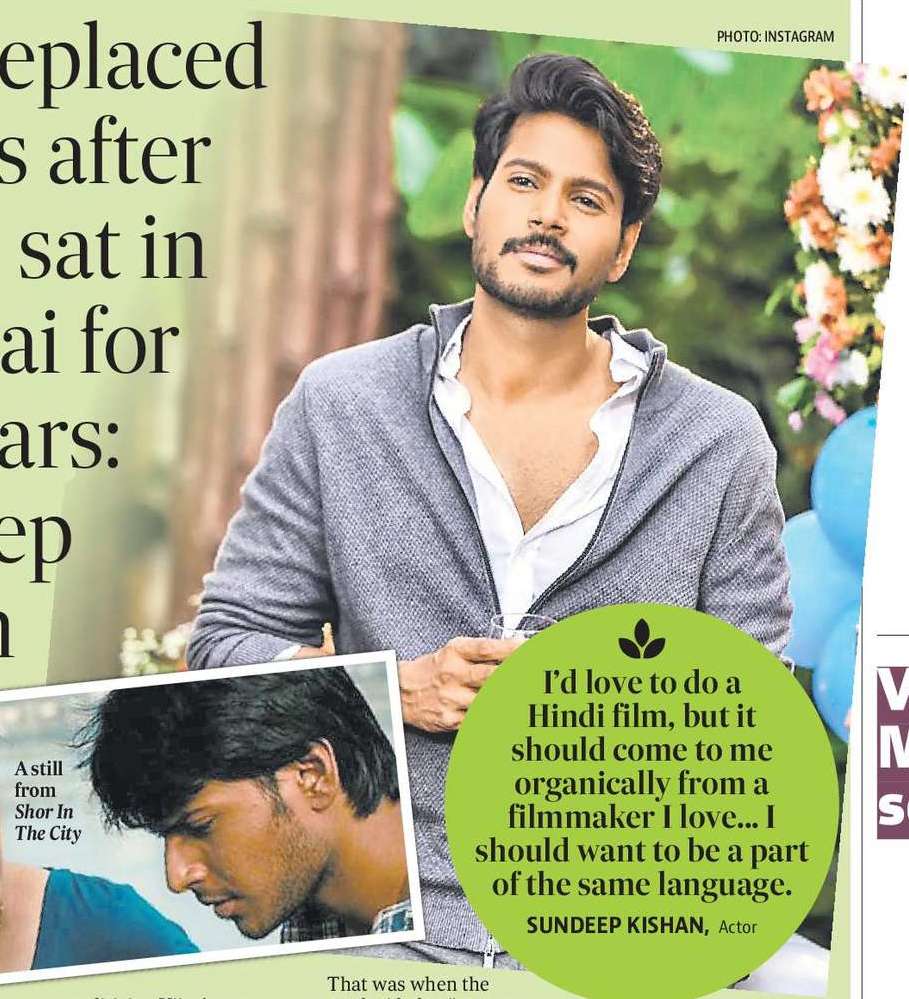
I was replaced in films after Shor In The City, sat in Mumbai for two years-Sundeep Kishan
10:03 AM
Yashika Mathur (HINDUSTAN TIMES; January 8, 2025)
Actor Sundeep Kishan made his debut in Hindi cinema with Shor In The City (2011), but was not seen again in any Hindi projects until 2019 in the Manoj-Bajpayee-starrer series The Family Man. Now gearing up for the third season of the series as well as the directorial debut of actor-politician Vijay’s son Jason Sanjay, the actor recalls his early days in Bollywood.
“Post Shor In The City, I had signed two Hindi films with reputed production houses and filmmakers. I was very excited,” he recalls, adding, “I sat here (in Mumbai) for two years doing nothing.”
Though the 37-year-old had one Tamil and two Telugu films to his credit, he turned down other projects to focus on the two Hindi films: “(But) neither of them happened with me and it was given the last second to someone else.”
That was when the actor decided to “stay true to my southern roots” and starred in Routine Love Story (2012), Ra Ra Krishnayya (2014), A1 Express (2021), and Michael (2023), to name a few.
Ask him if he has become weary of signing a Hindi film now, and Kishan shares, “No, that’s not fair to say... So many of my friends started off with me, like Rajkummar Rao who was doing LSD (2010). Kartik Aaryan did Pyaar Ka Punchnama (2011). So everybody who’s held on, it’s all worked fantastically. But I’d like to stay true to my identity.”
Now, his focus is on doing projects that come organically from a filmmaker whom he loves and in the language that he wants to do.
“Otherwise, I’m more than happy making a film which I believe will be a superb experience for the audience to watch in my language and bring it (to Hindi cinema) just like how my senior counterparts are doing,” he signs off.
I want to write and direct a project-Radhika Apte
8:12 AM

Pandemic-induced forced sabbatical compels Radhika to re-evaluate her film choices; actor reveals she has been studying script writing since three years
Priyanka Sharma (MID-DAY; December 26, 2022)
As doors of movie sets remained shut during the pandemic, Radhika Apte says she opened up to her purpose of being an actor. “I didn’t come here to be a star. I came here because I really liked to perform,” she says, confessing to becoming a victim of the rat’s race, and losing sight of her purpose over her career spanning 15 years.
“Every freelance industry is a vulnerable place. You get insecure and agree to do work because sitting idle becomes difficult. The thought of not working is scary. But, the pandemic was an eye-opener,” says Apte, who now wishes to give her nod to projects that genuinely excite her.
When she encounters dry spells, she says she will turn to her new-found passion – writing. The actor has been studying scriptwriting for three years, and plans to write and direct projects in the future. “Studying scriptwriting is making me extremely happy. I am not very good at it yet. I have been learning from a few script editors and writers because I want to make something. I want to write and direct a project,” she says, adding that her new endeavour shouldn’t be perceived as a career transition. “I don’t want to give up acting. It is my first love.”
A dearth of offers that were worthy of her attention prompted her move. “This industry does stereotype people. I was [seen as an actor who could only play] a village girl for a long time, after Rakht Charitra and Shor In The City. Nobody would cast me in an urban role. Now, I am told that I have become too urban to be considered for certain roles. After Badlapur, I started getting offers for thrillers alone.”
Comedy, she says, is a genre that excites her, but her tendency to “speak my mind” has bracketed her as a “serious person”. “Actually, I am not someone who talks seriously. I like to have fun, and am not the kind of person that people think I am. I have explored comedy in theatre, but have never been offered a comic film.”
As someone who refuses to distance her personal life from her professional one, she perceives her film offerings as opportunities to grow as an individual as well, instead of merely considering them for financial gains. “I am young. These are my best years, so, I want to avail every chance to learn.”
By now if we hadn’t got into movies, we'd be the founders of Amazon-Raj Nidimoru and Krishna DK
8:29 AM
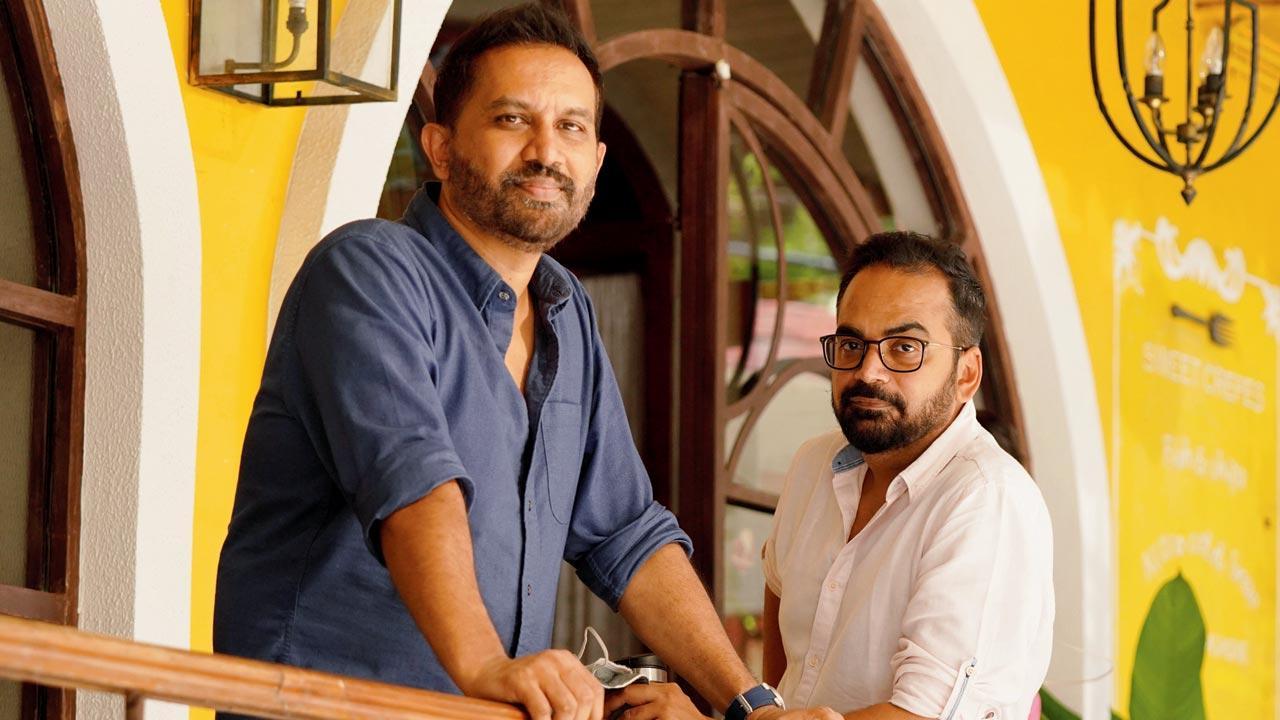
Decoding Raj & DK, the unlikeliest Bollywood directors to claim the ‘family audience’!
Mayank Shekhar (MID-DAY; October 9, 2021)
If this was a Bollywood script, a la DDLJ, we’d start from the exact moment Raj, first locks eyes with Krishna (since no Simran) — perhaps coming down the steps of Tirupati’s Sri Venkateswara University College of Engineering (SVUCE), on their first day in college, with an imagined mandolin tune playing in the background. Somewhere, knowing, because destiny is such, that they’d live together to make Bollywood movies, for babies, happily ever after!
But of course, this is not a Bollywood script. Neither do the typically indie-looking, under-stated Raj Nidimoru and Krishna DK, former engineering classmates from SVUCE, seem like massy Bollywood directors. But they’re as A-list as it gets. If you consider their filmography, that features top-shelf traditional to new Bollywood altogether.
Starting with Saif Ali Khan (Go Goa Gone, 2013), then pairing Saif with Govinda (Happy Ending, 2014), going berserk with Sidharth Malhotra (A Gentleman, 2017), a li’l bit. Casting Rajkummar Rao, Shraddha Kapoor in the year’s sleeper super-hit, Stree (2018).
Not to forget, placing late ’90s Satya’s Manoj Bajpayee back into stratospheric stardom, with The Family Man, Seasons 1 (2019) & 2 (2021). There’s also a Shah Rukh Khan film lined up, which will go on floors, they say, once SRK’s schedules match — since the superstar has enjoyed their script narration, and is very much up for the part.
Who’re these guys, man, and how did their stars so align in a city where everyone sits around with a script? No, there was no meet-cute moment in college, when they first met. Of which they don’t even remember exactly when, or how. As it happens only in desi Nerd Land, they were quiz teammates in college. “Not those general knowledge type quizzes, haan?” DK clarifies. “Music and movie quizzes — where they play songs and ask to identify the singer or composer, or name the movie [from a clip], or who is the director, that kind of stuff.”
This is where I’m guessing they got to collectively express their film geekery — about as much outlet the Nerd Land in the ’90s allowed you, once you’ve signed up for an engineering programme, I guess. The next destination is obviously a ‘starting salary’ (‘package’, best if earned in dollars), pursuing computer programming in the US, living thence the great suburban American dream. Ditto for Raj & DK.
Both are originally from Andhra Pradesh. Telugu is their mother tongue, although English is as much their first language. They’re trained engineers, of course, who eventually moved to Mumbai, to make movies. Starting off with an independent film (99, starring Kunal Kemmu), in Hindi — hardly their strongly suit, in fact decidedly their weak link; gradually veering toward more mainstream Bollywood.
Sounds like both Ram Gopal Varma and Nagesh Kukunoor to me. What’s happening in Andhra — you hardly hear similar stories about directors from other states in the South! “Well, I don’t think Ram Gopal Varma is the same graph [as us]. He went directly with an explosive [start],” Raj corrects me. And he’s right.
Varma’s debut Shiva (1990) was indie, only for a Hindi audience. It starred Nagarjuna, which is blockbuster-grade in Telugu cinema already. The stunning response to which had Bollywood roll out the red carpet for Varma. Although Raj admits, “With Kukunoor, initially, yes, as engineers-turned-screen writers, we were seeing parallels quite a bit, actually. Because he produced Hyderabad Blues, when we were [making our debut film] Flavors in the US.”
What was the flavour of Raj & DK’s debut film like? It had a very American Born Confused Desi (ABCD) vibe to it — a growing sub-genre in the early noughties, with stories about Indian expats and migrants, before Indian-American found more mainstream space in American pop-culture about a decade after.
These movie DVDs were usually available at side sections of desi rental stores in Indian neighbourhoods abroad, that otherwise stocked popular Indian cinema. Low-budget English language indies would include titles like American Desi, American Chai, Green Card Fever, Leela… With local female actors like Sheetal Sheth, Purva Bedi, and often a male character called Krishna, snipped to Krish, who’s confused between both his identities. At least that’s my perfunctory memory of it.
Flavors (2003) as an ensemble cast, slice of life comedy/drama is superior to its then sub-genre, I realise, having caught it on YouTube recently. This is also the same time a shrub of English language Indian films, made by directors for an audience more at ease with English, was growing in India as well. Possibly helped, if not heralded by the cult-like success of Kukunoor’s Hyderabad Blues (1998).
Rahul Bose was almost the poster boy of this Mumbai sub-genre — English August, Snip, Split Wide Open, Everybody Says I’m Fine… Soon enough, Bose once told me, producers in Bombay figured that if they simply changed the film’s language from English to Hindi in, say a movie like Jhankaar Beats, the audience multiplies few times over, automatically. That was the end of the English vinglish shrub!
Raj & DK suggest they knew this already: They knew their “sensibilities were niche” to start with, especially making a “small film” about Indian-Americans, in America, which was not going to be “mainstream, commercial, anyway.” If they stuck to English, even that small audience would get shaved off by many eventually picking up the picture [pirated] online. How do you widen that niche? “By [at least] taking the whole country as our audience, rather than one state [Telugu].” Hence Hindi, which is what Flavors is mostly in.
A decade-and-half later, with the advent of OTT platforms in particular, DK says, “We’ve come to a place, where we are letting the characters speak the language they are most comfortable in. A case in point being The Family Man, Season 1 & 2. While the primary language is Hindi, there are characters who speak English, Tamil, Malayalam, right? That’s a nice space to be in.”
In fact, given the setting —around hideouts of Sri Lanka, among militants of LTTE —The Family Man Season 2 could, for a fair portion, pass off as a Tamil series altogether. And no one seemed to mind, even as it was aimed at a mainstream, family audience — bachhe, boodhe, jawaan — otherwise unused to subtitled entertainment. The other thumb-rule The Family Man Season 2 broke was the ‘curse of the second season’ — the sequel never living up to the love for the original. The post-screening excitement went a few notches up in fact.
But we’ve jump-cut too far. Might be a good idea to go back to DDLJ’s Raj & DK, college mates from SVUCE, who went their separate ways, although within America. They stayed in touch with each other, and with their shared infatuation for films.
Raj hated his job: “It was a huge struggle for me and it kind of gets reflected in Shrikant Tiwari [in The Family Man], being stuck in a job.” “Actually you’ll find this comment on corporate culture in a lot of our films,” DK says, although he wasn’t particularly going through a hard time. He jokes, “By now if we hadn’t got into movies, I’d be the founder of Amazon.”
There are many such sarcastic ones slipped in, with a deadpan expression, throughout this conversation. Which is quite emblematic of their works too — all of which, in some form or the other, have been comedies. Even while they deal with zombies, ghosts, spies or Shor In The City! DK seems the more fun/chilled/gregarious one, while Raj comes across as the serious sort. Although it’s hard to tell for sure.
In the US, working their corporate jobs, living out their long-distance friendship still, Raj was based in Detroit; DK was in Minneapolis: “a significant distance.” At some point, they decided to test their filmmaking skills with a short film, that they shot in Detroit.
DK recalls, “Every Friday, I used to wrap up my software job, have a flight to catch, land in Detroit, we’d shoot Saturday, Sunday, and I’d catch the first flight back on Monday. We did this for about six to seven weeks in a row.” “And he holds the record for missing the return flight seven times in a row,” Raj reminds.
The wrap party, after the schedule, may have been the reason, I’m pretty sure. “No man,” sighs DK, “I am telling you, we are engineers. We didn’t know the concept of a wrap party. We were these people sitting around and planning stuff.” Raj chips in, “We are probably the sanest filmmakers you would associate with a film like Go Goa Gone!”
Even after their debut feature Flavors, Raj went back to his day-job, and DK had been a consultant all along anyway. This prompts DK to offer a piece to aspiring filmmakers, “Don’t quit your day job just yet — keep it going. You will need money, once you’ve used up every ounce of savings to make your first movie. You won’t know when you are going to make that money back.”
This is a cautionary, practical note, to keep both Indian parents and the bank teller happy — quite separate from the ‘3 Idiots’ credo of simply chasing a chimera in a vacuum.
But you gotta get a regular job first, no? Raj & DK held highly employable professional degrees. It’s not common among artistes. Especially if you consider the popular, although debatable theory, on the right and the left brain — wherein the former primarily controls our creative impulses; while on the latter, rests the analytical/logical side. Both never being equal for all.
In mentioning this theory, I may have chanced upon how Raj & DK actually function as a successful writer-director unit. Not that DK can have another nickname, unless you add Bose to tick him off, Raj says, “DK is also known by everyone as Logic King. I am extending logic to a broad sense of the term — understanding sensibilities, structure [of a script], and if it makes sense for a scene or character to be somewhere. That’s his core strength. [With him around] I’ve stopped using the left side of the brain. He is just technically super-sound — from cinematography, that is dealing with the DoP, to editing, even VFX. That would be where I’d fall back on him, and not think too much after.”
On his part, DK believes, “Part of being a film director, and I say this as a writer-director, involves art, yes. But it involves structuring, planning and analyzing everything else as well. It’s not a pure art-form as, say, composing a song, or painting, perhaps — those are pure art forms, which need only that burst of creativity. Of course as a filmmaker, you need that burst of creativity too. But creativity alone will make you look like a madman going around — with a bunch of ideas in your head, that are not structured right. You need to bring them into a format that makes sense as a story — one scene flows to the next, and a character graph that follows. There is also so much organisation involved. It’s everything around that makes [the art] happen.”
As for Raj’s role in the separate right- and left-brains seamlessly complementing, DK says of his partner, “I am trying to find the right word. I think the word is ‘disrupt’. Right when you think it is all good, Raj is — no, this is not good, and that is not good. Let’s redo all that! He is looking at all these small things — this guy doesn’t look like a millionaire, not old/young enough, he’s not saying it right, not wearing the right clothes…”
Raj obviously has a complaint. He doesn’t think DK is making him sound right — after he’s heaped his partner with all the compliments! But of course, DK is referring to perfectionism I guess — a cliché Aamir Khan has lived with all his life for similar reasons.
But Raj agrees, “People [from the set] will call and say, ‘I think, sir, you better come to the location’. And DK will say, ‘You better! I have said okay to it, but don’t complain later’. Invariably I have gone to a place that was done/locked, and said, ‘I like this, and this doesn’t work.’ People are like, ‘F*****, I knew it!’”
Although Salim Khan and Javed Akhtar never formally directed films, as Bollywood’s most successful screenwriting pair, the same was said of their individual strengths too. While one (that is Javed) looked into the minutiae of scenes, the dialogues, and the unsaid; the other (that is Salim) was more into getting the wider expanse, and the larger picture right.
It helps that Raj & DK write films together first, and by the time they’re on set, “most issues have already been hashed over.” The approach to filmmaking that is common between both though, and this, they attribute to their educational training, is “reverse engineering”. Which is really how they learnt to make movies. As Quentin Tarantino says when asked if he ever went to a film school, “No, I went to the films!”
Up until Goa Goa Gone, Raj & DK say they’d never been on a film set — as opposed to shooting on location. Let alone assisted anyone, or trained under a master. DK feels, “The engineering background came in handy in structuring and analysing whatever good creative ideas we could get. And then we reverse-engineered how somebody else made a movie.”
Raj explains further, “We had to teach ourselves. You are so familiar with the films you watch. That is the only familiarity you have — to, say, [Martin] Scorsese or [Steven] Spielberg, or whoever you are watching that you can connect with. Now the question is, can you make it as good, or even close enough? The idea was to figure out how a scene was made, and why is it looking so good?”
Scorsese or Spielberg are obviously the more obvious examples to emulate, or learn from. But if you glean through Raj & DK’s top 40 favourite films of all time, as they listed in a blog recently, there’s essentially a wide smattering of late ’90s indies, chiefly American, but also otherwise.
Invariably a list of popular cults within it too — Pulp Fiction, Fight Club, Boogie Nights, Lock Stock and Two Smoking Barrels, etc. There is hardly an Indian film — okay, I spot Varma’s Siva (1989, in Telugu). Oh, no Bollywood movie at all? There is Hrishikesh Mukherjee’s Gol Maal (1979)!
DK admits, “Honest truth be told, Gol Maal also, I watched first in Tamil; the Rajinikanth version. Then someone said, oh you loved the Tamil version? You should watch the Hindi movie now. And which was really good. That’s why it made it to the list. Otherwise the Tamil version would have!
Raj: “Correction here. There was [only] one Hindi film, yes, but quite a few regional films. That is what we were watching.” DK: “We used to watch Khuda Gawah [1992] — just one big marquee film used to come where we were anyway. That’s all we would get to see. And our [knowledge of] Hindi is not exactly ‘Mahabharat Hindi’, so you pick anything you understand!”
This might sound like a handicap. But it’s proven to be an advantage for Raj & DK in Bollywood. The voice that’s developed seems wholly non-derivative to popular Hindi cinema from the past. The western indie influences are strong alright, again not in a sense of a rehash — as writers, they tend to look within to mine stories still. In each of their spheres, whether in corporate jobs, or two young men in Mumbai out to make Hindi movies, they’ve operated like the observant outsider — piling on experiences into entertaining fiction.
DK says, “Even if you see our earlier films, until a few years ago, I could draw parallels to each character and say where those traits were picked from — from real life, mostly.”
We go over a few instances. Starting with Bombay films itself: The scene, for example, in Happy Ending, where Govinda’s character (who plays a Bollywood star) is offered two DVDs for a script — Meet The Parents, first half; Meet The Fockers, second half.
This happened to them: “It might be slightly exaggerated, but the idea came [from the fact] that these tapes were given to us [by a producer] to direct. The exact same movies. And when we said, not our genre, he immediately came up with two more DVDs — Analyze This, first half; Analyze That, second half!”
Even the names of characters in Stree (Jana, Vicky, Narendra etc) are picked from their friends growing up in Tirupati, including the “bizarre” refrain/idea of “making friendship with a girl,” which had become buzzwords around them. “She is available for friendship. What does that even mean? How far does this friendship go?” Raj laughs.
The young girl Dhriti (Shrikant’s daughter) in The Family Man is inspired by Raj & DK’s friend’s daughter, although she has disowned the character since the second season. The boy Atharva is partly based on Raj’s nephew.
Likewise, the pesky boss lording over Shrikant Tiwari in The Family Man 2 is an amalgamation of all the crappy, techie bosses they’ve worked with, and wished to publicly drill a hole in their heads. What about: “Don’t be the minimum guy”? I’ve come across a few websites explaining the ‘minimum guy’ matrix/concept as a legit HR principle! It’s something that Raj & DK simply came up with.
Raj says, “We were just looking at different quotable quotes on walls. All of which we had seen before — don’t be this, or that, or rise up, stuff like that. We just wanted to coin a word, in a kind of incorrect English slogan, inspired by Trump.”
It’s a sort of continuation too, DK recalls, “There was another phrase in Go Goa Gone, where the characters say, ‘What do we know? What have we learnt?’ They keep saying this. It’s a slogan from the telemarketing company they work at. We also wanted to do a little ode to Steve Jobs, so we put his picture up there, with that Steve Jobs quote that we made up.”
I’m actually quite curious about how Go Goa Gone got made at all for wide theatrical release, with Saif Ali Khan in the lead — a movie ahead of its time, since there hadn’t been an A-grade zombie Hindi film thus far, in order to do a send-up of the genre itself! It’s like the comic spoof appeared before the real thing. That green-lighting seems easy peasy enough. Kunal Kemmu had already been cast in the film. He took Raj & DK to meet Saif, who first wondered, will people in India watch a zombie film?
DK says, “We told him only half the story. At that interval point, he was literally rolling on the floor, laughing. Especially when he heard his gangster character with the name Boris, who is Indian, pretending to be Russian, to blend in, because he’s in Goa. That we’d spike and colour his hair blonde, he’ll have tattoos, and a shot gun. Halfway he said, ‘Yeh toh ch****apa hai, aur mujhe yeh karna hai [got to do this dumbf***ery!]”
The film remained within its original zone, despite the mainstream/Bollywood frills attached to it. Just as their second film in Mumbai — Shor In The City (2011); a manic take/tribute to the city itself, that brought them critical notices, and probably first placed them on the Bandra-Andheri map.
They had already planned the film as a low-budget indie, with multiple newcomers, and funds sourced from friends — a big chunk kept aside for having the Indian-American star Sendhil Ramamurthy on board, who was already charging significantly less than his market fee.
Ekta Kapoor was looking for scripts for her label ALTBalaji. Raj & DK gave her the idea they could work on, while casually mentioning the movie they were going ahead with anyway. She came on board Shor In The City. The film was a smooth sail, although DK says it took them five years to cast for their first film in Mumbai, 99 (2009), which also had Vinod Khanna in a key cameo.
There are two ways to decode the unlikely Bollywood success of Raj & DK in a city that’s traditionally been wary of attempting too many untested concepts in the mainstream. For one, they simply don’t sit on scripts. I cite to them the example of a friend who once met the Japanese master Akira Kurosawa. Kurosawa told him, you’ve got to be like a magician pulling out scripts like playing cards from various pockets — from under the shoe, behind the collar — depending on whatever might interest the producer.
That’s really how it works for us, DK says. They’ve been constantly writing, all these years. Raj remembers, “We were talking to a few filmmakers the other day, and they were struggling to make another film. We went back and counted scripts/ideas like poker chips, and realised, we have 20-plus scripts, and 70 ideas at various stages of development. The energy goes there!”
Also the mental distance from Bollywood allows them to approach their work without preconceived notions, for better or worse. Of all their achievements, Raj & DK may go down as rare filmmakers to pull off a shoot with Govinda, without delays, and no heartache whatsoever! “Oh no, he was amazing — only so happy to back before the camera.”
DK admits, “When I see Rajinikanth or Chiranjeevi in the South or Shah Rukh Khan or Salman Khan, that aura stays no matter what you say. But if you are going to work with somebody, you get into the nuts and bolts of it. We were meeting Kamal Haasan last week, and we kept thinking after the long meeting, if we should take a selfie, but we couldn’t!”
Raj extends the same worldview, “I don’t think we are fan boys, that way. Even people used to ask us, who is your favourite actor, director? Well, I like this film, and this is what I learnt from that film. But there are of course a few people, actors, musicians, we are in awe of. I have basically made a list of seven people I would not shy away from asking for a picture with.”
Subsequent interviewers must ask Raj who those seven are. I realise it’d be an intrusion on their time. You can barely profile Raj & DK looking back, since there’s just so much they’re working on simultaneously. DK lists, “Our series with Shahid Kapoor and Vijay Sethupathi is in production. We wrapped up work on a cool period, satirical comedy series, set in 5th Century, called Golconda. We have another series on the floor. We have Citadel, produced by Russo Brothers, that we aim to start shoot in a few months. Then there is The Family Man 3. There are a couple of films to start as well, since they took a backseat because of the pandemic…”
Speaking of the Russo Brothers, the most commercially successful director duo in the world — in fact, all other director teams we know are siblings; whether in Mumbai, Abbas-Mustan (Burmawalla), or abroad, the Coens, Wachowskis… Not Ashwiny Iyer and Nitesh Tiwari, but they are spouses. A natural creative chemistry that is hard to match. Very non-DDLJ Raj & DK, 48, only three months apart (Raj is elder), in that sense, are exceptions.
This conversation over Zoom is taking place from their respective homes, which is to say that while they seem like brothers from other mothers, indeed sharing their left and right brains, they do live separately.
Raj has to leave the chat early, since his guests are over for his father’s birthday party. DK wishes, “Say happy birthday to your dad.” Raj replies, “Okay, cool. Please say happy birthday to your mom too [same day].” Okay then.
We got clarity that we should stick to what we believe in and that is paying off now-Raj Nidimoru and Krishna DK
8:00 AM

Says Raj Nidimoru, of the writer-producer-director duo Raj and Krishna DK. They talk about their association and why they “focus on standing out and not just making money”
Kavita Awaasthi (HINDUSTAN TIMES; November 19, 2019)
After completing 10 years in the business, the writer-producer-director duo, Raj Nidimoru and Krishna DK are glad to have stepped into the digital platform. The duo enjoy working on never-done-before concepts and love adding quirk to each project, including Shor In The City (SITC; 2011), the quirky Go Goa Gone (2013) and their recent hit Stree (2018). Excerpts.
What kind of reactions have you got for the web series The Family Man (TFM)?
Raj: It has been overwhelming and amazing to see what a web show can do. Some people dissuaded us saying we are filmmakers but I am glad we took the plunge. There were so many layers from satire, friendship, terror plot, current affairs, family life, which is what we were excited about. Given that season one was so successful, there is a lot of expectation and excitement about the next season.
DK: Making a web show is a humongous task but it also allows us to explore a subject more deeply than what you can in a film.
What were your expectations while working on the show?
DK: For us, coming from the feature film background, we didn’t know what to expect. There are no box office figures, so we only got a sense of what people thought once we got the reviews and reactions on social media. And what’s lovely about web series is that every week we have new audiences watching it. The life cycle lasts longer.
How do you look back at your decade-long association?
Raj: We were two friends trying to make a film, not knowing how to make one. We taught ourselves everything from writing, producing and directing. We wanted to make movies that are unique and not run-of-the-mill. We didn’t focus on making money but standing apart. We didn’t want to get into the ‘business of films’ but focus on creation. It took four years for our first film to be made. It has been a long journey since then. Today, I feel we are in a happy space and making what we want to, be it Stree or TFM. Few years ago, we got clarity that we should stick to what we believe in and that is paying off now.
DK: Our initial films like SITC got good reviews but didn’t work at the box office. But after SITC came Go Goa Gone and people wondered, ‘who are these whacky guys?’ The last couple of years have been good in terms of the work that we have done. Also turning producers has enabled us to put out a lot more stories and have control over our own creations.
They said I had put on a lot of weight and kicked me out-Radhika Apte
5:00 PM

Radhika Apte on the struggles she faced en route to stardom and why she doesn’t mind being rejected for multiple international projects
Kunal Guha (MUMBAI MIRROR; November 29, 2018)
When we meet Radhika Apte at her boho-chic apartment in Andheri, she insists on sitting on the floor next to a low table. No, she hasn’t adopted Japanese living. “I’ve got a terrible back from scuba-diving,” she smiles. With six releases — Pad Man, Andhadhun, Bazaar, Lust Stories, Ghoul and Sacred Games — on the big and handheld screens in 2018, a couple of international projects—The Wedding Guest and an untitled World War II spy thriller —in the kitty and a presence in six film industries (Hindi, Tamil, Telugu, Malayalam, Bengali and Marathi), she couldn’t have asked for more. While the 33-year-old actress has found her feet over time, only a few years ago, she says, “things were quite different”. “The kind of roles I am being offered right now, I would have never rejected four years ago,” she admits. But rejecting films is something she can afford to do at present because “aspirations change over time”.
So, today, Radhika passes on projects that “repeat a character” she has essayed before and sometimes, because “it just makes no sense”. “Somebody messaged me two days ago and said he has written a film for me and the subject is feminism, how do you respond to that?” she asks, baffled. Now, she weighs projects based on “how much they excite or inspire”. “There’s no right or wrong but what you do has a consequence and you have to be prepared to face it. You think you know how things will work out, but you actually don’t,” she points out.
Her instinctive choices did pay off in Andhadhun, pegged as the sleeper hit of the year, which she considered “even though it wasn’t a meaty role or one that was relevant to the plot”. “I just love working with Sriram (Raghavan) and he gives me that inspiration,” she reasons. Radhika also credits Sriram’s Badlapur for accelerating her career: “It got me noticed by the industry which is the most important thing and it takes a long time for most.” Having dabbled in diverse onscreen avatars and being paired as a strong female lead opposite the biggest stars across industries, such as Rajinikanth (Kabaali) and Akhshay Kumar (Pad Man), she credits her decision to go against the grain for her success. “People say ‘don’t get married, ‘don’t do regional cinema’, ‘don’t do short films or digital’ but I did it all,” she says, adding that filmmakers now weigh an actor’s commercial viability before considering them.
The Fergusson College graduate who grew up in Pune on a heavy dose of Aamir Khan, Shah Rukh Khan, Madhuri Dixit and Juhi Chawla, says she wanted to act even as a child. But following a few theatre gigs when she landed up in Mumbai, she “couldn’t cope with the pressure and not knowing where to go for work, didn’t help”. “I did a play called Bombay Black (2008) for Anahita Uberoi who paid me Rs 3000 per show which was an insane amount then. I knew even if I did a couple of shows in a month, it would be good money,” says Radhika who shared an apartment with two others in Andheri’s Shastri Nagar at the time. Her screen debut Vaah Life Ho Toh Aisi barely created a stir. And it was Raj Nidimoru’s Shor In The City that gave Bollywood biggies a taste of Radhika’s abilities. “You will laugh if I tell you how much they paid me,” reminisces the actress who wasn’t even allowed to read the script before she was cast.
This was also her first brush with the PR machinery surrounding a release. “They encouraged news pieces that suggested that Tusshar (Kapoor) and I were dating. I was studying in London so I laughed it off,” says Radhika, who had taken a student loan and a break from acting to study contemporary dance from Trinity Laban. Incidentally, when she was in London, Rakht Charitra was dubbed in Tamil and Telugu and offers for South Indian films began trickling in. This was lucky because “the student loan had to be paid”. She also remembers being offered “something very massive” at the time. “They (the producers) had liked my work in Antaheen and told me the script was written for me,” she flashbacks, but when she returned from a backpacking trip to actually sign the agreement, the offer was withdrawn. “They said I had put on a lot of weight and I was kicked out. I told them that I had two months before the shoot to lose the weight but they were panicking and didn’t want to wait.”
Given the nature of the industry, she knows too well that being dropped from a project often has little to do with ability. “I still get rejected often but you get used to it, in a good way. Your anger fades and you realise that nothing is personal.”
Radhika moved to Mumbai in 2014, the decision prompted by then boyfriend and now husband, musician Benedict Taylor, because “he had some friends in the city”. In fact, films like Rakht Charitra and Shor In The City were shot during fly-by visits to Mumbai. “I remember Atul Kulkarni told me that if I had to make it, I had to make Bombay my home and not return to Pune every weekend,” she smiles. But moving to Mumbai didn’t instantly translate in offers and “there was no work in the first year”. Even the projects that excited her, didn’t materialise. “Hunterrr got cancelled a day before the shoot because the producers ran away. I remember going with Gulshan (Devaiah) to cheer up Harsh (director Harshavardhan Kulkarni).” The film eventually got backing when “some friends came together to pool in funds”. An odd offer that she let go then was for a film starring Kunal Kapoor. “I did Kaun Kitne Paani Mein with Kunal. Before it released, someone called me to brief me on another film that he was attached to. Half way through the brief, I learnt that I was being considered for the part of Kunal’s onscreen mother. I didn’t know what to say, I told them, I recently played his onscreen girlfriend. They were surprised,” she laughs.
But things have taken a turn for the better now. Her latest, Michael Winterbottom’s The Wedding Guest, co-starring Dev Patel, screened at the Toronto Film Festival this year. “It got mixed reviews but Michael’s films are like that.” She shares that she bagged the role even though the filmmaker hadn’t seen any of her work. “I had met his producer for another film where I didn’t make the cut but he auditioned me again and cast me here,” she informs. Even her forthcoming untitled spy thriller backed by Lydia Dean Pilcher, the producer of films such as The Talented Mr. Ripley and Queen of Katwe, was accidental. “Lydia was in the jury at Tribeca (Film Festival) where I won Best Actress for Anurag’s (Kashyap) Madly. A year on, when she began work on her next, she cast me in it.”
Apart from connecting with influential agents in the West, Radhika feels bagging that big-ticket Hollywood blockbuster is often a matter of likeness. “You’re very lucky when you look like the person they are looking for. A friend of mine recently got cast for a big international project and the makers don’t think that she is the best actress for the part but she resembles the person they are making a film on,” she says, admitting that at the moment, she’s “getting rejected left, right and centre for all the foreign projects” but is happy because she’s “still being considered for auditions”.
Comedy is not given as much importance as drama-Raj Nidimoru
7:56 AM

Nayandeep Rakshit (DNA; September 3, 2018)
Raj Nidimoru and Krishna DK, have already directed five Bollywood films and have now ventured into film production with Rajkummar Rao-Shraddha Kapoor starrer Stree. The director duo, known for their quirky comedies, continue their foray with this genre. We caught up with Raj, who spoke to us at length about his debut production venture that releases tomorrow and discussed how comedy films in Bollywood have evolved with the times. Over to him.
Did you always want to make quirky comedies?
It was never a conscious choice. We started off like that because I always thought things are funny in life. When you look at anything, you can make it dramatic and you can make it funny too. My favourite example is heartbreak — when someone experiences it, we can show it in a serious way with a lot of pain and agony, and we can treat in a humorous way, too. Quirky is the kind of humour I like. It’s just not the standard humour we are used to. Human beings around us are quirky so it’s a matter of just picking those characteristics up.
Do you feel there’s a dearth of comedies in Bollywood?
Percentage-wise, there are fewer comedies in India. Because we are more used to making movies that have everything — there’s comedy, bit of melodrama, action and everything else. We come from a certain history of films and the ratio of comedies to other films is certainly low. Lately, there have been nice comedies with a certain sensibility. I think we are exploring the various aspects of the genre.
Stree is spooky and funny at the same time. How did you come up with this idea?
Go Goa Gone was in a way, a horror comedy. I just wanted to make a movie that had absurdist humour. So there’s a bit of that in Stree also. I really like that genre. Stree is truer to it. It’s always fun to mix, fuse and bend genres. Horror and comedy are such base emotions and when you mix it together, what you get is even more interesting.
Akshay Kumar said that comedy is the most difficult genre. Do you agree?
Comedy is under-rated, because you watch comedy and you don’t give it as much importance as a heartfelt drama, or an underdog uprising. It’s also the toughest thing to pull off — whether in terms of writing or acting. Doing drama is easier because the emotion hits you faster. It’s always easier to act in a drama than a comedy. People’s perception is what makes the difference. Like, I can tell you that ratings for a comedy film is around three stars whereas a drama gets four stars. So this is definitely a tougher route. Drama is great stuff and there’s nothing wrong with it, but comedy is tougher.
Having made so many films, how difficult is it to not repeat the same kind of humour in your movies?
You’re not making a conscious choice of making the humour different. We just want to make another unique film. There’s Shor In The City, which was a gritty film with a lot of dark humour in it. And then, we made an absurd film like Go Goa Gone which is completely the opposite. The concept and the premise needs to be different from the previous one. That’s what brings about different kinds of comedy.
Why didn’t you direct Stree?
I just wrote it for experience. It’s very personal and truly a baby for us. We write to direct and we did write Stree to direct it. We have four-five strong scripts that we want to start and I know that the expiry date for those might come soon. That made us think that we should make more films, and not just direct one film in one-and-half years. So, we started producing and it’s still our film but we just have a different role in it. We have a different tag. However, this also means we can do more films now, which we can produce.
Badlapur has definitely got me a lot of visibility-Radhika Apte
8:46 AM

Radhika Apte is back in B-town with Badlapur and has replaced Richa Chadda in a Brit film
Ankur Pathak (MUMBAI MIRROR; March 9, 2015)
 Why the long break between Shor In The City and Badlapur?
It was annoying because all I was getting were sari-clad, middle-class housewife roles and I didn't want to get typecast. So I went off to London for two years to study contemporary dance. On my return, I bagged Badlapur which was different and more glamorous than Shor. Yeah, this wife is uninhibited yet vulnerable and will go to any lengths to protect her husband.
How much did Sriram Raghavan shape this act?
I had extensive discussions with both Sriram and Varun (Dhawan) to understand the complexity of my role and the worldview of all the characters. It was in one of these quasi workshops that one of the best lines of the film popped out , "Ab tum yeh 15 saal bhoolne ki koshish karna."
I had extensive discussions with both Sriram and Varun (Dhawan) to understand the complexity of my role and the worldview of all the characters. It was in one of these quasi workshops that one of the best lines of the film popped out , "Ab tum yeh 15 saal bhoolne ki koshish karna."
So now it'll be mainstream Bollywood over indie films?
No, my love for indie cinema is intense. I feel complete as a performer when I work in that space. What I'm focussing on now is several Indo-foreign collaborations as they're a great blend of sharp content and great visibility.
No, my love for indie cinema is intense. I feel complete as a performer when I work in that space. What I'm focussing on now is several Indo-foreign collaborations as they're a great blend of sharp content and great visibility.
But international projects like The Mountain Man, Parched, The Field and
the Hindi film, Kaun Kitney Paani Mein are yet to see the light of the
day...
It's good that they didn't release before Badlapur. The
Field is yet to start and Hunterrr is close to release. I'm optimistic
that the rest of the films too will be out by the year-end.
Meanwhile, you've bagged Anurag Kashyap's international project and
Michael Ward's Bombairiya which initially had Richa Chadda in the lead
role. So has Sriram's film changed the game for you?
It's too early to tell but Badlapur has definitely got me a lot of
visibility. It has been watched by every filmmaker in town, one of whom
texted me saying he'd
like to work with me. I've never received this kind of response before. Anurag's film is an interesting
take on an extra-marital affair. It's much darker than any of the films
he's made earlier. Bombairiya is a lovely script by Pia Sukanya who is
also directing the film. (Smiles) And I get to add another foreign
production to my portfolio.
Subscribe to:
Posts (Atom)