Showing posts with label Shobhaa De. Show all posts
Showing posts with label Shobhaa De. Show all posts
The term ‘Garam Dharam’ was coined by me. There was a natural hotness about Dharmendra-Shobhaa De
8:58 AM
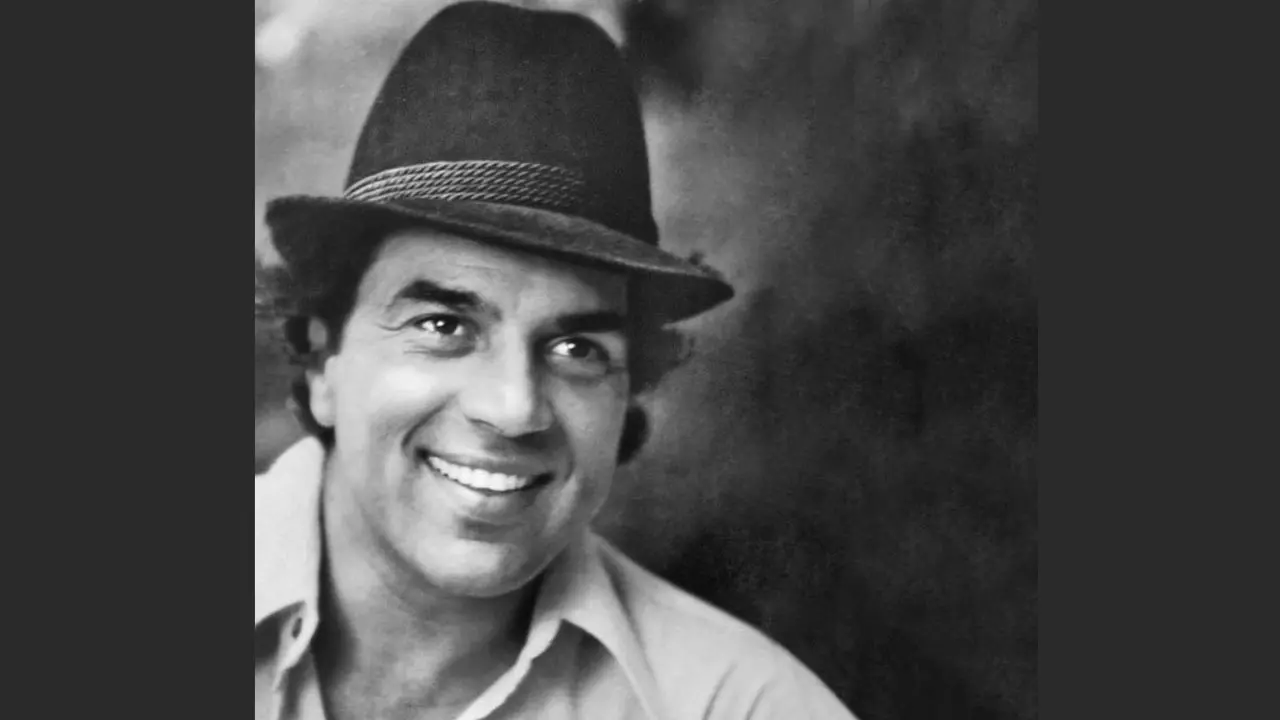
A tribute to the handsome titan who rose from the fields of Punjab to rule Bollywood with raw charm, quiet dignity, and a heart that stayed simple even when superstardom chased him
Shobhaa De (MID-DAY; November 25, 2025)
‘Aap Ka Dharam’, as he fondly called himself on social media, built a unique identity — the rustic farmer actor from Punjab. A hatta katta Jat more at home on a tractor than in a Mercedes. That was him. The real deal. Authentic and adorable. A man proud of his roots in an industry full of insecure actors, craving for attention by creating a fake aura around themselves. Dharmendra towered over his contemporaries and was Bollywood’s handsomest star. Simply by being himself, he won over everyone he met.
The term ‘Garam Dharam’ was coined by me. There was a natural hotness about him. He projected unbridled virility. Women would throw themselves unabashedly at him, and he would always oblige them with his undivided attention. His good looks and amazing physique made him a babe-magnet, but it was his chivalry that made women feel safe and comfortable in his presence. Dharmendra did not give a lecherous vibe, unlike his more predatory rivals — he didn’t need to! Women fell in droves for his natural charm, and soon a legend grew around his impressive prowess. He was not a cheap, sly, filmi flirt, like the rest. Macho, oh yes! But he was also gallant and protective.
Behind the exaggerated He-Man tag hid the quintessential Dharmendra — gentle, kind, generous, and a hopeless romantic. But one heard stories about the ‘other’ Dharmendra — the volatile star, who, (after a few Patiala pegs), once notoriously chased a female gossip writer from a film magazine, threatening to beat her up for something she had written in her popular column.
He was an old-fashioned hero, a matinee idol like Clark Gable. Devastatingly good-looking, hugely successful, and terrific with the ladies. There was nothing even remotely toxic about his persona. This is what made him special. He was like a tall tumbler of frothy Punjabi lassi, best enjoyed in the fields of Punjab — a kisaan who had strayed into the glamorous world of Bollywood.
As the editor, I frequently assigned senior feature writers like the late Ingrid Albuquerque to meet the stars and interview them. We had featured Dharmendra several times for cover stories — he was at his peak, and always obliged. Ingrid and other reporters would come back and regale us with hilarious stories of his disarming behaviour in the dressing room of the set, since there were no vanity vans back then.
I wouldn’t call him media shy, but he was definitely shy! Always a little embarrassed and socially awkward, preferring the company of his buddies, unsure of what he was meant to say during interviews, but happy to pose for publicity pictures and indulge in light-hearted banter. He was unapologetically himself — switching to Punjabi, given half the chance.
In an era when there were polished, sophisticated, well-read, articulate, English-speaking heroes like Shashi Kapoor, Rajesh Khanna, Vinod Khanna, and Amitabh Bachchan, Dharmendra created his own space by being unabashedly himself. That he was monumentally successful, giving seven consecutive hits in a single year, was a bonus. What stood out was his genuine modesty and simplicity. As he once stated, all he ever prayed for in those early years was a Fiat car! But God blessed him with abundance..... not that his wealth ever went to his head. He remained unaffected and down to earth, enjoying his life on the sprawling farm, shooting candid reels, and loving life on his own terms.
After his sons Sunny and Bobby Deol forayed into movies, he made the transition from ‘Garam Dharam’, the sex symbol, every woman’s fantasy lover, to a benign ‘Paaji’. And fans clapped at how gracefully he had crossed over. The love for him only grew.
What Bollywood weddings were like before Instagram overfed audiences
8:39 AM
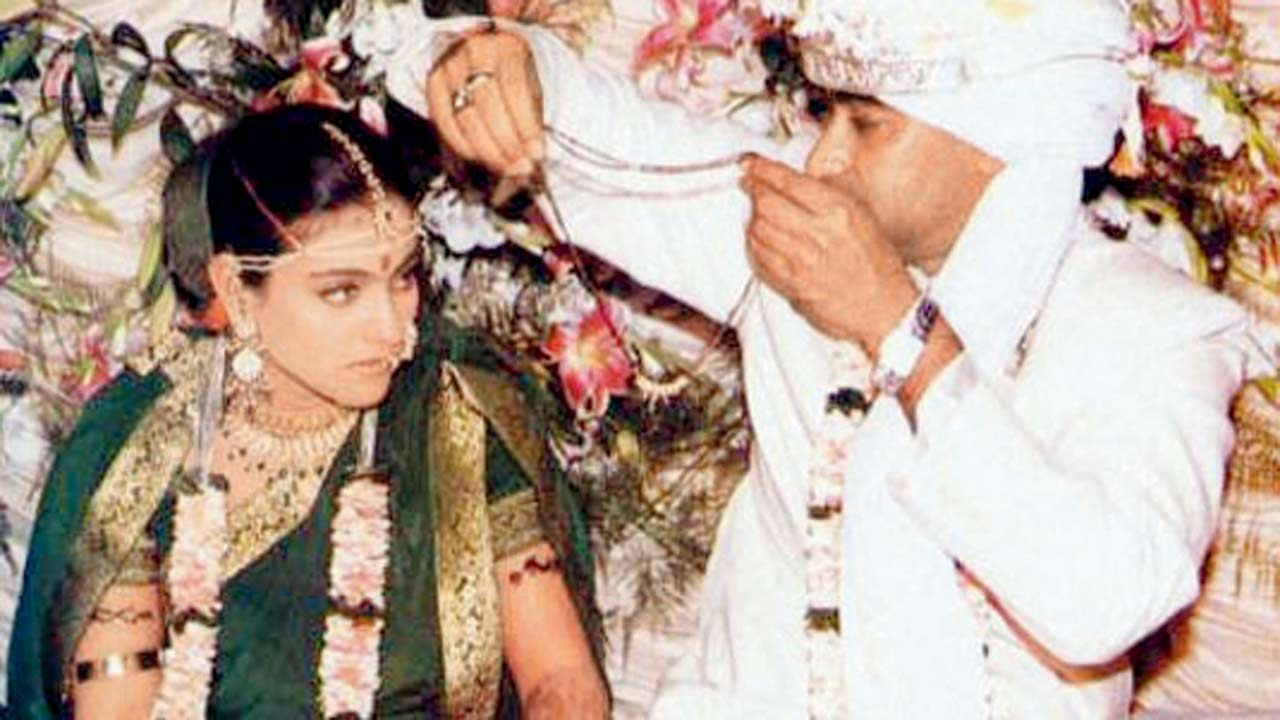
In the week of Bollywood’s biggest shaadi—intimate but everywhere—industry insiders do a total recall to speak of what Bollywood weddings were like before Instagram overfed audiences
Aastha Atray Banan (MID-DAY; April 17, 2022)
Alia Bhatt and Ranbir Kapoor are now married. Bhatt wore a chain with either the number 8 (his lucky digit) or the infinity sign. Yes, Ranbir was sporting diamond studs. Yes, the vows were exchanged on the balcony of their home, where they have lived for five years. No, the exes were not invited.
Yes, the bride and groom raised a toast with champagne. Yes, they have delayed their honeymoon as they have work commitments. Kapoor is not on Instagram. Bhatt released carefully chosen images on her handle, receiving loving comments from esteemed guests.
The three-day coverage and video footage by the paparazzi posted outside their Pali Hill home played out online and on television, ensuring we know every minute of how the run up to Bollywood’s biggest wedding this year went.
It wasn’t very different with the star weddings that preceded this one: Virat Kohli and Anushka Sharma, Ranveer Singh and Deepika Padukone, Sonam Kapoor and Anand Ahuja, Katrina Kaif and Vicky Kaushal. But what about stars who married before Instagram happened? We spoke to four Bollywood watchers and asked them to spill the beans on the simpler times.
‘Images were sent later with mithai’ - Sarita Tanwar, former entertainment editor, now producer
Back in the 1990s, actresses in Bollywood only got married when their careers were ebbing. Both Juhi Chawla and Sridevi hid the fact that they were married for years while they were acting. It was believed back then that if an actress got married, her career ended. Kajol changed this trend when she married at the peak of her career in 1999. She continued playing the protagonist after, and took a long maternity break.
A lot of the actresses today should credit her for making the change. Her wedding to Ajay Devgn was a quiet affair, where a friend of the bride took pictures, and later they sent off two or three selected frames with a box of mithai to all the journalists. Both, she and Ajay are private people and it was a family and friends affair. Hrithik Roshan and Suzanne Khan went off to Bangalore to get married, where Feroz Khan had a hotel, and Aditya Chopra and Rani Mukerji got married in Italy. It seems the Yash Raj stars followed this trend, including Ranveer Singh and Anushka Sharma.
‘Back then, stars eloped, performed temple shaadis’ - Shobhaa De, former editor-Stardust, author
The monster called social media is a creature of today. Back then, there was, of course, feverish excitement surrounding a star shaadi. The very first Stardust cover story (50 years ago) cheekily asked: Is Rajesh Khanna secretly married? The reference was to Anju Mahendroo. When he did marry Dimple Kapadia soon after, it was indeed a “secret” and sudden ceremony.
Stars eloped, performed “temple shaadis”, broke up shaadis at the mandap… all the drama you expect as part of showbiz. Today’s Bollywood weddings are staged like well-oiled super productions, with selective leaks to heighten fan worship. Star nuptials whether here or in Hollywood feed into fandom. People obsess over every scrap thrown at them. The classiest wedding by far was when Sharmila Tagore married Tiger Pataudi. The coverage was breathless but remained tasteful—when cricket marries movies, we know the madness that generates.
The media missed out on Hema Malini’s marriage to Dharmendra, for obvious reasons. More recently, the Abhishek Bachchan and Aishwarya Rai wedding wins by several miles. It was conducted with dignity and grace with privacy protocols in place. The main difference between the weddings of before and now is marketing. All else remains the same—the glamour, dazzle and romance. Stars today are super smart and know exactly how to exploit fan interest in order to generate the maximum publicity.
‘People climbed walls for Kareena’s wedding’: Kushal Rani Gulab, entertainment journalist
I think it was with Aishwarya Rai and Abhishek Bachchan’s wedding in 2007 that the frenzy around film star weddings started. My publication at the time had as many as eight journalists covering the wedding, and because the Bachchans are not just Bollywood royalty, but Indian royalty almost, people tried their best to take pictures they could. In the ’90s, there was easy access to everyone. I would head out to different studios in the morning, and chat with the stars available on set, and get an interview. The PR machinery had not kicked in. Weddings too were not that big a deal. It’s just the monthly film magazines that carried large photo spreads. It was when Kareena Kapoor and Saif Ali Khan got married in 2012, that we realised how interested the average person is in the personal celebration of celebrities. Photographers had scaled the walls of their residence since they were being secretive about the festivities.
‘Media persons were invited as guests’ - Pradeep Bandekar, photographer
I remember a lot of film star weddings, and most of them we attended as guests. Invitations would arrive with gifts and a box of motichoor ladoos. At Karisma Kapoor’s wedding to businessman Sunjay Kapoor in 2003, 700 people were invited, and Ranbir [Kapoor] promised us he would get the couple out for a picture. When Fardeen Khan married Natasha Madhvani in 2005, his father Feroz Khan got us a room in the same hotel, and the staff was told to take care of us like his personal guests.
Jo aish hamne ki hai, kisi ne nahin ki. Then Fardeen and Natasha came out before the photographers and kissed. My photograph of this moment appeared in mid-day. When Sanjay Dutt got married to Maanayata, it was impromptu and he had called just a few press photographers to the venue. The manager shared with us the exact time that the newlyweds would give us a photo op. We were offered food and refreshments in a special corner, while we waited.
The couple arrived on time as promised and posed graciously for us. Before leaving, Sanjay stopped and told each one of us personally that we were his guests and that we were to enjoy the wedding like family. These were relationships. Now, it’s transactional. It was Aamir Khan, who during his wedding to Kiran Rao, started the trend of keeping the press waiting.
We all went from Mumbai to Panchgani, where the two were married, and he didn’t give us pictures, nor did he make an appearance. So many of us had travelled long distances to be there. I think a wedding is an opportune time to take the blessings of people.
Inputs by Jane Borges
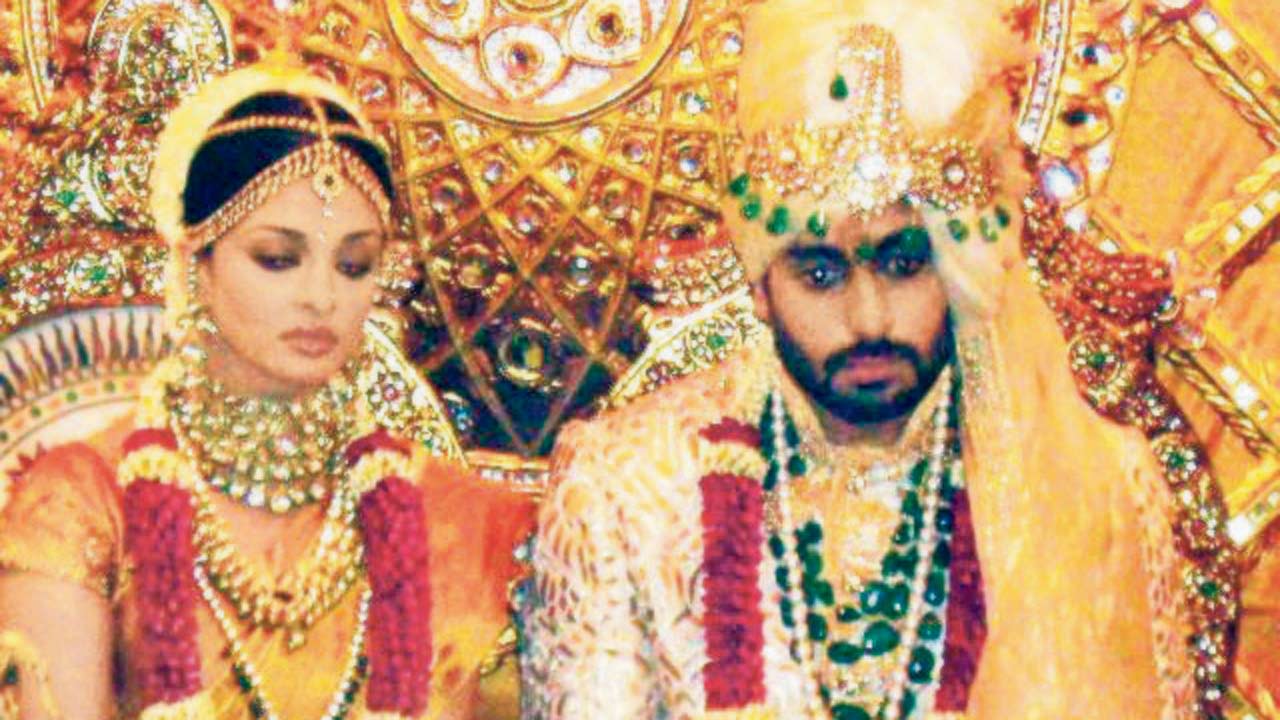
Abhishek Bachchan and Aishwarya Rai, 2007
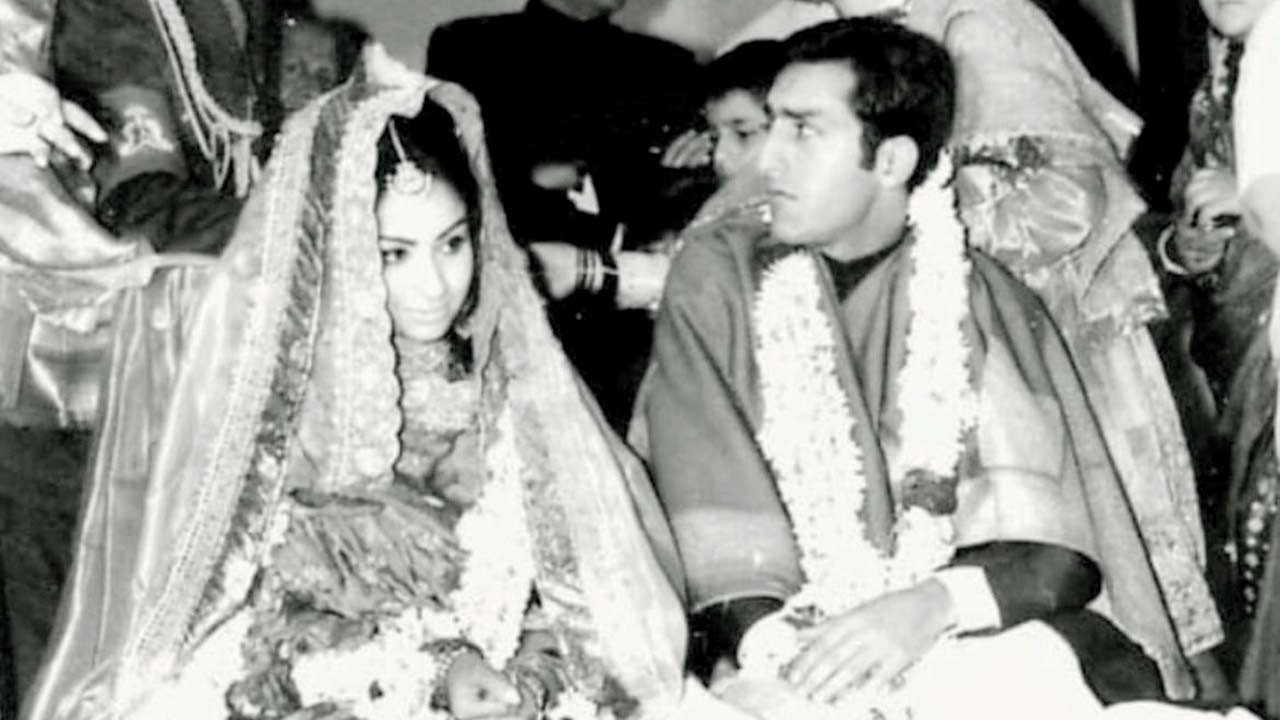
Sharmila Tagore and Mansoor Ali Khan Pataudi, 1969. Pic/@sabapataudi Instagram
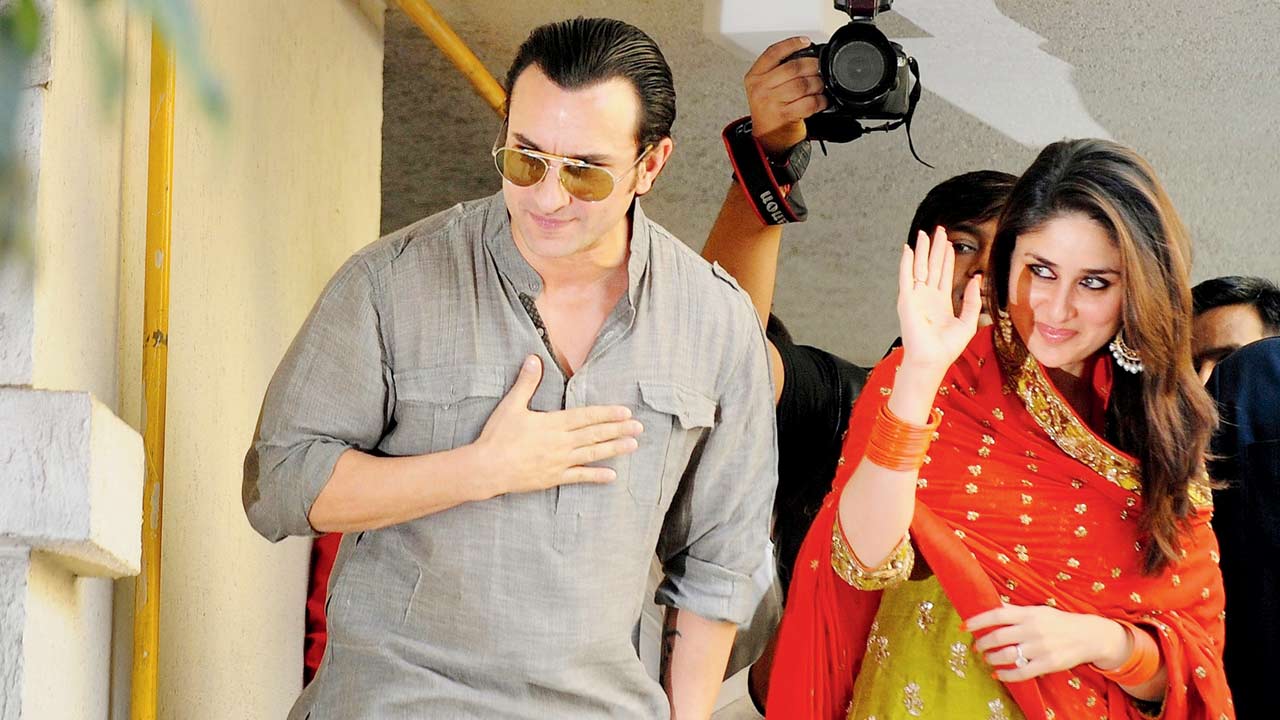
Kareena Kapoor and Saif Ali Khan, 2012
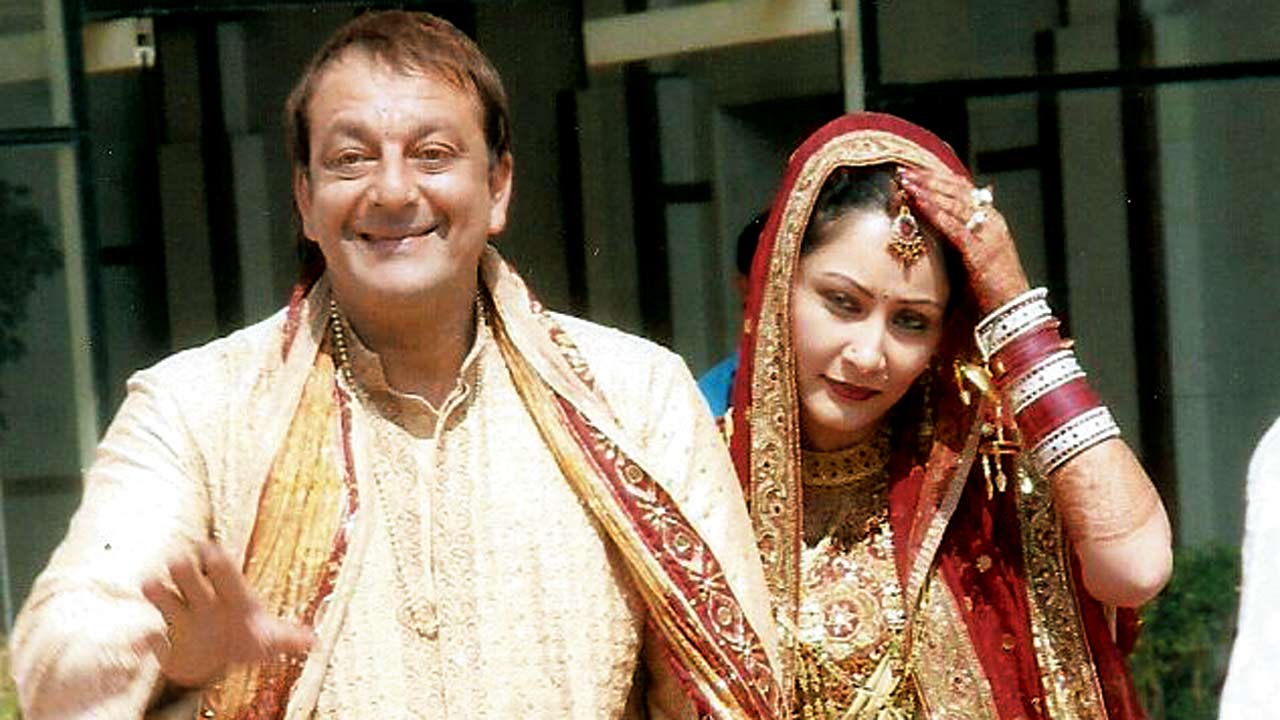
Sanjay Dutt and Manyata, 2008
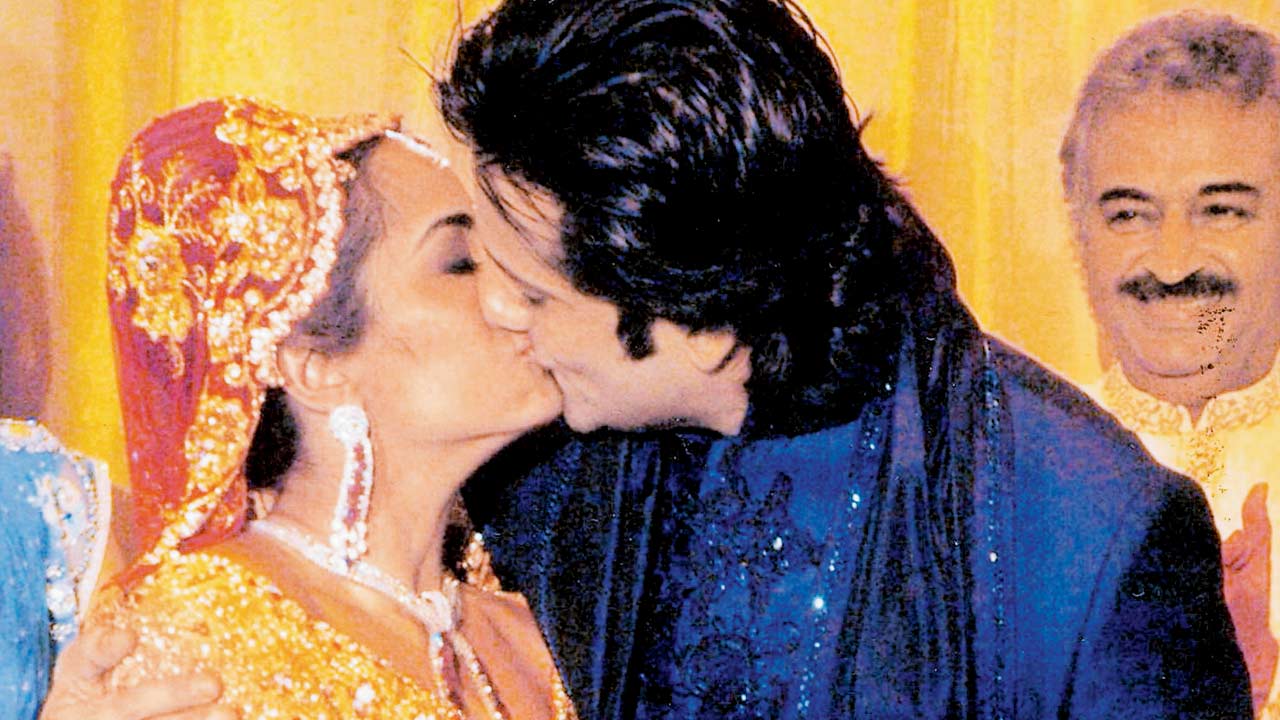
Fardeen Khan and Natasha Madhwani, 2005
Aryan Khan was unfortunately at the wrong place at the wrong time-Sussanne Khan
8:34 AM
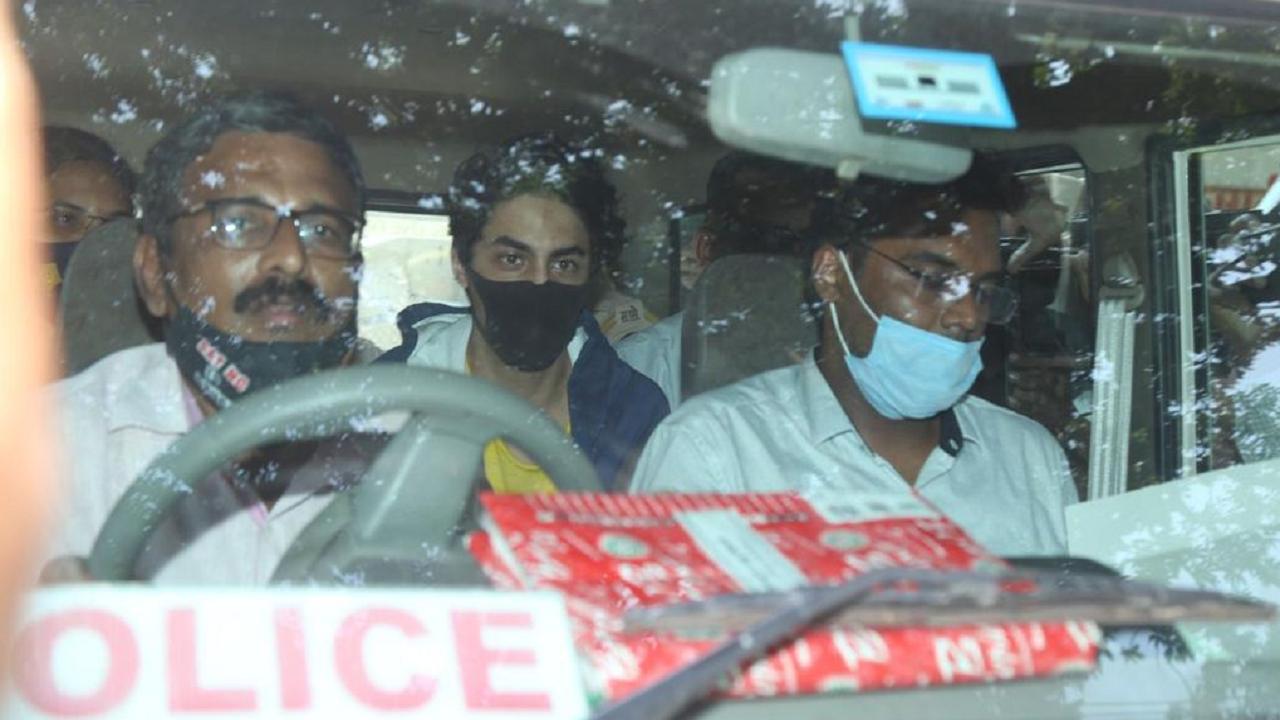
While most in showbiz maintained a studied silence, some have noted that the case is generating sensationalistic, voyeuristic pleasure. Others also extended moral support to the Khan family
BOMBAY TIMES (October 5, 2021)
On Monday, Aryan Khan, Arbaaz Merchant and Munmun Dhamecha were produced for their second remand hearing in the cruise ship drug raid case. They were sent to NCB custody till October 7.
The NCB had sought custody till October 11 and in its remand application stated that “shocking incriminating material has been found on his phone in the form of pictures”, which talks about “procuring in bulk for further distribution.” The sections applied under the NDPS Act were 8(c), 20(b), 27, 28, 29. Additional Solicitor General Anil Singh, appearing for the NCB, read Rhea Chakraborty’s bail order where it was observed that offences under NDPS are non-bailable.
Advocate Satish Maneshinde, appearing for Aryan, said, “My bag was searched but nothing was found. After some time, they took custody of my phone and began interrogating me. Mr Merchant is a friend of mine. This is a small quantity (six grams of charas). None of the other drugs was seized from us. The main seizure is from the other accused. I am not connected to others. Even if the offences are non-bailable as argued, based on Rhea's case, I am entitled to bail. There, Section 27A was invoked, for financing. If material is seized from other accused, that cannot be foisted on me. One of the grounds is that there is the seizure of total commercial quantity in the entire case. But that can't be used against me. According to them, I’m in the position of purchase. But nothing is recovered from me.”
Regarding the allegation that Aryan was involved in international trafficking, the lawyer said, “Now they say that when I was abroad, I have certain conversations in the phone and they want to bust an international drug trafficking racket. In the last one year, I've gone to my university. In the entire period, I have not indulged in any drug trafficking.”
Earlier, on Saturday, NCB officials raided a cruise ship off the coast of Mumbai and held eight people for questioning, including Aryan. On Sunday, Aryan, Arbaaz and Munmun were arrested by the NCB and produced before a holiday court in Mumbai. The court sent all three to NCB remand for a day. The other five accused – Nupur Satija, Ishmeet Singh Chadha, Mohak Jaiswal, Gomit Chopra and Vikrant Chhokar – were also arrested later on Sunday.
Before Monday’s remand hearing, Sameer Wankhede, Zonal Director NCB, had told us, “NCB will seek further custody of Aryan Khan. I cannot reveal the links and the findings of last evening’s interrogation, but there are areas we need to investigate.”
As to whether all eight accused will be questioned together or not, he said, “We use all techniques in our investigations, and will be using the same methods in this case too.”
On Monday, when the cruise ship returned to Mumbai, Wankhede and other NCB officials reached the cruise terminal and searched the vessel, an official reportedly said.
HAD HE NOT BEEN SRK’S SON, PEOPLE WOULDN’T HAVE BEEN INTERESTED IN THE CASE SO MUCH: SHOBHAA DE
It’s very indicative of something far deeper that needs to be investigated more thoroughly. And because it’s such a high profile arrest today, it is generating that kind of sensationalistic, voyeuristic pleasure in seeing whether Aryan is going to be actually arrested and how, what statement is he going to be signing. All of it, which has gone viral, has everything to do with his public profile, as the son of Shah Rukh Khan. But, the problem is very much there, and has been addressed perhaps not strongly enough, and there was no follow through after the Sushant Singh Rajput incident. This is the second such (case) which should act as a wakeup call, and what we have to remember, to start with, and that’s the most important thing, that whether it’s Shah Rukh Khan’s son, it’s Aryan Khan, or anybody else, due legal process is being followed... Had he not been Shahrukh Khan’s son, had it been just another arrest of a rich kid, I don’t think anyone would’ve been that interested in following this case. (The comment was made during a discussion on NDTV)
PAINFUL FOR PARENT TO DEAL WITH CHILD IN TROUBLE: HANSAL MEHTA
It is painful for a parent having to deal with a child getting into trouble. It gets compounded when people begin to arrive at judgements before the law takes its course. It is disrespectful and unfair to the parent and to the parent-child relationship. With you @iamsrk
HE WAS AT THE WRONG PLACE AT THE WRONG TIME: SUSSANNE KHAN
I think this is not about Aryan Khan, as he was unfortunately at the wrong place at the wrong time, this situation is being made an example to drive home the excitement that some people get as they have a witch hunt on people from Bollywood. It’s sad and unfair as he is a good kid. I stand by Gauri and Shahrukh. (The comment was in reaction to Shobhaa De’s post)
BOLLYWOOD GAWKING IS A TAMASHA: SUCHITRA KRISHNAMOORTHI
Nothing harder for a parent than seeing their child in distress. Prayers to all. For all those targetting #Bollywood remember all the #NCB raids on filmstars? Yes nothing was found and nothing was proved. #Bollywood gawking is a tamasha. It’s the price of fame.
THE CHILD SHOULD BE GIVEN AN OPPORTUNITY, LET THE REAL REPORTS COME: SUNIEL SHETTY
When a place is raided, a lot of people are detained. We assume that the kids must have consumed or done something. All I want to say is that the process is on, let's give that child a breather. Whenever there is something related to Bollywood, the entire media starts reacting on every angle and assumes that everyone is like that. I think the child should be given an opportunity and let the real reports come out. Till then, he is a child and I think he is our responsibility. (The comment was made on Sunday)
-------------------------
-------------------------
2011: SRK detained and fined by customs at Mumbai airport
This is not the Khan family’s first run-in with Sameer Wankhede. In 2011, Wankhede, who was then the Deputy Collector of Customs at Mumbai Airport, had stopped SRK and family when they returned from an international holiday. SRK was interrogated and then fined with a custom duty of approximately ₹1.5 lakh
Stardust, the magazine that taught us paparazzi rules, turns 50. Shobhaa De goes down memory lane
8:08 AM
Jane Borges (MID-DAY; March 14, 2021)
Shobhaa De was all of 23, when she took up the reins of Stardust, the monthly film and gossip magazine, which launched in February 1971, literally with a bang. Its inaugural issue cheekily asked, “Is Rajesh Khanna secretly married?” sending the Hindi film industry in a tizzy. Turns out, this was the beginning of the magazine’s tryst with scoops and scandals. “Stardust was a toofan, a hurricane... it was like nothing else in the market. The idea was to shake up the film industry and make readers sit up!” says De, the founding editor of the magazine, which just turned 50. During her 11-year stint with the publication, De went on to become one of the most intrepid editors, daring to push the envelope of film journalism, issue after issue.
Until before Stardust, De says, “there were only tame, goody-goody players on news-stands”. “Film magazines ran sugar coated, PR stories about a star’s pet Pomeranian or a dull photo shoot featuring star couples posing decorously next to plastic flowers,” she remembers. Stardust, she says, smashed all the stereotypes, emerging as a powerful game changer—not just in the realm of movie fanzine journalism, but across the board. “It was witty, bold, irreverent and deliciously wicked. It went where no others wanted to go—scandals, affairs, exposes. What is showbiz without masala? Stardust presented a far more thrilling picture, without glossing over the gory bits. It was catering unashamedly to the voyeuristic interest that fans have in the private lives of their favourite screen idols. Nobody wants a recipe for chutney from a sizzling star. Give us the dirt! Spill the beans—that’s human psychology,” shares De of the reason for the “aggressive approach” adopted by the magazine.
De recalls the time when Raj Kapoor initiated a lawsuit against them. “We had filed a review of Satyam Shivam Sundaram [1978]—his magnum opus—and titled it Satyam Shivam Boredom.” Court cases, of which they had their fair share, didn’t pull the plug on their writing. They confronted them with a “bring it on” attitude. “Stardust did not depend on movie ads for revenue. We could afford to cock a snook at all the players—and thereby retain our independence.” There were also the big shockers, like the cover story in August 1975, which screamed, “Will the Bachchan Marriage Survive Inspite of Zeenat?” “Every scoop had some amount of salaciousness built into it.”
Most readers of Stardust will, however, remember the magazine for its easy-breezy writing style and catchy Hinglish. The colloquial lingo was born organically. “Essentially, it was street speak—what we call Bambaiya or tapori talk. It was a new, unbridled way of expression. At the time, readers said we used Hinglish because our English was weak. But, to play with language and manipulate it to create a fresh vocabulary requires risk, confidence and a certain mastery over words. Mighty dailies started to use Hinglish—political headlines sounded like Stardust cover stories! Our column, Neeta’s Natter was constantly quoted.”
At one point, the magazine was so popular that even film stars, who loved and hated it in equal measure, didn’t miss the opportunity of a feature. “Our approach was not just imaginative, but also innovative. We got top stars to pose for daring shots that had the potential to shatter their carefully constructed ‘wholesome’ image. But, they gamely went along with our out-of-the-box ideas because they realised the publicity value of those pioneering shoots. Even our gossip pages carried exclusive shots of stars partying—these pictures were the forerunners of the paparazzi culture that followed,” says De, who after Stardust, went on to launch Society and subsequently, Celebrity.
Having the “gutsy” Nari Hira as publisher to back their product, says De, helped take Stardust to new heights. “His tabloid style formula totally transformed film journalism. Nothing was sacred. Nobody was spared. We derived our spunk and daring from the boss. He backed all our stories robustly, even when it came to nasty and expensive court cases. He went where rivals feared to enter, and taught his team to swim with the sharks.”
De’s top 5 picks

December 1980
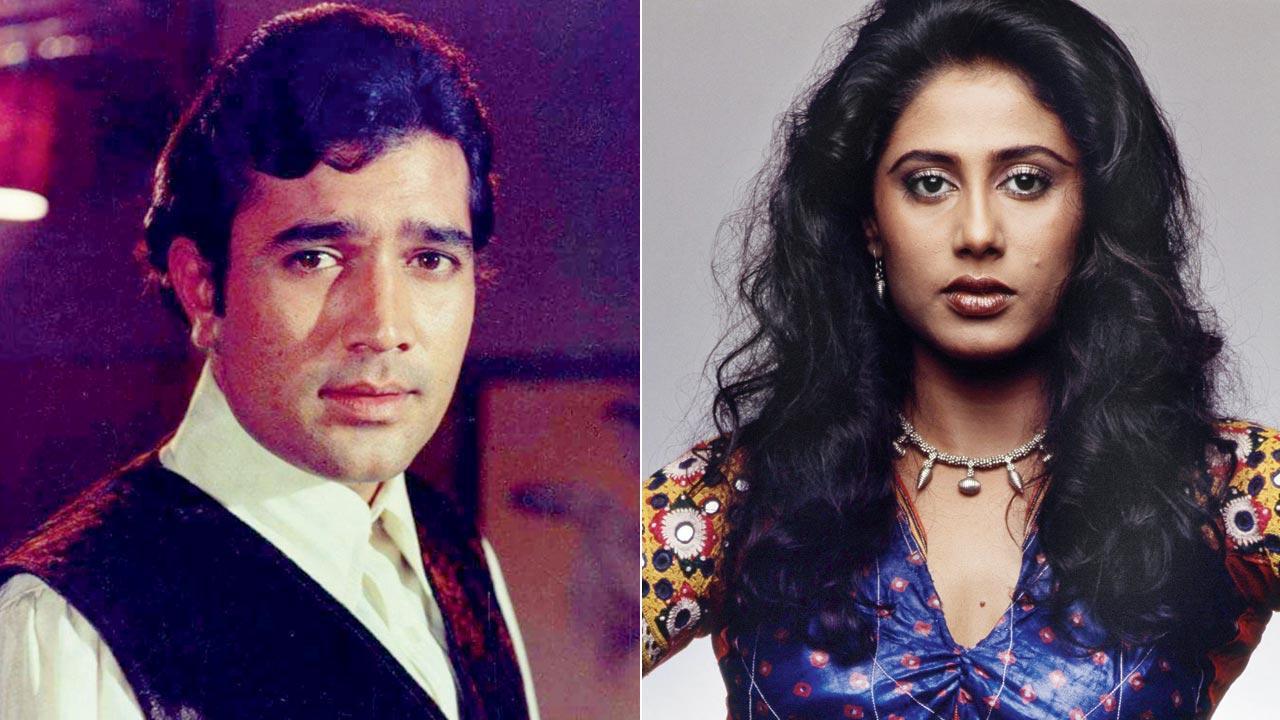
This was the quote we ran on the cover after interviewing Smita Patil’s wonderful, outspoken mother. Patil was a personal favourite of mine—I knew her quite well, and admired her talent, beauty and transparent nature.

November 1972
Here was an unconventional superhero like Vinod Khanna, unafraid to say it like it is. He was a good friend of Stardust, and got featured several times. We gave him the ‘Sexy Sanyasi’ tag when he joined the Rajneesh Ashram in Oregon and walked away from Bollywood.

February 1971
The cover image was notably ghastly! But the issue sold out! We doubled our print run from the next issue. The “scoop” was personally given to Nari Hira by Rajesh Khanna’s then girlfriend Anju Mahendru’s mother. It was Stardust that had dubbed him, “The Phenomenon”. Khanna still retains that title according to me. The madness around him has not been matched by any other star, the Khans included.

January 1972
Stardust had given Dharmendra the ‘Garam Dharam’ tag which he lived up to. The story detailed his many liaisons, and he didn’t have a problem with the reportage.

August 1974
This was declared by Katy Mirza, the lovely Parsi girl from Mumbai who went to London and became a Playboy Bunny. It was a candid story and she spoke freely about body-image at a time when nobody discussed such terms.
Indian publishing today increasingly looking at children of stars to write the next bestseller
9:02 AM

While celebrities turning authors is not a new trend, Indian publishing today is increasingly looking at children of stars to write the next bestseller
Urvashi Bahuguna (MUMBAI MIRROR; June 28, 2020)
 Step through the doors of a bookstore in India today and chances are you will see a prominently displayed title or two by a celebrity. With the presence of a wildly popular film and television industry in the country, it is unsurprising that publishers seek out actors and stars for memoirs and the occasional work of fiction. But a less obvious publishing practice, we’ve seen of late, is the commissioning of books written by the children of celebrities.
Some recently published titles include Shweta Bachchan-Nanda’s collection of short stories, Paradise Towers, Aishwaryaa Rajnikant Dhanush’s Standing On An Apple Box: The Story of A Girl Among The Stars (right), Shaheen Bhatt’s I’ve Never been (Un) Happier, Soha Ali Khan’s The Perils of Being Moderately Famous and Esha Deol Takhtani’s Amma Mia: Stories, Advice and Recipes from One Mother to Another.
While publishing celebrities is not a particularly new phenomenon, Mirror spoke to a few publishing houses, industry veterans, book critics and writers to get a sense of why a name matters, what drives this trend and what place it may or may not have in our burgeoning reading culture.
Art of selling
“Most people assume publishers will publish anyone who has a famous name,” laments Gurveen Chadha, a senior commissioning editor at Penguin Random House India, “While celebrity books are an easy sell, it has to be a compelling story at the end of the day — whether written by a celebrity or non-celebrity. Of course, selling a celebrity book is a tad easier, but if there’s no story to tell in the first place, the book will eventually tank.” Diya Kar, a senior commissioning editor at Harper Collins India, agrees that the talent of the person in the limelight is what eventually draws publishers to these deals.
 Shaheen Bhatt (daughter of filmmaker Mahesh Bhatt), who wrote a candid memoir about her struggle with depression, says she recognised that her privilege provided her with a platform. She felt compelled to use it to reduce the stigma around mental health. “When I first began talking about mental health publicly in articles and on social media, the response I got was far greater than anything I could have anticipated,” she shares. “I was flooded with hundreds of messages from people telling me that they were going through their own trials with mental health. I saw the difference sharing was making.” When Penguin approached her, she chose to go forward because a book could potentially reach far more people than a social media post. But I’ve Never Been (Un)happier wasn’t easy to write. She would work on it for a day before having to step away from it for several days because of the toll of “forcibly reliving bad memories”. Ultimately, she is glad she did it because she says she is “much more at ease” with herself and the world around her, “now that I have been able to lay my heart bare. There is nothing to hide anymore.” She was inspired by her father who never held anything back in his writing.
 Esha Deol, who is the mother of two young daughters, intends her book to be a “helping hand” for new mothers. In what she describes as her “first clueless year of motherhood” she encountered surprises every day. As she overcame them, she realised she wanted to share her experience with other mothers. She wanted to convey that “if I am able to do all these things, so can you.” Writing in the middle of the night, she spent a year-and--a-half working on Amma Mia as she went through the pregnancy and birth of her second child. Experiencing the emotions of pregnancy and the early stages of being a mother all over again was really helpful as she wrote. She’s penned down everything she went through alongside recipes and advice, and she hopes Amma Mia is everything a new mother is looking for.
A number game
Shobhaa De, Mirror columnist and the author of multiple books, suggests that a significant social media presence is a key determinant in these publishing decisions. On Instagram, Soha Ali Khan has 2.3 million followers, Esha Deol has 1 million, Shweta Bachchan-Nanda has 3,40,000, Shaheen Bhatt has 2,32,000 and Aishwaryaa Dhanush has 1,68,000. On Twitter, Ali Khan has 2.1 million, Deol has 3,56,694, Bachchan-Nanda has 42,983 and Dhanush has 1.7 million. Referring to social media’s impact on sales, Chadha says: “I believe we tend to buy books that have already done the rounds on social media and there are very few readers visiting bookstores looking for new writers or a new book. Most come with their minds already made up.” But like Kar, she sees this as only one of many factors that help sales.
While sales numbers for these books were not disclosed by the publishers, sources within the industry are not convinced that each of these books necessarily turns a profit. A publishing house employee, who wishes to remain anonymous, says that in these cases, the investment from the publisher is substantial in terms of advances and marketing budget.
 Kanishka Gupta, a literary agent and author, stresses that in addition to the above there are hidden costs for the publisher such as editorial trips to work with the celebrities, launches at top hotels and ghost writer fees, which are expenses they don’t normally encounter with other authors. With these steep costs in mind, he believes the profit margins may not be significant. Moreover, he has found in his experience of promoting books that there is no guaranteed correlation between social media following and book sales. He believes that the number of followers is less important than the quality of the celebrity’s content and the level of engagement of the followers.
Westland Books’ publisher Karthika V K believes that exceptional success stories within this genre keep publishers interested. She says, “It’s not as though every book written by a celeb becomes a hit, but there are enough success stories for us to know that the offtake from retail is quicker and more positive. Whether the celeb is connected to entertainment or politics or sport or self-help, there are existing channels of communication and marketing, which are already open and can be effectively leveraged.”
Aditya Mani Jha, a former commissioning editor at Penguin Random House and book critic, believes that even if each of these books is not profitable, a publishing house may take them on because they can risk “a small loss in the short-term so that they are in the good books of the celebrity whose family member wrote the thing and are well-placed to represent the ‘actual’ celebrity later”. The aforementioned anonymous employee also says that nepotism is a driving force where offspring of eminent personalities have easy rides to publication.
Some star power
Both De and Gupta see this publishing practice as an extension of society’s obsession with celebrities. Chadha appears to agree to an extent stating, “We’re a celebrity-obsessed country and there’s a vicarious thrill in reading about the lives of your favourite stars in books. It’s a sneak preview into their lives that you may otherwise not have access to. The interest in such books is massive and they generally tend to do well. In fact, some of the biggest bestsellers today tend to be celebrity books. It’s a very dependable publishing trend.”
According to Kar, the honour of being an author, and having a published book on the shelf, is what motivates celebrities to try their hand at writing. Chadha finds that for non-established names: “it’s a way to reinvent themselves, to use books as a medium to showcase a part of themselves with the world that they might not necessarily have otherwise.” Karthika imagines that “it’s a matter of legacy as well as brand extension, depending on where they are positioned in their careers.” De says, “Star kids have nothing to lose and a lot to gain by lending their names to books. They get invited to book fairs and literary festivals, where they even get mobbed.”
The question of quality is harder to assess. Gupta argues that both Bhatt and Ali Khan deserved to be published on the merit of their stories alone, though he qualifies this by saying that even good celebrity writers are often overrated. The quality of the books does affect sales, according to both Kar and Chadha, who state that in the long run, word-of-mouth endorsements and the book’s calibre are what sustain sales. Chadha further stresses that “a lot of these books are original, ambitious in scope and writing and really, really good.”
Many exciting things have happened in my 40s-Karan Johar on turning 47
8:47 AM
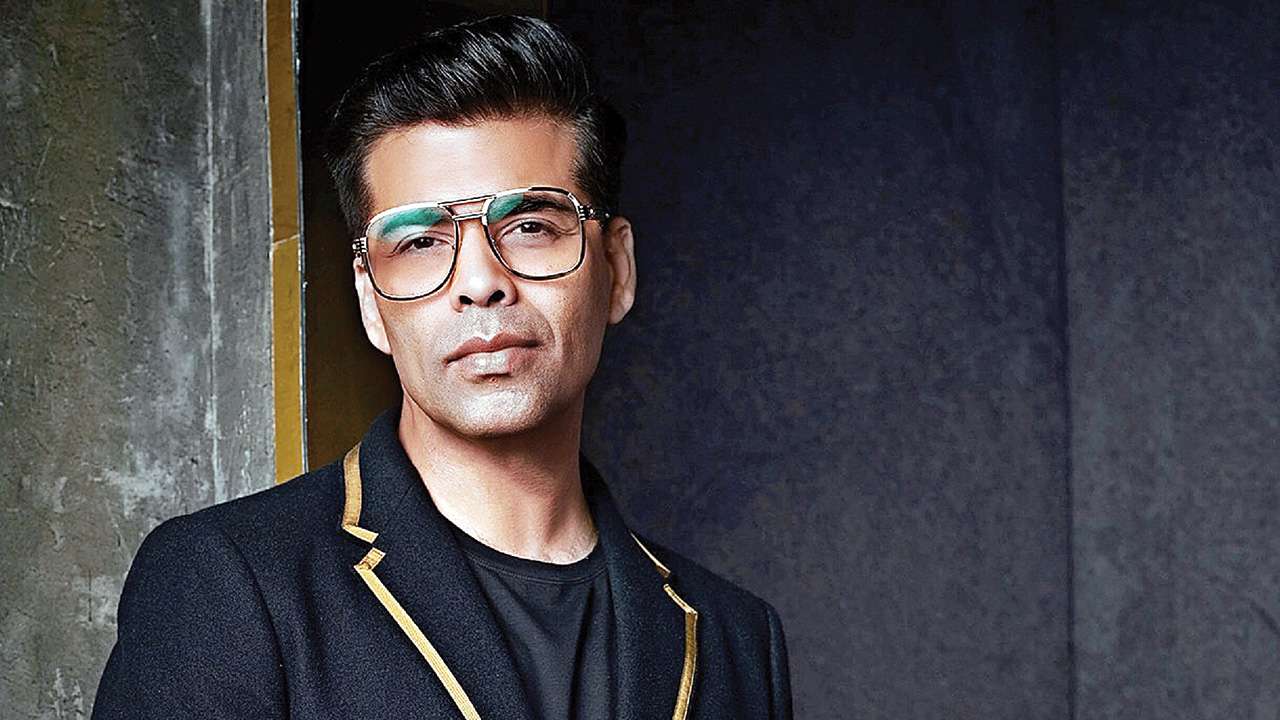
Meena Iyer (DNA; May 25, 2019)
It’s Karan Johar’s 47th birthday today. As reported by After Hrs earlier this week, the blockbuster filmmaker-cum-talk show host has flown to New York to celebrate his big day.
Before he took off, we got our fix of KJo’s magic and mantras. Charismatic as always, he addressed everything from midlife crisis to his anxieties with a candour that is rare and so welcome.
Over to Karan:
First things first, what are your thoughts on turning 47?
There was a point of time when I was very excited about turning 40. I thought it would be a new innings in my life, which in any case it was. So many exciting things have happened to me in my 40s. Like my company (Dharma Productions) has grown, my kids — Roohi and Yash — came. It has been a new life with my babies; they have changed my 40s around. I thought there would be the advent of a love story. I put the message out into the Universe and it came true through my children. The love that I was seeking in terms of a relationship, which I never had, and the loneliness that I felt is gone. The decision to have my children has changed my 40s around and it has changed my mother’s 70s around. It has transformed the fulcrum of our existence. At 47, I have two emotions. One of excitement that I am heading towards the mid-point of my life. There is so much I have to achieve before I turn 50. And the second is anxiety. Sometimes, I feel I have lesser and lesser time with my babies with whom I have the best love story going on.
But do you have any thoughts about ageing too?
There are some thoughts. When I started dressing in a certain way two years ago, I suddenly realised that what I was actually going through was a midlife crisis. I realised I was growing older, so suddenly a lot of colour came into my wardrobe. All the hipster clothes, which maybe I am too old for, came. I don’t care what others think. I am happy with the colours and designs. There are many thoughts in my head — fear, anxiety, excitement and acceptance of my midlife crisis.
However, no outward signs of your midlife crisis are showing?
Well, I just felt I should do everything that I have wanted to do. At a certain point in my life, I may not be able to pull some of this off. If I feel like pouting to my camera, I do just that. There is a lot of abandon. With wisdom comes abandon and there is a certain carefree spirit in my demeanour. I have accepted how I am and I’m not apologetic about it.
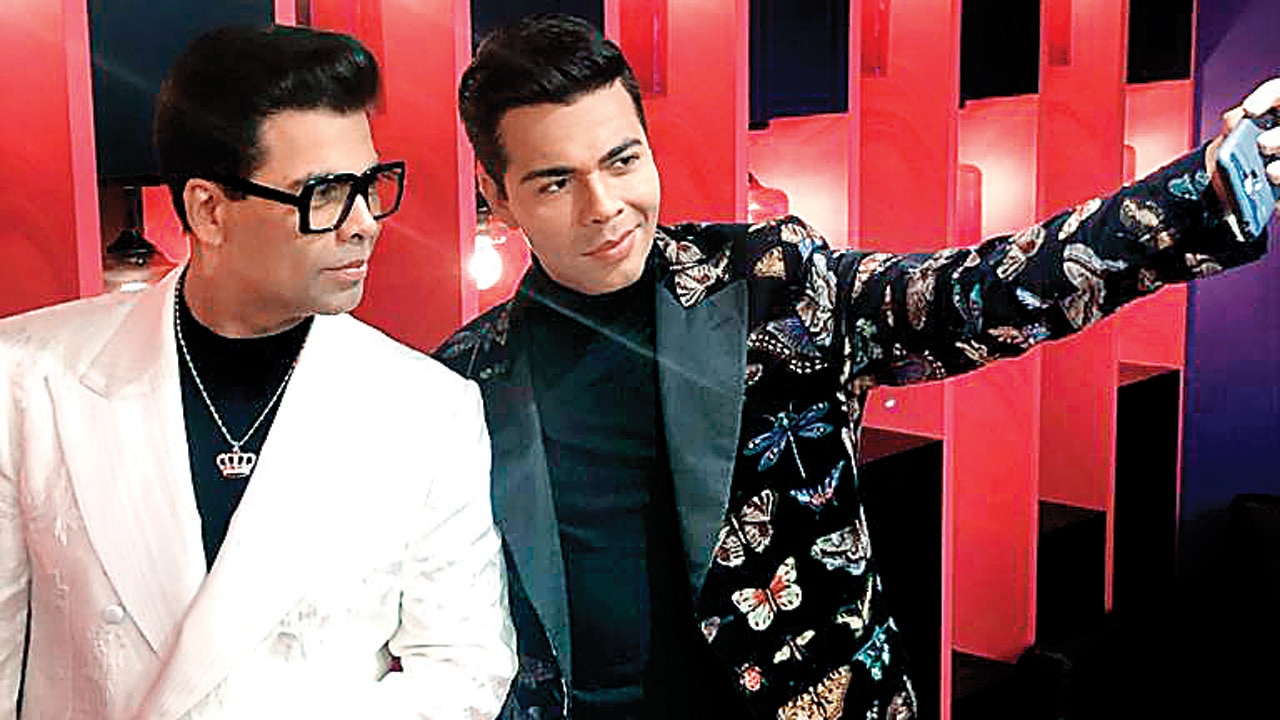
Karan Johar with his wax replica at Madame Tussauds in Singapore
Karan, the seven years since your 40th have seen many highs for you — your book (An Unsuitable Boy), your statue at Madame Tussauds, etc.
I feel fortunate that I have been given a platform to achieve my dreams (making the films I want) and also fulfill some of my hobbies. I have done everything that I love. I love fashion, so I have dabbled in it. I like the idea of being a talk show host and I have that going on for the last 14 years. I love walking on red carpets across the world and I have done that. I have always wanted to tell my story and I did that in my book. I was excited to be at Madame Tussauds because I said, ‘Heck, why not a filmmaker? Why do only actors have to have all the glory?’ I’m happy I’m there. Everything I have always wanted to do cinematically and in my hobbies, I have been able to do in my 40s. I feel blessed. It has opened my plethora of dreams and I feel happy that I achieved most. Now, I feel I have to create new dreams and set new benchmarks. I am hugely excited about what can come beyond this year, beyond 47.
Is there a part two to An Unsuitable Boy?
Yes, there is. I have spoken to Poonam Saxena (my co-author), Shobhaa De and my publisher at Penguin who were with me on my first book. I will definitely do another one. But not immediately. There is so much more to talk about, but I will wait a few years. As I expressed earlier, there’s a lot to address like my fears and anxieties. My babies, who have brought a new aura and energy into my life, will feature in part two of An Unsuitable Boy.
You have a new office closer to your home?
Yes, I do because that way I can spend more time with the babies. Besides this office in Andheri, I also have one in Bandra for my digital work. I have made some structural changes around my professional routine so that I can give my kids the maximum time. I am also blessed to have a mother who is completely hands on. She is there for me and my babies 24/7. This makes me feel peaceful and happy. Instead of making Roohi and Yash work around my schedule, I have been a good parent and worked my schedule around them. That way I can maximise my time around them.
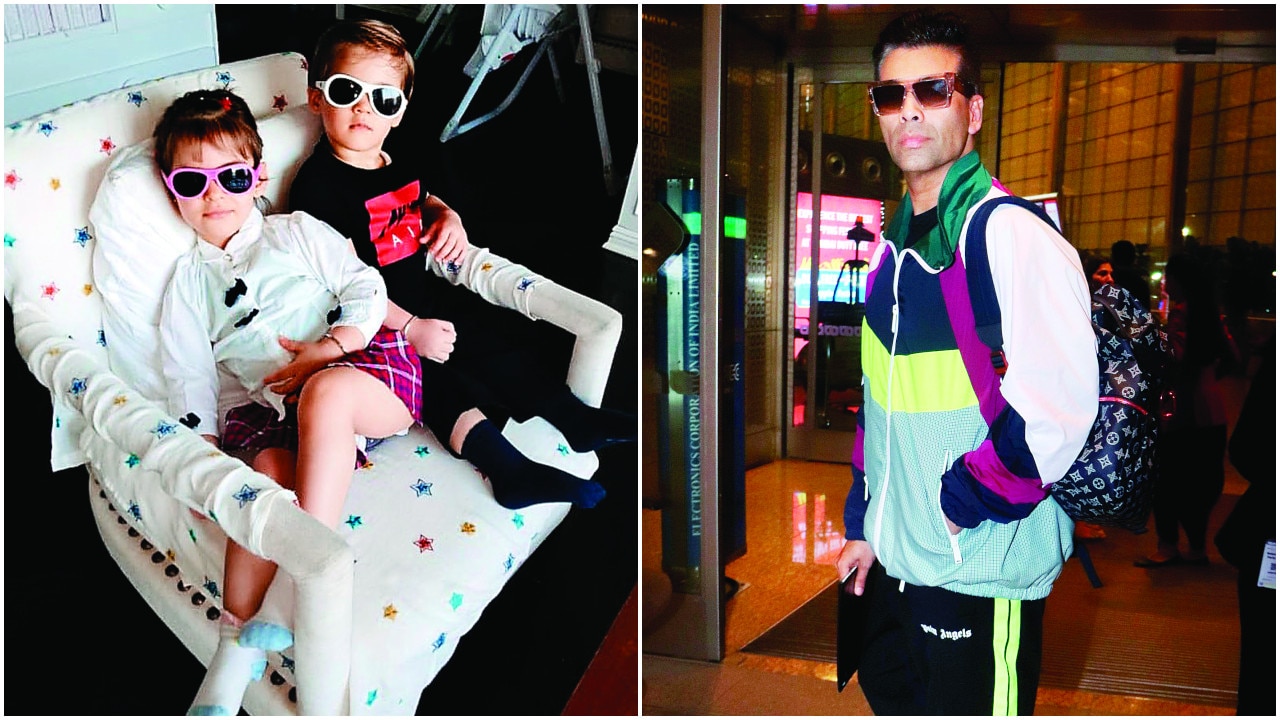
His kids — Roohi and Yash (left) and his style is always on point
Is Roohi more possessive about you?
No. I am only trying to get her attention. I have to chase her to give me a hug and a kiss. On the other hand, each time my son spots me, he flashes a big smile and welcomes me with open arms. Only a parent can understand what that feels like. He gives me all the hugs and kisses I crave for. When I walk into the room, Yash runs into my arms. What happens in my heart at that time is something I cannot describe in words. Barring your own children, who else meets you with so much excitement? I’m always running behind Roohi, who is totally her grandmom’s girl. She calls my mother, ‘Mamma’. My son is interested in me and Roohi is interested in my mother. So, we have our balance right.
Finally, what’s with the grey showing at the temples? Is it deliberate?
No! It’s my hair colour that has let me down (laughs).
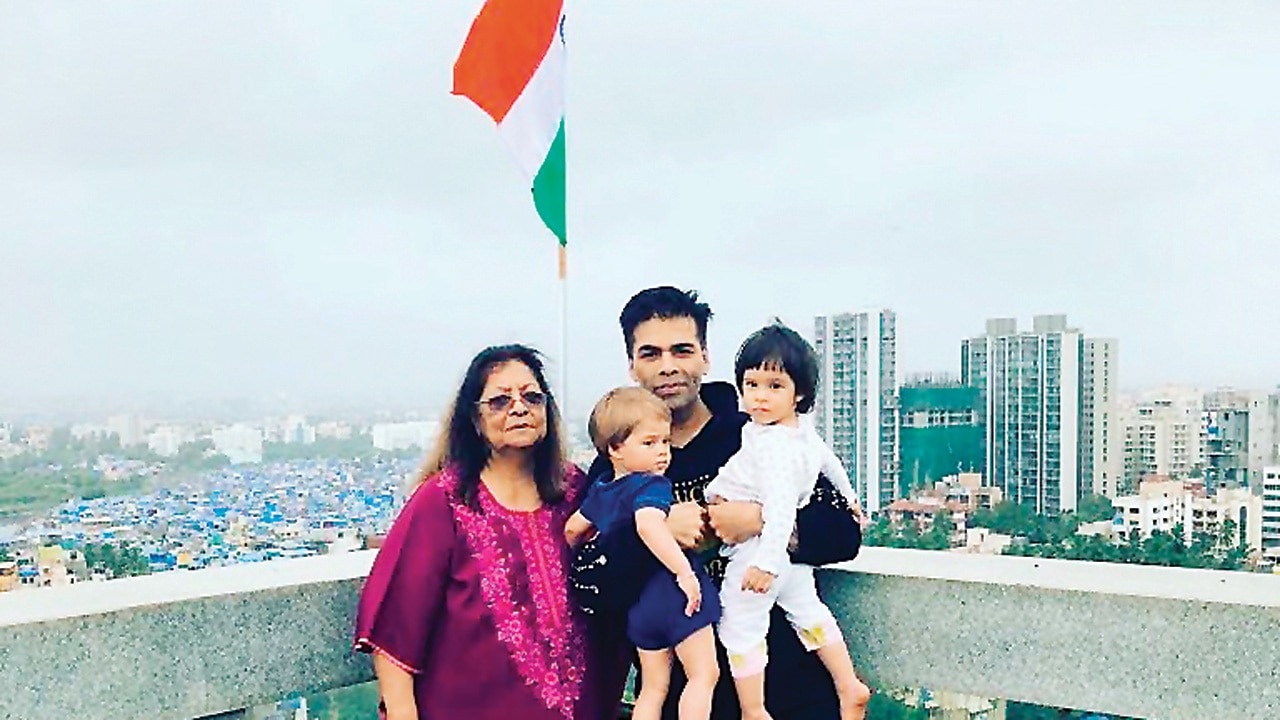
Karan with his mother Hiroo Johar and his twins, Yash and Roohi
I told my mom that Ronit was doing sleazy films, wearing just a chaddi-Rohit Roy
7:55 AM

The actor-director siblings have had chequered careers. While Ronit Roy has revived his film career, Rohit is hoping to build a new one behind the camera
Kunal Guha (MUMBAI MIRROR; April 30, 2017)
At present, the Roy brothers are in a “comfortable space”. Apart from being one of the biggest names in the television industry, Ronit has been praised for his performances in critically-acclaimed films such as Udaan, Ugly and Kaabil, while Rohit has refashioned himself as a filmmaker and will helm the next Sanjay Leela Bhansali production.
Growing up in Ahmedabad, Ronit had earned the moniker ‘Kumar Gaurav of Ahmedabad’ but Rohit remembers him as the most flamboyant man in town. “You need money for that. I was only an extrovert,” says Ronit, before he is corrected by Roy junior, “You can be Jackie Shroff from Teen Patti, so you can be flamboyant without money.” He also adds that his elder brother also had the reputation of being a “quintessential naughty boy”. “If I got into a scuffle in Ahmedabad and they came to know I was Ronit’s brother, they’d run away,” he says.
Rohit, who was preparing for his MBA when his brother bagged his feature film debut in Jaan Tere Naam (1992), remembers visiting him during a song shoot at Andheri Sports Complex. “He was in swimming trunks and the actress was in a ridiculous purple bikini and they were jumping in and out of the pool. I returned home to tell my mom that her son was doing sleazy films, wearing just a chaddi.”
Ronit signed 40 films following his debut, “of which, 25 producers never showed up, 15-16 went into production, 13 got made, half didn’t release and the ones that did, flopped.” He continues, “I wanted to be a hero when I came to Mumbai and all the trappings that came with it — big house, big car and girls running after me. I got all that with Jaan Tere Naam and then I lost it too. Now, I want to become an actor, and not a star,” says Ronit, who will be next seen in Sarkar 3. “May be, I signed the wrong films. When you’re 26, you don’t know any better.”
Ronit, who won a Filmfare Award for his performance in Udaan, eventually turned to television as a means of keeping his acting career alive. He began with a show opposite Bhagyashree before Ekta Kapoor cast him in Zee TV’s Kammal in 2000 and later in Kasautii Zindagii Kay and Kyunki Saas Bhi Kabhi Bahu Thi in 2002. “I was initially paid Rs 2,500 a day. I felt that if I could make Rs 50,000 a month, it would pay for food, rent, alcohol and mobile bills.” Instead, Ronit became an overnight primetime success. From 2002 to 2010, he worked on a minimum of three TV shows every year and “couldn’t spare time for films”.
Rohit, who admitted to scoffing at his brother’s profession initially, was left adrift when his US visa was rejected in 1992. Prior to his entrance test at Symbiosis, Pune, a chance meeting with Kunal Kapoor, an advertising maverick then, resulted in a move to agency life and he reluctantly strayed into modeling too. “Anant Balani, who had made Patthar Ke Phool, saw my photographs, which were terrible, and called me for a screen test, which was even worse. But he liked it and that’s how I got my first film with Suchitra Krishnamoorthi called Jazbaat which never released,” says Rohit.
A year later, Rohit shot to fame with his TV debut in Swabhimaan. “I was rejected during my audition by Shobhaa De, who wrote the show. She felt I was ‘too MTV’ to play Rishabh Malhotra. She wanted someone like Mohnish Behl, but younger. Later, Mahesh Bhatt, one of the makers, spotted me while going through the rejected auditions, and because of my red jacket he placed his bets on me,” he says.
The Roy brothers’ up and down relationship with success caused some problems for their mother too. “During Swabhimaan, when Ronit was totally out of work, people would tell my mother, ‘we saw the show, but bada beta kya kar raha hain?’ Then, the same phase came in my life in 2013-2014, and they’d ask her, ‘we watch Adaalat but chota ladka kya kar raha hain?’” Rohit says with a laugh.
These days, Rohit has chosen to get behind the camera because it is something he had “always planned to do” but was also in part due to his stuttering acting career. Rohit says he has made peace with the fact that he is “not a star”.
As it happens, Ronit will be playing the lead in the Bhansali love story that Rohit will direct. The younger Roy shares his first choice for the lead was Naseeruddin Shah. “I hated Ronit’s work in Jaan Tere Naam even though the film made him a star. But when I saw him in Udaan, I cried and then I saw him as the gritty cop in Ugly and I was sure that only he could play the character I had in mind.”
So the next time someone asks their mother what the brothers are doing, the answer will be easy.
Alia Bhatt, Varun Dhawan, Hrithik Roshan take centrestage at Hello Hall of Fame Awards
8:13 AM

Alia Bhatt, Varun Dhawan, Hrithik Roshan took centrestage at the recently concluded Hello! awards
Sanyukta Iyer (MUMBAI MIRROR; March 30, 2017)
The 10th anniversary of Hello! Magazine was marked with the star-studded Hello! Hall of Fame Awards on Tuesday, March 28 at the Taj Lands’ End in Bandra, with Bollywood A-listers headlining the red carpet arrivals.
Hrithik Roshan, who received an award from Rekha, his screen mum from Koi... Mil Gaya, was ecstatic, repeatedly exulting that it was a “special award because Rekha has been a silent angel” in his life. When the 43-year-old actor proceeded to touch the Bollywood diva’s feet, she joked that she’d gladly accept a ‘guru dakshina’ in the form of a movie with him.

 Elsewhere, Katrina Kaif, Alia Bhatt and Anushka
Sharma put their never-seen-before camaraderie on display, even sharing a
table briefly. Kat, who was initially unsure about turning up, having
spent the entire afternoon filming Jagga Jasoos, looked radiant in a
fiery red Abu Jani-Sandeep Khosla number and took home the Glamour Icon
trophy. She was back on the set of the Anurag Basu fantasy-adventure
after the do.
Elsewhere, Katrina Kaif, Alia Bhatt and Anushka
Sharma put their never-seen-before camaraderie on display, even sharing a
table briefly. Kat, who was initially unsure about turning up, having
spent the entire afternoon filming Jagga Jasoos, looked radiant in a
fiery red Abu Jani-Sandeep Khosla number and took home the Glamour Icon
trophy. She was back on the set of the Anurag Basu fantasy-adventure
after the do.Host of the evening Sophie Choudry crooned “Diamonds Are Forever”, while saxophone prodigy Rhys Sebastian delivered a standout performance; Indo-Canadian comedian Russell Peters had the audience in splits with a stand-up act and also shook a leg with Badrinath Ki Dulhania hero Varun Dhawan.
An overwhelmed Karan Johar, while handing out the Outstanding Talent of the Year award to his protégée, Alia, exclaimed, “She is my second daughter and third child,” to which the 24-year-old ‘student’ quipped that she’d play KJo’s mum Hiroo if there was a biopic being made on the filmmaker. “You aren’t Sindhi enough,” KJo noted, adding that she should play his childhood friend, Twinkle Khanna, instead.

 Meanwhile, Mrs Funnybones, who
arrived with mum Dimple Kapadia, won a standing ovation at the end of
her acceptance speech that was generously peppered with spiffy punch
lines. The Visionary Woman of the Year quipped, “I might not deserve
this award, and I definitely didn’t deserve the name, Twinkle, which was
a major reason for me being bullied as a kid.” The bestselling author
and soon-to-debut film producer thanked her actress-mum for being her
role model. “She wasn’t always an exceptional actress, but she didn’t
let failures get to her,” Twinkle noted, while dotting mum Dimple hurled
flying kisses from the front row.
Meanwhile, Mrs Funnybones, who
arrived with mum Dimple Kapadia, won a standing ovation at the end of
her acceptance speech that was generously peppered with spiffy punch
lines. The Visionary Woman of the Year quipped, “I might not deserve
this award, and I definitely didn’t deserve the name, Twinkle, which was
a major reason for me being bullied as a kid.” The bestselling author
and soon-to-debut film producer thanked her actress-mum for being her
role model. “She wasn’t always an exceptional actress, but she didn’t
let failures get to her,” Twinkle noted, while dotting mum Dimple hurled
flying kisses from the front row.Disha Patani, last seen in Jackie Chan’s Kung Fu Yoga, was the Fresh Face of the Year, while Anushka Sharma received the Entertainer of the Year trophy. Shahid Kapoor went down on one knee (again) for missus Mira Rajput, as the duo picked up with Most Stylish Couple prize. Author-columnist Shobhaa De, who sat between Hrithik and Varun Dhawan (the Popular Choice winner) in the front row, was adjudged Timeless Icon trophy. Saif Ali Khan, who’s recently returned from a brief holiday in London, was to receive the Most Stylish Man award but gave the event a miss.


Check out Hrithik Roshan, Athiya Shetty, Kanika Kapoor at launch of Shobhaa De's daughter's blog
8:01 AM

MUMBAI MIRROR (December 10, 2016)
Proud mum Shobhaa De launched her daughter Anandita De’s feisty new blog about fashion and fitness – Risque by Ana De – at a popular European resto-bar in Bandra. Hrithik Roshan, whose elegant and sporty clothing line has been one of Ana’s favourite, launched the blog, while friends Kanika Kapoor, Athiya Shetty and businessman Yash Birla cheered on.
Ban on Pakistani artistes polarizes Bollywood
8:46 AM

The oldest film producers' body in India has passed a resolution that Pakistani artistes will not be allowed to be a part of our entertainment industry. Opinion makers speak up...
Rachana Dubey, Debarati Sen and Seema Mattoo (BOMBAY TIMES; October 1, 2016)
In less than a week after
MNS issued an ultimatum to artistes from Pakistan to leave India, Indian
Motion Pictures Producers' Association (IMPPA) called for a blanket ban
on artistes and technicians from Pakistan. The decision was made on
Thursday at IMPPA 's 87th AGM, and comes as a reaction to the Uri attack
that claimed the lives of 19 Indian jawans. The body states that the
films that are complete and about to release will not be in the line of
fire. But films that were being planned with Pakistani artistes will
come under the radar.
While Pakistani artistes have always been warmly welcomed in India, over the last two years alone, a large number of popular Indian films have not been released across the border under various pretexts, the latest being M S Dhoni - The Untold Story.
Following the recent turn of events, including the Pathankot and Uri attacks, and the surgical military operation carried out on Thursday by the Indian army, Bombay Times spoke to an array of opinion makers to understand the impact IMPPA 's decision will have on the cultural exchange between India and Pakistan.

“WE HAVE ALWAYS GIVEN CONTRIBUTED POSITIVELY MORE AND TO THE RELATIONSHIP, WHICH HASN'T RECIPROCATED IN THE SAME BEEN MEASURE“
India-Pakistan's cultural relations have been lopsided. The reception for Pakistani artistes here has always been grand. We have always given more, and contributed positively to the relationship, which hasn't been reciprocated in the same measure. Lata Mangeshkar is the most popular Indian singer with a wide following in Pakistan. But the establishment there has never hosted her as a performer in their country. The common man and most of the artistes of Pakistan don't think and act like the army and the establishment. They see India as a land of opportunity, but given the current circumstances it might not be possible. And for that, they can only blame their own establishment and the army. Going by the sentiment of our nation, the decision made to suspend the involvement of Pakistani artistes in our films and cultural programmes, appears to be inevitable. But let's hope that at some point, the relationship changes and we can balance our cultural exchanges - Javed Akhtar, screenwriter, lyricist
-----------------------
BOMBAY TIMES (October 1, 2016)

SHOBHAA DE, Author and columnist
This is just the sort of 'tokenism' that goes nowhere in the long run. As has been repeated a hundred times earlier by performing artistes across the spectrum, politics has no role to play in cultural collaborations. Boycotts, threats, bans and tit-for-tat strictures are an outdated form of official protest. By vandalising theatres or threatening filmmakers, nothing can be achieved. It doesn't prevent terrorism, nor does it solve the ongoing problems, which require solutions that go beyond meaningless diktats. Bowing down to pressure tactics is not the response one expects from responsible bodies that are supposed to safeguard the interests of members who belong to the vast entertainment community. It is not a question of whether or not we can do without Pakistani artistes. We have abundant talent right here. It is more a question of surrendering to the diktats of political parties, trying to derive mileage from the political crisis. Instead of indulging in such conduct, why not do something constructive for the film industry? Let's not convert this into the ultimate test of patriotism. Whether one watches or does not watch Fawad Khan does not make you a better or worse Indian.

SALMAN KHAN, Actor
They are artistes not terrorists. It's the government that gives them permits and visas. (The actor said this at an event yesterday)

SAJID-WAJID, Music composers, singers
SAJID: Our government allowed the artistes, so we befriended them. We didn't go after them to come and work here. Now that our government is banning them, we will support them. Nothing else is more important than your land. Baat aa gayi hai apne desh pe, humare Hindustan pe.
WAJID: In all these years, we have never really required any other artiste from any country, be it Pakistan, Bangladesh, Sri Lanka or elsewhere. However, that does not mean we did not welcome talent if it came along. We are a civilised country and we love artistes, but that does not mean we can be taken for granted. It does not mean we need them and we cannot do without them. Our country is full of brilliant artistes in all fields. No artiste is bigger than their country. We have been supportive and loving towards them when our country was on good terms with them.

MAHESH BHATT, Filmmaker
India has carried out a surgical strike. Please understand that the word surgical is used when you want to preserve the whole and clean up the part that is affected. Even the PM of our country has stated clearly that we are not at war with Pakistan. We are against rogue elements and we're cleansing them from the system. Every civil society, even in the most trying times, preserves its people to people connections. Glory is in preventing a war. Artistes are forces leveraged to avert war-like situations. We need to delink rogues from artistes. Let's not confuse the goal post.

MUKESH BHATT, Producer and President of Film And Television Producers' Guild Of India
We have always abided by the government's decisions and policies. The previous government at the Centre had wanted us to promote peace and increase cultural exchanges, which we did. We offered a lot of work to the artistes, singers and technicians from Pakistan. The current government, right from Mr Modi's swearing-in ceremony, had set a tone for the Indo-Pak relations. But being do-gooders hasn't been of any help. I assure you that the industry will act the way the government guides it. But we shouldn't hamper the interests of those producers whose films with Pakistani artistes are complete. They shouldn't pay the price for the current change in the relations between India and Pakistan.

RAMESH TAURANI, Filmmaker and music label owner
I don't think the decision will impact our film industry at all. There are not many artistes from Pakistan who are working here. And I don't see us being dependent on them. I also feel the films that are complete and feature Pakistani artistes should not be targeted, because our Indian actors and technicians have also worked in those projects.

VINTA NANDA TV, producer and director
Nothing is permanent, including war. There are films with Pakistani talent ready for release, and they are big ones, therefore the losses will impact the industry as a whole. But I don't think that it'll be too long before we bounce back to normalcy. I don't think we should panic or be worried. Let us trust our government. However, we're not the only industry which will have to sacrifice.There is business and trade which will also suffer. Unless there is resolution, we as an industry must support and stand unified with our government and armed forces. Hopefully, once this difficult phase is over, art will provide its healing touch.

SHEKHAR RAVJIANI, Singer and music composer
It's distressing to see political motives affecting people who want to spread love and happiness through music and films. But when one country bans the cultural content from another, then the other is left with no choice but to take a strong stand, too.

RENUKA SHAHANE Actor-director
Though art and sport transcend boundaries, I cannot condone the loss of lives of our brave soldiers. We are not the ones at the border losing lives, so the least we can do is stand by our army. And send a strong message to Pakistan that unless they stop exporting terror to our country, we will not want any cultural exchange with them.

SALIM MERCHANT, Singer and music composer
I will abide by the rules of our film fraternity and hope that we come to a peaceful conclusion.

IQBAL KHAN, Actor
This is the only industry where there was no sifaarish, you could make it only on the basis of your talent, and you are judged by the audience for your work. Your religion, or the country you hail from has nothing to do with it. The industry is not going to get affected if they stop taking Pakistani actors. It is very easy to say 'let's go to war', but we should ask people who live in disturbed areas, how it is to live life in that kind of environment.

SHAAN, Singer
While I agree that some Pakistani voices are distinct, I don't think they are exceptional and irreplaceable. They will be missed, but not for too long. The show will go on.

ASHOKE PANDIT, Filmmaker and VP of IMPPA
It's not a question of which body is bigger or stronger in India, it's about aligning ourselves to our nation and its sentiments. Over the years, we have been the givers in the relationship with Pakistan. They have received warmth from us, but never reciprocated the same. So, this decision was inevitable.
AT A GLANCE...
The resolution passed by IMPPA is in alliance with the State Information and Broadcasting Minister Rajyavardhan Singh Rathore's vision. Actors including Fawad Khan, Mahira Khan, Saba Qamar and Ali Zafar who have already completed projects don't fall under the resolution's purview.
Current Bollywood films with Pakistani artistes are Ae Dil Hai Mushkil and Raees. A leading production house that was planning to launch Daniyal Zafar (actor Ali Zafar's brother) might have to put the idea on hold.
A petition has been filed in the Lahore High Court seeking a ban on the screening of Indian movies starting with M S Dhoni -The Untold Story. Previously, films like Neerja, Dishoom, Calendar Girls, Phantom, Bangistan, Baby, Haider, Bhaag Milkha Bhaag, Happy Bhag Jayegi, Ranjhanaa and Ek Tha Tiger among others have not been released in Pakistan.
Atif Aslam's concert at Gurgaon, scheduled for October 15, stands cancelled as of today.
Rahat Fateh Ali Khan was replaced in a film with an Indian singer.
On the other side of the border too, similar actions are being taken. One of the largest cinema operators in Pakistan has reportedly announced that it will boycott exhibition of Indian films in all Pakistani theatres and has urged to ban Indian content on all Pakistani TV and cable channels. Sale of Indian films on CDs and DVDs have also been stopped. Recent releases like Pink and Banjo are reportedly taken off theatres.
-----------------------------

IMPPA's decision following the Uri attacks, has evoked strong reactions from the industry
Sanyukta Iyer and Natasha Coutinho (MUMBAI MIRROR; October 1, 2016)
While Pakistani artistes have always been warmly welcomed in India, over the last two years alone, a large number of popular Indian films have not been released across the border under various pretexts, the latest being M S Dhoni - The Untold Story.
Following the recent turn of events, including the Pathankot and Uri attacks, and the surgical military operation carried out on Thursday by the Indian army, Bombay Times spoke to an array of opinion makers to understand the impact IMPPA 's decision will have on the cultural exchange between India and Pakistan.
“WE HAVE ALWAYS GIVEN CONTRIBUTED POSITIVELY MORE AND TO THE RELATIONSHIP, WHICH HASN'T RECIPROCATED IN THE SAME BEEN MEASURE“
India-Pakistan's cultural relations have been lopsided. The reception for Pakistani artistes here has always been grand. We have always given more, and contributed positively to the relationship, which hasn't been reciprocated in the same measure. Lata Mangeshkar is the most popular Indian singer with a wide following in Pakistan. But the establishment there has never hosted her as a performer in their country. The common man and most of the artistes of Pakistan don't think and act like the army and the establishment. They see India as a land of opportunity, but given the current circumstances it might not be possible. And for that, they can only blame their own establishment and the army. Going by the sentiment of our nation, the decision made to suspend the involvement of Pakistani artistes in our films and cultural programmes, appears to be inevitable. But let's hope that at some point, the relationship changes and we can balance our cultural exchanges - Javed Akhtar, screenwriter, lyricist
-----------------------
BOMBAY TIMES (October 1, 2016)
SHOBHAA DE, Author and columnist
This is just the sort of 'tokenism' that goes nowhere in the long run. As has been repeated a hundred times earlier by performing artistes across the spectrum, politics has no role to play in cultural collaborations. Boycotts, threats, bans and tit-for-tat strictures are an outdated form of official protest. By vandalising theatres or threatening filmmakers, nothing can be achieved. It doesn't prevent terrorism, nor does it solve the ongoing problems, which require solutions that go beyond meaningless diktats. Bowing down to pressure tactics is not the response one expects from responsible bodies that are supposed to safeguard the interests of members who belong to the vast entertainment community. It is not a question of whether or not we can do without Pakistani artistes. We have abundant talent right here. It is more a question of surrendering to the diktats of political parties, trying to derive mileage from the political crisis. Instead of indulging in such conduct, why not do something constructive for the film industry? Let's not convert this into the ultimate test of patriotism. Whether one watches or does not watch Fawad Khan does not make you a better or worse Indian.
SALMAN KHAN, Actor
They are artistes not terrorists. It's the government that gives them permits and visas. (The actor said this at an event yesterday)
SAJID-WAJID, Music composers, singers
SAJID: Our government allowed the artistes, so we befriended them. We didn't go after them to come and work here. Now that our government is banning them, we will support them. Nothing else is more important than your land. Baat aa gayi hai apne desh pe, humare Hindustan pe.
WAJID: In all these years, we have never really required any other artiste from any country, be it Pakistan, Bangladesh, Sri Lanka or elsewhere. However, that does not mean we did not welcome talent if it came along. We are a civilised country and we love artistes, but that does not mean we can be taken for granted. It does not mean we need them and we cannot do without them. Our country is full of brilliant artistes in all fields. No artiste is bigger than their country. We have been supportive and loving towards them when our country was on good terms with them.
MAHESH BHATT, Filmmaker
India has carried out a surgical strike. Please understand that the word surgical is used when you want to preserve the whole and clean up the part that is affected. Even the PM of our country has stated clearly that we are not at war with Pakistan. We are against rogue elements and we're cleansing them from the system. Every civil society, even in the most trying times, preserves its people to people connections. Glory is in preventing a war. Artistes are forces leveraged to avert war-like situations. We need to delink rogues from artistes. Let's not confuse the goal post.
MUKESH BHATT, Producer and President of Film And Television Producers' Guild Of India
We have always abided by the government's decisions and policies. The previous government at the Centre had wanted us to promote peace and increase cultural exchanges, which we did. We offered a lot of work to the artistes, singers and technicians from Pakistan. The current government, right from Mr Modi's swearing-in ceremony, had set a tone for the Indo-Pak relations. But being do-gooders hasn't been of any help. I assure you that the industry will act the way the government guides it. But we shouldn't hamper the interests of those producers whose films with Pakistani artistes are complete. They shouldn't pay the price for the current change in the relations between India and Pakistan.
RAMESH TAURANI, Filmmaker and music label owner
I don't think the decision will impact our film industry at all. There are not many artistes from Pakistan who are working here. And I don't see us being dependent on them. I also feel the films that are complete and feature Pakistani artistes should not be targeted, because our Indian actors and technicians have also worked in those projects.
VINTA NANDA TV, producer and director
Nothing is permanent, including war. There are films with Pakistani talent ready for release, and they are big ones, therefore the losses will impact the industry as a whole. But I don't think that it'll be too long before we bounce back to normalcy. I don't think we should panic or be worried. Let us trust our government. However, we're not the only industry which will have to sacrifice.There is business and trade which will also suffer. Unless there is resolution, we as an industry must support and stand unified with our government and armed forces. Hopefully, once this difficult phase is over, art will provide its healing touch.
SHEKHAR RAVJIANI, Singer and music composer
It's distressing to see political motives affecting people who want to spread love and happiness through music and films. But when one country bans the cultural content from another, then the other is left with no choice but to take a strong stand, too.
RENUKA SHAHANE Actor-director
Though art and sport transcend boundaries, I cannot condone the loss of lives of our brave soldiers. We are not the ones at the border losing lives, so the least we can do is stand by our army. And send a strong message to Pakistan that unless they stop exporting terror to our country, we will not want any cultural exchange with them.
SALIM MERCHANT, Singer and music composer
I will abide by the rules of our film fraternity and hope that we come to a peaceful conclusion.
IQBAL KHAN, Actor
This is the only industry where there was no sifaarish, you could make it only on the basis of your talent, and you are judged by the audience for your work. Your religion, or the country you hail from has nothing to do with it. The industry is not going to get affected if they stop taking Pakistani actors. It is very easy to say 'let's go to war', but we should ask people who live in disturbed areas, how it is to live life in that kind of environment.
SHAAN, Singer
While I agree that some Pakistani voices are distinct, I don't think they are exceptional and irreplaceable. They will be missed, but not for too long. The show will go on.
ASHOKE PANDIT, Filmmaker and VP of IMPPA
It's not a question of which body is bigger or stronger in India, it's about aligning ourselves to our nation and its sentiments. Over the years, we have been the givers in the relationship with Pakistan. They have received warmth from us, but never reciprocated the same. So, this decision was inevitable.
AT A GLANCE...
The resolution passed by IMPPA is in alliance with the State Information and Broadcasting Minister Rajyavardhan Singh Rathore's vision. Actors including Fawad Khan, Mahira Khan, Saba Qamar and Ali Zafar who have already completed projects don't fall under the resolution's purview.
Current Bollywood films with Pakistani artistes are Ae Dil Hai Mushkil and Raees. A leading production house that was planning to launch Daniyal Zafar (actor Ali Zafar's brother) might have to put the idea on hold.
A petition has been filed in the Lahore High Court seeking a ban on the screening of Indian movies starting with M S Dhoni -The Untold Story. Previously, films like Neerja, Dishoom, Calendar Girls, Phantom, Bangistan, Baby, Haider, Bhaag Milkha Bhaag, Happy Bhag Jayegi, Ranjhanaa and Ek Tha Tiger among others have not been released in Pakistan.
Atif Aslam's concert at Gurgaon, scheduled for October 15, stands cancelled as of today.
Rahat Fateh Ali Khan was replaced in a film with an Indian singer.
On the other side of the border too, similar actions are being taken. One of the largest cinema operators in Pakistan has reportedly announced that it will boycott exhibition of Indian films in all Pakistani theatres and has urged to ban Indian content on all Pakistani TV and cable channels. Sale of Indian films on CDs and DVDs have also been stopped. Recent releases like Pink and Banjo are reportedly taken off theatres.
-----------------------------
IMPPA's decision following the Uri attacks, has evoked strong reactions from the industry
Sanyukta Iyer and Natasha Coutinho (MUMBAI MIRROR; October 1, 2016)
"Pakistani artistes are just
artistes and not terrorists. They come with proper visas and the
government gives them
a work permit. Terrorism and art are different subjects,“ Salman Khan
had contended at an event in Delhi on Friday when quizzed about the
Indian Motion Pictures Producers' Association (IMPPA) banning Pak talent
in the Indian film industry (Mirror, September 29) in the wake of the
Uri attacks. The resolution coincided with the Indian army launching a
surgical strike beyond the LoC. “The ideal situation should have been
that of peace. But, now a reaction to an action has happened. It was a
proper action as they were terrorists. But still in this day and age, I
think if we lived in peace and harmony it would have been better for
everyone, especially for the common people,“ the actor added.
The Bajrangi Bhaijaan who made a successful crossover to Pakistan in the Kabir Khan hit to take a lost girl home to her parents may be all about “love thy neighbour“, but the IMPPA move has polarised the Hindi film industry. Filmmaker Vivek Agnihotri stresses on the term “fair“ while talking about cultural exchange. “If they're working in India, it is important that they condemn terrorism. It's not about Pakistanis coming here with valid visas. Right now their Defence Minister has threatened that they will launch a nuclear bomb attack on us. When there is no threat and the situation normalises, we can reconsider the decision,“ he asserts.
 Sonakshi Sinha hopped on
the pro-ban bandwagon at the trailer launch of her film, Force 2,
stating, “We can only speak for ourselves and do our job which is to
stand by our own people. This is the need of the hour. We
have to deal with terrorism.“
Sonakshi Sinha hopped on
the pro-ban bandwagon at the trailer launch of her film, Force 2,
stating, “We can only speak for ourselves and do our job which is to
stand by our own people. This is the need of the hour. We
have to deal with terrorism.“
 Saif Ali Khan at a recent fashion awards show had reasoned that the film
industry is open to the world's talent, especially from across the
border, but the government has to decide these things. “We are artistes
so we will talk about love and peace but the government must take
decisions about law and
who's allowed to work here and who isn't.“ he reiterated.
Saif Ali Khan at a recent fashion awards show had reasoned that the film
industry is open to the world's talent, especially from across the
border, but the government has to decide these things. “We are artistes
so we will talk about love and peace but the government must take
decisions about law and
who's allowed to work here and who isn't.“ he reiterated.
Meghna Gulzar who believes that it is important to have a sense of solidarity with your country said, “Whatever way it manifests is a good thing so that's the positive part but I also believe one should keep art and politics separate.“
Veteran filmmaker Shyam Benegal is all for artistic freedom irrespective of nationality and insists that there's no reason to ban Pak artistes because they have been invited by Indian film producers to work in their films. “They are representatives of their country, not its government's. They are also individuals coming to India as artistes. What's wrong with that, why should they be banned?“ he questioned.

Kangana Ranaut is overwhelmed with the loss of our soldiers. “It is such a big loss that it is hard to be objective right now,“ she admits. “These extreme reactions are nothing but anger and pain building up in every Indian. This is a testing time for all of us, especially for the families of our jawans we have lost. Anything that diverts us from that loss and puts a focus on 'sensational Bollywood' is just not acceptable. This is not the time to discuss actors but about real heroes. They don't need to be the centre of everything that is happening. This is not about films.“
TV host-actress Mini Mathur echoed Kangana's views, saying, “The IMPPA ban on Pakistani actors would have made sense only if it hurt the interests of the Pakistani establishment that sponsors cross-border terrorism. In my opinion, the ban will serve no purpose, since unfortunately, actors are not significant enough in the political scenario of the sub-continent.“
When asked if there is an alternate solution for actors from both countries to co-exist in a crisis situation, Mini added, “Unfortunately it's not imperative for either side to do that. There is enough talent and opportunities on both sides to wait it out till the political sentiment stabilises.“
IMPPA DIVIDES FATHER AND SON

 IMPPA's move to ban Pak artistes from working in India has stirred up
dissent even within its own ranks. Filmmaker Rahul Aggarwal, an
Executive Member of IMPPA who is also its President, TP Aggarwal's son,
took a stand against the resolution by submitting his resignation from
the post in a letter that is addressed to the President. “I strongly
feel that art is above politics and as the custodians of this art; it is
our responsibility to bring people together rather than divide them.
The Indian and Pakistani people are suffering from the same plague,
which is fundamentalist terrorism. It is more important than ever for us
not to fall prey to this calamity. Banning one another is not the
solution; rather bringing everyone together and showing the world that
terrorism cannot divide these two great nations can become a beacon for
acceptance and hope... Since the people who elected me to this valuable
post do not see my viewpoint, I take this as a personal failure and am
no longer useful to your esteemed executive body,“ the letter read.
IMPPA's move to ban Pak artistes from working in India has stirred up
dissent even within its own ranks. Filmmaker Rahul Aggarwal, an
Executive Member of IMPPA who is also its President, TP Aggarwal's son,
took a stand against the resolution by submitting his resignation from
the post in a letter that is addressed to the President. “I strongly
feel that art is above politics and as the custodians of this art; it is
our responsibility to bring people together rather than divide them.
The Indian and Pakistani people are suffering from the same plague,
which is fundamentalist terrorism. It is more important than ever for us
not to fall prey to this calamity. Banning one another is not the
solution; rather bringing everyone together and showing the world that
terrorism cannot divide these two great nations can become a beacon for
acceptance and hope... Since the people who elected me to this valuable
post do not see my viewpoint, I take this as a personal failure and am
no longer useful to your esteemed executive body,“ the letter read.
The Bajrangi Bhaijaan who made a successful crossover to Pakistan in the Kabir Khan hit to take a lost girl home to her parents may be all about “love thy neighbour“, but the IMPPA move has polarised the Hindi film industry. Filmmaker Vivek Agnihotri stresses on the term “fair“ while talking about cultural exchange. “If they're working in India, it is important that they condemn terrorism. It's not about Pakistanis coming here with valid visas. Right now their Defence Minister has threatened that they will launch a nuclear bomb attack on us. When there is no threat and the situation normalises, we can reconsider the decision,“ he asserts.
Sonakshi Sinha hopped on
the pro-ban bandwagon at the trailer launch of her film, Force 2,
stating, “We can only speak for ourselves and do our job which is to
stand by our own people. This is the need of the hour. We
have to deal with terrorism.“Saif Ali Khan at a recent fashion awards show had reasoned that the film
industry is open to the world's talent, especially from across the
border, but the government has to decide these things. “We are artistes
so we will talk about love and peace but the government must take
decisions about law and
who's allowed to work here and who isn't.“ he reiterated.Meghna Gulzar who believes that it is important to have a sense of solidarity with your country said, “Whatever way it manifests is a good thing so that's the positive part but I also believe one should keep art and politics separate.“
Veteran filmmaker Shyam Benegal is all for artistic freedom irrespective of nationality and insists that there's no reason to ban Pak artistes because they have been invited by Indian film producers to work in their films. “They are representatives of their country, not its government's. They are also individuals coming to India as artistes. What's wrong with that, why should they be banned?“ he questioned.
Kangana Ranaut is overwhelmed with the loss of our soldiers. “It is such a big loss that it is hard to be objective right now,“ she admits. “These extreme reactions are nothing but anger and pain building up in every Indian. This is a testing time for all of us, especially for the families of our jawans we have lost. Anything that diverts us from that loss and puts a focus on 'sensational Bollywood' is just not acceptable. This is not the time to discuss actors but about real heroes. They don't need to be the centre of everything that is happening. This is not about films.“
TV host-actress Mini Mathur echoed Kangana's views, saying, “The IMPPA ban on Pakistani actors would have made sense only if it hurt the interests of the Pakistani establishment that sponsors cross-border terrorism. In my opinion, the ban will serve no purpose, since unfortunately, actors are not significant enough in the political scenario of the sub-continent.“
When asked if there is an alternate solution for actors from both countries to co-exist in a crisis situation, Mini added, “Unfortunately it's not imperative for either side to do that. There is enough talent and opportunities on both sides to wait it out till the political sentiment stabilises.“
IMPPA DIVIDES FATHER AND SON
IMPPA's move to ban Pak artistes from working in India has stirred up
dissent even within its own ranks. Filmmaker Rahul Aggarwal, an
Executive Member of IMPPA who is also its President, TP Aggarwal's son,
took a stand against the resolution by submitting his resignation from
the post in a letter that is addressed to the President. “I strongly
feel that art is above politics and as the custodians of this art; it is
our responsibility to bring people together rather than divide them.
The Indian and Pakistani people are suffering from the same plague,
which is fundamentalist terrorism. It is more important than ever for us
not to fall prey to this calamity. Banning one another is not the
solution; rather bringing everyone together and showing the world that
terrorism cannot divide these two great nations can become a beacon for
acceptance and hope... Since the people who elected me to this valuable
post do not see my viewpoint, I take this as a personal failure and am
no longer useful to your esteemed executive body,“ the letter read.
Subscribe to:
Posts (Atom)