Showing posts with label Shiv Kumar Sharma. Show all posts
Showing posts with label Shiv Kumar Sharma. Show all posts
Pandit Shiv Kumar Sharma's music didn’t make masses feel disconnected-Shankar Mahadevan
8:18 AM

Noted composer hails Sharma for bridging the gap between classical and film music
As told to Sonia Lulla (MID-DAY; May 11, 2022)
When you are handling a mainstream subject like a Bollywood movie, there is always a discussion around classy music and massy music. Creating a piece that satisfies both, the maestro and the masses, is not easy because the latter may not understand Indian classical music. But Pandit Shiv Kumar Sharma had the ability to do that. If you see his work in Silsila [1981] and Chandni [1989], you can see that the classical music that he used had depth, but wasn’t so difficult that the masses felt disconnected.
In a mainstream song like Dekha Ek Khwab from Silsila, there is a beautiful santoor section. He raised the bar of Indian music, and was an example for a musician like me who wanted to imbibe [those qualities] and use Indian classical music in mainstream compositions. Not many people know that he also played the tabla in so many legendary songs that were sung by Lata ji [Mangeshkar].
His contribution to film music is only a fraction of all that he has achieved. The santoor was not traditionally known as an Indian classical instrument. The Kashmiri folk instrument was [alien] to the Indian classical music world, and he popularised it all over the world. Indian classical music became popular via the santoor, because of him. He made people take the fact that the instrument was associated with Indian classical music, for granted. With the word santoor, no other name except Pandit Shiv Kumar Sharma can be associated. He will be remembered forever.
Shiv Kumar Sharma was offered a role in Amitabh Bachchan's debut film, Saat Hindustani
8:17 AM
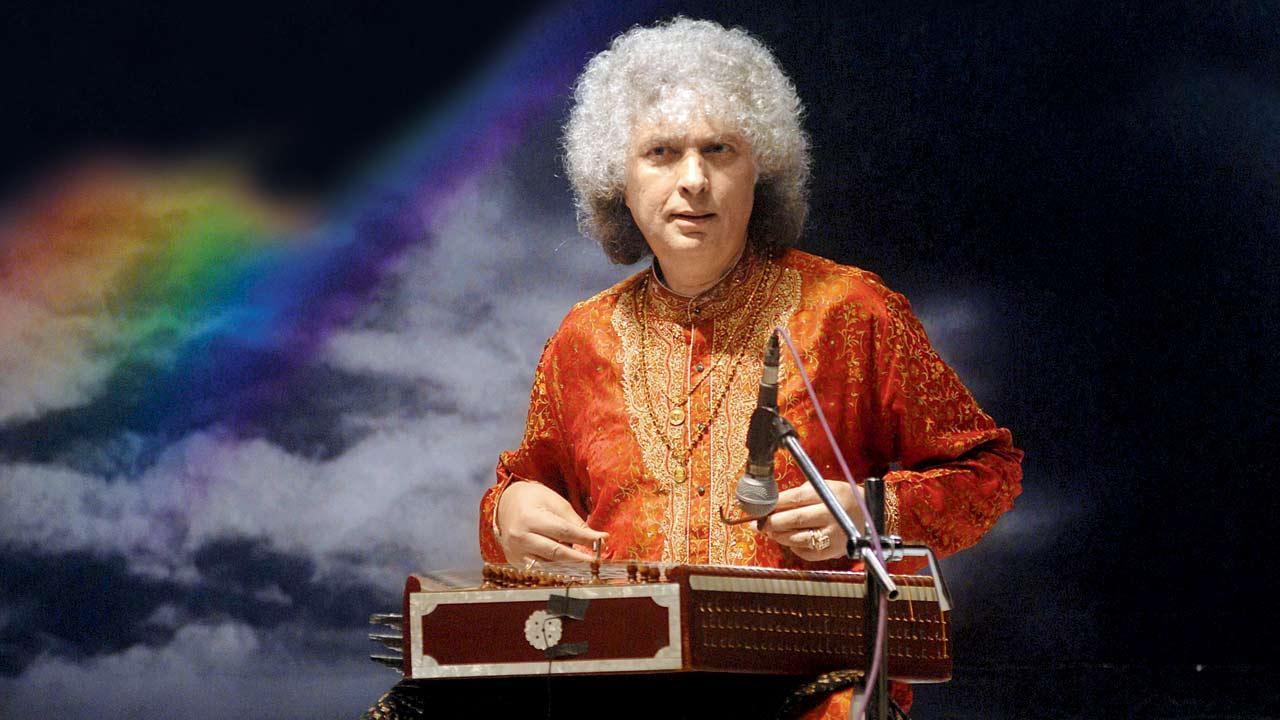
Ustad Amjad Ali Khan, flautist Rakesh Chaurasia remember the maestro who gave the santoor its exalted status in Indian classical music
Yogesh Pawar (MID-DAY; May 11, 2022)
The year 1967. Filmmaker K A Abbas was explaining a situation to musicians gathered for the background score of his Dharti Ki Pukaar. When his eyes fell on a young musician, he called him aside. The young man felt Abbas wanted something specific in the music, but was shocked when he was offered a role in Saat Hindustani (1969). “Dikhte-bolte bhi theek ho... kad-kaathi bhi sahi hai,” Abbas told him.
The young man folded his hands, and said he was happy to only pursue music. Had the 29-year-old agreed, he would have debuted along with Amitabh Bachchan. What that trajectory would’ve done for Pandit Shiv Kumar Sharma, we’ll never know, but the silver screen’s loss was music’s gain. The octogenarian legend was suffering from kidney problems for the past six months and was on dialysis. He breathed his last on Tuesday morning, following a massive cardiac arrest soon after his bath, according to his family.
Among those condoling the maestro’s demise was Prime Minister Narendra Modi, who tweeted: “Our cultural world is poorer with the demise of Pt Shiv Kumar Sharma ji. He popularised the santoor at a global level. His music will continue to enthral the coming generations. I fondly remember my interactions with him. Condolences to his family and admirers. Om Shanti.”
Talking to mid-day, sarod maestro Ustad Amjad Ali Khan said his demise marked the end of “a musical era”. “We were close. Our families share a great rapport. We are all deeply saddened by this tragic news. With him, a musical era has ended. We live in a cruel time when so many legends are bowing out. Apart from a pioneering musician, he was an exceptional human being.”
The santoor, previously confined to Jammu & Kashmir, rose meteorically to ensconce itself as a classical instrument, thanks to Sharma. Though connected with the Sufi tradition of Kashmir and called shatatantri veena in ancient texts, it didn’t enjoy its current exalted status at that time. The santoor maestro’s father Pt Uma Dutt Sharma came across the santoor as a music supervisor with a local radio station and felt it could lend itself to the classical style. A young Shiv Kumar (initially trained in tabla and singing) was introduced to santoor at 13. Within three years, he was playing it on the radio.
Despite purists curling their lip at the santoor, filmmaking legend V Shantaram was impressed with the 18-year-old Sharma and asked him to play for his Jhanak Jhanak Payal Baaje (1955) under Vasant Desai. Back in Srinagar, following an argument when he refused a secure job in the Jammu and Srinagar Radio, Sharma left home and came to Bombay with his santoor and Rs 500. Pt Shiv Kumar Sharma has often told this writer of those tough times. “I’d only have an anna in my pocket and nothing to eat. I’d accompany others on tabla since the negative criticism of the santoor meant no concerts,” he’d reminisce.
Odd film assignments helped sustain both him and his fire for the santoor. While the instrument was traditionally played in Kashmir on a small stand, with the player squatting in front, he placed it on his lap to cut vibrations. He worked on the tuning, increased range and discovered how to use mallets to reproduce the Indian vocal nuances. A decade of his toil finally saw the music fraternity warm up to his instrument. With Silsila (1981), both he and flautist Pandit Hariprasad Chaurasia turned film composers, following it up with Faasle (1985), Vijay (1988), Chandni (189), Lamhe (1991), Sahibaan (1993) and Darr (1993).
“In some songs, like Tere mere hoton pe, you can clearly see how he brought in elements of classicism and folk music from the mountains,” remembers ghazal exponent Pankaj Udhas, who says he has never met a more disciplined musician. “Once at an event, he gently stopped me from drinking water immediately after my meal, saying it was bad for digestion,” said Udhas, adding, “Even in his 80s, he never slouched on stage and sat ramrod straight.” He also spoke of Sharma’s prowess over rhythm. “As someone who had played tabla and could sing, it was interesting to see how he would even for Zakir bhai [Zakir Hussain] at times when they played together.”
Santoor exponent Satish Vyas, who trained under Sharma from 1975 to 2006, says he feels orphaned. “Both Pandit ji and his wife treated me like their son. Even when he corrected me, guruji did it gently, playing on each disciple’s strength.”
Sharma knew flautist Rakesh Chaurasia, his colleague Pt Hariprasad Chaurasia’s nephew, from when he was little. “Extremely loving and indulgent, he’d come up after a concert and praise even the smallest improvisation I tried. Sadly, I’ll miss uncle’s loving caress now,” says the flautist.
Career milestones
- Sharma gave his first public performance in Mumbai in 1955.
- In 1960, he recorded his first solo album.
- In 1967, he teamed up with flautist Hariprasad Chaurasia and guitarist Brij Bhushan Kabra to produce the concept album, Call Of The Valley.
- The santoor virtuoso was honoured with the Sangeet Natak Akademi Award in 1986, the Padma Shri in 1991, and the Padma Vibhushan in 2001.
Shiv Kumar Sharma passes away; to be accorded a funeral with full state honours
8:14 AM

THE TIMES OF INDIA (May 11, 2022)
Shiv Kumar Sharma, who reshaped the identity of santoor, elevating the instrument’s stature across the globe, and who composed a bunch of dulcet melodies with renowned flautist Hariprasad Chaurasia in Yash Chopra movies, passed away following a heart attack in Mumbai on Tuesday morning. He was 84.
Although the maestro was on regular dialysis, he remained active till the end and was to perform in Bhopal next week, family sources said.
“My story is different from other classical musicians. While they had to prove their mettle, talent and calibre, I had to prove the worth of my instrument. I had to fight for it,” Sharma had told TOI in 2002.
He will be accorded a funeral with full state honours, said CM Uddhav Thackeray. The last rites will be performed at the Vile Parle crematorium at around 3:00 pm on Wednesday.
-----------------------------------------
Shiv Kumar Sharma, who reshaped the personality and identity of santoor elevating the instrument’s profile and stature across the globe, and who composed a bunch of dulcet melodies in tandem with renowned flautist Hariprasad Chaurasia in Yash Chopra romances and thrillers, passed away following a heart attack in Mumbai on Tuesday morning. He was 84.
“He was on regular dialysis but was still active. He was to perform in Bhopal next week,” a family source told PTI.
With his arresting features — the shock of hair being his signature — the santoor maestro regaled music lovers in thousands of concerts over decades; his jugalbandis with Chaurasia and tabla virtuoso Zakir Hussain a treat to the ear and the soul. But the accolade and the glory came after a long struggle to gain respect for the instrument he played.
“My story is different from other classical musicians. While they had to prove their mettle, their talent, their calibre, I had to prove the worth of my instrument. I had to fight for it,” Sharma told The Times of India in 2002.
“Shiv Kumar-ji was an epochal musician. Braving almost universal cynicism, he made an obscure staccato instrument capable of a convincing presence in classical music. His ascension to the Hindustani Music Hall of Fame is even more significant because it coincided with the era ruled by formidable instrumentalists like Ustad Vilayat Khan, Pt Ravi Shankar, and Ustad Ali Akbar Khan,” musicologist Deepak Raja said.
Jammu-born Sharma was ushered into music when just five by his vocalist father Uma Dutt Sharma of Benaras gharana and showed promise in both vocals and tabla. But the notes changed when he was 13 after his father brought a gift from Srinagar. “I tore at the wrapping paper eagerly, expecting a game or something else as exciting. But the box held a strange-looking musical instrument which I hadn’t seen before! And that’s how I was introduced to the santoor,” he told TOI in 2001.
The Dogri musician’s father-guru wanted him to play this instrument. “At that time, the santoor was used only in Sufiana music in a small pocket in Kashmir. No other part of India had ever seen it. But dad wanted it to be developed for national use in Indian classical music — and he entrusted the job to me,” he said.
In 1955, Sharma came to Bombay for a concert packed with the galacticos of Indian classical music: Bade Ghulam Ali Khan, Ali Akbar Khan, Ravi Shankar, among others. He was just 17. But he made an impact. The same year Sharma also composed a background piece in V Shantaram’s film, ‘Jhanak Jhanak Payal Baaje’ (1955) for music director Vasant Desai.
But many critics were far from convinced about santoor’s range. “… connoisseurs rejected it as a complete instrument since I couldn’t play alaap. Santoor is essentially a percussion instrument played by strikers. It can’t sustain the vibrations and so, there was no scope for meend (glide from one note to another)…I modified the instrument and created a distinct character,” he once told TOI.
Much against his father’s wishes, Sharma came to Bombay in 1960, hoping to build a career as a freelance musician. Over the years, his services were utilised by top Hindi film composers, including Hemant Kumar (‘Bees Saal Baad’), Jaidev (‘Hum Dono’), SD Burman (‘Guide’) and RD Burman.
‘Call of the Valley’ was released in 1967. The long-playing record, put together by the trio of Sharma, flautist Hariprasad Chaurasia and guitarist Brij Bhushan Kabra, musically expanded on a day in the life of a shepherd through a bouquet of ragas. The album steadily entered the music shelves of the culturally-inclined and became a milestone in their careers.
When director Yash Chopra introduced Sharma and Chaurasia as a composer duo in ‘Silsila’ (1981), the film industry was surprised. Silsila was a multi-starrer and roping in two classical musicians, Shiv-Hari as they were christened, was deemed a commercial risk. In the end, the music turned out to be one of Silisila’s few highlights. Shiv-Hari became regulars for Chopra (‘Faasle’, ‘Vijay’).
In the Eighties, when melody had largely taken a backseat in mainstream commercial ventures, they provided ear-pleasing yet chartbusting scores, most notably in ‘Chandni’ (1989). That the two had internalised the idiom of Hindi film music was most evident in ‘Darr’ (1993), where they delivered a score that fused seamlessly with the demands of a thriller.
-----------------------------------------
A MUSICAL JOURNEY
- 1938: Shiv Kumar Sharma is born into music – the only son of Jammu-based musician Pt Uma Dutt Sharma of Benaras Gharana
- His music journey begins at 5 as a tabla player. At 13, gets gift of santoor from his father
1955 Sharma gives his first public performance at 17, playing the santoor in the presence of Bade Ghulam Ali Khan, Ravi Shankar, Allah Rakha Khan and other maestros
- Gets his first film as a santoor player in V Shantaram’s ‘Jhanak Jhanak Payal Baaje’. It is also the first time santoor is used in Hindi cinema 1967
- Teams up with flautist Hariprasad Chaurasia and guitarist Brij Bhushan Kabra for the concept album ‘Call of the Valley’, which becomes a huge hit 1981
- Collaborates with Hari Prasad Chaurasia for a film for the first time, composes music for Yash Chopra’s ‘Silsila’ 1986
- Sharma receives the Sangeet Natak Akademi Award 1991
- Is awarded the Padma Shri 2001
- Is honoured with the Padma Vibhushan May 10, 2022
- Dies of heart attack at 84
Subscribe to:
Posts (Atom)