Showing posts with label Shaukat Kaifi. Show all posts
Showing posts with label Shaukat Kaifi. Show all posts
Actors are neurotic, says Shabana Azmi; focus has shifted to PR machinery than acting, believes Saiyami Kher
10:17 AM

Renuka Vyavahare (BOMBAY TIMES; September 12, 2023)
Saiyami Kher, granddaughter of acclaimed Hindi and Marathi film actress Usha Kiran, addresses Shabana Azmi as maushi (aunt in Marathi) as they are family, but listen to their banter and you’ll know they are more like friends. There’s a bit of an age reversal here in terms of demeanour. Saiyami is an old soul, while Shabana has the spirit of a youngster. Those trying to figure out the Saiyami-Shabana connect, here’s a little trivia. Saiyami’s aatya (father’s sister) Tanvi Azmi is married to Shabana’s brother Baba Azmi. The aunt-niece pair who shared screen space for the first time in R Balki's 'Ghoomer' recently, took a trip down memory lane through this exclusive interaction with us. The two exchanged thoughts on a variety of subjects like...
Family ties and talent
Shabana: Saiyami took a few acting lessons from my mother, (the late Shaukat Kaifi, acclaimed theatre and film actress). My mother was someone who never minced her words. She said, ‘Yeh ladki ki andar se machine chalti hai’, which was a way of saying that Saiyami connects emotionally. She isn’t superficial. When my mother said that about her, I took it seriously because she wasn’t the one to say these things easily.
Saiyami: Daadi ma (Shaukat Kaifi) was kind enough to help me out with my Hindi improvement and acting. I was very fond of her, and she loved me, too. She was an extremely strict teacher. When Shabana maushi and I shot together, she reminded me so much of her mother that I accidentally called her daadi ma several times. I remember Shabana maushi telling me to work on my voice. “Don’t speak so nasal,” she would say.
Social media and making of a star
Shabana: I am not the kind of person who likes indulging in nostalgia and say, “Humare zamane mein yeh tha, woh tha.” How many followers you have on social media is now a reason for casting an upcoming actor. Earlier, you had to carry a portfolio, then reels of your work and now it’s about isko cast karte hai, iskay itnay followers hai. You get endorsements based on it, so for the younger generation it is important. For the senior generation, it’s a question of choice — whether we want to be out there or not. Zeenat Aman and Saira Banu are on Instagram now. Zeenat has made such a dignified entry on the platform. People are not going to cast us because we have a certain number of followers but because of our body of work.
Saiyami: I am from this generation, but I feel like I am 85. Given a choice, I would rather spend an evening with Gulzar sahab or Javed (Akhtar) uncle than go out and party with 25 or 30-year-olds. We will have more things to talk about. I have never been a fan of social media. I feel the focus has shifted to PR machinery and the Instagram algorithm today, as opposed to what you are supposed to do on camera, which is act. I hope we can revert to how the older generation functioned; the work was purer. But we can’t keep living in nostalgia. We must live in the present and strike a better balance between virtual and real.
Overcoming career battles
Shabana: Saiyami is a very passionate and committed person. There was a time when she went through a dark phase, and yet, kept going. She didn’t give up because she had faith in her abilities. She never let down the parts she played, but she needed something where her work would be recognised. I feel Ghoomer (the film directed by R Balki in which Shabana and Saiyami shared screen space) has done that for her. It was physically and mentally gruelling for her.
Saiyami: I was not getting work after my debut film (Mirzya, 2016). A wise man’s writing kept me going and his name is Javed Akhtar. I remember he wrote, “Zindagi mein kyu dare kya hoga? Kuch na hua toh tajurba hoga.” That line is etched on my mind.
Actors are neurotic: Shabana
Shabana says, “Acting is an interesting profession. You can come to a set feeling low after having had a nasty argument at home or show up elated if the day has been good. You can be expected to do a happy scene when you are feeling sad or vice versa. You must keep your personal feelings away and do what a scene requires of you. Which is why I say actors are neurotic. A civilised society says that you have to keep your emotions under control. Acting demands the opposite. You have to constantly keep yourself in a state of emotional preparedness.”
Shabana Azmi’s complaint with OTT: Why should it run after mainstream stars?
8:23 AM
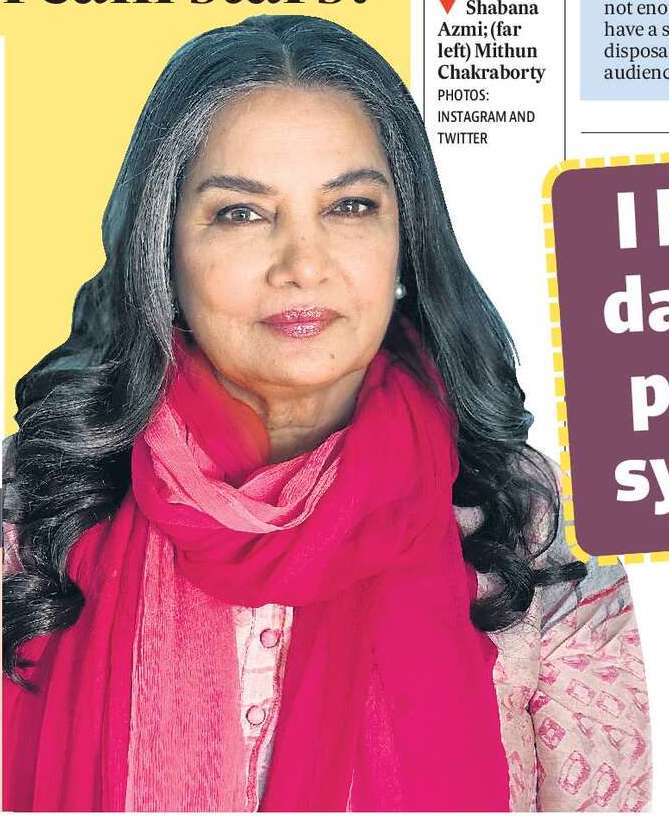
Rishabh Suri (HINDUSTAN TIMES; April 17, 2023)
After featuring in the 2021 period drama series The Empire, Shabana Azmi worked on another big-budget streaming series — Steven Spielberg’s sci-fi spectacle, Halo. Even as the veteran actor continues to make strides in the OTT space — long considered a democratic and empowering format — she is afraid that ‘star culture’, which has been discussed widely in the big screen film space, has crept into the web space, too.
Azmi says, “Mujhe OTT se ek shikayat hai. The fact is that it is a tremendous platform that can and has created its own stars. But now, everybody is running after mainstream actors, who are in any case doing so much work!”
The 72-year-old is baffled that OTT should have to count on star power to stay relevant. She says, “Why shouldn’t this medium grab the opportunity to say: ‘At the moment, there are five-six mainstream stars, and look at the amount of work we are doing? Why shouldn’t there be 100 stars that we should be able to choose from?’ OTT should do that, instead of mimicking what mainstream cinema is already doing.”
Azmi, who will be seen next in the film Rocky Aur Rani Ki Prem Kahaani, reasons that unlike for theatrical releases, streaming doesn’t have to earn a lot of revenue right in the first weekend. “You don’t have to grab eyeballs right in the first weekend. [OTT] has such a longer shelf life, bahut waqt [mil] sakta hai, to be able to recover that money,” she ends.
What got under Mithun da’s skin?
Did you know that before he became a star, actor Mithun Chakraborty was insecure of his looks? Shabana Azmi, who starred alongside the former in films such as Hum Paanch (1980) and Jhoothi Shaan (1991), said in an interview to CNN, “Janki Kutir (Mumbai) was a place where all kinds of strugglers were always coming, and Abba and Mummy (poet Kaifi Azmi and actor Shaukat Kaifi) were always encouraging... But Mithun Chakraborty was very conscious of the fact that he had jutting teeth, so he used to smile (with his mouth closed). He was also conscious of the fact that he had dark skin. But I really have to give it to my mother, who made him drop his inhibitions.”
Within 2 days after breaking my wrist, I came to Budapest to shoot for Steven Spielberg’s Halo-Shabana Azmi
8:18 AM
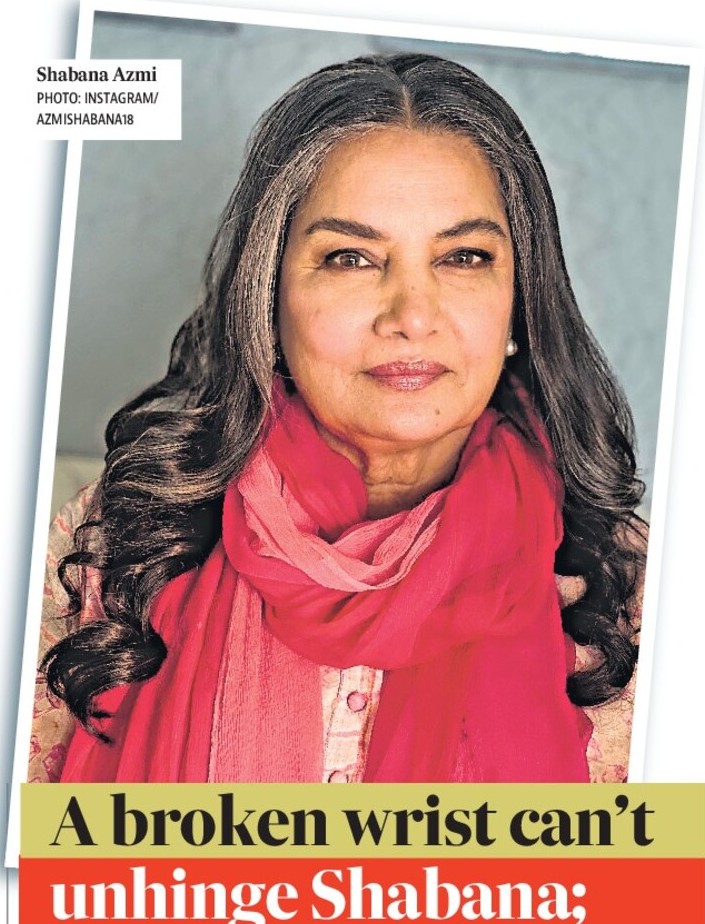
Sugandha Rawal (HINDUSTAN TIMES; March 23, 2023)
There is nothing that can stop actor Shabana Azmi from working, not even a broken wrist. The actor was back on the set, ready to shoot, just two days after sustaining injuries. The show must go on, she says firmly, and she hopes she can work till her last breath. “That is the way I have always been,” the 72-year-old tells us while opening up about her injury.
She adds, “This is not so bad. There was a time when I twisted my ankle just before a show. My mother (late artiste Shaukat Kaifi) said to me, ‘You can’t cancel a show. The show must go on’. And I have believed in that since then. At that time, I didn’t know it was a fracture. I thought it was a sprain. But I went on stage after taking injections. So, such things keep happening, and you have to just carry on.”
The veteran continues, “Now, I am working with a broken wrist. Within two days after breaking it, I had to come to Budapest to shoot for Steven Spielberg’s Halo. My family was worried and said, ‘How can you travel? What can you do?’ But I wanted to do it. Now, I am managing to work with this. It’s putting some challenges on the crew, and it’s putting some challenges on me. But over the years, I have realised that I am happiest when I’m working. I would like to die with my shoes on.”
In fact, even during the pandemic, Azmi chose work over everything else and decided to go to London to shoot Shekhar Kapur’s international project, What's Love Got to Do with It? “When I was told not to go, it was not coming from a place of ‘You are doing something wrong’, but in a way that it might be a hazardous thing to do. But I trusted my gut,” she ends.
We helped with two lakh vaccinations in Uttar Pradesh and distributed 100 tonnes of food grains-Shabana Azmi
7:56 AM
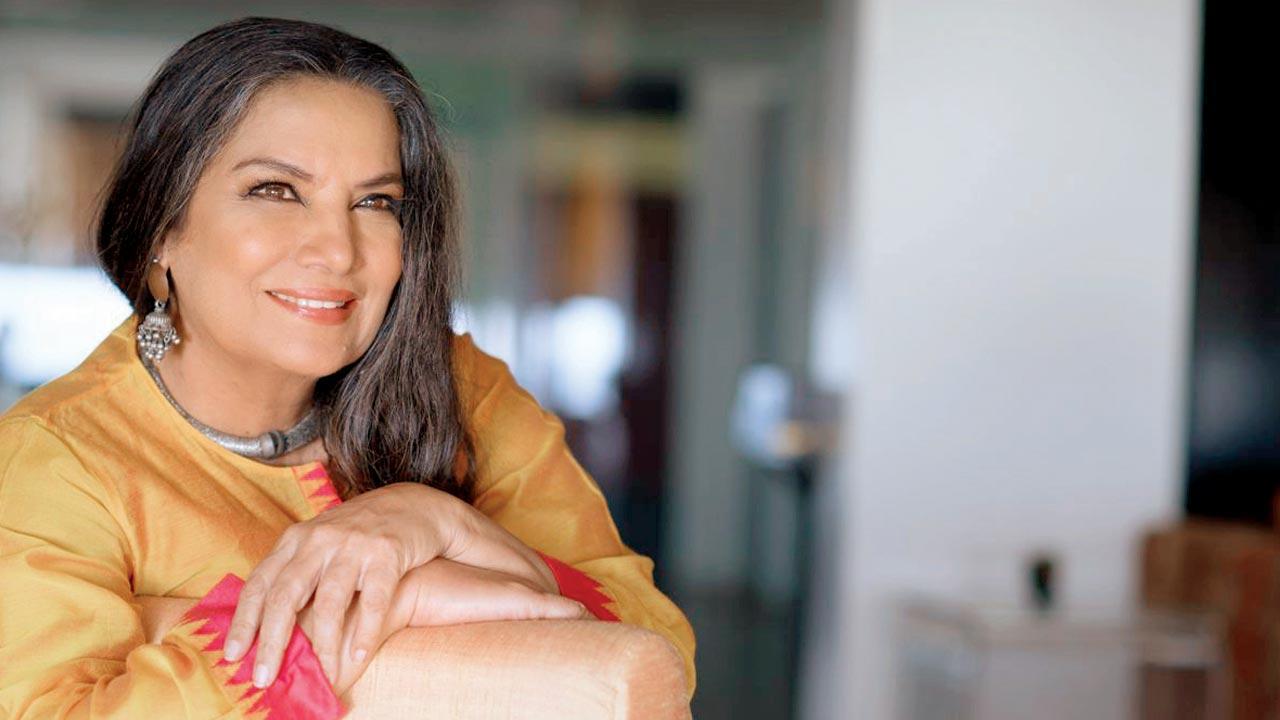
Travelling to Mijwan for the first time since the pandemic, Shabana discusses how she has lined up several initiatives to aid the villagers
Upala KBR (MID-DAY; November 12, 2021)
"I have a big paltan with me,” laughs Shabana Azmi, who is set to leave for Mijwan today. The actor, who has been unable to go to the Uttar Pradesh village since the onset of the pandemic last year, will be joined on the trip by brother Baba Azmi, his wife Tanvi and close collaborators at Mijwan Welfare Society, the NGO that works towards empowerment of the girl-child.
Azmi has a series of initiatives to oversee during her week-long stay in the village. “I am travelling to Mijwan after two years, though our work didn’t stop during the pandemic. We helped with two lakh vaccinations in UP and distributed 100 tonnes of food grains. [During this trip], Kakul Hai [Delhi University assistant professor] will interact with the villagers to write a book on the women of Mijwan. Neeraj Agarwal [CEO, Rural Shores Skills Academy] will train them in computer skills while M S Sathyu’s daughter Shaili is setting up a course in life skills and dramatics. My mother [Shaukat Kaifi] believed theatre played a key role in raising awareness on women’s empowerment and social justice. I am excited that Shaili will take forward the work my mother had started.”
After the jam-packed week, Azmi will head to Delhi for the shoot of Karan Johar’s Rocky Aur Rani Ki Prem Kahani.
Mijwan always reminds the veteran actor of her late father Kaifi Azmi. Remembering her 2002 trip with him, she says, “The villagers had surrounded me, wanting me to resolve their problems. Suddenly, Abba left with the driver only to return half an hour later. When I went to his room, he said, ‘My villagers are troubling my chidiya. Eat this, and then go out.’ I saw that he had gone all the way to Phoolpur to get samosas for me.”
It is sad that on World Theatre Day, there will be no theatre anywhere in the world-Manav Kaul
8:28 AM

Sanchita Kalra (HINDUSTAN TIMES; March 27, 2020)
The world of theatre has taken a pause and is struggling in the wake of the Coronavirus pandemic. As March 27 marks the occasion of World Theatre Day, prominent theatre personalities talk about the impact of Covid-19 on the industry and their memories of performing on stage.
 Theatre director and actor Manav Kaul, with a heavy heart, says, “It is sad and unfortunate that on World Theatre Day, there will be no theatre anywhere in the world.” He also reveals his play was scheduled to open in Mumbai on March 17 but was cancelled due to the shutdown. Kaul adds, “This is the need of the hour. I’ve been rehearsing rigorously for four months. I even gave a break to my acting jobs for this.”
Many actors unanimously agree that taking appropriate preventive measures during such critical crisis should be the topmost priority. Film and theatre actor Deepak Dobriyal says that it has not only impacted Indian film and theatre industry but also wreaked havoc in numerous professional worlds as well. He says, “The entire country is in the same situation. Whether it’s theatre or any other profession, every individual needs NOC from coronavirus. Only then will everyone be able to perform.”
Talking about the idea of presenting archived theatre shows on digital media platforms, actor Pankaj Tripathi says, “I saw that the members of the music fraternity are doing digital concerts on social media. Mujhe lagta hai rangmanch mein bhi log thoda bohot aise karenge. But ye medium toh nahi hai aisa. Woh toh live medium hai. But for now, our primary concern is health, whether it’s an artiste or general public. So, our complete focus should be on that. Rangmach Diwas toh har saal aata hai.”
 Actor Saurabh Shukla emphasises on the stress-free usage of social media, if people can’t go out to catch a play. He says “We are in this together. In a time when you know there’s an ominous fear, it’s good to have stress-free time. If people have recorded plays, then the footage should be on social media.” However, for many, it’s the happy memories that keep them going.
Actor Shabana Azmi shares one such incident and says , “I was once arrested along with 16 slum dwellers for a demonstration. My parents, Javed (Akhtar; husband), Feroz Abbas Khan and Farooq Sheikh all came to the police station because I was to perform Tumhari Amrita in Mumbai at 6 pm. My mother, Shaukat Kaifi pleaded with the police officer and said, ‘We come from theatre and for us the show must go on. Please release my daughter so she can do her play and I will personally bring her back to you’. Ultimately, I reached the auditorium at 8 pm and was on stage seven minutes later. We got a standing ovation!”

Shaukat Kaifi’s family and friends celebrate her life with music and memories
2:22 PM

Shabana Azmi, Javed Akhtar, Tanvi and Baba Azmi with family and friends ‘celebrate’ Shaukat Kaifi’s life
Akash Bhatnagar (MUMBAI MIRROR; November 27, 2019)
On Friday, at 5 pm, Shaukat Kaifi passed away at the age of 91. Four days later, family and friends met to celebrate her life rather than mourn her loss. Hosted by the Azmi family, including her children Shabana and Baba Azmi, daughter-in-law Tanve and son-in-law Javed Akhtar, the gathering drew many from the film fraternity, from actors like Aamir Khan, Anil Kapoor, Kajol, Tabu and sister Farah Naaz to filmmakers Ashutosh Gowarikar and David Dhawan. Zarina Wahab, Neena Gupta, Poonam Dhillon, Tisca Chopra, Divya Dutta and Aditi Rao Hydari were also spotted at Jalaram Hall in Juhu which was decorated with white flowers. A slideshow chronicled Shaukat Kaifi’s life, with pictures from her early days, theatre and films, as also her achievements and moments with the family.
The evening started with a classical music programme as the late actress had loved classical music, specially the violin, and had been obsessed with saris. Shabana recalled how at Ankur’s premiere, she was sitting beside her mother in the front row, and midway through the film, Shaukat Kaifi started praising her performance at the top of her voice. “A month later, at another film’s premiere, she did not like my performance and yelled at me with the same tone and loud voice, saying she would have got me married if she’d known I’ll perform so bad, not caring who was listening,” she recounted.
The family agreed that Shaukat Kaifi had advocated empowerment of women in her small ways when it wasn’t fashionable. So much so, that when Baba and Tanve married, he jokingly told her not to spend too much time in the company of his mother and sister, as he didn’t want them to convert her to their way of thinking, Tanvi shared with a laugh.
Shabana then recalled that when Nobel Laureate Amartya Sen praised her book, Kaifi and I, her mother bought 16 saris to celebrate. When Shabana reprimanded her, saying she had never purchased so many saris together, her mother shot back, “That’s because you were never appreciated by Amartya Sen.” She was very particular about dressing up, and even when she was in hospital, she wanted visitors to come dressed well. A video also had her singing from the hospital bed.
Javed Akhtar concluded by narrating how she had once forgotten his name, even though he was her only son-in-law, while introducing him to her sis-in-law. As the hall reverberated with music and laughs, one knew that somewhere far away, Shaukat Kaifi was smiling approvingly.

Images: Bollywood personalities pay last respects to Shabana Azmi’s mother Shaukat Kaifi
7:40 AM

PTI | inputs by Onkar Kulkarni (BOMBAY TIMES; November 24, 2019)
 On Friday, veteran theatre and film actor Shaukat Kaifi passed away at her residence after suffering a cardiac arrest. The 93-year-old was unwell for a while. She is survived by daughter Shabana Azmi and son Baba Azmi. Kaifi’s son-in-law, veteran writer-lyricist Javed Akhtar, who is in the US, said, “She was 93, and she was having one problem after another. She was admitted to the hospital, for certain days she was in the ICU and then she was out of ICU. It was all age-related. Ultimately, they brought her home. She wanted to come back to her own room, she stayed for a day or two and then passed away. Shabana is in Mumbai."
 Tabu, Urmila Matondkar, Divya Dutta, Satish Kaushik and Boney Kapoor were among the film industry people, who visited the family to pay their last respects. Shaukat Kaifi was married to renowned Urdu poet and lyricist Kaifi Azmi, who passed away in 2002. She had also penned a memoir titled Kaifi and I. The theatre veteran has been part of films including Heer Ranjha (1970), Faslah (1974), Garam Hava (1974), Umrao Jaan (1981), Bazaar (1982) and Salaam Bombay! (1988) among others.
Remembering Kaifi, filmmaker Muzaffar Ali, who directed her in Umrao Jaan, said, “Shaukat had the versatility and guts to reinvent herself. Be it her role in Umrao Jaan or Anjuman (1986), she was so different in every character. She would always get nervous before her shot, but on the set, she used to be extremely bindaas. She had an amazing sense of humour and would often joke around with the cast and crew. The last time I met her was a year ago. I have many fond memories of her. Our birthdays were just a day apart and we often celebrated them together at each other’s homes in Juhu. Also, I remember that she had immaculate taste in sarees, and had a beautiful collection of handwoven, handspun sarees. I never saw her repeating them.”
Recalling a fond memory, Divya Dutta, who is close to the family, said, “Many years ago, I was shooting in a bad network zone in Rajasthan when I received a call from Shabana ji saying someone wants to talk to me. It was Shaukat aapa, who she passed the phone to. She had just seen Delhi-6 (2009) and had called me to talk about my performance. She told me, ‘Mujhe lagahi nahi ki tum actor ho, mujhe laga wahin se le aaye hain tumhein.’ She spoke to me with so much warmth that it felt like she knew me forever. From thereon, my bond with her became strong. I was invited to all the celebrations and special occasions. She had been unwell, but that smile and glint in her eyes was constant. I think very rarely do you have people who have seen it all, fought it all and yet have this incredible grit, grace and warmth, and Shaukat aapa was one of them. She was full of life. I think Shabana ji is a mirror image of her. Their relationship was so beautiful. I could relate to it because I too was very close to my mother.”


Shaukat Kaifi didn’t have a calculating bone in her body-Anjum Rajabali
7:53 AM

Screenwriter Anjum Rajabali recalls fond memories of Shaukat Kaifi, who passed away at her home in Juhu yesterday
Reema Gehi (MUMBAI MIRROR; November 23, 2019)
Theatre artiste and actress Shaukat Kaifi passed away in her home in Juhu at 5 pm on Friday after suffering a cardiac arrest. Kaifi, the mother of actress Shabana Azmi and cinematographer Baba Azmi, was 91 and had been unwell for some time. Her funeral procession will leave from 25, Janki Kutir, at 3 pm today, and end at Sunni Kabrastan, four Bungalows.
An anecdote that still fills screenwriter Anjum Rajabali’s heart to the brim is one that the inimitable actor Shabana Azmi shared after the launch of her mother Shaukat Kaifi’s autobiography, ‘Kaifi and I’. The book, the motley crew learnt, was lauded by Nobel laureate Amartya Sen. The launch was to be followed by lunch and a particularly pleased Shaukat aapa (as she was fondly addressed) changed soon enough into a beautiful saree. Her daughter apparently commented, ‘No one changes just for a simple lunch!’ And pat came Shaukat aapa’s response, ‘Yes, but not everyone gets a message for their book by someone like Amartya Sen’. “That was Shaukat aapa for you,” says Rajabali, also a close friend of her son and daughter-in-law Baba and Tanvi Azmi. “She always had this child-like innocence.”
This attribute shone in the play ‘Kaifi Aur Main’ – her book that was adapted for the stage in 2006, on the fourth death anniversary of Kaifi Azmi – and where her daughter essayed the role of Shaukat, while her husband, veteran lyricist Javed Akhtar, essayed the role of the iconoclast Kaifi Azmi. The play was directed by Ramesh Talwar and produced by the Indian People’s Theatre Association (IPTA). Both Kaifi and Shaukat were greatly involved in the activities of IPTA Bombay, as it was known then. For many years, the couple lived with their two children in a rather tiny accommodation provided by the Communist Party of India. Kaifi, Shaukat and their children shared the apartment with three other families, who like them had communist leanings and interests in theatre as well as cinema. Through them, Shaukat was drawn to theatre and films. Although she’s known for her role as Khanum Jaan in the 1981-film Umrao Jaan, Shaukat played an instrumental part in quite few of Prithviraj Kapoor’s Prithvi Theatre – she acted in Shakuntala and Deewar, and IPTA Bombay’s Dhani Banke, Africa Jawan Pareshan, Aazar ka Khwab and Tanhai.
But according to Rajabali, “it’s her generosity, openness and sense of humour which truly stands out.” “She wasn’t merely Kaifi Azmi’s wife or Shabana Azmi’s mother; she was a great achiever in her own right,” he insists. When Kaifi saab’s work in cinema picked up, the family’s fortunes changed, “but their homes were still an open house; and it was Shaukat aapa who was really the soul.”
“The ease and generosity with which I have seen her interact with people coming from such humble backgrounds is the same as she would interact with the intellectuals, writers, theatrewallas and filmmakers,” says Rajabali. “She didn’t have a calculating bone in her body. All her relationships were personal. With each person, she had a unique emotional equation. She remembered everyone’s peculiarities, including mine.”

(clockwise) Shaukat, Baba, Tanvi, Shabana Azmi and Javed Akhtar
Garm Hava was screened by Oscars but I had no money to go to the US-M S Sathyu
7:39 AM

Roshmilla Bhattacharya (MUMBAI MIRROR; November 18, 2014)
M S Sathyu's 1974 directorial debut, Garm Hava, re-opened in theatres last Friday after four decades, with the sound digitally enhanced in the US and 2 lakh frames meticulously corrected.
One of the Sunday shows in Mumbai drew an 80 per cent attendance and had the audience on its feet, clapping appreciatively. It was a rare honour for its 84-yearold filmmaker in an era when "everything is going bang bang". The film's magic lives on in its subtle performances and sensitive story.
The Film Finance Corporation (now the National Film Development Corporation) had rejected a script earlier but immediately approved of this one, based on an unpublished short story by Ismat Chughtai, about a North Indian Muslim businessman, Salim Mirza, whose decision, post Partition and Mahatma Gandhi's assassination, not to relocate to Pakistan, devastates his family.
"Ismat had not even written the story, she simply narrated it to me. And though living in Mysore, I had not been exposed to the Partition, I had read and heard about it as a student, and this story struck a chord," Sathyu recalls.
He was associated with the leftist Indian People's Theatre Association and cast several stage actors, many of whom had never acted in a film before. One of them was A K Hangal, who ran a tailoring shop in Crawford market, wore natty suits, enjoyed the stage but had turned down many film roles before this. He plays Mirza's business associate, Ajmani Sahab, who buys his house.
Garm Hava also introduced a fresh faced law student, Farooq Sheikh, who was lured not so much by a Rs 700 remuneration, but that he would get to work with 'the' Balraj Sahni. Sahni who had been directed by Sathyu in a play earlier, immediately agreed to play the patriarch for a measly amount of Rs 5000.
Another debutant was Shaukat Kaifi, wife of Kaifi Azmi who bagged two Filmfare trophies for Best Screenplay (with Shama Zaidi) and Best Dialogue, plays Mirza's wife. She used to perform with Prithviraj Kapoor and Sathyu had seen her on stage when she was touring Bangalore. "Garm Hava was her first film too," he smiles.
The role of Mirza's mother was first offered to Begum Akhtar but the singer wasn't permitted to act in films. Sahani was getting anxious about rehearsing his scenes so Sathyu asked Mathur, the owner of the haveli in Agra where they were shooting, whether he could introduce them to one of the nautch girls who had once entertained his grandfather. And that's how the filmmaker and his cameraman, Ishan Arya, landed up on the doorstep of Badar Begum.
As a girl of 16, she'd come to Mumbai to become an actress, but unlike her neigbour Nimmi, Badar Begum couldn't make it big in Bollywood. After a few roles as an extra, she returned to Agra, became a prostitute and later the owner of a brothel.
On the day of Sathyu's visit, the police had raided the brothel and taken her girls away. "Let them come back another day," the septuagenarian, told Mathur, refusing to believe that the guests from Mumbai were there to offer her a film.
When she was finally convinced, she accepted the offer. Her performance bagged her two awards, and she returned to the brothel.
Sathyu persuaded Bahadur Khan with whom he'd work in the Little Ballet Troupe, to score the music. He flew down from Kolkata and recorded the entire score at Mehboob Studio in a couple of days.
The soundtrack included a qawwali by Aziz Ahmed Khan Warsi of the Warsi Brothers fame. "We had shot the qawwali without a song and showed the silent portion to him. He recorded the song in one go," marvels Sathyu.
He remembers how they had a dummy unit to lure away star-struck fans from the hotel so they could step out, shoot in the shoe factory, crowded bazaars, at Fatehpur Sikri and even the Taj Mahal, quietly, sometimes without requisite permission.
"We shot inside the Taj and in its gardens on a Sunday. I paid seven gardeners Rs 5 each to keep curious tourists at bay. By the time people realised we were shooting, we had run away with the reels," he laughs.
The chuckle dies away when he recalls the untimely death of Balraj Sahni's daughter Shabnam. "She was married to a man in Kolkata on the insistence of her grandmother who passed away soon after and her mother-in-law started taunting her about her association with a Muslim boy, making her lose her equilibrium," he says.
She returned to Mumbai and after rehabilitation started and she took up a teaching job at the Sadhana School. Sahni was campaigning in the interiors of Madhya Pradesh, when he learnt that she had committed suicide. He flew back in the CM's private plane and was accompanied home by Sathyu, where ignoring the family, he ran up the stairs to her room.
The scene was recreated in Garm Hava when his heart-broken daughter, Amina, kills herself. "I told him I didn't want any tears, he didn't shed any," says Sathyu.
Sahni died the day after he finished dubbing for Garm Hava. The last lines he recorded for the film were "Insaan kab tak akela jee sakta hai?" Salim Mirza is one of his finest performances.
However, the censors wanted the film banned. Sathyu screened the film for Prime Minister Indira Gandhi and I & B Minister I K Gujral who suggested that he release it down South first. Garm Hava opened in Bangalore, then premiered in Paris in January 1974, forging a connection with the 700-odd cine buffs, many of them French. On the recommendation of a critic, it was then invited to the Cannes Film Festival where it was nominated for the prestigious Palme d' Or. It was also India's official entry in the Best Film in a Foreign Language category at the Oscars.
"I didn't need to lobby for it, Garm Hava was invited by the Academy of Motion Pictures after the Cannes screening. I didn't have much money so I couldn't go to the US but I sent my film," smiles Sathyu.
Forty years later, the scorching winds continue to blow us away with this poignant post-Partition story of a nation divided.
Subscribe to:
Posts (Atom)