Showing posts with label Sharad Doshi. Show all posts
Showing posts with label Sharad Doshi. Show all posts
Single screens, integral to Mumbai's heritage, are looking for state govt’s support to revive their business
8:43 AM

The single screens, integral to city’s heritage and landscape, are looking for state govt’s support to revive their business
Nauzer K. Bharucha & Mohua Das (MUMBAI MIRROR; February 27, 2022)
Even as the return of Bollywood blockbusters to the big screen fuels what theatre owners hope could be the start of a post-Covid box office recovery, the once-teeming Central Plaza in Girgaum is reckoning with a heartbreak. The horseshoe-shaped cinema theatre designed like an opera house — which for nine decades played host to a well-heeled audience — is likely to emerge from the pandemic as a part-commercial, part-residential complex.
“It had a glorious history and even when multiplexes came to dominate, we kept pace with the times, changed the acoustics and brought in the 2K digital projection system. We believed we’d have continued patronage but the Covid-OTT invasion has been too huge,” said Sharad Doshi, owner of Central Plaza, which has been drawing thin crowds for almost a decade. “Also, our children don’t want to get tied up in a business that's steadily declining.”
It’s been a while that single screens across the city have been falling like ninepins to the juggernaut of VCRs, cable and satellite TV and then the rise and rise of multiplexes and OTT platforms. And now, overpowered by the pandemic, these theatres are shutting down at a dizzying rate.
If Mumbai had about 136 single screen cinemas with an approximate seating capacity of 99,000 before multiplexes arrived, today those numbers have dwindled to 69 out of which 20% have still not reopened despite the unlocking, according to the Cinema Owners & Exhibitors’ Association of India (COEAI). While the causes for it are the usual suspects — streaming videos, upkeep of an old cavernous building, real estate costs and shrinking patronage — cinema owners say that rigid government policies have dealt the final blow.
“It has become impossible to run a single screen theatre. The average occupancy was 8-15% even before the lockdown,’’ said Nitin Datar, COEAI president.
“Due to mounting losses, taxation, maintenance, electricity bill, salaries and Coronavirus, very few single screen cinemas will stay open in the future,” said deputy president Viraf Vatcha. “State government policies for single screen cinemas have become detrimental for the owners,’’ he added.
Vatcha, who owns New Shirin Talkies at Jacob Circle, said that with 801 seats, his theatre barely managed to sell 25 to 30 tickets per show. “Most of the shows would have to be cancelled since it would be economically unviable to operate at that low occupancy. Many such single screen cinemas in Mumbai were selling tickets as low as Rs 30 since they would have no audience if ticket prices were raised,’’ he said.
Datar added that even a big banner film runs for not more than two weeks in a single screen theatre. “Some owners are holding on due to sentimental reasons or have another source of income,’’ he said.
A theatre owner, who did not want to be named, said the big collections are only during six weeks of the year. Another six to ten weeks record average collections. “What do we do for the rest of the year?"
Architect Vilas Nagalkar, who consults the Association, said single screen owners are being compelled by the state to carry on the business even though it is not financially viable. “The state policy allows owners to redevelop their properties but with a condition that they retain a theatre one-third the size of the existing one. Many theatre plots in Mumbai have little open space and it becomes very difficult to comply with these diktats,’’ he said.
Nagalkar added that because of these restrictions, new entrants do not want to enter this business and get tied. Furthermore, the location of the theatres on the main roads without a boundary or car park, makes it impossible to redevelop the property with no relaxations from the government.
“If an old 800-seater single screen cinema owner wants to convert it into four single screens with 200 seats in each without altering the structure, the permission is unprocurable. One screen will be considered as the old screen and the other three will be considered as new ones and hence new rules shall be applied, which are impossible to follow on an old property,’’ said Vatcha, pointing that this survival script may hardly hold any possibility of resurrection.
A tragedy for decades-old movie houses that once anchored the city’s flourishing film industry from the Thirties. A pensive Rafiq Baghdadi, city historian and chronicler of the Mumbai film industry’s formative years, recalled how nine decades ago, as many as 19 cinemas came up back-to-back on the kilometre-long stretch of Grant Road including New Roshan Talkies, Nishat Cinema, Novelty Cinema, Royal Cinema, Imperial Cinema, Alfred Talkies, Daulat Talkies, Taj Talkies and Gulshan. It was no happy accident.
“This was, after all, a neighbourhood with a ready audience for the cinemas with the red light area, cotton mills, Parsi colonies, Chinatown and keema-pav eateries buzzing in its vicinity. It became an egalitarian space where no one questioned anyone’s religion or caste, people found comfort,” says Baghdadi, recounting how each theatre — owned mostly by Parsis and Bohras — had its distinct identity. “The acoustics of Capitol Cinema were designed to contain the sound of crying children, chai-samosa was an advent of Metro and most of the movie halls came up on a cemetery in the neighbourhood mohalla.”
As he looks back at the once luxurious “movie palaces” with towering screens, grand staircases and opulent lobbies with lush carpeting now reduced to crumbling shells with dusty broken seats, abandoned projector rooms and shattered glass booths, Baghdadi wonders: “Why don’t people who make movies and live in a city that is the hub of Indian cinema take interest in their own history? A lot could be achieved if a group was formed to revive these spaces as a heritage experience.”
We would have continued to run some of our cinemas, but the pandemic was the decider, says Sharad Doshi of Central Plaza
7:48 AM
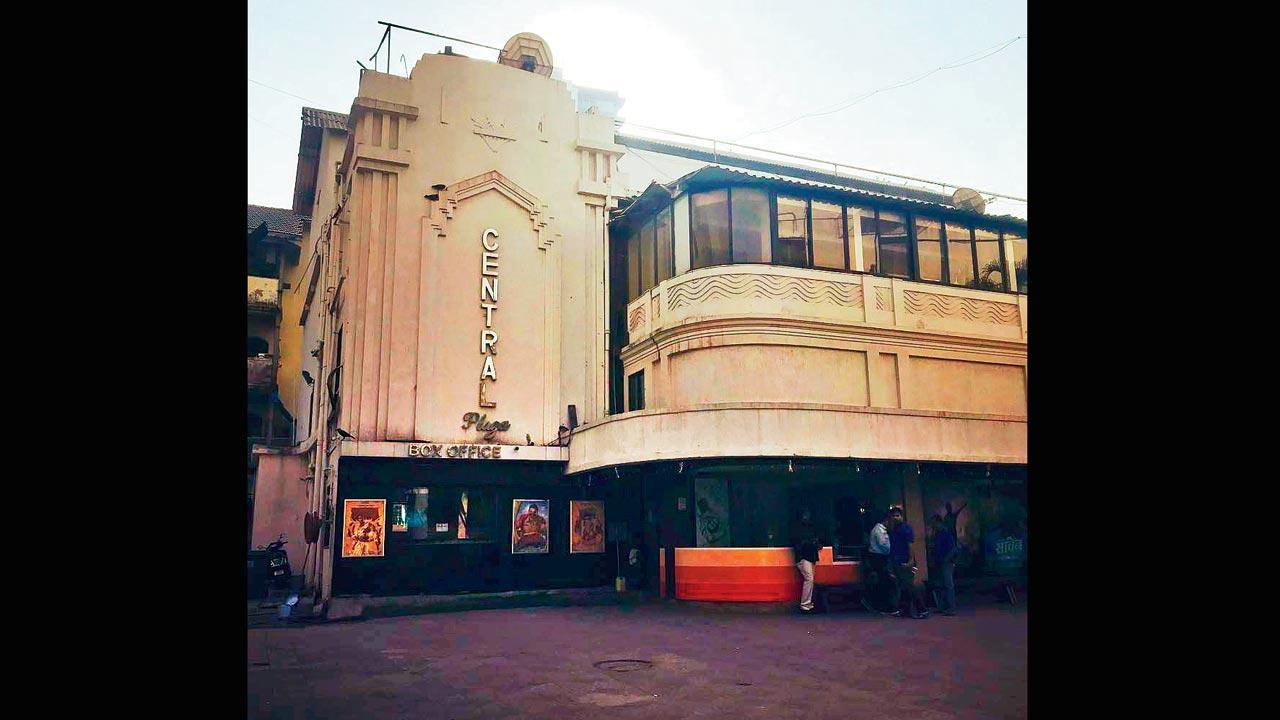
While establishing that the single-screen business was struggling to stay afloat even before the pandemic, owner of Central Plaza, which downed shutters, on why OTT will triumph
Uma Ramasubramanian (MID-DAY; March 22, 2021)
There’s little to debate when establishing that the theatre-business is among the hardest hit due to the pandemic. News of single screen cinema houses being unprepared to deal with the calamity surfaced soon after restrictions were imposed, but the closure of Central Plaza, which downed shutters after 84 years, hit closer to home.
Sharad Doshi, owner of the plaza, says, “We knew that the virus was spreading and this was not going to be a short-term affair. We called our staff and decided to close down indefinitely. We don’t know the viability of the business, so, we decided to let the staff go after compensating them [for their services].”
Doshi says the pandemic was the final nail in the coffin. They had been contemplating shutting down certain centres anyway. “We would have continued to run some of our cinemas, but the Coronavirus pandemic was the decider. We had issues regarding taxation, and single-screen survival.”
Doshi points out that the concern shown for multiplexes was not extended to single screens. “Distributors and producers didn’t care about single screens. When part of the industry doesn’t care, it becomes difficult to move on. Why would you want to be part of the system if you feel unwanted?”
So dissuaded is Doshi with the lack of support from the government that despite renovating the property, he will not venture into the film business. “Across the world, multiplexes are also suffering. In a country where the average income is less than Rs 30,000, what’s the point of charging Rs 800 for a popcorn? How long can this model sustain? OTT is the future we have to embrace.”
South Mumbai single-screen theatre Central Plaza shuts its doors
8:39 AM

Owner blames govt for not doing anything to support single-screens
Shruti Ganapatye (MUMBAI MIRROR; August 29, 2020)
The 84-year-old Central Plaza in Girgaon, once known as Central Cinema, one of the last standing single-screen theatres in the city, has shut its doors forever. The business is no longer financially viable, the owners say, especially after the Coronavirus pandemic and lockdown. At least 50 single screen theatres in Mumbai have shut down in the past 10 years.
Known for its dominant Marathi culture, the Girgaon area had iconic cinema halls like Central Cinema, Majestic Cinema, which has shut down long ago, and Sahityasangh Mandir, a theatre for staging plays. Central Cinema was started in 1936 by a Parsi near Girgaon Church, a five-minute walk from Charni Road station. Later, Sharad Doshi and Dilip Vartak’s families bought it in the 1960s and ran it successfully till date. Once known for screening only Marathi movies, the theatre soon became popular for its Hindi blockbusters of Jitendra and later English movies too. Angrezi Medium starring the late Irrfan Khan was the last movie shown in the theatre just before the lockdown started.
Upset with the not-so-friendly government policies for single-screen cinema halls, Sharad Doshi said the single screens have no future. “The government has not done anything to promote art and culture in the city. The result is that the single screen theatres are dying a slow death. We were running six shows a day but still it was not financially viable. The government is giving incentives to the multiplexes but not to single screens,” he said.
Recalling the history of the theatre, Doshi said they introduced Hindi and English cinema to the audience as it was the need of the changing times. “It was one of the most popular theatres in South Mumbai. Many of Dada Kondke’s movies saw silver jubilee. Basu Chatterjee’s Shaukeen (1982) was the first Hindi movie shown in the theatre. Jitendra’s Himmatwala, Dil Chahta Hai and American Beauty were among the blockbusters screened here,” he said, adding Jitendra was brought up in Ramchandra building, diagonally opposite the theatre. Dada Kondke’s movies like Ekta Jeev Sadashiv, Andhala Marto Dola, Pandu Hawaldar and Ram Ram Gangaram were some of the movies that ran here for over 25 weeks. Other blockbusters screened here include Shejari Shejari, Shikleli Bayko, Malhari Martand, Woh Kaun Thi, Gumnaam and Pyar Kiye Jaa.
A researcher of old Indian movies, Arun Puranik expressed disappointment over closing of the theatre. “The theatre was a cultural hub in the area. Sant Tukaram was the first movie shown in the theatre on December 12, 1936. It had a world record of running for 57 weeks then. On Republic Day, 1951, the movie Shri Ganesh Janma movie was shown there. It is sad to see these iconic structures shutting down,” Puranik said.
Narrating the problems of the single screen theatres, Nitin Datar, president of Cinema Owners and Exhibitors Association of India said that the government intervention is needed. “In spite of no revenues, recurring costs for maintenance staff, salaries, electricity charges, interest on loans, taxes etc have to be incurred which are pushing cinema owners towards a debt trap and permanent closure. These are extraordinary difficult times which require extraordinary measures. We require the government’s assistance to enable use to survive,” Datar said. The association has given numerous requests to the state government requesting help.
Admitting the problem of vanishing single screens from Mumbai, Gautam Chintamani, film historian and author said they would need a new business model to survive in these times. “The definition of entertainment is changing. The movie releases are going to OTT. So, the theatres would need to change its business model. They could screen classic films like Sholay, Lawrence of Arabia which requires a big screen experience,” Gautam said.
Ravindra Biwalkar, a journalist and an avid movie goer, has fond memories about Central Plaza. “My building is next to the cinema hall and I have grown up watching many movies there - black and white in my childhood and then many Hindi blockbusters. The two vada pav stalls outside the theatre were the main attraction during the interval. There was an old person who used to sell ‘Gaane Ka Pustak’, printed lyrics of popular Bollywood songs,” Biwalkar recalled.
Single screen exhibitors to desist from screening Ae Dil Hai Mushkil, Raees and Dear Zindagi
9:05 AM

Manishaa R (DNA; October 26, 2016)
The single screen exhibitors of COEAI (Cinematograph Owners And Exhibitors Association of India) have decided to uphold their decision not to screen all films starring Pak artistes in the forthcoming months, starting with Ae Dil Hai Mushkil, Raees and Dear Zindagi. The final decision was taken in an executive meeting held on Monday afternoon, after which it was conveyed to members, "The directive to our members is for all films starring Pak artistes hereafter till the situation is restored to normalcy. In fact our members did not even release 1:13:7 - Ek Tera Saath which was released last week, since it had Pakistani singer, Rahat Fateh Ali Khan rendering a number," revealed Sharad Doshi, the secretary of the COEAI.
According to Doshi and President, Nitin Datar, a majority of single screens have already booked Shivaay in all the four shows, with exhibitors in Maharashtra, Gujarat and Karnataka, also opting for regional films. "However they have all opened the advance booking for Shivaay, which has met with a very encouraging response," Datar revealed.
There was apprehension among certain exhibitors that Ajay Devgn and Jayantilal Gada of PEN, which had the distribution rights of Shivaay, would revise their terms and probably expect better terms from single screen exhibitors in the wake of the current development. However Doshi said that the exhibitors did not have to face any such problems, "They have confirmed to their earlier understanding and not asked for one penny more from the exhibitors. Apart from that, Mr Devgan has also agreed to contribute his share from the first show to the fund all over, the proceeds of which will go to the widows of army men,"
According to Datar, their decision had nothing to do with the MNS withdrawing from the scene. "We had always maintained that we had taken the decision out of respect for the army men who lost their lives in the Uri attacks."
However he added that it did not guarantee other unsocial elements jumping into the fray, "The whole issue has been already politicized and as of now, it is the Congress government which has called for protests in certain areas of the central suburbs, against the release of the film. Anti-social elements do not hesitate to take the opportunity and go on a rampage," he said.
Subscribe to:
Posts (Atom)