Showing posts with label Shankar-Ehsaan-Loy. Show all posts
Showing posts with label Shankar-Ehsaan-Loy. Show all posts
Farhan Akhtar asks, ‘Can you send me the tuning configuration for the strings?’-Purbayan Chatterjee
10:34 AM

Sitarist Purbayan Chatterjee reveals how Farhan Akhtar is learning the sitar from him and his student for his role of Pandit Ravi Shankar in ‘The Beatles’
Priyanka Sharma (MID-DAY; May 14, 2026)
From the outside, landing a plum role in Sam Mendes’s four-film event, The Beatles, seems remarkable. On the inside, it comes with immense hard work. Ask Farhan Akhtar. The actor, who will portray late sitarist Pandit Ravi Shankar, has begun his physical prep for his Hollywood feature debut. But that’s not it — his prep naturally involves learning to play the sitar.
mid-day has exclusively learnt that Akhtar is being trained by acclaimed sitarist and composer Purbayan Chatterjee’s Purbayan Arts and Artists Music Foundation (PAAMF).
Chatterjee remembered his first interaction with Akhtar; it happened without any indication of the film franchise that was driving it.
“My friend Anurag Rao, who is also associated with Shankar-Ehsaan-Loy, called me out of the blue and said, ‘Farhan wants to learn [the sitar] from you.’ I asked why he wanted to learn it. At that point, Farhan was bound by an NDA, so [my friend] couldn’t get all the details. [Later] Farhan said, ‘There’s this role that I’m doing.’ So, we met and I gave him some tips,” recalled Chatterjee.
That was just the start. Chatterjee realised that with Akhtar’s busy schedule, it was better if someone guided him whenever he sat down to play. “My student Ruthvik Rao goes regularly to monitor his [progress].”
Of course, Chatterjee is only a call away. “Sometimes Farhan bhai calls or texts, saying, ‘Can you send me the tuning configuration for the strings? I have forgotten it.’ I respect him, he is artistically inclined.”
You wouldn’t get 12 cinematographers to shoot your film. So, why do you get 12 composers?-Shor Police
9:55 AM

Clinton Cerejo and Bianca Gomes
Having composed for ‘Baramulla’, music band Shor Police questions Bollywood’s norm of roping in many musicians for a project and overlooking the background score
Priyanka Sharma (MID-DAY; November 24, 2025)
What started with a song turned into a full-fledged score for the movie. While Clinton Cerejo and Bianca Gomes, who form the band Shor Police, weren’t sure they had the time to go beyond composing the songs for Baramulla, the outpouring of love over the last 15 days has validated their decision. In a chat with mid-day, the duo talks about creating the soundscape of the Netflix horror film. Excerpts from the interview.
Take me back to when Baramulla came your way.
Gomes: Initially, we were called on board to only compose one song. After we saw the film, we were asked to do the score. Since it was a tight timeline, we were apprehensive. But the film was so beautifully shot that we were happy to adjust our schedules and meet the deadline.
What was director Aditya Suhas Jambhale’s brief?
Cerejo: Aditya was one of the most open directors we came across. He had a temp [temporary] score, but he was eager to hear what we have. That’s rare because often directors get so used to the temp score that they find it difficult to disconnect from it. [For them] nothing you do will match up to that score, because they’ve lived with it for so long.
Gomes: He wanted the music to sound new. In horror films, you have the same kind of music and the audience is led in a certain way. So, it’s easy to go down that same path. But Aditya wanted the music to be a reflection of the landscape. We’ve used instruments like the rabab.
Background score has been overlooked so much that if a musician’s name is attached to a project, it’s believed they only composed the songs. What’s your take?
Cerejo: When you think of movies, you think of the songs associated with them. Nobody used to talk about a film’s background score. As a result, even if composers got to do the background score, they’d feel it’s not worth spending their time. Composers like Shankar-Ehsaan-Loy and A R [Rahman] do both. In Bollywood, when you say that someone is a film composer, you’re most likely referring to the one who has composed the songs. In Hollywood, film composers are those who do the background score. Here, the score has been largely ignored not just by the public, but also by the industry. [People] don’t want to be score composers because they don’t get the respect they deserve.
The issue is also the [concept] of multiple composers in a film. You wouldn’t get 12 cinematographers to shoot your film. So, why do you get 12 composers?
Whenever I see two musicians together, I think, ‘How do they manage to be in tune with each other?’ Do you two fight?
Gomes: Oh, a lot!
Cerejo: One of us will walk out of the studio, mostly me (laughs).
Gomes: Musicians in a band are always having creative differences. So you can imagine how many differences there will be when two people are in charge of writing a song. But when you team up with someone, you have to make room for their opinions. I give Clinton credit for that because it takes a lot of openness from someone, who is more experienced, to say, ‘We are a team.’ If you can’t leave your ego at the door, you’ll have a problem.
The first time I performed live, I was downright terrified-Farhan Akhtar
8:28 AM

Debarati S Sen (BOMBAY TIMES; February 3, 2024)
Recently, Farhan Akhtar performed live at the finale of the Kala Ghoda Arts Festival in Mumbai. In an exclusive conversation with Bombay Times, he spoke about how he has gone from being terrified of live performances to thoroughly enjoying them. However, Farhan says that a certain degree of nervousness helps him focus on the stage. Excerpts:
What is it about live performances that you enjoy the most?
The feeling of live – in the here and now – is always exciting. The immediate reaction that you get from the audience at live shows, nothing compares to it! I mean when working on a film, you are surrounded of course by people who are working with you on that film and you only get a sense of what the audience feels, the public feels, months later, and at times maybe over a year later, but when you are performing live, everything is happening there and then and it’s a completely different feeling and it is not comparable to anything that I have done and I absolutely love it. I feel that the more honest I am on stage, the more ‘me’ I am on stage, that’s what the audience wants, that’s what they expect, and that’s when they have the most fun.
Have you ever dealt with stage fright?
The first time I went on stage to promote Rock On in 2008, it was really nerve-wracking because I had never performed on stage before that. So, it did take a lot of encouragement from Shankar, Ehsaan and Loy, to get me into the frame of mind to be able to go out there and perform. That is probably the time – I won’t even say I was nervous or anxious - I was downright terrified of going on to the stage. But over the years of course, it has gotten a lot easier, and I look forward to concerts now when they happen and I think it is completely normal for there to be a certain degree of nerves before each gig and I feel that it helps me focus. It does not scare me anymore; it makes me really kind of dig in and be very focused about how I want the show to be.
You are a self-taught guitar player without any formal training. Do you feel things would be different if you had?
Yes, I do love music and I am a self-taught guitar player up to a certain level. I would like to dedicate more time to improve on my guitar playing skills. I think it is difficult to do that, given that there is this whole alternate career I have, of doing films which take up a tremendous amount of my time, not that I am complaining about it, I absolutely love it. I would like to improve my guitar skills and I think that the more one learns the more one’s range improves in what they can write and what they are capable of ideating. So that’s something that I definitely want to keep doing.
In a family of many talents – Javed Akhtar, Honey Irani, Shabana Azmi and Zoya Akhtar – how do they react to your various creative endeavours, whether it’s direction, acting or music?
I am absolutely grateful for the family that I have – be it dad, mum, Shabana or Zoya. They have always been exceedingly encouraging with what I have done. Nobody has ever questioned why. I mean when I was directing, why take a break and act, or why take a U-turn or a hard left and start performing live on stage? They support me in my decisions in manners that I choose to express myself artistically. And it gives me strength and so there are no complaints whatsoever.
There’s a lot of excitement around your other projects, including Don 3, which you will be directing.
I will be directing Don 3 soon. Then, there is a new Hindi single and two English songs that should be released within the next two months. As a producer, there is a lot that’s happening, which we will announce soon. So, there are busy times ahead when it comes to acting, directing, and producing. I just have to find the right time to balance it out with my other passion, which is music, and I hope to do that.
15 Years of Rock On: Purab Kohli says no one recognized them during the shoot; Ehsaan Noorani reveals guitar sales went up
8:23 AM
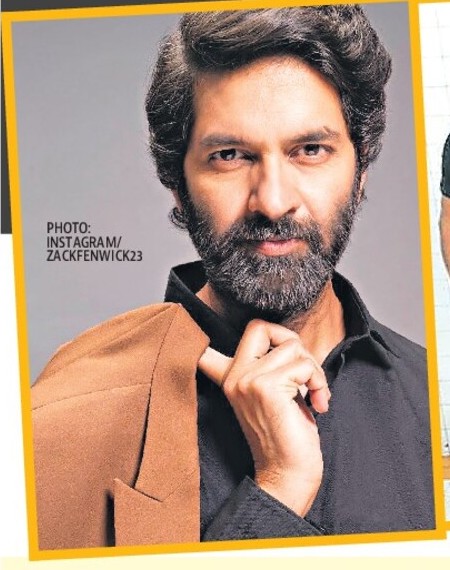
Kavita Awaasthi (HINDUSTAN TIMES; August 29, 2023)
Who can forget the drummer KD from Rock On!!? When he auditioned for the film, actor Purab Kohli didn’t know its scale. “I enjoyed shooting for the film. But I realized the magnitude of the film only when I saw the final cut,” says Kohli, adding that he bonded with co-actors Farhan Akhtar, Arjun Rampal and Luke Kenny on and off the screen.
“Farhan was an established director and producer when he did the film and everyone would turn to him for advice. But he was just focused on acting. Gattu (Abhishek Kapoor; director) was the captain of the ship.”
Music was a crucial aspect of the film and Kohli recalls shooting the song Socha Hai at Mumbai’s Hutatma Chowk. “Farhan was well-known, but back then, he wasn’t the star he is today. In fact, Arjun was the star. But since we were in our look — Arjun with long hair and me with a beard — the crowd that gathered didn’t really know who we were. They were just enjoying the song. Perhaps they thought a music video was being shot,” he ends.
-----------------------------------
Soumya Vajpayee (HINDUSTAN TIMES; August 29, 2023)
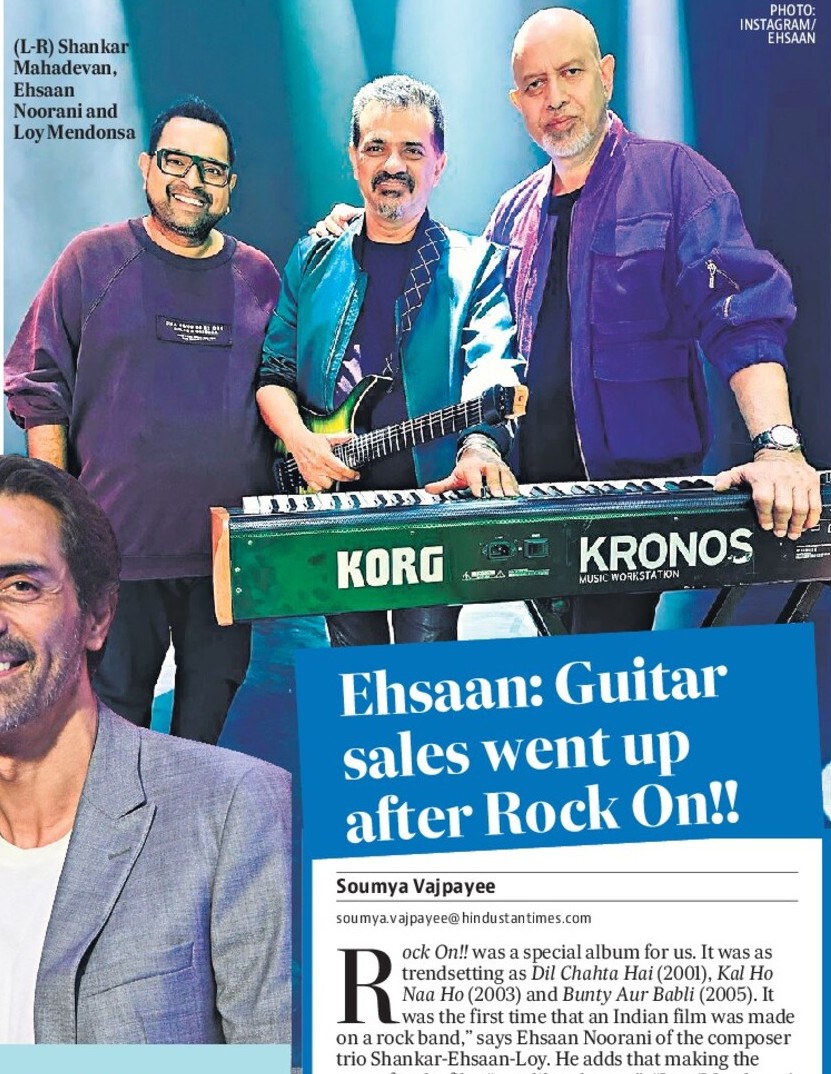
Rock On!! was a special album for us. It was as trendsetting as Dil Chahta Hai (2001), Kal Ho Naa Ho (2003) and Bunty Aur Babli (2005). It was the first time that an Indian film was made on a rock band,” says Ehsaan Noorani of the composer trio Shankar-Ehsaan-Loy. He adds that making the songs for the film “was like a breeze”:
“Loy (Mendonsa) and I grew up playing rock music. We also played with rock bands for many years. I was hugely influenced by the music of Jimi Hendrix, Led Zeppelin, Pearl Jam, Nirvana, U2 and The Police (rock outfits).”
Recalling the studio sessions, Noorani says, “Spending time with Javed (Akhtar; lyricist) saab, Farhan (Akhtar; actor), Shankar (Mahadevan) and the rest of the band and coming up with ideas that were turned into songs felt special. We had a rock band-like setup in the studio, with live musicians, including a drummer and a bass player. We composed the songs like how a band would. I’d come up with a guitar riff and that’d go on to become a song. The music became such a rage that my friends who are music instrument dealers told me that the sales of acoustic and electric guitars went up drastically after Rock On!! released.”
Noorani feels “Javed saab should have won awards for the film. An Urdu poet writing simple Hindi lyrics like Meri Laundry Ka Ek Bill was unique”. Calling Phir Dekhiye his favourite number, Noorani adds, “It’s a simple song that I came up with on an acoustic guitar.”
Being yourself and being recognized for it is the best thing, says Naatu Naatu singer singer Kaala Bhairava
8:47 AM

Debarati S Sen (BOMBAY TIMES; January 26, 2023)
The year has begun on a high note for the Indian film music industry as RRR’s Naatu Naatu, which has bagged a spot in the top five nominees in the Original Song category at the Oscars, has also won Best Original Song at Golden Globes and Critic’s Choice Awards. The song was sung by Kaala Bhairava (composer M M Keeravani’s son) and Rahul Sipligunj.
Kaala Bhairava, who is thrilled with the Oscar nomination, recalls the moment the Golden Globe win was announced. He says, “When we got to know that Naatu has won the Best Original Song at the Golden Globe, we were jubilant. I was watching the event live with my family at our home in the US. We were watching it like it was an ongoing World Cup cricket match where there was just the last ball left for India to win!”
‘IT TOOK US 2. 5 YEARS TO CREATE NAATU NAATU’
The song was created painstakingly. “Naatu Naatu took two-and-a-half years to create. We felt there was scope for improvement in the process of music production. Once the song was shot, we felt we could enhance it further, so we went back to the studio and worked on it some more. Due to all this, the song took so long to create.”
‘I HAVE GROWN UP LISTENING TO HINDI SONGS’
In Baahubali: The Beginning (2015), Kaala Bhairava had sung the duet Khoya Hain with Neeti Mohan. The singer says, “I have grown up listening to Bollywood songs and have loved them. Earlier, I would often listen to songs composed by Pritam sir and Shankar-Eshaan-Loy and Amit Trivedi sir. These composers made up most of my playlists.”
‘NO POINT IMITATING OTHERS’
Kaala Bhairava believes that the goal of an artiste should be to be recognized for their original work. “The best thing we can do is to try to be as original as possible and stick to our uniqueness because there is no point in trying to imitate something in order to be successful or in order to sell our work. Being yourself and being recognized for it is the best thing and you can’t compare that feeling with anything else,” he signs off.

Images: Celebs attend Farhan Akhtar and Shibani Dandekar's wedding in Khandala
10:16 PM
Mohar Basu (MID-DAY; February 20, 2022)
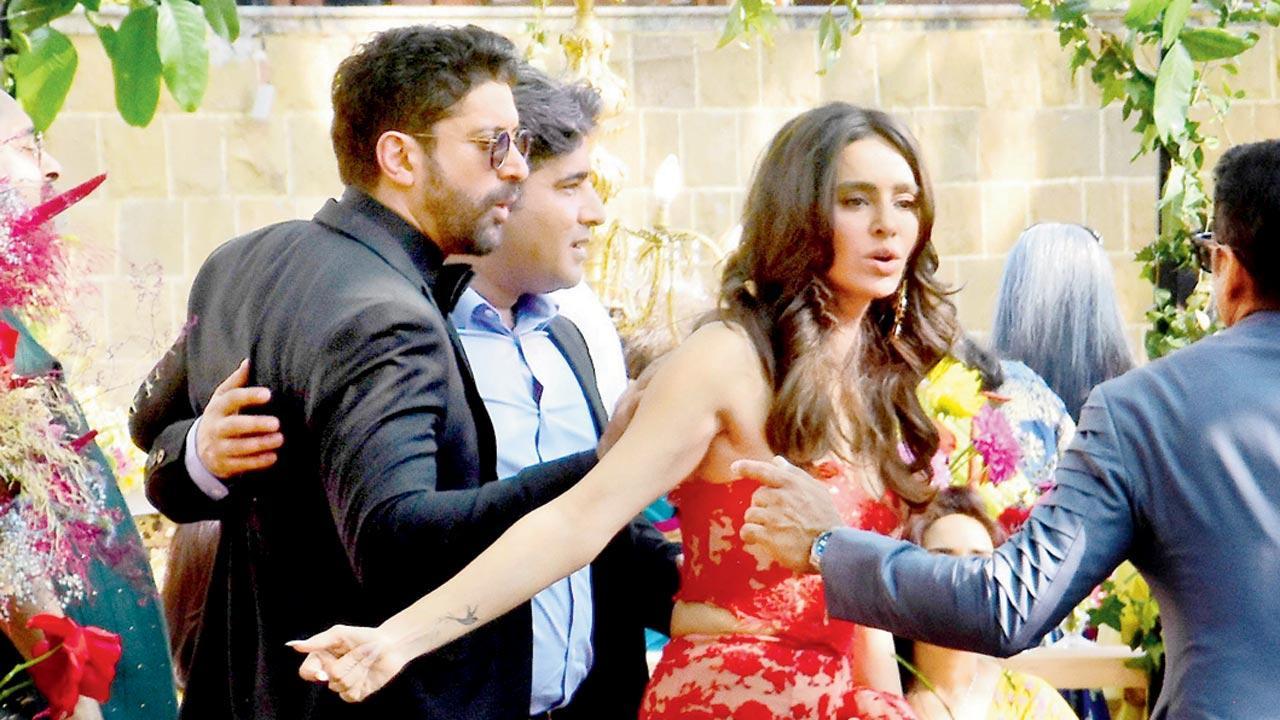
After four years of dating, Farhan Akhtar and Shibani Dandekar tied the knot in Khandala yesterday. The low key affair held at the Akhtar family’s bungalow was attended by the close friends of the couple including Shibani’s sister Anushka, Rhea Chakraborty, Hrithik Roshan and family, Rakeysh Omprakash Mehra, Ashutosh Gowarikar, Ritesh Sidhwani, Amrita Arora among others.
A source informs, “They decided to forgo traditional rituals and read vows to each other. The bride wore a red ensemble and the groom was in a black bandhgala suit. Javed Akhtar recited a poem for the couple.” Musical trio Shankar-Ehsaan-Loy performed for the guests belting out their hits from Zindagi Na Milegi Dobaara, Rock On and Dil Chahta Hai.
“Keeping COVID-19 protocols in mind, the guest list was kept to a minimal crowd of 50. The couple will register the marriage with a court wedding in Mumbai this week and host a reception later in the month,” added the source.
The mehendi and sangeet ceremony was held last evening and the haldi was earlier in the day.
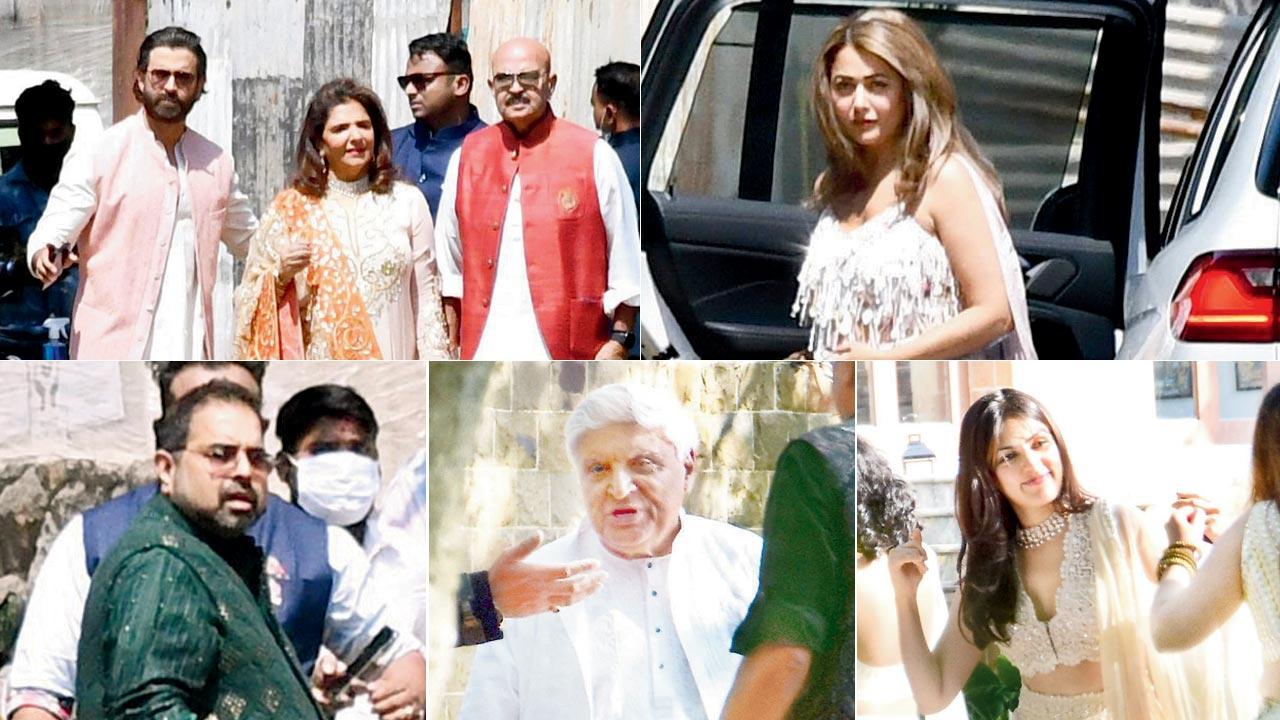
The Roshans; Amrita Arora; Shankar Mahadevan; Javed Akhtar and Rhea Chakraborty
Vicky Kaushal-Katrina Kaif's wedding: Gurdas Maan flown down to perform at the sangeet
8:24 AM

Folk singers flown down to perform groom’s favourite Punjabi songs at sangeet; couple shake a leg together for first time
Mohar Basu, Uma Ramasubramanian (MID-DAY; December 8, 2021)
What’s a Bollywood wedding without naach-gaana? On Tuesday, Vicky Kaushal and Katrina Kaif’s pre-wedding celebrations began with an elaborate sangeet night at the Six Senses Fort Barwara Resort that saw Karan Johar and Farah Khan shake a leg together on the stage. The highlight of the evening was the special performance by folk singers who were flown down from Punjab for the groom, a Punjabi music aficionado.
A source reveals, “From pop to rock, Vicky listens to a wide range of artistes, but Punjabi folk music has his heart. He was keen on having Gurdas Maan perform at the sangeet. The artiste, who flew down to Jaipur on Tuesday morning, performed a special set of his hit numbers, including Shagna Di Mehndi and Rabb Ne Baniyan Jodiyan.”
His love for the bridal couple was evident as he sang snatches of Teri jodi jeeve at the Jaipur airport itself, dedicating it to them.
The airport saw frenetic activity all through last morning, as Kabir Khan and Mini Mathur, Neha Dhupia and Angad Bedi, Sharvari, and Shankar-Ehsaan-Loy arrived for the nuptials. The guests were greeted with a customised welcome card that reminded them not to post pictures and videos of the ceremonies.
Another source adds, “The bride and groom have lined up an act together. Vicky will match steps with Katrina to Kala Chashma, Nachde Ne Saare and other songs. Since they’ve kept their relationship low-key, this will be the first time the guests will see them share the stage.”
I have been told by many that Dil Chahta Hai was a story ahead of its time that broke clichés-Farhan Akthar
8:53 AM

As Dil Chahta Hai clocks 20 years, director Farhan Akhtar says Aamir-Saif-Akshaye starrer gained cult status due to its novel treatment of friendship
Uma Ramasubramanian (MID-DAY; August 10, 2021)
Three friends, one car, Goa. So powerful is its imagery that millions can recognise the film in a heartbeat. With Dil Chahta Hai (2001), first-time director Farhan Akhtar did more than just reflect our Goa plans on screen, or influence popular hairstyles. In telling the coming-of-age story of three friends, he shunned over-the-top drama and dialoguebaazi, thus giving Bollywood a new cinematic language. Result? The Aamir Khan, Saif Ali Khan and Akshaye Khanna-starrer remains one of Hindi cinema’s cult films against which every buddy comedy is measured.
As the Ritesh Sidhwani-backed film clocks 20 years, Akhtar says he had little idea that his script would have such a lasting impression. “I have been told by many that it was a story ahead of its time that broke clichés and redefined friendship. Akash, Sameer, and Sid [played by Aamir, Saif and Khanna respectively] were projections of the people we see in our daily lives. That is probably why after two decades, the audience can still relate to them,” he says. The movie will air on &pictures today to mark the occasion.
Shankar Mahadevan, who composed the music with Ehsaan Noorani and Loy Mendonsa, says the film was a milestone in their careers. “It’s a path-breaking film where Farhan’s command over the craft is evident. The music was a clutter-breaker. When you hear the songs even today, they don’t feel dated.”
The song that we didn't use in Dil Chahta Hai...I have never forgotten it-Farhan Akhtar
8:27 AM
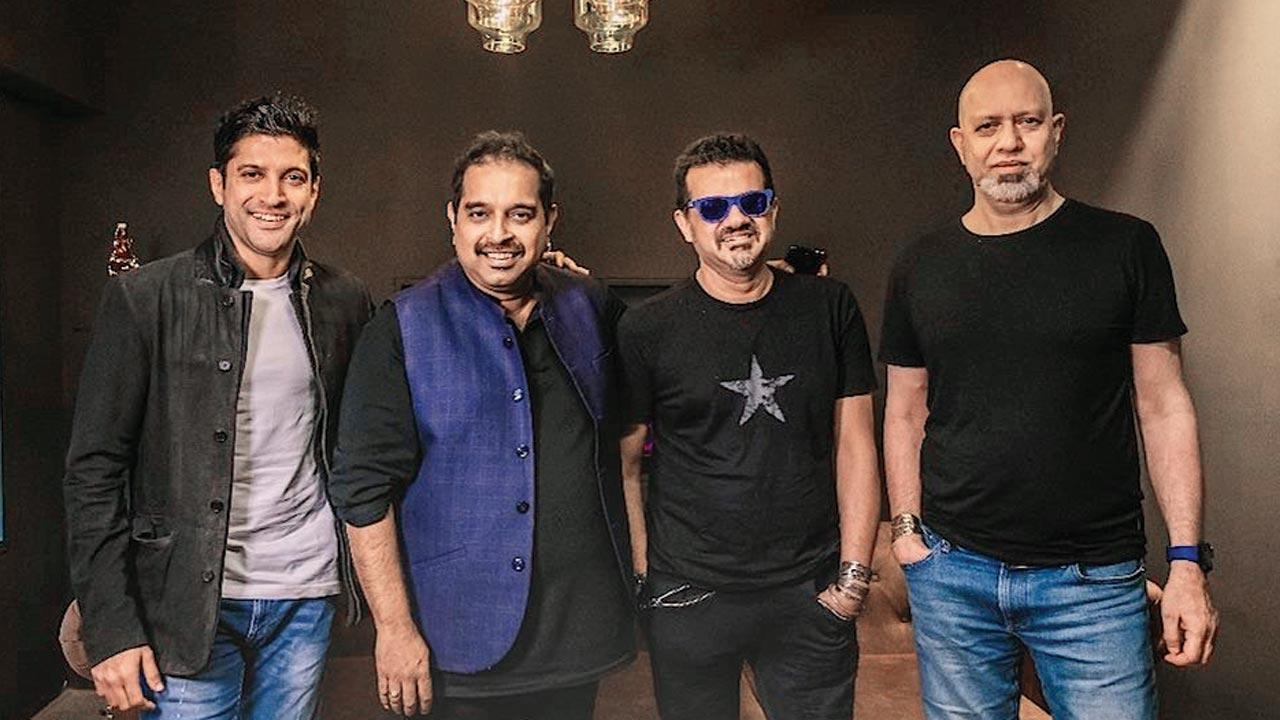
Farhan Akhtar, Shankar-Ehsaan-Loy, the team behind Toofaan, mark 20 years since the release of Dil Chahta Hai by sharing anecdotes, including that of a song that never made the final cut
Sonia Lulla (MID-DAY; July 12, 2021)
Several artistes suggest that they occasionally find themselves leisurely working on projects offered to them, only to scramble and wrap up the work at eleventh hour. This interview with Farhan Akhtar and Shankar-Ehsaan-Loy appears to proceed no differently. Abundant tomfoolery predominates the first 15 minutes — it appears as though the quartet is enacting the rough draft of Zindagi Na Milegi Dobara.
Reminded by their publicists that they are running against the clock, they seem to recall that they had ‘serious’ questions prepared for one another, as part of this interaction. They manage to squeeze some in, as Shankar enquires if the box-office performance of Farhan’s second directorial venture, Lakshya, was a disappointment. The latter, in turn, probes them about a project that has tested their sensibilities.
The entire interaction, available on our YouTube channel, is assuredly worthy of a watch. In the meantime, these edited excerpts will highlight why this team — whose latest work, Toofaan, releases on Friday — always creates the finest films based on friendship.
Shankar: Farhan, do you have that 60-page script of Dil Chahta Hai?
Farhan: I do, and, just the other day, I found these hand-drawn storyboards [that I had made] during the first few weeks of shoot. It was special. The memories of recording the music are special. I remember meeting you all at 4D [music studio]. You all were finalising the music of Mission Kashmir, and played the song Dhuan to me. It’s such a good song.
Shankar: What made you come to SEL for DCH?
Farhan: Breathless had blown my mind. I was still writing [the script of Dil Chahta Hai] then, and didn’t know what my plans were. At the time, [A R] Rahman had become a big name. I spoke to pa [Javed Akhtar] and said I’d like to meet him. But he said he didn’t think our temperaments would match. I am the kind of guy who sleeps at 9 am, and he wakes up then. Also, I wanted someone who was hungry, like I was. I remembered how amazing Breathless was, and there were other songs [of SEL] that I liked. Dus’ Suno gaur se had also come out then, and it all felt right.
Shankar: I remember, [with Breathless], you, Zoya [Akhtar] and Javed ji were sitting in a room, and you told me, ‘We will make this video. It will become famous. Then we’ll make big movies, and lots of money.’
Farhan: [I’d say] anything to get you all on-board. Every script has a culture; every character a sound. That the three of you could understand the process, and make it effortless, seemed amazing. The music [in that decade] was very different. The way you processed it felt right.
Ehsaan: I wonder if there is an idea that we didn’t use?
Loy: There was one; was it a blues [song]?
Farhan: That song hasn’t left me. I’ve put it in the archives, or something. It is in my head, I have never forgotten it.
Shankar: Pyaar mein kitna gham hai.
Farhan: That’s it. I will 100 per cent use it in some film. We recorded one mukhda and antara for it. Pa had also written the lyrics. It was for [the section which eventually included] Tanhaayi.
Shankar: There were things about the film’s lyrics that [bothered you].
Farhan: Yes, one was Chamkile din. I stand corrected now, but when I heard it, I told dad it sounded like a detergent [commercial]. Another one was pyar ke ghat jo utarte hai. I found the reference old-fashioned. But he said, like trends, words come and go. The young generation is reintroduced to some words only through songs. It’s a nice way to keep these words alive.
mid-day: When tackling a film like Karthik Calling Karthik, which isn’t generally driven by its music, how does the process change?
Farhan: There are a couple of films like that, including Lakshya. It’s not one you associate with music because it is about dramatic personal growth. In this case, it is about how effectively a writer can weave in a song to further the story. In films like Dil Chahta Hai and Zindagi Na Milegi Dobara, you can pause the story [to include a song]. But, in films like Lakshya, you can’t, because the driving factor for the viewer is the story. Such movies are tougher to work on. They are easier for the writer. So, for pa, it is easier because he knows where the song is being placed in the film, and can write in accordance with that situation. But, for the composers, it is harder. Because the music has to become an extension of the score.
Shankar: Talking about Toofaan, the work you have done is [commendable]. Had you learnt boxing before?
Farhan: I’ve never boxed before. The closest I’ve come to boxing is evading punches from Zoya. But, when you are inspired by a script, something happens. You don’t feel like you’re working anymore. It’s not about the physicality. If I was walking down the street and someone told me to do 50 push ups,
that will feel like hard work. But, if [a script like this] wakes something up within you, you are drawn to it.
Shankar: But to sustain that for [18 months] must have been tough. I remember, you would wake up and be at the boxing ring by 6.30 am. Often, you would message me from there with ideas about a song. I’d wonder how this man could do it?
Farhan: Like with Bhaag Milkha Bhaag, it came from being so excited and inspired by what was being asked of you. I’m sure it’s the same for you guys. If you’re in a studio, you all keep [creating music] till it feels amazing. Until that’s done, you can’t sleep.
Shankar: Were you disappointed with how Lakshya fared?
Farhan: Yeah, but only because it was probably the hardest I had worked for anything. [We were always taught] that if you work hard, you will succeed. Here, we did. But I had expected it to do better than it did. I was disappointed. But, on the flip side, there’s a story I’d like to share. In 2017, I went to Dehradun for a live concert. It was the first time I was heading there after the release of Lakshya. I told [the officials] I’d love to visit the academy [where the film was shot]. Graciously, they organised a visit. There were 700 cadets. Someone asked me the reason behind making the film. And I narrated a story about [something that transpired in 2000]. I think you [SEL] were there with my father at an event in 2000, when an [army official] had told him that there was a shortage of officers entering the army, after Kargil. The army was praised for how they dealt with the intruders. But, as a career option for the educated, it was vanishing. Dad said he would write a film about it, and that is how Lakshya got made. I was telling [the cadets] this story. One major, who supervises them, said he wanted to show me something. He took to the mic and asked [the cadets] who among them had joined [the force on being inspired by] Lakshya. About 70 per cent raised their hands. And that made me realise that we are [unfortunately] only bothered about box-office numbers. Here, the purpose of making the film was evidently served.
Farhan: Hadn’t you guys composed the [title track] of the film much earlier?
Shankar: I had composed it before I had met Ehsaan and Loy. It was for a TV series. The difference between working for your production and another one is that we don’t need to consult anyone else. When we work on music, we arrive at many [melodies]. We like some, we throw some. But, if we like an idea, we can consult you, and it is [finalised]. It’s not like we’re told, ‘Okay, we’ll come back to you.’ The process becomes easier.
Loy: Yeah, the fact that you take the call on a song speeds up the process by 10 times. That’s the problem in the industry. [Delays] set you back significantly.
Rewind to 2001: Composers walk down memory lane
9:41 AM
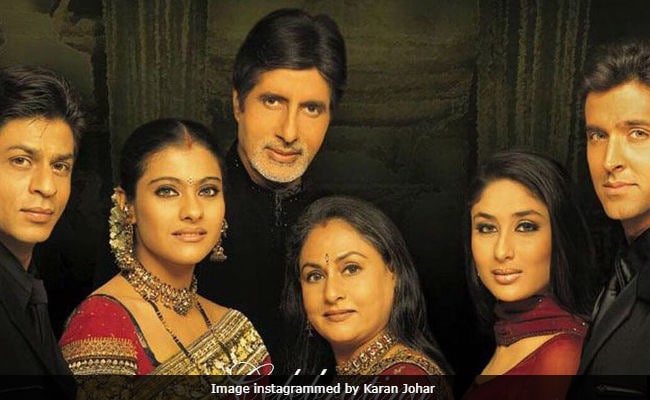
Did you know that the title song of Dil Chahta Hai was first made for a romantic sequence, or that Rehna Hai Terre Dil Main was composer Jayaraj’s debut film? As three music-classics turn 20, composers walk down memory lane
MID-DAY (January 25, 2021)
Karan Johar would create a visual portrait for music composers: Sandesh Shandilya
Right from the fact that Karan Johar was creating it, to the stellar star-cast associated with the film, there were several factors that served as inspiration for creating the soundtrack of Kabhi Khushi Kabhie Gham. Karan would often enact situations when attempting to highlight what he wanted. I recall, for Sooraj Hua Madham, he read and enacted the [preceding] dialogues, and then the song.
It was easy to visualise the scenes and work on creating the compositions, and that effort went a long way in ensuring that we made promising tracks. I admired [his idea] for the song Vande Mataram, where he wanted to showcase the [beauty] of India as the protagonist roamed the streets of London. He had been working on this film for two years, and left no scope for discrepancies when expressing what he expected. This was among my first few projects in the industry. My team and I studied music trends that were popular during the time. While You Are My Soniya and Sooraj Hua Madham were immediately approved, three iterations of Deewana Hai Dekha had to be made.
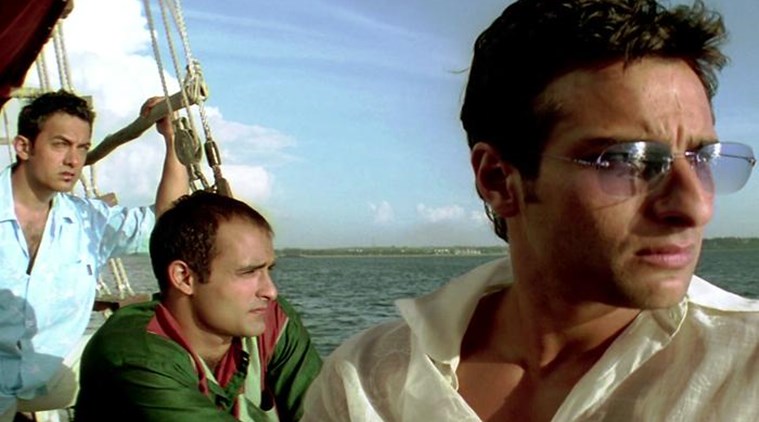
DCH had many genres: Shankar Mahadevan
Dil Chahta Hai was among Shankar-Ehsaan-Loy’s first few projects, so we didn’t have any inhibitions, because people didn’t have preconceived notions about what we could deliver. That worked in our favour. Also, I believe the soundtrack did well because we approached it differently. It had jazz music, as well as Indian, Western and Scottish folk. Koi Kahe introduced trance to [listeners]. And while a layman may not technically understand the genres, he can analyse that it is new. Farhan [Akhtar], Ritesh [Sidhwani], Javed ji [Akhtar] and we [SEL] headed to Ritesh’s Khandala bungalow to create the soundtrack.
We had allotted 10 days for it, and wrapped it up in the first three. It was made with ease, and amid laughter. It was among my most memorable experiences. I remember sitting on a swing with Javed ji and analysing how we should make Jaane Kyun. We both agreed that instead of being a typical love song, it should have a conversational undertone, where the [characters] analyse the pros and cons of falling in love. Javed ji said, ‘Haan, aisa gaane hona chahiye jo samjhaye ki, jaane kyun log pyaar karte hai’. That was it. Sitting on the swing, we finished composing it within 10 minutes.
Royalties outweigh salary from film: Harris Jayaraj
Barring two tracks — Dil Ko Tumse and Rehna Hai — the entire soundtrack was initially created for the original version, the Tamil film, Minnale. We were told that Mr Vashu Bhagnani wanted to create it in Hindi as Rehna Hai Terre Dil Mein, and retain the soundtrack. But, he wanted a few songs with a North Indian feel. So, we made the two additional numbers. But love songs [transcend] barriers of language, anyway. Arabic, Tamil, and English cover versions of the film’s songs have been made over the years, and I still receive royalties.
The royalties I have received have been more than my salary for the film. We had enjoyed working on the soundtrack, and that reflected in its music. The only thing I was [apprehensive about] was the song Vaseegara, which was remade into Zara Zara. Vaseegara had already become a hit in both, the Tamil and Telugu industries. Apart from its music, the lyrics were also immensely appreciated. So, recording it in Hindi again [posed its own set of challenges]. I was keen to retain the original singer, Bombay Jayashree, who also made [her] debut with the film, and created magic with it.

Many Bandish Bandits scenes were rewritten after our music sessions with Shankar, Ehsaan and Loy-Anand Tiwari
8:00 AM

With Bandish Bandits nominated for Best Series in mid-day and Radio City Hitlist OTT Awards, creator Tiwari on his purist approach
Mohar Basu (MID-DAY; January 20, 2021)
Bandish Bandits is a refreshing break from what Anand Tiwari calls “bhed-chaal” or herd mentality. His 10-part series, after all, focuses on a subject that is truly indigenous yet often ignored in mainstream entertainment — the conflict and confluence of classical sangeet and modern music. As the show is nominated in the Best Series and Best Romance/Comedy categories of the upcoming mid-day and Radio City Hitlist OTT Awards, the creator-director is proud that it launched two new talents, Ritwik Bhowmik and Shreya Chaudhry.
“The credit goes to Amazon Prime Video officials, who never pressured us to cast known faces. We had a detailed audition process through which Ritwik and Shreya earned their parts. Today, they are two of the most sought-after actors,” says Tiwari.
As he developed the musical romance with long-time collaborator Amritpal Bindra, Tiwari wanted to maintain a purist approach to the subject. Enter Shankar-Ehsaan- Loy, who not only composed the show’s score but also gave insights into the world of Indian music. “We had spoken to music experts when we wrote the bible. But when we went to Shankar, Ehsaan and Loy, they helped us add nuance to the script. Many scenes were rewritten after our music sessions with them. In episode four, Radhe [Bhowmik’s character] is being trained by Pandit ji [Naseeruddin Shah] and by Tamanna [Chaudhary] in dramatically different ways. That scene was changed once Shankar-Ehsaan-Loy decided the beats that Pandit ji and Tamanna would teach him. Music supervisor Akshat Parikh too guided us with details.”
Currently developing the script for its second season, the writer-creator says he will be mindful of the use of expletives. “If our audience includes grandparents as well as grandchildren, we want to be economical in our use of abusive language. In our show’s universe, few characters use cuss words — Radhe’s friend and Arghya [Tamanna’s manager]. But I will try to refrain from that as well.”
Cast your vote for the Hitlist OTT Awards
- Bandish Bandits has been nominated in the Best Series category. The other nominees are:
- Asur (Voot Select)
- Paatal Lok (Amazon Prime Video)
- Panchayat (Amazon Prime Video)
- Scam 1992 (Sony LIV)
- The Forgotten Army (Amazon Prime Video)
- Log on to www.hitlistottawards.com to cast your vote.
- You can also vote via SMS. Send HITLIST <space> category name <space> your choice (a/b/c as on the website) to 57575.
- Voting lines close on February 9.
Did you know?
- Anand Tiwari was Naseeruddin Shah’s student in theatre and even featured in a play by Motley

Now, Shankar Mahadevan turns mentor for child singers
8:10 AM

Singer-composer will be joined by Tony Kakkar and Jonita Gandhi in the new reality show that promises to teach budding talent, with no winners or losers
Akash Bhatnagar (MUMBAI MIRROR; October 13, 2020)
Singer-composer Shankar Mahadevan is set to return to television with Star Plus’s new singing reality show, Taare Zameen Par (TZP). He’s particularly excited because this one is about children and he acknowledges that they are highly competitive today. “But TZP is the journey of 20 kids who just want to sing, without anyone winning or losing at the end and no eliminations along the way. It’s about us mentoring them without any pressure. Yahaan sabhi seekhenge, sabhi jeetenge (Here, everyone will learn and everyone will win),” he asserts.
The title of the show was registered with Aamir Khan, but after hearing the concept, the actor happily gave it to the makers. “It’s sweet of Aamir and we are grateful because it’s the most apt title for our show,” says Shankar, who, along with Ehsaan Noorani and Loy Mendonsa had composed the music for the 2007 film by the same name. “Those songs are evergreen, there’s no better song to remember your mother than ‘Maa’ and if you want to talk about children, every line of ‘Taare Zameen Par’ does that beautifully.”
Shankar’s co-mentors on the show are singers Jonita Gandhi and Tony Kakkar. He describes Jonita as “family” and points out that she’s fun and can sing and adapt to any genre of music quickly. “Tony is today’s sensation; his songs are played everywhere. I met him only recently; he’s so modest and grounded!” Shankar raves. So, can we expect the trio to collaborate soon? “By the time this show ends, you can expect a lot since we will be like a family every day for a while.” The trio started shooting on Sunday and the show will air from November 2.
Meanwhile, in an era of remakes, Shankar-Ehsaan-Loy haven’t reworked a single song. “The success of Bandish Bandits’s music proves that originality cannot be replaced, it is food for a creator’s soul. Shankar-Ehsaan-Loy don’t align with the idea of recreations,” he maintains, saying they have enough on their plate, including Toofaan, Bunty Aur Babli 2, Prithviraj and Sooraj Barjatya’s next production. Will he be singing some of the songs? “I don’t like to sing all my songs, but you’ll hear my voice; there’s no escaping that,” he laughs.
We began our journey with 30-second jingles, moved on to 2-hour long films, and now, 8 hour shows - Shankar-Ehsaan-Loy
5:44 PM

From making bit-sized jingles, to eight-hour web shows, Bandish Bandits composers Shankar-Ehsaan-Loy on meeting industry's evolving demands
Uma Ramasubramanian (MID-DAY; July 27, 2020)
After repeatedly offering content that is markedly superior than its cinematic counterpart, OTT platforms could perhaps also offer solace to music aficionados who seek melodies that are free from commercial trappings. Following A R Rahman's foot-tapping soundtrack that elevated Dil Bechara, starring Sushant Singh Rajput, next week's release, Bandish Bandits will see the web debut of Shankar-Ehsaan-Loy.
"This is a new experience for us," says Mahadevan of the long-format narrative that explores the stories of two protagonists with distinct music sensibilities. "It's a 10-part series. We began our journey with 30-second jingles, moved on to creating two-hour long films, and now, [we're creating] music for eight-hour shows." The relatively new platform, he says, also comes with its set of fresh challenges. With a movie being in and out of theatres within weeks, they can usually simply focus on the project at hand. "In the case of a series, we need to consider how it will play-out after a couple of months as well, [because web shows are leisurely consumed]."
Anand Tiwari's directorial venture for Amazon Prime Video features Ritwik Bhowmik as a Hindustani classical performer and Shreya Chaudhry as a pop-star, along with a supporting cast comprising Naseeruddin Shah, Atul Kulkarni, Kunaal Roy Kapur, Sheeba Chaddha and Rajesh Tailang. In order to meet its music demands, the makers knew they could only turn to this trio to do justice to the distinct genres. "The three of us can tackle any genre that exists on this planet. The beauty of this show is that there are so many forms of music, including classical, folk, pop, in play. So, it is exciting for us since we have the scope to experiment. Also, we're looking at a global market; we need not only consider Indian [sensibilities]."
If the narrative provided them with the opportunity to exploit their talent, the musicians count themselves fortunate to have the finest cast enhance their creation. "When the character of Pandit [played by Naseeruddin Shah] was narrated, we were certain that we wanted to feature Pandit Ajoy Chakrabarty. We've always wanted to work with him. When we learnt that Naseer saab was playing the role, we were delighted. It is owing to his greatness that he adapted to Pandit sa'ab's singing."
Apart from the 12-odd full-fledged tracks, the trio peppered the offering with abundant melodic moments that viewers can indulge in. "You'll see scenes being [influenced by music], like when someone does riyaaz, teaches music, or jams. Apart from pure Indian classical music [like Sajan bin], there are pop, fusion, folk and Rajashthani elements," says Mahadevan, as Loy Mendonsa adds that it was Mahadevan's background in Indian classical music that enabled him to "catch finer aspects of the [genre] and bring that to the table."
In an industry where egos fly high, the trio has stood the test of time to complete over 25 years in Bollywood. Bound by their love for music, Noorani says it is their ability to hold their own that has kept them together. "We are respectful of one other's inputs. I have seen many bands dismembered in as little as seven years due to ego issues. We are here to serve a bigger [endeavour]. Millions love our music, so we owe it to them."
Naseeruddin Shah was a clear choice since we began writing Bandish Bandits-Anand Tiwari
8:45 AM

(From left) Amritpal Singh Bindra, Naseeruddin Shah, Anand Tiwari
Making a musical series for an OTT platform, creators Amritpal Singh Bindra and director Anand Tiwari could think of no one but Naseeruddin Shah for a pivotal role in Bandish Bandits. The Love Per Square Foot director says the veteran actor "adds value to the script".
"Naseer sir was a clear choice [to play the grandfather] since we began writing the script," says Tiwari, adding "We were clear about roping in someone who could showcase his stature and gravitas the moment he walked into the frame without uttering a word." Shah was the obvious choice, chimed in Bindra.
The makers accept that they had apprehensions before approaching Shah for the role. "We know he is picky about his roles, but [I'm glad] it resonated with him at the end of the day," says Tiwari as he firmly believes that every artiste wrestles with the idea of what art means to them until s/he identifies with it. "[Naseer sir plays] a morally upright grandfather [and a Hindustani classical musician]. He showcases varied character shades."
Set in Jodhpur, the Amazon Prime Video 10-part series introduces newcomers Ritwik Bhowmik and Shreya Chaudhary as Radhe and Tamanna respectively. Bandish Bandits will also mark musicians Shankar Mahadevan, Ehsaan Qureshi and Loy Mendonsa's debut in the digital entertainment. "We signed Shankar-Ehsaan-Loy because we wanted a blend of classical, pop, and contemporary music," says Bindra of the musical drama that unfolds on August 4.
Siddhant Chaturvedi explores his love for rap and poetry with his first single
8:31 AM

The actor, who shot to fame with Gully Boy (2019), has written, co-composed and sung Dhoop,which drops online soon
Rachana Dubey (BOMBAY TIMES; June 2, 2020)
Early last month, Siddhant Chaturvedi took to social media to offer a glimpse of a special track that he had been working on. Now, the Gully Boy actor is ready with the song, Dhoop, for which he has collaborated with DAWgeek (Devansh Bhatia), a record producer, DJ and songwriter. The song, composed by Siddhant and DAWgeek, features a slow rap by the actor and he has also lent his vocals for the chorus. He shot the song at home with the help of his parents.
Siddhant said, “This song came to life in the form of a poem, which I tried on my guitar, and it sounded decent. I casually sent it to DAWgeek, who’s working with Shankar-Ehsaan-Loy. He made it into a full-fledged song. This track is just another way of connecting with, and entertaining my fans in these tough times as the theatres are shut. The urge for creativity doesn’t fade, I’ll keep finding ways to bring a smile on my audience’s faces.”
When asked about his love for penning poetry, Siddhant said, “I enjoy wordplays. It also helps me dive into the thought process of a character in a more interesting manner. I just write my thoughts and since rap is the new cool, I don’t mind it taking a different form. I was 16, when I penned down my first thoughts on paper. It was a love poem, which I never had the courage to give to the girl I liked. I was shy. That wrinkled piece of paper is still lying in a drawer somewhere.”
Current trends like Punjabi pop, remixes or TikTok doesn’t uproot me as an artist-Rekha Bhardwaj
7:59 AM

To take her guru’s legacy forward, Rekha Bhardwaj has contributed to a new edition of a landmark book by him
Urmi Chanda (MUMBAI MIRROR; March 16, 2020)
Bongaa: ‘Unmusical’; idiotically out of tune and unaware of it.

You’re a classical singer, but also part of the Hindi film music industry where there is little appreciation for classical music at present. Why did you feel the need to revive this book now, when the roost is ruled by remixes, Punjabi pop and TikTok stars?
My roots are in classical music, and just because the current trends include Punjabi pop, remixes or TikTok, it doesn’t uproot me as an artist. And contrary to what it may seem, a lot of young people continue to take up classical music as a profession, it is a popular performance category in music reality shows too. Also, it’s not like the entire Hindi film music industry has forgotten its classical sensibilities. There are still music composers like Amit Trivedi, Shankar-Ehsaan-Loy, Pritam, Sachin-Jigar, who are making music that blends classical tunes with other elements, and I think it’s okay. Everyone has the right to express their musicality and choose the music that appeals to them. As for why now, I think the time is right. Many of the young generation of musicians I interact with seem genuinely interested in knowing more about classical music, but do not know where to start. This book is an excellent starting point for anyone curious about this art form. I feel fortunate to be able to utilise my position and bring the focus back on this important piece of work. As they say, there are only two ways of bringing light into the world — be a lamp or a mirror. I am just upholding a mirror to my Guruji’s luminosity.
In your foreword to the book, you warmly describe your relationship with Pandit Amarnath and the way it embodied the guru-shishya tradition. Have you had such a relationship with any of your students?
To be anything close to what my guru was like, takes immense patience and practice. As a performer and a busy artist, I’ve not really had the time or opportunity to take on any long-term students. I’m still learning myself. But as and when possible, I share my riyaaz with some of my peers and fellow artistes and those are always wonderful experiences. The guru-shishya tradition may not be as common today as it once was, but there still continue to be teachers and schools that uphold those values and teach their students the old way. For example, the respective schools of Pt Hariprasad Chaurasiya and Pt Jasraj, the Gandharva Mahavidyalaya in Delhi, and the Gundecha Brothers in Bhopal still teach in the old tradition.
Pt Amarnath’s decision to write this musicological dictionary in English can be said to be a ‘progressive’ step since this is a field where ‘linguistic purity’ is valued over Westernisms. What do you, as his student and an artist, think of that?
I’d just say, my Guru was very farsighted and decided to write this dictionary in English because he knew that would become the language of choice among the youth eventually. He wrote in an easy manner that would help musically even an elementary reader understand it easily. Remarkably though, he chose transcriptions over translations, when it came to describing technical terms. Instead of terms like ‘legato’ or ‘staccato’, he stuck to Hindi terminology that was best understood by practitioners of Hindustani Classical music. No matter what the current trends, this is a timeless piece of work and essential to any serious student and artist.
If you had to pass on one bit of your Guruji’s wisdom to the aspiring students of today, what would it be?
The most important piece of advice our Guruji gave us was “Listen to yourself.” It was meant to be both, musical and life advice, and practicing that sincerely would always ensure we picked the right path. Listening to oneself allows us to see our own weaknesses and strengths, understand the areas that need work, and to know what we truly are and want instead of being told that by society.
What is that one new term/phrase that you would add to this dictionary?
Frankly speaking, I would not dare to add anything to this dictionary, because that would be like sacrilege for me. I’m pretty orthodox in that sense; I take my responsibility of preserving my guru’s knowledge as it is very seriously. All I’ve done is added a very brief foreword and updated the book with some important profiles of musicians who were his contemporaries (he had written only of artists from the earlier generations). All we want is for this book to reach more people, translate it into other languages, and publish some more of his works in the hope that his art and wisdom remain immortal.
We had to import 16 tonnes of tomatoes from Portugal because local tomatoes had yet to ripen-Zoya Akhtar
8:11 AM

Roshmila Bhattacharya (MUMBAI MIRROR; July 20, 2019)
 Eight years ago, Zoya Akhtar took us on a journey through life… A life-changing journey of three lives. And since then, every time we ask someone to get a life, we say it with the title of the film, “Zindagi Na Milegi Dobara.”
The story revolved around a road trip through Spain that three young men—copywriter Imran, financial broker Arjun and Kabir whose family owns a construction business—take off. Kabir’s ‘mistaken’ fiancee, Natasha, joins them on the way, as does Laila, a Bohemian diving instructor, and Nuria, a local girl and Imran’s love. Zoya’s brother Farhan, (who wrote the dialogues and co-produced the film with Ritesh Sidhwani) Hrithik Roshan and Abhay Deol lived the roles of Imran, Arjun and Kabir.
For Zoya they were the natural choices: “I’d worked with Farhan and Hrithik before (in her first film Luck By Chance), while Abhay was in Reema Kagti’s (who wrote the story and screenplay with her) debut directorial (Honeymoon Travels Pvt. Ltd.). Also, Farhan’s into sky-diving, Hrithik is a certified deep-sea diver and Abhay is an athlete.”
She turned to her friend, Kalki Koechlin for Natasha and cast Ariadna Cabrol after seeing her in a Spanish film Eloise’s Lover as Nuria. “Katrina whom I knew socially, was apt for Laila. She and Hrithik were also a fresh pair. Interestingly, while the boys were confused, the girls, as different as chalk and cheese, were very clear about what they wanted from life,” she points out.
Shankar-Ehsaan-Loy’s songs, from the zingy rock track “Dil Dhadakne Do” and the lilting “Khaabon Ke” to “Senorita” crooned by Flamenco singer Maria del Mar Fernandez with Hrithik, Abhay and Farhan and “Ik Junoon” are still hummed. Zoya recalls how the whole town of Alajar, including the mayor, joined the “Senorita” shoot. Prod her on the La Tomatina festival of Bunol, recreated for “Ïk Junoon” and she shares, “We had to import 16 tonnes of tomatoes from Portugal because local tomatoes had yet to ripen and after getting permission, we couldn’t delay things”.
The film also has snatches of Javed Akhtar’s verses which Imran, a closet poet, sprouts. “Ek baat hoton tak hai jo aayee nahin, Bas aankhon se hai jhankti, Tumse kabhi, mujhse kabhi, Kuchh lafz hain woh maangti, Jinko pehanke hoton tak aa jayee woh…”
Zoya points out that many young boys internalise their deepest feelings. “I thought poetry could be a gentle way for Imran to articulate emotions and the essence of the film,” she says.
Will ZNMD return, dobara? “I don’t want to spin a sequel just for money. If I stumble on a story that resonates with me, I’ll be happy to go on the road again,” she promises.
Music has given me so much comfort-Farhan Akhtar
8:26 AM
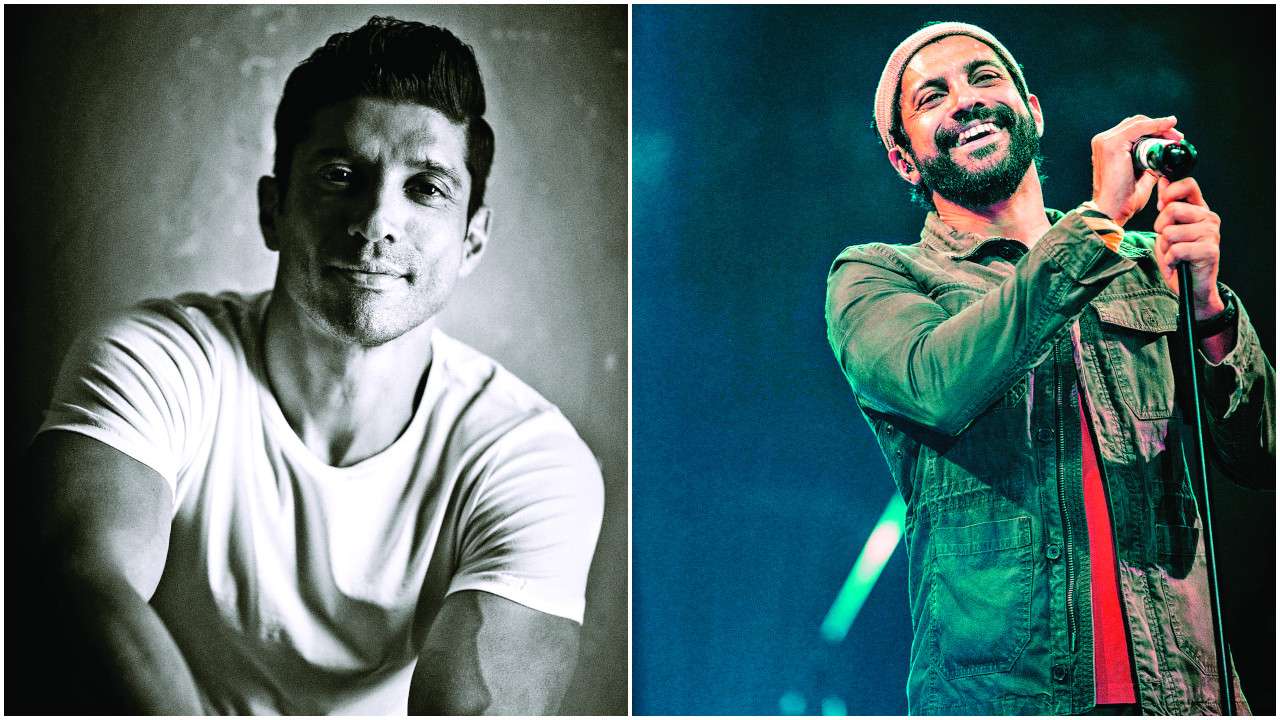
Dhaval Roy (DNA; April 13, 2019)
Music has always been an integral part of Farhan Akhtar’s repertoire, whether as a filmmaker or an actor — right from his directorial debut Dil Chahta Hai (2001) to his last outing as a singer, Rock On 2 (2016). Over the years, he has lent his voice to tracks in Rock On!! (2008), Zindagi Na Milegi Dobara (2011), Dil Dhadakne Do (2015) and more. While all those have been in Hindi, the actor-filmmaker-musician’s first solo English album Echoes released yesterday. The musician, who performs with Farhan Live Band, says that he has chosen to release the 11-track record in English because that’s the language in which he can best articulate his feelings.
A MEDIUM TO EXPRESS EMOTIONS
Four singles of the album — Rearview Mirror, Seagull, Why Couldn’t It Be Me and Pain or Pleasure — were released earlier. Farhan tells us that they are acoustic and intimate. The subjects are as varied as the Peshawar School Massacre in 2014 (Why Couldn’t It Be Me) to falling out of love and more. “I’m really excited about this album,” says the 45-year-old. He continues, “I’ve been performing as an artiste for six-odd years, and having a lot of fun doing music for films. But, I realised that it would be nice to share with my fans who I am and what my feelings are about things, instead of what a character thinks in a film. I’ve been writing poems for decades now and in the last couple of years, I started feeling a strong urge to put it all down and release it.”
Farhan tells us, “Music is a great outlet and has given me immense comfort. There’s so much love in creating something and it’s great when you are able to share it with people,” he states, adding that he cannot wait to play these tunes for a live audience.
MORE MATERIAL READY
The award-winning filmmaker tells us that he has more stuff ready to enter the studio again. The next record is likely to have collaborations. “Also, I need to focus on my film work. Currently, I’m in serious prep for the movie (Toofan) that I’m doing with Rakeysh Omprakash Mehra and need to see that through,” he explains. Farhan took a year-and-a-half off his film career to work on the album. “I didn’t shoot for anything between Lucknow Central (2017) and The Sky Is Pink, and only focussed on music. I’m trying to be as single-minded about each task as possible,” he elaborates.
NO COMPOSITIONS FOR FILMS
Since Farhan has also created these tracks, we ask him if he has given composing for his own movies a thought. “Making music for Hindi movies is a completely different ball game. Also, I have been extremely fortunate to be working with the best in the business for the past 20-odd years. And like it’s said, if something is not broken, why fix it?” he reasons, “We have a great collaborative relationship with Shankar-Ehsaan-Loy. It has worked so well over the years and I choose to keep it that way.”
The trio was also among the first people whom Farhan played the album for, when the songs were just scratches. “They loved the writing. They had tips in terms of music production and direction and I took the advice. They care a lot about me not only as a friend but also as an artiste, so the feedback was important,” he says.
FEEDBACK FROM THE FAMILY
Needless to say, lyricist-poet father Javed Akhtar and director-screenwriter sister Zoya Akhtar form the inner circle that will always hear everything he creates. “For dad, what each number said, the word, as well as the story, was important. It’s not just tracks put together without any thought that impressed him the most. It’s easy-listening stuff, so he liked that as well,” Farhan signs off.
If they wanted to respect, why haven’t they given the same to Shankar Ehsaan Loy and A R Rahman?-Javed Akhtar
3:26 PM

Producer Sandip Ssingh’s explanation for giving Akhtar credit in Modi biopic poster does not fly with lyricist
Natasha Coutinho (MUMBAI MIRROR; March 25, 2019)
Lyricist Javed Akhtar has slammed the explanation offered by the producer of a Modi biopic, Sandip Ssingh, who said that Akhtar was credited as lyricist in the poster as one of his old songs was included in the movie.
After Akhtar expressed his shock on finding his name credited as lyricist of the movie PM Narendra Modi as he had not written any songs for it, Ssingh tweeted, “We have taken the songs Ishwar Allah from the film 1947:Earth and the song Suno Gaur Se Duniya Walon from the film Dus in our film, thus we have given the due credits to respective lyricists Javed Sahab and Sameer Ji. @TSeries is our Music partner.”
This explanation did not go down well with Akhtar, who questioned the makers’ intentions for putting his name on the poster. Akhtar told Mumbai Mirror on Sunday, “Firstly I don’t know who Sandeep Ssingh is. Secondly, when you take an old song in your film you don’t give credit to the original person on your promotional material because I have not written anything for the film PM Narendra Modi. You can’t behave like I’m a part of your unit, as your songwriter. At the most you give a mention in credit titles along with the name of the original film from which the song was taken. If they wanted to give me respect, why haven’t they given the same to Shankar Ehsaan Loy and A R Rahman? (music directors of the songs Sandeep mentioned).”
Akhtar went on to say he was shocked that no one reached out to him before using his name to promote the film. “If they have bought my song from the music company they should have mentioned the original film (1947:Earth) while using my name on promotional material, along with music by A R Rahman. They would have done it if their intentions were correct, which clearly weren’t. Such an incident has never taken place in the Indian film history. Nowadays every second film has a recreated song but never has the original lyricist been mentioned on posters of the film.”
Akhtar’s wife, actor Shabana Azmi also waded into the battle on Twitter, posting, “It’s quite clear this was done with deliberate intentions to mislead public into believing that @ Javedakhtarjadu has written the songs for Mr PM Narendra Modi when the song Ishwar Allah Tere JahaN meiN is from @IamDeepaMehta film 1947Earth.”
The trailer of the Omung Kumar directed film, featuring Vivek Oberoi in the lead, released on March 20 and the film is scheduled to release on April 5, six days before the first phase of general elections on April 11.
I’m naturally inclined towards stories of valour-Prasoon Joshi
8:07 AM
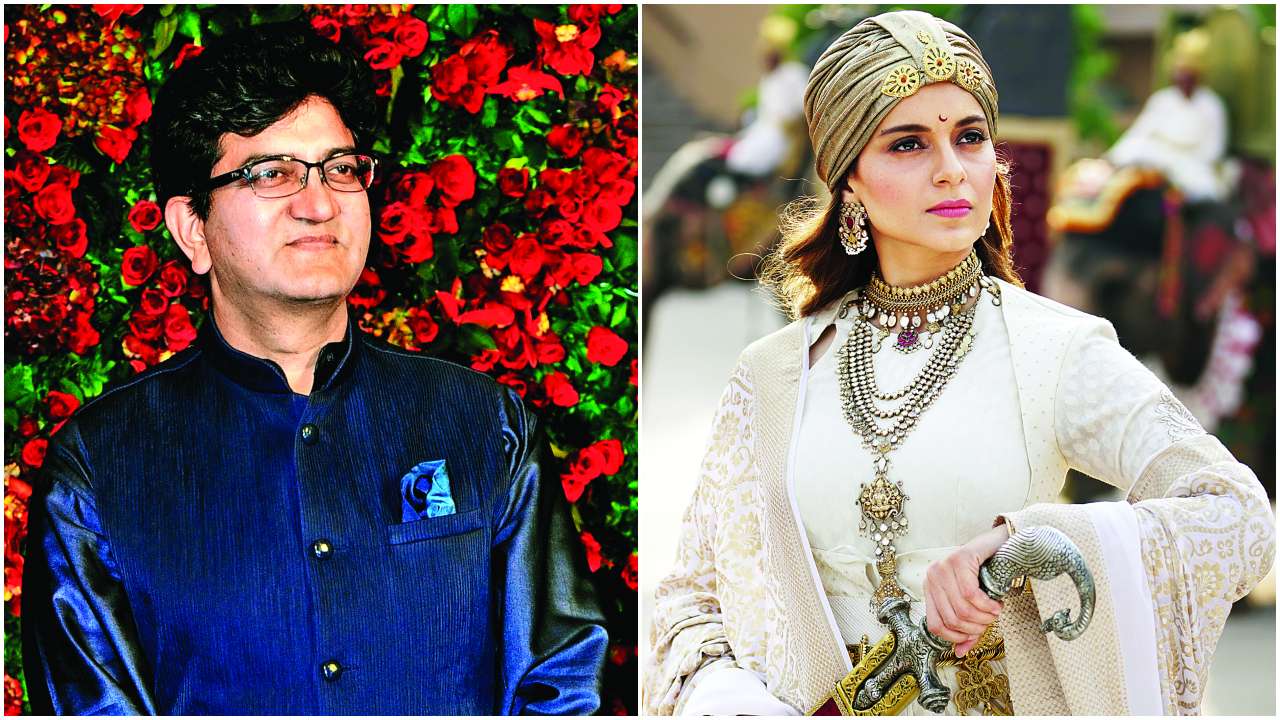
Deepali Singh (DNA; January 31, 2019)
Prasoon Joshi admits that when it comes to stories of bravery and national heroes, he has always wondered why Rani Lakshmibai’s story hasn’t found many takers in Bollywood. That’s why he was more than happy to green-light Manikarnika: The Queen Of Jhansi, when it was offered to him. In a candid chat, the wordsmith reveals more. Excerpts…
Post Neerja (2016), you didn’t choose any other assignment?
Yes, I was contemplating many subjects. Moreover, I was travelling a lot. I also became the chief of the Censor Board of Film Certification (CBFC) and was trying to streamline as well as smoothen the whole process. I signed Manikarnika two years ago.
So, what made you say yes to it?
I had been thinking of doing something new. Producer Kamal Jain explained the subject to me and asked me if I would be interested. Subsequently, I met the entire team. The one thing that struck me was why more films have not been made on Rani Lakshmibai before. She is a national hero and I felt ashamed that we haven’t done many movies on her... at least five films should have been. So, I felt I must write for this project.
What do you feel about Kangana Ranaut playing the lead role?
She was an apt choice. I have always liked her work. I feel she does every role with complete dedication. She was a natural fit here.
Does a historical require more research than a contemporary subject?
Every subject requires research and understanding. As for Rani Lakshmibai, I knew more folklore than the nitty-gritty of her story. But it’s something that has always interested me because I have this natural inclination towards bravery, valour and stories of our pre-independence era. So, writing for it was an organic process. The key message is that the independence we gained wasn’t achieved only because of slogans, but because of sacrifice. Sirf naaron se nahin, khoon ki dhaaron se bhi mili hai azaadi. Many people, especially the youth, don’t realise it. Rani Lakshmibai’s story inspires us. It asks whether you want to waste your youth or dedicate it to the country. What did she get out of it? She could have taken a pension and lived a good life. That’s what struck me and I wrote Main rahoon ya na rahoon, Bharat yeh rehna chahiye.
You have had a long association with Shankar, Ehsaan and Loy. How was it collaborating with them once again?
From Phir Milenge (2004) to Taare Zameen Par (2007), London Dreams (2009) and Bhaag Milkha Bhaag (2013), we have done a lot of films together. It’s always a joy to work with them.
Subscribe to:
Posts (Atom)