Showing posts with label Shankar Mahadevan interview. Show all posts
Showing posts with label Shankar Mahadevan interview. Show all posts
The idea for Breathless was with me for 7 years. Nobody took it up. Shankar Mahadevan immediately agreed-Javed Akhtar
10:53 AM

Debarati S Sen (BOMBAY TIMES; June 22, 2024)
Yesterday, on the occasion of World Music Day, renowned writer, lyricist and poet Javed Akhtar and celebrated Grammy-winner, singer-composer Shankar Mahadevan, came together to share some moments with us to talk about their musical memories, their strong bond and most of all, their endless fascination for music. Excerpts:
Your entire life has been immersed in music, words, sur and poetry…does the beauty of it all still continue to fascinate you?
Javed: The origin of music always fascinates me. That’s how humans must have found rhythm and sur in the universe - in nature, through birds, rivers, waterfalls, wind and so on. It’s so fascinating how human beings all over the world discovered that there are seven notes. Even when I think about how music developed in prehistoric times, it fascinates me. Music is inherent in human nature. I feel that music is the poetry of sound, and poetry is the music of language. So, of course, we should honour this day, but I feel World Music Day should be celebrated every day!
Shankar: Music unites people in a beautiful and tremendously powerful way. Music triggers wonderful feelings and is such an amazing tool of communication. It’s great to celebrate World Music Day, because the language of music is universal.
Tell us about your first memories of music – of learning, listening and being blown away by a song.
Shankar: When I was three-and-a-half years old, I saw an instrument (harmonium). At that time, I didn’t even know what it was, and I started playing a bhajan that we used to sing at home. So that was my first memory of music. The mystery of the seven notes was demystified in one shot. I guess the connection between music, notes and notation happened organically for me.
Javed: My mother, who came from a middle-class background, taught in a college. But being a great music lover, she had a gramophone and some records, a luxury which only rich people could afford back then. In Bhopal, we used to live on the first floor of a building and the owner was on the ground floor. Obviously, he was richer than us because he had a radio, and every time he would play it, we’d hear it too. When I was about five years old, I remember seeing my mother rushing to the balcony, because one of her favourite songs was playing on the radio. She would stand there, and I’d follow her and look at how she’d listen to this song (Ghabra Ke Jo Hum Sar Ko Takraye To Achcha Ho from Mahal) with so much attention. So, that is my first memory of music. Another memory is of my daughter, Zoya, who was about four months old when she used to react only to one song from Raja Jani. I always wondered why she was so fascinated by the tune of that song.
Both of you have worked together as composer-lyricist on over 250 songs. Tell us about the connect that you have & how that leads to creating great music together?
Shankar: I consider him as a blessing that has come to me from above. Javed sir is one person who stood by me like a pillar of strength, he has been a guide and a genuine well-wisher for my entire family. I feel secure that Javed sir is with me in the industry. We don’t feel it’s work when we are creating a song together. One day, Shabana (Azmi) came to the studio and said that if any producer sees the way you both work, they will never pay you. Javed sir’s biggest strength is his humour, and because of that, even serious work gets done easily.
Javed: Shankar is very special to me. Recently, I went to his house and we had a huge lunch. Mahadevans are foodies. Then we went to his music room, and by evening, we had completed a song. For us, one sitting means one song. But that’s not the case with every other composer. Our ultimate work together was Breathless. The idea was with me for 6-7 years. I’d mentioned it to different singers and music directors. Everybody liked the idea, but nobody took it up. Then I met Shankar and he immediately agreed to do it and that is how it started.
Did you always dream of being a musician?
Shankar: I’m from a simple, middle-class South Indian family. I could never think of pursuing music as a career. We were a simple family, we lived in a 1BHK (500 sq ft) house, so how could I think of making a living out of music? It was far, far beyond my reach.
Javed saab, you come from a family of writers, was writing always your calling?
My father had a singer friend who used to play the harmonium. One day, he brought it to our place, and for the first time, I saw a harmonium and pressed the keys. And then it became my fantasy to learn how to play the harmonium and learn music, but circumstances never allowed me to do it. Music and tunes have always fascinated me. I have the talent and I think that with a little training, I could be a musician. Writing, of course, was inevitable, as that was my heritage, it was in my genes. The last seven generations of my family were writers of a certain known status.
Creating a film’s soundtrack is a collaborative effort, how do you react to feedback that comes your way, given the knowledge and experience you have in this field?
Javed: The director has certain requirements. Then, there are music directors, and more often than not, the songs are written to the tune. So, he may say, ‘Sir, my tune cannot adjust this particular sound or word. There is a murki here and this word is flat and will not allow the murki.’ That happens. But I refuse to accept unnecessary, non-creative suggestions. Sometimes, if the situation becomes impossible, I walk out of it. I have no hesitation in leaving a film. But, I will not write what I am not capable of. I will not write anything that is obscene by any stretch of imagination. I will not write something grammatically wrong. If you don’t know the language, I cannot be responsible for that.
Shankar: I feel the director is closest to the film and the captain of the ship. For a movie, we are not just music composers, we are music designers. The director knows what works best for them. So, we take their inputs positively and design music that satisfies the director’s vision.
We’ve been told people skipped Bandish Bandits's talkie portions to hear the music - Shankar-Ehsaan-Loy
8:34 AM
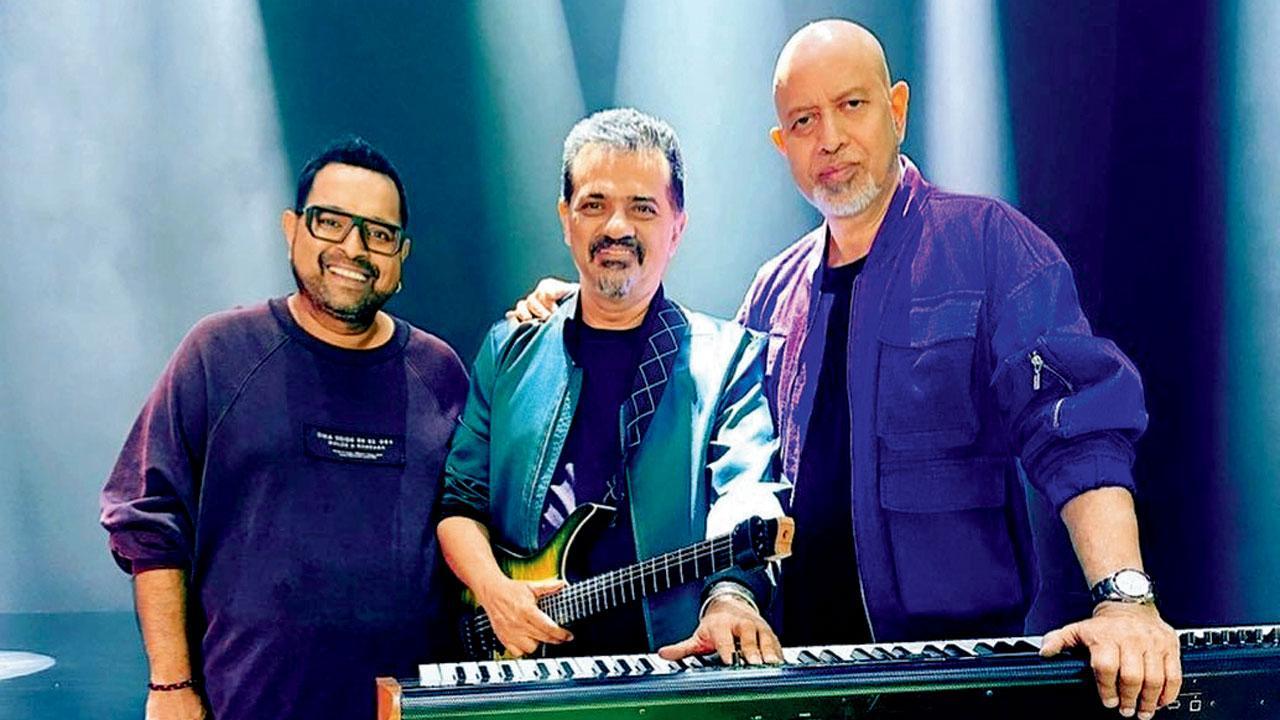
While agreeing that a song’s visual appeal keeps a web-film watcher from hitting the forward button, The Archies composers Shankar-Ehsaan-Loy say its sonic quality keeps them coming back on audio streaming platforms
Sonia Lulla (MID-DAY; December 4, 2023)
Having created six of the 17 songs that form the backbone of The Archies musical, Shankar-Ehsaan-Loy say they felt they could “smell sponge cake in the room”, when they watched the final edit. “It’s such a sweet film,” they promise, as they discuss recording with Suhana Khan, and working with Javed Akhtar.
Edited excerpts of the interview.
There’s always something special about the music you’ll make for a Zoya Akhtar-film. Why is that so?
Ehsaan: [We are given] the freedom to create. She never blocks an idea and says, ‘No, let’s try something else.’ Her attitude is respectful to the creative person.
Shankar: There are certain directors whose presence in the studio [enables] the music to flow easily. There may be parts of the music that we use or don’t use, or mould at a later stage. For example, the song Va Va Vroom came out to be as it is because he [Ehsaan] randomly played one line, and we decided to record it. Only later did we recall we had this recording. It was a founder’s ball, and we realized this would fit the scene because it has an element of rock. So, when music flows easily, it feels fresh to the listener.
Many cast members, like Dot, are also singers. Suhana has also lent her voice to a song. Did you’ll sit with them to discuss the music?
Shankar: For Suhana’s part, we wanted someone who had the required voice, age, and innocence. The singers we recorded sounded too professional. When she sang it, we said, this is it. She was nervous but practiced a lot.
Ehsaan: The song that she sang has a conversational quality. Another song has been sung by Kelly Dlima. These young singers are all unheard of. They’ve been singing in the studio, but now they’ll get this excellent break.
Shankar: There is one song that is completely picturized on skates. The kids had to learn skating for it.
Ehsaan: There’s another that has been rendered by Arijit [Singh]. People will be surprised when they hear it. It’s unlike anything you’ve heard from Arijit. He was also thrilled with it.
When creating music for the web, where it’s easier for someone to hit fast-forward when a song plays, do you believe the emphasis on the visuals of the song has increased in a bid to lure the viewer to watch it?
Shankar: I would agree that that it is valid. But, 80 per cent of the music that is consumed in the country is non-visual. It is consumed on streaming platforms, where you aren’t seeing it. So, the perception that Bollywood is the only thing [that matters in the music industry] is not true. Bollywood is a small part of the whole game. Monetarily it’s a big part. But there’s a lot happening otherwise. We did a web series called Bandish Bandits. [We’ve been told that] people skipped the talkie portions to hear the music.
Loy: Our job is to write a great song. What is done with the visuals is on the director. But, we have to create a song that sounds amazing even without the visuals.
Shankar: You know, Senorita [Zindagi Na Milegi Dobara] was not supposed to be a song. It was a situation in which they were meant to jam with some Spanish musicians, and leave. When we created that [motif] we realized it was an amazing song. So, visuals were created for it, thereafter. That was also the case with Havan Kund in Bhaag Milkha Bhaag. It was supposed to be a scene in the hostel. But Prasoon [Joshi] ji wrote a big paragraph, and that led to the making of a full song.
Since the songs are conversational, did you’ll spend more time with Javed Akhtar?
Shankar: We always do. I remember, when we were sitting with Javed saab for this film, he would tell us, ‘I have to [not consider] 80 per cent of the words in my vocabulary, because these kids are Anglo-Indians.’ Sometimes, Farhan [Akhtar] and I would playfully argue about some lyrics, and he’d say, ‘With your vocabulary, all I can do is send a telegram’. The kids in the film have limited vocabulary. So, he couldn’t write intricate poetry. He had to write simple words that still conveyed the message—whether that message was about politics or [love]. It had to be musical and the rhymes needed to fit the tune. Only he could have done this.
KK wasn’t bothered about social media; he didn’t even have a WhatsApp number-Shankar Mahadevan
7:46 AM

Rishabh Suri (HINDUSTAN TIMES; June 3, 2022)
The bond between singer-composer Shankar Mahadevan and late singer KK was one filled with love and mutual admiration, and it goes back to the time when they hadn’t even entered showbiz. That’s why Mahadevan says it’s unbelievable that he’s talking about KK in the past tense. “We had a long association even before we got into films; we were buddies, like a gang. We used to sing jingles together and that transitioned into films,” he says.
Mahadevan goes on to share that KK was a complete family man and used to talk about them all the time: “He used to take off on long holidays with them, cutting off from the world. Also, KK wasn’t bothered about social media; he didn’t even have a WhatsApp number. If you wanted to reach out to him, you had to call him.”
They have given audiences classic party-starters like Koi Kahe Kehta Rahe (Dil Chahta Hai, 2001) and It’s The Time To Disco (Kal Ho Naa Ho, 2003), which still reign in popular playlists about 20 years later, among numerous other hits. “More than that (creating hits), KK would bring a lot of energy into the studio whenever he entered. Months back, we met on a TV show. We were all teasing him, ‘You are like Benjamin Button, you are ageing in reverse!’ He was looking fabulous,” the 55-year-old says.
What’s surprising to many is that KK, despite being an accomplished artiste, didn’t receive many awards in his lifetime. Mahadevan says that the late singer “wasn’t worried about how many likes his songs got”. He adds, “KK just enjoyed what he was doing. He was only choosy about his concerts.”

Pandit Shiv Kumar Sharma's music didn’t make masses feel disconnected-Shankar Mahadevan
8:18 AM

Noted composer hails Sharma for bridging the gap between classical and film music
As told to Sonia Lulla (MID-DAY; May 11, 2022)
When you are handling a mainstream subject like a Bollywood movie, there is always a discussion around classy music and massy music. Creating a piece that satisfies both, the maestro and the masses, is not easy because the latter may not understand Indian classical music. But Pandit Shiv Kumar Sharma had the ability to do that. If you see his work in Silsila [1981] and Chandni [1989], you can see that the classical music that he used had depth, but wasn’t so difficult that the masses felt disconnected.
In a mainstream song like Dekha Ek Khwab from Silsila, there is a beautiful santoor section. He raised the bar of Indian music, and was an example for a musician like me who wanted to imbibe [those qualities] and use Indian classical music in mainstream compositions. Not many people know that he also played the tabla in so many legendary songs that were sung by Lata ji [Mangeshkar].
His contribution to film music is only a fraction of all that he has achieved. The santoor was not traditionally known as an Indian classical instrument. The Kashmiri folk instrument was [alien] to the Indian classical music world, and he popularised it all over the world. Indian classical music became popular via the santoor, because of him. He made people take the fact that the instrument was associated with Indian classical music, for granted. With the word santoor, no other name except Pandit Shiv Kumar Sharma can be associated. He will be remembered forever.
I had created [songs] in Hindi, Marathi, and Malayalam, but not in Tamil-Shankar Mahadevan
7:52 AM

After participating in gigs to raise funds for various initiatives and keep front- line workers entertained, Shankar Mahadevan discusses Kamal Haasan’s latest Tamil song
Sonia Lulla (MID-DAY; April 27, 2020)
Caught within the confines of his home-studio, Shankar Mahadevan finds himself busier than usual, during the period of Coronavirus lockdown. Apart from employing music to enable home-bound citizens to tackle with anxiety, he has been using his skills as a musician to subtly aid those braving the pandemic at the front- line. “We have done concerts for singers’ associations, and [ to raise money for] the PM-CARES fund. We’re [working on initiatives] in the Malayalam and Tamil industries as well, apart from performing for doctors to boost morale,” says Mahadevan, who also took part in an initiative to support folk singers affected by the pandemic, and aided struggling composers with monetary support.
In his latest endeavour, Mahadevan collaborated with Kamal Haasan for Arivum Anbum, a Tamil song that brings together various artistes from across India to spread the message of knowledge and unity. “I had created [songs] in Hindi, Marathi, and Malayalam, but not in Tamil. We’re using music as a tool to communicate a message. When music is used for a greater purpose, and you are chosen [to be part of it] from thousands of other singers, you feel humbled.”
Actor- politician Haasan’s frequent collaborator Ghibran has skillfully created the track that plays against rushes depicting people’s struggle with the pandemic. It is punctuated by clips of artistes like Anirudh Ravichander, Yuvan Shankar Raja, Shruti Haasan, Bombay Jayashree, Lydian, Siddharth, Sid Sriram and Mugen, crooning the song.
“In situations like this one, while the quality [of the video] is valuable, it is the message that is [the most] important,” says Mahadevan, whose portions were shot by his children in his home-studio.
When he isn’t playing second fiddle in the fight against the pandemic, Mahadevan hops aboard a video conferencing platform every Wednesday and Saturday, to conduct a masterclass for the students of his academy. “I also spend time in the studio with my sons [Siddharth and Shivam]. My elder son is a producer, so I don’t need anyone else. We’re like a band in the studio. We have been using this time to practice.”
There's not even one proper music school in India-Shankar Mahadevan
8:15 AM

Lamenting that the world doesn't look at India as an educational hub despite its rich classical heritage, musician Shankar Mahadevan on how his online academy hopes to be at par with music schools across the globe
Sonia Lulla (MID-DAY; October 29, 2018)
Nama Sankirtana is a term used in Indian classical music to describe the congregational chanting of a prayer. A singer renders a line, then urges listeners to repeat it after him. It's therapeutic, collaborative and interactive, says Shankar Mahadevan. Where did the composer employ the technique, you ask? He did so to create Amitabh, Abhishek and Aishwarya Rai Bachchan's revered item song, Kajra Re (Bunty Aur Bubli), where the track's hook line sees the male vocals come chiming in after those of the female.
It's not conventional, he admits, to employ devotional music techniques for an item song. Yet, he asserts, "you can be inspired by anything". In a bid to highlight the role that his solid background in classical music played in defining his success as a commercial music composer, Mahadevan draws many a similar example. In conversation with frequent collaborator, lyricist and CBFC chief Prasoon Joshi, at Music Concept's recently concluded India Music Summit, the musician highlights how writing and composing run hand in hand. Jogging our memory as he sings the lyrics that Joshi had penned for the title track of Taare Zameen Par, he talks passionately about how the melody of the introductory lines needed to be at stark contrast with the concluding one — Kho na jaaye ye, taare zameen pe. The latter, he says, needed to sound like a warning; distanced and distinct from the remaining stanza.
It's interesting, we admit, to get a sneak peek into the mind of the maestro who rarely stops appeasing with his compositions. It's only natural then that his face drop when we point to a recent study suggesting that 2018 has been dominated by remixes. "Music companies don't want to [promote] original compositions with the same conviction that we have when creating them," Mahadevan tells mid-day, adding that the industry could benefit if music honchos showcased more faith in composers. "Music companies are governed by those who don't know anything about music. Also, with the copyright laws changing, they want more power in governing music. They're not ready to give enough royalty to composers. When they rehash a song, they don't need to do that anyway. Then, they shove the remixes down people's throats. If you don't hear anything else, how will it do well," he questions, pointing out that arguments that remixes appeal to a "young audience" have little merit. The young, he says, are listening to platforms like Coke Studio, which give wings to original composers.
Mic in his hand, Mahadevan seems to be placed in a playground. He flirts with familiar tunes to render them with more appeal than in cinema. They say, if you get goose-bumps when listening to music, you're brain is special. With Mahadevan putting his vocals to work, we guess, every audience member is a genius then. It's evident that the banter he shares with his audience in live acts is important. "As composers, if we don't get feedback, the purpose [of creating music] is lost. Live shows give us instant feedback. When the crowd erupts, we've been gratified. I believe, if you perform week-after-week, you should ensure that the show goes on. No matter what the circumstances are, whether or not your technical requirements have been met with, or even if someone is sick, the show must go on. In a live act, you need to communicate with your energy. I stopped complaining [about technicalities] a while ago. Now, the motto is to simply go out, kill and come back."
Mahadevan has a wealth of information that he hopes to share. However, India, he argues, is lacking of schools that can truly impart knowledge about Indian music. "There's not even one," he says, going on to add that the Shankar Mahadevan Academy will be the first holistic offering that can be compared to universities from across the globe. The online education platform caters to students who cut across ages – "two to 82," he says. "Aspiring musicians must be exposed to the right kind of music. In our music event called Sangam, we have students and teachers perform together, so that they can be exposed to the culture. The platform also allows students to meet one another, and gauge themselves [as artistes]."
Bollywood artists need to work more as international market is highly competitive-Shankar Mahadevan and Badshah
7:53 AM

On World Music Day, BT spoke to Shankar Mahadevan and Badshah, who are two musicians on extreme ends of the musical spectrum; they talk about diversity of music and melody around the world
Reza Noorani and Debarati Sen (BOMBAY TIMES; June 21, 2018)
One is known for his raps, while the other for his soulful aalaps. If Shankar Mahadevan’s singing is steeped in classical tradition, Badshah is that crazy beat that makes you put on your dancing shoes. They may be as different as chalk and cheese, yet on World Music Day, both celebrate the diversity in music, even if they don’t sing that genre and talk about Bollywood music’s influence on the soundscape around the world.
MELODY IS KEY
“Without melody in a song, it is like dressing up a dead man,” says Shankar Mahadevan, and Badshah could not agree more. Be it making a foot-tapping, party anthem or a romantic song in a movie, melodies reign supreme. “I may be known as a rapper, but I have grown up listening to soulful melodies by composers like Nadeem-Shravan, Anand-Milind and the likes,” says Badshah.
Classical melodies, too, have enhanced the soundscape of Bollywood films and keep doing so. “Even an item song like Kajra Re (Bunty Aur Babli) with a classical touch will stay forever. You need to choose subtleties of classical to bring longevity and depth in your compositions. Every beautiful song since the last 20-30 years has an essence of classical music in it,” says Shankar.”
BOLLYWOOD MEETS THE WORLD
It’s always a joy to discover that the song you grew up listening to was later made part of a Hollywood movie’s soundtrack or some latest international phone commercial. It feels like your musical taste is validated. But is that enough? Shankar says Bollywood artistes need to pull up their socks, “I don’t think Bollywood has contributed enough. For the west, Bollywood is still just exotic. People aren’t really aware of Hindi film music. They’ve just heard vague terms like bhangra beat etc. They have taken it in the phone commercial, in the trailer (of Guardians of Galaxy Vol 2) as an exotic tadka, not as the main genre. They’ve used it as an interesting sound and the quirk element is what excites them. We need to break that and go deeper and establish the sound of our film industry into the mainstream sound.” Badshah, too, agrees that as musicians, Bollywood artists need to work more because the international market is highly competitive. He says, “We are competing with huge genres in the international market like Latin music. So,we need to work on the quality and the presentation of our sound. We actually have to work really hard and reinvent ourselves. Every six months the soundscape is changing and we have to keep up.”
MUSIC AS EXPRESSION
A large part of the popular music from the 90s was about melody. But it did fall short on diversity. Genres like rap, if ever used, were used as a funny element in a song (a la Devang Patel). But today, a rap track is the biggest part of some film’s soundtrack. Talking about it, Shankar says, “We have young artists whose interpretation of rap is absolutely prefect. They rap about certain experiences, messages they want to give, about issues or an angst which they want to let out. Many a times it is about anger and venting out too. Rap has become a way of expression, rather than using it as a garnish to make compositions interesting. It has gathered depth and makes sense.”
REMIX IN THE MIX
Be it as a way of paying tribute to the good ol’ classical song or as a gimmick, remixes have ruled the roost since the last two years in Bollywood. Badshah says, “Sur toh saat hi hai. Every song you listen to sounds like another...”
While Shankar agrees that some songs can stand the test of time and thereby merit a remix, it should not be the standard followed by filmmakers. “People remix songs because those songs are inherently great songs. But then why use old songs to sell a soundtrack, for a new film with new actors and new script? Don’t you trust your music composers? Do you feel that they are not capable enough to do original music? I think you should give them a chance to do original music and then you put one remix, but not in every film in every soundtrack.”

During the making of Dus, everyone was surprised to see three composers-Shankar Mahadevan
8:16 AM

Soumya Vajpayee Tiwari (MID-DAY; January 1, 2017)
Ehsaan (Noorani), Loy (Mendonsa) and I (Shankar Mahadevan) were friends since we worked together in the advertising field. But we never imagined that the three of us would be doing music for films together. We were doing a Pepsi commercial for Mukul Anand and he offered Ehsaan to do music for his next film, Dus. Ehsaan refused immediately. But when Mukul pushed him, he said he’d do it if Loy and I also do the film. We met Mukul and had the narration.
When we reached the studio to record the first song, the makers and people from the industry were all there. They asked Mukul who the composer of the film was and he pointed at us. Everyone was surprised to see three composers. They were shocked that there were no musicians, arrangers and music coordinators, etc. Mukul said these three would do everything. So they told Mukul, “Boss, tumne kisko sign kiya hai!” They’d completely given up. In the evening, we recorded the first song, Chandni, and they were floored. They offered us the entire soundtrack! A few days later, Mukul called me from New York, before we were about to record the most important song of the film, Suno Gaur Se Duniya Waalon. He blessed us, saying, “It’s a patriotic number, but I want it to play for every cricket and football match, and even at clubs.” We did the song and the team loved it.
But Mukul passed away during the making of the movie and Dus got stalled. We were happy doing jingles, but we were upset that our career in the film industry saw such a low right at the beginning. It was then that Nitin Manmohan (the producer of Dus), shot a video for Suno Gaur Se to pay tribute to Mukul. The song took off. It played everywhere, from cricket matches to clubs. Mukul was and has been a guiding force. Later, Vidhu Vinod Chopra gave us Mission Kashmir and Farhan (Akhtar) gave us Dil Chahta Hai.
There's no way we'll compromise on quality - Shankar-Ehsaan-Loy
7:52 AM

Shankar-Ehsaan-Loy on Rock On!! 2 and the current situation with indie music in India
Soumya Vajpayee Tiwari (MID-DAY; October 18, 2016)
They are celebrated music composers in Bollywood, but Shankar-Ehsaan-Loy (SEL) have an identity beyond Hindi film music. They are solo musicians, who also support the country’s non-film music scene. Shankar Mahadevan runs an online music academy while Ehsaan Noorani performs with ensemble bands like Fender & Friends and String Society. Loy Mendonsa is a familiar face in live jazz sets and has reformed his electronica group Instant Karma with Ehsaan. In a bid to promote indie music, the trio has come on board as content co-curators for an initiative by Hungama and Tata Sky. Titled Music +, the service will feature music videos across genres. “The fact that they focus a lot on indie music was exciting. In a way, we have a responsibility to bring good music to the listeners,” says Ehsaan. Excerpts from an interview with the guys behind the soundtrack of Rock On!! 2.
All three of you started out as indie artistes. What’s your take on the current indie scene?
Shankar: The Internet has given a major boost to it. People don’t need a record company to put their music out there. Of course, there’s a dearth of indie labels in India. Some years ago, record companies here released works by artistes like Alisha Chinai and Lucky Ali, but that, unfortunately, has fizzled out.
The number of film soundtracks from SEL has reduced over the years. Is this a conscious decision?
Ehsaan: There is just so much we can do. We tour, record for films and commercials, for corporate gigs. We also have individual commitments that make our musical existence more wholesome. We are doing the same amount of work. It’s just that new music releases every week, so the impression is that we are not working much. We’ve always stood for quality songwriting, and there’s no way we will compromise.
SEL is nearly two decades old. Have you thought of dissolving the group and going independent?
Loy: We are doing independent things too, while keeping the integrity of SEL intact. It has given us so much; why would we want to let go?
Since Rock On!! (2008) was a landmark album, was the soundtrack of its sequel more challenging?
Shankar: It’s a completely different soundtrack, and the challenging part was letting go of the basic three- chord garage band’ sound we achieved with Rock On!! It’s coming eight years later. All the members of the band (in the movie) have grown intellectually and musically. The songs are a lot more varied now.
It was somewhat scary. But I am rocking now-Shankar Mahadevan
7:41 AM

Shankar Mahadevan on returning to work post a heart attack
Subhash K Jha (DNA; December 17, 2015)
Shankar Mahadevan suffered a heart attack last week. Now, on his way to recovery, Shankar says he is feeling better than ever. “It was somewhat scary. But I am rocking now. It’s all thanks to the love and good wishes that I received while I was unwell,” says the maverick composer currently working on the large music score of director Shujaat Saudagar’s Rock On 2. The work has been postponed because of Shankar’s ill-health.
“But I’ll be back soon. I am now back at home from the hospital, chilling and creating music in my head. Soon, those tunes will find their way out,” says Shankar whose partnership with Ehsaan and Loy has yielded some of the most ear-friendly motion picture soundtracks in recent times. Says Shankar, “I am recovering quickly and will soon be back in action. I have never felt better.”
Shankar feels no need to cut down on work as SEL doesn’t believe in quantifying their output. “We’ve never believed in churning out music like products in a factory. We do only two films at the most per year. After 17 years of togetherness, we still look forward to the Monday morning jamming sessions at the studio.”
I'd always say, 'No way, boss, acting door ki baat hain'-Shankar Mahadevan
5:04 AM

Lauded for this acting debut, Shankar Mahadevan's best friend is still his iPhone's voice recorder.
Kunal Guha (MUMBAI MIRROR; November 29, 2015)
Shankar Mahadevan is a busier man now, and his chock-a-block diary has only little to do with his music projects. His acting debut in the Marathi film Katyar Kaljat Ghusali, which released alongside Salman Khan's big Diwali release Prem Ratan Dhan Payo, continues to run to packed houses in its third week at the theatres. The film was screened, and applauded, at the recently-concluded International Film Festival of India in Goa and Mahadevan has already bagged his next acting assignment — a role in a Nagesh Kukunoor musical, which also stars Sunidhi Chauhan, Papon, Salim Merchant and Sivamani.
So when we finally catch up with Mahadevan, the four-time National Award winning music composer and singer's multiple projects appears to have left him a little breathless.
In the film Katyar Kaljat Ghusali, Mahadevan plays Pandit Bhanu Shankar Shastri, an 18th century classical singer revered by the Maharaja of a certain Vishrampur. The movie also stars Sachin Pilgaonkar and Subhodh Bhave, who makes his directorial debut with the film.
Although the movie was released in a few, select screens, strong word of mouth boosted ticket sales. But Mahadevan says that such response goes beyond box office numbers. "Very often, mediocre films make hundreds of crores but for this one, the response has been truly gratifying. People are coming up to me and thanking me for bringing the tradition of classical music back to cinema and are watching it multiple times," he smiles. The response that the film garnered at the International Film Festival of India in Goa left him overwhelmed. "The bookings opened at 9 am and in exactly ten minutes, tickets were sold out and we had to organise a few more shows to accommodate those who wanted to watch it," says the thrilled musician, adding that such resounding appreciation has left him "humbled".
Mahadevan explains that acting was never part of an "engineered plan". "I'd always say, 'No way, boss, acting door ki baat hain'," he says. In fact, Mahadevan was in the middle of working on the soundtrack of the film when Bhave surprised him with a suggestion that he play the character of Pandit Bhanu Shankar Shastri. "Initially, I thought he was mad. Later, I discussed it with my wife and she reassured me that this was a good opportunity," says the famed, multi-lingual singer. That he could relate to the character of Shastri and his personality helped Mahadevan make up his mind about the role. So would he have agreed to playing a role if he didn't relate to it? "No way in hell," he says, flatly.
Bhave's decision to cast Mahadeven in the movie was influenced by the fact that the film (based on an iconic Marathi play of the same name) was a sangeet natak, first staged in 1967. "Sangeet nataks, which were hugely enjoyed by theatre-goers at the time, required actors to sing their own songs instead of miming them, much like Broadway," explains Mahadevan.
While composing the songs for the movie was a breeze (Mahadevan says he composed eight of the 20 songs in his car), getting into the skin of his character took earnest effort. It helped that Bhave, an established actor himself, guided him through the process and held acting workshops. "He would sit next to me and tell me how my character was supposed to feel at a certain point. So in the scene where Shastri is happy for his disciple's success, he asked me to imagine how I would feel when my son wins an award. It's a mind game and about putting yourself in the situation your character is in," he says, adding a disclaimer with a laugh. "Not that I've acted in 100 films to talk about the craft."
Mahadevan, who isn't a stranger to the screen, says that featuring in music videos, film numbers and reality shows over the course of his career taught him to face the camera. But essaying the role of an 18th century classical guru required more preparation. "In one scene, my character waves at someone and I went ahead and did it the way I normally do. But my director felt that it looked more like a 'Hey, what's up bro' kind of a wave and not the way my character — a dignified 50-year-old singer in a period film — would probably wave," he laughs.
The role also demanded that he pick up the nuances of Marathi. Married to a Maharashtrian, Mahadevan has always followed the cultural practices and festivals of the community. "We rarely speak Marathi at home but I speak it fluently. Since this is a period film, I had to be extra careful about my pronunciation while dubbing. I didn't want to sound like a South Indian speaking in Marathi."
However, Mahadevan insists that his acting assignments notwithstanding, he will not take a break from music, calling himself fortunate to have a profession that is also a passion. "My iPhone recorder is still my dearest friend," he says, adding that he has simple interests. "I keep myself entertained by cooking and I mean serious cooking, not just flipping omelettes. I cook Thai, Italian, Chinese and even Kerala specialties," he says.
The 49-year-old, who was raised in Chembur and has lived in Vashi since marriage, is also closely involved with government authorities to ideate for a 'futuristic Navi Mumbai'. "I met the commissioner of NMMC (Navi Mumbai Municipal Corporation) and shared my ideas for a smart city." Some of his ideas include wearables with distress alarms, dustbins with indicators to notify authorities when they need to be emptied and even cycles at public booths. "I feel that sense of 'my city' in Navi Mumbai. It's clean and has lots of parks. Technology can really help make the city smarter, safer and make basic essentials more easily accessible," he concludes.
Javed Akhtar can capture a deep thought in the simplest of words-Shankar Mahadevan
2:09 PM

Priya Gupta (BOMBAY TIMES; February 28, 2015)
While 2014 was the year
which saw new playback voices become stars, and young and multiple music
composers replacing the old norm of one composer per film, it was
heartening to see 18-year-old composers Shankar Ehsaan Loy win the award
for the best composers for 2 States at the 7th Royal Stag Mirchi Music
Awards. Excerpts from a conversation with the most simple, but extremely
talented Shankar Mahadevan:
SEL won the award for the best album for 2 States as well as best composers of 2014.
In today's day and age, in most albums, only one or two songs become hits whereas the other songs go unnoticed. In 2 States, each and every song became a hit and that means a lot to me. While Galliyan was the most popular song last year, we knew that 2 States was the No. 1 selling album. And the Mirchi jury understands this. They awarded Best Song, Best Composer and Best Album separately to make this distinction, as you cannot award an album basis just one song.
This is the first time that you won an award with your son Siddharth Mahadevan.
I want to thank Mirchi for this as it is the first time that we both got an award together and that too, for the same album as we sung a song together in 2 States. What made it even more special was getting the award from a maestro like Zakir Hussain.
Javed Akhtar sahab has been awarded the lifetime achievement award. You have a long-term association with him.
He has been like a pillar of strength for us in the industry. Like us, he is not intimidated by the industry and does not shy away from calling a spade a spade. Over the last 18 years of us being composers, he has been a friend, philosopher and guide. He has never shied away from speaking the truth and has never been insecure. At a time when other writers came in and started charging Rs 50000 for writing dialogues for films, Salim-Javed would charge Rs 21 lakh. He doesn't get swayed by what other people are doing as he is aware of his talent. He is a class apart from others. His biggest quality as a writer is that he can capture a deep thought in the simplest of words.
Javed sahab is always in control of his emotions. Have you ever seen him emotional?
The first time I saw Javed sahab crying was on his 70th birthday, which the entire fraternity of singers, composers and people from the industry recently celebrated at his farmhouse in Lonavala. I gifted him a piano for his farmhouse. He inaugurated the piano and all of us sang Kal Ho Naa Ho in chorus for him. He was in tears and so were some of us (Shabana Azmi, Sonu Nigam, Ram Sampath, me and many of us). I had never seen him cry before. That day looking at Javed sahab crying, I knew that he felt satisfied in life.
SEL won the award for the best album for 2 States as well as best composers of 2014.
In today's day and age, in most albums, only one or two songs become hits whereas the other songs go unnoticed. In 2 States, each and every song became a hit and that means a lot to me. While Galliyan was the most popular song last year, we knew that 2 States was the No. 1 selling album. And the Mirchi jury understands this. They awarded Best Song, Best Composer and Best Album separately to make this distinction, as you cannot award an album basis just one song.
This is the first time that you won an award with your son Siddharth Mahadevan.
I want to thank Mirchi for this as it is the first time that we both got an award together and that too, for the same album as we sung a song together in 2 States. What made it even more special was getting the award from a maestro like Zakir Hussain.
Javed Akhtar sahab has been awarded the lifetime achievement award. You have a long-term association with him.
He has been like a pillar of strength for us in the industry. Like us, he is not intimidated by the industry and does not shy away from calling a spade a spade. Over the last 18 years of us being composers, he has been a friend, philosopher and guide. He has never shied away from speaking the truth and has never been insecure. At a time when other writers came in and started charging Rs 50000 for writing dialogues for films, Salim-Javed would charge Rs 21 lakh. He doesn't get swayed by what other people are doing as he is aware of his talent. He is a class apart from others. His biggest quality as a writer is that he can capture a deep thought in the simplest of words.
Javed sahab is always in control of his emotions. Have you ever seen him emotional?
The first time I saw Javed sahab crying was on his 70th birthday, which the entire fraternity of singers, composers and people from the industry recently celebrated at his farmhouse in Lonavala. I gifted him a piano for his farmhouse. He inaugurated the piano and all of us sang Kal Ho Naa Ho in chorus for him. He was in tears and so were some of us (Shabana Azmi, Sonu Nigam, Ram Sampath, me and many of us). I had never seen him cry before. That day looking at Javed sahab crying, I knew that he felt satisfied in life.

Subscribe to:
Posts (Atom)