Showing posts with label Shammi Kapoor. Show all posts
Showing posts with label Shammi Kapoor. Show all posts
For a movie star, OTT requires a shift in gear-Karisma Kapoor
10:55 AM

Hasti Doshi (BOMBAY TIMES; August 31, 2026)
From a teenage actor finding her way on film sets to an established performer, Karisma Kapoor says her career has been one of constant evolution. In a conversation with Bombay Times, she reflects on growing up in the industry, adapting to new mediums and the role of dance in her life.
‘Being an actor means evolving every day’
After being in the industry for over three decades, Karisma believes an actor’s learning never really stops. “Being an actor means evolving every day. I have not only grown with every film, but every single day. I like to learn and grasp things from various people and various sets. It’s that constant growth that makes you evolve.”
Having started working at a young age, Karisma says much of her growing up happened on sets. “I started very young, in fact, Prem Qaidi released four days before my 17th birthday. So, I’ve literally grown up in the industry. I’ve learned from my experiences, from all the ups and downs. And literally climbed the ladder one step at a time. When you look back and feel that you could have done things differently, it means you’ve grown as an actor.”
‘When you’re doing an episodic show, you need to be on the ball’
Karisma, who in recent times has been part of OTT shows like Mentalhood and Brown, feels each medium comes with its own demands. While she is grateful for the opportunities, she admits that the transition to OTT was challenging initially.
“OTT is very different from filmmaking. If you ask me, it’s pretty tough. Because when you’re doing an episodic show, you need to be on the ball. In one day, you may be shooting scenes from episode one or seven. So, the pace and the way it’s shot is different. For a movie star, OTT requires a shift in gear. Even television is a different ballgame.”
For Karisma, instinct has always mattered more than a carefully mapped-out career. “I’ve always been the kind of person who, if I want to do something, I do it, and if I don’t, I don’t. I’ve never really planned anything in my career. I think I’ve been lucky enough to have had some memorable films and played some amazing characters throughout my career,” says the Raja Hindustani actress.
‘Dance has been an integral part of our lives’
Currently, Karisma is seen judging India's Best Dancer on television. But long before dance became part of her professional identity, the actress says it was something she enjoyed at home. Her memories include dancing with her younger sister, Kareena Kapoor Khan, to songs from the films they watched as kids. “As a child, I was a huge fan of Sridevi. I remember Kareena and I used to dance for our parents to the song Tathaiya Tathaiya, Naino Mein Sapna. Dance has always been important to me.”
Karisma also learnt Kathak as a child and remembers Kareena watching her during her dance classes. “Whenever I practiced with my ghungroos, she loved watching me and listening to the beats. Dance has always been an integral part of our lives, with so many great dancers in the family, including Shammi uncle, Chintu uncle and Shashi uncle, who had their own distinctive styles.”
Raj Kapoor’s ancestral Haveli in Peshawar partially collapses after heavy rains, earthquake
8:31 AM

The century-old Kapoor Haveli, once owned by (right) Raj Kapoor, was home to his father Prithviraj Kapoor, the first in the family to enter films. Photos: x
HINDUSTAN TIMES (April 6, 2026)
The historic Kapoor Haveli in Peshawar, Pakistan, once owned by the late actor Raj Kapoor, has sustained significant damage following heavy rains and an earthquake on Friday night.
Continuous rainfall had already weakened the structure, and late-night tremors on Friday further destabilized the building. Shakeel Waheedullah, secretary of the Heritage Council in KPK province, confirmed the damage, saying, “A section of the haveli’s wall caved in after the quake.”
The century-old Kapoor Haveli was once home to late actor Prithviraj Kapoor, the first member of the Kapoor family to enter the film industry. Built by his father, Dewan Basheswarnath Kapoor, between 1918 and 1922, it remains a significant cultural site and was declared a national heritage site by the Pakistan government in 2016.
Over the years, the estate has been visited by several members of the Kapoor family. Prithviraj’s sons, late actors Shashi Kapoor and Shammi Kapoor spent time there before Partition, while Raj’s sons, late actor Rishi Kapoor and actor Randhir Kapoor, visited in the 1990s and urged the Pakistan government to undertake its restoration.
Sulakshana Pandit was too sensitive and honest for the business-Shweta Pandit
8:44 AM

Shweta Pandit remembers her aunt, singer-actor Sulakshana Pandit, as ‘a woman ahead of her time who never got her due’
Vishakha Pandit (HINDUSTAN TIMES; November 10, 2025)
Veteran playback singer and actor Sulakshana Pandit died on Thursday at 71 following a heart attack, closing a luminous chapter in one of India’s most musically gifted families.
Sulakshana’s velvety voice defined the tender, romantic tone of 1970s Hindi cinema. She also charmed audiences on screen, becoming, as her niece actor-singer Shweta Pandit notes, “the only other female artiste after Nargis (Dutt) ji and Suraiya ji to be both a professional playback singer and a leading actor”.
Remembering her aunt, Shweta says Sulakshana “never received the recognition she truly deserved”. “She was immensely talented but she was too sensitive and honest for the business,” she adds.
Born in Madhya Pradesh, Sulakshana grew up in a home where music wasn’t just a passion, it was the family language. Her father, Pratap Narain Pandit, served as the state’s chief musician and was a respected Hindustani classical vocalist. Her brothers Jatin and Lalit would later form the celebrated composer duo Jatin–Lalit, while Mandheer Pandit (Shweta’s father) mastered the tabla, and her sister Vijayta Pandit followed her into singing and films.
“After our family moved to Mumbai in the late 1950s, her voice quickly found its stage. She recorded her first song at nine and performed with legends like Kishore Kumar,” Shweta recalls.
By the mid-1980s, Sulakshana quietly withdrew from the spotlight. “She got tired of how things worked,” Shweta says. “At that time, artistes didn’t have the management support they do now. She needed that guidance but never had it.”
In later years, Sulakshana battled health issues after a fall left her bedridden: “She was actually struggling with depression, something rarely spoken about then.”
To her niece, she will always remain the first superstar of their family’s cinematic journey. “She carried the Pandit family’s name into films and was my guru,” Shweta says, adding, “Once, Shammi Kapoor ji heard my name and smiled, saying, ‘The Kapoor family is the first family of cinema, and the Pandit family is the first family of music’. That was the biggest compliment.”
My daughter Natasha Madhvani and Fardeen Khan should not divorce-Mumtaz
8:09 AM

Vinay MR Mishra (BOMBAY TIMES; July 2, 2025)
Veteran actress Mumtaz speaks frankly, and it's led her into some tangled scenarios. In her recent interviews, she openly discussed her complex relationships—with Shammi Kapoor, Yash Chopra's unrequited love for her, and the dating rumors swirling around Rajesh Khanna.
“Everybody keeps asking me the same old things. And my sister got a few calls. People complained to my sister. They say, ‘Mumtaz shouldn’t answer those questions’. But how many times should I say no comments? People want to ask me everything. My sister told me, ‘You are hurting industry people’. I don’t want to hurt anyone; they are my family. People who I have spoken about, now their kids have grown up and they don’t like when I speak the truth. And I cannot lie,” she tells us.
Ask her if she regrets talking about her contemporaries, and she replies, “I don’t regret it. But it does get monotonous. Everybody just wants to ask me about Rajesh Khanna and Shammi Kapoor. It is so monotonous. His (Shammi’s) wife feels bad, ‘Why is she talking about my husband’. So, I don’t want to hurt anyone.”
'I have not gotten any tempting offers'
Though she's often in the spotlight, the actress, who is known for films such as Khilona (1970), Apna Desh (1972), Jheel Ke Us Paar (1973) and Aap Ki Kasam (1974), isn’t in a rush to return to acting. “You either work when there is a necessity, and I have no such majburi. Otherwise, I have not gotten any tempting offers,” she says. She is a fan of Jane Fonda-starrer, Monster-In-Law.
“I would like to do a movie like that, because the director showed Jane the way she looked. If a director shows me in that light, I might do it. I look reasonably good even now. But if they (makers) ask me to play a mother to a hero who is 60-year-old then I refuse it,” she explains.
'Heeramandi ke character mein dum nahi tha'
Mumtaz was supposed to make a comeback to the showbiz with Sanjay Leela Bhansali’s Heeramandi. The actress refused to play a part, which was eventually played Koi Sehri Babu co-actress Farida Jalal. Opening up about it for the first time, she states, “I love Sanjay. If you saw Heeramandi, it is a multi-starrer. There are many characters, and each has something to do. I felt what would I have done in that show? Sanjay was even open to make a few changes (in the script). I will die to work with Sanjay, but I want an important character. I don’t want to do a movie, where every character is doing something so the importance gets distributed. Itna dum nahi tha, uss character mein. He understood my point.”
She adds, "I don’t miss being in front of the camera. I started working at the age of seven as an extra. So, I was really tired. Yes, I do miss my colleagues. Bohot mazaa ata tha on set. I miss the people, and the fun times.."
'Natasha and Fardeen should not divorce'
Mumtaz’s daughter Natasha Madhvani and her actor-husband Fardeen Khan have been reportedly separated. Query about the couple to the actress and she sheds some light: “They are saying they are separating but they aren’t still divorced. I love Fardeen a lot. He was born in front of me. They are still husband and wife.”
Has Mumtaz sat down with the couple to identify what went wrong? She answers, “Nothing serious has happened. Maybe they don’t get along anymore. Every marriage has ups and downs. They are too old; they won’t listen to me. Sometimes people don’t get along with each other. Arguments hote hai. Natasha and Fardeen should not divorce, as they have kids. And I have seen Fardeen is a good father. He shifts his shooting days according to their schedule. He respects me to date. I don’t know what they want to do. Even if they divorce, they won’t be separated due to their kids.”
'It is not a crime to go under the knife'
At 77, the Do Raste actress continues to remain fit. She eats at 7 pm, works out for over an hour, and has a diet to follow. Talking about her need to still look perfect, she shares, “If you don’t work out, you won’t look good. I have not done any facelifts, but sometimes when I am too tired, I do use fillers on my left and right side of the face. Usse chal jata hai ek do mahina. I do it once every four months. I don’t feel the need of going under the knife, till now.”
She further talks about the idea of plastic surgery which is rampant amongst the younger actresses these days. “If you feel there is anything less in you, then you must rectify it. It is not a crime to change it. Everybody wants to look good and beautiful. Even if I feel like I need something I need to work on, I will change it. Even if I have to do a plastic surgery, I will do it. If that makes me look beautiful, why not. Everybody should do it,” she ends.
Mohammed Rafi at 100: From a barber shop to India’s heart
8:08 AM

From Chaudvin Ka Chand Ho to Chahe Koi Mujhe Junglee Kahe…Yahoo to Sar Jo Tera Chakraye, Hindi films wouldn’t have been the same without the magically versatile voice of Mohd Rafi, whose 100th birth anniversary falls today
Avijit Ghosh (THE TIMES OF INDIA; December 24, 2024)
On returning from a trip abroad sometime in the 1960s, Shammi Kapoor gave a listen to a song recorded for him by Mohd Rafi and was astounded by how the singer had captured his verve and andaaz to the last detail. “I asked him how he did it. Rafi saab smilingly said, ‘I imagined this is how Shammi would jump or roll or lift his hand or shake his leg or head, and sang accordingly,” the filmstar told TOI in 2010, a few months before he passed away.
It was this ability to infuse an extra dimension to any song – courting duets, farewell ballads, boisterous qawwalis, immersive devotionals, up-tempo folk, soft ghazals, complex classicals, naughty nightclub numbers – that made Rafi the most popular and versatile male playback singer of the 1950s and ’60s. He could even yodel; just listen to Unse rippi tippi ho gayee (film: 'Agra Road', 1957). Shringar, karuna, hasya, roudra, veera – his voice could effortlessly express each rasa (emotion).
On his 100th birth anniversary, it’s evident that Rafi’s popularity is undiminished. On every digital music platform and online video portal, Rafi playlists abound. There are adoring fans in the unlikeliest of places and a Rafi clone in every small-town orchestra.
But talking to those who shared both the recording booth and stage with him, one realises that their indelible memories are as much tied to Rafi, the singer, as Rafi, the man. And they run out of adjectives in describing his humility, nobility and gentleness. As singer Sudha Malhotra says, “He was perfect in everything.”
Singer Usha Timothy remembers how he made her relax during the recording of her first duet, Tu raat khadi thhi chhat pe (film: 'Himalay Ki God Mein', 1965). “Kalyanji [Anandji’s composer half] told me, ‘Jamm ke gaana, aapke saamne sher hai. [Sing with gusto, you are facing a tiger].’ I was a teenager, got nervous and fumbled during the recording. But when ‘saab’ (as she refers to Rafi) came to know why, he immediately put me at ease with his gentle talk.”
Other singers, too, acknowledge his human touch. Malhotra talks of Naa To Karvaan Ki Talash Hai and Yeh Ishq Ishq Hai, two iconic qawwalis from the film, ‘Barsaat Ki Raat’ (1960). “He was very encouraging and made me feel like I know everything and am singing very well,” says Malhotra. The qawwalis had multiple singers with Manna Dey, Asha Bhosle and S D Batish also joining in.
Rafi didn’t have any pretensions. Preeti Sagar remembers recording for comedian Mohan Choti’s film, ‘Dhoti, Lota aur Chaupati’ (1975), when a musician said something in English that Rafi couldn’t comprehend. “When the guy went away, he just asked me, ‘What's he saying?’. He didn't feel embarrassed asking me. He didn’t pretend to understand. Everyone knows he was an extraordinary singer. But he was also an honest soul. He never behaved big or flaunted his seniority. He was very affectionate, just wonderful.”
Another incident showcases his professional and benevolent side. In 2010, music director Khayyam told TOI that during the recording of the poignant Jaane kya dhoondti hain (film: 'Shola Aur Shabnam', 1961), Rafi had a 102-degree fever. “But he was worried about the producer’s losses and we went ahead with the recording. Despite the fever, nobody could have sung it better.”
Loved In Tokyo
Rafi captivated listeners home and abroad. Timothy, who toured worldwide with Rafi as part of a musical troupe, recalls a show in Tokyo for a mostly Japanese audience that didn’t know Hindi or Urdu. “We wondered how they would react. But when he started singing, Madhuban mein Radhika naache (film: 'Kohinoor', 1960), there was all-round applause. The announcer later told him, ‘We just love listening to your voice, even though we don’t understand the words. His voice had that kind of taseer [effect],” she says.
Born in Kotla Sultan Singh village, about 20km from Amritsar, Rafi left for Lahore when he was 12 to assist his elder brother, who ran a barber shop. But as Sujata Dev writes in the neatly-detailed biography, ‘Mohammed Rafi: Golden Voice of The Silver Screen’, he was obsessed with music. In a radio interview, Rafi named the peerless K L Saigal, Vidya Nath Seth and Pankaj Mullick as singers who had influenced him.
The biography also recounts how Rafi, still a teenager, was “giving a shave to a customer” and singing when he was heard by chance by Jiwan Lal Mattoo, All India Radio’s Lahore programme executive. Impressed, Mattoo offered him an audition in 1943, which he passed easily.
A year later, he left for Bombay with mentor Hameed, a friend of his brother Deen, to try his luck in films. “The ’40s tested Rafi’s tenacity and desire to become a successful singer,” writes Dev.
Shining Bright Among Stars
Male playback was a crowded place those days with Mukesh, Manna Dey, Kishore Kumar, Talat Mehmmod, Hemant Kumar – all masters in the making – jostling for space on the podium. Rafi rose to the top in the 1950s and stayed there for most of the 1960s, as Binaca Geetmala records show, when the Kishore Kumar reign began.
Rafi’s success spawned a generation of singers influenced by his voice and style to a greater or lesser degree. Anwar, Shabbir Kumar, Mohd Aziz, Jaspal Singh, Sonu Nigam being some of the notable ones. “Whatever I am, my name, my livelihood, it’s because of him. Woh mere rom rom mein baste hain. [He’s in the breath of my being],” says Baroda-born Shabbir.
“His voice made us aware of every twist in life, of every season that comes and goes. Every song he sang was complete from the adayegi to expression. He wasn’t just singing songs; if you listen carefully, he was also acting and choreographing them. Some actors are remembered only for what Rafi saab sang for them,” says Shabbir.
Jaspal says Rafi could sing in any octave and it made no difference to his voice. “His throw of words remained matchless,” says the singer, who still regrets that the only song he recorded with Rafi was for an incomplete film, ‘Sarhad’. Adds Timothy, “For him, singing wasn’t a profession, but a form of prayer.”
Rafi stormed back to prominence with ‘Laila Majnu’ (1976) and kept the momentum up in ‘Hum Kisi Se Kum Nahin’ (1977) and ‘Sargam’ (1979). The untimely end came following a heart attack in 1980. He was 55. Mukesh and Kishore Kumar, too, died in their 50s.
Over the decades, Rafi fans have carried out campaigns and online petitions demanding the Bharat Ratna for him. In his lifetime, he had only received the Padma Shri. But it’s undeniable that across the globe Mohammed Rafi remains Bharat’s Ratna.


Arpita Khan Sharma usually organizes our family reunions, and all of us enjoy Christmas lunch together-Helen
8:25 AM

Natasha Coutinho (BOMBAY TIMES; December 24, 2023)
From preparing sweets to packing gifts for her grandchildren, 85-year-old Helen enjoys celebrating Christmas with her family. She recalls how everyone in the family loves marzipan. “Salma, the children and grandkids relish marzipan the most. Salim sahab has a small piece so that he can be part of the festivities,” says Helen.
Speaking about this year’s Xmas plans, Helen adds, “Arpita (Khan Sharma) usually organizes our family reunions, and all of us enjoy Christmas lunch together. Our family’s favourite dish is Vindaloo Turkey; sometimes I make Burmese Khow Suey.”
Helen shares a close bond with yesteryear actresses Waheeda Rehman and Asha Parekh. Talking about their friendship, she says, “We still travel together and make great memories. We used to be a big group of friends from the film industry and would celebrate special occasions. Shammi and Nanda used to be part of our friend’s group as well, but they are no more.”
Helen shares a special connect with Bandra and attends midnight mass at St Andrew’s Church on Christmas Eve with her friends. “I love how every home is decorated with fairy lights at this time of the year. It’s truly a melting pot of cultures, and everyone comes together to celebrate the festival. I also send gift hampers to the local hospital for the less fortunate. I moved to different parts of Mumbai after coming to India and joining films but kept returning to Bandra, it’s a special connection. Especially after marriage Bandra became home and it’s where I’ve lived most of my life. Although the bungalows that existed in the past have gone and now the area is full of buildings,” says Helen.

40 Years of Hero: I would love to see Tiger Shroff in Hero remake-Jackie Shroff
8:57 AM

As the film clocks four decades, Jackie Shroff expresses his desire for his son to take his legacy forward’ in Bollywood
Sugandha Rawal (HINDUSTAN TIMES; December 16, 2023)
With his 1983 film, Hero, completing 40 years, Jackie Shroff is feeling nostalgic. The film marked the actor’s debut in a lead role and he is grateful to director Subhash Ghai. “We sowed the seed 40 years back, and I am still reaping the benefits. Subhash ji brought me out of the chawl and made me a star. Unhone patthar ko hero bana diya,” he says.
With many older films and songs getting remakes, Jackie, who, too, has starred in a remake (Devdas, 2002), feels that there’s “nothing wrong” in it. “It’s a way to give a tribute to an iconic film and try to recreate the magic,” says the Jailer actor, adding, “It can’t be the same as the original, but it is the attempt that matters.”
In 2015, Hero was remade with actors Sooraj Pancholi and Athiya Shetty in the lead. Now, Jackie wants to see his son, actor Tiger Shroff star in a remake of the film: “I feel if it is remade again, it would turn into a beautiful one. I would like to see Tiger in it. Hero role mil gaya toh maza aayega as he would take my legacy forward. I hope he gets to work with good directors, like I did. I want the audience to give him the same love they gave me.”
Hero was the third-highest grosser that year and the songs were hit, too. However, the 66-year-old confesses that he didn’t think it would do well at the box office: “[When I was shooting for the film] I couldn’t believe what was happening around me. I starred alongside Meenakshi Seshadri, Shakti Kapoor and (late actor) Shammi Kapoor. I was scared to work with them. After the film’s release, my life changed.”
International Dance Day: 8 influencers get a chance to get up, close and personal with and earn adulation of Hrithik Roshan
8:32 AM
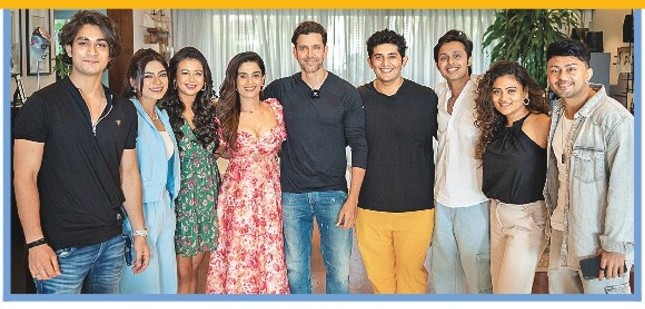
On International Dance Day, eight influencers got a chance to get up, close and personal with and earn the adulation of Hrithik Roshan
Rishabh Suri (HINDUSTAN TIMES; April 29, 2023)
It’s a sunny day at actor Hrithik Roshan’s Juhu house overlooking the beach. We walk in to join a bunch of enthusiastic dancers who can hardly wait to meet their idol. “Main unke videos dekhte huye bada hua hoon. I can’t believe I’ve got this opportunity to meet him. I don’t know what I will say to him!” gushes Tarun Namdev, popular for his reels where he starts dancing in the middle of the road.
Eight such influencers are here on a personal invite from the actor, who walks in dot on time and delivers the perfect ice-breaker — “I am nervous because of you all!” — considering he’s unequivocally one of the top Bollywood dancers of the past two decades ever since bursting onto the scene with the iconic Ek Pal Ka Jeena (Kaho Naa... Pyaar Hai, 2000).
HRITHIK, THE MENTOR
Roshan, ever the mentor and idol, often encourages budding artistes via social media — leaving likes and comments and reposting their reels on his account. But he doesn’t think this is “going the extra mile”.
“I want to touch and feel this community of dance, to understand these dancers’ lives because they inspire me. If I want to still keep learning, I have to grow with them now. I have the opportunity and access to them. It is amazing because when I was young, dance was not considered a valuable asset. So, these people have come and changed that.”
What’s his takeaway from this meetup with these people? Roshan tells us, “I have information now — that it is possible for me to pick up my phone, call one of them, and say ‘Let’s do a class’. I am seriously thinking about learning dance again. I want to start to dance, just for myself.”
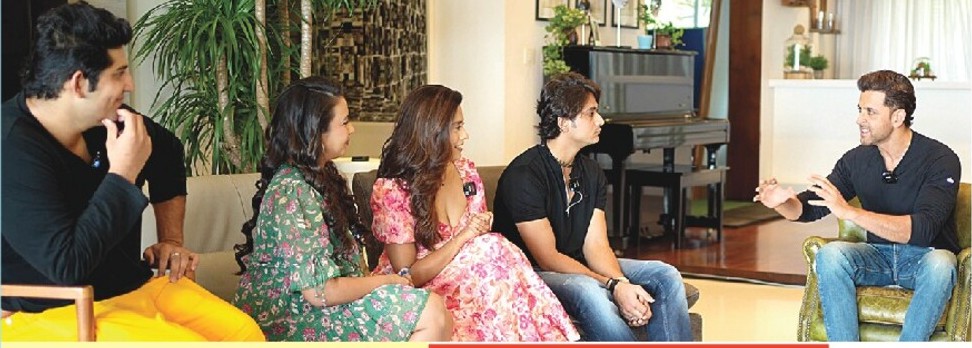
The conversation between actor Hrithik Roshan and the curious bunch of eight dancers touched upon various topics, ranging from overcoming his childhood inhibitions, the people he looks up to in the world of dance to even fitness tips. In fact, he is amazed when he learns that Rohit Jethwani and Chinmay Khedekar conduct classes across Mumbai. “Why don’t I join you guys and do a class!” he exclaims.
What prompted the actor to put in so much effort in perfecting the art form? Roshan is quick to say to us, “It was a lock I think... I believe all of us are born with the dance gene. We need to expose ourselves to something that unlocks it. I think when I got exposed to Michael Jackson (late king of pop), that dormant gene in me got unlocked. I just followed that passion.”
Be it Ek Pal Ka Jeena (Kaho Naa... Pyaar Hai; 2000) Dhoom Again (Dhoom 2; 2006), the Bang Bang (2014) title track or Ghungroo (War; 2019), the hook steps of Roshan’s songs stand out. Does he feel the pressure to up the ante with each song of his? “It does, but that’s what it is about. The challenge is what drives you to find the magic every time. I also have enough encouragement behind me, which I use to push myself. It is special. It is good for me,” he says.
FANS ASK HR
Who do you idolize when it comes to dance?
When I was a teen there were not many inspirations. It was either film stars, like Shammi Kapoor ji, I used to be crazy about Mr Amitabh Bachchan’s grace and Michael Jackson.
What’s the most fun song you’ve done?
Dhoom Again and Bang Bang. In Bang Bang, actually, that step where I go back, I was not at my best. Everything matters - the shoes, the friction on the floor. I used to test which shoe I can get the right amount of friction with. I changed nine pairs of shoes, took all from my house, painted them black for the song, and used a different one for each step. Main khud woh step bhool gaya hoon!
Which was the toughest song to do?
The ballet in Jaane Kiske Khwaab, from Sanjay Leela Bhansali’s film Guzaarish (2010). It took me a month-and-a-half to learn.
Raaj Kumar, Shammi Kapoor, Saira Banu’s personal letters to fan go viral; NFAI shows interest to acquire them
8:24 AM

Rishabh Deb (CHENNAI TIMES; March 3, 2021)
A Twitter thread by user SamSays on February 25 got everyone nostalgic about older days of Bollywood.
The precious thread gave a glimpse of how Sam’s aunt, an avid film buff — Mehrunnisa Najma, who passed away in 2006, received responses to her letters from some of the popular Bollywood stars including Shammi Kapoor, Dharmendra, Sunil Dutt, Saira Banu, Tabassum and many more.
These letters that were locked in the basement for more than 15 years, wearing dust, will now breathe a new lease of life as the National Film Archive of India (NFAI) will acquire and preserve this collection for Bollywood buffs.

PRESERVATION OF A PERSONAL HISTORY
Soon after the tweets went viral, NFAI reached out to Sam seeking approval to acquire and preserve this unique collection.
Prakash Magdum, director, National Film Archive of India, told us, “We are always looking for filmy materials that are of archival value. What we saw on Twitter is a fantastic collection because this also constitutes part of cinema history. It is so interesting that a lady was writing to these stars and they were replying to her. It that the stars in those years, had a personal connect with their fans. And these were times when there was no social media. Our aim is to acquire rights, preserving them and making them accessible to cinema lovers and history buffs.”

‘I THINK WE NEED TO PAY MORE ATTENTION TO MEMORABILIA LEFT BEHIND’
Speaking with us, Sam Javed, who shared her aunt’s tweets says, “Everyone knew of my aunt’s collection, but somehow no one ever gave it much attention or importance. She used to show it to us when we were kids, and over the years, it was forgotten. It was rediscovered recently during a clean-up and I decided to share it on Twitter. I had absolutely no idea that it will get such an overwhelming response. I think we need to pay more attention to memorabilia left behind to us and do our best to treasure it in the same way, that the person who left it behind did in his/her lifetime.”

‘HAPPY TO SEE THE LETTERS BEING RESTORED AND PRESERVED’
Happy to have received such an overwhelming response to the tweets, Sam is now looking forward to have these letters restored and preserved by NFAI.
“NFAI was one of the first to do so, and it gives me immense happiness to see the collection get such recognition. My priority is to restore and preserve the images so that they can be enjoyed by generations to come. My Twitter thread has got me responses from cinema lovers around the world. I feel blessed that I’m able to share my aunt’s legacy with the world. These pictures and letters take us back to a completely different era. They give us a glimpse of a gentler world. The kindness of superstars for sparing the time to write a handwritten note to a young woman is something very hard to imagine today. The message to today’s generation is to slow down, value the simple pleasures in life and spread love and happiness.”
WHO WAS MEHRUNNISA NAJMA?
Najma was born in the 1930s. Her father was from Punjab and her mother was from Burma (Myanmar). She had two sisters and a brother. The father died in infancy. She and her entire family lived with their uncle. Her aunt was the wife of the then Nawab of Tonk Saadat Ali Khan. Najma was brought up by her Burmese mother in the palace of the Nawab of Tonk.
My aunt passed away many years ago. Among her belongings was an old album that she was very fond of. The album remained lost for many years, buried somewhere in a storeroom in the basement. It was found again recently during a clean-up. 1/n
— SamSays (@samjawed65) February 24, 2021
Roshmila Bhattacharya’s book Matinee Men is filled with RARE trivia about Shah Rukh, Salman, Aamir Khan, John Abraham, Dev Anand etc
3:04 PM

Roshmila Bhattacharya, who headed the entertainment section at Mumbai Mirror for 7 years, is now back with her second book, Matinee Man. Her first book, Bad Man, released in July 2019 and was a biography on Gulshan Grover and traced his journey in cinema. In Matinee Man, however, she attempts to go beneath the glam, glory and greasepaint, to find the men behind these demi-Gods we have been watching live out different characters in reel life.
Roshmila Bhattacharya has a career spanning three decades and has worked with all the leading media houses like The Times of India, The Indian Express, Zee and Hindustan Times. As part of her work, she has got multiple chances to interact with and interview several screen idols of Bollywood. In Matinee Man, she her focused on 13 actors – Ashok Kumar, Dilip Kumar, Dev Anand, Shammi Kapoor, Dharmendra, Amitabh Bachchan, Farooq Sheikh, Mithun Chakraborty, John Abraham, Aamir Khan, Shah Rukh Khan, Salman Khan and Irrfan Khan. Through the memories of moments spent with them, and conversations with family and colleagues, she brings us interesting trivia, like their unique talents that not many known about.
Some of the fascinating and never-before-known trivia that she covered in the book are as follows:
1. Ashok Kumar made more than three hundred painting and when M F Husain saw his horses, he told the actor that these were not the strokes of an amateur artist.
2. Dev Anand was mistaken for a real guide during the shooting of his American-Indian co-production, Guide, in Udaipur by a group of American tourists. And instead of getting affronted, the evergreen star simply whizzed off with them in a motor boat, returning to the shoot after giving them a guided tour
3. John Abraham, an economics graduate with a Masters in management, would get frustrated when people treated him like a “clothes hanger” during his modelling days even though he reads Frank Kafka and is very knowledgeable about world affairs. Even after he entered the movies, the focus was only on his looks, body and sexuality. But being a marketing guy, he decided to position himself this way, till he got the power to do the kind of films he wanted. He admits that the studio that distributed Vicky Donor were appalled that he was making a film during the shoot of which curious bystanders in Delhi would ask its director, Shoojit Sircar, “Yeh donor ka matlab kya hai?” Today, John is not just an action hero in commercial blockbusters, from Dhoom to Satyameva Jayate, he has an impressive library of off-beat films like Kabul Express, Water, New York and No Smoking as an actor and Vicky Donor, Madras Café, Parmanu and Batla House as a producer.
4. Ashok Kumar loved dogs and had around twenty at various times. Interestingly, he named then after dictators like Stalin, Brutus, Chiang Kai-shek and Hitler!
5. A young boy while watching the Dilip Kumar film Shabnam told himself that when he became an actor, he would call himself Manoj after the film's character. We know him as Manoj Kumar today.
6. The world knows him as 'He-man' whose dhai kilo ka haath can make the bad man disappear from the face of the earth on screen. But Dharmendra prefers the tag 'Darling D'.
7. It was the last day of shooting of The Tashkent Files. During the tea break, Mithun Chakraborty called his director and told him, "There's a question I've waited to ask. You took me for a reason, have I passed your test?" Vivek Ranjan Agnihotri couldn't believe a 3-times National Award winner was asking him this!
8. Dadamoni as Ashok Kumar was fondly called refused to be the chief guest at his daughter, Bharti’s college function. Why? For that you have to read the book and you will know much more
There have been plenty of books on cinema. What makes Matinee Men different is that it’s intensely personal in its approach, anecdotal in its narrative and is all about many untold stories… About men, movies and journeys.
An actor, they say, lives a hundred lives. He wakes up every morning, wears a different face and sets out to make the world his stage. This book tells you how he feels wearing these faces, and more importantly, without them. If you are a Bollywood buff and love your stars, it promises that you will get to know them better.
AMAZON LINK TO BUY MATINEE MEN:
https://amzn.to/3oYEyLO

I hope to shoot Ayushmann Khurrana’s film in December-Anubhav Sinha
8:35 AM

A month before, Anubhav Sinha to film a short on pandemic; remembers Rishi on Mulk’s anniversary
Roshmila Bhattacharya (MUMBAI MIRROR; August 3, 2020)
 Anubhav Sinha plans to get back to action in November with a 25-minute short, part of a five-film anthology on the common theme of the Coronavirus pandemic. It will be helmed by five directors in Maharashtra, Gujarat, Goa and Delhi. While Hansal Mehta’s film is dark and funny, Sudhir Mishra’s is a social with political undertones and Subhash Kapoor’s has elements of science-fiction. Ketan Mehta is yet to finalise his subject but Anubhav’s film is about how the pandemic started out as a rich man’s disease with only those who had been to Italy and China at risk, but has now resulted in a clear class divide. “The rich are safe in their homes, five-star hotels and private hospitals while the poor struggle to survive,” he rues. Born out of regular phone conversations with filmmaker-friends, the project aims to chronicle these unusual times.
In December, he expects to roll with the Ayushmann Khurrana-starrer which was to flag off in April. “The film will be shot in a nearby jungle. I hope a vaccine finds its way to Mumbai by then because I hate talking through a mask and no matter how much we pretend, most directors are incorrigibly indisciplined,” asserts the filmmaker who has been working on two other scripts through the lockdown, one alone, the other with Thappad co-writer, Mrunmayee Lagoo. Will either of them reunite him with Taapsee Pannu? “Taapsee is a habit and I may have something for her, but she has to like it too,” he says.
Today is the second anniversary of Mulk, which featured Rishi Kapoor, Taapsee and Rajat Kapoor in the lead. Anubhav recalls going to meet Rishi nervously for the role of Murad Ali Mohammed. He was Immediately thrown off when the veteran actor looked pointedly at his script and asked, “Pura sunayenge?” He agreed to do the film after a 15-minute narration, wondering curiously, “Hero kaun hai?” This time Anubhav surprised him, saying, “You are.”
It was a struggle getting finance, but Mulk finally rolled in October 2017, in Lucknow. As he was setting up the second shot, the director noticed his ‘hero’ observing him with a smile. When prodded, Rishi admitted he was wondering if he was old school or like some new-age directors, taking the shot from 15 angles. Anubhav smiled back, “I’m somewhere in between the two.” Anubhav himself wondered if Rishi was anything like his uncle, Shammi, with whom he’d done his first TV serial, Shikast, and discovered the two Kapoors shared a passion for food and had the same flamboyance.
“Both were born stars—one in the home of Prithviraj Kapoor, the other in Raj Kapoor’s—and instinctive actors who didn’t believe in too much discussion. Chintu ji would simply insist I explain the scene to him before the shot and observe me carefully while I spoke. From that he’d deduce what I wanted,” reminisces Anubhav.
They finished Mulk in 27 days but even after the final shot was taken on November 9, “Chintu ji wasn’t convinced the film was over and insisted I keep 10 days as a back-up. Then, one day my CFO came to me asking if I had some shooting left, saying Chintu ji had allotted dates between January 5 and 15, 2018,” he recounts with a smile. “During the censor screening, Chintu ji was on tenterhooks, calling every 30 seconds for an update, afraid Mulk would be banned. After a 90-minute discussion, when I stepped out with a U/A certificate and told him so, he repeated in disbelief, ‘You mean picture release hogi!’”
 The film opened on August 3, 2018, to rave reviews. Soon after, Rishi was diagnosed with cancer and went away to the US for treatment. “On his return, we met at the Bachchans’ Diwali party. I ran to hug him little knowing that he’d go away so soon. I had planned many more movies with him,” Anubhav sighs.
Rishi Kapoor was an effortless actor, a true gentleman-Poonam Dhillon
8:27 AM

Shreya Mukherjee (HINDUSTAN TIMES; May 2, 2020)

Dhillon met him two months earlier. “Chintu had recovered and was so grateful to have beaten such a horrible disease. It’s going to be very difficult to accept that he is gone. I knew him since I was 18. We have been friends and I was close to his family. I had worked with him, Dabboo (Randhir Kapoor), Shammi Kapoor uncle, Shashi ji (Shashi Kapoor),” she adds.
Dhillon and Kapoor had collaborated in films such as Yeh Vaada Raha (1982), Tawaif (1985), Zamana (1985), Ek Chadar Maili Si (1986), Dosti Dushmani (1986), Amiri Garibi (1990), Yeh Hai Jalwa (2002), among others. And they wanted to work together again. “The other day I joked saying, ‘Aaj kal baat toh karte ho par kaam kab karenge?’ and he said, ‘Haan yaar, chal ek saath ek film karte hai’,” she says.
The actor says Kapoor “looked fit” when she last met him. “He was an unassuming, effortless actor. He never needed any prep. His performance wasn’t theatrical or dramatic, he was a natural actor. That’s what I loved about him,” she adds. Dhillon shared a “fun and warm” relationship with Kapoor and they would often joke with each other. “I learnt a lot from him. He was a good man. He would never misbehave with anyone. He expressed what he felt, which at times would sound wrong, but that’s that,” she recalls.
Calling him one of the “finest actors of our times”, she says it’s a “huge loss” for everyone. “It’s sad that on his last day, there was a restriction to pay our last tribute to this true gentleman,” she concludes.
I would be upset if Saif Ali Khan had said he liked new Love Aaj Kal's trailer better-Imtiaz Ali
8:36 AM

Imtiaz Ali on why he keeps returning to the themes of finding a soulmate and self-discovery; explains decision to go with the original title for his next
Roshmila Bhattacharya (MUMBAI MIRROR; February 5, 2020)
 The quaint cottage in a Versova bylane is a sylvan oasis in the city’s concrete jungle. The room we are escorted into has unpainted walls, unvarnished furniture and blinds, through which the sunlight filters through, transporting us to another world, another time. Then, Imtiaz Ali strolls in and we’re jolted back into the present, just the way it happens in his upcoming Valentine’s Day release. The film brings back fond memories of Saif Ali Khan and Deepika Padukone spontaneously joining a baraat and grooving to “Chor Bazaari” in the earlier Love Aaj Kal. How stressful is it when your new film is being compared to one you made a decade ago, we wonder, and Imtiaz flashes a wry smile, “The fact that everyone asks me this question means I should feel stressed, but I only feel validated and gratified that people remember what I’ve done in the past and are hoping to find some of that in this film too.”
Sweeping back his salt-and-pepper mane, the director admits he’s never been interested in sequels and this is the only franchise-able idea he’s had, following the realisation that the story, if told today, would be shockingly different, with a new set of youngsters falling in love and getting into relationships. He’s quick to add that one doesn’t need to have watched the previous film to understand this one as it’s a fresh story with new characters. “The only common factor is the idea of two stories that are separated by an era, influencing the other,” he avers.
Why did it take them so long to decide on the title, then? Imtiaz says it’s because everyone had their ideas, fears and premonitions about the title. “We didn’t want to confuse people. But, at the same time, I knew I had to tell the audience that it was the same concept as the original. Otherwise they would have felt cheated after watching the film. I didn’t care for Love Aaj Kal Reboot and was against a Part 2 appendage as that signifies an extension of the original story and people would expect the old characters to return. Finally, we bought the rights and settled on Love Aaj Kal,” he explains, adding that he is okay with people calling it Kartik-Sara’s Love Aaj Kal or Love Aaj Kal 2020. “God is one but has many names,” he notes.
Once, Yash Chopra was the ‘King of Romance’, a title Imtiaz has inherited, though his love stories are not rain-drenched, with heroines in chiffon saris, but journeys of self-discovery through their quest for a soulmate. Today, when, like Sejal in Jab Harry Met Sejal, we are struggling to understand love, how would he define it? The query draws a disbelieving look, “I make movies about love not because I know the answer but because I’m wondering what the answer is.”
He goes on to acknowledge that he knew Jab Harry Met Sejal was a risky proposition as the subject was waferthin but he didn’t want to load it with flashbacks or peripheral characters. “I wanted it to be a story of a guy who’s wordly, a little dirty, and a girl so naïve, she tells him to think of her as his girlfriend so he doesn’t feel lonely and in her innocence, stops him from messing with her. There were some good things in it, but people didn’t like the film. The inability to communicate is always the filmmaker’s, I should have made a better film,” he rues, pointing out that if he could go back to it, he’d rebuild from the concept, travel with a very small unit and make a film which is edgy, adulterated and realistic, with a certain pulse and thrill.
And would he make any changes in Jab We Met too, given that it is considered textbook commercial Hindi cinema? Imtiaz surprises us by admitting that he believes the writing could have been better, the costumes, locations and VFX too. “The casting worked, both Shahid (Kapoor) and Kareena (Kapoor) brought a lot to the film. She was talking so much, yet there’s a softness and cuteness in her which kept people from getting irritated. But I’d shoot certain scenes differently now to make them more effective,” he muses, but is quick to add that when people love something, they find it perfect. “Nothing’s perfect in the world really, it’s only your affection that makes it perfect. I don’t think anyone would allow me to make changes to this film now,” he smiles.
Cut to the present and his new hero, Kartik Aaryan. Imtiaz informs he’d met the actor for another film, but the fact that Kartik is living in a city after being in a small town, made him believe the actor understood different cultures. It made him the perfect fit for Love Aaj Kal, which revolves around two characters in different time zones. “He’d know where I am coming from, having heard stories like this from older people. He grasps things quickly, is accessible and in the right age group,” Imtiaz says.
And what about Sara Ali Khan? He has known her since the making of the earlier Love Aaj Kal, with her dad. Imtiaz describes his new leading lady as a modern girl with a long career ahead. “She can change the concept of the Indian film heroine. She ticks all the right boxes. She looks nice, dramatic, even, has a great voice and an expansive worldview. She can fit any character, from any bracket of society. Most importantly, she listens closely and submits completely,” he gushes.
That’s high praise coming from Imtiaz Ali and makes you wonder about his take on Sara’s dad, who has said that he liked the trailer of his Love Aaj Kal better. “Of course, he would. Saif was emotionally invested in that film. I would be upset if he’d said he liked this trailer better,” reasons the filmmaker who describes the actor as a “smart, quirky guy”
with whom he had a lot of fun. “Saif was also the producer on that film while I was the director. But it was usually the reverse, with me telling him not to come late, for example. We had an easy equation, and even in a difficult situation, both of us had a connection because we were shameless enough to not let it really bother us,” he chuckles.
Imtiaz also has a connection with Deepika Padukone. Going by the buzz, his next is with Kartik and her. He admits he’s heard the rumours too and while he’d love to work with Deepika, he insists there’s nothing on his mind for now. “Nothing I’ve spoken to her about, but hopefully, something will happen,” he shrugs.
The new Love Aaj Kal has also reunited him with Randeep Hooda after Highway, the film which saw Alia Bhatt graduate from a ‘student’ to an actress par excellence. The observation evokes a smile. Imtiaz describes his Veera as a “ferociously passionate girl” who owned the role. “Ranbir (Kapoor) and she are alike in many ways. They have the natural ability to transform themselves into people they are playing in a way that even I don’t understand. As for Randeep, he’s not just a talented actor but a driven and trained one. He has control, and acquires the emotions of the character. After Highway, Love Aaj Kal felt like he was a different actor,” Imtiaz marvels.
With Rockstar, film shoots resumed in Kashmir after a long gap. Highway was also filmed there, as was Laila Majnu. With the scrapping of Article 370, will he return there? Imtiaz nods, saying he has a connection with the Valley and a commitment to its people. His words bring back memories of Shammi Kapoor, who had loved the Valley as much. What was it like taking the ailing actor back there for his last film, Rockstar? Imtiaz recalls the late actor’s agony—he had just undergone a surgery in which he lost a toe. He was in pain when they were canning a shot that required Shammi ji to smile for the camera. Imtiaz had the unenviable job of letting him know that his smile reflected the pain. “Despite my assurances that no one would notice, Shammi ji insisted on giving one more shot, this time masking the pain. We take so many short cuts, but that memory inspires me to give my best shot,” he asserts.
The minutes are ticking away but we can’t leave without asking about his daughter, who’s studying to be a director in a Los Angeles film school. He’s been vocal about Ida’s contributions to Tamasha and the new Love Aaj Kal. Can we hope for a collaboration? “There can only be one director on the set but I’d love to work with her. I respect her mind. Her short films have got more accolades than any of mine, she’s a precious commodity,” he smiles.

Sholay grew out of my love for westerns while Shaan was more like a Bond film-Ramesh Sippy
8:04 AM

Roshmila Bhattacharya (MUMBAI MIRROR; January 21, 2020)
Suave and well-spoken, the Sholay maker doesn’t look like a man who has built his career on risks, but his first directorial, Andaz, brought together a widow and a widower, a taboo subject back in 1971. Ramesh Sippy recalls that when he took the subject to Shammi Kapoor, with whom he’d bonded during Brahmachari, produced by his father G P Sippy, with him as the executive producer, the actor asked him if he really wanted to tackle such a serious subject at such a young age. The 23-year-old debutant was sure he didn’t want to do another song-and-dance film with the Yahoo star even though he aced them. “I knew I was taking a chance, but with their children playing matchmakers, I thought the audience might be happy to see Ravi and Sheetal come together at the end of Andaz,” he reminisces.
Sippy took another gamble, pairing an ageing Shammi ji who was on a journey of rediscovery, with the fresh-faced Hema Malini who was on the threshold of her career. With Rajesh Khanna, whose Aradhana had made him a craze, entering the picture in a guest appearance, the filmmaker was able to carry off the awkward romance. “It was too much to expect a super-hit, but the film did well,” says Sippy, who turns 73 on January 23.
That gave him the confidence to attempt a double role with Hema Malini next. Dilip Kumar’s Ram Aur Shyam had already experimented with the twin track successfully, but Sippy believed the idea could be explored better with a subdued woman being exploited by her family and pulled out of misery by another woman who’s her lookalike. “The year was 1972 and women were slowly coming to fore, refusing to be taken for granted, and as part of this young world, I wanted to do my bit,” he smiles, admitting that his heroine was not confident of pulling off the dual challenge, but he pushed her into giving the two characters distinguishing traits while juggling with multiple projects. “It was hard work, but with two successful actors, Dharmendra and Sanjeev Kumar, who were really fond of her, agreeing to be a part of a part of my woman-centric film, Seeta Aur Geeta, worked well,” he smiles.
In a chequered career of nearly half a century, Sippy today is also remembered for giving Hindi cinema two unforgettable villains in Gabbar Singh and Shakaal. The original choice for Sholay’s daku was Danny Denzongpa, the best of the baddies then. But by the time the film went on the floors, he was in Afghanistan shooting for Feroz Khan’s Dharmatma, and had to apologetically bow out.
Unwilling to take an established actor and run into date problems again, Sippy took heed of his writer duo Salim Khan and Javed Akhtar’s suggestion to consider actor Jayant’s son, Amjad Khan. “I had seen him in a play on apartheid in South Africa opposite my sister and invited him to my office. He was a mountain of a man with a peculiar face and voice but turned out to be the most colourful character in Sholay,” he recounts.
He was also such a larger-than-life character that when Shaan came along five years later in 1980, with Kulbhushan Kharbanda as Shakaal, many were expecting another Gabbar and were disappointed. But Sippy points out that he wanted to get away from the rustic dacoit and came up with a sophisticated, clean-shaven villain who keeps playing with his bald pate. “I had seen Kulbhushan in Shyam Benegal’s Manthan and knew he could perform. But the setting was different here, moving from a rocky terrain to an almost futuristic den. Sholay grew out of my love for westerns while Shaan was more like a Bond film with car chases, gadgets, special effects and an international crime lord operating from a remote island. It was an expensive film and I am grateful to my father for having faith in me and pumping in so much money into it,” he says.
In 1985, the leap of faith took Sippy into Saagar, an epic romance in 70 mm, which brought Dimple Kapadia back to the screen and reunited her with her Bobby co-star Rishi Kapoor. For any other maker that would have been enough, but Sippy took it a step further, roping in Kamal Haasan whom he’d seen in Ek Dujje Ke Liye and turning his film into a love triangle. “Kamal Haasan had great intensity and juggled between light and tragic scenes with amazing dexterity,” he points out.
Saagar was India’s entry for the Oscars and though it didn’t make the cut, RD Burman’s “Chehra hai ya chand khila hai… Yeh to bata tera naam hai kya?” still makes me fall in love with the ethereal Dimple Kapadia who’s never looked more beautiful. “That’s the magic of cinema. Everyone, from my actors to my writers, composers and other technical crew contributed to making these movies memorable,” Sippy avers.

Shammi Kapoor in Andaz, Hema Malini in Seeta Aur Geeta, Amjad Khan in Sholay, Kulbhushan Kharbanda in Shaan and Kamal Haasan, Dimple Kapadia and Rishi Kapoor in Saagar
Dilip Kumar taught me how to understand philosophy of my film’s story & psychology of my characters-Subhash Ghai
7:06 AM

Dilip Kumar and Shammi Kapoor in Vidhaata
Roshmila Bhattacharya (MUMBAI MIRROR; December 13, 2019)
Dilip Kumar is 97 and I’m reminded of a time when, as a cub reporter, I had watched him from afar, as he lounged in the lawn of his bungalow, recounting his journey to my editor. Then, suave in a suit and a tie, he posed with Filmfare’s Black Lady that he’d bagged for lifetime achievement. My biggest regret is that I didn’t get to interview him. Perhaps that’s why, I keep talking to those who knew the man who made me laugh in my growing up years as he strutted around on my black-and-white TV screen crooning, “Sala Main To Sahab Ban Gaya” in Sagina and weatched my mother swoon as he went careening in a tonga to the tune of “Maang Ke Saath Tumhara”. By the time I met him, he was no longer a dashing Casanova with an errant lock kissing his forehead. But he was still just as charming and made me wonder even more about the man behind the matinee idol.
So, I quizzed a filmmaker who decided to become an actor after watching Dilip saab’s Shaheed and Jugnu, then, went on to co-star with him in Aadmi. While it was being filmed, Manoj Kumar would often borrow from his friend’s wardrobe. In the course of a conversation, he recalled how, whenever Dilip Kumar spotted him in one of his costumes, he would smile and say graciously, “Achche lag rahe ho.”
 Thirteen years after the 1968 film about obsessive love, Manoj saab convinced Dilip saab to end a five-year sabbatical to spearhead his Kranti (right). The historical drama was his most ambitious production, with Manoj saab as its writer, director and actor too. For the first four days at RK Studio, he just sat patiently and watched Dilip saab get into character. Then, he was living Sanga, reeling off one perfect take after another. Having known him closely, Manoj saab understood that his role model was a perfectionist who could not be hurried. But once Dilip saab was ready, the assistants never had to remind the thespian to report for work. He’d be on the sets by 11.15 am at the latest, and leave only after taking permission from his producer-director.
Subhash Ghai who directed Dilip saab in three films—Vidhaata, Karma and Saudagar—informs that the two most influential persons in his life till date were both born on same day, December 11. “One is Osho who taught me how to understand the philosophy of life and the psychology of people and stay happy. The other is the emperor of acting, Dilip Kumar, who taught me how to understand the philosophy of my film’s story and the psychology of my characters,” Subhash ji points out.
The filmmaker goes on to add that during Vidhaata he had no idea that Dilip saab and Shammi Kapoor had a spat decades ago and set up his first scene with the two actors in Agra. “Shammi ji was not happy with the scene shot because he had got intimidated by Dilip saab and expressed his resentment to me in his room. He was shocked when I told him that after the shoot, Dilip saab had told me, ‘Subhash, Shammi’s character seems to be a very interesting part of the film and he is a good actor as well. Please see that you increase his role even at my cost. You will be happy,” reminisces Subhash ji, saying that Shammi ji went on to bag the Filmfare Award for Best Supporting Actor for his performance in the film.
Shammi Kapoor's song Aaj Kal Tere Mere revisited in Kunal Kemmu-starrer Lootcase
7:55 AM

Shaheen Parkar (MID-DAY; September 27, 2019)
 Even as the debate over reboots of classic numbers continues, the makers of Lootcase have revisited the yesteryear chartbuster, Aaj Kal Tere Mere Pyar Ke Charche, from the Shammi Kapoor-starrer Brahmachari (1968). However, director Rajesh Krishnan explains at the outset that they have not tampered with the Shankar Jaikishen composition. "We have incorporated the entire track, as it is, in the film," he clarifies.
The recently dropped teaser of the Kunal Kemmu-starrer sees the protagonist's adventures after he discovers a suitcase filled with hard cash. As his obsession with the suitcase piques the curiosity of those around him, the Mohammed Rafi ditty plays in the background. "Aaj Kal Tere Mere has quirk written all over it, especially when you use it in today's context. In the case of Lootcase, it helped us amplify the madness of the plot," explains the director.
Kishore Kumar came home and sang till my parents agreed to our marriage-Leena Chandavarkar
7:57 AM

The legendary singer’s wife, Leena Chandavarkar, speaks up while attending his 90th birth anniversary celebration
Debolina Sen (BOMBAY TIMES; August 7, 2019)
 The pretty face of the Hindi film industry of the ’70s still glows warmly. The soft countenance and the innocent smile are still in place. Leena Chandavarkar, who also made headlines for her marriage to Kishore Kumar — a man 21 years older than her — amazes you with her childlike simplicity. We caught up with the former actress when she was in Kolkata recently, to attend Tomay Poreche Mone — Kishore Kumar’s 90th birth anniversary celebration. She spoke about her life, films, Kishore Kumar and more. Excerpts:
How did Kishore Kumar influence your personal and professional lives?
I have innumerable memories of him. He was like a pillar of strength who taught me to accept the good and bad in life. He looked at life as a whole and understood that you win some and lose some. He would show his funny side to the world, but never his sad face. He also taught me to do that. I went through a lot in life and it was only because of him that I could come out of depression. So, I have written this song for him now — Kaun tha woh kya tha, Jadugar ya farishta tha, Athwa woh ajooba tha. Even he always wanted me to write songs. After he passed away, Amit (Kumar) asked me to fill in some dummy words, to which he gave the tunes and it got approved. So, I think it’s Kishore da who has again guided me from heaven. His song, Hamein Aur Jeene Ki Chaahat Na Hoti, is one of my favourites because it resembles my relationship with him. He would also mention that he always came across talented people as life partners. True, you see Ruma didi was there. Amit received a letter from the President of India after Ruma didi passed away. That’s a great honour. Both of Amit’s parents were extremely talented people. He has also carved a niche for himself. It’s extremely difficult to match up to a father like Kishore Kumar, but he has done well for himself.
You live with your son Sumit Ganguly and stepson Amit Kumar Ganguly. It is a rare sight in Indian households today where sons take care of their ageing parents.
I wouldn’t know what triggered this bond, but it feels like the expression, Sago se zyada apna. Amit respects his father a lot. He would always ask for his advice when taking an important decision. Sumit was only five years old when Kishore da passed away, but he scolds me and tries to guide me now (laughs). Amit and Sumit have a beautiful bond between them. In fact, Amit brought up Sumit. If I would ever forget to pick up Sumit from school on time, Amit would leave his recordings and rush to his school. Then he would scold me. Amit was also responsible for getting Sumit married. Now, the family is complete.
You have dealt with deep personal losses. What would you have to say to people who are unable to deal with the ups and downs of life?
Kishore da was the reason why I could successfully deal with all the pain in life. He could give strength to anyone. He would also say, ‘Hum log travellers hain duniya mein. Kisiko first class milti hain, kisiko third class. Par free mein duniya dekhne ko saab ko milti hain na?’ (laughs). I went through a lot in life. My brother committed suicide and my mother passed away just after Sumit was born. After Kishore da passed away, I would depend a lot on tablets and injections to deal with depression. Then one day, Amit said he would be busy with shows abroad and that so, I’d have get out of my depression and take care of Sumit. So, a supportive family is extremely important. But to stay out of depression, you have to accept life the way it is.
Tell us about your marriage with Kishore Kumar.
Kishore da and I had many funny memories together. I had told him that he marries whoever he works with, so I wouldn’t do a film with him. He then cancelled the proposal because according to him, two August-born people shouldn’t marry each other. He was born on August 4 and I, on August 29. Then, when my father hurt me by saying ‘Yeh phirse mere ghar wapas aa gayi’, I called Kishore da to get married then and there because I wanted to leave my father’s house. I even called him up to say that I would ask the drivers of every car that passes me that night if they would marry me. He said, had he thought that only he was eccentric, but I had joined that list. My parents were apprehensive about me marrying him. My mother said he had married thrice, but wanted to know his ancestral origin. I told her he must be Christian since I had seen many statues of Christ and other biblical things at his house. Until our wedding, I never knew he was a Bengali Brahmin (laughs).
He told me that he couldn’t marry me unless he got divorced from Yogeeta Bali, his third wife. He had stopped doing playback for Mithun (Chakraborty) at that time. Mithun did gauge the situation, but still came home to ask him why he wasn’t singing for him. After all, every hero wanted his voice in their songs. He told him about the divorce clause. Mithun saw to it that the divorce was through in no time. Then, I said, ‘Let’s get married now’, but he said he wanted to get my parents’ approval. He came home and sang till every member of the family agreed to our union, even my father. He sang Nafrat karne walo ke seene mein pyar bhar du, Arey mein woh parwana hu, Pathar ko moum kar du (laughs)!
You belong to an era that saw some of the biggest superstars in Hindi cinema. How difficult or easy was it making your presence felt when working with them?
For some people like me, dreams do come true. If you want to pursue something with all your heart, you don’t find the effort too difficult. I had learnt a lot from the superstars who were my costars. They were like family. Dilip Kumar would be so natural while acting that his voice would sound muffled at times like it does when we speak in our normal tone. I would often miss his dialogue cues (laughs). Shammi Kapoor would make me laugh a lot.

When Mukesh proved his detractors wrong with Sardar Malik’s Saranga
7:40 AM

Anu with father Sardar Malik
Roshmila Bhattacharya (MUMBAI MIRROR; February 1, 2019)
Not many will recall a 1961 film titled Saranga but its song, “Saranga teri yaad mein”, filled with the pathos of a broken heart, ranks amongst Mukesh’s best. Anu Malik, son of its composer Sardar Malik, recalls his dad telling him that after bowling Mukesh over with Bharat Vyas’s poetry and his melody, he confided in the singer that some of his detractors were calling him “kansura” and he wanted to shut them up with this song. “But I’ll need to rehearse it with you every day,” Malik Saab insisted.
 Mukesh ji would dash down to his Juhu residence every day and despite the summer heat, they’d switch off the fan and he’d rehearse in his vest. “By the end of the session, both would be drenched in sweat,” recalls Anu. By the time of the recording, Mukesh ji knew every word and note. “Like me, he sang with the harmonium and the song flowed in perfect sur,” says Anu believing that if it had been picturised on Raj Kapoor rather than Sudesh Kumar (right), it might have been a bigger hit. “Stars carry forward your songs, that’s why I’ve fought for an Aamir, Shah Rukh and Salman Khan for my songs,” he reasons.
Salman’s father, Salim Khan played the lead in Bachpan. A Sardar Malik composition, sung by Mohd. Rafi, “Mujhe tumse mohabbat hai magar main keh nahin sakta” was filmed on him.“My first song for Poonam, 'Mohabbat rang layegi janaab ahista ahista', at the age of 17, was also sung by Rafi Saab. After the recording, he called me, ‘True son of a true father,’” Anu beams proudly.
 He also remembers approaching Shammi Kapoor (left) for his blessing only to be told he didn’t need to introduce himself. “You are Sardar Malik’s son,” Shammi ji smiled and when Anu wondered how he knew his father so well, he informed him, “I was launched with Sardar Malik’s music in the 1953 film Laila Majnu .” Despite several screen adaptations and Malik saab sharing the credits with another composer, Ghulam Mohammed, he left his imprint on the film with songs like “Baharon Ki Duniya” and “Dekh Li Aye Ishq Teri Meherbani.”
Malik saab also scored for Shammi Kapoor’s Chor Bazar which boasts of Lata Mangeshkar’s “Hui Yeh Humse Nadaani”and Shammi’s favourite “Tere Dar Pe Aaya Hoon Fariyad Lekar”. Then, there was Thokar unforgettable for Talat Mehmood’s ghazal “Ae-gham-e-dil kya karoon”with lyrics by Javed Akhtar uncle’s Majaz. It also had a female version by Asha Bhosle. “Asha ma adored daddy’s compositions as did her late husband Bhosle Saab. He loved and trusted daddy and told her this was one family she could stay with for as long as she wanted. I grew up playing in her arms,” Anu smiles, humming “Hum Apne Gham Ko Saja Ke” from Madan Manjari. Other Asha-Sardar Malik gems include “Tum Salamat Raho Hazar Baras” (Aulad).
Sardar Malik was a musician ahead of his times as reiterated by Saranga’s “Haan Deewana Hoon Main” composed on a minor key much before Bobby’s “Main Shayar To Nahi” was born. But despite this and songs like “Main Garibon Ka Dil Hoon Watan Ki Zubaan” (Abe-Hayat) he disappeared in a string of B-grade films with lesser known actors much before his demise on January 27, 2006. “Yes, his films didn’t do well and makers stopped coming,” admits Anu, pointing out that his simple, quiet father was too proud to ask for work. “He’d say they know the work I’m doing and if they need me they know where I live. With three children—Anu, Daboo and Abu—to bring up, he accepted what he got.” In these difficult times, Anu, at 12, picked up his harmonium and went looking for work. “People made fun of me saying I’d make songs on car bonnets and in the bathroom. They didn’t see the insecurity that made me run after people humming tunes, begging for a chance,” he says.
His dad smiled at Judwaa’s funky “Tan Tana Tan” and kissed him for Border’s “Aye Jaate Hue Lamhon”. “He was upset Asoka’s 'Roshni Se Bhare Bhare', 'Raat Ka Nasha Abhi' didn’t win me a National Award. When I won for Refugee , he raved, ‘Anu, you have combined Raag Yaman with Shudh Bihar.’” Anu had done it unknowingly but Malik Saab had studied music under Ustad Allauddin Khan and dance under Uday Shankar. “I told him his one 'Haan Deewana Hoon Main' was equal to my 200 films and he reiterated that he was proud I was a fighter who wouldn’t let go.”
Gaata Rahe Mera Dil was shot after Guide was completed-Mohan Churiwala
2:06 PM

Roshmila Bhattacharya (MUMBAI MIRROR; January 25, 2019)
He would have turned 85 on January 22 had death not snatched him away 15 years ago. But for me, Vijay Anand or Goldie Saab as I knew him, still lives on in the movies he left behind.
He is best remembered for the cult classic Guide which came to him on the rebound after Waheeda Rehman refused to work with Raj Khosla following an altercation on the sets of Solva Saal earlier, and the eldest Anand brother, Chetan, opted out after getting financial aid and army clearance for his war drama Haqeeqat. Goldie Saab who had turned down the offer to direct the film twice, agreed on the condition that he’d rework Nobel laureate Pearl S Buck’s original script on which the Tad Danielewski-directed English version was based. “I couldn’t have a film starting with Raju and Rosie jumping into bed within hours of her stepping off the train with her husband Marco,” he told me years later.
And while changing the first scene, and diluting the adulterous content of R K Narayan’s novel, Goldie saab also tweaked the ending, making it more spiritual and befitting a Hindi film hero. “In the English version, Raju after serving a jail sentence, lands up, broke, in a village where he is mistaken for a godman after a sadhu, seeing him shivering in his sleep, throws his saffron chaddar over him. While in the Hindi Guide Raju fasts for rains and breathes his last as the first of the life-saving showers come, in the English film, he keeps reiterating, ‘I can see the rains coming.’ But the film ends with the camera panning on a clear blue sky, implying that even in death he cheats the villagers who’d believed in him,” informs Mohan Churiwala, a close associate of Dev Anand. While Danielewski’s version didn’t impress anyone, Goldie Saab’s ‘Guide’ became a saviour even in real life as a drought-hit Gujarat turned to Raju to bring rain.
R K Narayan outraged by all the changes, publicly denounced the film, calling it “Misguided Guide”. But that didn’t dent its appeal. Guide was India’s official entry for the Oscars, losing in the second round to a Norwegian film. Half a century later, its regarded as a classic, and its songs remain evergreen. “The Lata Mangeshkar-Kishore Kumar duet, 'Gaata Rahe Mera Dil', was shot after the film was completed, in Ooty, because Dev saab wanted to incorporate a song by Kishore Kumar,” says Churiwala.
After Guide, Goldie saab was signed by Nasir Hussain for Teesri Manzil, initially planned with Dev saab. He was replaced by Shammi Kapoor after a fallout with Nasir saab at R K Nayyar and Sadhana’s engagement ceremony. While Goldie saab attributed the exit to a date clash, Aamir Khan was reported saying it was because his uncle had overheard Dev saab saying Nasir saab had signed Goldie to direct Baharon Ke Sapne, a small black-and-white film with newcomer Rajesh Khanna, while he was all set to helm a colour film with him. The next day, Nasir saab exchanged projects with Goldie saab on the condition that Teesri Manzil would not feature Dev Anand.
According to Churiwala however, the argument was over remuneration. “Dev saab wasn’t the kind of person to make an issue over money but during Jab Pyar Kisise Hota Hai he’d learnt that Nasir saab had borrowed money at a very high interest rate to finance his first production. So, he returned his signing amount, telling him to pay him after the film’s release. Nasir saab did settle his dues but did not pay him the price he commanded then, assuring him that he’d compensate him in their next film together,” informs Churiwala. He adds that at the engagement party, Dev saab jokingly asked Nasir saab what remuneration he had in mind for him in Teesri Manzil . “Nasir saab casually replied, ‘Don’t worry, I’ll take care of you.’ That sparked off Dev saab’s temper as he had said that earlier too many times and he stormed out of the party and the film. Shammi Kapoor when approached, called Dev saab and only after getting his go ahead agreed to a script narration.”
The Anand brothers did five more films — Jewel Thief, Johny Mera Naam, Tere Mere Sapne, Chhupa Rustam and Bullet. There was a sixth film, Jaana Na Dil Se Door, a tribute to Chetan saab. A father-daughter story with Indriani Banerjee in a double role, it was completed but not released. “And with it we lost a beautiful song penned by Kaifi saab (Azmi) for which he hadn’t charged a rupee,” sighs Churiwala. “Tu chala jo apni talash mein, To kahan kahan se guzar gaya, Har kadam pe tha inteha, Har inteha se guzar gaya…”
Dev Anand met everyone who came to wish him personally on his birthday-Mohan Churiwala
8:05 AM

Roshmila Bhattacharya (MUMBAI MIRROR; September 27, 2018)
On Wednesday, September 26, Dev Anand would have turned a sprightly 95. But the last birthday he celebrated was in 2011 (pic above) and since Chargesheet was opening four days later, he didn’t fly off to London as he liked to for the occasion. He spent it at his office in Mumbai, surrounded by bouquets and showered with love by fans who came from across the country to personally wish their ‘Raju Guide’. “Some of them would come straight from the station and camp out there. We served tea and snacks all day. Dev saab would arrive a little after 2 pm and they’d queue up to shake hands with him, returning home with a photograph and his autograph. He met everyone who came to wish him personally, late into the evening, returning home exhausted and satiated,” reminisces his close associate Mohan Churiwala.
His last film featured two of Dev saab’s favourite actors, Naseeruddin Shah and Jackie Shroff. With both his association dates back to Swami Dada. Naseer who played Aslam, the butcher, in the 1982 film, was cast as Sultan, a Dubai don, 29 years later and Churiwala remembers the late filmmaker explaining a scene to him in great detail.
“Naseer heard him quietly and with an ‘okay sir,’ went off to get his make-up done. I asked him if he’d remember everything that had been said and Dev saab assured me he would and come up with a flawless performance. The shoot was okayed in one take after which Dev saab shot me an I-told-you-so smile,” Churiwala chuckles, adding that Naseer, who usually is so hard to convince, never turned down an offer from Dev saab, did what he was asked without any questions and almost reluctantly accepted the cheque he was handed in an envelope.
It was the same with Jackie, says Churiwala, who called Dev saab ‘Baba’. “He was always happy to work with him, made no demands and would sometimes film videos of his mentor at work. He also came to wish Dev saab on his birthday when he was in town, once even driving down to Aamby Valley,” he narrates.
The film also reunited Dev saab with his “Dum Maro Dum” singer Asha Bhosle after “Hare Rama Hare Krishna”. “She sang two songs, 'Sapnon Ki Hoon Main Rani' and 'Har Dil Akela', for free even though Dev saab had given me a blank cheque and told me she could put whatever figure she wished on it. Adnan Sami also never encashed a cheque, even though it was for a sizeable amount, and kept it along with the letter Dev saab had sent him in a folder, to remind himself that he had given him a break in his Love At Times Square,” he informs.
Dev saab himself was grateful to Shammi Kapoor for agreeing to do a small role in his 2001 film, Censor, for which he refused remuneration. A decade later, when Shammi ji was confined to the wheelchair and undergoing dialysis three times a week, he called Dev saab complaining that even though they lived in the same city, they didn’t get to see each other. “Dev saab and I drove down all the way to his Malabar Hill residence one Sunday. A delighted Shammi ji embraced him and they had tea and spoke for a while. On the way home, Dev saab was teary-eyed and emotional. It was their last meeting,” Churiwala says.
Dev saab himself passed away in London, three months after the release of Chargesheet.
Subscribe to:
Posts (Atom)