Showing posts with label Shalmali Kholgade. Show all posts
Showing posts with label Shalmali Kholgade. Show all posts
I’ll never match a film’s marketing budget and I’ve made peace with that-Shalmali Kholgade
10:00 AM

Debarati S Sen (MUMBAI MIRROR; October 30, 2026)
Singer Shalmali Kholgade, known for hits such as Balam Pichkari, Lat Lag Gayee, Daaru Desi, Pareshaan and Baby Ko Bass Pasand Hai, is exploring a more personal side of her artistry through independent music. While she remains grateful for the songs that have become part of people’s celebrations, she says going indie gives her the freedom to be heard on her own terms.
“Playback taught me so much, and I’m proud of every song I’ve done. You understand the character, the scene and what the composer and director need, and then you give your voice to that story. With my own music, the story starts with me,” she says, adding that she is involved in everything from lyrics to visuals. “I don’t see indie as moving away from Bollywood; film music gave me my audience, and I’d happily sing a great film song if the right one came along.”
She confesses, that she is, "genuinely grateful for my songs", and adds, "Balam Pichkari is played every Holi and Baby Ko Bass Pasand Hai still gets people dancing at weddings. To be part of people’s celebrations like that is a gift and I’d never want to distance myself from it. People often think of me as the voice of high-energy, fun party songs but that’s only one part of who I am. I grew up training in classical music and I love softer, more reflective songs just as much.”
For Shalmali, independent music is also about creative control and ownership. “Agency isn’t something anyone hands you; it comes from owning your work,” she says, expressing the hope that more women will write, produce and take charge of their careers.
Acknowledging that she cannot match a film’s marketing budget, the singer says she is learning to reach audiences differently. “I don’t think I’ll ever match a film’s marketing budget and I’ve made peace with that. What I can do is be smarter and more personal about how the music reaches people. The other thing I’ve realized is that a song doesn’t have to live only on streaming platforms. As a multidisciplinary artist, I’m very interested in building worlds around my music, whether that’s through fashion, a new craft or collaborations that genuinely share my values."
Shreya Ghoshal sets BKC ablaze with melody: "Mumbai tumhari aur meri love story hai"
8:41 AM

Debarati S Sen (BOMBAY TIMES; May 26, 2025)
Saturday evening turned into a surreal musical celebration as Shreya Ghoshal took centrestage at BKC, delivering an unforgettable performance that was nothing short of electric. Thousands gathered to watch the melody queen live in action, and she did not disappoint, holding the audience in rapturous delight from the first note to the final bow.
As the evening set in and the crowd erupted in deafening cheers, Shreya made a powerful entrance singing “Sunn Raha Hai”, setting the tone for a night of nostalgia, emotion, and celebration. “Are you ready to sing with me, Mumbai? Are you ready to party?” she asked, and the crowd responded with euphoric chants of “Shreya, Shreya!”
“Mujhe iss din ka intezar saalon se tha!”
Brimming with emotion, Shreya expressed how special the Mumbai concert was for her. “Finally the day has come, and I am performing in Mumbai (The same show was to be held earlier on May 10 at the same venue). I am so excited! Trust me Mumbai, mujhe iss din ka intezar saalon se tha!” she said, visibly overwhelmed.
“Bahut gaana hai, it's going to be an incredible night. Sab saath mein gaane wale hain. Hope you are prepared with some moves!” She then set the stage ablaze with chart-toppers like “Tum Kya Mile”, “Jadu Hai Nasha Hai”, and many more, turning the ground into one massive karaoke session with the audience singing in unison.
“Mumbai tumhari aur meri love story hai”
Declaring her eternal bond with the city, Shreya said, “I have a perfect song, because Mumbai tumhari aur meri love story hai. Aisi love story honi hai because Mumbai mera ghar hai, meri Bhoomi hai, mera sab kuch hai.” That heartfelt proclamation was followed by songs that touched the soul, “O Rangrez,” “Piyu Bole,” “O Saathi Re,” and “Deewani Mastani”.
As she sang, Shreya also took time to connect with fans holding up placards. “You’ve travelled 12,000 kilometres to be here!?” she read aloud in amazement. One fan had brought her a painted portrait to which she asked, “Main yeh rakh loon?” A girl from Kota caught her eye, prompting a warm, “You are from Kota! Hello, girl from my place!”
“Singing a Gulzar Saab song is an award in itself”
Shreya paid rich tributes to the lyricists and composers who’ve shaped her musical journey. “Gulzar saab ka koi gaana agar ga liya toh wohi award hai apne aap mein.” Reflecting on her blessed journey, she added, “Mujhe saare composers ne apne best gaane diye hain. Main bahut shukr guzar hoon unn sab ka. Aaj bhi woh sab gaane dil ko chhoote hain… because acche music ki life bahut lambi hoti hai.” She then delivered those very timeless tunes that audiences continue to cherish, proving that good music indeed has no expiration date.
“Aaj sabse surili audience hai. Kasam se”
As the audience harmonized note-for-note, Shreya playfully joked, “Everywhere I perform, I say, ‘I have the best singing audience today.’ I have said this in so many places that iss sentence ka koi trust value nahi raha. Iske toh memes bhi ban chuka hai. But today I really have to say, ‘Aaj sabse surili audience hai. Sacchi main, kasam se.’” Popular Bollywood singers were spotted cheering from the audience including Benny Dayal, Amit Trivedi, Aditi Singh Sharma, and Shalmali Kholgade.
“The reason I became a singer is because of Lata Ji’s voice”
In one of the evening’s most poignant moments, Shreya paid tribute to her greatest inspiration, Lata Mangeshkar. “The reason I became a singer is because of her voice. Her songs inspired me to choose music beyond just a simple passion or a career.” She followed this with soul-stirring renditions of “Lag Jaa Gale” and “Abhi Na Jao Chhod Kar”.
“This is the first time I am singing this verse on stage”
In a surprise, Shreya sang a verse she had never sung live before. “There are so many songs I want to sing but never have the time. But aaj main tayyari karke aayi hoon. This is the first time I am singing this verse from ‘Main Agar Kahoon’ on stage.”
The magical moment left the audience spellbound. She also performed duets with singers Kinjal Chatterjee and Chaitanya Devadhe, fondly calling him “Chaitu.” They sang some favorites like “Manwa Laage,” “Tere Naina,” “Teri Ore,” “Dagabaaz Re,” and “Saans.”
“Thank you for being with me despite the rain”
Despite a mid-concert drizzle, the crowd stayed rooted to their spots. Organizers swiftly distributed free raincoats to all. Shreya smiled and thanked them saying, “Thank you for being with me despite the rain today.” Towards the end, she warmly introduced every member of her band and background vocalists, showing her appreciation for the people who make the magic happen behind the scenes.
After nearly 40 songs and three hours of pure musical bliss, Shreya closed the night with a powerful tribute to India’s armed forces with “Vande Mataram”.
There’s so much more to music than 30 seconds of reels-Shalmali Kholgade
7:50 AM

Yvonne Jacob (BOMBAY TIMES; October 24, 2024)
This may be the year of collaborations across the film and music industries, but for Shalmali Kholgade, collaborations are about artistic pursuits rather than any possible business strategies. With a career that spans several Bollywood hits and deeply personal independent music, the Balam Pichkari and Pareshaan singer talks about exploring new music and cultures while staying true to her artistic identity. Excerpts from a chat:
‘I wanted to focus on making my music before Bollywood happened upon me’
While Bollywood shaped Shalmali’s career as a playback singer, she believes that her true passion lies in independent music. “I started with the intention of creating music that I identify with, but Bollywood just happened. It did help me understand essential lessons of delivering a song and learning rhythms but, in the last 10 years of doing Bollywood, I always felt like I had to be at my optimal level at all times,” says the Lat Lag Gayee hitmaker.
However, during the lockdown, Shalmali took a step back to see if she had something personal to express through music. “That marked the beginning of my independent music journey. People realized I had a mind of my own and directors let me arrange songs and experiment. In a way, playback and independent music have complemented each other throughout my journey,” she shares.
‘Independent artists need more support’
Shalmali talks about the need to provide more support to independent musicians who operate without the backing of major labels and says, “Not all songs can have the mammoth budget of a Bollywood release. I also don’t know how much I appreciate the reel audio culture, yet. You get to hear the same song repeatedly, whether you like it or not, but there’s so much more than those 30 seconds of music that we want you to listen to.”
Despite having hit songs to her credit, Shalmali values the personal connection with fans more than viral success. “Even if one person tells me they discovered me through a lesser-known track like Regular, it makes me happier than seeing millions of views on Bollywood hits,” she adds.
On her Maharashtrian roots and the importance of taking a break
Shalmali’s Maharashtrian roots play a vital role in shaping her music. Talking about her song Follow along with Bebhumika and pixl, which has a blend of Afrobeats along with Tamil and Marathi music, she says, “Singing in Marathi wasn’t planned—it just felt right because I am a Maharashtrian.”
Working on the music for the Marathi film June also made her gravitate more to her roots. “After the songs for June, I realized Marathi music can have a modern, youth-centric approach,” she says.
However, as much as music is an essential part of her life, she also believes in taking breaks from it to stay creative. “I need mental space to let the music come back to me. Not doing music can be very refreshing—it lets me reset and approach work with a fresh perspective,” says Shalmali.
On collaborations in the music industry...
“Collaborations have taken precedence over many decisions for people. These mostly come from a business perspective. Since I am an independent artiste, I’ve never felt the need to collaborate with someone just because it would benefit my career,” says Shalmali, adding, “I have done it purely out of wanting to work with someone for what they bring to the table.”
On her connection with Pune
Shalmali has fond memories of Pune. “I was part of a Latvian cabaret, and we rehearsed in Pune while staying in Koregaon Park. I spent a lot of time in Vimannagar too,” she shares. About her experience of working in the Marathi industry, Shalmali says, “I think Marathi artists are the most intelligent and passionate in India. Take that!”
For Beqaaboo in Gehraiyaan, I didn’t know that it would be picturized on Deepika Padukone-Shalmali Kholgade
8:18 AM

Juhi Chakraborty (HINDUSTAN TIMES; May 2, 2022)
Shalmali Kholgade may have built a discography of hits — Balam Pichkari (Yeh Jawaani Hai Deewani; 2013), Lat Lag Gayee (Race 2; 2013) and Kheench Te Nach (Chandigarh Kare Aashiqui; 2021), but the singer reveals that she does not really get choice of taking up songs in films. “As far as Bollywood is concerned, singers don’t choose the songs,” she says.
Elaborating, she adds, “We can turn down a song if we are not comfortable with the lyrics, but we can’t equate it to actors choosing to take up a role. When you get the call to sing a song for a film, you have to understand what the film and music is saying to you.”
Kholgade also adds that, more often than not, singers nowadays don’t even know who they are singing playback for. “For Beqaaboo (Gehraiyaan), I knew nothing about who is going to be in the song. I didn’t know that it would be picturized on actor Deepika Padukone. I just knew that I needed to have fun and sound sexy. For this song, I didn’t have to ask where it is going to be placed or who is going to be a part of it,” she reveals.
However, the singer says that for some tracks, it helps to know who the song would be picturised on. “For a more deeper song, you need to ask what is the context, who is going to be there, etc. For me, songs like Pareshaan (Ishaqzaade; 2012) or Tera Naam Doon (Entertainment; 2014), I had to be told why I had to sing a certain way, but a song like Lat Lag Gayee or Balam Pichkari, it is pretty much about me having fun,” she ends.
Shalmali Kholgade believes versatility is no longer a good thing for singers
8:14 AM

Juhi Chakraborty (HINDUSTAN TIMES; March 19, 2022)
Singer Shalmali Kholgade feels it wouldn’t be wrong to say that the Indian music scene today is crowded, overcrowded even. And she finds that in such a situation what becomes challenging is sustainability, since everything is so fleeting — including the audience’s taste in music.
“It is getting harder to stay in the game now. There is so much stimulus and the listeners are so distracted. Today, they might like something, tomorrow something else. I feel that for longevity, an artiste needs to find their voice. And that does not mean you are trying to sound different, but it could be the style of singing, kind of songs or the tone,” she elaborates.
The 32-year-old, who is the voice behind hits like Balam Pichkari (Yeh Jawaani Hai Deewani; 2013), Lat Lag Gayee (Race 2; 2013)and the recent Beqaaboo (Gehraiyaan), believes that it helps to have a certain niche.
“It helps because people recognise you amid other musicians. I feel blessed that my tonal quality is what marks my voice from others... There are so many incredible singers out there, like Sunidhi Chauhan, Neeti Mohan, Jonita Gandhi... And they all play by their strengths,” she continues, “It is not advisable keep changing the style of singing. I don’t think it is as important to be versatile; it is not a good thing. I feel it is important to be good at one thing and keep working on that thing, so that no one can touch you in that space. I feel that works for an artiste’s longevity.”
What has also helped singers establish their names and stand out from the crowd is the indie music space. Even Kholgade launched her solo English album last year.
“This is a welcome change! There is a market now and people are listening to independent music more. It gives you the confidence to do it again without questions, like, ‘Will I be wasting my time doing this and not playback and stage shows?’ You can do both. That’s what I am doing and I want to do it more,” she wraps up.
Omicron scare: Covid-19 forces artistes to call off live gigs, again
8:20 AM

Debarati S Sen and Riya Sharma (BOMBAY TIMES; January 9, 2022)
In light of the rapid spread of the Omicron variant, the unprecedented increase in the number of Coronavirus positive cases in Mumbai, and the curbs set up by Maharashtra government to curtail its spread, most concerts, private gigs and stage events in the city stand cancelled or postponed.
Live performances that had picked up quite well in the last quarter of 2021, have all quieted down to a large extent under the current circumstances in Mumbai, despite it being the season for live music shows, concerts, events, college festivals and wedding gigs. The Maharashtra government has banned large gatherings and also put restrictions on the number of people that can attend events. That apart, in the last few days, Mumbai’s singer-musician community has had multiple Covid-positive cases including Sonu Nigam, Vishal Dadlani, Shankar Mahadevan and others. While musicians agree that the situation is tough, they urge fans to mask up and stay safe, and also talk about how this current phase will impact the music industry, once again.
ABOUT 80% OF THE EVENTS HAVE BEEN POSTPONED; IT’S DIFFICULT FOR MUSICIANS AND PEOPLE INVOLVED IN THE BUSINESS: RAHUL VAIDYA
“About 80% of the events have been postponed. It is extremely saddening for the people who work in the live entertainment industry, especially those who survive on daily wages. It’s also very difficult for musicians. I have already started getting messages from people who are worried about what’s going to happen, but I am positive that this won’t last for very long,” says Rahul Vaidya.
WAS IMPORTANT TO CANCEL OUR UK TOUR FOR THE SAFETY OF OUR FANS: JUBIN NAUTIYAL
Jubin Nautiyal, who cancelled his December 2021 UK tour, shares, “It’s just unfortunate that we are once again facing this situation, but postponing the concerts was a conscious decision taken for the safety of my fans. A couple of shows in India have been cancelled too.”
Jubin adds that it is important to follow the guidelines that are being issued. “One thing we have learnt recently is to work from anywhere. Last time we were not as prepared, but now, with many of us fully vaccinated, we all have to be responsible and follow whatever guidelines are being issued by our government and health experts. That is the only way to keep moving ahead,” he says.

UNPREDICTABLE IS THE NEW NORMAL AND WE MUST ADAPT TO THAT: SHALMALI KHOLGADE
Shalmali Kholgade says, “I just got back from a holiday, ready to begin working again, but it looks like I will have to wait. Although I would have loved to get back to it, several of my shows are either cancelled or postponed. Unpredictable is the new normal and we must adapt to that as well, just like we’ve adapted to other things in the past. I’ve decided to focus my energies on completing my album.”

IT’S GOING TO BE DIFFICULT FOR ARTISTES WHO DEPEND ON LIVE CONCERTS FOR THEIR LIVELIHOOD: KAVITA KRISHNAMURTI
Kavita Krishnamurti shares, “All my engagements have been cancelled. Though concerts were beginning to start a couple of months ago, the pace was still slow compared to the pre-COVID scenario. It’s going to be very difficult for artistes who depend on live gigs for their livelihood. The situation is really bad now and I do hope that some organisations raise money for these artistes through online events and fundraisers.”

THERE’S LOSS OF WORK DUE TO THE PANDEMIC AGAIN, BUT WE HAVE TO BE PATIENT: ARKO PRAVO MUKHERJEE
Arko says, “I’ve just arrived in LA from Chicago after a music video shoot and judging a singing competition. My recording has been cancelled as my music producer and family tested positive. So, I understand the loss of work due to this pandemic again. But we have to be patient. A couple of years of difficulty will be forgotten in the long run, but we can’t afford to be ‘penny wise pound foolish’ by ignoring the health scare.”

THESE MONTHS ARE CRUCIAL BECAUSE THERE ARE A LOT OF THINGS HAPPENING: SALIM MERCHANT
“Just as we began to go back to normalcy, events started to get cancelled. But, this is something that we have to live with now. Musicians and performers have to work out a way to live and we have to work out an alternate way of life. The performance industry has really suffered in the last two years and it’s about to suffer some more now. These two to three months are crucial for us because there are a lot of weddings, concerts, college festivals that usually happen. The earnings of musicians, performers, people in the events industry, stage artistes are affected. Having said that, I’m still performing at some events and I feel grateful about that. These are small private gatherings and weddings in smaller cities,” the musician shares.

IF THIS PHASE LASTS FOR TOO LONG, IT WILL SEVERELY IMPACT THOSE WHO DEPEND ENTIRELY ON LIVE GIGS: AKRITI KAKAR
Akriti Kakar says three of her gigs have been cancelled in January itself. “Just when we felt that things were getting better, with artistes travelling extensively, and weddings and concerts returning, this new variant came in to walk all over us again. I hope this phase passes soon and we can resume our work again. If it does not, then it will severely impact those who depend solely on live gigs, just like in the first and second wave,” she shares.

SINCE THE LAST WEEK THINGS HAVE GONE QUIET: NIKHITA GANDHI
She says, “It was exciting to start travelling again for concerts. Things were picking up in November 2021 and it felt incredible to be on the road. But, things have gone quiet again and almost everyone I know seems to be catching the new variant. I find myself feeling low quite often and it's counterproductive. There’s a lot of studio work to do from home, but the heart is hurting from all of this, making it hard to make music.”

IT’S DEPRESSING AND SCARY, BUT HEALTH IS A PRIORITY: MAHALAKSHMI IYER
“It’s heartbreaking to see that just when we were all gearing up for a good season, events are getting cancelled or postponed. It’s both depressing and scary. But yes, health is a priority, so let’s hope we get through this quickly. Everyone please mask up and stay safe,” the singer urged.
WE ARE HOPING THE COVID SITUATION IMPROVES BY APRIL-MAY: SACHIN-JIGAR
Composer duo Sachin-Jigar shares that they have cancelled many of their gigs keeping the current situation in mind. “The whole live entertainment industry will take a hit because of this situation. January to March was slated to be the peak shaadi season, but we are hoping the situation improves by April-May. The last two years have been terrible. We know a lot of musicians who left Mumbai and went back to their hometowns for alternative means of income.”

Being married to someone who knows every mood of mine is special-Shalmali Kholgade
7:56 AM
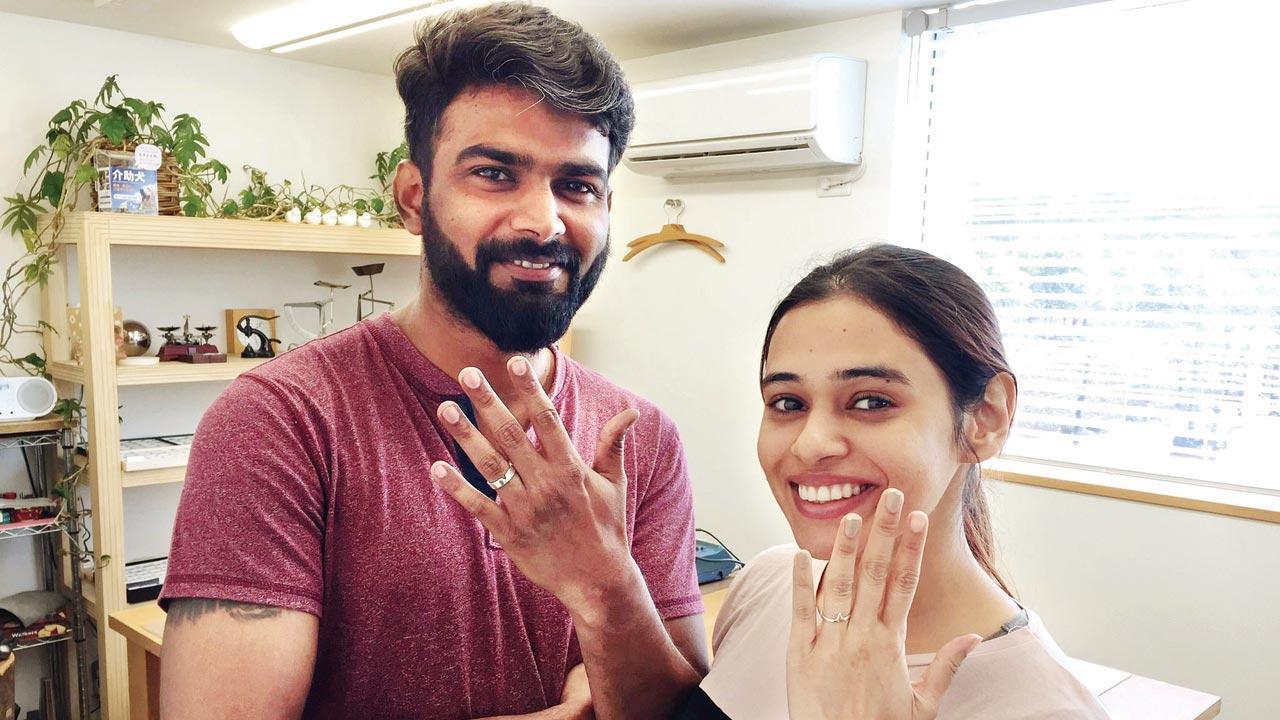
In her first interview post nuptials, singer Shalmali on how she wanted an intimate ceremony and making their own wedding bands in Japan
Mohar Basu (MID-DAY; December 1, 2021)
No Bollywood frills — that’s the apt way to describe Shalmali Kholgade’s wedding. The singer tied the knot with long-time boyfriend Farhan Shaikh in an intimate ceremony at her Andheri house on November 22. Ahead of their reception today at a five-star hotel in Mumbai, Kholgade says the first week of her married life has been pure bliss.
“The ceremony was exactly how Farhan and I had dreamt of, for as long as we can remember. We had only family and friends in attendance, about 15 people, all of whom could fit in the living room. People thought the low-key wedding was because of the new variant [of the virus], but this is how we always wanted it,” beams the new bride.
The couple did not shy away from including a DIY element in their nuptials, and made their own wedding bands. Attending a ring-making workshop in Japan during a 2017 vacation came in handy. “We had told each other then that if this relationship goes all the way, these could pass off as our wedding rings. Four years on, these are actually our wedding rings. There is a triangle on my band, and a carved triangle on his. One is meant to fit the other.”
Sounds romantic and dreamy, until Kholgade sportingly drops the punch line. “We were so lazy that we didn’t even polish them before our wedding!”
The singer, every bit the radiant bride, says marriage has brought in “a surreal bond”. “Even in my wildest dreams, I didn’t imagine being this happy. We have lived together for six years, so nothing is changing. But being married to someone who knows every mood of mine is special.”
When Pareshaan came out, my friends from college said, ‘that’s not you!’-Shalmali Kholgade
8:09 AM
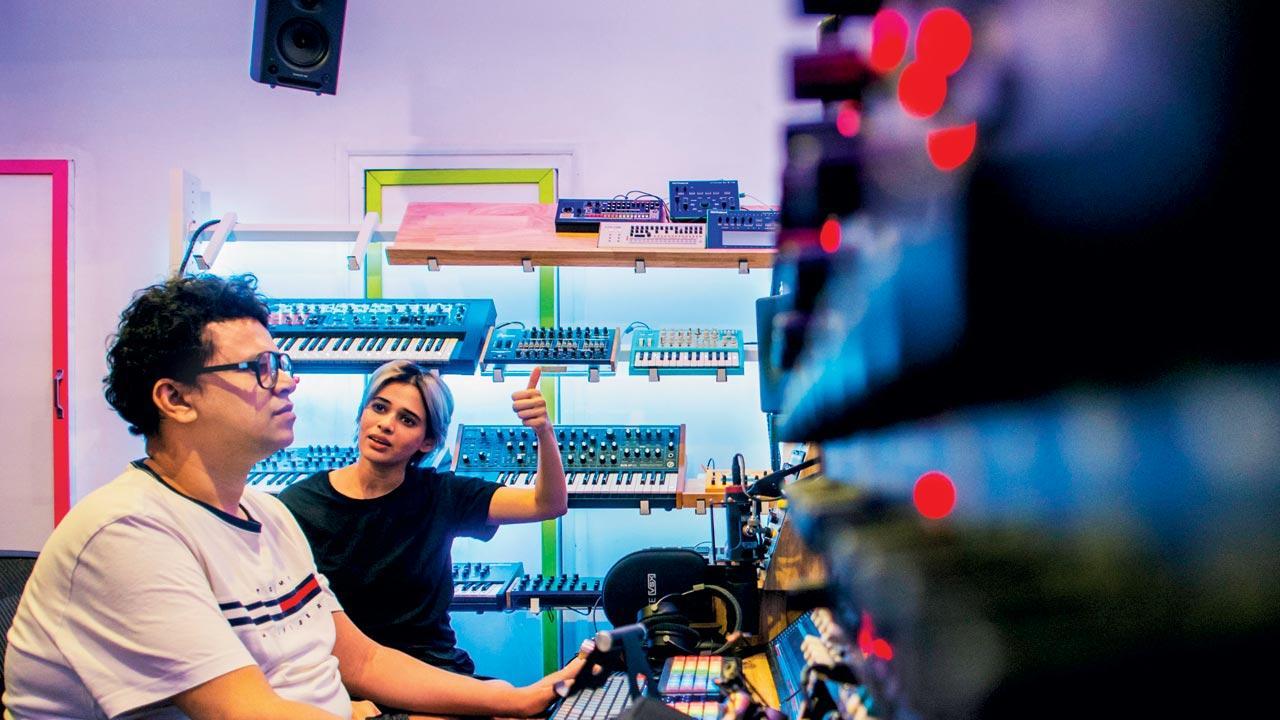
Despite a shining Bollywood playback career, Shalmali Kholgade has gone back to her college dream of being an English independent music singer-songwriter. Her debut album with producer Sunny M R is unabashedly 'Amy Whinehouse' and could be the gamble that was worth taking
Aastha Atray Banan (MID-DAY; May 2, 2021)
It was in 2012 that singer Shalmali Kholgade burst on the scene with the stunning Pareshaan from Arjun Kapoor and Parineeti Chopra’s debut film Ishaqzaade. Ever since, it’s been one Bollywood hit after another—her strong voice shining through in Balam Pichkari (2013) and Baby Ko Bass Pasand Hai (2016) among other masala numbers. So when we put our headphones on and pressed play on her indie English album, 2X Side A, we didn’t really know what to expect.
A friend, who had seen Kholgade perform at festivals while she was a student at St Xavier’s in Mumbai, offered this perspective—“she has gone back to what she had started out with and it’s so good to hear”.
When we share this with Kholgade on a Zoom call, the 31-year-old singer laughs. “Yes, exactly. This is what I always wanted to do. When Pareshaan came out, my friends from college said, ‘that’s not you!’ This is what I have always wanted to be—a singer-songwriter.”
If the album is anything to go by, Kholgade has crossed over into another realm. Produced by composer and sound engineer Sunny M R, who has composed for many a Telugu movie, and worked as sound designer for Race 2 and Barfi!, the album has an R&B vibe that’s mellow but distinct. When you hear Kholgade’s smooth, yet strong vocals, you may not associate her with the Bollywood songs she has rendered. It’s also been mixed and mastered by Stuart Hawkes, who mixed late British singer, Amy Winehouse’s record-breaking album, Back to Black. The work put in shows, and shines.
“I had started writing the music and lyrics four years ago, when I was at Berkeley, where my instructors told me I had a Soul style of writing. I had even sent Sunny a recorded voice note of the song, Uncool, and he said, let’s do it. And then last October, we got into a studio. It was Sunny who gave it this shape,” she says.
Sunny M R, who loves John Mayer’s musical styling, has a candid take on it all. “We got Staurt to mix the album, because we wanted that Amy Winehouse feel. I think music these days is an amalgamation of all the music we have heard in our lifetime, and there is nothing that’s not really influenced by something.”
At this point Kholgade says, “Yes, I am so glad that he has said that. When I was writing the songs, I had that Winehouse treatment going on in my head.”
When it comes to the lyrics, Kholgade is honest that most songs, like the soulful Love You Double, were inspired by herself and her feelings about love. “I wrote Love You Double after a fight. I felt I had done something wrong, so I said I would love you double [to make up]. Most of these songs are about me—I don’t know how long I will be able to sustain this kind of writing, though,” she laughs.
As far as the business of music goes, both are aware that the market for English independent music in India is limited. But they hope to stay committed to doing what they love. “This is me, and I want to continue doing this. The best thing Bollywood taught me was how to be behind the mic. I am just so happy being here. And it may be at a nascent stage, but I think it will grow. It will for sure,” says Kholgade. “There is a certain kind of freedom in doing this. With music for any film industry, there are constraints you grapple with. But here, there is creative freedom,” adds Sunny M R.
They both are waiting for the release of the second part of the same album, Side B. It will also have six songs, though different in vibe and feel. “They will be less about heartbreak, and more about moving on,” he says.
Today, female singers and their songs are disappearing from the scene-Shilpa Rao
8:16 AM

Nikita Deb (HINDUSTAN TIMES; June 23, 2020)
The Bollywood music industry has always boasted of beautiful female voices in the form of legends such as Lata Mangeshkar, Asha Bhosle, Kavita Krishnamurthy, and many others. But lately, a lot of industry insiders and music lovers have pointed out the lack of female singers and songs for them in Bollywood.
Singer Shilpa Rao, who got a breakthrough with her unique voice in Bachana Ae Haseeno’s (2008) Khuda Jaane, says that she really “misses a good female album” in the industry today. “There is a situation today, where female singers and songs by female artistes are just disappearing from the scene. We have very beautiful female driven films, and I think, we need more female driven albums, too. Everyone keeps asking me why they don’t hear more songs from me in the mainstream, but this question can only be answered by the makers of the songs and albums,” says Rao, adding that this is a change that would be very welcome “because we have such great voices”.
Rao, who has been focusing more on her independent music career for a couple of years now, says that all her contemporary female singers are busy doing their own thing. “All the female singers are obviously making their own independent singles, like I have been singing ghazals for the last three-four years for no major return or anything, but just to satisfy myself and because it has been my upbringing. I am making a few singles as well, which are in the pipeline, and should be out this year. Neha Bhasin is doing her folk music, Shalmali [Kholgade] is doing her RnB music, so everyone is making their own stuff, and doing their own thing. But when people ask us where are the female voices, that’s not a question we can answer,” says Rao.
The Tose Naina Lage (Anwar; 207) singer adds that she is not asking for this change from a gender perspective, but from the point of view of talent capacity. “If you feel that yes, this female vocalist is doing justice to this film where the lead is a female, we should have a female voice sing for that film. When there is a conception of a film where the lead is a female, I would want to hear a female voice representing her attitude and personality and focus, so that is something that I would love to see. That is something that I am missing from the entire music scene. That is one change I would love to see. I just want to hear more beautiful voices irrespective of gender,” says Rao, clarifying that the problem doesn’t exist in the independent music scene where singers like Asees Kaur and Neha Kakkar are actively bringing out new singles.
I am now in my dirty girl zone-Shalmali Kholgade
8:02 AM
Award-winning artiste Shalmali Kholgade is getting ready with her singles, the first which she says is “Hindi trap”
Beneta Fernando (MID-DAY; December 18, 2016)
"It's not a singing kind of song but more of the listening kind,” says Shalmali Kholgade. The singer, who became synonymous with the song Pareshaan from the film Ishqzaade (2012), is just days away from releasing her first indie single. The 26-year-old artiste’s comment is neither a smug statement about her indie debut nor is she absolving herself with a neat disclaimer.
“‘Aye’ is based on trap, a subset of hip hop that has been doing well in the international music scene recently,” continues Kholgade, evoking inspirational girl-power divas Beyonce and Rihanna. The subgenre, exemplified by its use of synth, rhythmic snares and kick drums, is a first for Kholgade, who explains that her first indie track is going to depend heavily on music producer, Sunny Sanour. “It’s a fully produced track and a producer-based genre with tonalities of several instruments,” she adds.
Unlike many debut indie artistes, Kholgade is more assured, yet concerned that her listeners buy into her music. After all, her voice has been showcased several times with Bollywood hits, right from her first, Pareshaan, and Balam Pichkari (Yeh Jawaani Hai Deewani). She won a Filmfare Award for Best Female Playback Singer for the former and a nomination for the latter. From mainstream cinema to soulful jazz, Kholgade went on to sing in The Bartender albums – Mikey McCleary’s soulful twists to vintage Bollywood hits. The collaboration began after McCleary watched her tribute to the late Amy Winehouse.
‘Aye’, which releases on January 9, 2017, is just the first of many tracks to come. As versatile as her musical interests (which range from Hiatus Kaiyote to John Mayer), her upcoming tracks will explore other genres — there’s going to be a house dancer number, an acoustic one later — in Hindi and English. ‘Aye’ is a Hindi trap number, a mix that Kholgade is excited about; most of her work even in Bollywood has drawn from Western music forms, like that in Bombay Velvet. “I plan to release one track every month and, when I feel I am done, I’ll compile them into an album.” With lyrics written by Parag Agarwal, ‘Aye’ will have another first for Kholgade as director.
Hesitant to tell us what kind of video it might be (Kholgade just says “bold”), the artiste tells us that the video has tapped into “a faculty of her brain which I haven’t used before.” She went with the advice of McCleary, who on a flight back from a gig told her that if she knew exactly what she wanted in her video, she should do it herself. “When he said it would be a great learning curve, I was hooked. I think of myself as a student-like person,” she says.
“I love all kinds of music and I have my phases. I am now in my dirty girl zone,” she says explaining the lyrics and the video of the song. Hoping to undo stereotypes of what is expected of men and women, the song intends to address the freedom of expression. Male dancers in heels — the thing that French dancer Yanis Marshall is famous for — was intended as part of the video but dropped later on on account of not finding the right shoes.
We wonder if Kholgade is eager to break away from the things that she is best known for. Is it time for her to showcase her versatility just as much as her voice? “Inside me, there is this feisty person who wants to do just what she wants. It may seem I am challenging myself but it is genuinely who I am. In Bollywood, there is only so much that you can do. This is me putting down my thoughts,” she says.
Christina Grimmie's murder: Indian singers talk about security concerns in India
8:31 AM
Singers weigh in on security concerns while performing in India, in light of the recent murder of Christina Grimmie by a fan
Bryan Durham (DNA; July 3, 2016)
Fans and admirers are an unpredictable lot. At their best, they stand one as armies that cannot bear even the slightest slight against their idol; at their worst, the same idols need to take out restraining orders against them. Worse still, tragic incidents occur around gigs and concerts, with the idol at the receiving end of a fan’s attention and cruel intentions. Former The Voice USA contestant Christina Grimmie found out the hard way at a club where she was performing, that an enamoured fan had managed to smuggle a gun into the venue where she was playing. He shot her dead.
As artists in this country will tell you, most people in most places and venues are the best kind. But, at times, in certain places, crowds do get unruly. For example, earlier this year, a DJ was shot dead in North India for not playing a request. But by and large, such incidents are few and far between. We asked young, popular singers with legions of fans what their security concerns were and what precautions, if any, could be taken...

Shalmali Kholgade
Frankly, I haven’t imagined a situation like this, arising in my career. At least, not at this point. I have admirers and fans, but I have always assumed they are realistic in their idea of who I am. Having said that, during a government festival, college show or any public gig, it is important to have adequate security to avoid any unruly behaviour. My manager has the final say in what is safe for me to do and what not. I don’t question her judgement.

Anushka Manchanda
I usually don’t feel threatened during, before and after a concert. Sometimes there are huge crowds which are pushing and pulling, but I always have big, beefy security guards who are very vigilant, and my manager and team are super protective about me because I’m totally out there and never hold back. In different parts of the country and at different shows, the audience is always different. I would be more careful at a public show than a corporate one, or in the North of India than in the South. Danger can come from anywhere in any form. All you can do is be careful and not incite or invite trouble.

Neeti Mohan
This kind of an incident can happen to anyone irrespective of the quality of security measures undertaken, since artists generally get up, close and personal with fans at public events and there’s a high risk of threat to life when it comes to any public figure. However security measures such as screening of all fans at entry points with metal detectors, assigned artist security personnel, personalised electronic gate passes for all crew members, sniffer dogs at key access points, screening of meet-and-greet fans is a must. I would even go the extent of suggesting artists wearing bullet-proof jackets, artist’s families being insured and organisers ensuring all ticket holders have a clean police record. Artists in India don’t have standalone security riders really and that would be a great start to things. The basic requirement of venues being patrolled by local police and then being cordoned off 12 hours before a show is a must, with sound check happening only 24 hours before the show instead of the general norm of an hour before the show. Backstage green rooms should have strict regulations minus the ad hoc walk-ins and the live stage should also have armed personnel and not just stage managers. But I think, at the end of the day, if someone is mentally unfit, the chances are he or she will find a way to do something socially unacceptable. At the end of it, artists and fans are very closely integrated and no amount of monitoring can really protect an artist from a calamity of this sort.

Jasmine Sandlas
What happened to Christina Gimmie is heart-breaking. I pray that her loved ones find solace in the memories that they have shared together. As a performer, this incident doesn’t motivate me to necessarily beef up my security but it reveals to me that there should be an effort to increase awareness of mental health issues and treatments. I feel that there are many signs of distress before an act of violence is committed. It’s important to recognize these signs and get professional help before it’s too late. This way, we can combat the bigger issue at hand. I hope something like this never happens to anyone again.

Shipra Goyal
Often, I get to hear news of skyfires (celebratory gunfire), at our very own Indian weddings, which sometimes end up in untoward accidents. We all are aware of this. Not only weddings, though. Apparently, clubs in the metros are not safe either becasue sometimes one hears of people entering with guns. So, as an artist, it scares me, if the venue I am going to be performing at, a history of such incidents. I clearly refuse to go onstage Or the event managers or organising people they have to make sure of my security and remove any alien element or threat present in my audience. For security reasons, I have my personal bouncers present with me during all my shows. But yes I feel there is a strong need for change in regard to security of artists across the globe because not just this one case, there have been numerous of artists shot down dead while performing in Punjab or Pakistan, too!
Bryan Durham (DNA; July 3, 2016)
Fans and admirers are an unpredictable lot. At their best, they stand one as armies that cannot bear even the slightest slight against their idol; at their worst, the same idols need to take out restraining orders against them. Worse still, tragic incidents occur around gigs and concerts, with the idol at the receiving end of a fan’s attention and cruel intentions. Former The Voice USA contestant Christina Grimmie found out the hard way at a club where she was performing, that an enamoured fan had managed to smuggle a gun into the venue where she was playing. He shot her dead.
As artists in this country will tell you, most people in most places and venues are the best kind. But, at times, in certain places, crowds do get unruly. For example, earlier this year, a DJ was shot dead in North India for not playing a request. But by and large, such incidents are few and far between. We asked young, popular singers with legions of fans what their security concerns were and what precautions, if any, could be taken...
Shalmali Kholgade
Frankly, I haven’t imagined a situation like this, arising in my career. At least, not at this point. I have admirers and fans, but I have always assumed they are realistic in their idea of who I am. Having said that, during a government festival, college show or any public gig, it is important to have adequate security to avoid any unruly behaviour. My manager has the final say in what is safe for me to do and what not. I don’t question her judgement.
Anushka Manchanda
I usually don’t feel threatened during, before and after a concert. Sometimes there are huge crowds which are pushing and pulling, but I always have big, beefy security guards who are very vigilant, and my manager and team are super protective about me because I’m totally out there and never hold back. In different parts of the country and at different shows, the audience is always different. I would be more careful at a public show than a corporate one, or in the North of India than in the South. Danger can come from anywhere in any form. All you can do is be careful and not incite or invite trouble.
Neeti Mohan
This kind of an incident can happen to anyone irrespective of the quality of security measures undertaken, since artists generally get up, close and personal with fans at public events and there’s a high risk of threat to life when it comes to any public figure. However security measures such as screening of all fans at entry points with metal detectors, assigned artist security personnel, personalised electronic gate passes for all crew members, sniffer dogs at key access points, screening of meet-and-greet fans is a must. I would even go the extent of suggesting artists wearing bullet-proof jackets, artist’s families being insured and organisers ensuring all ticket holders have a clean police record. Artists in India don’t have standalone security riders really and that would be a great start to things. The basic requirement of venues being patrolled by local police and then being cordoned off 12 hours before a show is a must, with sound check happening only 24 hours before the show instead of the general norm of an hour before the show. Backstage green rooms should have strict regulations minus the ad hoc walk-ins and the live stage should also have armed personnel and not just stage managers. But I think, at the end of the day, if someone is mentally unfit, the chances are he or she will find a way to do something socially unacceptable. At the end of it, artists and fans are very closely integrated and no amount of monitoring can really protect an artist from a calamity of this sort.
Jasmine Sandlas
What happened to Christina Gimmie is heart-breaking. I pray that her loved ones find solace in the memories that they have shared together. As a performer, this incident doesn’t motivate me to necessarily beef up my security but it reveals to me that there should be an effort to increase awareness of mental health issues and treatments. I feel that there are many signs of distress before an act of violence is committed. It’s important to recognize these signs and get professional help before it’s too late. This way, we can combat the bigger issue at hand. I hope something like this never happens to anyone again.
Shipra Goyal
Often, I get to hear news of skyfires (celebratory gunfire), at our very own Indian weddings, which sometimes end up in untoward accidents. We all are aware of this. Not only weddings, though. Apparently, clubs in the metros are not safe either becasue sometimes one hears of people entering with guns. So, as an artist, it scares me, if the venue I am going to be performing at, a history of such incidents. I clearly refuse to go onstage Or the event managers or organising people they have to make sure of my security and remove any alien element or threat present in my audience. For security reasons, I have my personal bouncers present with me during all my shows. But yes I feel there is a strong need for change in regard to security of artists across the globe because not just this one case, there have been numerous of artists shot down dead while performing in Punjab or Pakistan, too!
Lauren Gottlieb rings in her birthday with a charitable cause
7:51 AM

Lakshmi V (BOMBAY TIMES; June 13, 2016)
 It has been four years since
Lauren Gottlieb settled in India, and the dancer-actress says she
always wanted to give back to the country that helped her carve an
identity of her own. This year on her birthday, she took the first
step towards it by launching Leap for Hunger - an initiative that helps
to pursue her passion for dancing and do her bit for the
underprivileged. “I've got a lot from India - friends, fame and a good
living. And it has always been on my mind to do something in return. Food
is the most basic need of humans, and
by feeding them a meal, we are not only satiating their hunger, but also
sharing our love and spreading joy,“ she begins.
So, how did the idea originate? Lauren says, “A month ago, when I was thinking what I should do for my birthday, I realised I didn't want to host a bash or celebrate it by cutting a cake. I wanted to contribute to the society and that's when the name, concept and execution plan fell in place. I'm passionate about teaching dance, but I've never done it in India. So, I decided to conduct a free dance class for those who are equally passionate about it.“ “And while nurturing their creativity, I thought it would be a nice gesture to treat the underprivileged kids to some good food too,“ she adds.
The artiste admits that get ting volunteers was like a social experiment for her. She explains, “I spread the word on social media by posting a video, inviting people to learn dance, and at the same time, volunteer for the cause. I didn't know if people would sign up, but 1,500 people registered with us and the first 400 got a chance to participate. We held the first event on June 8. While I taught the participants some interesting steps, my team of people put together boxes comprising food items like water, juice, burger, fruits, crackers, cookies and chocolates. At the end of the event, we had about 1,000 boxes, which we distributed at NGOs, orphanages and the church. As part of this initiative, I also went to the slums off the Sea Link, where I had spent three months of my life shooting for ABCD: Any Body Can Dance. It was one of the happiest moments of my life that I will cherish forever.“
Lauren's friends from the industry also lent their support to her endeavour. “Ileana D'Cruz is a dear friend; she came early and was involved in the whole event. She even bought cookies and helped us in putting everything together. Vishal Dadlani, Shalmali Kholgade and Ankit Tiwari joined us and even performed impromptu. Mouni Roy and Sooraj Pancholi also lent their support,“ she smiles. One of the biggest compliments came from her mother, who burst into tears after she heard about the initiative. The performer recalls, “I've supported many causes back home, but have never started one. So, my mum was very moved and happy for me. The smile on people's faces after we distributed the food boxes was the best birthday gift I could ever receive.“
She is now working towards taking this scheme across the globe. “We've got invitations from people from Chennai, Delhi and even Dubai to host a Leap for Hunger session there. I know we will not be able to solve the hunger problem in the world with this, but by doing our bit, I hope we can bring about a change,“ she signs off.

It's London calling for Shalmali Kholgade
7:38 AM

Mohar Basu (BOMBAY TIMES; March 30, 2015)
Shalmali Kholgade has been
on a roll and 2015 seems to have begun on a terrific note for the
playback singer and performer, who is gearing up to set the stage ablaze
in London. The artiste will be performing at one of UK's most iconic
venues - The O2 arena that has staged performances by notable
artists like Beyoncé, Britney Spears and Barbra Streisand, popular
rock band Bon Jovi and the hip-hop group The Black Eyed Peas. A R Rahman
is one of the few prominent Indian artistes, who has also performed at
this venue.
All set to get the Brits dancing to her quintessential peppy Bollywood
tunes, Shalmali says, “I've been fortunate to have had a whirlwind 2014,
doing what I love, travelling across the globe and this year too, holds
more promise than I ever imagined. I feel truly blessed and can't wait
to get on stage to perform the songs that people loved so much - Lat Lag
Gayi, Balam Pichkari, Besharmi Ki Height. It is going to be a magical
experience singing to audiences in London!“ She is hopeful that this
stint will cement her presence abroad as a performer, as well as open up
a wide market in the live-shows arena.
Shalmali Kholgade ready for her 12-city US tour
7:44 AM

Parag Maniar (BOMBAY TIMES; February 18, 2014)
Shalmali Kholgade, who gained popularity with the track Pareshaan (Ishaqzaade, 2012) is excited about her 12-city US tour, which will commence in March. Her 75-minute-act will be a multimedia audio-visual extravaganza, which will showcase a mix of music, colours, visuals and dramatic performances. Says she, “With this tour, my endeavour is to take things to a new level. All of us like an honest musical performance. When music, drama and dance are woven into a single fabric, the audience is bound to get a complete Bollywood experience.” The singer, whose other popular numbers include Lat Lag Gayi (Race, 2013) and Balam Pichkari (Yeh Jawaani Hai Deewani, 2013), has already performed across countries like Mauritius, Kenya, South Africa, Dubai, Bahrain, Muscat and Canada.
Subscribe to:
Posts (Atom)