Showing posts with label Shakti Samanta. Show all posts
Showing posts with label Shakti Samanta. Show all posts
Ashim Samanta to reimagine An Evening In Paris following Indo-French cinema tie-up
9:04 AM

Chaitanya Padukone (MID-DAY; February 20, 2026)
Was it Shammi Kapoor’s charm, filmmaker Shakti Samanta’s storytelling, or Shankar-Jaikishan’s music? Maybe it was all of these that made ‘An Evening In Paris’ (1967) a jubilee hit on its release. And it looks like the Kapoor and Sharmila Tagore-led musical, which has remained much loved over the decades, might have a sequel of sorts.
With French President Emmanuel Macron’s India visit putting the spotlight on Indo-French collaborations in cinema, Samanta’s son and filmmaker Ashim Samanta has revealed to mid-day that French national Georges-Emmanuel Morali has proposed “relaunching” the movie in France.
“If all goes well, and with the backing of proactive financial, creative, and governmental support, there is a possibility of a modern spiritual sequel, ‘An Evening In Paris’. Our home production has influenced French national Georges-Emmanuel Morali to consider relaunching this romantic film in France,” said Ashim.
The film has been envisioned as a love story between a French boy and an Indian girl. “The girl visits Paris after watching ‘An Evening In Paris’, and desires to see every heritage spot shown in the film. The French boy takes her to all those locations, and in the process, both fall in love. The clips of the scenes and songs from ‘An Evening In Paris’ would be seen in this movie,” explained Ashim.
Shakti Samanta shot Roop Tera Mastana as a background song, without rehearsals-Sharmila Tagore
2:59 PM
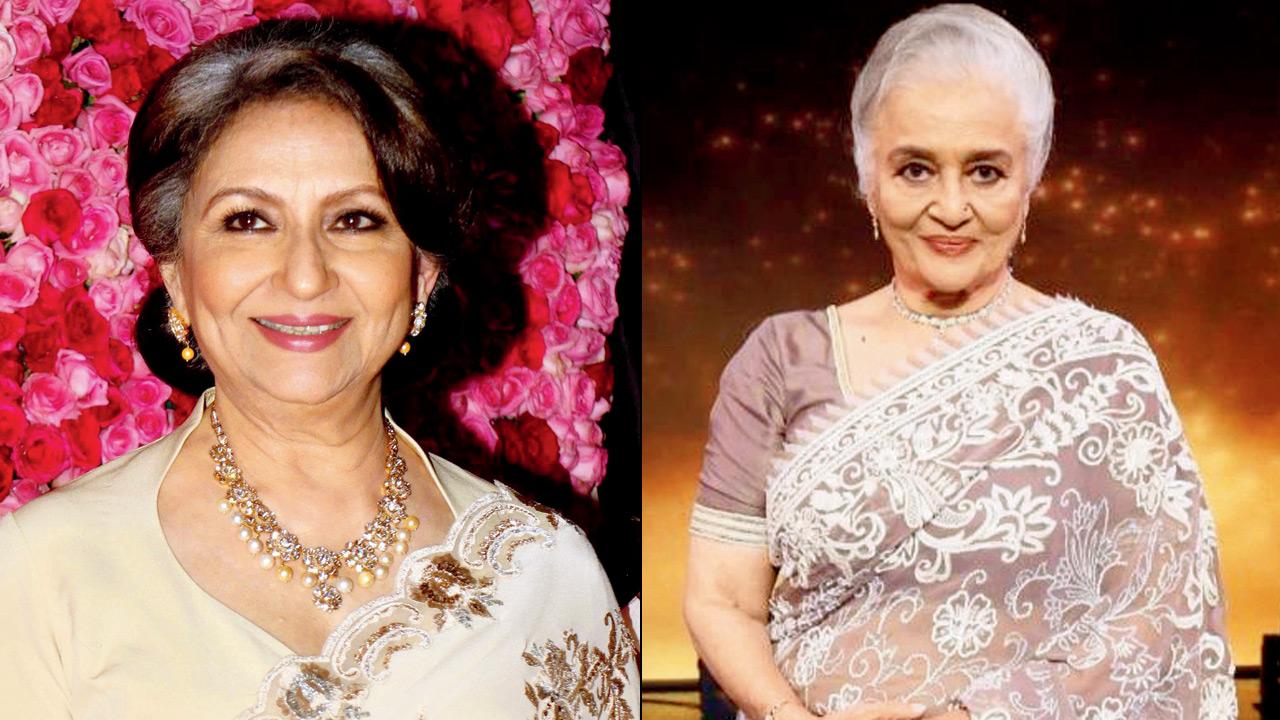
Sharmila Tagore and Asha Parekh take a nostalgic trip down Shakti Samanta lane as his restored hits stream online to mark his 100th birth anniversary
Upala KBR (MID-DAY; January 18, 2025)
Kuch Toh Log Kahenge, Logon Ka Kaam Hai Kehna… More than 50 years later, the iconic song from legendary filmmaker Shakti Samanta’s Amar Prem (1972) continues to resonate. January 13 marked the beginning of a month-long celebration for his 100th birth anniversary. The subscription-based platform Ultra Play OTT will stream 32 of his digitally restored Hindi films to honour the yesteryear filmmaker who gave us gems like Howrah Bridge (1958), Kashmir Ki Kali (1964), Kati Patang (1971), among others.
“I consider Amar Prem to be my best Hindi performance,” begins Sharmila Tagore. She laughs that she “looked very good” in it
“His movies have a repeat value, and his [film’s] songs have lived on forever. Music was his forte, but his films also had social relevance and his women were strong with a lot to say. Shakti da was a man of few words. He was always well-prepared and very efficient with his time. He shot the entire song Roop Tera Mastana [from Aradhana, 1969] as a background song, without rehearsals and lip syncing, in one shot, because we were pressed for time.”
Asha Parekh, his leading lady in Kati Patang and other films, says Samanta’s movies cracked the code for perfectly packaged entertainers. “He was one of the leading producer-directors of our film industry. It was a delight working with him because he was a fine person and an intense director,” shares Parekh, adding that Samanta often coaxed his actors to deliver multiple takes until he felt visually satisfied. His sincerity, she says, “impacted and influenced me”.
“Shakti da handed me Gulshan Nanda’s book Kati Patang and asked me if I’ll work with him. The film was a big hit.”
Rajat Agarwal of Ultra Media says Samanta’s films remain relevant even today. “They represent a perfect blend of emotion, music, and human connection. [The themes in his movies are] universal and ageless.”
Did you know?
For the song ‘Mere Sapno Ki Rani’ from ‘Aradhana’, Sharmila Tagore was not in Darjeeling during the shoot. She was busy filming another project. Shakti Samanta shot all of Rajesh Khanna’s portions on location in the hills, and later filmed Tagore’s train-window reactions in a Mumbai studio.
Why Mahesh Bhatt wept bitterly after the release of Do Raaste and later got Rs. 300 for it
8:42 AM

Avijit Ghosh (THE TIMES OF INDIA; May 20, 2025)
New Delhi: In the winter of 1969, a tornado named Rajesh Khanna barrelled through India. Two films created Hindi cinema's first superstar: Shakti Samanta’s Aradhana, shortly followed by Raj Khosla’s Do Raaste.
But the first few days of Do Raaste were uncertain at the box-office. Mahesh Bhatt, a young “production hand” in the film, wept bitterly over the film’s grim prognosis, says a forthcoming biography of Raj Khosla, whose 100th birth anniversary falls on May 31.
Khosla had already delivered superhits in a variety of genres: thriller CID (1956), suspenseful Woh Kaun Thi? (1964) and romantic drama Do Badan (1966) underlining his ability as an all-rounder. But his last two ventures, Anita (1967) and Chirag (1969), hadn’t fared well. Debt collectors were at the door.
Do Raaste, which he produced and directed, was based on Marathi writer Chandrakant Kakodkar’s novel, Nilambari. When the film opened at Bombay’s Royal Opera House on December 5, 1969, editor Waman Bhonsle and Bhatt were at the theatre.
Biographer Amborish Roychoudhury writes in the book, “A manager by the name of Desai, came to Bhatt and Bhonsle and said, “Saamne woh Shakti ki picture chal rahi hai Aradhana, woh advance mein housefull hai. Yahan par log nahin aate. Picture doobegi.” (Shakti’s film Aradhana, playing across the road, is running to full house in advance booking. No one is coming here. This film will flop.)
“When he heard this, Bhatt broke down. Bhonsle had seen it all before, but the young Bhatt, all of 20, was emotionally attached to the film,” says the book, co-authored by Anita Khosla and Uma Khosla Kapur, both director’s daughters.
The crisply-written book titled, "Raj Khosla: The Authorized Biography,” also says that the film originally ended with some “touching lines about mother-son relationship” which wasn’t working too well with the audience.
Khosla reached out to heroine Sadhana, with whom he had worked in four films. “Over the years, she had become a confidante and a sounding board. He showed her his films, and she told him what she felt,” writes Roychoudhury.
Sadhana suggested ending the film with a clip of the track, “Bindiya Chamkegi”, which was to become radio countdown show, Binaca Geetmala’s No 1 song of 1971. Khosla carried out the change.
Do Raaste “ran for more than 50 weeks at the same Opera House where the staff had written the film off.” Debt collectors were paid. Khosla announced a bonus for some staff members. Bhatt’s bonus was Rs 300, equivalent to a month’s wage. “He gave me 300 bucks extra to me for shedding tears!,” the biography quotes Bhatt as saying.
Khosla passed away in 1991. In the foreword, Bhatt describes him as “My mentor. My master.”
Badi amma (Sharmila Tagore) gives me advice on life, social media-Sara Ali Khan
8:16 AM

Niharika Lal (BOMBAY TIMES; May 15, 2024)
After wrapping up her morning shoot in Mumbai, Sara Ali Khan joined Sharmila Tagore in the capital recently. The ever-poised Sharmila Tagore had a fun partner in Sara Ali Khan as they spoke about their careers and wish lists. During a round of fireside questions, Sharmila Tagore joked that she would like to wear the five-inch heels on the red carpet like Soha.
At one point, the grandmother-granddaughter duo had some disagreement over which young heartthrob could be cast opposite Sharmila Tagore if the latter were to star in a rom-com. While Sara thought Ranbir Kapoor would be a classy option opposite her badi amma, Sharmila said, “Maybe Ranveer (Singh)!” Here’s a glimpse of all that transpired...
Sharmila Tagore’s advice to Sara if she had to do a biopic on her
Sharmila teased, “Must not copy my hairdo. But you have to because it’s recorded. You poor thing! Nandita Das copies me very well. I think Sara is going to do it her own way. Give me some years, hopefully then I will be around to teach more mannerisms.”
Sara responded, “A lot of grace will be required.” Sharmila Tagore quipped, “You have not seen my old films. There were many scenes where I stomped my feet and said, ‘Shut up!’” Sara warmly replied, “Yes, but gracefully.”
RELATIONSHIPS REQUIRE A LITTLE BIT OF FORGETFULNESS: SHARMILA TAGORE
About her idea of a life well lived, Sharmila Tagore said, “Sometimes it worries me that, ‘Oh! God, if something happens to me and the people I love aren’t there, I won’t be able to see them for the last time. It’s an awful thought, but sometimes all you want is to be loved by your family. But that doesn’t happen unless you nurture your relationships. Relationships require nurturing, kindness, a little bit of forgetfulness – letting things go. A little bit of amnesia could be a good thing.”
I WENT THROUGH A PHASE WHEN I NEEDED SUPPORT, AND BADI AMMA CAME LIKE AN ARMY: SARA
Talking about her bond with Sharmila Tagore, Sara said, “Ek hota hai that you are there in good times – Pataudi gaye aur phuljhariyan jalayi, ya London gaye aur Hyde Park mein Ibrahim ki chocolate churayi. Woh theek hai. But when things go south in life, and you need somebody (she is there). I went through a phase in life when I needed support, and badi amma came like an army. She was there for me. In times like that, you realize the true value of relationships. My parents don’t live together but despite that, there is a very appropriate equation that my grandmother shares with my mother, for which I respect both of them immensely. My mom doesn’t have parents, but if anything were to happen to me or Ibrahim, I know that she wouldn’t be alone because badi amma will be there, and that’s everything.”
She added, “She gives me advice on how to manage a lot of things – my life, social media. I think the sense of politeness, of balance, taking it seriously but not over-obsessing – these are ongoing reminders. But she has taught me these not just because she is an actor herself but also because she is an extremely balanced person.”
The bikini story has never been forgotten: Sharmila Tagore
Sharmila Tagore recalled, “It was a Filmfare cover. There were a lot of adverse comments as well as positive comments. It created a huge stir, so there was a lot of learning. I thought I looked very nice in that costume. If I wore it now, it would be odd. Back then, Shakti ji (Samanta), my director, called and said that we have to do some damage control. Not damage control as such, but I decided to change my image. I realized that this glamorous image doesn’t stay in people’s minds forever. So, if you make a place in people’s hearts as a person and not just as a glamorous individual, they could be more loyal to you. The films I chose, I chose with care, like Aradhana and Amar Prem. Of course, the bikini story has never been forgotten. Once upon a time, it was frowned upon, and then it became a very feminine and feminist thing to do. I just thought I had a good figure and I wanted to show off. I still feel that there was nothing wrong. But one needs to learn that you are not living on an island; we need to coexist.”
There was a time when opinions were formed on magazine covers, now they change every day: Sara
Sara added, “It is very important, no matter what age and stage we are, to have a strong sense of self and not seek validation externally. As an actor, I love my audience. I have been taught by my family that when you love, you are loved back. But here (with the audience), it’s not the same. Aur worse tab hota hai jab aapko yahan le jate hain aur phir yahan le aate hain (gesturing ups and lows). It’s not even about movies anymore. There was a time when opinions were formed on magazine covers, then they were formed at the Friday box office. (Now it’s like) Today, I did something good, people like me; tomorrow, I did something bad, people write me off. So I think it is important to surround yourself with like-minded people; otherwise, all of it could be very daunting.”
RANBIR OR RANVEER?
When Sara was asked who she thinks would star opposite Sharmila Tagore in a modern rom-com, if she were to do one, Sara said, “Ranbir Kapoor. I think that you need class to star opposite badi amma.”
When Sharmila Tagore disapprovingly nodded, Sara said, “So, who do you want Ranveer Singh? Sharmila Tagore responded, “Why not?” Sara joked, “So Ranveer Singh it is. There is another DP in the house!”
Koffee With Karan: Sharmila Tagore recalls being 'trolled' for her bikini shoot: Questions were raised in the Parliament
10:33 AM

On Koffee With Karan, Sharmila Tagore revealed while the world criticised her bikini photos, husband Mansoor Ali Khan Pataudi supported her
Bohni Bandyopadhyay (MID-DAY; December 28, 2023)
Sharmila Tagore created quite an uproar when she appeared in a bikini for a magazine photoshoot in the mid-sixties. Indian actresses dressed more modestly back than and posing in a swimsuit was unheard of. The actress' bold move, which has been lauded over the years, was hugely criticised back then.
The 79-year-old actress graced the couch on Koffee With Karan season 8 episode 10 with son Saif Ali Khan. The conversation began with the infamous bikini photos as a topic. Host Karan Johar, while eulogizing Sharmila, said, "Not only were you a huge megastar, you broke ground. Your famous bikini shot..." Sharmila chuckled.
"Nobody else wanted it to happen, right? I have heard that the photographer had some anxiety issues about that," Karan continued.
Saif interjected, "People in boarding school used to tell me, is that your mum? I used to be very proud of it."
Sharmila said, "Yes the photographer was slightly worried. I just thought I looked very nice. What had really hurt me later was that everybody had interpreted in such a way, that I was upwardly mobile, I was trying to catch eyeballs. I didn't feel like that."
She recalled being reprimanded by filmmaker Shakti Samanta, but gaining support from her husband Mansoor Ali Khan Pataudi (aka Tiger).
"When it came out in Filmfare, I was in London. I was unaware (of the criticism), till Shakti ji called me and said, 'Will you come back quickly? Terrible things are happening here.' He gave me a dressing down. He said, 'If you want to be in the public eye, this is not the way to go.' I used to live alone and I was very upset with all these... completely opposite of what I thought would happen. So, I sent a telegram to Tiger. He said, 'I am sure you are looking very nice.' That was my support," Sharmila shared.
Karan pointed out, in many ways perhaps, Sharmila was the first to experience trolling. "A version of trolling, which is also what happens on social media today," Karan said.
"Totally, yes. I think questions were raised in the Parliament. It was not pleasant for me. But learning I did. And after that I was very careful. I chose Aradhana," she said.
"What a blockbuster," Karan added. "Yes, RRR of our time," said Sharmila.
-------------------------------------
On Koffee With Karan, Sharmila recalls Tiger Pataudi and her first reactions to Saif-Amrita marriage; says they were a good fit as they made each other laugh
Mohar Basu (MID-DAY; December 28, 2023)
In a departure from its usual controversies, the eighth season of Koffee With Karan is turning out to be a treasure trove of unheard personal stories. Sharmila Tagore and actor-son Saif Ali Khan have graced the latest episode of Karan Johar’s chat show. In the Disney+ Hotstar offering, the veteran actor revealed details about how Khan and his ex-wife Amrita Singh got married without informing anybody.
Tagore recalled, “I was visiting Mumbai. Saif met me and said, ‘I have something to tell you,’ and then he told me. I was [initially] quiet and then said, ‘Okay, we will talk about it later.’ After he left, I rang Tiger [Mansoor Ali Khan Pataudi], told him and there was a long silence.” The veteran actor added that when they met Singh, they took an instant liking to her.
Grateful that his parents were ‘supportive’, Khan said, “I was 20 years old, ran off and got married without telling anyone. It’s not a nice thing to do to your parents.” While Khan and Singh went their separate ways after 13 years of marriage, Tagore remembered those times as ones filled with laughter. “When they talked, there was a lot of laughter, a lot of mimicking other people. He is good at mimicry and she is a great storyteller. So, they looked very happy together.”
Earlier, we had to wait for hours for the hero to arrive on the set-Sharmila Tagore
8:32 AM

Fourteen years after Antaheen, Sharmila Tagore will be back on the big screen, as Rituparna Sengupta’s mother in a Bengali film. Highlights from a conversation about her role & male co-stars
Ruman Ganguly (BOMBAY TIMES; September 4, 2023)
A challenging role ahead
I’m very fond of Rituparna. I watched her in Mondo Meyer Upakhyan and was impressed by her performance. When she approached me with the script of Puratawn, I knew I had to do it. I’ve seen Suman’s (Ghosh’s) work. He’s a sensitive director. Over 60 years, I’ve done good, bad, indifferent and glamorous roles. If I can pull off this challenging role, it will be one of my better ones.
Juggling Aradhana & Aranyer Din Ratri
I cannot really explain how I managed to balance my work with Satyajit Ray and my Hindi films. I went with my directors’ instructions, be it Hindi or Bangla. During Aradhana, we were shooting for ‘Sapno Ki Rani’ in Darjeeling, and Manik da (Satyajit Ray) called me to say he needed my dates for a month. I told Shakti ji (Samanta) that I was going and he didn’t know what to do! Saying no to Manik da was impossible, so he had to let me go. When Aradhana became a hit, I guess Shakti ji’s anger subsided, even though I had to leave the set for a month!
Manik da was always supportive of my Bollywood career. Most Bengalis were disapproved of my move to Mumbai, but he simply smiled at all the criticism.
No more waiting for hero ki entry!
The entertainment industry is a better and far more professional space now. People are on time, there is a proper script and costumes, a break after every five days. It’s a very comfortable environment for us seniors especially, to work in. Earlier, we had to wait for hours for the hero to arrive on the set. Now everyone comes on time and most importantly, people come to the floor only after having read the script and well prepared. Besides, thanks to improved sync-sound, we hardly need to dub.
On an OTT set, that’s teeming with bright young women, the energy is infectiously high and positive. While these days we get our scripts written in the Roman script, I still prefer to read a Bengali script in Bangla, Hindi script in Hindi and an English script in English. English is a language of power and is important, but a script should be written in the language it is meant to be spoken.
----------------------------------------------
Kolkata has not changed much. While the potholes are the same, I do see some of the beautiful old buildings being replaced by modern structures that remind you of Delhi
----------------------------------------------
My husband (Mansoor Ali Khan Pataudi) knew only one Bengali phrase: ‘Tumi jodi ponero minute ready na hoteh paro, ami chole jabo!’ (If you can’t get ready in 15 minutes, I will leave). When I get annoyed with my children I feel like telling them, ‘Poramukho!’ (laughs).
----------------------------------------------
I can’t eat street food like ghugni, phuchka like I used to. Now I eat very boring food!
----------------------------------------------
When I got into acting, my teachers said I would be a bad influence on other students, so I had to switch to another convent school. But I learned Sanskrit and Bengali. Bangaliana comes naturally to me
----------------------------------------------
Can’t believe I’ll be working with Sharmila Tagore, my idol! She had once hinted that she’d be interested in a Bengali film again, if the script was good. That’s how Suman and I developed this story
– Rituparna Sengupta
Utpal Dutt was a voracious reader, he must have also read Shakespeare a million times-Ashim Samanta
8:04 AM

Roshmila Bhattacharya (MUMBAI MIRROR; August 19, 2020)
 “I never saw Dada without a book on the sets. Between shots, he was always immersed in an English novel whose cover changed every few days,” recalls filmmaker Ashim Samanta about his father producer-director Shakti Samanta’s frequent collaborator Utpal Dutt. “Curious, I once asked him how long it took him to complete one and Dada said three-five days. A voracious reader, he must have also read Shakespeare a million times.”
When still in college, Dutt toured with Geoffrey Kendal’s Shakespeareana Theatre Company across India and Pakistan for two years, playing Brutus in Julius Ceaser, Horatio in Hamlet and Antonio in The Merchant Of Venice. Within three years of Independence, he set up a cosmopolitan theatre group, Amateur Shakespearana, adapting Julius Ceaser in contemporary costumes and bringing a World War setting to the stage. For him it was, to quote Jacques from As You Like It, “All the world’s a stage; And all the men and women merely players.” And it was in a play in Kolkata, in the early ’70s, that Shakti da spotted him. He had already accepted Hrishikesh Mukherjee’s Guddi to pay off a Rs 12 lakh debt brought on by theatre, and agreed to play the main villain in Shaktida’s Hindi-Bengali bilingual, Amanush.
Based on a novel by Shaktipada Rajguru, the film revolved around the misunderstood scion of a zamindar family, Madhusudhan Roy Chaudhury, reduced to a much-maligned, misunderstood penniless drunk by the family munim, Maheem Ghoshal. Ghoshal is eventually unmasked and Madhu, absolved of all blame, is reunited with his lady love, Rekha, by inspector Bhuvan during a short time in the small fishing village. “It was the description of this village in the Sundarbans that caught dad’s interest. He met the writer and asked him if he’d actually visited this place he had described so vividly. When Rajguru admitted to having been there, dad got into a boat with him and his cinematographer, Aloke Dasgupta, excited to see it for himself,” Ashim recounts.
 By the time they reached, it was evening. In the gathering gloom, the place looked deserted, desolate and unlike the Eden of his dreams. Disappointed and far away from home, Shakti da decided to sleep in the boat and spent the night warding off swarms of mosquitoes. At some point, he nodded off. His eyes opened around dawn and the picture he saw took him back to the remote village in the Sundarbans with a unit of 150, which included Bengal’s matinee idol Uttam Kumar, who played Madhu, Sharmila Tagore, who was cast opposite him and Dutt as the wily munim. “Amanush began with the titles playing out against the colours of a glorious sunrise he had woken up to that day and captured on screen for posterity,” he narrates.
The village had only a handful of huts. Shaktida built pucca houses at a height of three-four feet to ward off snakes, as also crocodiles and baby sharks, which infested the surrounding waters. The famous Royal Bengal tigers prowled the surrounding jungles, but the light from three generators he’d carted along, ensured they kept their distance. “They were there for almost 40-50 days and dad was so happy with Dada, both as a person and an actor, that after Amanush, he became a regular in our films,” says Ashim.
He remembers that the introverted Dutt, who only visited their home for the occasional party when in Mumbai, was jovial during shoots. “I was still studying during Amanush, but whenever I dropped by, I’d see dad, Dada and Uttam Kumar laughing. Dada walked with an exaggerated limp in the film and many of the jokes centered around his gait and speech,” Ashim reminisces, pointing out that Dutt had great comic timing which was evident in Amanush, and brought on the laughs in films like Gol Maal, Naram Garam and Shaukeen, starting the trend of comic villains patented by Shakti Kapoor, Kader Khan and Amrish Puri in later years.
Three years after Amanush, Shakti da returned to the Sundarbans. “The houses dad had built for Amanush had been handed over to the locals, who were able to boost tourism by renting them out to holidaymakers and globetrotters. He had them renovated for another long outdoors for Anand Ashram,” informs Ashim, about the film revolving around three generations, with Ashok Kumar as the grandfather, Uttam Kumar as his estranged son and Rakesh Roshan his grandson.
A third bilingual was Anusandhan/Barsaat Ki Ek Raat, based on another Shaktipada Rajguru novel, Anusandhan, with Dutt as the corrupt Sahuji, who, with his son Kaliram, unleashes a reign of terror in a slumbering hill station, till a stranger in a Sombrero hat comes in their way. “Amjad Khan as Kaali was the main villain, Dada was there only for the first 25-day schedule in Darjeeling and we had a blast,” he reminisces. Their last film together was the Indo-Bangladeshi co-production, Aar Paar. “Unfortunately, I couldn’t go to Bangladesh and very little was shot here. But Dada was absolutely brilliant as the crooked and lecherous greedy Mahesh Manna.”
The world continued to be Utpal Dutt’s stage, till the curtains came down on August 19, 1993.
An Evening in Paris: When Shammi Kapoor had to fortify himself with a huge peg of brandy for the helicopter shot
7:54 AM

Roshmila Bhattacharya (MUMBAI MIRROR; August 16, 2018)
This story goes back to Singapore, when Shakti Samanta was shooting his 1960 thriller, Singapore, there with Shammi Kapoor. The filmmaker was going through a rough patch because Naughty Boy, the romcom he was producing and directing with Kishore Kumar and Madhubala, had stopped abruptly after 10 reels. The doctor had forbidden Madhubala to shoot for even a day after they detected a hole in her heart. The film had to be re-shot with a new heroine, Kalpana, leaving Shakti in the red.
“Noticing the worry writ large on his face, Shammi uncle asked him one day why he’d retreat into a shell occasionally and dad explained what had happened,” Shakti’s son Ashim reminisces. “Shammi uncle told him to start another film with him, pointing out that since his market was good, he’d be able to sell it easily and get money. That’s how China Town happened, after which dad never looked back.”
However, while they were shooting the film which had Shammi in a double role, money was tight and Shakti requested Shammi to delay the last instalment till after the release. China Town was a huge hit and 10 days after it opened, the filmmaker went to Shammi’s house with the balance. He was left sitting in the living room for 10 minutes. On his return Shammi told him he’d been speaking to a top actor who when told that Shakti had delayed the payment, had snidely remarked, “Tab to tere paise mile.” “I told him my friends are not like his, you’re here now with the money,” he informed.
Shammi, Shakti and Jaikishan (from the Shankar-Jaikishan composer duo) were the three musketeers who went by the names of Shammi, Shaky and Jacky and it was a given that Kashmir Ki Kali would have music by Shakar-Jaikishan. But just before it rolled, O P Nayyar who’d worked with Shakti in two films, including Howrah Bridge, confided that he was going through a bad patch and had many songs in stock. Not wanting to disappoint, Shakti hopped over to O P Nayyar’s music room where the composer played around 100 tunes for him from which he selected 20. The next day he called Shammi to tell him about this treasure trove. “When he demurred saying they had already decided on Shankar-Jaikishan, dad suggested they visit O P Nayyar’s music room together that evening to listen to these 20 tunes. If he didn’t like them, they’d go back to S-J. Shammi uncle picked 12, eight were used in Kashmir Ki Kali and four in Sawan Ki Ghata,” narrates Ashim.
For An Evening in Paris they went back to Shankar-Jaikishan and for “Aasmaan Se Aaya Farishta” came up with the brainwave of having Shammi serenade Sharmila Tagore from a helicopter with Shammi suggesting he hang out from it. But on the day of the shoot in Beirut, he had an attack of nerves and had to fortify himself with a huge peg of brandy. “But then they realised that the roar of the helicopter was drowning out the music so dad stood right below and mimed the lines with his mouth. Reading his lips while hanging from the sky, Shammi uncle synced it perfectly. It was an incredible feat,” marvels Ashim
They did two more films together, Pagla Kahin Ka and Jaane Anjaane and Ashim remembers his uncle as a flamboyant guy, full of life and fun, and a flirt who’d stand on the balcony attached to their hall, blowing kisses at the girls screaming his name from their balconies and they’d swoon. “He was our Elvis Presley, even off screen. There’s never been another star like Shammi Kapoor,” he asserts.
Shakti Samanta bid the world goodbye on April 9, 2009. On August 14, 2011, it was curtains for Shammi but their “Asmaan Se Aaya Farishta” lives on.
Sharmila Tagore's bikini scene was cut during a screening on Doordarshan-Shakti Samanta
7:39 AM

Madhubala in Howrah Bridge; Shakti Samanta; Sharmila Tagore in a still from An Evening in Paris
Roshmila Bhattacharya (MUMBAI MIRROR; January 18, 2018)
I met Shakti Samanta just once, at his office in Natraj Studio, and over a couple of hours, I discovered that the stories behind his jubilees were just as fascinating. Tall, with an almost expressionless face, Shaktida, as he was fondly called, though in his 80s and by his own admission not keeping well, still reminded me of a cop. He surprised me by revealing he’d play some bit roles as an inspector, before going on to direct Inspector, featuring Ashok Kumar as the inspector this time, chasing after a car, like he’d done before.
Interestingly, it was a car that resulted in the crime-thriller, Howrah Bridge, whose song, “Aaiye Meherbaan” showcased Madhubala in a glamorous avatar as club singer Edna. It also had Helen doing a “Mera Naam Chin Chin Chu” but for me it was Madhubala’s showgirl oomph that made this Howrah Bridge unforgettable.
Soon after Sheroo, Shaktida was in hospital after crashing his car, with three broken ribs, when in two weeks of forced bed-rest, he came up with the idea of Howrah Bridge which launched his banner. He contacted Ashok Kumar as soon as he came out of hospital. The actor was game, even interceding with Madhubala’s father on his behalf. She shot for his film at the same time as K Asif’s Mughal-E-Azam. “Even as she swayed to 'Aaiye Meherbaan' in a short dress she’d be doing a 'Pyar Kiya To Darna Kya' at Badshah Akbar’s court later in the day,” Shaktida informed, his impassive face breaking into a rare grin.
The following year, Madhubala returned to the screen in his second production, Insan Jaag Utha, this time building a dam with Sunil Dutt. A hat-trick followed with Jaali Note but this time his partner reneged on their verbal agreement and Shaktida laughed that the film lived up to its title even in real life. His fourth film, Barood, was set in a coal mine, but Kishore Kumar who went on to marry Madubala, pointed out that she wouldn’t be able to shoot in a mine with her heart condition. So, Shaktida started Naughty Boy, a comedy with Kishore and Madhubala but after around 10 reels, she was too ill to shoot and he had to reshoot the film with Kishore and Kalpana. He ended up losing money again.
Kashmir Ki Kali put him back in the hit list. It introduced Sharmila Tagore, who’d impressed in Satyajit Ray’s Apur Sansar and Devi, to Bollywood and soon the entire nation was singing, “Yeh Chand Sa Roshan Chehra... Yeh Jheel Si Neeli Aankhen” along with Shammi Kapoor who choreographed the song himself. It didn’t matter that her eyes weren’t aquamarine, her dimples floored everyone.
Sharmila went on to do his Saawan Ki Ghata, but the film that turned her into a fashionista was An Evening In Paris. Sharmila, he confided, had been prepared to wear a bikini for the film — she even posed for a Filmfare cover in a two-piece — but Shaktida didn’t want to take on the censors, and settled for a more conservative swim-suit. “Despite this it was deemed vulgar by Mandi House officials four decades later, and the scene was cut during a screening on Doordarshan,” he shared.
More eyes rolled when Sharmila turned up in Aradhana, with Rajesh Khanna seducing her with “Roop Tera Mastana” then, calling her “ma”. The film made Rajesh Khanna the ‘Phenomenon’ and bagged Sharmila the Filmfare Award for Best Actress, silencing all detractors. Shaktida also bagged the Black Lady for Best Film.
The actor-director jodi would have collaborated on Kati Patang too, but Sharmila was expecting Saif then and had to reluctantly refuse. But she returned to do Amar Prem. This time however, they did not take home any awards because the film was a remake of a Bengali film and despite all the changes Shaktida incorporated was deemed ineligible. No one cried despite the disappointment because as Rajesh Khanna’s character says through the film, “Pushpa, I hate tears...”, Shaktida hated tears too. But he was back to claim more awards with Anurag and Amanuush.
The stories would have gone on had Shakti still been around. He’d have been 92 now, and going by our last conversation, still brimming with ideas. Devdas in 2002, with Prosenjit, he admitted had been a “mistake” but he’d been toying with another Sarat Chandra story. Which one? I’ll never know.
Amar Prem: Of tears and tribulations
7:51 AM

Roshmilla Bhattacharya (MUMBAI MIRROR; February 24, 2015)
Shakti
Samanta ended the swinging '60s with the intense Aradhana which gave
Bollywood its 'Phenomenon'. By the time Amar Prem inspired by
Bibhutibhushan Bandopadhyay's Bengali short story, Hinger Kochuri
started, Rajesh Khanna's diary was packed, yet he insisted on playing
Anand babu. "I don't want you to cancel any dates, mujhe kissi producer
ki baddua nahin chahiye," Samanta warned. The star told him he'd pack-up
his other film and be at Natraj Studio by 4 pm. "But will you reach the
other set on time every morning?" Samanta asked. Kaka promised he
would, and kept his word.
In an earlier interview, Samanta had revealed that after Aradhana, he wanted to repeat Rajesh Khanna and Sharmila Tagore in Kati Patang. But she was expecting her first child and turned down his offer to play Madu/Poonam, which then went to Asha Parekh.
By the time he started Amar Prem, Saif had been born but Samanta wasn''t sure if Sharmila was ready to return to the archlights. But with Rajesh urging him on, he approached her. "When I narrated the story to her, she reacted with, 'It's a difficult film but I'll do it.' That was Rajesh Khanna's reaction too," Samanta said.
The film was shot almost entirely at Natraj Studios, including the song Chingaari koi bhadke. Since authorities in Kolkata did not permit him to shoot under the Howrah bridge, fearing crowd problems, he filled the stage with water to recreate the iconic bridge.
Incidentally, one evening, lyricist Anand Bakshi happened to croon his latest song to Samanta who loved it and wrote a situation to justify it: Anand takes Pushpa on a boat ride down the Hooghly, to comfort her after she learns of her mother's death.
Amar Prem also had the unforgettable Raina beeti jaye, Kuchh toh log kahenge, Yeh kya hua and Bada natkhat hai re. "After Kati Patang dad had wanted to approach SD Burman for a more classical score but Panchamda (RD Burman) took up the challenge of creating music like his father," says Samanta's son, Ashim who remembers hearing RD sing Bada natkhat hai during a music sitting. "I ran into the living room and after he'd finished, asked for an encore. Lataji (Mangeshkar) who recorded it is the best singer in the world but Panchamda had sung it with more feeling," he says. Buzz is, SD Burman got his son to rework the song to convey the agony of a nautch-girl who can never become a mother. RD set it in Raag Khamaj and attributed its success to the music lesson from his father who he roped in to sing Doli mein bithai ke kahaar, a bard song which appears twice in the film.
The film completed a hatrick for Samanta and Rajesha Khanna after Aradhana and Kati Patang. It was nominated for the Filmfare Awards in the best actor, best singer, best lyricist and best music categories. But only Arabinda Mukherjee took home the Black Lady for his screenplay, Ramesh Pant for dialogue and Jehangir Nowrojee for sound. "It'd been made in Bengali two years before as Nishi Padma (Night Flower) with Uttam Kumar and Shabitri Chatterjee so it didn't win any of the popular awards though I'd made many changes from the original," Samanta had reasoned.
There are some who found the ending filmy but Samanta insisted it was apt: "After all that Pushpa has gone through, it was only right that she get some happiness. She'd always yearned for a child so I thought rather than unite her and Anand as miya-biwi, let me bring her 'son' and her together. And Anand had to cement the union because he'd always wanted her to be happy." We all remember the line, 'Pushpa, I hate tears...'
Forty three years later, it's still repeated.
Amanush: Second coming for Bengal's matinee idol Uttam Kumar
7:43 AM

Roshmilla Bhattacharya (MUMBAI MIRROR; September 2, 2014)
In the late '60s and early
'70s, when the Naxalite movement was at its peak, Bengal's matinee idol,
Uttam Kumar, fled to Mumbai following a threat to his life. During the
time, he'd often sigh over the debacle of his debut Hindi film, Chhoti
Si Mulaqat.
“Just because this one film didn't work, is Hindi cinema lost to me forever?“ he'd ask his friend, producer-director Shakti Samanta, who assured him that he would definitely get another chance.
Soon after, Samanta read Shaktipada Rajguru's Naya Basat and on meeting the Bengali novelist, wondered if the little fishing village in the Sunderbans was just a figment of his imagination. When Rajguru told him it was for real, he decided to go there himself. “There was a cluster of half-a-dozen huts and nothing else for miles. Since it was already dark, dad decided to spend the night in the boat,“ reveals the filmmaker's son Ashim Samanta.
He spent a restless night with mosquitoes for company, and was up on the deck by 4 am waiting for daybreak so he could leave the god forsaken place. “But with the first rays of the sun, the skyline changed. Dad was fascinated by this glimpse of heaven and decided that he was going to film there,“ reminisces Ashim.
Samanta went on to build a real set on the location with 20 deluxe rooms with western style washrooms for the cast and regular rooms for the rest. Cooks were brought from Kolkata and the 120-member unit settled down for a month-long schedule. “After the shoot was over, he donated the set to the village authorities who used the rooms to lodge tourists,“ says Ashim.
Amanush was a bilingual and that was the reason he decided to rope in mostly Bengali actors fluent in both Hindi and Bengali, like Anil Chatterjee, Utpal Dutt, Asit Sen, Abhi Bhattacharya and his protégé Sharmila Tagore. He also handed Uttam Kumar his second chance to woo Bollywood audiance as Madhusudhan Roy Chakraborty.
Madhu, played by Uttam Kumar, was a zamindar's son who when rejected by the girl he loves, following the machinations of the wily Manik Babu, turns into a debauched drunkard,. Then inspector Bhuvan Sen befriends him and helps him redeem his reputation.
Ashim insists that his father was confident of the thespian's prodigious talent, putting him on par with one of Hindi cinema's best actors, Sanjeev Kumar. And the actor, he remembers, worked really hard on his Hindi, going over his lines again and again on the set.
The film opened in 1975 and while Samanta was already established in Hindi cinema with a string of superhits like Kashmir Ki Kali, An Evening In Paris, Aradhana, Kati Patang, Amar Prem and Anuraag, he was unsure of the reception to Amanush in Bengal. It wasn't a regular black-and-white family drama but a colour film, with a generous dose of action.
“Dad was at a theatre, first day, first show, but chose to sit in the projection room from where he could gauge the reaction of the audience. However, someone got wind of his presence, and when the film ended, around 1000 viewers lined up outside the projection room, clamouring to meet him,“ recalls Ashim.
Samanta stepped out to a roaring welcome and when he tried to hurry away, his new-found fans hoisted him on their shoulders and carried him out to his car. Around 1000 more viewers were waiting to see the movie. Years later, this memory always brought a smile on the filmmaker's face. “Uttam Kumar was foldly called 'Guru' by his fans. After Amanush which was a blockbuster in Bengal, I became 'Guru' too. There were two 'Gurus' in Kolkata after that.“
Unfortunately, at 48, Uttam was too old to make a place in Mumbai. Samanta believed that had he chosen the right films, he might have succeeded. But the ones he picked up were not worthy of him.
Besides Anand Ashram, he was seen in a cameo in Kitab, the lead in Dooriyan and had special appearances in Mera Karam Mera Dharam and Desh Premee. The last two films released after his death on July 24, 1980.
Almost four decades have passed, but Shyamal Mitra's compositions--Bipin babur karan sudha and Ki ashay baandhi khelaghar in Bengali and Kal ke apne and Dil aisa kisi ne mera toda are still unforgettable. The film bagged two Filmfare awards--for best playback singer male (Kishore Kumar) and best lyricist (Indeevar) for Dil aisa kisi ne mera toda.
“I've seen the film a couple of times in both versions,“ says Ashim, adding, “Whenever this song plays, the audience applauds, particularly for the shot of Uttam Kumar in the early morning sun which captures the beauty of the desolate Sunderbans that captivated father on his first visit there.“
Yeh Chand Sa Roshan Chehra was shot in just 4 days-Ashim Samanta
8:20 AM

Roshmilla Bhattacharya (MUMBAI MIRROR; June 17, 2014)
Half a century has passed since Shakti Samanta's 1964 Shammi Kapoor-Sharmila Tagore starrer, Kashmir Ki Kali, opened at the box-office but even today, Yeh chand sa roshan chehra, Deewana hua badal, Isharon isharon mein, Kisina kisi se, Subhan allah, Meri jaan balle balle get feet tapping and fingers snapping. Today, it is impossible to recall the film without remembering these immortal compositions by O P Nayyar. But Samanta's son, Ashim, reveals that O P was not the first choice for the film.
"Dad had worked with O P Nayyar earlier but the combination of Shammi Kapoor and Shankar-Jaikishen was a recipe for success then. However, destiny had some other plan for his Kashmir Ki Kali. One day O P ji called and invited dad over to listen to some of the beautiful songs he had in stock. And dad was floored!" says Ashim.
That very evening he selected 12-15 songs and on reaching home called his hero to inform him about the development. Shammi wasn't impressed. He reminded his producer-director that they had already decided on Shankar-Jaikishen. However, on Samanta's insistence he agreed to listen to the tunes.
And once he did, even he was hooked. And that day the actor went home humming Tareef karoon kya uski jisne tumhe banaya.
Samanta in an earlier interview had admitted that even though the heroines of the time were real beauties, for this film he needed a really young and delicate girl. Sharmila caught his eye as the young bride of Apu in Satyajit Ray's Bengali film Apur Sansar. "She had no ego about being a Ray discovery and though she didn't look like a Kashmiri girl, I felt she would suit the role and approached her," he had revealed, adding that Sharmila was initially unsure whether she'd be able to convincingly pull off a Hindi film. But Samanta assured her that language wouldn't be a problem.
She was a 14-year-old schoolgirl when she made her debut in Bengali cinema. She was still a teenager when she did her first Hindi film. But coming from a progressive family she was self assured and didn't hesitate to romance Shammi Kapoor, a top star of the time, on camera.
Ashim, who was around 10 at the time and in Kashmir when the film was shot, remembers that it had rained non-stop for three weeks while his dad and his crew of 140 members waited patiently for the sun to come out from behind the clouds. He remembers Sharmila using this break to rehearse all her songs with the dancers. "I could hear her rehearsing for hours in the houseboat behind the one we stayed," says Ashim.
Shammi wasn't a part of the rehearsals. He was a natural dancer and could shimmy through any song with elan. "He never worked with any dance director but since he was an old friend, I let him choreograph the songs the way he wanted and the result was Yeh jheel si neeli aankhen and Isharon isharon mein," Samanta had revealed.
Twenty-one days later, when the sun finally came out, there was sunlight from 7 am to 7 pm and Samanta worked for 12 hours a day and wrapped up the shoot on time. "Yeh chand sa roshan chehra was picturised in just four days. Even today, with all the technology at our disposal, it would take at least eight days to shoot a song like that. Sharmilaji's diligence, Shammi uncle's flair for song and dance and dad's genius paid off," says Ashim.
He is restoring the film's prints, along with other classics from his father's repertoire for TV telecasts. Ask him on whether the film can be remade and Ashim says that would be possible only if either Ranbir Kapoor or Salman Khan played Shammi Kapoor's role. He adds, "For Sharmila's part, we would have to cast a newcomer. You can't sign an established star to play a kali (bud), can you!"
When Sharmila Tagore dropped the bikini bomb in An Evening In Paris
7:52 AM

(Clockwise
from top) Shammi Kapoor in the song Asmaan se aaya farishta, Sharmila
Tagore on the cover of Filmfare, the actress in An Evening in Paris
Roshmilla Bhattacharya (MUMBAI MIRROR; January 28, 2014)
Filmmaker Shakti Samanta knew that Satyajit Ray's Devi had to be transformed into a '60s diva if she was to make a career in Bollywood. The first step was a makeover for his protege Sharmila Tagore -- string cholis, chic chignons and maybe a swimsuit, the director suggested. And his An Evening in Paris heroine, who had glammed up in the three years since she made her debut in Hindi films with his Kashmir Ki Kali was up for it. So much so, that she suggested she would wear a bikini!
But Samanta, realising how conservative our censors were and not wanting to go through the nightmare of a re-shoot, knowing he could never match the colour of the Mediterranean Sea in India or ferry French extras over without going over-budget, insisted on a demure blue single-piece swimsuit. "Sharmila wasn't very happy, but she gave in to my wishes. I'm glad I was prudent, because even then the song was clipped out during a screening on Doordarshan," Samanta had revealed in the course of an interview, adding that when he had questioned a DD official on the subject, he was told that the song was "vulgar". "The answer silenced me. Imagine a film that was passed in '67 with a U certificate being considered "vulgar" almost four decades later!" he said.
Sharmila eventually got her way during a Filmfare shoot. She graced the cover of the magazine in a bikini and shocked the conservatives at the time. But the swimsuit/bikini made her one of the hottest Bollywood actresses of her time and it remained a talking point down the decades.
Apart from Sharmila's swimsuit, Samanta's '67 hit is unforgettable for Shankar-Jaikishen's evergreen score. Ashim Shamanta, the son of the filmmaker, remembers how Shammi Kapoor had agreed to hang from a helicopter during the picturisation of the chartbuster, Aasmaan se aaya farishta, confident that Samanta would never get a chopper on hire. But he did get one, in Beruit, and Shammi got the hotel bar opened so he could fortify himself with a large peg of cognac before reporting for the shoot.
"Once the chopper's propellers started whirring and it ascended to the skies with Shammi uncle clinging on, the unit realised that their hero couldn't hear the song above the din. So, dad took it upon himself to sing the lines. Reading his lips Shammi uncle, who knew the Rafi saab number by heart, lip synced the words perfectly and mimed the action," says Ashim.
He recalls that during the shooting of another song, Raat ke humsafar, Shammi and Sharmila had a slight misunderstanding. "They were not on talking terms. But no one could have guessed that watching them on screen. However, the real romancing was happening off the sets," Ashim reveals. "Nawab Mansoor Ali Khan Pataudi fractured his finger in England and was ruled out of a couple of Tests. Taking advantage of his forced break, he flew down to Paris to serenade Sharmilaji. And it was an evening in Paris for real for the much-in-love couple."
Subscribe to:
Posts (Atom)