Showing posts with label Shahid. Show all posts
Showing posts with label Shahid. Show all posts
The middle-of-the-road, independent film is gone-Apurva Asrani
8:46 AM

Stating that ‘The Pact’ was born from his relationship with his late father, editor and writer Apurva Asrani says it was crucial to turn producer with it
Mohar Basu (MID-DAY; January 20, 2026)
It has been five years since Apurva Asrani’s last work, Criminal Justice: Behind Closed Doors (2020), was released. In the interim, the writer and editor wrote three series that have yet to see the light of day. More importantly, that pause coincided with a personal loss — he lost his father in 2023. Asrani’s upcoming short film, The Pact, was born from that grief.
“I had known my father as a strong, strict, larger-than-life personality. Vulnerability wasn’t part of his language,” started the writer, when we got on a call with him.
“As I saw him become dependent — say, when I had to lift him and take him to the washroom — I realized he believed his vulnerability was a burden on the family. I kept trying to talk to him, but I didn’t have the wisdom to offer comfort. I loved him dearly, but I was also afraid of him. That generation believed discipline and distance mattered. I wished we had found a language, but men usually don’t.”
Led by Parambrata Chattopadhyay, The Pact tells the story of a man confronting his memories as he revisits his late father’s home. The title comes from a real incident.
Asrani shared, “Once, my father had hit me. Later, he felt immense guilt. He took me out for ice cream, apologized profusely, and said, ‘Let’s not be trapped by father-son roles. Let’s be friends.’ That moment told me he was trying. I held on to that vulnerability.”
While Lakshmi R Iyer took the directorial reins, Asrani decided to turn producer with the short film. “When a story is this personal, a lot can be lost in translation. Producing allowed me to protect it,” he explained.
The result is a meditative film, miles away from the over-the-top movies that are dominating the scene today. Asrani, who broke out with Satya (1998), rued that such films have no space anymore.
“The middle-of-the-road, independent film is gone. I’ve survived because of these films — Satya, Shahid [2013], and Aligarh [2016]. They’re stories about real people, universal struggles. Today, you’re either making an arthouse film that only plays at festivals, or you’re expected to deliver a big, marketable product. There is no space for stories about real people anymore. Whenever the industry chooses commerce over storytelling, it pushes storytellers to tell their stories independently.”
A weekend cannot decide the fate of a film-Hansal Mehta
8:18 AM
Vinay MR Mishra (BOMBAY TIMES; March 19, 2025)
The re-release of films has led people to rediscover the movies that didn’t receive the kind of box office success they deserved when they hit the screens years ago. Hansal Mehta, who recently held a screening of Shahid, was thrilled with the response to the film headlined by Rajkummar Rao. While there have been talks about the film’s re-release, there is not much clarity on that yet. Mehta, who has also made films like Citylights, Aligarh, and the web series Scam and Scoop, hopes the film gets a “dignified re-release”.
He says, “At that time, Rajkummar and I were at a different place. Today, more people know us, so at least there’s an audience that has evolved and wants to watch our work. We are trying to figure out a way to re-release this film. Hopefully, we’ll have a dignified re-release.”
‘I believe that films don’t fail, budgets fail’
The screening of Shahid saw a packed house, and Mehta admits it was moving to see the ‘housefull’ tag.
“I was overwhelmed. Just seeing a packed show was very moving. It tells you that all hope is not lost,” Mehta says.
Speaking about the commercial aspect of filmmaking, he shares, “I cannot be left unbothered by it (box office) because the system forces you to bother about it. But I don’t make films just for the box office. What I believe is that films don’t fail, budgets fail. My job is to secure the film by making it at a cost that is recoverable without relying purely on box-office numbers. So, it is about leveraging and hedging your risks correctly, and I do that. I am very conscious about the budget at which I can make my films.”
‘Good films never die’
Reflecting on the trend of re-release of films, some of which are just a few years old, Mehta shares, “Tumbbad did very well, and that sort of encouraged people that maybe there’s a second chance for their films. Good films never die. A weekend cannot decide the fate of a film or define the legacy of a film.”
‘You will see a comedy film made by me very soon’
In today’s era of heightened sensitivity, is filmmaking more challenging? Mehta replies, “I don’t know… it is just noise. As a filmmaker, I have to wear blinkers and make what I want. My next series, Gandhi, is as fearless as Shahid was. You should keep your head down and do what you want to do. If I want to make an out-and-out commercial film, I will do it with conviction and have fun because I’ve grown up on those films. Whatever you do, make the film with purity and honesty.”
Ask Mehta whether he plans on making an action film, and he says, “You will see a comedy film and a big action film made by me very soon. It’s a completely whacked-out, crazy comedy, and the other one is a well-mounted, hardcore heartland action film. I’ll make only what I enjoy making; otherwise, I would rather not do it.”
Jai was born when I was 23. I managed to find my son when I needed him-Hansal Mehta
3:13 PM
His father’s early failure was a learning. The recent zip zap zoom to critical acclaim and fame has brought faith. Hansal Mehta, readying for the release of his first solo directorial, says it’s cinema that has kept the two together
Priyanka Sharma (MID-DAY; March 24, 2024)
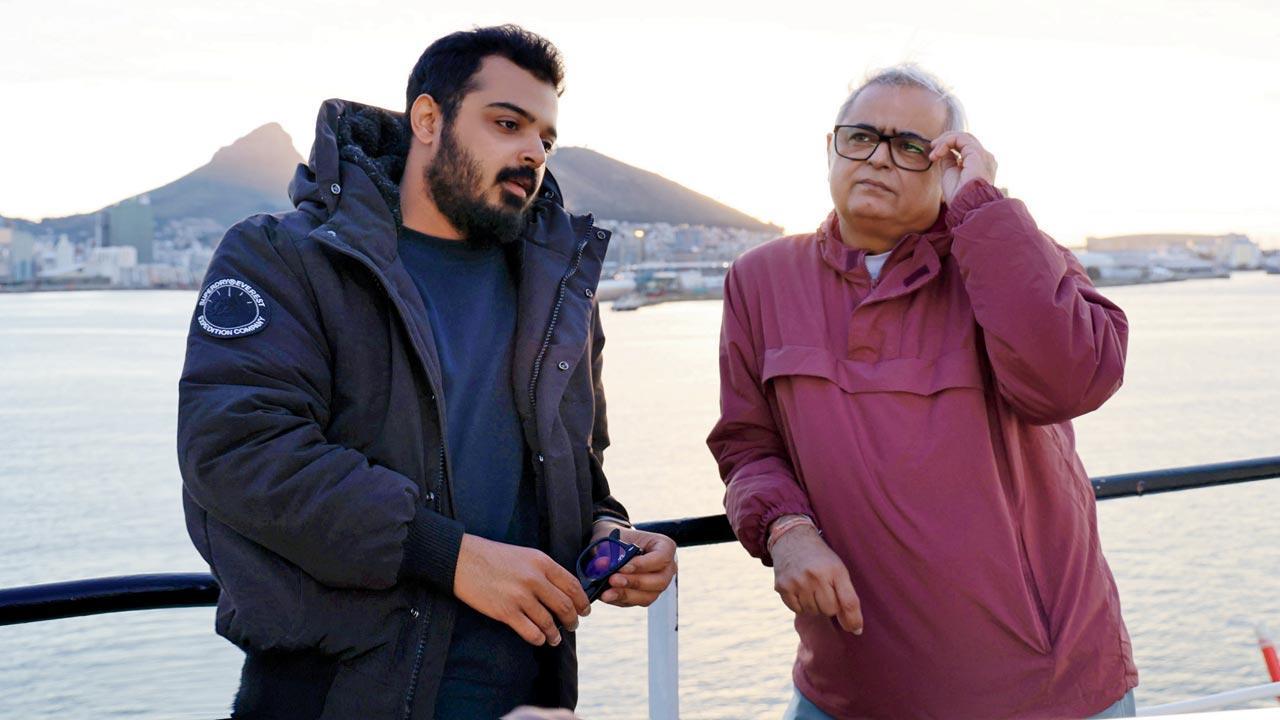
“Disney’s mandate doesn’t allow the title of father on screen,” Hansal Mehta displays disarming candour as he opens up about his motivation to board son Jai’s latest directorial, Lootere, as showrunner. This is not the first time Jai has taken up director duties—he co-directed Sony LIV series Scam 1992 (2020) with Hansal, his director-producer father—but it’s the first time he is the captain of his ship, prompting senior Mehta’s emotional involvement.
“The only reason for me to be the showrunner was that it was Jai’s solo directorial. I have seen him in action before, but it was good to see him taking charge this time and not having to fight with me,” he chuckles. Before collaborating with his father on the web series, Jai served as associate director on several of his films, including Shahid, Citylights and Aligarh. This time, Mehta wasn’t instructing him.
“I was handling him. We served as a sponge for each other. When Shaailesh [R Singh, show’s co-creator, co-writer and producer] had an issue and wanted to tell Jai something, he’d target me, because Jai would be at the shoot. He would call and scream. I would say, ‘Okay, okay. I will talk to Jai.’ Then I would convey the message to him, but in a different way. Similarly, if Jai was facing frustration, he couldn’t share it with his team; a director must keep the morale high. So, he too would come to me.”
Jai doesn’t feel the difference, though. The roles might have changed, but his father’s unwavering support stands. “He has been supportive, including for my short films.. and I have made some terrible ones; some even I don’t have copies of,” he laughs.
Their filmmaking styles are different, but there’s much that they share in common as people. Like their ability to veil emotions as mature professionals. “I refer to him as Hansal Sir. The last time I called him on the phone and addressed him as ‘dad’, he asked, ‘Do you need money? What happened? Why are you calling me dad?’,” Jai says.
It can be attributed to the fact that their relationship has been built on film sets. To Hansal, their shared love for the movies is what makes them father and son. “We have spent more time on set than we have at home together. He was born when I was barely 23. I was searching for myself and in that search, I managed to find my son when I needed him, which was when he became assistant director. We have ended up discovering each other on set. We have spent the most intense times together and discovered each other as people, passionate about films and telling stories. So, it [cinema] keeps us together.”
Even before he joined his father on the set as assistant, Jai had developed an intimate connection with Mehta’s filmmaker self. He grew up watching a director failing with every movie and trying again. “A lot of people know of Hansal Mehta only after he made Shahid [2013]. He made six films before that. That’s something no one will talk about. Even he won’t,” Jai laughs, before adding, “I have two younger sisters. Their father is the director of Shahid, Citylights, Aligarh, Scam, Scoop. [But] the father I know is the director of Jayate, Dil Pe Mat Le Yaar, Chhal, three unreleased films. Of Raakh too. I grew up with that director.”
Shahid, a critically acclaimed film based on the life of lawyer and human rights activist Shahid Azmi, who was assassinated in 2010, it starred Rajkummar Rao, and brought Mehta the Best Director gong at the 2014 National Film Awards.
Evidently, it has not been easy. Mehta is the first in his family to take up filmmaking. “We aren’t film royalty,” Jai declares.
In a rare display of emotion, Mehta sounds poignant while painting a picture of Jai’s childhood and their journey as a family. “He has seen me through days that weren’t exactly ideal, struggling to find myself and keep our lives together. We were searching for a structure as family when things were going haywire. Jai has lived through the troubles of a slightly complicated childhood,” Mehta says.
In a bid to snap out of this reflective moment, Jai quickly adds, “But there are no regrets. There’s only good from here on. You don’t look back. You think about all that you learnt and use that to do better.”
And the biggest learning from a challenging childhood is to never give up. “There was a time when he felt, ‘What am I doing?’ And he did take a break [from filmmaking] but ultimately, he returned and did Shahid, which took two years to make, and another year and a half to release. It was tough but he never stopped.”
I am upset that Shahid isn’t on streaming sites-Hansal Mehta
9:11 AM
Rishabh Suri (HINDUSTAN TIMES; October 18, 2023)
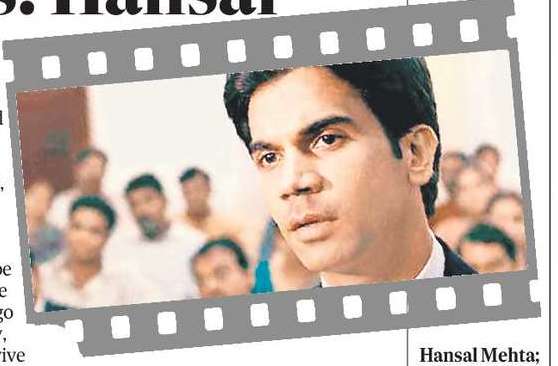
For director Hansal Mehta, his entire career changed with the 2013 film Shahid. Based on lawyer-human rights activist Shahid Azmi, the film revolves around his fight for justice for those falsely accused of terrorism but in the end, he is assassinated. It starred actor Rajkummar Rao and went on to garner acclaim and awards.
But the director still rues one thing: “What upsets me is that the film isn’t available on any streaming platform today. A censored version is there on YouTube and that bothers me because the film had nothing that needed to be censored.”
The 55-year-old adds that the biggest challenge while filming was, in fact, the shoot itself. Mehta recalls, “It was a challenge just to be able to shoot those days. We used to go to shoot every day, thinking let’s survive somehow, kal ka kal dekhenge. We would shoot with limited funds, literally beg for locations and shoot. We used to pray that we would get the camera we wanted for the shoot that day. It was a struggle but also a great joy as we used to go back every day satisfied after the shoot.”
Rao, on the other hand, saw his career take a complete U-turn after he was conferred the National Award for Best Actor for the film.
Mehta remembers how the announcement was made, “I was mixing for my film Citylights (2014) that day and I didn’t know the awards were being announced. My producer kept calling me. When I finished two reels, I came out of the room and then he told me. The phone never stopped ringing after that. Rajkummar was shooting Dolli Ki Doli that day so we met after his shoot. I had already gone to bed when he said, ‘Come down, I want to see and hug you’. We met in the parking lot, and were so happy.”
Success has emboldened me to continue being fearless-Hansal Mehta
9:39 AM
After helming the hit show, Scam 1992, Hansal Mehta on shifting gears to make hostage drama, Faraaz, with new faces
Mohar Basu (MID-DAY; November 6, 2022)
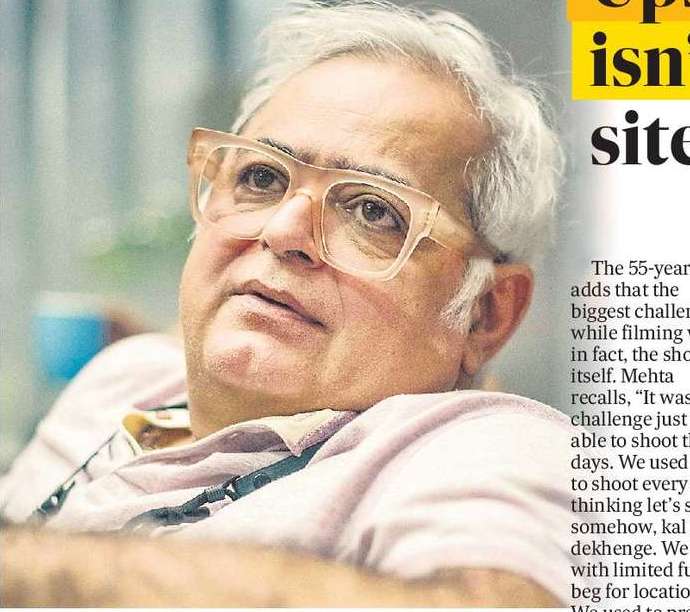
Hansal Mehta, who had a smashing success in Scam 1992: The Harshad Mehta Story (2020), believes that the biggest upside of success is telling stories with abandon, without falling prey to compromises. “What has obviously changed for me is that I make some money,” he quips. “Besides that, I will always do what I do best—tell stories fearlessly. Success has emboldened me to continue being fearless.”
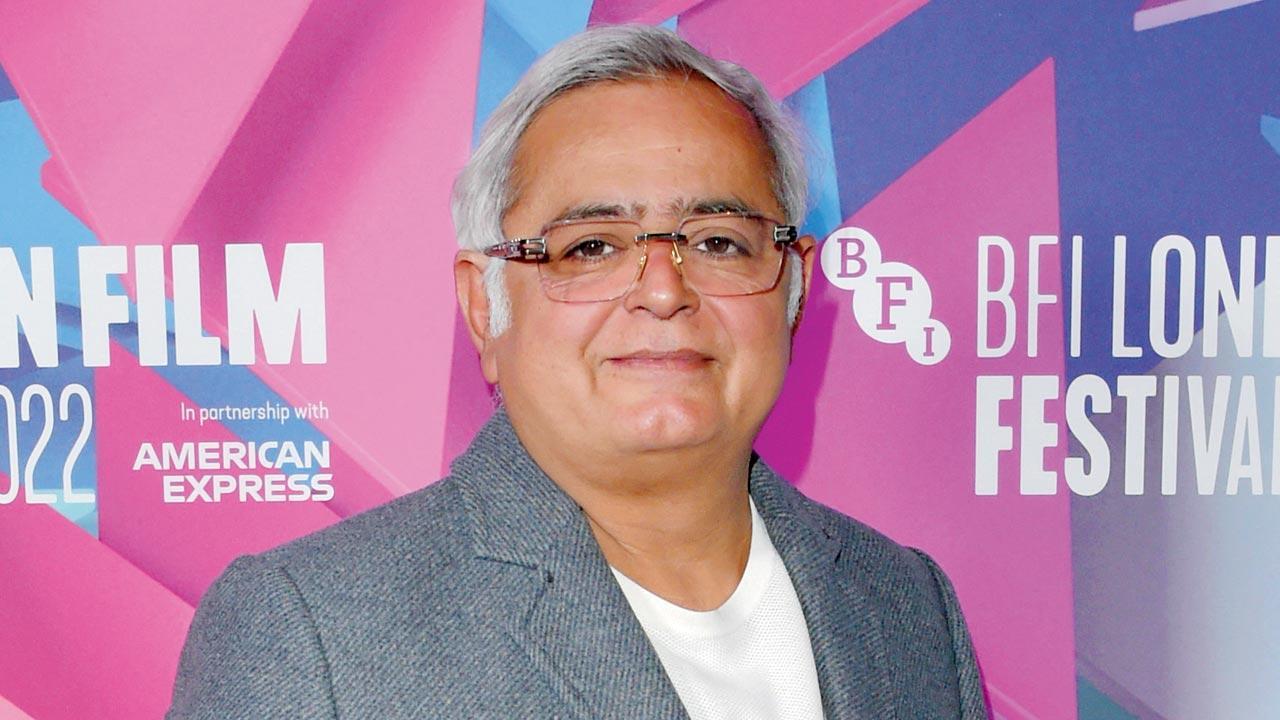
His pursuit for brave stories has led him to Faraaz. After Scam 1992 that caught the nation’s interest, Mehta has shifted gears to make an admittedly “small” film featuring Zahaan Kapoor and Aditya Rawal. The film—which recounts the 2016 terror attack in Holey Artisan Bakery in Dhaka, where armed gunmen held customers hostage for 12 hours before killing over 20 of them—was premiered at the BFI London Film Festival last month.
“It was a conscious decision that the moment Scam 1992 comes out, I will get this film going [regardless of the former’s fate]. I have made it exactly how it should be made. It has no trapping, no stars. Casting for the movie wasn’t easy. We took months to get Aditya and Zahaan. Along with them, there are five new faces in the film. There was an exhaustive audition process; we then workshopped for months. Even when we shot, I would constantly shift the scenario. I wanted people to respond to the scenes in an impromptu way. The film is an example of exceptional casting.”
The hostage drama is set to release at a time when the world around us is increasingly sensitive. What are the challenges of telling stories that have a social impact, at such a time? “Shahid [2013] is on YouTube right now, and is completely mutilated as a movie. It hurts me as a maker. The film begins with the riot sequence eliminated. The challenge is to continue telling stories and find like-minded collaborators. On Faraaz, I lucked out. I found Anubhav Sinha and Bhushan Kumar to back the film. Given the socio-cultural climate we are in, the challenge is to release the film. Even business-wise, these are challenging times and we have to maximise a film’s potential to reach the masses and minimise monetary risk.”
I don’t think Safeena Husain and I had any time to think about a wedding-Hansal Mehta
8:21 AM
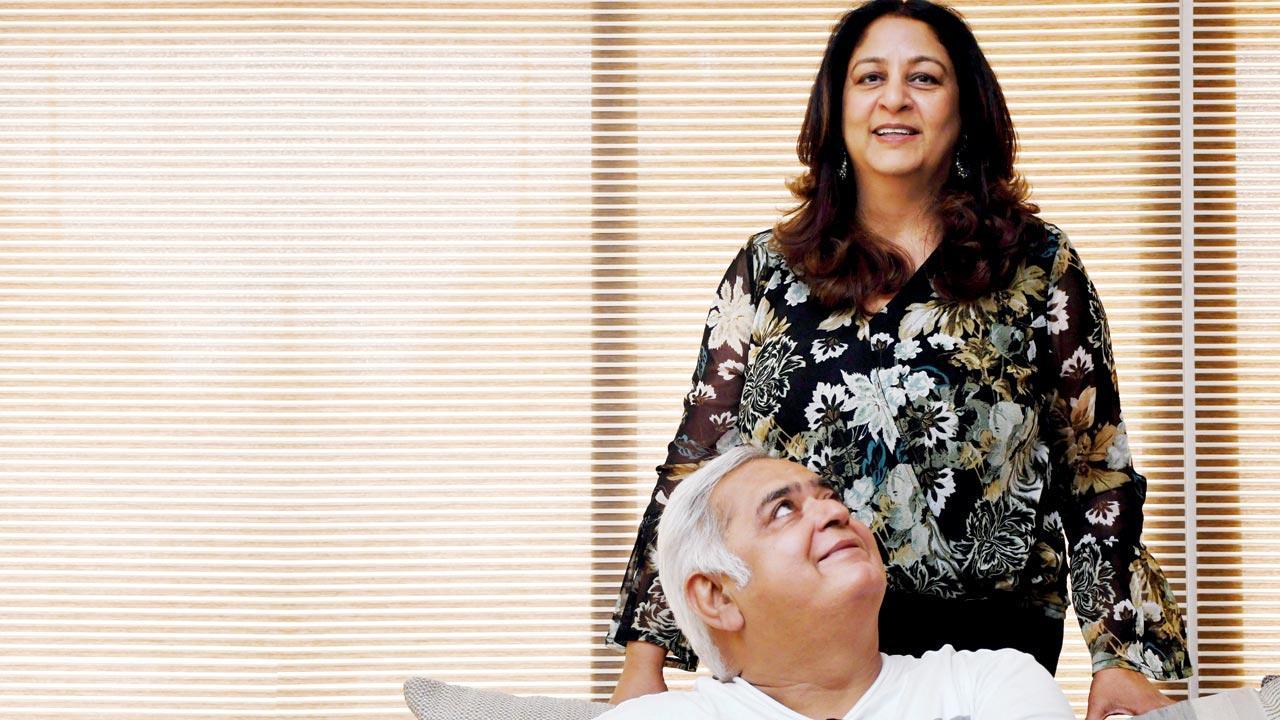
Critically acclaimed filmmaker Hansal Mehta and social entrepreneur Safeena Husain look back at 17 years of struggle, togetherness and children. And three weeks of marriage
Jane Borges (MID-DAY; June 19, 2022)
What would it be like to marry someone you’ve been with for 17 years? It’s something this writer wondered on her way to meet filmmaker Hansal Mehta and his long-time partner and “new bride” Safeena Husain. We were obviously not expecting them to be all coy. Perhaps, we were looking for traces of this new relationship that binds them. “I wonder why anyone would be interested in our story,” Hansal tells us, curious that we were actually curious. Safeena joins us moments later, and sits across her husband on a three-seater sofa at their Bandra home. “Paas aajao,” he says. “Tum aajao,” she teases, “Or else people will think that it was me who was chasing you. Jabki sachayi kuch aur hai.”
The day we meet, it has been exactly two weeks since their “secret wedding” in San Francisco. Theirs wasn’t the kind of ostentatious shaadi that Bollywood is now known for. In fact, their daughter Kimaya played pap with a DSLR that had been gifted to her a few weeks earlier. The wedding happened in a lawyer’s office in California that had been modestly decorated with plastic flowers, drapes and heart-shaped cardboard cutouts, with ‘Love’ scribbled on them—Hansal clarifies this wasn’t his doing. It was a pre-designed set on the mezzanine floor of the office for the many marriages that the lawyer was registering that day. But even while breaking away from the typical, they stuck to the filmi rule book: They announced their wedding on Instagram.
Had it been left to the couple, none of this would have really happened. Marriage, they say, wasn’t even on their mind. “[The conversation about] marriage never came up, because we had children very early on in our relationship,” says Hansal, of his two daughters Kimaya and Rihanna. “And when we started seeing each other, I was already a father to two kids [Jai and Pallava from his first marriage], so she had some advanced booking already,” he jokes. “With all of this, I don’t think we had any time to think about it [a wedding].”
Hansal and Safeena owe writer Daisy Rockwell, who last month won the Booker Prize for translating Geetanjali Shree’s Hindi novel Tomb of Sands, for bringing them together. This was on January 21, 2005. “Daisy was the head of the Institute of South Asia Studies at Berkley, and thought it would be fun to do a Bollywood internship programme for her students. She checked if I could set up a dinner [for her with a few filmmakers and actors], during one of her visits,” recalls Safeena, who at the time, had just moved from California to be closer to her actor father Yusuf Husain.
The dinner, she remembers, was attended by Rajpal Yadav, Tinu Anand and Hansal among a few others. “I didn’t know Daisy or Safeena,” says Hansal. “But a common friend had requested that I join them. It was during this dinner that I learnt that she is the daughter of Yusuf Husain, who I had worked with in a show called Family Business. He always spoke about her. Sometimes, if he wanted to leave the shoot early, he would make an excuse that his daughter had come down from the US. He’d actually go somewhere else,” Hansal laughs.
At the time, Hansal had no clue that Safeena was already a huge fan of his work. “Everyone in my family knew how much I loved his film, Dil Pe Mat Le Yaar [2000]. When I finally met him, I was charmed. I liked him a lot. His political leaning was interesting,” she says. We ask him about it. “I was more Left leaning,” he says, adding, “It wasn’t considered a bad word back then. Today, I consider myself liberal.” “But, I think she liked my humour,” he tells us. “No, no, no, he is not funny at all. One should never encourage his sense of humour,” she butts in.
After that dinner, the two only met a month later, when Safeena along with a student, visited him in Alibaug where he was shooting for a film. “I was trying to take that internship programme forward,” she says, when we tease her about conspiring yet another meeting. It’s at this shoot, that Safeena narrated her favourites scenes from Dil Pe Mat Le Yaar. “He very romantically told me, ‘Mere to baal khade ho rahe hain’,” she smiles.
The truth, Hansal tells us, was that until then, he had never met a person who had understood his vision for the film that starred Manoj Bajpayee and Tabu. The film’s failure at the box office had left him broken. “I wanted to forget it. There were some memories attached to the film that were not very pleasant. But, here was someone who remembered every single detail. That was enough to get me attracted to her.”
Safeena came into Hansal’s life when he was going through a professionally low phase. “It was a phase of despair, to be honest. I was completely lost, and didn’t know what I was doing with my life. I was making these so-called ‘sex films’, so that I could make money out of something... anything. And somewhere, I did feel like I had sold out. Her coming in was almost like a timely reminder that ‘you are that filmmaker, not this’,” shares Hansal.
The couple started seeing each other soon after—a road trip from Ooty to Mumbai followed. “I didn’t realise when we started living together. I used to live very close to her home. She used to stay with her dad in Tarapore Gardens, while I lived in Lokhandwala Complex. Sometimes, I would stay back for days at her place,” he remembers. After Kimaya was born, the two got busy putting their lives in order. Safeena started Educate Girls, a non-profit which focusses on mobilising communities for girls’ education in India’s rural and educationally backward areas.
Since they couldn’t see themselves afford a home in the city, they moved to a village in Malavli near Lonavla, living a frugal existence. “We couldn’t afford anything else.”
Hansal, who was still struggling to find a footing in the movies, used that time to help his wife build her organisation. “I made three films during that period [2005-08]. Two of them never got released, and the one that did, Woodstock Villa, wasn’t my kind of work. I remember asking Safeena then, that if I gave up all of this [movies] indefinitely, and did something I really wanted to do, would she be able to support me. She instantly said, yes. That support saw me through 2008 and 2013, until I made Shahid, which received a lot of critical acclaim. Until then, I was hand to mouth. I was not doing any work.”
The couple returned to Mumbai after three years, buying their first home together with the help of their parents. “We actually lived the life you live after you marry in your 20s. Everything happened to us 10 to 15 years later. We found ourselves, our voice, and our mission together, and then we were just busy pursuing that mission; marriage as a conversation never came up,” says Hansal, adding, “Until, we had to get a passport for our child.”
One of the reasons why Hansal and Safeena also resisted the idea of marriage was because they had both been married once before. “There was this feeling then that... If you don’t get married, you don’t have to get divorced.” Hansal says that their parents too, didn’t force them. “Safeena’s father lived his life unconventionally. In a way, he inspired us to live just that way. We saw him, and never adhered to the conditioning that was thrust upon us. We sort of imbibed that.”
But the only time they felt the challenge of not having a marriage certificate was when it came to getting legal work done. “We couldn’t apply for a bank loan, or even rent an apartment together,” Safeena remembers.
When it came to getting their daughters’ passports, Hansal says he had to give an affidavit “saying that the child has been out of the wedlock”. “It’s the most ridiculous paper to submit. Unfortunately, this institution [of marriage] has been imposed upon us,” he says.
But the real trigger was Khar Gymkhana, Hansal says with a straight face. Safeena breaks into a laugh. “That really irritated him. In all the 17 years that I have known him, he hasn’t been to the gymkhana even once, but he still wants the membership,” she shares.
“See, my father was a Khar Gymkhana member, and I also spent my early years there. That’s where I developed my love for sports, be it cricket, tennis or swimming. Jai also grew up playing badminton and tennis there. When the time came for my daughters to get a membership, I was asked to show over 20 papers to prove that they are my children. The authorities told me that there are byelaws that cannot be flouted. I had to give them so many affidavits and certificates through the lawyer, for my girls to get the membership. After all this, they didn’t give Safeena the membership. They said I had to get married for that. I was so pissed off.”
Safeena clarifies it wasn’t the gymkhana membership, as much as her father’s death, six months ago to Coronavirus, that made her realise how insensitive the system can be. “There was some money stuck in his bank accounts, and despite being his daughter, I had to go through a lot to even inherit what he left me. I thought, ‘Oh my god, our situation is even more complex’. We didn’t want to make it messy for our children, just because we chose to live our lives differently.”
Hansal says his dear friends, actors Rajkummar Rao and Patralekhaa had been trying to convince them to get married since forever. “They even suggested that we get married alongside them,” says Hansal. “But we wanted to have an age-appropriate wedding.”
Their decision to get hitched was an impulsive one. They hadn’t told any family member, including their sons, that they were planning this. “Because, we weren’t sure of it either.” Since Safeena is an American citizen, they were able to get dates for the court marriage almost immediately. They left for San Francisco on the spur.
The couple was married on May 24, in front of their daughters and Safeena’s mother and sister, who live there. “We informed them about it only a day before the wedding,” he says, “The moment I got married, I sent the pictures to our family back home. Jai [Hansal’s son], was quite upset. He said, ‘If you had told me, I’d have been there’.”
The ceremony, Hansal recalls, was an emotional one. “Hansal was crying,” Safeena recounts. “Suddenly, while taking the vows, it just hit me. The spirit of that ceremony is actually sacrosanct. I think we married at the right time, because we understood the meaning of being together.” Safeena adds, “We realised, we had got married for nothing, but love. In the last 17 years, we’ve seen a lot together. We lost our parents, we’ve experienced struggle. And we have stood by each other. Marriage makes it all very real.”
Ever since they returned to Mumbai, they’ve been holding small, intimate celebrations for friends and family. “And can you imagine, the moment that Instagram post was out [announcing the marriage], who messages me?” asks Hansal, leaving little room for us to guess. “The gymkhana president.”
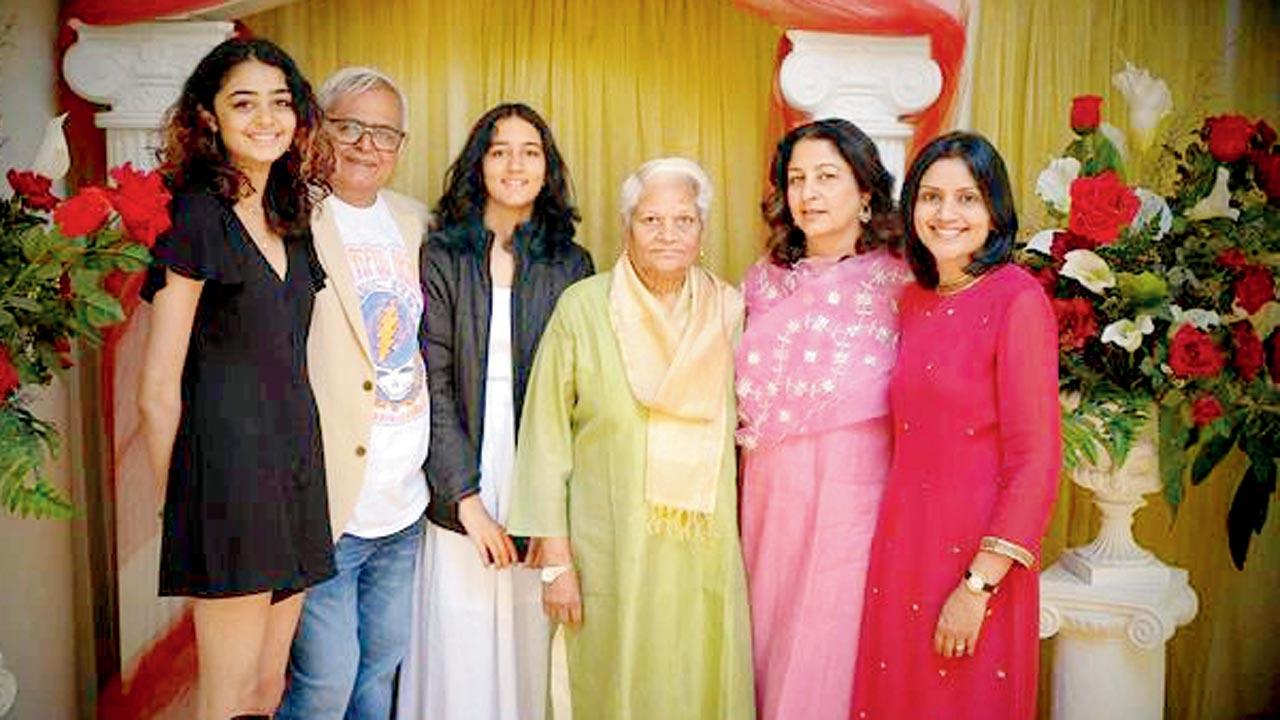
Hansal Mehta and wife Safeena Husain with family at their wedding on May 24, 2022 in San Francisco
Yusuf Husain no more; celebs mourn the loss
8:22 AM

HINDUSTAN TIMES (October 31, 2021)
Veteran actor Yusuf Husain, known for featuring in films such as Dhoom 2, Vivah (both 2006) and Raees (2017), died on Saturday due to Coronavirus. He was 73. Husain’s son-in-law, filmmaker Hansal Mehta, confirmed that the actor died at Lilavati Hospital in Mumbai.
Mehta also penned an emotional note for Husain, recalling how the late actor had helped him financially after his film Shahid (2012) was stuck after two schedules. “I was troubled. A non-existent career as a filmmaker was almost finished completely. He just came up to me and said I have a fixed deposit and it is of no use to me if you are so troubled. He wrote a cheque. Shahid was completed. That was Yusuf Husain. Not my father-in-law but a father....(sic),” Mehta tweeted.
Actor Abhishek Bachchan, who worked with Husain in his upcoming thriller, Bob Biswas, also paid his condolences: “...He was gentle, kind and full of warmth. Condolences to his family”. Mehta’s close friend, actor Manoj Bajpayee tweeted, “Sad News! Condolences to the entire family...”.
Celebrities including actors Ayushmann Khurrana, Renuka Shahane and Kubbra Sait as well as filmmakers Reema Kagti and Nikkhil Advani also mourned the loss.
There is stability and depth to such romances-Paresh Rawal
8:18 AM
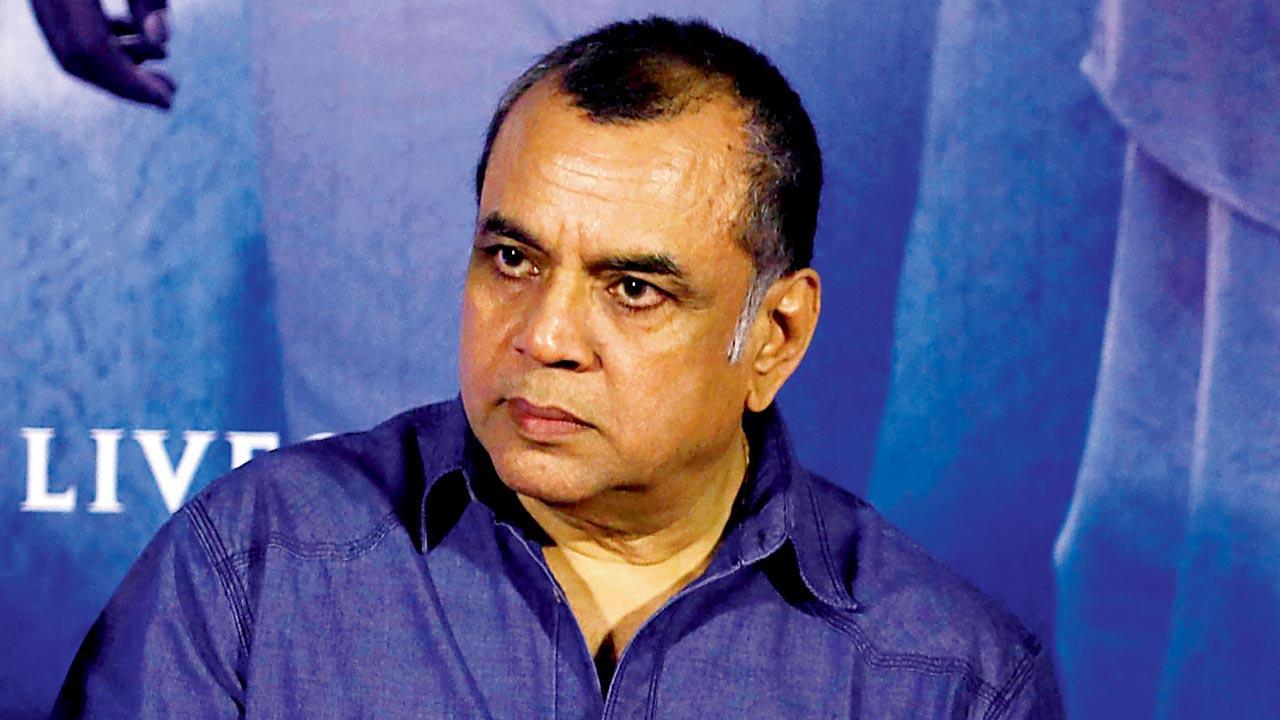
Paresh Rawal, who is teaming up with Ratna Pathak for Hum Do Hamare Do, proud that Hindi films are exploring mature love stories
Mohar Basu (MID-DAY; October 29, 2021)
"Kya alag kism ki kahani hai!” That was Paresh Rawal’s first thought after the narration of Hum Do Hamare Do. “I found the premise of adopting parents quirky,” begins the senior actor, who has joined Rajkummar Rao and Kriti Sanon in the comedy. While the film focuses on the protagonist’s efforts to woo his ladylove, director Abhishek Jain also showcases an elderly romance through Rawal and Ratna Pathak Shah’s characters.
With the movie coming a few years after Badhaai Ho’s (2018) success, Rawal is glad that filmmakers are developing mature love stories. “Usually, romances are associated with the youth. The only other elderly love story with recall value is Cheeni Kum [2007]. You need such films to be grounded and mature. What people are unable to bring on screen is that the intensity of love increases with maturity. There is stability and depth to such romances.”
The senior actor was delighted to join forces with Pathak whom he has deeply respected since their theatre days. “When you have a tremendous actress like her, you can approach every emotion from a fresh perspective. The material is only a part of our job; the rest is about enhancing the written word.”
Collaborating with Rao was another draw for Rawal. Describing himself as a “huge fan” of Rao, he says, “When I first watched Shahid [2013], I didn’t have his number. I called up Hansal Mehta twice. I have seen every film of his. He is truthful in every performance. This new generation of actors is full of gems.”
The timing of Chhattisgarh verdict, coinciding with Criminal Justice winning this international honour, was just crazy-Apurva Asrani
8:29 AM

Naina Arora (HINDUSTAN TIMES; August 31, 2021)
For writer Apurva Asrani, starting a “conversation in society” through his work is of utmost importance. Recently, the show written by him, Criminal Justice: Behind Closed Doors, bagged the Best Asian Drama Series award at ContentAsia Awards 2021. But the recognition has come at a time when the Chhattisgarh High Court ruled that ‘sexual act with one’s wife is not rape, even if forced’.
This has put the spotlight back on marital abuse in India. “The timing of the verdict, coinciding with our show winning this international honour, was just crazy. On one hand, the civilised world is moving towards undoing the evils of domestic abuse, and on the other, Indian courts are giving men a free hand to rape their wives. Many women and men are under the misconception that control is equal to love. It’s in fact the opposite. Let’s raise our voice against the awful Chattisgarh verdict,” he says.
“I’m blessed to find collaborators who feel deep empathy towards such stories. My film Shahid (2012) talks about minorities wrongly imprisoned under draconian laws, fighting for justice. Then Aligarh (2016) made the case for a teacher who happened to be homosexual, fighting for his right to privacy. Made In Heaven, where I worked as an editor, took that conversation into an urban space,” he adds.
Asrani shares how women reaching out to him on social media is his greatest reward. “Women of all ages watched the show and sent me messages about their domestic situation,” he says, adding, “One woman begged me to save her from an abusive husband. I was shaken till I connected her to an NGO.”
So, how important is it to create content such as this? “I wept the day I learned Criminal Justice Behind Closed Doors was a big OTT hit. Not just because every artiste strives for recognition, but it also meant households were ready to talk about what happens behind closed doors,” he adds.

Until Bareilly Ki Barfi released, people would see me as a ‘serious, dramatic actor’-Rajkummar Rao
7:55 AM

Rajkummar Rao says people love to put Hindi film actors in boxes, adds that ‘some kind of a shift’ happened in his career with the 2017 film
Prashant Singh (HINDUSTAN TIMES; October 20, 2020)
Be it his “serious” parts in films such as Shahid (2013) and Newton (2017) or lighter outings in hits such as Kai Po Che! (2013), Bareilly Ki Barfi (BKB; 2017) and Stree (2018), actor Rajkummar Rao has successfully straddled all kinds of roles through his decade-long Bollywood journey. But Rao admits that he was considered a “serious and dramatic” actor till BKB came along.
“People love to put actors in boxes, and are like, ‘If they have done a particular kind of work, then let’s give them more such parts’. Until BKB released, people would see me as a ‘serious, dramatic actor’. But I, as an artiste, never thought, ‘Oh, I am going to do something very different’. I knew that it was a great role for any actor — to portray a dual personality in a beautiful script,” says Rao, whose character Pritam Vidrohi and his humorous undertones became a major talking point for the film.
The actor says it “never occurred” to him that he was “dabbling in comedy space” with the Ashwiny Iyer Tiwari directorial. “But the end result was amazing. The kind of response I got from people was overwhelming, and I really enjoyed that space. Films such as Newton, Trapped (2017) and Shahid take a toll on you, as a person as well as an artiste, but when you have a fun part in a film like BKB, you enjoy those great moments... Comedy-laden parts are all about having fun with your lines on the sets. You have to let it flow, and enjoy,” says the 36-year-old actor.
Like trade pundits, Rao also feels that BKB gave a new twist to his career path. “In a way, some kind of a shift happened in my career with BKB. Then, Stree (2018) came along and lot of things changed... I have constantly learned and grown. As an actor, that’s exactly what you want to do — play completely diverse parts in all your movies,” he says.
I would have liked to do songs but things are so controlled in the Bollywood music industry...-Karan Kulkarni
8:14 AM

Raat Akeli Hai and Shakuntala Devi's background score composer, Karan Kulkarni says to do what he does, you need to love movies as much as music
Aastha Atray Banan (MID-DAY; August 2, 2020)
 "Making background scores… it all happened by accident," says Karan Kulkarni. A fortunate accident it would seem, because Kulkarni is the man behind the scores for Abhishek Bachchan-starrer Breathe - Into The Shadows, and now, Amazon Prime's upcoming film Shakuntala Devi and Netflix's Raat Akeli Hai. Both released this Friday. The Punekar, who moved to Mumbai to make it as a musician, tells us why he shifted tracks.
"I would have liked to do songs, and I have done many, but things are so controlled in the Bollywood music industry, that only a few directors manage to get their songs into movies. So here, I am, doing background music," he laughs, adding, "I guess, it's best to adapt."
 Since Kulkarni moved to Mumbai nine years ago, he has given music for a short film directed by Vasan Bala. This was after he returned from Australia where he signed up for a music production course. He then started assisting music director Amit Trivedi, but it was with Bala's Peddlers in 2012 that his career truly kicked off. "That movie never released, but it gave me the chance to do something. Then I did Aligarh and Shahid, and it all took off from there."
He also may have been well accustomed to the wily ways of the music industry, and thus, started composing jingles for brands like Amazon and Flipkart. "I did Tumhari Sulu and Mard Ko Dard Nahin Hota, but as I said, it's all very controlled here—how much work a person actually gets [depends on other forces]. Web series have opened up the floor, and the bar is raised high, since you are competing with the best in the world. For example, Stranger Things, which has a great background score, is available to watch on the same platform as my work," says the 34-year-old.
Ask him what makes a music composer different from one who makes background scores, and his answer is deceptively simple. "You need to love movies! Otherwise, how will you know what fits with what? You also need to be able to tell a story through music—and be aware that change is constant, as emotions keep changing. So your music has to based on what's happening on the screen."
Keeping this in mind, Kulkarni's score for Breathe is more "psychological", with character themes for everyone. For Raat Akeli Hai, which is a murder mystery starring Nawazuddin Siddiqui and Radhika Apte, the music had to be darker. "For Shakuntala Devi, everything was more upbeat and positive. There is a certain brightness to it."
Personally, Kulkarni is inspired by music that is technology-driven, so composers like Trent Reznor are high on his listen list. After all, who can forget the brilliant score Reznor gave for Social Network, where the piano melody harbours the power to give rise to an emotion. And Kulkarni has made good use of technology this Coronavirus lockdown. He and his team completed the full score for Shakuntala Devi in four months of lockdown, sometimes going to a studio, but mostly working out of their bedrooms. "It was quite tricky, but we managed. We exchanged samples, and put it all together. It has been a lesson."
Here on, Kulkarni has decided to take on less work. "There are a few projects that have come up, but I am going to take it slow. I am utilising this time to study. I am practising guitar, and also working on the tabla, which is a brand new instrument for me. After a very long time, I am a student again, and I am completely enjoying it."
Lyricists fight for credit on apps, streaming platforms
8:41 AM

Songwriters, long given short shrift in Bollywood, are now up in arms for recognition and royalties
Rishabh Suri (HINDUSTAN TIMES; July 26, 2020)
After nepotism and favouritism, another debate seems to be in the making in Bollywood. Recently, songwriter-singer Swanand Kirkire tweeted, “OTT pe lyricists ka naam na hona sirf credit ka na hona nahin hain balki Lyrics Writer ke Wajood ko na maanana hai”.
Last year, the Indian Performing Rights Society (IPRS) filed an FIR against a production house seeking around ₹100 crore in royalties due to composers and writers since 2012. Danish Javed, of the Screen Writer’s Association, says, “If lyricists get their name on a publishing platform, as a member of the IPRS, they get part of the royalty,” he says. We got in touch with some prominent lyricists on this.

SWANAND KIRKIRE (3 Idiots, Barfi!, Lage Raho Munnabhai)
Music companies and big labels put songs on YouTube, and don’t give proper credits. They don’t get back when we point out. Some platform did get back recently saying ‘thanks for bringing to our notice’. They didn’t even say it was a mistake. Apps don’t credit the lyricists anywhere in their algorithm. You can’t search a song by a lyricist’s name. You can search the music director’s name. I can search for songs I’ve sung as I am a singer too. I get a detailed history what’s happening with my song, how many are streaming it, which state or country they belong to, but lyricists have no way to find that out.

SHELLEE (Shahid, Manmarziyaan, Jawaani Jaaneman)
I wrote a song in 2014, Beparwah, for Shahid. Why is my name missing on YouTube? People comment ‘soulful lyrics’ but my name is missing! There’s a rule: if the name is missing, the royalties from the song won’t come to you, be it YouTube or music apps. Music apps have a different algorithm. If we are given credits, we’ll start getting royalty. But what about the royalties of the past? We don’t do gigs or concerts like singers. We get paid peanuts once, and nothing after that. Even if the spelling of your name is wrong, you won’t get royalty. IPRS controls the domestic royalties, we need more transparency in it too.

VARUN GROVER (Gangs of Wasseypur, Fan, Udta Punjab)
I have been talking about it for years now. Many official channels on YouTube, and music company channels of Eros, Sa Re Ga Ma, Shemaroo, Ultra, don’t credit lyricists or give wrong credit. We have a list of these song credits. Gulzar, Javed Akhtar, Shailendra, these legends have credits missing on YouTube channels. Apps pick data from music companies who provide them their libraries. In their library itself, they don’t have the lyricist’s name! Some apps work on the American mode, where they think composer is the songwriter. They don’t even have space for lyric credits in their software. You can’t search if you want to.
SAMEER ANJAAN (Aashiqui, Kuch Kuch Hota Hai, Dhoom 3)
The Screen Writer’s Association is taking a big step because I think people do this knowingly. They have a huge nexus and intention behind not keeping the writer or composer’s name, because then royalties will not go to the right place. But now we are trying our level best to make them (apps) aware. Then we will take legal action.
Also, about last year’s hit Dilbar Dilbar (Satyameva Jayate), a leading publication said, ‘Music by Tanishk Bagchi, lyrics by Shabbir Ahmed’, when the original song was by Nadeem-Shravan, and lyrics by me. Shabbir wrote one line in the beginning, rest of the song was original.

OTT frees me from the vagaries of a Friday-Hansal Mehta
8:26 AM

Prashant Singh (HINDUSTAN TIMES; July 14, 2020)
Due to the Coronavirus scare, film theatres were among the first ones to down their shutters. Immediately after that, when certain filmmakers chose to go towards OTT platforms, a debate around ‘OTT vs theatres’ started to rage. Hansal Mehta, for one, feels “theatres aren’t going anywhere”, but also adds that OTT has come as a boon for many.
“Honestly, the magic of big screen/theatres will continue to thrive. But at the same time, for a filmmaker like me, the presence of OTT platforms mean that, if need be, I don’t have to be tied to the vagaries of a Friday,” says Mehta, whose films such as Shahid (2012), Citylights (2014) and Aligarh (2015) are available on streaming platforms.
“The kind of feedback I have got from people, who have watched Shahid or Aligarh now on OTT, is tremendous. Many may have missed out on watching them in theatres but it’s a great feeling for me, as a filmmaker, that people are appreciating my work, regardless of the platform,” says Mehta, who has Rajkummar Rao-starrer Chhalaang as his next release. “Let’s see what the producers do (with regards to its release plans). Right now, there is no clarity on theatres reopening, so I don’t know what’s going to happen,” he says
But Mehta “feels great” that due to OTTs, he doesn’t have to depend on Fridays to showcase his work to audiences. “Every platform, at the end of the day, is going to coexist, but streaming platforms just frees a filmmaker like me from so many things or pressures that may come with a Friday,” says the writer-director, who is currently stationed at his Lonavala home, along with the family.
“I am enjoying my family time here. Besides doing all cooking that I really enjoy, I am also taking out time for work. So, I do my weekly meetings — with my writers and actors — for my show as well as Chhalaang, and my next directorial, too. I don’t see myself coming back to Mumbai anytime soon, or at least till the time when I have some work in the city,” says Mehta, who has also finished two scripts during the lockdown.
The curious case of identity theft on IMDb
8:32 AM

How a man, busted for fabricating entries on IMDb, exposes the entertainment industry’s struggle to find a safe home for credits
Jairaj Singh and Arnab Ganguly (MUMBAI MIRROR; July 12, 2020_
 Till a few weeks ago, he was a legend the film industry had failed to acknowledge. On IMDb — the largest and most popular TV and movie database on the internet — his feats were going spectacularly unparalleled, and there for all to see. Even Satyajit Ray — whom Akira Kurosawa hailed as a ‘giant’ — paled in comparison to his filmmaking prowess, if you compared the credits listed on their respective profile pages. The 18-year-old student from Navi Mumbai, who was running the page with his own name, claimed not only to be an actor and director, but also to have experience in animation, costume design, editing, stunts, visual effects and scriptwriting, among other things.
On June 23, screenwriter and poet Varun Grover exposed the IMDb account. He took to social media when he saw an ‘Abhishek Chaudhary’ listed as one of the writers of Sacred Games, the show Grover had developed from Vikram Chandra’s 2006 novel by the same name. Upon inspecting the profile page on the website, he found that this person also claimed to have played the role of a newborn in Good Newwz (2019) and a father in Badhaai Ho (2018), besides other stuff. “The guy is a bit of a credit-vandal. A normal talent would have credits in 4 or 5 different fields (writer, director etc). A genius like Mr Ray has credits under 14 categories. Our maestro ‘Abhishek’ has 30+ varied talents,” Grover wrote in a Twitter thread. He also questioned IMDb’s “strict monitoring and verification process”, which had allowed something like this to pass.
IMDb was quick to follow up as the posts went viral, and instantly wiped out almost all the fake credits on Chaudhary’s page, without acknowledging the oversight. It left behind the entries of two films, one genuine and one fake: Brazen Epiphany, which credits Chaudhary as an actor, and Chosen Few, a TVF short, which credits him as playing the role of a policeman. Within a week of the issue coming to light, a man claiming to be Abhishek Chaudhary messaged Grover on Instagram and confessed that he was behind the IMDb profile — and proved it by making fresh edits on the page. Chaudhary told Grover that IMDb had barred him from creating more fake entries, and then tried to justify himself.
“My initial impression, on discovering the fake credits on IMDb, was that he was misusing the mutual trust platform,” Grover tells Mirror. “But after interacting with him, I figured he has some kind of reasoning behind it. He thinks of himself as some sort of a vigilante, exposing loopholes in a system. Also, the joy of cheap thrills is difficult to resist. So I believe it’s a mix of everything.”
The (con) artist
On his LinkedIn page, Chaudhary introduces himself as a “pseudo-introvert, a web developer and a maker”. He also says he’s the “Chief Executive Officer of The Abbie”, which does not appear to be an organisation, and has only one follower on its page.
A second year student of computer engineering at an institute in Vashi, Chaudhary is not a self-avowed film buff but is “open to making films” once he gets his engineering degree. Last year, he and his friends took part in a contest organised by the India Film Project, where each team was given a theme and 50 hours to make a film. They made Brazen Epiphany, a 5.26-minute audio film about a journalist who is interviewed after winning an award. The film was uploaded on YouTube on April 11, and has had 45 views. “I knew my film was not going to win, but I wanted to promote it. My first step was to create an IMDb page,” Chaudhary tells Mirror. “I had to fill up a long form, which took two days to get approved. This left me wondering whether IMDb was actually verifying all the information that it was being fed.”
At first, Chaudhary claims, he would spend quality time on the crowd-sourced website by contributing genuine entries, like adding missing plot details and fixing the release date of a film. It was only once he discovered the existence of a loophole, and realised how easy it was to fabricate credits, that he started misusing the website. “I was jealous of not being famous,” says Chaudhary, who created his first fake entry in March by calling himself a comic who was a part of Comicstaan, the stand-up comedy reality show. “I was just eager for fame. At the time, Sacred Games was trending. I thought that if I add my name to it as a writer, people might recognise me.”
 While Chaudhary found it easy to create such fake entries, Pooja Tolani (left) — a writer who has actually worked on two episodes in the second season of Sacred Games with Grover — had to struggle to make even a legit entry. She was asked by IMDb to send a screenshot of her name in the end credits, and it took her, in all, almost three months to get the credit.
“At first, I did not pay much attention to adding my name to the show’s credit list. My colleagues had added their names and it had been a very simple process for them,” says Tolani. “I tried in December once, but couldn’t do it. Later, I learnt it had been declined because the information could not be verified. In February, I tried several times, and every time it said it could not be verified. I was then asked to submit evidence. I wrote on the IMDb website that I was one of the co-writers, and mentioned the two episodes that I had worked on, and also provided the links. It was still declined.”
IMDb, on its site, maintains that for users to get credit they “need to have at least one pre-existing credited entry in the database”. It says that it relies on end credits because “these days, end credits are much more comprehensive and most people who contribute eligible work, receive a credit”. Even though it operates as a crowd-sourced website like Wikipedia, on its own Wiki page, IMDb makes a distinction about how it is different by stating that “contributors cannot add, delete, or modify the data or text on impulse, and the manipulation of data is controlled by IMDb technology and salaried staff”.
When Mirror reached out to IMDb to ask how Chaudhary managed to fabricate credits while Tolani had to struggle to get her due, a spokesperson responded by sharing the information that’s already on the website. “The information in IMDb comes from various sources. While we actively gather information from and verify items with studios and filmmakers, the bulk of our information is submitted by people in the industry and visitors to our site,” reads the statement. “Our sources of information include, but are not limited to, on-screen credits, press kits, official bios, autobiographies, and interviews. Given the sheer volume and the nature of the information we list, occasional mistakes are inevitable and, when spotted/reported, they are promptly verified and fixed.” The website evaded all questions pertaining to the specifics of the case.
A flawed system
On July 8, filmmaker Apurva Asrani tweeted how his name, as co-writer of the legal drama Shahid (2013), “miraculously popped back” on IMDb after he wrote a blog, despite three years of chasing the website to include it. “Credits on IMDb should exactly reflect those that appeared on the film, but that’s not always the case,” says Asrani. “In the case of Shahid, Hansal Mehta and I are mentioned as additional screenplay writers in the film’s opening credits. We both even shared a screenwriting award with the film’s main writer, but for the last three years, my name and a mention of the award has been missing from IMDb. After I blogged about it, someone was able to edit the page and attach proof of my name in the opening credits. Now it is there, but I don’t know for how long.”
For most people in the entertainment industry — especially those still trying to establish themselves — IMDb is the go-to site. Filmmaker Bejoy Nambiar says that in recent years, an IMDb profile has become a “calling card”, an online resume, for people to verify and crosscheck credentials. It also helps actors, writers and tech crew to negotiate better deals. The loopholes in the system have, however, given rise to fraudsters, both online and offline. Last year Gaurav P Singh, an assistant director, had to conduct a sting operation to nab a man, his namesake, who was using his IMDb profile to get work. “I had to make him apologize to me on camera and write to all the production houses he had been doing the rounds of, seeking work by posing as me,” he says. “The funny thing is that he knew everything about me and my work and, during the first quarter of the meeting, tried very hard to convince me that he was me.”
Such incidents expose a major faultline in an industry which refuses to be transparent about giving credit to people. Other than the end credits of a film or a TV show, there is no way for people — involved in the larger creative process — to be formally acknowledged for their contribution. If production houses do create an official webpage, including all the credits, it is usually a transient exercise. IMDb is, arguably, the only database that one can refer to for information long after a project is done. So correct and honest representation is crucial.
Grover, like many people in the industry, feels the onus should also lie with production houses to ensure proper credits go on IMDb, but adds, “we are talking about an industry with no structure, no strict labour laws, no unity, and, in most of the cases, [sees] rampant exploitation”. As long as that continues, fraudsters and vandals will also continue to thrive.

The fake credits on the page (before IMDb removed them)
'Jeena yahaan, marna yahaan' applies to my life and work-Rajkummar Rao
8:13 AM

Rishabh Suri (HINDUSTAN TIMES; March 23, 2020)
He’s been off the radar since November last year, and it took us quite some time to get Rajkummar Rao to talk to us. After all, he’s completed a full decade in the industry since his debut in Love Sex Aur Dhokha (LSD). He connects with us from Goa, where he’s in self-isolation due to the Covid-19 scare. “I was actually supposed to start a film’s shooting in March with Kriti Sanon, when the outbreak became worse. I am keeping busy by reading, watching movies and shows, trying to learn cooking, working out and meditating,” he says.
Ten years in the film industry, how does this milestone make you feel?
Makes me feel like I just started. I want to be here (in the world of films), live here and die here, too. As the song goes ‘Jeena yahaan, marna yahaan, iske siwa jaana kahaan’! That clearly applies to my life and my work. I feel really good about the journey.
Being an outsider, did you face any challenges after the release of LSD?
With my very first film also, I was sure that my aim was not to make a name, but just to continue doing more work. LSD was directed by Dibakar Banerjee, and produced by Ekta Kapoor, so I was sure all makers would watch it. After that, I was constantly working. I finished LSD, then Anurag (Kashyap) sir saw me, so I got cast in Gangs Of Wasseypur (2012), and then got Shahid (2013).
Your career has had its share of ups and downs, with you even winning international awards such as the Asia Pacific Screen Award for Newton (2017). What’s been the highest, and toughest point for you so far?
Being an outsider and getting your first break is so tough. LSD remains my highest point, then it was winning the National Film Award for Best Actor for Shahid. Then I got into the so-called ₹100-crore club, and (started) the horror-comedy genre with Stree. I feel very blessed. I always got a lot of love and support.
You have been away from the limelight for a few months, but 2020 is set to be packed with Badhaai Do and The White Tiger. Does it get hectic?
I don’t work on so many films at the same time. Since December, however, the day I finished The White Tiger’s shoot, I have been on a break for three-four months, which has got extended now. It was conscious, because I have been working non-stop for the last two-three years, I felt I should take a break.
The Coronavirus situation has pushed the shoot of your next…
It’s fine. I hope it gets better soon, because what’s going on is quite crazy. I hope people are responsible. Please stay at home in self-isolation. You can give it to a lot of people without realising it.
How’s the situation in Goa? How’s your girlfriend Patralekhaa doing back in Mumbai?
It is fine, we are being careful. I am at a friend’s house, and inside all the time. I have been here for some time. And what makes you think Patralekhaa is not here? (laughs) The two of us are not venturing out, we aren’t taking any chances. We are spending a lot of time with each other.
Mirror Newsroom: Hansal Mehta, Anubhav Sinha, Gaurav Solanki, Mayank Tewari speaks up on trolls, CBFC
8:20 AM

Anubhav Sinha, Hansal Mehta, Mayank Tewari, Gaurav Solanki
In the latest edition of Mirror Newsroom, filmmakers and writers speak on adapting from real-life stories, negotiating trolls, the CBFC, and the repercussions of having a political opinion
Kunal Guha (MUMBAI MIRROR; July 31, 2019)
Depicting stories inspired by real events on celluloid has become an accepted model in Hindi cinema. Tales of those who have been marginalised to horrific accounts of violence that have either been ignored by newsrooms or relegated to the inside pages of dailies has surely delivered as compelling ‘material’. In the latest Mirror Newsroom session, filmmakers and writers who have championed socially-relevant films, spoke about what drives their cinematic decisions. The esteemed speakers at the roundtable included filmmakers Hansal Mehta (Aligarh, Omerta) and Anubhav Sinha (Mulk, Article 15) and writers Gaurav Solanki (Article 15, Taandav) and Mayank Tewari (Newton, Delhi Crime 2). Here’s what they had to say:
 What has sustained Bollywood’s obsession with real stories?
Hansal Mehta: We don’t have too many stories. So in real life, you’re finding all these stories. But Aligarh (right), for instance, wasn’t just a true story, it reflected ageing, loneliness and being marginalised on account of your sexuality. So it’s important that the real-life character resonates with you. It is finally your voice that is giving life to that real-life character. But it’s good that we are finding new stories in our world, of our times.
Mayank Tewari: As a society, we have become very affluent and self-obsessed and seek stories which are rooted in our realities.
Can filmmakers voice political views?
Hansal: I’ve not seen PM Narendra Modi or The Tashkent Files. But I knew it was going to be difficult for them because even before the film releases, they know that they will be ridiculed. And sometimes, the filmmaker’s reputation precedes him. In terms of a piece of cinema, The Accidental Prime Minister may be inadequate and it was the filmmaker’s first. But the things that you’re showing about the Congress Party during that period are coming to the fore now. They’ve reduced India’s oldest party to a joke. I should also be able to criticize the people I idolise.
Mayank: I watched Modi because I wanted to watch what a propaganda film is like and felt it was atrocious. When it came to The Accidental..., I was heart-broken because I feel a lot of people rubbished the film because of the subject.
 Has the CBFC become more rigid?
Hansal: Sometimes, I’ve had ridiculous episodes with the CBFC. Once, they gave an A certificate to my film’s trailer just because of a certain word that conveyed that the film’s theme is adult. Then, there’s no way to promote the film because my trailer cannot be played with any other film. But then, they also gave a U/A certificate to Article 15 (left) which is wonderful. They are the industry’s favourite punching bag. My last film Omerta had travelled to festivals around the world before releasing in India. The CBFC objected to the scene where you see a guy peeing while the “Jana Gana Mana” was being played. I told them that it was the character who was disrespecting the National Anthem, not me. But they were worried about the backlash and that is something they have to account for. For Aligarh, the CBFC is still fighting a case, while I have made three films after that.
Anubhav Sinha: If you read the Cinematograph Act, 1952, five per cent of the films won’t release. It was written at a time when the Constitution was four years old and it’s based on interpretation. Those who judged Article 15, suggested just five modifications and I just shook hands and ran. Sometimes, you get lucky.
Mayank: Aside from the CBFC, the larger threat is that, as a society, we’re getting addicted to being outraged. And that is more worrying.
Has modern literature tweaked itself to be more conducive for adaptations?
Hansal: In recent years, a lot of books are written with the intention of becoming a film adaptation. Publishers pitch the ideas before the books hit the shelves. As a filmmaker, one has to be discerning and look for subjects that resonate with you. It may be a very mediocre book but you can make it into something wonderful. For instance, you can make a 3 Idiots from a Five Point Someone.
Mayank: I would like to adapt Shubhangi Swarup’s Latitudes Of Longing. Then, Jhumpa Lahiri’s first book Interpreter Of Maladies has some very interesting stories, particularly the one titled ‘Mrs. Sen’s’.
Is this the best time to tell stories?
Hansal: The thing about making movies is you make them when you feel strongly about something. If I would have made Shahid today, it wouldn’t be the same film. The fact that it is still relevant and resonates with so many, I feel it did its job. We knew that we were at a disadvantage then since no one knew who Rajkummar Rao was. I was returning to films after three years, having made a film I shouldn’t have made, perhaps. And despite all that, we made the film in Rs 75 lakh. Today, with the resources at my disposal, I may not make the same film. Shahid partly came out of that hunger and anger that was brewing inside me.
Anubhav: Long back, I had the privilege of spending some time with Shekhar Kapur and he had told me that filmmakers need to quit their obsession with the theatre. Some films are not meant for the theatre but they will have a much longer life. A distributor friend told me recently that the audience of Kabir Singh and Article 15 doesn’t overlap and yet, both did well. So there’s enough market for all kinds of movies. Now, the audience wants a big star, a big dhamaka that follows the big Bollywood recipe. For everything else, they have access to so many other platforms. The only other segment that remains, is our own stories…Malihabad ki kahani, Jharkhand ki kahani. There was no space to tell these stories and TV has always told the Karan Johar version of village stories. But the market that seeks realistic stories wasn’t catered to till recently.
Gaurav: There are also stories that the media refuses to follow. Some time ago, magazines and newspapers would do long pieces on them. But now, since no one covers them, people are deprived of that information. So feature films cater to that need gap by telling stories that news channels don’t want to tell.
How do filmmakers deal with trolls?
Hansal: When I won the National Award (2014, for Shahid), I was invited to a news channel. It was pre-election time, and they asked me why I had signed a document that stated I would vote for the secular candidate from my constituency and I had said, “Because I don’t want Narendra Modi as my Prime Minister”, and the trolls haven’t stopped ever since. Every time I say something, they say, ‘he’s a left-wing guy’. Interestingly, when I did The Accidental Prime Minister, I had left wing trolls after me who are equally rabid.
Anubhav: If I write ‘Hello’ on Twitter, there will be people who will have contrarian views. I find trolls to be like children stuck in a well. You don’t need to respond to them. After one film, I’ve had both, Brahmins and Dalits abusing me.
Shahid Azmi's mother still hasn't watched the film; it’s too painful for her to relive that chapter-Hansal Mehta
8:12 AM

Roshmila Bhattacharya (MUMBAI MIRROR; February 16, 2019)
 On February 11, 2010, four gunmen stormed into Shahid Azmi’s office in Mumbai and shot him dead. The next morning the news caught filmmaker Hansal Mehta’s eye, more so the slant of the headlines that pronounced that the 32-year-old lawyer who had been defending Faheem Ansari in the 26/11 attacks case had been killed. “There was an attempt to colour perception by underlining the fact that a Muslim defending another Muslim, one accused of being a terrorist, had been killed. The marginalization of a minority community, an issue relevant even more today, had begun to bother me and I met my writer Sameer (Gautam Singh) in March and told him to script a biographical drama on Shahid. But since the wound was still fresh, I suggested he start his research with neighbours, friends and other lawyers, giving the family a few more months before approaching them,” the filmmaker reminisces.
 When they finally interacted with Shahid’s mother, Hansal remembers how concerned she was, asking him several questions on who he was and why he wanted to document her son’s life, wondering if he would be able to represent it correctly. Nine years have passed since and six years since the release of the film, but she has yet to watch it. “It’s too painful for her to relive that chapter,” says the filmmaker, recalling how on the first day of the shoot at Shahid’s office she came, looked long and hard at Rajkummar Rao, then hurried home to return with a pen because “Shahid always carried one”.
They shot the film over 10 months, in fits and starts, as and when the money came in. Some days Hansal would go out praying that the little money they had didn’t run out before packup. They filmed in actual locations, in Pydhonie which otherwise is a difficult place to shoot, but thanks to the goodwill Shahid had earned, doors of homes were thrown open to them without any talk of remuneration. Memories were shared generously, some from as far back as the Valley from when Shahid had spent time at a military training camp in PoK and local boys even provided unsolicited security for the unit. “There were times when I despaired, wondering if I’d be able to wrap up the film, but then, the money would come through and difficulties would melt away making me believe that Shahid was watching over us,” Hansal says emotionally.
His home in the film is in the same residential colony where he had lived and the office where they shot was his own, its décor unchanged from when Shahid had occupied it except for the original tiles on the wall behind which had been splattered with his blood and subsequently replaced. However, the quotation of New York-based civil and criminal defence lawyer, Roy Black, still hangs in his office and Hansal quotes it from memory, “By showing me injustice, he taught me to love justice. By teaching me what pain and humiliation were all about, he awakened my heart to mercy. Through these hardships, I learned hard lessons. Fight against prejudice, battle the oppressors, support the underdog.” The plaque outlined the principles of justice which had guided Shahid who was often called a ‘terrorist lawyer’ because he was once a terror accused and had spent time in jail for a crime he didn’t commit.
In fact, it was during his seven-year term at Tihar Jail that Shahid started his college education, and once he was out, went on to study law. After getting his degree, he started taking cases of Muslims charged under the Prevention of Terrorism Act, 2002 (POTA), fighting for many of them pro bono in consultation with NGOs. “In his brief career of seven years, he secured the acquittal of 17 men charged with terrorism, with several more coming through after his murder,” informs Hansal, who having gone through the transcripts of his cases, learnt that unlike many senior lawyers, Shahid used simple, easy-to-understand English to put his point across lucidly, without the baggage of legal jargon.
Prod him on the first reactions of family, friends and neighbours to the film and Hansal recounts they were all very moved, marvelling over how Rajummar had played their Shahid bhai with such accuracy, and wanting to take pictures with him though he was still very new at the time. Later at the party hosted after Rajkumar and Hansal bagged the National Awards for Best Actor and Best Director, Shahid’s younger brother Khalid broke down. “He told us that we had not only brought his brother alive again but imprinted his name in history by shining the light on all that he had achieved in his short life,” says Hansal, asserting that even today, many young men are inspired by him to take up the cause he fought for.
An actor is always greedy and wants to stay on the screen for as long as possible-Rajkummar Rao
3:43 PM

Actor Rajkummar Rao on riding the ‘content is king’ wave that catapulted him from bit-sized roles to a lead part in one of the year’s most loved films
Kunal Guha (MUMBAI MIRROR; December 21, 2018)
 This has been a year where the Badshahs and Shehenshahs of the Hindi film industry have toppled at the box office. But it is also one where a horror comedy about a small-town tailor who falls for a witch, happens to be the surprise hit of the year. When we meet the film’s 34-year-old lead, Rajkummar Rao, at an Andheri studio, he’s humbled to learn that leading actresses of the day are queuing up to work with him. “The industry is driven by content today and people are respecting the writing part of the process which is the way forward for films to be,” says the actor who will be seen in films such as Ek Ladki Ko Dekha Toh Aisa Laga, Mental Hai Kya, Made In China and Turram Khan in the following year. Dressed in deliberate casuals, complete with distressed denim and heavy-set glasses, Rao has a hurried manner of someone with a nervous tick. But given the space that he has carved for himself, having proved his mettle in independent films (Trapped, Newton) and commercial entertainers (Bareilly Ki Barfi, Stree) alike, it’s safe to toss the industry cliché and say that he has ‘arrived’.
Rao credits the welcome turn in favour of content-driven cinema for a spike in demand for performance-oriented actors, including him. In fact, while he refuses to name names, there are filmmakers who have rejected him in the past and are now approaching him with new offers. “I have nothing against anybody and I understand that it is a business model. You have to see who you cast at what point based on who can get you what in return.” And while he accepts that the equity attached to him has got a shot in the arm, he insists that little else has changed. “If somebody pays me more money, it’s not like my process changes. I still approach my characters the way I did in LSD,” he says, referring to his debut in Dibakar Banerjee’s experimental troika Love Sex Aur Dhokha. And how exactly does he slip into the skin of his on-screen avatars? “Once you understand where a character comes from, they talk to you,” says Rao, offering an example to illustrate, “So, in Stree, I knew this is a guy who is flamboyant and thinks he is very cool. Then, I just allow them to respond to the circumstances they find themselves in.”
Rao describes the last two years with a monosyllabic response: “phenomenal”. But 2018 began on a shaky note for the actor who played a vicious terrorist mastermind in Hansal Mehta’s Omerta and a bumbling sidekick in the Atul Manjrekar’s Fanney Khan — both failed to impress audiences. But he isn’t too affected by these setbacks. “We all want our films to do well but we never expected Omerta to make (Rs) 100 crore. I was only driven by the greed to play a dark, negative character in a Hansal Mehta movie,” says the actor who has collaborated with the filmmaker in acclaimed films such as Aligarh, CityLights and Shahid and will feature in his next, Turram Khan opposite Nushrat Bharucha. He defends Fanney Khan, saying that it offered a chance to work with the inimitable Anil Kapoor. “He’s a factory of energy and a student of film even today,” he describes the veteran actor. Rao was impressed by Kapoor’s ability to stand-in for his cues while filming Fanney Khan. “He is Anil Kapoor and has a body of work to fall back on but he doesn’t take it easy. He’s like a curious child who wants to learn something new every day and that’s inspiring,” says the actor who lists being more emotional than he’d like to be as one of his weaknesses.
Growing up in a middle-class joint family in Gurgaon, Rao’s earliest association with films was being part of his family’s weekly ritual of collecting in front of the TV set to watch a Hindi film or two on VHS. “It introduced me to a surreal world and I wanted to be a part of it.” He didn’t need to tell us that a healthy dosage of Shah Rukh Khan hits put the “seed of acting” in him. His onscreen tribute to SRK in the scene in Stree where his character mimics the actor in a drunken spur was enough. But it was a dream that took a while to realise. Following theatre gigs in Delhi, graduating from FTII in Pune, Rao bagged his debut in Love Sex Aur Dhoka and a year-and-a-half later, his next important role, Ragini MMS gave him some ground. But only bite-sized parts in films such as Shaitan, Talaash and Gangs Of Wasseypur (GOW) followed. “As an actor, one is always greedy and wants to stay on the screen for as long as possible. But there was always something for me to do in those small parts too.” Moving to Mumbai at first, he remembers, gave him “a sense of freedom and an opportunity to build a life” and even encounters like his association with Anurag Kashyap, his director in GOW, got him a referral for his first crucial lead in Hansal Mehta’s Shahid — a film he credits as his career’s turning point. “It was a biopic made with a lot of passion, but it didn’t get the kind of reception it should have,” he regrets, adding, “In hindsight, post Bareilly, Stree and Newton, people know me now and I get a lot of love on social media as well, so if the film would release today, it would surely do much better.”
Rao’s next, opposite Sonam Kapoor, is another love story set in a small town, his fourth after Behen Hogi Teri, Bareilly Ki Barfi and Shaadi Mein Zaroor Aana. And he says he picked the film “just for the story” and Mental Hai Kya because it belonged in a “quirky, edgy space” and because “it’s always fun working with Kangana” [Ranaut]. But the top priority for picking the film remains, whether the story excites him. “Even if it’s an action film, it would have to be the story that would set one apart from the other. It can’t just be about one guy beating up 20 others in every second scene,” he says with a smile.
Few know that Rao’s trained in martial arts but is yet to be seen in an action film. “I like giving a spin to my characters. So, I play a Gujarati in Made In China and while I’ve played one before (in Kai Po Che!), in this one, you can smell Gujarat,” says the actor who isn’t sure if one can bag roles based on networking alone today. “I have never really tried it. But if I have to go and talk to somebody, I will end up talking to them about everything, instead of just asking them about what they are making next.”

The actor as Ahmed Omar Saeed Sheikh in Omerta; A still from Stree
Garba requires particular moves and I will need some training and rehearsals-Rajkummar Rao
7:51 AM

As told to Roshmila Bhattacharya (MUMBAI MIRROR; October 1, 2018)
For my last release, the horror comedy Stree, I learnt to use a sewing machine as I play a ladies’ tailor to perfection. I had told my director, Amar Kaushik, that I didn’t want to use a body double, I wanted to do everything myself, which included stitching clothes. Growing up, I had seen people in my neighbourhood in Gurgaon and Delhi using these sewing machines. I also remember going to the tailor with mom. Back then, I thought it was easy, but the first time I sat on the chair and started using a sewing machine, I realised just how tough the job was.
Your hand-feet coordination has to be perfect, one wrong move, the thread snaps and you have to start again. It’s all about reflexes and getting used to the sewing machine. So, before I left for the shoot, I took a week to 10 days training from a tailor in Mumbai. In Chanderi too there was a machine on the sets and I would sit on it every day trying to make it look like mine. That was important to play the character convincingly. I didn’t stitch a dress or anything, just parts of a blouse.
 Bareilly Ki Barfi was another challenge because even though it is not
really a double role, I was playing two distinctly different
personalities. While Vidrohi was loud and full of swag, Pritam was a shy
and submissive sari salesman. I visited a showroom in Juhu for a couple
of days to observe the salesmen there and learnt how to drape the sari
from them.
Bareilly Ki Barfi was another challenge because even though it is not
really a double role, I was playing two distinctly different
personalities. While Vidrohi was loud and full of swag, Pritam was a shy
and submissive sari salesman. I visited a showroom in Juhu for a couple
of days to observe the salesmen there and learnt how to drape the sari
from them.
To differentiate between the two characters, I worked on my voice too, giving the character different pitches. Pritam was soft-spoken while Vidrohi made sure everyone around heard him. Both had pronounced UP accents. I have an ear for accents and since I was a child, I’ve been mimicking people’s accents. That came in handy after I became an actor. Just the other day someone pointed out that I have covered almost the whole of the country, playing a Malayali, a Bengali, a Rajasthani, a Gujarati and a Haryanvi. I’ve played characters from Delhi, MP, UP and Bihar as well. And since I want my performances to look authentic, I try to sound like a guy who belongs to the region, putting in the extra effort to learn new languages for these characters.
From an Uttar Pradesh accent in Bareilly Ki Barfi, I moved to Rajasthani for Citylights and the local diction of Madhya Pradesh for Stree. Now, it’s Gujarati for the struggling businessman in Made In China which I am currently filming in Ahmedabad.
I have to walk the thin line here and speak Hindi the way a Gujarati would. Gujarati doesn’t come naturally to me because I didn’t have any friends from the state while growing up. Today, half my team on this film is Gujarati but since they are based in Mumbai, their language doesn’t have the detailing I was looking for. So I spent time with the locals in Ahmedabad, even visited some families to pick up nuances.
Bangla which I needed to learn for the Bose biopic was easier as FTII has a rich Bengali culture. I’d chat with the Bengalis there. Patralekhaa (his steady girlfriend) is also a Bengali and that helped.
 The toughest language for me was Malayalam as it’s so different from Hindi. I was in touch with a couple of my friends from Kerala
all through the Aligarh shoot. I also called up Anish John, my FTII
batchmate and now a leading sound designer, and would speak to him in
his mother tongue, trying to pick up some lines and speak them in the
right accent. As the journalist, Deepu Sebastian, I was required to
converse in Malayalam in a couple of scenes.
The toughest language for me was Malayalam as it’s so different from Hindi. I was in touch with a couple of my friends from Kerala
all through the Aligarh shoot. I also called up Anish John, my FTII
batchmate and now a leading sound designer, and would speak to him in
his mother tongue, trying to pick up some lines and speak them in the
right accent. As the journalist, Deepu Sebastian, I was required to
converse in Malayalam in a couple of scenes.
Having taught drama and dance to students at DAV Public School in Gurgaon, dancing is something I enjoy, but I’ve realised that grooving to a song onscreen is a totally different ball game. I didn’t have time to rehearse for Stree as I was shooting for another film and had to pick up the steps on the sets, but that won’t work for Made In China as Mouni (Roy) and I have to do the Garba. This requires particular moves and I will need some training and rehearsals.
For Shahid, Hansal sir (Mehta, director) and I would sit in an Andheri court for hours wanting to bring that realism to the screen. I also learnt how to count currency for a small scene in Kai Po Che! If you look at cashiers in the bank, you will notice that while talking to you they will be flipping through a bundle of notes without even looking down once. I can tell you that’s not easy. I practised with a stack of cash for days so that by the time we shot the scene, I would look like a natural.

I believe that the only thing that holds us back from telling stories is fear-Hansal Mehta
8:54 AM

Madhureeta Mukherjee (BOMBAY TIMES; May 1, 2018)
Some of his best movies are deeply rooted in reality. In real people and their lives which are complex, unpredictable and unsettling. He’s a filmmaker with a voice, who tells stories to make statements and open doors for conversation and debate. Even if that means confronting some alarming facts and cruel truths. Mehta believes, that’s the need of the hour. The National Award-winning director has trespassed various genres of cinema and made a sex comedy, too. That’s what makes him an interesting filmmaker with various shades, like the characters in his movies. With his next, the biographical crime drama Omertà, based on terrorist Omar Sheikh, coming up for release this week, he talks to us about the times of terror we live in, and tells us about his failures, flaws and his fighting spirit. Excerpts...
Interestingly, Ahmed Omar Saeed Sheikh, the central character of Omertà, also appeared in your film Shahid (2013), based on the slain lawyer and human rights activist, Shahid Azmi. Is that where the idea of making Omertà emerged?
Yes, Omar Sheikh was a part of Shahid, he appears in the scene where he is in prison with Shahid (played by Rajkummar Rao). I was trying to make Omertà since 2005, before I decided to make Shahid. Initially, we wanted Rahul Bose to play the role, but he didn’t want to do the film. Some actors were unsure about doing the film, because they thought, ‘We don’t know what your politics are’. So, it never got made then. But the research for the film continued and then the Shahid Azmi story came to me, which was easier to pitch, because it was the story of a hero. So that way, Shahid was a defining point for this film.
The subject of Omertà is dark and terrifying. How was it to live with the story for so long, because in an interview with us, Rajkummar Rao (who is playing Omar) said that at one point, he was waiting to move on from the dark space?
The moment we completed shooting the last scene, Rajkummar got rid of his beard. For him, I think it was symbolic, it was a way of getting rid of the character. Usually, when I see the final copy of my film, I am more or less detached.
Even when Omertà premiered in Toronto, I didn’t watch the screening. I can’t handle watching the film with a crowd where someone is sneezing or chatting, it makes me mad. And I feel that my energy rubs off on the crowd. Once a film releases, you have no control over it, anyway. But it is difficult to detach myself from the stories that I deal with, because they are not merely films. They are issues that affect our daily lives. So, how can I detach myself from the life I lead?
Omertà is based on a true story, though you have fictionalised it to an extent, right?
It’s a biography, and it is unauthorised, as I can’t get permission from Omar Sheikh, where I am portraying him as an out-and-out villain. It is an imagination of what transpired and what could have happened. So, from different versions of his real story and my research, I have culled out pieces of information and made my own truth. It’s like a journalistic exploration done in a thrilling format.
But then, are you presenting various sides of the story, as that could become complicated and tricky?
The idea is to not make heroism hagiographic or justify villainy. I believe that a hero should not be portrayed as a saint and villainy should not be justified. These are two dangers, and I have not done that in my films. Shahid (Azmi) wasn’t a holier-than-thou personality, he had his own flaws and weaknesses. Similarly, Omar Sheikh is vile, and I have gone to the furthest extent to depict the violence within him and violence outside of him. I wanted to tell this story because there are people like him.
As a filmmaker, you hold strong political views and you voice it brazenly. However, expressing your ideologies through your movies is another challenge — it needs guts, belief and accountability...
I wanted this story to be out of my system. But in a way, it won’t ever leave my system, because there are deep states within Pakistan that harbour people like him. They create people like him and protect them.
Until that state-sponsored terrorism doesn’t end, nothing will change. So, I have called them out and I have taken names. I have said that Pakistan’s ISI (Inter-Services Intelligence) is totally complicit in such operations. And this is all factual, based on research. We refuse to acknowledge the war that is already raging; instead, we talk about eating biryani together. I am asked why I’m not exploring what creates monsters like Omar Sheikh. By doing that, I will be portraying him as a hero, and I refuse to do that and justify his actions. There is a sense of injustice that we all often feel.
There are haves and have-nots all around us. Even in our own lives, there is a feeling of not being first-class citizens and of being marginalised. Many of us go through such feelings, but does that manifest into us becoming monsters? No! That manifestation happens because there is patronage. There is an entire network that patronises you and they are all hand-in-glove in creating elements like these. So, I think the important thing is to first clean up that system. We have stopped questioning things and this film will provoke you to think.
Today, the society we live in has become hypersensitive. We often react and overreact to events, people, views and cinema, sometimes even without having sufficient information or knowledge about the subject. Don’t you fear making the kind of films you do in such an environment?
Now, I want to become more fearless. I want to be fearless at 50 (laughs!). I believe that the only thing that holds us back from telling stories is fear. Omertà was appreciated at film festivals, where there were also people from Pakistan in the crowd. Some of them are also friends who were upset with me as they felt stereotyped in some way. There was a gentleman from Pakistan, who lives in Canada, and he told me that he wasn’t too pleased with the film. Later, I met him in Italy and over a drink I asked him what the problem was. He said, ‘After making films like Shahid and Aligarh, you are stereotyping people in Omertà’. So, I told him, ‘If I have made films like Shahid and Aligarh, it means that my point of view is much wider. If there is a Shahid Azmi, there is also an Omar Sheikh. Why don’t you see that? I am not saying that all of you are like that. I am not targeting the community. I am targeting people like Omar’. We had that conversation, and over a period of a few days, we revived our friendship. He also saw the film with a fresh perspective. That’s what a film needs to do; it needs to open a dialogue. Even at the Hong Kong International Film Festival, a similar thing had happened. Someone told me that I have presented the American viewpoint of terror. I told them that this is something that the Americans are vocalising now; earlier, Pakistan was their strategic military partner. Now, given so many terrorist attacks in the US, they have begun to take a stance. I’m glad that now we are openly having conversations about this. We have spoonfed our audience for too many years. We have fed them everything, right from the story, back-story to the message. We don’t leave anything untold for them to go back and think. We tell them, ‘Go back home feeling like you’ve seen everything and that you’re happy’.
You have had an interesting journey; you went from directing a food show, television soaps, and feature films to short films. Your first film was Jayate (1999). Post that, you faced several roadblocks and criticism, but eventually, you made it where you are today, with a National Award (for Shahid) on your mantle. What kept you on the beat when the going was tough?
I have faced so many roadblocks that I have stopped seeing them as roadblocks. Now, if I don’t face them, I feel there something is wrong. These obstacles keep my fighting spirit alive (laughs!). It’s been 25 years since I did the show Khana Khazana, and even back then, I always knew that I wanted to make films. In 2002, I made a sex comedy called Yeh Kya Ho Raha Hai, then I made Woodstock Villa and I also made a C-grade sex film. I have made all kinds of films and television shows. As long as the script excites me, I don’t mind making any kind of film. Simran was an attempt to do something different, it had certain lightness to it, but yes, I could have made that film better. For years, I’ve been judged in different ways. I have been judged as a bad filmmaker and as a failure. I have been judged as someone who makes sex comedies and a filmmaker who tries to copy Ram Gopal Varma. I have had names thrown at me, but I don’t care. I will tell stories about the realities that I confront and the stories that excite me, even if it is a comedy. Now, I am planning to make a comedy with Rajkummar Rao.
Talking about sex comedies, do you think that the Indian audience will develop a taste for the kind of sex comedies that we have been seeing in the West, anytime soon ?
Well, I am unofficially the father of sex comedies in India, because I made Yeh Kya Ho Raha Hai in 2002, which was a film inspired by American Pie. I introduced nine newcomers in that film. Post that, films like Masti, Grand Masti and Style were made.
So, in a way, my film started off that phase.
I couldn’t do another sex comedy after that because I didn’t get a script that was bang on (pun intended!) Unfortunately, comedy doesn’t come naturally to us and that’s why every time AIB and others like them make comedy videos, they are met with major opposition, because we are not used to seeing that flavour of comedy. There are so many English shows that I watch and it makes me wonder… if I cannot achieve that natural humour, then I am falling short.
How much does validation at the box office mean to you? The films that you make are not big-budget projects...
For me, commercial success is about making films within the budget. In that sense, Simran was the only film in my career that overshot its budget. That will remain my regret and that is my failure. What I can control are the budgets and the story that I want to tell, because I cannot control the box office.

Subscribe to:
Posts (Atom)