Showing posts with label Shaheen Bhatt interview. Show all posts
Showing posts with label Shaheen Bhatt interview. Show all posts
Depression curbs your ability to love, be loved and communicate-Shaheen Bhatt
8:52 AM

At 13, Shaheen was dealing with depression but was diagnosed when she turned 18. Today, along with her mother, Soni Razdan, Shaheen is vocal about her battle with mental illness. As part of Mind Matters, we tell you why they feel it is important to normalise talks around mental health, how one can help, and more
Renuka Vyavahare (BOMBAY TIMES; October 24, 2020)
In a chat, Shaheen Bhatt spoke to us about what it means to be depressed, how people can help in such situations and the need to normalise the conversation. Excerpts:
It becomes increasingly difficult for someone with depression to reach out for help. How can one help that person in this situation?
Depression restricts your ability to effectively communicate. It curbs your ability to love and be loved. Ironically, you need this the most when you are going through depression. All you can do as a loved one is to be present and assure the person that you are there for them. That’s what my family does for me. It’s also important to consult professionals if you think that someone you know is going through something. As someone who has faced depression, it helps to know that someone is there for you.
A lot of people are yet to come to terms with the fact that mental illness is a matter of concern and needs attention.
The only way to acknowledge or normalise something is to have a conversation, no matter how uncomfortable it gets. I often get asked this question in context to corporates dealing with mental health issues of their employees. If you lead by example, people will feel comfortable talking about it. Unfortunately influential people rarely talk about it much. Depression and mental illness have always been around. With more people and means of communication, we hear about it frequently now.
‘He/she had money, love, fame, success... why were they depressed?’ What would you say about arguments like these?
It’s incredibly hard to pinpoint why a person is depressed. It’s a chemical imbalance that can be caused by so many things. For me, it was a chemical component that kicked it off, but it progressively became more psychological. Statistics show that every person, at some point in their life, is likely to face some version of mental illness to a certain degree.
While it depends on person to person, what are some of the warning signs of depression?
Major warning signs of depression could be changes in your sleep pattern and appetite. You will either sleep a lot or sleep too little. You will either eat too little or eat a lot. In my case, I started binge eating and slept very little. I had terrible insomnia. Persistent low mood that stays for at least two weeks is another warning sign, as is loss of energy. Trust your instincts. If you feel something is wrong, something could be wrong. It’s always worth investigating.
Bourdain’s death made me scared that I may never shake the pain-Shaheen Bhatt
8:43 AM

Screenwriter Shaheen Bhatt’s debut book ‘I’ve Never Been (un)Happier’ is a candid account of her 20-year-long struggle with depression and life in a famous filmi family. She spoke to Shobita Dhar about how writing helped her survive the dark times
Shobita Dhar (THE TIMES OF INDIA; January 12, 2020)
You make an interesting point in the book about how we have fetishised happiness. This often puts pressure on people to appear happy all the time and not pay attention to their sadness. Is that why people delay seeking help?
If we’re not happy all the time we’re programmed to automatically assume that there’s something wrong with us. No one wants to feel like they’re a broken thing that needs fixing, no one wants to feel like they’re weak so you delay getting help because even the idea of “getting help” has negative connotations. It suggests that you’re incapable. It suggests that you have somehow lost control. There’s also a general resistance built into us when it comes to talking about ‘negative’ or unpleasant feelings or things. As a result, we often don’t even know how to talk about anything remotely difficult.
The book includes many moving and terrifying pages from the diary you kept. Did writing help you through the dark days?
I’ve journalled since I was 12 years old, which is when depression first started for me. I had to do something with the overwhelming feelings I was experiencing, so I wrote about them. Writing has been one of the greatest tools for healing — it helped me process and expel every bad feeling I couldn’t make sense of. It helped me see patterns, it helped me understand myself better and it helped me get through it all.
You’ve been very candid — your dad’s addiction to first alcohol and then work, your own troubled relationship with food and alcohol, your insecurities when Alia found fame. Now that the book is out, do you regret your honesty even a teeny tiny bit?
Launching a book involves a lot of press and talking about yourself especially if you’ve written about yourself, and talking about myself is something that I’m not used to doing. It feels self-indulgent and self-involved to me. For me, the only time I regretted it was when I had to discuss myself in interviews and I was worried that the larger message (about mental health) was getting lost. Otherwise — nope, no regrets. I’ve never really been afraid of sharing because my entire family is one that shares — we’re honest and we value vulnerability.
The account of the demons you fought is very hard to read. How hard was it to for you to write this, and what made you decide to put your pain to paper?
It was definitely hard — I had to relive things I didn’t want to. I had to go back to dark places. It sent me back into a bit of a slump that I’ve only just about gotten out of. However, it was also incredibly rewarding. It taught me so much more about myself and it allowed me the chance for profound connection with a lot of people — in the end it’s been really good for me.
You have talked about how deeply affected you were by the deaths of Kate Spade and Anthony Bourdain. What was it that bothered you the most — the dissonance between their celebrity lives and their personal pain?
What bothered me the most was that these two, seemingly successful, middle-aged people were unable to shake the pain so far into their life. It was the fear that twenty years from now, I might still feel like this. You hope that by a certain age you will get better at least partially. It’s scary to think that you might not. It’s scary to think that there’s potentially another 30 or 40 more years of this in my future.
As a screenwriter, do you feel the way the Hindi movie industry portrays mental health needs to change?
To start with perhaps we need to tell more stories about mental health. It’s important also that we tell these stories with sensitivity and portray mental illnesses as accurately as we can. Caricaturing mental illness is dangerous because it spreads the wrong information and colour general perception. Movies are one of the best tools we have to spread messages world over and it’s always great when you can use that to good effect.
You have written about how depression affected all your relationships. Has the book helped your sister Alia and your parents understand you better?
Through my book my family has better understood the intricacies of what my mind is like on a bad day. It’s hard to let someone in when you’re in the throes of something because your focus is on just getting through it. This has helped them understand what is happening behind closed doors when I sometimes isolate myself. Through this book I’ve been able to let them into that part of my life in a much bigger way and I’ve been able to explain things to them that were hard for me to explain at one point. They’ve always understood me but through this book they saw what I’d been hiding.
I would mound my plate with chawal and would keep eating till I got sick-Shaheen Bhatt
7:46 AM

Shaheen Bhatt on battling depression and helping others deal with it
Kunal Guha (MUMBAI MIRROR; November 24, 2019)
Seven years ago, when Shaheen Bhatt was assisting Vikram with Raaz 3, she was also dealing with severe bouts of depression. There wasn’t a day during the film’s 80-day schedule when Bhatt, all of 24 then, wouldn’t find herself shrinking away to the washroom to break down. “I couldn’t cry on the set in front of people, or let anyone know,” she says. “So I had to hide how I felt.”
Today, she has not only addressed her condition, but is also helping others deal with theirs. This journey is detailed in her book, I’ve Never Been (Un)Happier. Her digital campaign ‘Here Comes The Sun’, too, has garnered an overwhelming response and is inspiring others to speak up about their plight. Her decision to record her condition, however, has been met with polarising views. “Some feel that I am oversharing, others feel they can connect with what I’ve been through.”
And to think that it all began with an Instagram post in 2016. The 31-year-old remembers lying in bed, thumbing through her phone gallery for a suitable photograph to share. The shortlisted ones had her grinning, a mood starkly divorced from her own at the time of posting. She was having one of her “bad days”, and decided to speak about it in a social-media post. “I’ve written a book and headed a campaign, but that single post resonated with people a lot more,” she says. The Insta post was followed by a long first person account on copping with mental illness, which appeared in this paper, and helped Bhatt sign a book deal with Penguin. “We’re all pretending to be okay because we’re uncomfortable talking about it,” she says. “The only way to remove the stigma surrounding depression is by talking about it,” says Bhatt, who credits her family for supporting her through it all.
In the book, Bhatt also includes scanned pages from her childhood diaries, where she poured her feelings out. “It was my only release, journaling actually saved my life,” she says, adding that it was her father, filmmaker Mahesh Bhatt, who inspired her decision to record her memories in a book. “He told me, ‘don’t let this pain go to waste… turn it into something… and it will be a lot more than what you have held and dealt with’.” In fact, her father, on reading about her struggle, even admitted that he, too, had experienced the same, but let it go undetected.
Bhatt distinctly recalls the first time she got a sense of her depression. It was in the run-up to her 12th birthday. “I thought something was wrong with me, but I couldn’t articulate it,” she says. “I would feel weird and empty and spend hours staring out of the window and couldn’t speak to anyone about it. I would be in my room for days.”
When Bhatt turned 18, she told her mother what she was going through and professional help was sought right away. “I fought treatment for a long time as I struggled with the idea that I am someone who has to take medication to control my mind,” she says.” It was her dad who explained to her that “when you have a viral, you take an antibiotic and feel better; this is the same”.
Apart from struggling to understand and accept, Bhatt read her unusual sinking feeling as a sign of “going crazy”. “I would come home and mound my plate with chawal and would keep eating till I got sick,” she says. “Soon, I had an eating disorder and slipped into a vicious circle.”
Bhatt talks of a home video she recently found of her adolescent days, where she’s seen “jumping in front of the camera”. “When we recently watched it, Alia found it surprising that she became an actress, instead of me,” she says. Despite dabbling in editing, assistant direction and even script writing, Bhatt candidly says that it wasn’t her calling.
Today, she wants to reach out to people so that they can have the right resources, such as a curated list of therapists and helpline numbers, to address their condition. “As a teenager, if I had the kind of information that people today do, I would’ve been on the path to recovery much sooner,” she says.
I didn't even know what depression meant, so how would I know I have it?-Shaheen Bhatt
8:32 AM

Mahesh Bhatt's daughter Shaheen on chronicling her battle with depression
Aastha Atray Banan (MID-DAY; October 21, 2018)
"My mind is an animal I cannot control. I feel starved for real human contact. No matter how much I have, it isn't enough. I fixate on people I barely know without even the slightest provocation. I expect transcendence. I expect permanence. I expect to be proved wrong." This was an entry in screenwriter Shaheen Bhatt's diary at the age of 27, in 2016.
Last week, she put vignettes of it out there for everyone to read in her new book, I've Never Been (Un)Happier (Penguin Random House). In the book, Shaheen — filmmaker Mahesh Bhatt's daughter and actor Alia's elder sister — has chronicled her fight with depression, which she refers to as "the feeling", since the age of 11. "I have been keeping a diary ever since. It was my catharsis. It was the only way I could make sense of things, and put them in perspective," she tells us over a telephone call.
Seventeen years later, she revisited those entries again for this book. As we go through the pages, we can almost feel her pain, concerns, misgivings, insecurities and tears. We were reminded of what Japanese author Haruki Murakami said in a recent interview, that when he writes, he goes to a place inside himself, which is almost like exploring a cosmos, and "you go to a different place, where it's very dangerous and scary, and it's important to know the way back".
When we ask Shaheen how she finds her way back after going so deep within herself, she pauses and then says, "Writing this book was like reliving it all over again. And going back can be extremely traumatic. But as my father always told me, 'the deepest truth is found close to the deepest wound'. Recalling all of that, sent me into another depressive spiral, but I now have better knowledge about myself. You are forced to analyse it all. And how do I come back? Like each time, I struggle, push and fight."
But how does a young child realise that it's not external causes that lead to depression, but just an "unexplained sadness"? Shaheen says she knew early on that this wasn't in her control. "Initially, I thought it was about how I looked, or external things like that, so I tried to fix those. But every time I fixed something, I didn't feel better. I didn't even know what depression meant, so how would I know I have it? When I realised I have no answers, I knew it was internal," she says.
She also writes about her family, and especially those times when she compared herself to her outgoing sisters, actor Alia and filmmaker Pooja Bhatt. But, their social media accounts would show that all the three sisters get along fabulously today. "I never had to work on my relationship with them. They are my best relationships. I had to work on my relationship with myself. I was outgoing to start with, but then slowly, became an introvert. Then I realised I couldn't be them and it was okay." Right now, all she wants is that people read her book, and know that they are not alone. "Even if one person feels like they are not alone after reading it, or understands what a loved one is going through, then it's all worth it."
My sisters are more excited about the book than I am-Shaheen Bhatt
8:04 AM
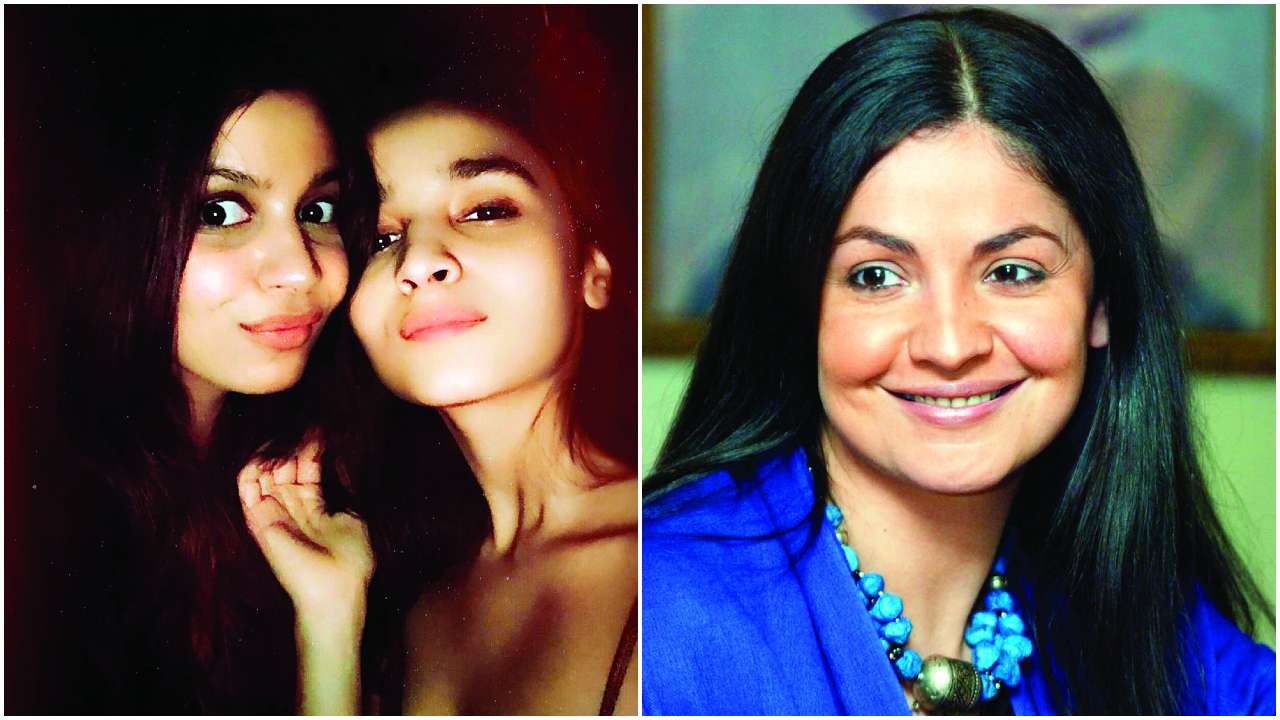
Harshada Rege (DNA; October 19, 2018)
In November 2016, Shaheen Bhatt posted a message on her Instagram handle narrating her experience of living with depression since the age of 13. Since then, not a day has gone by when she hasn’t had people writing to her about their trials and tribulations or thanking her for talking about it. The 29-year-old now gives a deeper insight into the life that she had led while battling this condition through her book titled, I’ve Never Been (Un)Happier. Her sisters, Alia and Pooja, as well as parents, Soni Razdan and Mahesh Bhatt, have taken to their social media handles to show support and admiration for the soul-baring account that Shaheen has penned. Excerpts from a chat with the author...
Battling depression is such a personal experience. What prompted you to share it with others?
Honestly, I hid the fact that I lived with depression for a long time. I never spoke about it because I thought there was something wrong with me. It took me a while to understand that what I was going through was an illness, which could be controlled and it’s not something that I need to be ashamed about. Since then, I have encouraged others to come out in the open about it as well. I wanted to lead by example, so I decided to write this book.
You wrote a social media post two years ago about suffering from this illness...
Yes, and that is one of the main reasons why I decided to pen the book. Every single day after that post, I have received messages from people sharing their own experiences or just reaching out to thank me for talking about it on such a platform. That made me realise how many of them are suffering in silence. When I was approached to write the book, I said yes almost immediately. I didn’t consult anybody. It was a personal decision for me.
How would you describe living with depression from the young age of 13?
While I was going through it, I was too young to understand. At that time, there was complete confusion and lack of awareness about what was happening. As I grew older, I learnt how to and deal with it. I realised that I don’t have to live with it all the time. Today, I feel grateful for what it has given me in my life — a lot of empathy and understanding. I wouldn’t change anything about my journey so far even though it has been quite difficult.
Have your family members read the book?
Yes. They read it months ago when it was in the drafting stage. I am lucky to have the most supportive and encouraging family in the world... my parents, my sisters and brother. Honestly, my sisters are more excited about it than me. Alia is treating it like it’s her own work (smiles). This book is my heart laid bare on a page. It’s about the last 16-17 years of my life — about how it began, how I learnt about it and everything that has happened since then. It’s a short format book and it’s designed in such a way that you can read it in one sitting. Books on mental health can be intense and difficult to get through, so we wanted people to understand as much as they could within a short span of time.
The conversation about mental health began in Bollywood only recently...
I think everyone is afraid of things that they can’t see or understand. There’s not enough awareness about mental illness for people to comprehend it. And when you don’t understand something, you talk about it in whispers and that makes it even worse. Deepika (Padukone) set the ball rolling by sharing her own experience. When somebody in that position talks about something that has not been spoken about before, it helps to change the perception.
After the book, will we see you writing a script?
I’m taking a step back from screenwriting for the moment. I want to focus on penning something personally for myself.
Subscribe to:
Posts (Atom)