Showing posts with label Shabana Azmi interview. Show all posts
Showing posts with label Shabana Azmi interview. Show all posts
Dissent and dialogue are not acts of disrespect; they are essential to a healthy society-Shabana Azmi
4:55 PM

Renuka Vyavahare (BOMBAY TIMES; July 25, 2026)
Shabana Azmi is cut from a different cloth. At 75, while much of the film industry remained silent or issued carefully worded, "neutral" statements, she chose to travel to Jantar Mantar in solidarity with the student movement led by the CJP, demanding accountability from the education minister and those in power. The students remain resolute, vowing to continue their nationwide agitation until their demands are met. Back from Delhi, Azmi spoke to Bombay Times while recovering from an asthma attack triggered by tear gas during the protest. In a candid conversation, she reflects on why she felt compelled to stand with the students, what she witnessed on the ground, and why she believes silence is no longer an option. Excerpts…
At 75, you travelled all the way to Delhi to stand with the students, age and health issues not withstanding. What compelled you to take that decision?
The sheer injustice of it. Students of our country are peacefully demanding a dialogue for educational reforms. They seek an overhauling of the educational system and accountability for the several lapses in key entrance exams over the years leading to despair to the point of suicide. Why can’t you listen to them? We need to build their hope, not crush their spirit. The prolonged hunger strike by the students and Sonam Wangchuk whose deteriorating health we were all witness to deeply concerned me. Can you imagine the pain of their parents who made huge personal sacrifices to assure a better future for their children?
What was that particular moment that made you feel, "Enough is enough"?
The complete indifference of the ruling party to initiate a dialogue. Sonam Wangchuk is a respected scientist and environmentalist whose work on climate change is applauded across the world. Yet, attempts were made to discredit him through canards and insinuations. The students, too, were branded anti-national and accused of being stooges of "foreign powers." That was the tipping point for me.
You've often been labelled 'anti-national' for speaking out, yet you've never stopped raising your voice. What gives you the courage to continue despite the personal attacks?
These are attempts to obfuscate the real issue and replace dialogue. And we take pride in being the world’s largest democracy?
India has witnessed many protests over the years, but this movement seems to have united people across generations and, for many, broken the collective fear of speaking up. Why do you think it has resonated so deeply with people across the country?
Because we all know that the youth are the future of our country. Increasingly, young couples are choosing not to have children because they cannot guarantee them a secure or hopeful future. That should worry all of us. I remember a university student saying during a debate many years ago, "Humko azaadi aadhi raat ko mili thi, aur savera aaj tak nahin hua." ("We got Independence at midnight, but dawn has still not arrived.") Those words stayed with me. In fact, I used that line to open my maiden speech in the Rajya Sabha. Atal Bihari Vajpayee ji appreciated it, you can verify it in the records. He did not treat it as a personal insult or an attack on his government. It resonated with him because he understood the larger sentiment behind it and responded like a true statesman. They were leaders of a different mettle. It saddens me to see how far we've drifted from that spirit today, where every criticism is viewed through the lens of hostility instead of being seen as an opportunity for dialogue and introspection.
Many believe we as a nation are conditioned from childhood to equate obedience with respect, whether at home, in school or at work. The people who don't question authority are often rewarded. Do you think this culture of silence and unquestioning compliance has become one of our biggest societal challenges?
I don't think it can be generalized like that. I would leave that to experts in the field. Speaking for myself, I was raised until the age of nine in Red Flag Hall, the commune of the Communist Party of India (CPI) in Mumbai. It was a remarkable space where discussions on social justice, women's empowerment and India's composite culture were part of everyday life. Progressive writers, poets, artists and political thinkers came together there, and our parents believed that art should be an instrument of social change. My brother Baba and I absorbed these values almost by osmosis. We were encouraged to ask questions, voice our opinions and speak up whenever we felt strongly about something, even if it meant disagreeing with others. That environment taught us that dissent and dialogue are not acts of disrespect; they are essential to a healthy society.
The day of the Parliament march shocked the nation. Videos showed unarmed students, including young women, being beaten, while later claims suggested the crowd had turned violent. You were in the middle of it. What did you witness firsthand, and what would you want the nation to know about what really happened?
Prakash Raj and I had been helped into a police truck by the protesters. I had to lie down for a while to catch my breath after one of the activists rushed to pull me up because the police had entered the area, triggering a stampede. Looking through the truck's grills, I narrowly escaped being hit by a large stone that was hurled towards it. Soon after, the tear gas and lathi charge began. The police were furious because they claimed that a shoe had been thrown at one of their colleagues. Now, who can verify that? It is their word against the students. What is beyond dispute, however, is that there is a clear protocol the police are mandated to follow while dispersing a gathering they deem "unlawful." It is fair to assume that those protocols were not strictly followed. I personally witnessed young boys and girls, many of them barely out of their teens, badly injured and bleeding because of the lathi charge. When I sat down in the mud with the protesters, I saw students who had themselves been injured rushing to shield and protect me instead of tending to their own wounds. One young man told me, "Ek lathi khaane ke baad lathi ka darr nikal jaata hai." ("Once you've been hit by a baton, the fear of it disappears.") A 15-year-old boy said, "Had I not joined this protest, I would never have been able to look myself in the mirror." My respect and salaam to these young people. Their courage, compassion and conviction showed us the way.
Many people are now unfollowing celebrities and actors who chose to remain silent, arguing that silence in the face of injustice amounts to complicity. It seems people are rethinking who they want to look up to and consider role models. Even the formulaic statements now trickling in, many feel they sound pre-planned and follow a familiar template rather than expressing genuine conviction. All this has only added to the public's frustration. What's your take on this?
Every artist has to make that decision for themselves. I don’t think it’s fair to judge people for speaking out, and I don’t think it’s fair to judge those who choose not to. Everyone weighs the consequences differently. What is important is that we don’t lose sight of the real issue. The conversation should remain focused on the concerns raised by the students and on how those concerns are addressed, rather than on whether individual celebrities have commented. Artists can amplify conversations, but they are not a substitute for institutions or democratic processes. Lasting educational reform and the protection of democratic rights come through public engagement, civic participation and accountable governance. It is encouraging that many members of the film industry have chosen to speak this time. The issues affecting young people because they are our future and we are all stake holders.
Shabana Azmi on what happened at Chalo Sansad march in Delhi: "Tear gas and lathi charge were unwarranted"
4:37 PM

Niharika Lal (BOMBAY TIMES; July 22, 2026)
Five days before she reached Jantar Mantar, Shabana Azmi and Javed Akhtar had written to PM Modi as concerned citizens and former nominated members of the Rajya Sabha, urging him to begin a dialogue with Sonam Wangchuk and the students. The letter was emailed, faxed and personally delivered, and an acknowledgement promised a response within two days.
When no reply came, Azmi decided to join the protest herself. “We waited two days, then three, then four. On the fifth day, I decided I would come here,” she said at Jantar Mantar on Monday.
Azmi maintained that her presence was never about herself. Standing in solidarity with the students, she said her presence was meant to draw attention to the young people who had shown the courage to raise their voices.
She also rejected claims that the students were being used for political ends. Speaking to a news channel, she said, “It was a sea of young people. I have never seen such a scene in my life… I have never been involved with any political party. I have never been a member of any political party. On record, I’m telling you, nor do I intend to be. I have never been a member of any political party because I have always believed that joining a political party means the party’s truth becomes your truth, which could be a one-sided truth. When I was in Parliament, we (she and Javed Akhtar) were Presidential nominees. We were with no party.”
‘MAIN HAMESHA NAHI BOLTI HOON. JAB MUJHE KOI CHEEZ ANDAR SE JHINJHORTI HAI TAB BOLTI HOON’
About the protesters, Shabana Azmi told reporters at Jantar Mantar, “They are saying violence kiya, jo bilkul sachh nahi hai. Ek tarfa jo sach bata rahe hain woh nainsaafi ho rahi hai yahan.”
When asked how she responds to being repeatedly labelled anti-national, she said, “Iss baat ko dil se nahi lagana chahiye. Mujhe kitni baar anti-national kaha gaya hai.”
At 75, Azmi said she sees speaking out not as activism but as a moral compulsion. “Main hamesha nahi bolti hoon. Jab paani hadd se guzar jata hai, jab mujhe koi cheez andar se jhinjhorti hai tab bolti hoon... ab meri 75 saal umar ho gayi hai, main bahut kuch dekh chhuki hoon.”
She added that she understands the resolve required for a hunger strike because she has experienced it herself. In May 1986, she joined filmmaker Anand Patwardhan and activist Gurubai Bhaskar Hamza in a five-day hunger strike demanding rehabilitation for slum dwellers displaced from Colaba in Mumbai. The protest was successful.
Throughout the protest, Azmi posted several videos from Jantar Mantar and recited a verse by her father, Kaifi Azmi: “Koi toh sood chukaye, koi toh zimma le, uss inqalab ka jo aaj tak udhaar sa hai.”
-----------------------------------
Upala KBR (MID-DAY; July 22, 2026)
When you express solidarity with others, you come back strengthened. That’s something Shabana Azmi always believed in. And the veteran actor experienced it over the past three days as she joined the ongoing protests — led by Abhijeet Dipke’s Cockroach Janta Party (CJP) — at Jantar Mantar in New Delhi, demanding education reforms and the resignation of Union Education Minister Dharmendra Pradhan over the NEET paper leak.
Since July 19, Azmi has been at Jantar Mantar, even joining thousands of youth in the Chalo Sansad march on July 20. Talking to mid-day from New Delhi, she said, “These young people have been pushed to the wall, and they have chosen to resist with courage and dignity.”
The actor criticized the police that resorted to lathi charge and tear gas even as the students protested peacefully on Monday. According to Dipke, over 150 protesters were undergoing treatment in hospital due to the violence.
Expressing her disapproval over the police’s handling of the situation, Azmi said, “What impressed me most was that despite their pain, their anger, and the provocation, the students remained determined to protest peacefully. The tear gas and lathi charge were completely unwarranted and condemnable. Who treats young students this way when all they are asking for is dialogue?”
A dialogue with the students, in fact, is what Azmi and her husband, noted writer and lyricist Javed Akhtar — both former members of the Rajya Sabha — sought from Prime Minister Narendra Modi. Azmi revealed that they wrote a letter to the PM, urging him to understand the students’ concerns.
“We received an acknowledgement, saying that we would get a reply within two days. When four days passed without any response, I decided to go to Delhi in support of the students. We are constantly told that our youth are our greatest strength. Then why were their voices not even being heard? When I went to Jantar Mantar, I saw hope and strength. We often dismiss Gen Z as careless or disengaged. I think the failure is ours. We have failed to provide them with the leadership that inspires trust. Yet today they are inspiring us, even to the extent of risking their own lives for what they believe is right,” said Azmi, referring to the protesters’ hunger strike.
The actor’s participation has been criticized by some sections, who claimed her presence was giving a political colour as she is seen as aligned with Left-wing politics. “I have never been a member of any political party,” she asserted, before adding that a patriot must hold those in power accountable for the betterment of the country.
“Democracy is strengthened by questioning, not weakened by it. I’ve been called many things over the years. Both Javed and I are criticized with equal intensity by Hindu and Muslim fundamentalists, which says something about our refusal to belong to any ideological camp. The real question is not what people call me. The real question is whether young citizens asking for dialogue deserve to be heard.”
Hearing their concerns and acting on them is the need of the hour, Azmi insisted. For her, the students are the “real story”. “Throughout history, young people have been the harbingers of change. They are our greatest investment. Let us nurture them, undertake the educational reforms they have been demanding, overhaul a system that too often fails them, and give every young Indian an equal opportunity to realize their potential.”
When I began winning National Awards, female actors started feeling ki iss space mein kuchh hai-Shabana Azmi
8:16 AM

Neha Maheshwri (BOMBAY TIMES; April 2, 2025)
From her early days navigating the then-distinct worlds of art-house and mainstream cinema, to her current place as a celebrated actress, who is keen to explore roles across mediums, Shabana Azmi has consistently broken stereotypes and paved the way for generations of actors. In an interview with BT, she reflects on her journey, talks about the positive changes happening in Hindi cinema, and how she wants to have a choice of films to work in. Read on...
‘Art-house cinema automatically placed me on a pedestal’
Shabana entered the film industry at a time when actresses were often just a glamorous addition to a hero’s narrative. Art-house cinema, while respected, was not considered commercially viable. However, the actress skilfully navigated both spaces, showcasing her versatility with every role she played.
She reflects, “When I started working, the fact that I was doing art-house cinema automatically placed me on a pedestal, putting me on the same level as Hema Malini. Had I started out in mainstream cinema, it would have taken me much longer to reach a certain level. When I began winning National Awards, female actors started feeling ki iss space mein kuchh hai. There is respectability. So, they began exploring.”
The actress believes the blurring lines between art-house and mainstream cinema have been beneficial for the industry. She says, “It has led to greater realism in filmmaking. I always felt, why should there be a division between the two.”
She adds, “The actresses today want agency because they have realized that something more is needed than just a role in which you are glamorous, pretty, and playing second fiddle to the hero. If you look at the actresses at the top, they are all playing substantial characters and that’s really good.”
‘Zeenat Aman & Jaya Bachchan didn’t wear wigs or make-up like their contemporaries’
Bring up how there is a certain homogenization of appearance in the way actors look on screen these days, and she explains, “These standards have been shaped by ideas of glamour we have now. So, the way your hair is done, the way your clothes are worn, all that is very similar,” she says. However, she believes there is a positive shift that is visible with actors embracing more individual and realistic looks.
“I think there is a change, which makes me happy, as there is now an attempt at characterization that feels much more realistic. In the past, there were only two people – Zeenat Aman in western roles and Jaya Bachchan in Indian roles – who had distinct personalities, and neither wore wigs or make-up in a particular way,” she explains.
There is this belief that actors in our industry, especially female leads, are easily replaceable, hence, one needs to stand out in the way they look and the roles they choose to create their own identity. On that, she recalls how her husband, writer-poet-lyricist Javed Akhtar, has an interesting point of view.
She says, “It’s a strange thing because Javed saab believes it’s an anachronism. If you aspire to be a star, the audience expects certain things from you. They’ll feel cheated if Shah Rukh Khan goes through a film without doing his signature arm spread. Yet, he also has to strive to be different. It’s a dichotomy.”
‘Rocky Aur Rani Kii Prem Kahaani paid me great dividends’
Talking about her current selectivity in choosing projects across mediums, the actress, who was recently seen in the web series Dabba Cartel, says, “I am an actor, and I love to do everything. People have this impression of me being drawn to art cinema. Aisa kuchh nahi hai, I want to do mainstream cinema. I had a ball when I did Rocky Aur Rani Kii Prem Kahaani. It also paid me great dividends. But I’m greedy and I want more. I want to work with all kinds of filmmakers. I want to work with both independent and mainstream directors. I want to have a choice of films to work in.”
‘I was not talented in the mainstream; I could not dance to save my life’
Shabana also believes that she made an awkward heroine in mainstream cinema. “I was not talented in the mainstream scene,” she says, elaborating, “I couldn’t dance to save my life. I was very awkward because I had this notion that I was Kaifi Azmi’s daughter, and I was from St. Xavier’s College and if I ran around trees, what would my friends think? I had certain inhibitions that took me a long time to overcome. I am saying all this in retrospect. It’s not that I was mindful of it in the beginning, or that there was any great design.”
Women are largely relegated to playing the victim, moll or seductress-Shabana Azmi
8:05 AM

Thrilled about Dabba Cartel winning praise, Shabana Azmi says the all-female crime drama was a gamble as the genre is rarely led by women in India
Upala KBR (MID-DAY; April 2, 2025)
Rich praise has been a frequent feature in Shabana Azmi’s career. It’s not surprising then that the actor’s latest release, Dabba Cartel, continues to be appreciated over a month after it began streaming. “The response I’m personally receiving is overwhelming,” she exclaims.
With Dabba Cartel, director Hitesh Bhatia has given us an unusual crime drama where five women—portrayed by Azmi, Jyotika, Nimisha Sajayan, Shalini Pandey and Anjali Anand—ingeniously run a drug cartel under the guise of a food delivery service.
Azmi shares, “The answer to its success lies in its writing. Plus, the director was clear in his vision. Also, a special thumbs up to Shibani [Akhtar, creator] who didn’t ask for favours just because she is Farhan’s [Akhtar, producer] wife.” Tell her it’s being referred to as the Indian version of Breaking Bad, and she says, “I haven’t seen Breaking Bad. So, I can’t comment.”
The Netflix series’ potential was not lost on her when she read the script. But the senior actor considered it a gamble. “We never thought that a women-led crime drama would become so popular. It was a gamble that paid off. I call it a gamble because there are no women-led crime drama series [in India]. Women are largely relegated to playing the victim, moll or seductress.”
Leading the drug ring is Azmi’s Sheilaben, a cold and calculative woman. Was it tough to play such a restrained character, emoting through one’s silences?
“Experience helps an actor to calibrate the performance. I worked on the look and added the Gujarati dialect to make her more interesting. The most challenging bit was that I had to play her differently from Godmother [1999]. Sheila’s power is more muted,” she reflects.
With Dabba Cartel, her daughter-in-law Shibani has forayed into writing. The Akhtar fold is populated with writers, beginning with Javed Akhtar, his filmmaker-children Farhan and Zoya as well as their mother Honey Irani.
Asked if she has ever considered penning a script, Azmi says, “I can never write. It’s a specialized skill and not everyone can do it, although many try it almost in a cavalier fashion. I come from a writer’s family and have the highest regard for writers. I’m happy being an actor.”
If marrying Javed Akhtar would make me Shabana Azmi, I would marry him-Vidya Balan
8:16 AM

Neha Maheshwri (BOMBAY TIMES; October 22, 2024)
The masterclass with veteran actress Shabana Azmi moderated by Vidya Balan, at the MAMI Mumbai Film Festival 2024, left the audience inspired. The two acclaimed actresses shared their journeys, offering insightful perspectives on the craft of acting, the evolving landscape of Indian cinema, and the key to staying relevant.
‘Theatre isn’t my first medium, I find it incredibly challenging’
During their conversation about the diverse mediums in today’s entertainment landscape, Vidya asked Shabana about her love for theatre, given her unforgettable performances in plays like Tumhari Amrita and Broken Images.
“I still see myself as a film actor,” Shabana responded, elaborating, “I’m trained in cinema and understand the medium much better. However, I believe the ideal situation for an actor is to work in both mediums.”
Shabana said, “While theatre isn’t my first medium, I find it incredibly challenging. The thrill of performing live on stage is unmatched. However, I wouldn’t say it’s the most satisfying because a film performance lasts forever, whereas theatre is ephemeral.”
Vidya added, “I’ve been offered a few plays, but I haven’t had the courage to say yes. The idea of performing in front of a live audience is extremely intimidating.”
‘Hindi cinema used to operate in an alternative reality’
Vidya brought up the fact that Shabana has starred in a diverse range of films, from arthouse cinema to mainstream escapist hits. When asked about the contrasting impact and reception of her vast body of work, she replied, “I just have a ball. I surrender myself to the director. For example, if I were to ask someone like Manmohan Desai, ‘What does this mean?’ He’d reply, ‘Iska kuchh matlab nahi hai. Main bol raha hoon yeh hai iska matlab. Yeh Satyajit Ray ki picture nahi hai’(laughs!). And you are happy to surrender to someone who directs with such conviction.”
‘The lack of attention to detail in mainstream cinema drove me crazy’
Elaborating on her experience of working in mainstream and offbeat cinema, she said, “It’s actually easier for actors to perform in arthouse cinema because it is realistic. Hindi cinema used to operate in an alternative reality; it didn’t matter if you were playing a policeman or a businessman – their homes looked no different from one another. The lack of attention to detail drove me crazy. It was left to art films to capture those finer nuances. I feel there was a design behind it though – Hindi cinema aimed to cater to the lowest common denominator and wanted to be all India. This focus on mass appeal made it more challenging to create credibility in such a stereotypical world.”
‘I lament the loss of songs & lip-syncing in our films’
Shabana expressed her disappointment over the decline of lip-synced songs in Hindi cinema, saying, “I lament the loss of songs being sung in sync because, in Hindi films, we tell our stories through songs. These songs were like little philosophies that captured life’s moments. We had a song for every situation, creating a nostalgic connection. However, in the effort to be modern, we’re replacing the song with something no one is paying attention to.”
Vidya agreed, adding, “I absolutely miss lip-syncing to songs; they have now been relegated to the background. I also feel that the urge to be universal is robbing the Hindi film industry of its unique essence.”
‘Actors who start playing meaningful roles have a longer career span’
When asked how she has managed to stay relevant over the decades, Shabana shared, “I’ve never been someone to rest on past achievements because I constantly seek new challenges. So, staying relevant is important to me. Even after 50 years, I am still learning. I adapt to changes, like working with green screens (chroma) where I react to nothing.”
On the topic of ageing and the kind of roles that women get offered, Shabana concluded, “Ageing has never been a problem for me, I embrace it as a natural part of life. I don’t try to look younger than I am because there’s nothing more beautiful than ageing gracefully. Even in my 30s, I wasn’t doing only naachne-gaane ke roles; I was playing substantial characters. Actors who start playing meaningful roles have a longer career span. There’s always more space for characters than just leading men and women.”
‘My entire family supported my decision to do Fire’
When I was working with women living in slums, I was concerned that if I accepted the role (in Fire), it could be used against me, making it difficult for those women to continue working with me. Zoya (Akhtar), who was only 18 then, asked, ‘If you like the script, what’s the big deal?’ Farhan, even younger, liked the script but was concerned about the ending — my character was meant to die in the fire. He argued it would suggest the character did something wrong, insisting she needed to survive. I shared his feedback with Deepa (Mehta). Ultimately, my entire family supported my decision
---------------------------------------------------
If marrying Javed Akhtar would make me Shabana Azmi, I would marry him – Vidya Balan
---------------------------------------------------
I really enjoyed working on Rocky Aur Rani Kii Prem Kahaani. In the very first scene, I had my hair down on one side, wearing a silk sari while cooking macchi curry. I asked Karan (Johar), ‘Which Bengali woman cooks in a silk sari with her hair open?’ He said, ‘In a Karan Johar film, she does, just go with it’. I’m glad I trusted his vision because it turned out beautifully – Shabana Azmi
Shabana Azmi lists her five special films from her 50-year career
3:10 PM

Natasha Coutinho (BOMBAY TIMES; March 15, 2024)
Five decades in the movies – and what a glorious journey it has been for Shabana Azmi. “But then, acting can’t be taught in 15 days or a month, that’s not even touching the tip of the iceberg. The greatest resource for an actor is life itself. Getting into the world of the character is not an easy task, just learning your lines is not enough,” she says.
It’s a 50-year career marked with several milestones, from winning a National Award for her debut in Ankur (1974) to choosing to play a queer character in Fire (1996). Here are five movies from her 50-year career that she exclusively spoke on during an hour-long chat.
ANKUR (1974): ‘I TOLD MY MOTHER THAT IT WAS LIKE SHOOTING A SATYAJIT RAY FILM’
I had started shooting for Faslah and Parinay, but it was Shyam Benegal’s Ankur that was my first release (Shabana won the Best Actress National Award). I was an urban, city-bred girl who spoke English and had never gone to a village. Then, Shyam Babu got Lakshmi’s costumes ready and we started working on what her gait would be like. It was interesting working with Shyam Benegal and I told my mother that it was like shooting a Satyajit Ray film. We went to the Berlin Film Festival and it was so glamorous. We got special treatment because Satyajit Ray’s film had been screened there in the past and were widely appreciated. Richard Dreyfuss and I were announced as the talented newcomers. The journey afterwards was a dream, and I was lucky as I faced no struggle.
ARTH (1982): 'EVEN TODAY PEOPLE TELL ME THAT THE FILM CHANGED THEIR LIVES’
One could give up an arm or a leg for my role in Arth. Mahesh Bhatt and I were friends and he excited me as a director. It’s like he would press a button and I would become the character. When the film released, people said it was nice, but objected to the ending – how could a woman not forgive her husband when he was apologizing? We said that we had made the film with that specific ending in mind and thank god for that! I won the National award, and it was a big hit. Even today people tell me that the film changed their lives and gave them courage. It was a small-budget film and many of the clothes I wore were my own. It didn’t have a bound script and kept developing even as we were shooting. One day, I was shooting for another film and Bhatt asked me to come over for 10 minutes. When I reached, he started shooting the important telephone call scene, with just one technical rehearsal. I started trembling, but today I’m glad it turned out that way and I did not over-prepare.
MANDI (1983): ‘I VISITED THREE BROTHELS TO UNDERSTAND THE WORLD OF THE FILM’
There was no question of saying no to Shyam Benegal and I gave 40 days for Mandi. My secretary was baffled and told me that I could’ve finished more films in that time. Most people on set were from FTII or NSD and we had a great time. Smita and I were given cars, but we gave it up to travel by bus with the others. Ila Arun would keep us entertained with her songs. I visited three brothels to understand that world. Faaroq Shaikh took me to Peela House and I noticed the girls were not garishly dressed; they wanted to look like film stars. Amrita Singh’s mother Rukhsana Sultana took me to GB Road, Delhi, that had tawaifs. Shyam Benegal took me to Heeramandi, where the madam asked one girl to perform on Dil Mein Tujhe Bitha Ke (from Fakira, that stars Shabana opposite Shashi Kapoor). Afterwards, she went back to being the person she was, a woman who had to support a family of eight. Pankaj Kapur had one scene but Shyam Babu would like the actors to be around. So he built a volleyball court and a carrom space so that we wouldn’t get bored.
FIRE (1996): ‘IT WAS NANDITA DAS’S FIRST FILM BUT SHE HAD THE COURAGE TO SPARKLE’
People still talk about Fire. It was Nandita Das’s first film but she had the courage to sparkle. We shot in a small house in Lajpat Nagar in Delhi and I knew there would be different reactions. People would be disturbed and overwhelmed, as these subjects were generally shoved under the carpet. The final confrontation between the characters played by Kulbhushan Kharbanda and me, where I talk about desire, was memorable. Deepa (Mehta) described my character as a ‘centred woman’ and for me, that’s when the penny dropped in my head. I don’t like directors showing how to act; one has to inspire the actor – not make them imitate. Having said that, the director is the most important person on the film, it’s their vision. But actors get more credit because we are on camera.
ROCKY AUR RANI KII PREM KAHAANI (2023): ‘KARAN JOHAR WOULD SAY ‘TRUST ME’ AND I WAS HAPPY TO SURRENDER’
Rocky Aur Rani Kii Prem Kahaani was a very different world for me. Karan Johar would just say ‘trust me’ and I was happy to surrender. Karan has kept up with the times and also wanted to bring in the world of Yash Chopra. The film raises such important points on gender roles. On one side I was playing Jamini and on the other side I was shooting for R Balki’s Ghoomer, I was also shooting for Shekhar Kapur’s What's Love Got To Do With It? In the same period.
I never thought I’d get such diverse roles in the 50th year of my career-Shabana Azmi
2:34 PM

Niharika Lal (BOMBAY TIMES; February 25, 2024)
During a recent discussion with a student collective, Shabana Azmi spoke about her days at St. Xavier's, her experience at FTII, her first roles, and the lasting impressions her teachers left on her. Shabana shared how in the 50th year of her career, she is once again getting the kind of roles she had never expected: from Steven Spielberg's Halo and Shekhar Kapur's What's Love Got To Do With It to Rocky Aur Rani Kii Prem Kahaani and Ghoomer.
"Meri energy wahan se aati hai ki mujhe zindagi se bahut dilchaspi hai. Mere 50th saal mein ek naya silsila shuru hua hai mere career mein - do saal ke dauran mujhe itne mukhtalif (diverse) roles mile. Pehle main yeh kabhi nahi soch sakti thi ki mujhe itne mukhtalif role milenge. I feel I'm so lucky. I am at that stage in life where I don't need to do any roles, so when I find a role challenging, if I feel if the role is saying something that I believe in, then I do it. Mujhe ek mauka milta hai apne films ke zariye unn subjects ko chhune ka jo aam taur par log nahin discuss karte."
Talking about her co-stars, Shabana remembered Farooq Sheikh. Shabana shared that when she enrolled at St. Xavier's College, she found that there was no Hindi theatre program in the college. So Shabana and Farooq Shaikh decided to form the Hindi Natya Manch. Talking about her friendship with Farooq Shaikh, she said, "Farooq se meri behad dosti thi. Woh St. Xavier's College mein mere saath thay."
Later in their careers, they worked together in the play Tumhari Amrita, directed by Feroze Khan, which they performed across various countries. She recalled, "Jab aakhri show hua Tumhari Amrita ka, toh humne usey Taj Mahal ke backdrop mein kiya. Maine kaha ye play hum 22 saal se kar rahe hain, ab humein iss play par parda gira dena chahiye. Farooq ne poocha, kyun? Hum 22 saal se kar rahe hain, agle 22 saal tak aur karenge isey."
She added how just 14 days after this, Farooq passed away. “Ye baat mere sar mein constantly ghoomti hai. Woh itni young age mein guzar gaye ki mujhe aaj tak ajeeb lagta hai ki itni jaldi zindagi ne use kyun chheen liya humse? It's a huge pity."
Shabana also shared other anecdotes from her career. When Shyam Benegal offered her two roles together for the first time, she told her mother 'koi fraud director hai'. And when Satyajit Ray offered her a role, “main khushi se pagla gayi.” She told the students how these directors appreciated her craft and the nuances of acting that she learned from them.
Actors are neurotic, says Shabana Azmi; focus has shifted to PR machinery than acting, believes Saiyami Kher
10:17 AM

Renuka Vyavahare (BOMBAY TIMES; September 12, 2023)
Saiyami Kher, granddaughter of acclaimed Hindi and Marathi film actress Usha Kiran, addresses Shabana Azmi as maushi (aunt in Marathi) as they are family, but listen to their banter and you’ll know they are more like friends. There’s a bit of an age reversal here in terms of demeanour. Saiyami is an old soul, while Shabana has the spirit of a youngster. Those trying to figure out the Saiyami-Shabana connect, here’s a little trivia. Saiyami’s aatya (father’s sister) Tanvi Azmi is married to Shabana’s brother Baba Azmi. The aunt-niece pair who shared screen space for the first time in R Balki's 'Ghoomer' recently, took a trip down memory lane through this exclusive interaction with us. The two exchanged thoughts on a variety of subjects like...
Family ties and talent
Shabana: Saiyami took a few acting lessons from my mother, (the late Shaukat Kaifi, acclaimed theatre and film actress). My mother was someone who never minced her words. She said, ‘Yeh ladki ki andar se machine chalti hai’, which was a way of saying that Saiyami connects emotionally. She isn’t superficial. When my mother said that about her, I took it seriously because she wasn’t the one to say these things easily.
Saiyami: Daadi ma (Shaukat Kaifi) was kind enough to help me out with my Hindi improvement and acting. I was very fond of her, and she loved me, too. She was an extremely strict teacher. When Shabana maushi and I shot together, she reminded me so much of her mother that I accidentally called her daadi ma several times. I remember Shabana maushi telling me to work on my voice. “Don’t speak so nasal,” she would say.
Social media and making of a star
Shabana: I am not the kind of person who likes indulging in nostalgia and say, “Humare zamane mein yeh tha, woh tha.” How many followers you have on social media is now a reason for casting an upcoming actor. Earlier, you had to carry a portfolio, then reels of your work and now it’s about isko cast karte hai, iskay itnay followers hai. You get endorsements based on it, so for the younger generation it is important. For the senior generation, it’s a question of choice — whether we want to be out there or not. Zeenat Aman and Saira Banu are on Instagram now. Zeenat has made such a dignified entry on the platform. People are not going to cast us because we have a certain number of followers but because of our body of work.
Saiyami: I am from this generation, but I feel like I am 85. Given a choice, I would rather spend an evening with Gulzar sahab or Javed (Akhtar) uncle than go out and party with 25 or 30-year-olds. We will have more things to talk about. I have never been a fan of social media. I feel the focus has shifted to PR machinery and the Instagram algorithm today, as opposed to what you are supposed to do on camera, which is act. I hope we can revert to how the older generation functioned; the work was purer. But we can’t keep living in nostalgia. We must live in the present and strike a better balance between virtual and real.
Overcoming career battles
Shabana: Saiyami is a very passionate and committed person. There was a time when she went through a dark phase, and yet, kept going. She didn’t give up because she had faith in her abilities. She never let down the parts she played, but she needed something where her work would be recognised. I feel Ghoomer (the film directed by R Balki in which Shabana and Saiyami shared screen space) has done that for her. It was physically and mentally gruelling for her.
Saiyami: I was not getting work after my debut film (Mirzya, 2016). A wise man’s writing kept me going and his name is Javed Akhtar. I remember he wrote, “Zindagi mein kyu dare kya hoga? Kuch na hua toh tajurba hoga.” That line is etched on my mind.
Actors are neurotic: Shabana
Shabana says, “Acting is an interesting profession. You can come to a set feeling low after having had a nasty argument at home or show up elated if the day has been good. You can be expected to do a happy scene when you are feeling sad or vice versa. You must keep your personal feelings away and do what a scene requires of you. Which is why I say actors are neurotic. A civilised society says that you have to keep your emotions under control. Acting demands the opposite. You have to constantly keep yourself in a state of emotional preparedness.”
Aamir Khan ke cupboard mein alag alag jism rakhe hue hai, jo woh utha ke pehen leta hai, when he starts a new film-Shabana Azmi
7:56 AM

Soumitra Das (BOMBAY TIMES; May 11, 2023)
Shabana Azmi was recently in Vadodara to attend a literature festival organised by a citybased university. At the event, she said, “Main ek writer (Kaifi Azmi) ki beti, writer (Javed Akhtar) ki biwi aur writer (Jan Nisar Akhtar) ki bahu hoon! I am often asked if I ever felt the urge to write. Toh main kehti hoon ki main unn ki inspiration hoon! Literature is the basis of all art forms.”
‘I WAS THRILLED TO WORK WITH EMMA THOMPSON, WHOM I ADMIRE A LOT’
Shabana, who is all set to work with Prateik Babbar on a new film and was recently seen in a romantic comedy directed by Shekhar Kapur, says, “Working with Shekhar Kapur after 40 years was a great experience (the actress last worked with the director in his debut film, Masoom, 1983). We shot in London when the pandemic was at its peak and my family was quite worried. Shekhar went out of his way to ensure that everyone was happy on set. I was thrilled to work with Emma Thompson, whom I’ve always admired as an actress and activist. I believe an artiste’s job is not just to entertain, but also provoke. We followed strict protocol and completed the shoot in 40 days. I am glad that the film was received well.”
She adds, “The Hindi film industry has certainly changed for the better. Earlier, we would spend three months in pre-production and shoot a film for two years. Now, one year is spent in pre-production and the shooting is completed in a year. Many actors do just one project at a time and that allows them to work on transforming their look. Main humesha bolti hoon, Aamir Khan ke cupboard mein alag alag jism rakhe hue hai, jo woh utha ke pehen leta hai, when he starts a new film (laughs)!”
She adds, “Also, casting directors are playing a very important role by casting terrific actors from small towns and ensuring that we move away from stereotypical characters.”
‘WHILE TAKING UP MAIN CHARACTERS, ACTRESSES HAVE TO TAKE A PAY CUT’
The National Award-winning actress is happy with the way actresses are now getting to play central characters in movies on a regular basis. She says, “I love the fact that our actresses are now keen on doing roles where the film is centred around them. While doing such central characters, they often have to take a pay cut too and a lot of people might question, ki aisa kyun kar rahi ho? These actresses should think that by making this sacrifice, woh log raasta bana rahe hain, jahaan aage jaa ke there will be much-needed pay parity.”
‘OTT HAS CERTAINLY CHANGED THE VIEWING PATTERNS’
Asked about the impact of OTT, she shares, “While I don’t know how long it will last, OTT has certainly changed the viewing patterns in a big way. So, while films that promise a big spectacle might draw audiences to theatres, people prefer to watch realistic films on OTT. ”
‘TROLLING DOESN’T BOTHER ME’
Talking about the trend of boycotting films on social media, Shabana says, “Yeh boycott wale bahut udd rahe thay, lekin Pathaan ki success ke baad chup ho gaye. Trolling doesn’t bother me at all. Most of these trolls don’t have even 10 followers. Toh woh jo bhi bakwaas kar rahe hain on social media, why should we bother about it?”
‘SHARED A GREAT BOND WITH SATISH KAUSHIK’
We shared a great bond with Satish Kaushik and it’s heartbreaking that he left us so early. Javed (Akhtar) saab humesha kehte hain, Satish ko log achha comedian samajhte hain, but he was so good in all kinds of roles. He was a fantastic human and I love that Anupam Kher decided to celebrate his life (by organizing a musical night on his birth anniversary).
-------------------------------------------------------
Rishabh Suri (HINDUSTAN TIMES; May 11, 2023)
Actor Shabana Azmi has managed to strike a balance between work in the West and back home in India. She recently shot for Steven Spielberg’s series, Halo and will also play one of the main roles in Karan Johar’s Rocky Aur Rani Ki Prem Kahani.
Has the chatter around Indian cinema changed in the West in the past few years? “Not really,” she continues, “Actually, if you have a realistic view, now that we have won an Oscar for Naatu Naatu (RRR, 2022), maybe to some extent [it has changed]. Earlier, the awareness of Indian cinema was only [limited to] (filmmakers) Satyajit Ray and, in some pockets, Shyam Benegal and Mrunal Sen. Now, the word Bollywood has been copied, everything is Bollywood.”
The 72-year-old goes on to add that she “really fought against the term Bollywood”. Explaining why, she says, “It (the term) suggests that all of Indian cinema is just a mimic of Hollywood. But now, we have finally come to terms with it... What they actually call Bollywood is the song and dance number, which, in any case, is reducing as a natural matter of process. That seems to be happening.”
However, there is still a long way to go for Indian cinema on the global level, feels the actor. “The fact that we won two Oscars is obviously making us feel very happy. But, they (people in the West) have vague ideas... They know we make the largest number of films. In fact, Nollywood (Nigerian film industry) now makes more films than we do. Magar abhi aur manzilein baaki hai,” smiles Azmi.
I didn’t even have money to buy a cup of coffee when I first went to Cannes-Shabana Azmi
8:14 AM
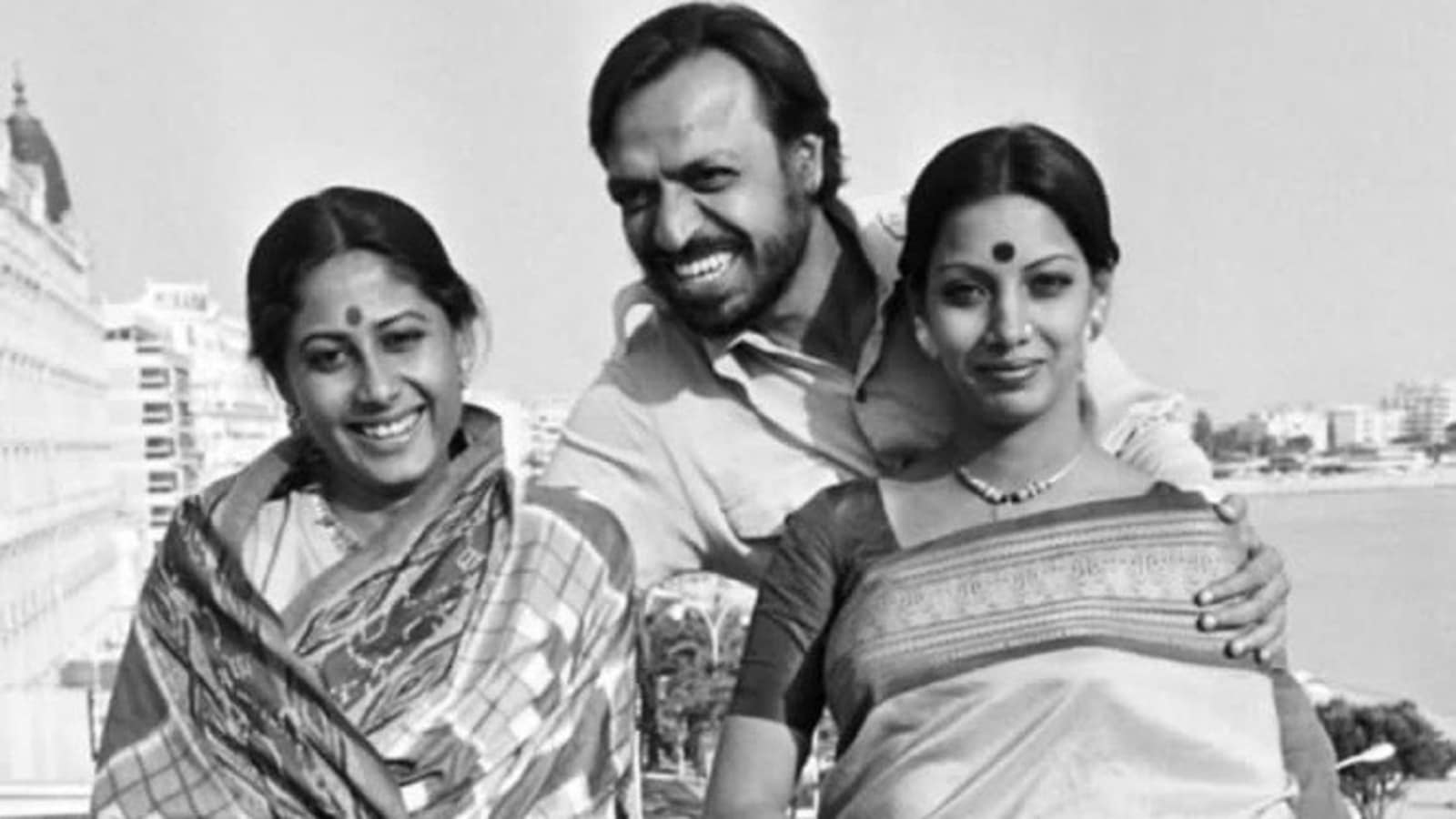
The actress recounts memories of her first experience at the Cannes Film Festival in 1976
Tanvi Trivedi (BOMBAY TIMES; May 21, 2022)
Veteran actress Shabana Azmi along with Smita Patil and filmmaker Shyam Benegal represented India at the Cannes Film Festival as early as 1976. The trio was at the prestigious film festivals to showcase their film Nishant. The actress in a recent post on Instagram shared how they had no publicity material or funds to promote their film, but they still managed a full house! BT spoke to Azmi about her experience back then and how she views the festival now. Excerpts:
You had recently posted on your social media about attending the Cannes Film Festival in 1976. What do you remember about your first experience there? How was it meeting people on a global platform?
Back then, we were not glamour struck by anything. We were experiencing terror at not having any publicity material or any money whilst others were throwing lavish yacht parties with caviar and champagne.
We were allowed the princely sum of eight US dollars in foreign exchange, so when I say we had no money, I mean it. Since breakfast was included in the room tariff, we used to fill our stomachs and survive on coffee and French fries during the day. Inevitably, we had dinner at many parties, where our intention was less to network and more to fill our stomachs! What was fascinating, however, was to have Shyam draw up a list of the films that we could watch, as we rushed from one screening to the next!
You spoke about the lack of funds. How did your team manage a full house?
Shyam came up with the idea that Smita and I should dress up in our best sarees and walk up and down the promenade to attract attention. We turned many heads because whilst there were many in bikinis and shorts, we looked like we were out of some oriental exotica! We would then rush to the curious people and say, ‘Please come and watch our film, which is in competition on so and so and this date!’ But the ruse worked, we managed a full house and even received a standing ovation.
After 1976, when did you go to the Cannes Film Festival next?
I was scheduled to go there for the screening of my film Genesis, an Indo-French-Belgian co-production directed by Mrinal Sen in 1986. A day before the trip, I decided to go on a hunger strike organised by the NGO Nivara Hakk with Anand Patwardhan and three slum dwellers for the rights of slum dwellers in Cuffe Parade, whose huts had been demolished. Five days into the hunger strike, Shashi Kapoor negotiated on our behalf with Chief Minister S B Chavan, and we managed to get the alternative land we were demanding. It was worth giving up going to Cannes and mercifully Mrinal da was very supportive. Later, I was invited to Cannes to give the award for the best documentary film in 1989. I was chuffed; I was now staying in a fancy suite of the very hotel we used to look longingly at; when we didn’t have money to even buy a cup of coffee at the Cannes Film Festival.
Celebs’ red-carpet appearances at Cannes become a talking point every year. How do you view the Cannes Film Festival now, with a huge focus on fashion, along with great cinema?
I remember some years ago it was said that any woman wearing flat sandals cannot appear on the red carpet. I was horrified and protested loudly. They received a lot of flak for it. Mercifully, they decided not to go ahead with that diktat. This business of the red carpet drawing so much attention is pure commerce. Many jewellers and fashion houses use it as an opportunity to advertise their wares. The celebrities are happy to look good without having to pay for it and so it’s a win-win for both. That’s the way the world functions today. But for me, the primary focus of a film festival remains the opportunity to watch the latest in world cinema. I am less interested in who wins the award and more interested in catching a distant film that otherwise I would be unable to.
If you were to go to Cannes now, how would you like to dress for the festival?
Without a doubt, in a saree. There is a timeless elegance to the saree, which is unmatchable.
None of the actor in Steven Spielberg's Halo is cast due to their ethnicity-Shabana Azmi
8:09 AM

A still from Halo. Pics/Instagram, Getty Images
With the makers of her upcoming sci-fi series Halo employing colour-blind casting, Shabana Azmi bats for diversity on screen
Upala KBR (MID-DAY; March 6, 2022)
In early 2020, Shabana Azmi began shooting for Steven Spielberg-backed Halo, adapted from a popular video game. Two years on, the sci-fi television series—which sees the actor play Admiral Margaret Paragonsky, the head of the Office of Naval Intelligence—is set to air on Paramount+ from March 24. Azmi says it was a sheer pleasure to be part of a project that employed colour-blind casting.
“Halo has a cast that includes Korean, African American, English, Indian and Hungarian actors. None of them is cast due to their ethnicity, nor is anyone made to put on an accent that is not intrinsically theirs. That is so refreshing,” she exclaims.
Colour-blind casting, where one’s ethnicity is not considered while casting for a role, has become increasingly popular in recent times. While the practice has some detractors, the move is largely welcome as it boosts diversity on screen.
Azmi echoes the sentiment, as she says, “Every part that I have played in the West in the last 34 years has been that of a South Asian, and they weren’t visible on the screen till recently. I remember asking John Schlesinger as far back as 1988 [while working on Madame Sousatzka] that in the book, the mother was a Jew; how come he decided to make her Indian? He had said, ‘Indians are so much a part of the British fabric, it must result in the choices we make.’ As the world becomes a global village, it makes sense to be inclusivist and diverse. The struggle for colour-blind casting started about 40 years ago, and finally, we are seeing some results.”
The senior actor describes her character as a hard-nosed, no-nonsense woman. “But I had to find her vulnerable spot because you can’t play a character on one sur. She is conflicted because she has been trained to abide by the rules and yet she allows the unscrupulous scientist to manipulate her.”
Before Azmi reported to the show’s set, showrunner-director Otto Bathurst organised her visit to the Halo world’s lab, 343 Industries. “It was such an alien world, but so fascinating. I didn’t know the game but my 12-year-old nephew Viraaj, who had never before given me time of day, was suddenly impressed by his Shabana bua,” she laughs.
In a film like Kapoor & Sons, Fawad Khan’s character of a queer person was an important one-Shabana Azmi
8:26 AM

Nuzhat Aziz (BOMBAY TIMES; September 28, 2021)
After more than two decades of the release of Deepa Mehta’s controversial film Fire, actor Shabana Azmi feels that the representation of same-sex relationships in mainstream cinema is finally being dealt with empathy, rather than mockery. From playing a character in a same-sex love film, to essaying a mother who finds it difficult to accept her daughter’s relationship in an upcoming project, she feels that even today, despite the far greater acceptance and awareness of LGBTQIA issues, there is still reluctance and misconstrued notions around the same.
Having recently won the Best Actor for Sheer Qorma at the India International Film Festival at Boston, the versatile actress talks to us about how important it is to showcase the underrepresented LGBTQIA community in mainstream cinema, how dissent is valid in a healthy democracy and what the pandemic has taught her. Excerpts:
Sheer Qorma has been showcased at several festivals and is winning praises and acceptance. Your thoughts on being part of a project that highlights an underrepresented group like the LGBTQIA community in India, especially after the decriminalization of Section 377.
I think that this is a subject whose time came several years ago. If you look at Fire, which was made in 1996, it was a logical extension of that. A film like this is very important because it is done in a very sensitive manner to sensitize people who still have mixed reactions about the topic. I think that Sheer Qorma is an important film, particularly because it has been made by a queer, non-binary filmmaker (Faraz Arif Ansari) and it has been his journey and struggle in being able to come out with it.
Fire released in the 90s and created a controversy because it spoke of same-sex love. How far have we come from then? Do you feel the queer community has greater representation and acceptance in mainstream cinema today?
Certainly, because earlier it was inconceivable that any actor, particularly in mainstream cinema, would agree to play a character from the queer community. But now, although in the beginning it almost happened surreptitiously, the fact is that in a film like Kapoor & Sons, Fawad Khan’s character of a queer person was an important one. So, I think the queer narrative is making its way into mainstream cinema by being dealt with empathy, rather than mockery. This not only leads to acceptance of people with different choices in love, but also gives hope that this acceptance of the “other” will then be extended to communities, nations, gender, race and religion; and that’s what we need. Not just tolerance, but acceptance as well.
Your character in Sheer Qorma is layered.Even though you have accepted your child’s sexual identity, it somewhere rattles you to see them in the same light as your son and his partner. Do we, in some way, cause the damage to our children because of our inability to understand what exists outside of us?
Parents are still in that space where they think ‘Oh my God, I have done something wrong’. Any departure from a social norm is considered wrong and then you either blame yourself, or the other person. So, it requires a sea change of attitude. We are inching towards it. I think one of the most important dialogues in the film is where the mother says: “Yeh khuda ke khilaaf hai” (This is against God). And then her son says, “Magar jinhone inko banaya hai woh bhi toh usi khuda ne banaya hai, ya kisi aur ne?” (But God has created them and they are part of his creations). And that makes the penny drop for her.
This is the point that the actors, filmmaker and writer are making – this is love. People have different kinds and expressions of love – who are we to judge them? It is all this prejudice that keeps surfacing and erupting, not only when it comes to same-sex love, but to anybody who is different from us. You need people in the public eye who have accepted same-sex relationships of their children. Because when you start seeing this being accepted, then people who are less empowered will get the courage to accept it.
Your recent web series, The Empire, was subject to trolling and ran into a controversy because some felt that it glorifies the Mughal ruler Babur…
Political agendas have permeated into every single thing in our society, and you have to negotiate your way through that. You cannot treat every comment and remark as a war. People have a right to express their opinion and dissent is one of the strongest things in a democracy. So, when people have the right, some of them will use it, some will misuse it. When you welcome all the accolades, you also have to accept the brickbats. It’s part of the game.
You recently shot for Jemima Goldsmith’s What’s Love Got to Do With It, along with Emma Thompson. What was the experience like, especially during the lockdown period?
I left on January 3, which was the height of the pandemic, and we completed the film in 38 days. We were in a very tight bubble and the whole crew was tested every single day. We were all very respectful of the bubble and weren’t allowed to meet anybody outside our shooting group. It was bitingly cold, and the outdoor sequences were very hard, but with actors, I think it is just an adrenaline rush that comes up when you are against forces. The film is a lovely rom-com and I think that kept people’s spirits up.
The Coronavirus pandemic has made all of us look at the world differently. Do you think we will see the world in a better light now?
It makes you very sharply aware of the fact that every single person, from the richest to the poorest country, is connected. It is evident now that we have become a global village. For me personally, what it has made me do is distinguish between needs and wants. We have an overdose of everything – clothes, shoes, bags, books - anything that catches our fancy. Throughout the two years of the pandemic, I did not buy a single thing and have always felt the need to curb the material desire.
I decided to join FTII after I saw a diploma film starring Jaya Bachchan-Shabana Azmi
8:14 AM

Shabana looks forward to sharing screen space with her idol Bachchan as she kicks off Karan’s Rocky Aur Rani Ki Prem Kahani shoot
Upala KBR (MID-DAY; September 15, 2021)
There’s something about the first day of shoot — it can make even the finest actors a ball of nerves. Shabana Azmi draws an interesting analogy, as she explains, “Slipping into a role on the first day is like entering the living room of a person you have never met. Sometimes, you can make friends with the character instantly; at other times, it takes a few meetings to warm up.”
It probably best sums up the headspace of the senior actor, who kicks off the shoot of Rocky Aur Rani Ki Prem Kahani at Powai today. The film, starring Ranveer Singh, Alia Bhatt, Jaya Bachchan and Dharmendra, marks her first collaboration with director Karan Johar. “It’s a comedy that deals with some important issues in a breezy way. I find it challenging to play a character in a Karan Johar film. He is both respectful and irreverent, and is open to suggestions. The prep has been invigorating. I have known Karan as a podgy teenager who would come to meet Javed [Akhtar, husband].”
One of the reasons she was drawn to the project was that it gave her the opportunity to share screen space with Bachchan. “I decided to join FTII [Film and Television Institute of India] after I saw a diploma film starring Jaya Bhaduri. I was taken by her life-like performance. Her work in Abhimaan [1973] and Mili [1975] continue to move me deeply.”
Before she slips into haute couture for Johar’s movie, Azmi is basking in the praise coming her way for The Empire. She was magnetic as the shrewd strategist Aisan Daulat Begum in the period drama. “The most important compliment came from Javed. We are stingy with compliments, and offer an honest appraisal of each other’s work. [A performance] can seem effortless only after a lot of effort is put in during the prep. I am happy that Hindi projects have now started the practice of readings and workshops before the actors go on set.”
That isn’t the only change in Indian entertainment. Today, senior women actors — including Dimple Kapadia and Neena Gupta — are bagging powerful roles. Glad that the industry has left behind its ageist ways, Azmi says, “Finally, substantial roles are being written for women. It is a healthier ecosystem to work in.”
To have Divya Dutta and Swara Bhasker as co actors in Sheer Qorma was a bonus-Shabana Azmi
8:03 AM

Renuka Vyavahare (BOMBAY TIMES; July 6, 2021)
In a career spanning over four decades, Shabana Azmi has been seen in a wide range of roles, and several of them focused on social issues and were applauded for being brave attempts at bringing taboo subjects onto the big screen. Recently, she featured in the short film Sheer Qorma along with Swara Bhasker and Divya Dutta. The film directed by Faraz Arif Ansari focuses on the relationship of a same-sex couple — played Swara and Divya, and how love is judged in society based on gender and sexuality. The film, which has been screened and appreciated at various film festivals, won Best Short Film Audience Award at the Frameline Fest and has also qualified for the BAFTA this year.
Shabana says, “Divya Dutta, who is a dear friend, spoke to me about the film, and I liked the script. When I met Faraz, I knew I had made the right decision. To have Divya and Swara as co-actors was a bonus. The attitude of the mother I play reflects most of society’s attitude towards the LGBTQ+ community. The film succeeds in making the audience see the protagonists as people who are in love.”
Shabana has previously featured in Deepa Mehta’s film Fire (1996), which focused on two women who form an intimate bond. The actress says, “Fire was made 25 years ago, and although the climate around the LGBTQ+ community has softened, a lot more needs to be done. For me, acceptance of who you consider 'the others' — the other race, religion and nation — is needed. Tolerance is different from acceptance. We are enriched when we accept diversity and stop judging people through prejudiced eyes. I remember watching Wong Kar-wai’s Happy Together (1997), and it was so refreshing to have the two male leads presented normally.”
It is therapeutic to work and as long as one adheres to the safety protocols, it’s fine-Shabana Azmi
8:09 AM

Kavita Awaasthi (HINDUSTAN TIMES; March 26, 2021)
A year ago, Shabana Azmi had just returned from Budapest, Hungary, after shooting for Steven Spielberg’s futuristic sci-fi adventure television series Halo and was in quarantine. Today, she is busy wrapping up her portions in the European city and is expected to return to India in early April.
The 70-year-old actor has been shooting almost non-stop for the past few months for Nikkhil Advani’s web series, Moghuls, in India, Shekhar Kapur’s rom-com, What’s Love Got To Do With It, in London (UK) and Halo. Thoroughly enjoying the hectic work schedule, she reveals, it didn’t take a lot of convincing to return to the sets post the lockdown.
“I resumed work in Mumbai as early as September 2020 for Nikkhil’s web series and then followed it up with shoot in Budapest and London. We get tested five times a week. It is therapeutic to work and as long as one adheres to the safety protocols, it’s fine,” she says.
Azmi had tweeted that she was having a wonderful time working with Hollywood actor Emma Thompson. She adds, “Emma is lovely, funny and warm. We got along from the minute we met.” Azmi, who was in her Khandala home with her husband Javed Akhtar for over three months last year during the Coronavirus lockdown, says that it was lovely. “Both Javed and I were glad to discover that we enjoy each other’s company a lot! The crisis became an opportunity for us, which is not to say that the divide between the haves and the have-nots were not of concern to us,” she says.
When not shooting for Halo, I'm washing clothes and shopping for groceries-Shabana Azmi
8:03 AM

Resuming work on Steven Spielberg's Halo in Budapest amid pandemic, Shabana Azmi on enjoying her stint away from home
Upala KBR (MID-DAY; November 19, 2020)
While we continue to be confined within the four walls of our homes, Shabana Azmi has not only dashed off to Budapest but also raced ahead in time to the 26th century. Earlier this month, the actor resumed work on Steven Spielberg's futuristic sci-fi adventure television series Halo, which has been adapted from a video game. The Otto Bathurst-directed venture, also featuring Pablo Schreiber and Natascha McElhone, sees Azmi play Admiral Margaret Parangosky, the head of the Office of Naval Intelligence.
"It's lovely to be back on the set. Pablo Schreiber and Natascha McElhone are wonderful co-stars. We have adopted the bio-bubble mode, and are following several precautionary measures," says the actor, who will be stationed in the Hungarian capital till December. When she is not facing the camera or rehearsing her lines, Azmi jokes that she is busy making errand lists. "I live in an apartment here. I am washing clothes, cleaning and shopping for groceries — something that I never need to do in India. I have a house help who comes to service the apartment. I cannot cook to save my life, so I order in on most days," she laughs, evidently cherishing the experience of living on her own in a foreign land.
The past few months have been hectic for Shabana Azmi — she shot for Nikkhil Advani's web series, Moghuls, before joining the unit of Halo. The actor marvels how the two projects are worlds apart. "One is a historical drama and the other, a futuristic sci-fi show! An actor cannot ask for more diverse subjects," she says, noting that the difference in the working styles of the Hindi film industry and Hollywood is gradually diminishing. "Now, we have proper call sheets. Earlier, that was not the case [in Bollywood]. I remember, Rajesh Khanna and I were shooting a scene in Khar for Aravind Sen's film [Nasihat, 1986] while Kader Khan was writing the next scene in R K Studios, where he was shooting for another film! It's a miracle that we, actors, managed to bring any authenticity at all."
Though the actor missed being part of Diwali festivities in Mumbai, she celebrated it in her own way. "I lit two diyas, wished everybody on Facetime and ordered pizza. It's a strange feeling to be away from home during the festival because we celebrate it in a grand manner."
Lack of attention given to the issue of female infanticide shocks me-Shabana Azmi
7:46 AM

Shabana Azmi wages war against female infanticide with a dramatic act in Kaali Khuhi.
Upala KBR (MID-DAY; November 4, 2020)
Managing to rise above the slate of promising content available on web platforms, Shabana Azmi's Friday release Kaali Khuhi (black well), based in a village in Punjab, sheds light on the practice of female infanticide. Her production is a plea of sorts to the young generation to ban the malpractice that has crippled society. "This practice, and the fact that it doesn't get the kind of attention that it needs to be eliminated, continues to shock me," says Azmi, adding that discussion on women empowerment is rendered insignificant if India can't protect the girl-child.
"Female infanticide happens in metropolitan cities too. Why is it mandatory for hospitals to ban sex [determination]? Because the practice exists, right? Unless the patriarchal mindset changes, this will continue to happen."
As crucial as it is to consistently spread awareness about the issue, Azmi says altering the way children are brought up will play the most significant role in bringing about change. "Raise girls and boys as equals. Train sons to respect daughters. Stop objectifying women in ads, films, and literature. Celebrate stories about women who can become role models," says the actor, who plays Satya masi, a woman who attempts to prevent the practice in the offering.
"She is burdened with the guilt of carrying a dark secret. I lent heaviness to her voice, gait, and her being. I knew that a uni-brow would make my face look different, and would give viewers the impression that this character hasn't seen herself in the mirror, for years. It was also physically challenging to pull off scenes like wrestling in the mud in the blistering heat, and milking a cow."
She traces her most challenging shot to the first one she filmed, showcasing her character furiously chanting mantras in an attempt to cut out external noise. "I would have preferred to perform it after I had [spent more time] with the character, but, in a way, it also threw me right into her world. Then, I traced her steps back. It's not the ideal way to inhabit the world of a character that is so far removed from your own, but I am told by my director Terrie Samudra that it worked!"
The film also features Satyadeep Misra, Leela Samson, Sanjeeda Shaikh and Riva Arora, 10 as Shivangi, who prevents an incident of female infanticide from occurring.
The Hindi film industry is a sitting duck; it is easy to hurl malevolent accusations-Shabana Azmi
8:06 AM

Shabana Azmi lashes out at the vicious Bollywood baiting, insists that instead of focusing on mental health, sensationalism is at play, explains why film personalities have remained silent and why she chose to return to work in the midst of the Coronavirus pandemic
Roshmila Bhattacharya (MUMBAI MIRROR; October 6, 2020)
I guess you had never imagined that you would be shooting in the middle of a pandemic. What’s it been like?
It felt strange in the beginning and totally anachronistic to do a period series with the crew in PPE suits straight out a sci-fi project! But it’s amazing how quickly one gets used to it. It feels so good to be back on a set, and facing the camera, gets the adrenaline flowing. The apprehension goes flying out of the window and all you focus on is getting the shot right. I did some pretty adventurous action scenes and had a ball!
When was the last time you were confined to your home for so long?
Javed (husband Javed Akhtar), and I have never spent so much time together since we got married 36 years ago. Fortunately, we found that we rather enjoy each other’s company. We were at Sukoon, our Khandala home, for almost three months and it was lovely. My brother also has a house close by and my best friend Parna’s home is within walking distance. So, it was a community living of sorts.
How did you bring in your 70th birthday on September 18?
Very quietly. Our building was out of bounds because there was a Coronavirus case. So, I spent it at home with Javed and the staff. It was different… Strange… My first birthday without both parents.
Will this seven-month shutdown change cinema? Will people stop going to the theatres?
I think not… I hope not. The magic of watching a film in a theatre is irreplaceable. But how we tell stories is changing. Technology is going to lead to storytelling that is immersive. The gaming industry is already being integrated into films.AI is the new buzz word. Audiences will soon be active participants and not passive recipients. We have to look ahead and cannot afford to be caught in a time warp.
This period will also be remembered for the witchhunt in Bollywood with you being named by a particular news anchor almost every evening. Will what we have heard in the last few weeks tarnish reputations and public images?
I don’t watch shrieking anchors. I feel sorry for them. What an awful life to lead! Imagine getting up in the morning and spewing venom to earn a few bucks. Quite pathetic to vomit out all the anger and frustration cooped inside them so they can feel powerful. The toxicity reveals much more about the emptiness of their lives than those towards whom it is directed. It’s ironic that they point fingers at the industry. What are they doing, pray? Being ethical and morally upright?
But will all this talk of nepotism, drug abuse, casting couches, and short-term relationships create a perception that Bollywood is a den of vice?
My primary identity is that of being a Hindi film industry actor and I am very proud of it. Unfortunately, the Hindi film industry is a sitting duck; it is easy to hurl malevolent accusations. It is a systematic campaign to divert attention from real issues, failing economy, China border tensions, spiraling Covid cases, and farmers’ agitation by putting the spotlight on the supposed ills of the film industry. Like Urmila Matondkar said, if the film industry is as awful as is being projected, why did the PM Narendra Modi call a delegation and ask them to make films on Mahatma Gandhi’s ideology?
But it’s not without its ills?
The Hindi film industry is not a monolith, neither is it composed only of actors. There are technicians in every department. How can you paint the whole lot with one brush?
There are miscreant elements in all professions. Like Shyam Benegal says, why expect all the people in the film industry to be paragons of virtue? There are many socially committed outspoken people too, does the entire industry get bathed in a halo because of them?
Let’s not lose sight of the fact that this started as a nepotism charge, then, Rhea (Chakraborty) was accused of murder and siphoning off Rs 15 crore from Sushant’s (Singh Rajput) account, none of which stood any ground. The AIIMS report clearly states it was not murder. So ‘Justice for Sushant’ has given way to ‘Weed out the Druggies’, the goal post keeps changing. Instead of focusing on mental health as a serious issue in our society, it’s sensationalism that’s at play.
But Kangana Ranaut has stated that we need to save the industry from all kinds of terrorism, including nepotism, drug mafia, sexism, religion and region, foreign films, piracy, and exploitation of labourers...
Kangana has started believing in her own myth. She says she taught feminism to the film industry, she taught it nationalism. I’m glad she spelled that out because nobody else had noticed! I think she fears the day when she will no longer be in the headlines and so has to keep making outrageous statements to stay in the news. Poor girl, why doesn’t she just do what she is best at, which is acting.
Many film personalities remained silent during this vicious attack on the industry and their colleagues. Was it because of fear?
Of course, fear plays a big part because speaking out jeopardises not only your personal safety, but also your film on which huge amounts of money have been spent by the producer. Do you have the moral right to do that? Figure it out yourself.
All Aamir Khan had said in the past was that the Narmada dam oustees must get relief and rehabilitation, and his film could not be released in Gujarat. It is not a reflection of the industry’s cowardice; it’s a failure of the system that, while seeking redressal, doesn’t protect you. It makes you vulnerable and puts at risk a film that affects the livelihood of hundreds of people.
2020 in a word...
Learning... A journey into introspection… A realisation that there is a difference between need and want, that we need to cut out the unnecessary clutter and do more with less.
We must give till it hurts. If you give comfortably, it means you’re not stretching yourself enough-Shabana Azmi
7:58 AM

From Mumbai to Mijwan, Shabana Azmi and Javed Akhtar’s relief work continues; migrants and 800 non-members of the IPRS also reached during the pandemic
Roshmila Bhattacharya (MUMBAI MIRROR; June 4, 2020)
 During the Coronavirus pandemic, images of daily wage-earners trekking in the scorching summer heat with wife and children, clinging to little bundles of what constitutes their entire life in the city, is imprinted on our minds. But for Shabana Azmi and Javed Akhtar, these people are not just migrants heading back home. “My domestic staff are all from Bihar, Orissa and West Bengal, my manager is from Goa, I was born in Hyderabad, my husband in Gwalior. The hard fact hits home, that almost 3/4th of the city’s people are migrants who had arrived in search of work,” the actress-activist points out.
And because the connect is immediate and empathetic, the couple has been doing their bit for those going through tough times. “I have personally donated to CINTAA (Cine & TV Artistes Association). Javed and I have provided 4000-plus meals in the city’s slums,” informs Shabana. Javed adds that the Indian Performing Rights Society (IPRS), a copyright society mandated by the government, has also been helping out its 3,700 members with rations and cash donations. Apart from that, he, along with Shankar Mahadevan and the music label Sa Re Ga Ma, have made direct cash transfers of Rs 2,500 per week, per person, through the lockdown to 800 vulnerable members of the music industry who are not registered members of the IPRS. This is being facilitated by the IPRS.
Meanwhile, back in Kaifi Azmi saab’s native village, Mijwan, relief work continues in full force. Shabana says that till June 1, the Mijwan Welfare Society was able to reach 50,000-plus individuals in 152 villages under 26 districts in Uttar Pradesh, Bihar, Rajasthan, and Delhi. “Vinod (Kumar Pandey, CEO) had left for Mijwan on March 6 and was supposed to be back in 10 days. He is still there, working closely with the authorities since April 2, to spread awareness and support the daily wage earners with dry food grain kits (consisting rice, dal, atta, soya chunks, sugar, salt, oil) and hygiene kits (soaps and masks). With transport networks snapping, people have been using their own cars to deliver supplies. I feel it is abba’s blessings that people have been able to overcome fear and follow this path,” asserts an emotionally overwhelmed Shabana, adding that till June 1, they have distributed 1,04,777 kg of food grains, 6,306 handwash soaps, 860 sanitary pads and 27,098 cloth masks.
Educated in the use of masks and social distancing, some of the village girls working at the Mijwan Welfare Centre, who assist stylist Manish Malhotra with embroidery work, have been making cloth masks on their 28 sewing machines. “They started out by making 7,000 masks in a week for chef Vikas Khanna, who donated five automatic sewing machines to enable them to increase their output. Thereafter, they have been taking orders of a lakh and above, and are currently targeting a million. This is not just great community service, but also helps keep them gainfully employed,” reasons Shabana, pointing to her “shining star” Renu. She walked the ramp with Deepika Padukone and Ranbir Kapoor at a Mijwan fashion show a few years ago and is currently training over 50 village girls in chikankari while pursuing a masters degree in sociology. “In the last 20 days, Renu has made more than 3000 three-layered cotton masks which were distributed to people from different villages in Azamgarh and Varanasi districts.”
She is particularly excited about the Rozgar Dhaba, a community information centre, where returning migrants and daily wage earners get help with regards to employment opportunities, government schemes, health initiatives and documentation, among other things. “So, while continuing our relief work, we have simultaneously started working on rehabilitation. We will have to become a more inclusive, more altruistic, less hard-hearted society. Mutual benefit will have to become the guiding principle. We must give till it hurts. If you give comfortably, it means you’re not stretching yourself enough. Let us not lose sight of the fact that the maximum work needs to be done during 'normal' periods, so that a natural disaster does not turn into a human disaster,” Shabana concludes.
It’s a miracle I survived without breaking any bones-Shabana Azmi
8:03 AM

Shabana Azmi on getting back on her feet after accident and working on an international project while under lockdown
Roshmila Bhattacharya (MUMBAI MIRROR; May 18, 2020)
Even a lockdown cannot keep Shabana Azmi down. The internationally-acclaimed actress has just collaborated with Tony award-winning director, Michael Mayer, Italian author Erri De Luca and his partner, Paola Bisson, on a unique project. Titled Decameron 2020, it entailed turning 1000-word stories on the Coronavirus crisis by a group of authors from across the world into dramatic recitations. She has recorded Professor Tabish Khair’s story, which prompts the first question:
Why the story ‘River Of No Return’? What is your take on the current crisis, or as you say, the human crisis?
When I was approached for this project by Prof Tabish Khair, I said “yes” immediately because I was touched by his story ‘River Of No Return’. Also, the central idea that different authors from across the world use the lockdown creatively and get actors to do dramatised readings appealed to me because I feel creativity flourishes in solitude. In trying times like these, the artist must rise to the occasion and create sense out of chaos.
The great Italian writer-director, Erri Luca, with Decameron 2020, is connecting storytellers from all over the world—authors, journalists, poets and actors—to write and perform stories which grow out of our collective isolation. In this way, he is building a bridge, bringing together diverse voices and ideas to share their compassionate vision of this collective human experience. I have already completed my recording. Julian Sands, Stéfi Celma, Michael Alone, Pascal Greggory and Luigi Lo Cascio are some of the other actors involved, with production designer Richard Petit creating a virtual background for each story.
What was the process like?
It was challenging because I was working with director Michael Myers on a virtual platform without having ever met him—an inconceivable idea just a few months ago. I had to arrange for a green chroma screen, fix the phone on a tripod, arrange the lights etc. Mercifully, since my brother Baba Azmi is a DoP, he sent me the equipment and his colleague Ravi Vohra to help me. I’m used to big cameras and the hustle bustle of a shoot. Here, I was filming on an iPhone and had to okay takes on my own!
Are digital films and shows, dramatic recitations and online concerts the way forward in a world of social distancing?
Is this going to be the new normal? I hope not! I like to work with people around me, not in isolation. Both Javed (Akhtar, husband) and I have been giving talks, doing poetry recitations and participating in webinars, but I miss the adrenaline rush of being on a set with the crew and my co-stars.
Two of my projects have been interrupted because of the pandemic and two films—a feature and a short are complete, but on hold. But I’m being sent scripts so hope is not lost!
Have these weeks of lockdown changed your perception of life, made you feel vulnerable, restless or evolved?
I think a bit of all three has happened. On a personal level, I am grateful for the time Javed and I are getting together, but the plight of the migrant labourers trudging home on foot haunts me. The deep inequalities in our society, the fragile structure of our public healthcare system, the lack of social security covers send shivers down my spine. I also realise how little we actually need.
My wardrobe is overflowing with clothes, bags and footwear that I’ve never used, while a large majority of our people (eight crore have lost their jobs in the last 50 days) don’t know where their next meal is coming from. I read some beautiful lines recently, “We need new parameters to measure success—the amount of time we spend with loved ones and the number of people we help.” I hope this crisis will lead to a new world order, one that is equitable, just and in sync with nature.
Is there something you wish you had to help you through this isolation?
I miss my mother. I could have spent uninterrupted time with her. I feel jab tak badon ka haath hamare sar par hota hai, tab tak barqat rehti hai ghar mein.
Have you completely recovered from the road accident soon after Javed saab’s birthday in January?
I have recovered 90 per cent, but there is still some pain in my arms and palms because of the whiplash on my neck. Doctors tell me it will take another couple of months to heal. It’s a miracle I survived without breaking any bones. I’ve broken my shoulder, wrist and foot in the past. Javed says when he saw me covered in blood, he had his heart in his mouth till I reached the ICU. Mercifully, I remember nothing, but I’m grateful for all the prayers and blessings I received from all over the world, which had a big hand in my recovery.
So, when’s the next fun party?
I’ve been having virtual parties with my girl-gang every week! I’m ready to rock ‘n’ roll!
Subscribe to:
Posts (Atom)