Showing posts with label Seeta Aur Geeta. Show all posts
Showing posts with label Seeta Aur Geeta. Show all posts
Sholay’s jailer Asrani passes away at 84; Javed Akhtar says, "Fame harmed his acting career"
9:06 AM

Bella Jaisinghani (THE TIMES OF INDIA; October 21, 2025)
Mumbai: Even as his most iconic film ‘Sholay’ was playing as a Diwali highlight on television, legendary comedian and character actor Asrani passed away at the age of 84 Monday, reports Bella Jaisinghani. His familiar face and nasal twang brought smiles to generations of film audiences through 300 films over a career spanning 50 years.
“He was feeling weak for the past 15 days and had respiratory difficulty four days ago. He was hospitalized in Juhu. The final rites were performed in Santacruz crematorium with wife Manju (Bansal) and friends in attendance,” said secretary Babubhai Thiba. Manju was an actress who featured as Asrani’s wife in his famous Champak Bhoomiya avatar in ‘Aaj Ki Taaza Khabar’.
The death of the actor known for his iconic line, ‘Angrezon ke zamane ke jailor’, evoked a wave of sorrow nationwide. Born Govardhan Asrani to a carpet dealer in Jaipur in Jan 1941, he completed his school and college education in his native state before heading to FTII Pune to make a career in cinema.
After being advised to try his luck in cinema by Kishore Sahu and Hrishikesh Mukherjee, Asrani was first noticed in ‘Satyakam’ then ‘Mere Apne’ (1971) followed by Abhimaan. He accompanied Rajesh Khanna in nearly 25 films from 1972 onwards, including ‘Namak Haram’ and ‘Bawarchi’. He lent able support to Amitabh Bachchan especially as his Sindhi secretary in ‘Abhimaan’ and P K Shrivastav in ‘Chupke Chupke’.
Asrani’s memorable roles include Roti, Prem Nagar, Chhoti Si Baat, Rafoo Chakkar, Sholay, Balika Badhu, Fakira and Anurodh. He got to express more nuanced performances in Koshish and shades of grey in Nikaah and Ab Kya Hoga.
The multifaceted artist also experimented with singing as a horse cart driver in Alaap. Asrani later wrote and directed ‘Chala Murari Hero Banne’ which along with ‘Salaam Memsaab’ cast him as hero.
A diverse range of directors from Hrishikesh Mukherjee to Basu Chatterji, onward to David Dhawan and Priyadarshan, exploited his talent well. Asrani also enacted scores of Gujarati films as hero, and directed a few.
He won the Filmfare Award for Best Comedian for Aaj Ki Taaza Khabar and Balika Badhu. The audience of the 2000s became familiar with him through Hera Pheri, Chup Chup Ke, Hulchul, Deewane Huye Paagal, Garam Masala, Dhamaal, Malamaal Weekly, Bhagam Bhag and Bhool Bhulaiyaa.
Akshay Kumar mourned his loss saying, “Speechless with grief at the passing of Asrani ji. We had just shared the warmest of hugs just a week back at the shoot of Haiwaan. Bahot pyare insaan the. He had the most legendary comic timing. From all my cult films Hera Pheri to Bhagam Bhag to De Dana Dan, Welcome and now our unreleased Bhoot Bangla and Haiwaan.. I had learned so much from him.. thank you for giving us a million reasons to laugh.”
NCP (SP) MP Supriya Sule to his alma mater FTII, people and institutions mourned Asrani’s death. One fan wrote a beautiful epitaph on social media. Quoting his dialogue from Sholay, he said, “Aadhe idhar jao, aadhe udhar jao. Baaqi mere peechhe aao! Truly no one can follow your footsteps, Asrani Sahab.”
------------------------------------
Komal RJ Panchal, Upala KBR (MID-DAY; October 20, 2025)
It’s heartbreaking that on Monday, as the country was in a jubilant mood celebrating Diwali, the man who made us chuckle and laugh over the years, through his comic acts, was no longer with us. Veteran actor Govardhan Asrani, better known by his mononym Asrani, passed away on October 20 in Mumbai.
Confirming the news to mid-day on late Monday evening, his personal assistant Babubhai said, “Asrani sahab was admitted to Bharatiya Arogya Nidhi Hospital in Juhu four days ago. He passed away between 3.00 and 3.30 pm today. His funeral is done.”
In a career spanning over five decades, Asrani gave Hindi cinema many memorable characters, most iconic among them being his quirky jailor act in Sholay (1975).
As mid-day reached out to Javed Akhtar, who had written the action drama along with Salim Khan, the veteran screenwriter shared, “He was an extremely versatile actor. He achieved tremendous fame for the jailor’s role in Sholay, but at the same time, it harmed his acting career too. That became his image. Asrani had such a range of acting; I can never forget his dialogues in Bawarchi.”
Asrani’s command over his craft implied that he shone in supporting roles — as the able manager in Abhimaan (1973), or the street-smart guy in Chhoti Si Baat (1975).
Sholay director Ramesh Sippy remembered Asrani as someone who was “very easy to direct”. “He became the character so naturally. He had worked with me earlier in Seeta Aur Geeta for a cameo, and we thought he deserved another chance because he did that scene so well. He was 10 times better [in Sholay]. We will miss a great human being and a fine talent,” he said.
If my marriage had been conventional, I would have been a nobody-Hema Malini
8:12 AM
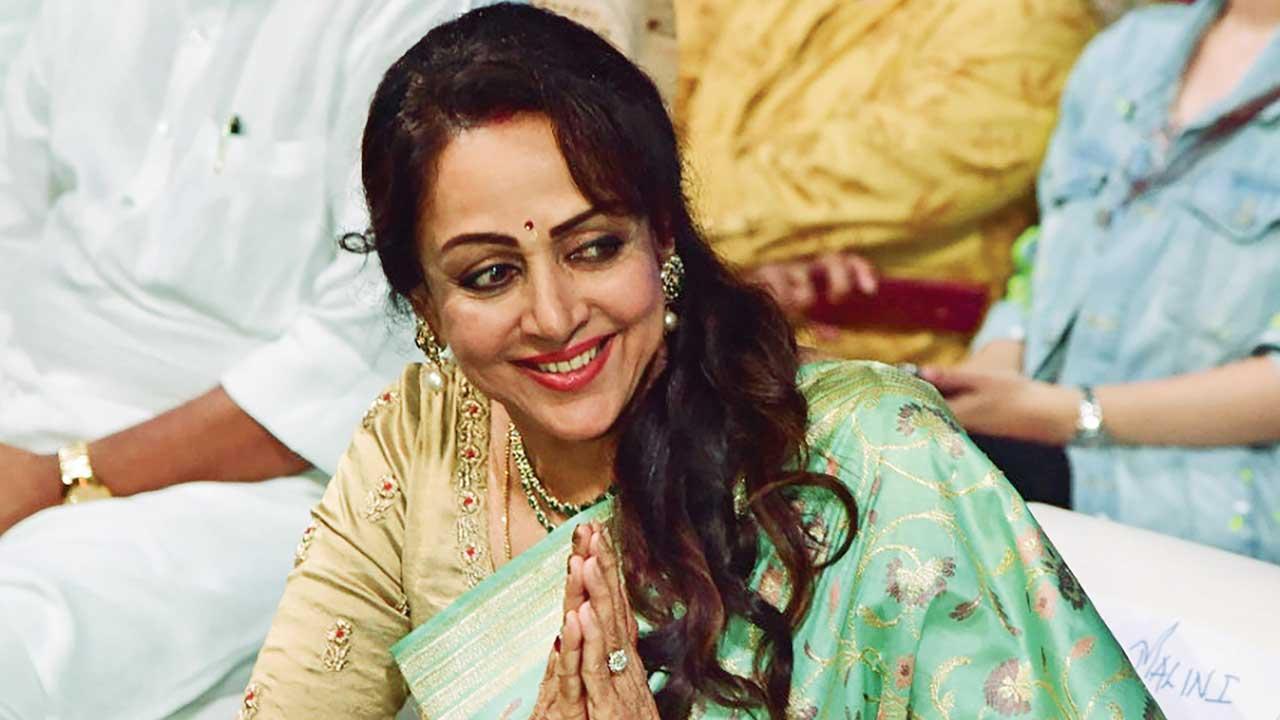
Debarati S Sen (BOMBAY TIMES; May 9, 2023)
She’s the OG Dream Girl of Bollywood. At 75, her beauty, grace and poise are striking and unmatched. Hema Malini, actress, danseuse, director, and politician keeps her creative passion alive more through her dance ballets than cinema. In an exclusive conversation with Bombay Times, she spoke about her work, her unconventional life and the rise of the Southcinema. Excerpts...
You have been working for the last 60 years, what keeps you going? What inspires you?
I have been working for so many years now ki ab main chup chaap nahi baith sakti. I kept working even after my marriage and kids, all thanks to Dharam ji (Dharmendra). He never interfered in my work at all. Also sometimes, I need to go to Mathura (my constituency), for work. Managing all these aspects of life comes naturally to me. I feel that if I don’t work, I will get bored. Kuch na kuch karna chaiye. Kuch seekhne ko bhi milta hai. If it is difficult, I don’t say I can’t do it, I learn. If it’s a new role, then I plan for it. If there is a song, then I decide how to perform it, what to wear...I need to think about all that. You are constantly in a creative mode and that is what keeps you going. If you don’t do that, then what will you do?
Your work, especially your ballets have a spiritual tonality to them. Is that an aspect which you have consciously weaved into your work?
Spirituality has always been a part of my life and upbringing. Also, my dance is connected to Gods and temples. So, automatically there is a connection there. Similarly, children also pick it up and get attracted to what the parents do. Parents should lead a good life so that they can set a good example for their children, hai na?
Your marriage with Dharmendra was not conventional, and recently, you posted a picture on social media celebrating your 43rd wedding anniversary…
Love is such a thing – you get involved with somebody, you like somebody, and that continues. Being conventional is something which I guess was not meant for me, and that is why I am able to do all this. If my marriage had been a conventional one, I think I would have been a nobody. Today, I am doing all this – films, dance, going to places for talks, being in politics – itna sab kuch kaise hota if it was a conventional life.
You were one of the first female superstars of Bollywood. What kind of pressure did that put on you?
I never planned to be a superstar in Bollywood. Aisa ho gaya. Maybe, I am the lucky one and people liked me. There was a transition happening in the Hindi film industry when I came in. Meena Kumari and Nargis ke jo type of films thhe, uss se badalke thoda sa modernise ho raha tha sab. You could call it women empowerment. In my film Seeta Aur Geeta (1972), Geeta earns money by doing nautanki and that is her profession, while Seeta is very timid and is restricted to the house. These were contrasting roles, and then there was Basanti in Sholay, who was also an independent woman. I also played Meera, and even in bhakti bhava the character is of a very powerful woman who left everything. Lal Patthar is one of my best films, along with Ek Chadar Maili Si and Kranti. I have always portrayed very strong women on screen. Isi liye shayad logo ne mujhe zyada pasand kiya. Plus, main fight scenes bhi karti thi. Mostly, Dev Anand ki filmon mein maine dhana-dhan marpeet ki hai aur villain ko maara bhi hai (laughs!).
This year, Indian cinema was celebrated internationally with RRR’s song Naatu Naatu bagging Best Original Song at the Oscars and the Golden Globes. The Elephant Whisperers also won the Academy Award in the Best Documentary Short category…
I’m very proud that we won two Oscars this year. It’s a great honour for India. Yeh toh bas shuruat hai. Main toh chahungi ki aage bhi bahut mile. I feel happy that RRR is from the South film industry. When referring to South Indian films, people would always say yeh regional films banate hain, but what a movie they’ve made! I watched RRR and I must say, Rajamouli ne kya kamaal ka kaam kiya hai. I also saw Pushpa: The Rise - Part 01, aur bada maza aaya dekhke. So many people have done the dance steps based on Allu Arjun’s walk in the film. I loved his performance, too. Then I saw him (Allu Arjun) in another film and realised that he is such a good-looking boy. He looked so rustic and drastically different sporting a lungi in Pushpa. He played such a character and yet, he is the hero! It’s commendable that he agreed to sport such a look and do the role. Hamare Hindi film heroes thodi na aise dikhenge. I remember in Razia Sultan, Dharam ji had to look darker, and he was hesitant.
Do you feel the South Indian film industry is finally getting the recognition it deserves?
The South film industry is doing very well now, but that wasn’t the case before. Itna ubhar ke kuch nahi aaya tha for all these years. Kamal Haasan also tried his best, but those remained as regional films because the subjects were all very regional. Rajamouli’s Baahubali also was amazing. They have used technology so very well in the movie. With RRR, too, Rajamouli has taken it to another level.
The iconic Famous Studio turns 75
8:14 AM
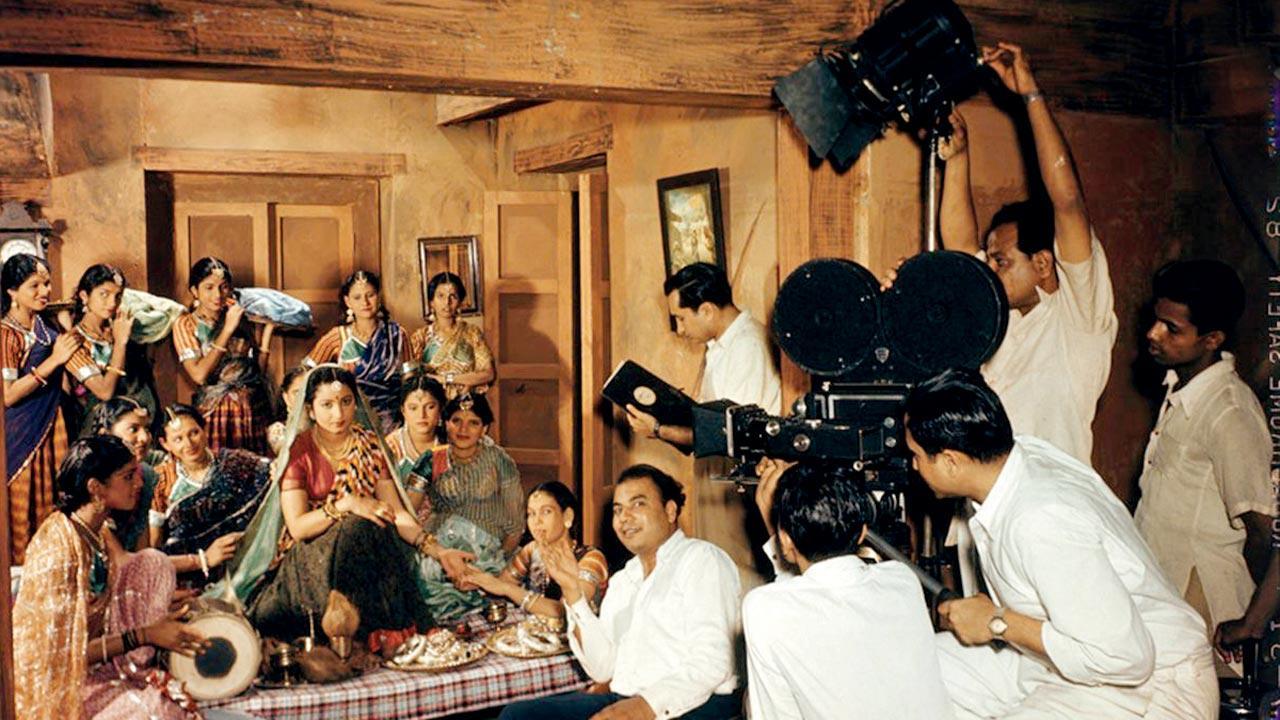
A colourised version of a photograph that shows a wedding scene being shot in Famous Studios in 1948
One of the city’s most iconic studios turns 75. Famous Studio’s Anant Roongta talks about what continues to keep them relevant
Aastha Atray Banan (MID-DAY; May 15, 2022)
It was in the early 1900s that Juharmal Roongta decided to leave Rajasthan and head to Mumbai to discover what business opportunities the city held for him. He worked in the jute and cotton industry, and even dabbled in stock trading before he came into possession of a piece of land in Mahalaxmi, where Famous Studios stands today. “A Muslim gentleman owed my great-great grandfather some money, and when he was unable to repay, he transferred this land’s ownership to him. We retained the name Famous, as the original property was called that,” says Anant Roongta, the proprietor of one of Mumbai’s most famous studios, which is celebrating its 75th anniversary year.
“Construction,” says, Anant, began in the 1940s, and “by June 1946, Asia’s first air-conditioned studio was open for business”. It was headed by J B Roongta, who was also the founding president of The Indian Motion Picture Producers’ Association, before his son Arun Roongta took over.
Much like Bandra’s Mehboob Studios, Famous become a city landmark. Spread across 1,10,000 sq ft, it grew as the go-to destination for film and advertising shoots, music recordings, events and concerts. It now also houses a co-working space. This writer has spent many an evening at Famous. Once, 12 years ago, we watched a raw MMA fight there, and then in 2019, caught international pop star Lauv in concert here.
It would seem that Famous has always been ahead of the curve. “In the ’50s and ’60s, we introduced new technology. We had the American Mitchell Cameras. Then we got into set design, collaborated with Bollywood cinematographer Fali Mistry and even entered production,” says Anant of the studio which has been the location for legendary movies such as Seeta Aur Geeta, and Mr India.
Add to that, in the 1980s, when Arun Roongta took over, it also received the first license for video services from the I&B Ministry. It then became the first studio in India to introduce video and audio production. “World-leading acoustics expert Andy Munroe, who has worked as an engineer at Shure where he designed systems for venues, and where he worked with Led Zeppelin and The Rolling Stones, also designed the recording studio,” says Anant.
Anant, who was a student at Campion High School, and later Cathedral and John Connon School, before heading to the UK to earn a degree in international business, says that he grew up in a home that knew everyone in the movie business, but weren’t star struck. “I used to walk in on my dad sitting around with celebrities, and he was never affected or fazed. He was also great friends with Mehboob Khan, the founder of Mehboob Studios.”
He did, however, take some time to find his own passion for the family business. And since 2018, he has resurrected the place by adding a co-working space, and making it wholly tech enabled. “Owing to its location [stone’s throw from Mahalaxmi station], we had many a developer reach out. It has a certain nostalgic value, and an even bigger brand value,” Anant feels. It could be this that led to State Tourism Minister Aaditya Thackeray inaugurating the revamped bus stop dedicated to Famous Studio under the tactical urbanism initiative.
Ask him what’s the defining moment for Famous, and Anant names shooting for the song, Koi Kahe from Dil Chahta Hai in 2001. “Creating that club ambience was something we did well. We have also restored the Sholay print. And thanks to the technology we have, which now includes a Dolby Atmos studio, we have been the centre of many big advertisements.”
But for the Roongtas, the goal is to bring together the best of old-world feel and new-age technology. If Anant has to list one factor that differentiates Famous from the studios that dot Mumbai, he says it is flexibility. “The whole aim was to retain the charm of the place, and keep it as modern as possible, offering all levels of comfort.”
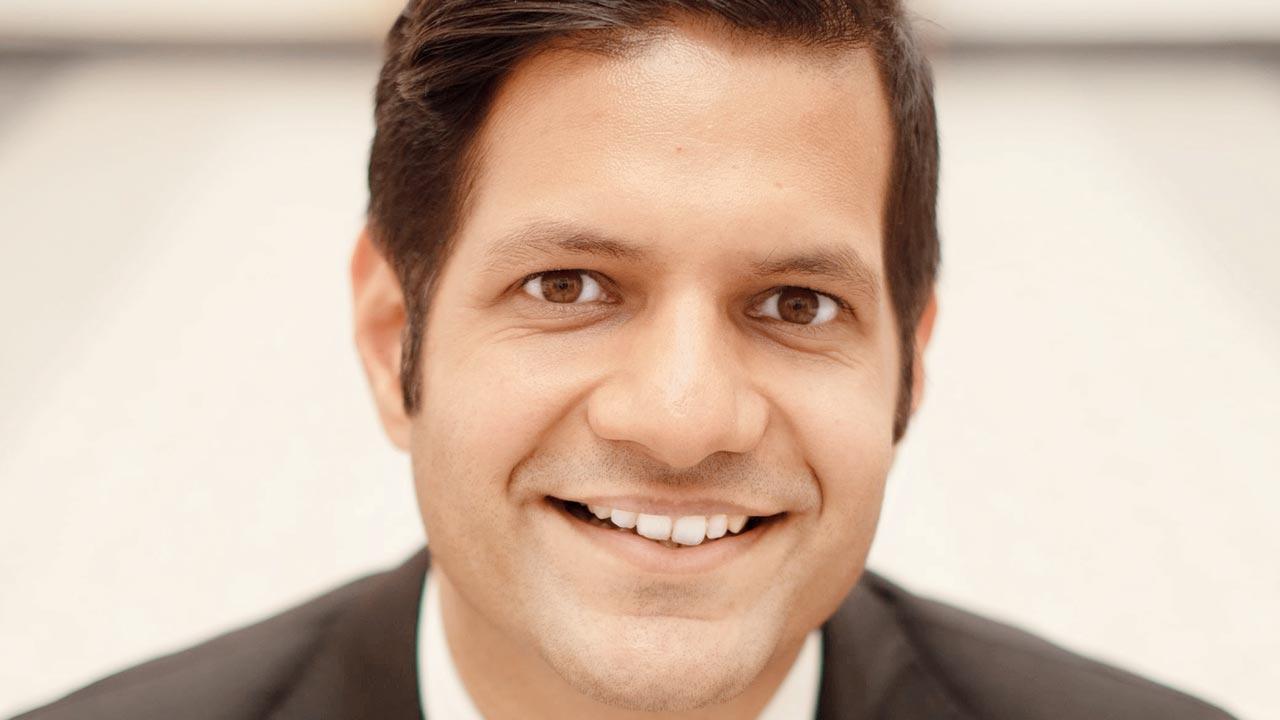
Anant Roongta
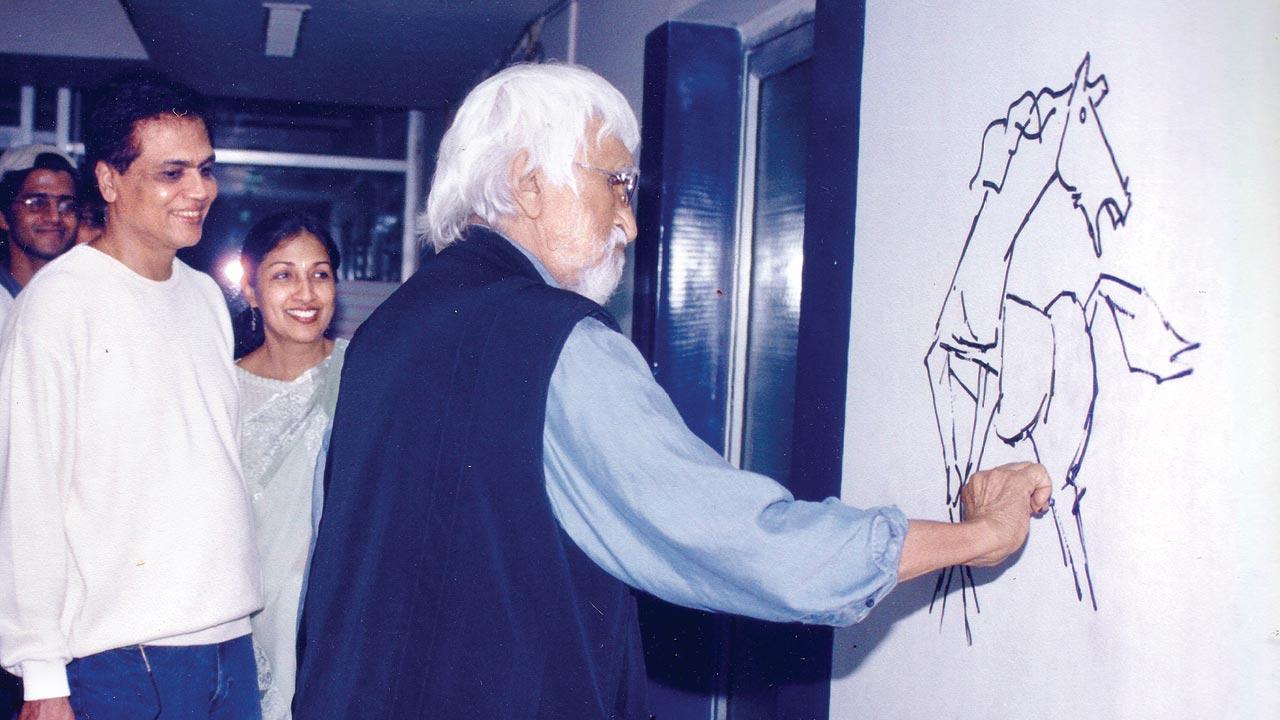
M F Husain sketches on the wall outside the animation studio in 2001, as Arun and Chandralekha Roongta watch
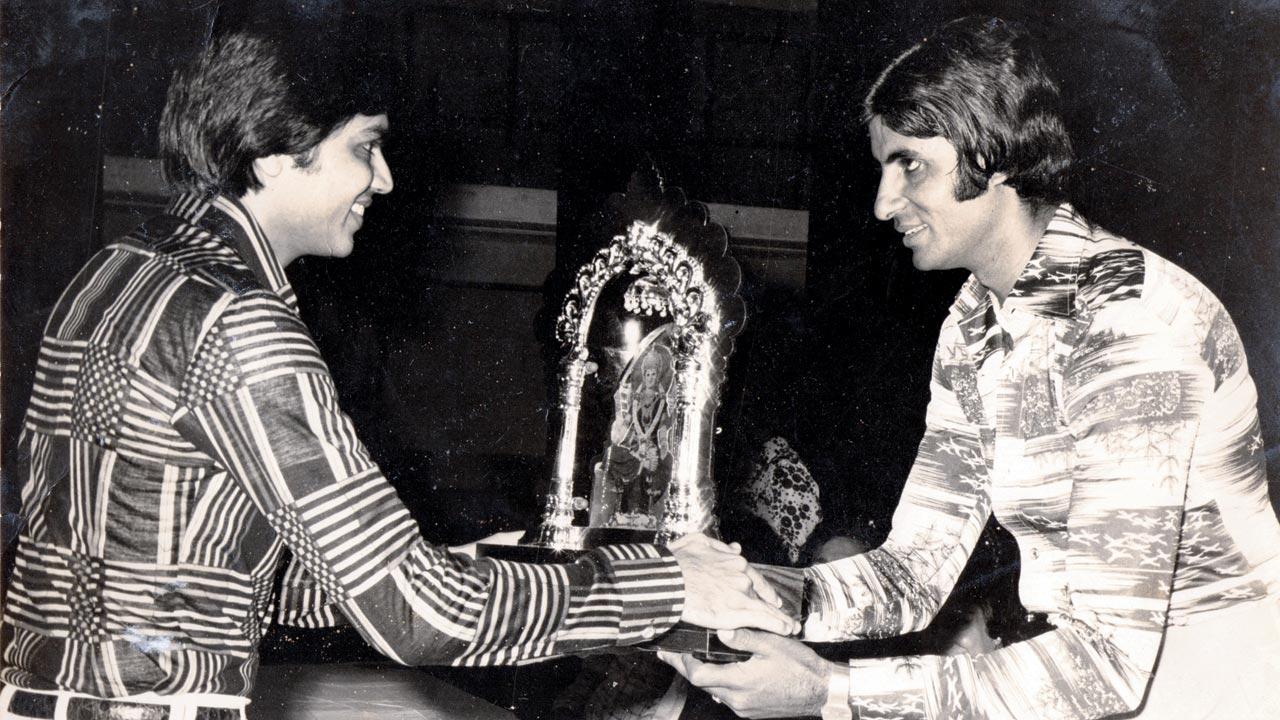
Amitabh Bachchan gives an award to Arun Roongta in the 1970s
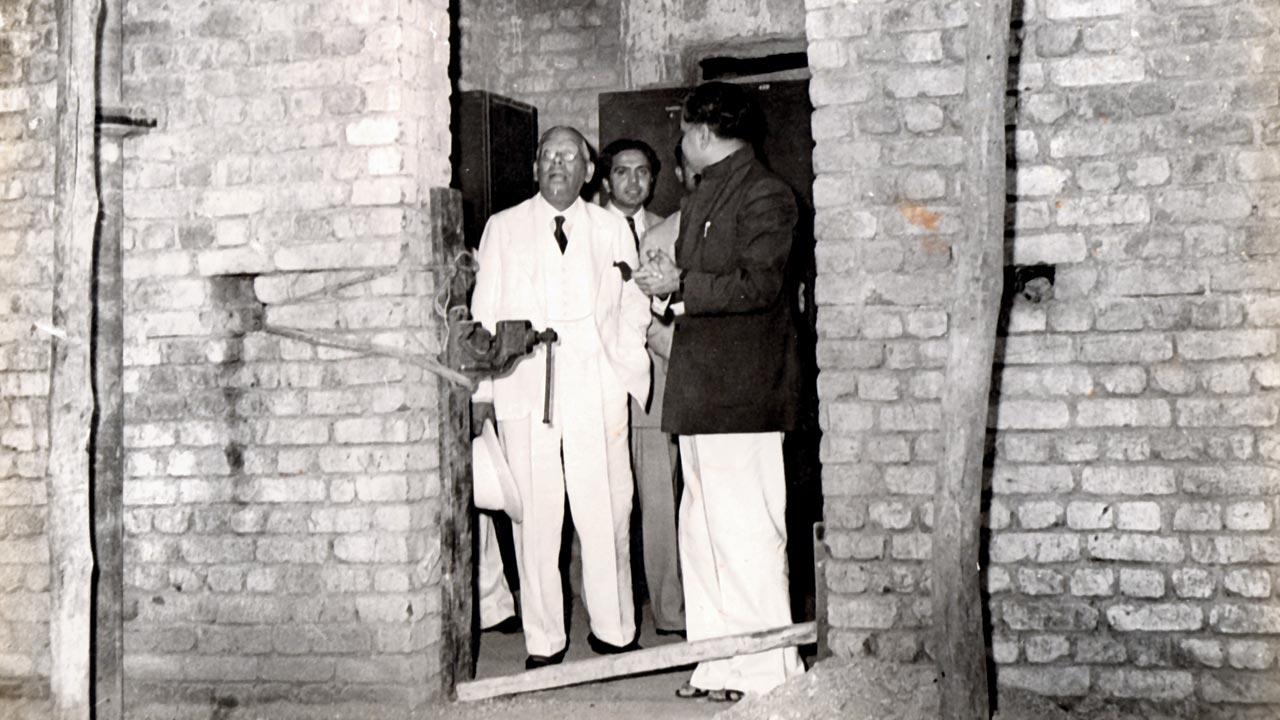
Mehboob Khan of Mehboob Studios visits the construction site in the 1940s
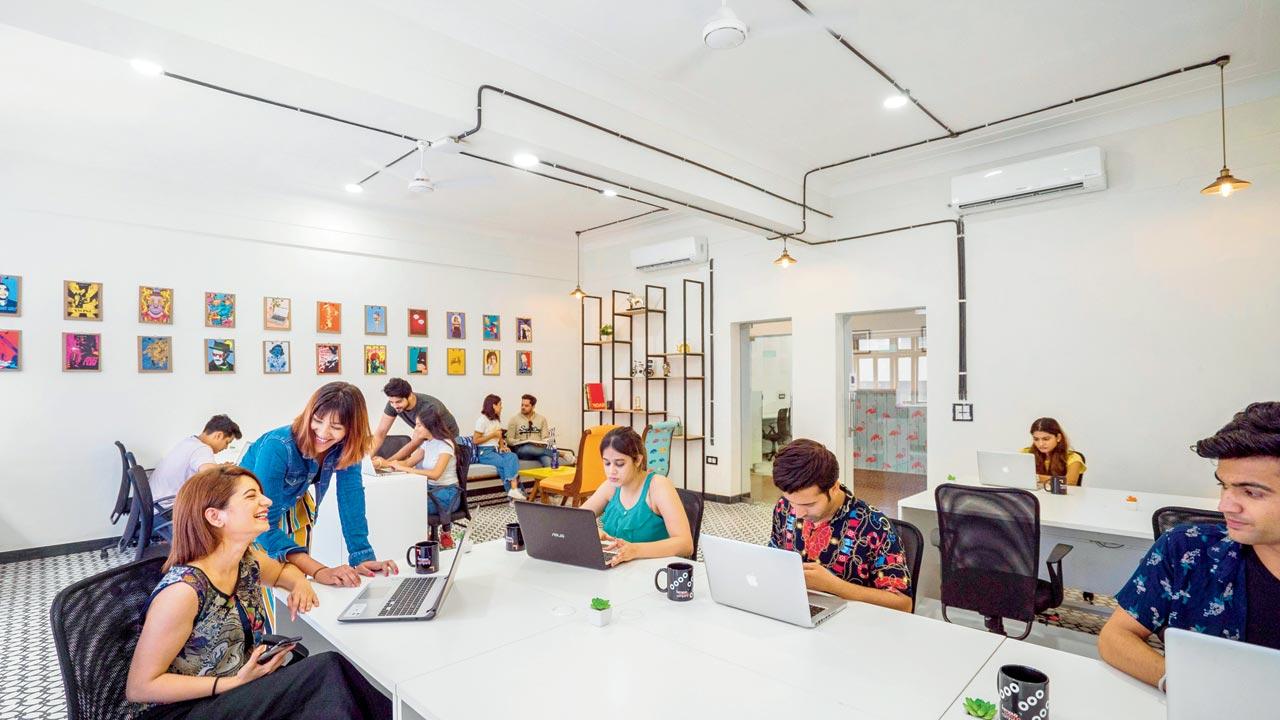
For the past three years, Famous Studios has had a co-working space
Reliving Bollywood's poster era
8:25 AM

Rachana Dubey (BOMBAY TIMES; April 2, 2022)
From adorning the walls of cinema halls, film posters have over the decades begun to occupy a place of pride in the homes, offices and private spaces of cinema patrons. While buying poster art of the bygone era is not entirely new, the trend has caught on in a big way, owing to availability and exposure the new generation has to the cinema of yore through digital platforms. While the new age, digitised film posters with airbrushed images ofstars are slick and stylishly designed, the hand-painted posters of the past, with dramatic brush strokes and vibrant colours screaming out loud from the walls they were plastered on, are sorely missed. Now with movies making their way back into cinema halls, BT takes a closer look at the art of film posters and how it continues to be an important part in the journey of a film.
‘POSTERS ARE THE PHOTOGRAPHIC SYNOPSIS OF A FILM THAT ATTRACTS THE AUDIENCE EVEN IN THESE TIMES’
Manoj Desai, one of the oldest names in the film exhibition business, who has spent 50 years running Maratha Mandir and the G7 Single Screens says, “I had never seen a phase like the last two years in my 50-year career when we practically didn’t have posters adorning the outer walls of the theatres. My theatre had opened with Hema Malini’s Seeta Aur Geeta and it bounced back to life with Sanjay Leela Bhansali’s Gangubai Kathiawadi. In these five decades, what hasn’t changed is the audience’s love for a great film — something that its poster promises them in one visual. Akshay Kumar, Shah Rukh Khan, Salman Khan or Ajay Devgn, standing with a gun in one hand and his heroine on the side, signifies an action-packed love story even today. It’s the photographic synopsis of a film that attracts the audience even in these times.”
OVER THE YEARS, POSTER ART HAS FOUND A PLACE OF PRIDE IN SEVERAL HOMES
Back in the day, film posters were not designed digitally. Right up to the 1990s, the posters were hand-painted and artistically designed by a rare breed of technicians. M F Husain, in his early years had also designed several movie posters. While current film posters can be accessed at the click of a button, the posters of yesteryear’s cinema have achieved the status of vintage art, especially the hand-painted ones. There are special collectors and restoration teams to keep them in good condition.
In the last two decades, posters of old films with kitschy artwork, loud colours and over-the-top drama have found a place of pride in the homes of thousands of people around the world, including Shah Rukh Khan who reportedly got an original Mughal-E-Azam poster through an online auction, which was later signed by Dilip Kumar. It rests, beautifully framed at his residence, Mannat.
‘ARTISTES CAPTURED RAW EMOTIONS THROUGH THEIR HAND-PAINTED POSTERS’
Hinesh Jethwani of Indian Hippy has been working hard since 2009 to ensure that vintage posters of films are restored, shares, “With the overall art market taking a hit, even the poster market saw a slight slump in sales. However, with most of the businesses moving online, we gradually started experiencing a surge in demand for posters, not just from Indian buyers but also from abroad. This was during the first lockdown. What is sad in all of this is that the generation of painters who created these pieces of art are passing away, without anyone taking the baton from them. Studying this art form takes four to five years — these painters were self-taught, and they used rudimentary techniques which are not taught in art schools. These painters captured the raw emotions of the films from their stills and created these visual treats which have become part of memorabilia today. Today, in the name of a poster what you see is an airbrushed image of a star. The rawness is missing. 100 years down the line, people may not have any reference to the art of creating these hand-painted posters, unless someone steps up and takes the baton forward.”
‘EARLIER,A POSTER WAS THE ONLY MEDIUM TO INTRODUCE A FILM TO THE AUDIENCE’
Filmmaker Ramesh Sippy, whose posters of Seeta Aur Geeta and Sholay are among those that are perpetually in demand, believes that with evolving time and changing technology, poster art will survive, albeit in a different form.
He reasons, “Posters played an important role in the journey of a film and they still do. The digital era cannot be ignored. Those days, there was a poster between a film and its audience, but today there’s a lot more in between. Back in the day, it was so important to sit with the painters and create a visual communication using the characters of the film. Like Sholay’s poster evolved from the time it was in the offing to the time it became a hit. Posters were the promise of a story that a film bore for its audience. They were hand-made then; they’re technologically made now. Styles of pursuing an art can always change but posters continue to be art.”
‘POSTERS OF C-GRADE FILMS ARE IN DEMAND BECAUSE THEY LOOK FUNKY AND QUIRKY’
Mumbai’s Chor Bazaar, even in its redevelopment phase, continues to harbour shops that sell vintage posters. Business may not have been as good as it was once upon a time, but the motivation to keep the shops running is admirable and visible in the way the stores have kept the posters in great shape.
Haji Abu, who possesses over three million Hindi and English vintage film posters, arguably one of the largest collections in the country, has a shop inside Mumbai’s Chor Bazaar, which dates back decades. He says, “Films have been made for more than a hundred years now. A poster is always made with each film. The stars of that era actually command a high market value in the poster business. Posters are also sold for the artistic value they carry. Posters of C-grade films are sold for high prices because they look funky and quirky. ”
‘DIGITAL POSTERS HAVE MADE THIS ART MORE ACCESSIBLE’
Rahul Nanda, who is a campaign designer for some of Bollywood’s biggest films, says that creating posters through digital technology has taken over the hand-painted posters of the bygone era. The impact a poster creates for film promotion is just the same even today. He adds, “A poster is the first piece about a film that people react to. Poster art has evolved with the evolution of content. If a movie is brave, the poster will reflect that. Unlike the past decades, a lot of the poster work is digital and downloadable today, which makes this art more accessible to film patrons.”
POSTER TALES
- C Mohan, Diwaker, Vishnu, S M Pandit, Pandit Ram Kumar Sharma, D R Bhosle and Shrikant Dhongade were among the top-billed artists of that era for poster art. MF Husain painted posters for Novelty cinema before he became a renowned painter.
- In the early 1990s, hand-painted posters were replaced by vinyl, computer-generated designs. Darr and Prahaar are said to be the last of the hand-painted posters.
ARTISTES WHOSE FILM POSTERS SELL THE MOST
- Amitabh Bachchan
- Dev Anand
- Raj Kapoor
- Dilip Kumar
I was just a tomboy. My co-stars used to make fun of my hands-Esha Deol
8:19 AM

Onkar Kulkarni (BOMBAY TIMES; August 28, 2021)
For the last decade, Esha Deol has focused on family life and motherhood, but now Hema Malini and Dharmendra’s daughter, feels it’s time for her comeback. In an earlier interview with us, she had expressed her interest in acting again, but now she says that she is also keen to produce films with her husband Bharat Takhtani. In a conversation with BT, she opens up about why sustaining in the industry was difficult for her and how she is excited about facing the camera again with some of her former colleagues. Excerpts:
The last time we saw you on the big screen, in a Bollywood movie, was in the 2011-film Tell Me O Kkhuda, which was directed by your mother. After that, you stepped away from films. What inspired you to make a comeback after a gap of 10 years?
One can’t make creative people sit at home for too long. Acting is that one thing that keeps me going. I left the field in 2011 because starting a family at that age was my priority. I enjoyed that phase of my life. When I was working, I had no time to date. It was only when I got married to Bharat that I experienced love. Otherwise, I was just a tomboy. My co-stars used to make fun of my hands. They would say, tere haath ki padegi toh malum padega sabko (laughs!). That was the kind of rapport I shared with my male co-stars. It was Bharat who changed me. We dated for a year before we got married. It was during that phase that I started investing time in getting dressed, wearing beautiful clothes, stilettos and going out for romantic dinners. It was Bharat who guided me through it. He knew me from my school and college days, so there was a good understanding between us.
The last 10 years have been magical, and it took away my attention from a lot of things (smiles). Thankfully, I am in good shape today and work is coming my way. I felt this was the right time to get back in front of the camera, as a set feels like home to me, and I love it there.
From your earlier stint in Bollywood, what were the learnings that you think will be helpful this time around?
When I started out, I was very young. The one thing I have learnt is that you need to be thick-skinned to sustain in showbiz. If you are from the industry, right from your first film, you are compared to your parents, who have such a large repertoire of work behind them, and that gets to you. It is not as easy as it’s been made out to be. Everyone goes through their struggles. In my way, I have dealt with it. What is important is that everyone works hard to achieve their goals. Life’s no fun without any hard work.
How have your friends from the industry reacted to your comeback? What do you have to say about the new breed of actors and how the industry functions today?
All my friends — Ajay (Devgn), Abhishek (Bachchan), Tusshar (Kapoor) — are very happy. They have been very encouraging. I am happy to be making a comeback as an actor with Ajay (for an OTT show). We have done around seven films together and have always shared a great rapport. Even back then, he guided me through many situations. I am grateful that filmmakers are reaching out to me with interesting scripts. OTT platforms have helped us move away from stereotypes. Overall, for an actor, it is a great time to do good work. Everyone performs so well today... even the newcomers look so seasoned and well-prepared. There is so much time spent on prep before a film goes on the floor. This wasn’t the case earlier. Today, there is an entourage that’s putting their time and energy to ensure that you are up to the mark. It is definitely not a one-man show anymore. As for me, I have worked hard before taking this step. I have shed my post-pregnancy weight. I am excited to work with the new set of filmmakers.
You are also getting into production with your husband, who isn’t from a film background. How is it working with him in the professional space?
Bharat is my constant support in whatever I do. It is nice to have your life partner as your colleague. He understands the creative part of a project, the technicalities and choosing the right scripts. He watches a lot of films and shows, so he has a good understanding of content as an audience, which helps him pick the right scripts, while I see projects from an actor’s point of view.
Have your daughters Radhya and Miraya watched your films or parent’s movies? How do they react when they see you on screen?
They enjoy watching my song Dilbara from the film Dhoom. They make me play it and dance to it. They also like the song Arey Zindagi Hai Khel from Seeta Aur Geeta, which starred my parents. They get excited when they see their nani walking the rope and their nanu doing a summersault in the song.
Hema Malini becomes first Bollywood star to appear on top Russian talk show Tonight
7:46 AM

Upala KBR (DNA; August 24, 2017)
Russia's romance with Raj Kapoor is well- documented. But very few know that Hema Malini too enjoys wide popularity in the country. In what can only be seen as a validation to her popularity, the senior actor and MP will be appearing on Andrey Malakhov’s talk show, Tonight. The TV show’s crew has currently flown down to India to shoot the candid portions of the episode. Malini will film the live portion of the episode in October in Russia, which will then air in November.
Malini says, “It’s an honour to be the first Indian celebrity to appear on this show. Russians love my film Seeta Aur Geeta [1972] even today. I was not aware of my popularity there till I was invited by our Speaker in Parliament [Sumitra Mahajan]. So I went there in the capacity of a parliamentarian.”
She recollects how overwhelmed she was by the love she received from the Russian population. “They were standing on the streets with flowers, as they wanted to see Zita Gita — that’s how they call Seeta Aur Geeta,” she smiles, before adding with wide- eyed delight, “It is the most popular film there. They don’t even know Sholay [1975]!”
The Tonight crew will leave tomorrow, only to fly back to India on September 8. They will cover Malini’s dance festival Synergy — a dance fusion, which will showcase Georgia’s popular ballet dance group Sukhishvili and traditional Indian dance forms as part of 8 aya Smriti ( named after the actor’s mother).
After 50 years, I’m acting again, with Hema Malini-Ramesh Sippy
8:40 AM

Ramesh Sippy admits that at 68, he cannot afford long breaks anymore
Roshmilla Bhattacharya (MUMBAI MIRROR; January 26, 2015)
Not many know that as a teenager Ramesh Sippy had dabbled in acting and one of the cameos was in a film titled Bewakoof. He played a young Pran who cheats his way to a win after knocking the hero out cold in a boxing ring. But Sippy quickly realised that he was more inclined towards direction and didn't appear on camera for almost half a century till Shimla Mirchi, which brings him back as a director after 20 years, came along.
It was Hema Malini's first day of shooting. The actress who's reuniting with the director after four decades, was ready to accept the role even without a narration though Sippy insisted on one. "It's a one scene appearance and we were looking for an actor when Hema suggested I do it myself. And after 50 years, I ended up on screen again with the Dream Girl," says Sippy.
Their innings started in 1971 with his directorial debut Andaz about a widow and widower with young children who get another chance to love. Sippy remembers filming the chartbuster, Zindagi ek safar hai suhana, with Rajesh Khanna careening down Marine Drive on a bike, Hema laughing gaily behind him.
Suddenly, taking everyone by surprise the actor took his legs off the foot pegs and swung them on the handle bar.
"All of us froze, the camera capturing the OMG! expression on Hema's face. It was a spur of the moment decision, prompted perhaps by the adoring crowds around. Rajesh Khanna's split-second move was extremely dangerous as he was surrounded by fast-moving cars on all sides. We had our hearts in our mouths," Sippy shudders, adding with a laugh, "Fourty years later, Hema Malini, takes Rajkummar Rao for a ride, literally, on a bike."
That's not all. In Seeta Aur Geeta, Hema clambered up to sit on a ceiling fan in the police station, taunting her aunt, "Upar aa ja moti." In Sippy's upcoming rom-com, she climbs up a tree. "It was one thing to do it when she was in her 20s, but when I suggested she climb a tree after so many years, she looked at me and quipped, 'You won't stop doing these things to me, will you?' Eventually, she obliged," he laughs.
Their last film together was Sholay in 1975. Sippy remembers that on the last say they were waiting for a train to pass by, so they could can their final shot before Dharmendra and Hema boarded the flight. Everyone was ready, when suddenly an AD remembered that in the earlier shot she had a flower tucked in her hair. They needed it for continuity. A frantic search revealed that the truck with the flower was on its way to fetch breakfast for the unit. "We chased it down, retrieved the flower, and just as it was tucked into Hema's hair, the train came roaring down and Sholay was done," reminisces Sippy.
In contrast, the 'tangy' Shimla Mirchi, which wrapped up yesterday, was smooth sailing. But Sippy recalls that after they'd been spotted on the streets of Shimla for three consecutive days, a bemused bystander suddenly piped up, saying, "Arrey, these guys are still shooting for a two-hour film! Yeh kya kar rahe hain?"
He says that despite the technological advances that have made filmmaking a different experience, for some viewers the reel life action should correspond with real time. "That's the magic of cinema," he asserts.
So, has he started planning his next film or will there be another long break?
"I can't afford any more long breaks," admits Sippy who turned 68 on January 23. "What I want to do, I have to do in the next few years. Clint Eastwood who is still making films at 84 is an inspiration to rest of us to continue."
Subscribe to:
Posts (Atom)