Showing posts with label Satyadev Dubey. Show all posts
Showing posts with label Satyadev Dubey. Show all posts
Amitabh Bachchan, Shashi Kapoor, Sharmila Tagore were original choices for Basu Chatterji's Rajnigandha
9:57 AM
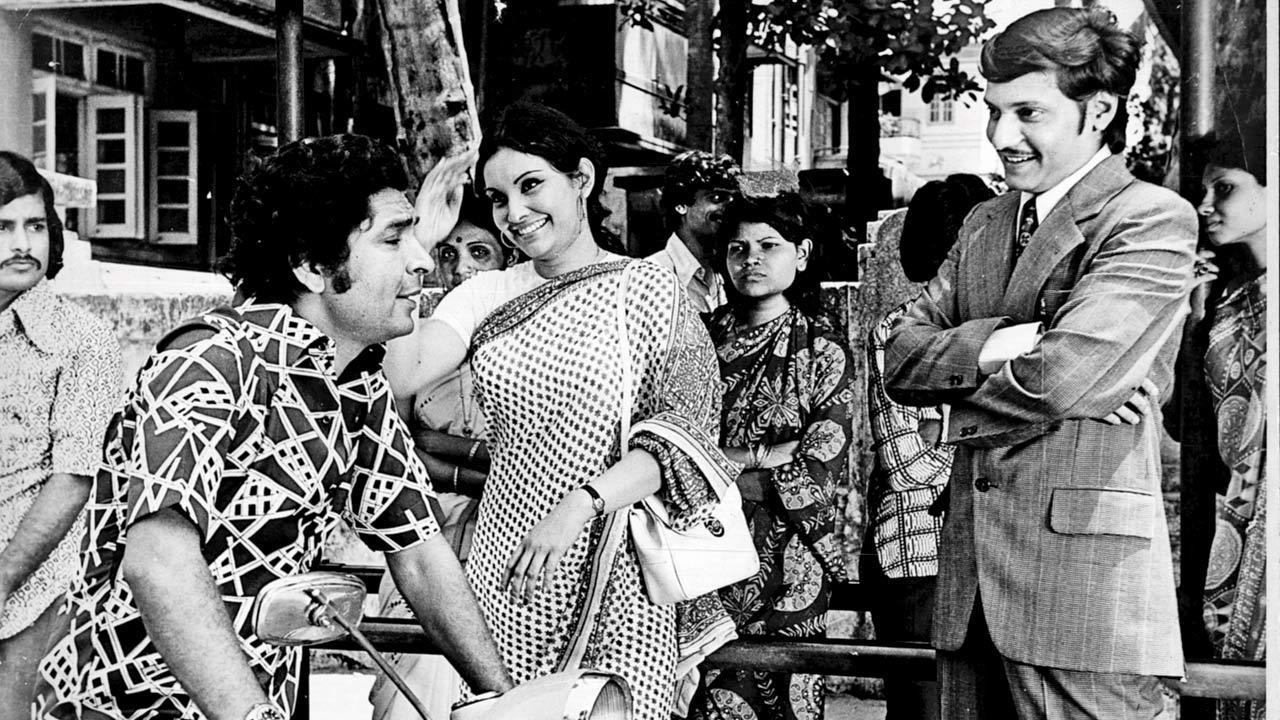
Rajnigandha’s lead pair Amol Palekar and Vidya Sinha, who play Sanjay and Deepa, were later seen in Chatterji’s 1976 film
It was Shashi Kapoor and a host of other big stars, who Basu Chatterji first had in mind for the lead pair of his 1974 film Rajnigandha. A new biography of the late filmmaker discusses how the ‘simple-looking’ Amol Palekar made the cut
MID-DAY (March 26, 2023)
Like most small-towners, Basu was an early riser. Post Piya Ka Ghar, he would be at work by 7 am. By 8.30 am, the ceiling fans would be switched off in the rooms where the others would be sleeping. It was their wake-up call. Those who woke up early would find Basu in his chair, sometimes on the floor, writing his screenplays. Except for the days when he had a morning shoot. This was the time when Basu cut down his professional assignments for Blitz. The script of Rajnigandha happened during the early morning sessions when Piya Ka Ghar was in the making.
The first actor Basu had in mind for the role of Sanjay was Amitabh Bachchan. He was yet to become the Alpha Male then. History could have been very different had Basu stuck to his original choice. Shashi Kapoor was offered the role of Naveen. Suave, slick, with leadership qualities that extended beyond the college campus to wield influence in college selection panels, he was, as defined by Sulagna Biswas, the original LinkedIn Man.
Sharmila Tagore was Basu’s first choice as Deepa. Independent, but not a renegade. Observant, sentimental, committed, steadfast and yet ambivalent. The plan fell through. Shashi Kapoor was fine with playing Naveen, subject to the condition that the film was sold to distributors at the existing rate for a Shashi Kapoor film, something Basu was not comfortable with. Sharmila was out of the contention too, but the reason is not known. Maybe Basu wanted fresher faces.
Meanwhile, Basu flew to Calcutta and offered Aparna Sen the role of Deepa. Aparna, who probably had not seen Sara Aakash, felt that the story of Deepa was ordinary. Her refusal prompted Basu to pitch it to Mallika Sarabhai. She was referred by Yogesh. Both Yogesh and Mallika were working in Sonal (1973) then. Basu met Mallika in Ahmedabad and the dates for a few shoots were fixed. However, Mallika was planning to do her MBA and later walked out of the film. In the meantime, Piya Ka Ghar was released in Calcutta. News of its critical acclaim reached the cognoscenti. Aparna Sen, being one of them, had a change of mind and wrote to Basu expressing a desire to play Deepa.
A few days after Basu acknowledged the mail, Aparna came down to Bombay to complete her part of the shoot of Tapan Sinha’s Sagina (1974). Basu met her, and when the discussion boiled down to money, Sen said she was fine receiving in kind as a small film-maker like Basu would find it difficult to compensate her at the market rate. The contract with Suresh Jindal had been finalised by then.
Said Basu: “I discussed the possibility of giving Aparna Sen a Fiat car. It would have cost us around Rs. 32,000. But things began to get topsy-turvy when she refused to work with the Naveen I had in mind—Samit Bhanja, who I had seen in Guddi (1971) and liked. While the producer and I were fine with the monetary arrangements, we started to become skeptical of starry tantrums. This is when we consciously took the decision of taking all new faces.”
The search for rookies thus commenced. Basu, for a short time, had also mulled trying out Rakesh Pandey, but he was preoccupied, as told to the author. “Basu-da wanted me to do Rajnigandha. At the time, I was doing a film with Mohan Segal called Intezar (1973). The set was at Rooptara Studios. Basu-da came down to the set, and said, ‘I am doing a film called Rajnigandha. It is about a girl and two boys. It will take 20 days to shoot.’ I said, okay, when do you want to start? He said next week. I said, ‘Basu-da, I am doing this film, and it will take at least 15–20 days here on this set. I can manage three to four days at the most if you shoot in Bombay.’ He said, ‘No no, the producer might run away.’”
-----------------------------------------------
In addition to his National Award-winning screenplay for Shyam Benegal’s Bhumika (1977), theatre veteran Satyadev Dubey—who people would recall as the weekly waged stevedore who confronts the goons only to be run over by a truck in Deewar (1975)—made one extremely significant contribution to Hindi cinema: Amol Palekar.
Dubey had directed the Hindi play Aadhe Adhure, starring Amol, who was acting in Marathi plays at the time. Basu loved his acting, and Amol was Basu’s original choice for Piya Ka Ghar (1972), but producer Tarachand Barjatya’s son Raj Kumar Barjatya, who was there at the theatre with Basu, opined that Amol was too simple-looking for a hero. Suresh Jindal, however, had no issues in accepting Amol, a postgraduate of JJ School of Arts, Bombay, as the Sanjay of his film.
Basu was happy with the onboarding, about which he told the author: “Amol was then working with Bank of India. He was a part-time actor. I was fond of Marathi theatre and had seen Amol in a few plays. He used to come to film shows arranged by Film Forum as well. Raja Thakur, the maker of Mumbai Cha Jawai (1970) had also put in a word. Amol had played a small role in his film Bajiravacha Beta (1971). After he was rejected by Raj, I proposed his name to Suresh Jindal.”
Amol had talked about his first business meeting with Basu with author Balaji Vittal: “There used to be a café named Samovar inside the Jahangir Art Gallery. I met Basu-da and producer Suresh Jindal there. Mr Jindal did not talk during this meeting. But the interesting part was that Basu-da did not talk much either. He narrated the story of the film like this. ‘Amol, kya hai, ek ladka hai, mano tum. Aur ek ladki hai. Nayi ladki hai, Vidya Sinha hai uska naam. Usse miloge tum. Toh, ye dono hai . . . aur . . . yaar ye tum padh lo na [Amol, there’s a boy. You. And a girl, a new actress called Vidya Sinha. You will meet her . . . you two . . . oh, why don’t you read it for yourself].’
Basu-da handed me Mannu Bhandari’s story. Following my acceptance to do his film, he gave me the script as well. After reading that, I kept wondering how someone who was so ill at ease narrating a story could write a screenplay in so much detail. Even the dialogues were there. He was extremely eloquent in the cinematic language. Once you understood that, communication becomes easy.”
Excerpted with permission from Basu Chatterji And Middle-of-the-Road Cinema by Anirudha Bhattacharjee; Vintage, Penguin Random House
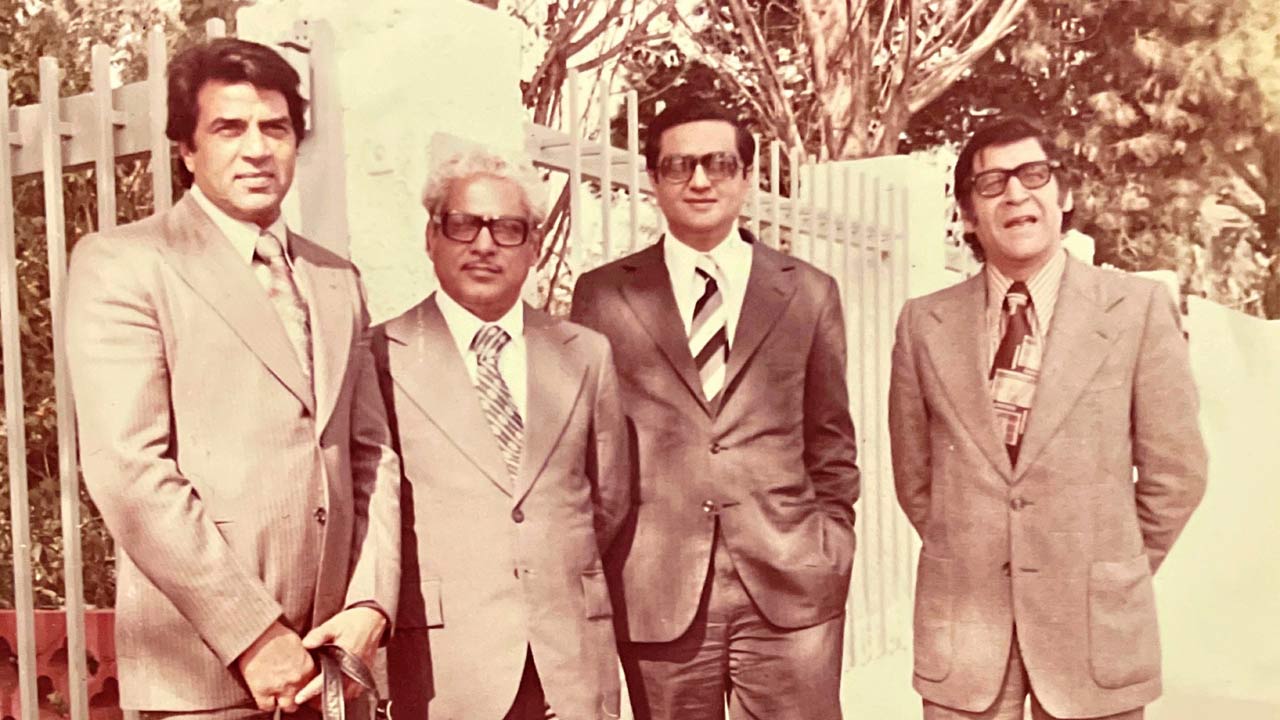
Chatterji and Dharmendra at the Cairo Film Festival. Pics courtesy/Rupali Guha
Being Amrish Puri’s grandson is a responsibility, which I take very seriously-Vardhan Puri
7:45 AM

Rachana Dubey (BOMBAY TIMES; November 19, 2019)
Vardhan Puri will make his debut with Yeh Saali Aashiqui that releases this week. Not only is he playing a character with grey shades in his first film, but he has also penned the story and has been a part of the film’s production journey. Even though he is veteran actor Amrish Puri’s grandson, he’s not had it easy so far. In a conversation with BT, he relives the road travelled and what lies ahead for him:
 Despite being in and around the film fraternity, how did you skip the paparazzi radar?
My father is not really a member of the fraternity and doesn’t hang out with the film folks. He has a different line of work and his circle has people from the world of finance. My parents are not even social in that sense; they rarely party. Fraternity parties are where you meet people from the industry, but I seldom went to those. I worked at a film studio and was busy learning the ropes of filmmaking. I still don’t have an industry friend though I know people. My buddies are the ones who’ve been with me since my school days. The reason the paps never spotted me was that I was never at the parties. I was behind the cameras on a job. It’s important to find your film; the paps will automatically find you. No sensible casting director in the business casts you because he bumped into you at a bash. He or she will chase you if you’ve knocked it out of the park at an audition. Theatre teaches you to be focussed on the prep and rehearsals, so when the time comes, you don’t have to think too much. I worked on that without compromising on my focus.
With a lineage of strong character actors like your grandfather Amrish Puri and his brother Madan Puri, the industry and the audience expects a lot from your debut film. Do you feel that the pressure you face is different from that of a star kid, like Sunny Deol’s son Karan for instance?
I think it’s a responsibility which I take very seriously. People love them both, especially daadu (Amrish Puri). I want people to love me, too. I can’t be Amrish Puri, I don’t want to be him and I can never be him. We look and sound different. However, our core values, drawn from theatre, are the same. So, our understanding of cinema is quite similar. Veteran filmmaker Yash Chopra had once told me that if I ever decide to be an actor, I should refrain from aping my grandfather. He had also told me that the reason my grandfather became successful is that there was no one like him. Gaanth baandh li maine unki iss baat ki. A superstar is someone who lives in the minds of cinegoers forever. Amrish Puri is an eternal superstar who is in people’s minds even now. Sunny sir is a brilliant actor, and I am sure Karan will live up to his family’s name. Our job as actors is to deliver great performances. I will upset my grandfather if I don’t do that. I’m following his principles. He believed in the work he did, which is the reason you will never find his performance below par even if the film was not all that great. Daadu’s taken my family’s name to a certain level and I have to work thrice as hard to keep it up.
You have co-written your debut film and played a big role in getting the project off the ground…
I’ve been a theatre actor since I was five years old. I was trained by theatre veteran Satyadev Dubey, who was also my grandpa’s coach. After graduation, I started working with a studio where I assisted on Ishaqzaade (2012), Shuddh Desi Romance (2013) and Daawat E Ishq (2014). That’s where I decided to learn film acting because it’s different from theatre. I had picked up things while assisting filmmakers and I also learnt it formally, and then, I started auditioning. There were two films that I could have made a debut with, but they didn’t take off. I was upset and emotional with what had happened. Around that time, I met Dr Jayantilal Gada while I was auditioning and he was keen to launch me. I had an idea that I decided to develop with my friend Cherag Ruparel (director of the film). The reason we decided to write and pitch on our own is that no one wants to give you a chance. As an actor, people saw my auditions and were willing to cast me, but they didn’t want to hear my stories. A writer is the most important member of a team; it’s that content that takes the shape of a film. Also, once, Yash ji had told me that if I ever make my acting debut, it should be somewhat like Shah Rukh Khan’s role in Darr (1993). I pitched my idea to my father. He liked what Cherag and I had put together. We met Jayanti uncle soon after and things got going. It may all sound very easy today, but it was a long ride and wasn’t planned. It was destined to play out this way.
Wasn’t production, writing and acting a lot to handle for a newcomer?
This film is my baby. I did a lot of work on this project, not by choice but by chance and majboori. I needed to find something exciting and good to work on when my first two outings didn’t take off. My father is a businessman and he wouldn’t have made a decision purely on the basis of emotions. Making this film was like going to a film school three times over. Handling a 200-member team is tougher than handling babies.
While children from film families do have an advantage when it comes to getting a break, do you think that the story of your struggle might change the perception of those who think the industry is too nepotistic in its approach?
I don’t know about that, but I just feel that this struggle was a real blessing. I wouldn’t have learnt anything if all of this had fallen into my lap. I would not have appreciated things so much. When I was turned away from offices, rejected at auditions I remembered Satyadev Dubey, who had told me that rejections and humiliation teach you the most. There’s no actor who hasn’t faced rejection. I would give three auditions in a day. People were fed up of seeing my face at the auditions every day, but I was persistent. I remember that on one particular day when I didn’t turn up for an audition, one of the casting guys called to check on me. It was funny.
 Talking about your debut, it has a strong romantic angle and it taps the grey side of romance. Was it one of your own experiences that pushed you to write this?
Yes, in some way, it does stem from one of my relationship experiences. There was something crazy that I went through, and funnily enough, even Cherag went through something similar. We started questioning the very emotion. Gradually, I realised that one should never give anyone the power to influence emotions so much. Sometimes, we have these forbidden experiences where we fall for people we should not be with. The idea behind this film is to drive home the point that it’s a double-faced world, and one should be careful while choosing a companion.
Do you still believe in love?
Of course, I’m old-school when it comes to that. Main romantic aadmi hoon. If I love someone today, I will think of a life that we can make together; I’d like to marry her. I’m not the one-night-stand kind or a hook-up type of a guy. I have been in love before, but right now, I’m single and gladly so. If I was dating someone, I would not have had the time for her, which would’ve been unfair. I will be happy to tell the world about the woman I’m with. My father and grandfather should get the credit for this. Despite being a busy actor, there’s not one scandal about my grandfather. He loved being with his family when he was not at work. My parents have been together since they were in their late teens. They’re best friends.
Lastly, while you play a cross between a hero and an anti-hero, your grandfather often played characters which were pivotal to the story. Do we see you going that route, too?
I would be lying if I say that I don’t want to lead the cast in my films, but every actor wants to play a great character today, because everything is driven by that. Sometimes ensemble cast films have a lot to offer to actors. So, if a film with a great character ticks certain boxes for me, I’ll be game for it.

I’ve already said that I will not take this play beyond 25 shows-Amol Palekar
8:06 AM

Legendary actor Amol Palekar on why he’s returning to stage, 25 years on, with Kusur, a play based on a Danish film adapted by his wife Sandhya Gokhale
Sanchita Das (MUMBAI MIRROR; November 17, 2019)
Come November 24, a veteran thespian will take the stage he quit 25 years ago. With this, he says, he will be flagging off his last round of performances. The date holds special meaning to Amol Palekar, who turns 75 on that day. So does the venue — National Centre for the Performing Arts (NCPA), at Nariman Point — the place he’d performed last at (in Kala Wazir Pandhra Raja).
Palekar’s life appears to have come full circle. He completed another such cycle when he turned 70, by going back to the artform he first favoured — painting. He celebrated his return to the easel with a solo exhibition after a gap of 30 years. But unlike his continued engagement with the canvas, Palekar is very categorical that Kusur — the play he is set to perform in — will not reboot his acting career. “I’ve already said that I will not take this play beyond 25 shows,” he says, “I don’t know whether I will have the fitness, energy and emotional strength to go on performing beyond this.” He also doesn’t want to limit his performances to the metros this time. “I will explore new grounds such as Guwahati, Ahmedabad, Chandigarh and smaller towns — to reach as many people as possible.”
The present exercise, he says, is homage to his followers who’ve been coaxing him to return to acting for a long time. “The kind of love and adulation I continue to enjoy, despite quitting the scene 25 years ago, and the continuous coaxing to perform, is really overwhelming,” he says. “I felt I owed my admirers one last showcasing of my talent or skills, however you may wish to put it. It had to be a show-stopper and I did not find a proper vehicle to do this, until Sandhya’s script threw out this challenge.”
Kusur is his wife Sandhya Gokhale’s adaptation of Danish film, Den Skyldige, and it’s being produced by BookMyShow. Gokhale says the script was the culmination of a long search for material that might appeal to her husband, who’d turned a reluctant actor. “I had heard him say ‘no’ just too many times,” she recounts. “He doesn’t like to do anything that does not challenge him. I was looking for a play but I am not a theatre person and I don’t take to theatre scripts. I prefer to draw my inspiration from literature and novels. When I saw this film, I thought — now here is some drama that lends itself to theatre. But nothing in the film could be associated with in the Indian context.”
“After I was done with the adaptation, I read it to Amol and he actually liked it. He demanded no changes and that is something, after my experience of scripting eight of his films. Once the script was ready, after some fine-tuning, I sent it to the original screenplay writers, and they too commended it. Adaptation is a tricky train where one cannot be truthful to the original piece of art, but when the original authors approve, it is very fulfilling.”
Palekar, who is co-directing the play with her, finds the script he is working with challenging on multiple levels. “It is terribly taxing, both physically and emotionally, and I hope, I can deliver on it,” he tells Mirror.
Palekar believes the play will afford an opportunity to present his craft — one that has been honed by observing some of the country’s doyens in theatre, primary among them being his mentor Satyadev Dubey. Palekar, who prefers to call himself an “accidental actor”, would hang around Dubey’s theatre group those days, as he was dating Chitra (now, Palekar’s ex-wife). Dubey offered him a role, with the disclaimer that he had not spotted any talent in the young man, but had simply observed that he had a lot of time to spare.
This uncharted career path got him out of the clerical bank job he’d taken on for subsistence, while he experimented with his creative outings. Dubey, who had sculpted the theatre career of many luminaries, exposed him to various theatre forms. “Back then, Dubey was networking with theatre movements across the country. Thanks to him, I got to sit in on sessions where people such as Badal Sircar, Mohan Rakesh, Vijay Tendulkar, Girish Karnad and Dubey hobnobbed and exchanged notes. It opened up new vistas for me,” he recalls wistfully.
Dubey, he says, did not hold back when it came to sharing his craft. Most important was the nuanced exposure he ensured Palekar got. “He made me go watch Kolkata’s Shyamanand Jalan perform Badal Sircar’s Evam Indrajit. It was so removed from the realistic Marathi theatre (which remains so to date) in its abstract and yet eloquent form. Then I saw Dubey’s interpretation of the same play, which, without any change to the script, managed to change the very protagonist of the play. While Jalan had made the playwright central to the play, in Dubey’s version, Indrajit’s was the pivotal role. This triggered a creative surge in me,” he reminiscences.
Palekar who went on to become a face of India’s parallel cinema, working with Basu Chatterjee (who drew him into the cinematic fold), Hrishikesh Mukherjee, Tapan Sinha, Shyam Benegal among others, points out that this body of work was done during what he considers the cultural renaissance period of the country. “The ecosystem was such that I could indulge in all three of my creative endeavours — painting, theatre and movies — between 1967 and 1984,” he says. He rules out, however, that this coming full circle will translate into a return to cinema, as he reiterates his resolve to take on commitments commensurate with his age and energy levels.
Along with his sketches, self-portraits and other artworks on a sideboard in his studio, sits a group photograph of Palekar flanked by three of his most popular costars — Zarina Wahab, Bindya Goswami and the late Vidya Sinha. All three are holding up portraits of themselves that were made by Palekar. The picture was taken five years ago during that solo exhibition to celebrate his turning 70, Palekar says.
The artist-actor-director who has been unabashedly vocal about his political views right through his career, says that the present day scenario is one of the most oppressive times he’s lived through. “Dissent was not deemed a crime even during Emergency,” adds the actor. “Today, even if we share an opinion with our friends on social media, we can be labelled secessionists,” he says, recalling the ignominy he suffered at National Gallery of Modern Art earlier this year. At that event, Palekar was repeatedly interrupted and asked to wind up his speech, when he spoke against the dissolution of the advisory committee of local artists that used to guide the gallery on exhibitions and events.
Both, Gokhale and he have made it clear that they resent the censorship theatre is subjected to in Maharashtra and Gujarat. “This is unconstitutional. When I can stage a play unfettered everywhere else, why not in these two states. We are fighting the matter in court, but at the same time, have passed Kusur’s script by the monitoring body — ironic as that may be,” Palekar scoffs.
He remains determined. Palekar, whose parents had never restrained him from pursuing his dreams — their lower middleclass station notwithstanding — says that he will continue to protest, question and criticise, unmindful of the circumstances.
I want to do plays that sock you in the gut-Naseeruddin Shah
8:22 AM
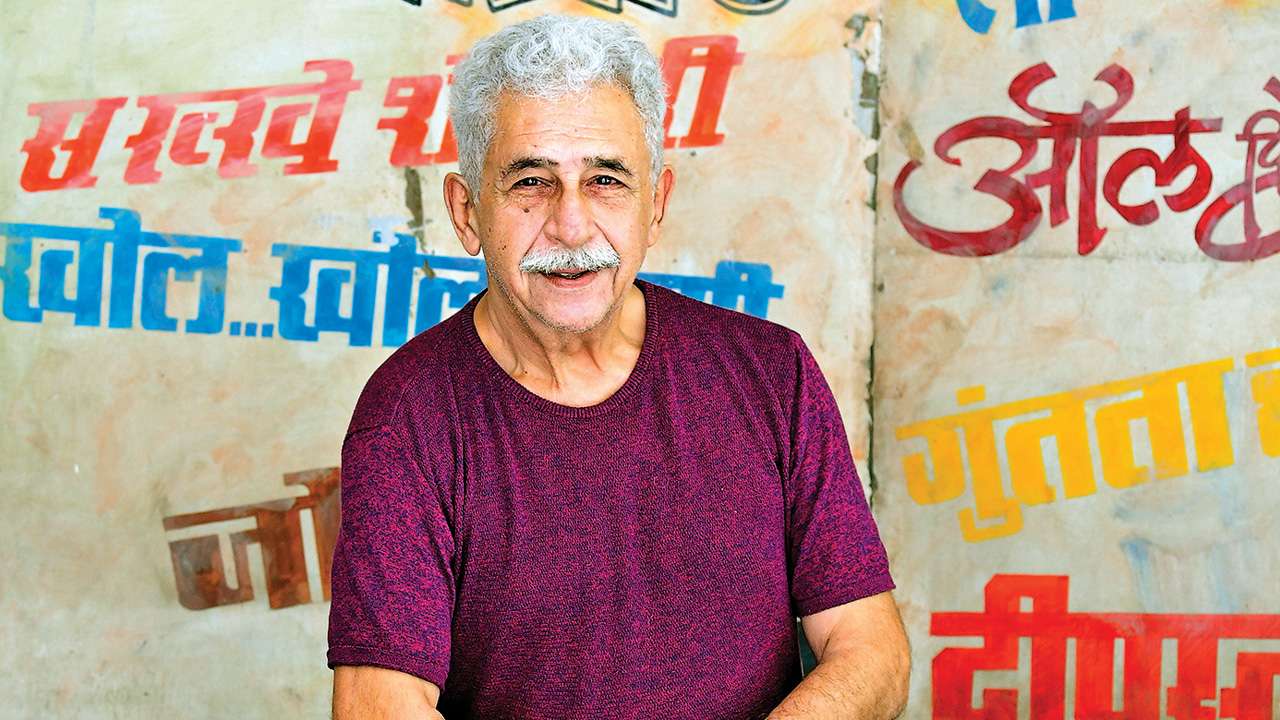
Naseeruddin Shah talks about the past, present and future of his theatre group, Motley, which celebrates its 40 years this month
Deepali Singh (DNA; July 15, 2019)
Circa 1978. Naseeruddin Shah and Benjamin Gilani sat in a small coffee shop in Lucknow and decided to make plays that aroused their curiosity. On July 29, 1979, they opened their first play, Samuel Beckett’s Waiting for Godot at the newly-inaugurated Prithvi Theatre in Juhu, although they didn’t have a name in mind for their group yet. Forty years and 42 productions hence, Motley continues to stage plays that resonate with them. They are now staging some of their most popular ones, including Manto Ismat Haazir Hain, Aurat Aurat Aurat, Dear Liar and Ismat Apa Ke Naam among others, and also doing a couple of readings at the Motleyana Festival to celebrate the milestone. We caught up with Naseer to tell us more…
The line in the 40 years celebration logo, ‘In Godot We Trust’, is quite apt for Motley. Who came up with it?
I did! It’s actually a meme that’s going around. Initially, there was something about the 40-year celebrations but I wanted this motto because if it hadn’t been for Waiting For Godot, Motley wouldn’t have existed. We owe Godot a great deal. We performed it for so many years. We will be reading portions from it for one of the shows and introducing all the actors who were in it — those who are still alive and around. Some who are not in India will be sending video messages. The people who played the boy are now all grown up, like Akarsh Khurana, Imaad (Shah, his son) and others. We will talk about the fun we had doing the play. I believe people should attempt drama they don’t necessarily understand. The process occurs only when you tackle the script.
Can you rewind to the early days of performing it?
There was no Motley name when we first performed it! Om (Puri) had a theatre group called Majma for which I had done several plays. We didn’t have a banner, so he said, ‘Do it for Majma’.
It wasn’t a particularly tough time. Ben chose Godot because he thought it would be a practical play to do, not because of its greatness. He said it’s just four men and we needed a child actor. He knew cinematographer Ishan Arya had a 10-year-old son called Sameer, so, we went ahead with it. The play was so difficult to comprehend and we didn’t know what the hell we were doing! Gradually, the references to Chaplin, circus, religion and all began to strike us. So, we tried to convey those as best as we could. I think it cost us around Rs 3000. We had to get one suit made, while the rest of us were in rags. We just produced our old clothes for that.
Please continue...
We didn’t expect it to make money but we did it because we wanted to do it and found more and more meaning to it. Then it began to get us revenue with full houses in Prithvi Theatre and other venues. And that’s how Motley established itself. I don’t remember it as being a very traumatic time. Tom (Alter) had a very large apartment in Juhu and we would often rehearse at his or Ben’s place. Sometimes, while working with Om, we have rehearsed on local trains, buses, at Juhu Beach, wherever we could find space. Looking back, even then it was great fun as we were doing what we loved.
Can you tell us about the influence theatre doyens Ebrahim Alkazi and Satyadev Dubey had on your works?
I spent my childhood in places like Ajmer, Aligarh, Meerut and Nainital. I studied at Aligarh University, where I met some inspiring teachers who introduced me to modern literature and encouraged my dreams. The plays we did there were shabby productions. There were hardly any resources or money. Then a teacher of mine took me to National School of Drama in Delhi and I was dazzled by the plays I saw! I didn’t know theatre like this happened in India but Alkazi was doing it. They were spectacular productions staged at the Red Fort and Talkatora Stadium, with a cast of 50-60 people. Every detail, right from the rings and shoes they wore, was looked after. That is what I have absorbed from him.
Then I saw Dubey’s plays. He often did works that Alkazi had done, but with no budgets at all. I consider his production of Hayavadana as one of the most memorable things I’ve seen on stage. There were Amrish Puri, Amol Palekar, Priya Tendulkar and Kalpana Lajmi among others. It was a spectacular play with nothing on stage but the actors. He and Alkazi detested each other and I can understand why now (laughs). I’ve learnt from both equally but I follow Dubey’s path. I want to do what he did — to reach out to an intimate audience, do plays that sock you in the gut, not ones which dazzle you. There are so many rudiments of staging I picked up from them. Alkazi was a genius at crowd scenes, while Dubey was great at handling actors and creating moments of dynamism on stage. The value of the word is what I learnt from Dubey most.
You rely a lot on the spoken word…
I love the spoken word. I believe it is the most important thing on stage. I admire well-spoken languages, whichever they may be. I’m not dismissing physical theatre. I admire it but unfortunately, I’m incapable of doing it. So, I stick to what I am good at — the spoken word.
What’s the one thing that’s been a constant for Motley in these 40 years?
To do the plays that we want to do. We once tried to do a crowd-pleaser — The Odd Couple. That was at a time when comedies were popular and we wanted to make some funds. All we did was lose money because nobody came to see it (laughs). So, we want to do the plays we feel the urge to do and that’s a rule we have followed. Sometimes we succeeded, sometimes we failed. Doing Julius Caesar was a dream I had since school. We attempted it, we failed. I think I was a little muddled in my head as to what kind of play it should be. It was part Alkazi, part Dubey. The mix didn’t work.
Is there a play on your wish list?
Saint Joan by George Bernard Shaw that I will certainly do at some point. It needs 15 male actors, all of whom have extremely important parts. It’s a tough task to find 15 outstanding male actors who can speak well. I’m also yet to find an actress who can play Joan. I’m gradually accumulating the cast but I want to be certain how to do the play, so I haven’t launched into it.
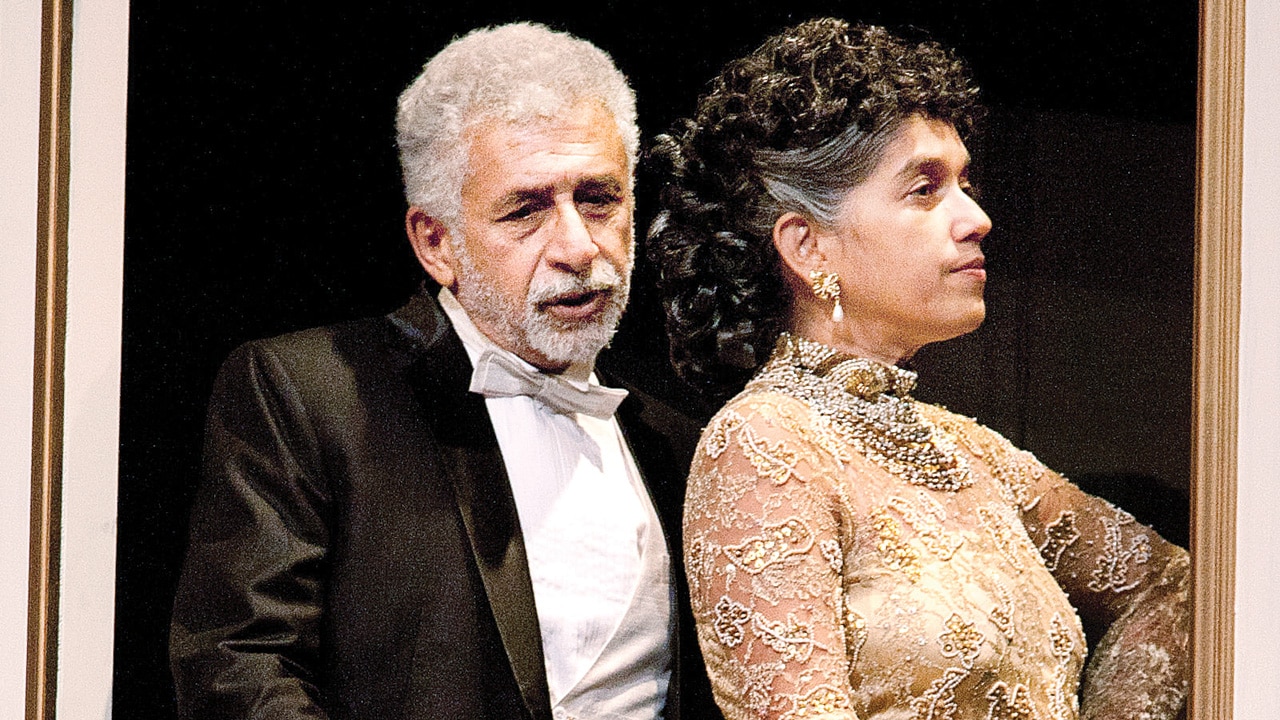
The actor with Ratna Pathak Shah in Dear Liar
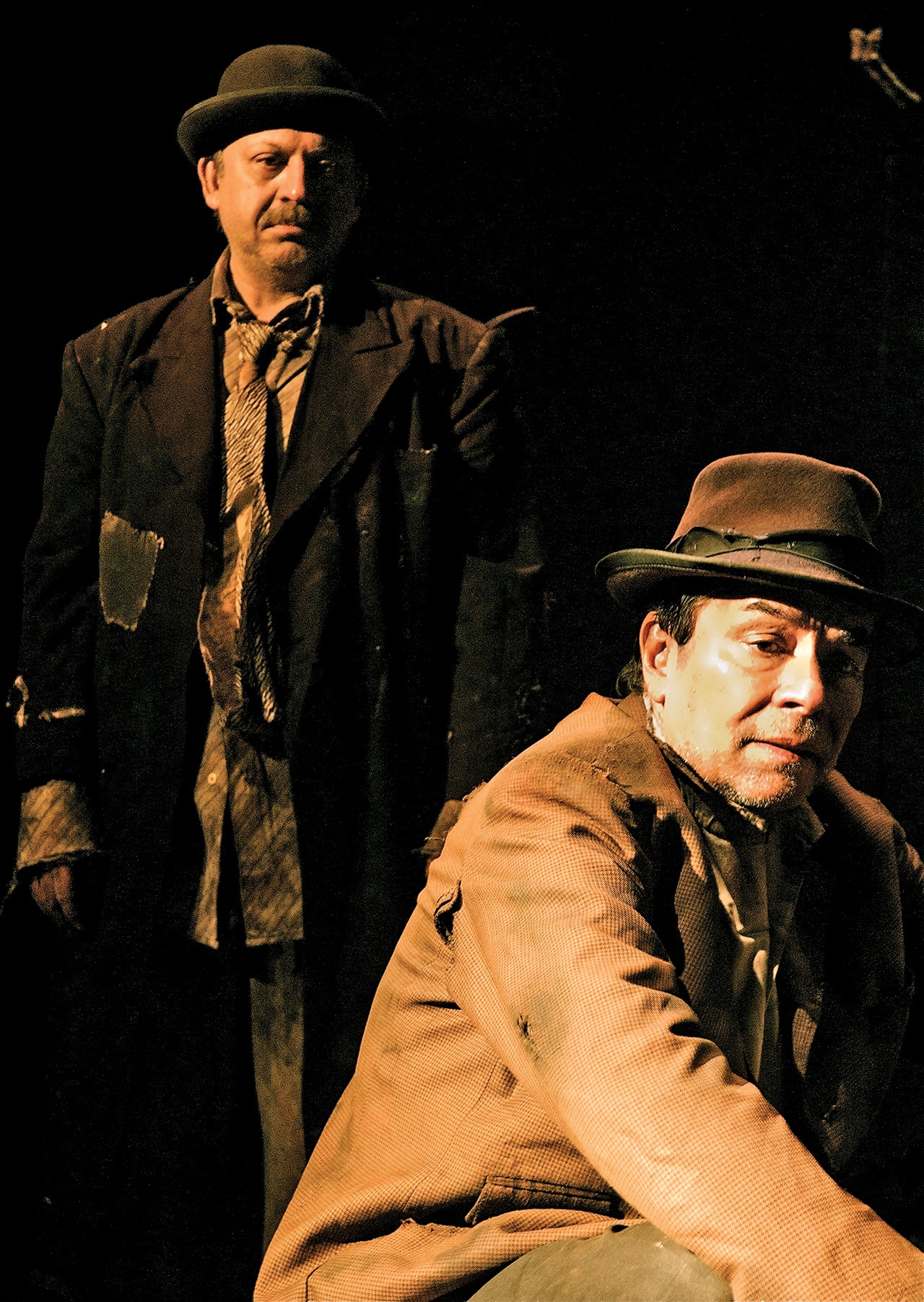
Akash Khurana and Benjamin Gilani in Waiting For Godot
Naseeruddin Shah and Benjamin Gilani's Motley theatre group still stands strong after 40 years
8:43 AM

The Motley family: Jairaj Patil, Akash Khurana, Naseeruddin Shah and Benjamin Gilani with Ratna Pathak Shah. Pic/Shadab Khan
Four decades after Waiting for Godot's debut at Prithvi Theatre, Naseeruddin Shah and Benjamin Gilani's theatre group shows no signs of slowing down. As they get ready to revisit five of their plays at Prithvi next month, they revisit their first act
Ekta Mohta (MID-DAY; June 30, 2019)
Naseeruddin Shah, looking like Einstein, and Benjamin Gilani, now sporting a wig, are discussing cricket and women like 40 years haven't passed. In the hippie decade, the two became college buddies at FTII, Pune; then co-actors in Shyam Benegal's Junoon, 1978; and then co-founders of the theatre group, Motley, in quick scene-changes. Gilani, who had been part of The Shakespeare Society in St Stephen's College, recalls, "He asked me, 'How come you haven't done any theatre in Bombay in the last five years?' I said I can't afford it." So, they started with a play that was easy on the pocket: Waiting for Godot by Samuel Beckett.
Since then, Motley has done 44 productions, including The Caine Mutiny Court-Martial (1990), Dear Liar (1994), Ismat Apa Ke Naam (2000) and The Father (2017). They celebrate 40 years next month, the party for which includes reviving five of their plays at Prithvi Theatre. Along their journey, the twosome also became a family, with producer Jairaj Patil, and actors Ratna Pathak Shah and Akash Khurana onboard. When we sit with them to trace their early days, they've just gone over the same questions and memories with another journalist. But Shah says, in theatre parlance, "Once more with feeling."

Julius Caesar
'What Was The Cheapest Classic We Could Do?'
In July 1979, when Motley's Waiting for Godot debuted at Prithvi Theatre, Shah played Didi and Gilani played Gogo, the two clowns. Khurana says, "That was the cheapest classic we could do. It had a huge budget by those standards: Rs 5,000. But, that was the only play that had one dirty tree, with a leaf sometimes, and tattered costumes. I did four shows as Didi, and I wore the same costume."
Naseeruddin Shah: I'm not the only one in the world who did not understand Waiting for Godot. I wrote an essay [in NSD, Delhi] that this play is absolute nonsense. The writer is making a fool of everybody. I got thoroughly blasted for writing such a thing. But, when we started working on it, and concentrated on the words and not worry so much about the meaning, it began to make sense. Like in any great poetry, it states things in a very simple, recognisable and brief way.
Benjamin Gilani: Didi and Gogo have been together for 50 years. When you think of 50 years, that play should have been as thick as the Bible. Prithvi Theatre was being built at that time. During the shooting of Junoon, I asked Jennifer Kendal Kapoor, "What are you going to do with this theatre?" She said, "I don't know. Take it. It's yours." Three sentences. So, we started off and Godot fell into place, by chance, not so much by design. When people actually came to see the play, we hadn't hit a goldmine, but we started doing short plays: Chekhov, Pinter, Genet, Mortimer. There was something as difficult as The Lesson [by Eugène Ionesco]; and on the other hand, we had Chekhov's The Bear.
Ratna Pathak Shah: But frankly, we were just blundering. We all learnt on the job. There was nobody to tell you how to do anything. We were all lucky that we at least got Satyadev Dubey, in terms of his ideas and not letting poverty get in the way of perfection. There were times when there was nobody backstage. Everyone was either onstage or in the light booth.
Shah: Nothing lonelier than the backstage of Godot.

The Caine Mutiny Court-Martial
'Naseer Wanted To Do Julius Caesar In Jeans And T-Shirts'
The group performed The Caine Mutiny Court-Martial by Herman Wouk and Julius Caesar by Shakespeare in 1990 and 1992 respectively. When asked about their favourite plays, Khurana says, "I think if you take a consensus from the older lot, you will find Godot and Caine emerging as winners." Julius Caesar was an important milestone as well, but for entirely different reasons.
Shah: I bought a copy of Caine Mutiny for Rs 5 on the pavement at Churchgate station. It was a tattered paperback, and it lay around with me for years, like the Einstein script [by Gabriel Emanuel], like A Walk in the Woods [by Lee Blessing]. One day, I picked it up and I was electrified.
Gilani: It involved a large number of people — at least by Motley's standards — 17 people. And, there were 70 people in Julius Caesar. The youngest was 4, the oldest was 74. There were three generations [of one family]. The logistics was the biggest challenge.
Pathak Shah: How many sandwiches do I order today? Starting from there to: how do you get everyone dressed backstage in Sophia Bhabha Hall, in Roman costumes with shields, swords and banners? Where do you store that stuff?
Gilani: Originally, Naseer wanted to do it in jeans and T-shirts. But, Julius Caesar was on the course of 13 schools, and they didn't want to see Brutus in jeans.
Shah: I was muddled as a director, I have to admit. I had [NSD director Ebrahim] Alkazi on my mind. Alkazi did these grand productions with 30 people carrying flaming torches onstage. Meanwhile, I got introduced to Dubey's method. And, I was torn between the two. It didn't really work, and I had edited the play, changed a few things, which appalled a lot of the teachers. One teacher said, "What about reference to context? If you have given Cassius's speech to Brutus, students will get confused." I said, "You've been teaching this play for one year and your students will get confused with one performance? What kind of a teacher are you?"

Waiting for Godot
'We Had No Message, No Political Agenda'
In the last two decades, Motley's focus has shifted to storytelling theatre, and also, plays in Hindustani. Starting with Ismat Apa Ke Naam (2000), they have interpreted the works of Ismat Chughtai and Manto extensively, and also opened up the platform for more roles for women.
Gilani: There were no Hindi plays. Even now there are very few. As Naseer had pointed out then, and I agree 100 per cent, if you're going to translate from one language to another, you need to know both languages like a grammarian.
Shah: The translator must be of the same level. How many times can you do Aadhe Adhure and Andha Yug, which are the only two worthwhile original plays in Hindi? Ghashiram Kotwal and Sakharam Binder are in Marathi. Tughlaq is in Kannada and so on. The plays we wanted to do happened to be in English. Then we started feeling limited. That's why I felt the need to perform in Hindustani. But, shortage of plays is still there.
Gilani: It's a matter of economics. Where does a writer earn money, unless you happen to be Chetan Bhagat? And, that's not really writing of any calibre, that's promotion.
Pathak Shah: The playwriting issue is a big one in our country. And now, with the invasion of your personal equipment with all kinds of information and entertainment, it's going to be very hard for live arts to stay around. [Regarding the lack of roles for women], it wasn't a deliberate attempt to keep women out. I was the only girl around, and I don't think I was much liked as an actress. And rightly so, because my skills in early Motley days were very, very basic. I have also grown since then, and fortunately, Dubey trusted me. He found plays for me. We were making do with whatever we had around us. And there were no other girls around. Maybe they got scared of me and ran away.
Shah: You can only cast in a play somebody you can trust with your life. You cannot take a chance of a person not turning up or not delivering the goods.
Gilani: That's one word that operates very strongly: 'trust'. If we didn't trust each other implicitly, we wouldn't have stuck around, and we're going back 45 years.
Shah: I think a strong reason for me [to start Motley] was to be able to spend time with people I enjoyed spending time with and produce something creative. Instead of sitting in a party or chatting, you're sharing creative juices with people you like. What greater joy can there be? And it's really because of friends that we continue, the encouragement and support we receive, the belief they had in our work, which initially was shabby and amateurish. Dubey used to say, "I do theatre for the 10-15 people I love. I don't give a damn about the rest." And, it's really true to a large extent. We had no message, no political agenda, no profound reason for doing theatre. We were not exploring or trying to understand the nature of theatre. We were content with what we knew. And, we had great fun.
Gilani: [I remember], in Godot, we had this young boy, who is a very famous cinematographer now, Sameer Arya. The boy comes twice, and in the second act, we have started and Sameer went off to sleep. And, Naseer and I are waiting. Somehow we managed to get the play together. After that, Sameer was holding on to his mother, thinking he's gonna get a mouthful from Naseer. Though I had directed the play, Naseer was the one who would give mouthfuls at the time. Naseer didn't say a word. Now, this guy (audience member) comes and says, "I particularly liked your second act's interpretation. You didn't bring the boy. It was a touch of genius."
Khurana: This other time, we were in Bengaluru, and in the middle of an intense scene, this lady in sari and perfume says, "Yeh car number kiski hai? It's been parked there. Bataiye, aisa hota hai? Sorry, but we have to stop this show." And the curtain came down. In five minutes, we resumed, and something very interesting happened. The next few lines, whatever we said, coincided in context with what had happened. So, she became a star in absentia. She became Godot in a sense. It brought the house down.
The Influence Of Satyadev Dubey
Akash Khurana says, "For me, he was a bridge for Motley. At that time, Dubey was in his Renaissance phase. He cast me in Abe Bewakoof, and he hated my performance, because he was supposed to cast Amrish Puri. I had my wardrobe [ready], part of my wedding stuff, so that was great for Dubey because impoverished theatre: costume ke saath aaya hai. I tried to sound like Puri sahab and screwed my vocal chords. And Chhabildas Hall, that's another legend: you could hear hawkers shouting, TVs blaring, windows open, fans creaking, and I'm in a three-piece. But Naseer liked what I did. Cut to a few years later, theatre, struggle, job, house-hunting, which is another trauma, and we were homeless. I had a kid, a suitcase and no place to go. He called us over and I lived with him for 11 months. What happened there was not just the sharan (shelter) I got, but an exclusive gurukul. You sleep, wake up, read and drink rum with Dubey. I was getting an oral history of Bombay's theatre. Talk about influences."

I’m allergic to selfie hunters after my show-Naseeruddin Shah
8:01 AM
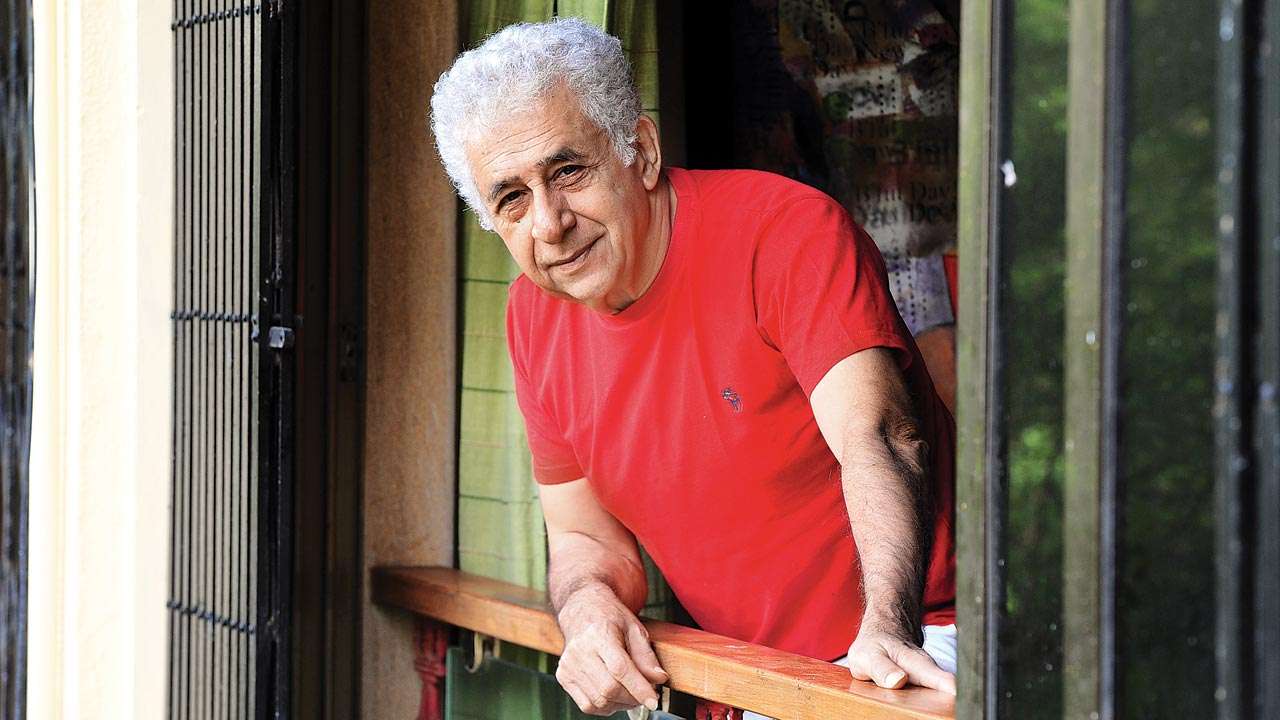
Deepali Singh (DNA; September 8, 2018)
Naseeruddin Shah has been busy of late. Between his play The Father that’s having a month-long run at the NCPA Experimental Theatre, conducting acting classes, swimming and playing tennis, he’s got it all sorted. But the one thing he isn’t doing is acting in movies. “I’m out of work,” Naseer states simply, when we meet him for a chat at his Bandra residence, adding that he’s glad he doesn’t have films at the moment, as it’s giving him time to do what he wants. Over to the veteran actor...
You may not be acting in films but are you watching a lot of movies?
I’m happy with some of the movies I have seen in recent times like Shubh Mangal Saavdhan, Nude, Dum Laga Ke Haisha and Kaun Kitne Paani Mein — the latter was a totally unknown film which I saw on TV one day. Several other films like Anarkali Of Arrah, Ankhon Dekhi, A Death In The Gunj and Newton were also good. But all these filmmakers get snapped up so fast by the Bollywood machine. It chews them up and spits them out. They made these movies out of conviction, but the moment one of these movies succeeds, they get snapped up by the movie-making factories and then they have to conform.
The boundaries between commercial and art cinema have been blurring now...
It’s a good thing. Films don’t get stamped as art films and the audience doesn’t need any help in deciding. They smell it out, as Dubey ji (Satyadev Dubey) used to say. ‘Audience soongh leti hai kaunsi film kaisi hai’. It’s true. Even among the ones being made now, I know which ones I want to see and that has been the case since school. ‘Six months from now, Shammi Kapoor ki jo film aa rahi hai woh dekhni hai!’’
Have you been offered any projects on the digital platforms?
I’ve been offered a few things but I didn’t find them interesting. I’ve been doing some short films with young people and that’s been great fun.
After month-long runs at Prithvi Theatre and NCPA last year, you’re back on the stage with your play, The Father...
Yes, and by the time this month ends, we would have completed 80 shows. Then we’ll need to do a few more to make a 100. We’re planning to take it to Bengaluru and also to Pune, so we will achieve that figure. It’s quite an achievement because we have managed to do this in a-year-and-a-half. It took us about 20 years to do 100 shows of Waiting For Godot! (laughs)
Do you think the success of the play will encourage other theatre companies to follow suit with the format?
I always felt that it’s possible to do it, but the problem is most theatre companies don’t have the resources. One has to book a theatre for a month which means a fat amount of money. And now these theatres cost a lot. Then the actors have to be available for a month. So, I don’t expect that everybody will start doing it. I did it because I could afford to do it. The actors I chose have all given their commitments and it’s been great fun.
When you were doing the play for the first time, you had said that it’s a complex one, but you never underestimate the intelligence of the audience.
Absolutely, and the response has been very encouraging. At the same time, there are always walkouts in every show. I don’t mind. Maybe those people found the play confusing, which is actually the playwright’s purpose, to put you into the mind of the character. So if you’re confused at the end, it’s intended, provided the experience has given you something of seeing this man. But the majority of audience stay on and that has been really good to see.
What’s the kind of feedback you have received from audience members?
So many of them come and tell me about some member of their family, or some relative. And everybody knows what it’s like, because at some some point or the other, one feels that their parents have grown old, and that they don’t understand them. So, it’s easy to empathise with the situation where this man has receded to this point that nothing he does is making sense to anybody. They come and say ‘it must be so hard for you’, but it’s not hard for me. I’m just telling them a story. It’s hard on the audience.
You have always maintained that you don’t like audience members coming backstage to talk to you post a show, but seems like it was different this time...
I’m allergic to selfie-hunters after the show! But this time, I actually had meaningful conversations with people. A number of youngsters have come to me, some of them went away when I told them ‘no selfies’. But some stayed and spoke to me. That has been really wonderful. One of them actually said ‘thank you for doing this because today, I understood my grandmother. She was just like this’. I don’t feel that I have achieved perfection or anything close to it. But I have at least managed to convey the essence of this play and that’s what I feel happy about.
What next?
I’m planning a month-long run of a play called Old World for November next year. It’s a lovely play which I had seen, enacted by my heroes Mr and Mrs Kendall of Shakespearana Theatre Company.
Dadu is the God to whom I pray-Amrish Puri's grandson Vardhan
7:56 AM

With a theatre stint under Satyadev Dubey and late-night movie binges, Amrish Puri’s grandson Vardhan, who makes his Bollywood debut with a romantic-thriller, has been an actor-in-training since he was five
Avinash Lohana (MUMBAI MIRROR; August 8, 2018)
Mirror has learnt that another star kid is gearing up for a Bollywood launch. Taking the legacy of his late grandfather Amrish Puri forward, Vardhan Puri will make his acting debut with a yet-untitled romantic-thriller produced by Jayantilal Gada. The film is expected to roll in September and will be shot in North India. The debutant has earlier assisted Habib Faisal on Ishaqzaade and Daawat-e-Ishq, and Maneesh Sharma on Shuddh Desi Romance.
 “I was supposed to start off with a period-drama with Jayanti bhai,
but for some reason that didn’t work out. He approached me later for
this film which I loved and immediately gave my nod to. It’s a
performance-oriented role and in terms of treatment it will be in a
space similar to (Hollywood director David Fincher’s
psychological thriller) Gone Girl’s,” Vardhan informed, adding that he is
currently attending workshops and undergoing training for the role. The
director and his leading lady will be locked soon, while recce is
currently on in Delhi and Shimla.
Vardhan has been an actor-in-training ever since he was five, learning the craft under the tutelage of his grandfather’s mentor, National Award-winning actor-filmmaker-writer Satyadev Dubey. Through the years, he has also been a part of over 90 plays.
“I have a strong inclination toward writing and direction too but acting is my first love. Initially Dubey ji made me work backstage, serving tea to the cast and crew and cleaning the stage, after which I started getting smaller roles. I got to play a lead role when I was in my teens,” the actor revealed, adding that he has also trained with acting gurus like Athar Nawaz, Neeraj Kabi, Vidur Chaturvedi, Mujeeb Khan and Faezeh Jalali.
However, Vardhan, who identifies as a fan of Charlie Chaplin, Kishore Kumar and Puri Sr, had found his first teacher in his grandfather. “Dadu is the God whom I pray to. I was so close to him that I would sleep between him and my grandmother. When he passed away, for me it was like losing the protective cover of an umbrella. It was then, that I decided that if I do something, it would be for my grandfather and this film is an ode to him,” recounted the debutant who counts Virasat, Ghatak, Mr India and Dilwale Dulhania Le Jayenge as his favourite films featuring the late veteran.
Narrating his earliest memories of his dadu, Vardhan added that he wouldn’t sleep till Puri returned from work. After that they would watch movies till 3 am with little regard for young Vardhan’s early morning tuitions. “We would watch films of Dilip Kumar saab, Al Pacino, Robert De Niro, and also binge on classics like The Godfather and The Shawshank Redemption. Sometimes, I also used to sit with him for reading sessions when filmmakers came home. His films with Shyam Benegal sir and Govind Nihalani sir top my list of all-time favourites. I really miss him,” Vardhan signed off with a sigh.
Given the prep that I put in for Neerja, I won’t lie and say that it didn’t hurt to not get it-Neena Kulkarni
7:44 AM

Model, theatre artiste, film and TV actor, Neena Kulkarni discusses her career spanning 40 years...
Yogesh Pawar (DNA; September 23, 2017)
As a model, theatre person, film and TV actor, filmmaker and columnist, Neena Kulkarni wears several hats and brings the sincerity of her craft to every frame making each character she portrays, real and imbuing even similar ones with an edge that make them different. To do this once in a while is itself worthy of admiration so what does one say to someone, who has done this for four decades. On the completion of 40 years in the industry, the seasoned actor opened up on her exceptional work, her life and her hopes from the future...
It’s been four decades of acting. Does it still thrill you like when you started in the mid-70s?
Of course, it does. Nothing gives me the same high as acting. Acting will always be my biggest love. I think that’s happened because I’ve enjoyed and made the most of every part, however, big or small. I’ve almost never taken up a part that I didn’t like under compulsion.
Do you feel the Padma awards have taken their time to find you? After the National award for Shevri (2006) and state awards for theatre and films, not many have come your way?
What is recognition after all? Recognition and love I get from people when I step out? The way someone recalls/praises a play/serial/ad I did even from the early 80s? Or the respect and warmth I receive from people in the fraternity? Isn’t that more important and satisfying? Having said that, I haven’t stopped hungering. Who knows, a better, more challenging role and the recognition it will bring in its wake may still be ahead. After all, we live in really interesting times when filmmakers are pushing the envelope, both with subjects and genres.
How does that affect you?
You know how this plays out. An actress is assumed to have a certain shelf life after which she’s thrust into a ‘character role.’ I’m 62. There was a time when someone my age would be just another glorified prop, but not so anymore. One of the nicest things about contemporary takes on gender and sexuality have meant assertive women. And filmmaking has had to make space for that. That is why films are being written for a Meryl Streep, a Judi Dench or a Sridevi here. Even if one has to etch a mother she isn’t simply filling the frame. Look at how wonderfully Shabana ji (Azmi)’s character stood out in Neerja.
Didn’t you too audition for that part?
Well, I did. And given the prep that I put in, I won’t lie and say that it didn’t hurt to not get it. But when I saw the film, I was floored with what Shabana ji brought to the role. We come from really different schools of acting so obviously her take on the character is very different from mine.
You did not grow up in a filmi family.
Not at all. I was always the upper middle-class Mahim girl. My parents were both doctors and really well-respected names in the medical fraternity and I schooled at Canossa Convent and then pursued my BA from Elphinstone College. So acting happened as a matter of chance.
Really?
You can blame that on our short college hours and lack of diversions like social media. (Laughs) We’d have a lot of time on our hands. I’d begun doing fashion shows and modelling for a lark even doing the odd experimental play. My progressive parents were quite supportive and never resisted. And so I carried on.
And then you met Pt Satyadev Dubey?
Satyadevji is known as a director, actor, playwright and screenwriter. But his greatest contribution has been his mentoring of an entire generation of actors helping them discover their own strengths. Imagine my luck that I met this walking encyclopedia of theatre and went on to be part of several productions under him. Though extremely moody and temperamental, he was a very generous teacher. I was young and all of this was totally new, so I’d be excited about everything. I hadn’t had any formal training in acting. It all began with Satyadev ji. He’d make us learn the whole play, all dialogues for all parts. And anyone could be called to play anyone if that person didn’t turn up. It trained and opened up doors for me to act in other plays like Mohan Rakesh’s Adhe Adhure, Shankar Shesh’s Mayavi Sarovar and Willie Russell’s Educating Rita.
You were to shortly meet your second mentor Vijaya Mehta...
All of us call her 'Bai' respectfully. She was already quite a big name and I was quite chuffed she chose me to play Shabbo in Anil Barve's Hamidabai chi Kothi (1978). The grammar, craft and technique of her theatre work is at a complete variance from Satyadev ji. She wants you to find your character yourself. Given my enthusiasm, I adapted and picked up soon. It set the stage for me to do iconic plays like Mahasagar and Savitri with her. Later I did other plays like DhyaaniMani, Prem Patra and Vatvat Savitri. A few years ago in a hugely emotional development, I got to step into Bai's shoes and play Hamidabai's character which she played when the play was revived. At her behest, I have joined her to conduct workshops for young actors.
You also did a play with autobiographical shades of the dynamics between Medha Patkar and her ex over her career and cause choices.
Yes, a lot of people saw resonances of her life in a play I did with my late husband Dilip, Aaicha Ghar Unhaat. I only met her much later personally when she was asking many of us to join her in the Narmada Movement.
And did you?
No, I didn’t. I felt it should be something one does full-fledged and not as occasional photo-ops. I was by then faced with the prospect of running a home by myself and couldn’t make time.
Are you talking about the passing away of your husband Dilip Kulkarni?
Yes, till it happened very suddenly in 2002, I’d thought of what I do as only a passion. True, I contributed to the family kitty, but he was the man of the house in my head. You know, he acted as a part-time thing, but worked in a cooperative bank full time. With his passing away, once I was past the sorrow what stared at me was providing for my two children and running the house.
Do you still miss him?
I know it’s been 15 years. I’ve reconciled to the idea of his passing away, but how can one not miss a partner one loved and shared a life with? You know when we first met during rehearsals for a play, he’d maintain a shy distance. That drew me to him and made me fall in love. We came from really different backgrounds. He came from a working class background in Deolali and was settled here in a bank job. On my insistence, he agreed to buy a flat in the same housing society I grew up in from early childhood and set home here. Even now when I’m by myself I feel like talking to him.
Your children are both in the entertainment industry now.
Yes, but both have decided to be behind the scenes. My daughter is into TV production and my son is into advertising.
Speaking of the latter, you are an Indian model with one of the longest innings. Aren’t you?
Well, I began early. I was the Clearasil girl when I was barely 16. I have played everything from young girl, wife, mother, elderly old age home inmate selling everything from hair oil, insurance and what have you. I have never sought work. But over the years, people have always approached me and I feel lucky to have done campaigns like Bisleri, Sprite, Mother Diary, Cadbury and Life Insurance Corporation and others. Besides, ads don’t tie you down to a project for long.
You mean daily soaps like Yeh Hai Mohabbatein where you are Madhavi Vishwanathan Iyer since 2013?
TV is no longer the poor cousin of the big screen. With its wide reach, it has pulled actors towards it. Actors of my seniority too get a lot of different characters without getting stereotyped. Many big actors are coming to the small screen since it gives them a direct connect with fans. But I must mention here that sometimes TV can be a blur. Some people think as long as they look good and say their lines properly, it’s fine. This is unfair to other actors really working on their craft. But given the rush, even a not-so-good take is canned and often makes it on air too. That hurts because I come from a culture of worshipping my work.
Will you continue to do plays?
I’ll continue to do theatre till I breathe. I only feel the work should challenge me. Wedding Album or a Mahatma versus Gandhi with Naseeruddin Shah was quite fulfilling and I want more of that kind of work. The last play I was doing was Chaapa Kaata. After I point, I was unhappy about turning up at work. The idea of travelling long distances for a three-hour-show, which is not doing anything for me got to me and I stopped doing that play.
And you’re equally selective about films?
The medium seems to love me. I’ve worked with greats like Mani Ratnam, Amol Palekar, Priyadarshan and Shankar. I even played a cameo opposite Amitabh Bachchan (Bhoothnath) because it was a BR Films project. Also, many new indie filmmakers are doing fascinating stuff. It will be great to work with them. Unlike TV, here it matters who the director is and what the set-up is.
You have to talk about working with Judi Dench.
The modesty and humility of a legend like Judi Dench can only be seen to be believed. For a scene in The Best Exotic Marigold Hotel where she was not even in the frame, just to cue me she came and stood in front. Here if an actor realised that s/he was not in the frame a spot boy would replace her/him.
You've done a French TV series Raani which ran to great acclaim on channel France Deux and a French film Noces. Did you learn especially learn French?
French was what I majored in while graduating from Elphinstone College. I did occasional translation jobs till I got drawn to fashion, modelling and acting. Of course, my French is quite rusty but in both these projects, it suited the context of my characters. I haven't quite gotten over the fun we had while shooting for Noces in Luxembourg last year.
Who are your favourite young actors among the current lot?
I think almost all of them bring such energy and drive to what they are doing that its almost inspiring. When we began we were just looking for work. These guys come looking careers.
Any advice for the younger actors?
Who am I to advise anyone anything when I learn so much from them? I have learnt to lighten up, live the moment and have fun. They help me stay young. Who would have thought, but it’s also kept me busy on social media.
Who are you closest to in the industry?
Given my innings, I get along with almost everyone. But in the passing away of Reema Lagoo, I have lost a soulmate. A fellow acolyte of Vijaya Bai, I’d discuss anything personal/professional with her with complete ease. I’ve now reached a stage where I prefer being a loner.
Returning to theatre is always a beautiful holiday for me-Swanand Kirkire
8:22 AM

His words have complemented many a tune in Hindi cinema, but the celebrated lyricist, who plays a pivotal role in a recent play, remains a theatrewallah at heart
Reema Gehi (MUMBAI MIRROR; July 24, 2016)
An hour before the rehearsal of Chakkar Chalaaye Ghanchakkar, at the Jamshed Bhabha Auditorium located inside the National Centre for the Performing Arts, Swanand Kirkire seems visibly composed. The lyricist of movies such as Fitoor (2016), 3 Idiots (2009), Lage Raho Munna Bhai (2006) and Parineeta (2005) for the first time essays a full-length role in a play, which opened on Saturday. Written by Gulzar, it draws inspiration from his own film, Angoor (1982), which was based on William Shakespeare's The Comedy of Errors — the play is perhaps director Salim Arif's most ambitious production and he seems rather content with Kirkire's contribution.
The 46-year-old, who played a small role in Manav Kaul's Colour Blind opposite Kalki Koechlin in 2014, says, "Returning to theatre is always a beautiful holiday for me. But acting in a play written by Gulzarsaab means something else. I greatly admire and respect his work," says Kirkire. "The other day when he was at the rehearsals, he told me that he really liked my performance and I was over the moon."
Kirkire credits his achievement to his foundation in theatre. "Whatever work you do in cinema, you do it at a certain time and space, and it reaches people much later and your work is served as a whole package. Theatre offers spontaneity, which I enjoy very much. It not only helps you became purer as a creative person, but it allows you to develop a direct relationship between you and your audience," he shares. "But I must confess, each time I go on stage I feel as nervous and excited as I did the first time."
Hailing from Indore, Kirkire, whose parents Chintamani and Neelambari were disciples of the legendary Kumar Gandharva, dreamed of a career in the business of entertainment. Before he enrolled himself at the National School of Drama in Delhi, Kirkire joined a theatre group and performed alongside actors Manoj Bajpayee, Ashish Vidyarthi and Piyush Mishra. "I learnt a lot from our director N K Sharma, especially the basics from him. It was my beginning in theatre."
At the NSD, where he studied design and direction, he met Satyadev Dubey with whom he shared a "love-hate relationship". The inimitable Dubey played a pivotal role in shaping Kirkire's career. "Everybody knows how Dubey was and is. For me, he's still there in our lives," he smiles.
Recalling an incident when Dubey met him for the first time at NSD, where he would organise classes, Kirkire laughs, "He saw me and asked me to leave. He said he didn't like my face and that it depressed him. I was very upset. I didn't know what to think."
But Kirkire chose to take the personal jibe in his stride and continued hanging around at his rehearsals. "The man had charisma and somehow you wanted him to like you," he says. It was only much later when Dubey heard Kirkire, an untrained singer, croon to his beautifully-penned Bawra Mann for Sudhir Mishra's Hazaron Khwahishein Aisi that he truly warmed up to him. "Before giving it to Sudhir, I sang that song at a party. Dubey was present there and he hugged me after listening to the song, and since then he started to love me," he says. "After that day, whichever play I staged, for instance, Aao Saathi Sapna Dekhe in 2013, he would tell me to stop the play and sing Bawra Mann. When I would argue saying it doesn't make sense, he would respond, 'You don't know how to cash in on your success which is why you're going nowhere'."
Currently, Kirkire is in the process of writing a film for R Balki and songs for Rajkumar Hirani's next (a biopic on actor Sanjay Dutt). According to him writing lyrics for Hindi cinema was sheer "serendipity". "My plan was to make movies," he says "When I was recording Bawra Mann for Sudhir Mishra, Pradeep Sarkar was present and he made me meet Vidhu Vinod Chopra, and that's how Parineeta happened and then it just snowballed into something else. Much like life, really."
Staging a good theatre experience is not as frightening as movies can be-Mahesh Bhatt
10:23 AM

Based on his mother's life, Mahesh Bhatt has scripted a forthcoming play. The filmmaker talks about his liberating discovery of theatre
Reema Gehi (MUMBAI MIRROR; December 6, 2015)
It's no sort of a trifling exaggeration when veteran filmmaker Mahesh Bhatt draws an analogy between him and a spider. Settling down on a massage chair, at his office in Linking Road, he explains, "When the spider creates a web, it takes out the raw material from his own gut. The objective of the spider is not to get marvellous responses from the critics, but to catch a fly. Similarly, man is memory. I have nothing but my memory. When I create a story, I write to grab an audience,"
The 67-year-old first borrowed vignettes from his life to make his 1982-film, Arth, which was a semi-autobiographical look at his extramarital relationship with actor Parveen Babi. Saaransh (1984) was influenced by his life growing up in Shivaji Park, Janam (1985) spoke about his illegitimacy, Daddy (1989) dealt with the ghost of his alcoholism, while Zakhm (1998) revolved around the relationship between his Muslim mother and Hindu father, against the backdrop of the 1992-1993 Mumbai riots. "There's nothing like a cathartic experience. Inhale life, exhale films," he breathes. "Having said, I don't have a sense of proprietorship over my ideas once I hand the script to the directors. It's not what I write; it's about what they read."
Director Mohit Suri read Hamari Adhuri Kahani and created his interpretation of what, in Bhatt's his words, "has the heartbeat of my mother". The film wasn't lauded by the critics, but has enjoyed "an unusual journey". It was first explored as a book, then as a film and now a play of the same name — dramatised and directed by Delhi-based theatre practitioner Happy Ranajit — to be staged on December 26 at the NCPA. "Mohit wanted to explore the space of what is called 'the traditional Indian woman' who has been kind of bleeped out from the radar of mainstream cinematic space," he shares. "That's when I revisited the lives of my parents — my father, my stepmother and my mother, and excavated a story from their lives."
Bhatt came across writer Suhrita Sengupta who expressed her desire to write a novel of the story, which was a precursor to the film, starring Emraan Hashmi and Vidya Balan. "While the crew was still working on the post production of the film, Happy adapted the book into a play," he says.
Amongst the plays he has been associated with, Bhatt counts, The Last Salute, which was staged in 2011 as the most "gratifying". The play is based on Iraqi journalist Muntadhar Al-Zaidi's book, The Last Salute to President Bush, and narrated the series of events that led the scribe to hurl shoes at former US president George W Bush. Bhatt opened the play by reading out the letter he wrote to the White House against the US intervention in Iraq. "It's a contemporary political play, which talks about things which are not recorded by the mainstream media. It locks horns with the mightiest power on this planet," he muses over Al-Zaidi's account. "This narrative is still fresh in the consciousness and even more topical than it ever was, because of the ISIS and what's going on concerning them. This play is a voice of the underdog. It marked my first foray into theatre," he says, before quickly correcting himself, "Or maybe, that wasn't my first."
Bhatt's formative years in films were shaped by Satyadev Dubey. The legendary theatre maker wrote the dialogues of Bhatt's very first film, Manzilein Aur Bhi Hain, about two fugitives and their relationship with a prostitute. "Dubeyji had a great impact on my psyche. It was because of him I understood the meaning of what you call 'minimalist art form'," he says. "He was a lonesome; a maverick who spoke Hindi, but had a great commitment to Marathi theatre."
It was through Dubey that Bhatt was introduced to the Chhabildas movement and enjoyed the privilege of meeting the other theatre iconoclast, Vijay Tendulkar. He even owes meeting his wife Soni Razdan to theatre. Recalling the time he watched Dubey's adaptation of Jean Paul Sartre's No Exit, Band Darwaze at Prithvi Theatre, Bhatt smiles, "That was the first time I set my eyes on her. Little did I know we would soon be married."
Watching his friend Kabir Bedi in Alyque Padamsee's Jesus Christ Superstar, back in 1974, "was something which mesmerised me. But I never considered it my medium," he says. Bhatt, who's currently in the midst of writing Aashiqui 3 with his daughter Shaheen, and may craft a film with the youngest superstar in the family, Alia, now considers theatre as a means of injecting subversive thought, which the idiom of popular cinema doesn't allow. That is the "dharma" of theatre, he says. "Besides, staging a good theatre experience is not as frightening as movies can be," he thinks. "I feel for a society, which is doomed to be governed under the boots of the power who rule us, theatre gives expression to those voices, and I have only just about woken up to it."
People don't watch my plays for the story; they watch them for my madness-Makarand Deshpande
9:05 AM

Purvaja Sawant (BOMBAY TIMES; April 5, 2015)
With over 40 plays to his
credit, writer-director-actor Makarand Deshpande's devotion to theatre
is unmatched. For the first time ever, he is staging 10 of his most
revered plays at the Ansh theatre festival being presented by Bombay
Times, starting April 11. In an exclusive tête-à-tête, he talks about
the inspiration behind his theatre group and why he loves doing abstract
plays.
You've worked in theatre for more than two decades. What was the idea behind starting your own group?
I began doing plays way back in 1986 at Prithvi and would park myself outside the theatre all day long. I formed an informal drama troupe called Head's Together, where we only did platform performances. It was like street theatre. I did plays in Hindi, English, Marathi, Gujarati and even Sanskrit! Actors from all over India - from Kolkata to National School of Drama - would join me and we used to write plays together and work on them. Anybody and everybody who visited Prithvi would work with me. One day, I spotted actor Kay Kay Menon, who was performing a platform act, and decided he should work with me. In him, I found a pillar for the theatre group that I wanted to start. We worked on a biopic of saint Sadhu Vaswani; that was when Ansh was officially formed. I wanted to contribute something to the legacy of Indian theatre. Ansh is my contribution. At that point in time, we started churning out plays like a factory! In a year, we would come out with at least four original plays. I became a writer, director, actor, producer... everything. I would work in movies and TV and put that money in my plays, because it was in theatre that I found my calling and true focus. Theatre had a calming effect on me. Today, I have staged more than 40 plays.
This is the first time in 21 years you are staging a festival of your plays... why did you wait for so long?
For the last 10 years, people have been telling me to host a festival of my plays. But my mentality was that a fest means reviving old plays, and I didn't want to do that; I wanted to only work on new plays. Eventually, I decided to look at my old plays from a fresh perspective, cast new actors and add nostalgia. So, for the festival, I am calling my original actors like Anurag Kashyap, Sonali Kulkarni, Kay Kay Menon and Ratna Pathak Shah who have acted in these plays. Some of them will introduce the new cast. We will begin with Sir Sir Sarla, which was originally nine hours long! I am reviving plays like Ek Kadam Aage, Kasturi and Grihalaxmi that haven't been staged for years. There will also be new plays like Krishna Kidding and The Doll.
Your work has often been termed abstract and incomprehensible.
Yes. Actually, I was a rebel when I began doing theatre. I didn't want to showcase bedroom, kitchen or bus stop conversations on stage. Those are stories that should be captured on camera. Theatre is a medium that should explore what's inside your mind. It should give you an adrenaline rush. It should not be slice of life. There is nothing realistic about my plays. I belong to the world of magic realism. Ansh was formed because of my passion for this kind of theatre. People don't watch my plays for the story; they watch them for my madness. Anurag Basu had once told me, 'Your plays are open to interpretations'. In fact, when people criticised me, I decided to write Sir Sir Sarla, a story they could understand. I became instantly popular! But I am no here to make hit plays. That's why don't work on remakes, classics adaptations.
Why do you think you've survived so long in theatre?
I am lucky that many people have worked with me purely on good faith. For example, Vishal Bhardwaj com posed the original music for my play Kasturi, because he loved the story. Satyadev Dubeyji (playwright) would always tell me, 'You exist only because of your madness.' I got a lot of support from my mother too, who allowed me to take creative liberties and let me do whatever I wanted. She never asked me, 'When are you getting married?' or 'Why are you refusing films?' I think I have survived theatre for all these years only because I don't have any ambitions or dreams. I never wanted to become a renowned playwright, actor or director. I work and live in the moment.
In Gardish Mein Taare, characters aren't classified as good, bad or ugly-Sonali Kulkarni
8:50 AM

Sonali Kulkarni, who essays a character inspired by Geeta Dutt in an upcoming play, on the role theatre plays in her life
Reema Gehi (MUMBAI MIRROR; January 4, 2015)
The last few years have been particularly exciting for Sonali Kulkarni. The 40-year-old actress, who made her film debut in Girish Karnad-starrer, Cheluvi (1992) was part of a National award-winning Marathi film, Deool (2011), the record-breaking Singham (2011) and Gyan Correa's The Good Road (2013) which was India's entry to the Oscars. In fact, currently, her Marathi-film, Dr Prakash Baba Amte: The Real Hero is running to houseful shows in cinema halls. "So, as an actor," she says, "I am deeply satisfied."
As she settles into a chair at a coffee shop in Khar, she reflects, "I was naive when I started off. But I feel my naivety has paid off. After my breakthrough in Hindi cinema, I never thought that now since I am a commercial star, I mustn't act in regional films or not go back to theatre. For me, the role was always more important, irrespective of the medium."
But theatre holds a special place in her heart. And she's only too happy to get back on stage with Saif Hyder Hasan's upcoming play, Gardish Mein Taare, which opens at the 1,100-seater Jamshed Bhabha Auditorium, NCPA, on January 26.
The play traces the paths of the two protagonists, Devdutt Bose (played by Arif Zakaria) and Bhavana, essayed by Kulkarni, inspired by the lives of the cinema genius Guru Dutt and his songstress wife, Geeta Dutt. The play, she adds, is a tribute to the creatively volatile period of Hindi cinema in the 1950s.
"What I appreciate most about this play is that the director is not trying to classify the characters as good, bad or ugly. He's seeing them as creative beings," says Kulkarni. "It's important for the aam janta to understand what creative souls go through, because they have passions and pursuits that don't match regular, mundane lives."
As far as her creative pursuits go, "I have never had a plan," she admits. "My calling is instinctive."
Kulkarni, who launched her theatre production, Sokul, in 2013, with a Marathi play, White Lily Ani Night Rider, is largely drawing her attention to the stagecraft.
She says she is perplexed by the quick, seamless transitions most of her actor colleagues are making across different entertainment mediums. "I have been slow in comparison," she says. When she participated in a reality dance competition in 2007, she dedicated six months to learning dance. "I am not the sort to make swift jumps," she says.
For Kulkarni, theatre is equal to revisiting ground zero. "It helps me understand my own pace and lets me find my own breath and balance."
In fact, while shooting for Dil Chahta Hai, Kulkarni was a part of Makarand Deshpande's theatre production Basant Ka Teesra Yauvan. She had the shoot dates adjusted to accommodate the show.
Kulkarni credits her intense involvement and dedication to the craft to late thespian, Satyadev Dubey. She was 16 when she first met Dubey, at a workshop he conducted in her hometown, Pune. She calls herself "a beautiful bag of complexes," until she met Dubey."I believed that I wasn't good, pretty, fair or rich enough. It was Dubeyji who told me that until I don't accept and like myself, people will have doubts about me. Theatre is a full-shot, not a close-up, he said," she narrates.
She calls his workshops "unique". Balancing an iPad on her head, she says, "It was commonplace for Dubeyji to make actors place light chairs on their heads to teach them how to walk straight, hold a pencil in their mouths and speak and scream when they'd ask nonsensical questions."
One such query she asked was what one must do if they don't like their voice. It took some courage, she says. "Dubeyji made me repeat the same question a 100 times. I broke into a sweat and trembled, but kept asking and he didn't let me complete the sentence because he kept insisting to ask in my 'own' voice. At one point, I took a deep breath, and determined to finish it, I screamed, 'agar kissiko apni awaaz acchi nahi lagti hai, toh woh kya karein?'. He then said that's my voice and made me realise that if I speak in my pitch and breath, I'd able to convey what I have to say truthfully."
Kulkarni clings on to this influence Dubey's workshops made on her young mind. "I will not put up a fight to claim my share in my parents' estate, but I'll fight to be considered Dubeyji's prodigy," she laughs.
Playwright Vijay Tendulkar was another maverick who made an impression. "I got to know him because my brother Sandesh dramatised some of his newspaper columns into a play. He was someone who reinforced fearlessness in me," she says, fondly.
"He urged me to stop being a good girl. He told me to open the cage and learn to fly. He allowed people to dream," she says.
By her own admission, "No other theatre school could reinforce the lessons these two geniuses taught me."
I will fight till I get cast in better roles-Manav Kaul
8:31 AM

From acting to writing, directing and now back to acting... Manav Kaul on his 15-year journey.
Gitanjali Chandrasekharan (MUMBAI MIRROR; June 22, 2014)
There's hardly a story that Manav Kaul doesn't tell well. Whether it's about his first few days in 1999 when he moved to Mumbai from Bhopal ("I found a room in Charni Road East for Rs 50 a night, and was so overwhelmed by the crowds that for 15 days, I didn't even cross over to the west to see the sea"), or how his first play as writer happened ("when Kumud Mishra saw the first draft of Shakkar Ke Paanch Daane, he said he'd do it, if I finished it; Sanjna Kapoor wasn't confident, but when the play was staged we got a 10-minute standing ovation"), he describes each detail meticulously. It's to build the journey of a man no one knew 15 years ago to the guy they are calling the-next-big-thing-to-watch-out-for.
The theatre bug bit Kaul, when he was in Bhopal training as a national swimming athlete. "I was at a play... I don't remember the name... at Bharat Bhavan with friends, and was mesmerised. As an actor, I could be someone else and people would watch me, laugh with me, clap for me, congratulate me," he adds, sipping on the filter coffee he has ordered at the Yari Road cafe. "I realised that this is what I want to do."
Kaul quickly dumped the swimming career that he had moved from Hoshangabad to pursue, and worked with local productions. "Everything was so new. At rehearsals, there'd be someone who'd be singing, or playing an instrument. I'd do anything to participate, even get water or chai," adds the 37-year-old. But the novelty wore off - there'd be two productions a year and money would come from odd jobs. "I figured, if I have to struggle, why not struggle in Mumbai," he says.
It was a struggle - Kaul's first test was to stand out among 180 students who participated in Satyadev Dubey's Monday workshops at Prithvi. But he managed. When Dubey announced a play, Kaul was among those chosen for a role. "I got a call saying Dubeyji is asking for 'the fair man', which was probably me. He didn't know my name then." The play opened doors for him. Later, television and films like Jajantaram Mamantaram happened. But the acting career soon came to a halt. "I didn't want do those roles. I didn't want to just earn money, I wanted to be proud of my work." His first play, he says, was born out of this frustration.
Since then, he has written 11 more, and directed 16. He is also behind a few films including Hansa, a 2012 film which tells the story of two young children in the search of a missing father, and Tathagat - a story of a monk who after 30 years of sadhana realises that the path is not for him - which is waiting on the editing table for lack of funds.
After the long break, he is returning to acting in film. "The industry has changed. When actors perform, there is complete silence. The camera persons respond to the performance," he says, sharing the best bit of working with Hansal Mehta in the just released Citylights - the freedom to interpret his character. "I turned the role upside down. Initially, Vishnu was a manipulative villain, someone you couldn't reason with. But there's a scene where Rajkummar's (Rao) character and Vishnu, his boss at the security agency he works for, get into a tussle," he says, adding that the complexities of his character, made the role tough but enjoyable. "You can see that he also starts off as an honest man, but isn't wary of crossing the line."
There are a few good offers on hand - Sujoy Ghosh's Durga Rani Singh and Soumitra Ranade's Albert Pinto Ko Gussa Kyon Aata Hai, a remake of the Naseeruddin Shah-starrer - but stereotyping is the real threat. "I will fight till I get cast in better roles," he says vehemently, harnessing his inner sportsperson.
Yet, he knows, there's little to complain about. "I am living my dream. This is the best life I could have imagined for myself," he says. "I'd also thought I'd have a chai shop somewhere in the mountains. Or a book store," he pauses. "I may still do it some day. That's another dream."
Subscribe to:
Posts (Atom)