Showing posts with label Saswata Chatterjee. Show all posts
Showing posts with label Saswata Chatterjee. Show all posts
Saswata Chatterjee to play Sourav Ganguly’s father in biopic
4:29 PM

Ruman Ganguly (BOMBAY TIMES; May 21, 2026)
Saswata Chatterjee has started shooting for Sourav Ganguly biopic Dada: The Sourav Ganguly Story (tentative title) in Mumbai and is portraying his father Chandi Ganguly. Also part of the shoot are Aparajita Auddy, who’s playing Sourav’s mother Nirupa, and Rahul Dev Bose, who’s playing his brother, Snehasish.
“All three actors are currently shooting in Mumbai. Dada was present on set during the shoot on Sunday. The production team will shoot in Kolkata from the end of this month,” a source close to the unit told us.
According to the source, the Vikramaditya Motwane directorial has an exciting ensemble cast, with Tanya Maniktala essaying the role of Dona Ganguly, while, as we reported earlier, Rajkummar Rao portraying Sourav.
Before Tanya was finalized, several prominent Bengali actresses were rumoured to be in contention for the role, including Mimi Chakraborty, Ishaa Saha, and Amrita Chattopadhyay.
The biopic is expected to chronicle Sourav Ganguly’s journey – right from his formative cricketing years to becoming one of India’s most influential and fearless captains – while delving into his personal life and enduring relationship with Dona.
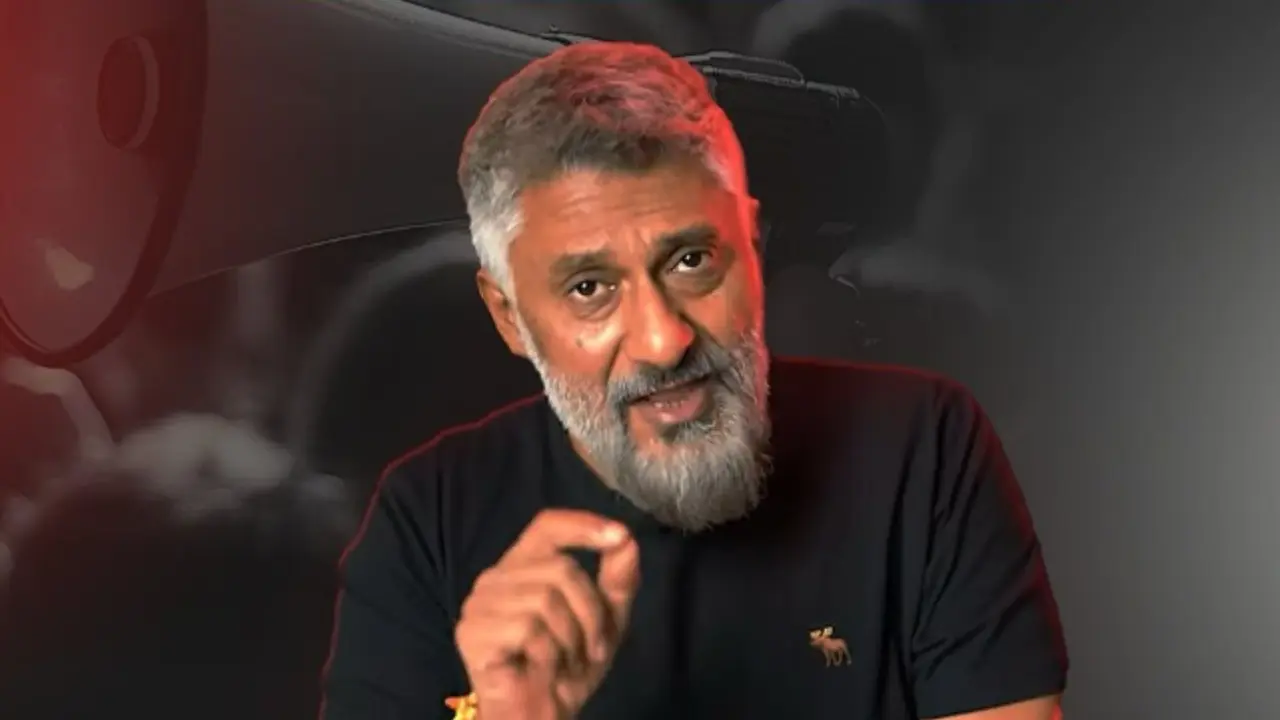
What we need right now is for all politicians to shut up for five years-Vivek Agnihotri
3:33 PM
Chandrima Pal (BOMBAY TIMES; September 4, 2025)
Vivek Ranjan Agnihotri likes to make all the right—pun intended—moves. Ahead of the release of The Bengal Files, the third instalment of his Files series, he picks a Bengali-themed restaurant in suburban Mumbai for an interview, tells us that he likes Kishore Kumar’s Bengali songs and settles down for a Bengali meal with shukto and fish paturi . Excerpts from the conversation.
Let us imagine you had zero opposition to The Bengal Files, which releases in theatres tomorrow. That you had no political outfit, entity or individual to name and blame in your interviews. How would you promote your film?
I would have felt suffocated. I would have failed. My idea was to pick up taboo subjects, and in my mind the problem was that even after 78 years of Independence, we are still fighting with the same problems that led to the Partition. Unless you acknowledge there is a problem there can be no healing, no solutions. The purpose, the whole objective of my movies is to start a conversation. Since the trailer has launched, everybody is writing about Direct Action Day or Gandhi’s role, they are dissecting the film. Many Bengali Hindus are now admitting that their parents or grandparents had spoken about Direct Action Day and the Partition trauma. This, I believe, marks the beginning of healing from a generational wound.
No other place has sacrificed as much as Bengal: it was the cradle of the Renaissance, the wellspring of nationalism in all its shades—Congress, communist, centrist—with both Vande Mataram and Jana Gana Mana emerging from here. Bengal gave India its cultural crown, from cuisine and poetry to cinema, the Bengal School of Art shaped by Abanindranath Tagore. For me, Bengal is India’s lighthouse. My purpose was to shock people into realising how much we’ve lost.
How can you connect Bengal’s loss of cultural and intellectual capital directly to the Hindu– Muslim conflict at the heart of your storytelling? Isn’t it too much of an oversimplification?
That’s a very deep question. Which other state in the world has been divided three times? Without Direct Action Day or the Noakhali genocide, there would not have been Partition. Gandhi himself spent seven months in Noakhali, yet afterwards Bengalis were told not to speak of their pain—silenced by political forces that wanted to take India on a different path.
Later, communist ideology took deep root in Bengal, but it viewed everything only through oppressor versus oppressed. That western lens does not fit India, where the so-called majority was ruled and persecuted by minorities for 1,200 years—our literature, music, architecture, everything was distorted. That is why, I argue, Bengal’s decline cannot be seen separately from communal fault lines.
Films have been made on the Holocaust, Hiroshima, slavery— always with a core of humanism, empathy. Many feel your films don’t address that.
First, let’s be clear—which lot of people? Viewers? Critics? I am very research-oriented. And why should I force closure when history itself has none? Lal Bahadur Shastri’s death has no closure. Kashmir still has no closure—people were killed in Pahalgam just recently. But this film does have closure. What I believe should be done, that’s the closure.
Suppose this film triggers unrest. Would your role as a filmmaker end with reopening certain chapters in history?
Look at The Kashmir Files. People warned it would cause unrest. Nothing happened. Instead, I received thousands of emails from Kashmiri Pandits saying the film began their healing process. I can guarantee Bengali Hindus will say the same after this film; they already are, across screenings in the US.
Both communities suffered losses. Isn’t everyone part of the healing process?
Of course. Healing belongs to everyone. But not everyone had the luxury of moving on. Many were forced. Did we really move on? Germany and Poland confronted their past—they outlawed Nazi glorification, built museums, preserved Auschwitz.
Should India simply say “move on”? Or acknowledge that we have a genuine Hindu–Muslim faultline—Partition, Bombay blasts, Pahalgam killings, constant election rhetoric. If America could confront slavery through films, articles, debate, why are we in India told to stay silent about our own history?
Some of the cast members of your film — Saswata Chatterjee and Sourav Das — are facing backlash for being part of the film.
What backlash? Sourav and I had lunch recently. He never distanced himself. A journalist twisted his words, and he immediately asked, “Show me my tweet, quote me if I said that.” Same with Saswata. He never disowned the film.
Saswata did say he wasn’t told the full context.
That’s media manipulation. Do you think an actor of his calibre would sign without reading the script? He has to say things to survive in Bengal. I even spoke to his family—they shrugged it off. Look, he speaks Bengali throughout, eats paturi maach, plays a Murshidabad MLA. He knew what he was doing. After Nana Patekar in Parinda, we have not had such a cold-hearted villain in our cinema.
You say there will be closure at the end of the movie. What kind of closure?
Cinematic closure. But let’s be real—I cannot close the Hindu– Muslim conflict in Bengal or India. Who am I?
You often say you listen to your audience, pick stories that people want told. There are so many other stories that need to be told.
Honestly, what India needs right now is silence. All politicians should shut up for five years. Dalit leaders, Brahmin leaders, Muslim leaders, TV anchors— everyone. Just shut down the noise. And focus only on eradicating corruption. Solve that and 90% of India’s problems vanish.
Do you have political ambitions?
I’d rather die than join politics. But yes, I understand politics deeply. My father was a freedom fighter, I’ve debated politics since childhood. That’s why I can say what I say; most filmmakers can’t.
Many filmmakers, despite festival acclaim and dealing with socially relevant issues, can’t get theatrical releases. You always manage to make controversial films and take them to your audiences. What’s your secret?
Conviction. A filmmaker must guard their work like a mother rabbit protecting her babies from vultures. Most filmmakers lack that instinct. I don’t. I fight till the end.
But is it right to say they do not have the conviction to fight for their creative freedom?
Look, if you make a film on caste, someone’s offended. On women’s persecution, men are offended. On Muslims, Hindus are offended. Everyone is offended. But cinema cannot be hostage to sentiment. Honestly, I do not understand Muslim trauma or pain. Maybe if I am born as a Muslim in my next life, I would. But I still have the right to tell stories drawn from history and testimony.
And when films like Santosh don’t make it to audiences?
Then I fight for them. I don’t know why they don’t come to me, I would be happy to fight for them. Even my ideological enemies, I defend their freedom of speech. I fought for comedians like Kunal Kamra and Samay Raina.
Would you speak up for Umar Khalid?
He’s in jail, it’s sub judice, so I won’t comment.
Gopal Mukherjee aka Gopal Patha is a complex character. North Kolkata always remembered him as one of those powerful, street-cred strongmen—like Fata Keshto.
Yes, yes. They were the fiercest. Part of the akharas, too.
Utpal Dutt wrote in Towards a Revolutionary Theatre that after Direct Action Day, leaders used people like Gopal Patha to settle political scores—a muscleman on hire. He ran a family meat business, he ate meat, he spoke Bengali, he was no saint. You have said that after this film, kids will see him as a hero. Given the ideology to which you are aligned, are you okay with glorifying a figure like that?
Why? Bengalis eat meat. What’s wrong with that? Hindus in Kerala eat beef, Kashmiri Pandits ate meat too. India is not a vegetarian country; 73% of Indians eat non-veg. To reduce Gopal to food habits or language is just superficial politics. I believe in total freedom of food, speech, lifestyle.
----------------------------------
‘I hate disclaimers. They assume audiences are stupid’
Trailers don’t need disclaimers. The film will have one, because the law demands it. I hate disclaimers. They assume audiences are stupid. Does a painting carry a disclaimer? Cinema is art. My disclaimer will be the usual: “based on true incidents, survivor accounts, historical texts… intention not to hurt anyone.” Plus the silly statutory warnings—smoking kills, animals unharmed, etc. But because Jinnah was a chain-smoker, I was forced to add two extra minutes of anti-smoking ads.
----------------------------------
‘I am a storyteller, not a social scientist’
I am nobody to find answers. I am not the Prime Minister, not a social scientist. I am a storyteller. My job is to observe and narrate, not to prescribe solutions. People expect too much from filmmakers. Journalists often ask me — why don’t you rehabilitate Kashmiri Pandits? I tell them, I am not a politician. It’s like asking Satyajit Ray after Pather Panchali to eradicate poverty. That’s not how art works.
Why should I be disappointed? They are making it for the Hindi market; they will look for a bigger name-Saswata Chatterjee
12:22 PM

Vinay MR Mishra (HINDUSTAN TIMES; December 16, 2021)
Movie buffs were overjoyed to learn that Bob Biswas, the mild-mannered serial killer from Kahaani (2012), was getting his own film. However, they seemed disappointed to learn that it did not star the original actor, Saswata Chatterjee, but Bollywood’s Abhishek Bachchan. “I thought Bob had died in an accident,” Chatterjee shares when asked about the stand-alone spin-off.
Probe him if he was unhappy with the casting and he counters, “Why should I be disappointed? They are making it for the Hindi market; they will look for a bigger name.” He adds, “I made the film in 2012. Why will I be bothered about it being made in 2021? If I was upset, I would have come out and given so many statements.”
On the contrary, Chatterjee admits that he is proud of having created a character that has become so iconic that someone like Bachchan has stepped into his shoes. “I was proud of myself because I just did a role for 10 minutes. If a full-length feature film happens with someone like Abhishek, then I’m proud.”
He shares that he hasn’t watched the latest release and claims that neither (Abhishek) Bachchan nor filmmaker (Sujoy) Ghosh spoke to him about the movie. “They didn’t reach out,” he says, while adding, “When two different people play the same character, it should be played in two different ways. Take, for example, James Bond. Every actor has taken a different approach, and we should respect that. Bob, like Bond, has become a franchise. Audience should go to the movies with an open mind.”

If you look the part, half your job is done, says Abhishek Bachchan on his Bob Biswas
8:11 AM

As his Bob Biswas look from Kolkata shoot goes viral, Abhishek Bachchan discusses slipping back into role after nine months of lockdown
Upala KBR (MID-DAY; December 1, 2020)
When Bob Biswas — a spin-off film based on a character from Sujoy Ghosh's Kahaani (2012) — was announced in November 2019, many had wondered if Abhishek Bachchan would be able to pull off the part of a cold-blooded contract killer. A year later, the doubts have been quelled. As the actor resumed work on the project in Kolkata last week, pictures from the shoot went viral. Almost unrecognisable in a portly frame, with a bald patch and thick-rimmed glasses, Bachchan was praised by Twitterati for his physical transformation.
"The media knew we were shooting in Kolkata. So, the photographers showed up at the venue [and clicked the pictures]. I would have loved for the look to come out the way Diya [Annapurna Ghosh, director] intended — during our marketing campaign," says Abhishek Bachchan, adding that he is humbled by the praise coming his way. "The [netizens'] reaction was an endorsement that we are doing something right. I believe that if you look the character, half your job is done. In Kahaani, Bob Biswas [portrayed by Saswata Chatterjee] is portly, so I had to pile on the kilos. Maintaining the frame during the lockdown was difficult."
The crime thriller, also featuring Chitrangda Singh, was one of the many projects affected due to the lockdown. Bachchan agrees that slipping into the character after a long break was initially difficult. "When you are shooting a film, there's a creative momentum that builds up. So, getting back in the groove can be challenging. But, after the first day, it didn't feel that we had a nine-month break."
Filming in Kolkata is always a joyous experience for the actor, who considers it his second home. "This city has showered my family and me with love and respect. My father is called 'jamai babu' [son-in-law] here, and I am referred to as 'aamar naati' [our grandson]. It has been a lucky city for me. Every time I have shot here, the film has gone on to fare well — be it Yuva or the recent Ludo."

Subscribe to:
Posts (Atom)