Showing posts with label Sarfarosh. Show all posts
Showing posts with label Sarfarosh. Show all posts
Anurag Kashyap ko mujhse aur mujhko Anurag se laalach hi nahin hai kisi cheez ka-Nawazuddin Siddiqui
6:47 AM
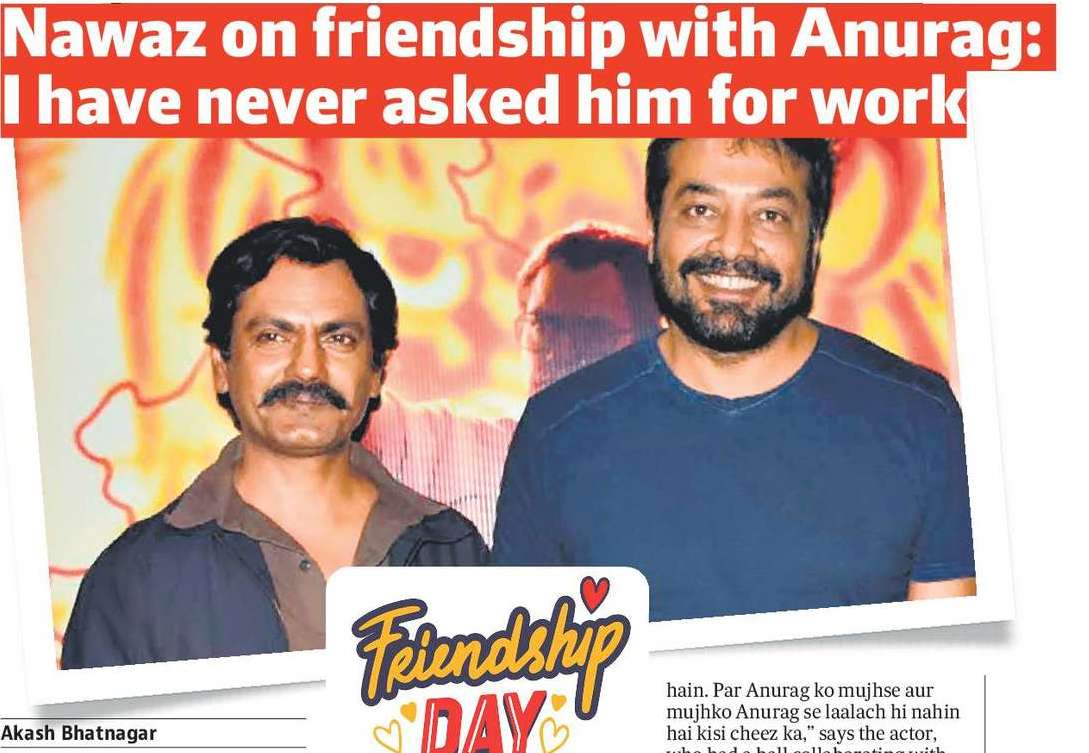
Akash Bhatnagar (HINDUSTAN TIMES; August 3, 2024)
Actor Nawazuddin Siddiqui met filmmaker Anurag Kashyap for the first time on the set of Shool (1999), and their first interaction was the latter dissuading him from taking up the job he was there for. “Anurag had seen my work in Sarfarosh (1999) and he told me to not do Shool, as it was a small part. He wanted me to wait for a bigger role, but I had to take it up as I needed work,” says Siddiqui, as he talks about his bond with Kashyap ahead of Friendship Day tomorrow.
Talking about their equation, the 50-year-old adds, “When we met for the first time, I felt, ‘Yeh meri vibe ka banda hai’. I had this feeling that he would always take care of me. There was that connection, as he gives off such positive energy.”
Siddiqui feels what sets their friendship apart is a balance between work and personal equation. “I have never asked Anurag for work. Hamari industry mein jab kaam waali dosti hoti hai, tab differences aane start ho jaate hain. Par Anurag ko mujhse aur mujhko Anurag se laalach hi nahin hai kisi cheez ka,” says the actor, who had a ball collaborating with Kashyap, 51, on Gangs Of Wasseypur (2012).
Ask if they ever had any creative differences while working together, and Siddiqui shares, “Creative differences are always there, but mazaa tab hi hai jab mil kar ek raay par pahuchein. Jab main chaaron taraf se phans jaata hoon, I go to Anurag for advise, and he always pulls me out of it.”
Is there anything about Kashyap that he’d like to change? “Carelessness,” says the actor, adding, “He is very careless when it comes to his health.”
We’ll definitely give Sarfarosh 2 a shot now-Aamir Khan
8:31 AM

BOMBAY TIMES (May 12, 2024)
At the special screening of Sarfarosh in Mumbai on Friday, Aamir Khan said that he has been trying to make a sequel to the classic for a long time and the team is now more than serious about developing the followup. The John Matthew Matthan-directed movie completed 25 years recently.
“I’ve been telling John (director) for many years to make Sarfarosh 2. Also, the film ended in such a way that we could make part two of this film. I’ve told John that if he writes a good story, then we can make a Sarfarosh 2. This time he told me he was trying,” Khan said. “I can commit one thing, that we’ll definitely give it a really serious shot now, coming up with the right script and the right kind of film for it (part two),” he added.
-------------------------------
HINDUSTAN TIMES (May 12, 2024)
Even as he awaits the release of his next, Sitare Zameen Par, Aamir Khan has already hinted at another film. At an event marking 25 years of his acclaimed film Sarfarosh, recently, he was interacting with the media when he was asked if there would be a sequel to his political thriller.
“Aapne hum sabke dil ki baat chheen li hai,” he responded with a smile, adding, “Main to kayi saalon se John (Matthew Matthan, filmmaker) ke peechhe pada hoon ki banao. Balki humne jo film ka aakhri scene hai, usme thoda sa feeling bhi di thi ki Sarfarosh 2 aane waali hai.”
The 58-year-old, who was with his co-stars from the film Naseeruddin Shah and Sonali Bendre, added, “I can commit about one thing, that we will definitely give it a really serious shot now of coming up with the right script and the right kind of film for it. So John, you will have to get to work here. Sarfarosh 2 banni chahiye — even I feel that.”
Sarfarosh was a right mix of realism and commercialism-Sonali Bendre
8:06 AM

Niharika Lal (BOMBAY TIMES; May 7, 2024)
During a visit to the capital in 1991, ad filmmaker John Matthew Matthan was taken aback by the sight of deserted streets in the early evening hours, police personnel checking all vehicles to assess and avert security threats. Delhi was on a high alert, which made Matthan realise that in Bombay, he had never heard of similar terror-related security concerns. It’s this realization that led to the making of Sarfarosh.
For his debut film, John – the writer, director and producer of Sarfarosh – had approached Aamir in 1992, but due to scheduling conflicts, the film finally went on the floors in 1995 and was released in 1999.
Aamir, who essayed the role of ACP Ajay Singh Rathod in the film, had mentioned in an interview that he agreed to do the film because he believed there were certain societal issues that needed to be addressed through cinema. On being asked if he was aware of the political implications of the film, he had said, “Ofcourse, that’s why I did the film.”
I can’t believe it’s been 25 years since Sarfarosh: Sonali Bendre
The actress told us, “I can’t believe it’s been 25 years since Sarfarosh. I owe Sarfarosh to my director John and nobody else. I had done ad films with John. He was so clear that he wanted me in that role. Sarfarosh was a right mix of realism and commercialism. Everything was just right in it. Though till date, I have not seen Sarfarosh. I have not seen any of my films. Now I see it in bits and pieces when it comes on social media.”
‘Naseeruddin Shah was initially considered for the role of Salim’
The director initially considered casting Naseeruddin Shah for the role of Salim, but the actor had declined to play a cop. So instead, John offered him the role of Gulfam Hassan, the ghazal singer, which Shah accepted. When it came to creating the villain for Sarfarosh, John said he needed a character with good access to places. During that period, only Pakistani cricketers and ghazal singers frequented the country.
The director told us, “I couldn’t have portrayed a cricketer as the villain in my film. So, I thought, why not a ghazal singer? Ghazal singers were often invited to high-profile gatherings, so I thought of using that for the plot.”
CBFC had asked the makers to remove Pak & ISI references
John recalled, “A few months before the film was submitted to the CBFC for certification, in February 1999, then-PM Atal Bihari Vajpayee had visited Lahore on the inaugural run of the Delhi-Lahore bus service. So, the CBFC wanted us to remove references to Pakistan and ISI. But after several discussions, the film was passed without any cuts.”
The film released on April 30, 1999, and shortly after, the Kargil war officially began on May 3, and went on till July 1999. John added, “I remember visiting the theatres in July; they were packed. People felt that the film was topical.”
‘It took Nida Fazli a year to write Hoshwalon’
About the iconic song Hoshwalon from Sarfarosh, the late lyricist Nida Fazli had said in an interview, “Director John Matthew Matthan asked me to get Jagjit to sing it, initially composed by Jatin-Lalit. But after he heard it, Jagjit refused to sing it because the metre and rhyme were out of sync. But Aamir wanted only Jagjit to sing for him. So I spoke to Jagjit again. Eventually, he agreed on one shart – that he would compose it.”
John shared with us, “It took Nida Fazli ji a year to write Hoshwalon.”
DID YOU KNOW?
• Sarfarosh was listed 33rd among Variety’s top 100 films of the week in 1999.
• Nawazuddin Siddiqui played a small role in the film.
• There have been multiple discussions to make a sequel to the film
• The film was shot in Mumbai and Jaisalmer. While Gulfam Hassan’s haveli was the Mohangarh Fort, Mirchi Seth’s den was the Mandir Palace in Jaisalmer

MIA: Where have these directors gone?
8:34 AM

Himesh Mankad (MUMBAI MIRROR; December 20, 2020)
Ken Ghosh: ‘Films are boring, very boring... but never say never’
DIRECTOR: ISHQ VISHK, FIDA, CHANCE PE DANCE

The last film was a debacle and eight years later, Ken returned on the digital platform. “Films are boring, very boring, as compared to OTT. You go back to the same circle of writing a script with an interval, the occasional songs and a climax. I’m happy directing web shows, but never say never,” he laughs.

John Mathew Mathan: ‘Working on multiple scripts, hoping to film one’
DIRECTOR: SARFAROSH, SHIKHAR


Arbaaz Khan: ‘I don’t know when I will direct my next film but it will happen’
DIRECTOR: DABANGG 2

“I don’t know when I will direct my next film, but it will happen. And it need not be a big film, it can be small too,” he points out.

Abhinav Kashyap: ‘I don’t talk to the media’
DIRECTOR: DABANGG, BESHARAM

Abhinav turned down the sequel and went on to direct Besharam with the Kapoors, Rishi, Neetu, and Ranbir. It was a disaster and no one has heard of Abhinav since.
When Mirror called, he rang off abruptly, saying, “I don’t talk to the media.” Ah well, we just wanted to know when he’d be back in action.

Rajiv Rai: ‘I self-isolated myself for 15 years, but I am planning a film now’
DIRECTOR: TRIDEV, MOHRA, VISHWATMA, GUPT

“I didn’t want anyone to lose money on my films; the break was a calculated decision as I’d got complacent. I self-isolated myself, and in the last 15 years have penned multiple ideas and two scripts. I’ll be back soon. I’m planning a film now,” he promises.

Sanjay Gadhvi: ‘I have refused 23 films since 2011... but something is happening now’
DIRECTOR: MERE YAAR KI SHAADI HAI, DHOOM, DHOOM 2, KIDNAP

Ayushmann Khurrana inspired by Amitabh Bachchan’s, Aamir Khan’s and Manoj Bajpayee’s no-nonsense cop acts
8:52 AM
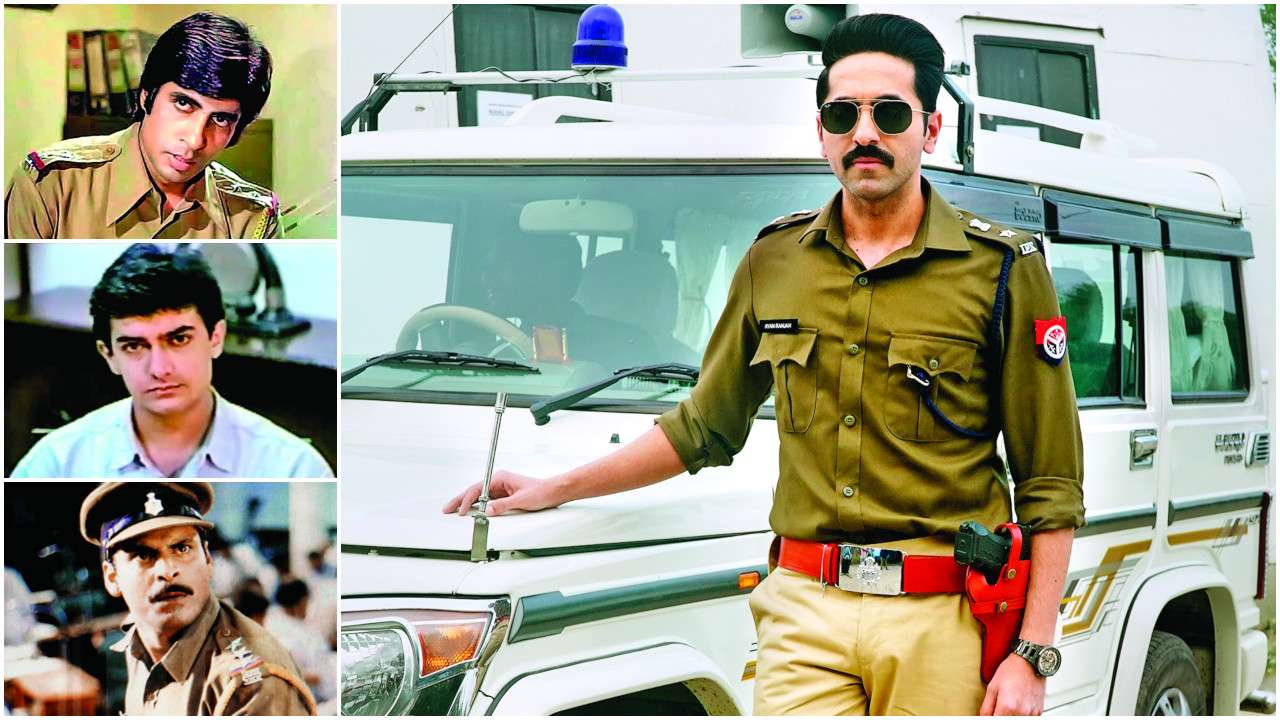
Hiren Kotwani (DNA; June 3, 2019)
The teaser of Article 15, which recently released, has resonated with cinegoers and also got Ayushmann Khurrana a lot of praise for his portrayal of a no-nonsense cop. Given that it’s an honour for every mainstream actor to essay a police officer on screen, Ayushmann, too, has always desired to don the khaki uniform for a movie role.
What is interesting to note is that he sought his inspiration from the characters of Amitabh Bachchan’s Vijay Khanna (Zanjeer, 1973), Aamir Khan’s Ajay Singh Rathod (Sarfarosh, 1999) and Manoj Bajpayee’s Samar Pratap Singh (Shool, 1999). That’s why he preferred to wait for a strong subject. And going by the response the teaser has generated, it looks like it has been worth the wait. Ayushmann essays a unique cop who’s zealous about bringing about a change in society in this Zee Studios production.
The AndhaDhun actor says, “My idols for playing a cop on screen are Amitabh Bachchan sir from Zanjeer, Manoj Bajpai sir from Shool and Aamir Khan sir from Sarfarosh. I wanted to go the realistic way and show the vulnerable side of cops. More than that I was keen to meet real cops and then portray my character in a certain way. Thankfully, I was in touch with lot of real-life officers... one of which is Manoj Malviya — a senior IPS officer from Delhi. It is part of the bucket list for every actor to play a cop on screen and I was waiting for the right script.”
The investigation drama premieres at the 10th London Indian Film Festival later this month. The Anubhav Sinha directorial will open the fest.
Yes, Sarfarosh 2 is happening with me-John Abraham
8:01 AM

John Abraham confirms stepping into Aamir Khan's shoes
MID-DAY (August 4, 2018)
Days after mid-day had reported that John Abraham would replace Aamir Khan in the second instalment of Sarfarosh (1999), the actor confirmed to reporters that he, indeed, was working on John Matthew Matthan's venture.
Abraham promised that the action-drama would be distanced from the original. "John Mathew Matthan and I are co-producing the film. We are still working on the script, but, yes, it's happening with me. We plan to go on floors next year. He is probably the only director whose house I went to after seeing Sarfarosh and said, 'Man what a film'."
Sarfarosh, also featuring Naseeruddin Shah and Sonali Bendre, chronicled the story of an Indian police officer's quest to stop cross-border terrorism. It opened to critical acclaim and went on to win the National Film Award for Best Popular Film Providing Wholesome Entertainment. When asked if he is apprehensive about stepping into Khan's shoes, Abraham said, "I'm, in fact, excited. I love Aamir Khan. It's a challenge, but it's a different character and different story, even though the ethos is the same. It's going to be very exciting."
The actor's line-up of films - beginning with Satyameva Jayate releasing on August 15 - includes Batla House, and RAW: Romeo Akbar Walter. "Batla House will be the most explosive film you've seen. It'll show how polarised the world is, and it's straight in its face. If [viewers] accept Batla House, it will be the most successful film," he says.
Directed by Nikkhil Advani, the film features Abraham as the cop who led the Batla House encounters, which occurred in September 2008 against Indian Mujahideen terrorists in Jamia Nagar, Delhi. "It's an honest film and Nikkhil is an honest director. We have got something so explosive in our hands and we will treat it with a lot of caution," the actor adds.
Abraham recently shot for the first schedule of RAW: Romeo Akbar Walter, directed by Robbie Grewal. The actor said there will be 18 different looks of his in the spy thriller and the shoot was "pretty intense."
He says his line-up of films resonates with what he wants to do as an actor-producer. "This is probably an inflection point in my career where I can say, at least in terms of the cinema that I'm getting out as a producer, as an actor, the next five years are probably [going to be] my best years," he signed off.
John Abraham to step into Aamir Khan's shoes for Sarfarosh sequel?
8:07 AM

Sonil Dedhia (MID-DAY; July 31, 2018)
Only a year ago in the midst of an interview, Aamir Khan was taken aback to know that a sequel to his 1999 hit venture, Sarfarosh, was in the pipeline. Expressing excitement over the development, he had then stated that he would be delighted to slip into his celebrated role of ACP Ajay Singh Rathod. However, in a unique turn of events, the role has apparently fallen into the lap of John Abraham.
mid-day has it that director John Matthew Matthan is already in talks with Abraham for the action drama, with this version shedding light on the Naxal movement in India. "Abraham and Matthan are in advance talks for the film. The sequel will revolve around the Naxal movement and red corridor in India. The first instalment touched upon this topic in passing. There is a possibility that it will take off from there," says a source close to the development.
The film, we hear, is expected to go on floors after Abraham wraps up his prior commitments. "As of now, the team is looking for production houses to back the venture."
When contacted, Matthan simply said, "I am scripting Sarfarosh 2 now, but it is too early to give out any details. We are in talks with a few actors. I can't confirm the cast."

Cinema is more important to me - huge screen, Atmos sound, a richer, larger experience, than a laptop-Aamir Khan
8:13 AM

Aamir Khan kicks off mid-day's unique conversation series, where Mumbai's most popular and sharp creative minds dig deep and decode their art and craft, before a select live audience
Mayank Shekhar (MID-DAY; October 27, 2017)
Aamir Khan came over, rather under-slept, stressing over the release of his latest film 'Secret Superstar'. He spoke in-depth on the economics and craft of filmmaking. And only two days later, he conquered the box-office yet again with 'Secret Superstar', maintaining an unrivalled cent per cent hit-rate as a Bollywood producer
Superstar, filmmaker Aamir Khan kicked off the first edition of Sit with Hitlist - a conversation series with India's top creative minds, before a select audience. We intended to host this freewheeling chat in an auditorium. Date and technical issues did not permit it this time. This was a budget version of 'Sit with Hitlist', held at the mid-day office. But as goes with low-budget ventures, with Aamir in it, we knew the word-of-mouth would ensure mid-day's brand-new property would be a huge hit! It was.
Excerpts from the conversation
The big news of 2017 was of course Dangal, and China. Producer Siddharth Roy Kapur's reason for the film's unprecedented success is the Chinese audiences sensed a common Eastern sensibility in the film's father-daughter relationship. Do you agree?
When I visited China and Turkey recently, I realised that their emotional key is very similar to ours. I carefully noticed the reaction that Dangal got in theatres in China. It was the same as for an Indian audience - they were laughing, crying, and clapping at the same points. There was no difference at all.
Is that true for Indians watching Chinese films? I am not sure I get that sensibility the same way.
Well, I saw Crouching Tiger Hidden Dragon [2000], and loved it. I was clapping and whistling throughout. I didn't come with any pre-conceived notions. I love Jackie Chan movies. I was in college, when I first saw Police Story [1985] - the action was unbelievable. And it's so humorous. I have connected with these films.

Aamir Khan in conversation with Mayank Shekhar at the first edition of Sit with HITLIST, before a live audience, at the mid-day office
Another theory is that the way the kids
get treated in Dangal, and how the father is determined to turn them
into champions, is similar to China - except the father is the communist
state, attempting to turn them into Olympic gold-medalists from a young
age. Do you see a connection?
I never thought of it like that. I've read reactions from Chinese audiences. They apparently watched the film, and desperately wanted to talk to their parents, right after. It is a personal, human connect.
I never thought of it like that. I've read reactions from Chinese audiences. They apparently watched the film, and desperately wanted to talk to their parents, right after. It is a personal, human connect.
Your personal global reach as an actor really began, thanks to the Internet. Is that right?
My assumption is that it happened with 3 Idiots [2009], which became a huge hit on the Internet. Rajkumar [Hirani] and Vinod [Chopra] got to know about it. Someone from China contacted us, and we released the film there a year later, by when most people had already watched it. They started looking for my other films, and now many of them have watched Taare Zameen Par [2007], Lagaan [2001] and Rang De Basanti [2006].

Considering the strong role of Internet, it was a surprise when I read somewhere that you are such a "big screen guy". Would you bypass something like Netflix?
I was talking about myself as a consumer, and not the creator, of content. As an audience, cinema is more important to me - huge screen, Atmos sound, a richer, larger experience, than a laptop. This doesn't mean I wouldn't want to do a Netflix, or TV series, when the quality is equally cinema-like. I have been asked by them [Netflix] to create something. Content for every platform is different. For Netflix, the content cannot be delivered in one session. The narrative needs to be episodic. I would be keen if something like that comes my way. I have watched Breaking Bad. It's my favourite. I like Game Of Thrones and House of Cards.
One of the central themes of your latest release, Secret Superstar, is how Internet can turn you into an overnight star. How do you compare that kind of stardom with yours, at a time when anything can go viral?
Some of the videos which go viral are one-offs, like a cat doing something funny. But then there are talents that people discover on the Internet - it offers great opportunities. The small-town girl in Secret Superstar has no access, but she is full of passion. She doesn't have to break into the limited distribution network anymore.

Back in the '90s when there wasn't so much talk about box-office numbers, how could you tell someone is finally a star?
From the time I was seven, I remember reading Trade Guide, and other box-office journals. We would check out the figures of dad's films, and there would be a circuit-wise break up. Within the industry, the [box-office] knowledge was always there, since cinema has always been around as a business. Today, mainstream media is picking up box-office figures, and that's a choice you're making.
In small towns, for instance, when people didn't know box-office numbers, one way to gauge stardom was if people had begun copying an actor's haircut. True?
There are many yardsticks for measuring how popular a star is. Copying style is one of them. I remember when Mr Bachchan became a huge star, I wanted to get bell-bottoms made like his. For me, it is essentially about how many seats one fills. It means that people love you and your work, and now they want to go and experience it. That's important. We often measure stardom by how big an actor's commercial successes have been. That is a faulty method. PK's or Dangal's business has to do with how great those films and their scripts were. It's incorrect to attribute that to my stardom. My stardom comes into play when I make a bad film that people don't want to watch. They still come because of my name. So if you want to measure an actor's stardom, you should check out how well his flop does.

Aamir Khan signs on a memorabilia, the original poster of his 1994 release, Andaz Apna Apna
In that sense, the Khans have dominated Bollywood for over 25 years. My question to you is: Do you remember the first time you met Salman and Shah Rukh?
The first time I met Salman was at Babla's [director Aditya Bhattacharya's] house, who made Raakh [1989]. Incidentally, Salman and I were in the same class for a year in the second standard [at St Anne's, in Pali Hill]. And we didn't know each other then! I was at Babla's house to discuss a short film called Paranoia, where I was the actor, spot-boy, production head, first AD - all rolled into one. We shot that film for a month. I was 15, and this is the first time I ever acted. Salman was cycling around in Carter Road. He knew Babla too. We stood in the balcony and talked. He told me about how he also wanted to become an actor. I thought of him as a sweet chap. Shah Rukh, I remember meeting briefly, when I was shooting with Juhi [Chawla], somewhere on the road. He had begun shooting a film with her [Raju Ban Gaya Gentleman]. Deewana [his debut, 1992]
hadn't released yet. He was sweet, and it was a warm meeting.
Clearly nothing momentous. Now one of the reasons 2017 has been considered a sub-par year in Bollywood is because the two top stars' films didn't do well - let alone break records. Do you think the film industry has been relying on the Khans for too long to bail them out every year?
There are other hugely successful stars - Akshay [Kumar], Hrithik [Roshan], Ajay [Devgn]…. The three of us [Khans] have been successful for quite a while; it's natural for the trade to bank [on us]. Sometimes films work, sometimes they don't. At one time, Mr Bachchan was huge. None of us will ever see the stardom he has. He once had eight films simultaneously doing really well in theatres. Trade would bank on him for seats and popcorns. Ideally, there should be more stars. But it's a natural process. Becoming a star is an intangible thing. What is it that people connect with me so strongly over? I have absolutely no idea.

Over a conversation in 2011, you'd told us about a bubble in the film industry, referring to studios that paid money assuming the highest possible returns. Effectively in 2016, most studios went bust. Did you predict this?
Who am I to predict? But it's bad business. Say, Dangal has done Rs 385 crore business, and I come with the next film that gets sold at Rs 400 crore, because a studio is willing to pay that much. They assume that my next will be as big or bigger than Dangal, which was huge to begin with. That's not sound business. A studio can't pay on hope. You have to invest on surety. If the lifetime of the last film is Rs 380 crore, then you know that the next will definitely make Rs 200 crore. The upside is then there for everyone to share. This is why I don't load my film with my fee. My model is that I don't charge any money. All the money goes into filmmaking, and fees, of everyone else. And then the first money [coming in] goes towards recovering the P&A [cost of print and advertising]. Eventually if the film tanks, I get zero. That's a risk I am willing to take. I'd rather lose.
And then if the film [Dangal] does Rs 1,300 crore [in China], means you get a good bulk!
Sure, and I bring that value to the table. Investors are completely secure. I take a sizeable chunk. When the film does Rs 1,300 crore, first the government takes a certain tax amount, and a major chunk goes to theatre chains, and the exhibition sector. It's the same with India, except in China, there are also rules on how much people from outside the country can take as share [revenues from a film]. It finally boils down to 12.5 per cent, which is still good.
Did you pick up a mansion from 12.5 per cent of Chinese box-office?
I am not good with money. I don't do investments and I have very few properties. Basically, my mind doesn't work in that direction. I am not a business savvy person.
You're certainly good at film business, with a 100 per cent track record as producer.
Creatively I don't want to mess with what I want to do. So, say, I want to do a Dhobi Ghat [2011], I'll make sure it's made in Rs 5 crore. For the investor, I know this [amount] will come back, and we'll make a little profit. Films will be profitable if you make them economically viable, and this gives me the freedom to make what I want.
Here's how you get it right each time: budgeting, great script-sense, making sure casting, locations are spot-on. The new thing I've learnt is how much emphasis you give to the audience testing the first-cut of your film. Unknown people repeatedly watch it in focus groups, whose responses eventually determine the final cut/edit. Isn't that losing creative control, almost like filmmaking by public consensus? Odd, no?
No. It's not [by] public consensus. I'm not going around asking people what I should do with my film - and they say cut this or that - and I make the changes. The whole basis of testing a film is that we have a story in mind that we're trying to narrate to you. I just want to make sure that what I'm narrating to you, is coming through. Or are you receiving something else? We become so close to our material that while making a film, we're not able to be objective enough to understand how it's being received.
Can you give concrete examples from your films where there was disconnect between what you were saying, and what was being received?
Let me give you two examples. Take Sarfarosh [1999] first, which was a cop film, about policing. At the test screenings, the consistent response was, "Where's the policing? We don't see any. He [the cop] is constantly listening to ghazals!" We were like, "How's that possible - there's the Khera Naka scene, with the entire action, his leg gets broken, he's in the hospital, where he dives, despite the injury - all those scenes were there." While we were befuddled, we knew this was a problem. So we added three scenes to the film. One, in the beginning, we raid a corrupt cop in the tribal belt of Maharashtra, where ACP Rathore [his character] goes through the phonebook, to get whereabouts of Sultan, which he gets after delivering a tight slap to the corrupt cop. Again, while searching for Sultan, we reach his mother's house, where I stop my colleagues from being rough with her. The third scene was about a raid, where we caught two guys, who we interrogated, but we were getting nothing out of them. This is when I fire at one of the guys, just so the bullet misses him. He spills the beans.
Wasn't that guy Nawazuddin Siddiqui [in a split second role, much before he became popular]?
That was Nawaz, which I didn't know! When I was working on Talaash [2012] with Nawaz, is when he told me, "Sir, I've already worked with you!" "Kab?" "Sarfarosh mein. Main wahi tha!" (laughs). So, after inserting those scenes, the problem [over showing policing in the picture] that we were constantly facing, disappeared overnight. Suddenly the film changed.
Another example?
Now the whole thought behind Taare Zameen Par was that one has to be inclusive. Every child has a problem, and you can't segregate them from other kids. What we were arguing for is that special schools should actually not be necessary. All kids should study in the same school. The reaction we would get is: "So, you're saying, Ishan is a special child, so he should study in a special school!" And we were clearly saying the opposite. As were all our lines. We realised there's some miscommunication here, and for the life of me, I couldn't understand why. Now if you remember, the film's title track is shot in a school for special children, where I teach. The school's annual day is going on. The kids are dancing in slow-motion, parents are hugging their kids, I've got tears in my eyes. This is when the song begins. From my face, the screen dissolves to Ishan's face, sitting all alone, lonely and low, in a [regular] boarding school. His parents can't come to meet him, because his brother has a tennis match. We then cut to the brother playing tennis, while his father is upset etc. A friend of mine, Amin Hajee, who played the mute in Lagaan, told me he thinks the problem is in the song: "You're looking at children getting so much love in the special school, and the image dissolves to Ishan alone. It seems you're saying he should be here, and not in a regular school." First I didn't agree with him, because that's not what I was trying to communicate. But, heck, let me try. So instead of dissolving from my face to Ishan's, we cut to the brother, who's not playing tennis well, and then brought in Ishan. We literally changed one thing over 30 seconds. That problem got solved. Nobody made the same point [about the film's intention] anymore. Now with dissolving my face with Ishan's, I wanted to communicate, sub-consciously, that he [Nikumbh, the teacher] actually sees himself in Ishan [he went through the same problems as a kid dealing with Dyslexia]. But I was failing in communicating that anyway. And I've been doing test screenings right since QSQT [Qayamat Se Qayamat Tak, 1989].
Showing the first cut to regular junta, from your first major film onwards?
Yes. Some of the reactions make sense, some don't. Many of which I already have answers to, since the film still has to go through post-production. Again, I'll give you a broad example. Often people say that from a particular point, a film becomes very boring: "The moment the song comes in second half, the film dips." Now most people will feel that they should cut the song. But that won't be the solution. You're feeling the weight over here [in the film's timeline], but the reason for that is somewhere earlier [in the film]. There's something wrong in your structure. You need to figure that out. It's like going to a doctor and telling him your symptoms. Can he treat that? No. He can treat your problem. Likewise, there is a dip in the second half, but the problem is somewhere in the first half, you need to treat that - either you haven't built up the plot properly, or the sub-plot is too weak. You need to understand where the correction lies. So it's not filmmaking by consensus. With Raja Hindustani [1996], we had a very bad reaction [from test audiences]. Dharmesh [Darshan] was like, "Oh God, we're finished!" I told him, according to me, you shouldn't change a single thing about the film. So it's a science: you have to know what to take, or correct.
But who did you show Raja Hindustani to? Can't be a Malabar Hill audience, they'll reject it anyway, it's too massy and hardcore.
Well, we showed it to a hardcore Hindi heartland audience. There was a wedding happening in Dharmesh's family, so people had come in from Punjab, Allahabad, and other places.
Another thing I learnt about you, from my childhood [guitarist] friend, who spent over 10 days in your Panchgani house, scoring music with Amit Trivedi, is that you're seriously hands-on. How important is it for a Hindi filmmaker to know his music?
I am not formally trained in music, and I am not involved in the music of every film, unless the producer/director invites me to be part of the process. When I was working with Mansoor [Khan] on Jo Jeeta Wahi Sikander or QSQT, I was very closely involved. As I am with the films I produce.
What do you mean by involved, do you make suggestions?
I react to the piece and convey to the composer what I feel. I might act out something to tell him what I want. Sometimes I do get technical. I have basic knowledge to make a few suggestions. In Secret Superstar, for instance, the song Main Kaun Hoon (sings it) was at one point going on falsetto. It wasn't sounding right. I requested Amit to change it. He obliged. We already had another track, Main Nachdi Phira, going into falsetto. We couldn't do it for two important songs.
You've spoken at length here about the science of filmmaking. How do you merge that with art? (Mohar Basu in the audience asks)
Let me fine-tune your question. It's not the science of filmmaking, but mass communication, because filmmaking may choose not to be mass communication, and then it won't follow these laws that you're talking about. You are trying to communicate to a whole mass, so you try and reach the common point among all these people. But that's not how I begin. While listening to a script, I become the audience. It's like you watching a film. And at that time, I'm just reacting emotionally to it. For example, when I heard the script of Delhi Belly, I was on the floor, laughing. At that time, I'm not thinking of the science. That happens when I start work on the script, with the director and writer, and say, I check: Have we locked our goal early enough? What is the premise of Delhi Belly? 'Shit happens'.
You keep a one-liner, always?
Yes. The premise and what the film is trying to say are important. A film may not be socially relevant, but it has to say something. So yes, do we have a clear enough premise? Do we want to sharpen it? Is my goal locked, well in advance? There are times when the film is going on and on, and you don't know where it is going, so you start losing interest.
Let's look at Lagaan. The premise is, "Rains aren't happening. You can't pay tax." Gora says, "Lagaan maaf kar denge, if you beat us in cricket." My character says, "Sharat manjoor hai." The moment he says that, my goal is locked. Now, as an audience, I know that cricket main harane wale hain. Now, that journey from goal-locking to the goal has to be exciting, difficult, with a lot of obstacles, which makes it even more exciting. At times, the main plot becomes too boring. Are the subplots getting over, before the main plot? Because if that's not the case, I'm not interested; having reached the goal. The end fizzles out. So these are the basic rules of mass communication in entertainment.
You emphasize strongly on emotional connect, is that something you seek in all your films? (Sonil Dedhia in the audience asks)
All. When I say emotional connect, I don't mean crying, because that's what people often associate with that word - "Oh matlab rona dhona hai." What I mean is some emotion is being tapped into - it's making you feel thrilled, giving you lots of stress, because suspense is an emotion being tapped into, in a thriller. Or it could be fear, because it's a horror film. So, the film connecting at an emotional level is important to me.
A distinction between art-house and mainstream, according to a filmmaking wit I once interviewed, is that with the latter, the audience knows exactly what's going to happen (they like that), while with the former, they don't. In fact, they don't even know if anything will happen in an art-house film at all.
I feel that in mainstream cinema, you should have a sense of where the film is headed. But at each stage, if you know what is going to happen, then the film becomes too predictable, and doesn't engage you enough. So it's important to surprise the audience.
Final question: Honestly, decode your character Shakti Kumarr in Secret Superstar. He's a sleazoid called Shakti, clearly named after Shakti Kapoor. He talks a lot like Anu Malik and Anil Kapoor, both of whom I saw at your film's private screening.
I've taken a lot from various people and built this personality. I've used Anil's style of talking a few times-like in the awards' night scene, where I say, "Awards lete lete thak gaya hoon main." When Anil says bye to you on the phone, for instance, he never says one 'bye'. He goes, "Okay, bye bye bye bye bye bye…". There are some things that stay with me. Jeetu ji [Jeetendra] once came to meet my uncle [Nasir Hussain]. I used to be his assistant at the time. And Jeetu ji is a fab guy, with a great sense of humour. He told my uncle, "Nasir saab, mujhe double role offer hua hai. Mujhse ek role theek se hota nahin, mujhe do role de rahe hain!" But he used a phrase then, "Dekhte hain. Buck up India!" Now whenever I meet Jeetu ji, he says, "Buck up India." He'd ask me, when is your movie releasing? I'd say, December. "Haan, buck up India!" I used that in the film! (laughs).
There's no Anu Malik in it, come on?
Now, don't ask me who all are in it. Okay, there's a little bit of Anu Malik. But I'm not mimicking anybody, because I can't do that.
In Bollywood, the heroine is still a prop and the hero must dance and shoot people-Nawazuddin Siddiqui
8:01 AM
Sharmila Ganesan Ram (THE TIMES OF INDIA; October 22, 2017)
As if to casually justify the title of his soon-to-release memoir 'An Ordinary Life', a pyjama-clad Nawazuddin Siddiqui is sitting on the velvet sofa of his Andheri office with his legs folded under him.
Ash-grey lips alternating between sips of green tea and long drags from a freshly rolled-up cigarette, the red-eyed actor says he owns two "high-tech" homes nearby but their lavishness alienates the rustic in him. Both in person and in his new memoir co-authored by writer Rituparna Chatterjee, Siddiqui seems reluctant to fully embrace his ascent from the dung cake-laden walls of Budhana village in western UP to the red carpet of Cannes.
In Budhana, Siddiqui — the eldest of eight — grew up washing buffaloes, wrestling to develop muscles in vain, and declaring his love to a girl by sticking romantic notes to kites. Not only was he the first to don a pair of jeans here but also the first to become a graduate. What followed was a stint at a petrochemical firm in Vadodara, the discovery of theatre there, National School of Drama, day job as security guard in Noida, a 12-year-long struggle in Bombay, marriage, divorce, marriage, daughter, son and, finally, success. He talks to Sharmila Ganesan Ram about the power of lies, Saadat Hasan Manto's honesty and the things he can't talk about
You've shared many personal details such as your series of relationships. Were you ever worried about the reactions?
I wanted to be honest as this is a memoir after all but I am also nervous because I have named many women that I either had crushes on or had affairs with. I don't know how my wife will react to that. But I'm not that worried about (public) reactions as I'm not a trend-following, market-pleasing actor.
Why were you called 'Risky Pehelwan' in Budhana?
I was very weak so my mother enrolled me to train under wrestler Mullah Pehelwan. He used to think I was brilliant but weak. Kushti matches in our village used to be hour-long events typically but in my case, either the opponent would defeat me or I would defeat him, all within a minute. So I was called Risky Pehelwan.
How does Budhana react to your success?
People there shower me with love but there's one particular relative of mine — in his sixties — who still refuses to believe that the guy he is seeing on screen is me. There is a cinema hall in our village now and every time I am on, he turns to the person on the next seat and says this isn't Nawazuddin but someone who looks and sounds like him.
Your mother was shortlisted by the BBC as one of 100 most influential women recently. Tell us more.
She used to live in a village smaller than Budhana in a mud hut. She was unlettered, started her education only after marriage and went on to coach 150 to 300 kids, some of whom are now in the army and some are doing government jobs.
What did your struggle in Bombay entail?
It started with bit roles in crime serials on TV but soon after, the Ekta Kapoor era came up and TV turned glossy. As many TV serials would be shot in the evening, no one wanted dark-complexioned actors whose faces could not be seen when it was overcast. This would mean extra expenditure on lights. Then came bit roles in films such as Sarfarosh where I would get beaten up. I even did C-grade films with the famous Joginder. One was called Bindiya Maange Bandook.
Your first car was a second-hand Maruti Esteem?
Yes. It was the first big thing I bought from my paycheck for Rs 75000 but it got stolen once and I spent the whole night looking for it. I had a shoot that morning for a film but I couldn't remember the dialogues. In the scene, the actress Shefali Shah had to slap me but she was gentle. So I asked her to slap me hard and when she did, I woke up and was able to remember the dialogues.
Did your stint as a chemist inform your acting in any way?
I used to conduct purity checks on crude oil at a petrochemical factory in Vadodara. What science has taught me is accuracy of measurement which I try to bring into acting by measuring my emotions. Not getting overly sentimental in a sad scene for instance. Foreign-educated directors always say, "do less".
Is Bollywood changing?
Like the 17th century playwright Moliere who would repeat the same type of characters in every play, Bollywood has a set of stock characters — a hero, a heroine, and a comedian. The actress is a prop with a butt and boobs who has no job except to love the hero. The hero must dance and shoot 10 to 15 people unnecessarily. There's no reference to his job or her intellect. Even though that is changing and many are showing courage to do something substantial, there are actors who are turning down good roles to pander to the same kind of cinema.
Where does the star system of Bollywood leave the script?
Many stars get stories written for themselves. They are busy making projects instead of films.
Do characters change you?
Of course. Every character gives as well as takes from you. I'm playing writer Saadat Hasan Manto in a new film and his sensibility resonates deeply with me. He stood for honesty and courage and exposed the society's hypocrisy. I wanted to enter his inner world so I listened to old songs, read him and his contemporaries such as Ismat Chugtai and Premchand and even imagined them having conversations filled not just with mutual admiration but also ego clashes.
Are you able to say things through cinema that you are itching to say in real life but can't?
For sure. For instance, I can't and won't comment on the political climate because I have seen what happened to those who did. But I can channel my urges and my frustrations through my characters. In a famous scene in Raman Raghav 2.0, my serial killer character tells a cop: "Maarte toh aap bhi ho. Par fark yeh hai aap dharam, desh aur insaniyat ka sahara leke maarte ho aur main bas maze ke liye maarta hoon (You kill and so do I. The only difference is you use the crutch of religion, nation or humanity for murder whereas I just kill for fun)." This is so relevant to what is happening in the world now.
Nawazuddin Siddiqui decodes his relationship with Shah Rukh, Salman, Aamir & Irrfan Khan
8:05 AM

The actor decodes his relationship with his four biggest co-stars in the course of his Bollywood journey
As told to Sanyukta Iyer (MUMBAI MIRROR; March 22, 2017)
Apart from the true rags to riches story that has been Nawazuddin Siddiqui’s journey in Bollywood, the 42-year-old-actor has also taken to consistently overshadowing co-stars who are far ahead of him in vintage and stature. Point this out to the maverick performer and he chuckles, “Theatre main bolte hai na, kha gaya”. Here, Nawaz takes stock of the films he has done with the Khans of Bollywood and his equation with each one of them.

Apart from the true rags to riches story that has been Nawazuddin Siddiqui’s journey in Bollywood, the 42-year-old-actor has also taken to consistently overshadowing co-stars who are far ahead of him in vintage and stature. Point this out to the maverick performer and he chuckles, “Theatre main bolte hai na, kha gaya”. Here, Nawaz takes stock of the films he has done with the Khans of Bollywood and his equation with each one of them.
RAEES (2017): The sheer joy that is acting with Shah Rukh
When I was filming Raees, I was constantly telling myself that it wasn’t Shah Rukh Khan, the superstar, who was standing there in front of me, because that would be disrespectful to the actor. So for me he was always Raees Khan.
Shah Rukh also comes from a theatre background and like me, during prep, he learns not just his own lines but that of his co-actor’s. And when in front of the camera, he’d say his dialogues in a completely new andaz, full of josh, leaving me stumped and eliciting an impromptu response. This made our onscreen time together spontaneous, bringing a different energy to the set.
My chemistry is best with this Khan. It was like reliving my theatre days, playing to a ‘live’ audience and experiencing the sheer joy of acting.
Whether it is Raees, Bajrangi Bhaijaan or Haraamkhor (directed by Shlok Sharma) I’m always honest to my character. But in real life I’m always lying. That’s because I have to think about what to say and then how what I say will be projected in the media. I end up wearing different masks with different people. But when I’m acting, I’m completely nude, truthful and strip myself bare.
Ditto, Shah Rukh. We agreed that actor hone ka faayda yeh hi hai that even for a twominute scene we can be a Sufi singer or a criminal. And in the end we’ll both die happy knowing we’ve lived a thousand different lives and dreams.
KICK (2014), BAJRANGI BHAIJAAN (2015): No parties, even with Salman
In the garden of Bollywood, Shah Rukh and Salman are as different as a red and a black rose, each blooming with their own beauty. Neither has ever made me feel or look bad. They’ve never been jealous or told a director to cut my role or reduce my lines. In fact, I’ve become the face of a leading fashion brand for men’s wear which today, sells even better up North than it did before. They were happy to learn this and congratulated me warmly.
During Freaky Ali (produced and directed by Sohail Khan) I wrapped up 10-20 scenes every day. I finished the 45-day shoot in 30-32 days. I don’t take two hours for hair and make-up like other actors. In fact, I sometimes change costumes on the set itself. Also, everybody knows that once I learn my lines, I don’t forget them. Usually the director has to tell me, “Chalo bas ho gaya!”
Like everybody else, Salman bhai too used to invite me to his parties but I tend to avoid all Bollywood bashes. Despite walking red carpets at Sundance, Berlin and Cannes film festivals, I’m still uncomfortable at a typical desi party. So now, I guess, everybody has decided not to invite me knowing I’ll say “no”.
SARFAROSH (1999), TALAASH (2012): Aamir described his 40-second performance as ‘magic’
Many have told me that they went back to see my one scene in Sarfarosh after watching me in Gangs of Wasseypur. Aamir did it too, he was so blown away by the 40-second debut performance. I knew that after years of struggle this would be my moment in the spotlight and if I couldn’t nail this, I would never be great even if I were to replace Al Pacino in The Godfather or Scarface. Aamir described my performance as “magic” and I know that for those few seconds, I made the audience ask, “Who’s this guy?”
Those days, I would have three-four performances ready to enact, and Aamir, Naseer saab (Naseeruddin Shah) happened to see it while I was doing it in front of the director (John Matthew Mathan). I’d also narrate Hamlet when standing in the kilometre-long queue outside Ramu’s (Ram Gopal Varma) office every time I saw him walk out in a desperate bid to catch his eye. I did, after he saw me in Sarfarosh, and I went on to do his Shool (1999) and Jungle (2000).
(In Reema Kagti’s Talaash) I played a thief and a liar. I knew I couldn’t fake emotions because everyone would catch on. Nobody understands how long it takes to get into a character. You can’t just switch on and off. So the prep was long and arduous. After Gangs, I was in my Faizal Khan mode for months until I finally began to hate my character.
PAAN SINGH TOMAR (2012), THE LUNCHBOX (2013): No equation or relationship with Irrfan
I thought the fourth Khan we’d talk about would be Saif Ali Khan? Isn’t he bigger? I have no equation or relationship with Irrfan. Mere acting ka alag tareeka hai… Uska apna alag tareeka hai...
I thought the fourth Khan we’d talk about would be Saif Ali Khan? Isn’t he bigger? I have no equation or relationship with Irrfan. Mere acting ka alag tareeka hai… Uska apna alag tareeka hai...
Nida Fazli: Perfect synthesis of Hindi and Urdu poetry
7:33 AM

Colleagues and friends remember the poet-lyricist who passed away on Monday
Roshmila Bhattacharya (MUMBAI MIRROR; February 9, 2016)
Seventy-eight year-old eminent Urdu writer-poet and Hindi film lyricist Nida Fazli suffered a heart attack at around 11 am on Monday. By the time he was rushed to a hospital, the man, who has given Hindi cinema one of its best ghazals, "Hosh walon ko khabar kya bekhudi kya cheez hai, ishq kije phir samajhiye zindagi kya cheez hai," was gone.
"His demise is a great loss. He was a poet of great stature and calibre, the perfect synthesis of Urdu and Hindi poetry," said writer-poet-lyricist Javed Akhtar, in an emotionally choked voice, later in the evening. "While on the one hand he was influenced by Ghalib and Meer, on the other, he was inspired by Tulsi, Kabir, Meera and Rahim and wrote both, dohas and ghazals with equal ease. But while dohas and ghazals are traditional songs, his content was modern, coached in a language that reached the common man."
Fazli emerged in the '60s as an established poet. When only in his '20s he followed the progressive writers' movement and was a product of the new wave. Born in a Kashmiri family in Delhi on October 12, 1938, he grew up as Muqtida Hasan in Gwalior. His father, Dua Dubaivi, was a poet but Fazli did not agree with his politics. While his father found Jinnah inspiring, Fazli himself was influenced by Maulana Abul Kalam Azad. So after the Partition, when his family migrated to Pakistan, he stayed back in India. He was only nine.
Writer Javed Siddiqui who was his friend for almost three decades since they met at a film party, lauds him for bringing a new look, new style and new subjects to the old form of Urdu ghazals. "He was well versed in Hindi dohas and Hindu mythology, the changing world view and techniques of filmmaking. He was all for Hindu-Muslim amity and one of the most progressive and broad-minded persons I've met," asserted Siddiqui, who lives close by and met him at least once in two months, but they spoke more frequently on the phone. They last met in January. Siddiqui recalled fondly how upset Nazli was when he published his first novel, Roshandan, a compilation of biographical sketches for "encroaching on his jurisdiction".
Fazli had moved to Mumbai in 1964 and wrote for magazines then. His first collection of Urdu poetry was published in 1969. The book dealt with Marxism and got him banned from mushairas for a while but he was soon back on the poetry reading circuit and his shayaris and books kept him busy till the end.
After the untimely death of Javed Akhtar's poet-lyricist father, Jan Nisar Akhtar, in 1976, Fazli landed two songs in Kamal Amrohi's Razia Sultan (1983), "Tera Hijr Mera Naseeb Hai" and "Haryala Banna Aaya Re". "A unique aspect of his poetry was that it wasn't the 21st version of something you had heard 20 times before. He may have had his muses but what he said was original, his views and verses were his own," maintained Javed Akhtar.
He went on to work with Raj Kapoor and Yash Chopra. His "Khud Se Jo Waada Kiya Tha" was sung by Pamela Chopra for Silsila but not included in the film. But he wrote two films for Chopra, Nakhuda (1981) and Vijay (1988). He also penned "Ghar Se Masjid" for Mahesh Bhatt's Tamanna (1997). Some fundamentalists were upset that he equated offering pooja and prayers to making a crying infant laugh. "Today I am reminded of those lines, "Ghar se masjid hai bahut door, chalo yun kar len, kisi rote hue bachche ko hasaya jaye". They are beautiful," said Siddiqui.
 The Padma Shri and Sahitya Akademi Award winner also collaborated with
ghazal maestro Jagjit Singh on many albums. And it was on Jagjit Singh's
suggestion that Jatin-Lalit approached him to pen a ghazal for
Sarfarosh, whose score they were working on. "We had known him since we
were kids, Sulakshana (Pandit) didi had sung several of his ghazals. He
asked us to sketch the situation to him and was so impressed, he agreed.
I remember Jatin, Jagjitji, my assistant and me sitting together
watching him write. He'd say 'Hosh walon' was one of his best ghazals.
He was happy it was incorporated in an Aamir Khan film," reminisced
Lalit.
"Hosh walon" struck an immediate chord with everyone and Lalit recalled that at concerts, when Jagjit Singh noticed the audience getting restless, he'd immediately break into this song and they would settle down. "If "Munni Badnaam Hui" was our item song, then "Hosh Walon" was Jagjitji's item song, his Brahmavaan," he maintained. "Nida Fazli was one of our last great shayars. With him an era has come to an end...
Subscribe to:
Posts (Atom)