Showing posts with label Sanjeev Kumar Bijli. Show all posts
Showing posts with label Sanjeev Kumar Bijli. Show all posts
Gen Z is bringing audiences back to cinemas, says PVR Inox
9:23 AM

Regional films, sleeper hits help sustain multiplexes between tentpole productions
Javed Farooqui (THE ECONOMIC TIMES; June 12, 2026)
Mumbai: Young, particularly Gen Z, consumers are emerging as an increasingly important audience cohort for India's multiplex industry, as cinema chains seek to broaden footfalls beyond blockbuster releases. Younger audiences are returning to cinemas amid signs of digital fatigue, industry executives said. Also, regional films, Hollywood titles and sleeper hits are increasingly drawing audiences alongside marquee releases, helping sustain occupancies between tentpole films.
The trend comes as younger moviegoers assume a larger role in theatrical performance. According to Ormax Media's TOBAR 2026 report, consumers under 30 contribute 57% of Hindi box office collections and 70% of first-day revenues.
"Gen Z is driving admissions. They are back at cinemas and showing fatigue with the online world," said PVR Inox executive director Sanjeev Bijli.
Bijli cited the performance of Curry Barker's psychological horror film Obsession and Backrooms, directed by Kane Parsons, as examples of films resonating with younger audiences.
"These are original films and storylines. They are not superhero franchises or established IPs being remade or rebooted," he said, adding that both films had been made by young filmmakers and had connected with audiences globally.
Obsession, produced on an estimated budget of $750,000 to $1 million, has grossed over $234 million worldwide, according to box office trackers. A24's Backrooms, produced on a budget of about $10 million, has collected more than $221 million globally. Backrooms releases in India on June 12, while Obsession released on May 29.
Gen Z theatrical footfalls are rising as younger consumers increasingly seek in-person social experiences, said Rohit Dalmia, director at CineNow, a Rs. 1,350 crore film-focused fund based in the British Virgin Islands. "For younger audiences, cinemas offer a shared social experience with friends and close circles," he said.
Industry executives said premiumization, expansion into smaller towns and cities, and lower dependence on event films through a steady pipeline of sleeper hits are likely to remain key trends shaping the theatrical business.
65-70% moviegoers book tickets online; 73% say going to cinema is good for their wellbeing
11:17 PM

Niharika Lal (BOMBAY TIMES; April 25, 2026)
Back in the ’90s, buying a film ticket felt less like a transaction and more like a ritual. It meant stepping out, taking time out of a busy day, and heading to a cinema hall where the queue at the ticket counter was part of the experience. Unlike now, when a few taps on an app secure a seat in seconds, cinephiles then waited for hours, sometimes sending someone ahead to hold their place, all for the promise of a seat. Tickets were often flimsy and poorly printed, still carried weight. They were folded into wallets, tucked into books, saved after movie dates as quiet reminders of moments that lingered. Today, that ritual has quietly disappeared. While some still prefer buying tickets offline, exhibitors say the shift is clear: online booking has become the default for most moviegoers.
‘The line at ticket counter is situational’
Exhibitors say that when demand spikes, behaviour becomes more predictable. For big releases, 80-90% of first-week ticket sales happen online. This is no longer limited to metro cities. Moviegoers in Tier II and Tier III cities are also booking tickets online. So, who is buying offline? Exhibitors say it is not a fixed demographic. Moviegoing behaviour is situational. Moviegoers are more likely to walk in when they are confident tickets will be available.
As Raj Bansal puts it, “The line at the ticket counter hasn’t disappeared. It is just shorter and more situational. Many senior citizens who are not tech-savvy still prefer offline booking, although their tickets are often booked online by family members.”
‘Don’t mind paying the convenience fee’
Moviegoers treat online booking as the default, but switch to the counter when they are confident they will not miss the show. Sonali Gupta, a moviegoer in her 20s who works in the hospitality sector, says, “For me, online booking is standard. We don’t mind paying the convenience fee anymore, as we are used to paying it everywhere. But when we are a group of seven or eight, we prefer buying tickets at the counter and saving that money for food and beverages. The same applies to family outings. Still, it mostly comes down to individual preference.”
Pinaki Mishra, who works in a cinema chain and is in his 30s, says, “Whether I book a ticket online or not, I always check show availability online first. If the theatre is mostly empty and I am confident I will get a ticket at the last minute, I prefer to buy it at the counter.”
Uma Chaudhary, who works in a gallery and is in her 50s, says, “Sometimes, if there are not many tickets sold, I book online because I worry the show might get cancelled. I don’t want to risk making the trip for nothing.”
‘For shows after three weeks of a film’s release, we see more walk-ins’
There was a time when convenience fees were a deterrent. Today, that resistance has largely faded, and moviegoers increasingly prefer booking online. Exhibitor Sanjeev Kumar Bijli says, “We have the data to prove it. Around 65-70% of our sales are now online, through our app, website or aggregators. The shift is clear.”
Exhibitor Raj Bansal says, “However, later in a film’s run, say after three weeks, we see more walk-ins.”
Exhibitor Bhuvanesh Mendiratta notes that online booking is also driven by deals and offers on food, beverages and tickets.
----------------------------------
BOMBAY TIMES (April 25, 2026)
The digital revolution was supposed to be the death knell for the multiplex, yet the latest data from the Global Cinema Federation suggests the “death of cinema” narrative is due for a rewrite. Only 7% of respondents prefer watching films at home, leaving an overwhelming majority still choosing the theatrical experience over the comfort of their living rooms.
For the modern cinephile, the cinema has evolved into more than just a place to watch a film; it is a social and psychological necessity. Nearly three-quarters of audiences (73%) say that visiting the theatre is essential to their sense of wellbeing, with one in three describing it as very important.
Shrinking windows are costing cinema 2.2 visits a year
The survey carries one pointed warning. Shortened theatrical windows are eroding habit in a measurable way, with respondents watching an average of 2.2 fewer films annually because titles arrive at home sooner than before. The damage, however, is not uniform. In Japan, France and Switzerland, where windows have contracted less sharply, the impact on cinema visits is considerably more muted. The audience is there, enthusiastic and growing younger. The question is how long studios will allow them to stay.
Global cinema and niche festival films becoming mainstream in theatres-Sanjeev Kumar Bijli
8:15 AM

By Sanjeev Kumar Bijli, Executive Director, PVR INOX Ltd (BOMBAY TIMES; October 4, 2025)
After a long summer break following the Cannes Film Festival, we are once again seeing news and highlights from film festivals around the world. Venice, Telluride, and Toronto each host their prestigious film festivals within weeks of one another, showcasing and awarding some of the best global cinema across various categories. Although these festivals may have once seemed relatively obscure compared to the glamorous spectacle of Cannes, they are now gaining prominence and popularity, not just for their films but also for their elusive red-carpet moments. As these festivals rise in stature, their red-carpet events increasingly capture public attention, with stars making bold statements both in fashion and social values.
This year at Venice, Amanda Seyfried wore the exact same Versace ensemble that veteran actress Julia Roberts donned – a spirited and intentional nod to sustainability. By choosing to re-wear a famous ensemble, Seyfried not only paid tribute to Julia Roberts but also promoted sustainable fashion practices on one of the industry’s biggest stages.
Notably, there has been an abundance of reviews for films participating in the competition, generating anticipation for their upcoming fall and winter releases – a season recognized for its substantive content as compared to the lighter offerings prevalent during the summer. The films featured at these festivals frequently emerge as leading contenders throughout the awards season as they continue to receive acclaim and build momentum in subsequent months.
One of the most significant releases this year is Chloe Zhao’s adaptation of Hamnet, featuring Paul Mescal and Jesse Buckley, which has received exceptional reviews. Following his mainstream role in Gladiator 2, Paul Mescal returns to independent cinema with both Hamnet and History of Sound, each drawing strong acclaim on the festival circuit. After earning a Best Actor nomination for his performance in Aftersun, Mescal may be considered for another nomination for his portrayal of William Shakespeare in Hamnet. Zhao, previously awarded Best Director for Nomadland in 2020, continues to receive industry recognition.
At the recently concluded Venice Film Festival, Benny Safdie was awarded the Golden Lion for Best Director for his real-life drama The Smashing Machine. Dwayne Johnson’s transformative performance as UFC wrestler Mark Kerr could result in his first major acting nomination. The awards have traditionally recognised actors for substantial physical and emotional transformations undertaken for their roles. Emily Blunt also delivered a compelling performance as Kerr’s insecure and desperate wife, potentially positioning her for a Best Supporting Actress nomination.
Park Chan Wook’s No Other Choice has garnered widespread acclaim and positive reviews. While lengthy standing ovations at festivals are sometimes seen as promotional tactics rather than true indicators of quality, No Other Choice appears to be an exception, receiving consistently favourable feedback. With Korean cinema’s growing recognition by the Academy Awards, this year may see No Other Choice achieve significant success.
Lynne Ramsay’s Die My Love, featuring Jennifer Lawrence and Robert Pattinson, is a noteworthy film on the festival circuit this year. Having received a standing ovation at Cannes, it has garnered significant attention for Jennifer Lawrence’s compelling and deeply nuanced portrayal of a new mother experiencing post-natal depression. While the film may not appeal to all audiences, Lawrence’s performance is particularly distinguished.
Anticipation also surrounds Guillermo del Toro’s adaptation of Mary Shelley’s Frankenstein, with Jacob Elordi cast in the unconventional role of the creature. Although the production may not be positioned as a major contender for industry awards, it promises to be a visually impressive cinematic experience, even if its release will not be limited to traditional theatrical venues.
Additionally, Luca Guadagnino returns with After The Hunt starring Julia Roberts. Guadagnino’s commitment to producing diverse stories at a remarkable pace continues to set him apart as a director. While this film may not receive widespread recognition during awards season, it is expected to attract interest due to its accomplished director and prominent cast.
The landscape of contenders for the awards may further evolve as more films get released. Following a successful summer featuring box office hits such as Jurassic Park, Superman, and F1, audiences now have the opportunity to appreciate a range of distinctive and exceptional films from around the world.
When Titanic was released in 1997, there was only one print in entire Delhi-Sanjeev Kumar Bijli
8:33 AM

By Sanjeev Kumar Bijli, Executive Director, PVR Inox Ltd (BOMBAY TIMES; April 20, 2024)
There was a time, not so long ago, when only Hindi movies used to play at the single screen cinemas in India. The ’80s and early ’90s were decades dominated by films with Amitabh Bachchan, Rishi Kapoor and Jeetendra to name a few. If we wanted to watch a Hollywood film, we either had to wait for months for it to release at the cinemas, or drive to obscure places to rent it on VHS. Hollywood studios usually gave India a miss in their overall release plan, as there just weren’t enough cinemas and business to justify the cost of releasing it here.
With the advent of multiplexes though in the late ’90s and early 2000, things began to change. The proliferation of new and premium screens gave rise to both demand and supply for English films. And from a gap of months from US release, films were released within a couple of weeks. Sometimes even on the same day as the US release.
Liberalization, rising middle class and incomes, proliferation of satellite channels and the internet, all contributed to the discovery and consumption of English films. I remember, in 1997, when Titanic was released, it was nothing short of a momentous event in India. We were operating only two properties in Delhi at the time, a four screen multiplex and a single screen. The studio, 20th Century Fox, wanted to release only one print in the entire city, and we had to choose where to play the film. We decided to play it at a single-screen cinema. Such was the euphoria and anticipation around the film, that we had the entire cinema decked up by an eminent designer.
The landscape of cinema, consumer taste and preference has evolved over the years. A day and date in sync the US release of a Hollywood film is now standard, and so is a wide release with over 500 prints or more of commercial films. The list of blockbusters that have surpassed the 50 crore to 100 crore box-office collections is long and impressive with recent hits like Oppenheimer, Barbie, Avatar proving that English films can be as big as Indian films.
But what has also emerged in the last few years is the penchant for foreign language films. The Indian audience has become extremely discerning and receptive to consuming content in foreign languages. We are travelling more, getting exposed to different cultures and watching foreign language content on streaming platforms.
A couple of years ago, through social listening, we inferred there was a huge demand for Japanese anime films. We started to distribute and screen them, and the response was phenomenal. Films like Suzume and Demon Slayer did a box office of 10 crores and 6 crores respectively. Not just anime films, other foreign language films have also done exceedingly well at the box office. Buoyed by the Oscar recognition, films like Parasite and most recently Anatomy Of A Fall did a business of 7 crores and 1.5 crores respectively.
With globalization and increased awareness, I am certain this is just the tip of the iceberg, and foreign language films have found an audience in one of the largest cinema markets in the world!

2023, a blockbuster year for film industry; Box-office earnings pegged at Rs. 12,000 cr
10:53 AM

Box-office earnings pegged at Rs. 12k cr as diverse content, innovative marketing help Bollywood
Javed Farooqui & Shradha Sukumaran (THE ECONOMIC TIMES; December 30, 2023)
Mumbai: 2023 has been a golden year for the Indian film industry, in general and for Bollywood in particular, with four Hindi films crossing Rs 500 crore each in box office earnings and the gross box office collections projected to touch a new high of Rs 12,000 crore.
Bollywood's resurgence has been driven by diverse content offerings, innovative marketing, and pent-up demand among audiences for experiencing movies on the big screen notwithstanding the rise of streaming platforms, industry executives and experts said.
While star-studded films like Gadar 2, Pathaan and Animal did send the cash registers ringing, mid-budget films such as 12th Fail and Sam Bahadur have performed reasonably well.
After a challenging 2022, Bollywood delivered four films — Gadar 2, Pathaan, Jawan, and Animal — with box office earnings of over Rs 500 crore. In 2022, the gross box-office collection of Rs 10,637 crore was driven largely by South Indian films KGF - Chapter 2, RRR and Kantara, according to a report of consultancy firm GroupM-Ormax Media. The report said that the box collections of Bollywood films had declined 27% from 2019 to Rs 3,513 crore in 2022.
In 2023, industry executives project the box office collections of Bollywood films to touch Rs 5,000 crore.
PVR Inox executive director Sanjeev Kumar Bijli said Bollywood's growth in 2023 was driven by both blockbusters and mid-scale movies.
"Despite featuring renowned stars with massive fan followings, the success of these movies can be attributed to the resonating content that particularly struck a chord with the young audience," he added.
Bijli said the Indian film industry's box office collection is expected to reach an all-time high of Rs 12,000 crore, driven in part by the strong performances of films like Animal, Salaar and Dunki towards the end of the year.
Cinepolis India chief executive Devang Sampat said the overall box office collections grew by 10–15%, driven equally by Hindi and regional cinema.
"The rekindled audience interest in theatrical experiences can be partly attributed to a burgeoning sense of ‘OTT fatigue’, prompting moviegoers to seek the communal and emotionally rich experiences afforded by the big screen," he added.
While concurring with Sampat's take on OTT fatigue, director Nikkhil Advani said that there is a “post-Covid buoyancy” from audiences that has reflected in a return to cinemas and a waning interest in OTT content.
Larger-than-life movies
Screenwriter Anjum Rajabali feels the obvious conclusion is that spectacle, action and larger-than-life movies have a visceral reaction. "That habit of collective viewing of fans stands strong — you love going to the cinema because there is a seamless, exclusive relationship with your star," Rajabali said.
Yash Raj Films' Pathaan and Tiger 3, which together collected close to Rs 1,500 crore, fall in the larger-than-life category.
Akshaye Widhani, who is the YRF CEO, noted that 2023 has been one of the best years in the company’s five-decade-old history due to the performances of the two movies.
"As an industry, this year we have seen great content reap huge rewards, whether it is Gadar 2, Jawan, or now Animal. The entertainment industry rule book has changed," Widhani said.
Advani, who produced the hit Rani Mukerji-starrer Mrs Chatterjee vs Norway, said star power certainly has a key role to play in the success of films.
“It’s the stars we’ve grown up watching — Shah Rukh Khan, Sunny Deol and Rani — that still have that aura. You can’t deny the ingredients of a mass entertainer like Animal too," he added.
According to Zee Studios CEO Shariq Patel, big stars telling entertaining and emotional stories compelled audiences to throng the theatres in large numbers. He termed it a revenge-viewing phenomenon.
"The foundation of a good movie is a strong emotional story with stardom laced on top of it to deliver the knockout punch," he said.
Zee Studios' Gadar 2 grossed close to Rs 700 crore in global box office collections.
Viacom18 Studios chief operating officer Ajit Andhare said the box office resurgence in 2023 was driven by compelling narratives and star power woven into conversations resonating deeply with the audience.
Viacom18 Studios delivered multiple blockbuster films during the year, including Drishyam 2, Mission Impossible: Dead Reckoning - Part One, Rocky Aur Rani Kii Prem Kahaani and OMG2, he said. It is gearing up to the release Hrithik Roshan starrer Fighter, which is touted as the first-of-its-kind aerial action film.
Smaller films like 12th Fail and Sam Bahadur were the ones that worked on content and stellar performances. “There’s an earnestness that is missing in today’s cynical world and that connects to us,” said Rajabali.
------------------------------------------
Niharika Lal (BOMBAY TIMES; December 30, 2023)
The dawn of 2023 saw serpentine queues outside cinemas as moviegoers flocked to theaters in January to watch Shah Rukh Khan’s return to the big screen after four years, in the titular role of Pathaan. As if that set the mood for the year, the Hindi film industry’s success story at the cinemas continued with Jawan, Gadar 2, OMG 2, Tiger 3 and Animal.
With the audience turnout increasing exponentially with each passing quarter, theatre owners added midnight screenings for many films – Dunki even got a 5.55 am show at a Mumbai theatre. While the success of films down south (RRR, Kantara) had catapulted the post-pandemic Indian film industry to a position of stability, Hindi cinema was written off. Now, with its massive successes in 2023, the Hindi film industry is finally heaving a sigh of relief with over Rs. 11,000 crore in revenue.
2023 EMERGED AS THE BEST-GROSSING YEAR OF ALL TIME IN INDIAN CINEMA
The cumulative box office for Jan-Nov releases stands at Rs. 10,252 crore, which is 5% higher than the same period in 2022. Animal, which released on Dec 1, is not a part of this cumulative number. If we consider Animal’s box office collection at the time of publishing this report, 2023 has crossed the Rs. 11,000 crore mark already, emerging as the best-grossing year of all time in Indian cinema. – Ormax media November report
BOLLYWOOD REIGNED IN CINEMAS IN 2023
Significantly, 2023 also marked the return of the superstars to theatres – Shah Rukh Khan (Jawan, Pathaan, Dunki), Sunny Deol (Gadar 2) and Salman Khan (Tiger 3), which made for historic box-office quarters.
RETURN OF SMALL FILMS TO CINEMAS
Speaking to us on how small-budget movies fared in the theatres this year, Sanjeev Kumar Bijli, Executive Director, PVR INOX Limited, said, “The year 2023 was good not just box-office wise but also because our ‘sleeper hits’ came back. Small-budget movies were not doing well in 2022, and everyone was really bothered. In 2022, those films had disappeared, but they returned. Fukrey 3, 12th Fail, Zara Hatke Zara Bachke, Dream Girl 2 and OMG 2 have all done well.”
THE YEAR OF RE-RELEASES
In 2023, select cinemas across the country re-released several popular films. In February, a lineup of timeless romantic films was released. By the end of the year, DDLJ and Gadar were re-released in theatres. Re-releasing films was a strategy that exhibitors had used to bring back moviegoers after the cinemas reopened in 2020. In observation of the strategy’s success – with moviegoers willing to shell out money to watch a much-loved film in the theatres – re-releases became a regular phenomenon this year.
FILM INDUSTRY WAS ON RECOVERY MODE FROM 2022
As per Ormax media, a consultancy that analyses box office stats, in the backdrop of COVID-19, revenues for Indian cinema overall had shrunk by 85% in 2020, and 65% in 2021. However, the industry recovered in 2022 with a gross box-office collection of Rs. 10,637 crore.
SOUTH DUBS RELEASING IN HINDI INCREASED IN 2022-23
From only six films in 2019, the number of South dubs releasing in Hindi has increased to 23 in 2022, and is certain to go up further in 2023, with the first half already seeing 12 such releases. – Ormax media report

Is Brahmastra a hit? Film industry stakeholders discuss different aspects of its business
8:47 AM
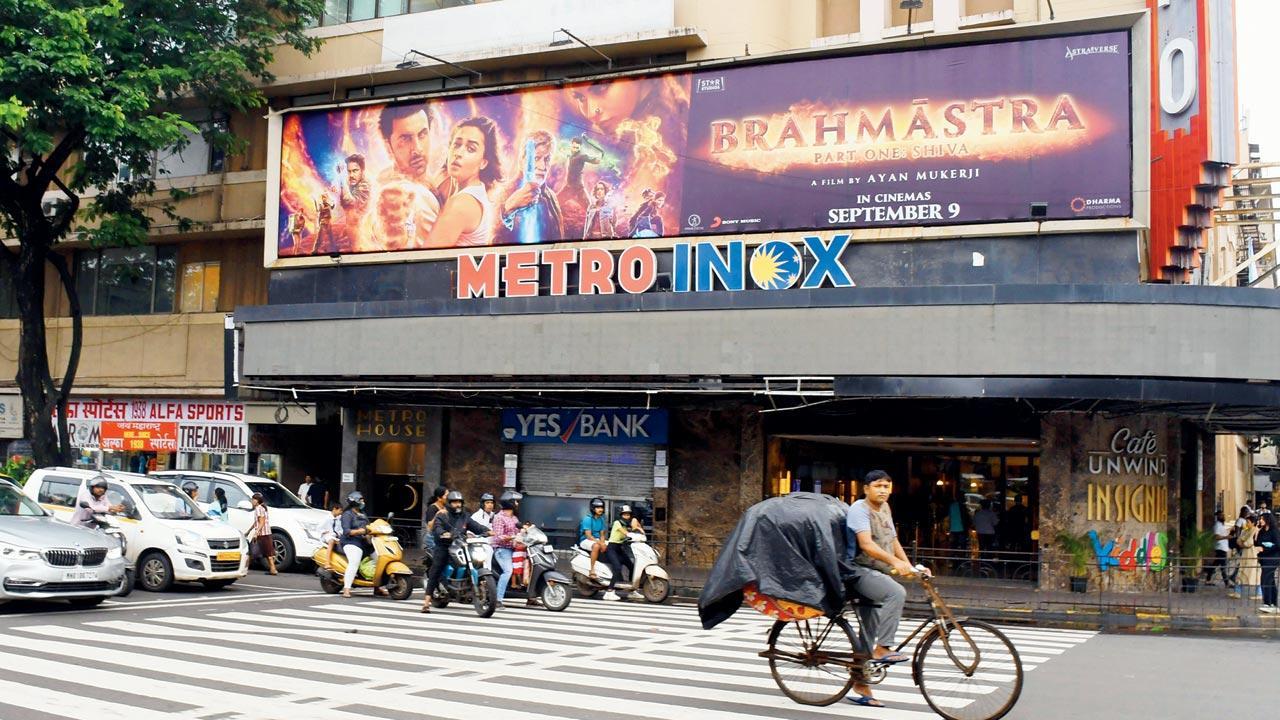
Why does Brahmastra’s proclaimed collection not match the scene in theatres? Is it inflated ticket prices or bravado, we ask stakeholders
Heena Khandelwal (MID-DAY; September 18, 2022)
It is important that Brahmastra: Part One–Shiva do well not only for the people directly associated with it, but for everyone in the Hindi film business. Film exhibitors and distributors pointed this out in mid-day’s report ‘Content is the problem, not #boycott calls’ (dated September 4, 2022). After Aamir Khan’s Laal Singh Chaddha and Akshay Kumar’s Raksha Bandhan’s lacklustre show at the box office, everyone was desperate to resuscitate Bollywood.
The Ayan Mukerji film saw the light of day after eight long years. Made at a budget of Rs. 410 crorse—a major chunk of which was spent on VFX—it opened to promising box office numbers, with a gross collection of Rs 300 crores worldwide in the first week, as pointed out by its producer Karan Johar.
But is the audience paying for this shot-in-the-arm? On Monday, a colleague bought a ticket for Rs 650 for a 2D show at a theatre in Malad; stubs for 3D versions in premium theatres crossed Rs 1,000. “Ticket prices have inflated,” says Kolkata-based film critic and trade analyst Sumit Kadel. “Producers have increased ticket prices by 30 to 40 per cent for weekend shows.”
This raised box office numbers, echoes Mumbai-based entertainment analyst Karan Taurani. “Prices were hiked by 35 to 45 per cent. This film has been adapted for 3D and IMAX 3D, which comes at an additional cost.”
Taurani adds the technology demands budgets of Rs 500 crore and more. “To make it profitable for producers, ticket pricing has to be higher,” he explains. “The audience is also willing to pay because they want to watch compelling content that is larger than life.”
Speaking for multiplex chains, Sanjeev Kumar Bijli, joint managing director of PVR Limited, said that just like airlines, cinema halls also have different ticket price slabs for the same film. Rajender Singh Jyala, chief programming officer of INOX Leisure Ltd, adds that price varies from theatre to theatre and area to area within a city. “A theatre in Nariman Point would charge Rs. 400, while a theatre in the same multiplex chain in Ghatkopar would charge Rs 200.”
He elaborates on the ticketing policy: INOX has four pricing categories—regular, popular, blockbuster and mega-blockbuster. “If a film looks promising, it is considered popular,” he says. “It is a blockbuster when it has a strong star cast and is made on a good scale. Only a few films—such as KGF - Chapter 2 and RRR—make it to the block-buster category. Brahmastra was put in the blockbuster category. If a regular ticket is priced Rs. 100, tickets for a popular film would fall between Rs 115-120, for a blockbuster it would be Rs 130-35, and a mega-blockbuster would be Rs 145-150.”
However, he dismisses reports that say ticket prices for Brahmāstra have been hiked. “In fact, the rates for Brahmastra are lower than those for KGF - Chapter and RRR,” he says.
A report in an online portal pointed out how stocks for PVR and INOX were gaining steam after Brahmastra’s release. “We are in the business of movies,” says Jyala. “If films do well, our stock prices gain momentum, and if they don’t, that too affects us.”
Much has been made about the box office collection. Mukerji puts it at a gross business of Rs 75 crores worldwide on opening day, and Rs. 300 crores in the first week. Domestically, according to Bollywood Hungama, the film opened to Rs. 36 crores on the first day, did a business of Rs 120 crore over the weekend and Rs 170 crores in its first week.
“The exhibitors are very happy,” says PVR’s Bijli, adding, “PVR saw 12 lakh admissions over the weekend across the country; it testifies that people do come to theatres. We feel that the movie has potential to run another week.”
Seconding him, INOX’s Jyala says the film has had a sizable box office collection considering the environment around it, including the call for boycott. “All big films are released around the holidays, but Brahmastra is the second highest non-holiday weekend film of all time; the first was Baahubali 2: The Conclusion,” says Jyala.
The scenes on ground contradict this confidence. Social media was filled with pictures of empty theatres, and soon there were memes, one of which said, ‘Brahmastra box office collections surpass GDP of India, Dharma Productions become world’s fifth biggest economy.”
Taurani has an explanation: “The weekday drop has been very high. Generally, if you compare weekday business to that of a weekend, the drop is usually 45 to 50 per cent; Brahmastra dropped 60 per cent.” Could word-of-mouth be blamed? “Yes,” says Taurani.
When asked if footfall and revenue have touched pre-COVID levels, Taurani says, “Yes, it happened last quarter when KGF - Chapter 2 and RRR had released. We saw a growth of 13 per cent even as the footfall was down by 10 per cent. [But] this quarter we are expecting a decline of 45 per cent when it comes to revenue and 50 per cent when it comes to footfall because none of the films has done well.”
Usually, traders call out fudged numbers. “But this time,” says film journalist and trade analyst Amod Mehra, “the outcry is from the public; and it is because the figures don’t match what they saw in theatres.”
Mehra says the situation is dismal in non-metro cities. “Mumbai and Delhi have prominent theatre areas, where many people go to multiplexes,” he says. “Places such as Lucknow, Jammu and the interior parts of Maharashtra are seeing empty theatres. The film performed well on Friday, Saturday, and Sunday, but the collection dropped Monday onwards. By Tuesday, shows were being cancelled.”
Then why does the box office say otherwise? And can the claim be verified? “In the good old days, trade papers and magazines would collate figures from every theatre,” says Mehra. “Then one could judge whether figures announced by film producers were inflated. There was also a fear of being exposed, so even if producers fudged numbers, it was only marginally. Today, if a film makes Rs 70 crores, you can exaggerate to Rs 100 crores, and it will be published without verification. Besides, earlier producers would manipulate box office collection by buying tickets and sending them to friends. Today, you can book tickets online, and cancel them one day or a few hours prior. So it may seem that seats are filling up fast, but in a theatre you’d find them empty.”
All this effort to raise hype pays off, says Mehra, because it becomes the benchmark to determine digital rights. “Whether it is satellite or OTT, these rights are swayed by box office collection. If a film is declared a hit, the producer can sell it for, say, Rs 150 crore,” he says. “But if declared a flop, the OTT rights could come down to R100 crore. Besides, every filmmaker wants to declare their film a hit, as do the actors. It decides their future [in the industry]. So everybody chimes in.”
Will Brahmastra register a profit? Unlikely, say distributors. While they recognise and acknowledge that the scale of the film brought audiences back to theatres, and proved that a Hindi film can have a huge opening, it would be far-fetched to say it will be a hit.
Manoj Desai, executive director of G7 multiplex and Maratha Mandir cinema, says the film did well over the weekend, but dropped in appeal Monday onwards. “Instead of running it at both Galaxy and Gaiety [theatres], we decided to run it only at Gaiety, keeping Galaxy free for other movies. Maratha Mandir is running only two shows instead of three,” he says, betting that the film won’t recover the cost of making. “The expectations were high,” he sighs, but blames the poor plot. “BrahmÄstra was an astra used in the Mahabharata, but here, they turned it into a love story.” Though every action film has a kernel of a love story within, this one couldn’t do it justice, he thinks.
Breaking it down to how profit for a film is calculated, Mehra says, “From a ticket priced at Rs 100, Rs 18 goes to GST. From the remaining Rs 82, Rs 41 goes to the producer/distributor, and Rs 41 remains with the multiplex. So, if a film does Rs 100 crores at the box office, it is bringing the producer’s home only Rs 41 crores.”
Brahmastra was made on a budget of Rs 450 crores, including promotion cost; so it will have to do a business of at least Rs 500 crores at the domestic box office to break even. This excludes money from digital rights and overseas release. “Say it gets Rs 150 crores from digital rights and Rs 50 crore from overseas [collection],” calculates Mehra, “it will still have to do a business of Rs 500 crore to earn the remaining money. This seems like a very distant dream.”
However, Mukerji has already confirmed that the second installment in the trilogy will be released in December 2025. “What Dharma did right is that they sold all rights to Disney,” says trade analyst Kadel. “Disney has been making films worth Rs 3,000 crores in Hollywood, [so] spending Rs 400 crores isn’t a deal breaker. Besides, they are looking at creating an intellectual property.”
The moving forward of National Cinema Day, so that it doesn’t interrupt the film’s collection, can be seen as a hefty vote of confidence. The Multiplex Association of India had announced it on September 16, which would be marked by all multiplexes selling tickets at Rs 75. However, it was postponed to September 23.
When asked why, a source close to the development said that distributors thought it would be best that the movie continues to gather momentum at the box office. “Cinema day was pushed by a week so that it doesn’t affect any major film’s chances,” he said.
Hello LED: How movie-watching is changing yet again
8:14 AM

Goodbye parda, projection booth, and even PDA in the dark. With a Delhi multiplex switching to an LED screen, it may be the end of another era
Sonam Joshi (THE TIMES OF INDIA; September 2, 2018)
Tikeshwar Nath still remembers the day he started working as a projectionist at Delhi’s Delite Cinema. It was 1994, and celluloid ruled the roost. Hum Aapke Hain Koun was playing in theatres, and was to continue its hit run for another 52-odd weeks. For every show, he would head up to his little booth, power up the “carbon stick projector” and pour out the stuff of dreams — a svelte Madhuri Dixit in flamboyant purple and a charming young Salman Khan.
“When film reels arrived, we had to assemble them from different cans, splice them together with tape, then reverse them after every show. It was hard work,” says Nath, 48, the senior-most projectionist at the 64-year-old theatre, who’s seen the transition from analogue to digital. The screening of a film now means transfer of data from a hard disk to a server, activating it with a code, and letting the projector roll. Those bulky reel canisters have been consigned to the mechanical past, along with the whir of the projectors, the sound of the sprockets locking into their holes, and the beam of golden light overhead.
If the transition from celluloid to digital marked a big shift in how films were screened, winds of change are blowing again. This week, multiplex chain PVR introduced the country’s first LED cinema screen in partnership with Samsung in Delhi. It replaces projectors, which have been central to the movie-watching experience since the birth of cinema over 120 years ago. This LED screen is essentially a giant television screen, which Samsung says has “unmatched visual quality, technical performance and reliability over traditional projectors”. “Content becomes far more enriched and enhanced, which we think will excite the audience,” says Puneet Sethi, vice-president, enterprise business at Samsung India.
Launched in Korea in 2017, this is the 12th Onyx screen in the world. Samsung plans to roll out five more LED screens in India by the end of the year. The LED screen is unaffected by ambient lighting, which means you can now eat your buttered popcorn and nachos in non-darkened theatres.
It’s also curtains for the parda. “A lot has happened as far as sound and projection are concerned, but the humble parda or vinyl screen stayed till this LED came along,” says Sanjeev Kumar Bijli, joint managing director of PVR. He says the new screen has another advantage: Saving prime real estate occupied by the projection booth. But this new tech doesn’t come cheap — PVR said upgrading to an LED screen costs nearly Rs 7 crore.
As online streaming threatens to overtake traditional theatres, can newer technology woo audiences? “Over the decades, the industry has faced competition from cassettes, piracy, and now streaming services, but there is a social need to go out and watch movies,” Bijli says.
While filmmakers have experimented with formats since the Lumière brothers first showed their films in the 1890s, the evolution of projection technology has been comparatively slower. Movies were shot on 35mm film and projectors cast them on white screens in darkened theatres. The shift to digital took place towards the end of the 20th century.
Film theorist and historian Amrit Gangar says that in the last 20 years, projection technology has changed faster than in the century before. “Around 1999, digital projectors began to be installed, first in cities,” he says. A decade ago, 4K digital projectors were launched which had a higher resolution than existing 2K projectors and showed brighter, sharper images. Not everyone is a fan though. For Gangar, the analogue 35mm projector was “more immersive” than digital projection that may be “faultless, but it looks synthetic and, to an extent, false”.
“To sell a new technology, they’ll always claim it’s better and brighter but brightness is not the determining factor,” says Bollywood cinematographer K U Mohanan. “The scientific way to see a film is through a projector. Since the projected image is a reflected image with mixed light, it’s more soothing for the eyes. LED backlit screens will exhaust the eyes,” he adds.
Gangar feels the new viewing technology will also be far less sensual.
If the multiplexes do decide to keep the lights on, it will be far less sensual in other ways as well. After all, a movie theatre has been the favourite place for couples to make out or at least hold hands.
With inputs from Mohua Das

----------------------------------
Pop-up plexes bring theatres back to the small town
Sonam Joshi (THE TIMES OF INDIA; September 2, 2018)
The movie-watching experience is changing beyond the big cities. A few years ago, Sushil Chaudhary realised that most villages had no halls as most single screens had wound up. Chaudhary, an engineer, designed his own travelling, inflatable multiplex, the digiplex. “I was inspired by touring tent or tambu talkies in old Indian trucks in Maharashtra that would do open-air screenings,” Chaudhary says.
 Unlike the tambu talkie, a digiplex is fully air-conditioned, equipped with a 18ftx7ft screen and surround sound, and seats 120 people on chairs. Prices are kept low: tickets cost between Rs 30 and Rs 70, with a bag of popcorn for Rs 8 to Rs 15. These inflatable air-conditioned digiplexes can be packed into trucks and assembled in just 2.5 hours. Chaudhary’s company, PictureTime, runs 37 such trucks with plans to expand to over 100 by next March. His focus is on entertainment dark spots — villages and Tier-3 towns with populations of 50,000 to a lakh. “I want families to come back to theatres.”
Caravan Talkies, started by distribution company UFO Moviez in 2015, works on a similar concept, but in even smaller villages. Its fleet of 114 vans travels to villages with a population of less than 10,000, and it is experimenting with LED screens. “We take content to the audience without investing in brick and mortar cinema screens,” says Siddharth Bharwaj, national sales head, enterprise business, UFO Moviez. “Just like the bioscopewala took cinema to the villages earlier, we thought why can’t we take cinema on wheels to an audience that has never seen a movie on a big screen?”
Subscribe to:
Posts (Atom)