Showing posts with label Sanjeev Kapoor. Show all posts
Showing posts with label Sanjeev Kapoor. Show all posts
Hansal Mehta is set to make a biopic on Chef Sanjeev Kapoor
8:21 AM
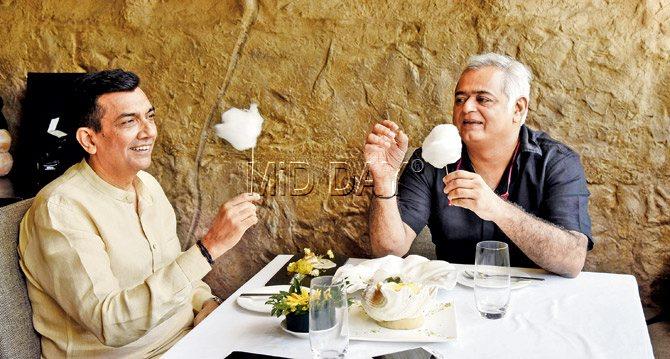
Onkar Kulkarni (BOMBAY TIMES; August 12, 2022)
A film on celebrated Chef Sanjeev Kapoor, which will be made by filmmaker Hansal Mehta, is currently in the works. Sanjeev says, “I wasn’t ready for a biopic. There is a lot more to do in life. However, whenever someone asked me if I would like to have a biopic on me, I would always say that there is this one person and the day he says he wants to make a film on me, I will say yes! His name is Hansal Mehta. A few months ago, he said let’s make the film, and I agreed immediately.”
Interestingly, it was Hansal who discovered Sanjeev and directed the famous cookery show Khana Khazana in the ’90s. “You don’t need just a passionate filmmaker to make my biopic, but also someone who is passionate about food. Hansal loves food. Also, the two of us started (our respective careers) together. He knows me and my struggles. We worked together on that show for almost a decade,” shares Sanjeev.
Ask him who will step into his shoes in front of the camera, and he says, “There are two actors in the discussion, let’s see who we get on board.”
Lata Mangeshkar had a great interest in cooking and she loved watching food shows, recall chefs
8:51 AM

Legendary singer late Lata Mangeshkar had a great interest in cooking and she loved watching food shows, recall chefs who were fortunate to interact with her and serve her their food
Shara Ashraf Prayag and Ruchika Garg (HINDUSTAN TIMES; February 7, 2022)
Lata Mangeshkar’s zest for life was infectious. And it often reflected in her kitchen that emanated delicious aroma every time she took to cooking with great enthusiasm.
Despite being particular about her food choices and practising discipline while eating, she loved to indulge in her favourite delicacies once in a while. Owing to her Konkani roots, spicy seafood dishes were her favourite. Her father, Pandit Deenanath Mangeshkar was from the village of Mangeshi in Goa. Mangeshkar also loved mutton preparations flavoured with zesty spices.
Tarun Gunjal, the CEO of Sarjaa Restaurant & Bar, Pune, the 25-year-old restaurant owned by the Mangeshkar family, shares that singer was actively involved in putting together the menu. “Lata ji loved mutton and seafood, and she was a fan of all things spicy. Mutton Kothimbir, a recipe of mutton prepared with coriander, was her favourite and she even taught the recipe to my mother. She also loved Mutton Kakori Kebab. Food was a passion for her and we often sent her food parcels to Mumbai,” recalls Gunjal.
Although Mangeshkar would rarely eat out, but when she did, she liked to indulge wholeheartedly. “We were lucky to often serve her in London. Zeera Chicken, Methi Chicken and Dal Makhani were her go-to dishes whenever she visited our Brilliant Restaurant in Southall, London. My dad also used to pack her favourite food and take it to the flat she used to stay in, which overlooked Lord’s Cricket Ground,” shares UK-based Indian chef Dipna Anand.
Delhi-based chef Nishant Choubey also happened to serve her at a pre-wedding function in Pune in 2018. “It was an all vegetarian menu, and I curated a special Sattvik menu for her which she loved. She enjoyed Aloo Sabudana Tikki Chaat and Nariayal Makhane ki Kheer and I was delighted when she asked for another helping! The waiter told me she was praising the food. I will always cherish that moment… it’s a blessing that I could serve her something made by me,” says Choubey.
Chefs who have bonded with her over food say that her love for life and her humility set her apart. Despite being a living legend, she was always unassuming. Veteran chef Sanjeev Kapoor recalls his most cherished interaction with Mangeshkar on a flight many years ago. “As I boarded the flight, she was already on her seat. She was on 1 D, while mine was 1 C. Both were aisle seats. She had closed her eyes and was resting. So I didn’t want to disturb her to say hello. I dozed off after a while. When the flight was in mid air, she woke me up with a gentle tap on my shoulder and said, Namasakar, main Lata Mangeshkar hoon. That was Lata ji…unbelievably down to earth,” says Kapoor.
Mangeshkar talked about her love for food throughout the flight. She told Kapoor that she liked to watch his shows but when it came to cooking, she liked to give it her own twist. “She told me how much she loved preparing seafood and how Asha ji also cooks along with her.” Kapoor says he will always treasure the memories of that journey. “She had the most compassionate and innocent smile. One can never forget that,” he says.
New York based celebrity chef Vikas Khanna also shared a very special bond with Mangeshkar. “Lata ji was a big fan of Masterchef and she had watched me on the show. It was Ganesh Chaturthi and a friend took me to meet her because she wanted to see me. We had a very long chat. Since then, I started visiting her regularly during Ganesh puja. She looked like the incarnation of Maa Saraswati, chanting right next to you. We built a very special bond… every time she read in the paper about me being in India, she would text me and I would visit her. When I gave her the copy of my book Utsav and told her there are 12 copies in the world and one is for her, she was very touched,” he says.
On Ganesh Chaturthi, the chef would always carry modaks and puran polis made by him for Mangeshkar. “I made my own special versions of modak for her, both savory and sweet, which she totally loved. But I always found the ones served at her home the best,” says Khanna. A visit to Mangeshkar’s house was like visiting a temple for him, says the chef. “It was always a very deep and emotional experience… her death is a huge personal loss and half of the planet is feeling the same way but remember, she’s always going to be with us... she has to,” he says. Indeed, India’s Nightingale will live on!
Check out Arjun Kapoor cooking up the storm in the kitchen with Sanjeev Kapoor
11:43 AM

MUMBAI MIRROR (March 2, 2016)
Diehard foodie Arjun Kapoor's longtime dream came true recently when he got to cook up a storm in the kitchen with celebrity chef, Sanjeev Kapoor.
In between rustling up some lipsmacking 'Junglee chicken', which is Arjun's favourite dish, the duo exchanged notes on the art of cooking.
The meeting came in handy for the actor, who plays a house-husband in R Balki's Ki and Ka, after picking up tips from sister, Anshula, an expert cook.
I hounded Mahesh Bhatt and wanted him to watch Shahid-Hansal Mehta
3:32 PM

Priya Gupta (BOMBAY TIMES; April 22, 2014)
Hansal Mehta, 46, is an angry, but an
extremely gentle man. Much like all other Gujaratis, he too knows how
to do his jugaad. He fears rejection, but doesn't give up. After years
of struggle and rejection, he won his first National award as Best
Director for his sensitive film Shahid. Over an hour-long conversation,
ahead of his upcoming film City Lights, he talks to Bombay Times about
his mentor Mahesh Bhatt, his inspiration and partner Safeena and why
Sanjay Gupta will always hold a special place in his life. Excerpts:
Tell us about your journey into films?
I am a Gujarati and come from a middle-class happy family from Mumbai. I was not a great student, but was very studious. I was not good at examinations and, in fact, I hate examinations and that phobia still exists. I don't like to be judged in two hours. Examination brings a lot of anxiety to me. It's ironical that I interact with students and that is what I do for a living. I run a small company , which organises experiential learning and it's a social service, where young people look at India in its social context.
Rejection really scares me and it's always been like that. I completed my software engineering from a capitation college from Pune and went to Australia at 21. And that was the turning point in my life. I realised how bored I was. Until then, I had been in denial as I knew that that was the career I had chosen and was trying to convince myself that I would enjoy doing that. And that I would need to do that for earning a big car, a big house and making your parents proud. That's what a good boy does.
But there I was alone and started having conversations with my girl as I had got married at 21. Luckily , opportunity fell in my lap. The company I was working for ran rental stores for pirated films and they wanted me to network all their stores. It was a two-year contract, but I finished my work in three months. There was a huge exodus of their entire staff and I started looking after their division. I started tinkering with their cameras and their editing setup and started editing some of the films they were pirating. For some reason, I grew up watching Kishore Kumar films.
If I watched a Kishore Kumar film, I would sleep well. I also liked watching Utpal Dutt and Amol Palekar films. I liked the fact that they were like normal people and the films were funny. I returned to India in 1993. Satellite TV had just begun. I always liked cooking and typed a proposal with an electronic typewriter I had at home, for a food show and presented it to Zee TV .
They accepted my proposal in two weeks, but their condition was that I would need to find a pretty girl to host the show titled Khana Khazana. I went looking out for pretty chefs and landed at Hotel Centaur, where I didn't find a pretty girl but discovered a tall chef called Sanjeev Kapoor. I decided to shoot with him without telling the channel. When they saw the episode, they freaked out and found it very boring without the pretty girl, with this man wearing a chef's uniform. But they ran four episodes and kept extending it every four weeks, till he made a dish called Shaam Savera that became such a huge success that he became a household name. That launched me as a producer and director. I was then hired to cut a song for Children's Society and went to Vishal Bhardwaj to collect the music for it, as he was the composer. Vishal was very rude to me, as they had not paid him. But he gave me the song to cut. I edited the song that Gulzar sahab had written and both Vishal and he loved it. Vishal called me and apologised and we became friends for life. I then made a very dark story on TV called Highway, which was initially rejected by the channel. I was very depressed, but next morning I got a call from Subhash Ghai who said, `I saw Highway and could not sleep all night. You should make films.' He was the first person to put that in my head and it stayed with me. Vishal later called me to cut the promo of Maachis, when the producer of that film asked me to make my first independent film as a director and I made Jayate. Jayate was inspired by Saaransh, but never got released. After that, nothing happened for two-and-a-half years. I went back to TV as I needed the money. I then made Dil Pe Mat Le Yaar with Manoj Bajpayee, Tabu and Mahesh Bhatt and it did not work. Today I realise that it was way ahead of its time. Post that, I went into a deep, dark well, where nothing did well and many of my films did not get released. In 2005, Sanjay Gupta called me and asked me to direct Woodstock Villa for his company, which, too, did nothing and in fact killed me further. I realised it was a mistake. But the stint with Sanjay saved me. I was, at that time, debt-ridden, sweeped in alcohol, fully in depression and was in a terrible phase. My self-esteem was at its lowest and suddenly, I had Sanjay calling me and giving me a film. He will always hold a special place in my life. He asked me to head his company and I was with him for over three years. After I left him, I left Mumbai. I was very upset with myself. I felt I had let Sanjay down, let Sikandar Kher down (debuted in Woodstock Villa) as I had made an indifferent film. I stayed in a village outside Mumbai and had decided that I would not make films, unless I could make a good film.
What made you make an angry legal-oriented film like Shahid?
I am an angry person. Everybody likes the fact that I am shy and look docile. So, every time they see the angry part of me in the film, they get surprised. Shahid, too, is an angry film, but is gentle. I have always had a flair for very formal writing, be it for my father or for my bosses. I would always write these very formal lengthy letters and probably , that's what made me make a legal-oriented film like Shahid. I am also emotional and overtly sensitive. If you tell me anything, I will think about it for days. I had started turning cynical when I left the city, but having daughters and a lot of love around you, allowed me to let go of my cynicism.
Talk about Mahesh Bhatt?
My whole journey had Mahesh Bhatt in some way . I always wanted to make an Arth, Saaransh and Janam. I used to love his films till one day, when he started letting me down as a director and he made some really bad films. He has come into my life at various points. One of the love stories I directed on television was inspired by Arth. My film Jayate was inspired by Saaransh.
He played a small role in Dil Pe Mat Le Yaar, but surprisingly didn't see the film. He saw it many years later on television and called me one night at midnight, when I coincidentally, was at the lowest point in my life. And he said, `I don't watch films that are not successful, but I am watching your film and it's very good. Don't give up on your dream.' I wanted to tell him that in my heart, I had already given up on my dream.
Again, after Shahid, I hounded him and wanted him to watch it but he was unable to see it, till when Rajkummar made him watch it, after which he told me he wanted to do a film with me. He said, `Be fear less. This is Vishesh Films version 2.0.' That resonated with me and we made City Lights. He has allowed me to open up as a person. My shyness is a little less because of Bhatt sahab, as he actually provokes you to get angry . So, I don't hold back. He is a great spiritual person and motivator. Spending just 10 minutes with him gives me a lot of strength.
Talk about your partner Safeena?
I was initially married at 21 and had my first son at 22. We had two sons and got divorced after 11 years. My older son Jai assisted me in City Lights. I met Safeena in 2005 at a dinner. That was a time when I would do anything for free alcohol. After Dil Pe Mat Le Yaar, I had started drinking regularly . I would get emotional and start crying every night after consuming alcohol. Shockingly for me, she claimed Dil Pe Mat Le Yaar as her favourite film and that did it for me. We fell in love instantly and started living together and have two daughters. I like challenges and know that I can never give up. I can not accept rejection of any kind and therefore, I am constantly fighting.
That rejection keeps me going and Safeena is like my pillar. She is a strong person. She works for nearly half a million girls in Rajasthan and has been awarded for girl education around the world. She is from the London School of Economics and could have been an investment banker and yet, she chose to work for social change and that is inspiring for me. She is very firm about ethics, unconditionally compassionate and allowed me to look inwards.
Do you feel vindicated in a sense by winning the National award as Best Director for Shahid?
I was most attached to my mother, whom I lost last year. She was sud denly detected with oral cancer and she passed away too quickly. She saw me getting an award at the Mumbai festival for Shahid, but after that she missed everything and that for me is the biggest regret, as she had only seen me struggling. Struggling to find my voice, my place. Today, everything without her is meaning less. I was editing City Lights, when I came to know about the National award. Anurag Kashyap, who debuted with me as a writer in Jayate and produced Shahid called me and said, `Sir, roye aap?' I was overwhelmed and cried by myself. And reconciled myself by thinking that even though my mother was not there with me today , it was her blessings that had come to reality .
Tell us about your journey into films?
I am a Gujarati and come from a middle-class happy family from Mumbai. I was not a great student, but was very studious. I was not good at examinations and, in fact, I hate examinations and that phobia still exists. I don't like to be judged in two hours. Examination brings a lot of anxiety to me. It's ironical that I interact with students and that is what I do for a living. I run a small company , which organises experiential learning and it's a social service, where young people look at India in its social context.
Rejection really scares me and it's always been like that. I completed my software engineering from a capitation college from Pune and went to Australia at 21. And that was the turning point in my life. I realised how bored I was. Until then, I had been in denial as I knew that that was the career I had chosen and was trying to convince myself that I would enjoy doing that. And that I would need to do that for earning a big car, a big house and making your parents proud. That's what a good boy does.
But there I was alone and started having conversations with my girl as I had got married at 21. Luckily , opportunity fell in my lap. The company I was working for ran rental stores for pirated films and they wanted me to network all their stores. It was a two-year contract, but I finished my work in three months. There was a huge exodus of their entire staff and I started looking after their division. I started tinkering with their cameras and their editing setup and started editing some of the films they were pirating. For some reason, I grew up watching Kishore Kumar films.
If I watched a Kishore Kumar film, I would sleep well. I also liked watching Utpal Dutt and Amol Palekar films. I liked the fact that they were like normal people and the films were funny. I returned to India in 1993. Satellite TV had just begun. I always liked cooking and typed a proposal with an electronic typewriter I had at home, for a food show and presented it to Zee TV .
They accepted my proposal in two weeks, but their condition was that I would need to find a pretty girl to host the show titled Khana Khazana. I went looking out for pretty chefs and landed at Hotel Centaur, where I didn't find a pretty girl but discovered a tall chef called Sanjeev Kapoor. I decided to shoot with him without telling the channel. When they saw the episode, they freaked out and found it very boring without the pretty girl, with this man wearing a chef's uniform. But they ran four episodes and kept extending it every four weeks, till he made a dish called Shaam Savera that became such a huge success that he became a household name. That launched me as a producer and director. I was then hired to cut a song for Children's Society and went to Vishal Bhardwaj to collect the music for it, as he was the composer. Vishal was very rude to me, as they had not paid him. But he gave me the song to cut. I edited the song that Gulzar sahab had written and both Vishal and he loved it. Vishal called me and apologised and we became friends for life. I then made a very dark story on TV called Highway, which was initially rejected by the channel. I was very depressed, but next morning I got a call from Subhash Ghai who said, `I saw Highway and could not sleep all night. You should make films.' He was the first person to put that in my head and it stayed with me. Vishal later called me to cut the promo of Maachis, when the producer of that film asked me to make my first independent film as a director and I made Jayate. Jayate was inspired by Saaransh, but never got released. After that, nothing happened for two-and-a-half years. I went back to TV as I needed the money. I then made Dil Pe Mat Le Yaar with Manoj Bajpayee, Tabu and Mahesh Bhatt and it did not work. Today I realise that it was way ahead of its time. Post that, I went into a deep, dark well, where nothing did well and many of my films did not get released. In 2005, Sanjay Gupta called me and asked me to direct Woodstock Villa for his company, which, too, did nothing and in fact killed me further. I realised it was a mistake. But the stint with Sanjay saved me. I was, at that time, debt-ridden, sweeped in alcohol, fully in depression and was in a terrible phase. My self-esteem was at its lowest and suddenly, I had Sanjay calling me and giving me a film. He will always hold a special place in my life. He asked me to head his company and I was with him for over three years. After I left him, I left Mumbai. I was very upset with myself. I felt I had let Sanjay down, let Sikandar Kher down (debuted in Woodstock Villa) as I had made an indifferent film. I stayed in a village outside Mumbai and had decided that I would not make films, unless I could make a good film.
What made you make an angry legal-oriented film like Shahid?
I am an angry person. Everybody likes the fact that I am shy and look docile. So, every time they see the angry part of me in the film, they get surprised. Shahid, too, is an angry film, but is gentle. I have always had a flair for very formal writing, be it for my father or for my bosses. I would always write these very formal lengthy letters and probably , that's what made me make a legal-oriented film like Shahid. I am also emotional and overtly sensitive. If you tell me anything, I will think about it for days. I had started turning cynical when I left the city, but having daughters and a lot of love around you, allowed me to let go of my cynicism.
Talk about Mahesh Bhatt?
My whole journey had Mahesh Bhatt in some way . I always wanted to make an Arth, Saaransh and Janam. I used to love his films till one day, when he started letting me down as a director and he made some really bad films. He has come into my life at various points. One of the love stories I directed on television was inspired by Arth. My film Jayate was inspired by Saaransh.
He played a small role in Dil Pe Mat Le Yaar, but surprisingly didn't see the film. He saw it many years later on television and called me one night at midnight, when I coincidentally, was at the lowest point in my life. And he said, `I don't watch films that are not successful, but I am watching your film and it's very good. Don't give up on your dream.' I wanted to tell him that in my heart, I had already given up on my dream.
Again, after Shahid, I hounded him and wanted him to watch it but he was unable to see it, till when Rajkummar made him watch it, after which he told me he wanted to do a film with me. He said, `Be fear less. This is Vishesh Films version 2.0.' That resonated with me and we made City Lights. He has allowed me to open up as a person. My shyness is a little less because of Bhatt sahab, as he actually provokes you to get angry . So, I don't hold back. He is a great spiritual person and motivator. Spending just 10 minutes with him gives me a lot of strength.
Talk about your partner Safeena?
I was initially married at 21 and had my first son at 22. We had two sons and got divorced after 11 years. My older son Jai assisted me in City Lights. I met Safeena in 2005 at a dinner. That was a time when I would do anything for free alcohol. After Dil Pe Mat Le Yaar, I had started drinking regularly . I would get emotional and start crying every night after consuming alcohol. Shockingly for me, she claimed Dil Pe Mat Le Yaar as her favourite film and that did it for me. We fell in love instantly and started living together and have two daughters. I like challenges and know that I can never give up. I can not accept rejection of any kind and therefore, I am constantly fighting.
That rejection keeps me going and Safeena is like my pillar. She is a strong person. She works for nearly half a million girls in Rajasthan and has been awarded for girl education around the world. She is from the London School of Economics and could have been an investment banker and yet, she chose to work for social change and that is inspiring for me. She is very firm about ethics, unconditionally compassionate and allowed me to look inwards.
Do you feel vindicated in a sense by winning the National award as Best Director for Shahid?
I was most attached to my mother, whom I lost last year. She was sud denly detected with oral cancer and she passed away too quickly. She saw me getting an award at the Mumbai festival for Shahid, but after that she missed everything and that for me is the biggest regret, as she had only seen me struggling. Struggling to find my voice, my place. Today, everything without her is meaning less. I was editing City Lights, when I came to know about the National award. Anurag Kashyap, who debuted with me as a writer in Jayate and produced Shahid called me and said, `Sir, roye aap?' I was overwhelmed and cried by myself. And reconciled myself by thinking that even though my mother was not there with me today , it was her blessings that had come to reality .
Subscribe to:
Posts (Atom)