Showing posts with label Sanjay Tandon. Show all posts
Showing posts with label Sanjay Tandon. Show all posts
Artistes have finally moved from being remembered to being rewarded-Sonu Nigam
9:25 AM

Debarati S Sen (MUMBAI MIRROR; April 2, 2026)
In a landmark moment for India’s music industry, ISAMRA distributed Rs. 100 crore in royalties to 26,000 singers and musicians, marking what its leadership calls a long-overdue “correction of history.” We spoke to veteran singers Anup Jalota, Sonu Nigam and Founder, MD of ISAMRA, Sanjay Tandon.
Tandon described the payout as more than a financial milestone, calling it “justice for performers” whose voices have shaped the nation’s musical legacy while remaining excluded from its economic rewards.
He said, “With over 4 lakh tracks played upwards of 4.5 crore times across platforms, the move underscores the growing importance of structured systems, as ISAMRA’s metadata backbone ensures accurate tracking and monetisation across radio, television, digital and public platforms.”
VOICES FINALLY HONOURED
Anup Jalota called the moment “deeply emotional and historic,” adding, “For years, singers gave their voices to immortality, but did not always receive their due. Today, with this distribution, that voice is not just heard, it is honoured. It reinforces that royalties are a right, not a privilege.”
Sonu Nigam echoed the sentiment, saying, “Our decades-long battle pays off. Artistes have finally moved from being remembered to being rewarded. This goes beyond applause. It gives performers a financial identity and dignity, and acknowledges that the voice is not just emotion, it is value.”
A SHIFT ACROSS GENERATIONS
For veteran artistes, many of whom never expected to receive royalties within their lifetime, the payout signals delayed justice, while for younger performers it offers long-term assurance. Jalota noted, “It brings peace to legends and confidence to the young. When an artiste knows their work will continue to earn for them, it brings dignity and security.”
Nigam added, “For years, recognition came in the form of love and applause, but not proportionate reward. This shift changes that narrative. It tells every young artiste that their art will not just be celebrated, it will be protected and valued.”
WHY SYSTEMS MATTER
The scale of music consumption today makes transparency critical. “Today music travels everywhere. Without structure and transparency, it is impossible to track it,” said Jalota, crediting ISAMRA with bringing “discipline and accountability” to an unorganized space.
Nigam emphasized, “Transparency is everything. If you cannot track usage, you cannot value it. Systems like ISAMRA ensure that every play, every performance translates into rightful earnings with clarity and credibility.”
THE ROAD AHEAD
Looking forward, the focus is on expanding awareness, strengthening enforcement and building global integration. Tandon stressed the need to bring more artistes into the royalty framework, ensuring no voice is left behind. Jalota underlined the importance of parity, saying, “We must ensure that Indian artistes receive global respect and parity. As our music travels across borders, our rights must travel with it.”
Nigam added a note of caution in an evolving landscape: “The industry is evolving rapidly with digital platforms and AI. But the core must remain human. Technology should empower artistes, not dilute their rights. We need ethical frameworks that protect the voice behind the music.”
If you make a hundred songs, at least one will be a hit. That can be profitable for you-Sanjay Tandon
8:59 AM
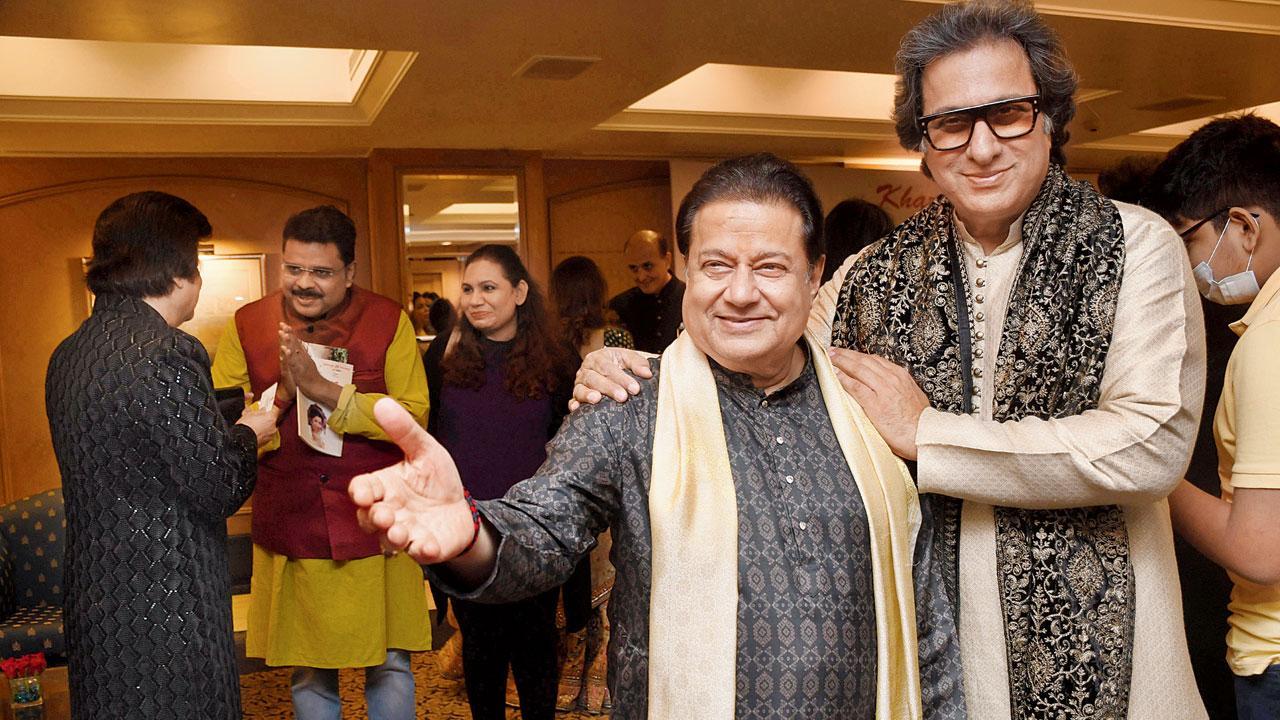
Jalota and Aziz
As they unravel the process of acquiring royalties, ISAMRA bosses Jalota, Aziz, and Tandon on why artistes should make “as much music as possible” to safeguard their futures
Parth Srivastava (MID-DAY; July 15, 2024)
Established in 2013, the Indian Singers and Musicians Rights Association (ISAMRA) has been spearheading the fight for monetary benefits for musicians in the film industry. Navigating the workings of music labels and associations to ensure that artistes earn their due royalties, the board of directors tells mid-day that they have worked towards tweaking laws that do not favour those who do the leg work.
The organization's CEO, Sanjay Tandon, says that in this day and age, “being aware of your rights” is imperative. “As a collecting body, we collect royalties on behalf of artistes, and subsequently pay them. Only in the recent past have musicians raised questions on these aspects, and our organization is working as the middleman to facilitate this exchange [of money],” he says.
A discussion on royalty becomes important in a world that’s increasingly dependent on artificial intelligence. With voice samples of artistes being fed to software that subsequently generates a new song in the desired voice, we ask Tandon if the rights of musicians are indeed protected.
“As of now, if people are using AI to create content for social media, we aren’t taking any steps. However, if they [are deriving monetary benefits by] uploading it on YouTube or other similar platforms, we are imposing copyright strikes.”
Chairman Anup Jalota, who has leveraged his stature to push for reforms in royalty distribution, has been instrumental in shaping policies that favour fair compensation. “Singers and musicians have always been under the hand of [music] publishers. We ensure that if a member’s song is played, either digitally or on the radio, they are compensated. However, if the song is never played, we cannot pay them,” says Jalota.
In a bid to put money into the hands of musicians, Tandon thus encourages singers to “sing as many songs as possible”. “Make as many compositions as you can. If you make a hundred songs, at least one will be a hit. And that can be profitable for you.”
At a time when reworking old ditties has become the norm in the industry, Jalota says “the original artiste always gets a share of the royalties”. “Even after the artiste’s demise, their children continue to benefit. For example, the royalties of Kishore Kumar are received by his son, Amit Kumar.”
Ghazal maestro Talat Aziz, who has also been associated with ISAMRA, says artistes must “understand the concept of distribution in music”. His efforts have been pivotal in addressing issues faced by musicians, particularly those working to further the classical music scene. “Those who understand the process can be empowered enough to demand fair compensation. This will help establish standardised practices for royalty distribution.”
Music and laws
- While the use of AI for entertainment purposes is not being objected to, ISAMRA is imposing a copyright strike if the voices of their singers are being generated for commercial purposes using AI tools.
- Only when a song becomes a hit, and is subsequently played on multiple occasions does it yield monetary benefits. The board suggests that artistes create as much work as they can to create a financial basket.
- ISAMRA says after the demise of an artiste, his or her children can continue to earn monetary benefits from royalties.
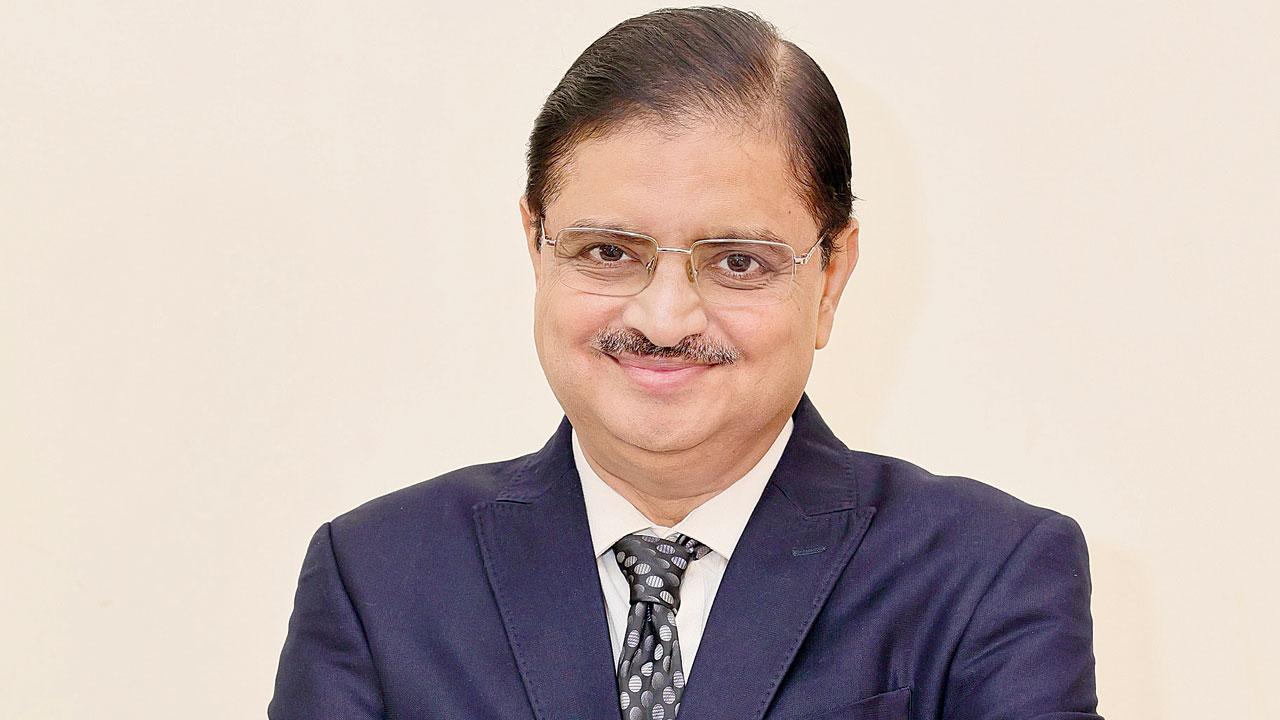
Sanjay Tandon
World Music Day: IPRS and ISAMRA musicians talk about their long struggle for copyright and royalties
4:44 PM

On World Music Day today, musicians, who are part of copyright and licensing societies in India like the IPRS and ISAMRA, talk about their long struggle for copyright and royalties, and how its bearing fruit
Soumya Vajpayee (HINDUSTAN TIMES; June 21, 2024)
The lack of copyright compliance remains a hot topic in Indian music industry. On World Music Day today, artistes who are a part of copyright and licensing societies in India, such as the Indian Performing Right Society Limited (IPRS) and Indian Singers’ and Musicians’ Rights Association (ISAMRA), talk to HT City about the ongoing struggle.
It’s unlikely for a music aficionado in India to not know about the issue surrounding the distribution of royalties for music creators and not just music labels and producers, which started in the 1960s. With music societies like the Indian Performing Right Society (IPRS) and the Indian Singers and Musicians Rights Association (ISAMRA) spearheading the mission, the industry has come a long way.
On World Music Day today, musicians Sonu Nigam, Shaan, Sameer Anjaan and ISAMRA Founder-CEO Sanjay Tandon, in an exclusive sit-down with HT City, delve into the topic of music copyright and how these societies — which are of the musicians, for the musicians and by the musicians — safeguard the democracy of music in India by ensuring justice for all the stakeholders, including composers, singers and lyricists.
Sanjay Tandon (Founder, Director and CEO of ISAMRA)
Unfortunately, in India, copyright is the least talked-about subject. If you compare the music of India to the scene in the US, UK and Europe, it’s suffering because these places have a proper copyright structure in place. In the initial years, more than the money, establishing the principle that you have a right is the greatest challenge. Also, while a lot was being done to safeguard the rights of composers and songwriters, singers were not really thought about. So, I decided to spearhead that mission.
Sameer Anjaan (Lyricist and Board of Director at the IPRS)
I had returned from London in 2002 after a meeting with PPL (UK’s music licensing company) and Nadeem (one half of the composer duo Nadeem-Shravan) told me how important it was to preserve my rights as a lyricist. He said, ‘Future digital hai aur agar humare rights humare paas nahin honge, toh humein kuch nahin milne wala’. So, I met Sanjay (Tandon) and sought his support for the IPRS. We wanted to take the matter to the government. We were lucky that Javed (Akhtar; lyricist and Chairman of the IPRS) sahab became a part of this mission.
‘Javed sahab nahin hote toh kuch bhi nahin hota’
Sameer Anjaan says, “Javed Akhtar sahab felt so strongly for the rights of the fraternity that he decided to spearhead the mission and since he was a Member of Parliament, it worked in our favour. He had a meeting with all music labels so that we could mutually sort things rather than going to court. But they weren’t ready. In fact, some music companies said, ‘Hum royalty nahin, aapko bheek de rahe hain’. Javed sahab was told, ‘Aap jo gaane likh rahein hain, chup chaap likhiye, warna woh kaam bhi aapko milna band ho jayega’. Uske baad, Javed sahab ne kaha, ’Ab baat meri zidd pe aa gayi hai’. He did research for three years about copyright from across the world, made a file and took a delegation to meet the government. It symbolised our unity as a fraternity, and both the ruling party and the opposition supported us. That’s when the Copyright Act was amended.”
‘Lata ji was always with us’
Sanjay Tandon says, “In August 1991, Lata ji and I attended a conference in Delhi and a minister in his speech said that singers are mere vocal instruments. That hit us hard. She was so upset that she wanted to walk away. Post that, I told her, ‘The mistake is ours. Bina roye to bachche ko maa doodh bhi nahin deti... Kya humne as a music community kabhi apna haq maanga?’ She asked me to promise her that alongside fighting for composer and lyricist rights, I would also fight for the royalties for singers. Lata ji, Sonu ji, Alka (Yagnik; singer) ji and Kavita (Krishnamurti; singer) ji fought for the rights of the singers since the beginning and Lata ji would accompany us to all the meetings. Her contribution to our mission was unparalleled.”
Shaan (Singer and Board of Director at ISAMRA)
A lot of our contemporaries who joined us in the mission were not hopeful of a result. Kitni baar humari himmat bhi toot jaati thi. Kaafi singers ne yeh assume kar rakha tha that if they joined us, they wouldn’t get work. They were so fearful of getting on the wrong side of the music companies. But ab sab cheezein sahi direction mein hain aur woh singers jo pehle shak karte the ab dekh sakte hain ki sabke ghar mein cheques aa rahe hain. It’s great that all music companies are now with us and we work in tandem.
Sonu Nigam (Singer and Board of Advisor at ISAMRA)
Jab se main iss industry mein aaya hoon, main nirantar ismein laga raha (fighting for musician rights and royalties). A lot of singers became part of the mission and quit after a while. But some of us, who were at the peak of our careers, were perseverant to not give up. We wanted to fight for the rights of our fraternity and we also lost work because of that. I am glad that we have come a long way and our efforts are bearing fruit. Achcha lagta hai jab humari meetings hoti hain. Saari music companies aur hum log pyaar se milte hain, achcha khaana khate hain and we discuss the way forward. Mere baare mein jo bhi negativity unmein (music labels) thi, ab sab theek ho gaya hai, so I am busy again (laughs).
Fact check
- Earlier, songs belonged to composers, lyricists and the music labels. Singers were neither considered owners of the copyright, nor were entitled to any royalty. In 2012, this anomaly was fixed with a landmark amendment to the Copyright Act, 1957, which recognised ‘Performer’s Rights’ of the singer of a commercially recorded song for 50 years from the beginning of the calendar year in which the performance is made.
- Until March 2024, the IPRS claims to have distributed Rs. 500 crore among the artistes. “And this is still the tip of the iceberg,” says Anjaan.
- The royalties start ticking from the day a song is released, and is credited to the artiste after almost a year.
- The IPRS distributed its first royalty, Rs. 14,000, for the song Aayega Aanewala (Mahal; 1949) in 2013.
- The ISAMRA distributed its first royalty, Rs. 51,000, for the song Lag Jaa Gale (Woh Kaun Thi; 1964), says Tandon.
Royalty now a reality: Singers rejoice at landmark feat
8:43 AM
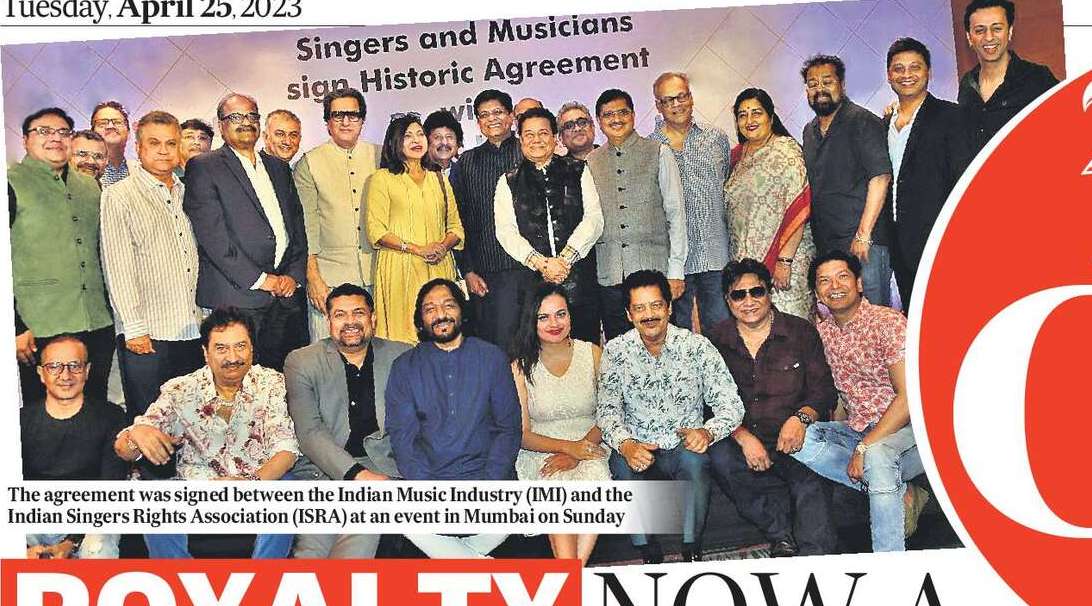
A crucial agreement signed recently has paved the way for artistes to be paid their dues
Rishabh Suri (HINDUSTAN TIMES; April 25, 2023)
In a glittering event held in Mumbai on Sunday, the Hindi music industry turned up in full force to witness a big feat for artistes. The Indian Music Industry (IMI) and the Indian Singers Rights Association (ISRA) signed an agreement, whereby all registered singers will now be paid royalty by music labels for the songs they have sung.
As per this, 25% of the collections of Phonographic Performance Ltd (PPL) — the governing body responsible for collecting and distributing royalty — will be paid to singers who are part of the ISRA. This also includes posthumous royalty paid to an artiste’s surviving family.
Union minister Piyush Goyal, who played a key role in facilitating the agreement, said on the occasion, “When this amendment was made in 2012, I was an MP of the opposition. But, in June 2019, when I took charge of the Ministry of Commerce and Industry, I came to know that nothing had been done in seven years. I felt that this was an injustice to those singers who had served the nation with their talent.”
Welcoming the agreement, singer Udit Narayan tells us, “Jiss din ka humein intezaar tha, woh ab nazdeek lag raha hai. We have struggled for this for so many years now. Chaliye, marne se pehle kam se kam royalty mil raha hai. I am very happy, thanks to ISRA and the ministry.”
For singer Alka Yagnik, this agreement has been no less than a dream. “This is a significant decision. We never really thought it would happen. This debate started in the early 1990s, so this dream has been there with me for 30 years. Pehle singers mein unity nahin thi, iss endeavour ke liye unity badhaai gayi,” she says.
How much royalty will be paid will be decided basis the number of songs of a singer played across radio stations, concerts, shows, etc. Sanjay Tandon, CEO of ISRA, informs that in India, radio stations, OTT and TV stations refuse to pay singers their dues: “Even after the 2012 amendment, where it was clear that radio stations playing a singer’s song will have to pay royalty, they (radio stations) ganged up and decided to not pay. They are people with big pockets, they expect us to take them to court, and we cannot fight them. It is a huge expense... People playing music at concerts and occasions — why do they want to play a singer’s song, but not pay them? This is why we took the initiative.”
Singer Shaan adds that the disagreement between singers and music labels has been a huge obstacle. “What they thought was fair, was not fair for us, and vice versa. A lot of credit goes to Anup Jalota ji (president, ISRA). He put that hand out and welcomed music companies towards us.”
Sonu Nigam brings together 100 artistes from across India for a song
9:13 AM

Sonu Nigam brings together 100 artistes from across India for an acapella piece that cuts across languages, to raise funds for PM-CARES
Sonia Lulla (MID-DAY; May 4, 2020)
Despite the sealed borders keeping him from returning home to India, Sonu Nigam has been neck-deep in work, supporting causes for daily-wagers, and raising awareness for relief funds for the country. It's been a month since Nigam, who is currently holed up in Dubai, began the cumbersome task of breathing life into a passion-project, the brainchild of his industry associate Srinivas. Along with Indian Singers Rights Association CEO Sanjay Tandon, the duo reached out to 100 artistes from across India for the creation of the 14-language track, One nation one voice, which is set to be unveiled by Lata Mangeshkar.
"We had been struggling to find a Sindhi [singer], and that's when we reached out to Ghanshyam Vaswani. Though disconnected from mainstream [music], he has been a ghazal singer for decades. My mother was proficient in Sindhi. So Ghanshyam ji and I collaborated for those portions. Similarly, Papon [worked on] the Assamese [verses], Bhajan Sopori ji and Kailash Kher did the Kashmiri track, Mame Khan crafted Rajasthani [verses] and Krishna [Beura], the Odia portions," Nigam tells mid-day of the song that also includes lines in Bengali, Marathi, Malayalam, and Tamil.
The coalescing of an assortment of home-bound artistes for a single track becomes simpler when employing a digitally transferable background score that they can individually lay their vocals on. But Nigam was creating an acapella piece, which didn't have instruments to play second fiddle in supporting his endeavour.
"We sent two songs to all the singers. One [included] the base track that had been created by [a select few], and included sounds, layers and harmonies. No instruments were used to create this, and it was upon this piece that the singers [recorded their vocals]. We also gave them a reference piece of how we wanted the song to sound, but offered an empty space [for them to experiment]." Those singers who do not have a home-studio had to let the acapella piece play in the background as they recorded their vocals over it, he informs.
There's a peculiar cheer in his voice when he talks of Asha Bhosle's involvement in this number. "With her being by our side, this project has become invaluable. At 86, she has opened this song like a boss. You find yourself wondering how someone at that age can sing so beautifully. I was reduced to tears on hearing her 30-second performance."
Now, Bollywood’s playback singers get payback thanks to ISRA
8:25 AM

You hear their hit tracks in restaurants, gyms and stadiums but singers say they don’t get a penny of royalty. But things are changing. Now, for the first time, around 700-odd vocalists have got their dues
Mohua Das (THE TIMES OF INDIA; April 15, 2018)
About a month ago, singer Aditi Singh Sharma walked into a recording studio to find the party anthem, Sooraj Dooba Hai, being intensely discussed. She exclaimed instinctively: “Oh, that’s my song!” The music makers in the room corrected her: It’s (the composer) Amaal Mallik’s song. “There was something so wrong with that sentence,” she recounts. “If I’m not entitled to a song I’ve sung, what am I left with? Similarly, a hit track is called a Ranbir-Deepika song. No one calls it the Vishal Dadlani-Shalmali Kholgade song. As long as the issue of royalty remains unresolved, singers will continue to be ignored.”
Singers, they’re known for speaking out on civil rights, politics, climate change and peace. Not so much for activism within their own industry or the disharmony beneath the surface. While film producers and music companies have been getting their share of profit from radio stations, TV channels, and online sites, singers like Aditi feel they are being rewarded less and less.
That may be changing now. After a long battle to secure royalty, the Indian Singers’ Rights Association (ISRA), a copyright collection society established in 2013, was able to collect a sum of Rs 52 lakh and distribute it among 730 singers for the first time.
“This is for 2016-17. For the year ending March 2018, we’ve already collected around Rs 1 crore, which too will soon be distributed,” explains Sanjay Tandon, CEO of ISRA. “What artistes have received maybe a nominal amount but it’s a start.”
Aditi, among the first batch of royalty recipients, says it’s a huge leap for singers. Unlike the previous generation of singers, careers these days are short-lived with new voices emerging every day. And not everyone does live shows where the money is better. “I’d probably have earned more in royalty than my fee for singing the song Dilli Dilli (in No One Killed Jessica) that was played everywhere in Delhi for two years since its release in 2010,” says Aditi.
Singer Sonu Nigam believes it is about giving singers their due respect and a sense of security. “Our fight wasn’t with music labels but what was due to us,” explains the singer, who along with Sunidhi Chauhan, had once walked out of the film Heartless when asked to sign away their royalty rights.
The question of equitable share of revenues dates back to the 90s when someone at a function called singers ‘vocal instruments’. To fix this anomaly, singers like Lata Mangeshkar, Sonu Nigam, Alka Yagnik and Tandon banded together and took up the matter with the government.
In what was hailed as a landmark amendment in the Copyright Act of 1957, ‘Performer’s Right’ came into effect in June 2012. The singer was granted economic rights, independent of the composer and songwriter. This meant that once a singer had recorded an original song, for the next 50 years, everyone except the producer needed their consent and would have to pay royalty to play or perform their song in public. Be it at a restaurant or gym, on radio and television, streamed through internet, or played by DJs.
“Till then it was a zamindari system where the tune belonged to the composer, the song to the lyricist and sound recording to the music company. Singers weren’t considered owners of copyright or entitled to any royalty. Starting June 21, 2012, they were added as a fourth party, entitled to 50% of whatever anyone earned worldwide using their voice,” explains Tandon.
Despite the recent triumphs, Tandon says the struggle to get royalty from television, radio and online streaming platforms still continues. “We can’t get complacent. They are the ones with the lion’s share of the music industry’s total revenue,” he says, pointing at the plight of older singers who have died in penury in the past. “Rajkumari Dubey and Mubarak Begum did not have money to even meet their basic needs. Financial aid by way of royalty could have helped them,” states Tandon.
HOW THE MUSIC MATH WORKS
Royalty that an eatery has to pay is calculated according to the “least priced drink on the menu card”; for big arena events, the licensing fee is Re 1 per seat; for airports and gyms the annual royalty is Re 1 per sq ft of the total carpet area; and for free online streaming platforms it is 50 paise per song. Thus, a pub where the cheapest drink costs Rs 20, has to pay an annual royalty of Rs 7,300 for any number of songs they play every evening, be it Lata Mangeshkar or Arijit Singh, while Wankhede Stadium which has a capacity of 33,108 would need to cough up the same digits in royalty for any number of songs played at each IPL match.
After 5 years of toil, Indian Singers Rights Association manages to pay royalty to singers
7:56 AM

Soumya Vajpayee Tiwari (DNA; April 14, 2018)
A five-year-long effort by copyright society Indian Singers Rights Association (ISRA) is finally bearing fruit. In January this year, the association, which has been fighting for the royalty rights of singers since 2013, was able to procure approximately Rs 52 lakh for 730 singers. Sonu Nigam, who was among the few to earn royalties for his ditties, says, “This is the beginning of a new era. Something that we have been working on for several years is finally seeing the light of day.” The government body, which has also been trying to earn royalties for its singers from music labels, has been able to earn the amount from sporting events, restaurants and gyms, among other facilities.
ISRA co-founder Sanjay Tandon says, “We are proud that despite heavy odds, we managed to collect royalties from users, and also distributed them to singers. Though the amount collected this time is small, this marks a beginning.”
Alluding to the stature of the facility, ISRA chairman Anup Jalota tells mid-day that they collect revenues “based on their capacity”. “Around 20 per cent of the collection is retained for the expenses of ISRA, while 80 per cent is paid to the singers.”
The founder chairperson of the association, Lata Mangeshkar, is content that singers are finally getting their due. “Jo mudda maine uthaya tha, ab woh rang laa raha hai. Singers will now get what is their right,” she says.
While the singers associated with the organisation earn royalties, those who haven’t registered with it are not paid any amount initially. “The royalty of non-members is held in a separate account. It remains untouched for three years. During this period, they can register with us and claim their amount. However, if they do not register, the money is credited to ISRA’s fund,” says Tandon, adding that legal heirs of deceased singers can also become members of the organization and claim the royalty amount.
For Tandon, the journey to get to this stage has been a long one. “When we first started off, we sent out notices to all parties, specially sporting events like the IPL. When they didn’t pay for playing songs in the stadium, we took them to court. They started paying us royalties from March 2017, which went into the collections we distributed in January,” he says, further highlighting that royalties are also decided upon based on different tariff plans. “There are 21 plans. For instance, the tariff decided upon for sporting events is Rs 1 per seat in the stadium. Restaurants, on the other hand, pay us an amount equivalent to the least priced drink on their menu per day. The amount collected from these restaurants is equally distributed among all singers who are members of ISRA.”
ISRA and the fight
The Copyright (Amendment) Act, 2012 on June 21, 2012 provides that a singer — as a performer — shall be entitled to royalties in case of performances for commercial use. It is now stipulated that anyone would require a clearance from ISRA and pay royalty to play/use/utilise/perform film and non-film songs.
Singers on song
Sonu Nigam

Although the amount, when distributed among the singers, is little compared to what should actually have been given from day one, even this victory is a huge achievement. The fact that Indians are getting regulated and artistes are aware that they are entitled to royalty is celebrated. The law needs to be followed, just like every other law that is enforced upon citizens.
Shaan

It's not about the money; getting the royalty is symbolic of the fact that we are being recognised. In case of live shows, ISRA doesn't need to be paid any royalty. But when that performance is recorded and broadcast, royalty needs to be paid. This is a breakthrough for us.
Anup Jalota

In India, the government-backed Indian Performing Right Society (IPRS) could collect royalty for lyricists and composers. But they didn't collect it for singers. Then Javed Akhtar saab and we met and decided to form ISRA. We have still to be paid from All India Radio and Doordarshan. We feel, because of this development, the members of ISRA will also increase. For instance, Kanika Kapoor needs to be paid R60,000. She will only be paid the amount if she becomes a member.
Talat Aziz

It's not the question of the amount of money we've got; the principle of being paid what is due is what matters. This is a first step in the right direction.
Sonu Nigam's songs in Kick, Main Tera Hero being re-recorded?
12:10 PM

Sonu Nigam fast getting to be out of work as all his songs are being re-recorded
Bharati Dubey (MID-DAY; January 30, 2014)
Owing to his stance on the music royalty issue, songs composed with Sonu Nigam are being re- recorded with other singers now. So while the singer’s voice has been edited out of songs in David Dhawan’s film, Main Tera Hero, word has it that his songs in the films Kick and Heropanti too will be re-recorded with another singer. The singer says that he is not aware about being replaced in songs for the latter two films. He said, “I don’t know who has sung my portion but I will not do something that is illegal. I have been fighting this injustice all along and change can be brought about only if others join me in this fight. I am not scared of being out of work because eventually good sense will prevail."
Both Bhushan Kumar and Ekta Kapoor, co-producers of Main Tera Hero, refused to comment. When contacted, the former asked us to get in touch with the film’s producer while Kapoor denied knowledge of any such development. It may be recalled that Nigam was recently replaced by Mohit Chauhan in Shekhar Suman’s Heartless.
Faced with such opposition, it seems that Sonu has found support in Subhash Ghai. The filmmaker, who is reviving his music label Mukta Music with his forthcoming film Kaanchi, has asserted that he will follow the copyright law and share royalty where it is due. When asked whether he will allow Nigam to collect royalty for his songs, he was diplomatic about it. “I am going to study the law and will do everything in keeping with legalities.”
When contacted, Sanjay Tandon, managing trustee of Singers Association of India, expressed anguish over Nigam being replaced for having taken a stand. “Producers and music companies are using such tactics because they don't want to adhere to the law. If this continues, we will be forced to take legal action against them,” he said.
Owing to his stance on the music royalty issue, songs composed with Sonu Nigam are being re-recorded with other singers now.
Singers protest ‘feudal’ contract, music companies maintain 'no royalties'
9:42 PM

Vickey Lalwani (MUMBAI MIRROR; December 25, 2013)

With this the on-going war between ISRA (Indian Singers Rights Association) and the music companies has grown uglier, and other singers like Shreya Ghoshal, Shaan, Neeti Mohan, Nikhil D’Souza, Arijit and Kailash Kher have joined the duo to fight for royalties.
So what is this contract which has B’Town’s leading voices up in arms? According to Sanjay Tandon, managing director of ISRA formed last July, the singers are being asked to sign a contract which stipulates that they are assigning their performer’s rights to the music director who passes them on to the producer who then has “exclusive right including but not limited to the right to reproduce the performance in any material form”.
A sample of this agreement, given to Mirror by Tandon, further states that in the case of any audiovisual recording of a performance, the singer has to assign his/her right to royalty under Section 38A (2) to the music director who passes it to the producer in lieu of a lump sum of royalty payment.
Finally there’s one clause under Section 31C according to which a singer has to agree that he/ she will not perform or record a song, and this includes cover versions, without the permission and licence of the music director and/or the producer.
 Shaan
explains,“Besides being denied royalty, we have now been told that once
we record a song for a film, we cannot sing it on any other platform.”
Shaan
explains,“Besides being denied royalty, we have now been told that once
we record a song for a film, we cannot sing it on any other platform.”Tandon and the singers insist that these clauses are in complete violation of the amendment in the Copyright Act, which was brought into force on June 21, 2012, which states that “provided that, notwithstanding anything contained in this subsection (38A (2), the performer shall be entitled for royalties in case of making of the performances for commercial use.”
Further, Section 39(A) states that as per Section 18 and 19, “the right to royalty cannot be assigned or waived by the performer except to the legal heir of the performer or to a Copyright Society (in this case is ISRA) and any agreement to the contrary shall be void”.

He adds that there is no embargo on the assignment of performer's rights or the right to receive royalties. “Certain singers with vested interests, based on their erroneous interpretation of draft singer agreements adopted by the producers, have been spreading false rumours and are trying to dissuade others from signing the agreements,” he alleges.
Sonu points out that the singers aren’t demanding money from the music companies per se. “They want money from sponsors and not share with us which is why they want us to sign these contracts,” he asserts.
Bhushan reasons that producers are investing crores in lyricists, composers, music recordings, song picturisations and promotions while singers are only lending their voices to compositions which have already been created with little creative input of theirs. “The same singer then earns crores by performing these songs at live shows and doesn't share the income with the producers,” he grouses, adding that a song can be rendered by any talented and trained singer. “So singers should take a film song as an opportunity and not arm-twist producers by not signing the contracts on the basis of unreasonable and unrealistic demands.”
He adds that the draft agreement referred to by Sonu and Tandon has no restrictions whatsoever on any singer's ability to perform live. He says singers like Arijit, Shaan, Mohit Chauhan, Shreya Ghoshal, Ash King, Benny Dayal, Neeraj Sridhar, Humsika Iyer and Nandini Shrikar are happily signing the producer's agreements.
Seems Shreya has broken away as she says, “We have always worked on the basis of trust, but the time has now come for a change.”
Tandon’s rejoinder to Bhushan Kumar’s reasoning is that if the returns of music companies has decreased due to a drop in physical sales, then they are being aptly compensated by digital downloads which are increasing everyday and also earning money from radio and TV.
“All the music companies--T-Series, Venus, Sony and Tips--are in this together. We are ready to forfeit royalty if the law ministry says singers should abide by the contracts," he says.
 Ramesh Taurani of Tips counters this
argument saying, “We have released four films this year. Singers don’t
need to be given royalty, we are giving them one-time payment.”
Ramesh Taurani of Tips counters this
argument saying, “We have released four films this year. Singers don’t
need to be given royalty, we are giving them one-time payment.”Sunidhi says the contracts come to the singers long after they've recorded the songs, close to the film’s music release. “I'm ready to be replaced, like it happened with Heartless, but I won’t give up the fight,” she says.
Arijit who crooned the chartbusters in Yeh Jawaani Hai Deewani and Aashiqui 2 has given up the fight and returned to West Bengal, telling close friends that he'll think twice before singing for films in Mumbai again.
ISRA president Lata Mangeshkar recalls that in her time they'd formed a Playback Association which ensured that singers got royalty. “But following some misunderstanding, the Association shut shop. The singers must continue to fight for their royalty,” she urges.
Tandon charts out ISRA’s course of action, “We will have field staff to educate all platforms, like hotels, shops and airways, and ISRA will conduct surprise checks on these platforms.”
Mandar Thakur, COO, Times Music says, "Times Music is supportive of a fair copyright / royalty system based on best global practices and on a local music industry structure based system that recognizes that India's music industry is fundamentally dependent on the film industry and different from the rest of the world and is upfront payment based . Hence the law needs to be reflective and respective of that economic reality. Many constituents are interpreting the law at their own will /viewpoint and that may or may not be necessarily correct for the industry to grow.
Bhushan Kumar advises calm in the face of a gathering storm, telling singers not to get carried away by a few passionate tweets or posts and getting misled by parties with vested interests. “If the singer fraternity still has any concerns, we are happy to discuss and address the same. We remain committed to nurturing an excellent relationship with the singer fraternity.”
Subscribe to:
Posts (Atom)