Showing posts with label Sanjay Gandhi. Show all posts
Showing posts with label Sanjay Gandhi. Show all posts
I remember sitting on Sanjay Gandhi's lap and he offered me biscuits-Rahul Bhat
10:20 AM

Onkar Kulkarni (BOMBAY TIMES; March 31, 2026)
Rahul Bhat, recently seen in Kennedy, is set to take on one of the most complex roles of his career, playing Sanjay Gandhi in political drama Summer Of 76.
The actor who became popular with the TV show Heena and was seen in Section 375 and Dobaaraa, said, “What struck me immediately was the intensity of his personality. Sanjay Gandhi was someone who carried enormous ambition, impatience and conviction at a very young age. When I approached the character, I was less interested in the political label attached to him and more in the human being, the psychology of a young man operating in extraordinary circumstances and wielding extraordinary power.”
Talking about the prep for the role, he tells us, “The preparation involved studying archival footage, photographs, interviews and written accounts to understand not just how he spoke or walked, but how he carried himself in a room. I also had a very early personal memory connected to him. As a little boy, I had met Sanjay Gandhi once. I remember sitting on his lap and he offered me biscuits. My uncle, A K Bhat, (who was known as Bhat saab in Kashmir) knew him closely, so I had seen him around during that time. I was far too young to understand who he was then, so it remained only a faint childhood memory.”
Meanwhile, his last film, Anurag Kashyap directorial, Kennedy, co-starring Sunny Leone, released after a long wait. The actor also got applauded for his role in the film.
About his approach towards picking up the projects, the actor signed off saying, "My focus has always been on the craft and on characters that allow me to explore the darker, more complicated sides of human behaviour. Kennedy is very special in that journey because the character operates in a very internal space, there is a lot happening beneath the surface. It demanded a certain stillness, restraint and emotional control. In many ways it represents the kind of actor I want to continue becoming, someone who trusts silence, detail and psychological depth more than spectacle."
Emergency will be a tight slap on all those who think I’ve projected Indira Gandhi in a negative way-Kangana Ranaut
8:13 AM
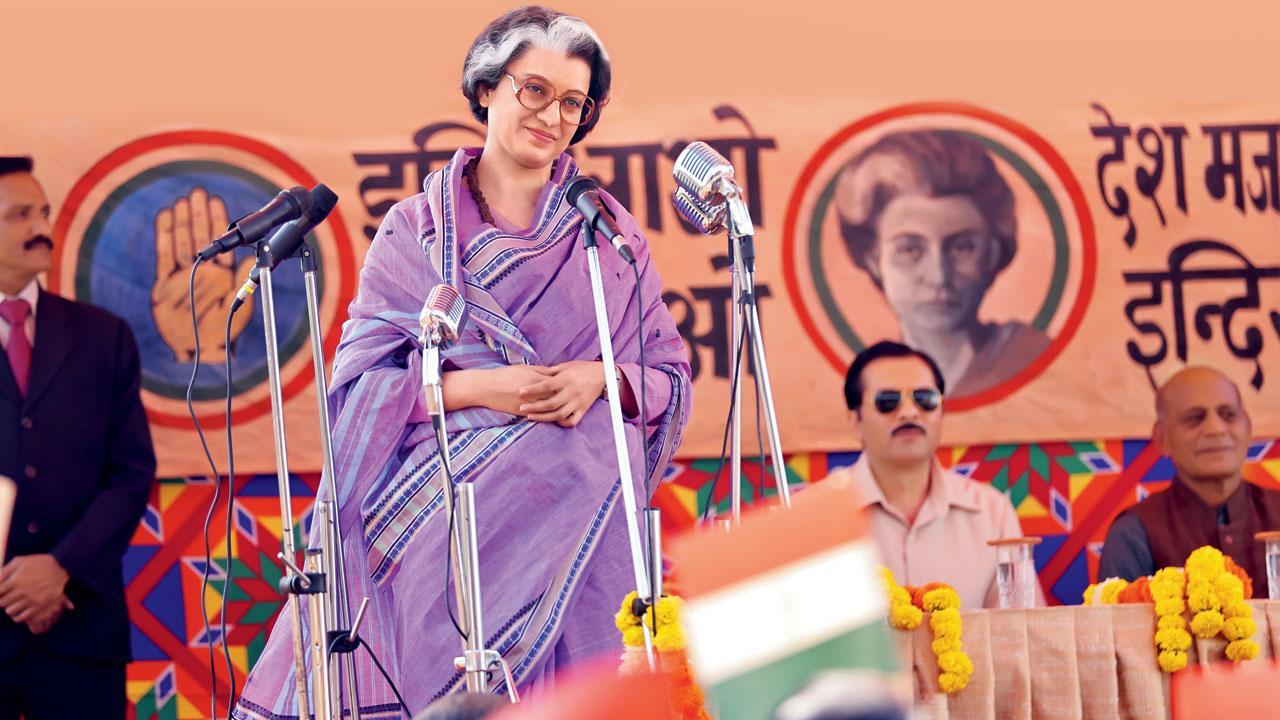
Amid speculation that Kangana has projected Gandhi in a negative light in Emergency, actor discusses portraying her as a mother and someone who loved her country
Upala KBR (MID-DAY; August 30, 2024)
Emergency could well be among Kangana Ranaut’s definitive films. It not only sees her wield the directorial baton after she co-directed Manikarnika: The Queen of Jhansi (2019), but also holds the potential to be her most memorable role. What made her tell the story of late Prime Minister of India, Indira Gandhi? Was it the allure of essaying one of the most formidable figures in Indian politics? Or the desire to decode the darkest chapter of Gandhi’s political career?
The actor-director says, “I didn’t begin with the intention of making a movie on it. Since I am a socially and politically-aware person, I started reading about the Emergency. Apart from Coomi Kapoor’s book [The Emergency: A Personal History], I read Mrs Gandhi’s autobiography. Her guru Jiddu Krishnamurti had told her to stop the Emergency and she told him, ‘I feel I’m riding a beast, which I loved riding initially, but now I can’t get off it.’ This gave me an insight into somebody who had a conscience. Mrs Gandhi’s life was such a beautiful Shakespearean tragedy. There is a throne, a person destined to be the queen, her opponents, and her internal battle with her conscience.”
Ranaut’s position as a Bharatiya Janta Party member has also coloured people’s perception of the biopic. Many feel that she may have projected Gandhi in a negative light. Broach this subject, and she says, “What is it like to love your country and be loved back? That thought took over my existence. It reached a point where I was sure that I’d make the film, even if I have to sell my house to do it. I’ve been judged so much that I’m fed up. This film will be a tight slap on all those faces, who think I’ve projected her in a negative way! They didn’t even give my film a chance. It’s a week away, at least watch it [before forming your judgment].”
With the biopic, Ranaut believes she has shown Gandhi’s different facets—as a woman, a mother, and a politician. “Mrs Gandhi loved her son [Sanjay Gandhi] so deeply and then lost him! As the character, it was one of the most difficult things for me to come to terms with. Her life had so much pain, trauma and drama. I was keen to make this film because people don’t know those aspects of her.”
Directing the film, she admits, was an intense job. “My revenue took a hit. As an actor, I can do three films in a year, but as a writer-director, I can only do one film in three years. Then you’re selling your own things to pay for the film. So, I will take some time before I direct again. Selling the movie was a challenge. The protagonist is in her 60s, and everybody in the movie is wearing khadi kurta pyjamas, but luckily Zee Studios stepped in.”
‘Kishore would sing to anybody’s tune but not the government’s’: A new book traces the life and times of Kishore Kumar
8:48 AM
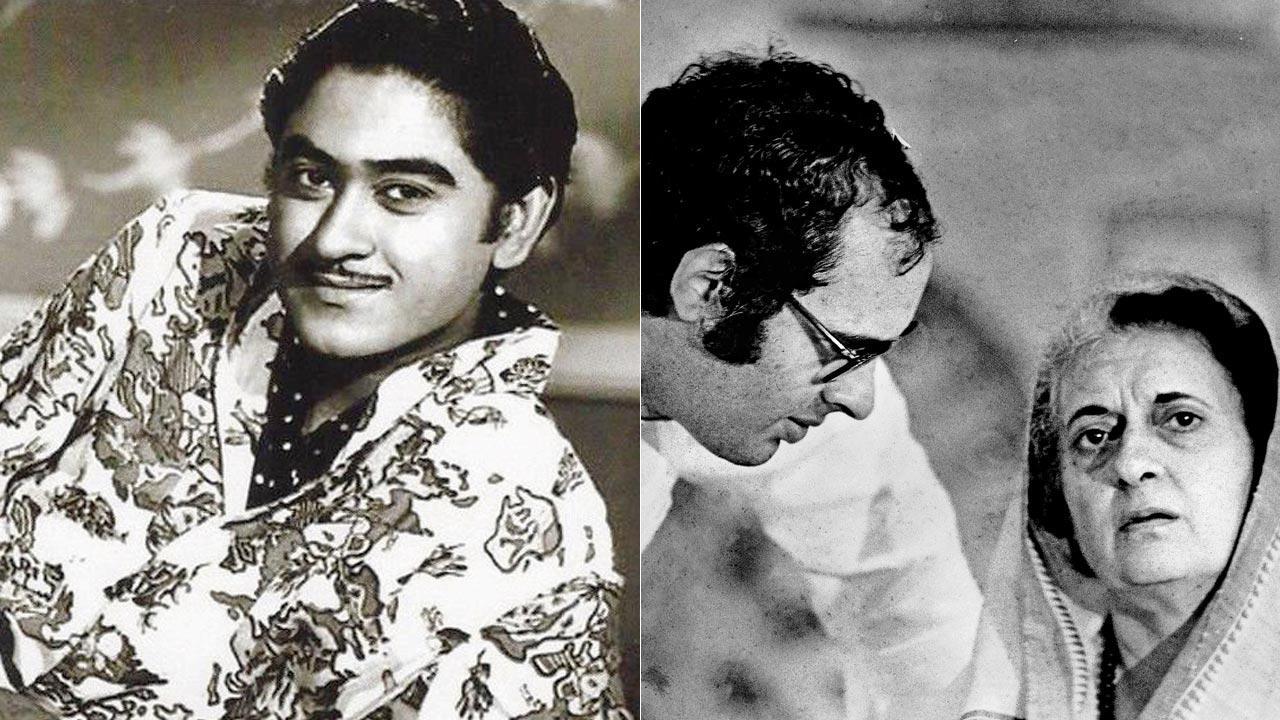
Pic/Wikimedia Commons; (right) Sanjay Gandhi with his mother, Indira Gandhi during the Assam session of the All India Congress Committee, November 19, 1976. Pic/Getty Images
He snubbed Sanjay Gandhi, and cared less about repercussions. A just-released biography looks back at the life and times of veteran singer-actor Kishore Kumar, whose impertinence was as legendary as his music
MID-DAY (October 16, 2022)
It was around January 1976. Geeton Bhari Shaam was Sanjay’s brainchild, and it was decided to rope in film celebrities to do films for television eulogising the Twenty Point Programme. The session was to be the antidote for a nation engulfed in despondency. And who better to lift them from the despair than Kishore, by now the authority on live shows?
He wanted Kishore to sing jingles in praise of the government and its schemes. “Wanted” would be a wrong choice of word for Sanjay of those days. It was more of a demand than an appeal. Kishore was basking in the glory of a Filmfare Award, his first in six years, when the trunk call came from Delhi. Not known to pick up phone calls directly, Kishore had made an exception that day.
“You have to come to Delhi. Sanjay Gandhi ka programme hai.”
“Who are you?” Now it was Kishore’s turn to “demand”.
“Burney.” It was a voice that reeked of unmerited power.
An infuriated Kishore was unusually cool and, for a change, politically correct.
“Please talk to my secretary or else take prior appointment.”
In his interview with Pritish Nandy, Kishore would set the record straight some nine years later. “Who knows why they come? But no one can make me do what I don’t want to do. I don’t sing at anyone’s will or command.”
The conversation would end there, but the confrontation had just begun. In those days, the Gandhi scion would not take no for an answer. Shukla needed to act in a hurry to save his job and honour.
Sayed Muzaffar Hussain Burney, the then Secretary in the Ministry of I&B, reported the conversation to his boss and was swiftly directed to arrange a meeting with some government officials and industry representatives in Bombay. The said meeting took place on 29 April 1976 and was attended by G P Sippy, the then head of the All-India Film Producer’s Council, director Shriram Bohra, B R Chopra, Subodh Mukerji and Nasir Hussain, among others.
Sippy tried to convince Kishore for the show but was snubbed. Sippy then explained to the officials that convincing Kishore was not their cup of tea and that ministry officials should contact him directly.
Next, it was the turn of Joint Secretary C B Jain to engage with Kishore. He spoke to the singer directly on phone and explained the government’s stance on the matter. Jain even suggested visiting Kishore to discuss the matter but was told that Kishore was not to see anyone as per medical advice. Kishore, during these years, was indeed suffering from hypertension, eosinophilia and other issues for which some live shows had to be curtailed midway.
By this time, Kishore was also mentally prepared to make a debut on the streets. With a harmonium hanging from his shoulders, he would sing to anybody’s tune but not the government’s:
I did what I thought best. Singing at private functions is definitely not an anathema. With genuine love and respect, I am only too eager to bend. However, if someone decides to rest his foot in my head, he will not have the good fortune to witness the best of my courtesies.
The film industry had attuned themselves to the eccentricities of Kishore, but for the mandarins at Delhi, this “impertinence” was not to be taken lightly. Note sheets were initiated, and the job was entrusted to Jain.
Jain’s note started with the meeting at Burney’s office, where Kishore Kumar’s name was mentioned as being one of those who was “non-cooperating”.
Therefore, the government needed to immediately ban the playing of Kishore Kumar records on AIR and Doordarshan for three months. Contact had to be made with the gramophone recording companies to request them to “freeze all records of Kishore Kumar’s songs” and to see that “no record of his should be sold”.
Jain had not finished yet. A list of under-production films with Kishore Kumar as the playback singer was also to be produced so that steps could be taken not to release any raw stock to “these productions”. It was also to be examined whether “such films could be refused censor certificate(s)”.
Still not satisfied, Jain took the matter to ridiculous proportions by exploring options regarding the broadcasting of songs by the BBC and if anything, “can be done to stop this”.
Based on Jain’s note, Burney would initiate his on 30 April, which Shukla would approve on 11 May 1976. The note read thus:
All the songs of Sri Kishore Kumar should be banned from AIR and DD and that all films in which he was the playback singer should be listed out so that suitable action can be taken against these films. Besides, the representative of HMV and Gramophone recording Companies should be sent for and, in consultation with the Ministry of Education, the sale of Sri Kishore Kumar’s records and discs should be frozen.
Strangely, the orders were issued even before Shukla had vetted the proposal. Exactly a week before that, on 4 May 1976, orders were issued by the Director General of AIR that songs by Kishore Kumar should not be broadcast and that film excerpts or films featuring him as a playback singer should not be shown on TV. All records of his songs should be kept in the “personal custody” of the head of the various AIR and TV centres. Three days later, on 7 May, another order followed, this time related to advertising spots featuring Kishore Kumar’s voice. They could be used but only without any mention of his name.
The ban had well and truly begun. For Doordarshan, which had just been separated from AIR a month previously, the start could not have been more inauspicious.
Reproduced with permission from Kishore Kumar: The Ultimate Biography by Anirudha Bhattacharjee and Parthiv Dhar, published by HarperCollins India
Akshaye Khanna to play controversial politician Sanjay Gandhi in Ekta Kapoor's next?
7:59 AM

Sources say Ekta Kapoor's digital wing working on biopic of controversial politician Sanjay Gandhi, Akshaye Khanna in talks for lead role
Mohar Basu (MID-DAY; May 6, 2019)
 While a film based on the late Sanjay Gandhi is reportedly being worked upon by Hansal Mehta, the politician seems to have caught the attention of Ekta Kapoor as well. mid-day has learnt that ALTBalaji is working on a biographical series, which has been titled The Prince. Sources say that Akshaye Khanna is in talks to play the titular role.
A source close to Kapoor informs, "Ekta has deputed a team to research on the political heir, who was seen as the right-hand man of mother and then Prime Minister Indira Gandhi.
The show will depict him as a young political scion, with an anti-hero slant. While his controversial initiatives - including the sterilisation programme - will find a place in the story, it is yet to be determined if the Emergency period will be the focal point. The final draft will be ready by August, with the project expected to roll by January 2020. The team has initiated a dialogue with Akshaye."
We reached out to Kapoor and Khanna, who hadn't responded till the time of going to press.
Madhur Bhandarkar hits back at claims of 'Indu Sarkar' being anti-Congress
8:04 AM

Sonil Dedhia (MID-DAY; June 21, 2017)
Recently, a spate of films, including Karan Johar's Ae Dil Hai Mushkil (2016) and Alankrita Shrivastava's Lipstick Under My Burkha faced political protest. The latest project to have become victim of criticism is Madhur Bhandarkar's Indu Sarkar. Inspired by the Emergency imposed in India in 1975, the film's protagonist is said to be based on then prime minister Indira Gandhi.
On June 19, Congress MP Jyotiraditya Madhavrao Scindia expressed strong reservations about Indu Sarkar, calling it a propaganda project by the BJP.
When contacted, Madhur Bhandarkar defended his film, saying, "There are many books, films, articles and even a five-part documentary [aired on Doordarshan] on the subject. Why didn't anyone object to them? I am not a fly-by-night filmmaker. I have been making hard-hitting, realistic films for 17 years, and they have been appreciated. Indu Sarkar is a period film set against the backdrop of the Emergency, with a touch of drama. The events in the movie are inspired by true incidents, and I thought it was important to tell this story, especially to today's generation."
On June 26, 1975, Indian president Fakhruddin Ali Ahmed drew on Article 352 of the Constitution to declare a state of internal emergency, stating that the "the security of India is threatened by internal disturbance". From then until March 21, 1977, Indira Gandhi took all measures to crush voices of dissent. Opposition leaders, including LK Advani and Jaiprakash Narayan, were arrested, media censored, and civil liberties suspended. The government also suspended the right to move court for enforcement of Fundamental Rights. The phase is often referred to as 'the darkest period in Indian democracy'.
There has been chatter that Censor Board chief, Pahlaj Nihalani, who has in the past made his allegiance to the ruling government apparent, will be lenient towards the film when it comes up for review, claiming that it doesn't require a no objection from the Congress party or the Gandhi family. Commenting on this, the filmmaker says, "There are no direct references in the film. Take the case of this dialogue -- Iss desh mein Gandhi ke maayane badal chuke hain. Who is to say which Gandhi I am referring to? I suggest that the film is seen in totality and then questioned. I'm going to take it to the censors in the next 10 days and hope no cuts are recommended."

Neil Nitin Mukesh to play Sanjay Gandhi in Madhur Bhandarkar's Indu Sarkar
7:49 AM

Renuka Vyavahare (BOMBAY TIMES; November 24, 2016)
 Madhur Bhandarkar seems to
have taken a break from exposing the underbelly of the entertainment
industry. BT has it that his next is a political thriller titled Indu
Sarkar, which is set against the backdrop of the 1975 Emergency,
imposed by then Prime Minister Indira Gandhi. Interestingly, Neil Nitin
Mukesh has been roped in to play Sanjay Gandhi, Indira's younger son.
The actor said, “It's great to team up with Madhur once again after Jail
(2009). The role is extremely challenging.“
The movie, which has drawn many real-life political references. revolves around the life of a poetess (played by Kirti Kulhari, one of the lead actresses in Pink). The character, who begins her journey as a stammering, unconfident girl, later gains courage to rebel against the system.
Madhur is doing extensive research for the project. Other than reading Vinod Mehta's book on Sanjay Gandhi, he has also been meeting veteran journalists and activists, who've closely watched that period. When asked if the film will revolve around the Gandhi family, the filmmaker said, “It's a fictionalised tale inspired by events that unfolded between 1975 and 1977.“
According to sources, the film will go on floors in December in Karjat, where Delhi will be recreated.
In San '75, we refer to Indira Gandhi as Queen & Sanjay Gandhi as Prince-Kabir Lovee
7:46 AM

Sanyukta Iyer (MUMBAI MIRROR; June 9, 2016)
After Sudhir Mishra's 2005 film Hazaron Khwahishein Aisi, debutant filmmaker Kabir Lovee's San 75 takes on a unique approach to portraying the Emergency era of 1975-77 with a madcap twist. "We're referring to Indira Gandhi as 'Queen' and Sanjay Gandhi, who was at the forefront of bringing technology into India, as 'Prince'," Kabir clarifies, further revealing that one of Indira's speeches has been officially adapted into a quirky rap number titled "Panic", which will be set against real footage from the period.
The period thriller begins from June 25, 1975, the day the Emergency came in to effect, and follows a German who brings the first mobile phone prototype, which cost Rs 40 lakh then, into India. Two local goons from Kakori who can't figure out what the mysterious object is kidnap him. "The incident piques the interest of intelligence and security agencies as they manipulate each other to get their hands on the phone," Kabir smiles at the thought of his film, adding that his leading man Kay Kay Menon's character resembles JNU student activist Kanhaiya Kumar. "He is an opportunist; he knows what is going wrong around him and moves from the good to the bad side."
The tonality of the film is styled with black wigs, long locks, bellbottoms, checkered shirts and a Dawood-esque spectacled look.
Directed by Navneet Behal, San 75 has been shot entirely in Lucknow on real locations of police stations, courthouses and markets, modified to resemble the 1970s.

Biopics of Rajiv Gandhi & Sanjay Gandhi in the pipeline?
3:11 PM

Subhash K Jha (DNA; July 5, 2015)
The Gandhi fixation continues in India — and we’re not
talking about the Mahatma here — but rather, the political dynasty that
stayed in power for several years.
We recently told you how director Manish Gupta has a script ready for an Indira Gandhi biopic starring Vidya Balan, but that the actress will only say yes once the necessary permissions from Sonia Gandhi are in place.
All the way from 2006 to the time of his death in 2011, director Jagmohan Mundhra struggled to bring out his biopic on Sonia Gandhi, but was served with a legal notice.
Then, in 2012 Bhavna Talwar announced a biopic on Sonia’s slain husband Rajiv, but the film never really took off after the scripting stage. While names like Abhishek Bachchan, Colin Firth and Riz Ahmed did the rounds for a while, we learn that Ranbir Kapoor’s name has also been cropping up of late and that the film will finally take shape soon and Abhishek is most likely to be picked.
Now, in 2015, filmmaker Hansal Mehta has just announced his project on Rajiv’s controversial younger brother, Sanjay Gandhi and is looking at names like Rajkummar Rao, Arjun Kapoor and Varun Dhawan. Only time will tell, who makes the cut for the role. Both films are expected to release mid-2016. Will we see a clash of the Gandhi brothers at the box- office?
Hansal Mehta to make a biopic on Sanjay Gandhi
7:52 AM

Priya Gupta (BOMBAY TIMES; July 3, 2015)
The eminent late journalist
Vinod Mehta had written a book on the life of Sanjay Gandhi
titled The Sanjay Story. We have learnt that prior to Vinod passing away, the rights to the book were acquired to be made into a film. The
film that is yet untitled will go on the floors next year after Hansal Mehta
completes Simran with Kangana Ranaut this year and will be directed and
co-produced by the National Award-winning director Hansal himself. This
will be the first feature film ever made on any member of the first
family of Indian politics the 'Gandhis'. Quoting Vinod Mehta, “To engage
with the present, the country must come to terms with the past.“ It's
interesting to note that Hansal has announced his film in the 40th year
of the Emergency.

Subscribe to:
Posts (Atom)