Showing posts with label Sandesh Shandilya. Show all posts
Showing posts with label Sandesh Shandilya. Show all posts
Convincing Ustad Rashid Khan to sing Aaoge Jab Tum wasn’t easy-Imtiaz Ali
8:19 AM
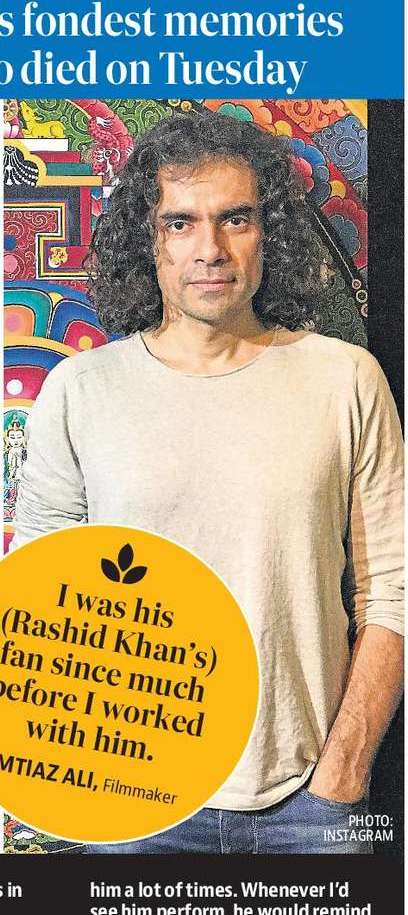
Imtiaz Ali remembers working with the late Ustad Rashid Khan for Jab We Met
Sundas Jawed (BOMBAY TIMES; January 11, 2024)
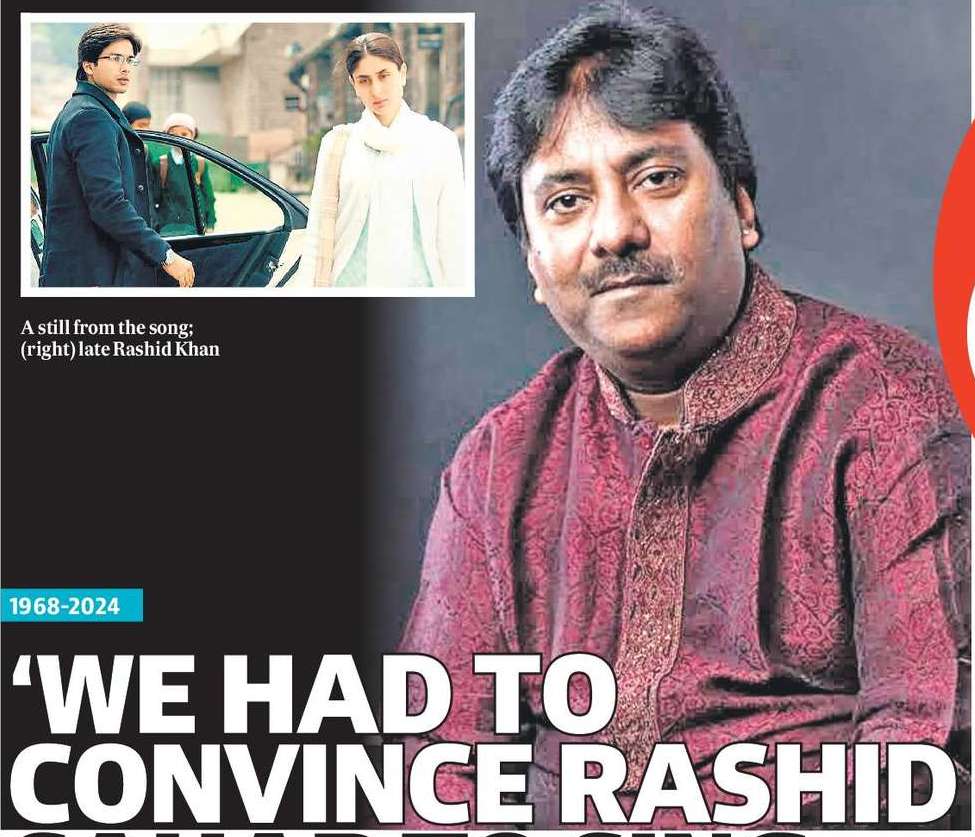
Ustad Rashid Khan, whose mastery over Indian classical music earned him awards and accolades around the world, became a household name with Jab We Met's iconic song Aaoge Jab Tum. Filmmaker Imtiaz Ali expressed his grief at his demise: “Losing him at this age is unfortunate for all of us. The amount of love, dedication and hours he gave to music is a blessing for all of us.”
Collaborating with the maestro for ‘Aaoge Jab Tum’
It wasn’t easy to convince Ustad Rashid Khan to sing for Jab We Met, recalled Imtiaz. “He was not ready to sing for the film because it is not usual for Ustads to do playback singing. But Sandesh (music director Sandesh Shandilya) was eager to have him on board. He went all the way to Kolkata to invite and convince him,” said Imtiaz, adding, “He finally agreed because he figured out how serious we were about collaborating with him and also the fact that we were big fans of his music. The way he embraced the song is evident in the fact that ‘Aaoge Jab Tum’ is the most famous and well-loved song from the Jab We Met album. Etched in our memories, it will live forever.”
Despite his stature, Ustad Rashid Khan was a keen learner. “During the recording he used to tell us that ‘Don’t treat me like an Ustad, but a newcomer because I am new to this (playback singing),” recalled Imtiaz.
A childhood icon
“I remember going for his classical concerts in Jamshedpur. I was always a big fan of his singing, but after working with him I was enamoured and in awe of him. He had invited me to Kolkata last year for his son’s music event. Although I could not make it to teh concert, it was the last time we spoke,” said Imtiaz.
---------------------------------------
Filmmaker Imtiaz Ali recalls his fondest memories with maestro Rashid Khan, who died on Tuesday
Rishabh Suri (HINDUSTAN TIMES; January 11, 2024)
For 16 years now, Aaoge Jab Tum from Jab We Met has been the undisputed anthem for broken hearts, and director Imtiaz Ali credits Rashid Khan’s soulful voice for making it the classic that it is.
Remembering the late maestro — who died at the age of 55 after a prolonged battle with cancer — Ali tells us, “I was his fan since much before I worked with him. The first time I met him was when I had attended his live recital of the Megh Malhar (a Hindustani classical raga). It started raining when he sang, and the belief is that when someone sings the Malhar well, it rains. That’s my first memory of him.”
Ali’s regard for Khan grew further when they went on to collaborate for Aaoge Jab Tum. “I realised how simple he is. He said, ‘Don’t think of me as a big singer. I am a newcomer who has never sung in a recording, so you have to guide me’,” the 52-year-old recalls, adding, “In fact, we had to convince him to do the song. It wasn’t an instant yes from him. And now, the track is perhaps the most popular one in my repertoire.”
Ali attributes Khan for giving the song a life of its own: “It lives on forever and that is owing to him and what he acquired over years and years of practising in the gharana. That is what brings that larger-than-life quality to his work.”
The filmmaker and the late classical singer would often have conversations about the song. Last year, Khan invited Ali to an event that marked the beginning of his son’s musical journey. “I couldn’t make it, but it was the last time we spoke... I’ll always be grateful to him for Aaoge Jab Tum. It was a blessing for my film,” Ali ends.
Rewind to 2001: Composers walk down memory lane
9:41 AM

Did you know that the title song of Dil Chahta Hai was first made for a romantic sequence, or that Rehna Hai Terre Dil Main was composer Jayaraj’s debut film? As three music-classics turn 20, composers walk down memory lane
MID-DAY (January 25, 2021)
Karan Johar would create a visual portrait for music composers: Sandesh Shandilya
Right from the fact that Karan Johar was creating it, to the stellar star-cast associated with the film, there were several factors that served as inspiration for creating the soundtrack of Kabhi Khushi Kabhie Gham. Karan would often enact situations when attempting to highlight what he wanted. I recall, for Sooraj Hua Madham, he read and enacted the [preceding] dialogues, and then the song.
It was easy to visualise the scenes and work on creating the compositions, and that effort went a long way in ensuring that we made promising tracks. I admired [his idea] for the song Vande Mataram, where he wanted to showcase the [beauty] of India as the protagonist roamed the streets of London. He had been working on this film for two years, and left no scope for discrepancies when expressing what he expected. This was among my first few projects in the industry. My team and I studied music trends that were popular during the time. While You Are My Soniya and Sooraj Hua Madham were immediately approved, three iterations of Deewana Hai Dekha had to be made.

DCH had many genres: Shankar Mahadevan
Dil Chahta Hai was among Shankar-Ehsaan-Loy’s first few projects, so we didn’t have any inhibitions, because people didn’t have preconceived notions about what we could deliver. That worked in our favour. Also, I believe the soundtrack did well because we approached it differently. It had jazz music, as well as Indian, Western and Scottish folk. Koi Kahe introduced trance to [listeners]. And while a layman may not technically understand the genres, he can analyse that it is new. Farhan [Akhtar], Ritesh [Sidhwani], Javed ji [Akhtar] and we [SEL] headed to Ritesh’s Khandala bungalow to create the soundtrack.
We had allotted 10 days for it, and wrapped it up in the first three. It was made with ease, and amid laughter. It was among my most memorable experiences. I remember sitting on a swing with Javed ji and analysing how we should make Jaane Kyun. We both agreed that instead of being a typical love song, it should have a conversational undertone, where the [characters] analyse the pros and cons of falling in love. Javed ji said, ‘Haan, aisa gaane hona chahiye jo samjhaye ki, jaane kyun log pyaar karte hai’. That was it. Sitting on the swing, we finished composing it within 10 minutes.
Royalties outweigh salary from film: Harris Jayaraj
Barring two tracks — Dil Ko Tumse and Rehna Hai — the entire soundtrack was initially created for the original version, the Tamil film, Minnale. We were told that Mr Vashu Bhagnani wanted to create it in Hindi as Rehna Hai Terre Dil Mein, and retain the soundtrack. But, he wanted a few songs with a North Indian feel. So, we made the two additional numbers. But love songs [transcend] barriers of language, anyway. Arabic, Tamil, and English cover versions of the film’s songs have been made over the years, and I still receive royalties.
The royalties I have received have been more than my salary for the film. We had enjoyed working on the soundtrack, and that reflected in its music. The only thing I was [apprehensive about] was the song Vaseegara, which was remade into Zara Zara. Vaseegara had already become a hit in both, the Tamil and Telugu industries. Apart from its music, the lyrics were also immensely appreciated. So, recording it in Hindi again [posed its own set of challenges]. I was keen to retain the original singer, Bombay Jayashree, who also made [her] debut with the film, and created magic with it.

Sandesh Shandilya's world music symphony Search For Buddha to premiere in Germany on Feb 7
7:46 AM

Sandesh Shandilya has composed and co-produced a world music symphony that will premiere in Cologne
Roshmilla Bhattacharya (MUMBAI MIRROR; January 23, 2015)
For the last three years, Sandesh Shandilya who has composed the music for 27 Indian films, including Chameli and Jab We Met, has been missing in action. He had a release last year, Rang Rasiya, but he'd worked on that film five years ago.
Now, Mirror has learnt that Sandesh was working on a world music symphony, Search For Buddha, which will have its world premiere in Cologne, Germany, on February 7, followed by a show in Bielefeld the next day, and then a UK premiere in London. "We plan to have shows around the world, in India too," he says.
The composer admits that he always wanted to create music with a message of world peace. Buddha became the symbol after he took a course in Vipassana Meditation which put him in touch with his inner self through 10 days of silence. "I learnt that by conquering anger, lust, greed, fear and attachment, you can be at peace with yourself and bring peace to the world," he recalls.
Buddha's inner journey will be traversed by 60 musicians from Germany, Hungary, UK Japan, the Middle East, South Africa and India, 40 members of the WDR Funkhaus Orchestra and the WDR Radio Choir and five soloists, including Rhani Kriya, Strings' percussionist on the drums and Markus Stockhaousen, his co-producer, on the trumpet/flugelhorn. "During rehearsals I noticed that the music sounded western classical so I decided to draw musicians from all over," he says.
Sandesh has also arranged the music with Christopher Masand and will do some folk-singing. The symphony will be conducted by Wayne Marshall, but some day soon, like Zubin Mehta, Pandit Ravi Shankar, Illayaraja and Pyarelal, Sandesh would like to conduct too.
All the musicians have been gifted a CD of Rang Ransiya. "Marcus introduced me to the WDR Funkhaus Orchestra, they loved the symphony and when they quizzed on my previous work, I played Rang Rasiya for them which mesmerised them," he reminisces.
Will this new journey bring an end to his Bollywood tenure? "I'll do only two-three shows a month which means I'll be in India for 20 days," he asserts, saying he's working on iPad with Road to Sangam director Amit Roy, Satra Ko Shaadi for John Abraham, Time Out and Sudhir Mishra's Aur Devdas. "Aur this Devdas will have a contemporary score," he says.
Jugalbandi of Kailash Kher & Folk singers makes Anhad naad unforgettable-Sandesh Shandilya
7:35 AM

Roshmilla Bhattacharya (MUMBAI MIRROR; October 16, 2014)
Rang Rasiya is Ketan Mehta's biopic on Raja Ravi Varma, the celebrated 19th century Indian painter known for his depiction of scenes from the epics, The Ramayana and The Mahabharata and for giving a human face to gods and goddesses.
In the film, Ravi Varma undertakes a journey in his quest for a muse. It began from Baroda, coursed through the deserts of Jaisalmer, took a tour of Khajuraho temples before ending on the ghats of the Ganges in Benares.
His travels are explicitly detailed in the script and Mehta wanted to recreate the artist's trek through a song. "In his brief to me he mentioned a phrase which was common in Sufi poetry a 100 years ago. Anhad naad jaga de is a prayer to the lord for a muse," recalls composer Sandesh Shandilya, explaining that 'anhad' means limitless, and 'naad' is a sound created by God, present everywhere yet only visible to the inner eye, which can inspire an artiste to achieve creative highs.
With the phrase as the starting point, lyricist Manoj Muntashir came up with a song which evocatively describes the painter's struggle ... Main dhoondun tunjhe galli galli, main dhoondun tujhe charon aur, o mere mann ke chor. Har jog mein tu, sanjog mein tu, main tujh mein, aur mujh mein tu, ab chahe jitna mere mitwa, aaja aa jee bhar ke jag-jhor, jhor. And ends with a prayer to the Lord, Anhad naad jaga de, jaga de re.
Sandesh set it to tune using a century-old harmonium, a sarangi and the Middle-Eastern wind instrument called bahu to recreate the rustic melody of the times. "Anwar Khan, a Sufi folk singer from Rajasthan, and his team also brought with them the sound of the kartal," he says.
Anwar and his troupe were flown down from Rajasthan and their first few days in Mumbai were devoted to listening to the song, feeling it and letting it seep into their souls. "These folk singers are not used to the regimental ways of film recording. I didn't want them to sacrifice their khulapan, their freedom of self, so we gave them time to adapt to our ways before taking them to the recording studio where Kailash Kher, a modern-day folk singer, joined them. Their jugalbandi makes Anhad naad jaga de unforgettable," he says.
It took a month for the song to take shape.
It was recorded three-four years ago. "We remixed it again because the technology at our fingertips today is far superior to what we used back then, and it's just fresh and universally appealing going by the reactions we've been getting from all over the world," he smiles.
Sandesh admits that it was worth devoting six months exclusively to the film's score. "It was like I took a dip in this ocean of music and emerged from it after six months. I have no memory of the struggle, all I have acquired from this sublime experience are eight beautiful songs, five of which you will get to see and hear in Rang Rasiya. It's like a miracle of sorts," says the awed composer who believes that Rang Rasiya is his biggest film of the decade.
He remembers how impressed he was with Milos Forman's Amadeus that depicted the life of Wolfgang Amadeus Mozart and believes that this film would have a similar impact on the audience . "Everyone should watch this film at least once," he asserts.
Rang Rasiya songs: Colours from another era
7:39 AM

Roshmilla Bhattacharya (MUMBAI MIRROR; August 28, 2014)
Five years ago, when Ketan Mehta approached Sandesh Shandaliya with the script of Rang Rasiya, the inspired music director instantly came up with a mukhda using just the two words of the title.
The connect was immediate. As Sandesh points out, the film's artist hero, Raja Ravi Varma, was from his community, his world. His story is that of every artiste. The meditative state, the creative flourishes, the lifelong struggle to make his art reach out to the world was something he could easily relate to and empathise with. "It was almost like seeing my life unfold before my eyes even though before I started work on the film, I was clueless about this man who hailed from another century. It is a beautiful story and it offered me a huge canvas and a gamut of emotions to play with," he smiles.
Thereafter, Sandesh collaborated with Manoj Muntashir to come up with the rest of the lyrics."Today, Manoj is well known in music circles for the Ek Villian chartbuster, Galliyan. Back then, he wasn't a familiar name. But the song he presented us with, flirting with words and hues, was poetry at its best. We didn't feel the need for even minor changes," he recalls.
Rang Rasiya was recorded five years back, and the delay, he insists, wasn't disheartening. Being a period film, it will never look outdated. And as Ketan pointed out to him, the extra time gave him an opportunity to improve on this song and five others.
"We mixed this track again early this year. With more sophisticated software at our fingertips today, it's definitely sounding better," asserts Sandesh.
He insists that every artiste-- be it a singer, composer, actor or writer--like a child starts from zero. "We create something out of nothing and need someone to inspire us. I found that man in Ketan. Bahut hausla diya hamein unhone," he reveals, adding that as an artiste he is not insecure or afraid of criticism. "I don't overthink. I just go with my heart rather than follow my head."
In this case however, since the film is a fictionalised biopic of a legendary 19th century artist who left an indelible mark on Indian art and culture with his paintings of Gods and Goddesses inspired by his muse and lover, Sugandha, a certain amount of research was involved. "I discovered that in the late 1800, the British era, Indian folk and classical music blended beautifully with Western classical strains. You'll see this fusion in our music too," says Sandesh.
Also, since Raja Ravi Varma was from South India, they used a lot of Kerala's local traditional instruments which are played during festivals and by wandering minstrels. "You can hear the Panch vadiyam in this song," he promises.
Sandesh is best remembered for the evergreen Piya Basanti Re even though he has scored hardcore commercial hits like Kabhi Khushi Kabhie Gham's You Are My Soniya, and Chameli's Saat Samundar. For him music has no boundaries, classical flows into the commercial and back.
"The idea is to create variety. Monotony bores you and others," he reasons. "Sunidhi Chauhan and Keerthi Sagathia's melodious, romantic Rang Rasiya is undoubtedly the best song I have composed to date."
The Randeep Hooda-Nandana Sen starrer is releasing this Diwali, along with Shah Rukh Khan's home production, Happy New Year, and Indra Kumar's Rekha starrer, Super Nani. Will he, with his songs, be able to draw people to the theatres? "The effort always is to reach out to the maximum number of people and this kind of a film is Ketan's forte. It's a bhandaar of knowledge for both the young and the young at heart. I'm sure even those who don't see it today, will see it tomorrow. It's the kind of album you'd want in your library," he says.
Rang Rasiya is the first song to be released online. And the response, says Sandesh, has been encouraging. "I hope this is just the beginning of a colourful musical journey," he smiles and croons...
Lal, peele, hare, champai, surmayi
Ek tu hai magar tere rang kai,
Mohe rang de re, rang de re...
Ustad Hamid Ali Khan records his first ever Bollywood song for Kya Dilli Kya Lahore
7:44 AM

Asira Tarannum (MID-DAY; April 11, 2014)
 Ustad Hamid Ali Khan has sung a song for Vijay Raaz’s directorial debut,
Kya Dilli Kya Lahore. This is the first time that he has recorded a
track for a Bollywood film. Belonging to the Patiala gharana, Ustad
Hamid Ali Khan is the son of Ustad Akhtar Hussein Khan and the youngest
brother of singers, Bade Fateh Ali Khan and Amanat Ali Khan.
Dealing with the subject of Indo-Pak partition, Kya Dilli Kya Lahore is an upcoming film set in 1948; it is being presented by Gulzar and stars Vijay Raaz, Manu Rishi, Raj Zutshi and Vishwajeet Pradhan in lead roles.
Sandesh Shandilya, the film’s music composer, says, “We recently met Ustad Hamid Ali Khan at an event that was held in Amritsar. When we requested him to record a song for our film, he readily agreed upon hearing that Gulzarsahab is associated with the project. It turns out that both of them share a very good equation. Soon after, he came down to Mumbai for two days and recorded the song, Kaleje mein lag jaati toh kya hota. It’s an emotional song that advocates putting humanity above border scuffles.”
Shandilya adds that since the film revolves around Indo-Pak relationship, they have roped in singers from both countries for the film’s soundtrack. “There are four songs in all; while Sukhwinder Singh and Papon have recorded one song each, the other two have been sung by Pakistan’s Shafqat Amanat Ali Khan and Ustad Hamid Ali Khan respectively,” he says.
Subscribe to:
Posts (Atom)