Showing posts with label Salim-Sulaiman interview. Show all posts
Showing posts with label Salim-Sulaiman interview. Show all posts
There is favouritism when it comes to music labels choosing artistes, say Salim-Sulaiman
8:32 AM

Nikita Deb (HINDUSTAN TIMES; August 8, 2020)
Music composer duo Salim Sulaiman have been part of the Indian music industry for almost three decades, and without having any inside connections in the industry, they managed to make a mark. Hence, they find themselves on the opposite side of the favouritism debate.
But while Sulaiman believes “hard work is everything”, his brother and the other half of the duo, Salim, agrees that favouritism does exist in this industry much like it does in every other sector. “There is favouritism when it comes to labels giving opportunities to artistes who are signed with them, and that is fair. It’s their business model, but it’s not fair to artistes who are amazing. And that’s why, we have started a record label for a beautiful creative community to come together where we give equal chances to known and unknown singers,” says Salim.
Since the lockdown, a lot of singles have released and done relatively better. Sulaiman feels that the non-existence of Bollywood music for almost four months has helped the genre. “Earlier, producers released songs to enhance their films, but now, no Bollywood music is releasing either, and that’s given a great window of opportunity for independent musicians to showcase their music on various platforms,” adds Sulaiman.
The duo’s new single titled Beech Raaste has crossed one million views on YouTube and the composers feel that though the lockdown has a lot of negative aspects, “it’s a great time to make music”. “Things are going to be a little difficult for composers and performers, but we just have to reinvent ourselves,” signs off Salim.
Bhoomi is our best work in 15 years - Salim-Sulaiman
8:35 AM

Set to present their labour of love, Bhoomi, as part of their newly launched record label, Merchant brothers Salim, Sulaiman on creating music devoid of commercial tropes
Sonia Lulla (MID-DAY; July 13, 2020)
A sense of agitation is making itself evident in the Bollywood music industry. It began with disregard for the trend of rehashing old ditties — with some original composers even threatening to take legal action against those meddling with their compositions — and extended to expressing disdain over creative calls being taken by the men in suits running record companies. However, the disquiet is paving the way for something great. Weeks after revered musician Amit Trivedi vowed to celebrate music that appeases his heart with his label, AT Azaad, composers Salim-Sulaiman have launched Merchant Records, which will also celebrate talent that is discredited by Bollywood.
"We have been making non-film music, and collaborating with artistes from India, America and UK for a while. We want to continue to do so; take the back-seat as composers and bring new talent [to the fore]," says Salim, adding that the label's first release, Mangi duaein will feature Raghav Chaitanya, who "didn't get a chance in the past due to the mafia labels".
Set to release today, the song will be followed by another Merchant Record-offering towards the close of the month, and successively, with a new single every 15 days. "The track at the end of July will be helmed by two incredible artistes who are more established. They've also come together for a song of ours in the past. Next month, another commercial Punjabi dance track will be out. It will feature a new singer. Then there are two more tracks that eye a September release," says the musician, who also hopes to collaborate with his favourites from the industry, including Mithoon, Clinton Cerejo, Ranjit Barot and Karsh Kale.
It is, however, another venture being presented by the label that particularly piques our interest. In a previous interaction with mid-day, the musician jumped to the edge of his seat when discussing his "most desirable, cherished and revered project". "It's the best thing we've done in the last 15 years," he had said of his upcoming album, Bhoomi, which was to initially release in April before the pandemic compelled them to defer it. "Twenty years ago, we had created an album by the same name, and got singers from across India for it. It had artistes from Kashmir and Bengal being featured in it, and language wasn't a barrier. Record labels said India wasn't ready for it. Then, we got busy with making film music, but continued to cherish that album. No one had created something of that kind before," Sulaiman said, as Salim added that the experience encouraged them to take things into their own hands.
The seven-track offering features artistes including Arijit Singh, Shreya Goshal, Jonita Gandhi, Nikita Gandhi, Salman Ali, Osman Mir, and Kaushiki Chakraborty, among an array of other musicians. "While most of these are our own compositions, we've revisited two classic thumris. We had wanted to give them a different touch and colour. While doing that, there is so much that I learnt about my own music [sensibilities]. I found a different way to [express] myself because we were not bound by the commitments of creating it around a story, or other commercial requirements. It was an effort to experiment with music, and the result has been magical. We will continue to [bring out such albums] each year."
Before the pandemic established a new normal, the composer duo would frequently log air miles as they travelled for live gigs across the globe. Cooped up at home, Salim finds himself busier than he has been as he breathes life into projects that were stuck in limbo owing to their busy schedule. "One of those is our merchandise brand," he says of the recently launched apparel line that features lines of their Bollywood songs.
The hardest part about a musical is the casting-Salim and Sulaiman Merchant
8:01 AM

Set to follow their Broadway adaptation of Umrao Jaan with Disco Dancer, composer duo Salim-Sulaiman on transitioning from musicians to storytellers
Sonia Lulla (MID-DAY; March 9, 2020)
Seated at a spacious studio, Salim and Sulaiman Merchant are weaving for us a tale that is set to open for theatre-going audiences on March 27, through 29. The months that they have spent breathing life into the Broadway adaptation of Disco Dancer hasn't diminished their fever. It is palpable in the twinkle in their eyes as they discuss "adding a dramatic ma-beta angle", employing lavish LED sets to depict "Bombay of the '80s", and "lowering of two telephone booths for a scene."
As they discuss Saregama Carvaan's adaptation of Mithun Chakraborty's 1982 musical for the stage, which follows the composer duo's successful Umrao Jaan, it is evident that they've emerged from being musicians to story-tellers. "The hardest part about a musical is the casting," says Salim, adding, "In India, finding someone who can sing, dance, and act, is a big challenge. While people may excel in one or two [skills], it's tough to find those who are good at all three. And we need to find at least five of them." The journey to merely zeroing in on the lead actors took them seven months, reveals Sulaiman. "Our country is not geared [to creating] a sampoorna kalakar, or true performer. Our aim was to find a good singer. That's the toughest part, since all the singing is done live. We identified singers who are good-looking, and then sent them to acting class." The unit roped in to feature in the production is currently on a fitness programme designed to build endurance, and hence, enable them to sing appropriately, without struggling for breath in the midst of dancing stints.
Employing larger than life screens and abundant technology meets a two-fold purpose. Firstly, it enables them to transport viewers back to the '80s with visuals from the era. "Also, since the story demands that we create backdrops, like the inside of a police station, or [scenes from] Goa, we needed to avoid moving sets since we want this show to travel to Delhi, US and the UK."
A great story, and a promising soundtrack are the essential factors to consider when choosing a film for a theatrical adaptation. But as cinema does with reality, the duo also takes creative liberty when adapting a project for their platform. While they "introduced a conflict" in Umrao Jaan via the addition of a character, they've added comic relief to Disco Dancer by featuring a Goan friend of the protagonist, Jimmy. "We created a character called Anthony, who is Jimmy's childhood friend. The comic relief is important for people to enjoy it."
The duo has gone to great lengths to ensure Bappi Lahiri's compositions are retained "exactly the way they were" in the original film, even taking off to New York and Prague to record with instruments popular in the '80s, but no longer available in India. "Apart from his tracks, we have three original compositions. There's a beautiful love song to give [viewers] a break from all the disco [tracks]. The other a track made for a film. It's called Yaaron main toh star ban gaya, and depicts Jimmy's growth from a nobody to a superstar. It has Latin and Brazilian beats. The third is an instrumental number which comes at a crucial point. It's [along the lines of] an opera, but we're contemplating adding a song there as well."
Whether it was when creating four original songs for Umrao Jaan, or the three that they did for this offering, the duo is mindful of the music style of the original composer "so that a listener can't differentiate a fresh composition from the [original soundtrack]". "With Umrao Jaan, we tried to create songs befitting Khayyam saab's compositions. In Disco Dancer, we've retained every cheesy element that Bappi da used, and became popular."
We’ve tried to compose a good melody rather than running after creating hits - Salim-Sulaiman
10:47 AM
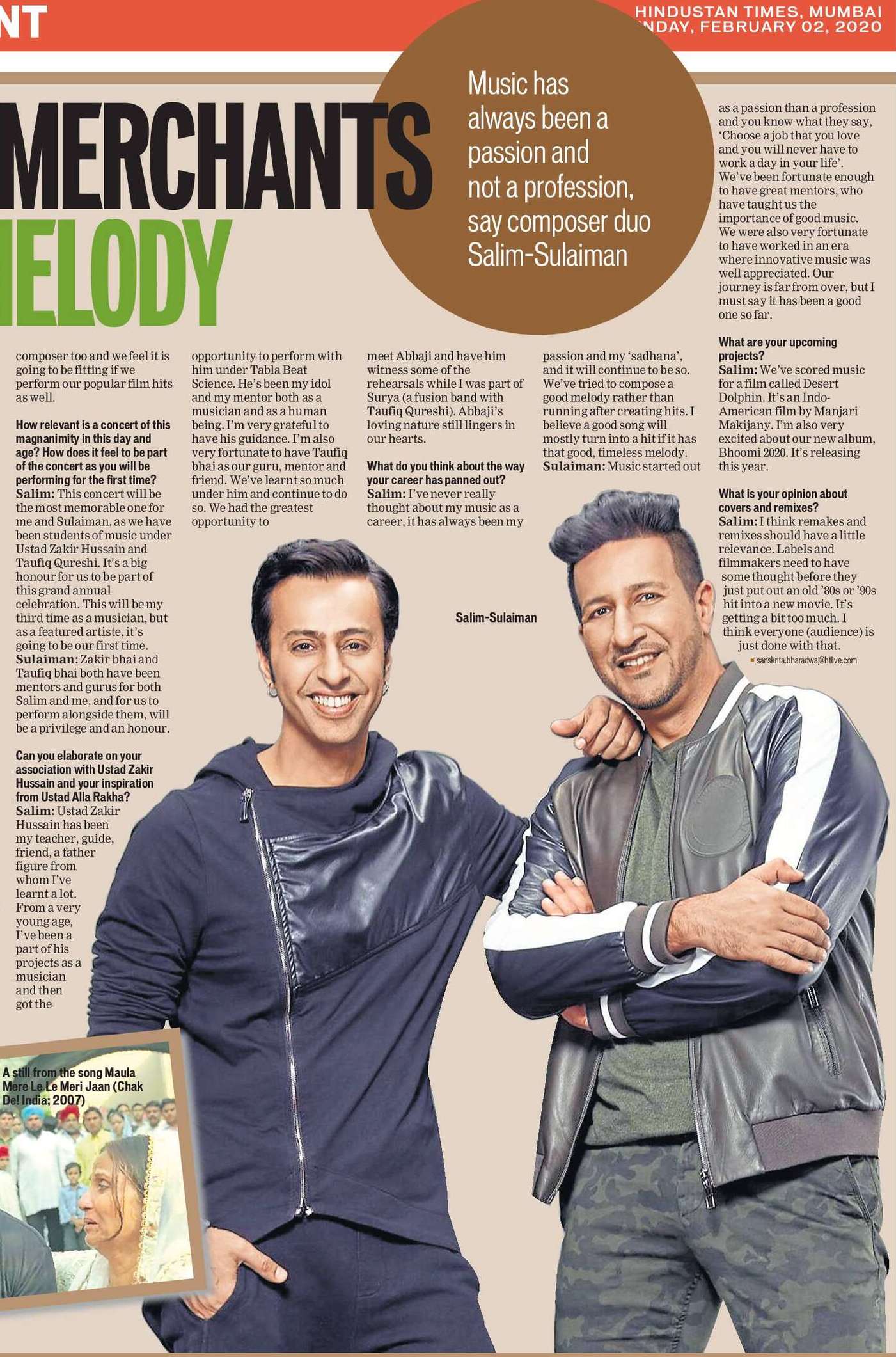
Music has always been a passion and not a profession, say composer duo Salim–Sulaiman
Sanskrita Bharadwaj (HINDUSTAN TIMES; February 2, 2020)
Music composers Salim–Sulaiman grew up in a family where music was a tradition. Salim mastered the piano at the Trinity College of Music in London, UK, while Sulaiman took up tabla training with legends such as Taufiq Qureshi and Ustad Zakir Hussain.
Composing music for over two decades now, they have scored for films like Chak De! India (2007), Rab Ne Bana Di Jodi (2008) and Fashion (2008), among others. Over the years, the duo have also composed for many indi-pop performers including Viva, Aasma and Shweta Shetty, among others, composed and produced several TV commercials and collaborated with many artistes.
In an upcoming tribute concert titled Ustad Alla Rakha - A Homage to Abbaji, the duo will be performing to pay their respect to the timeless legacy of the tabla maestro. The two spoke to us about their love for music, the concert and their future plans. Excerpts:
What does your set for Ustad Alla Rakha — A Homage to Abbaji consist of?
Salim: Our set is going to be a mix of some folk fusion compositions that we have composed for another music show. It will also have some devotional songs featuring the Manganiyars of Rajasthan. Abbaji was a film composer too and we feel it is going to be fitting if we perform our popular film hits as well.
How relevant is a concert of this magnanimity in this day and age? How does it feel to be part of the concert as you will be performing for the first time?
Salim: This concert will be the most memorable one for me and Sulaiman, as we have been students of music under Ustad Zakir Hussain and Taufiq Qureshi. It’s a big honour for us to be part of this grand annual celebration. This will be my third time as a musician, but as a featured artiste, it’s going to be our first time.
Sulaiman: Zakir bhai and Taufiq bhai both have been mentors and gurus for both Salim and me, and for us to perform alongside them, will be a privilege and an honour.
Can you elaborate on your association with Ustad Zakir Hussain and your inspiration from Ustad Alla Rakha?
Salim: Ustad Zakir Hussain has been my teacher, guide, friend, a father figure from whom I’ve learnt a lot. From a very young age, I’ve been a part of his projects as a musician and then got the opportunity to perform with him under Tabla Beat Science. He’s been my idol and my mentor both as a musician and as a human being. I’m very grateful to have his guidance. I’m also very fortunate to have Taufiq bhai as our guru, mentor and friend. We’ve learnt so much under him and continue to do so. We had the greatest opportunity to meet Abbaji and have him witness some of the rehearsals while I was part of Surya (a fusion band with Taufiq Qureshi). Abbaji’s loving nature still lingers in our hearts.
What do you think about the way your career has panned out?
Salim: I’ve never really thought about my music as a career, it has always been my passion and my ‘sadhana’, and it will continue to be so. We’ve tried to compose a good melody rather than running after creating hits. I believe a good song will mostly turn into a hit if it has that good, timeless melody.
Sulaiman: Music started out as a passion than a profession and you know what they say, ‘Choose a job that you love and you will never have to work a day in your life’. We’ve been fortunate enough to have great mentors, who have taught us the importance of good music. We were also very fortunate to have worked in an era where innovative music was well appreciated. Our journey is far from over, but I must say it has been a good one so far.
What are your upcoming projects?
Salim: We’ve scored music for a film called Desert Dolphin. It’s an Indo-American film by Manjari Makijany. I’m also very excited about our new album, Bhoomi 2020. It’s releasing this year.
What is your opinion about covers and remixes?
Salim: I think remakes and remixes should have a little relevance. Labels and filmmakers need to have some thought before they just put out an old ’80s or ’90s hit into a new movie. It’s getting a bit too much. I think everyone (audience) is just done with that.
It’s beautiful to make music that has absolute creative freedom - Salim-Sulaiman
7:44 AM

Popular composer duo Salim-Sulaiman complete 25 years in the music industry
Kasmin Fernandes (MID-DAY; September 12, 2016)
Maverick at technique, musical duo Salim and Sulaiman Merchant have carved a niche for themselves in Bollywood in their journey spanning over two decades. The Emmy-nominated duo (for Nickledeon show Wonder Pets: Save the Bengal Tiger) have ventured into Hollywood (with the film Sold) and nurtured talent like upcoming Bollywood singer Raj Pandit. A new musical documentary Shukranallah celebrates their musical journey over the last 25 years. Excerpts from a chat with Salim:
Your latest single Tu Hai features Internet sensation Jonita Gandhi.
Tu Hai is the fourth song in the YouTube Jammin line-up. It is an upbeat club track. We would call it a combination of a love song and a heartbreak track. If it hadn’t been for YouTube, perhaps we would have never noticed a talent like Jonita. She is an Indo-Canadian singer, who has sung in over 15 albums, and worked with A R Rahman and Clinton Cerejo. These musicians do not need a break. The digital world is becoming the real world. People are watching less of television and exploring the internet more.
Your recent collaborator was another Internet sensation, Siddharth Slathia.
We made Mast Maula with him. The underlying emotion of the song is how carefree and easygoing love has made all of us. I also sang the track with Siddharth. With Jammin, Qyuki and YouTube are building a platform which is giving us some unique voices and the world some even greater melodies. It’s beautiful to make music that has absolute creative freedom and personality to express your emotion without any boundaries.
How has technology changed the way you compose music?
In July, we collaborated with Pakistani singer Abida Parveen and a Canadian music choir on the song Noor-e-Ilahi, yet none of us actually travelled for the song. We composed it over a bunch of FaceTime and Skype sessions.
Music should not be made into a commodity - Salim-Sulaiman
7:35 AM

Nuzhat Aziz (BOMBAY TIMES; March 18, 2016)
They seem like the perfect
jugalbandi jodi - one calm and the other restless. They have their share
of differences, but believe that music is a freedom of expression which
needs to be respected. What makes their combination potent is their
passion for the art form and their body of work, which ranges from
popular soundtracks to melodious songs to Sufi numbers. In a
conversation with BT, Suleiman and Salim Merchant talk about their
junoon, the intolerance debate and the 'flash in the pan' brand of music
in Bollywood these days.
The Hindi film industry is going through an interesting phase with new voices and varied subjects to experiment. But the current flavour seems to be Sufi. Do you think people are using this genre loosely while composing songs?
Salim: We don't want to comment on what genres people are using because music is a freedom of expression. For us, it has been a conscious effort. It's good that people do it, but it would be nicer, if people felt the power of Sufism. And I don't blame the composers and the lyricists because there is so much of pressure from the filmmakers. Some of them say, 'Sufi type ka gaana chahiye'. When music comes from your heart and soul, you know it is so powerful, it gets timeless. Then a flash in the pan song comes and stays for a few days and is replaced with another track. Music should not be made into a commodity that works because once it gets into that category, it's the end. What is this formula of a hit song? We always follow the formula of making a good song. If it's good, it can become a hit, but first try and make a good song.
You seem to have a certain junoon when you compose songs or perform on stage...
Suleiman: We have composed songs on hope, inspiration and women's equality. We composed Khalipan just after the Peshawar attacks (December 2014) where school kids were gunned down by terrorists. We realised that someone needed to talk about it. It doesn't matter whether it happened in Pakistan or Afghanistan. There are human beings dying. Imagine if your closed ones are taken away from you, there will be a sense of emptiness. When we wrote Chulein aasman... for Farhan Akhtar, it spoke about women's equality. We started with old sayings - Kehte hain padh likhkar aakhir kya karogi, tumko toh kisi ka ghar basaana hai... It was about the misconceptions and the need to change the mindset of people. These causes are close to our hearts. And when the audience reciprocates, we get the junoon, it comes from within. We are also collaborating with Abeda Parveen for a qawaali which we intend to release during Eid, this year.
Your last Bollywood outing Jai GangaaJal was in the news for its eclectic numbers and background score. How was it working with Prakash Jha?
Salim: This is our third film with Prakash Jha. We were aware that the subject of his films usually revolve around social issues. We had initially composed four songs but Jha wanted us to see some portions of the film and compose tracks for every action sequence. We were a little skeptical, but when he showed us some folk songs he had used as reference, we realised that the music was making the scene look different. It was unique and we took up the challenge. We used desi, Bhojpuri along with electronic... it was entertaining.
What is your take on the new-age popular Bollywood numbers? You had said in an interview that Honey Singh kind of music has a low shelf life...
Salim: The new-age Bollywood numbers are doing what they are supposed to do. They are attracting the audience's attention to a particular film, but will never have a shelf life. Of course, there are popular dance numbers that will always have a recall value. But Honey Singh is a smart artiste. He has given power to the people to sing. The regular people, who cannot sing, will be able to hum his numbers, because there are three to four notes.
Suleiman: People often ask why the current music generation does not have timeless songs. We feel there are artistes who do compose and sing numbers that are timeless. Our song Shukran Allah... is still popular. We have been performing the number for almost five years and we continue to get the same kind of reaction. Fifty years later, I am hoping it will be the same. But a hit number does its job - it creates the buzz for a film, ringtones, downloads and the trend will continue. It's like a factory. If at some point in time, you are unable to do these kind of songs, you will be replaced with someone else. The journey continues...
What do you feel about the intolerance debate? Both of you are active on social media but restrict yourself to talking only about your work.
Suleiman: Social media are used by approximately two-three per cent of Indians. Music has the ability to reach millions of people not just in India, but across the world. It is a powerful force and if you use it in the right way, you can communicate with so many people.
Salim: I am blessed that I am born in a country where I have been able to bring every faith to my heart and soul through my songs and I have practiced my faith without any prejudice. As musicians, we've done so many songs which have Krishna and Shiv bhakti. We are born with a secular state of mind. This debate is ridiculous. I can't speak about others, but we are fortunate. Our music is our religion.
Subscribe to:
Posts (Atom)