Showing posts with label Salaam Noni Appa. Show all posts
Showing posts with label Salaam Noni Appa. Show all posts
Dimple Kapadia steps into the titular role of Twinkle Khanna’s Salaam Noni Appa adaptation
8:22 AM
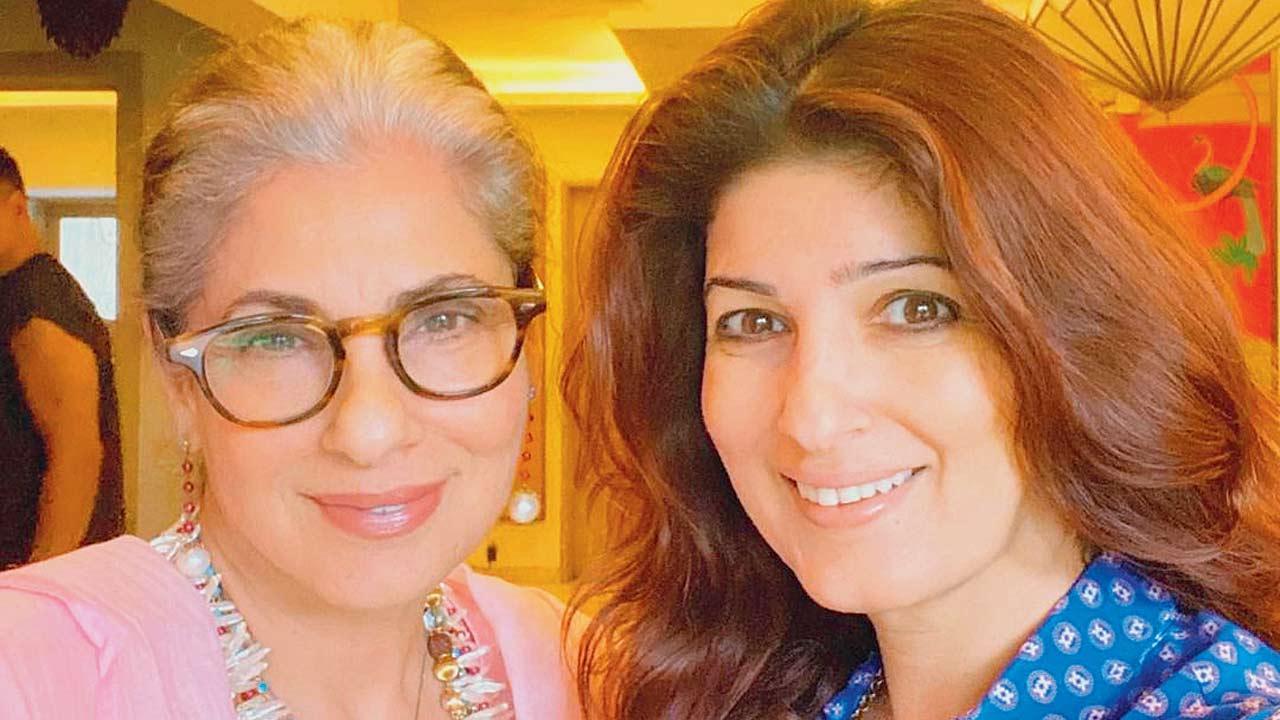
Dimple Kapadia steps into the titular role of Twinkle’s Salaam Noni Appa adaptation; actor has been shooting for comedy over past week
Mohar Basu (MID-DAY; April 28, 2022)
The week began with Twinkle Khanna’s announcement that her short story, Salaam Noni Appa, is being adapted into a feature film. The story was a part of Khanna’s The Legend Of Lakshmi Prasad, a collection of four tales on feminism. While ad man Sonal Dabral will make his directorial debut with the slice-of-life movie, producer Khanna didn’t have to look too far for the lead actor. Who better than her actor-mother Dimple Kapadia to bring alive the part of the worldly-wise protagonist!
mid-day has learnt that Kapadia, who made a splash not too long ago with Christopher Nolan’s Tenet (2020), began shooting for the project about 10 days ago. The unit’s first stop was the Jio Mall in Bandra. A source reveals, “The story revolves around two sisters, Noni and Binny, who have reunited in the autumn of their lives. With its breezy treatment and Twinkle’s signature witty material, the movie has the potential to be India’s Grace and Frankie. So far, Dimple’s solo scenes have been shot. Noni’s unexpected love story, which forms the crux of the movie, will be filmed in the second schedule.”
The ongoing stint is 25-day long with most scenes to be canned in and around Bandra.
While announcing Sameer Nair’s Applause Entertainment and Ellipsis Entertainment-backed project, Khanna revealed that the story is loosely based on the relationship between her grandmother and her sister. The film marks her return to production after Pad Man (2018).
Akshay Kumar has told me to never act again-Twinkle Khanna
8:06 AM

Deepali Singh (DNA; September 11, 2018)
We’ve reached 15 minutes early for a chat with Twinkle Khanna at her beach-facing residence. The lady in question arrives right on time and with just a minor digression into topics like black coffee putting her to sleep — an idiosyncrasy she blames on her being born upside down — we dive straight into a chat about her third book and first novel, Pyjamas Are Forgiving. After all, there’s a particular brand of humour the actor-turned-author has come to be associated with — there’s wordplay, some self-deprecation, irreverence and a pinch of political incorrectness — that has made her one of the most loved ‘no-filter’ writers today. Clad in a striped blue pantsuit, Mrs Funnybones (as she is popularly known) sits down for a no-holds-barred chat. Excerpts...
Did the title strike you first or the story?
As usual, I was writing something else. Then in the middle of it, somebody asked me to be a part of an anthology of short stories and I told them that I would let them know when I had an idea in mind. After a month, I had to call back and say, ‘Sorry, I have a feeling this is going to be my first novel and thank you for pushing me on that path’. Their idea was to have something to do with clothing. I had this story in my head for a while. I had been to a stringent ayurvedic retreat, like in the story, and it has stayed with me.
So, there was no planned move from short stories to novel?
No. In fact, Salaam Noni Appa was supposed to be a big novel. I tried it thrice but instead, it became a short story and this was a short story that became a novel. So, I guess it comes to being born upside down (laughs). Whatever we plan, we end up doing it in a different way.
What seems like a light-hearted read actually talks about some relevant issues like consent and self-worth... That’s something we find in your columns as well...
I guess that’s the way I write. For instance, I wanted to write an adventurous dystopian India sort of novel, but I couldn’t find the scope of any humour in it. So, I abandoned it. Maybe one day, I will write a book which has no jokes, but I think it won’t hold my interest.
You have dedicated this novel to your mother, Dimple Kapadia. Somewhere in the novel, the protagonist says, ‘I still find it hard to figure when my mother is serious and when she is just trying to mess with my head.’ Does that apply to your mom, too?
Completely! So, whether it’s my columns or books, I seem to be writing about women who are not interested in finding a man. They are trying to live life on their own terms as well as dealing with the constant chafing between who a woman is and who she’s meant to be. I think it all comes from growing up with a mother who lived life on her own terms. We never had conversations about feminism or equality in our house, but it was only when I was about 35, that I realised what I have always taken for granted, is something most women don’t have. I never felt I was less than a man, in fact I always felt I was superior and we have to just bear with these creatures. Putting a man on a pedestal had never even occurred to me. That’s why I think not only this book but most of what I write should be dedicated to my mother because it comes from being raised in a particular manner. She did it with a lot of irreverence. There were never any complaints. She just shrugs off her burdens and I think I’ve learnt to do the same from her.
Do you get your brand of humour also from her?
Completely! She is more eccentric than me! You would not believe some of the things she tells me, they are bizarre! So yes, I have inherited my humour from her and her side of the family.
When you have to speak in public, do people expect you to be funny?
Yes, they do. When I walk on stage, they say things like, ‘Now, she’s here to make you laugh for the next one hour’ and I’m like ‘Somebody kill me right now!’ Actually, it’s one of my fantasies to be a stand-up comic. I practise in the mirror. But my husband (Akshay Kumar) has told me two things, to never go back to acting and not to ever do stand-up comedy, because I’m terrible at both! (laughs). But once you get onto that platform you know what’s expected of you and inhabiting that persona is not very difficult for me. Saying things which make people laugh is not such a difficult thing because I’m telling them the truth. It’s just from a person and in a way they don’t expect, so they find it funny. Also, I’m giving them a perspective which apparently most women don’t seem to hold. They would probably expect a man to say things in this politically incorrect way. I’m sure I will find one day that I’ve nothing funny to say and it will be a disaster, but so far it’s been fine.
Have the man of the house and the prodigal son read your novel?
No, they haven’t read it yet, but they know the story in detail. Both of them are my sounding boards. I had a couple of alternative ends. My husband wanted the more dramatic end but my son liked this one. There was an ending which was much darker and my editor Chiki Sarkar and I kept arguing about it. When I started writing, this is the one that made most sense.
Have you planned ahead for the next book?
I’m the person who wants to start writing a book the day I finish one. I don’t like having that empty space in my head; it bothers me. I don’t know what to do with myself. Suddenly, I have so much time and I’m not used to having time. I have ideas, but of course, I’ll abandon them and start writing something else (smiles).
Trouble seems to have become my middle name-Twinkle Khanna
8:51 AM

Twinkle Khanna on her online woes, a second innings in films, and why the film fraternity shouldn't be seen as a single unit in the wake of controversies
Sanyukta Iyer (MUMBAI MIRROR; December 1, 2017)
Twinkle Khanna's online witticisms sound even better in person. Appearing on a panel recently about overcoming failures with the punchline, "Haar ko harao", she shows us how to work a crowd, as she traces her "idiosyncratic upbringing". "When I went to her (mother Dimple Kapadia) as a plump nerd and said, 'I've scored 97 in math', she said, 'well, it matches your weight," she says, and the crowd chuckles.
Then, she gives them a peek at her signature irreverence. "Hrithik (Roshan, her neighbour) once said that he beat his genes, adding, 'have you seen my father dance?' I said that I beat my genes too. Have you seen my mother act?" she says.
In the interview that follows, the 42-year-old actress-turned-columnist and bestselling author also offers up a glimpse into her carefully-worded candour as she tackles controversies, her foray into film production, and bringing up her kids, Aarav and Nitara, with actor-husband Akshay Kumar.
Leading stars, filmmakers and even you have chosen to maintain a stoic silence on the Padmavati and S Durga controversy.
You are putting a horde of people in one category but we are all different. Some people are diplomatic, others are outspoken even within the film industry. You can't put them all under one bracket and ask them to change. Why should anybody try to be someone else? What will that prove to the world? Also, if you scroll through my timeline you will see that I have made two rather strong comments about Padmavati. (Twinkle's tweet from November 19 reads: And as far as #Padmavati is concerned I wish it is the biggest hit ever as that would be the befitting rejoinder to all these loony threats!)
But you always speak your mind, even if it gets you in trouble on Twitter...
Trouble seems to have become my middle name. My problem is that I always voice my opinions vociferously. Sometimes, I may be right, sometimes wrong. When I feel it's the latter, I examine the scenario. I always try to find things to learn, whether it is from criticism or financial failure. I ask myself, 'is there something more I need to be aware of'.
Do you enjoy being a social media celebrity?
I enjoy Twitter because you get different viewpoints on certain news and quickly. My attention span is short so it suits me. I think it's important to constantly adapt to the times.
Do you worry about the implications of your stardom, lineage and your husband's celebrity status on your kids? Is there a certain way they are expected to behave in the public eye?
My husband and I really try to protect our children in the fishbowl that we live in. We are rather particular about it. But beyond that, the world has changed. Every generation thinks that theirs was the ideal situation. But our children live in the world of Instagram and Snapchat and I think they are more equipped to handle it than we are.
What about sex-education, gender equality and alcohol? Is everything up for discussion at the dinner table?
I make jokes about everything. When a friend's daughter came to me and said that she didn't want to go swimming because she was afraid of getting a tan, I told her, "daag achhe hain" and that I wanted to be green because my favourite vegetable is broccoli. Humour always works better than a lecture. I make jokes about sex, alcohol, failure... with the hope that at a crucial point, when my children need to talk to somebody about these things, they will come to me.
My son plays a few sports, and I recently received a letter from a member of our society, which read, "Madam, please check, your son is banging his balls against my car." I tell him things like these and we laugh about them. Nothing is wrapped in cotton, nothing is sacred. I'd rather have my son or daughter have a glass of wine with me than stop them from drinking. They are going to drink with their friends anyway. This way, at least there's always an open door.
Was turning producer with R Balki's Akshay Kumar-starrer Pad Man, a meticulously planned move?
This is not something I thought of or planned. I wrote the story of Arunachalam Muruganantham for my second book, The Legend of Lakshmi Prasad, and I felt that this was an important story that should reach as many households as possible. Unfortunately, we are a world of viewers, not readers, and in order for that to happen I had to do something - like make a movie out of it. That's how the conversation started. That was my straight philosophy as far as Padman goes.
Are you worried about not making it as a successful producer?
Every human being wants to succeed. It is a survival instinct. All I tell myself is that I have prepared to the best of my abilities, and what happens, happens. My story, Salaam Noni Appa, was recently adapted into a play. I have to do my job and my job is to write. Whatever else happens is an organic output. If I start writing things based on whether it will be made into a movie or a series, then I will be doing myself and my readers a disservice.
I like living in my cave with my cubs and scribbling on the walls-Twinkle Khanna
8:03 AM

Lasyapriya Sundaram (BOMBAY TIMES; November 3, 2017)
While she often jokes about the
lukewarm response that her
career as an actress garnered
with tongue firmly in cheek, Twinkle
Khanna sure has the talent to elicit a
chuckle and more as a writer. As the
play Salaam Noni Appa, adapted from
the short story of the same name,
penned by her tours the country, BT
caught up with Mrs Funnybones who
talked about ageism and sexism directed
at older women and how she wants to
steer clear of the arc-lights, in her characteristic
style. Excerpts…
The story of Salaam Noni Appa is about a 68-year-old lady who falls in love. Our patriarchal mindset does not see women post a certain age as living-breathing individuals. Was the short story an attempt to debunk that thought process? Do you agree that the patriarchal mindset also doesn’t give women the liberty to live their lives, irrespective of their age, in the manner in which they want to?
Salaam Noni Appa was as much about ageism as it was about sexism. We look at older people, through the cobweb of wrinkles and folds that time bequeaths them, without truly being able to see that underneath, within their minds they are just like us, their hearts as sprightly as ours and of course, older women are judged even more harshly than older men. There are stereotypes and limitations that society sets — an elderly woman should play a certain role, bring laddoos for her grandchildren, but she cannot be someone’s lover. Her shopping trolley should never have push-up bras, but must only consist of discounted detergent and cough syrup almost past its expiry date, just the way she is assumed to be.
Apparently, you began writing the short story at 18, then revisited it and it eventually became part of your anthology. Did you always know that the narrative would lend itself to a play?
Noni Appa was never meant to be the protagonist, she was part of a bigger tableau. But each time I visited this story, rewrote it again and again, she and her sister Binni were the two characters that seemed to truly shine.
During the launch of your book, you had said that, “Anybody who doesn’t believe in feminism is an idiot.” Do you think effective communication about gender-inequality is possible when it’s done with a dash of humour, without taking away from the seriousness of the issue?
I think any sort of communication, irrespective of its form, whether it is a book, a painting or a film, in order to pass on its inherent message, it must have the ability to hold the viewer’s attention. If I give my children a sermon, often they behave like I am a television on mute — they can see my mouth moving up and down, but seem unable to hear a word of what I am saying. But if I make them laugh at something, even at themselves, my message reaches them loud and clear. I try and follow the same principle when I am writing.
While Salaam Noni Appa, the first short story from your work of fiction, The Legend of Lakshmi Prasad, has been adapted as a play and another short story, The Sanitary Man of Sacred Land will see itself play out in Pad Man, are the other two short stories in the anthology also going to be made into a film or a play?
I did not plan any of this. Nor have I tried to tie up any more collaborations in the near future. But like I have said before — life is, but, a play of chance in the game of choice, which pretty much sums up how I got here in the first place.
Do you plan to ever act in a play which will be based on a story written by you?
Never! I like living in my cave with my cubs and scribbling on the walls intermittently. This spot in the bright sunlight business tends to give me a bit of a heat stroke to be honest.
The story of Salaam Noni Appa is about a 68-year-old lady who falls in love. Our patriarchal mindset does not see women post a certain age as living-breathing individuals. Was the short story an attempt to debunk that thought process? Do you agree that the patriarchal mindset also doesn’t give women the liberty to live their lives, irrespective of their age, in the manner in which they want to?
Salaam Noni Appa was as much about ageism as it was about sexism. We look at older people, through the cobweb of wrinkles and folds that time bequeaths them, without truly being able to see that underneath, within their minds they are just like us, their hearts as sprightly as ours and of course, older women are judged even more harshly than older men. There are stereotypes and limitations that society sets — an elderly woman should play a certain role, bring laddoos for her grandchildren, but she cannot be someone’s lover. Her shopping trolley should never have push-up bras, but must only consist of discounted detergent and cough syrup almost past its expiry date, just the way she is assumed to be.
Apparently, you began writing the short story at 18, then revisited it and it eventually became part of your anthology. Did you always know that the narrative would lend itself to a play?
Noni Appa was never meant to be the protagonist, she was part of a bigger tableau. But each time I visited this story, rewrote it again and again, she and her sister Binni were the two characters that seemed to truly shine.
During the launch of your book, you had said that, “Anybody who doesn’t believe in feminism is an idiot.” Do you think effective communication about gender-inequality is possible when it’s done with a dash of humour, without taking away from the seriousness of the issue?
I think any sort of communication, irrespective of its form, whether it is a book, a painting or a film, in order to pass on its inherent message, it must have the ability to hold the viewer’s attention. If I give my children a sermon, often they behave like I am a television on mute — they can see my mouth moving up and down, but seem unable to hear a word of what I am saying. But if I make them laugh at something, even at themselves, my message reaches them loud and clear. I try and follow the same principle when I am writing.
While Salaam Noni Appa, the first short story from your work of fiction, The Legend of Lakshmi Prasad, has been adapted as a play and another short story, The Sanitary Man of Sacred Land will see itself play out in Pad Man, are the other two short stories in the anthology also going to be made into a film or a play?
I did not plan any of this. Nor have I tried to tie up any more collaborations in the near future. But like I have said before — life is, but, a play of chance in the game of choice, which pretty much sums up how I got here in the first place.
Do you plan to ever act in a play which will be based on a story written by you?
Never! I like living in my cave with my cubs and scribbling on the walls intermittently. This spot in the bright sunlight business tends to give me a bit of a heat stroke to be honest.
Subscribe to:
Posts (Atom)