Showing posts with label Saif Hyder Hasan. Show all posts
Showing posts with label Saif Hyder Hasan. Show all posts
I never wanted to act; I’m the only graduate in our entire family-Tejaswini Kolhapure
9:22 AM

Debarati S Sen (BOMBAY TIMES; March 7, 2025)
Sisters, actors, and now co-stars—Padmini and Tejaswini Kolhapure recently shared the stage for the first time ever in the musical play Ammi Akhtari, that premiered last October and feature renowned ghazal singer Talat Aziz. While the sisters’ artistic journeys have been vastly different, their deep-rooted connection with performing arts remains unchanged. In this candid conversation at Padmini’s Juhu home, the sisters discuss theatre, family, and navigating comparisons.
We are like one unit, but we also argue: Padmini
Despite their close bond, working together came with its own set of dynamics. “It was comfortable yet casual and because it was us, our rehearsals weren’t too strict! But there was a lot of learning, especially in perfecting Urdu. Padmini guided me with diction and of course Talat Ji helped us both.”
Padmini adds, “There was also extra pressure! I felt if Tejaswini is loved on stage then it’d be like a reflection on me as well and it’d be vice-versa.”
Their sisterly camaraderie has always had plenty of fun moments. “Oh, we’re always arguing, and we keep nagging each other! Our elder sister, Shivangi, is also a nag—it just runs in the family!” Padmini laughs.
I never wanted to act. I wanted to be in aviation: Tejaswini
Coming from a family deeply rooted in cinema and music, acting seemed like a natural choice. But not for Tejaswini. “I never wanted to act! I’m the only graduate in our entire family! I admired my mother and wanted to be in aviation, like her. I even worked with Jet Airways. But during training, my instructor told me, ‘You’re meant to act.’”
That set her on an unexpected path—participating in Miss India, modelling, and eventually entering TV and films. “Earlier, I’d visit Padmini’s sets and get bored. My only thrill was collecting autographs there because she worked with everyone in the industry! Theatre and working with Satyadev Dubey was actually an important part of my life,” she admits.
Padmini, on the other hand, embraced the craft early on. “Acting is an endless learning process—you never reach a point where you know it all. My father used to say that he spent his entire life mastering just one raag. It’s the same with acting.”
Earlier, comparisons with Padmini were very disheartening: Tejaswini
With Padmini being a well-established actress, comparisons were inevitable. “I didn’t feel the pressure, but others did,”
Tejaswini says. She explains, “Directors would say, ‘Padmini used to act like this, waise karke dikhao’. My response? ‘Then take her, why call me?’” Those comparisons took a toll. “In my early 20s, it was very disheartening. I withdrew for a while, went into a shell, but theatre and Satyadev Dubey’s encouragement kept me going. He always told me, ‘Your Mother India moment will come.’”
Over time, the comparisons faded. “People saw we’re very different,” says Tejaswini. “Padmini prefers commercial projects; I like offbeat roles. We have distinct identities. The kind of work I do, I don't think she’d be interested in. I like to take risks, she doesn't.”
‘We are always there for each other’
Beyond the stage and screen, the Kolhapure sisters share an unbreakable bond. “Padmini and Shivangi have been like mothers to me,”
Tejaswini shares. “When my daughter Vedika was 10 months old, I had to shoot and Padmini stepped in without hesitation. Later when Vedika was three, she took her to Abu Dhabi so I could focus on my flea market project. She has this trait of going out of her way to do things. She’s always there and she is the person that everyone in the family will go to for advice.”
Their niece, Shraddha Kapoor, also values their guidance. “She values our opinions, asks advice but eventually does what she likes!” says Tejaswini. “We’re tight-knit —Shivangi, Padmini, Shraddha, and I are always there for each other.”
Padmini, in turn, is a staunch supporter of Tejaswini’s work. “Tejaswini is a brilliant actor, and I’m not just saying that because she’s my sister,” she says. “Her performances in Paanch, Ugly, and Yes Papa were exceptional. She’s incredibly composed on stage, and she was outstanding in the English play The Graduate.”
Bringing Ammi Akhtari to life
For Padmini, Ammi Akhtari wasn’t an immediate yes. “When Saif Hyder Hasan offered the role, my first reaction was, ‘No way! Does he expect me to sing?’” she laughs. But once rehearsals began, she found herself enjoying the process. Tejaswini, who returned to theatre last year with The Graduate, was the one who convinced Padmini to take on the title role. “She was hesitant at first, but once we started rehearsing with Talat Aziz ji, it was mind-blowing!” she recalls. The play also marked a first for Tejaswini—her first full-fledged Hindi-Urdu theatre production. “I had to refine my Hindi because I grew up speaking Marathi and English.”
Many actors let go of the part in Yes Papa-Ananth Narayan Mahadevan
3:06 PM
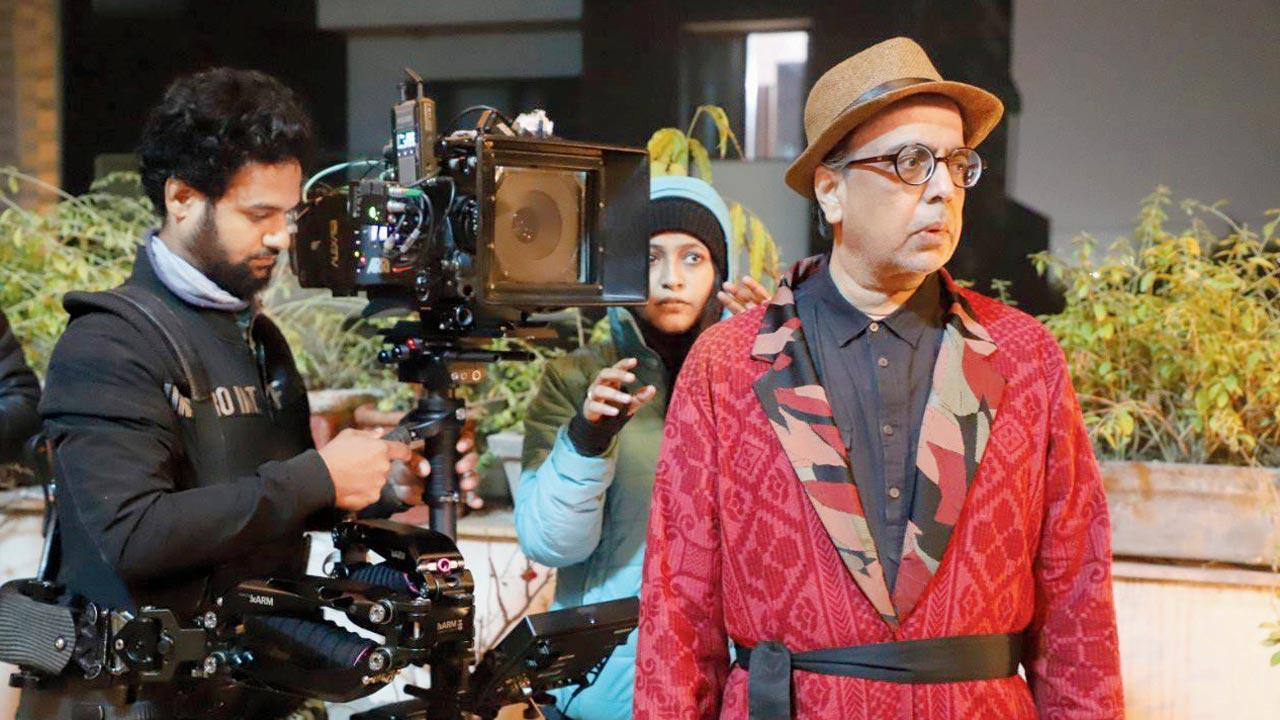
Initially scared to portray a sexually abusive father in Yes Papa, Ananth says he gave his nod to the film to highlight the issue
Mohar Basu (MID-DAY; March 29, 2024)
How do you play a character you despise? Approach it without judgment, and remain honest to the story. That is how Ananth Mahadevan played a sexually abusive father in Yes Papa, directed by Saif Hyder Hasan. Walking into the role, the senior actor knew that it would take an emotional toll on him.
“I am told many actors let go of the part. It’s eerie to play such a character. But as an actor, it’s your job to look for challenges,” starts Mahadevan. His apprehension regarding the role was outweighed by the need to shed light on the issue.
“You do the film because the subject needs to be highlighted. To some extent, the role scared me, but [you overcome it].”
What helped him in his portrayal was having a supportive director and the knowledge that the film had the right intent. “The reason why I could pull off the four scenes that depict abuse is because the director handled them sensitively. The idea and intention wasn’t to entice. The abuse is never depicted; you leave it to the audience to understand.”
It’s not often that mainstream films deal with such pressing subjects. Mahadevan says that through his role, the movie highlights how seemingly innocent-looking men can be capable of heinous acts. “We had to fight stereotyping. The character is soft-spoken, sings and doesn’t look menacing. He is your typical man-next-door. We tried to give him touches of a regular man who is capable of monstrous things.”
Yes Papa, which also stars Geetika Tyagi, was recently screened for the National Human Rights Commission.
Those who saw Yes Papa have gone bonkers over Ananth Narayan Mahadevan's performance-Saif Hyder Hasan
8:36 AM

Director Hasan and Anant Mahadevan discuss their upcoming film on child abuse, Yes Papa, as they plan a screening for UNICEF
Upala KBR (MID-DAY; March 3, 2024)
Art stems from reality; this holds true for the Ananth Narayan Mahadevan-starrer, Yes Papa. The film sheds light on a daughter who is sexually abused by her father, while the mother chooses to remain silent. Acclaimed theatre playwright, director, and producer Saif Hyder Hasan, who has previously directed plays including Ek Mulaqaat, Gardish Mein Taare, and Mirror Mirror, will make his directorial debut in Bollywood with Yes Papa, also starring Geetika Tyagi.
After winning four awards at the India International Film Festival (2022), the film is expected to release in theatres on March 29. The director shared that it was his wife who encouraged him to take the story up. “My wife, Sadia [producer] had met a real-life survivor in 2018 in an orphanage. That’s when the idea came into being. She told me to use my craft for an issue like this,” he said, adding that the Central Board of Film Certification (CBFC) was in a dilemma over the certification of the film deserved after watching it. “They didn’t cut a single scene.”
The movie has been screened for the National Human Rights Commission and the Delhi Commission for Women. Now the makers are planning a screening for UNICEF.
Hasan is all praise for Mahadevan, who plays the abusive father. “It was brave of Anant to play this role. He has four scenes in the film, but those who watched it have gone bonkers about his bone-chilling performance. He has lent a certain dignity to his performance, which adds to the menace,” complimented the director.
Mahadevan, who was scared to take up the part initially, claims that the role was “not a cakewalk”. “While doing some scenes, I would feel horrible because it would push me to believe that I am that person, and I don’t want to do that. The scenes have been done with such subtility, finesse, and class that nothing is shown; it’s all suggested,” added the actor.

Kasturba Gandhi was a very petite woman. I am not-Zeenat Aman
8:32 AM

Zeenat Aman, the 1970s siren, returns to the stage as Kasturba Gandhi negotiating a difficult marriage
Vishwas Kulkarni (MUMBAI MIRROR; February 16, 2020)
 To Mumbaikars of a certain vintage, Zeenat Aman is an emotion; and for Indians of a certain pedigree, Mahatma Gandhi is an even deeper faith. So when you put these two icons on the same stage, it does touch a nerve. Again, strictly for some in these volatile times.
Dearest Bapu, Love Kasturba, a play directed by Saif Hyder Hasan, and starring Arif Zakaria as the Father of the Nation and Zeenat Aman as his significant other, will be the opening play of The Great Indian Theatre Festival 2020 this Friday. And the vibe in Green Room Number 1 of the Mukti Foundation in Model Town — home to many an aspiring actor — is electric: This is, after all, the same compound that also houses Anupam Kher’s eponymous acting academy. Zeenat is trapped between vanity mirrors on opposing walls and loathes considering them as a motif when our photographer arrives. “Please, this is about Kasturba Gandhi. I’m not entirely convinced about using the vanity mirror. Can we just go down and shoot in natural light?”
But then we cajole her and eventually sit down for some banter with the team. What was the inspiration for the play? “What we have here is Kasturba and Gandhi depicted as a real husband-wife duo, in a man-woman context, shorn of their mythological aura. And that is the challenging and exciting bit,” says Zakaria, whose angular features are an apt complement to Gandhi’s anorexic, ascetic physicality. “When I first cast Zeenat, I wrote this as a monologue, three times its current length. But I also tend to edit and rewrite on the floor — and once Arif came on board, the play took on an epistolary format, a story told through letters,” says Hasan, who has also directed Gardish Mein Taare, a play about the troubled marriage between legendary filmmaker Guru Dutt and singer Geeta Dutt.
He shares that many questioned his casting choice “since Zeenat is perceived as glamorous”. “However, the same folks won’t mind a white guy playing Gandhi because a gora made the film. That’s the mindset,” says the thespian, who also admits that he would be as comfortable to cast a black guy as Gandhi and a white woman as Kasturba. “That’s the leap of faith that any art form demands. We need to step outside of silly thinking,” he says.
We turn to Zeenat and ask her if the theme of a difficult marriage excited her? “Look, no marriage is ever the same as another, troubled or not. There is a man and there is a woman. They are individuals. That is what excited me about this project,” she says, going on to detail her character’s unique position. “Kasturba is largely an unsung legend, stoic and nuanced. She stood by her husband, even went to jail for him, had a heart attack in Arthur Road Jail during our freedom struggle. And there were all these experiments with sex that Gandhi had her participate in, which he himself has written about. It’s all in there. But ultimately, it is Saif’s verbal imagery that seduced me,” she says.
That the play has a visibly excited technical team is evident from the colour palette, set design and music — all the gorgeous chaos that goes into making theatre. For instance, a version of “Vaishnava Jana To”, scored by musician Ratnesh Bhagat, and one that Aman insists we listen to, is genuinely plangent and moving. “Technology is a necessary component. In addition to the performances, we have original photographs of Gandhi, some very subtle lighting design and other elements. In essence, the audience will explore a dual journey through 70 minutes,” adds Hasan.
Did the cast and crew have to endure any particular challenges in assembling this production? Aside from the obvious physicality associated with playing Gandhi, Zakaria says, the presentation of the relationship is not linear, and being a reading format, “there is always the challenge of syncing the pages whilst connecting with the audience”. “The text is right there. But how do you capture the hidden mystique of a relationship with mere words? That was a welcome learning curve,” he adds.
For Zeenat, the challenge in portraying Kasturba was also about her body: “Kasturba was a very petite woman. I am not,” says the 1970s siren. Is this perhaps the oldest role she has ever performed? After all, it was only Rakhee Gulzar from her generation who played both lover and mother to leading heroes in yesteryear Bollywood. “When it came to taking on Kasturba’s persona, I was delighted beyond measure to dab on wrinkle after wrinkle after wrinkle. I did not shy away from playing a 74-year-old. I embraced it. It is, in fact, the antithesis of make-up. I feel her. I get her,” says the 69-year-old.
Have both Zakaria and Aman consciously chosen theatre as an outlet for their thespian health? “I wouldn’t say that. Film and television will always be a part of my life, but when your life gets too comfortable, it is important to push your boundaries. Theatre helps you to be grounded and sharp. Because theatre is about now,” says Zakaria, who has also worked in The Merchants Of Bollywood, a 2005 Australian musical by Toby Gough, which boasts of selling out 400 shows and was seen by 500,000 theatre-goers by 2008. “It’s been a rather organic journey for me,” says Aman. “For instance, when I started this project and got down to doing my research, one of the things that struck me was what the Mahatma said to Kasturba when encouraging her to take part in our freedom struggle. ‘Even if you die, do it. I’ll worship you like a goddess.’ That’s theatre for me,” she says.
The technical crew is insistent that we stick around for the rehearsals, but Aman interjects, “No! Let them see the final version, please!” Our photographer, meanwhile, comes forward with some select shots of the actress for her preview. “Wah, wah, Satyajit ji! Salaam,” she says, enthused and playfully raising her right palm to her heart in a matching gesture. Because that, too, is theatre.
My first reaction was, me as Kasturba Gandhi? Why me?-Zeenat Aman
9:19 AM

Veteran actor Zeenat Aman says she was surprised to be offered Gandhi's wife's role in Dearest Bapu, Love Kasturba
Shaheen Parkar (MID-DAY; February 10, 2020)
 "My first reaction was, me as Kasturba Gandhi? Why me?" laughs Zeenat Aman, recounting her surprise when approached to step into the shoes of Mahatma Gandhi's wife for the play, Dearest Bapu, Love Kasturba. As she returns to theatre after over 15 years, the veteran actor has an author-backed role at hand — the English play, which premieres in the city on February 21, takes a look at the couple's 60-plus-year marriage against the backdrop of India's freedom struggle.
"We don't know much about the Mahatma's wife. This project provides a fascinating insight as the story is from her point of view. I took up the offer as I had a lot of time on hand," she says. Over the three-month rehearsals, she admits that her scepticism about the casting gave way to a deep respect for her muse. "[Once I wore] the white khadi saree, and sported grey hair and spectacles, I was excited." The actor adds that she has deliberately kept sons Zahaan and Azaan away from the rehearsals. "I can't wait to see their reaction on the opening night!"
Writer-director Saif Hyder Hasan agrees that Aman — who, in her heydays, was known for infusing oomph into her characters — is an unconventional choice for the role. "Casting against type is interesting. When I wrote the play, I picked up the phone and called her."
I thought I would die without playing Gandhi-Arif Zakaria
7:39 AM

Arif Zakaria is thrilled to be playing the role of the Mahatma in a new play, says he thought he would ‘die without playing Gandhi’
Kavita Awaasthi (HINDUSTAN TIMES; January 9, 2020)
Ever since Arif Zakaria became an actor, he had a wish to play Mahatma Gandhi and he is over the moon that his wish has been fulfilled in the new play by director Saif Hyder Hasan. “The play is called Dearest Bapu, Love Kasturba and it explores the relationship between Gandhiji and his wife, Kasturba Gandhi. It is based on facts but woven into fiction by Saif. In the play, Gandhi and Kasturba write letters to each other after passing away and talk about their relationship of 60 years. It gives us a peek into the ordinariness of their lives as opposed to the great pedestal that we have put them on,” he shares.
The Great Indian Theatre Festival in March will open with this play, which also celebrates the 150th year of Gandhi’s birth. “But not many people know that it is also 150th year of Kasturba’s birth,” adds the actor, who is excited to work with veteran actor Zeenat Aman, who will essay the role of Kasturba.
The idea of playing Gandhi appealed to Arif, who instantly decided to be a part of the play. “I started with theatre very early in college and later veered towards the visual medium. It is good to come back to theatre. I knew I wanted to play Bapu at some point in my life and there were opportunities on TV and in films which never came to fruition. I thought I would die without playing Gandhi,” he quips, adding initially the play was conceived as memoirs of Kasturba. But when Saif thought of Arif and asked him to attend a reading, it worked in Arif’s favour. “Initially, I didn’t take Saif seriously as I thought maybe he is toying with an idea but things fell into place. The role of Gandhi was quite attractive,” he says.
Other than getting his mannerisms right for the role, Arif also had to keep the larger-than-life persona of Gandhi in mind. “He is a father-figure, so making his voice effective and real while reading letters was a challenge. As it is a play, we will have to deliver each time,” opines Arif, who has been performing shows of the play, Gardish Mein Taare.
I hadn’t worked for a very long time but I really enjoyed my theatre experience-Minissha Lamba
8:19 AM

The actor, who has just made her theatre debut, on why she welcomes cynicism about her acting skills, and why the stage is just the thing for her
Anuka Roy (MUMBAI MIRROR; October 7, 2018)
“When you are unsuccessful in life and are sitting at home, and not working, everyone has the most amazing pearls of wisdom and one-sentence solutions to offer. I spent three years listening to all that. Initially, I used to give explanations but later I just used to say ‘yes’ and the conversation would be over within minutes,” says Minissha Lamba when Mirror met her at a café in a western suburb on Thursday.
Lamba was introduced to Bollywood audiences in Shoojit Sircar’s Yahaan in 2005. The actor’s last movie as a protagonist was Hum Tum Shabana in 2011. Though she did a few more Hindi movies after that and also starred in two Punjabi films, they were forgettable and success in Bollywood eluded her. Her frankness and outspokenness makes it evident that she is quite aware that her career did not take off the way it should have.
However, this year is proving to be a good one for her. Last month, she made her theatre debut with AGP World’s Mirror Mirror in Delhi. “The play opened at Kamani Auditorium on September 8. We started rehearsing for it almost 45 days before the premiere date,” says the Miranda House alum. “Theatre is something I always wanted to do. I dived into this because I met Ashvin Gidwani [founder of AGP World] very randomly at a common friend’s wedding. We struck up a conversation, where he asked if I’d be interested in doing theatre. I said yes,” she says.
The play directed by Saif Hyder Hasan, is a solo-act about sibling rivalry, in which the petite actress plays as many as 13 characters. Learning how to act on stage, as opposed to being in front of a camera, wasn’t easy. From voice training to physical exercises to acting workshops, Lamba had to do it all. “I hadn’t worked for a very long time. So — getting my body and mind back into acting — I had to understand and go through that process for theatre. But I really enjoyed it,” she says.
She was also mentally prepared to deal with the scepticism surrounding her theatre debut. “But that’s fair. I have not done any substantial role in the past couple of years which would make people excited. I’m sure a lot of people said ‘They were so desperate for a Bollywood name that kisiko bhi le liya’. This kind of cynicism is great for me. I love it because you come in with zero expectations. So even if I do an okay job, you’ll compliment me,” she says matter-of-factly. Apart from theatre, the actress is currently acting in the daily soap Internet Wala Love as the owner of a radio station who is boss to two main characters.
Some might think of her stage debut as a gamble but one facet of Lamba’s personality that not many know about is that she’s an avid poker player. She has been signed up as a professional player by one of India’s largest poker websites. Lamba has even participated in the Indian Poker Championship and the WPT 500 Aria Poker Tournament in Las Vegas. “It again happened randomly, as things seem to happen in my life. A couple of friends came down from abroad and taught us the game. I’m not a card player at all. But they said it’s a sport abroad and this is how they do it. The game is mentally simulating,” she says.
While her professional life is fair game, Lamba is extremely guarded about her personal life. She is married to city restaurateur Ryan Tham, but when his name is brought up, she makes it clear that her personal life is off limits. “It’s a very private family. And you need to respect that,” she says.
Having got a taste of theatre, the actress, who is in her early 30s, now sees it as her future. “We are looking at taking Mirror Mirror to the world, hopefully,” she says. “Theatre is something that I’m going to do for the rest of my life. I have realised that whenever I have time, I will be doing theatre. It’s the best time as an actor to be working right now.”
I have always been a very serious actor. I just ended up getting funny roles-Satish Kaushik
8:23 AM

Veteran actor Satish Kaushik makes a comeback to theatre with the new Hindi play, Mr & Mrs Murarilal. Of all things, he wants to break away from being typecast as a comedian
Jane Borges (MID-DAY; July 3, 2016)
On a rainy Monday evening, actor Satish Kaushik has chosen to enjoy the comfort of the beautiful weather, locked inside an Andheri studio. Here, in between sipping hot tea, he engages actress Meghna Malik in light-hearted banter. Sometimes teasing, sometimes flirting, Kaushik’s effortless style draws many a smile from the popular television actress. The atmosphere is both surreal and romantic, and, had it not been for the crew pacing the dimly lit studio, one would have believed this playful repartee was for real.
When we caught Kaushik a while later, the rigours of the four-hour-long rehearsal for his new Hindi play, Mr & Mrs Murarilal, had done nothing to dampen his jovial self. “My life is a celebration,” Kaushik tell us, as he sits down for the interview. “And that’s why I chose to play this character. Mr Muralilal is a lot like me. He sings, dances, enjoys life and feeds on happiness, despite his own share of grief and sadness.”
The veteran actor is making a comeback on stage after a four-year hiatus. His last role as Salesman Ramlal in the Hindi-language adaptation of Arthur Miller’s Death of A Salesman saw Kaushik take the American playwright’s protagonist Willy Loman to dizzying heights. “I played Ramlal for 14 years,” he says. “And then I thought, I needed a break.” “Ramlal was not only a difficult character to bring alive on stage, it was also emotionally draining. I still remember having nervous breakdowns during the initial shows. I think that happened because I saw my own father in Ramlal. I come from a poor family and my father struggled as a salesman, travelling between small cities, to make ends meet,” recalls Kaushik.
When Saif Hyder Hasan brought Mr & Mrs Murarilal to Kaushik recently, the National School of Drama alumni knew this was the script he had been waiting for. “I have always done plays adapted from works by great playwrights like (Henrik) Ibsen, (Bertolt) Brecht, (William) Shakespeare and Miller. This is the first time that I am doing an original play. And, I’ll be honest, I was nervous before going ahead,” says Kaushik, though he is quick to clarify that it was because he was moving away from doing character roles on stage.
“As an actor, you have to be worried about every performance,” says the veteran. “Acting is a process of learning and unlearning, and until you don’t swim in that nervous energy, you won’t be able to get the best out of yourself.” Mr & Mrs Murarilal is a love story about two people — Kaushik and Malik, who meet in a park one night, and are interrupted by a watchman (Amit Pathak), who is zealously guarding the premises. As the night unfolds, secrets are revealed, and the characters slowly begin to let their guard down.
“I think that’s what drew me to Hasan’s plot. It’s realistic, breezy, entertaining and has depth,” says Kaushik, adding that it also helped him tap into his serious acting side, steering away from the Bollywood films, where he has been usually typecast as the funny man, be it Calendar (Mr India), BBC (Jamai Raja), or his recent role as Tommy Singh’s tayaji (paternal uncle) in Udta Punjab. “Frankly speaking, I have always been a very serious actor. I just ended up getting funny roles. While I am not complaining, I feel it’s time that I take up roles that have vigour and intensity. I’d like to be taken more seriously.”

Subscribe to:
Posts (Atom)