Showing posts with label Sai Paranjpye interview. Show all posts
Showing posts with label Sai Paranjpye interview. Show all posts
Pardon me if I am being immodest, but I am a first rate writer and a second rate director-Sai Paranjpye
8:19 AM

The director who remains an enigma among filmmakers and theatre practitioners charts her journey in A Patchwork Quilt, her memoir
Navneet Vyasan (HINDUSTAN TIMES; December 6, 2020)
Sai Paranjpye is a legend, there’s no two ways about it. The 82-year-old director is responsible for pioneering numerous changes in the film industry and the theatre circuit. With her memoir A Patchwork Quilt, Paranjpye charts her journey that saw her stints at All India Radio, Film and Television Institute of India in Pune, a delightful realisation in a Paris to creating some of the most memorable movies known to people in the Hindi film industry.
“I used to have a very vivid imagination. I guess I was born with it,” says Paranjpye, who credits her mother for bringing her up with a love for storytelling. “She used to tell bed time stories to put me to sleep. One night, she ran out of them and said, ‘you tell me a story’, so I did, and she said ‘that’s not so bad, who told them to you?’ I said no one, I made them up. Then she didn’t believe me and I told her another and another,” she remembers.
Thanks to that nightly tête-à-tête between mother and daughter, what transpired was a collection of stories published under Paranjpye’s name when she was all of eight years old. Although, she says, “I had to write every day, three to four pages before I was allowed to play. That bit I hated.”
A memoir for a reader may be a medium to get a peek into a writer’s world, but for the writer, it becomes a portal for revisiting past memories. Pleasant and unpleasant in varying degrees, the director swears by her skill for storytelling and absolutely enjoys writing. “I always say, and I’ve repeated it in my book, and pardon me if I am being immodest, but I am a first rate writer and a second rate director,” she quips.
One look at her filmography and even those who’re unaccustomed can point out films like Sparsh (1980), Chashme Buddoor (1981) and Katha (1982) for the importance attached to them and the legacy they left behind inadvertently. But selecting what to write and what not to, for her, was not as hard.
“Selecting what to say was not terribly difficult because I began with radio, and I am passionately fond of radio. That’s my first love. I never had a moment when I had to sit and scratch my head and say, now what shall I do,” she says, adding, “I have mentioned some unpleasant memories, too, how I was taken for a ride by the producers, how I was left with peanuts and the producers made king size profits out of the films. Now when I look back, I do not think I will change anything because I enjoyed the making of these films and writing their stories and putting it all together. I loved doing it. So, that in a sense, was the reward.”

I have had my #MeToo moments too-Sai Paranjpye
8:31 AM
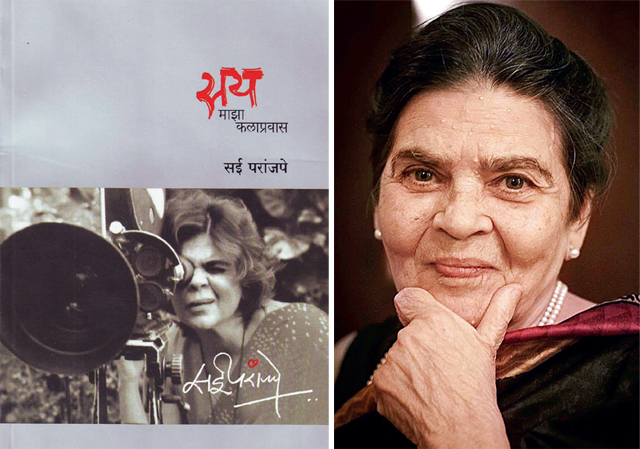
Cover of Paranjpye’s book, Say: Maza Kalapravas
Sai Paranjpye, while discussing her autobiography, expresses solidarity with women outing sex predators
Khalid Mohamed (MUMBAI MIRROR; October 30, 2018)
She’s in the throes of translating her best-selling autobiography Say: Maza Kalapravas from Marathi to English even as she shuttles between her Juhu apartment and her ancestral home in Pune.
Pinning the feisty octogenarian down for a conversation on topics ranging from the book in works to the #MeToo movement takes some doing. But once she’s in the chatmode, Sai Paranjpye right off recalls that when she was a teenager, a ‘roadside Romeo’ who had flashed her while she was cycling down Pune street, was hauled by her straight to the police station.
Next morning, she was advised not to register a formal complaint. It wouldn’t be proper for a young woman to even mention the offender’s private parts. That didn’t deter her though. If the man had dared to do the unspeakable, surely, she didn’t have to mind her language.
On the #MeToo movement, Paranjpye says, “It’s terrific that many women are coming forward to expose the offenders. But it shouldn’t just become the trend of the season, the momentum has to be sustained. Suspects or whatever the correct legal term is, have been reined in. Women can’t be bulldozed any longer. It’s been asserted loud and clear, ‘You can’t get away with it’.”
Next, her pause speaks. Am I merely interested in extracting quotable quotes on the #MeToo topic? Am I using her book as a journalistic ruse? Fair enough. Hence, I return to the translation regimen, only to be answered with a knowing chuckle, “Alright, I’ll take your word for it. The book’s my labour of love right now and it’s taking me forever. I’m still living in the past century. Since I’m not computer savvy, I write on clean white paper with a black ink pen. That led to a crick in the neck, spondylitis. After intensive physio therapy, I’m back to the grind.”
By the year-end, she should be done with the English translation. “If you have a catchy title, let me know,” she laughs companionably. Right.
Over time, the Padma Bhushan awardee has excelled in a variety of mediums, be it cinema, theatre, radio, documentaries, story books, and television. “If I may say so, I’m a pioneer of television,” she points out. “Unbeknownst to many, I was sent from Delhi to produce the inaugural programme, featuring the shehnai wizard Bismillah Khan and other artistes, for Mumbai Doordarshan.”
The autobiography, as its Marathi title indicates, focuses on her creative journey. “It’s not about my love life,” she remarks, adding frankly, “But you could say I’ve been catty. I’ve pointed out nasty instances in my career. Like Basu Bhattacharya (producer of Sparsh) took me for a ride. I’ve been blunt about Gul Anand (producer of Chashme Buddoor) who made tons of money, wringing the film’s success to the last drop.”
Never the sort to mince words, Paranjpye continues, “And I haven’t shied away from the Javed Akhtar story. He was writing the lyrics of Saaz. A recording had been scheduled with Suresh Wadkar and Kavita Krishnamurthy, but he took off without so much as a by-your-leave to Khandala. Overnight, I had to write the lyrics of the song ‘Baadal Ghumad Bhad Aaye’. And what do you know? Javed Akhtar won the National Award for the Saaz lyrics and didn’t have the courtesy to say a simple thank you.”
Vis-à-vis Nana Patekar, the lead actor of her film Disha, the filmmaker comments, “I’ve given him a piece of my mind in the book and beautifully so. At the B.R. dubbing studio, he was throwing one of his tantrums. I told him to leave and never come back. A few minutes later, he opened the studio’s door theatrically and had the nerve to say, ‘You’re saved because you’re a woman. Or else you wouldn’t still be here.’ Next morning, he called sweetly to ask about the timing of the dubbing session. I was as sweet, and the work was completed.”
The multiple award winning director and writer states that she can be fiercely self-critical. After graduating from the National School of Drama, she had staged a Marathi adaptation of Hamlet which was “expressionistic and stylised but I missed out on the soul of Shakespeare’s masterwork. I was roasted by the critics deservedly. However, I was shocked by the response to my adaptation of Neil Simon’s Last of the Red Hot Lovers, about a 50yish man who resolves to have flings with women. The audience roared with laughter but after the show, several people whose opinion I counted on, said, ‘This was not expected of you Sai. How can you bring up the topic of adulterous affairs?’”
At this point, I ask whether she has ever been subjected to sexual harassment. “Plenty of times,” she responds firmly. “There was a time, when men from all sorts of circles would try to kiss me and that’s putting it politely. I’d tell them to back off. Then there was this instance when a minister in the central cabinet offered to drop me home in his chauffeur-driven car, after an evening party hosted by my friend Saryu Doshi. During the drive, he passed me a chit saying, ‘I’d like to spend the night with you.’ With a deadpan face, I declined. On reaching my place as I was getting out from the car, he asked me meekly, ‘May I have the chit back?’ So, I’ve had my #MeToo moments too. No point revealing the minister’s name now, he’s dead and gone.”
Paranjpye surmises whether it’s yesterday or today, when sexual predators see that a woman is alone — single, married, separated or unaccompanied — they jump to the conclusion that she’s “available and fair game…it’s high time that such male chauvinists were shamed.”
And the parting shot is, “I am supremely glad about the #MeToo movement. Here’s wishing more power to the elbow of my soul sisters.”
Writers are vulnerable, they get a raw deal-Sai Paranjpye
10:10 PM

Clockwise from above: Sai Paranjpye; Chashme Baddoor (2013); the 1981 original
Filmmaker Sai Paranjpye discloses how she was left in a lurch by the Film Writers’ Association over the David Dhawan remake of her cult comedy Chashme Buddoor
Khalid Mohamed (MUMBAI MIRROR; March 30, 2018)
Unbeknownst to many, five years ago, stalwart film writer and director Sai Paranjpye had appealed to the Film Writers’ Association — now known as the Screenwriters’ Association — to argue the case on her behalf against David Dhawan’s remake of her Chashme Buddoor.
The cult comedy classic had opened to rave reviews and housefull shows in 1981. As it turned out, Paranjpye who objected to the retread was left stranded at the last minute.
She had to take the matter to court on her own, with the help of lawyers who had tremendous regard for her track record and the ever-fresh laughraiser which had featured Farouque Shaikh, Deepti Naval, Ravi Baswani, Rakesh Bedi and Saeed Jaffrey.
“The Film Writers’ Association not only proved to be useless,” Paranjpye tells Mirror, adding, “I was assured by the top officer-bearers of the association that they would take care of everything. As a result, I lost out on valuable time, and had to go to court at just a few days before the release of the remake on April 5, 2013.”
The subject of the effectiveness of the Film Writers’ Association (renamed SWA in 2014) was addressed to the spry Padma Bhushan awardee in the wake of the controversy which has erupted over Cheat India, a film on scams in the education system, starring Emraan Hashmi which will get rolling in July.
The Delhi-based writer Dinesh Gautam and actor Imran Zaidi have alleged that Cheat India is a rip-off of their script Marksheet (also to be launched in July). Reportedly, they were vexed vis-a-vis their appeal for redressal to the Screenwriters’ Association.
On its part, the Screenwriters’ Association’s official stance is that it takes all complaints seriously and has strict protocols in place. “Knowing the seriousness of copyright issues, we make every effort not just to be transparent but also neutral, giving equal opportunity to both complainants and respondents to present their case. It is owing to the due diligence practised by SWA’s Dispute Settlement Committee that its intervention is taken seriously by the film and television industries. When cases adjudicated by SWA have gone to court, judges have asked for our report and have also upheld our decisions several times,” Vinod Ranganath, Chairperson of the Dispute Settlement Committee of the SWA, had earlier told Mirror (March 28).
Paranjpye, while speaking specifically on her Chashme Buddoor experience, points out that the rights for the remake were formalised without so much as a by-your-leave by the film’s co-producer Jayshree Anand Makhija. The creative rights which accrue to the writer were ignored, leaving her with no option but to appeal to Kamlesh Pandey, then honorary general secretary of the Film Writers’ Association.
As the release date of the retread produced by Viacom 18 Motion Pictures, starring Ali Zafar, Siddharth, Divyendu Sharma, Taapsee Pannu and Rishi Kapoor, was nearing, Paranjpye was left in a quandary. “Nothing was happening,” she recalls. “I was even advised that I would have to handle the matter myself. Willy-nilly I had to go to court. Fortunately, because of my well-wishers, justice prevailed.”
Striking a cautionary note, she concludes, “I am not playing my seniority card at all, or tarring the association with one fell swoop of a brush. No writer, whose claims have substance, should go through what I did. Please understand that every writer — if he or she has a tenable case — should get a semblance of protection at the very least from the association. Film writers are vulnerable, they get a raw deal. It’s for the sake of all writers whose intellectual property rights are endangered, that I am speaking out today. Going to court is never a pleasant experience. But when a push comes to a shove, it has to be done.”
Subscribe to:
Posts (Atom)