Showing posts with label Sachin-Jigar interview. Show all posts
Showing posts with label Sachin-Jigar interview. Show all posts
For us, it’s a matter of pride if Pardesiya even gets compared to A R Rahman's work - Sachin-Jigar
10:41 PM
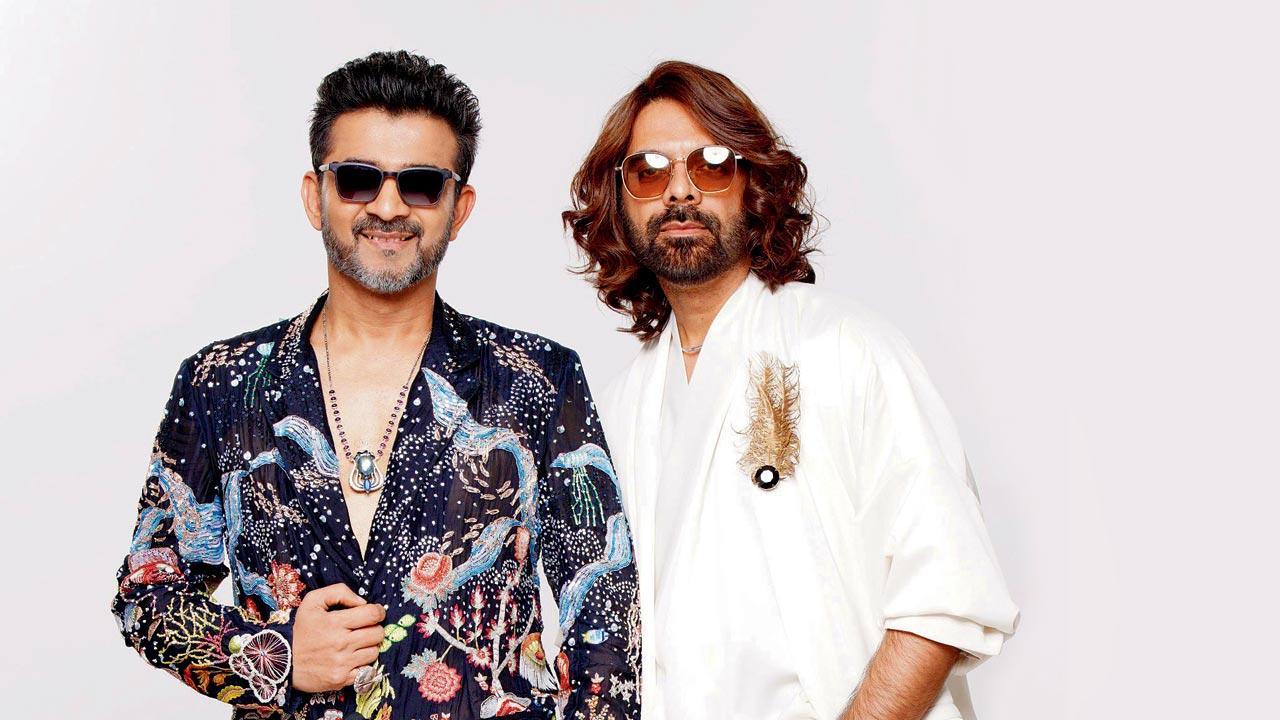
As listeners say that ‘Pardesiya’ is influenced by AR Rahman’s music, Param Sundari composers Sachin-Jigar reflect on how the album is their tribute to the maestro. They also share that they are proud that their work is being compared to A R Rahman's
Mohar Basu (MID-DAY; August 25, 2025)
Few composer duos in Hindi cinema today straddle madness and melody as deftly as Sachin–Jigar. Over the past decade, they’ve swung between quirky tracks like Kamariya, romantic numbers like Mileya Mileya, and chartbusters like Aaj Ki Raat. Ahead of their latest outing, Param Sundari, the duo talks about their mindset, music, and their tribute to the master. Excerpts from the interview.
What’s the secret of a long-term collaborative equation?
Sachin: It is destiny. We never sat in business meetings to plan this partnership — it just happened. I first met Jigar to share some workload, and there’s no way two people living so far apart could’ve just decided to become a jodi. It feels like something beyond us put us together. Let me give you a recent anecdote: I needed Jigar not just as my business partner but as family, and he came through for me. That’s when I realised I admire him beyond music. He’s five years younger but has this politeness, manners, and ability to communicate that I really look up to. He’s also the rebel in our duo, the one who pushes.
Jigar: The common thread between all of us is that we’re mad but sane enough to know that we’re mad! Otherwise, who decides to make a song “Baba Ji Ki Booti”? And when we did that track, everyone sang — Raj, DK, Anand, Kunal, me. Whoever was in the room. None of us was in it for stability. I think it’s that madness that connects us and keeps us together.
Last year was stupendous for you, with Aaj Ki Raat becoming 2024’s most-streamed song. When you start a new project after such a success, what is your mindset?
Sachin: Jigar doesn’t sleep — and he doesn’t let anyone else sleep either! (laughs) For him, the moment a song works, that gate is closed. He won’t allow us to repeat ourselves in the same way. That forces us to think differently, and that’s why we’ve managed to stay versatile. For me, that success gave me a certain ease. I’ve lived through the struggle of not finding popularity, so to be on the other side feels nice. But we were never in the game for just hits or flops. We came here to make good music, and even after success, that hasn’t changed.
Our mantra is never to define a “Sachin–Jigar sound.” We don’t want people to say, this is exactly what they always do. We move on, leave that sound behind, and try something new. If others want to pick it up, great. If not, no problem. That’s why after Stree 2, we thought, okay, we’ve done the madness in Stree, we’ve done dance numbers, now how do we break out again? That’s how Param Sundari happened. It’s become an unplanned pattern with us — one big dance number, then one big love song, then something unexpected.
Jigar : We’re also conscious of not getting typecast as “the commercial dance anthem guys.” So if we’ve just done a massive dance track, next time we’ll want to balance it with a love song or something soulful.
When the Param Sundari teaser dropped, it went viral, with Sonu Nigam’s voice everywhere on social media. How did that feel?
Sachin: A day before Jigar and I flew to Dubai for the Param Sundari music session, Dinesh Vijan called us to his office and told us this is a once-in-a-lifetime opportunity. Instantly, [A R] Rahman sir started playing in my head. Roja [1992] changed my life forever — if I’m a composer today, it’s because of those five years of listening to him. So working on Param Sundari felt like living a dream.
Jigar: South Indian music has also inspired us a lot because it stays rooted in its culture. Even in the most commercial films, you’ll hear classical influences. I trained in classical singing for 10–12 years, and often had to “unlearn” some of it to compose for cinema. But “Param Sundari” brought everything we wanted together, it felt like a dream we didn't want to wake up from. As for Sonu Nigam: growing up, albums like Yaad, Deewana, Jaan were my everyday listening. First it was a dream to see him live, then to hear him sing songs we produced. The first track we ever programmed was sung by Sonu Nigam. That was already a big moment.
But as composers, we never got to record him again. We always kept it inside us. One day, we have to make a tune worthy of his voice. I was such a huge fan, I would literally pray to him before going to school! (laughs) So when we composed Param Sundari, we both knew deep down: this is it. We didn’t even say it out loud to each other, but we knew this was the song for Sonu Nigam.
We called him, he heard it, came to the studio, and recorded it in half an hour. It was magical. For us, it’s the greatest tribute — to have the man who inspired us be part of our music. Recently, he called and told us how much love he’s receiving for the song. To hear that from your idol — that’s the biggest moment of the year.
With the first track going viral, the flip side is that the rest of the album has to match up. Do you worry about how people will receive a song?
Jigar: Definitely the latter. That’s not our job. Once we put our music out, it belongs to the audience. As fellow creators, we may form opinions, but as listeners, people have the right to completely own or dismiss what we make.
We learned early in our careers to detach ourselves from the fate of a song. It hurts when a track you love doesn’t do well, but once you release it, it’s no longer yours. You’ve shot the arrow, and it’s out in the world. What feels “good” to me might not land with someone else, and that’s okay. So yes, we’ve made peace with it. Especially today, when there’s such great indie music and such strong new artists coming through, we’re not greedy. We just try to give our best and then leave it to the universe.
Has it happened that you expected a song to be a big hit and it didn’t catch on?
Jigar: Many times! One example is Happy Ending [2014]. The album actually caught on months later. At release, it didn’t get the traction we hoped for, though we felt it was a true coming-of-age album in terms of sound and concept. The first song, Jee Phaad Ke, generated noise, but the other tracks didn’t bloom immediately. And because once a producer sees one song breaking through, he’ll naturally invest all his energy and money into pushing that one, the rest often get sidelined. We always believed the album would find its way — and it did, but very late. There are other examples too. A beautiful song like Pinjra Tod Ke in Simran, or Hoor in Hindi Medium with Atif Aslam. We thought they’d immediately catch on. They didn’t at first, but later people came back to them, and now they even request us to perform them on shows.
Sachin: It’s a part of the game. That’s why having the first song of an album break through is actually a huge victory. Because imagine if you’re waiting until the fourth track for something to click — by then the producer may lose hope, and the entire album can collapse.
Jigar: For us, every film’s music carries big stakes. Actors want to be seen in a good light, producers are investing heavily, directors have worked hard. If the first song doesn’t land, there’s panic. And in those moments, you have to put art aside and think practically: we have to make this work. When the first track works, it also gives us the liberty to experiment with the rest of the album. For example, because Stree worked, we could make Stree 2 completely different — even put a ghazal on a beat. That was a risk, and it only happened because the first one clicked. So yes, we’ve learned that “first song tracking” is the safer and better place to be in, even if the others don’t explode in the same way.
Dinesh Vijan, Amitabh Bhattacharya and the two of you almost function like a unit. And every time this unit comes together, it delivers. What makes it work?
Sachin: Dinesh is extremely critical of his own work, and Amitabh Bhai is the same. He’ll come back after six days to change just one word in the last line of an antara, or fight with us about a line even before a shoot mix is delivered. That level of self-criticism keeps the bar high.
The truth is, at the end of the day, no matter how many aspirations or ideas we all come in with, there’s only one song to be made. That perspective keeps us grounded. We keep checking each other.
Dinesh loves to experiment — he’ll come to us with a reference, or say, “Here’s this Afro-inspired song, can we make it a love track?” He’s always hustling, always infusing new ideas. Jigar, as I’ve said, is the rebel — he refuses to repeat himself, and he shares a bond with Dinesh that goes beyond work, which makes them almost like brothers.
Jigar: For me, I try to stay objective, to keep perspective when things get too passionate. And Amitabh Bhai has this magical ability to bring in a word or phrase that sparks a whole song. Among the four of us, someone always has the starting point.
Because this unit has delivered before, we have the courage to keep pushing further — to take one more risk, one more step. The balance of being able to check each other and push each other is what keeps us both grounded and moving forward.
Also, we’ve been through failures together — films that didn’t work, songs that vanished without a trace. That’s why now, even if something doesn’t work, it doesn’t shake the association. Our bond isn’t dependent on hits. It’s dependent on whether we’ve fulfilled each other’s creative soul. If between the four of us, we’ve inspired and satisfied each other creatively, then that’s success, no matter how far the song travels.
On social media, people are calling Param Sundari’s music derivative and influenced by A R Rahman. Do you worry about that?
Sachin: Never. From the beginning, this song came from a place of pure art, dedication, and a tribute to the master. For us, it’s a matter of pride if one of our songs even gets compared to his work. I look up to Rahman sir not just for his work, but for the person he is. On the inlay card of his first independent album [Vande Mataram], he wrote: ‘Hope to become the song of an independent India.’ That’s the man we’re paying homage to.
Jigar: When people say Param Sundari feels familiar, for us, familiarity isn’t bad. Familiarity can make you feel at home, and once you’re there, you can surprise the listener with new things hidden inside.
We often wonder how bizarre our life would be had we not met the right people - Sachin-Jigar
8:15 AM

Musician duo Sachin and Jigar to enable skilfull Gujarati individuals hone their talent, promote them on their social media handles
Sonia Lulla (MID-DAY; March 2, 2020)
A mammoth six-track set-list in Street Dancer 3D behind them, and with their eyes set on the March release, Angrezi Medium, Sachin Sanghvi and Jigar Saraiya have been devoting time to a passion project. A bevy of aspirational messages from their fans in Gujarat enquiring about measures they must take to enhance their individual skills has encouraged the musician duo to take matters in their own hands. With Gujarat Cultural Movement, they aim to provide a platform for talented individuals to enhance their craft, and showcase their work.
"We often wonder how bizarre [our life would be] had we not met the right people," says Sachin, as Jigar adds, "It was about time we too stepped up and did stuff for other artistes, especially those from Gujarat. We're not trying to shape anyone's career, but we're hoping to inspire them to step up their game, reinvent themselves, or even find themselves."
Sachin reveals that with the movement, they will invite entries to an official email ID, and encourage artistes across platforms — dance, music, handicraft, and everything under Gujarati entertainment — to express themselves. "Our team will pick deserving artistes, and we will bring [suited professionals] to help them enhance their art. After it has [met a certain standard], we will send it to our social media team [to share it on our platform]. I won't stop at calling this just a mentoring program. It could well become a talent pool. We'll look at every possible collaboration and viable outlet [for them to grow]."
Just yet, the duo isn't exploring a mentoring format that is rather defined. "If someone doesn't need to travel here, [they won't]. For instance, we have a friend in Vadodara who is a stand-up comedian. So, should we receive a suitable application from comics from the city, she can help them from there. We are looking at learning methods that are feasible and contemporary. Art is discovered, and we'll wait for people to discover [artistes]."
On the work front, Irrfan's Angrezi Medium, comprising five songs, has them take charge of four. "One is a remix, and we've decided we won't do them," they say. The film, that explores the relationship between a father and daughter — played by Irrfan and Radhika Madan — will also include their "favourite" song, the Coke Studio number, Laadki, also devoted to daughters. "Another is a promotional number that will release soon."
Yet another track, Ek zindagi, is a throwback to the first edition of the series, Hindi Medium. "Each [instalment] is seen as a stand-alone piece, and we have to see where the script's heart lies. But, we also try to retain something from the past edition. With [the] ABCD [franchise], we keep Bezubaan as a constant. Here, it is Ek Zindagi. But [each edition] has its own demand."
Among the new breed of musicians who still choose to work as a set, the duo admits that the clashing of their distinct music sensibilities implies there's always scope for each of them to learn. "Musically, we are so different that we keep surprising each other and discovering one another," says Jigar, as Sachin adds, "You have to respect each other for a jodi to work. We've had our share of fights, but we've realised that together we can deal with stress, and [people's] expectations better."
The real battle starts when the world notices your work - Sachin-Jigar
7:00 AM

Neha Maheshwri Bhagat (BOMBAY TIMES; August 12, 2016)
Sachin-Jigar catapulted into
limelight with the freshness of Saibo (Shor In The City). And though
they have a signature style that spells folk fusion, the young musical
duo has gone on to do unpredictable things with their music. After
reinventing the idea of trippy in Goa Goa Gone and bringing the raw rage
of rock in Badlapur to the forefront, they are back with A Flying Jatt
- fifty shades of Punjabi. And, the Gujju boys have their listeners on
the edge, once again. In an interview with Bombay Times, they tell us
what keeps their bond thriving even after 12 years, why singers in India
are not as big as their Western counterparts and why they are both
constantly competing with each other.
Since you are not related by blood, how did you come to work together?
Sachin: Amit (Trivedi) introduced me to Jigar after I told him that I was looking for someone who I could not only share the workload with, but also trustworthy, who I could bring home, as my home was my studio then. We became inseparable after a couple of projects. Our graduation from arrangers to composers strengthened the bond further. It was a huge leap of faith. Little did we know that the real battle starts when the world notices your work.
Jigar: Before we realised we are a team, we were on the same page.
Was it risky to refuse offers right in the beginning of your career?
Sachin: Fortunately, we didn't know how risky it was at that point. After seeing some renowned artistes getting typecast, we didn't want to go through the same. Sometimes, it's totally my call to reject an offer and he doesn't understand it. Jigar is a rebel and I am rational. We stop talking to each other for weeks. But whoever realises his mistake, gracefully accepts it.
Jigar: We want to outdo and reinvent ourselves with every project. If we can't make a trend, we won't follow one either. We aspire to make a song, which may not generate many hits, but enable us to move a step ahead from where we were. We make songs that people like without following a formula or repeating your last success. We didn't get any reaction for almost 15 days when Party Abhi Baaki Hai released. People bashed it further when the video over a guy lip-syncing to a girl's voice. There was so much negativity around it that we thought we could never make songs. Nacho was rejected thrice even though we believed that it would be a hit. Finally, we got a taker and it made its destiny.
Jigar, did you ever mind Sachin's name preceding yours?
Jigar: People started calling us that. It's more out of respect that Sachin's name comes first as he is the elder one. It has a certain rhyme to it. Jigar-Sachin sounds odd. We could have called ourselves crazy carters or dafliwallas.
Sachin: We are honest people and don't believe in showing off. In fact, many think that we are one person, so we use social media to break the notion.
Jigar: We want to clarify that we are two people and Jigar is not his surname
What about composing for double meaning lyrics?
Sachin: We don't endorse double meaning songs. We can be naughty, even though we are simple. We believe that music should not just be deep or serious, but it definitely should not be sleazy. There is a variety of listeners to cater to.
Jigar: We are director's boys and have to deliver as per his requirement. We can't be expected to compose a bhajan for Go Goa Gone. I am not ashamed of crooning G Phaad Ke in my concerts. If people find certain songs objectifying women, then there are women dancing to it. We are young and like to make what youngsters want to hear without degrading anyone.
People often debate that today's music lacks melody.
Sachin: I agree. But films represent the times we are in and today's generation wants to dance. Music is not only for those who seek soulful melodies as they are just one segment of the listeners. We are trying to write melodies that will outlive the films.
Why are singers in India not as big as their western counterparts?
Sachin: We are not listening to music seriously and hence, not taking it seriously. We don't have enough dedicated takers, which has led to producers not taking music seriously. There is no money attached to music. The producer doesn't want to bid time to wait for the right mix of songs for his film.
Jigar: Half of the films have run-of-the-mill songs, which will probably work for 15 days and play at shaadis. We call it popcorn music. I am not against it, but I am saying that we are undergoing a transition phase. This will probably last another two years until the album culture returns. An album is rare and I want it to become even more rare, because you start taking things for granted when it's in excess. I want it to become extinct so that people start value it. Also, Bollywood has absorbed every vertical and hence, all other industries have lost their individual identities, including independent singers.
Do you feel singers are at the mercy of superstars?
Jigar: A superstar has worked his way up and we need to respect that. Having said that, our hits have been with no superstars. And unlike music with superstars that becomes a hit overnight, the response to our music even though delayed, is multifold. The song works on its own. Because we work with all honesty and dedication, we don't think we won't be able to deliver quality music. And if we continue to deliver good work, there will be a day when a superstar will ask us to compose for them.
Jigar, you sing as well. Is there an urge to sing all your compositions?
Jigar: A composer need not sing his own song, just like a singer need not be the face of his own. Instead we try out 10 different voices for the same song. If I had learnt singing diligently, I would have sung all the songs. There is too much talent outside that cannot be ignored just because I am obsessed with my voice. My wife Priya sings beautifully, but she hasn't sung in A Flying Jatt. In fact, we replaced her in one song as we wanted a new voice. We don't want to succumb to the temptation of becoming superstars.
Since you are not related by blood, how did you come to work together?
Sachin: Amit (Trivedi) introduced me to Jigar after I told him that I was looking for someone who I could not only share the workload with, but also trustworthy, who I could bring home, as my home was my studio then. We became inseparable after a couple of projects. Our graduation from arrangers to composers strengthened the bond further. It was a huge leap of faith. Little did we know that the real battle starts when the world notices your work.
Jigar: Before we realised we are a team, we were on the same page.
Was it risky to refuse offers right in the beginning of your career?
Sachin: Fortunately, we didn't know how risky it was at that point. After seeing some renowned artistes getting typecast, we didn't want to go through the same. Sometimes, it's totally my call to reject an offer and he doesn't understand it. Jigar is a rebel and I am rational. We stop talking to each other for weeks. But whoever realises his mistake, gracefully accepts it.
Jigar: We want to outdo and reinvent ourselves with every project. If we can't make a trend, we won't follow one either. We aspire to make a song, which may not generate many hits, but enable us to move a step ahead from where we were. We make songs that people like without following a formula or repeating your last success. We didn't get any reaction for almost 15 days when Party Abhi Baaki Hai released. People bashed it further when the video over a guy lip-syncing to a girl's voice. There was so much negativity around it that we thought we could never make songs. Nacho was rejected thrice even though we believed that it would be a hit. Finally, we got a taker and it made its destiny.
Jigar, did you ever mind Sachin's name preceding yours?
Jigar: People started calling us that. It's more out of respect that Sachin's name comes first as he is the elder one. It has a certain rhyme to it. Jigar-Sachin sounds odd. We could have called ourselves crazy carters or dafliwallas.
Sachin: We are honest people and don't believe in showing off. In fact, many think that we are one person, so we use social media to break the notion.
Jigar: We want to clarify that we are two people and Jigar is not his surname
What about composing for double meaning lyrics?
Sachin: We don't endorse double meaning songs. We can be naughty, even though we are simple. We believe that music should not just be deep or serious, but it definitely should not be sleazy. There is a variety of listeners to cater to.
Jigar: We are director's boys and have to deliver as per his requirement. We can't be expected to compose a bhajan for Go Goa Gone. I am not ashamed of crooning G Phaad Ke in my concerts. If people find certain songs objectifying women, then there are women dancing to it. We are young and like to make what youngsters want to hear without degrading anyone.
People often debate that today's music lacks melody.
Sachin: I agree. But films represent the times we are in and today's generation wants to dance. Music is not only for those who seek soulful melodies as they are just one segment of the listeners. We are trying to write melodies that will outlive the films.
Why are singers in India not as big as their western counterparts?
Sachin: We are not listening to music seriously and hence, not taking it seriously. We don't have enough dedicated takers, which has led to producers not taking music seriously. There is no money attached to music. The producer doesn't want to bid time to wait for the right mix of songs for his film.
Jigar: Half of the films have run-of-the-mill songs, which will probably work for 15 days and play at shaadis. We call it popcorn music. I am not against it, but I am saying that we are undergoing a transition phase. This will probably last another two years until the album culture returns. An album is rare and I want it to become even more rare, because you start taking things for granted when it's in excess. I want it to become extinct so that people start value it. Also, Bollywood has absorbed every vertical and hence, all other industries have lost their individual identities, including independent singers.
Do you feel singers are at the mercy of superstars?
Jigar: A superstar has worked his way up and we need to respect that. Having said that, our hits have been with no superstars. And unlike music with superstars that becomes a hit overnight, the response to our music even though delayed, is multifold. The song works on its own. Because we work with all honesty and dedication, we don't think we won't be able to deliver quality music. And if we continue to deliver good work, there will be a day when a superstar will ask us to compose for them.
Jigar, you sing as well. Is there an urge to sing all your compositions?
Jigar: A composer need not sing his own song, just like a singer need not be the face of his own. Instead we try out 10 different voices for the same song. If I had learnt singing diligently, I would have sung all the songs. There is too much talent outside that cannot be ignored just because I am obsessed with my voice. My wife Priya sings beautifully, but she hasn't sung in A Flying Jatt. In fact, we replaced her in one song as we wanted a new voice. We don't want to succumb to the temptation of becoming superstars.
Jee Karda: Varun Dhawan's suicidal song about pain and aggression
7:54 AM

Roshmilla Bhattacharya (MUMBAI MIRROR; December 11, 2014)
 Around two months ago,
Sriram Raghavan's dark thriller, Badlapur, was screened for Sachin
Sanghvi and Jigar Saraiya, followed by a team meeting during
which the music score was discussed. The composer duo, who had been
involved with the film from the scripting stage, agreed that they needed
a gritty theme song expressing the urge to die in love which
could be picturised on the aashiq hero,Varun Dhawan. This song playing
in the background in the film's trailer, immediately caught the
attention, and on Tuesday, Jee Karda was released online without a video
which is yet to be shot.
Around two months ago,
Sriram Raghavan's dark thriller, Badlapur, was screened for Sachin
Sanghvi and Jigar Saraiya, followed by a team meeting during
which the music score was discussed. The composer duo, who had been
involved with the film from the scripting stage, agreed that they needed
a gritty theme song expressing the urge to die in love which
could be picturised on the aashiq hero,Varun Dhawan. This song playing
in the background in the film's trailer, immediately caught the
attention, and on Tuesday, Jee Karda was released online without a video
which is yet to be shot.Talking about it, Sachin says that the aim was to make the “best suicide song“, adding, “Sometimes love can turn fatal too“.
Jigar points out that while most songs about heartbreak and judaai talk about the pain of love, this one is different because of the aggressive undertone which takes Varun's character to the edge of madness where he's ready to do anything to get his love back, even kill himself.
“Hanste hanste mit jaaneya ni mera jee karda marjaneya ni aaj mera jee karda,“ he croons. “It's melody with a tinge of melancholy. There's pain but it is not mixed with tears of weakness but a burning aggression.“
As the emotions flowed, Jigar's wife Priya Saraiya gave words to their music which is a mix of sufi, rock and pure melody. The words were in a college boy's lingo. They sent a scratch to the film's producer, Dinesh Vijan, who assured them that they were on the right track. Two weeks ago, Dinesh gave them a line that helped them crack the song. “He came up with Marjaneya ni aaj mera jee karda and and we wrapped up the song in four hours flat,“ reminisces Jigar.
After that Divya Kumar came on board. The singer has hit all the right notes lately with the remixed version of Happy Endings' G phaad ke and Finding Fanny's Shake Your Bootiya. The music directors were convinced that his was the kind of raw, unique voice required for Jee karda. “During jam sessions he wowed us with his renditions of Ghulam Ali's ghazals and Sufi songs,“ says Sachin.
Badlapur is reportedly inspired by a real story but Sachin-Jigar hasn't met Sriram's muse yet. “What we saw on screen was painful enough for us to pray that this never happens to anyone else,“ Jigar says emotionally. Even though the visuals are yet to be filmed, the composers are confident that Sriram will do full justice to their instant hit. “He's amazing and so is Ahmed Khan who will be choreographing the song,“ asserts Sachin. “All of us are on the same page on this one.“
And did they concur with the producer's decision to release the audio almost a month before the video? Sachin insists they were in complete agreement: “Of late, so many people have been telling us that yesteryear songs have a longer shelf life. That's because as compared to 20 films a year, today we are producing up to 600 and at four songs per film, that's 2400 songs annually. There's always the danger of your song getting lost in the crowd, so giving it time to grow on the listeners is a good idea,“ he reasons.
I hope people like our attempt to get catty in love - Sachin-Jigar on Such A Pussycat
8:11 AM

Roshmilla Bhattacharya (MUMBAI MIRROR; October 30, 2014)
Paji Tussi Such A Pussycat
began with just this single line which Amitabh
Bhattacharya had penned and presented compos ers Sachin
Sanghvi and Jigar Saraiya before they flew out to the US with director
duo Raj Nidimoru and Krishna DK for the shooting of their Saif Ali
Khan-Ileana D'Cruz starrer. “Happy Ending is a comedy about rom-coms so we needed a song for every mood. Along with a love song and a
dance track, it was imperative that we had a gana on heartbreak too,“ points out Sachin.
Jigar is quick to add that they were well aware that this song about tanhaai and a toota hua dil couldn't be the usual rona-dhona, tabladholak dirge. The idea was for the 'ditched' dude to quickly realise after a few days of melancholy that he was no longer 'stuck' in a relationship. “He needed to shrug off the 'mistake', move on and live life again,“ he explains, adding that it is the reverse philosophy which is at work here. “Instead of crying his heart out like a Devdas, this modern-day Romeo laughs away his woes. Isn't that what dark irony is all about?“ Playing around with Amitabh's catchy one-liner, the composer duo came up with five funky tunes for Raj-DK to choose from. “Amitabh had begged us not to turn this into a typical Punjabi song despite the words 'paaji' and 'tussi,'“ recalls Jigar, pointing out that since the number was to be filmed in Amercian shores where the director duo are originally from, they knew that a western tune was expected from them. “We've come up with something in the Blues tradition, very country music style.“
 With the tune locked, Amitabh needed
just a day to finish writing the rest of the song. He also sang the
scratch and after hearing him, the music directors didn't even think of
taking it to another singer. “His voice is just so right for this,“
smiles Jigar who has turned crooner for Paaji too. “I sang the antaras
with Divya Kumar. When you see the film you'll realise why we needed
different voices for them,“ he says.
Sachin-Jigar had earlier scored the Johhny Johnny song for Entertainment
which had its roots in a nursery rhyme. Is this song too borrowed from
another nursery rhyme, Pussy cat pussy cat where have you been?
With the tune locked, Amitabh needed
just a day to finish writing the rest of the song. He also sang the
scratch and after hearing him, the music directors didn't even think of
taking it to another singer. “His voice is just so right for this,“
smiles Jigar who has turned crooner for Paaji too. “I sang the antaras
with Divya Kumar. When you see the film you'll realise why we needed
different voices for them,“ he says.
Sachin-Jigar had earlier scored the Johhny Johnny song for Entertainment
which had its roots in a nursery rhyme. Is this song too borrowed from
another nursery rhyme, Pussy cat pussy cat where have you been?
“No, this one is more of a literal translation of a popular one-liner: ladki dekhi to sher bhi billi ban jaati hai,“ laughs Sachin, pointing out that when Jigar's wife and his wife heard the song, they told the two that it was the first time they have come up with a track which was ekdum sach.
Interestingly, the composer duo features on screen too along with 'hero' Saif Ali Khan. “It was just a two day shoot in the US with Saif who is a chilled out dude. We just had to play ourselves. So there was no stress,“ Jigar shrugs nonchalantly, adding that Raj and DK and the two of them are a team now which upped the comfort level. “We also have a great connect with Remo sir (Remo D'Souza) who choreographed the number. We have earlier done FALTU and ABCD. He always takes our songs up step up.“
Sachin stresses this is not a stereotypical sad song: “We took a risk steering off the beaten track. I hope people like our attempt to get catty in love.“
Jigar is quick to add that they were well aware that this song about tanhaai and a toota hua dil couldn't be the usual rona-dhona, tabladholak dirge. The idea was for the 'ditched' dude to quickly realise after a few days of melancholy that he was no longer 'stuck' in a relationship. “He needed to shrug off the 'mistake', move on and live life again,“ he explains, adding that it is the reverse philosophy which is at work here. “Instead of crying his heart out like a Devdas, this modern-day Romeo laughs away his woes. Isn't that what dark irony is all about?“ Playing around with Amitabh's catchy one-liner, the composer duo came up with five funky tunes for Raj-DK to choose from. “Amitabh had begged us not to turn this into a typical Punjabi song despite the words 'paaji' and 'tussi,'“ recalls Jigar, pointing out that since the number was to be filmed in Amercian shores where the director duo are originally from, they knew that a western tune was expected from them. “We've come up with something in the Blues tradition, very country music style.“
With the tune locked, Amitabh needed
just a day to finish writing the rest of the song. He also sang the
scratch and after hearing him, the music directors didn't even think of
taking it to another singer. “His voice is just so right for this,“
smiles Jigar who has turned crooner for Paaji too. “I sang the antaras
with Divya Kumar. When you see the film you'll realise why we needed
different voices for them,“ he says.
Sachin-Jigar had earlier scored the Johhny Johnny song for Entertainment
which had its roots in a nursery rhyme. Is this song too borrowed from
another nursery rhyme, Pussy cat pussy cat where have you been?“No, this one is more of a literal translation of a popular one-liner: ladki dekhi to sher bhi billi ban jaati hai,“ laughs Sachin, pointing out that when Jigar's wife and his wife heard the song, they told the two that it was the first time they have come up with a track which was ekdum sach.
Interestingly, the composer duo features on screen too along with 'hero' Saif Ali Khan. “It was just a two day shoot in the US with Saif who is a chilled out dude. We just had to play ourselves. So there was no stress,“ Jigar shrugs nonchalantly, adding that Raj and DK and the two of them are a team now which upped the comfort level. “We also have a great connect with Remo sir (Remo D'Souza) who choreographed the number. We have earlier done FALTU and ABCD. He always takes our songs up step up.“
Sachin stresses this is not a stereotypical sad song: “We took a risk steering off the beaten track. I hope people like our attempt to get catty in love.“
Johnny Johnny is pure entertainment and not meant to be taken seriously - Sachin-Jigar
8:43 AM

Roshmilla Bhattacharya (MUMBAI MIRROR; July 17, 2014)
A party song inspired by a nursery rhyme? It happens only in Bollywood! Composer duo Sachin-Jigar reason that Entertainment, a caper with a canine hero, was the perfect film for the musical mocktail with a kiddy connect. And that is how Johnny, Johnny? Yes Papa, Eating Sugar? No Papa, Open Your Mouth, Ha, Ha, Ha, translated into Johnny Johnny? Haanji, Tuney Pee Hai? Naaji, Munh Ko Kholo, Hawji, Jhooth Boleya? Naaji.
"At any party you come across an inebriated Johnny begging for one more, promising it'll be his last peg. The kindergarten hook was a novelty which appealed to everyone, including Akshay Kumar who has lip-synched to dozens of such intoxicating dance numbers, but not one drawn from a nursery rhyme before," says Jigar.
He adds that today he hears variations of the song in a parent-child conversation, like Johnny, Johnny? Haanji, Khel Raha Tha? Naaji, Padhai Ki Hai? Haanji, Jhooth Boleya? Naaji. However, the music director is quick to say that the intention was not to promote drinking or drive kids astray. "This song is nothing but pure entertainment and not meant to be taken seriously. It's about enjoying the nasha without actually getting drunk. Our lyricist, Mayur Puri, just took the first two lines of the nursery rhyme, and incorporated them into a bade bachchon ke liye orginal song, which he penned in just three days," informs Jigar.
And how long did it take them to set Mayur's words to tune? Jigar admits that it took 10 days, over a month, to get everything in place. "This one is an out-and-out commercial song, different from our regular beats. So we needed to think beyond Sachin-Jigar," he smiles.
Interestingly, the scratch was dubbed by Jigar and to his surprise everyone insisted that it be retained. His wife, Priya Panchal, has sung the female version. Jigar explains that he wanted the petulance of a childish tantrum to come through in the line Na Na Na Maine Pee Nahin Hai and his better half understood instantly what he was looking for and delivered it on cue. And to their surprise, everyone liked her rendition so much, that it too was retained. "Akshay liked it so much that he decided to lip sync to Priya's tunes. Having him sing in a ladki ki aawaaz was another new twist," he beams.
However, the composers realised that they needed a professional's voice to enhance the song and that's how Madhav Krishna entered the picture. "He's sung for us before, Duhaai in ABCD. And being a new singer he gives the song a youthful feel," Sachin points out.
When asked why they didn't bring in a fourth voice, that of the dog, Jigar admitted that the thought had crossed their minds, but they refrained from it because it might have felt strange to those who didn't know about the canine angle, to hear a dog barking in the middle of the film. "Radio par aisa lagta jaise gaana sunte hi galli ke kutte bhaunkne lage hain," he chuckles.
The duo's biggest boost came from choreographer Remo D'Souza who after hearing the song told them, "Bhai log, yeh ekdum correct hai."
Remo is someone the two look up to and run most of their compositions by him. Jigar admits that Remo rarely pays a compliment but in this case he felt that they had come up with the perfect track for a comedy starring Akshay Kumar. They in turn are all praise for the way the dance director has visualised their song on screen. "Any other choreographer would have set it in a dark night club and given it some hip-hop moves. But we decided on a pool party so the frame would be full of light and bright colours.
The childish gamble has paid off, Johhny Johnny is everywhere, from the lips of little children to the discotheques. So it is surprising that Saturday Saturday, the other party anthem of a just released film, which they scored too, was the brainchild of another composer duo, Toshi-Sharib.
Jigar retorts. "Saturday Saturday was a recreation of an old Punjabi song by Badshah and we do only original songs." Touche!
Subscribe to:
Posts (Atom)