Showing posts with label Sabrina Lal. Show all posts
Showing posts with label Sabrina Lal. Show all posts
Delhi itself was a character in No One Killed Jessica-Raj Kumar Gupta
11:11 PM

Niharika Lal (BOMBAY TIMES; January 8, 2026)
Released in the first week of January 2011, No One Killed Jessica became a film audiences returned to each time the case saw a new turn. At the time, director Raj Kumar Gupta was warned that January releases rarely worked and that films led by women didn’t work – his had two. Yet the filmmaker says his faith in the film never wavered, a belief shared by everyone involved in the project.
A decade and a half on, the film remains iconic – for its hard-hitting subject, its authentic portrait of Delhi, its grounded courtroom sequences, and for helping open doors to female-led cinema at the time. Raj Kumar Gupta, who also wrote the film, looks back at the project that quietly reshaped the space for women-centric narratives in Hindi cinema.
‘There was no agenda behind the film’
“I wanted to tell the story, there was no agenda,” asserts Raj, adding, “I chose to tell it through the eyes of the two protagonists. One was Sabrina’s perspective and another perspective came from a character (of Rani Mukerji) who represented the media and, more broadly, the people who were seeking justice – those who wanted to see that justice was done. That is how the narrative came together. My approach was to stay focused on these viewpoints. Of course, many other characters came in and out of the story, but the core always remained centered on these two perspectives.”
‘It was a long and hard-fought battle for justice, and that was deeply inspiring’
Raj says, “When this incident happened in 1999, I was in college, so I remember it very clearly. This case was stuck in my head. Later, when we were discussing possible subjects, it came up again, and I felt it was something worth pursuing. I had lived in Delhi during my graduation, I had seen the city up close, and I had a certain point of view – both about Delhi and about the case. That perspective is what brought everything together.”
He reflects, “It was a long and hard-fought battle for justice, and that was deeply inspiring – a sister who refused to give up, who kept fighting for justice. The way the media and others collectively came together to support the cause was also powerful. This reflects society at large and is inspired by real events, and that is what ultimately compelled me to tell it.”
For the character of Jessica, Raj shares that he had Myra in mind. He says, “She was my friend. I also clearly remember the iconic smile of the real Jessica – I could see that smile in Myra, and that was extremely important for me to get it right. Although it was her first film, Myra did a great job in it.”
‘Filming the scene when Jessica was shot had an emotional complexity’
Raj recalls, “While we were shooting the first party sequence, it was one of the most complex scenes in the film not just technically, but emotionally as well. In many ways, the entire argument of the film rests on that scene. How it was shot was crucial, because later in the film, this is the very sequence that would be discussed in the courtroom.”
Shooting in real spaces
Raj Kumar Gupta wanted to shoot the film largely on real locations in Delhi. He says, "Delhi had a certain grit, a certain rawness, and that feeling was essential to the film. We had to have Delhi in the film. In many ways, Delhi itself was a character in the story. In the opening of the film, we talk about Delhi almost as if it’s a living presence."
Because of that, it was important for me to shoot across the city and the film was shot at locations like ITO, Tees Hazari, the streets of Delhi, Chandni Chowk, and other real locations.
He says, "I wanted the film to feel as authentic as possible, to be filmed in the real spaces where these events unfolded."
India Gate protest scene
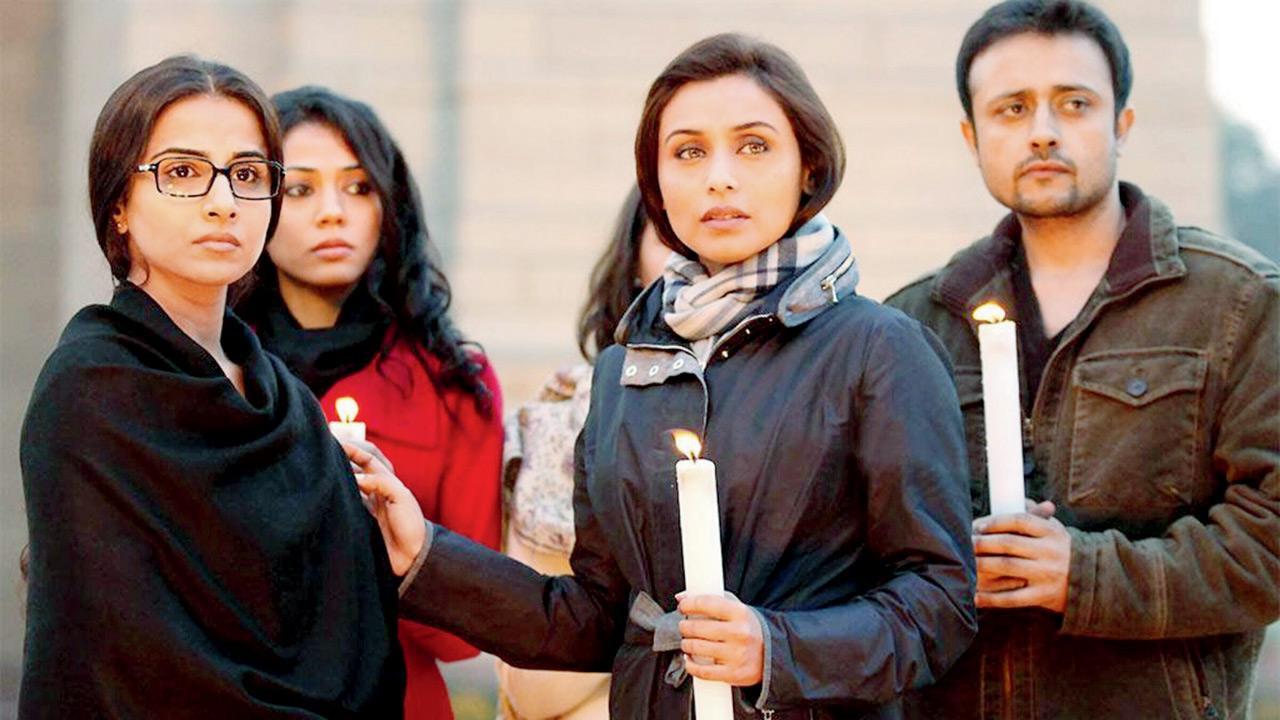
Back in 2006, on Republic Day, Rang De Basanti hit the screens and gave Indian cinema one of its most unforgettable protest scenes. A couple of weeks later, what India witnessed was the RDB effect when the film served as a catalyst for civic justice in the Jessica Lal case when thousands of people, including students, gathered for a candlelight rally at India Gate.
Raj Kumar Gupta shares, "While there are many places in Delhi, when we have to think of a place in Delhi, we think of India Gate. It became a place of collective rebellion. In No One Killed Jessica, we incorporated the protest at India Gate because in reality, people protested at India Gate after Manu's acquittal. I think India Gate is one of the locations in Delhi which evokes strong emotions."
He shares, "India Gate scene was the climax of the film. That sequence had a very strong emotional arc, and logistically it was a huge challenge. We were shooting at India Gate and had permission only for certain hours. On the same day, there was a major sports event happening, so teams were being shuttled through the area. That meant we had to finish the shoot within a very tight time frame. There was also a massive crowd present during the shoot, which added to the difficulty. Despite all that, the sequence was extremely emotional. It was designed to represent the end of the film through a song, and the light, the atmosphere, and the setting all had to come together perfectly. The challenges were many - managing the crowd, executing the scene within the limited time, and ensuring that the emotional weight came through. Most of the characters seen in that sequence are people the audience has already watched fighting for justice throughout the film - friends, supporters, and allies, so it was important to bring them together in a way that felt truthful and earned."
------------------------------------------------
"The story is about hope and justice. In real life also, people came together and justice was done. The story itself is driven by a tragedy; it should not have happened. I wanted to tell the story in a format where the story never goes dark. It was a very conscious effort. We were telling the story about real people. Life is about hope. The world runs on hope. I took a hard-hitting approach, but I also took an approach where it never gets too heavy to handle." - Raj Kumar Gupta
------------------------------------------------
Raj Kumar Gupta says, "Vidya and Rani come from different schools of acting. Vidya is very meticulous; she prepares for her character and is very methodical about her approach. With Rani, she is very spontaneous. You will not believe that five minutes back, she was laughing and joking. I got to work with two contrasting and opposite actors, and the character was also such that it gave me a wide range. Vidya Balan met Sabrina, but not before the film."
Forgiveness is individual choice, and I’m conflicted-Raj Kumar Gupta
8:16 AM
After Jessica Lal’s murderer Manu Sharma’s rehabilitation amid the success of his Indri whiskey sparks outrage, No One Killed Jessica director Raj Kumar Gupta notes that Sabrina Lal had forgiven him after he served his sentence
Mohar Basu (MID-DAY; April 21, 2025)
Last December, Manu Sharma hit headlines again. Sharma, who was sentenced to life imprisonment in 2006 for Jessica Lal’s murder and released from the prison in June 2020, was discovered to be the owner of the whiskey brand, Indri. It was found out that Sharma—born Siddharth Vashisht—now went by Siddharth Sharma and is associated with a £15 million investment in Scotland’s distillery Argyll and Bute, through his family’s company Piccadily Agro Industries. It led to wide debate over his rehabilitation and the role of privilege in it.
When we recently met director Raj Kumar Gupta, we asked him about his stand on the matter. His directorial venture No One Killed Jessica (2011)—starring Vidya Balan and Rani Mukerji—chronicled Jessica’s sister Sabrina Lal’s seven-year fight for justice.
“Sabrina Lal had fought tooth and nail to get her sister justice. But [in 2018], she had written a letter to the Tihar Jail authorities, saying she had forgiven Manu for his crime. She had said, ‘He has served his sentence and I’ve forgiven him. It will be like a catharsis to forgive and move on.’ When I had first read about her stand, I was numb. Our loss or rage can’t be more than Sabrina’s. No one suffered as much as she did. [Yet], she didn’t oppose his release. Everyone can have an individual take on it, but Sabrina reminds me of forgiveness,” he noted.
In early 2006, Sharma was acquitted after his privilege as a politician’s son had ensured that witnesses were silenced. It led to a nationwide uproar. In March 2006, the case was reopened in the Delhi High Court and he was convicted in December 2006. The recent turn of events has left Gupta with more questions than answers.
“Forgiveness is individual choice, and I’m conflicted. The court [served] justice. After that, he is back to where he is. This makes me wonder whether a criminal, who has done his time, has a right to live normally again. I wonder, doesn’t a criminal, having served his sentence, deserve to assimilate in the society or earn a living?”
The case that shook the nation
- Jessica Lal was shot dead on April 30, 1999, after she refused to serve liquor to Manu Sharma, son of former Union Minister Venod Sharma.
- In February 2006, Manu and eight others accused in the case were acquitted due to lack of evidence.
- His acquittal led to widespread outrage. Numerous candle marches, and SMS campaigns were organized to protest against the decision.
- As a result of the public outcry, the case was reopened in the Delhi High Court on a fast-track basis.
- In December 2006, Manu was convicted for the murder and sentenced to life imprisonment.
- In June 2020, he was released from the Tihar Jail for ‘good behaviour’.
Subscribe to:
Posts (Atom)