Showing posts with label Sabbir Khan interview. Show all posts
Showing posts with label Sabbir Khan interview. Show all posts
Tiger Shroff and Sajid Nadiadwala are just a call away-Sabbir Khan
7:53 AM
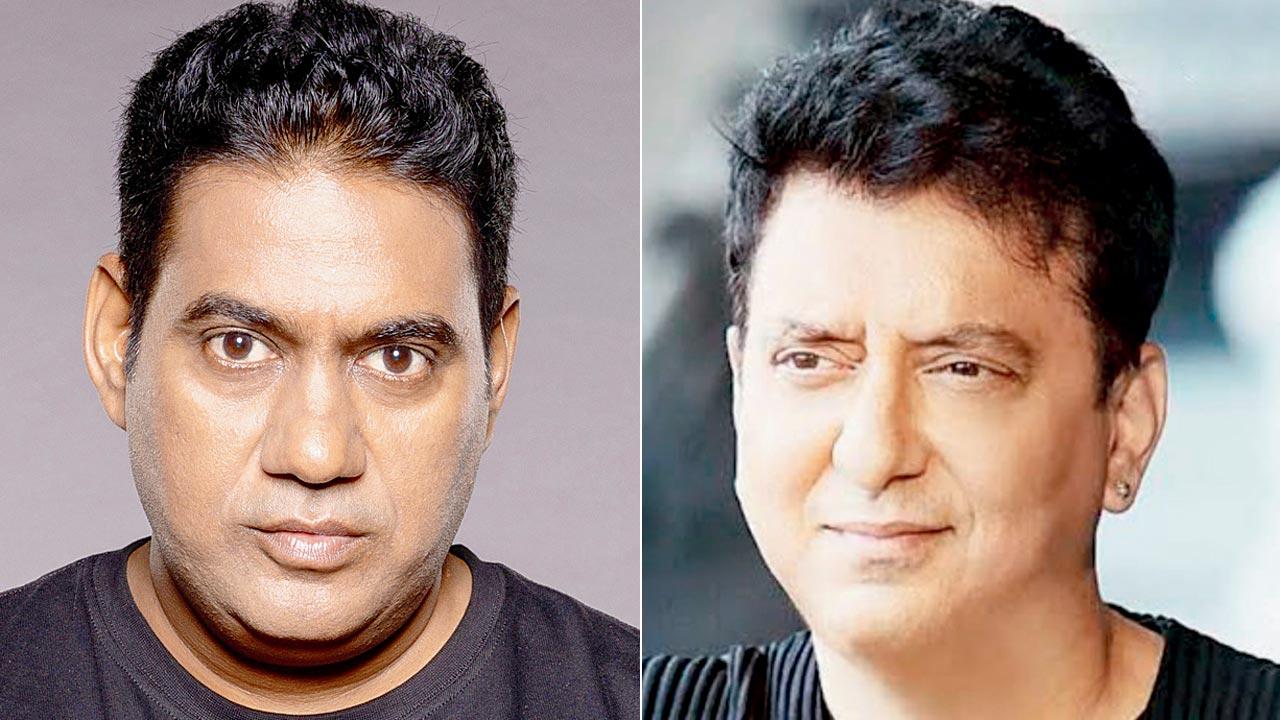
Sabbir Khan and Sajid Nadiadwala
Director Sabbir, whose Nikamma hits screens today, dismisses reports of fallout with Baaghi collaborators Shroff and Nadiadwala
Hiren Kotwani (MID-DAY; June 17, 2022)
Tiger Shroff has been a permanent fixture in Sabbir Khan’s last three films — Heropanti (2014), Baaghi (2016) and Munna Michael (2017). But the director’s latest release, Nikamma, sees him collaborating with Shilpa Shetty Kundra, Abhimanyu Dassani and Shirley Setia. While Shetty was seen in OTT offering Hungama 2 last year, the director is thrilled that his action comedy sees her grace the big screen after 14 years.
“Nikamma is the first film Shilpa signed [after her break from movies]. She got Hungama 2 later. Hers is a tricky part, but I always wanted to cast her. When she said that she is not doing films, I insisted she hear the narration. When she heard the script, she loved it,” he recounts.
Considering he was the mind behind Heropanti and Baaghi, it was surprising that he didn’t direct the sequels. “I lean towards organic franchises wherein while you’re writing the script, it has the scope to take the characters and story forward. It is strange to see different stories, having different characters, [being told] with the same film title,” Khan argues.
Is that the reason he didn’t helm the subsequent editions of the actioners? Or has there been a falling-out with Shroff and producer Sajid Nadiadwala, as rumours suggest? “There is no fallout. Tiger and I talk almost every week. He shared an encouraging post about the Nikamma song. Sajid bhai is my mentor. If things work out, we will collaborate again. They are just a call away.”
Khan adds that Shroff and he are “working on something”, but refuses to divulge details as it’s in the early stages.
I can't make biopics or pseudo-intellectual fare just to be taken seriously as a director-Sabbir Khan
7:18 AM
 Rachana Dubey (BOMBAY TIMES; July 21, 2017)
The failure of his
directorial debut may have been a setback of sorts, but the experience
taught Sabbir Khan a few valuable lessons about the industry and its
ruthlessness. It also made him a man who knows his mind. On the eve of
the release of his next, Munna Michael, Sabbir talks to BT about how a
film's box-office fate doesn't affect him, how he only pays heed to
constructive criticism and why he'd never make a 'pseudo-intellectual'
film. Excerpts...
All your previous films were for the same banner. Munna Michael is your first project outside it and many perceive it as your litmus test. Agree?
Would you look at a painting and call it the artist's litmus test? No one has a 100 per cent record, but everyone's intention is the same - to make an interesting film. I know that the industry is a ruthless place and only success is worshipped, but these things have never affected me. I'm not nervous or anxious about the outcome of Munna Michael. A story excited me and I set out to make it, that's all. The only time I am under pressure is when I am choosing a story. I am particular about it being interesting and universal.
Commercial cinema thrives on the universality of content. But don't you think it's a tad difficult to pinpoint what is universal and what isn't?
My math is simple: Can everyone watch what I'm making as a filmmaker or is it targeted at a select subset? At its core, Munna Michael is about fulfilling your dreams. Almost everyone can relate to that. We're all caught up with something while we have some other dreams. I grew up watching films in theatres that housed a thousand people, and everyone would react the same way - for me, that is the universality of content; it has become the basis of my filmmaking. I can't narrate stories in a dry or dull manner. I can't make biopics or pseudo-intellectual fare just to be taken seriously as a director.
Do you agree that the days of typical Bollywood commercial films are numbered?
Nothing in life disappears. Fashion, films, food...Everything is reinvented and presented with a relevant perspective. This is the golden age of Indian cinema, where compelling stories narrated beautifully have taken precedence over everything, including the star system that was the norm in the 80s and 90s. Having said that, Hindi cinema has its unique identity and that shouldn't be lost while we're trying to be different. While we're aiming to be unique, we shouldn't ape a Korean, Hollywood or a French film and add a Hindi subtext. We must find ways to keep our identity as an industry intact while narrating stories in diverse ways with a fresh set of actors. No one has a formula for surefire success. Creativity and sincerity are the only way forward.
Masala films are often accused of giving their heroines a raw deal while focusing entirely on the hero...
(Cuts in) Yes, uneducated, non-liberated film writers and directors should be blamed for that. Also, this question would have been more relevant a few years ago when that was prevalent. As a director, I have always kept my stories real and characters balanced. Munna Michael belongs to Tiger, but it's also Nidhhi's film. I don't accept or encourage stories where the girl is nothing more than a cardboard. Shraddha Kapoor, Kriti Sanon and even Nidhhi will vouch for that.
Munna Michael and Baaghi ran into legal issues despite all your sincerity and effort. Does that demoralize you as a filmmaker?
It doesn't; I believe in our judiciary and the systems that the industry has set up. There were cases when we announced Munna Michael, but I was never scared. My team and I work on the screenplay for months to bring something novel to the audience. So, the best way out is to submit the script before the court and the result will be for everyone to see. But yes, these episodes irk me. There are a few who are interested in making films and there are some who do this for free publicity.
How much does criticism impact your work?
Constructive criticism helps. For example, after my first film, a critic had pointed out that the use of the word 'bitch' was not right. My screenplay writer and dialogue writer were girls who had no problem with the word, but I understood what the critic meant. I consciously became more careful since then. What upsets me is the lack of research and stereotyping mainstream directors. To quote another example, a critic accused me of plagiarism after my last outing. When the studio pointed out that film is an official adaptation, a fact that was never hidden from the press, the said critic took to social media to say that she 'was just informed by the studio that the film is an official adaptation'. No apology was tendered to me. Even the review was not retracted.
After a star-studded first film (Kambakkht Ishq), was it a conscious decision to choose newcomers for your later projects?
I was secretly praying to make Heropanti with new faces because I knew that if stars came on board, they might not place their trust in me. I also thought that making the film with newbies would bring larger glory to everyone involved. Today, I prefer to work with a mix of established actors and new faces, the way I have done with Munna Michael. Despite being a star, Nawazuddin Siddiqui doesn't behave like one. I've realised that I can't work with people who have baggage. Besides, I know how tough it is to get a break in any stream in Bollywood; I've slogged for years as an assistant. I'm a middle-class guy whose father was in this industry. I know how the cookie crumbles.
Why did you opt out of Baaghi 2?
After Baaghi, I was approached to do the sequel and the contract was sent home, but there was no concept or a script. It takes almost a year to structure a screenplay. By then, Tiger and I had plunged into Munna Michael. It would be unfair on my part to think that they would wait for me, but my best wishes are with the team.
Ahmed Khan, who is directing Baaghi 2, has worked with you as a choreographer. Any exchanges with him?
Nope. Honestly, I didn't expect it also. He was on my set one day and I treated him well. I realise the value of a break, especially when you are making a comeback.
Michael Jackson's dance troupe trained Tiger Shroff for Munna Michael
7:36 AM

Mohar Basu (MID-DAY; July 13, 2017)
 Munna Michael is a special film for Tiger Shroff, who considers it his
tribute to Michael Jackson. The actor, who is known for his swift moves
on the dance floor, left no stone unturned in perfecting MJ’s style
of dancing for the film. Shroff can be seen recreating MJ’s iconic
moves in the recently released song, Beparwah.
Talking about the gruelling practice sessions that Shroff endured, director Sabbir Khan says, “Tiger attended a dance camp in the US. Not just that, dancers were brought in from Los Angeles. They practised with him for about 18 hours everyday. Many of these dancers have accompanied MJ on his tours and danced with him. We used them in a few sequences in the film as well. Off work, they shared anecdotes on MJ’s personal style, his gimmicks, et al.” Shroff has often expressed his admiration for the King of Pop and his passion for the dancing legend was evident during the movie’s shoot as well. Khan says, “He got emotional every time one of MJ’s tunes was played.”
In fact, it was Tiger who pushed Khan to direct the dance drama. “We were shooting a promotional number for Heropanti (2012), when I happened to discuss the idea of Munna Michael with Tiger. It was forgotten after that. In June last year, he called me saying, ‘Why don’t we make that film?’” recalls Khan.
The filmmaker, who is collaborating with Shroff for the third time, after Heropanti and Baaghi (2016), says he has never seen him as invested in a project. “He was bummed out after A Flying Jatt (2016) didn’t work, but he didn’t let that dampen his spirits. He used the dejection and failure to make this a wonderful film.”
I am who I am because of Vinod Khanna-Sabbir Khan
8:07 AM

Sabbir Khan (DNA; May 10, 2017)
I must’ve been six or seven when I first realised that Vinod Khanna was an important part of my life. During my boarding school vacations, when I used to come back to Mumbai, my father (lyricist Noor Dewasi who wrote Aao Huzoor Tumko from Kismat) would take me to film shoots where he always made sure I met Vinod Uncle. I call him that because that’s what my father asked me to address him as and that’s what I’ve called him in all the time I knew him.
By the time, I was around eight or nine, I began to understand everything. Vinod Uncle was this huge superstar and you understood that in the way people would stare at him in awe and in the way they treat him. Even at that young age, I realised that he had this aura, a strong glow around him and yet, I observed how polite and courteous he was to everyone.
This big superstar was always making me feel special whenever I visited him. I always had a front row seat watching him shoot and production hands fussed around me offering me soft drinks and chocolates. Lunch breaks were these big spreads in his room and as I nibbled through my food, I recognised other actors and filmmakers who came to meet him.
Vinod uncle always asked me about school and if I was happy. He was soft-spoken, and I was extremely shy, given the time I spent on a movie set with a superstar. It was only after constant prodding by my father to reply that I managed to mumble a few sentences like ‘school is good but the food is bad’. He would laugh and then give me some pointers on how I could make it interesting.
These memories and experiences were the foundations of my wanting to be a filmmaker later on in life. I am one today and there is no joy bigger than being on set writing for, shooting and creating films. But all of this could only be possible because of Vinod Uncle... I am who I am because of him.
I am unsure of how it all started… I have faint memories of my father’s conversations, but I believe it all began during a film shoot, where my father wrote songs for a film Vinod Uncle was starring in, where they became friends.
It was an unusual friendship between a superstar and a struggling songwriter, but I recall that Vinod Uncle was extremely fond of Urdu poetry and my father often mentioned that he was a far more profound man than his image revealed. Vinod Uncle insisted my father accompany him on outdoors and shoots, which he wasn’t part of and somewhere there, the friendship grew stronger.
Dad had no clue how he would handle a child alone. For months, he struggled to cope until he met Vinod Uncle, who he shared his troubles with. I was told that Uncle made one trunk call to someone in Deolali and said, ‘I am sending this boy. Make sure he gets into Barnes.’ Barnes High School is British-era boarding school in Deolali. It’s the same school Vinod Uncle went to. He reassured my father not to worry about my education and to get his life back on track. My father voiced nervously that he could never afford all this. Vinod Uncle just smiled and said, ‘You leave all that to me.’ I was packed off to boarding school and that became my life for 11 years from kindergarten to the 10th grade. It was an extremely expensive school, but every single thing about it was taken care of, by Vinod Uncle.
And then, one fine day, I came home from my vacations, looking forward to meeting Vinod Uncle, and dad said he was gone! Gone where, when, why? I was as confused as the rest of the country was. My father tried explaining it. All I remember was that he had left everything and gone off to America. My father taught me to be thankful for whatever he had done for us and was making arrangements to pull me out of school. I was devastated as I had just started fitting in, and coming to terms with boarding life and forming a community.
Then Pramod Khanna, Vinod Uncle’s brother called my father to see him. We made our way to his house somewhere near Gowalia Tank, I think. My father assumed it would be a kind request to wind up given the situation, but my father was really surprised when he was told that Vinod Uncle had given specific instructions before he left that no matter what, I had to be in school and finish my education and how everything I needed was to be taken care of.
I remember the ride back home from Pramod Uncle’s house, my dad was crying. He kept saying I was probably destiny’s child and that I must take life seriously and make something of it, that people don’t get these opportunities in life. I went through the remaining years of my school like any other kid, but secretly there was a void, a vacuum that I could not understand. So many questions plagued me like so they did others. ‘Where did Vinod Uncle go and why? How could a superstar who had everything just disappear and disconnect from it all? I went through the rest of my years at school wondering where Vinod Uncle went. I always hoped that when the vacations came around, dad would give me a surprise that he’s back but that never happened.
A couple of years turned to five and that was a really long time. Everyone lost hope. From the film magazines I managed to read, even the industry had moved on. Not me.
Vinod Uncle became a permanent part of my prayers and I am now certain knowing the man and his good deeds, that he was a part of many people’s prayers. It was now almost seven years… I was keeping track. I had entered the 10th grade feeling all grown up and had come down for my summer vacations when dad said Vinod Uncle was back, I couldn’t believe it and couldn’t stop grinning. I was so happy, but I sensed dad was nervous.
Within minutes of meeting him, everything seemed normal. Of course, my father was in tears, but Vinod Uncle hugged him and laughed. He hugged me and like he had never gone anywhere began inquiring about school and stuff. I couldn’t believe I was actually seeing him. He laughed when my father complained about silly things like I was being distracted by girls. “What did you expect?” he laughed. There were hordes of people wanting to meet him, wanting to make films with him and I could sense Vinod Uncle was swamped, but he still made it a point to spend enough time with me and walk me to the door. He whispered to me by the elevator, ‘Listen, pay a little attention. It’s your final year’.
I passed with good numbers, but I had no clue what I wanted to do post-school, this happens a lot with boarding school students but my father had made up his mind that my further education would not be with any help from Vinod Uncle. I remember very clearly two friends having an argument about my further education, Vinod Uncle insisting that he wanted to continue with whatever I needed while dad said he was good enough to do it now and that he felt extremely indebted to him. I remember the conversation ended with a happy drink.
I enrolled in National College Bandra. I was so naïve, I took Arts in college because I wanted to be an artiste. I wanted to write books, wanted to paint, do anything that would make me an artiste. What I was secretly suppressing was that I wanted to be a filmmaker. Being a single parent, my father had taken me to almost every recording studio and movie set during my vacations. Laxmikant Pyarelal, Anand Bakshi, Raj Khosla, Mahesh Bhatt had left lasting impressions on my mind. I was in complete awe of the movie industry, especially the man who stood behind the camera and told everyone what to do. Seven cinema halls surrounded me and I was always at the movies instead of being at college. Films filled up my entire system. I was living and breathing films.
“Heated arguments ended with he taking me to Vinod Uncle to put some sense in me. I dreaded this meeting, I was so scared that if Vinod Uncle didn’t understand me or side me I was done because I knew I had to listen to him. My dad laid out the entire conversation. All mention of film was as if talking about a leper. ‘Can you imagine? After all this education he wants to become a filmmaker. Why don’t you put some sense in him?’ Vinod Uncle took me away to another room, and we had a heart-to-heart. He very gently explained how tough the industry was, how some make it and some don’t (like my father). How my father was right in thinking the way he did. I think I said something like, ‘I cannot do anything else in life’. Vinod Uncle came out and told dad let him do what he wants and if it’s a mistake let him make his own mistakes and learn. Dad was a little confused but Vinod Uncle put his huge arms around him and made some joke to lighten things up. I swear I wanted to do cartwheels. While leaving, Uncle asked me if he wanted me to speak to some director and I said cockily, ‘No, I got this’.
My days as an assistant director spanned eight years and that is a long story. We had to give up our home. The place we lived in, went in for redevelopment, Dad wasn’t keeping well and was advised bed-rest. I was shuttling between all this and my passion on set.
Things changed after my father passed away in 2000. My meetings with Uncle withered away as dad was the glue that bound us together. I was all alone, no family, no house. I could have easily cracked, but I didn’t. I felt extremely confident and I think it was because of my education and my passion for cinema. I thought I understood cinema and how to make films. From the outside, it looked like rocket science, but I thought I’d cracked it.
I had a few stray meetings with Vinod Uncle and they were few and far between. He was once again a-sought-after star while I was a struggling assistant director but it was sheer joy to know Uncle was shooting in the same studio as me and I’d go to meet him and we would have our little talks. I would always tell him things I was discovering in cinema in awe and he would laugh.
I remember he was shooting for Wanted and I was in the same studio looking for a location to do the photo-shoot for my first film as a director. The news wasn’t out yet. It was all hush-hush. I got to know he was there and I went to meet him to give him the news. He hugged me and it was the longest, sweetest hug. He made me feel I’d made him proud. For me, that hug meant everything.
My becoming a filmmaker is a long story, I was completely consumed by it, and I was going through its highs and lows, simultaneously starting my own family. Vinod Uncle had joined politics and spent a lot of time in Gurdaspur. There was a drift, a disconnect. And then, out of the blue, I was shooting and a picture of his from the hospital came out.
I was shocked, I felt like someone had punched me in the gut. I didn’t believe it, I thought it was morphed, a dirty joke. Clarifications followed from the family and I was relieved. Of course, he was fine. How could anything happen to him? In my eyes, he was no less than Superman.
I just wanted to finish my shoot and go see him. Unfortunately, that could never happen, Vinod Uncle passed away. I don’t want to believe it. I can’t come to terms with it. But in my heart I know its true.
I don’t know how I feel exactly, there’s a sense of loss I cannot explain. It feels like I lost my father. My angel. Trying to thank him for everything would mean so little.
What could it actually mean? A man going out of his way to do something for his friend and child... that’s so selfless. But it’s very important that I let as many people know what a great human being Vinod Uncle was. Whatever I am, whoever I am today, is because of him. I owe him everything. And even though the line is from a movie, Vinod Uncle makes me want to be a better person.
I guess, I am the real rebel-Sabbir Khan
7:42 AM

Sabbir Khan on his upcoming action film and emerging victorious in a plagiarism row
Sanyukta Iyer (MUMBAI MIRROR; April 28, 2016)
 Sajid Nadiadwala's Baaghi, featuring Tiger Shroff and Shraddha Kapoor,
has been given the clean chit by the Bombay High Court after filmmaker
Guneet Monga, who owns the remake rights to Raid: Redemption, alleged
that Baaghi is a copy of the Indonesian film.
"It's like that Shakespeare quote: 'The evil that men do lives after them, the good is oft interred with their bones'", says Baaghi director Sabbir Khan, pointing out that the negativity surrounding the film often takes away from all the hard work that goes into creating it. "We worked on the film's action for over a year. Tiger and Shraddha had weeks of choreography sessions with Thai martial artists. The film features never-seen-before hand-to-hand combat. There are no cars exploding or guns," he says. He points out that the film travels from Kerala to Thailand and one of its most prominent parts is the annual Kerala boat race. "We actually filmed a chase sequence live, while the water show was on. It was the most exhilarating experience," he adds.
Sabbir informs that at the forefront of all the action is a love story, which is the crux of the film. "Of course, we are planning to shock the audience with the action, but 'rebels in love', the tagline, came organically, because that was the essence of the film at the end of the day," says the filmmaker, who directed Tiger in his debut, Heropanti.
So who's the rebel on the sets? "I am a happy-go-lucky person but I have been asked why my films are so intense. I guess, I am the real rebel," he laughs.
It is not in my DNA to make provocative cinema-Sabbir Khan
9:32 AM

Mohar Basu (BOMBAY TIMES; April 19, 2016)
In his directorial debut Kambakkht Ishq, Sabbir Khan had none other than Hollywood action superstar Sylvester Stallone in a cameo. However, the Akshay Kumar-Kareena Kapoor-starrer didn't create a stir. That experience taught him to follow his heart and free himself from the fear of the box office. In a tête-à-tête with BT, he talks about how these lessons came in handy while he was working on his forthcoming film, Baaghi, and why casting Shraddha Kapoor and Tiger Shroff was a risky business.
No one imagined that Shraddha could show such a flair for action. What prompted you to cast her?
I wanted the perfect blend of innocence and action. Her character, Sia, is a girl-next-door who retaliates when she is cornered. Shraddha had never tried action before, but casting her meant pushing the envelope. Moviegoers are now looking for versatility and this was a good opportunity to ensure that people saw her in a new light.
Tiger must have been an easy choice for you, since you had launched him...
Launch is a strong word. I discovered Tiger and showcased his best qualities on screen. After Heropanti, he had decided not to take up everything that came his way. I knew he suited the part in Baaghi. But I didn't want to impose a film on him. However, he loved the idea and that set the ball rolling.
Since Tiger and Shraddha are childhood friends, did their friendship enhance their on-screen chemistry?
On the contrary, it was risky. There is a big difference between camaraderie and chemistry. I was looking for a spark and had to push them to make them look like a couple.
The film's tagline, 'A rebel for love', can be misunderstood. Were you apprehensive about it?
Rebellion is good when you are trying to take a stand. I have grown up watching movies in single-screen theatres like Gaiety and Chandan, where families come together to enjoy a film. It is not in my DNA to make provocative cinema. I want to cater to grannies and kids alike.
Do you fear that it will face flak from the Censor Board for its heavy-duty action scenes?
I don't believe in adding excessive violence to my films. Moreover, Indian audiences aren't ready for gory films yet. The movie is about martial arts that teaches people not to raise their hand unless they need to defend themselves. When we were choreographing the action sequences, we worked meticulously to create scenes where people fight with bare hands.
Were you disheartened when your previous films didn't win much critical acclaim?
Critical appreciation follows a set pattern. It is easy to gauge the critics' likes and dislikes. Commercial directors are catering to viewers in Malabar Hill as well as Meerut. In trying to make a film that manages to capture such a larger spectrum, we sometimes tend to dumb things down. But more often than not, it seems that critics no longer like classic Indian storytelling. Why should we shy away from what is quintessentially Bollywood? That is our pedigree and that is what we do best.
Most critics have a common complaint that masala films aren't backed by intelligent writing anymore.Do you agree?
Not at all. Every filmmaker in our generation looks up to Rajkumar Hirani. He takes a regular subject, makes it intelligently and his films are entertaining.When I make a movie, I don't need to do something crass to grab eyeballs. When you are directing a film, you are obviously up for judgement but you can meet yourself in the eye only if you don't cheat yourself.
Do you feel the release day pressure?
I have kept myself away from the rat race. I don't believe that I have to make one film every year. I am happy on the Friday when my film releases and the week after that, I will be more than happy watching someone else's movie. I am a secure person.

Subscribe to:
Posts (Atom)